INTRODUCTION
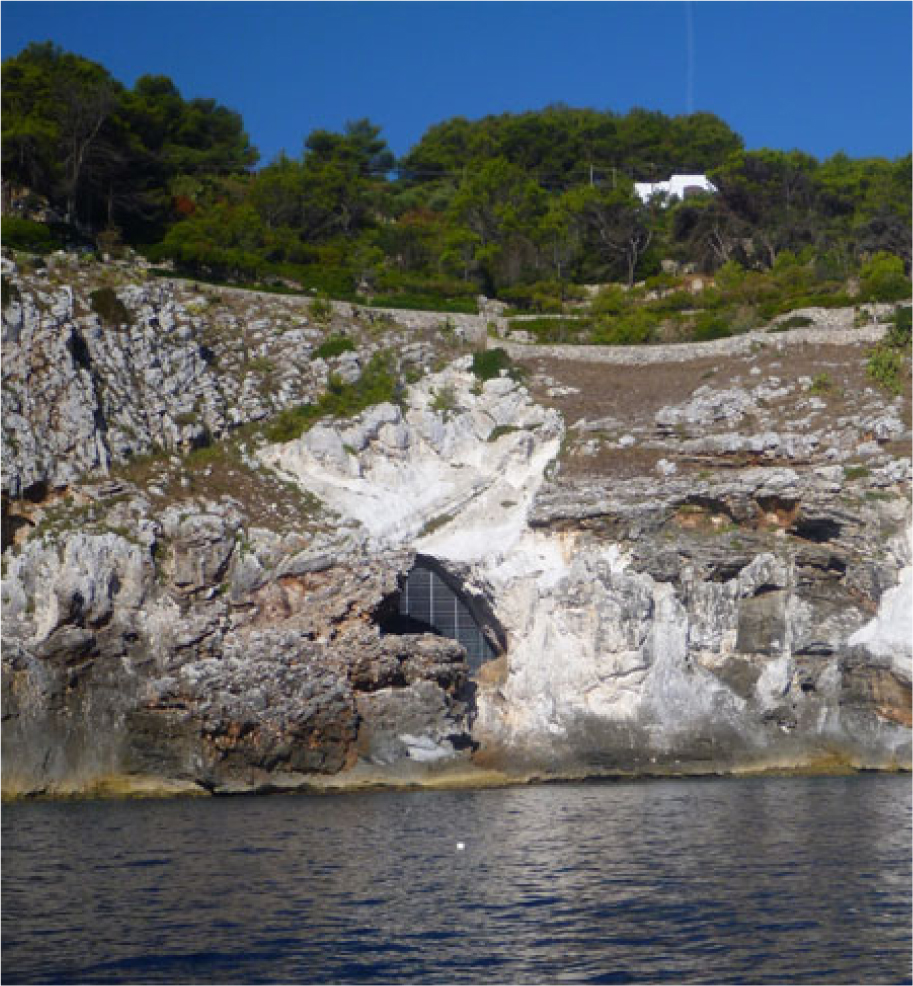
“Grotta Romanelli” (Figure 1) (40°00′58.30″N, 18°26′00.01″E) is a natural cave located along the Ionian coast of the Salento Peninsula in southeastern Italy in the territory of Castro (Lecce, Apulia). The cave, regarded as the first Upper Paleolithic deposit in Italy, represents a key site for understanding of the Mediterranean Middle Pleistocene–Holocene regional context and establishing the framework of human presence in the Mediterranean region. The deposit was discovered in 1871, but it was only thanks to the systematic and pioneering excavations carried out at the beginning of 1900 that its great archaeological importance was assessed and the presence of fossil vertebrate assemblages recognized (Stasi and Regalia Reference Stasi and Regalia1904; Blanc Reference Blanc1920, Reference Blanc1928; Spinapolice Reference Spinapolice, Borgia and Cristiani2018).
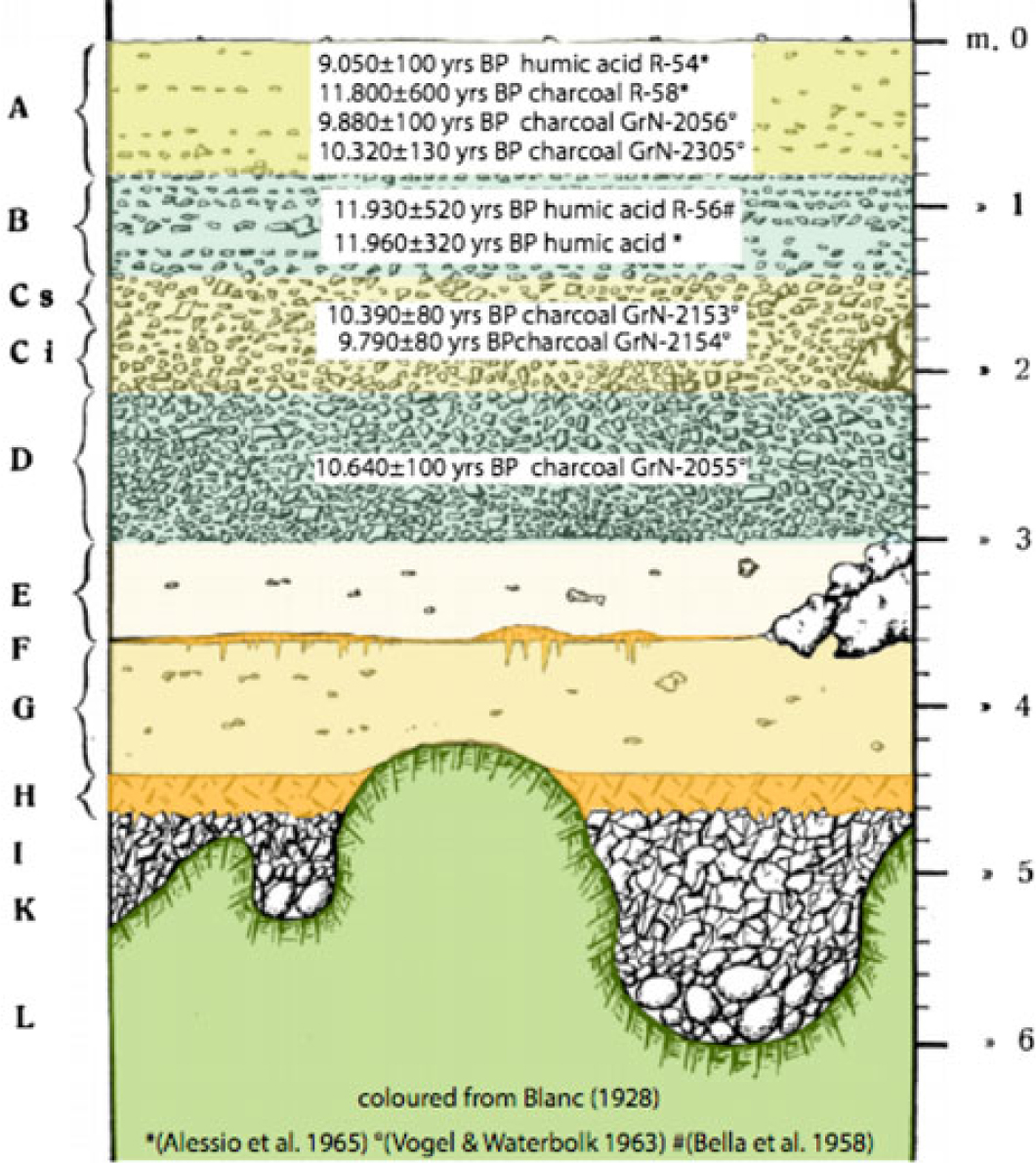
Grotta Romanelli opens into Cretaceous limestone (layer L in Figure 2) along the Adriatic coast of the Salento peninsula in southern Italy.

The stratigraphy of the cave subdivided in two main complexes, as proposed by Blanc (Reference Blanc1928; Figure 2), is regarded as a reference for the definition of the Late Pleistocene and Palaeolithic chronology in Italy. The infilling deposit is bounded by Cretaceous limestone (level L), at 7.4 m asl, that Blanc considered shaped during MIS5, constraining the age of the deposits to the Late Pleistocene. The lower complex includes the beach deposit (K), the bone breccia (I), the stalagmitic layer (H) and the terre rosse (red soils—level G) with large mammals and limestone artifacts referring to the Middle Paleolithic. The two complexes are divided by the sub-horizontal stalagmitic layer (level F). The upper complex, known as terre brune (brown soils—levels E–A), is characterized by Upper Paleolithic artifacts and by a diversified fossil vertebrate assemblage including mammals and more than one hundred species of birds.
Schematic stratigraphy of the cave with the radiocarbon ages so far available for the different layers.

Blanc (Reference Blanc1920) referred the rich lithic material recovered from the terre brune to the end of the Late Pleistocene. Based on the typological analysis of the artifacts recovered from the upper part of the infilling succession, the so called Romanellian facies was identified (Taschini and Bietti Reference Taschini and Bietti1972; Mussi Reference Mussi2002; Bietti Reference Bietti, Fabbri, Ingravallo and Mangia2003; Palma di Cesnola Reference Palma di Cesnola, Fabbri, Ingravallo and Mangia2003; Martini et al. Reference Martini, Ronchitelli and Sarti2017). The peculiarity of the lithic complex and the chronology of the terre brune, corroborated by radiometric age (Bella et al. Reference Bella, Blanc, Blanc and Cortesi1958; Vogel and Waterbolk Reference Vogel and Waterbolk1963; Alessio et al. Reference Alessio, Bella and Cortesi1964, Reference Alessio, Bella, Bachecchi and Cortesi1965), set Grotta Romanelli as a key site for understanding the framework of human evolution in the Mediterranean area during the end of the Late Pleistocene–Early Holocene (Mussi Reference Mussi2002; Bietti Reference Bietti, Fabbri, Ingravallo and Mangia2003).
Albeit the scholars have long considered the site of international significance, many issues need to be investigated and clarified (see Sardella et al. Reference Sardella, Mazzini, Giustini, Mecozzi, Brilli, Iurino, Lembo, Muttilllo, Massussi, Sigari, Tucci and Voltaggio2018 for discussion).
A systematic excavation campaign started in 2015 under the scientific supervision of the University of Rome “La Sapienza” with several aims: (1) increase the resolution of the site stratigraphy; (2) revise and update the existing palaeontological and archaeological research; (3) develop conservation strategies of the infilling sequence (deeply excavated and eroded but still well preserved, at least in the lower part). The state of the art of the research about the cave, a brief report on the preservation conditions and first results obtained during the new excavation campaigns have been recently summarized (Sardella et al. Reference Sardella, Mazzini, Giustini, Mecozzi, Brilli, Iurino, Lembo, Muttilllo, Massussi, Sigari, Tucci and Voltaggio2018). New mineralogical and sedimentological analyses of the terre brune sequence confirmed the eolian origin of the sediments and allowed the reconstruction of environmental variations related to climate changes, between the end of the last glaciation and the Early Holocene (Giustini et al. Reference Giustini, Bona, Brilli, D’Agostino, Lembo, Mazzini, Mecozzi, Muttillo and Sardella2018).
Our research aims to define an absolute chronology of the different levels of the terre brune so far based on only nine 14C dates measurement, sometimes scarcely consistent and with large statistical uncertainties, performed on humic acid (sample R54 and R56), and charcoal samples from the uppermost layers in the 1960s (Figure 2).
MATERIALS AND METHODS
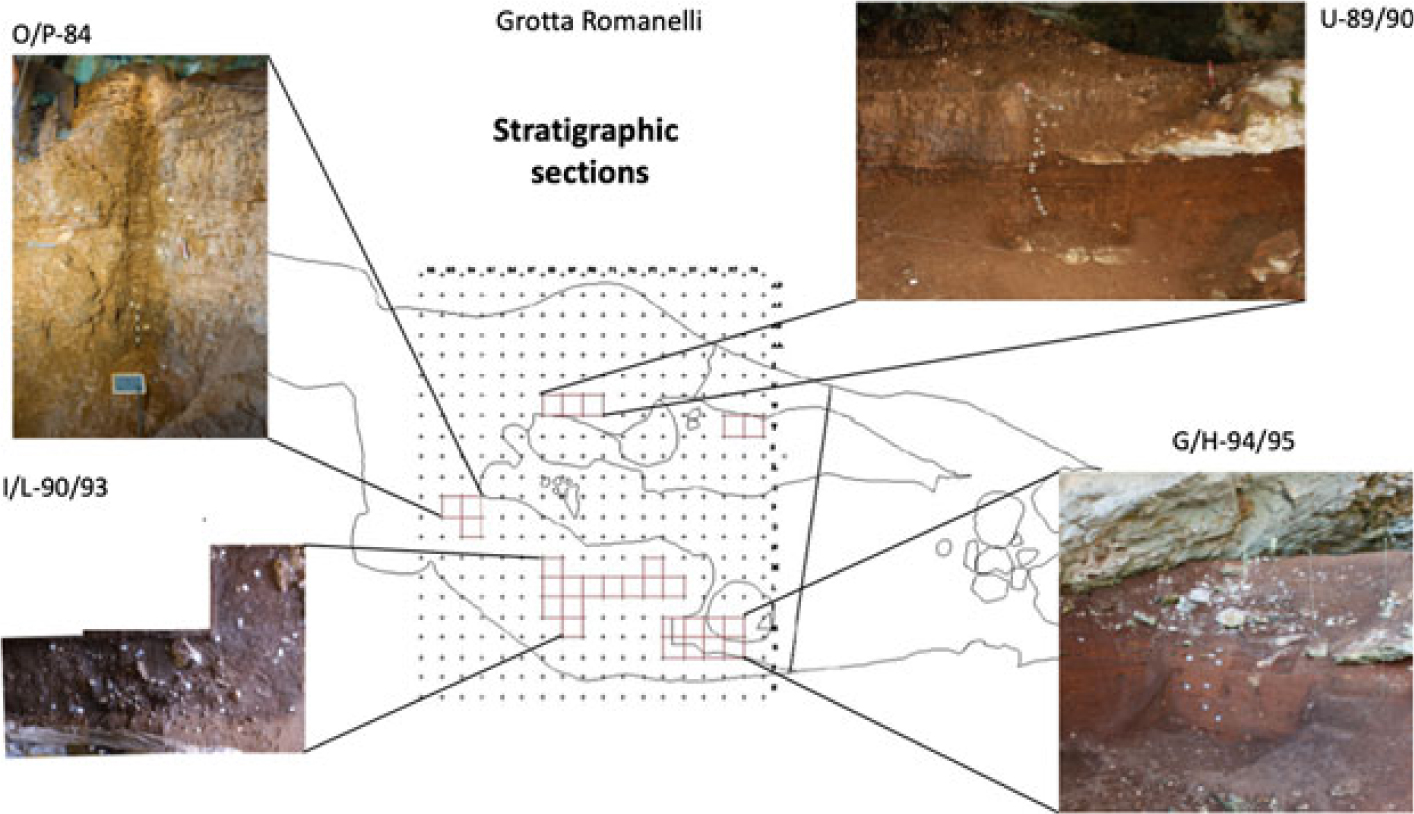
Fourteen animal bones (Table 1) were sampled during the 2015–2016 excavation campaigns from the different layers identified in the different stratigraphic sections opened in the cave (Figure 3).
Planimetry and stratigrafic sections of the Grotta Romanelli Cave (Castro-Italy).

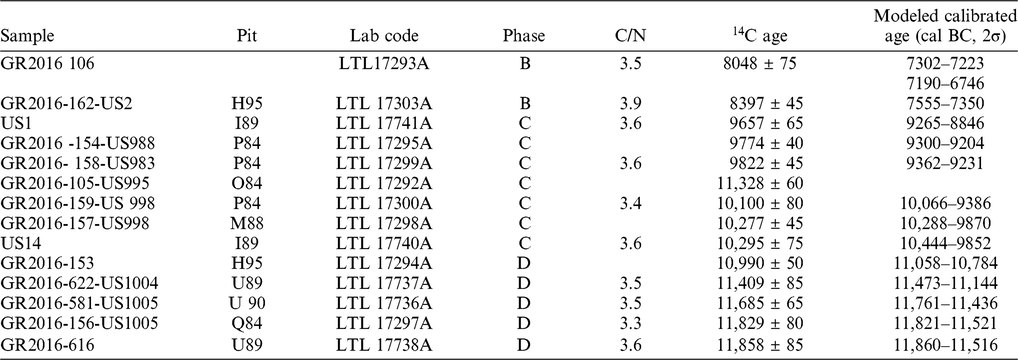
Analyzed samples, C/N ratios, and conventional 14C ages.

Collagen was extracted from the samples by using the Longin protocol (Longin Reference Longin1971) at the chemical laboratories of the Centre for Applied Physics, Dating and Diagnostics (CEDAD)-Department of Mathematics and Physics “Ennio de Giorgi”-University of Salento (D’Elia et al. Reference D’Elia, Calcagnile, Quarta, Rizzo, Sanapo, Laudisa, Toma and Rizzo2004). A fraction of the extracted collagen was separated from nine of the samples for the determination of the C:N ratio and for carbon and nitrogen stable isotope analyses which were performed by using an elemental analyzer (EA-Mod. Flash 2000 HT by Thermo) and an isotopic ratio mass spectrometry (IRMS) system (Delta V Plus by Thermo; Braione et al. Reference Braione, Maruccio, Quarta, D’Elia and Calcagnile2015; Maruccio et al. Reference Maruccio, Quarta, Braione and Calcagnile2017). The fraction selected for 14C analysis was combusted to CO2 in sealed quartz tubes with CuO and Silver wool and then reduced at 600°C to graphite with H2 on Fe powder used as catalyst. AMS 14C measurement were carried out with the 3 MV Tandetron at CEDAD-University of Salento (High Voltage Engineering Europa BV Mod. 4130HC; Calcagnile et al. Reference Calcagnile, Quarta, D’Elia, Rizzo, Gottdang, Klein and Mous2004, Reference Calcagnile, Quarta and D’Elia2005). The measured 14C/12C isotopic ratios were corrected for isotopic fractionation by using the δ13C term measured on line with the accelerator, and for machine and chemical processing background. The conventional 14C ages were then calculated according to Stuiver and Polach (Reference Stuiver and Polach1977) and calibrated by using the last internationally accepted IntCal13 calibration curve (Reimer et al. Reference Reimer, Bard, Bayliss, Beck, Blackwell, Bronk Ramsey, Buck, Cheng, Edwards, Friedrich, Grootes, Guilderson, Haflidason, Hajdas, Hatté, Heaton, Hoffmann, Hogg, Hughen, Kaiser, Kromer, Manning, Niu, Reimer, Richards, Scott, Southon, Staff, Turney and van der Plicht2013) and the OxCal ver. 4.3 software (Bronk Ramsey and Lee Reference Bronk Ramsey and Lee2013).
RESULTS AND DISCUSSION
The measured 14C ages are shown in Table 1 together with the determined C/N ratios. It can be noted that all the samples gave C/N ratios within the range considered indicative of a good preservation of collagen (2.9–3.6; van Klinken Reference van Klinken1999). Only sample LTL17303A gave a C/N ratio significantly outside the optimal range. Nevertheless, no other indication of poorly preserved collagen has been highlighted (C and N stable isotopic ratios and collagen yield) so this result was not excluded a priori from the following analysis.
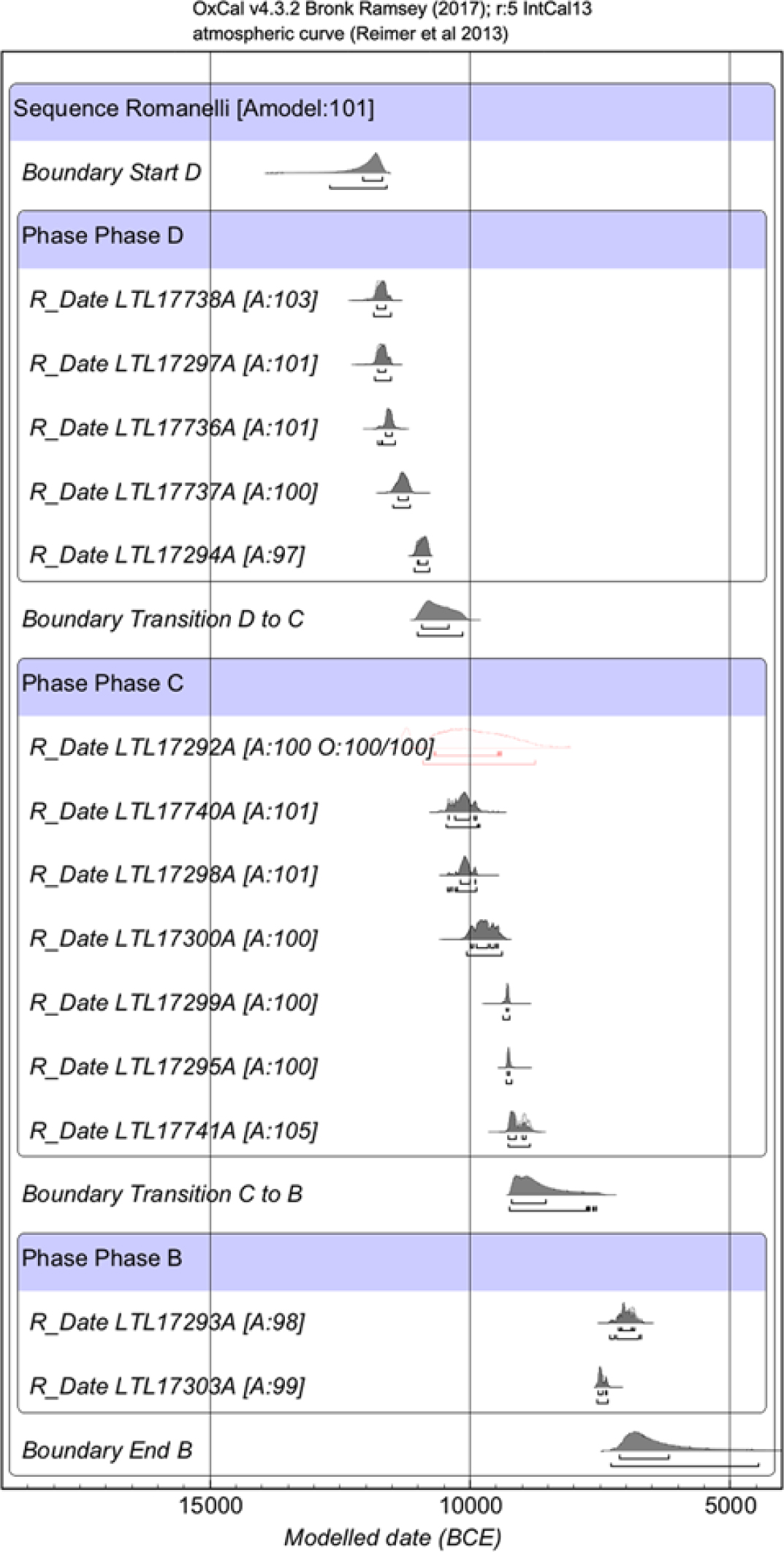
The analysis of the whole set of 14C ages was also performed by using the advanced Bayesian tools available in OxCal Ver. 4.3 (Bronk Ramsey Reference Bronk Ramsey2009a). A Model was then generated in which all the samples were grouped in different Phases divided by boundaries and forming a Sequence named Romanelli. The identification of possible outliers was carried out by using the dedicated routines available in OxCal and by following Bronk Ramsey (Reference Bronk Ramsey2009b).
Indeed, one of the samples (LTL17292A) can be considered an outlier and was then removed from the following analysis whose results are given in Figure 4 and Table 1.
It can be seen that all the obtained results are consistent with the stratigraphic position of the samples. In particular the phase D is dated between 12,000–11,000 cal BC, the phase C between 11,000–9,000 cal BC and phase B to 8th–7th millennium BCE.
Calibrated 14C ages and Bayesian OxCal model.

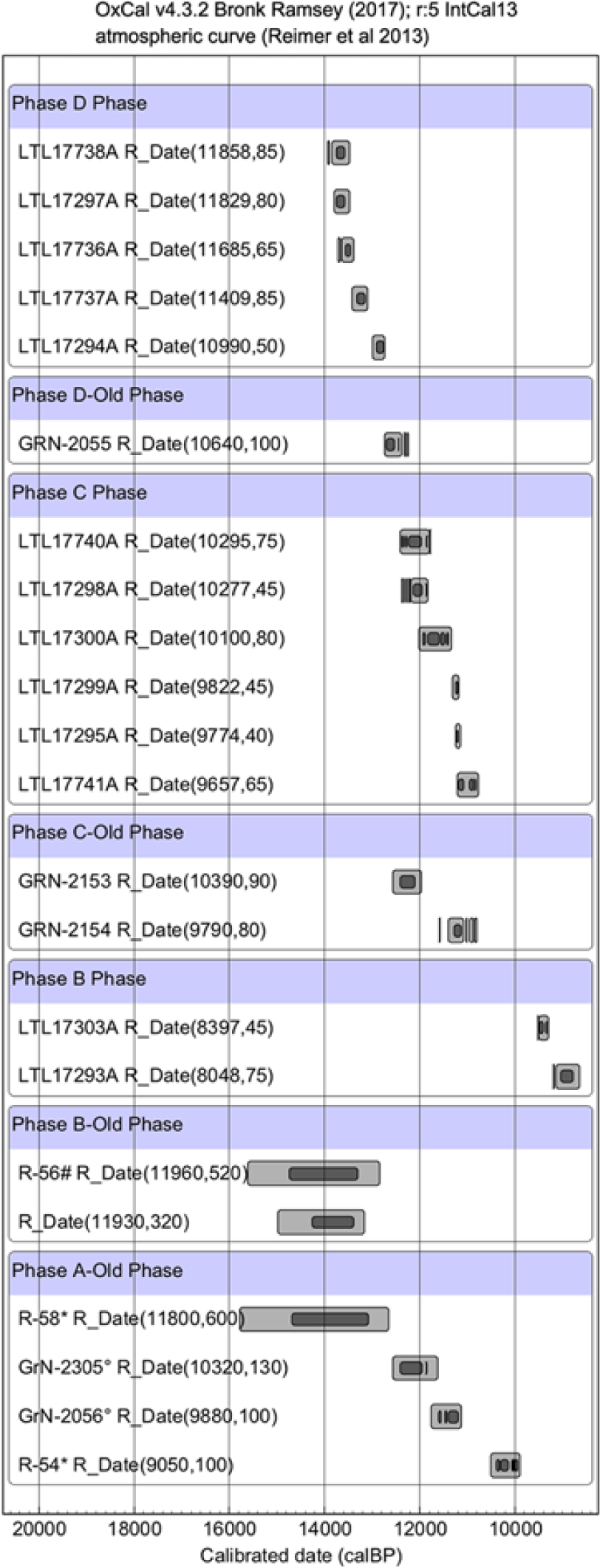
The comparison with the previously available data is given in Figure 5 where the current 14C ages are shown together previous ones (indicated as “old” in the figure). It can be immediately recognized that the current study allowed to significantly constraint the previous results which were highly scattered and only partially consistent with the stratigraphic provenance of the samples. In particular, phase D is significantly older than what previously obtained on the basis of the 14C results on one single sample. The age obtained for the Phase C is essentially consistent with previous determinations. The results so far available for the Phase B were non-consistent with the stratigraphy of the cave and characterized by large uncertainties on the single measurements. These discrepancies are now solved by the results obtained on the samples LTL17293A and LTL17303A which gave a 14C age consistent with the cave stratigraphy and significantly younger than previous determinations.
Comparison of the results obtained in the present study and previous 14C data from the same stratigraphic units. Dark and light gray indicate one and two standard deviations confidence levels intervals, respectively.

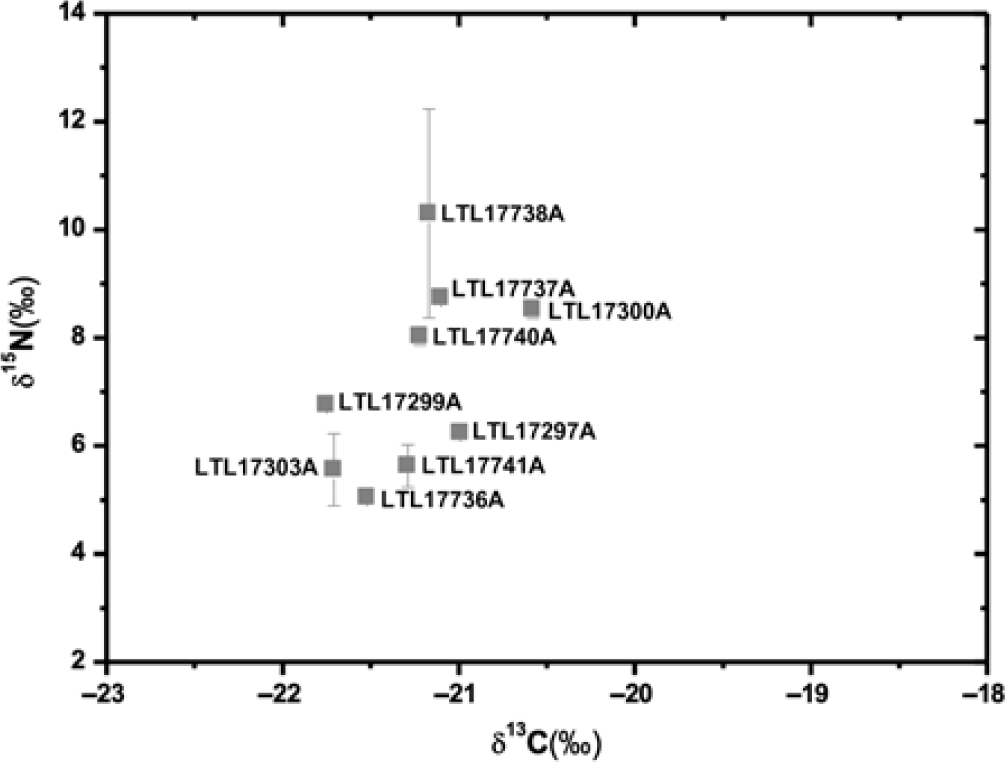
The results of IRMS measurement of stable carbon and nitrogen content are given in Figure 6. It can be seen that δ13C values range from −21.75 to −20.58‰ and are then typical of animals feeding of C3 plants. The δ15N values range from 5.05 to 10.30‰. Figure 6 shows that the data appear to fall into two groups, mainly because of the nitrogen isotope compositions; the first group is approximately centred around +6‰, whereas the second group around +8.5‰. The difference (about 2.5‰) supports the conclusion that the two groups are representative of two trophic levels, likely herbivores and carnivores (Post Reference Post2002). The identification of one sample (LTL17736A) as Cervidae could confirm the above distinction.
Carbon and nitrogen stable isotopic data obtained by IRMS on some of the analyzed samples. Error bars represent the scattering obtained on the replicate measurements performed on each sample, when no error bars are visible they are included in the size of the symbol. Data are expressed in the usual δ notation, nitrogen vs. AIR standard and carbon vs. V-PDB.

CONCLUSIONS
New systematic excavations carried out in 2015–2017 in Grotta Romanelli allowed us to assess the stratigraphic sequence identified at the beginning of 1900s. Animal bone samples were selected and AMS 14C dated. C/N ratio data indicate that the collagen is well preserved.
The results expand and refine the previous chronology. Phase D resulted much older, encompassing the Late Pleistocene-Holocene boundary. The new age of the uppermost part of the stratigraphy (level B) is quite different from the older data, extending the chronology to Mesolithic (Northgrippian, Middle Holocene). Considering the great importance of the site in the Late Paleolithic framework of the Mediterranean area, new typological analysis of the lithic complex recovered from the terre brune will be required.
Finally, further studies are already in progress for refining the chronology of the terre brune, with a particular focus on the level E (no 14C age available) and level A (if still present in the cave). New 14C dating enable to extending the data of the older stratigraphic units to provide a detailed chronology of human occupation in the cave.
ACKNOWLEDGMENTS
The undergoing excavation campaigns are being carried out with the permission of the “Soprintendenza archeologia, belle arti e paesaggio delle province di Brindisi, Lecce e Taranto” (former Soprintendenza archeologica) whose support is deeply acknowledged, and granted by Sapienza, Rome university (Progetto Grandi Scavi 2017, resp. Raffaele Sardella).