INTRODUCTION
Religion influences political activity in a variety of ways — from the impact of religious tradition on vote choice (Layman Reference Layman2001; Guth et al. Reference Guth, Kellstedt, Smidt and Green2006) to the correlation between church attendance and civic skills (Verba and Nie Reference Verba and Nie1972; Jones-Correa and Leal Reference Jones-Correa and Leal2001; Lasswell Reference Lasswell1936, Verba, Schlozman, and Brady Reference Verba, Schlozman and Brady1995). Additionally, recent scholarship demonstrates that individual's religious beliefs can influence their political behavior: from foreign policy attitudes (Djupe and Calfano Reference Djupe and Calfano2013; Glazier Reference Glazier2013) to charitable giving (Lunn, Klay, and Douglass Reference Lunn, Klay and Douglass2001) to opinions on the role of government (Baylor 2011).
Yet, scholars do not have a clear idea of the mechanisms by which religious belief influences political behavior. Understanding the link between the two is challenging for many reasons, but key among these is the difficulty of constructing and deploying useful survey measures. Most religious belief measures are either too complex or too specific to regularly include in surveys (e.g., Barker, Hurwitz, and Nelson Reference Barker, Hurwitz and Nelson2008; Driskell, Embry, and Lyon Reference Driskell, Embry and Lyon2008), or there is not a clear causal mechanism driving their inclusion (Wielhouwer Reference Wielhouwer, Smidt, Kellstedt and Guth2009), or both. As a result, we lack a solid understanding of the specific lines of influence that might lead religious beliefs to influence political behavior. This problem is a serious one, not only for political scientists interested in religion but, indeed, for political scientists who want to know more about the factors that drive political behavior more broadly.
Toward the aim of addressing this problem, I examine the path by which a specific type of religious beliefs — providentiality — shape political behavior. Providential believers are those who believe, first, that God has a plan and, second, that they can help to bring it about. Both components are essential to understanding how providential beliefs might matter for politics and are described in more detail below. Religious believers from many backgrounds and traditions are providential, but they may not always see their providential beliefs as relevant for politics. That is, individuals may believe that God has a plan that they can know and facilitate, but they may not see politics as part of that plan. A religiously-framed political cue can potentially change that — providing the link that can lead to a shift in political behavior. Here, I examine the providential religious beliefs and political activities of congregants in Little Rock, Arkansas during the 2012 presidential election campaign. I hypothesize that the effect of providential religious beliefs on political activity will be felt most strongly when clergy cues establish a bridge to connect religion and politics.
RELIGION AND POLITICAL ACTIVITY
The research on political activity is guided by the seminal work of Verba, Schlozman, and Brady (Reference Verba, Schlozman and Brady1995), who emphasize resources, recruitment, and motivation as key contributors to political activity. They and others (e.g., Peterson Reference Peterson1992) argue that the primary impact of religion is indirect and felt through church attendance — church attenders learn civic skills by leading meetings, organizing events, recruiting volunteers, and so on (Verba and Nie Reference Verba and Nie1972; Jones-Correa and Leal Reference Jones-Correa and Leal2001) and those skills then “spill over” into politics (Peterson Reference Peterson1990).Footnote 1 Additionally, those who attend church regularly are more likely to be targets of mobilization efforts (Rosenstone and Hansen Reference Rosenstone and Hansen1993, 166-167; Guth et al. Reference Guth, Kellstedt, Green, Smidt, Cigler and Loomis2002) and are politically socialized at church (e.g., Wald, Owen, and Hill Reference Wald, Owen and Hill1988; Reference Wald, Owen and Hill1990; Huckfeldt, Plutzer, and Sprague Reference Huckfeldt, Plutzer and Sprague1993; Harris Reference Harris1994), providing opportunities for religion to contribute to recruitment and thereby boost political activity. Thus, it comes as no surprise that attending church is positively correlated with political activity; simply put, church life equips people for political engagement (Smidt Reference Smidt1999; Reference Smidt2003b; Lasswell Reference Lasswell1936).
Although there is a strong research tradition in this field, the story of religion's influence on political activity remains incomplete. For instance, Djupe and Grant (Reference Djupe and Grant2001) find that, although church attenders do develop civic skills, there is no natural spill over to political activity; instead, “some cognitive or social process must occur before members apply church-gained skills to political endeavors” (Djupe and Gilbert Reference Djupe and Gilbert2009, 179). Similarly, Schwadel (Reference Schwadel2005) find that simply attending church “does not seem to supply the knowledge or skills that translate into secular organizational activity” (Schwadel, Reference Schwadel2005, 167). The gap in the story of religion's influence on political activity can potentially be filled by an improved understanding of the role of religious beliefs.
Religion matters for politics in part because it provides believers with a worldview, which in turn helps them make sense of political events, messages, and actions (Wielhouwer Reference Wielhouwer, Smidt, Kellstedt and Guth2009, 402). Thus, religion can mobilize — or demobilize — believers for political activity. For instance, Quinley (Reference Quinley1974) finds that religious believers with an “otherworldly” orientation — meaning they are more concerned with spiritual salvation than temporal matters — are less likely to be politically active. The “liberation theology” more common in Black churches (Lincoln and Mamiya Reference Lincoln and Mamiya1990; Sernett Reference Sernett, Dayton and Johnston1991), on the other hand, may affect the political activity of congregations in both amount and kind (Harris Reference Harris1994; McDaniel Reference McDaniel and Smidt2004), including increasing political efficacy (Calhoun-Brown Reference Calhoun-Brown1996). Other research on religious belief (e.g., Schwadel Reference Schwadel2005; Djupe and Neiheisel Reference Djupe and Neiheisel2012) has focused on the relatively narrow issue of Biblical literalism, which is negatively associated with political activity.
Recent research by Driskell and colleagues draws on data from the Baylor Religion Study to further demonstrate the importance of religious beliefs when it comes to understanding political activity (Driskell, Embry, and Lyon Reference Driskell, Embry and Lyon2008; Driskell and Lyon Reference Driskell and Lyon2011; Driskell, Lyon, and Embry Reference Driskell, Lyon and Embry2008). Operationalizing religious beliefs in part by asking respondents about prayer topics, Driskell and colleagues find that beliefs have a greater impact on political activity than church attendance (Driskell, Lyon, and Embry Reference Driskell, Lyon and Embry2008), that people who pray about general world concerns are more likely to be politically active, and that people who believe that “God is directly involved in world affairs” are less likely to be politically active (Driskell, Embry, and Lyon Reference Driskell, Embry and Lyon2008).
In a subfield that has plenty of data but fewer causal explanations, beliefs form a critical link between the religious realm and the political, with effects that are more direct and immediate (Wald and Smidt Reference Wald, Smidt, Leege and Kellstedt1993, 32) compared to other religious measures (Page and Bouton Reference Page and Bouton2006). Better understanding the relationship between religious beliefs and political activity is thus an essential next step for the literature. I propose that examining providential religious beliefs is one way to move this research agenda forward.
Providential Religious Beliefs
Providential believers share two key characteristics: they believe God has a plan and they believe they can contribute to bringing that plan about. Both components are necessary for understanding the beliefs measured here. People who believe that God has a plan, but that the plan is unknowable, or people who believe that God has a plan and carries it out without cognizant human help, would not be considered providential believers. The belief in a divinely-authored plan is politically important because it means there is some future end state that is — to the believer — inevitable. Thus, research on the political implications of relative socio-tropic time horizons, foremost the nearness of Biblically-foretold “end times,” indicates that those who hold such beliefs behave differently than those who don't (Barker and Bearce Reference Barker and Bearce2013). But, importantly, the belief that God has a plan by itself is not sufficient to generate political activity. Believing God has a plan without believing people can contribute to bringing it about may lead, as in Barker and Bearce's (Reference Barker and Bearce2013) research, to believers' not prioritizing carbon emission reduction or environmental protection — that is, to believers not engaging in politics to further God's plan. Instead, God's plan will come about whether or not they engage.
Thus, the belief that one can contribute to carrying out God's plan is important because it indicates a potential willingness to engage in political activity. Theoretically speaking, providential believers may be more likely than non-providential believers or non-believers generally to see a divine purpose in voting for a particular candidate, participating in a political action, or pursuing a specific policy (e.g., fighting terrorism, preserving the lives of unborn children, or promoting democracy). Both components — belief in God's plan and belief that people can help bring it about — are included in the concept of providential beliefs discussed here.
Providentiality is thus measured here and elsewhere (Glazier Reference Glazier2013; Reference Glazier2014) through two survey questions: a five-point Likert agreement scale in response to the statement “God has a plan and I have a part to play in it,” and the question “Would you say your religion provides some guidance in your day-to-day life, quite a bit of guidance, or a great deal of guidance in your day-to-day life” (“religion really isn't important to me” is also available as a response option).Footnote 2 In the data presented below, the Cronbach's alpha of these two questions is 0.83. The two questions get at the two elements of providentiality that work together: the notion that there is a divine plan in place and turning to religion for guidance regarding what to do to facilitate that plan. Other surveys that have utilized these questions show similar alpha scores, ranging from 0.73 in a national survey conducted in 2012 to 0.81 in a national survey conducted in 2008 (Glazier Reference Glazier2013).Footnote 3 Using the “God's plan” and “religious guidance” questions together to measure providential beliefs is both theoretically and statistically justified and is the approach taken here.
This two-question battery is useful because it taps into a common religious belief — providentiality — that is broadly relevant and fairly simple to measure. Although the reviewed literature has found that religious belief measures have great explanatory power (e.g., Guth Reference Guth, Smidt, Kellstedt and Guth2009; Guth et al. Reference Guth, Kellstedt, Smidt and Green2006; Bader and Froese Reference Bader and Froese2005; Finke and Adamczyk Reference Finke and Adamczyk2008; Jelen Reference Jelen1994), most religious belief batteries are either too narrowly focused on denomination to make them broadly applicable and/or too lengthy for regular inclusion in surveys. For instance, the Baylor data utilized by Driskell and colleagues (Driskell, Embry, and Lyon Reference Driskell, Embry and Lyon2008; Driskell, Lyon, and Embry Reference Driskell, Lyon and Embry2008; Driskell and Lyon Reference Driskell and Lyon2011) provides an incredible depth of survey research on religion from a representative national sample. However, the number and detail of the questions the survey asks about religion in general and religious belief in particular are rarely available to most survey researchers.
Although, theoretically, providential believers might be more likely to participate in politics, this is not necessarily the case in practice. In fact, Driskell, Embry, and Lyon (Reference Driskell, Embry and Lyon2008) find that agreement with a statement about God's active role in world affairs is negatively associated with political participation. Just as national surveys demonstrate that many Americans claim religion is very important to them but that they don't see the relevance of religion for politics (Ben-Nun Bloom and Arikan Reference Ben-Nun Bloom and Arikan2013), in a similar way, providential believers don't inherently link politics to their religious beliefs.
Building Bridges between Religion and Politics
In order for providential believers to see politics in a religious light, a bridge between the two must be built. We can think of this process in the classic political communication terms of “who says what to whom” (Lasswell Reference Lasswell1936; Iyengar and Valentino Reference Iyengar, Valentino, Lupia, McCubbins and Popkin2000; Hovland, Janis, and Kelley Reference Hovland, Janis and Kelley1953). A message (the “what”) is delivered to bridge religion and politics, but whether that bridge leads to real change depends on the credibility of the source (the “who”) and the characteristics of the receiver (the “whom”). Because religious teachings are internalized and interpreted differently by different congregants, even within the same congregation (Broughton Reference Broughton1978) the nature of the receiver's beliefs matters. Theoretically, if a providential and a non-providential believer receive the same bridging message from the same credible source, the providential believer will be more likely to act. Although, this bridging process is not a given. For instance, Ellis and Stimson (Reference Ellis and Stimson2012) find that a substantial minority of people are religiously and socially conservative, but do not connect those personal choices to their political choices and “end up taking moderate or left-of-center positions on a wide range of issues” (Ellis and Stimson Reference Ellis and Stimson2012, 133).
A bridge between religion and politics can thus potentially impact political attitudes and behaviors, but who can construct such a bridge? Bridge-builders can range from oneself to the divine, but congregation leaders are uniquely equipped to build bridges. Clergy members tend to have more coherent worldviews (Crawford and Olson Reference Crawford and Olson2001; Guth et al. Reference Guth, Green, Smidt and Kellstedt1997; Beatty and Walter Reference Beatty and Walter1989), making them “particularly effective opinion leaders…[who can] frame grievances in a way that makes them politically relevant to parishioners” (Wald and Calhoun-Brown Reference Wald and Calhoun-Brown2010, 115). For instance, when a congregation leader talks about a traditionally political topic during a Sunday sermon, he or she provides congregants with a religious lens through which to see the issue (Smidt Reference Smidt2003a; Reference Smidt2004; Schwadel Reference Schwadel2005; Djupe and Gilbert Reference Djupe and Gilbert2003). Similarly, when a political leader uses religious language — particularly “coded” language targeted to a specific religious audience (Calfano and Djupe Reference Calfano and Djupe2009; Albertson Reference Albertson2014) the political is linked to the religious. Credibility matters (Lupia and McCubbins Reference Lupia and McCubbins1998) and, generally speaking, clergy have less credibility when they communicate political rather than religious messages (Djupe and Calfano Reference Djupe and Calfano2009; Kohut et al. Reference Kohut, Green, Keeter and Toth2000), but, as “professional arbiters of values and absolute truths” (Olson Reference Olson, Smidt, Kellstedt and Guth2009, 375), clergy pronouncements do carry a lot of weight, particularly among the faithful, for whom God — speaking through religious leaders — has the ultimate source credibility (Druckman Reference Druckman2001; Iyengar and Valentino Reference Iyengar, Valentino, Lupia, McCubbins and Popkin2000; Jelen Reference Jelen1994).
However, the influence of clergy messaging is limited by a number of factors based in receiver characteristics (Leege Reference Leege1985; Huckfeldt and Sprague Reference Huckfeldt and Sprague1995; Djupe and Gilbert Reference Djupe and Gilbert2009), including members projecting their own views on to clergy (Krosnick Reference Krosnick1989; Krosnick et al. Reference Krosnick, Boninger, Chuang, Berent and Carnot1993), defensive motivations in information processing (Chaiken, Giner-Sorolla, and Chen Reference Chaiken, Giner-Sorolla, Chen, Gollwitzer and Bargh1996), and confirmation bias (e.g., Munro et al. Reference Munro, Ditto, Lockhart, Fagerlin, Gready and Peterson2002). That being said, the research here is primarily concerned with the conditions under which providential believers engage in political activity, not the conditions under which clergy messages motivate political activity. Religious experience is often deeply personal (e.g., James Reference James1985). Thus, what matters is not so much the objective content delivered by the congregation leader, but the subjective content received by the congregant. As Djupe and Gilbert (Reference Djupe and Gilbert2009) argue, “People attending church bring with them their own predispositions and external life experiences, which can expand or attenuate the church's ability to influence their opinions and behaviors” (Djupe and Gilbert Reference Djupe and Gilbert2009, 9). Holding providential beliefs changes the characteristics of the receiver — potentially making her more likely to hear and respond to a call to political action framed in terms of God's will and delivered by someone she views as God's servant.
Thus, the message that bridges providential religious beliefs and politics forms the critical causal link that leads the receiver to take providential considerations into account when making decisions in the political realm.Footnote 4 In the research here, an individual providential believer's perception of a political cue from a congregation leader provides the link. Without this link, believers don't know what God's will is on a particular political issue or whether it is even an issue of religious relevance. But once the connection is made, the political contributions of providential believers have the potential to be significant. Research indicates that tight-knit religious communities with strong commitments to their faith represent networks that can facilitate rapid, episodic mobilization, even if political activity among the membership is rare (Campbell Reference Campbell2004). One way to think of these believers is as “dry kindling” waiting to be mobilized (Campbell and Monson Reference Campbell, Monson and Wilson2007). It is the bridge between religion and politics that makes such mobilization possible.
When it comes to the potential influence of religion on political activity, we know that attending church provides the civic skills, socialization, and recruitment opportunities that can boost political activity. However, it is likely that only a portion of the story of religion's influence on political activity is told in the chapter on attendance. Research on religious beliefs has a lot of potential, but we don't yet know how religious beliefs lead to political activity. Some mechanisms are being explored through experimental research (e.g., Djupe and Calfano Reference Djupe and Calfano2009; Djupe and Gwiasda Reference Djupe and Gwiasda2010), but to fully answer the question, we need to know more about what the relationships between religious beliefs and political activity look like in practice and in context. It is possible that congregation leaders can play a role in the process of connecting powerful religious beliefs — here, specifically, providential religious beliefs — to politics. Sunday sermons are one opportunity for bridge construction. When these sermons encourage political involvement, providential believers who hear and remember them will respond with greater political activity. Thus, I hypothesize that the effect of providentiality on political activity will be greater in the presence of a perceived political cue from a congregation leader.
DATA AND METHODS
The Little Rock Congregation Study was conducted from May 1 through November 11, 2012, with the aim of collecting data from both congregation leaders and congregants. The study proceeded in three stages. First, a survey of congregation leaders was distributed via mail to a total viable sample of 409 churches within the city limits of Little Rock. A total of 66 surveys were returned completed, for a return rate of 16.14%. Second, from these 66, a representative sample of 15 religious organizations was selected for congregation leader interviews. A major goal of these interviews was to establish relationships with the congregation leaders that would facilitate data collection from congregants in the third stage, where five congregations were selected for participation in the congregation portion of the study. The five congregations selected included one from each of the following religious bodies: Mainline Protestant, Evangelical Protestant, Catholic, Black Protestant, and the Church of Jesus Christ of Latter-day Saints. The first four religious bodies were chosen as they are the largest in Little Rock and the fifth was chosen due to the prominence of candidate Mitt Romney's Mormon faith in the 2012 campaign.
Although these congregations represent the major religious traditions in Little Rock, they are by no means representative. Among other data limitations, the Black Protestant and Evangelical congregations surveyed were smaller than the Mainline Protestant, Catholic, and Mormon congregations,Footnote 5 possibly obscuring religious tradition-specific relationships that may have been apparent in a larger sample. In addition to these five religious organizations, surveys were also distributed to a group of agonistics and atheists who meet each Sunday at the local library in Little Rock. Members of this congregation of sorts emphasize reason over faith and are unlikely to hold providential religious beliefs. This organization was chosen as an actively non-religious comparison group that retains some of the social and potentially political benefits common to congregations. For congruence, this organization is referred to as a congregation and designated as Atheists.
Surveys were distributed by hand in each congregation on the Sunday before the 2012 Presidential Election. The return envelopes for the surveys were prepaid with postage back to the PI's university address and respondents had the choice to mail them back or drop them in secure boxes on the way out of their church. There were a total of 968 surveys distributed and 374 returned, for a response rate of 38.63%.Footnote 6 As a sample of convenience, data were only collected from those who attended church the Sunday the surveys were distributed.
Variables
Summaries and descriptions of the dependent and independent variables used in the analysis are presented in Table 1 and the full question wording is provided in the Appendix.
Variable names, question wording, and descriptive statistics

The dependent variable in the models that follow is Political Activity, as measured by the sum of the same six political items used in the American National Election Study: donating to a political campaign, volunteering for a political campaign, displaying a campaign bumper sticker, persuading someone to vote, attending a political rally, and signing a petition, undertaken in the previous 12 months. I hypothesize that the effect of providentiality on Political Activity will increase when the respondent reports receiving a strong political activity cue.
Identifying or creating a cue (for instance, through an experimental treatment) that will resonate across religious traditions is a challenging proposition. Religion is personal; individual interpretations can vary greatly. Because so much depends on receiver characteristics, one solution is to let respondents determine if they have received a cue (Welch et al. Reference Welch, Leege, Wald, Kellstedt, Leege and Kellstedt1993). The potential impact of providential beliefs can vary across individuals, making a measure of perceived political cues received by congregants — as opposed to a measure of object political cues delivered by congregation leaders — most appropriate. Respondents were asked how often they heard sermons in the past year on: getting involved in a local issue, getting involved in a national issue, volunteering in the community, and registering to vote (Burwell et al. Reference Burwell, Hernandez, Pena, Smith and Sikkink2010), all questions were measured on a four-point scale from 0 to 3.Footnote 7 A binary High Activity Cue variable was then created by separating out those respondents who scored in the top 35% (9 or higher on a 0 to 12 point scale) on this summary measure.
Both within and across congregations, congregants reported receiving significantly different levels of cues via sermons — ranging from a low of 6.2 in the Mainline Protestant congregation to a high of 10.2 in the Black Protestant congregation. In each congregation, individuals reported activity cues of 10 or higher. In fact, every congregation but the Mainline Protestant one had respondents reporting the highest score of 12. The standard deviation was highest in the Mormon congregation (1.88) and lowest in the Mainline Protestant congregation (1.34).Footnote 8 Additionally, there is no reason to suspect that the measure of perceived political cues varies by providential belief. The two measures, Providential and High Activity Cue, are correlated at 0.001.Footnote 9 Those who hold providential beliefs are not any more likely than non-providential believers to report receiving a high activity cue. While Djupe and Gilbert (Reference Djupe and Gilbert2009) find that higher rates of misperception are driven by disagreement or disengagement, that pattern is not a concern for the providential measure. Whatever misperception there may be, it is not driven by providential belief.Footnote 10
Interestingly enough, the survey of congregation leaders indicates that neither the Mormon congregation leader nor the Mainline Protestant congregation leader reported giving a sermon on a political topic during the time period in question, indicating that, in addition to the many barriers that prevent clergy political messages from reaching congregants (Djupe and Gilbert Reference Djupe and Gilbert2003), it may also be the case that congregants hear political messages even when clergy don't intend to deliver them. The perceptual measure of clergy political cues utilized here is the best one, given the nature of the data. The impact of providential beliefs on political activity is hypothesized to be greater when a clergy-built bridge (perhaps a congregant-imagined clergy-built bridge) between religion and politics is in place. Thus, the High Activity Cue measure is interacted with the Providential battery described above to create the interaction term Providential × High Activity Cue.
The models also contain a measure of how much the respondent cares about the outcome of the 2012 election: Election Interest. Because “members tend to receive inspiration, and sometimes perceive inspiration, on issues about which they are motivated to care” (Djupe and Gilbert Reference Djupe and Gilbert2009, 72) the model also includes an interaction term to measure the combined impact of Election Interest interacted with Providential. As the data do not contain a measure of civic skills, Election Interest is the best available proxy for political interest and engagement. Although we might expect Election Interest to be highly correlated with high activity cue perception, the correlation is only 0.15.
Given what the literature has shown about the importance of congregational context (Djupe and Gilbert Reference Djupe and Gilbert2009; Reference Djupe and Gilbert2003), appropriate congregation dummy variables were created. Because the Mainline Protestants and Black Protestants in the sample are significantly more politically active than the Mormons, Catholics, and Evangelicals, both a Mainline Protestant and a Black Protestant religious tradition dummy variable are included in the models.Footnote 11 A dummy variable for the Atheist group is also included. Additionally, the models include a measure of Homogeneity, based on the respondent's answer to the question “How would you compare your views with other congregation members' on political issues?” with higher values indicating more homogeneity, that is, the response “about the same,” as opposed to “mine more liberal” or “mine more conservative.” Because political environments are different — and political messages may be received differently — in politically homogeneous congregation environments (Schwadel Reference Schwadel2005; Djupe and Gilbert Reference Djupe and Gilbert2006; Putnam and Campbell Reference Putnam and Campbell2012), the interaction term measuring the combined effect of Homogeneity and High Activity Cue is also included in the models.
Other variables in the models include a measure of church Attendance, and a Religiosity measure that combines frequency of prayer and frequency of scripture reading. An interaction term that combines Religiosity and the High Activity Cue measure is also included. An Ideology measure is included, with higher scores associated with more conservative ideology. Standard demographic variables, which the literature has shown often influence political activity, are also included: the dummy variable Male (Schlozman, Burns, and Verba Reference Schlozman, Burns and Verba1999; Verba, Burns, and Schlozman Reference Verba, Burns and Schlozman1997), Income (Brady, Verba, and Schlozman Reference Brady, Verba and Schlozman1995), Education (Nagel Reference Nagel1987), Non-white (Stokes Reference Stokes2003; Wielhouwer Reference Wielhouwer2000) and Age (Campbell Reference Campbell2002).
RESULTS
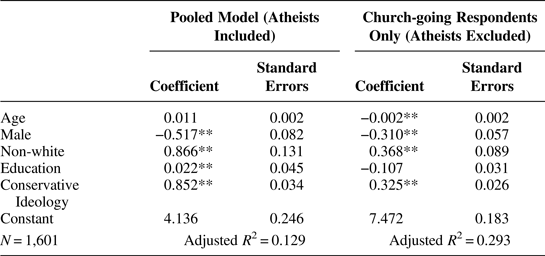
Across the population sampled, the mean providential score was 7.69 with a standard deviation of 1.99, ranging from a low mean of 2.22 for the Atheists (the lowest mean score among religious congregations was 7.56 for the Mainline Protestant congregation) to a high mean of 8.63 for the Black Protestant congregation. Although the standard deviation is narrower when we consider just the religious congregations (1.18), every congregation but the Atheists contain at least one very providential believer (someone who scores 9 out of 9 on the two-question providential battery). The Mainline Protestant and Catholic congregations cover nearly the entire range — from 3 to 9 — the Evangelical and Mormon congregations range from 5 to 9, and the Black Protestant congregation has a much narrower range from 7 to 9. The Atheists range from 2 to 5.Footnote 12 Theoretically, providentiality is orthogonal to religious affiliation; Catholic, Protestant, Jewish, Muslim, and spiritual non-church-going populations can contain providential and non-providential believers (Glazier Reference Glazier2014). Here, we see providential believers distributed across the spectrum of religious traditions measured — and we see them noticeably absent from the Atheist group. Although there are some differences in the demographic profiles of providential believers across congregations,Footnote 13 no single religious tradition or congregation has a monopoly on providentiality. A regression model of providential beliefs across all congregations (including Atheists) indicates that older, non-white, female congregants who hold a conservative ideology are more likely to be providential. Looking at just the church-going population (excluding Atheists) conservative, more educated, non-white women are more likely to be providential. The full results of both models are included in the Appendix.
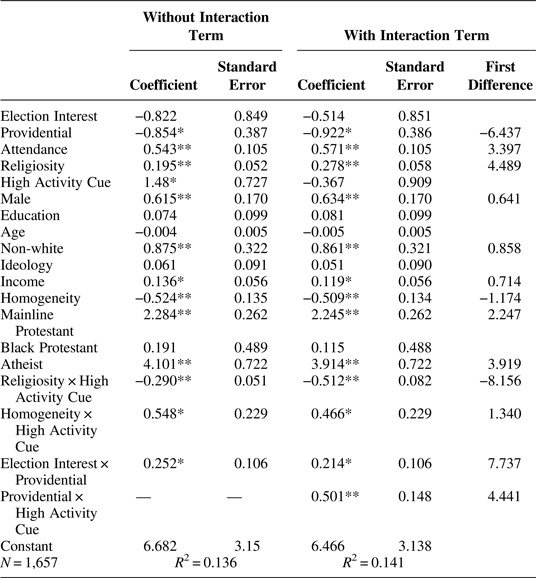
With a better sense of the distribution and characteristics of providential believers, we can examine the potential political effects their beliefs might have. Providential religious beliefs can be powerful political motivators — when they are connected to politics. Without an explicit bridge linking politics to God's will, providential believers may actually be less likely to get involved in politics, deciding instead to leave it in God's hands. The first model of Political Activity presented in Table 2 includes the independent variables High Activity Cue and Providential to demonstrate the effects of both without their interaction. The second model in Table 2 adds in the Providential × High Activity Cue interaction term to demonstrate the effect of providential religious beliefs when there is a bridge to link those beliefs to political activity.Footnote 14
OLS regression models of congregation member political activities, calculated from imputed datasets (m = 5)

* p < 0.05, **p < 0.01.
Note: First differences were calculated using Clarify. The hypothetical individual is a 53 year-old white female, holding the modal scores for ideology, election interest, providential beliefs, church attendance, education, income, homogeneity, and religiosity. She is not a Black Protestant, an Atheist, or a Mainline Protestant and did not report receiving the high activity cue.
The results in the first half of Table 2 show a number of significant variables. Consistent with prior literature, those who attend church more frequently are more likely to be politically active, as are the more religious, men, and those with higher incomes. Minorities are also more likely to be politically active in this model. The High Activity Cue variable is significant in this model — those who report hearing a strong political message from their congregation leader are more likely to be politically active. But when religiosity is interacted with the high activity cue, respondents are less likely to be politically active. This may be a case of congregation leaders preaching to those who need to hear the message the most (Djupe and Gilbert Reference Djupe and Gilbert2003) — those who are religious, and likely regular church-goers, but are not actively participating in politics. We also know that higher religious commitment may inhibit congregants from receiving clergy cues accurately (Djupe and Gilbert Reference Djupe and Gilbert2009); it may be that the more religious respondents in this sample of church-attenders are more likely to discount or even resent clergy political cues and instead focus on religious priorities.
Additionally, being a member of the Mainline Protestant congregation or the Atheist group also makes one more likely to participate in politics. Attending what one personally perceives to be a politically homogeneous congregation is a negative predictor of political activity, but when Homogeneity is interacted with reporting a high activity cue, respondents are more likely to participate politically. We know that homogeneous congregations tend to look inwards, “sorting” to become more homogeneous over time, and therefore less likely to engage in politics (Djupe and Gilbert Reference Djupe and Gilbert2009; Putnam and Campbell Reference Putnam and Campbell2012). It is interesting that this can be reversed with a perceived political message from a congregation leader — under those circumstances, homogeneity may be a benefit for civic engagement (Djupe and Gilbert Reference Djupe and Gilbert2006).
Providential is a significant and negative independent variable in this model. In the absence of a bridge to link their beliefs to politics, providential believers appear to default to a position of leaving God in control and are actually less likely to be politically active than non-providential believers. The nature of the interaction between Providential and Election Interest reinforces this idea. Strong providential believers have a fairly low level of political activity, no matter their interest in the election, while those who hold lower levels of providential beliefs exhibit higher levels of political activity, even when interest is low.
What is the effect when a providential believer reports hearing political messages from his or her congregation leader? We know that providential beliefs are not inherently political, but a political cue from a congregation leader might motivate political activity. The second column of Table 2 displays the results of the model that includes the interaction term Providential × High Activity Cue to directly test this hypothesis. Many of the same variables are significant in this model, including church Attendance, Religiosity, and both the Mainline Protestant and Atheist dummy variables. Once again, men, those with higher incomes, and minorities are more likely to be politically active; those who report political homogeneity in their congregations and the religious who receive a high activity cue are less likely to be politically active. Once again, the interactions between Providential and Election Interest, as well as between Homogeneity and the High Activity Cue, are significant and positive. Providential is again significant and negative in this model and the High Activity Cue doesn't reach significance on its own. Most importantly, the interaction term Providential × High Activity Cue is positive and significant. This finding indicates that the combined effect of holding providential beliefs and receiving a strong political cue is greater political activity. Thus, providentiality has a stronger positive effect on political activity when connected to politics by a high activity cue. This finding is directly supportive of the hypothesized idea that providential believers, when exposed to a resonant political connection, will be more politically active.Footnote 15
We can further interpret these results by using the Clarify program for Monte Carlo Simulations to produce estimates of the substantive effects of all of the significant variables in the model on an average respondent (King, Tomz, and Wittenberg 2000). All of the independent variables are set to their appropriate measures of central tendency and then each independent variable, in turn, is changed from its lowest to its highest value. The resulting “first differences” make it possible to directly compare variable effects. The interaction term complicates the interpretation and is dealt with independently below. For the hypothetical average respondent used in the calculations here, both the high activity cue and the interaction term are set to their model values of zero.
The results indicate that the interaction term is a moderately powerful variable in the model — it is more influential than church attendance. The “average” individual respondent — one whose characteristics are set to the mean or model value for each variable — is predicted to have a political participation score that is about four-and-half points higher when the interaction term is set to its maximum value of 9, compared to its minimum value of 0. Given that the political participation scale ranges from 6 to 24, this impact is notable, although not as great as the Providential variable alone, which decreases participation by nearly six-and-half points, or the Election Interest and Providential interaction term, which boosts activity by nearly eight points. The only variable that has a stronger effect is the Religiosity and High Activity Cue interaction term, which negatively influences political activity by just over eight points.
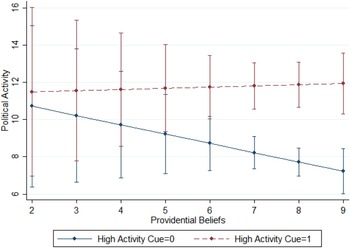
For the first differences presented in Table 2, the values are calculated with Providential set to its model value of 9. We can get a closer look at the effect of providential beliefs on political activity by charting respondents' predicted political activity scores at each level of providential beliefs, both with and without the perception of a high activity cue. The results are displayed in Figure 1.
(Color online) predicted political activity scores by providentiality, with and without a high activity cue.

At the lowest levels of providential beliefs, the high activity cue doesn't make much of a difference; the predicted score for those who receive the cue is 11.48 and the predicted score for those who don't is 10.71, a difference that is not statistically significant. At the other end of the providential spectrum, however, there is a significant difference — 4.71 points on the 18-point political activity scale — between those who report receiving the high activity cue and those who don't. Although this difference does not come from a surge in participation by those providential believers who report hearing a cue, there is a significant drop in activity by providential believers who do not perceive a cue. As other results suggest, the providential default appears to be inactivity. A high activity cue boosts the political participation of the strongest providential believers over that of the non-providential believers, but without such a cue, providential believers are much less likely to participate in politics.
CONCLUSION
To understand how religion influences political behaviors and attitudes, we need to know more about the impact of religious beliefs. This study has looked at one particular type of religious belief — providential beliefs — and at the impact providential beliefs have on political activity. The results indicate that providential congregants who report hearing political sermons are more likely to be politically active.
These findings reveal the importance of cues that can bridge the providential and political realms. It appears that those who believe God has a plan may default to the position of leaving politics up to God. In order for providential believers to see the political as a part of God's plan, there must be a compelling connection. Thus, in the results here, providential beliefs matter, but only when they are connected to politics. For the congregants studied, one connection came from the sermons their religious leaders delivered. Providential believers who reported hearing sermons about the importance of political participation were more likely to be politically active. It may be that providential believers are more psychologically “open” to new information, which enables them to make connections between religion and politics. Or perhaps they are more open to cues from clergy because they happen to agree with them. The homogeneity measures begin to get at some of these complex relationships among clergy, congregant, and congregation, but more research is clearly needed to understand providential beliefs and their effects.
The data presented here are neither able to nor meant to generalize to the population at large. The sample is not representative, but includes only five churches (and one Atheist group) in a single, Southern US city: Little Rock. Although far from perfect, the data represent responses from real congregants experiencing real political cues from their own congregation leaders. This provides a very different environment for evaluating the effect of clergy political messages, when compared to telephone surveys, experimental manipulations, or student convenience samples (Calfano and Djupe Reference Calfano and Djupe2009; McKeown and Carlson Reference McKeown and Carlson1987; Sears Reference Sears1986; Djupe and Gwiasda Reference Djupe and Gwiasda2010). The data here provide a look at how the effects of providential beliefs are conditioned by clergy political cues in the context of sermons delivered over a long period of time, which may or may not be heard or remembered by congregants. Essentially, they allow us to see what providential beliefs can do when connected to politics by clergy cues in the “real world.”
Providentiality is still a new concept. The fact that providential religious beliefs cross denominational boundaries is an advantage for survey researchers seeking analytical traction in a limited space. While we don't have longitudinal data to know if these beliefs are growing in the population, we do have a potential causal mechanism through which the religious beliefs — in this case, knowing and seeking to help bring about God's will — can have measurable political effects. Thus, although the study sample is not representative, the processes and patterns observed within these congregations provide initial support for a casual story that can be further explored with larger and more representative populations.
APPENDIX
OLS regression models of providential beliefs, calculated from imputed datasets (m = 5)

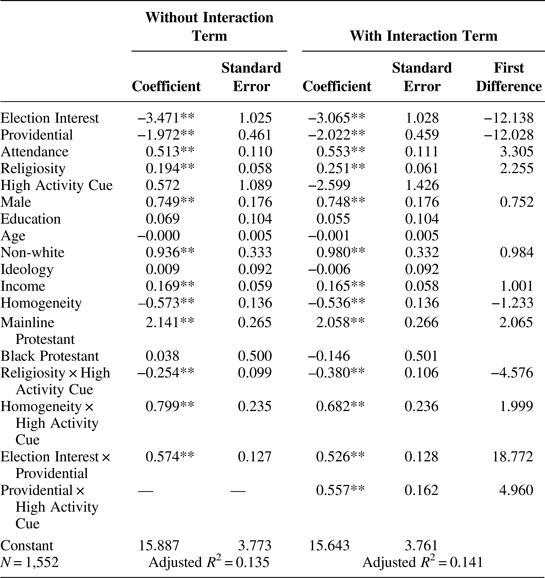
OLS regression models of congregation member political activities, calculated from imputed datasets (m = 5), church-going respondents only (atheists excluded)

QUESTION WORDING
Congregant Survey Questions
By your best estimate, what was your total household income last year, before taxes?
(1) $10,000 or less
(2) $10,001–20,000
(3) $20,001–35,000
(4) $35,001–50,000
(5) $50,001–100,000
(6) $100,001–150,000
(7) $150,000 or more
In the past year, how often have you heard sermons or homilies by the pastor/priest here that:
(1) Never (2) Sometimes (3) Often
A. Spoke against same-sex marriage?
B. Encouraged you to get involved in a local political cause or issue?
C. Encouraged you to get involved in a national political cause or issue?
D. Encouraged members to serve or volunteer in the community?
E. Urged you to register to vote?
F. Spoke against abortion?
In the past 12 months, have you:
(1) No
(2) Yes, once or twice
(3) Yes, a few times
(4) Yes, many times
A. Tried to persuade someone to vote
B. Donated money to a political candidate or campaign
C. Worked as a volunteer for a political candidate or campaign
D. Attended a political rally
E. Stuck a campaign bumper sticker on your car or window
F. Signed a petition
How often do you pray?
(1) Never
(2) Occasionally
(3) About Once a Week
(4) A Few Times a Week
(5) About Once a Day
(6) Several Times a Day
How often do you read Holy Scripture?
(1) Never
(2) Occasionally
(3) About Once a Week
(4) A Few Times a Week
(5) About Once a Day
(6) Several Times a Day
How often do you attend religious services?
(1) Never
(2) Occasionally
(3) About Once a Month
(4) 2-3 Times a Month
(5) Every Week
(6) Multiple Times a Week
Generally speaking, would you say that you personally care a good deal who wins the presidential election this fall, or that you don't care very much who wins?
(1) Don't Care
(2) Very Little
(3) Some
(4) Quite a Bit
(5) A Great Deal
Generally speaking, do you think of yourself as a Democrat, Republican, independent, or what?
(1) Strong Democrat
(2)
(3)
(4) Independent
(5)
(6)
(7) Strong Republican
What is the highest year in school/degree you have achieved?
(1) Less than High School
(2) High School/Ged
(3) Some College/Applied Degree
(4) College Graduate
(5) Post-Graduate
What is your race/ethnicity?
(1) White
(2) Black
(3) Hispanic
(4) Other
In what year were you born?
How would you compare your views with other congregation members' on political issues?
(1) Mine more conservative
(2)
(3) About the same
(4)
(5) Mine more liberal
Providential Beliefs 2 Question Battery
Please circle if you agree or disagree with the following statements about religious beliefs.
God has a plan and I have a part to play in it.
(1) Strongly Disagree
(2) Disagree
(3) Neutral
(4) Agree
(5) Strongly Agree
Would you say your religion provides some guidance in your day-to-day life, quite a bit of guidance, or a great deal of guidance in your day-to-day life?
(1) Religion Really Isn't Important To Me
(2) Some Guidance
(3) Quite a Bit of Guidance
(4) A Great Deal of Guidance