Implications
The objective of this study was to improve our understanding of genetic effects on early pregnancy failure in Holstein dairy cows. Daughters of 12 bulls of known fertility estimated breeding value (calculated using the calving rate of their lactating progeny) were followed between D0 (day of first artificial insemination) and D90 to identify non-fertilisation-early embryonic death, late embryonic death and early foetal death. We showed that the sire had a large effect on the incidence of NF-EEM and LEM, but this did not explain all the differences between progeny groups. Consequently, this study highlights the importance of defining the precise time of pregnancy failure to identify quantitative trait loci and/or candidate genes for female fertility in dairy cattle, as some might influence early pregnancy failure, as investigated in this study, while others may influence late abortion.
Introduction
Fertility, most particularly postpartum first-service conception rate, has declined during the last few decades in Holstein cows (Royal et al., Reference Royal, Darwash, Flint, Webb, Woolliams and Lamming2000a; Lucy, Reference Michel, Ponsart, Freret and Humblot2001; Lopez-Gatius, Reference Lopez-Gatius2003; Barbat et al., Reference Barbat, Le Mézec, Ducrocq, Mattalia, Fritz, Boichard, Ponsart and Humblot2010; Le Mezec, Reference Liquet and Commenges2010). An important part of this deterioration results from the relatively high negative genetic correlations (around −0.35) between milk production traits and reproductive traits, which have been demonstrated in most dairy breeds (Boichard et al., Reference Boichard, Barbat and Briend1998; Barbat et al., Reference Barbat, Le Mézec, Ducrocq, Mattalia, Fritz, Boichard, Ponsart and Humblot2010; Berry et al., Reference Berry, Wall and Pryce2014). Despite this negative relationship, and early trends for a reduction in fertility, selection for this trait has been neglected for a long time, except in Scandinavian countries (Syrstad, Reference Veerkamp and Beerda1981; Miglior et al., Reference Moore, Fair, Lonergan and Butler2005). Although this was in part due to the very low heritability of fertility traits (2% to 3%; Humblot and Denis, 1986; Veerkamp and Beerda, Reference Walsh, Walton, Kelton, LeBlanc, Leslie and Duffield2007; Berry et al., Reference Berry, Wall and Pryce2014), it was mostly due to a lack of interest for this functional trait in most dairy producing countries. However, its high genetic variability (Veerkamp and Beerda, Reference Walsh, Walton, Kelton, LeBlanc, Leslie and Duffield2007; Barbat et al., Reference Barbat, Le Mézec, Ducrocq, Mattalia, Fritz, Boichard, Ponsart and Humblot2010) and the amplitude of its deterioration has led most dairy producing countries to introduce female fertility and other functional traits in their breeding objectives from the beginning of the 2000s (with functional traits comprising 3% to 37% of the synthetic indices; Miglior et al., Reference Moore, Fair, Lonergan and Butler2005). In 2007, 15 countries contributed to the international estimation (Interbull) of bull genetic value for female fertility, increasing to 20 countries in 2013 (Institut de l’Elevage, 2013). Today, genomic selection increases the reliability of genetic evaluation for this trait and many quantitative trait loci (QTL) and single nucleotid polymorphisms (SNPs) associated with fertility have been found (Berglund, Reference Berglund2008; Hayes et al., Reference Heuer, Schukken and Dobbelaar2009; Fortes et al., Reference Fortes, Deatley, Lehnert, Burns, Reverter, Hawken, Boe-Hansen, Moore and Thomas2013). However, the breeding values and genetic markers have been and are still usually based on very imprecise phenotypic measurements (calving rate after artificial insemination (AI), pregnancy rate, 56 days non-return rate (NRR) or calving to conception interval), indicative of the different sources of pregnancy failures. A few attemps have been made to study more precisely the sire effects on embryonic mortality or foetal death (FD; Humblot and Denis, 1986; Guillaume et al., Reference Hayes, Bowman, Chamberlain and Goddard2007; Ben Jemaa et al., Reference Ben Jemaa, Fritz, Guillaume, Druet, Denis, Eggen and Gautier2008; Druet et al., Reference Druet, Fritz, Boussaha, Ben-Jemaa, Guillaume, Derbala, Zelenika, Lechner, Charon, Boichard, Gut, Eggen and Gautier2008). However, even in this study, the results based on sequential NRRs led to the underestimation of early pregnancy losses because of the low sensitivity of oestrous detection under farm conditions (Roelofs et al., Reference Royal, Mann and Flint2010).
At present, by measuring the phenotypes with more precision, one can expect to improve the accuracy of the QTL/SNP detection and the identification of candidate genes.
Studies aiming to investigate accurately the genetic effects on reproductive function were initially performed in experimental herds. This has been carried out using progesterone measurements to better define the interval from calving to initiation of ovarian activity (Berry et al., Reference Berry, Bastiaansen, Veerkamp, Wijga, Wall, Berglund and Calus2012). Pedometers have also been used to better detect oestrous behaviour from calving to first AI (Homer et al., Reference Humblot2013). However, to our knowledge, investigations allowing the determination of precise phenotypes of pregnancy failures after insemination on a large-scale basis and the possible impact of the sire have not been conducted. In cows, most of the pregnancy failures occur during the very beginning of pregnancy (Santos et al., Reference Silke, Diskin, Kenny, Boland, Dillon, Mee and Sreenan2004; Diskin and Morris, Reference Diskin and Morris2008). A combined use of progesterone measurements and pregnancy-associated glycoproteins allows the identification of the different phenotypes of pregnancy failures under field conditions (Humblot, Reference Humblot and Denis2001).
The aim of this study was to investigate on a large-scale basis (i) the sire effects on the respective frequencies of early, late embryonic mortality (LEM) and FD from precise phenotyping of their progeny and (ii) the relationship between bull estimated breeding value (EBV, based on imprecise cow fertility phenotypes from previous years) and the above distribution of pregnancy failures. Collecting this information was also a first step to run subsequent whole-genome association studies (GWAS) for those traits.
Material and methods
Animals and data recorded
A total of 12 Holstein sires widely used were introduced in this study. Their EBV for fertility was well known (reliability⩾0.95). In France, the bull fertility EBV is a combination of the following three variables: heifer conception rate, cow conception rate and calving to first-service interval. The EBV for cow conception rate is estimated by calving rate – that is, presence of a calving after an insemination in a period corresponding to the gestation length of the breed (Barbat et al., Reference Barbat, Le Mézec, Ducrocq, Mattalia, Fritz, Boichard, Ponsart and Humblot2010). All AIs of the daughters during the postpartum period are taken into account. In this study, the 2010 edition of the bull EBVs (INRA and Institut de l’Elevage) was used. This EBV is expressed in units of genetic standard deviation (σ g =7 points of conception rate; Barbat et al., Reference Barbat, Le Mézec, Ducrocq, Mattalia, Fritz, Boichard, Ponsart and Humblot2010) relative to 0 being the phenotypic value of a female reference population (cows registered in the national database and born between 2002 and 2004 for the 2010 EBV). Bulls’ EBVs ranged from −0.7 to 1.
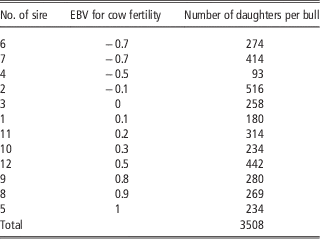
A clinical examination was carried out by technicians on the day of AI to exclude cows with metritis or pyometra (abnormal vaginal discharge before or after uterine palpation). The initial survey group of females consisted of 4239 daughters of the 12 bulls in their first or second lactation. After exclusion for clinical genital disease at AI, missing data or doubtful pregnancy status at 90 days after AI, a sub-sample of 3508 cows was included for the final analysis. These cows were maintained in 984 herds and the final number of completely phenotyped cows per progeny group ranged from 93 to 516 per sire (Table 1). The percentage of eliminated cows did not differ between the progeny groups. Phenotypes were determined after first service in cows that calved from September 2006 to September 2010.
EBV (2010 edition) for cow conception rate and number of daughters of the 11 Holstein bulls introduced in the study

EBV is expressed as number of genetic standard deviation units relative to the reference population (cows born between 2002 and 2004).
For each cow, the following data were recorded: region and herd of origin, date of calving, lactation rank, date of first service, date of return to oestrous and/or date of second AI, milk yield, milk fat and protein contents recorded by the milk board once a month during the first 3 months of lactation. Milk samples were collected following oestrous detection or first AI and 18 to 25 days later. Transrectal ultrasonography was performed to identify the presence of a living embryo at days 45 and 90 after the first AI.
Progesterone assay
Milk samples were collected at the beginning of the morning milking session from the four mammary quarters into a plastic tube containing a Bronopol and Natamycin pellet (8 mg Bronopol and 0.30 mg Natamycin, Broad Spectrum Microtabs II®, Biovalley, Marne La Vallée, France). Samples were sent by surface mail the same day of collection to the UNCEIA laboratory and were analysed by ELISA (Ovucheck® MILK, Biovet Inc., St-Hyacinthe, Canada). Results were classified as ‘negative’ when the concentration of progesterone was ⩽2.5 ng/ml, ‘positive’ for a concentration ⩾3.5 ng/ml and ‘doubtful’ for intermediate values. For the average values of 8.3, 0.67 and 1.70 ng/ml, the inter-assay coefficients of variation were 11.5%, 8.8% and 11.5%, respectively. Intra-assay coefficients of variation were 2.6%, 4.3% and 1.6%.
Pregnancy phenotypes
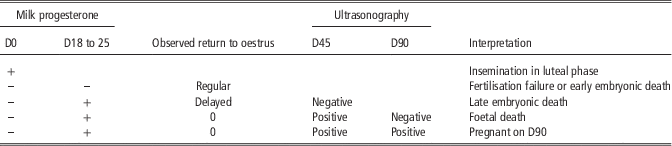
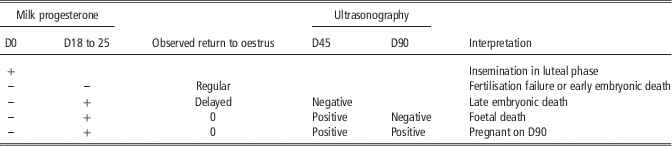
Pregnancy status after AI was determined by a method adapted from Humblot (Reference Humblot and Denis2001). Phenotypes were characterised by combining results from milk progesterone assays, oestrous observation and ultrasonography (Table 2). The progesterone measurements on the day of AI were used to identify cows inseminated during the luteal phase (high concentration of progesterone on the day of AI). Four pregnancy phenotypes were distinguished in cows inseminated in the follicular phase (low concentration of progesterone on the day of AI) as follows: non-fertilisation/early embryonic death, late embryonic death, FD and pregnant on D90. Cows were classified as (i) fertilisation failure or early embryonic mortality (FF-EEM, before D16 of pregnancy) when oestrous was observed around 21 days after AI and/or when a low concentration of progesterone was observed 22 to 24 days after AI, (ii) as LEM when concentration of progesterone was high 22 to 24 days after AI and cows were detected as not pregnant by D45 after AI by ultrasonography, (iii) as FD when progesterone measurements and results of ultrasonography were positive until D45 and the result of ultrasonography was negative by D90 and (iv) as pregnant when positive results were confirmed by the presence of a living embryo by D90.
Pregnancy phenotypes of the bull’s postpartum daughters after first service
Statistical analysis
The dependant variables were as follows: percentage of total pregnancy failure (number of non-pregnant cows at 90 days after AI/total number of AIs), incidence of AIs during the luteal phase (number of AIs during the luteal phase/total number of AIs), incidence of FF-EEM (number of non-pregnant cows at D18 to 25/number of AIs in the follicular phase), incidence of LEM (number of non-pregnant cows at D45/number of pregnant cows at D18 to 25) and incidence of FD (number of non-pregnant cows at D90/number of pregnant cows at D45).
Sires EBVs were allocated to the following three groups: low (⩽−0.5; n=3 bulls), moderate (>−0.5 to <0.5; n=5) and high EBV for cow fertility (⩾0.5; n=4). The other factors taken into account in the analysis were milk yield, milk protein (MP) and fat (MF) content during the first 3 months of lactation, lactation rank, weekday and season of insemination, calving to first-service interval, geographic area, year of AI and their interactions. MP and MF contents were introduced in the multivariate models as quantitative variables, as well as the MF/MP ratio and the MF-MP difference.
Relationships between variation factors and dependent variables were tested in a first step by univariate analysis using the χ 2-test with SAS® 9.2 software (SAS Institute Inc., Cary, NC, USA). All variables associated with the dependent variables at a threshold of 20% were subsequently introduced with their interactions in multivariate mixed logistic regression models using the GLIMMIX procedure of SAS. The random herd effect was introduced in all models (3.6±2.1 cows followed per herd) and was applied on the intercept (Witte et al., Reference Zobel, Tkalcic, Pipal and Buic2000). The multivariate models were simplified step by step to retain only variables associated with dependant variables at the threshold of 10%. A Bonferroni correction was used to adjust the p-values for comparison between modalities for qualitative variables (Liquet and Commenges, Reference Lopez-Gatius2001). Odds ratios were converted to adjusted relative risk (RR) according to the method recommended by Beaudeau and Fourichon (Reference Beaudeau and Fourichon1998) for not rare events. Results are presented as mean±s.d. or adjusted percentages for the incidences of pregnancy failures.
Results
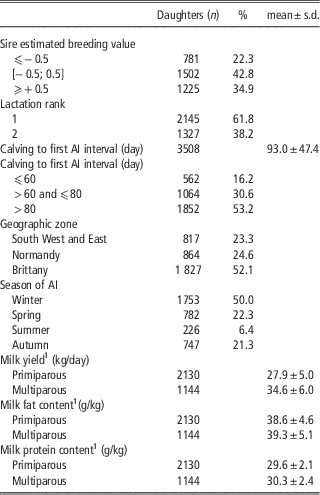
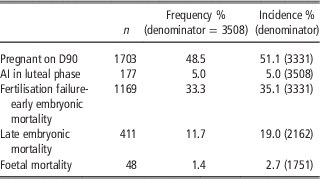
Milk samples were collected on the day or the day after AI and 21.0±1.5 days later. Pregnancy diagnosis was performed 43.2±8.3 and 94.5±31.7 days after AI. Characteristics of the cows are presented in Table 3. Among the 3508 cows inseminated, 1703 were pregnant by D90 (48.5%). Five per cent of the cows were inseminated in the luteal phase. Frequencies of FF-EEM, LEM and FD were 33.3, 11.7 and 1.4, respectively (Table 4).
Characteristics of the 3508 daughters of the 12 Holstein sires included in the study

AI=artificial insemination.
1 Average of the first 3 months of lactation, measured once a month by the milk board.
Conception rate, frequency and incidence of pregnancy failure between 0 and 90 days after first service in the 3508 cows introduced in the study
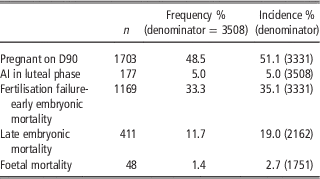
AI=artificial insemination.
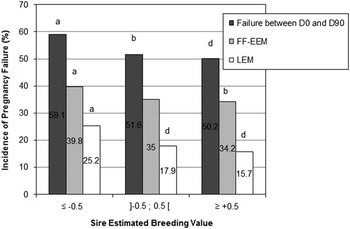
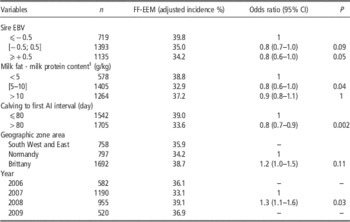
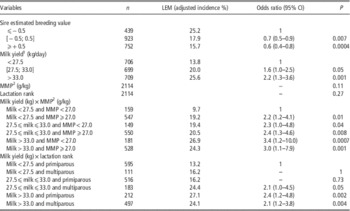
None of the factors studied influenced the proportion of cows inseminated in the luteal phase. EBV of the sire was significantly related to incidence of total pregnancy failure between D0 and D90 (Figure 1), incidence of FF-EEM, incidence of LEM, but was not related to the incidence of FD between D45 and D90 of pregnancy. Significant effect of the EBV and other factors on FF-EEM and LEM are presented in Tables 5 and 6. Total incidence of pregnancy failure between D0 and D90, FF-EEM and LEM were significantly higher for the progeny of the bulls with low EBV compared with high EBV (Figure 1), but these incidences were not different between the progenies of the moderate and high EBV bulls. The RR of FF-EEM was significantly higher (RR=1.2) for the progeny group of low EBV bulls when compared with high EBV ones. The RR of LEM was also significantly higher when comparing the progeny groups issued from the low EBV bulls with those from moderate EBV bulls (RR=1.3) and when compared with progeny groups form high EBV bulls (RR=1.4).
Relationship between sire estimated breeding value for postpartum conception rate and adjusted incidence of pregnancy failure between D0 and D90, fertilisation failure-early embryonic mortality (FF-EEM) and late embryonic mortality (LEM) in their progeny. a v. b, P<0.05; a v. c, P<0.01; a v. d, P<0.001.

Relationships between sire EBV for postpartum conception rate and incidence of FF-EEM in their progeny after the first insemination (n=3247 Holstein cows without missing values and inseminated during the follicular phase)

EBV=estimated breeding value; FF-EEM=fertilisation failure-early embryonic mortality; AI=artificial insemination.
1 Difference between mean milk fat and mean milk protein contents measured once a month during the first 3 months of lactation.
Relationships between sire estimated breeding value for postpartum conception rate and incidence of LEM in their progeny after the first insemination (n=2114 Holstein cows without missing values and pregnant on D21)

LEM=late embryonic mortality; MMP=minimum milk protein content.
–: non-significant.
1 Milk yield=average of first 3 months of lactation, measured once a month.
2 Minimum Milk Protein content during the first 3 months of lactation, measured once a month.
The incidence of FF-EEM was significantly related to calving to first AI interval, difference between milk fat and protein contents and year of observation (Table 5). The risk of FF-EEM was higher when AI was performed before 80 days than after 80 days postpartum. It was higher when the difference between milk fat and protein contents was low than when it was between 5 and 10 g/kg, and tended to be higher (P=0.07) than that for the middle class of the variable when the difference was high (>10 g/kg). This risk was higher in 2008 than in 2007.
The incidence of LEM was significantly related to the mean milk yield during the first 3 months of lactation and with the following two interactions: milk yield×minimum milk protein content and milk yield×lactation rank (Table 6). Incidence of LEM was lower for the cows producing less milk (<27.5 kg/day during the first 3 months of lactation) when compared with other classes of production. The lowest risk was observed (9.7%) for the cows that produced less milk (<27.5 kg/day) with the lowest protein content (<27 g/kg), and the highest risk was observed (26.9%) for the high producing cows (>33 kg/day) with low protein content (<27 g/kg). The incidence of LEM was the lowest (13.2%) for low producing (<27.5 kg/day) primiparous cows and highest (24.1%) for the high producing (>33 kg/day) primiparous cows.
Discussion
Pregnancy rate at first service measured on D90 was higher in this study than that observed in recent field trials in France (45.9% on D75 (Freret et al., Reference Freret, Ponsart, Rai, Jeanguyot, Paccard and Humblot2006); 45.8% on D80 to 100 (Grimard et al., Reference Grohn and Rajala-Schultz2006)). The conception rate decreased with parity (Grohn and Rajala-Schultz, Reference Guillaume, Gautier, Ben Jemaa, Fritz, Eggen, Boichard and Druet2000), and this may be due to the low lactation rank (1 or 2) of the cows in the present study.
The frequencies of FF-EEM (33.3%) and LEM (11.7%) were close to the values observed in previous studies (FF-EEM between 20.5% and 43.6%, LEM between 8.4% and 17.5%; Humblot, Reference Humblot and Denis2001; Santos et al., Reference Silke, Diskin, Kenny, Boland, Dillon, Mee and Sreenan2004). The incidence of LEM between ∼21 and 45 days (19.0%) was in agreement with other reports in Holstein cows (mean 12.8% ranged from 3.2 to 42.7 between D30 and D45; Santos et al., Reference Silke, Diskin, Kenny, Boland, Dillon, Mee and Sreenan2004; Cummins et al., Reference Cummins, Lonergan, Evans and Butler2012a). Foetal mortality incidence between 45 and 90 days was low (2.7%) compared with previously reported values during the same period (early foetal loss of 10.7% and 4.3%; Santos et al., Reference Silke, Diskin, Kenny, Boland, Dillon, Mee and Sreenan2004; Zobel et al., Reference Zobel, Tkalcic, Pipal and Buic2011). This might also be partly due to the low rank of parity of the cows in this study. Zobel et al. (Reference Zobel, Tkalcic, Pipal and Buic2011) observed less early foetal mortality in first and second calvings than in the third and fourth calvings.
In this experiment, the FF-EEM incidence was related to sire EBV. It was higher for the three bulls that had the lower EBV for postpartum conception rate than for the best class of EBV. A putative genetic effect on FF-EEM was previously described by Humblot (Reference Humblot and Denis2001), who reported a negative association between cow genetic merit for milk production and FF-EEM (measured with a similar methodology while using the combination of two concentrations of progesterone in milk on D0 and D18 to 24). This might be partly explained by the genetic effect on uterine health and progesterone secretion, as recently observed in small groups of dairy cows with different genetic merit for fertility (Cummins et al., Reference Cummins, Lonergan, Evans and Butler2012a; Moore et al., Reference Nusinovici, Seegers, Joly, Beaudeau and Fourichon2014).
This observation is in agreement with the hypothesis that the decline in calving rate to a single service in Holstein cattle during the last few decades is because of an increase in early rather than late embryonic death (Humblot, Reference Humblot and Denis2001; Grimard et al., Reference Grohn and Rajala-Schultz2006; Diskin and Morris, Reference Diskin and Morris2008). However, the identification of QTL linked to FF-EEM in Holstein cattle failed to date when using NRR on D28 (Ben Jemaa et al., Reference Ben Jemaa, Fritz, Guillaume, Druet, Denis, Eggen and Gautier2008). This is probably due to the poor accuracy of the criteria already used to investigate FF-EEM (NRR on D28 after AI; Ben Jemaa et al., Reference Ben Jemaa, Fritz, Guillaume, Druet, Denis, Eggen and Gautier2008). Previous studies comparing the efficiency for detecting early non-pregnant cows from oestrus detection and progesterone measurements by D21 to 23 post AI showed that around half of the non-pregnant cows by D21 were not detected as such by herdsmen (Humblot, Reference Humblot and Denis2001).
LEM was strongly related to sire EBV. Progeny of the low EBV sires were 30% to 40% more at risk of LEM than progeny of the moderate and high EBV bulls. To our knowledge, this was not observed previously in other studies. Humblot and Denis (1986) did not observe any sire effect on the distribution of NRR between 25 and 35 days after AI in the Montbéliarde breed. In the study of Grimard et al. (Reference Grohn and Rajala-Schultz2006), there was no relationship between LEM/FM measured between 21 to 24 days after AI and 80 to 100 days and EBV for milk production in Holstein cows. This might be the particularity of our three low EBV bulls, as previously observed by Lopez-Gatius et al. (Reference Lucy2002) for one bull and requires further studies to be confirmed.
Thus far, FF-EEM and LEM have been combined while investigating genetic effects on D56 NRR (Holmberg and Andersson-Eklund, Reference Homer, Derecka, Webb and Garnsworthy2006; Ben Jemaa et al., Reference Ben Jemaa, Fritz, Guillaume, Druet, Denis, Eggen and Gautier2008; Sahana et al., Reference Santos, Rutigliano and Sa Filho2010). NRRs on D28, D56, D90 and D282 were used for fine mapping of QTLs (Guillaume et al., Reference Hayes, Bowman, Chamberlain and Goddard2007). In the last study, two QTL were identified, one having an effect on pregnancy failure before D90 after AI (based on NRR by D90 data, NR90) and the other related to late abortions and stillbirth (based on NR282). This highlighted the interest of using better phenotypes than calving data to investigate the genetic effect on conception rate.
In the present study, we did not observe any relationship between sire EBV and foetal mortality. This might be due to the short period of investigation (45 to 90 days of pregnancy) and to the low incidence of this variable. Our study, aiming to investigate embryonic rather than FD, was not powerful enough to investigate this specific aspect of fertility. A genetic effect has been reported recently on foetal mortality and some genes related to it have been identified (Charlier et al., Reference Charlier, Agerholm, Coppieters, Karlskov-Mortensen, Li, de Jong, Fasquelle, Karim, Cirera, Cambisano, Ahariz, Mullaart, Georges and Fredholm2012; Fritz et al., Reference Fulkerson, Davison, Garcia, Hough, Goddard, Dobos and Blockey2013).
The early pregnancy failures explained most of the difference in conception rate between low EBV bulls’ progenies and high or moderate EBV bulls (close to 9% due to FF-EEM and LEM). This is more than what was expected. The EBV differed by 1 to 1.3 between the two classes of bulls – that is, by 1 to 1.3 genetic standard deviation for that trait – which corresponds to 7 percentage points of conception rate in the French Holstein population (Barbat et al., Reference Barbat, Le Mézec, Ducrocq, Mattalia, Fritz, Boichard, Ponsart and Humblot2010). Considering this, a difference of 3.5 to 5.4 points in conception rate was expected in their progeny, which is lower than the 8.9 points observed on D90 in this study. This difference might be due to the fact that, in this study, we measured the frequencies of pregnancy failures after the first service, whereas EBV for fertility is estimated by conception rate from all AIs made in the progeny group. This is consistent with results of a previous study in which early pregnancy failures were reported to be more frequent after first service postpartum than after subsequent ones (Fournier and Humblot, Reference Fournier and Humblot1989).
In this study, FF-EEM was significantly related to calving to insemination interval, difference between fat and protein contents and year of insemination. FF-EEM decreased when calving to first AI interval increased. This might be attributed to the increase of uterine health throughout the postpartum period and reduction of negative energy balance. Differences between milk fat and protein contents were related to high incidence in FF-EEM. Low fat and high protein contents are associated with acidosis in the cow when high fat and low protein contents are related to lipomobilisation, energy deficit and sub-clinical ketosis (Heuer et al., Reference Holmberg and Andersson-Eklund1999; Kessel et al., Reference Le Mezec2008). In both cases, FF-EEM was higher compared with healthy animals. This is consistent with the lower conception rate observed in sub-clinical or clinical ketosic cows (Heuer et al., Reference Holmberg and Andersson-Eklund1999; Fourichon et al., Reference Fourichon, Seegers and Malher2000; Walsh et al., Reference Witte, Greenland, Kim and Arab2007; Kessel et al., Reference Le Mezec2008). The year of observation effect observed in this survey might be due to the Bluetongue disease, which appeared in France in 2006 and re-emerged in 2007 and 2008. Both disease and vaccination have been recognised as factors decreasing fertility and increasing return rate after insemination in French dairy cattle (Nusinovici et al., Reference Nusinovici, Seegers, Joly, Beaudeau and Fourichon2011 and Reference Nusinovici, Seegers, Joly, Beaudeau and Fourichon2012).
LEM was related to milk yield, milk yield×parity and milk yield×protein content interactions. An effect of milk yield on LEM was previously observed by Michel et al. (Reference Miglior, Muir and Van Doormaal2003) and Cutullic et al. (Reference Cutullic, Delaby, Gallard and Disenhaus2012), but not by Chebel et al. (Reference Chebel, Santos, Reynolds, Cerri, Juchem and Overton2004) and Freret et al. (Reference Freret, Ponsart, Rai, Jeanguyot, Paccard and Humblot2006). When studying LEM and early foetal mortality together (between 21 and 90 days of pregnancy), milk yield was already identified as a variation factor for pregnancy loss (Grimard et al., Reference Grohn and Rajala-Schultz2006; Zobel et al., Reference Zobel, Tkalcic, Pipal and Buic2011) but not in all studies (Lopez-Gatius et al., Reference Lucy2002; Silke et al., Reference Syrstad2002; Santos et al., Reference Santos, Thatcher, Chebel, Cerri and Galvao2009). In these last three trials, the authors recorded body condition score (BCS) at calving, at AI and/or its variations between calving and AI or during early pregnancy. They all found a negative effect of low BCS or BCS losses on LEM. We did not investigate this variable in this study, which was conducted in a large geographical area with many different technicians. Interestingly, despite the limitations mentioned above, LEM incidence was the lowest for the lowest producing cows and the highest for the highest producing cows with low protein content, which is an indicator of energy deficit at the beginning of lactation (Heuer et al., Reference Holmberg and Andersson-Eklund1999; Buckley et al., Reference Buckley, O’Sullivan, Mee, Evans and Dillon2003). However, this relationship was not observed in the low producing cows: LEM was higher when the minimum protein content was greater than 27 g/kg at the beginning of lactation than when the minimum protein content was lesser than this value. This suggests an interaction between milk yield and level of feeding, as previously observed by Fulkerson et al. (Reference Grimard, Freret, Chevallier, Pinto, Ponsart and Humblot2008). When investigating the parity×milk yield interaction, the primiparous cows producing less milk were at the lowest risk for LEM, whereas the highest producing primiparous cows were at the highest risk for LEM. In the two classes of lactation rank, the LEM cows were those with the highest production and probably with the most pronounced negative energy balance. This is in favour of the previous results cited above, suggesting that negative energy balance is a major risk factor for LEM and early FM. However, the effect of milk production seemed to be less deleterious in primiparous cows (incidence of LEM non-related to milk production up to 33 kg milk/day) than in multiparous ones (incidence of LEM increased from 27 kg milk/day). This interaction between milk yield and parity has not been previously described to our knowledge.
Heat stress is frequently cited as a risk factor for low conception rates in the cow (Lopez-Gatius, Reference Lopez-Gatius, Santolaria, Yaniz, Rutllant and Lopez-Bejar2012). However, we did not identify any effect of the season of AI on FF-EEM and LEM. Results are contradictory in France – for example, for Freret et al. (Reference Freret, Ponsart, Rai, Jeanguyot, Paccard and Humblot2006) FF-EEM and LEM were the highest in spring and the lowest in autumn, whereas LEM was the highest in winter and the lowest in summer for Grimard et al. (Reference Grohn and Rajala-Schultz2006) when Michel et al. (Reference Miglior, Muir and Van Doormaal2003) did not find any effect of season on FF-EEM or on LEM. Temperatures are rarely extreme in France and are no longer up to the comfortable interval for dairy cows (5°C to 25°C) and this might explain the contradictory observations.
The proportion of cows inseminated during the luteal phase was low in this study (5%) and very close to that observed in other large-scale trials (Royal et al., Reference Sahana, Guldbrandtsen, Bendixen and Lund2000b; Michel et al., Reference Miglior, Muir and Van Doormaal2003; Freret et al., Reference Freret, Ponsart, Rai, Jeanguyot, Paccard and Humblot2006; Grimard et al., Reference Grohn and Rajala-Schultz2006). This can be considered as an indicator of good accuracy of heat detection (Roelofs et al., Reference Royal, Mann and Flint2010). This accuracy was not related to EBV and could not explain differences in fertility between progenies. Genetic effect on oestrous expression have been previously reported (Roelofs et al., Reference Royal, Mann and Flint2010; Cummins et al., Reference Cummins, Lonergan, Evans and Butler2012a and Reference Cummins, Lonergan, Evans and Butler2012b; Homer et al., Reference Humblot2013), but it might have an impact on the sensitivity of oestrous detection rather than its accuracy.
Conclusion
This study showed very clearly the strong differences in the incidences of early pregnancy failures between progeny groups. However, these differences were evidenced between low EBV sires and high or medium EBV ones. The lack of difference between the last two groups suggests that the part of the genetic differences observed here might be explained by differences in the frequencies of late FD in the progeny groups. Taken together, the results from this study highlight the interest of refined phenotyping by precise measurement of chronology of pregnancy failures to further identify candidate genes for female fertility.
Acknowledgements
This study was supported by the French National Agency for Research (ANR-GENANIMAL program) and the Apis Gene GIS. The authors address their special thanks to their correspondents in AI centers: Didier Berthelot (SORELIS), Patrick Bonnand and Aurélien Michel (AMELIS), Jacky Martin (ELIACOOP), Alain Chevallier, Jean-Luc Viala and Christian Nicolas (GENOE), Jean-Michel Philippot (URCEO), Hervé de Préaumont (CIA l’Aigle), Pierrick Drevillon (CECNA), Pierre Gigant and Lionel Simerman (ELITEST), Brahim Khireddine (COOPELSO), Philippe Gisbert and Gilles Mally (GENESIA), Olivier Sourbé (Groupe Altitude), Philippe George (CIA Meurthe et Moselle), the trainees Julie Goffin, Pierre Vergiat, Benoit Mouchard and Anthony Groualle. They also acknowledge the technicians and the farmers for their active and persistent co-operation and Loic Desquilbet for help in statistical analysis.