As the care of the critically ill patient becomes increasingly complex, many hospitals have instituted 24-hour coverage by an intensive-care attending physician. However, it is unclear whether nighttime intensivists offer an advantage in a tertiary care center when compared to the traditional structure of residents providing immediate care with intensivists available by telephone.Reference Levy 1 A retrospective review of 65,752 patients in 49 intensive care units throughout the United States revealed that nighttime intensivist staffing did not improve in-hospital mortality among those institutions with high-intensity daytime staffing.Reference Wallace, Angus, Barnato, Kramer and Kahn 2 A randomized trial in an academic medical intensive care unit (MICU) conducted over the course of 1 year showed similar results. At that center, nighttime intensivist staffing did not have a significant effect on mortality, length of stay, readmission to the intensive care unit, or likelihood of discharge home.Reference Kerlin, Small and Cooney 3 Another large retrospective trial of more than 270,000 patients also showed no change in mortality with 24-hour intensivist coverage.Reference Kerlin, Harhay, Kahn and Halpern 4
To implement 24-hour coverage, a shiftwork model was created. This model can have negative implications for nursing and house staff. A study that evaluated the effects of the 24-hour intensivist presence showed that nurses reported more role conflict, and house staff stated they had less autonomy with the nighttime staffing model.Reference Garland, Roberts and Graff 5 The basis for this model is that an intensivist is able to provide urgent therapies with immediate bedside evaluation, which may result in improved outcomes.Reference Kahn and Hall 6 Availability of an intensivist throughout the day and night can promote quicker and more efficient care, as plans are completed sooner rather than delaying them until the day team arrives. From the perspective of nursing, staff are more likely to alert a physician if they are immediately available in person and communication delays (if the physician needs to be called at home) are avoided.Reference Lindell, Chlan and Hoffman 7
Another benefit to nighttime critical care physician staffing may be increased adherence to evidence-based care practices. In a prospective, single-center trial, processes of care such as sepsis resuscitation, daily interruption of sedation, and protective ventilation strategy were compared before and after instituting night intensivist in-hospital coverage. There was a significant decrease in the number of omissions in processes of care per patient day.Reference Gajic, Afessa and Hanson 8
Decreasing exposure to invasive devices can lower infection rates and impact patient outcomes. Urinary catheters, central venous catheters, and mechanical ventilation are frequently required in critically ill patients. However, prolonged use of such devices can increase rates of catheter-associated urinary tract infection (CAUTI), central-line–associated blood stream infection (CLABSI), and ventilator-associated events (VAE). Daily assessment and evaluation of need for use of central venous catheters and urinary catheters along with removal prior to transfer out of the ICU represent opportunities to reduce infection rates.Reference Fakih, Krein, Edson, Watson, Battles and Saint 9 A multi-centered quality improvement trial that incorporated 20 ICUs showed that increases in daily spontaneous awakening trials (SATs) and spontaneous breathing trials (SBTs) were associated with a decrease in VAE rates.Reference Klompas, Anderson and Trick 10 Although the SATs and SBTs were driven by nurses and respiratory therapists in that trial, 24-hour attending physician involvement could improve the likelihood of those processes occurring. The objective of this study was to evaluate the effect of nighttime intensivist staffing on length of stay, VAE, CLABSI, and CAUTI.
METHODS
We instituted a before-and-after study design to retrospectively evaluate the effect of nighttime intensivists on length of stay and specific infection rates. The analysis included 2 geographically separate adult medical intensive care units (MICUs), with a total of 29 beds in a university-affiliated tertiary care facility. The pretest period was from June 2012 to May 2013, when our 2 MICUs utilized daily structured multidisciplinary critical care team rounds with nighttime, on-call, critical care attending physician coverage. During this time period, residents provided 24-hour coverage and daily rounds were conducted with an intensivist. Critical care fellows were involved in the care of each patient and were in house until at least 2:00 a.m. Between 2:00 a.m. and 6:00 a.m., critical care fellow physicians were called by house staff and routinely returned to the hospital to evaluate a patient that needed immediate attention.
The post-test period was between June 2013 and May 2014, after we transitioned to 24-hour in-hospital intensivist coverage. Residents, fellows, and attending intensivists are now in house day and night to staff both MICUs. A convenience sample was selected based on the study years.
Average patient length of stay and length of ventilator duration were compared for the year before and the year after the change in attending physician staffing using t tests. Acute Physiology and Chronic Health Evaluation (APACHE) II scores were calculated for each group and were compared to document the severity of illness using a non-parametric Kruskal-Wallis test (SPSS 21.0, IBM SPSS, Armonk, NY). Infection rates for VAE, CLABSI, and CAUTI were calculated as number of events per 1,000 device days and were compared using the χ2 test (Epi Info 7, CDC, Atlanta, GA).
RESULTS
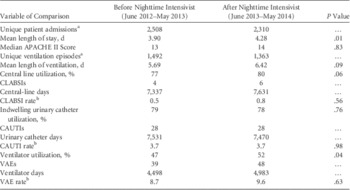
Significantly more MICU admissions occurred from June 2012 to May 2013 (n=2,508) (pre-intervention) than in the year after the intervention of night intensivist coverage was instituted (n=2,310) (P<.001). No significant difference was detected in median APACHE II scores between the pre-intervention group and the post-intervention group (P=.83) (Table 1). Mean length of intensive care unit stay increased after the intervention (3.9 days pre-intervention vs 4.3 days post-intervention; P=.01). The mean length of ventilation (defined as the mean ventilation duration per ventilated patient) prior to the intervention was 5.69 days compared with 6.42 days after the implementation of 24-hour intensivist staffing (P=.09). Utilization of central lines and indwelling urinary catheters were similar in the pre- and post-intervention groups. There were no significant differences in CLABSI rate (0.5 vs 0.8; P=.56), CAUTI rate (3.7 vs 3.7; P=.98), or VAE rate (8.7 vs 9.6; P=.63) between the 2 time periods (Table 1).
Impact of Overnight Intensivist Coverage in Medical Intensive Care Units

NOTE. APACHE, Acute Physiology and Chronic Health Evaluation; CAUTIs, catheter-associated urinary tract infections; CLABSIs, central-line–associated bloodstream infections; VAEs, ventilator-associated events.
a Single patient hospital admissions and ventilation episodes without including duplicate episodes per patient.
b No. of events per 1,000 device days.
DISCUSSION
Specific outcomes evaluated in this retrospective study included length of stay, exposure to ventilator support, and rates of device-related infections. Exposure to mechanical ventilation, central lines, and indwelling urinary catheters remained the same after the intervention. Our results are similar to those of previous studies documenting that 24-hour intensivist care did not improve outcomes in institutions with high-intensity daytime staffing. However, it is unclear why the mean length of stay in the MICU increased after the change in staffing. Our study was different in that it also evaluated specific infection rates in MICUs. We found that implementation of a 24-hour in-house critical care attending intensivist model did not decrease rates of CLABSI, CAUTI, or VAE. These findings are limited to the facility studied and should not be generalized to other intensive care units or to those facilities without high-intensity daytime intensivist staffing. Moreover, our study is limited in that we did not assess hospital mortality or time of admission (day vs night). In addition, our numbers of hospital-associated infections were small, making it difficult to detect differences between study periods. Further studies are needed to evaluate the effect of 24-hour intensivist care on infection rates.
ACKNOWLEDGMENTS
Financial support: No financial support was provided relevant to this article.
Potential conflicts of interest: All authors report no conflicts of interest relevant to this article.