


Introduction
In April 1938, as Christians celebrated Easter Sunday, two hundred people gathered at 103 Morningside Avenue in Harlem for the opening ceremony of the Buddhist Universal Holy Temple of Tranquility. Having assembled in the three-story building housing the temple, congregants waited for the start of the opening ceremony. At 8:15 in the evening, a gong rang out and the lights dimmed. At the front of the room, kimono-clad women pulled back large curtains that concealed an altar. With the curtains drawn, the congregation could now see His Holiness Bishop Amiru-Al-Mu-Minin Sufi Abdul Hamid Eugene Brown. But most people knew him as Sufi Abdul Hamid, the thirty-five-year-old Black man who arrived in Harlem a few years prior and gained notoriety for his involvement in the jobs campaign.
Hamid was a charismatic man with an impressive presence, standing at five feet ten inches and weighing 230 pounds. He wore a black and gold biretta “at a cocky angle,” a chartreuse brocaded robe, and a twenty-two-carat gold vestment. He lowered his head solemnly and slowly crossed the platform. He bowed before the altar and began to chant: “Oh, arach lo cha, gyah gyah, oon she foorah. Allah she forrah. she susa, she susa, shu sheelee.”Footnote 1
An assistant priest opened the “casket-like altar,” revealing a golden Buddha statue against a royal purple background, “outlined by gold filigreed columns.”Footnote 2 With the altar now open, Hamid turned to address the congregation. His voice, described as having full, round tones and perfect Oxfordian English, rang out over the air waves of the radio station WINS. “Noble sons and daughters,” he proclaimed, “let us begin this service in the name of the Absolute, the Compassionate, the astreal and psychic consciousness. It is a privilege to bring the first message of Buddha to be broadcast over the air.”Footnote 3
Hamid's sermon, partially recorded by Marvel Cooke, at the time a journalist for The New York Amsterdam News, shed some light on the more mystifying aspects of the ceremony. Hamid's manner of speaking about religion suggests he assumed many in his audience to be Black Christians. “I don't suppose you like the kind of religion I preach,” he told them, “because it is not emotional enough for you. You'd rather get out in the aisles and mess around and pat your feet. But I am teaching you the truth. There will be no collection plates here.”Footnote 4 He revealed that the incantation he intoned at the beginning of the ceremony was Chinese, and that it was proof of his reincarnation from China. “For how would I know Chinese if I had not been reincarnated?” he declared.Footnote 5 Hamid claimed the statue of the Buddha at the altar was nine hundred years old, and that neither it, nor any decorations or ritual implements in the temple, were made in Harlem—for “there is nothing in Mott Street or Harlem worthy of the Universal Holy Temple of Tranquility.”Footnote 6 He also spoke of matters beyond Buddhism, covering a wide variety of topics. He proclaimed that university education was inadequate for understanding the esoteric truths taught by his Temple; promoted Communism as a Christian value; criticized his rival, Father Divine; promised to build a Universal City in Long Island; and appealed for jobs for Black people in Harlem. After Hamid's sermon, a choir, directed by actor Daniel Haynes, performed a spiritual. According to Cooke, during the second half of the service a “mandarin garbed” priest exhibited his supernatural powers by putting a child into a trance and sewing a woman's arms together.Footnote 7 The ceremony creatively synthesized various religious elements while appealing for the betterment of Black lives in Harlem.
In this article, I examine the life of Sufi Abdul Hamid (1903–1938), asking what his life reveals about the relationship between Buddhism and racial discourses at local, national, and global levels. I apply and extend Judith Weisenfeld's religio-racial framework to consider how Hamid drew on various repertoires to craft his own religio-racial identity in relation to the religio-racial hegemonic frameworks of the United States. Weisenfeld uses “religio-racial identity” to describe “early twentieth-century black religious movements whose members believed that understanding black people's true racial history and identity revealed their correct and divinely ordained religious orientation.”Footnote 8 The term religio-racial speaks to members’ understanding that “individual and collective identity” was “constituted in the conjunction of religion and race.”Footnote 9 One of the most significant interventions of the framework is in Weisenfeld's emphasis on the religious and racial subjectivities of Black religious communities who rejected the racial identifiers and hierarchies of the United States. In doing so, Weisenfeld intervenes in discussions of race that place the agency of race-making in the hands of white people. Whereas Weisenfeld draws out the followers of religio-racial groups to highlight “the complexity and variety of presentations of alternative religio-racial identities,”Footnote 10 I narrow my focus to a single figure, Sufi Abdul Hamid, to highlight how his religious and racial subjectivity changed over time, the contentious ways in which individuals develop religio-racial subjectivities, and how they fashion these self-identities in tension with the dominant racial categories of the nation-state.
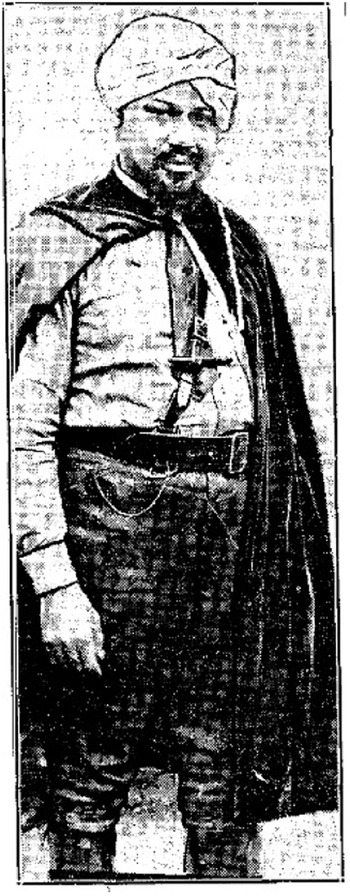
We can observe how Hamid uses clothing, ritual, and bodily performance to assert his religio-racial identity as what might be called a Black Orientalist from the very beginning of the opening ceremony of his Temple. His ceremonial clothing, as well as his everyday attire, carefully reflected his Black Oriental identity. When he wasn't wearing his chartreuse robe and gold vestment, he was known to don a purple or white turban, gold-braided green cape, green shirt, Sam Browne belt, and black riding boots (Figure 1).Footnote 11 In asserting that he spoke Chinese, and crediting it to a prior reincarnation, Hamid based his authority as a Buddhist in an alternative history and ancestry that circumvented both slavery and, possibly, white Buddhists in the United States. In addition to his prior rebirth in China, Hamid frequently claimed to have been born “in Halfa, in the Sudan,” on January 6, 1903, “the son of a rug merchant, with whom he traveled in Egypt, Persia, Hindustan, and Greece before coming to this country at the age of fourteen with an uncle.”Footnote 12 After his death, police clarified that Hamid was born in Philadelphia, as Eugene Brown. Hamid, himself, however, traced his own ancestry to two geographical origins: Africa and China. His chosen name, Sufi Abdul Hamid, reflected his Black Orientalist identity. During his life, Hamid created his own religio-racial identity by constructing a unique history for himself that extended over multiple lifetimes.
A photograph of Sufi Abdul Hamid from 1934. He is wearing a turban, cape, riding boots, and a ceremonial sword. Photograph from Afro-American, August 6, 1938 (Matthews, 1938c).

Hamid's capacious construction of his religio-racial identity occurred within local, national, and global discourses. Articles published in Black newspapers from the early twentieth centuryFootnote 13 reveal that, throughout his career as a racial rights activist and community leader, Hamid negotiated his religious and racial identity in relation to a number of religions, including Buddhism, Islam, and spiritualism, as well as Black nationalist discourses. Within Harlem, Hamid used his temple to materially support the Black community. In his negotiation of a Black Orientalist identity, Hamid participated in broader conversations about the meaning of Blackness taking place in Harlem and the urban north. His words reveal influences from Black Israelites, Black Muslims, and spiritualists. His Black Orientalist identity would have resonated with other groups who resignified Blackness, thereby rejecting hegemonic religio-racial frameworks that centered whiteness in divine histories and classifications of “Christian Negros” that associated Blackness with oppression and enslavement. Hamid's Black Orientalist identity, which amalgamated various Asian religions, drew from global Orientalist discourses even while being recalcitrant to forms of white Orientalism.
In the first part of this article, I examine Hamid's life, prioritizing how he shaped his own religio-racial identity; in the second half, I turn to how his identity was also framed by others. By investigating Black newspapers and FBI documents,Footnote 14 I reveal how Black newspapers constructed Hamid's religio-racial identity in ways that at times echo a hegemonic discourse that marks nonwhite, non-Christian people as dangerous to the American body politic. In doing so, I extend Weisenfeld's framework of the religio-racial identity in ways similar to Matthew Cressler, whose work on Black Catholics suggests “the ways we can decenter white agency in race-making while revealing how racial whiteness operates beneath the surface of normative ‘religion,’”Footnote 15 and Megan Goodwin, who argues that “religio-raciality is not made in isolation: religio-racial identity is not merely elastic but dialogic (cf. Bakhtin), negotiated between the self and the state, among other authorizing parties.”Footnote 16 Goodwin asserts that American white supremacy operates as a “religio-racial force” and that “efforts to resignify Blackness via religious belonging never operated outside state surveillance or discipline.”Footnote 17 This article similarly interrogates how the co-constitution of religion and race operates in tension in different political and social contexts.
Hamid died in 1938 but was posthumously implicated in a World War II conspiracy theory, called the “Black Buddhism Plan,” which proposed Black Buddhists would join forces with the Japanese Empire against the United States. At a time when the FBI increased surveillance on African Americans suspected of pro-Japanese sympathies, the religio-racial stereotype of Japan as an empire of conniving Buddhists created an environment in which Black Buddhists were rendered potential enemies of the state. These convergences marked Hamid, whose associations with Buddhism operated in support of the Black community, as the perfect suspect for the head of a reported plot based in fears of a counterhegemonic religio-racial vision of a Pacific regional order counter to that envisioned by the United States government. The fact that this plan was published by a Black newspaper and authored by a former follower of Hamid illustrates the presence of competing ideologies of Black American religio-racial subjectivity. As Lerone Martin has noted in his study of Elder Lightfoot Solomon Michaux's role in FBI efforts to discredit Martin Luther King Jr., some Black religious figures were not subversive, but rather engaged with the religio-racial mechanisms of the state in alternate ways.Footnote 18 Black religio-racial subjectivity could be informed by and serve the interests of the American religio-racial state. This story, however, is not only about Black religious subjectivity. I contend that it is also about how Buddhism operates in various religio-racial formulations as individuals negotiate their own religio-racial subjectivities in tension with dominant national and international religio-racial categories.
Historical Contexts
Hamid's life and memory rests at the intersection of multiple histories that have rarely been studied in conjunction, including the transmission of Buddhism to the West, the Great Migration and new religio-racial movements in the twentieth-century, and the juxtaposition of Pacific Empires leading up to World War II. In this article, I primarily situate Hamid in relation to the history of Buddhism in the United States. I do so not to ignore the importance of these other histories, but to illustrate how Hamid's story hints at an untold chapter in the transmission of Buddhism to the “West,” one that considers not only the religio-racial contours of both the American nation-state and individual Buddhists, but also the history of Black American engagements with Buddhism. Here I am not concerned with the “accuracy” or “authenticity” of Hamid's Buddhism. This would miss the point. There is no doubt that Hamid understood himself to have been practicing Buddhism, and that Buddhism was an important component of his own identity—he believed, after all, that he brought “the first message of Buddha to be broadcast over the air.”Footnote 19 I am interested in what Buddhism meant to Hamid, how he represented it, and how it fit into his own racialization—both by himself and by others.
For Buddhist studies, a study of Hamid's religio-racial subjectivity builds on a growing body of scholarship that complicates our understanding of how Buddhists negotiate religious, ethnic, and racial identities within inter- and transnational networks.Footnote 20 At the same time, it also complicates historical narratives that replicate the story of the development of Buddhism in the United States as one of “two Buddhisms,” one Asian immigrant, the other white convert.Footnote 21 Despite widespread criticism of this typology, our histories of Buddhism in the United States still replicate this model. A broad-strokes description of this history begins in the mid-nineteenth century, as Asian Buddhists began arriving in what is now the United States. The first to arrive were Chinese indentured workers, followed by Japanese laborers, most of whom were Jōdo Shinshū Buddhists. In the nineteenth century, Romantics, like the Transcendentalists and Theosophists, began to incorporate Orientalist understandings of Buddhism into their religious philosophy. Interest in Buddhism among white Americans peaked after the World's Parliament of Religion in 1893, following popular speeches given by Modern Asian Reform Buddhists, like Anagārika Dharmapāla. This initial interest is believed to have died down prior to World War I,Footnote 22 with public opinion of Buddhism reaching a nadir with the incarceration of Japanese people during World War II. During incarceration and in the years following, Japanese American Buddhists adapted their practice to present Buddhism as consonant with American ideals. While Japanese Buddhists cultivated an “ethno-national vision” that saw Japanese Buddhists capable of being incorporated into the nation, white Beat Buddhists deployed a countercultural vision of Buddhism.Footnote 23 Following the Immigration Act of 1965, Buddhists from Asia, including South and Southeast Asia, immigrated to the United States in increased numbers. At the same time, prominent white teachers began travelling to Asia to study under Buddhist monks. Increased exposure to Buddhism coincided with the white countercultural movement, which used Orientalist visions of Buddhism to support criticism of mainstream, middle-class American culture. And the medicalization and secularization of the practice of Mindfulness allowed for the mass dissemination of Buddhism into American mainstream culture. Despite new works that complicate this history, such as ethnographic studies of temples housing multiple ethnic or racial groups,Footnote 24 American Buddhist history overall presents an image of two “parallel congregations,” often privileging “American” Buddhists as “white.” In such histories, we have missed opportunities to examine how images and ideas about Buddhism are employed by actors who are neither white nor Asian. There is no room for a 1930s Black Buddhist in this narrative.Footnote 25 Yet this, too, is a vital part of American Buddhist history.
The supposition that there was a decline in engagement with Buddhism among white Americans prior to and during the interwar period only holds if we ignore Black American religious history. Increased American engagement with the Pacific coincided with the rise of Black international consciousness and a growing engagement of the Black American community with Asia. The period in which Hamid lived witnessed the growth of Black nationalist movements, the rise of Afro-Asian solidarity movements that looked to Asians as fellow sufferers of white supremacy and comrades in the fight against colonialism, and the emergence of new Black religious movements that resignified Blackness and oriented their religious and racial history toward Asia. Combined with an increased popularity of Black spiritualism and metaphysical traditions, this period provided the conditions for someone like Sufi Abdul Hamid to fashion a Black Orientalist identity, in which Buddhism formed part of his own negotiation of his religious and racial identity.
Constructing a Religio-Racial Identity
Local Contexts
The Temple's opening represented the climax of an innovative religio-racial identity that Hamid cultivated, performed, and evolved throughout the 1930s. This process began, to our knowledge, with his career as a soapbox orator and community organizer, first in Chicago's South Side, and later in Harlem. It evolved over time as Hamid added new layers to this identity—first spiritualism, then Islam, then Buddhism—each one adding to his religious repertoire, rather than replacing what came before it. It was through his identity as a Black OrientalistFootnote 26 that Hamid conceptualized novel links between religion, race, and national belonging, both for himself and for Black people as a whole.
Hamid spent his adult life in the urban north at a time of great religious change. In the Great Migration, Black Americans migrated to the urban north to flee the violence of the Jim Crow American south and seek new opportunities, bringing with them southern religious practices. There, they joined migrants from the Caribbean, who brought with them their own religious practices. They would have encountered a flourishing artistic and literary scene, religious innovation within Christian communities, and newly established religions. Along with a wide variety of Black Churches—including mainstream churches and storefront churches—one could find Black nationalist movements like Garveyism, spiritualists and practitioners of the “Oriental sciences,” and new religious movements “comprised of mostly poor and working-class black southern migrants.”Footnote 27 Some of these groups incorporated religious repertoires from Pentecostal Christianity, Spiritualism, Kabbalah, and Freemasonry.Footnote 28 Such innovation is an example of what Jacob Dorman terms “polycultural bricolage,” a term employed to capture the way that religions “are not bounded systems, but fluid, multivalent processes, constructed by many individual bricoleurs who work by recombining old and new” in creative ways.Footnote 29 Justin McDaniel and Robert Campany have employed the term “religious repertoires” to refer to the cultural and religious elements—such as objects, texts, and rituals—drawn on by individuals, noting that religious repertoires “can be internally inconsistent and contradictory,” and are developed “within intimate familial, social, and professional networks.”Footnote 30 Such creativity appears at the opening ceremony of Hamid's Universal Holy Temple of Tranquility, with the performance of Christian Spirituals, the reverence of “all the sages and prophets of the ages,” the prostration toward the Buddha, and Orientalist displays of supernatural powers.Footnote 31
Hamid belonged to a constellation of new religions that reimagined Blackness in relation to religion in response to “racial alterity, the systematic devaluing of black humanity, and the disciplined efforts ‘in pathologizing the religious experiences of blacks.’”Footnote 32 Tracey Hucks observes that Black religious nationalism “has continually sought to resist, dismantle, and recast” “anti-blackness imagery” that presents Black people as morally and physically inferior to white Euro-Americans.Footnote 33 New religio-racial groups, in endowing Blackness with new meaning and rejecting the identifier “Negro Christian,” asserted the humanity of Black people and established them within sacred histories that circumvented ones of enslavement. They “provided new ways of understanding their origins as a people, the events that led them to their current social, religious, and political locations, and their corporate futures.”Footnote 34 Multiple groups emphasized cartographic connections between African Americans, Africa, and Asia through religion, culture, and race. Some did so through dialogue between Asians and African Americans (like the Nation of Islam [NOI] and the Ahmaddiya movement).Footnote 35 Some communities varyingly placed their origins in Ethiopia (Ethiopian Hebrews), Morocco (Moorish Science Temple of America [MSTA]), and Asia (NOI), while others, like the Peace Mission led by Father Divine, rejected racial identifiers altogether, favoring visions of a common humanity. Hamid, we will see, appears to have absorbed varying elements of these movements. Likely influenced by Black Israelite religions, at one point he professes that Black people originated in Ethiopia. His Muslim name would have connected him to other Black Muslim groups. And he established a Buddhist temple that offered a vision of a shared humanity among different races—perhaps in competition with Father Divine, with whom he had a rivalry.Footnote 36
Religio-racial groups performed their new sense of self by adopting new names, manners of dress, and dietary and health practices. Followers of Father Divine adopted new names to separate themselves from their “false, mortal selves,” and indicate their turn toward their spiritual commitments.Footnote 37 Members of the MSTA took on new names that reinstated their tribal name (Bey, El, or Ali) in favor of their prior “slave name.”Footnote 38 Followers of the NOI similarly rejected their “slave name” in favor of restoring their Asiatic Muslim names.Footnote 39 Ethiopian Hebrews covered their heads during services (black skullcaps for men, turbans or headscarves for women); male MSTA members donned a red fez (influenced by Masonic garb) while women wore turbans and long dresses.Footnote 40 Each community employed such embodied performances to “engage the history and contemporary politics of the black body, speaking to the place of ideas about race and the body in understandings of national belonging.”Footnote 41 For this reason, Weisenfeld claims, adopting new embodied practices to reflect one's religio-racial identity was not simply political, but also performed religious functions.Footnote 42
Hamid, likewise, performed his adopted identity through his new name, his speech (the use of Chinese), and sartorial practices. While it was not uncommon in this period for Black Americans to dress “Oriental” as a method of obscuring any potential identification as Black and to evade Jim Crow laws,Footnote 43 Hamid's resignification of his own racial identity was not merely political. Rather, following Weisenfeld, Hamid performed his religio-racial identity as “a necessary part” of his “commitment to the narrative [he] believed conveyed [his] true history.”Footnote 44 His appearance reflected his dual origin of Africa and China and, combined with his charisma, attracted a following to whom he taught Eastern religions in the service of a radical counterhegemonic discourse. This does not discount Hamid's religious identity and expression, but rather shows he used the embodied performance of his religious identity to reflect on African Americans as political, social, religious, and racialized subjects. Through all this activity, Hamid sought to provide material relief to the Black community, protest anti-Black racism and discrimination, and reject white supremacy.
Hamid's Black Orientalist identity served him well in Chicago, where he first rose to prominence as a soapbox orator at the forefront of a successful jobs campaign. In Chicago, he styled himself as Bishop Conshankin. Roi Ottley describes Bishop Conshankin as “a Buddhist missionary and a devotee of Oriental magic.”Footnote 45 According to McKay, Bishop Conshankin “delved into the mysteries of occultism and, mixing together a hash of Hindoo, Persian and Chinese religions, he promoted himself as an Oriental philosopher.”Footnote 46 He reportedly adopted the name Sufi Abdul Hamid at the behest of Black Muslims in Chicago, who “convinced him that the magic racket was a hindrance to the more serious work of job campaigning.”Footnote 47 Apparently spiritualists lacked the reputation Muslims had among Black American elites. Both of Hamid's adopted names—Bishop Conshankin and Sufi Abdul Hamid—helped assert a new genealogy for himself, one that, like the names of other members of new religio-racial groups, signified “genealogies that transcended the bounds of Americanness, forging links to pre-American origins and transnational identities.”Footnote 48 But the latter moniker firmly tied him to other Black Muslims who adopted new names to signify their religio-racial identity as Moorish Americans or as Asians. It is perhaps with the selection of his new name that Hamid incorporated Islam into his ever-expanding religious repertoire, continuing to maintain interests in spiritualism, metaphysicalism, Buddhism, and Hinduism.Footnote 49 This would not have been unusual for the time—many migrants and immigrants in northern cities moved to, and through, different religious groups, with some individuals “combin[ing] political, social, and religious options as suited their individual needs.”Footnote 50
Hamid moved to Harlem in 1932, where, speaking from atop a stepladder on 125th Street in Harlem's commercial district, he quickly distinguished himself among other sidewalk orators. He soon cemented himself as a vital component to the first phase of the Harlem jobs campaign (1932–1935). At this moment Harlem was economically dominated by white businesses, many of them Jewish owned. When Harlem was annexed to New York City in 1873, it contained numerous ethnic groups, the largest of which was the Jewish community. By 1910, Harlem contained the second largest concentration of Eastern European Jews in the United States. Black people began to migrate to Harlem in the final decades of the nineteenth century. The Black population in Harlem increased during the Great Migration, when Black Americans from the South, joined by immigrants from the Caribbean, relocated to urban cities in the north. This coincided with the movement of Harlem's Jewish population into newer housing units in the Bronx.Footnote 51 By the end of the 1920s, Harlem's population was 97 percent Black.Footnote 52 The depression, coupled with rising rent in Harlem, hit the Back Harlem community hard. While some advocated for a solution that lay in African Americans starting their own businesses within their own communities, which would be patronized by Black people, others saw the solution in gainful employment in white-owned businesses.Footnote 53 However, the majority of white-owned businesses did not hire Black people, and if they did, offered only the lowest paying positions.Footnote 54 Hamid criticized Harlem business owners who discriminated against Black Americans in their employment practice, calling for a boycott of all white-owned business who would not hire Black people.
Although popular among the working class, Hamid drew attention and criticism for his flamboyant dress and radical rhetoric. Multiple people suspected Hamid of being an opportunist, noting that his jobs campaign organization, the Negro Industrial and Clerical Alliance charged membership fees in return for job promises.Footnote 55 Black elites in Harlem repeatedly distanced themselves from Hamid, whose frequent condemnation of Christianity, association with Islam and other Asian religions (described by Claude McKay, a prominent writer and poet of the Harlem Renaissance, as “the mumbo-jumbo of African fetishism and Oriental philosophy”Footnote 56), unusual dress, and fiery speeches defied Black respectability politics.Footnote 57 Particularly controversial was his antisemitism, which formed part of his larger antiwhite rhetoric and earned him the moniker of the “Black Hitler of Harlem.” Black Church leaders were quick to condemn Hamid for his antisemitism.Footnote 58 It is likely that they were also motivated by the threat of new religio-racial movements, which was “both theological, in that the groups offered options outside of Christianity, and institutional, in moving beyond the broad umbrella of ‘the black church’” during “a period of religious ferment and transformation.”Footnote 59
Hamid originally denied charges of antisemitism, and McKay suggests these accusations were purposefully exaggerated by his opponents to discredit him.Footnote 60 However, Hamid was known to use ethnic slurs and antisemitic language in his speeches. It seems that his stance toward the Jewish community changed over time, as part of his own constantly shifting and evolving negotiations of religion and race. In October 1934, Hamid was brought to court on charges of antisemitism. The plaintiff, Edgar H. Burman, Commander-in-Chief of the Jewish Anti-Nazi Minutemen organization, accused Hamid of referring to himself as “Black Hitler” and declaring open war upon the Jews.Footnote 61 Hamid avoided charges in this case, but wound up in court again in January 1935, when he was charged with distributing pamphlets titled “The Black Challenge to White Supremacy” and preaching atheism without a license. Hamid was sentenced to two ten-day terms at a workhouse. He denied the charges of atheism, arguing “I don't see how you can accuse me of that when I'm a Mohammedan, one of the most powerful religions in the world.”Footnote 62 Thus, for his first few years in Harlem, Hamid firmly asserted his religio-racial identity as a Black Muslim, positioning this identity in some ways that mirrored dominant religious and racial hierarchies (in his antisemitism) and in others that subverted the values of the white supremacist nation-state.
The pamphlet in question provides a reference point to Hamid's own complicated religio-racial identity. McKay provides a summary of this pamphlet in his book, Harlem: Negro Metropolis, which contains his account of major figures in Harlem during the Harlem Renaissance. He describes the pamphlet as follows:
The frontispiece contained a photograph of the turbaned Sufi and under it this verse from Omar Khayyam:
Today of past Regret and future Fears:
Tomorrow:—Why tomorrow I may be
Myself with Yesterday's Seven Thousand Years.
The thin pamphlet of 24 pages purports to be a history of the Negro race and ranges through the ancient world of Egypt. It extols Hermes Trismegistus as the greatest black man—he had discovered and created the “immortal works known as the ‘Caballah’ which is now in the hands of the Jewish Race and considered one of the world's greatest philosophical achievements.”Footnote 63
McKay adds that in 1935, Hamid started to begin his speeches “with a proemial statement that Africa was the cradle of religion, that the original Semites are Ethiopians, who are the true Negroes, and that therefore there can be no fundamental conflict of race between Negroes and Jews.”Footnote 64 This description provides us with some indication that Hamid's philosophy, at least at this time, included a vision for the larger history of Black people, and that within this history religion and race were intimately connected.
In tracing the religious and racial history of Black people to Ethiopian Hebrews—and claiming the original Jews were Ethiopian—Hamid echoed Ethiopian Hebrews, who maintained that “racially, Ethiopians were Semites.”Footnote 65 Ethiopia held special import for Black religious nationalism since the late nineteenth century, when Ethiopia defeated Italy in the 1895 Battle of Adwa. The victory of an African nation over a European one “reinvigorated traditions of Black political internationalism . . . inspiring later twentieth-century pan-African political organizing” and Black Israelite religions.Footnote 66 Black Israelite religions taught “that the ancient Israelites of the Hebrew Bible were Black and that contemporary Black people are their descendants.”Footnote 67 Black Israelite religions, by looking to Africa for their religio-racial identities, fashioned a divine history that centered Black people as sacred and portrayed Black people as “religious agents . . . instead of objects of missions.”Footnote 68 Black Israelite ideas could also be found among Black Muslim and Christian communities, such that Hamid's repetition of Black Israelite ideas would have been part of a broader religious rhetoric of the time.
Hamid borrowed from Black Israelite ideas to place the divine history of Black people, even while constructing his own identity as Arab and, eventually, Chinese. He claimed to have been born in Egyptian Sudan, and to have possessed an Arab passport.Footnote 69 If Hamid's current birth connected him to a larger discourse that connected Black people globally and looked to Africa as a place of religious origin, his prior birth—asserted at the Temple opening to be Chinese—linked him personally to the Asian religions and philosophies that he would bring together in his temple. The various repertoires that Hamid draws on reveal the messy and contentious process through which individuals make sense of their own religious and racial identities.
Global Orientalist Discourses
Hamid's temple, like his religio-racial identity, represents a heterogenous amalgamation of what Lisa Lowe has termed “a multiplicity of Orients.”Footnote 70 Just as Hamid had multiple reference points for his own religious and racial identity—Ethiopia, Egypt, China; Jewish, Muslim, Buddhist—the Temple of Tranquility incorporated a broad array of religious practices and credited multiple sources of knowledge. Hamid collected this Orientalist amalgamation under the banner of Buddhism, proclaiming the Universal Holy Temple of Tranquility to be Buddhist, although based on the teachings from all religions. In doing so, he participated in a form of Orientalism that at times shared in dominant Orientalist discourses, even while critiquing white hegemonic religious and racial categories.
Hamid began to advertise the Universal Order of Tranquility in late August and early September of 1937, proclaiming it to be open to “all people, regardless of race, creed, and color.”Footnote 71 Standing outside his home, dressed in plain clothes, Hamid laid out his plans for the Universal Order of Tranquility. As part of his pitch for a religious community open to all people, he repudiated his prior antisemitism, criticized Hitler, and invited Jews to join the community. In 1935, Hamid had been solicited by Nazi organizations who offered to help him fight against Jews in return for establishing a Black legion. To the press, Hamid recounted, “I spurned the Nazi offers because I realized that they had no better feeling for me or my people than for the Jews,” and “if the Nazis ever came into power in America, the Negroes here would suffer the same fate as the Jews in Germany.”Footnote 72 He concluded “I can now admit that it was fallacious for me to condemn Jews as a race”Footnote 73 and promised equality to all Jews who joined his temple, which would not discriminate based on race or religion.Footnote 74 In Cooke's article promoting the opening of the Temple, she remarked that his dedication to an intercreedal and interracial organization was “a far cry from the days . . . when he was trying to run all of the white folks out of Harlem.”Footnote 75 Regardless of his attempts to present the Temple as open to all races, the moniker “Black Hitler” stuck. But with the opening of his temple, he successfully cemented a new layer to his identity: Buddhism.
While by its opening, the temple may have been named as Buddhist, Hamid's early pitches for the movement drew from a wide array of religious influences. In his initial announcement of the formation of the Universal Order of Tranquility—of which he claimed his then-wife, Stephanie St. Clair, was a devotee—Hamid explained that the movement was based on “the teachings of Hermes Trismegistus, ancient Egyptian philosopher and sage,” and that the main features of the movement included “belief in the conquest of mind over matter, reincarnation and common ownership of property of all of its followers with the establishment of communal industries.” The Universal Order of Tranquility was to be further based on his knowledge from fifteen years of learning: “I studied the Upanershads of India, the Zhender-Vesta of Persia, the Tao and Louize movements of China and the political and religious philosophies of Confucius. I went beyond the Christian history of the last nineteen centuries and studied the originators of Christianity, the Gnostics. I studied the original alchemists, whose idea was not the turning of base metal into gold but the distilling of baser thoughts into a finer realization.”Footnote 76 He concluded:
[T]he followers of the Universal Order of Tranquility will develop the Neo-Ghosterian Spiritual Culture, which will encompass a belief in spiritual reincarnation. They will develop a form of devoted concentration which will make them immune to all human failings, including pain. Like the Janes of India and other masters of Hather Yoga, they will be able to walk on pits of fire or pierce their flesh with nails without feeling pain or suffering injury.
Hamid had planned to circulate a new pamphlet advertising his movement, called “Universal Truth vs. Universal Lie,” and was working on a “ten-volume set of books which will be the ‘true text’ of his movement.”Footnote 77 Hamid's ambitious program indicates he intended to consolidate a variety of religious philosophies into one movement that emphasized mind over matter and reincarnation.
Hamid might have been the leader of the temple, but his third wife, Madame Fu Futtam (born Dorothy Matthews), played an important role in the development of Hamid's philosophy, the gathering of followers for the Temple, and possibly the Temple's financing. Madame Futtam—who claimed to be part-Japanese and changed her name to reflect this background—was a spiritualist in her own right. She authored numerous dream journals that she promoted in newspaper ads. Hamid's second wife, Stephanie St. Clair, from whom he separated in November 1937, accused Hamid of having an affair with Madame Futtam. For their part, Madame Futtam and Hamid maintained that they had been meeting each other to discuss religious philosophy. In one interview, Fu Futtam claimed, “Sufi and I are interested in esoteric work, and he has been helping me on philosophical passages in a book I've just finished.”Footnote 78 When a reporter from the New York Amsterdam News asked Hamid to corroborate this, “after a lengthy discussion of the principles of Buddhism and its connection with his newly evolved philosophy,” Hamid explained “he is working on a philosophical concept of religion,” and St. Clair “interferes with his work. Mme. Futtam had been helping him organize his followers, and both were interested in the same ideas.”Footnote 79 Hamid married Madame Futtam in April 1938, which appeared to confirm rumors of the affair and that Madame Futtam had financed the Temple.Footnote 80
When it was finally time for the Temple to open, Hamid described it as “a Buddhist temple based on the teachings of all the sages and prophets of the ages,” the purpose of which was “to surmount untested faith and belief with sound knowledge similar to that practiced by the yogis of India, Tibet, and Japan.”Footnote 81 The Universal Holy Temple may have acknowledged other religious prophets, but without a doubt the Temple emphasized Buddhism and Asian religions, as they were understood by Hamid and by his community. In practicing Buddhism, Hamid was motivated by his confirmation that he was “a master of the same philosophy as practice by those of the European world.”Footnote 82 Hamid explained that in order to truly understand the philosophy of which he himself was master, one needed to take classes at the Temple. For “you can't learn this in Columbia or Harvard or Princeton. You will have to come to our school here to learn the deepest esoteric subjects that are taught. I may be speaking in parables like your Savior, but I will get more explicit as I go along.”Footnote 83 The Temple's program included an eclectic mixture of classes on Buddhism and Asian religions, such as “The Nirvanic Path,” “The Glorious and Supreme Path of Disciplehood,” “The Esoteric Path of Knowledge,” and “The Yoga of Subduing the Baser Self.”Footnote 84 By portraying university education as inadequate to understand the esoteric truths of Asian religion, Hamid employed common romantic Orientalist depictions of Asia as holding timeless, intuitive wisdom. But unlike white counterculturalists who employed the same rhetoric, Hamid also bypassed white supremacist restrictions on African American university education.
In his framing of Buddhism and other Asian religions, Hamid, like other new religious movement leaders of the Great Migration, criticized Christianity, capitalism, and imperialism. Although Hamid positioned the Temple as drawing on “the teachings of all the prophets,” he appears to have been rather critical of contemporary Christianity.Footnote 85 Reportedly, in his first sermon, he said of the Bible: “You are used to a preacher telling you what Isaiah told Paul to tell Moses. But the Bible is messed up so bad that we don't know what Moses said.”Footnote 86 As we have seen, Hamid contrasted his manner of worship to “emotional” churches, in which members would “rather get out in the aisles and mess around and pat your feet,” adding that “there will be no collection plates here.”Footnote 87 In making this comparison, it is possible that Hamid, like other Harlemites, criticized storefront churches “for their public piety and noisy worship practices, deeming them vestiges of a backward South.”Footnote 88 At this moment other new religious movements, like the MSTA, were “demeaning the Christian worship of African American migrants from the South whose cultural proclivity to religious ecstasy or spirit possession was drastically transforming the religious landscape of the urban North.”Footnote 89 Denigrating the religion of Southern migrants was a way of criticizing Christianity as a whole.
By referencing collection plates, Hamid appears to be echoing critiques of churches that capitalize off Black worshippers without contributing to their needs.Footnote 90 And by promoting Communism as a Christian value, Hamid joined “a small but vocal minority” who “asserted that Communism was more ‘Christ-like’ than Christianity and made calls for a ‘new religion.’”Footnote 91 His main issue was not Christianity, but rather the way it was practiced in Harlem in his day: “I approve of the philosophy of Christ, and even of the teachings of Christianity,” “but as advocated by the average Negro minister it is detrimental to the Negro race.”Footnote 92 Hamid rejected religious institutions “primarily based on dogmatic theology,”Footnote 93 an opinion he held for years. Since at least 1934, Hamid claimed to be “a disbeliever in the strict dogmas of Christianism, Jewishism and Confucianism equally with Moslemism and evangelism.”Footnote 94 He believed that “when a man becomes a slave to any dogma or creed he becomes a useless entity to the social order in which he lives.”Footnote 95 He further criticized “Occidental religion,” reasoning that if it had truly carried out the teachings of “Christnar,” the Buddha, and Jesus, then “there would not be room in the society of mankind for such things as lust, greed, hate, and passion, coupled with insanity,” which were at the root of racial injustice.Footnote 96 In his view, Western religion had failed, evidenced by the racist oppression of Black people in the United States. With the Universal Holy Temple of Tranquility, Hamid saw an opportunity to “bring about a complete revolution in the realm of spiritual culture in the West.”Footnote 97
Like other new religio-racial movements in Harlem, Hamid sought both the material and spiritual liberation of Black people. He believed the Universal Order of Tranquility to be both a social and divine community, proclaiming that “by common ownership we may be able to break down the five detrimental causes of human wreckage—lust, greed, hate, passion and insanity. Mankind has suffered religiously as a result of dogmatic and theological misinformation.”Footnote 98 He placed the material relief of the Black community at the center of the Temple's activities. Part of this community plan was the building of the Universal City, which Hamid planned to use to employ “thousands of Negroes who will produce everything my people need in the way of food.”Footnote 99 The Temple reportedly contained a free employment agency, a room for the manufacturing of sacred garments, offices, an auditorium, and a social center for youth.Footnote 100 After the conclusion of each service, Hamid would invite the audience to move to the banquet hall to eat as much as they should wish.Footnote 101 In addition to this material relief, Hamid planned to use the Temple as a platform to speak on behalf of Black struggles.
Already in his first sermon, notably broadcast over the radio, Hamid used his celebrity to address religion, politics, and racial inequality. He originally planned to transmit sermons nightly from 8:15 to 8:45, every day except Fridays.Footnote 102 But after about a month he ran out of funds and cancelled the radio broadcasts.Footnote 103 These broadcasts were intended to be used to “appeal nightly to private and public industry to give employment which will help obliterate the desperate plight of the people of Harlem.”Footnote 104 By broadcasting his sermons over the radio, Hamid took advantage of the growing trend of Black preachers utilizing the popular entertainment industry for proselytization.Footnote 105 Beginning in the 1920s, Black clergy began to use the medium of the phonograph as a basis of ministry. Phonograph sermons continued to be a popular commodity well into the 1930s. In 1930, only 7 percent of African American households owned a radio, and it was not until World War II that radio ownership in Black homes reached over 50 percent.Footnote 106 Like phonograph preachers who created race records, Hamid similarly used modern broadcasting to promote the well-being of the Black community and bring his religious messages to a wider audience. The “first message of Buddha to be broadcast over the air” was, then, one in support of the Black community.
We can see in Hamid's presentation of Buddhism, and the religion of the Universal Order of Tranquility, many features characteristic of Orientalism. Early scholarship on Buddhism was intimately bound up in colonialism, Orientalism, and the emerging field of race sciences. While early postcolonial Buddhist Studies scholarship emphasized the role of Euro-Americans in constructing knowledge about Asia and Buddhism, recent scholars have resisted totalizing narratives. These scholars highlight the process of cultural exchange in the construction of the “Orient,” the heterogeneity of interests and actors in this process, and the ways that Orientalist and colonial hegemonic discourse also made possible modes of resistance.
Colonial-era scholars, through a process of dialogue and exchange with Asian Buddhists,Footnote 107 forged new ways of understanding and representing Buddhism. Early Buddhist Studies scholars prioritized Pali texts and doctrine as the source for “authentic Buddhism,” which sometimes mapped onto racial theories of Aryan civilization. Nineteenth-century scholars, as part of a longer quest for the racial origins of the Buddha, determined that Buddhism emerged in India, and from there concluded, based on a conflation of linguistic families with racial sciences, that the Buddha was racially Aryan.Footnote 108 Such an identification, along with a text-based reading of Buddhism, made possible the articulation of a universalizing discourse that privileged whiteness, portraying “true” Buddhism as a “religion of science developed for an Aryan future,”Footnote 109 while simultaneously dismissing contemporary Asian Buddhists as local, ethnic corruptions of a world religion. Alongside such racial articulations of Buddhism ran a romantic Orientalist current, in which Euro-Americans saw in Buddhism and Asian religions the potential cure to an ailing Western society in the throes of a spiritual crisis brought on by the materialism of scientific rationalism.
For their own part, Asian reform Buddhists engaged in modernist discourses as both accommodation to and resistance against colonialism and modernizing discourse, and in response to their own nationalist contexts. Individuals like Anagārika Dharmapāla frequently subverted modernist discourses to critique the imperialist assumptions of Euro-American scholars and to elevate Buddhism above Christianity, particularly that practiced by missionaries in Asia. His rhetoric was not entirely counterhegemonic, however. He also deployed antisemitic rhetoric to condemn Christianity and Islam for the supposed degeneration of humanity, proclaiming, “[W]e condemn Christianity as a system utterly unsuited to the gentle spirit of the Aryan race.”Footnote 110 Instead, he claimed that Asians descended from the Buddha were the true Aryans. In doing so, Dharmapala undermined Western Christian superiority while upholding dominant racial categories.
Both anticolonial Buddhist discourse, as well as romantic discourses, might form part of what J. J. Clarke terms “affirmative Orientalism,” in which romanticized visions of the East are contrasted with the West “as an agency for self-criticism and self-renewal, whether in the political, moral, or religious spheres.”Footnote 111 For Euro-Americans, the universalizing project of Orientalism could be “subversive and counter-cultural within the Western context, designed to confront indigenous Western religious and philosophical assumptions and practices with a radical alternative.”Footnote 112 For Asian Buddhists, modernist and Orientalist discourses could be inverted to criticize Western imperialism and colonial epistemologies. And yet, neither of these Orientalist discourses capture the specific racial, political, and material dimensions of the Orientalism participated in by individuals like Hamid.
As Lowe observes, Orientalism is “heterogeneous and contradictory,” consisting “of an uneven matrix of orientalist situations across different cultural and historical sites,” each of which “is internally complex and unstable.”Footnote 113 As such, we should be skeptical of narratives that portray Orientalism as a process that occurs solely between a white West and an Asian East. Many Black Americans, including intellectuals like W. E. B. Du Bois and religious groups like the MSTA, constructed romantic images of Asia to protest the oppression of Black people in the United States, critique the colonization of Africa and Asia, and repudiate Orientalism's “discursive trap of mutual subordination and . . . separation” of Black Americans and Asian Americans.Footnote 114 Such a discourse is defined by Bill Mullen as Afro-Orientalism, “a counterdiscourse that at times shares with its dominant namesake certain features but primarily constitutes an independent critical trajectory of thought on the practice and ideological weight of Orientalism in the Western World,” a “subtradition in indigenous U.S. writing on imperialism, colonialism, and the making of capitalist empire.”Footnote 115 Afro-Orientalism “constitutes a self-conscious alternate modernity that . . . can only define its subversive potential in terms of the West itself.”Footnote 116 Jacob Dorman, who is interested in Black Orientalism in relation to religion, defines it as “a recalcitrant counter-discourse that critiqued American racism and the discourse of civilization by exoticizing the self.”Footnote 117 Many Black religious movements of the late nineteenth and early twentieth centuries—including Black Jews, Black Muslims, Rastafarians, Black Shriners and Freemasons, and spiritualists—“both generated and were generated by black Orientalisms.”Footnote 118 Such individuals studied languages, donned “Oriental” dress, and connected themselves personally to the “Orient.” They would have engaged in a larger Orientalist popular culture that included theater performance, film, images, and spiritualist shops.Footnote 119 For these individuals, religion was an important means for “resignifying blackness in the context of a hierarchical racial frame,”Footnote 120 shifting the meanings of Blackness away from white American racial categories and toward the Orient.
Hamid's Black Orientalism, therefore, ran contiguous to other Orientalist discourses. It shares in other Orientalist frameworks while simultaneously being counterhegemonic—or perhaps in Dorman's terms, recalcitrant—to the dominant religio-racial frameworks of Orientalism in the United States. Hamid understood Asian religions as philosophies by nonwhite people that not only rivaled that of European philosophers but could also revolutionize the spiritual culture of the West, whose spiritual decay was signified by the disease of white supremacy and racism. His juxtaposition of Asian religions to the racial oppression of American capitalism and empire was inseparable from a growing Black religious and political movement “that criticized White racism while promoting reforms to achieve racial equality and Black political empowerment.”Footnote 121 Through his Afro-Orientalist vision of Buddhism, Hamid could envision himself as a racialized subject within Harlem and the United States, even while participating in broader discourses of Black internationalism. He was not the only actor constructing his religio-racial identity, however. After his death, other individuals also read his Black Orientalist identity as subversive. But they did so in ways that echoed dominant racial categories that marked nonwhite, non-Christian individuals as inherently un-American.
Religio-Racial Groups as Objects of Surveillance
On a cloudless, clear day, Hamid, his secretary, and his pilot and flying instructor boarded a rickety, nine-year-old J-5 Cessna monoplane. Hamid had bought the $2,000 plane only ten days prior. Ten minutes after taking off, the plane wobbled and spiraled toward the ground, crashing into an open field on Long Island. Hamid died shortly after witnesses reached the scene, on July 31, 1938, merely three months after opening his temple.Footnote 122 While the funeral was being planned, Hamid's body lay in state at the Temple, “dressed in the colorful robes and vestments of a bishop of the Buddhist cult of far away Tibet.”Footnote 123 The Temple held two funeral services for Hamid, one Muslim on August 10 and the other Buddhist the following day. While it was originally reported that a Japanese priest would officiate both ceremonies, in the end the Muslim funeral was officiated by Sufi Akbar and featured Southern hymns sung by the Reverend W. W. Monroe. The Buddhist funeral was performed by Preceptor James Carter.Footnote 124 Following the Buddhist funeral, Hamid's body was taken away in a hearse and buried in Douglass Cemetery in Long Island.Footnote 125 Candles were made in his image, to “be kept in the home of each member of the Temple in memory of their dead leader.”Footnote 126
At the Buddhist service, Preceptor James Carter announced that Hamid's widow, Madame Fu Futtam, predicted Hamid “would return in ninety days in some other form.” The Afro-American clarified that this referred to the Buddhist theory of transmigration.Footnote 127 After Hamid's death, it was well-reported that Madame Futtam communicated with the spirit of her dead husband either from within the meditation room located on the second floor of the Temple or during overnight stays in the field where Hamid died.Footnote 128 Under the advice of her husband's spirit, Madame Futtam carried on Hamid's work at the Universal Holy Temple of Tranquility, determined to create a program that was opposed to the teachings of Father Divine and to continue Hamid's agenda of community support. She arranged to feed “hundreds of persons daily” at the Temple at twenty cents a meal, which was “much better than anything found at Father Divine's restaurants.”Footnote 129 While Madame Futtam hoped to continue Hamid's legacy within the Temple, Hamid's reputation followed him well beyond the grave.
Rumors quickly began to circulate following Hamid's death. Where was he flying to, and why did his plane fail? Newspapers reported that the plane mysteriously ran out of fuel only moments after taking off, despite having been refueled before departure. Many believed someone had tampered with the plane.Footnote 130 An article in the Afro-American speculated that perhaps Father Divine cursed Hamid, as Hamid's “Universal City of Tranquility” would have rivaled Father Divine's Heaven.Footnote 131 Or, If Father Divine was not behind the curse, then perhaps it was the evil eye of Hamid's second wife, Madame Stephanie St. Clair, the “numbers queen.”Footnote 132 At the time of Hamid's death, St. Clair was serving a prison sentence after trying to shoot Hamid three times when he tried to dissolve their marriage contract.Footnote 133
Among the rumors, theories surfaced about Hamid's supposed connection to Japan. In one interview, Fu Futtam claimed that Hamid was a licensed pilot in Chicago and had been in the process of securing another pilot's license. Hamid, Fu Futtam explained, “planned a non-stop flight to California. After that he was to leave September 15 on a sacred trip. We cannot say now where that trip was to be made.”Footnote 134 The Afro-American immediately reported that the location of this secret trip was Japan. Journalist Ralph Matthews stated that Hamid had originally desired to be the first African American to undertake a nonstop flight to Liberia or Ethiopia. After Ethiopia lost to Italy in the Italo-Ethiopian war, Hamid reportedly changed his mind and sought to travel nonstop to Japan from Los Angeles. Matthews explained, “[T]his goal was in keeping with his adoption of Buddhism as the basic philosophy of his Universal Tranquility Movement. He believed Christianity had failed as a religion to solve the race's problem and he hoped his goodwill flight to Nippon would cement good feeling between the darker races.”Footnote 135 One week later, in an article dedicated to piecing together any possible relationship between Hamid and Japan, the Afro-American reported that Hamid had a number of Japanese followers and highlighted the presence of “Japanese rituals” at his funeral.Footnote 136
Up to this point, we have examined how Hamid constructed his own religio-racial identity as an Afro-Asian Buddhist and how, in the performance of this identity, he was able to speak to issues of race, religion, and national belonging. But Hamid was not the only actor participating in his own racialization. For the rest of this article, I turn to Hamid's memory, specifically how one Black newspaper positioned Hamid in relation to the religio-racial state that disciplined nonwhite, non-Christian people. This is indicated in the publication of a conspiracy theory known as the “Black Buddhism Plan,” or “BB Plan,” published more than three years after Hamid's death in 1938. The theory built on growing fears about Black Americans, Japanese Americans, Buddhism, and other non-Christian religions. These fears cannot be understood only in terms of race (a potential Afro-Asian alliance) or religion (the threat of Buddhism and non-Christian Black religions). Rather, the “Black Buddhism Plan” speaks to the way that religion and race are co-constitutive forces in rendering Black Buddhists as dangerous to the American nation.
The “BB Plan”
The circulating rumors about Hamid's relationship with Japan resurfaced after Pearl Harbor, when The People's Voice published a series of articles on the “Black Buddhism Plan.” The People's Voice, a New York City–based weekly paper founded by Adam Clayton Powell Jr. in 1942, according to the FBI, enjoyed a circulation of more than twenty-five thousand.Footnote 137 The first of four articles on the “Black Buddhism Plan” was published just one week after President Franklin Roosevelt issued Executive Order 9066, which required all Japanese persons to be removed from the West coast, and in the context of recent FBI arrests of Black Americans in Harlem. The “Black Buddhism Plan,” or the “BB Plan,” appeared in four articles in The People's Voice between February 28 and March 21, 1942.Footnote 138 Two, if not all four, of the articles were written by Cheves Richardson, an early supporter and friend of Hamid.Footnote 139 The BB Plan, conceived of by The People's Voice, is essential to understanding how Hamid's religio-racial identity placed him within the geopolitical context of the early twentieth century.
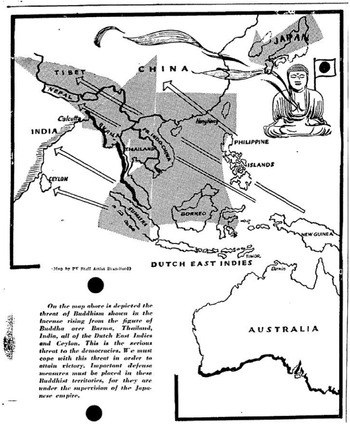
According to The People's Voice, the BB Plan was one aspect of a larger World War II plot, called the “B Plan” (Buddhism Plan) concocted by the Japanese to take over the entire world using Buddhism. The People's Voice warned readers that Japan would use Buddhism to unite the peoples of Asia. “The scope of the world B Plan of the Japanese is almost unbelievable,” Cheves Richardson wrote; “the strategy which they have used is definitely the cunning of an Oriental group.”Footnote 140 One article illustrated the threat of Japan, and of Buddhism, with a map (Figure 2). On this map, a large Buddha hovers off the coast of Japan. Incense smoke wafts from his torso, signifying the threat of Buddhism, and the Buddhism Plan, as it spreads throughout Asia. The People's Voice cautioned that Japan would first use Buddhist strongholds to attack India while simultaneously entering Sri Lanka through the Buddhist countries in Southeast Asia. “The World B. Plan has over 11,000,000 followers in Burma; 90,000 lamas act as agents, operating from Buddhist monasteries with headquarters in Rangoon,” they warned, and “in Thailand, Ceylon, Burma and Tibet, it is customary for every boy between 12 and 20 years of age to enter Buddhist monasteries,” where “particular stress is placed on the teachings of Bushido, imparting to them the fanatical battlefield heroism of which much has been said.” According to The People's Voice, Japan planned to consolidate their rule over all of Asia through Buddhism. And to make it worse, The People's Voice claimed, the Japanese “Buddhism” plan extended across the Pacific, to the United States.
Map of the progress of the “Buddhism Plan” in Asia. The text reads: “On the map above is depicted the threat of Buddhism shown in the incense rising from the figure of Buddha over Burma, Thailand, India, all of the Dutch East Indies and Ceylon. This is the serious threat to the democracies. We must cope with this threat in order to attain victory. Important defense measures must be placed in these Buddhist territories, for they are under the supervision of the Japanese empire.”Footnote 141

Sufi Abdul Hamid had allegedly been chosen before his death to lead the “BB Plan,” which would see Black Buddhists team up with the Japanese empire to infiltrate the United States from within.Footnote 142 Black Buddhists, the articles warned, “preached Buddhism as the religion of color the world over, the key to racial success.”Footnote 143 According to The People's Voice, Japanese agents, inspired by the success of Father Divine, believed religion provided the best means “to gain control over the Negro.” African Americans who converted to Buddhism would be offered Japanese citizenship and a chance to visit, study, and receive military training in Japan. The People's Voice reported that Hamid agreed “to send hundreds of Negro students yearly, financed by the Japs,” to Vidyodaya College in Colombo, which attracted “scholars from all units of the B Plan.”Footnote 144 In exchange for his agreement to lead the BB unit in the United States, Japanese agents allegedly supplied the funds for the down payment for Hamid's Temple.Footnote 145 One article reported the Japanese offered Hamid the backing of 300,000,000 followers, who, after the success of the “Buddhism Plan,” would establish a Black empire in Africa. The People's Voice alleged that Hamid's writings “immediately adopted the BB Plan line.”Footnote 146 The first article on the BB Plan claimed that the plan died with Hamid, but later articles argued that the BB Plan failed because African Americans distrusted Japan's imperialist ambitions.
The People's Voice was not the only news organization to connect pro-Tokyo African American sympathizers with Buddhism. In 1942, the Associated Negro Press (ANP), a news agency that provided its member papers with a twice-weekly packet of information, released a report on the influence of Japan on African Americans. The ANP reported the influence of Japanese agents in the Southern United States, as well as “colored agents,” consisting of “‘Japan's black allies in large seacoast cities of the black belt’ who ‘established themselves as fortune-tellers, seers, clairvoyants, spiritualists, voodoists, palmists, phrenologists, tea-leaf and coffee ground readers.’”Footnote 147 This group, according to the ANP, also included well-educated African Americans appearing as “turbaned East Indian mystics,” with “knowledge of Arabic or a smattering of some Oriental dialect” who had images of the Buddha in their parlor or reception rooms.Footnote 148 The ANP concluded “in the event of a full and successful invasion of our borders from the southwest [by Japan], her illiterate followers in the black belt were expected to rise with such vigor that a temporary diversion would facilitate more rapid movement of the invader.”Footnote 149 For the ANP, Buddhism and other non-Christian religions served as the smoking gun for pro-Tokyo Black sympathies.
That the BB Plan was published by a Black newspaper and authored by someone who had once claimed to be a follower of Hamid is not insignificant. The religio-racialization of Black Buddhists as dangerous to the body politic of the United States speaks to the presence of competing religio-racial subjectivities among the Black community. Both The People's Voice and the ANP speak to, and for, the Black community in constructing Hamid's religio-racial identity as not just subversive but dangerous. The People's Voice claims to speak for the entire African American community when it asserts, “[T]he BB Plan has failed among American Negroes because they distrust Japan and her Axis tie-up.”Footnote 150 Thus, as Martin has observed, Black religio-racial subjectivity could at times be aligned with the religio-racial force of the white Christian state.
The BB Plan, with its reliance on Orientalist exaggerations of Buddhism in Asia, seems far-fetched today. But at the time the FBI took the BB Plan seriously and chose to retain the March 21, 1942, article in their file on the MSTA because this article alleged that there was a connection between the Black Buddhism Plan and Duse Mohammed Ali of the MSTA.Footnote 151 When the “BB Plan” theory is placed within its historical context, we can understood why Hamid, as a racial activist who was both Black and Buddhist, was the perfect person to be placed within such a theory, and why the BB Plan's subsequent association with the MSTA alarmed the FBI. The Black Buddhism Plan was based on religio-racial imaginations of a Black Pacific community rooted in Buddhism. As a famous Black Buddhist, Hamid, though long dead, became the face of this community, centering him in visions of an alternate geopolitical community that threatened American imperial ambitions in the Pacific.
Buddhism Surveilled
As the Harlem Renaissance developed, the American empire increasingly shifted its focus toward the Pacific. The war of 1898 resulted in the U.S. acquisition of Spanish holdings in the Pacific and the Caribbean, including the Philippines, Guam, Cuba, and Puerto Rico, as well as Hawai'i. By the 1920s, the Pacific had become imperialized, leading to what Etsuko Taketani calls a “shift in social cognitive mapping—or a new spatial ordering of the world.”Footnote 152 The formation of an imperialized Pacific community, one in which the United States had a vested geopolitical interest, influenced Black internationalism in the United States. Black artists and intellectuals looked not just across the Atlantic to foster a Black international identity, but also across the Pacific, to other “colored nations.” The possibility of an Afro-Asian alliance alarmed government agencies. These fears came to a head after the bombing of Pearl Harbor in 1941, when intelligence agencies investigated both Japanese Americans and African Americans. Central to the surveillance of these communities was not only race but also religion.
For decades prior to December 1941, Japanese Americans were viewed with suspicion, and seen as “un-American” or “anti-American,” for both racial and religious reasons. Whereas in the late nineteenth century anti-Asian sentiment focused on Chinese people, culminating in the 1882 Chinese Exclusion Act, in the early twentieth century anti-Asian attitudes increasingly focused on Japan. A major impetus for rising anti-Japanese views was the Russo-Japanese War of 1904–1905, in which Japan demonstrated its military power. In the years leading up to and following World War I, anti-Japanese sentiment resulted in the creation of the “Alien Land Laws,” preventing Japanese people from owning property or becoming naturalized citizens, and the Immigration Act of 1924, which prohibited immigration from Asia altogether.
As Duncan Williams notes, the wide categorization of Japanese Buddhists as “un-American” involved discrimination on the basis of both race and religion.Footnote 153 For years before Pearl Harbor, government intelligence agencies in the United States and in Canada investigated Japanese American Buddhists in Hawai'i, California, and Canada. Buddhist temples were surveilled, and Buddhist priests were documented on the “ABC” list, which recorded names of persons to be arrested in case war broke out with Japan.Footnote 154 Group A suspects, the highest priority for arrest, included Buddhist and Shinto priests. At least three years before Pearl Harbor, intelligence agencies “commissioned studies on the ‘Americanization’ and ‘potential loyalty’ of Buddhists versus Christians in the Nikkei [second generation] community.”Footnote 155 These reports concluded that “Buddhists were more likely than their Christian counterparts to identify with Japan and less able to properly ‘Americanize.’”Footnote 156 As a result of years of government surveillance of Japanese American communities, Japanese American community leaders were arrested within mere hours of the attack on Pearl Harbor on December 7, 1941. Two months later, on February 19, 1942, President Roosevelt signed Executive Order 9066, authorizing the removal of those deemed a threat to national security from the West Coast. Over 110,000 persons of Japanese ancestry were forced to vacate their homes and detained in camps. Thus Buddhists, as a category, were seen as essentially un-American, persons to be subject to surveillance.
While on the West Coast government agencies interned Japanese Americans, on the East Coast the FBI began surveilling and detaining African Americans, particularly those religious groups who rejected the category of “Negro Christian.” Shortly after the attack on Pearl Harbor, the FBI rounded up any Black Americans who appeared to support Japan. Around 125 Black Americans were arrested on grounds of draft evasion, sedition, and pro-Japanese espionage, including the leaders of the NOI, the Peace Movement of Ethiopia, the Brotherhood of Liberty for the Black People of America, the Ethiopian Pacific Movement (EPM), and the Pacific Movement of the Eastern World (PMEW). When the leaders of the EPM were arrested, they were accused of plotting “a coalition of Africa and Japan in planning a ‘world empire for the dark races’” and of deterring recruitment and enlistment in the U.S. military.Footnote 157 These arrests represented the culmination of decades of suspicions of an Afro-Japanese alliance.Footnote 158
During the early twentieth century, some African Americans participated in the geographic imaginings of an alternate Pacific community, one dictated not by American imperial power, but by “colored solidarities against worldwide racism and Western imperialism.”Footnote 159 Taketani employs the term “Black Pacific community” to designate the imagined community formed through Black narratives that conjure a shared history between African Americans and the colored peoples of the Pacific Rim, and in doing so, questions and challenges American hegemonic visions of a Pacific community.Footnote 160 In the lead-up to World War II, many in the African American community articulated a sense of solidarity with Asian peoples through their shared experience of colonialism and oppression under white supremacy.
The Black Pacific Community
While Japan's military victory in the Russo-Japanese war prompted government officials to worry about what this would mean for American imperial ambitions in the Pacific, African Americans looked to Japan as formidable proof that a so-called “colored” nation could overthrow white colonizers. Throughout the early twentieth century, Japan was the object of some admiration among Black intellectuals like W. E. B. Du Bois, Marcus Garvey, and Booker T. Washington. These figures upheld Japan as evidence that modernity was not the sole province of Europeans and that white supremacy was not natural nor universal. They further looked to the country as a potential leader in the fight against white colonialism. Some foresaw with this victory a widespread anticolonial movement for self-determination in Asia and in Africa.Footnote 161 For example, Marcus Garvey, the founder of the Universal Negro Improvement Association (UNIA), envisioned that a Japan-led movement of “Asia for the Asiatics” would be the precursor for a restoration of “Africa for the Africans.”Footnote 162 Political solidarity against racism also extended to within the borders of the United States, where both Asian Americans and African Americans suffered from white supremacy. Throughout the early twentieth century, as anti-Asian sentiment rose in the United States, some African Americans, in recognition of their shared experiences of racism, objected to anti-Asian racism, including the passing of the Alien Land Laws and the segregation of Japanese school children.Footnote 163 Perceptions of an alliance between Black Americans and Japanese in the struggle against white supremacy increased following World War I. The 1919 Paris Peace Conference was instrumental to this development. When Japan proposed the addition of a racial-equality clause to the charter of the League of Nations, some Black Americans read this as a signal that Japan would lead in a global fight against white supremacy.Footnote 164 Such views heightened during the Second Italo-Ethiopian war (1935–1936) amid widespread anticipation that Japan would ally with Ethiopia against white colonialism.Footnote 165 Thus, leading up to World War II, some people in the Black community believed the Japanese Empire would be an integral player in the fulfillment of what the Chicago Defender termed a “manifest destiny”—one not dedicated to the expansion of the American empire, but to the abolition of white supremacy.Footnote 166
While positive sentiments toward Japan waned following the bombing of Pearl Harbor, some Black Americans remained skeptical that Black people would be better off from an American victory than a Japanese one. Some of the groups that emerged in the 1930s in support of Ethiopia, like PMEW and the EPM, remained pro-Japanese, proclaiming Japan as the “champion of the colored people.” Some individuals, like Robert Jordan, believed that, were Japan to win the war, they would liberate Black people in the United States and lead the fight to drive out white colonialism in Asia. The EPM proclaimed that after Japan defeated the United States, the nation “will be turned over to the Negro,”Footnote 167 while members of the PMEW hung a black cloth in their windows so that when the Japanese arrived their homes would be spared.Footnote 168 Visions of an alliance between Black people and the Japanese empire influenced interpretations of World War II as a global race war, with Black Americans understanding that liberation from Jim Crow in the United States was intimately linked to anticolonial struggles in Asia and Africa.
To be sure, Afro-Asian solidarity movements were not monolithic. Alongside those who celebrated Japan as the leader in the fight against white supremacy were those who looked at Japanese imperialism and colonialism with scrutiny. Such individuals, rather than seeing Japan as the hero of racialized people, sought solidarity elsewhere, particularly after World War II. Nevertheless, even for those critical of Japan's imperialism and colonialism, Japan still served as “an ‘index’ in the worldwide struggle for Black liberation.”Footnote 169 Pro-Japan provocation—the political solidarity with Japan against white imperialism and racism—brings “radical Black internationalism into sharper focus.”Footnote 170 Because of this, the possibility of a Black Pacific community entered the imagination of U.S. government and intelligence agencies as a dangerous form of Black internationalism.
Japan loomed large in the efforts of J. Edgar Hoover's FBI to investigate Black racial rights groups. In 1920, an FBI agent was tasked with assessing whether any Japanese people were behind Marcus Garvey's Black Star Line, a shipping company established by Garvey to facilitate the back-to-Africa movement.Footnote 171 Intelligence agencies viewed the UNIA as “the progenitor as well as incubator of the welter of new nationalist formations that sprang up in the U.S. in the 1930s, all of which absorbed and adapted UNIA principles of racial independence, African redemption and colonization, and Afro-Asiatic racial solidarity.”Footnote 172 Throughout the 1930s and 1940s, the FBI surveilled Naka Nakane (also known as Sakotaka Takahishi) and Yasuichi Hikida for spreading pro-Japanese propaganda, taking an interest in the treatment of Black people, and promoting solidarity movements against white supremacy.Footnote 173 The FBI's Survey of Racial Conditions in the United States, or RACON, commissioned by Hoover in 1942 to investigate “foreign-inspired agitation among the American Negroes,” dedicates significant space to Japanese influence and activity among African Americans.Footnote 174 The FBI's RACON reveals a distinct concern within the FBI that “the Japanese government has endeavored to implant pro-Japanese ideas and attitudes in the minds of the colored people” and to frame World War II as a “race war.”Footnote 175 It is through such reports that, in Taketani's words, “the black Pacific entered the domain of the thinkable, the imaginable, in the national security discourse.”Footnote 176 The FBI's creation of the Black Pacific as “an object of surveillance” constituted a counterimagining of a Black Pacific community as it was envisioned by Black authors.Footnote 177
Some African Americans, knowing the FBI's anxieties about pro-Japanese sympathies in the Black community, purposely played up their pro-Japanese sentiments. Malcolm X, leader of the NOI, wrote in his autobiography that when the army attempted to draft him, he circulated a rumor that he wanted to join the Japanese Army in an attempt to be disqualified from service.Footnote 178 Members of the American government took such threats seriously. In February 1942, Mississippi congressman John E. Rankin made a bid for the internment of Japanese Americans that conflated anti-Black racism with anti-Japanese sentiment. He claimed to the U.S. House of Representatives that “Japanese fifth columnists were stirring unrest ‘among the Negroes in Harlem’ so successfully that New York ‘city authorities’ had ‘entirely lost control.”Footnote 179 Rankin warned that if the Japanese were not incarcerated, they would incite twenty million African Americans to revolt.Footnote 180 Such claims helped reinforce the idea of a Black Pacific community.
Religion has, overall, been neglected in research on Black Pacific narratives, both as they were imagined by Black Americans and by government agencies. But religion is, in fact, integral to these imagined communities. Like Japanese American Buddhists, Black new religious movements were also surveilled for years prior to World War II. Sylvester Johnson has documented how the emergence of Garveyism and Black religio-racial movements coincided with the “unprecedented” “deployment of U.S. intelligence” “as an essential element of statecraft.”Footnote 181 New religio-racial groups were deemed enemies of the state, “as especially potent manifestations of grand racial opposition to White power that advanced a politics of Black liberation.”Footnote 182 The surveillance of the MSTA, for example, begun in the early 1930s, was rooted in both anti-Black racism and suspicions that the group used religion as a cover for their covert activities.Footnote 183 The MSTA's vision of “global unity among peoples of color in opposition to Western colonialism and racism” led to the greatly increased surveillance of members who held pro-Japanese sympathies in 1941 and 1942.Footnote 184 As we can see with the example of Hamid, Buddhism is also part of this story.
It is the creation of the Black Pacific, both in Black literature and as an object of surveillance, that allowed for the conceptual possibility of a “Black Buddhism Plan.” Just as Japanese Americans’ religious and racial identities led to their surveillance as suspected antinationalists, Buddhism also served as a point of concern for government agencies wary of pro-Japan Black Americans. Some government officials and agencies anxiously observed the relationship between African Americans and Japanese American Buddhists. These authorities particularly looked to San Francisco with anxiety. Congressman Martin Dies, for example, prior to the bombing of Pearl Harbor, worried about the potential of Japanese espionage in San Francisco, because of the concentration of African Americans and Japanese Americans in the area.Footnote 185 The U.S. military, in a list of “Japanese-Negro Front organizations” that featured the UNIA, the PMEW, and the EPM, also included the Emmanuel Gospel Mission of San Francisco because of its potential ties to Japanese Buddhist institutions.Footnote 186 Allegedly, the Mission preached “to Negroes, Hawaiians, Mexicans, and Hindus the doctrine of the necessity of a union of all colored races against whites.”Footnote 187 Therefore, both Japanese Americans and Black Americans, on the basis of their construction as religious and racial subjects, became suspect of harboring anti-American sentiment and of colluding together.
Conclusion
It is within this context that we must understand how Hamid, though long dead by the time of the events following Pearl Harbor, became associated with a “Black Buddhism Plan.” It matters little, in the end, whether Hamid actually held pro-Japan sympathies, although it is quite possible that he did. The significance of the BB Plan is in the way it constituted Hamid as a religio-racial subject of the state. We cannot separate these two components of his identity when speaking of the BB Plan. Hamid was not merely a Black man who spoke out against white supremacy, or one who resignified his Blackness to endow it with alternate meaning. His Black Orientalist identity—which at times shared with global Orientalist discourses, and simultaneously resisted them to critique the West—was inherently religious in nature and expression. Likewise, the counterhegemonic significance of Hamid's rejection of Christianity for Buddhism and other Asian religions cannot be understood separate from the racial context of the United States. Religion and race were mutually constitutive forces, both for Hamid's self-understanding, which he negotiated in tension with the dominant categories of the American religio-racial state, and for a dominant discourse that rendered those who fell outside of these categories as fundamentally un-American. For this reason, Hamid's religio-racialization was constituted in the tensions between multiple religio-racial formations, both nationally and internationally, including the making of Blackness, whiteness, and Asianness. This allows us to envision alternate histories of American Buddhism, in which Buddhism always exists in co-constitutive relationship with race and in which the religio-racial subjectivities of marginalized Buddhists are brought to the center, rather than pushed to the margins.