Introduction
Colour gives them [all creatures] life. Such is the divine breath that animates them.
Denis Diderot, seventeenth-century French philosopher persecuted for his questioning of science and industry: cited in Taussig (Reference Taussig2009, 245)
… marr or spiritual essence. This concept was similar to that of bir'yun … namely brilliance … was imbued with their [ancestral beings] essence: which is what gave it its shining and sometimes blinding quality … translucent siliceous quartzite …
Yolngu of Australia: Jones (Reference Jones, Yen and Mummery1990, 28–9)Colour was used as an indicator of quality … chert … occurs along and near water courses … where the Wola say it ‘grows.’ … the lithic technology of the Wola.
Wola of Papua New Guinea: Sillitoe & Hardy (Reference Sillitoe and Hardy2005, 558, 563)The earth is the mother of the stone; it [the stone] is a fetus when it is with her, and when it lives in your house it is an infant and boy.
Boreda of Ethiopia: Arthur (Reference Arthur2018, 97)Among many formerly colonized peoples of Australia, Papua New Guinea, Mexico and North America, lithic practitionersFootnote 1 often perceived the deep earth as inhabited by ancestors and spirits, who exuded a particular light, brightness and/or colour in stones as evidence of their vitality (Hampton Reference Hampton1999; Hoffman Reference Hoffman2003; Jones Reference Jones, Yen and Mummery1990; Taçon Reference Taçon1991). Colonized and formerly colonized people had/have varied perceptions of the relationships between humans, ancestors and the land/material world of colour, which were conscious theories of reality or ontologies (Deloria Reference Deloria1992; Smith Reference Smith1999; Ucko & Layton Reference Ucko and Layton1999; Viveiros de Castro Reference Viveiros de Castro1998). Their technological knowledge was transmitted orally as part of their heritage, even after colonial administrations declared it illegal for them to practise the production of many of their tools, such as spears and arrows (Ellicott Reference Ellicott1977; Riley Reference Riley2012). I argue in this paper that lithic practitioners’ technologies should be respected as science, as they were/are grounded in their observations of the movement and change in colour, texture, shape and lustre of material beings and tested against their lived experiences in the world, reinforcing their perception/theory that material transformation was/is reproduction. As Nigerian archaeologist Omotoso Eluyemi stated, ‘Our ancestors were material scientists’ (cited in Ogundiran & Ige Reference Ogundiran and Ige2015).
Colonized peoples’ diverse ontological perspectives concerning land and colour were often consciously concealed by imperial and colonial miners. Europeans largely perceived and experienced land as nature, an object, passive and female and thus subject to control by the active cultured male, a standpoint which Bender (Reference Bender, Ucko and Layton1999, 31) labels the Western Gaze. Stimulated by greed, systematic exploitation of subterranean resources increased in Europe between the fifteenth and nineteenth centuries (Williams Reference Williams1990). Mining also served to alienate colonized people from their land and transform their perceptions of the subterranean as sacred (Clark Reference Clark1993; Scott Reference Scott2008; Taussig Reference Taussig1980). Colonial industry forced colonized people into involuntary servitude to mine the earth for materials, which would be converted into products that would conceal and mimic nature, as well as inflict genocide. One of these raw materials was bitumen, a viscous sticky black material created through heat and pressure on organic debris, which ancient lithic technologists collected to smear on stone tools to secure them in hafts (Boëda et al. Reference Boëda, Connan, Dessort, Muhesen, Mercier, Valladas and Tisnérat1996; Rosen Reference Rosen1997, 57). Colonizers created coal-gas from bitumen for fuel and sold it to German Nazis, who developed chemical colours and poisonous gas to inflict genocide (Taussig Reference Taussig2009, 217–24). From black bitumen colonizers created colour that displaced and masked bright vibrant natural colours which colonized people held as sacred, animating their landscapes and bodies (Taussig Reference Taussig2009, 130–31). Europeans further sought to dissolve colonized people's ontological perception of animated landscapes and their material production as reproduction by ascribing their relationship with materials as fetishism—things made—rather than to technology (Taussig Reference Taussig2009, 130–31).
I propose that ethnoarchaeological practices should fully situate technologies in their ontological matrix, to reveal non-academic perspectives as valid theories of reality, which will ground theory in real-world behaviour and practice (Arthur Reference Arthur2018). Archaeological terminology for the attributes and practices related to stone tool technologies tend to be enshrined under the Western Gaze of masculinity, human agency, industrialism and capitalism—penetrating, striking, snapping, efficiency, economy, standardization, mining, hardness, texture, lustre, assigning rock colours to numbers and letters, chaîne opératoire, reduction sequences, etc. (Arthur Reference Arthur2018, 18; Gero Reference Clark, Staski and Sutro1991; Kehoe Reference Kehoe, Nelson and Armelagos1990). Ethnoarchaeology in particular continues to loom under criticism that it largely remains a discipline of ahistorical othering, which can only be corrected through implementing systematic laws, recognizing challenges and supports for theoretical models, incorporating an ethical stance, or by complete abandonment (Atherton Reference Atherton1983; Cunningham & MacEachern Reference Cunningham and MacEachern2016; Gosselain Reference Gosselain2016; Lyons & Casey Reference Lyons and Casey2016). Concealing what we learn into capitalistic and scientific theories and perspectives creates tautologies that lock us in intellectual imperialism (Gonzalez Reference Gonzalez, Bryzechczyn and Paprzychka2012). Ethnoarchaeologists should mature beyond the Western Gaze and willingly learn diverse histories and ways of knowing the world by drawing on the methodologies of community and indigenous archaeologists (Atalay Reference Atalay2012; Colwell-Chanthaphonh & Ferguson Reference Colwell-Chanthaphonh and Ferguson2007; Schmidt & Kehoe Reference Schmidt and Kehoe2019; Smith Reference Smith1999, 25–8; Smith & Wobst Reference Smith and Wobst2005). We need to adjust our language and historical descriptions, including deep histories, to represent, appeal and be significant to diverse publics.
Becoming a Boreda cultural apprentice
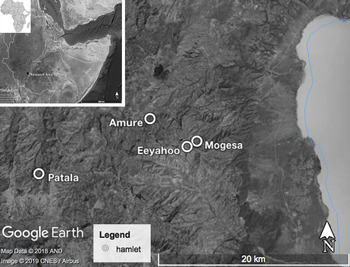
Since 1996, I have been fortunate to work with Boreda lithic practitioners of the southern Ethiopian Gamo highlands (Fig. 1). In the 1990s, I studied their stone tool technology as an academic and then more recently I was accepted as a cultural apprentice, who learned about their Indigenous ontology and how it informs their practices for selecting appropriate knapping stone.Footnote 2 Boreda lithic practitioners are part of an agro-pastoral highland society numbering some 100,000 people. They haft stone scrapers to process domesticated animal hides into everyday household leather products. Boreda lithic practitioners provided me with an education that situated their knappable stone in the landscape as living beings, who emit a shine or essence in particular colours when they are ready to transform and be birthed. First as an academic, I learned about their selection of particular colours of knapping stone. Then I became a Boreda cultural apprentice and thus began my education about their historic Indigenous ontology and how it informs a lithic practitioner's practices as birth (procurement), seclusion (storage), circumcision (knapping), marriage (hafting), maturation (use) and burial (discard). Lastly, I learned how colour, shape and lustre selection of knappable stone expresses respect for all earthly beings and encourages correct practice for apprentices. For many colonized and formerly colonized peoples, such as Boreda lithic practitioners, the subterranean is associated with the gaze of ancestors, invoking an intimate connection between humans and all earthly entities.
The location of the Boreda research area in Ethiopia and the location of the four communities with living lithic practitioners.

My brothers’ scrapers are the colour of cabbage
I propagated the ground with solid and multicoloured scrapers of black (kareteza—black cumin), yellow (bulla—Ethiopian eggplant), green (santa—cabbage), red (zo'o—blood), and grey-white (botza—a white lowland grass). They rested on my industrially manufactured faded periwinkle bandana or on the back of my bright blue clipboard on the earth-brown floor in front of the lithic practitioners. After an absence of two months, I returned with this collection of chert scrapers of a variety of colours, different stages of use, and made by different individuals from four communities. I wanted to learn about how Boreda lithic practitioners thought about their scrapers. I sat still, as the lithic practitioners looked them over and touched some of them. One lithic practitioner pointed to several and indicated that he thought these belonged to him, his brothers and his fathers. I asked how he knew these stones belonged to his lineage and he said, because they were the colour of cabbage (dark green). He did not know which ones he specifically made and all the other stones he implied were worthless, or t'unna.
In my early years (1996–98) working with Boreda lithic practitioners, I was caught in the Western academic gaze and yet I was determined to learn how Boreda perceived and selected knappable stone. I thought the way to accomplish this task was to conduct a scientific test—a sorting test. When I began to study stone scraper technology among the Gamo lithic practitioners, I was interested in one of the most controversial and long-standing debates in Palaeolithic archaeology—style versus function (Binford Reference Binford and Renfrew1973; Reference Binford1986; Bordes Reference Bordes1961; Reference Bordes and Renfrew1973; Sackett Reference Sackett and Renfrew1973; Reference Sackett, Conkey and Hastorf1990). To determine if there was variation in stone scrapers across the landscape, I began by conducting an ethnographic and material survey of the Gamo highlands, interviewing 185 lithic practitioners in 115 communities. I determined that very few communities produced stone hidescrapers and I decided to focus my in-depth research on 29 lithic practitioners who lived in four communities—Eeyahoo Boreda, Patala Zada, Amure Boreda and Mogesa Boreda (Fig. 1).
When I first began my research, I was not articulate in Boreda culture and language and this limited the information I could learn; and so I focused initially on aspects of functional variation. I quickly learned that lithic practitioners recognized that scraper morphology changed through use as a result of resharpening, which they determined by examining a scraper's edge. This transformation was further scientifically ‘verified’ by my detailed measurements of scrapers from their creation to death and statistical analysis of those measurements (Shott & Weedman Reference Shott and Weedman2007; Weedman Reference Weedman2002). Lithic practitioners told me that they did not intentionally produce or use scrapers of assorted parent material or vary scraper morphology to scrape different animal hides (highland and lowland cattle, goat, sheep, wild animal), different thickness of the hides (measured in mm), more efficiently and quickly (timed events), or as a result of their varied access to parent material (distance to resources), which I again substantiated through scientific measurements and analyses (Arthur Reference Arthur2008; Weedman Reference Weedman2002; Reference Weedman2006).
Exhausting ‘purely’ functional industrial explanations, I turned to assess style by implementing the scraper sorting-test to examine if lithic practitioners intentionally (active style) or unintentionally (passive style) produced scrapers to represent their identities. Under the Western gaze, I misunderstood the reference to cabbage and other plant names used for colour, as well initially the plural use of the terms brothers and fathers. I understood that santa was the word for ‘cabbage’, though mistakenly thought that there was no Boreda word for ‘green’, instead of realizing that the plant name and ‘green’ were one and the same. Kinship studies eventually revealed Boreda referred to their father's brothers as their father—aiwa and their father's brothers’ sons as their brothers—isha. A majority of lithic practitioners learned their craft from members within their lineage, particularly their fathers, older brothers and grandfathers (Weedman Reference Weedman, Frink and Weedman2005). Most lithic practitioners continue to live in their natal community after they marry, creating a stable community of lineage-related men, who tend to select the same colour of stone for scraper production.
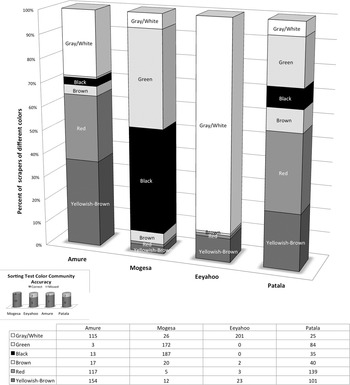
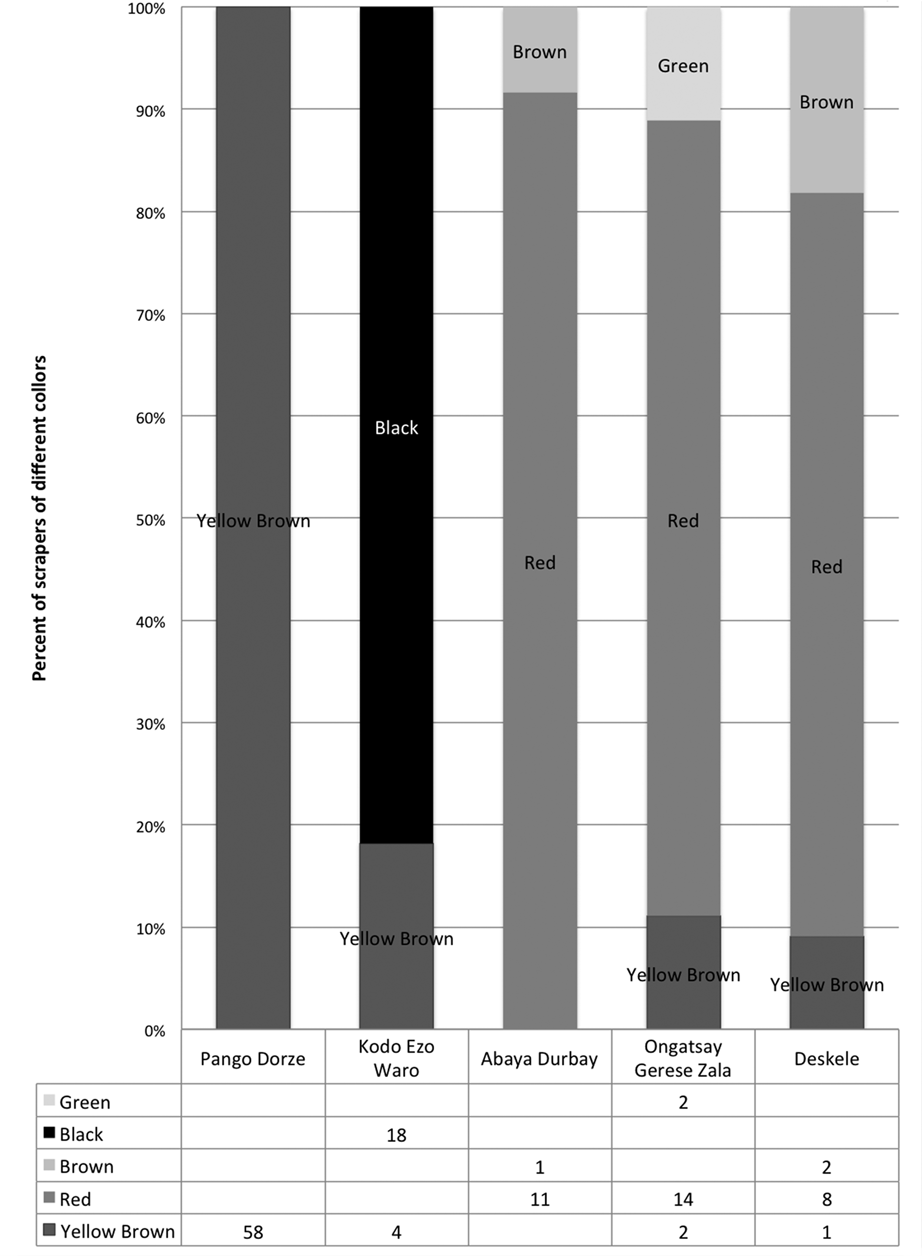
I learned through the sorting test the names of the colours and that each of the four communities had preferences for particular colours of chert, even though there are wide varieties of chert colours in their separate quarries (Arthur Reference Arthur2018, 102–3, 142). The lithic practitioners I worked with were often unable to identify their own scrapers, though they could identify their communities’ scrapers based on the colour with 70 to 100 per cent accuracy (Fig. 2, inset graph). Examination of my collection of 1494 chert scrapers from the four villages verified that each community had chert colour preferences: Amure—red, yellow, and grey-white; Mogesa—black and green; Eyehoo—grey-white; and Patala—red, green and yellow (Fig. 2). This trend of preferential chert colour selection held in five other communities in my broader survey, where I collected more than 11 scrapers (Fig. 3).
Graph illustrating the different colours of scrapers represented in four Boreda communities. Inset graph indicates the accuracy with which lithic practitioners identified their community's stone scrapers in a blind sorting test.

Graph illustrating the dominance of particular colours of scrapers represented in five communities in the Gamo highlands.

Lithic practitioners identified scrapers produced in their own community because of the colour. They did not actively recognize a particular colour as belonging to another specific community of lithic practitioners. However, they did perceive their colour of stone as good workable material and other colours of stone as worthless. I had learned that colour was important and rather ‘standardized’ in specific communities (Weedman Reference Weedman2002; Reference Weedman, Frink and Weedman2005). I interpreted their colour selection under the academic term ‘passive style’. I had not yet really learned why they selected particular colours of chert and deemed other stones worthless (t'unna).
Giving birth to stone and becoming a cultural apprentice
In 1996–98, there were hints of a deeper relationship between the men and their selection of stone, but I was culture-bound in my perception that the parent material and stone were inanimate. In one particular event after a 20-minute walk down the steep scree mountainside towards the chert quarry, we stopped to collect honey from a beehive. Twenty years ago, I classified this as an embedded activity (Weedman Reference Weedman2000), because I did not observe that the honey was connected to the quarry. At this time, I also first heard the phrase give birth to stones; I was told it was a grave insult because stones were worthless (t'unna) and caused infertility (Arthur Reference Arthur, Schmidt and Kehoe2019; Weedman Reference Weedman2000). A Gamo farmer shared this phrase with me and it was my understanding that he did not like stones because they caused infertility to his fields. I did not understand the connection between quarrying and infertility in the Gamo perception of the world. Furthermore, I recognize now that I was not really listening to Boreda lithic practitioners’ answers when I asked them ‘if they could describe to me the typical process of making a scraper?’ They conveyed to me that unused scrapers were young (oratay), discard scrapers were elders (cima) and debitage was waste (chacha). They ascribed human body parts to the scraper such that the dorsal side was back (zoco), ventral side was stomach (ulo), laterals were arm sides (gata), proximal was anus (dulea), and the working edge was eye (iffee) (Arthur Reference Arthur2018, 151). Yet when I (Arthur Reference Arthur2008; Weedman Reference Weedman2002; Reference Weedman2006) wrote about their technology, I described their scrapers as inert beings and sorted their process into our archaeological life cycles based on industrial production models, such as chaîne opératoire, formation process, or sequence model: procurement, production, use and discard (Bar-Yosef & Van Peer Reference Bar-Yosef and Van Peer2009; Bleed Reference Bleed2001; Leroi-Gourhan Reference Leroi-Gourhan1942; Schiffer Reference Schiffer1972).
Initially, as I worked with Boreda lithic practitioners, I refused to set aside my academic knowledge, humble myself and become a real cultural apprentice. My acculturation involved long-term commitment to Boreda communities, shedding my culture-bound perceptions, listening, becoming articulate in their language and accepting a Boreda methodology for acquiring knowledge ‘bit by bit’, according to my status in life (Arthur Reference Arthur2018; Reference Arthur, Schmidt and Kehoe2019). When I returned in 2006, I was eventually ritually incorporated as full Boreda citizen and mother, mischer. For many Boreda, I had demonstrated my long-term commitment and my life transformation to mother was essential for instilling in me a sense of understanding change and the importance of the future and the past (Arthur Reference Arthur, Cain and Raczek2020). Boreda Gamo elders began to share with me the tenets of their historic Indigenous way of perceiving the world—Etta Woga—a perspective eroded with the introduction of world religions.
According to the Boreda historic ontology Etta Woga, all matter, including stone, were alive, had a life-cycle and came into being through biological or ritual reproduction (Arthur Reference Arthur2018). A stone changed in life just as a human proceeded through birth (yella), circumcision (katsara), marriage (bullacha), and death (sofe). A flakable stone was created through the reproductive act of the male rain penetrating the female earth or womb (kantsa). The male fetus (gatchino) stone was birthed (yella) from the earth to become an infant (core, uka). It matured through initial cutting-knapping into a boy (na7a, blank), it was circumcised/knapped and became a youth (pansa, unused scraper) at the sacred forest; he married at the household hearth by joining with the female haft to become a full fertile tool (bullacha), and through use became a respected adult (wozanota, partially used), an elder (cima), and eventually died (hayikes) to be reincorporated (sofe) into the earth.
For many Boreda lithic practitioners, a quarry is alive, a womb (kantza), a parent, and can impact the life of the lithic practitioner. I learned that elder lithic practitioners collect honey along their trek to the quarry/parent stone and place a small amount of honey or barley porridge in the hollow of a tree for protection. In the Etta Woga ontology, male birthing of stone is a transgression against the natural order, in which only women should serve as midwives. Stone, earth and water spirits (Tsalahay) may choose to punish the leatherworker by landslide, drowning in a flash flood, or illness. Quarries are sacred places located commonly at 2300 m, in river gorges whose banks are occupied by sacred fig trees and are near flowing rivers that descend from the sacred mountain peaks.
Many Boreda consider the earth and all beings to be living entities. The earth as a living being can be an agency of harm and well-being, depending on the attention to propitiation provided by knowledgeable elders. Just as a Boreda lithic practitioner, slowly through time I learned bit by bit, first that particular colours of stone are important, next the agency of stone, and lastly why the colour, lustre and shape of the parent material are important in the Boreda perception of the world.
The good fetus has a shine, is a buried egg, and has a good colour
Gamo lithic practitioners consider with seriousness their responsibility to enculturate their sons and grandsons with the skills and knowledge of knapping. In the past, young men were taught knapping skills once they were circumcised and more earnestly once they married. A person earns their knowledge and skills bit by bit in concert with his life stage with long-term apprenticeships (Arthur Reference Arthur2018). Skill is evaluated based on a person's achieved life stages, which are ritually marked, and through which they are recognized for their knowledge, engagement and dedication to their community and other beings. Willingness to change, grow and mature are essential indicators of well-being, fertility and prestige in their Indigenous way of perceiving the world, Etta Woga. A lithic practitioner is not evaluated based on his specific age or evaluation of his final stone product. A novice lithic practitioner is a pansa (circumcised adult), a competent lithic practitioner is a wodala (married man), a proficient lithic practitioner is an older wodala (who has teenage children), an expert is a wozanota (respected adult with married children) and a master is a cima (elder with grandchildren). One of the important skills elders begin to impart to novices was how to identify viable stone beings.
I watched as a lithic practitioner pried into the wall of the river gorge with a digging stick to birth the gatchino-fetus from its earthly womb. Lithic practitioners only selected nodular or egg-shaped stone that is buried in the earth. Banded geological cherts also exist in the lowlands, but leatherworkers did not use these resources. The nodules are referred to as eggs or infants, uka, and are viable beings. He then placed the infants near the river and washed them, just as a newborn human is washed after birth. The lithic practitioner squatted down and slightly lifting his right hand grasped an iron hoe tip to remove a flake or two from a nodule—removing the chancha or waste material (umbilical cord). He breathed onto the nodule and then pointed at the fresh break and said ‘tompe’ (light) to the youth, looking over his shoulder. When I inquired why he breathed on the stone, the lithic practitioner answered that good stone has a shine—tompe. In scientific terms, the light or tompe is significant as an indicator of the lustre and conchoidal fracturing properties of the stone. For Boreda lithic practitioners, tompe has a deeper meaning in their ontology.
The light, tompe, and colour of the stone is a demand for attention by the stone's spirit or essence of life—a signal that the stone is ready for transformation (Arthur Reference Arthur2018). For many Boreda, tompe and particular colours are associated with ancestors and the power of transformation for well-being. Annually, Boreda farmers celebrated Tompe, a bonfire ceremony that commemorated their ancestors’ original settlement at the Bayira Deriya, sacred ancestral places. Leatherworkers were forbidden from participating in the Tompe bonfire ceremonies, because they transgressed the natural order and birthed entities from the earth. At the Tompe festival under the gaze of ancestors, non-craftspeople conducted rituals of transformation, acquiring prestige and dignity as adult full citizens, married adults and leaders. Transformation of all beings was essential for a good healthy life according to the Boreda ontology Etta Woga. Lithic practitioners select stone that has light (tompe) as an indication that it is a viable being ready to transform and be born. Elders offer that the shine is attached to particular colours of chert in their specific quarry; a combination that announces a stone will survive knapping and mature.
The most common selected colours of stone are green, red, yellow, white and black—all colours associated with transformation and fertility. The word for the colour green is ‘cabbage’ (santa). Cabbage is also the colour of mountain grass, which is cool and peaceful and placed on people's shoulders during initiation ceremonies for leadership positions of prestige. Red is blood and represents male strength and virility and the colour of the fertile earth. Youths wore red feathers in their hair when they completed puberty rites to become young men. Yellow is bulla or the Ethiopian eggplant (yellow flowers and yellow-orange fruit)—the colour of unity, seniority and kingship. Elite elders and kings wear yellow lion hides at ritual ceremonies. Black is kareteza or black cumin, which is known for its healing properties. White is botza as in botza matta, the white (pure) lowland grasses, where in the past men hunted the pure wild animals to attain prestige and dignity. Lithic practitioners select particular colours of stone that shine, which is a reminder of Etta Woga and the power of transformation, the vitality of all beings, and a lithic practitioner's responsibility to engage in correct practice.
Generational transfer of technological knowledge such as colour is a part of heritage. Each community of lithic practitioners identifies specific colours of chert that are viable and claims ownership of quarries as part of their patrimony. Lithic practitioners have faith in the longitudinal observations and experiences/experiments of their ancestors and their identification of the important qualities (colour, lustre, etc.) of viable stone beings associated with their particular quarry or parent stone. My observations and lessons from elders revealed that each quarry produces a variety of colours of stone. For example, lithic practitioners living in Mogesa recognize green chert as viable (Fig. 3). While the quarries visited by other Boreda communities may produce green chert, the chert may predominantly lack lustre and thus be considered not viable, or t'unna.
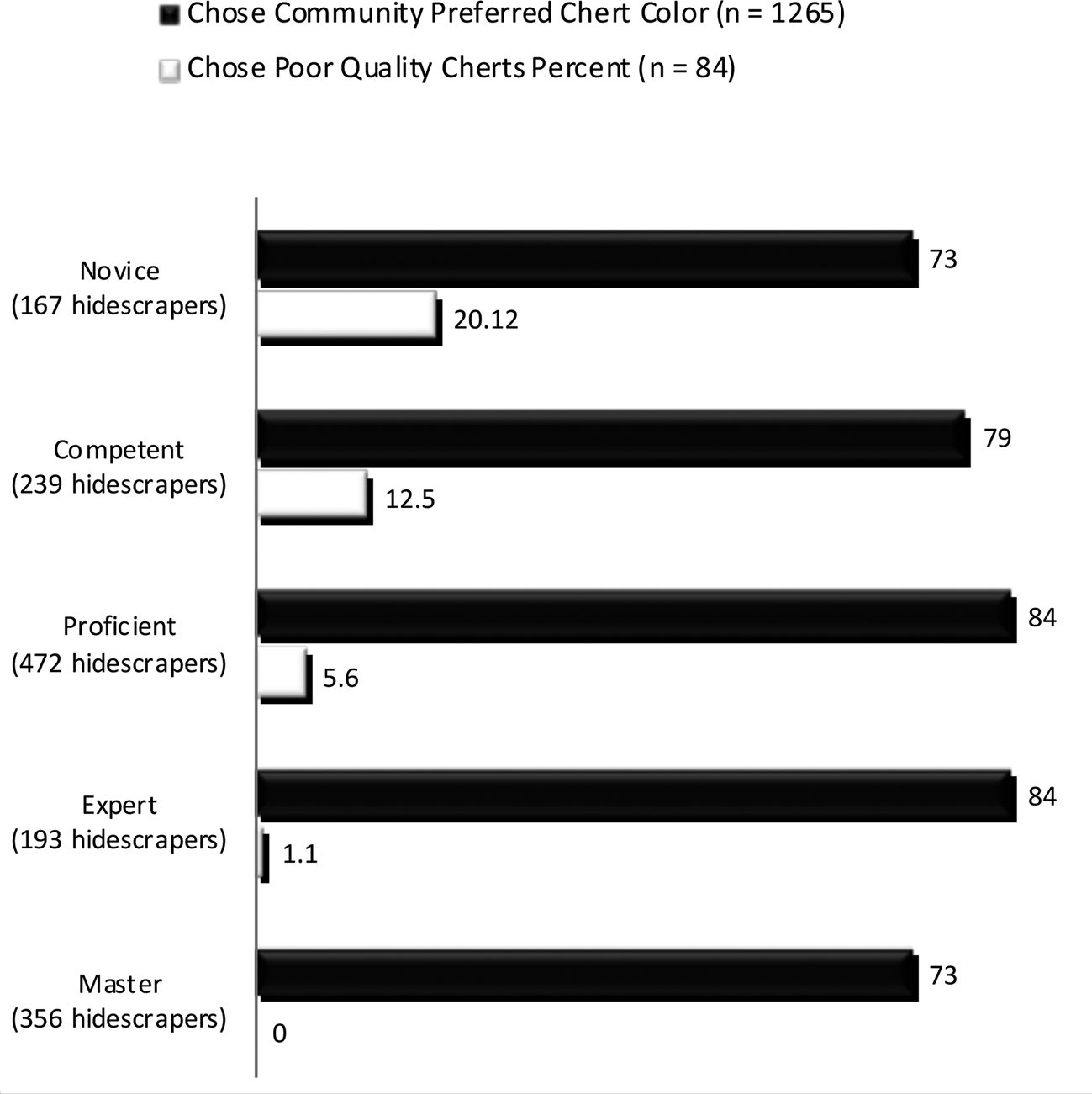
Elders draw on the attributes of colour and lustre to teach youth how to identify proper viable stone beings. As living entities, stone demands respect and proper treatment to maintain a long life of interaction with humans. Youth cannot travel to quarries alone because the power of the quarries requires an experienced, knowledgeable lithic practitioner to make offerings and properly assist with birth. Elders attempt to guide youth in their selection of viable fetus stones, and youth are predominantly compliant because they respect the knowledge of their elders and the stones. I compared the colour and lustre of 1265 chalcedony scrapers I collected between 1996 and 1997 from novice, competent, proficient, expert and master lithic practitioners (Fig. 4). All levels of experience generally selected a community's preferred chert colour a majority of the time. The selection of poor qualities of chert decreases with a lithic practitioner's experience. Gamo lithic practitioners depend on the observation and knowledge of their elders to select ‘high’ quality cherts, which means the stones are tompe (with light and alive) and are imbued by particular colours that are distinct in each quarry.
Graph illustrating the selection of different qualities and colours of chert for scraper production by skill level. (Adapted from Arthur Reference Arthur2018, 143.)

Boreda ontology Etta Woga ensures that a lithic practitioner's practices are consistent within a community and concerned with proper practice and respect for other earthly beings. Lithic practitioners are ‘material scientists’ who learn their trade slowly and methodologically over their lifetime, ‘bit by bit’ from experienced lithic practitioners in their lineage (Arthur Reference Arthur, Schmidt and Kehoe2019, 30). As one Boreda ritual specialist told me, ‘we have a science of religion—all this I do is science for all answer we try and try again; it is a process based on observation’. There is an interconnectedness of all beings that demands mutual respect and insists that humans have a responsibility to ensure the longevity of other beings, so that they too may have fertile lives full of well-being and light and do not become infertile, chaotic and dark.
Conclusion
Darkness—obscuring colour and light—describes all the photographs I took while at Boreda quarries. The reader has probably noticed there are no photos of Boreda knapping at their quarries in this article; this is because the photographs from the quarries are literally all black, except for a few taken before men began birthing the stone. Is there some quality about the quarry that transforms my camera to obscure in darkness the reproduction of stone beings? Several lithic practitioners inform me that they are not surprised to learn the state of my quarry photographs. They warn me that birthing stone is becoming more dangerous—there are more floods, more erosion with stones raining down from the top of the steep cliff walls of the gorge, more illnesses, more farmers living in the lowlands and chasing them away. In the last 20 years, Boreda lithic practitioners are beginning to bring back nodules rather than scraper blanks to their homes because of the dangers they perceive lingering in these wombs of the earth. Many admit bashfully that they continue to practise their trade according to the tenants of historic ontology Etta Woga despite their recent conversion to Christianity or Islam.
Ontologies are not just ephemeral inaccessible thoughts; they provide the basis for how people interact with the world and are visible in material manifestations of that interaction. Boreda lithic practitioners are not alone, according to academic literature, in their historic ontological perception of stone as a living entity that was imbued with colour through power and reproduction. Their perception shaped practice grounded in material ways, as discussed here in the location of parent material and colour and lustre of the selected stones. Boreda quarry locations are associated with ancestors and chert is perceived to be formed by vital forces of earth and rain and proximity to sacred water and fig trees. Scholars and historic texts of other lithic practitioners refer to ‘the earth gestating the fetus stone’ (historic text from Mexico: Pastrana & Athie Reference Pastrana, Athie, Levine and Carballo2014, 96), ‘chert growing along watercourses’ (Wola of Papua New Guinea: Sillitoe & Hardy Reference Sillitoe and Hardy2005, 557–8), ‘breeding stone as in the case of a pregnant woman with young inside’ (Yolngu of Australia: Jones Reference Jones, Yen and Mummery1990, 27; Jones & White Reference Jones, White, Meehan and Jones1988, 61), ‘referred to cores as “the mother one” which was “cut” or “bled”’ (Gugadja of Australia: Cane Reference Cane1992, 16), ‘when the world was made the stone came to Mt. Kagul … seeing a pleasanter place on the opposite of the Wahgi river, however, they moved across’ (Waghi of Papua New Guinea: Burton Reference Burton1984, 260) and ‘when male and female stones were wrapped in a bundle they could reproduce … contain smaller stones that were regarded as offspring’ (Absarokee of United States: Irwin Reference Irwin1996, 224–5). Many historic and living lithic practitioners in Ethiopia, South Africa, Papua New Guinea, Mexico and Australia preferred stone buried near rivers beneath trees (Binford & O'Connell Reference Binford and O'Connell1984, 412; Burton Reference Burton1984, 239; Clark Reference Clark, Staski and Sutro1991, 64; Gallagher Reference Gallagher1977, 408; Jones & White Reference Jones, White, Meehan and Jones1988, 59; Tindale Reference Tindale1965, 140).
Stone as a living entity demands attention and its essence or spirit evoked a shimmer, brightness, or shine and was of specific colours. In Australia, among some lithic practitioners correct stone that was ready exuded a brightness and stone spears and knives were given individual names based on their origin and colour and were thought either to bring death or to cure illnesses (Gould Reference Gould1980; Jones & White Reference Jones, White, Meehan and Jones1988; Taçon Reference Taçon1991). Many Plains Native Americans believed that shiny stones were sacred, with ancient knowledge of the earth and sky uniting the world, and when placed in a sacred bundle could reproduce new stones (Irwin Reference Irwin1996). In Mexico, different colours and translucency of obsidian often indicated the various powers; for example, green was associated with water, life and rebirth (Darras Reference Darras, Levine and Carballo2014, 66). In Indonesia, Dani men frequently perceived that translucent, glistening or sparkling stones were imbued with ‘mystic spirit power’ (Hampton Reference Hampton1999, 126).
The power of stone meant limited access and long-term apprenticeship beginning in puberty (Albright Reference Albright1984, 52; Arthur Reference Arthur2010; Burton Reference Burton1984, 239; Hampton Reference Hampton1999, 232). Stones were often considered ancestors and quarries were dangerous because of their agency and restricted access to particular lineages or age-group members of society (Burton Reference Burton1984; Gould Reference Gould1980; Gould & Saggers Reference Gould and Saggers1985; Hampton Reference Hampton1999; Jones & White Reference Jones, White, Meehan and Jones1988; Pokotylo & Hanks Reference Pokotylo, Hanks, Amick and Mauldin1989; Taçon Reference Taçon1991). Boreda lithic practitioners began to engage youth in quarrying after they were circumcised and taught them how to recognize a viable good knapping stone by its light and its colour, both indicative of life and the ability to change. Among some Australian groups, youth were responsible for selecting parent material and bringing it back to experienced elder men—they were frequently sent back to the quarry because they selected poor parent material (Aiston Reference Aiston1929; Tindale Reference Tindale1965). Among Yagan of Tierra del Fuego, boys at age three were encouraged to begin producing stone arrowheads and continued to learn until they were married (Gusinde Reference Gusinde1931). Unfortunately, very few ethnographic studies focused on how youth were taught to identify knappable stone. Stout's (Reference Stout2002) studies among the Langda indicate that youth often engage with smaller cores or poorer- quality parent materials.
There is strong evidence that historically documented lithic practitioners were material scientists, who understood their technology within their perception of the world as animated under the gaze of ancestors. Their perception informed how they thought, described and where they interacted with the material world. Particular colours and lustres of stone were selected from specific locations on the landscape designated appropriate within their perceptions of their relationship to their surroundings. Their practices aligned with their view of the world as animated and assured the collection of stones that were viable and ready to be birthed, preventing the death of immature material and waste.
At the beginning of this paper, I discuss Taussig's (Reference Taussig2009) meditation on the industrial creation of an artificial world of colour. The names of colours conjured from the natural world of plants and minerals deceive us, spoiling the natural world and impairing our minds as to the significance, meaning and role of colours in their natural context. For many Boreda, colour terms are usually the names of plants and their use in other contexts weaves together the material world. Potawatomi botanist Robin Wall Kimmerer (Reference Kimmerer2013, 42–3) lamented that the beauty of purple astrids and yellow goldenrods fields was fostered by her ‘inclination … to seek the threads that connect the world to join instead of divide … but science is rigorous in separating the observer from the observed … science trained me to separate, to distinguish perception from physical reality, to atomize complexity into its smallest components’. Similarly, colour as well as lustre are for most Western-trained archaeologists attributes—the smallest unit of analysis. Biologically the lithic practitioner's and the archaeologist's eyes are equally equipped to observe the same qualities in stone beings, such as lustre and colour. The Western scientist in their search to be objective, though, disassociates their being from the stone being and its qualities or ‘attributes’. The attributes may come together to define one particular type of stone, but these attributes are not connected to other beings. The lustre in a stone is not perceived to be the same as the sparkle in water, the brightness of a bonfire, or the gleam in a living person's eye. They are separate manifestations to most scientists; to many Boreda they are all light (tompe) and an indicator of life. Similarly, to the archaeologist, the red of stone is not perceived to be the same red as laterite soil, barley, birds of paradise and blood. For many Boreda, red connects these seemingly disparate beings of soil, barley, birds and blood, imbuing them with strength, ritual-transformation, fertility and life. Most scientists’ observations, experiments and results are perceived to be based on independent variables and performed in an ethos in which humans have a right to interact with other beings in any way humans perceive as acceptable. Lithic practitioners teach us that it is through a being's qualities that humans can be reminded of our interconnectedness to all other beings.
It is not my intent to rival science against Indigenous knowledge; rather I am insisting that both hold valid ways of perceiving the world. The past must resonate with the present; people need to perceive a connection with the past, or it will dissipate without a future. Archaeologists have a responsibility to ensure that those connections are nurtured rather than fractured, and to acknowledge that there is not one path leading to the past or one narrative of the past. A science of the past is not a science if it does not move forward, seeking to learn, build knowledge and change; it only reaffirms itself. According to the tenets of Etta Woga, this stagnation leads to chaos and death. We learn from lithic practitioners the potential for recognizing life and how to interact respectfully with other beings to ensure a future; and perhaps this knowledge will lead to transformations in archaeological practice.