

Career exploration is one of the crucial aspects of individuals’ career development (Super, Reference Super, Brown and Brooks1990). Exploration activities not only provide individuals with critical knowledge to make career choices (Lent, Ezeofor, Morrison, Penn, & Ireland, Reference Lent, Ezeofor, Morrison, Penn and Ireland2016), but also facilitate successful progress in career development (Herr, Reference Herr1993). Previous studies have found that individuals’ exploratory behaviors are associated with their personality traits, such as conscientiousness and openness to experiences (Tokar, Fischer, & Subich, Reference Tokar, Fischer and Subich1998). Social cognitive career theory (SCCT) also noted that personality traits, as key distal factors, could prompt individuals’ exploration activities by shaping their self-efficacy belief (Lent, Brown, & Hackett, Reference Lent, Brown, Hackett, Brown and Brooks2002; Lent & Brown, Reference Lent and Brown2013).
Studies exploring the relation between personality and career exploration generally adopt the Western Five-Factor Model (FFM), which has dimensions that are more self-oriented (Cheung, van de Vijver, & Leong, Reference Cheung, van de Vijver and Leong2011; Yang, Reference Yang, Kim, Yang and Hwang2006). However, exploratory behaviors are always embedded in a specific relational context and are influenced not only by personal factors, but also interpersonal affordances. Social support from a relational context can largely facilitate individuals’ exploration by providing emotional security, informational guidance and instrumental assistance (Blustein, Prezioso, & Schultheiss, Reference Blustein, Prezioso and Schultheiss1995; Schultheiss, Reference Schultheiss, Skorikov and Patton2007). Thus, social-oriented personality traits that help to improve one’s relational context should also benefit the development of exploratory behaviors.
In the current study, we investigated the contributions of both self-oriented and social-oriented personality traits in predicting adolescents’ career exploration with a longitudinal design.
Personality and career exploration
Personality is the consequence of people’s continuous effort to adjust to their environments, and benefits them in turn by helping them to adjust to the sociocultural environments more smoothly (Kitayama, Markus, Matsumoto, & Norasakkunkit, Reference Kitayama, Markus, Matsumoto and Norasakkunkit1997; Markus & Kitayama, Reference Markus and Kitayama1998). Based on different forming processes of personality and psychological and social functions, Yang (Reference Yang, Kim, Yang and Hwang2006) classified personality attributes as self-oriented and social-oriented. Self-oriented personality attributes are mainly emphasized in an individualistic culture, in which independence and autonomy is greatly valued (Markus & Kitayama, Reference Markus and Kitayama1991). This type of personality attributes focuses on the intrapsychic aspects of a person (e.g. Emotionality and Openness) and functions to maintain a unique independent self with high self-esteem (Digman, Reference Digman1990; Luk & Bond, Reference Luk and Bond1992) and efficacy (Tokar et al., Reference Tokar, Fischer and Subich1998). In contrast, the social-oriented personality attributes tap the interdependent aspects of personality (e.g. harmony and reciprocity) and are mainly highlighted in collectivistic cultural contexts, in which “being a part” and “belonging” are highly emphasized (Markus & Kitayama, Reference Markus and Kitayama1991). Accordingly, this type of personality attribute is related to one’s interdependent self-construal (Markus & Kitayama, Reference Markus and Kitayama1998; Singelis, Reference Singelis1994) and functions to develop and maintain harmonious relationships (Kwan, Bond, & Singelis, Reference Kwan, Bond and Singelis1997). Humans have both self- and social-oriented personality attributes, but with differentiated importance and salience depending on the specific environment that they are exposed to (Katigbak, Church, Guanzon-Lapena, Carlota, & del Pilar, Reference Katigbak, Church, Guanzon-Lapena, Carlota and del Pilar2002; Lin & Church, Reference Lin and Church2004). Actually, social-oriented constructs are included in earlier Western models of personality (e.g., Blatt & Blass, Reference Blatt, Blass, Noam and Fischer1996; Sullivan, Reference Sullivan1953; Wiggins, Reference Wiggins1979). However, the increased emphasis on the individualistic and independent nature of Western culture may lead to insufficient attention to the interdependent dimensions in theories and assessment of personality in modern psychology (Cheung, Cheung, Wada, & Zhang, Reference Cheung, Cheung, Wada and Zhang2003).
This insufficient attention on interdependent aspects of personality is also reflected in the domain of career development research. Although a number of personality dispositions have been found to potentially promote or impede individuals’ exploratory behaviors (Tokar et al., Reference Tokar, Fischer and Subich1998), most are self-oriented (e.g. neuroticism, conscientiousness, & locus of control), particularly under the framework of FFM (e.g. Nauta, Reference Nauta2007; Reed, Bruch, & Haase, Reference Reed, Bruch and Haase2004; Rogers, Creed, & Glendon, Reference Rogers, Creed and Glendon2008; Tokar et al., Reference Tokar, Fischer and Subich1998). In contrast, only a few empirical studies have examined the effect of social-oriented personality traits on career exploration (Hamer & Bruch, Reference Hamer and Bruch1997; Li et al., Reference Li, Guan, Wang, Zhou, Guo, Jiang and Fang2015). For example, shy college students were found to be less likely to have mature attitudes toward career exploration (Hamer & Bruch, Reference Hamer and Bruch1997). Interpersonal relatedness as a social-orientated personality factor could significantly predict career exploration among Chinese university students but not among American students (Fan, Cheung, Leong, & Cheung, Reference Fan, Cheung, Leong and Cheung2012). These findings suggested that social-oriented personality attributes are also important for career exploration, especially in a collectivistic culture. This study aimed to investigate the influence of self- and social-oriented personalities on adolescents’ career development and expected that there would be significantly incremental validity of social-orientated personality beyond the traditional self-orientated personality.
Self-oriented personality, career self-efficacy and career exploration
Self-efficacy is an individual’s cognitive belief about his/her capacities to successfully complete a designated task. Self-efficacy can predict the career fields that individuals will be interested in, as well as the process of how they manage their career development (Lent & Brown, Reference Lent and Brown2013). Individuals are more inclined to enter occupations in which they have high self-efficacy and to avoid activities in which they feel incompetent. Particularly in terms of career exploration, career decision self-efficacy, which reflects individuals’ efficacy beliefs regarding engaging in career exploration and decision-making activities (Lent et al., Reference Lent, Ezeofor, Morrison, Penn and Ireland2016), was found to have considerable contributions to exploration behaviors or intentions (Gushue, Scanlan, Pantzer, & Clarke, Reference Gushue, Scanlan, Pantzer and Clarke2006; Ochs & Roessler, Reference Ochs and Roessler2004; Rogers & Creed, Reference Rogers and Creed2011).
According to SCCT, self-efficacy not only affects career outcomes directly, but also bridges other distal factors (such as personality) with career adaptive behaviors (Lent & Brown, Reference Lent and Brown2013). Self-oriented personality traits are important antecedents of self-efficacy (Tokar et al., Reference Tokar, Fischer and Subich1998). Other studies with FFM showed that self-efficacy could mediate the relation between conscientiousness and career exploration (Lent et al., Reference Lent, Ezeofor, Morrison, Penn and Ireland2016; Rogers et al., Reference Rogers, Creed and Glendon2008). Therefore, we expected that self-oriented personality traits may motivate individuals to initiate more exploratory behaviors through shaping their efficacy belief (Lent & Brown, Reference Lent and Brown2013; Savickas, Reference Savickas and Brown2002).
Social-oriented personality, relational support and career exploration
Research on self-efficacy reveals the important role of personal cognitive belief in guiding people’s career behaviors. However, self-efficacy does not function alone in shaping people’s career possibilities. In the SCCT model, self-efficacy always works within a specific interpersonal context. The barriers and supports in the interpersonal context may influence individuals’ access to environmental resources and makes conjoint effect with self-efficacy on people’s vocational outcomes (Lent & Brown, Reference Lent and Brown2013). Particularly in terms of career exploration, as noted by attachment theory, exploration process entails individual initiatives into new social interactions and novel social roles, which inevitably provoke anxiety and other emotional challenges (Blustein et al., Reference Blustein, Prezioso and Schultheiss1995; Bowlby, Reference Bowlby1988). Although individuals with higher self-efficacy have more confidence in initiating exploratory behaviors, a supportive relational environment can largely facilitate their activities by providing a secure base and relieving their emotional stress (Felsman & Blustein, Reference Felsman and Blustein1999; Ketterson & Blustein, Reference Ketterson and Blustein1997; Lent et al., Reference Lent, Ezeofor, Morrison, Penn and Ireland2016; Ryan, Solberg, & Brown, Reference Ryan, Solberg and Brown1996; Schultheiss, Kress, Manzi, & Glasscock, Reference Schultheiss, Kress, Manzi and Glasscock2001). Moreover, detailed occupational information and financial support from the relational environment could act as direct assistance for one’s career exploration as well (Galambos & Silbereisen, Reference Galambos and Silbereisen1987; Herr, Cramer, & Niles, Reference Herr, Cramer and Niles2004; Schultheiss et al., Reference Schultheiss, Kress, Manzi and Glasscock2001; Young et al., Reference Young, Valach, Ball, Paseluikho, Wong, DeVries and Turkel2001). To sum up, various supports from the relational contexts could equip individuals with important resources to cope with the demands of exploration and other career-related tasks.
Although the SCCT model posits the possibility that personality could influence career adaptive behaviors through both personal agency and contextual factors (Lent & Brown, Reference Lent and Brown2013), the interpersonal path has rarely been examined (Lent et al., Reference Lent, Ezeofor, Morrison, Penn and Ireland2016; Rogers et al., Reference Rogers, Creed and Glendon2008). From a socioecological perspective (Bronfenbrenner, Reference Bronfenbrenner2005), research on adolescent development suggests that individuals and their environments are reciprocally influenced (Wachs & Kohnstamm, Reference Wachs, Kohnstamm, Wachs and Kohnstamm2001). Adolescents’ temperament and personality could elicit distinct parenting behaviors that in turn shape adolescents’ development trajectories (Kiff, Lengua, & Zalewski, Reference Kiff, Lengua and Zalewski2011; Shiner & Caspi, Reference Shiner, Caspi, Zentner and Shiner2012). Social-oriented individuals put more importance on reciprocal favors and exhibit more effective interpersonal contextual behaviors (Kwong & Cheung, Reference Kwong and Cheung2003), which allows them to maintain harmonious relationships (Kwan et al., Reference Kwan, Bond and Singelis1997) and receive and/or perceive more social support (Allemand, Schaffhuser, & Martin, Reference Allemand, Schaffhuser and Martin2015; Asendorpf & van Aken, Reference Asendorpf and van Aken2003). Parents are usually found to be the most helpful providers of social support for career development (Schultheiss et al., Reference Schultheiss, Kress, Manzi and Glasscock2001), particularly in the Chinese culture where parents are often involved in their offspring’s career decision-making process (Kwan, Reference Kwan2000). Therefore, we expected that social-oriented personality traits could facilitate exploration by helping individuals perceive more parental support.
The present study
The objective of the current study is to explore how self- and social-oriented personality influences individuals’ career exploration. The Cross-culture (Chinese) Personality Assessment Inventory for Adolescents (CPAI-A; Cheung, Fan, Cheung, & Leung, Reference Cheung, Fan, Cheung and Leung2008; Chueng & Ho, Reference Cheung, Ho, Kazuo, Sonoko, Takao and Tetsuro2018) was used to assess the self- and social-oriented personality traits for adolescents. The CPAI-A consists of three cultural universal factors – that is, Social Potency, Dependability, and Emotional Stability – and a culturally indigenous factor, Interpersonal Relatedness (IR; Cheung, Leung, & Cheung, Reference Cheung, Leung and Cheung2005). Dependability is a typical self-oriented personality factor. The core meaning assessed by this factor is the trustworthiness, seriousness and responsibility of personality traits, which are all temperamental traits and devoid of substantial social situational and social intentional components (Yang, Reference Yang, Kim, Yang and Hwang2006). Dependability is comparable to the conscientiousness factor in the FFM (Cheung et al., Reference Cheung, Leung, Zhang, Sun, Gan, Song and Xie2001; Cheung et al., Reference Cheung, Cheung, Zhang, Leung, Leong and Huiyeh2008). Although there are few studies about dependability and career exploration, studies in the literature have shown that conscientiousness has the most significant relationship in the FFM with individuals’ career exploration (Nauta, Reference Nauta2007; Rogers et al., Reference Rogers, Creed and Glendon2008), career information seeking (Reed et al., Reference Reed, Bruch and Haase2004), and other job-searching behaviors (Tokar et al., Reference Tokar, Fischer and Subich1998). Therefore, individuals who score high in dependability should be more meticulous in setting their career goals, and gather and weigh career information in a more organized way before they make career decisions.
IR is a typical social-oriented personality factor that highlights people’s inclination toward relational harmony and social orientation. The IR factor does not share any common factor space with the Big Five factors (Cheung et al., Reference Cheung, Leung, Zhang, Sun, Gan, Song and Xie2001; Cheung et al., Reference Cheung, Cheung, Zhang, Leung, Leong and Huiyeh2008), and is particularly effective in predicting contextual behaviors that involve interpersonal interactions (Cheung, Cheung, & Fan, Reference Cheung, Cheung, Fan, Gelfand, Chiu and Hong2013; Kwong & Cheung, Reference Kwong and Cheung2003). Individuals who are more interpersonal related usually pay greater attention to social propriety and reciprocal favors in their social interactions (Cheung et al., Reference Cheung, Leung, Zhang, Sun, Gan, Song and Xie2001). Thus, they are more likely to have a positive interpersonal environment and take advantage of relational supports to complete their exploration tasks.
Most existing studies on personality and career exploration are cross-sectional in nature and only reveal a correlational relation between personality and career exploration (e.g. Li et al., Reference Li, Guan, Wang, Zhou, Guo, Jiang and Fang2015; Nauta, Reference Nauta2007; Reed et al., Reference Reed, Bruch and Haase2004; Rogers et al., Reference Rogers, Creed and Glendon2008). Less is known about the process of how personality influences an individual’s continuous career exploration throughout the lifespan (Blustein, Reference Blustein1992; Super, Reference Super, Brown and Brooks1990), nor whether this influence can have a long-lasting effect. Therefore, to better explore how personality traits influence adolescents’ specific exploratory behaviors through shaping their career decision self-efficacy and perceived parental support, we examined the following hypotheses with a longitudinal design among Chinese high school students:
Hypothesis 1: Both self- and social-oriented personality factors can contribute to adolescents’ career exploration.
Hypothesis 2a: Career decision self-efficacy mediates the relationship between self-oriented personality factor and career exploration.
Hypothesis 2b: Perceived parental support mediates the relationship between social-oriented personality factor and career exploration.
Method
Participants and procedure
The current study is part of a large-scale longitudinal study on Chinese adolescents’ vocational development led by the third author. Participants were recruited with a cluster sampling procedure. We first selected four high schools in Hong Kong on the basis that they had different achievement levels and covered the three main geographical regions in Hong Kong. All 613 Year 1 students from the four senior high schools (Grade 10) participated in this research project in three consecutive years during the course of their senior high school from Grade 10 (Time 1) to Grade 12 (Time 3). The participants took three waves of questionnaire survey at the end of the second semester in each grade. After three waves of data collection, 488 students remained in the longitudinal sample, with 231 males (47.34%), 248 females (50.82%), and 9 participants who did not indicate their gender. The age of the participants at Grade 10 ranged from 16 to 22 years (M = 18.33, SD = 0.67). An independent t test indicated that the remaining participants were not significantly different from those who had dropped out on gender, t(601) = 0.68, p > .05, age, t(599) = 0.56, p > .05, dependability, t(608) = 0.12, p > .05, and IR, t(606) = 1.73, p > .05.
The participants completed the questionnaires in their classrooms under the supervision of their teachers and one researcher. An instruction was read to the students by their teachers before they started. All the supervising teachers were informed about the project and the procedures before the data collection began. Each participant who completed the questionnaire was rewarded with a summary report of his/her own profile.
Personality was assessed at Time 1; self-efficacy and perceived parental support, as mediators, were assessed at Time 2; and the outcome variable of career exploration was assessed at both Time 2 and Time 3.
Measures
Personality traits
The Cross-culture (Chinese) Personality Assessment Inventory for Adolescents (CPAI-A; Form B; Cheung et al., Reference Cheung, Leung and Cheung2005) was employed to assess the self- and social-oriented personality traits. The CPAI-A consists of 307 items that cover four factors, namely Social Potency, Dependability, Emotional Stability and Interpersonal Relatedness (IR). In the current study, only Dependability, as one self-orientated personality factor, and IR, as a social-orientated personality factor, were considered, based on the above-mentioned hypotheses. The Dependability factor consists of four scales with a total of 45 items. The four scales are Discipline, Responsibility, Meticulousness, and Life Goal. The IR factor consists of 90 items that cover eight scales, namely Graciousness versus Meanness, Ren Qing (Relationship Orientation), Harmony, Defensiveness, Interpersonal Tolerance, Veraciousness versus Slickness, Family Orientation and Social Orientation. All items were answered in a yes/no format. The item number of each subscale ranged from 8 to 14. The score of each subscale was the sum of all item scores of the subscale. Thus, the raw score of each subscale ranged from 0 to 14. The scores of all scales under each factor were averaged respectively. The mean Cronbach’s alpha for the scales used was .71 (ranging from .59 to .80) in the standardization study (Cheung, Fan et al., Reference Cheung, Fan, Cheung and Leung2008). In the current study, the Cronbach’s alphas for the scales used ranged from .60 (Discipline) to .78 (Veraciousness vs. Slickness), with a mean of .71, and for Dependability and IR they were .77 and .78 respectively.
Career decision self-efficacy
The Chinese version of the Career Decision-Making Self-Efficacy Scale-Short Form (CDSE-SF; Betz, Klein, & Taylor, Reference Betz, Klein and Taylor1996) was employed to assess participants’ confidence in career exploration and decision making. The CDSE-SF consists of 25 items covering five dimensions – self-appraisal, occupational information searching, goal selection, making plans for the future, and problem solving. A sample item is “How much confidence do you have that you could accurately assess your abilities?” The participants were asked to indicate their agreement on a 5-point scale ranging from 1 (no confidence at all) to 5 (complete confidence). Higher scores indicate greater confidence. The Cronbach’s alpha for the CDSE-SF was .94 in the previous study (Betz et al., Reference Betz, Klein and Taylor1996) and .93 for the Chinese translation version (Hampton, Reference Hampton2006). In the current study, the Cronbach’s alpha of the full scale was .91 and ranged from .59 (problem solving) to .74 (planning) for the five dimensions.
Perceived parental support
The Career-Related Parent Support Scale (CRPSS; Turner, Alliman-Brissett, Lapan, Udipi, & Ergun, Reference Turner, Alliman-Brissett, Lapan, Udipi and Ergun2003) was used to investigate participants’ perceived parental support on their career development. The CRPSS consists of 27 items covering four dimensions – instrumental assistance, career-related modeling, verbal encouragement, and emotional support. A sample item is “My parents tell me about their jobs”. The participants were asked to indicate their agreement on a 5-point scale ranging from 1 (strongly disagree) to 5 (strongly agree). Higher scores indicate greater perceived parental support. The reliability for the CRPSS was .79 in the original study (Turner et al., Reference Turner, Alliman-Brissett, Lapan, Udipi and Ergun2003). The Chinese translation was validated in Ma and Yeh’s (Reference Ma and Yeh2010) study and showed high reliability of .91. In the current study, the Cronbach’s alpha of the full scale was .92 and ranged from .76 (Verbal Encouragement) to .89 (Modeling) for the four dimensions.
Career exploration
Our research team developed the Career Exploration Questionnaire (CEQ) for examining adolescents’ career development based on Dietrich, Kracke, and Nurmi’s (Reference Dietrich, Kracke and Nurmi2011) Adolescents’ Career Exploration Questionnaire (ACEQ), and Porfeli, Lee, Vondracek, and Weigold’s (Reference Porfeli, Lee, Vondracek and Weigold2011) Vocational Identity Status Assessment. The structure of the CEQ followed the conceptual framework of ACEQ (Dietrich et al., Reference Dietrich, Kracke and Nurmi2011), covering four dimensions: self-exploration in depth, self-exploration in breadth, environmental exploration in depth, and environmental exploration in breadth. A total of 20 items were included, which were rated on a Likert-type scale ranging from 1 (never) to 6 (very frequently). Higher scores indicated more frequent exploratory behaviors in the recent three months. A sample item was “Think of my interests for future career choice”. The results of the confirmatory factor analysis indicated that the empirical data in the present study fitted the theoretical four-factor structure well, χ2(154) = 427.42, p < .001, χ2/df = 2.78, RMSEA = .065, CFI = .94, TLI = .93, and SRMR = .055 in the second wave and χ2(154) = 516.40, p < .001, χ2/df = 3.35, RMSEA = .077, CFI= .93, TLI = .92, and SRMR = .049 in the third wave. All Cronbach’s alphas for the four dimensions were above .76 in the second wave and above .79 in the third wave. The scores of the in-depth and in-breadth dimensions were averaged for self and environmental exploration respectively. The Cronbach’s alphas for self and environmental exploration were .88 and .89 respectively in the second wave, and .91 and .90 in the third wave. The Cronbach’s alphas of the full scale of the CEQ were .91 and .94 in the second and third wave tests respectively.
Data analysis
The measurement model was first estimated to assess the reliability, validity and normality of the construct measures by applying confirmatory factor analysis (CFA) with Mplus 6.0 (Muthén & Muthén, Reference Muthén and Muthén2007) and IBM Amos 24.0. For a multidimensional construct, the scores of the subdimensions were used as the indicators. Zero-order correlational analysis among the research variables was computed to examine the pattern of relationships among the research variables. To assess the potential mediation effects of career decision self-efficacy and perceived parental support on the link between personality and career exploration, we used a structural equation model (SEM) with Mplus 6.0, which utilized the robust maximum likelihood estimator approach in the presence of missing data.
Results
Descriptive statistics
The results of the CFA indicated that the empirical data fitted the measurement model well, χ2(348) = 928.16, p < .001, χ2/df = 2.67, RMSEA= .059, CFI = .91, TLI = .90, and SRMR = .073. The average variance extracted (AVE) for each construct (see Table 1) exceeded the recommended cut-off of .50 with the exception of IR (AVE = .34), and was higher than the square of the construct’s correlation with the other construct, which indicated an acceptable convergent and discriminant validity (Anderson & Gerbing, Reference Anderson and Gerbing1988; Fornell & Larcker, Reference Fornell and Larcker1981). The relatively low AVE for IR may be caused by the fact that social-oriented personality traits are usually social psychological syndromes, which tend to be broad in scope and complex in structure (Yang, Reference Yang, Kim, Yang and Hwang2006). In order to increase communality, improve model fit and more clearly explore the relations among latent variables (Little, Cunningham, Shahar, & Widaman, Reference Little, Cunningham, Shahar and Widaman2002; Matsunaga, Reference Matsunaga2008), the eight subdimensions of IR were parceled in the further analysis. Three measuring indicators were generated following the item-to-construct balance approach to ensure the parcels were equally balanced in terms of factor loading (Little et al., Reference Little, Cunningham, Shahar and Widaman2002).
Descriptive statistics and intercorrelations among the research variables
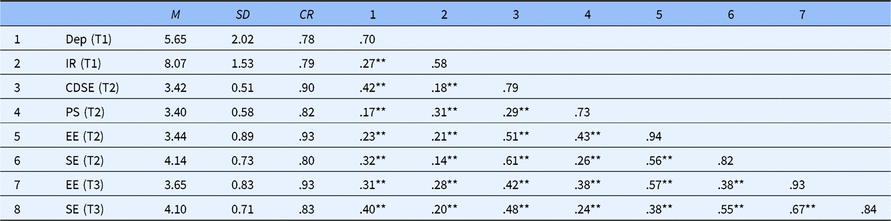
Note: Diagonal elements represent the square root of the average variance extracted (AVE). Off-diagonal elements are correlations between constructs. CR = composite reliability, Dep = dependability, IR = interpersonal relatedness, CDSE = career decision self-efficacy, PS = perceived parental support, EE = environmental exploration, SE = self-exploration.
*p < .05. **p < .01.
The means, standard deviations and correlations of the research variables are shown in Table 1. As expected, the CEQ environmental exploration and self-exploration scores at Time 2 were significantly correlated with those at Time 3. The concurrent and longitudinal correlations among personality, career decision self-efficacy, perceived parental support and career exploration were all statistically significant.
Contributions of personality to career exploration and mediation effects of self-efficacy and perceived parental support
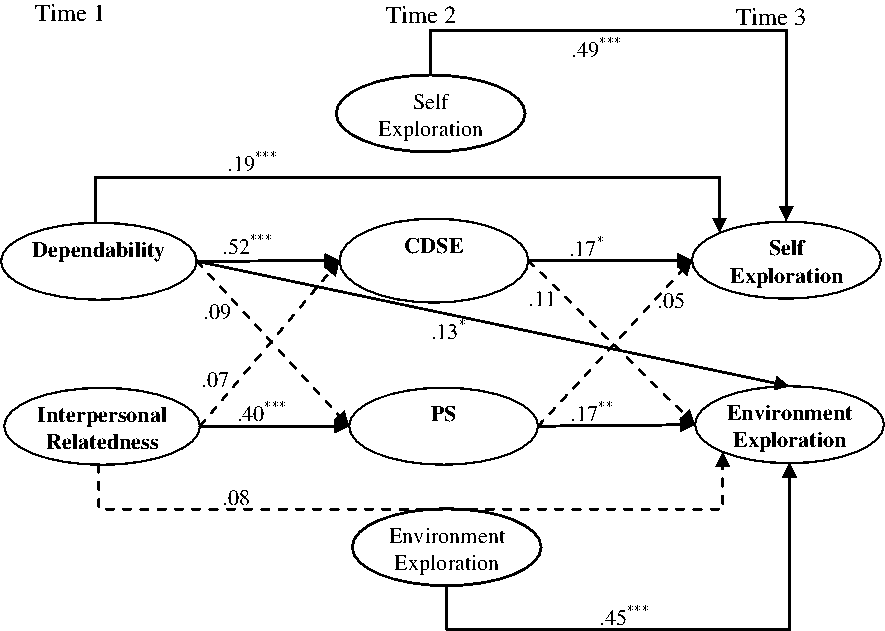
The test of normality suggested that the empirical data was not multivariate normally distributed (Mardia coefficient = 53.97, p < .05), so the robust maximum likelihood estimator approach was used in order to minimize concerns regarding multivariate non-normality and its effect (Satorra & Bentler, Reference Satorra and Bentler1990). Career exploration at Time 2 was closely associated with that at Time 3, which may exaggerate the estimated indirect effect if not controlled (Cole & Maxwell, Reference Cole and Maxwell2003), so the contributions of personality at Time 1 to career exploration at Time 3 were examined after controlling for career exploration at Time 2. The standardized coefficients for all the paths are shown in Figure 1. The goodness-of-fit indices indicated that the empirical data fitted the model well, χ2 = 711.78, df = 231, p < .001, χ2/df = 3.08, RMSEA = .066, CFI = .91, TLI = .89, and SRMR = .112. The indirect effects of personality are indicated in Table 2. Although dependability and IR were both positively associated with environmental exploration, only the relationship between IR and environmental exploration was significantly mediated by perceived parental support. The relationship between dependability and self-exploration was significantly mediated by career decision self-efficacy.
The influence of personality on career exploration through career decision self-efficacy and perceived parental support. The within-wave correlations among constructs are omitted for diagrammatic simplicity. Non-significant paths are indicated by the broken line.
Note: CDSE = career decision self-efficacy, PS = perceived parental support. *p < .05. **p < .01. ***p < .001.
Indirect effect of personality at Time 1 on career exploration at Time 3
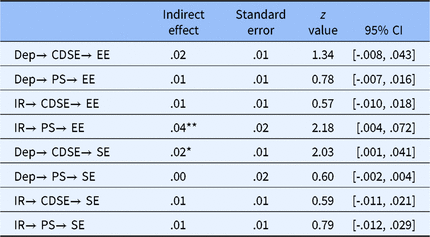
Note: Dep = dependability, IR = interpersonal relatedness, CDSE = career decision self-efficacy, PS = perceived parental support, EE = environmental exploration, SE = self-exploration.
*p < .05. **p < .01.
Discussion
The current study explored the possible underlying mechanisms of how personality contributes to individuals’ career exploration behaviors. Consistent with the hypotheses, both dependability (a self-oriented personality factor) and IR (a social-oriented personality factor) had concurrent and long-term effects on Chinese high school students’ career exploration. Furthermore, those students who were more interpersonal-oriented reported more perceived parental support, which promoted more participation in environmental exploration over time; whereas those with higher dependability had higher self-efficacy, which led them to be more involved in self-exploration activities.
Although the SCCT model posits that personality could influence career exploration through both personal agency (e.g. self-efficacy) and contextual factors (e.g. relational support), very few studies have examined the two possible paths simultaneously. Most empirical studies with the SCCT model have only discussed the mediation role of self-efficacy rather than social support in the relation between personality and career exploration (Lent et al., Reference Lent, Ezeofor, Morrison, Penn and Ireland2016; Rogers et al., Reference Rogers, Creed and Glendon2008). This may be partially due to the fact that previous studies usually focused on self-oriented personality traits (e.g. Lent et al., Reference Lent, Ezeofor, Morrison, Penn and Ireland2016), which have limited impact on individuals’ interpersonal environments (Allemand et al., Reference Allemand, Schaffhuser and Martin2015; Asendorpf & van Aken, Reference Asendorpf and van Aken2003). In our study, dependability also showed a non-significant relationship with parental support. By including social-oriented personality traits, our study provides empirical evidence for the proposition of the SCCT model and suggests that different types of personality traits may exert their impacts through different mechanisms.
Self- and social-oriented personality traits may contribute to individuals’ behaviors depending on differentiated importance and function (Cheung et al., Reference Cheung, van de Vijver and Leong2011; Yang, Reference Yang, Kim, Yang and Hwang2006). Students high in dependability are more organized and persistent in pursuing life goals. Their practice and successful experience in career exploration tasks may enable them to develop self-efficacy (Anderson & Betz, Reference Anderson and Betz2001), which in turn encourages more exploratory behaviors (Lent et al., Reference Lent, Ezeofor, Morrison, Penn and Ireland2016; Rogers et al., Reference Rogers, Creed and Glendon2008). In contrast, IR, as a typical social-oriented personality factor, is more effective in predicting social contextual behaviors (Kwong & Cheung, Reference Kwong and Cheung2003). People high in IR value relationship harmony and are sensitive to the needs of others. Therefore, they are more likely to have positive relationships with important figures (Chen, Cheung, Bond, & Leung, Reference Chen, Cheung, Bond and Leung2006), which could facilitate the exploration process by providing various interpersonal resources (Ketterson & Blustein, Reference Ketterson and Blustein1997; Schultheiss et al., Reference Schultheiss, Kress, Manzi and Glasscock2001; Young et al., Reference Young, Valach, Ball, Paseluikho, Wong, DeVries and Turkel2001). Similar findings were also found in life satisfaction research, that social-oriented personality traits benefit people’s life through maintaining harmonious and positive relationship, while self-oriented traits work through maintaining high self-esteem (Chen et al., Reference Chen, Cheung, Bond and Leung2006).
The SCCT is a triadic-reciprocal model that emphasizes personal agency and the bidirectional relations among persons, their environments and behaviors (Lent et al., Reference Lent, Brown, Hackett, Brown and Brooks2002). It posits that people are not merely beneficiaries/victims of situational forces, but active agents who can shape their career possibilities. This current study provided preliminary support to the proposition by showing that individuals with certain characteristics were more likely to have positive cognitive beliefs and supportive relational environments, which in turn benefited their career development. However, the identification of bidirectional processes between persons and their environments does not negate the possibility of other relations, such as interactional relations (Rutter & Pickles Reference Rutter, Pickles, Wachs and Plomin1991). Interpersonal contexts can also serve as facilitators or barriers that moderate the effect of distal influence (e.g. personality, ethnicity), or moderate individuals’ willingness or ability to transform their career interests into actions (Lent et al., Reference Lent, Brown, Hackett, Brown and Brooks2002; Rogers et al., Reference Rogers, Creed and Glendon2008). A similar idea is also reflected in research on child development, which addresses both bidirectional and interactive effects between parenting and child temperament (Kiff et al., Reference Kiff, Lengua and Zalewski2011). For example, children with low emotional stability may elicit negative parenting behaviors (Scaramella, Sohr-Preston, Mirabile, Robison, & Callahan, Reference Scaramella, Sohr-Preston, Mirabile, Robison and Callahan2008), and meanwhile they are more susceptible to the adverse effects of negative parenting (Rubin, Burgess, & Hastings, Reference Rubin, Burgess and Hastings2002). Therefore, further study may consider investigating whether social-oriented individuals could benefit more from a positive relational environment by examining the moderation effect of parental support.
Another interesting finding in the current study was that the effect of different types of personality, as well as the underlying mechanism, varied depending on different types of career exploration. Self-exploration was only influenced by self-oriented personality traits through the personal factor of self-efficacy, whereas environmental exploration was impacted by both self- and social-oriented personality traits through an interpersonal contextual factor (perceived parental support). The result is consistent with Kwong and Cheung’s (Reference Kwong and Cheung2003) finding that self-oriented personality traits better explain personal contextual behaviors (e.g. persistency and enthusiasm), whereas social-oriented traits are good predictors of performance in the interpersonal domain (e.g. cooperation). Activities involved in environmental exploration entail gathering information on a labor market and various occupations, whereas those in self-exploration entail reflecting one’s career preference and setting career goals and plans (Dietrich et al., Reference Dietrich, Kracke and Nurmi2011; Porfeli et al., Reference Porfeli, Lee, Vondracek and Weigold2011). Therefore, compared with self-exploration, environmental exploration usually involves more interpersonal interactions with others, such as career discussion with parents, friends or experts. Those interpersonal interactions are not only the most common way but also the most efficient way to obtain useful information (Stumpf, Colarelli, & Hartman, Reference Stumpf, Colarelli and Hartman1983). Accordingly, it is reasonable that the environmental exploration is more vulnerable to contextual influence (e.g., parental support), as well as one’s social-oriented personality. Moreover, some studies suggest that activities in environmental exploration usually induce more stress and emotional problems than self-exploration (Stumpf et al., Reference Stumpf, Colarelli and Hartman1983); thus, perceived parental support should have more significance to environmental exploration process. In contrast, self-exploration entails relatively fewer social interactions, which could be one of the reasons why interpersonal factors, including personality and relational contextual factors, have little relevance to self-exploration. However, Hamer and Bruch (Reference Hamer and Bruch1997) argued that individuals get to know themselves through their relationships with others, such as friends, parents or counselors.
Implications, limitations, and future direction
Using a longitudinal design with the effect of exploration at a prior time point that was well controlled, the current study investigated the relationship between personality and career exploration. It further revealed that the effects of different types of personality as well as the underlying mechanism varied depending on different types of career exploration. The current study not only enriches our knowledge about the process of how personality influences career exploration, but also suggests possible interventions for improving Chinese adolescents’ career exploration. For example, those adolescents who are less dependable may benefit from interventions that improve self-efficacy; whereas the adolescents who are less socially oriented may engage in more environmental exploration if the practitioners can help them to search out and utilize significant others as sources of social support.
The current study affirmed that social-oriented personality traits are as important as self-oriented personality traits in Chinese adolescents’ career development (Fan et al., Reference Fan, Cheung, Leong and Cheung2012). Career development is not a completely personal and independent decision-making process (Blustein, Reference Blustein2001). Before individuals make their career choices, they need to explore and understand themselves and the vocational world, and cope with the stress and emotional problems experienced in the exploration process (Lent et al., Reference Lent, Ezeofor, Morrison, Penn and Ireland2016; Schultheiss et al., Reference Schultheiss, Kress, Manzi and Glasscock2001). Social-oriented personality traits may not enhance one’s competence or self-confidence, but can facilitate the exploration process through providing a more supportive relational environment. Practitioners are encouraged to pay more attentions to the social-oriented personality dimensions of their career counseling clients when exploring their problems. For those adolescents who have problems in establishing positive relationships with others (e.g. people who are shy, self-oriented, or too defensive), practitioners may coach them on necessary social skills and help them to build up and utilize their relational resources.
This study was subject to some limitations. Although we controlled the effect of the dependent variable at the prior time point, compared with the full model of longitudinal mediation (Cole & Maxwell, Reference Cole and Maxwell2003), the influence of variables at Time 1 was not controlled in the model, which may have an impact on the estimated effect. In addition, the results of the current study were based on a relatively small sample, and all participants were high school students from Hong Kong, where interpersonal relationships are highly valued and play an important role in people’s lives (Bond, Reference Bond2010; Leung & Chen, Reference Leung and Chen2009). The effect of interpersonal factors may be more salient with Chinese adolescents than with adolescents from other cultures (Fan et al., Reference Fan, Cheung, Leong and Cheung2012). Future research with cross-cultural samples may consider replicating those findings to test whether these relations hold among students in other cultures. Finally, although we found incremental contributions of the social-oriented personality to adolescent career development beyond the self-orientated personality, the contribution was still small, as with other previous empirical research (Bartley & Robitschek, Reference Bartley and Robitschek2000; Lent et al., Reference Lent, Ezeofor, Morrison, Penn and Ireland2016). Studies with a more scientific design may be needed to further demonstrate the influences of different personality dimensions on adolescents’ career development in specific contexts.
Funding
This study was partially supported by National Social Sciences Foundation of China #14BSH081 and the Hong Kong Government Research Grants Council GRF Grant 2012/13 CUHK 441812.


 Open access

