Introduction
Regardless of country, suicide rates are higher in the elderly than in any other age group (Pearson and Conwell, Reference Pearson and Conwell1995; Bertolote, Reference Bertolote and Wasserman2001). Because of its elevated rate and unique characteristics, late-life suicide is considered to be a major public health problem.
In order to determine suitable policy and specific strategies for intervention, it is important to identify risk factors associated with late-life suicide. Prior research indicates that the most salient determinant of a late-life suicide attempt is the diagnosis of major depressive disorder (De Leo and Ormskerk, Reference De Leo and Ormskerk1991; Heikkinen and Lonnqvist, Reference Heikkinen and Lonnqvist1995; Harwood and Jacoby, Reference Harwood, Jacoby, Hawton and Heeringen2000; Althaus and Hegerl, Reference Althaus and Hegerl2003). However, the symptoms of most older subjects do not meet the diagnostic criteria for a specific psychiatric disorder (Burke and Wengel, Reference Burke and Wengel2003). This makes identification of elderly persons at high risk of suicide more challenging for primary care physicians. Valid screening tools and an adequate knowledge about mental disorders are needed to evaluate suicidal risk in later life effectively.
Prior research shows that subclinical symptoms are significant because of their strong association with subsequent malfunctioning and suffering in the elderly (Lyness et al., Reference Lyness2007). In the primary care setting, milder forms of depression are frequent precursors to more severe conditions (Moscicki and Caine, Reference Moscicki and Caine2004). From a public health perspective, subclinical symptoms may serve as practical targets for early intervention if there is a link between late-life suicide and mild forms of mental disorders. However, none of the published studies on late-life suicide has specifically examined whether subclinical symptoms are independent risk factors for suicidal behavior.
The role of another factor, the diagnosis of dementia, in suicide attempts has long been debated. Some research supports the hypothesis that dementia is either a risk or a protective factor for suicide in the elderly, while other studies fail to demonstrate any association (Lyness et al., Reference Lyness, Conwell and Nelson1992; Turvey et al., Reference Turvey2002). One proposed explanation for its protective effect is that people with severe cognitive impairment lack the ability to perform suicidal acts, but people with mild cognitive impairments are still at risk (Chiu et al., Reference Chiu2004). Nevertheless, prior studies inadequately explore the relationship between suicidal behavior and a mild level of cognitive impairment (Ayalon et al., Reference Ayalon, Mackin, Arean, Chen and Herr2007).
This study aimed to compare the risk associated with clinical factors, as well as subclinical symptoms and mild cognitive impairment, in those who attempt suicide with the risk among controls. We examined the occurrence of mild cognitive impairment and subclinical symptoms among the elderly based on a case-control study design.
Method
The study subjects were patients aged 60 years and older who sought emergency services in a university-affiliated general hospital for attempting suicide between March 2005 and December 2006. Seventy-two elderly suicide attempters were identified during the study period, of whom 43 (60%) were included. The other 29 subjects were excluded because of a lack of contact information, refusal to participate, or their poor physical condition.
The comparison group was recruited by placing posters about the study in the community around the hospital. Those recruited were matched for age and randomly selected based on the enrolled date of cases. Those with a past history of suicide attempts were excluded. Eighty-six subjects, equally distributed between case and comparison groups, were included in the final analysis. After obtaining informed consent, we collected the following data from our subjects: demographic data, past history of physical problems, previous suicidal attempts and past history of mental illness.
Both groups were assessed by a qualified psychiatrist to determine a DSM-IV psychiatric diagnosis if necessary. In addition, the 15-item Geriatric Depression Scale (GDS-15), one of the most widely used instruments for the screening of depression in later life, was used to assess the severity of depression among suicide attempters and controls (Yesavage et al., Reference Yesavage1982). Based on literature, scores greater than five were defined as suggestive of depression and was considered an optimal cutoff point, yielding high sensitivity and specificity rates (D'Ath et al., Reference D'Ath, Katona, Mullan, Evans and Katona1994).
In order to obtain a measurement of family function, individuals were asked to complete the family APGAR scale, which consists of five parameters: adaptability, partnership, growth, affection and resolve. The acronym “APGAR” is comprised of the first letter of each parameter. This instrument has been reported to be valid and reliable, and a score of less than six is generally defined as impaired family function (Smilkstein, Reference Smilkstein1978; Smilkstein et al., Reference Smilkstein, Ashworth and Montano1982).
The 5-item Brief Symptom Rating Scale (BSRS-5) was composed of five symptom items, each of which had the highest correlation with the corresponding subscale score for Anxiety, Depression, Hostility, Interpersonal Sensitivity and Additional Symptoms including sleep disturbance, in the original version of BSRS-50. For example, the degree of distress from anxiety was assessed by the item “feeling tense or ‘keyed up’”. Response options ranged from 0 (not at all) to 4 (extremely distressed). The proposed cut-off score of 5 points for the total of all 5 items was used to identify persons with possible mental distress or subclinical symptoms. Cronbach's α coefficient, indicating the internal consistency of BSRS-5, was 0.84 (Chen et al., Reference Chen, Wu, Lee, Liao and Lee2005). All of the scores on the GDS, family APGAR scale and BSRS-5 were dichotomized in our study.
Two types of dementia screening tests, the Mini-mental state examination (MMSE) and Cognitive Abilities Screening Instrument – Chinese version (CASI), together with a diagnostic interview were used to assess the occurrence of impaired cognitive function (Teng et al., Reference Teng1994; Tsai et al., Reference Tsai, Lin, Wu and Liu2004). These assessments and interviews were all completed one month after the indexed suicidal behavior and the subjects were asked to evaluate their condition before each suicidal act as completely as possible.
Statistical analyses, including χ2 and t-tests, were undertaken to compare the case and comparison group. Potential significant factors related to elderly suicide in univariate analysis were identified as being significant at p < 0.15. Multiple logistic regression analysis was then employed to detect the significant factors and evaluate the individual impact of each factor on the occurrence of elderly suicide attempts. The significance level was defined as p < 0.05. Adjusted odds ratios were estimated in the final model. The project was reviewed and approved by the Ethics Committee of the Cardinal Tien Hospital.
Results
Demographic comparisons
Both the case and control groups comprised 43 participants. The mean age of the comparison group on interview was 78.6 ± 7.94 years (range 61–90 years) and was higher than that of the case group (75.5 ± 8.67 years; range 60–92 years). Nonetheless, the age difference was not statistically significant. There was no difference in the gender ratio. Regarding educational attainment, the proportion of subjects with less than 6 years of education was 46.5% and 37.2% in the case and comparison groups, respectively, while the proportion of those with more than 14 years of education was 16.3% and 25.6%, respectively. Again, the differences were not statistically significant.
Only two suicide attempters and one comparison subject were employed at the time of interview. Approximately one third of both groups were married and lived with their spouse at the time of interview. More than 50% of comparison subjects were widowed, as compared to 45% of cases. This difference did not reach statistical significance.
Suicidal method, attributable causes, and repeated attempts in case subjects
Twenty-one of the suicidal subjects (48.8%) chose drug overdose as their means of suicide. The second most common method was using a sharp instrument, such as a knife (27.9%). Other methods included drowning (9.3%) and hanging (4.6%). Suicidal subjects revealed long-term life stressors and attributed their suicidal acts to certain precipitating factors (Table 1). Health conditions were the most frequent concern (51.2%).
Characteristics of late-life suicides (N = 43)

Twenty-three of the subjects (53.5%) reported that they had had previous suicidal behaviors, with various time lapses from their first suicidal acts. More than half of repeated suicide attempters had made their first suicidal attempt within the past two years. Age on their first attempt ranged from 25 to 92 years, with a mean of 70 years. As for hospitalization after their suicide attempts, ten had been admitted to a psychiatric ward; seven to a medical ward, but more than half were not hospitalized.
Physical problems, psychiatric conditions, and cognitive functions
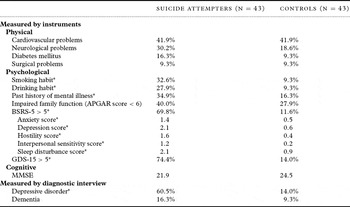
Four types of physical problems were identified in this study: cardiovascular disease, neurological disease, diabetes mellitus, and surgical or orthopedic problems (Table 2). There were no significant differences in the distribution of these problems between cases and comparison subjects. Suicide attempters tended to drink and smoke more. Compared to 16% of comparison subjects, 35% of suicide attempters reported a past history of psychiatric problems. Smoking, drinking and past history of mental illness were all significantly different between the two groups.
Comparisons of physical, psychiatric, and cognitive aspects between cases and controls

*p value less than 0.15
BSRS-5 = 5-item Brief Symptom Rating Scale; GDS-15 = 15-item Geriatric Depression Scale; MMSE = Mini-mental State Examination
Although more cases reported impaired family function, there was no statistically significant discrepancy in the initial analysis. There were more subjects with BSRS-5 score >5 in the case group than in the comparison group (70% vs. 12%, p<0.05). All scores of the five BSRS items are significantly higher in suicide attempters than comparison subjects. The mean GDS score was much higher in the case group than the control group. They also had a significantly higher rate of GDS scores more than 5. Regarding cognitive function, the mean MMSE score was 21.9 and 24.5 in the cases and comparison groups, respectively. After adjustment for age and education, there was no significant difference in cognitive function impairment between elderly suicide attempters and the comparison subjects.
Based on the diagnostic interview one month after the suicidal behavior, about 60% of the cases met the diagnostic criteria for depressive disorder, while 16% had a diagnosis of dementia. In the comparison group, 14% had a diagnosis of depressive disorder and 9.3% had dementia. The presence of a depressive disorder was significantly higher in the case than in the comparison group (p = 0.001), while there was no significant difference in the frequency of people with a diagnosis of dementia in these two groups. Impaired cognitive function, indicated by MMSE score and the diagnostic interview, was independent of late-life suicidal behavior.
Multiple logistic regression model
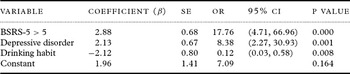
All six significant factors detected in univariate statistical analyses were analyzed for the final logistic regression model. Smoking habit, GDS score greater than 5 and past history of mental illness were excluded because of their insignificant effect on suicidal behavior. The identified risk factors and their effects on suicidal attempts in the final model are shown in Table 3. The adjusted odds of suicide among people with a BSRS-5 score greater than 5 is 17.8 times that of people with a BSRS score less than or equal to 5. After controlling for drinking and the BSRS-5 score, those diagnosed with depressive disorder were more likely to have made a suicide attempt than people without depressive disorder (odds ratio = 8.38, p = 0.001). After adjustment for depressive disorders and BSRS-5 score, drinkers had lower odds of developing suicidal behaviors than people who did not drink.
Significant variables on the multiple logistic regression model

BSRS-5 = 5-item Brief Symptom Rating Scale; SE = standard error; OR = odds ratio; CI = confidence interval
Discussion
The results indicate that drinking, BSRS-5 score, and diagnosis of depressive disorder based on diagnostic interviews all have significant associations with late-life suicide attempts. Based on prior research, more than 70% of elderly suicides have psychiatric illness, the most prevalent of which is major depressive disorder (Suominen et al., Reference Suominen, Henriksson, Suokas, Isometsa, Ostamo and Lonnqvist1996; Conwell, Reference Conwell1997; Lebowitz et al., Reference Lebowitz1997). The findings here are consistent with prior study results in that older people with a diagnosis of depressive disorder had significantly higher odds of developing suicidal behavior. They further confirm that the recognition and treatment of depression is an important strategy for intervention in late-life suicidal acts.
For the primary care providers, a powerful screening instrument will be helpful in detecting psychiatric symptoms and assessing suicidal risk. The BSRS-5, an easily applicable instrument, meets this need in the clinical setting. In the current study, the BSRS-5 score was highly correlated with a late-life suicide attempt. Anxiety, depression, hostility, sleep condition and interpersonal sensitivity are all self-rated and put together to measure general mental health. This score's strong influence on the odds of a suicide attempt is independent of the effect of drinking and the diagnosis of depressive disorder. Lebowitz et al. (Reference Lebowitz1997) indicated that subclinical depression is associated with an increased risk of major depression, physical disability, medical illness, and the frequent use of medical services. The identification and treatment of subclinical depression is warranted for early intervention in late-life suffering (Lebowitz et al., Reference Lebowitz1997). Although the impact of anxiety on suicidal behavior is mentioned in a few studies (Hawgood and De Leo, Reference Hawgood and De Leo2008), there is relatively little information about the influence of anxiety on geriatric suicide. Spira et al. (Reference Spira, Friedman, Aulakh, Lee, Sheikh and Yesavage2008) point out that subclinical levels of anxiety are related to sleep disturbance and overall functioning in the elderly. Sleep disturbance is also associated with suicide and suicidal ideation in younger populations and may affect the elderly as well (Ayalon et al., Reference Ayalon, Mackin, Arean, Chen and Herr2007). Since the self-rated mental conditions have separate contributions to suicidal risk, the score on BSRS-5 can serve as a predictor of elderly suicidal behavior. The role of subclinical symptoms should be highlighted in the field of prevention of suicidal attempts in later life.
With regard to drinking behavior, this study only analyzed a drinking habit instead of the diagnosis of alcohol use disorder, since the number of older subjects who met the diagnosis of alcohol use disorder was small. In the literature it is reported that about 33% of males and 18% of females who committed suicide in later life also abused alcohol (Waern, Reference Waern2003). Previous studies also demonstrate that drinking in older people has an elevated suicidal risk through mediation by other prevalent factors, such as depressive disorder, while drinking per se is not a risk factor (Blow et al., Reference Blow, Brockmann and Barry2004; Pirkola et al., Reference Pirkola, Suominen and Isometsa2004). This study, with a focus on suicide attempters, shows that a drinking habit is more frequent in suicide attempters than in comparison subjects and is positively related to the appearance of attempted suicide in univariate analyses. Interestingly, once depressive disorder and BSRS-5 score are controlled, this factor shows a negative relationship in terms of the odds of making a suicide attempt. This means that a drinking habit is protective in the elderly if both the diagnosis of depressive disorder and subclinical symptoms are controlled. This further implies that non-pathological drinking is more common among non-attempters, which is consistent with a prior study suggestive of an inverse correlation between drinking and depression in the elderly (Turvey et al., Reference Turvey, Schultz and Klein2006). Nonetheless, further investigation is needed to elucidate the underlying mechanism.
This study employed both measurement instruments and diagnostic interviews to examine the relationship between cognitive functioning and late-life suicide. There is no evidence to support the relationship between suicide in later life and impaired cognitive function, as impairment neither increased risk nor prevented suicide. The severity of cognitive impairment and psychiatric comorbidity have been previously mentioned in this regard (Chiu et al., Reference Chiu2004). People with severe cognitive impairment may be unable to attempt suicide and, as a result, are less likely to present with suicidal behaviors. Comorbidity with depression, early dementia, or mild cognitive deficit may place the elderly at increased risk for suicide. Mild cognitive impairment and depressive disorders have shown no significant difference between cases and comparison subjects in the current study. Poor cognitive functioning may decrease the efficacy of certain preventive strategies and the assessment for suicide prevention in the elderly.
This study has limitations. First, the cases of attempted suicide and the results are difficult to generalize to the population of completed suicides, although it has been proposed that elderly suicide attempters may be more similar to completers-than in a younger group (Pearson and Brown, Reference Pearson and Brown2000). Second, the selection of controls for comparison is from advertisements within the community and the volunteer effect should be considered. Third, two suicide attempters developed organic brain syndromes after their suicide attempts and their one-month post-event data had to be excluded. This may have skewed the results. Fourth, a low prevalence of suicide attempts in the small sample size limits the study's statistical power. The lack of statistically significant associations between late-life suicide and risk factors may be due to type II errors. For example, a Hong Kong study indicated that the estimated prevalence of dementia in elderly Chinese aged 70 or above was 6.1% (Chiu et al., Reference Chiu1998). Only 9.3% of the comparison group, with a mean age of 78.6 years, and 16.3% of cases met the diagnosis of dementia. The attempters seem to have a higher proportion of those diagnosed with dementia. Although there is no significant difference in this study, the power issue should be kept in mind in interpreting the insignificant result. Lastly, the result is subject to recall bias because the attempters were asked to recall their state prior to the attempt.
In conclusion, this study confirms the hypothesis that depressive disorder is a salient predictor of elderly suicide attempts. However, it provides no evidence to support a relationship between cognitive functioning and late-life suicide. The findings on the assessment of subclinical symptoms, including anxiety, depression, hostility, sleep condition and inter-personal symptoms, may help in the prevention of late-life suicidal behavior, particularly in primary care settings. Longitudinal data and powerful statistical approaches should be adopted in order to construct a comprehensive causal model for late-life suicide and to plan an effective program for its recognition and prevention.
Conflict of interest
None.
Description of authors' roles
Dr. C. H. Chiu collected the data and wrote the paper, while Dr. I. C. Liu designed the study and was responsible for the statistical analysis.
Acknowledgments
This work was supported by National Science Council grant NSC 94-2314-B-030-001 and Cardinal Tien Hospital grant CTH-94-2-014, both awarded to Dr I. C. Liu.