1. Introduction
The Meguma terrane of southwestern Nova Scotia is unique within the Appalachian Orogen (Williams & Hatcher, Reference Williams and Hatcher1982, Reference Williams, Hatcher, Hatcher, Williams and Zietz1983; Schenk, Reference Schenk1997; Waldron et al. Reference Waldron, White, Barr, Simonetti and Heaman2009). It represents the most outboard of all the accreted terranes and is comprised of the Cambrian–Ordovician Meguma Supergroup and the Silurian–Devonian Rockville Notch Group that were intruded by Devonian silicic plutons (Schenk, Reference Schenk1997; Keppie & Krogh, Reference Keppie and Krogh1999; MacDonald et al. Reference MacDonald, Barr, White and Ketchum2002; Waldron et al. Reference Waldron, White, Barr, Simonetti and Heaman2009; White & Barr, Reference White and Barr2017). The Meguma Supergroup consists of metapelites of the Halifax Group and metapsammites of the Goldenville Group, whereas the Rockville Notch Group consists of metavolcanic, plutonic and metasedimentary rocks (Keppie & Dallmeyer, Reference Keppie and Dallmeyer1987; MacDonald et al. Reference MacDonald, Barr, White and Ketchum2002; Waldron et al. Reference Waldron, White, Barr, Simonetti and Heaman2009; White & Barr, Reference White and Barr2017; Keppie et al. Reference Keppie, Shellnutt, Dostal and Keppie2018). The Meguma terrane is noted for its large volume of granitic plutons and batholiths that stretch ~450 km from Canso in the east to Wedgeport in the west (Clarke et al. Reference Clarke, MacDonald, Tate, Sinha, Whalen and Hogan1997). The silicic plutons appear to extend beneath the Gulf of Maine and the continental shelf (Pe-Piper & Jansa, Reference Pe-Piper and Jansa1999; V. I. Brake, unpub. B.Sc. thesis, Dalhousie Univ., 2006). The South Mountain Batholith is the largest Devonian (372 ± 3 Ma to 384 ± 4 Ma) batholith within the Appalachian Orogen and covers an area of ~7300 km2, but there are other intrusions including the Musquodoboit Batholith (378 ± 1 Ma), Shelburne pluton (372 ± 3 Ma to 376 ± 2 Ma), Barrington Passage pluton (372 ± 3 Ma to 373 ± 2 Ma), Liscomb pluton (374 ± 3 Ma), Wedgeport pluton (357 ± 1 Ma), Larrys River pluton (371 ± 2 Ma) and Port Mouton pluton (373 ± 1 Ma to 378 ± 3 Ma) (Fig. 1; Hill, Reference Hill1988; Rogers & Barr, Reference Rogers and Barr1988; MacDonald et al. Reference MacDonald, Horne, Corey and Ham1992; Clarke et al. Reference Clarke, MacDonald, Reynolds and Longstaffe1993; Keppie & Krogh, Reference Keppie and Krogh1999; MacLean et al. Reference MacLean, Barr, White and Ketchum2003; Kontak et al. Reference Kontak, Ham and Dunning2004; Dostal et al. Reference Dostal, Keppie, Jutras, Miller and Murphy2006).
Geological map of the Meguma terrane of Nova Scotia showing the distribution of Late Devonian to Early Carboniferous silicic plutons (modified from Keppie & Krogh, Reference Keppie and Krogh1999). MFZ – Minas fault zone.

The plutonic rocks are mostly peraluminous monzogranite to granodiorite, although there are minor volumes of tonalite, leucomonzogranite, leucogranite, aplite and pegmatite (MacDonald et al. Reference MacDonald, Horne, Corey and Ham1992; Clarke et al. Reference Clarke, MacDonald, Tate, Sinha, Whalen and Hogan1997; Keppie & Krogh, Reference Keppie and Krogh1999). In many cases the rocks are thought to be generated by partial melting of metasedimentary rocks that were variably contaminated by Meguma Supergroup rocks during differentiation (MacDonald & Clarke, Reference MacDonald and Clarke1985; Hill, Reference Hill1988; Rogers & Barr, Reference Rogers and Barr1988; MacDonald et al. Reference MacDonald, Horne, Corey and Ham1992; Clarke et al. Reference Clarke, MacDonald, Tate, Sinha, Whalen and Hogan1997; Shellnutt & Dostal, Reference Shellnutt and Dostal2012; MacDonald & Clarke, Reference MacDonald and Clarke2017). The silicic plutons broadly correspond to S-type granites (Clarke et al. Reference Clarke, Halliday and Hamilton1988; Hill, Reference Hill1988). However, the Wedgeport pluton is one notable exception as it is compositionally similar to A-type (ferroan, calc-alkalic) granite and has a radiogenic Nd isotope signature (εNd(t) = +2.1 to +3.3) in contrast to the unradiogenic Nd isotopic signatures (εNd(t) = +1 to −8) of the other plutons (Clarke et al. Reference Clarke, MacDonald, Tate, Sinha, Whalen and Hogan1997; Currie et al. Reference Currie, Whalen, Davis, Longstaffe and Cousens1998; Pe-Piper & Jansa, Reference Pe-Piper and Jansa1999; MacLean et al. Reference MacLean, Barr, White and Ketchum2003).
The classification and petrogenesis of A-type granites is somewhat contentious but it appears there are two broad types: (1) those derived by differentiation of mafic magma, and (2) those derived by partial melting of dehydrated crust (Loiselle & Wones, Reference Loiselle and Wones1979; Collins et al. Reference Collins, Beams, White and Chappell1982; Clemens et al. Reference Clemens, Holloway and White1986; Eby, Reference Eby1992; Bonin, Reference Bonin2007; Shellnutt & Zhou, Reference Shellnutt and Zhou2007; Shellnutt et al. Reference Shellnutt, Jahn and Zhou2011a,b; Dostal & Shellnutt, Reference Dostal and Shellnutt2016; Murphy et al. Reference Murphy, Nance, Keppie, Dostal, Wilson, Houseman, McCaffrey, Doré and Buiter2018a). The bulk rock composition and radiogenic isotopic signature of the Wedgeport pluton suggests that it could be derived from a mantle source (Pe-Piper & Jansa, Reference Pe-Piper and Jansa1999; MacLean et al. Reference MacLean, Barr, White and Ketchum2003). There are number of volumetrically minor mafic to ultramafic intrusions (Mcleods Cove, Forbes Point, Birchtown, Mersey Point, Weekend dykes) within the Meguma terrane that are considered to be contemporaneous with the silicic plutons and have radiogenic Nd isotopic signatures (de Albuquerque, Reference de Albuquerque1979; Tate & Clarke, Reference Tate and Clarke1995). The closest known mafic intrusion to the Wedgeport pluton is the Attwoods Brook gabbronorite located ~35 km to the south (Taylor, Reference Taylor1967; White, Reference White and MacDonald2003). Although the composition of the Attwoods Brook gabbronorite is known, it has yet to be dated using high-precision methods.
In this paper we present the first in situ zircon U–Pb age of the Attwoods Brook gabbronorite collected at Murray Cove, Shelburne County, Nova Scotia. The age date, along with whole-rock geochemistry, Sr–Nd isotopes and petrological modelling are used to evaluate the possible petrogenetic association between the Wedgeport A-type pluton and the Attwoods Brook gabbronorite. Our new results facilitate a discussion on the possible petrogenetic and tectonic implications of Middle to Late Palaeozoic mafic and silicic magmatism not only within the Meguma terrane but across the region.
2. Geological background
The Wedgeport pluton is located within the Meguma terrane of the Canadian Appalachians (Figs 1, 2). The Meguma terrane accreted to North America during Devonian time and is juxtaposed to the north against the Avalon (Avalonia) terrane along the Minas fault zone (Williams & Hatcher, Reference Williams, Hatcher, Hatcher, Williams and Zietz1983; Gibbons et al. Reference Gibbons, Doig, Gordon, Murphy, Reynolds and White1996). The Meguma Supergroup (Goldenville and Halifax Groups) is a ~10 km or more thick Upper Neoproterozoic–Ordovician turbidite sequence composed of metawackes and metapelites (Schenk, Reference Schenk1997; Waldron et al. Reference Waldron, White, Barr, Simonetti and Heaman2009). The turbidites were deformed and metamorphosed from lower-greenschist to upper-amphibolite facies during the Devonian Acadian Orogeny at ~400 Ma (Hicks et al. Reference Hicks, Jamieson and Reynolds1999). These activities took place just prior to emplacement of voluminous granitic intrusions, including the dominant granitoid body of the Meguma terrane: the composite South Mountain Batholith. A large majority of these granitoid intrusions were emplaced at a depth of ~10–12 km at 378–372 Ma (Kontak & Reynolds, Reference Kontak and Reynolds1994; Clarke et al. Reference Clarke, MacDonald, Tate, Sinha, Whalen and Hogan1997; Dostal et al. Reference Dostal, Keppie, Jutras, Miller and Murphy2006). The granitic intrusions produced distinct contact metamorphic aureoles, and their emplacement was followed by rapid exhumation, which produced 40Ar–39Ar mica cooling ages of 375–360 Ma (Keppie & Dallmeyer, Reference Keppie and Dallmeyer1995; Archibald et al. Reference Archibald, Murphy, Reddy, Jourdan, Gillespie and Glorie2018). Subsequently, the rocks were unconformably overlain by Upper Devonian to Carboniferous sedimentary (Horton Group) rocks with the oldest having a late Fammenian (~365–360 Ma) age and the basal units containing granite clasts (Martel et al. Reference Martel, McGregor and Utting1993; Murphy & Hamilton, Reference Murphy and Hamilton2000; Murphy, Reference Murphy2000)
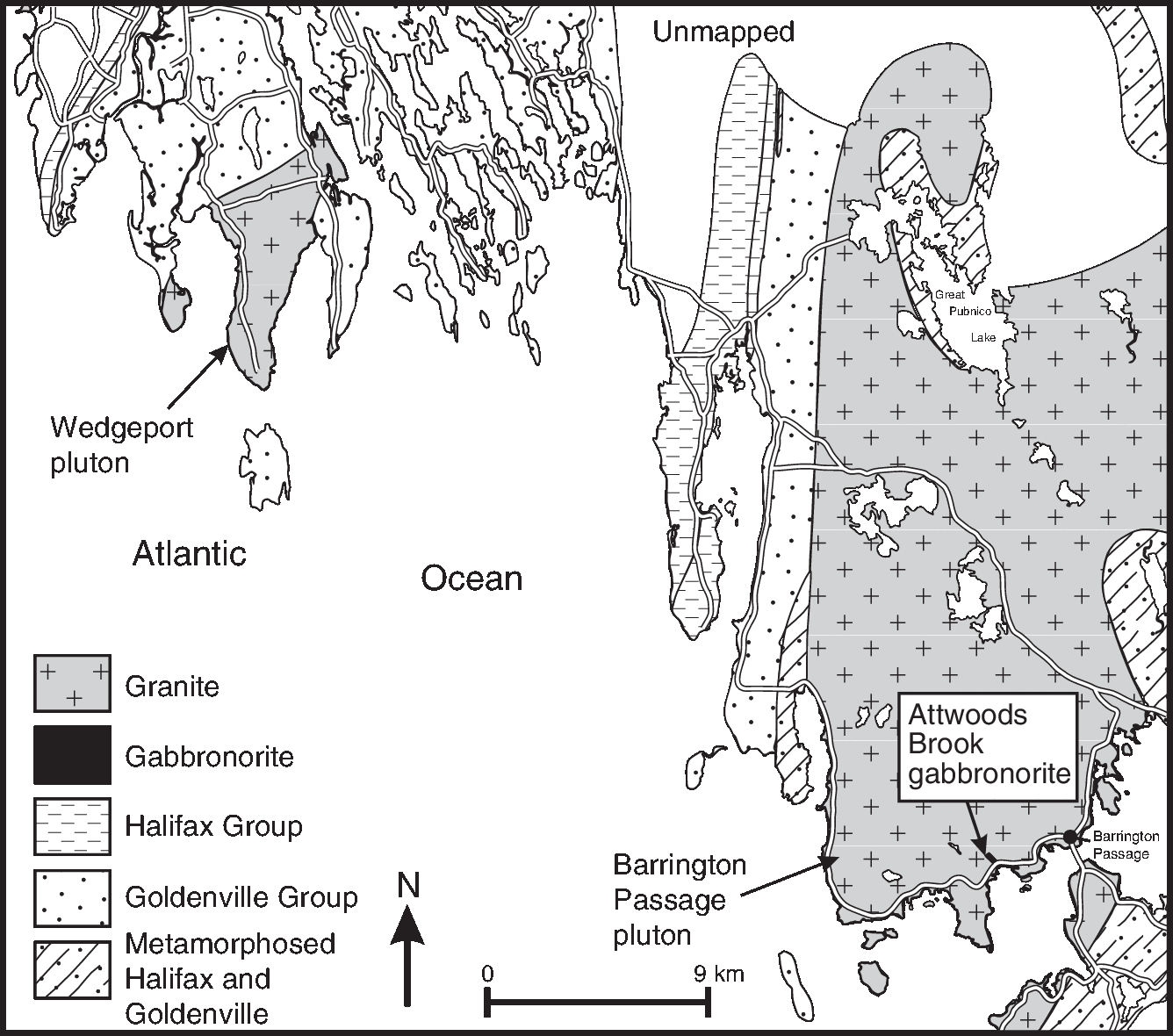
Geological map of SW Nova Scotia showing the location of the Attwoods Brook gabbronorite and the Wedgeport pluton (based on Taylor, Reference Taylor1967).

The Wedgeport pluton intrudes turbidites of the lower part of the Goldenville Group composed of deformed intercalated psammitic and pelitic rocks (White, Reference White and MacDonald2003). The pluton is poorly exposed but drill-core and geophysical data indicate that it covers an area of ~60 km2 (Pe-Piper & Jansa, Reference Pe-Piper and Jansa1999; MacLean et al. Reference MacLean, Barr, White and Ketchum2003). It is surrounded by a contact metamorphic aureole of spotted hornfels that indicates emplacement at a relatively shallow depth of ~3–4 km (MacLean et al. Reference MacLean, Barr, White and Ketchum2003). The pluton is made up mainly of unfoliated, medium- to coarse-grained equigranular biotite monzogranite. Biotite constitutes ~15 % of the rocks. The accessory minerals include titanite, zircon, apatite and ilmenite. The pluton is significantly younger (357 ± 1 Ma) than the other Late Palaeozoic granitoids of the Meguma terrane and is cut by a series of shear zones, most of which are NE-trending and steeply dipping (MacLean et al. Reference MacLean, Barr, White and Ketchum2003).
The Attwoods Brook intrusion is a located ~35 km south of the Wedgeport pluton and is described as a small plug about ~2 km long and ~0.45 km wide (Fig. 2; Taylor, Reference Taylor1967). It is a medium- to coarse-grained gabbronorite composed predominantly of plagioclase and clinopyroxene (Taylor, Reference Taylor1967; de Albuquerque, Reference de Albuquerque1979; M. C. Tate, unpub. Ph.D. thesis, Dalhousie Univ., 1995; Tate & Clarke, Reference Tate and Clarke1995). Taylor (Reference Taylor1967) observed that there is significant variability in grain size and in the proportion of plagioclase to mafic minerals. Moreover, the gabbronorite is cross-cut by a ‘thin, irregular porphyritic diorite dyke, which is also intruded by pegmatite’ (Taylor, Reference Taylor1967, p. 39). M. C. Tate (unpub. Ph.D. thesis, Dalhousie Univ., 1995) observed the granitic pegmatites emanating from the host Barrington Passage tonalite and suggested that they may be related to the brecciation of the gabbronorite. It is possible that the diorite and pegmatite dykes are derived from the Barrington Passage pluton owing to melting associated with the intrusion of the gabbronorite. The Barrington Passage pluton is composed of medium-grained foliated to equigranular biotite tonalite (S-type granite) and was emplaced at 373 ± 2 Ma (Keppie & Krogh, Reference Keppie and Krogh1999). For the purpose of dating we collected a ~5 kg sample (43° 30′ 47.4″ N, 65° 39′ 13.9″ W) ~300 m along strike (near the former Halifax & South Western Rail tracks) from the coastal exposure described by Taylor (Reference Taylor1967) and M. C. Tate (unpub. Ph.D. thesis, Dalhousie Univ., 1995). The contact with the country rock was not exposed nor was this portion of the gabbronorite intruded by pegmatite and thus our sample was not affected by the pegmatite fluxing described by Taylor (Reference Taylor1967) and M. C. Tate (unpub. Ph.D. thesis, Dalhousie Univ., 1995).
3. Petrography
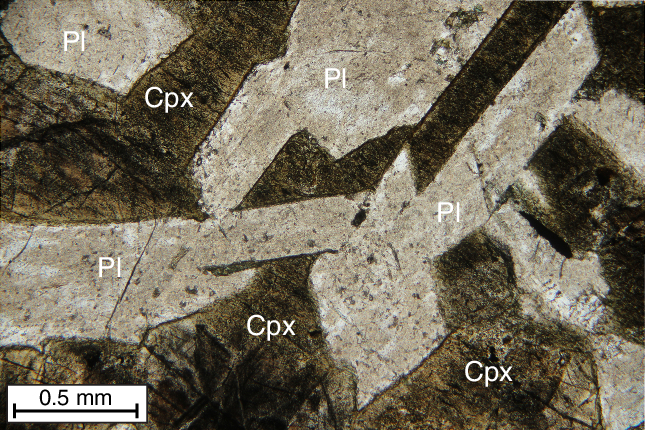
The Attwoods Brook gabbronorite collected for this study (SB-1) experienced lower-greenschist metamorphism as the original texture is preserved but many of the primary minerals are altered (Fig. 3). Consequently, we supplement our description with observations made by Taylor (Reference Taylor1967), de Albuquerque (Reference de Albuquerque1979) and M. C. Tate (unpub. Ph.D. thesis, Dalhousie Univ., 1995). The rock is coarse to medium grained and with idiomorphic to hypidiomorphic textures, although Taylor (Reference Taylor1967) stated that grain size and the proportion of feldspar to mafic minerals vary markedly. The primary mineralogy is plagioclase, clinopyroxene and orthopyroxene with accessory amounts of apatite and Fe–Ti oxide minerals. Secondary amphibole (hornblende and actinolite) and biotite are observed. Plagioclase is the most abundant (50–60 vol. %) mineral. It has euhedral lath textures that are typically enclosed by pyroxene (Fig. 3). Most of the plagioclase observed in sample SB-1 has saussurite alteration but poly-synthetic twinning is observed in some crystals. Plagioclase ranges in composition from An60 to An50, but M. C. Tate (unpub. Ph.D. thesis, Dalhousie Univ., 1995) reported anorthite values as low as 43. The pyroxenes are the most abundant mafic minerals, but clinopyroxene (20–30 vol. %) is more abundant than orthopyroxene (~10 vol. %). The clinopyroxene is augite (~Wo42En47Fs12) and the orthopyroxene typically has a Mg no. of ~70. Some pyroxenes are still preserved but many of them are altered to a combination of hornblende and actinolite with minor biotite. Fe–Ti oxides (<5 vol. %) have irregular, equant shapes and are usually interstitial to the pyroxenes. Accessory (≤1 vol. %) amounts of euhedral (acicular or hexagonal) apatite are observed. de Albuquerque (Reference de Albuquerque1979) and M. C. Tate (unpub. Ph.D. thesis, Dalhousie Univ., 1995) reported minor amounts of primary biotite (<3 vol. %) and amphibole (<10 vol. %); however, they were not observed in sample SB-1.
Photomicrograph of the Attwoods Brook gabbronorite showing the granular idiomorphic to hypidiomorphic crystal textures of plagioclase (Pl) and clinopyroxene (Cpx).

4. Methods
4.a. Zircon U–Pb geochronology
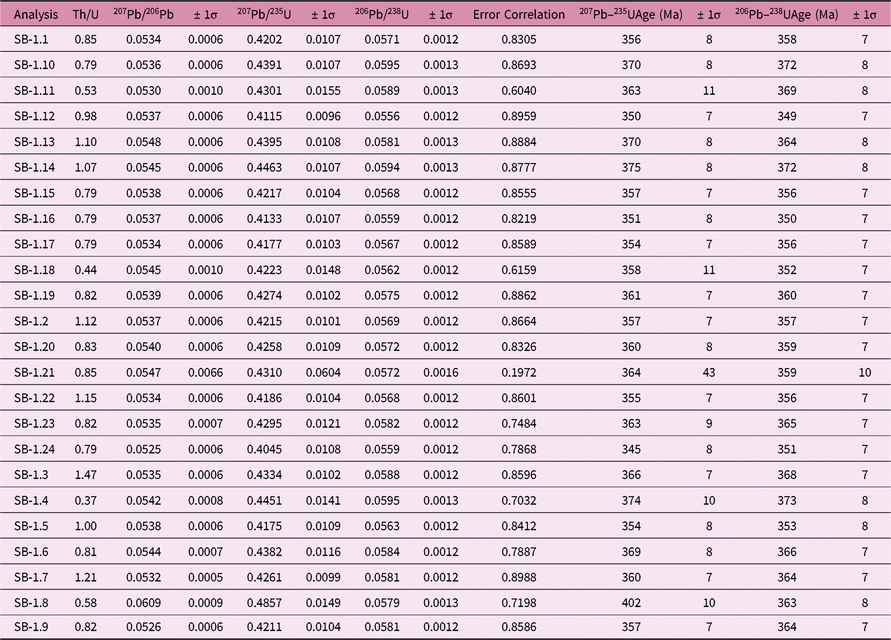
Sample SB-1 was processed using magnetic separation and heavy-liquid techniques at the Yu-Neng Rock and Mineral Separation Company (Lanfang, Hebei, China). Cathodoluminescence (CL) images were taken at the Institute of Earth Sciences, Academia Sinica, Taipei, for selecting suitable positions for U–Pb analyses and to examine individual crystal internal structures. Zircon U–Pb isotopic analyses were performed by laser ablation inductively coupled plasma mass spectrometry (LA-ICP-MS) at the Department of Geosciences, National Taiwan University, Taipei, using an Agilent 7500s Q-ICP-MS and a Photon Machines Analyte G2 193 nm laser ablation system following the method of Chiu et al. (Reference Chiu, Chung, Wu, Liu, Liang, Lin, Iizuka, Xie, Wang and Chu2009). A spot size of 35 μm with laser repetition rate of 5 Hz was used, and the laser energy density was 3.83 to 5.33 J/cm2. Calibration was performed by using the zircon standards GJ-1 (608.5 ± 0.4 Ma; Jackson et al. Reference Jackson, Pearson, Griffin and Belousova2004), 91500 (1065 Ma; Wiedenbeck et al. Reference Wiedenbeck, Allé, Corfu, Griffin, Meier, Oberli, von Quadt, Roddick and Spiegel1995) and zircon Plešovice (337.1 ± 0.4 Ma; Sláma et al. Reference Sláma, Košler, Condon, Crowley, Gerdes, Hanchar, Horstwood, Morris, Nasdala, Norberg, Schaltegger, Schoene, Tubrett and Whitehouse2008) for data quality control. Measured U–Th–Pb isotope ratios were calculated using the GLITTER 4.4.4 software (Griffin et al. Reference Griffin, Powell, Pearson, O’Reilly and Sylvester2008), and the relative standard deviations of reference values were set at 2 %. The common lead was corrected using the function of Andersen (Reference Andersen2002, Reference Andersen and Sylvester2008), and the weighted-mean U-Pb age and Concordia plot were created using Isoplot v. 4.1 (Ludwig, Reference Ludwig2011). The in situ zircon geochronology results are reported in Table 1.
Zircon LA-ICP-MS geochronology results

The analysis refers to the spot order of each data point. SB-1.1 is the first spot and SB-1.24 is the last spot.
4.b. Major- and trace-element geochemistry
The sample was cut into small pieces to remove altered portions using a diamond-bonded steel saw and was then crushed in a steel jaw crusher. The steel jaw crusher was washed and scrubbed after each sample with de-ionized water. The crushed sample was then pulverized in an agate mill until the suitable particle size was obtained. Each sample was heated to 105°C to remove ambient water and then to ~900 °C to oxidize the sample and remove molecular water so that loss on ignition (LOI) could be determined. Lithium metaborate was added to the oxidized sample and was fused to produce a glass disc using a Claisse M4 fluxer. The major oxide concentrations were determined by wavelength dispersive X-ray fluorescence (WD-XRF) using a PANalytical Axios mAX spectrometer at National Taiwan Normal University in Taipei (Table 2).
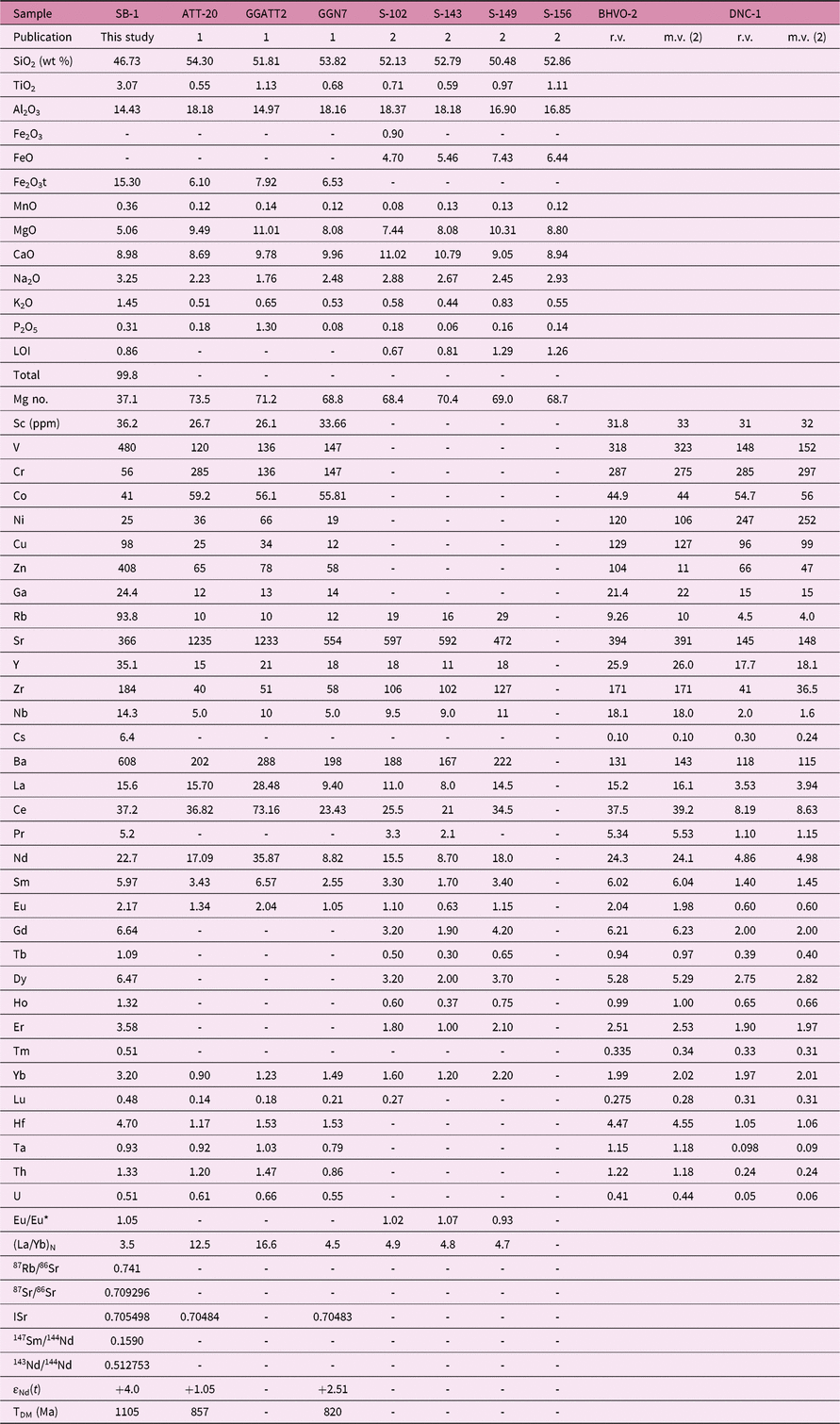
Whole-rock geochemical data of the Attwoods Brook gabbronorite

1 – M. C. Tate (unpub. Ph.D. thesis, Dalhousie Univ., 1995); 2 – de Albuquerque (Reference de Albuquerque1979). t – total Fe expressed as Fe2O3. LOI – loss on ignition. Eu/Eu* = (2*EuN/(SmN + GdN)) normalized to C1 chondrite of Sun & McDonough (Reference Sun, McDonough, Saunders and Norry1989). Mg no. = (Mg2+/(Mg2+ + Fe2+))*100. FeOt = 0.8998*Fe2O3t. N – normalized to chondritic value of Sun & McDonough (Reference Sun, McDonough, Saunders and Norry1989). m.v. – measured value for this study; r.v. – recommended value; number in parenthesis for m.v. is number of averaged analyses.
The glass bead (40 ± 5 mg) used for major-element analysis was dissolved in a Savillex Teflon beaker containing a mixture of 1:1 nitric acid (HNO3) and hydrofluoric acid (HF). The sealed beaker was heated to 140 °C for 24 hours to assist in the dissolution reaction. After drying the solution at 160 °C (~2 hours), 1.5 mL HNO3 was added to the dried residua. The sealed beaker was once again heated to 140 °C for 24 hours. The solution was diluted 1500 times with 2 % HNO3 and mixed with the internal standard (Rh + Bi) before analysis. The measured standard reference materials (BHVO-2 and DNC-1) of this study are within ± 10 % of the recommended values (Table 2).
4.c. Radiogenic isotopes
Approximately 100 mg of sample powder were added to a Teflon beaker with 50 drops of HNO3 and HF and heated (100 °C) for two days and then dried. 6N and 1N HCl are twice added and dried followed by the addition of 2 mL 1N HCl and centrifuged for 10 minutes to congregate the supernatant. Strontium and Nd were separated from other trace elements using chromatographic column separation. The first column with a 2.5 mL Bio-Rad AG50W-X8 cation exchange resin bed and grain size of 100 to 200 mesh was used to isolate Sr and rare earth elements (REEs). The Sr was concentrated using a 1 mL resin bed of AG 50W-X8 with 100 to 200 mesh grain size. Nd was separated from other REEs using an 8 mL column with a 1 mL resin bed of Eichrom Ln (100–150 μ), which was covered by a 0.1 mL anion exchange resin bed (Dowex 1-X8, 100–200 mesh). The Sr concentrate plus H3PO4 was added to a single Re filament, whereas the Nd concentrate plus H3PO4 was added to a double Re filament for analyses. For isotopic measurement, Sr and Nd were loaded with H3PO4 on a degassed, single Re filament. 87Sr/86Sr ratios were normalized to 86Sr/88Sr = 0.1194, whereas 143Nd/144Nd ratios were normalized to 146Nd/144Nd = 0.7219. The 87Sr/86 Sr isotopic ratio was measured using a Finnigan MAT-262 thermal ionization mass spectrometer (TIMS), whereas the 143Nd/144Nd isotopic ratio was measured using a Finnigan Triton TIMS at the Mass Spectrometry Lab, Institute of Earth Sciences, Academia Sinica, Taipei. The 2σ external precision (2σm) value for the sample is 0.000007 for 87Sr/86Sr and 0.000005 for 143Nd/144Nd (Table 2). Analyses of the NBS987 and JMC Nd standards are 87Sr/86Sr = 0.710248 ± 21 and 143Nd/144Nd = 0.511816 ± 11.
5. Results
5.a. Zircon U–Pb geochronology
Individual zircon grains range in size from ~25 µm to ~300 µm (online Supplementary Material Fig. S1), show igneous zonation and have fragmented anhedral to subhedral textures. The zircon analyses are concordant and yielded a total range of 206Pb–238U ages from 349 ± 7 Ma to 373 ± 8 Ma (Table 1). All zircons have Th/U ratios >0.3 (0.37 to 1.47), which is consistent with an igneous origin (Hoskin & Schaltegger, Reference Hoskin and Schaltegger2003; Kirkland et al. Reference Kirkland, Smithies, Taylor, Evans and McDonald2015). The 206Pb–238U Concordia age for all zircons is 360.0 ± 3.1 Ma, which is indistinguishable within uncertainty of the weighted-mean 206Pb–238U age of 360.3 ± 2.9 Ma (Fig. 4; MSWD = 0.93; 2σ error). However, the mean age includes five zircons with ages of 372 ± 8 Ma, 369 ± 8 Ma, 372 ± 8 Ma, 368 ± 7 Ma and 373 ± 8 Ma, whereas the remaining zircons are ≤366 ± 7 Ma. The weighted-mean 206Pb–238U age for the ‘older’ zircons is of 370.6 ± 6.8 Ma (MSWD = 0.082; 2σ error). The ‘older’ zircons have ages that are closer to the monazite and zircon U–Pb ages reported by Keppie & Krogh (Reference Keppie and Krogh1999) for the Barrington Passage pluton (372 ± 2 Ma, 373 ± 2 Ma). It is possible that the ‘older zircons’ are xenocrysts from the Barrington Passage pluton entrained during emplacement of the gabbronorite magma. The weighted-mean 206Pb–238U age without the five ‘older’ zircons is 357.9 ± 3.3 Ma (MSWD = 0.57; 2σ error). Consequently, we interpret the age of the Attwoods Brook gabbronorite emplacement to be 357.9 ± 3.3 Ma (Concordia age of 359.2 ± 3.4).
Concordia diagram of zircon U–Pb data from the Attwoods Brook gabbronorite.

5.b. Major- and trace-elemental geochemistry
The Attwoods Brook gabbronorite (SB-1) is mildly alkalic to tholeiitic (Na2O + K2O >4.0 wt %; Nb/Y = 0.2 to 0.8) with relatively low Mg no. (37), high TiO2 (0.31 wt%) and moderately high P2O5 (0.31 wt %) contents. The rock is compositionally similar to ocean-island basalt. The gabbronorite of this study is different from previously published analyses of the intrusion in that it has much higher Fe2O3t and TiO2, and lower MgO and Mg no. (Table 2) contents. The low Mg no. suggests that our sample is more differentiated than the gabbronorites (Mg no. = 68 to 73) reported by M. C. Tate (unpub. Ph.D. thesis, Dalhousie Univ., 1995) and de Albuquerque (Reference de Albuquerque1979). The whole-rock chemical variability is probably a consequence of the mineralogical variability reported by Taylor (Reference Taylor1967), but it could be that some rocks reported by M. C. Tate (unpub. Ph.D. thesis, Dalhousie Univ., 1995) were affected by hydrothermal alteration during brecciation, as Sr content can be two to three times (~1230 ppm) higher in some rocks.
The concentrations of transition metals (Sc = 36 ppm, Cr = 56 ppm, Co = 40 ppm, Ni = 25 ppm, Cu = 98 ppm) are relatively low with the exception of Zn (407 ppm). The primitive mantle-normalized incompatible element patterns show an enrichment of Rb and Ba, but the remaining elements are fairly constant from Th to Y (20–30 times primitive mantle) and show a flat pattern (Fig. 5a). The chondrite normalized REE pattern is enriched in light REEs (La/YbN ≈ 3.5), but the rock does not show Eu depletion or enrichment (Eu/Eu* = 1.05) (Fig. 5b). The initial Sr–Nd isotope values are 0.705498 and 0.512379, respectively (Fig. 6). The εNd(t) value is +4.0 and it has a depleted mantle (TDM) age of 1105 Ma.
(a) Primitive mantle and (b) chondrite normalized incompatible element diagrams of the Attwoods Brook gabbronorite and the Wedgeport pluton. Rocks normalized to the values of Sun & McDonough (Reference Sun, McDonough, Saunders and Norry1989). Wedgeport pluton data from Pe-Piper & Jansa (Reference Pe-Piper and Jansa1999) and MacLean et al. (Reference MacLean, Barr, White and Ketchum2003).

εNd(t) versus initial 87Sr/86Sr ratios (ISr) of the Attwoods Brook gabbronorite. Fields of depleted mid-ocean-ridge basalt mantle (DMM), the mantle array and Middle–Late Devonian Meguma plutons (i.e. South Mountain Batholith, Port Mouton pluton, Barrington Passage pluton, Shelburne pluton, Canso plutons) are shown with the bulk silicate earth (BSE) composition. The isotopic range of the Meguma plutons is from Clarke et al. (Reference Clarke, MacDonald, Tate, Sinha, Whalen and Hogan1997). The Sr isotopes are unavailable for the Wedgeport pluton but the range of εNd(t) values are shown for comparison (data from Pe-Piper & Jansa, Reference Pe-Piper and Jansa1999; MacLean et al. Reference MacLean, Barr, White and Ketchum2003).

6. Discussion
6.a. Temporal correlation of the Attwoods Brook gabbronorite with Meguma plutonism
U–Pb dates of zircon, titanite and monazite from the Meguma terrane plutons tend to cluster around ~375 Ma (384 ± 4 Ma to 370 ± 3 Ma), but the Wedgeport pluton yielded the youngest age (357 ± 1 Ma) known in the terrane (Clarke et al. Reference Clarke, MacDonald, Tate, Sinha, Whalen and Hogan1997; Keppie & Krogh, Reference Keppie and Krogh1999; MacLean et al. Reference MacLean, Barr, White and Ketchum2003; Kontak et al. Reference Kontak, Ham and Dunning2004; Moran et al. Reference Moran, Barr, White and Hamilton2007). The Clayton Hill pluton (~100 km north of the Wedgeport pluton) yielded a muscovite 40Ar–39Ar age of 359.4 ± 2.4 Ma but has a molybdenite Re–Os age of 362.9 ± 1.3 Ma, whereas the Seal Island pluton in the Gulf of Maine, ~30 km WSW of the Attwoods Brook gabbronorite, yielded an age of 362.8 ± 0.7 Ma (Moran et al. Reference Moran, Barr, White and Hamilton2007; Kontak et al. Reference Kontak, Horne, Creaser, Petrus and Archibald2013). The Shelburne (372 ± 3 Ma to 376 ± 2 Ma) and Barrington Passage (372 ± 2 Ma and 373 ± 2 Ma) plutons are Frasnian in age and spatially associated with the gabbronorite (Keppie & Krogh, Reference Keppie and Krogh1999; Kontak et al. Reference Kontak, Ham and Dunning2004). Mica resetting 40Ar–39Ar ages (~315 Ma) in the plutons and sedimentary rocks throughout the Meguma terrane, including those of SW Nova Scotia, implies that there was a post-emplacement thermal and structural event that affected the region (Dallmeyer & Keppie, Reference Dallmeyer and Keppie1987; Cormier et al. Reference Cormier, Keppie and Odom1988; Keppie & Dallmeyer, Reference Keppie and Dallmeyer1995; Culshaw & Reynolds, Reference Culshaw and Reynolds1997; White, Reference White and MacDonald2003). It is possible that this Late Carboniferous tectonothermal event is related to the Alleghany Orogeny (White, Reference White and MacDonald2003).
The mafic intrusions of the Meguma terrane are not as well dated as the silicic plutons. The ages of the mafic intrusions (Rb–Sr, K–Ar, 40Ar–39Ar) were compiled by M. C. Tate (unpub. Ph.D. thesis, Dalhousie Univ., 1995) and span ~53 million years (324 Ma to 377.3 ± 1.3 Ma) with one reported plagioclase 40Ar–39Ar age of 252 Ma (Reynolds et al. Reference Reynolds, Elias, Muecke and Grist1987). Amphibole and phlogopite 40Ar–39Ar dates obtained by M. C. Tate (unpub. Ph.D. thesis, Dalhousie Univ., 1995) yielded ages of 370 ± 6 Ma (Birchtown), 364 ± 1.7 Ma (Mersey Point), 366 ± 1.7 Ma (Mersey Point) and 370 ± 2 Ma (Little Harbour Road). The 40Ar–39Ar ages from SW Nova Scotia match those of two lamprophyric dykes (40Ar–39Ar = 370 ± 2 Ma and 367 ± 2 Ma) related to the Weekend dyke swarm along the eastern coastal area of the Meguma terrane (Kempster et al. Reference Kempster, Clarke, Reynolds and Chatterjee1989). The only published zircon 206Pb–238U age (376 ± 2 Ma) of a mafic intrusion is from a diorite unit within the Shelburne pluton (Tate et al. Reference Tate, Clarke and Heaman1997). Based on the available age dates it appears the mafic intrusions are broadly contemporaneous with the Late Devonian silicic plutons (M. C. Tate, unpub. Ph.D. thesis, Dalhousie Univ., 1995).
The first two ages of the Attwoods Brook gabbronorite were reported by de Albuquerque (Reference de Albuquerque1979) and M. C. Tate (unpub. Ph.D. thesis, Dalhousie Univ., 1995) on mineral separates of biotite and hornblende. de Albuquerque (Reference de Albuquerque1979) stated that the gabbronorite, using the biotite Rb–Sr dating method, yielded an age of 362 ± 18 Ma, whereas M. C. Tate (unpub. Ph.D. thesis, Dalhousie Univ., 1995) reported an amphibole 40Ar–39Ar age of 412 ± 6 Ma that was interpreted to be a maximum age. Our age is the first in situ zircon 206Pb–238U age reported for the Attwoods Brook gabbronorite and indicates that it is 15 to 20 million years younger than most silicic and mafic intrusive rocks of the Meguma terrane but does overlap with the Wedgeport and Seal Island plutons and possibly the Clayton Hill pluton. The implication is that there was a significant pulse of latest Devonian to earliest Carboniferous magmatism in SW Nova Scotia (Wedgeport, Seal Island, Attwoods Brook).
6.b. Petrogenetic association between the Attwoods Brook gabbronorite and the Wedgeport pluton
The age of the Attwoods Brook gabbronorite (357.9 ± 3.3 Ma) is within error of the Wedgeport pluton age (357 ± 1 Ma). Moreover, the Nd isotopes of the gabbronorite (εNd(t) = +1.1 to +4.0) and Wedgeport pluton (εNd(t) = +2.1 to +3.3) are similar (Pe-Piper & Jansa, Reference Pe-Piper and Jansa1999; M. C. Tate, unpub. Ph.D. thesis, Dalhousie Univ., 1995; MacLean et al. Reference MacLean, Barr, White and Ketchum2003). The Clayton Hill and Seal Island plutons are contemporaneous with the Attwoods Brook gabbronorite and the Wedgeport pluton, but there is less geochemical evidence available that could indicate a petrogenetic association (Kontak et al. Reference Kontak, Horne, Creaser, Petrus and Archibald2013). Moreover, the Seal Island pluton has lower εNd(t) values (−1.4 to +0.8) suggesting that it had a greater contribution of enriched material during its petrogenesis. MacLean et al. (Reference MacLean, Barr, White and Ketchum2003) stated that the Wedgeport pluton is similar to A-type granite that was likely derived from a ‘relatively primitive source compared to other plutons of the Meguma terrane,’ which presumably means a mantle-derived mafic magma (Fig. 7). Tate & Clarke (Reference Tate and Clarke1995) suggested that the Attwoods Brook gabbronorite was derived by partial melting of a subducted modified mantle source, but this seems unlikely as the Meguma and Avalon terranes were contiguous and thus subduction must have been outboard of both (east of the Meguma) at ~357 Ma as the Horton Group was being deposited (Murphy et al. Reference Murphy, Fernández-Suárez, Keppie and Jeffries2004; Shellnutt et al. Reference Shellnutt, Owen, Yeh, Dostal and Nguyen2019). The Avalon terrane became the structural basement to the Meguma terrane at ~400 Ma during the Acadian Orogeny (Eberz et al. Reference Eberz, Clarke, Chatterjee and Giles1991; Shellnutt et al. Reference Shellnutt, Owen, Yeh, Dostal and Nguyen2019). The gabbronornite and Wedgeport pluton do not have negative normalized anomalies of Nb, and the Nd isotopes and depleted mantle model ages of 1105 Ma and 873 Ma are within the range (0.8 Ga to 1.2 Ga) of proto-Avalonia (Murphy et al. Reference Murphy, Shellnutt and Collins2018b). Moreover, Late Silurian mafic dykes of the Rockville Notch Group that intrude the Meguma Supergroup have very similar Nd isotopes and model ages (εNd(t) = +1.4 to +2.2; TDM = 890 to 1254) as the gabbronorite and Wedgeport pluton (Murphy et al. Reference Murphy, Dostal, Gutiérrez-Alonso and Keppie2011). Consequently, it is likely that the parental magmas of the Attwoods Brook gabbronorite and Wedgeport pluton are derived from a proto-Avalonia lithospheric mantle source rather than a subduction-modified mantle source and that the two intrusions are related to the same thermal event and could be petrogenetically related.
Classification of the Wedgeport and Clayton Hill plutons using the schemes of Frost et al. (Reference Frost, Barnes, Collins, Arculus, Ellis and Frost2001) and Pearce et al. (Reference Pearce, Harris and Tindle1984). (a) Fe* ((FeOt/(FeOt + MgO)) value; (b) modified alkali-lime index versus SiO2 (wt %); (c) Rb (ppm) versus Y + Nb (ppm). The arrows denote the direction of compositional evolution relative to the log value of the fayalite–magnetite–quartz (ΔFMQ) buffer. VAG – volcanic arc granite; syn-COLG – syn-collisional granite; WPG – within-plate granite; ORG – ocean ridge granite.

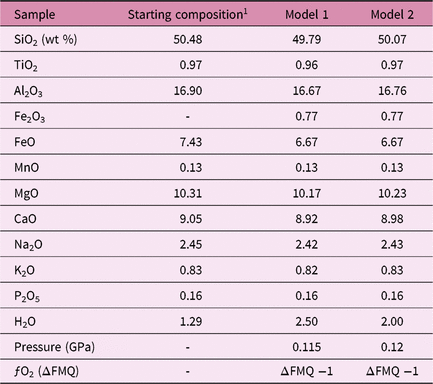
In order to test the petrogenetic link between the Attwoods Brook, Wedgeport and Clayton Hill intrusions, we applied fractional crystallization modelling using Rhyolite-MELTS (Gualda et al. Reference Gualda, Ghiorso, Lemons and Carley2012). The MELTS series of programs allows the user to model the chemical evolution of silicate magmas by equilibrium and fractional crystallization (Ghiorso & Sack, Reference Ghiorso and Sack1995; Smith & Asimow, Reference Smith and Asimow2005; Gualda et al. Reference Gualda, Ghiorso, Lemons and Carley2012). Magmatic parameters such as initial water content, relative oxidation state (ƒO2) and pressure (GPa) can be modified in order to constrain the likely conditions during differentiation. For this study, two fractional crystallization models are presented using the Attwoods Brook gabbronorite as the parental magma.
The starting composition used for the modelling is equal to sample S-149 (no. 6) from de Albuquerque (Reference de Albuquerque1979) as it has the highest Mg no. (69) content at the lowest SiO2 (50.48 wt %) content of all known Attwoods Brook samples (Table 3). Moreover, the Sr content of S-149 is 472 ppm and the Eu/Eu* value is 0.93, indicating that it is not composed of cumulate plagioclase. A relative oxidation state value of ΔFMQ −1 (fayalite–magnetite–quartz buffer) is used for the models because the Wedgeport rocks are mostly ferroan and calc-alkalic (Fig. 7a, b). Ferroan compositions are commonly produced with relatively reducing magma redox conditions, as moderately oxidizing to oxidizing conditions yield magnesian compositions (Fig. 7a; Frost & Frost, Reference Frost and Frost1997, Reference Frost and Frost2011; Arculus, Reference Arculus2003). The remaining conditions are not very well constrained. The emplacement depth of the Wedgeport pluton is thought to be 3–4 km, whereas the Clayton Hill pluton is less certain but could be the shallow member of a larger intrusion (Taylor, Reference Taylor1967; MacLean et al. Reference MacLean, Barr, White and Ketchum2003; Kontak et al. Reference Kontak, Horne, Creaser, Petrus and Archibald2013). Therefore, we chose pressures of 0.120 GPa to 0.115 GPa that correspond to a depth of ~4 km. We suggest that, given its likely derivation from a proto-Avalonia mantle source, the gabbronorite was either water-saturated or near water-saturated (Murphy et al. Reference Murphy, Shellnutt and Collins2018b). Rhyolite-MELTS calculates water saturation conditions at ~0.12 GPa to be ~3 wt % for the gabbronorite. Therefore, we ran one model using 2.5 wt % water and another one using 2.0 wt % water. The results of the Rhyolite-MELTS fractional crystallization models are presented in Figure 8 and compiled in online Supplementary Material Table S1. Starting compositions and input parameters (H2O, pressure, ƒO2) are summarized in Table 3.
Rhyolite-MELTS fractional crystallization modelling results showing the residual liquid evolution. The starting composition and conditions are listed in Table 3. Each model shows the liquid compositions at 10 °C intervals. Model 1 – small black circles. Model 2 – small light grey circles. All data are anhydrous and the rock compositions are compiled from de Albuquerque (Reference de Albuquerque1979), I. K. Wolfson (unpub. B.Sc. thesis, Dalhousie Univ., 1983), Pe-Piper & Jansa (Reference Pe-Piper and Jansa1999), MacLean et al. (Reference MacLean, Barr, White and Ketchum2003) and Kontak et al. (Reference Kontak, Horne, Creaser, Petrus and Archibald2013).

Starting compositions used for fractional crystallization modelling

1 de Albuquerque (Reference de Albuquerque1979). FMQ – fayalite–magnetite–quartz buffer. GPa – gigapascal.
The results of model 1 (0.115 GPa; 2.5 wt % H2O) indicate that the liquidus temperature is 1250 °C at which point olivine (Fo = 88) crystallizes (Fig. 8). The total fractionating assemblage from the liquidus temperature to the end of the model (760 °C) is: olivine (1250 °C to 1090 °C, 1070 °C to 760 °C), augite (1090 °C to 1030 °C), pigeonite (1030 °C to 990 °C), plagioclase (1080 °C to 760 °C), ilmenite (980 °C to 890 °C, 830 °C to 760 °C), spinel (880 °C to 840 °C), quartz (770 °C to 760 °C), K-feldspar (760 °C) and apatite (760 °C). The total proportions of the fractionated minerals are: olivine = 25.6 %, augite = 14.2 %, pigeonite = 0.4 %, plagioclase = 54.3 %, ilmenite = 1.0 %, spinel = 0.3 wt %, quartz = 3.1 %, K-feldspar = 0.9 % and apatite = 0.2 %.
The results of model 2 (0.12 GPa; 2.0 wt % H2O) indicate that the liquidus temperature is 1260 °C at which point olivine (Fo = 88) crystallizes (Fig. 8). The total fractionating assemblage from the liquidus temperature to the end of the model (760 °C) is: olivine (1260 °C to 760 °C), augite (1100 °C to 1030 °C), pigeonite (1030 °C to 980 °C), plagioclase (1100 °C to 760 °C), ilmenite (970 °C to 910 °C, 840 °C to 760 °C), spinel (910 °C to 840 °C), quartz (770 °C to 760 °C), K-feldspar (760 °C) and apatite (760 °C). The total proportions of the fractionated minerals are: olivine = 25.4 %, augite = 14.4 %, pigeonite = 0.7 %, plagioclase = 50.6 %, ilmenite = 0.7 %, spinel = 0.5 wt %, quartz = 3.2 %, K-feldspar = 4.0 % and apatite = 0.1 %.
The models show that the Wedgeport and Clayton Hill granite compositions can be produced by fractional crystallization of a parental magma similar to the Attwoods Brook gabbronorite. Specifically, the silicic liquid compositions generated from 780 °C to 770 °C fall within the measured compositional range (Fig. 8). The highest zircon saturation thermometry estimate from the Wedgeport pluton is 730 °C and suggests that zircon saturation was close to the temperature of the crystal-free liquid derived from the model (I. K. Wolfson, unpub. B.Sc. thesis, Dalhousie Univ., 1983; Pe-Piper & Jansa, Reference Pe-Piper and Jansa1999; MacLean et al. Reference MacLean, Barr, White and Ketchum2003; Boehnke et al. Reference Boehnke, Watson, Trail, Harrison and Schmitt2013). Both models indicate that the residual liquid represents ~15 % of the magma system and that plagioclase is a major fractionating phase (~50%). Such a significant amount of plagioclase fractionation could explain the depletions of Ba, Sr and Eu in the primitive mantle and chondrite normalized diagrams of the Wedgeport rocks (Fig. 5). The modelled compositions yield slightly higher CaO content (CaO ≈1.8 wt %) than the observed content (CaO ≈1.2 wt %) of the Wedgeport pluton but this could be an artefact of limited apatite fractionation or possibly alteration within the pluton. Chlorine and fluorine are important volatile elements in the crystallization of apatite but are not present in the model (Harlov, Reference Harlov2015; Webster & Piccoli, Reference Webster and Piccoli2015). The amount of additional apatite fractionation required to reduce the CaO content is ~0.8 % to ~0.9 %, assuming apatite CaO content of ~55 wt %.
The possible petrogenetic link between the Early Carboniferous mafic and silicic intrusions may be the only example of a ‘mantle-derived’ bimodal gabbro-granitoid complex in the Meguma terrane. Mantle-derived bimodal complexes are common features of large igneous provinces and rift-related tectonic settings (Shellnutt et al. Reference Shellnutt, Jahn and Zhou2011a,b; Dostal et al. Reference Dostal, van Hengstum, Shellnutt and Hanley2016, Reference Dostal, Hamilton and Shellnutt2017). Late Devonian – Early Carboniferous bimodal complexes (Mount Pleasant complex, Cobequid Highlands) are located in New Brunswick and Nova Scotia but outside of the Meguma terrane (McCutcheon et al. Reference McCutcheon, Anderson and Robinson1997; Dostal & Jutras, Reference Dostal and Jutras2016; Papoutsa et al. Reference Papoutsa, Pe-Piper and Piper2016). Moderate to weakly alkalic bimodal complexes can be associated with magmatic Fe–Ti oxide-ore deposits and rare-metal (REE, Th, U) deposits (Shellnutt et al. Reference Shellnutt, Zhou and Zellmer2009, Reference Shellnutt, Wang, Zellmer, Iizuka, Jahn, Pang, Qi and Zhou2011b ; Gray et al. Reference Gray, Dostal, McLeod, Keppie and Zhang2010; Dostal & Shellnutt, Reference Dostal and Shellnutt2016; Dostal et al. Reference Dostal, van Hengstum, Shellnutt and Hanley2016). However, the Wedgeport intrusion is calc-alkalic (Frost et al. Reference Frost, Barnes, Collins, Arculus, Ellis and Frost2001; Arculus, Reference Arculus2003). Consequently, the possible magmatic deposit-types potentially associated with both intrusions are probably different than those typical of alkalic intrusions. In fact, Kontak et al. (Reference Kontak, Horne, Creaser, Petrus and Archibald2013) suggested the Clayton Hill pluton may be associated with Mo mineralization and possibly Sn–W–Cu–Zn mineralization (skarn).
There is one outstanding issue regarding the petrogenetic association between the Attwoods Brook and Wedgeport intrusions that requires further testing. The model predicts that the silicic residual liquid represents ~15 % of the volume of the parental magma. However, the comparative sizes of the two intrusion are heavily in favour of the silicic rocks as the gabbronorite is ~0.45 km wide and at least ~ 2 km long, whereas the Wedgeport pluton is ~3–5 km wide and ~9 km long (Taylor, Reference Taylor1967). The simplest explanation for the proportionality dichotomy is that the mafic cumulate is unexposed and, based on the modelling parameters, located ~4.4 km below the original emplacement surface. If that were the case then it is possible that potential field geophysical methods can identify gravity and magnetic field anomalies in the region. V. I. Brake (unpub. B.Sc. thesis, Dalhousie Univ., 2006) investigated the gravity and magnetic fields offshore of Yarmouth and Shelburne Counties in the Gulf of Maine that indicate the Goldenville Group could overlie higher-density rock (Profile 2 of V. I. Brake, unpub. B.Sc. thesis, Dalhousie Univ., 2006). Additionally, a magnetic anomaly (Profile 3 of V. I. Brake, unpub. B.Sc. thesis, Dalhousie Univ., 2006) that was twice the intensity as the Early Jurassic Shelburne mafic dyke was observed, which V. I. Brake (unpub. B.Sc. thesis, Dalhousie Univ., 2006) attributed to a ‘localized intrusion’ without constraints of depth or composition. Although the residual mafic cumulate portion of the Wedgeport pluton is not identified at the surface, there remains a possibility that it is either currently located offshore or at some depth below the Wedgeport pluton.
6.c. Regional tectonomagmatic implications
Post-Acadian Orogeny, rift-related volcanic and plutonic rocks within the southern Magdalen Basin (Western Maritimes Basin), ~300 km north of the Attwoods Brook gabbronorite, were emplaced over a 50 million year period from ~390 Ma to ~340 Ma (Pe-Piper et al. Reference Pe-Piper, Cormier and Piper1989; Doig et al. Reference Doig, Murphy, Pe-Piper and Piper1996; Dunning et al. Reference Dunning, Barr, Giles, McGregor, Pe-Piper and Piper2002). Dunning et al. (Reference Dunning, Barr, Giles, McGregor, Pe-Piper and Piper2002) identified four distinct magmatic pulses: (1) Middle Devonian (390–385 Ma), (2) Late Devonian (375–370 Ma), (3) latest Devonian to Tournaisian (365–354 Ma), and (4) late Tournaisian to early Visean (339 Ma). The magmatic rocks comprise continental alkalic and tholeiitic flood basalts, rhyolites, granitic (A-type) plutons and gabbroic intrusions. Collectively, they represent the last major input of juvenile magmas into Avalonia as many of the flood basalts and some of the A-type granitic rocks have radiogenic Nd isotope (εNd(t) ≥ +2) signatures (Barr et al. Reference Barr, Grammatikopoulos and Dunning1994; La Flèche et al. Reference La Flèche, Camiré and Jenner1998; Pe-Piper & Piper, Reference Pe-Piper and Piper1998, Reference Pe-Piper and Piper2003; Piper et al. Reference Piper, Dessureau and Pe-Piper1999; Dessureau et al. Reference Dessureau, Piper and Pe-Piper2000; Papoutsa et al. Reference Papoutsa, Pe-Piper and Piper2016).
The three oldest pulses identified in Avalonia broadly overlap with the emplacement of the silicic and mafic intrusions in the Meguma terrane (Clarke et al. Reference Clarke, MacDonald, Tate, Sinha, Whalen and Hogan1997; Keppie & Krogh, Reference Keppie and Krogh1999; Pe-Piper & Jansa, Reference Pe-Piper and Jansa1999; Kontak et al. Reference Kontak, Ham and Dunning2004). Clarke et al. (Reference Clarke, MacDonald, Tate, Sinha, Whalen and Hogan1997) stated that the mafic intrusions and the smaller ‘peripheral’ plutons (e.g. Port Mouton, Barrington Passage, Shelburne, Canso area plutons) were emplaced from ~385 to ~378 Ma (Middle Devonian pulse), whereas the main plutonic bodies of the Meguma terrane (e.g. South Mountain Batholith) were emplaced at ~372 Ma (Late Devonian pulse). The new age of the Attwoods Brook gabbronorite along with the Wedgeport and Seal Island plutons and possibly the Clayton Hill pluton suggest that a latest Devonian to Tournaisian pulse may be more voluminous in the Meguma terrane than previously thought and that it definitively involved mantle melting. Moreover, the relatively shallow emplacement depth of the Wedgeport pluton is consistent with regional crustal thinning as the South Mountain Batholith was exhumed between 360 Ma and 355 Ma (Martel et al. Reference Martel, McGregor and Utting1993; Keppie & Dallmeyer, Reference Keppie and Dallmeyer1995; Archibald et al. Reference Archibald, Murphy, Reddy, Jourdan, Gillespie and Glorie2018). The contemporaneity of the magmatic rocks in both terranes suggests they could be related to the same tectonomagmatic event that affected the entire region and covered an area ≥150 000 km2.
The nature of the thermal event is uncertain as it could be related to a mantle plume or to post-orogenic extension (Lynch & Tremblay, Reference Lynch and Tremblay1994; La Flèche et al. Reference La Flèche, Camiré and Jenner1998; Murphy et al. Reference Murphy, van Staal and Keppie1999; Dessureau et al. Reference Dessureau, Piper and Pe-Piper2000; Shellnutt & Dostal, Reference Shellnutt and Dostal2015). There is debate on the origin of the Magdalen Basin flood basalts as La Flèche et al. (Reference La Flèche, Camiré and Jenner1998) suggested they are derived from metasomatized lithospheric mantle that was melted owing to passive asthenospheric upwelling, whereas Dessureau et al. (Reference Dessureau, Piper and Pe-Piper2000) suggested the basalts are representative of melts derived from a high thermal regime associated with a mantle plume (Keppie & Krogh, Reference Keppie and Krogh1999). Murphy et al. (Reference Murphy, van Staal and Keppie1999) noted that there is a magmatic younging (~390 Ma to ~330 Ma) trend from south to north, which may be related to the passage of a mantle plume. Although there appears to be a broad younging trend of the magmatic rocks, the Attwoods Brook and Wedgeport intrusions, and the St Peters gabbro of SW Cape Breton (339 ± 2 Ma) demonstrate that there was ‘young’ magmatism to the south and east as well (Barr et al. Reference Barr, Grammatikopoulos and Dunning1994). The emplacement of the younger intrusions could be due to peripheral plume melting as they are volumetrically minor compared to the basalt and plutonic rocks of the Magdalen Basin.
It is also possible that the punctuated melting regime in the Meguma terrane is related to post-orogenic crustal relaxation. For example, the southern margin of the Saharan Metacraton experienced orogenesis related to the collision with Congo Craton during Neoproterozoic time and had four distinct periods of post-collisional magmatism that are 5 to 15 million years apart. The magmatic rocks range in composition from mafic (minor) alkalic to silicic (major) calc-alkalic (Toteu et al. Reference Toteu, Penaye and Djomani2004; Shellnutt et al. Reference Shellnutt, Pham, Denyszyn, Yeh and Lee2017, Reference Shellnutt, Yeh, Lee, Iizuka, Pham and Yang2018). However, some mantle plume-derived large igneous provinces exhibit a ‘pulsed nature’ of eruptive and plutonic units, but they tend to have a Gaussian distribution over time with respect to volume (Bryan & Ernst, Reference Bryan and Ernst2008; Ernst, Reference Ernst2014). Regardless, all that is required in order to generate the silicic melts is an elevated thermal regime (Annen et al. Reference Annen, Blundy, Leuthold and Sparks2015). The presence of Middle Devonian to Early Carboniferous mafic intrusive rocks (e.g. Attwoods Brook, Birchtown, Mersey Point), although volumetrically minor, within the Meguma terrane is evidence of a long-term (~20 million years) high-temperature melting event irrespective of its origin via a mantle plume or decompressional melting (Kempster et al. Reference Kempster, Clarke, Reynolds and Chatterjee1989; M. C. Tate, unpub. Ph.D. thesis, Dalhousie Univ., 1995; Tate et al. Reference Tate, Clarke and Heaman1997; Shellnutt & Dostal, Reference Shellnutt and Dostal2015; Murphy et al. Reference Murphy, Shellnutt and Collins2018b).
Yet there are still key issues that cannot be resolved at the moment but could shift the balance of evidence in favour of the mantle plume model or decompressional melting model. For example, (1) why are the Devonian–Carboniferous mafic and silicic rocks from the Magdalen Basin generally more alkalic than those from the Meguma terrane? (2) Why was melting of crustal sources more common in the Meguma terrane than in Avalonia? (3) Why did Early Carboniferous magmatism occur in SW Nova Scotia and not elsewhere in the Meguma terrane? (4) What was the cause of rapid exhumation of the South Mountain Batholith? The answers to certain aspects of these questions could be related to the difference in crustal thickness, as ~10 km of Meguma Supergroup metasedimentary rocks should be on top of Avalonia basement rocks in southern Nova Scotia (Eberz et al. Reference Eberz, Clarke, Chatterjee and Giles1991; White, Reference White2010). Additionally, the Wedgeport and Clayton Hill plutons are spatially associated with shear zones and faults that may have assisted in channelling magmas, and thus there could be significant influence from lithospheric structures on their transit through the crust.
7. Conclusions
The Attwoods Brook gabbronorite intrusion was emplaced at 357.9 ± 3.3 Ma and is contemporaneous with the neighbouring Wedgeport pluton (357 ± 1 Ma). The similar Nd isotopes between the gabbronorite and the biotite monzogranite suggest the two intrusions may be petrogenetically related. Rhyolite-MELTS fractional crystallization modelling indicates that a parental magma similar to the Attwoods Brook gabbronorite can produce a residual liquid composition matching the Wedgeport pluton. The modelling results support the notion that peraluminous, ferroan, calc-alkalic granitic intrusions can be derived from a mantle source in a similar manner as peralkaline, ferroan, alkalic granitic intrusions. Furthermore, the emplacement of the gabbronorite and Wedgeport pluton likely occurred during a period of rifting or tensional plate stress after the underthrusting (377 Ma to 415 Ma) of Avalonia beneath the Meguma terrane and the emplacement of the Late Devonian (~372 Ma) mafic and silicic plutons. The implication is that magmatism within the Meguma terrane was punctuated in a manner similar to Avalonia, and that Early Carboniferous within-plate magmatism in SW Nova Scotia may be directly associated with rift-related magmatism in the Magdalen Basin.
Acknowledgements
This manuscript benefited from the constructive reviews of John Greenough and Brendan Murphy and editorial handling of Chad Deering. We are grateful to Carol Chuang, Dieu Nguyen and Terri Tang for their laboratory assistance. This research was supported by funding provided by MOST (Taiwan) grant no. 106-2116-M-003-007 to JGS and NSERC Discovery grant to JD.
Supplementary material
To view supplementary material for this article, please visit https://doi.org/10.1017/S0016756819000694.