Introduction
Karnal bunt (KB) of wheat, caused by Tilletia indica (Mitra) Mundkur, is responsible for minor yield losses but adversely affects grain quality via the discoloration of flour and the generation of a fishy odour caused by the production of trimethylamine (Mehdi et al., Reference Mehdi, Joshi and Abrol1973). The disease, once considered to be minor, has now attracted worldwide attention due to the strict international quarantine measures imposed by more than 70 countries (Herrman et al., Reference Herrman, Jardine, Miller and Sim2003), with some countries observing zero tolerance limits. The disease thus poses a serious threat to international wheat trade and movement of germplasm. Since the pathogen is soil, seed and air borne in nature, it is difficult to control once introduced and established in an area. The fungicides so far tested for seed treatment are fungistatic but not fungicidal (Gill et al., Reference Gill, Sharma and Aujla1993). Thus the most effective, economical and eco-friendly method of KB management is host plant resistance.
A large number of cultivated wheat germplasm lines has been screened using artificial inoculation, and resistant sources have been identified (Warham et al., Reference Warham, Mujeeb-Kazi and Rosas1986; Fuentes-Davila and Rajaram, Reference Fuentes-Davila and Rajaram1994; Dhaliwal and Singh, Reference Dhaliwal and Singh1997; Sharma et al., Reference Sharma, Bains, Singh and Nanda2005). Mujeeb-Kazi et al. (Reference Mujeeb-Kazi, Fuentes-Davila, Villareal, Cortes, Rosas and Delgado2001) identified ten synthetic hexaploids and six spring type KB-resistant bread-wheat lines. KB resistance appears to be controlled by two or more genes acting additively (Morgunov et al., Reference Morgunov, Montoya and Rajaram1994; Fuentes-Davila et al., Reference Fuentes-Davila, Rajaram and Singh1995; Singh et al., Reference Singh, Rajaram, Montoya and Fuentes-Davila1995; Villareal et al., Reference Villareal, Fuentes-Davila, Mujeeb-Kazi and Rajaram1995; Singh et al., Reference Singh, Grewal, Pannu and Dhaliwal1999). Sharma et al. (Reference Sharma, Bains, Singh and Nanda2005) identified nine different genes conditioning KB resistance in four separate resistant bread-wheat lines. Although a number of sources of resistance has been identified, the development of resistant cultivars has been slow because of difficulties encountered in combining minor genes. Wild species may represent a valuable source of KB resistance, but only limited screening has as yet been carried out (Warham et al., Reference Warham, Mujeeb-Kazi and Rosas1986; Dhaliwal and Singh, Reference Dhaliwal and Singh1997).
A reproducible screening technique is necessary for the identification of resistance. For KB, the syringe inoculation of sporidial suspension at the boot stage (Aujla et al., Reference Aujla, Grewal, Gill and Sharma1980) is currently the most effective method (Beniwal et al., Reference Beniwal, Chawla and Singh2001). Disease development under field conditions, even following syringe inoculation, is highly influenced by prevailing weather conditions. A temperature range of 8–20°C and nearly saturated humidity, which occurs in conditions of light rain and cloudy weather during heading/anthesis favour spore production, infection and disease development. The screening of wild species under field conditions is complicated, as they commonly require vernalization and extended photoperiod to induce flowering. In the Indian subcontinent, wild relatives of wheat typically flower after mid March, when the temperature in the field is above 30°C and the relative humidity is low.
Here we report the outcome of a screen-house method aimed at obtaining reliable KB infection in a collection of Aegilops tauschii accessions. Based on 2–3 years of screening in the specially designed screen-house, accessions with a good level of resistance have been identified. These accessions represent potential donors for KB resistance for bread wheat.
Materials and methods
KB screen-house
A screen-house was designed to simulate the environmental conditions conducive for KB development. This consisted of two 57 m × 30 m × 10 m chambers, separated by a central cabin in which the control panels were housed (Supplementary Fig. 1, available online only at http://journals.cambridge.org). Temperature, humidity (fogging) and photoperiod were regulated automatically. The fogging system was installed on the ceiling at a height of 2 m, and two large humidifiers-cum-coolers were installed at the opposite ends of each chamber. A green net on the top and polythene curtains on the sides of screen-house chambers were manually rolled or spread to cover the chambers during morning to provide high relative humidity (RH), shading and low temperature, thus simulating the cloudy conditions conducive for KB development. These measures maintained the screen house at 90% RH and 6–10°C below the ambient temperature. The shading net and polythene curtains were rolled up after sunset to provide the natural low temperature, dew point and high RH conditions at night, considered helpful for the production and release of sporidia. The daytime temperature was maintained at 20 ± 2°C. Conditions conducive for disease development could be maintained in the screen-house until the end of March, when the temperature outside typically rises to 35°C and RH falls to about 30–40%. The soil of the screen-house was mixed with well-rotted farmyard and poultry manure to enhance fertility.
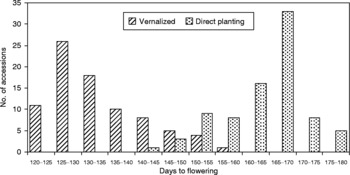
Comparison of the days to flowering in vernalized and unvernalized Aegilops tauschii accessions in 2004–2005. The unvernalized material was planted directly in the field whereas the vernalized set was planted in the KB screen-house and given an extended photoperiod.

Germplasm
A total of 183 Ae. tauschii accessions were screened for reaction to KB infection in the screen-house. These included 80 accessions from IPK, Gatersleben, Germany and 103 from various other sources (Supplementary Table 1, available online only at http://journals.cambridge.org). Due to space limitations in the screen-house, it was not possible to test all the accessions in any one year. During 2003–2004, 61 accessions were screened, and those which were identified as resistant were re-tested during 2004–2005, along with an additional set of 63 accessions. Similarly, accessions identified as resistant during 2003–2004 and 2004–2005 were retested during 2005–2006 with an additional set of 59 accessions. Two KB-susceptible bread-wheat cultivars (WL711 and WH542), and one KB-resistant line (HD29) were included as checks to monitor the effectiveness of the inoculations in the screen-house.
Percentage KB incidence in control bread-wheat lines under field and screen-house conditions

R, resistant; S, susceptible.
Vernalization and transplanting
Ten seeds from each Ae. tauschii accession were sown in plastic trays and vernalized in a growth chamber (Nuaire) for 6 weeks at 4 ± 1°C and 8 h of fluorescent light. Five seedlings of each accession were transplanted into soil in the screen-house in 1 m rows. The inter-plant distance was kept at 20 cm and the inter-row distance 60 cm. Seedlings were hand watered for 8–10 d, and thereafter flood irrigated at intervals of 3–4 weeks, depending upon the prevailing temperatures. Plants were given 16 h light with sodium vapour lamps to induce early flowering. Disease incidence data were obtained for 183 out of 231 accessions, as some lines flowered late and others set no seed.
Inoculations
The Ae. tauschii accessions and the check wheat varieties were inoculated at the boot stage with a mixture of nine KB isolates, representing pathogen variability from the North Western Plains of India (Sharma et al., Reference Sharma, Nanda and Kaloty1998). Teliospores of each isolate were germinated to produce sporidia which were subcultured on potato dextrose agar medium and then mixed in equal volume before injecting into the ear. Boot inoculations followed the syringe method described by Aujla et al. (Reference Aujla, Grewal, Gill and Sharma1982) using a suspension of 10 000 sporidia/ml in water. The susceptible variety WL711 was used to monitor the efficacy of the inoculations. Each inoculated tiller was tagged and marked with the date of inoculation. Between 25 and 30 spikes from each accession were inoculated. The inoculated ears were bagged to avoid loss due to shattering at maturity. Spikes from each entry were bulked, threshed manually, and the percentage of diseased grains recorded. The same inoculation procedure was followed for screening of the check varieties under field conditions.
Data recording
The percentage KB incidence was calculated as 100 × the number of infected grains/total number of grains. Accessions with KB incidence in the range of 0–5% were classified as resistant, 5–10% as moderately resistant and >10% as susceptible.
Results
Inducing early flowering by vernalization and extra photoperiod
The accessions were vernalized and given an extended photoperiod to induce early flowering. From a duplicate set of accessions planted in the field, most flowered between the third week of March and the second week of April. The vernalization and extended photoperiod treatment advanced flowering in the screen-house by about 30 d and most of the accessions flowered in February, the period considered the most suitable for KB development. The variation in days to flowering in vernalized and directly planted accessions in 2004–2005 is depicted in Fig. 1.
KB rating of Ae. tauschii accessions
KB incidence in the susceptible check varieties was 1.5- to 2.5-fold higher in the screen-house than in the field (Table 1). In the screen-house, the susceptible checks had a KB infection of 42.1–75.6%, compared to 23.5–48.0% in the field. The resistant check HD29 developed no KB under field conditions and showed a mean incidence of 2.1–8.3% in the screen-house. The screen-house conditions were thus highly effective for screening against KB.
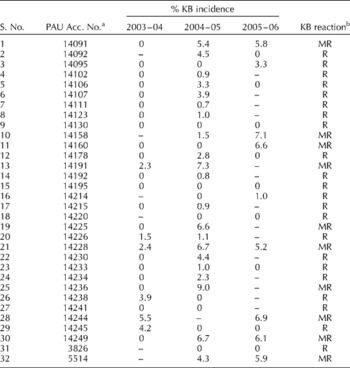
Total grain set in the inoculated Ae. tauschii spikes ranged from 50–250. During 2003–2004, 44 accessions were resistant, five moderately resistant and 12 susceptible. A maximum incidence of 62.5% was recorded for accession 14254. During 2004–2005, of the 31 retested accessions, 20 remained resistant (Table 2), six proved moderately resistant and five susceptible, while of the 63 fresh accessions, 18 were scored as resistant, two moderately resistant and 43 susceptible. The highest level of KB infection (77.7%) was recorded for accession 14201. The 2005–2006 screening of 82 accessions included nine resistant selections from 2003–2004 and 2004–2005, seven of which maintained their resistance, one was moderately resistant and one susceptible (20% KB incidence). Accessions scored as moderately resistant maintained their rating in 2005–06. Of the 11 resistant accessions selected in 2004–05 and retested in 2005–06, four remained resistant (Table 2), while three were scored as moderately resistant and four as susceptible. Of the 59 accessions screened for the first time in 2005–2006, seven were classified as resistant and four as moderately resistant. All other accessions were susceptible. The highest KB incidence (73%) was recorded for accession 14345.
Percentage KB incidence in resistant Ae. tauschii accessions in 2003–2004, 2004–2005 and 2005–2006

MR, moderately resistant; R, resistant.
a Country of origin of these accessions is presented in Supplementary Table 1.
b Highest KB incidence in any of the years was used for assigning KB reaction.
Based on three repeated screenings, seven accessions were identified as having a high level and four with moderate levels of KB resistance. An additional 15 accessions showing a high level of resistance and six with a moderate resistance were identified based on 2 years of screening. Two accessions (14130 and 14195) showed no detectable infection over all the 3 years when the resistant check HD29 recorded 2.1–8.3% infection.
Discussion
The genetic base for KB resistance in bread wheat is extremely narrow. Most of the resistant stocks identified so far are from India, China and Brazil, and resistance in these lines is governed by minor genes, which are, by their nature, difficult to exploit for the breeding of KB-resistant varieties. Here we have identified a number of new potential sources of resistance within Ae. tauschii. The screen-house method delivered a high level of KB infection in susceptible control varieties, and is more effective than field screening. We also noted that single-year data are rather unreliable, even when collected under the most suitable conditions. Based on 3 years of data, seven Ae. tauschii accessions were identified as being highly resistant to KB. Six of these flowered during the third to fourth week of February, the period most conducive for KB development. The remaining accession (14178) flowered during the second week of March, and hence its resistance may be artefactual. The six highly resistant accessions represent good candidates for wheat germplasm enhancement, while the remaining selections still need to be validated by further rounds of screening.
A number of diploid A, B and D genome materials have been evaluated elsewhere for their KB resistance. Dhaliwal and Singh (Reference Dhaliwal and Singh1997) found that Triticum urartu was immune to KB, all the diploid Aegilops species belonging to the Sitopsis section were susceptible, and Ae. tauschii included both resistant and susceptible accessions. Warham et al. (Reference Warham, Mujeeb-Kazi and Rosas1986) identified a number of KB-resistant accessions from the Ae. tauschii collection screened at CIMMYT. The hexaploid synthetics derived from these accessions showed high levels of KB resistance (Mujeeb-Kazi et al., Reference Mujeeb-Kazi, Montoya and Rajaram1987; Multani et al., Reference Multani, Dhaliwal, Singh and Gill1988), and some of these have been used to transfer KB resistance to cultivated wheats (Mujeeb-Kazi et al., Reference Mujeeb-Kazi, Fuentes-Davila, Villareal, Cortes, Rosas and Delgado2001).
The wild relatives of wheat are a source for many disease-resistance genes, and a number of useful genes have been transferred from a range of wild species to cultivated wheats (McIntosh et al., Reference McIntosh, Devos, Dubcovsky, Rogers, Morris, Appels and Anderson2005). Thus the KB-resistant Ae. tauschii accessions identified here may have utility for broadening the genetic base of bread-wheat for KB resistance. Because Ae. tauschii can be crossed directly with bread-wheat (Gill and Raupp, Reference Gill and Raupp1987), it should be possible to recover resistant progenies in the backcrosses, thereby avoiding the phenomenon of gene suppression which is commonly observed in T. durum × Ae. tauschii crosses (Gert et al., Reference Gert, Keme and Van1995; Ma et al., Reference Ma, Singh and Mujeeb-Kazi1995).
Acknowledgements
We gratefully acknowledge the financial support provided by United States Department of Agriculture, USA and Department of Biotechnology, Government of India. The Tilletia indica isolates were provided by Dr Indu Sharma, Senior Plant Pathologist, Department of Plant Breeding, Genetics and Biotechnology, PAU, Ludhiana. The germplasm was procured from Dr Andreas Boerner, IPK, Gatersleben, Germany, Dr Perry Gustafson, University of Missouri and Dr B. S. Gill, WGRC, Kansas State University, Kansas. We gratefully acknowledge their support.