1 Introduction
It is generally accepted that unbounded spreading is myopic (Wilson Reference Wilson2003; McCarthy Reference McCarthy2009, Reference McCarthy, Goldsmith, Hume and Wetzels2011; cf. Walker Reference Walker2010, Reference Walker2014). In this context, myopic means that spreading processes cannot look ahead: given an unbounded spreading process for some feature [F], and a domain [w x y z], the decision to spread [F] from z to y does not take into account whether [F] will succeed in spreading to w, the edge of the domain (description after Walker Reference Walker2014). A schematic example illustrates. In Step 1 (1a), the spreading feature [F] spreads from its host, z, to the adjacent y. In Step 2 (1b), [F] spreads from y to x. In Step 3 (1c), [F] cannot spread from x to w (w blocks spreading), so the process terminates.

The process in (1) is myopic because the ability of [F] to spread from z to y, and from y to x, is blind to [F]’s eventual failure to spread from x to w. An example of a non-myopic process would be one in which the language anticipates that [F] will be unable to spread from x to w, and adjusts its behavior accordingly. The language could choose to not initiate the spreading process, for example, based on the knowledge that spreading will eventually fail.
The apparent absence of non-myopia poses a problem for theories in which well-formedness is assessed globally over surface forms, e.g. classical Optimality Theory (classical OT; Prince & Smolensky Reference Prince and Smolensky2004). If global evaluation is possible, nothing prohibits a process spreading [F] from z to y from checking to see if it can spread all the way to w. Accounting for the absence of non-myopic patterns has led analysts to propose substantial revisions to the architecture of classical OT. Wilson (Reference Wilson2003), for example, excludes non-myopic patterns by employing a new class of constraints, targeted constraints, couched within a derivational variant of OT. McCarthy (Reference McCarthy2009, Reference McCarthy, Goldsmith, Hume and Wetzels2011) proposes to both redefine the harmony-driving constraints and redefine Gen, or the set of candidates considered. These proposals result in the exclusion of non-myopic processes from the predicted typology, which is a desirable result – if non-myopic processes are unattested.
This paper suggests that a non-myopic [nasal] spreading process is attested in Gurindji (Pama–Nyungan; McConvell Reference McConvell1988, Reference McConvell1993). When full application of [nasal] spreading would violate a local phonotactic, the trigger deletes, blocking spreading entirely. Although phonetic evidence to support this proposal is limited, I argue that it is a plausible interpretation of the data. A simplified, schematic version of the pattern is in (2). If the blocker w is absent from the spreading domain, [nasal] spreads from z to x (2a). If w is present, [nasal] deletes (2b).Footnote [2]

The pattern in (2) is non-myopic in the sense defined above, as the decision to spread [nasal] from z to x depends on the presence or absence of the blocker w within the spreading domain. In what follows, I argue that the existence of the Gurindji pattern has implications for theories of unbounded spreading and the structure of the phonological grammar more generally. The only theories that can account for its proposed interpretation are those in which surface candidates are globally evaluated.
2 Gurindji nasal cluster dissimilation
In Gurindji and many other languages, words that contain sequences of nasal-stop clusters (NCs) are dispreferred. In these systems, while words like ambada and abanda are possible, words like ambanda are not (on this topic see e.g. Meinhof Reference Meinhof1932; Meeussen Reference Meeussen1963; Herbert Reference Herbert1977, Reference Herbert1986; McConvell Reference McConvell1993; Jones Reference Jones2000; Blust Reference Blust2012; Stanton Reference Stanton2018a). Languages repair sequences like ambanda in a variety of ways: many delete either the first oral (ambanda
 $\rightarrow$
amanda) or second nasal consonant (ambanda
 $\rightarrow$
ambada); these repairs are well known in the literature as Meinhof’s Law (or the Ganda Law) and the Kwanyama Law, respectively. Throughout, I refer to this collection of repairs to illicit NC1…NC2 sequences as nasal cluster dissimilation, following McConvell (Reference McConvell1988).
Regardless of repair, nasal cluster dissimilation often exhibits segmental or contextual restrictions. In Gurindji, if the material that intervenes between NC1 and NC2 contains only [+continuant] segments, nasal cluster dissimilation must occur, subject to certain morphological restrictions (ambawanda
 $\rightarrow$
ambawada, *ambawanda). If however the intervening material contains a [-continuant] segment, nasal cluster dissimilation is blocked (ambatanda
 $\rightarrow$
ambatanda, *ambatada). In this section I suggest that the observed blocking effects can be seen as a symptom of non-myopic regressive [nasal] spreading, and propose an interpretation of the data along these lines.
2.1 Preliminaries: Phonemic inventory
I first provide basic information regarding the inventory and transcription of Gurindji phonemes, to aid in interpreting the data that follow. This discussion is based on McConvell (Reference McConvell1988: 136–137).
Gurindji has a small vowel inventory, composed of the short vowels /i/, /a/, and /u/. The quality of these vowels varies according to context: /a/ ranges in quality from [ɛ] to [ʌ] to [ə]; /i/ and /u/ may be lowered to [e] and [o], respectively; and /u/ is often realized as [ʉ] following palatal consonants. Phonetically long vowels usually result from loss of an intervocalic glide (e.g. aya can be pronounced as aa), but a small number of minimal pairs suggest a marginal contrast.
The consonant inventory is considerably larger, and is summarized in Table 1. For clarity, each phoneme is marked by both its correspondent in the practical orthography (in angled brackets) and the most likely phonetic category given the description and distinctive features provided by McConvell (in slashes). The transcriptions in this paper make use of the phonetic symbols only.
Gurindji consonant inventory.

Regarding allophonic variation in the stop series, McConvell (Reference McConvell1988: 136) writes that ‘voiced allophones are generally found except in syllable-final position, where voiceless allophones appear, except in the case of k, where a voiceless allophone also occurs in initial position’. Throughout this paper, I follow the general orthographic trend and transcribe all stops as voiceless; the contextual variation between voiced and voiceless allophones is not important here.
2.2 Nasal cluster dissimilation
Gurindji allows NCs in suffixes (e.g. [lutcu-ŋka], ridge-loc, ‘on the ridge’) and across suffix–suffix boundaries (e.g. [cawuɾa-ɲ-kaɻi-wuca], steal-nom-other-comit, ‘with another thief’), but NCs in these positions are dispreferred given the presence of a preceding NC1 in the same phonological word. In most dialects of Gurindji, such sequences are avoided through eradication of N2’s [nasal] feature (though see McConvell Reference McConvell1988: 150 on the Western dialects). If NC2 is homorganic, the nasal consonant deletes (3a–b); if it is heterorganic, the nasal consonant is realized as an oral stop (3c–d).

The difference between (3a–b) and (3c–d) can be captured under an analysis in which N2 deletion is the preferred repair to *NC1…NC2, subject to a ban on the deletion of place features.Footnote [3] Assuming that place features are multiply linked in homorganic clusters, N2 deletion is permitted in this context because the place features of the deleted nasal are still linked to the remaining oral stop. In heterorganic clusters, deletion of the nasal would result in the deletion of its place features, so the repair in this context is N2 denasalization. Both N2 deletion and denasalization serve the greater goal of destroying N2’s [nasal] feature, however (see also McConvell Reference McConvell1993: 18), and the source of the difference between them is not crucial here. Throughout, I refer to these processes as N2 modification.
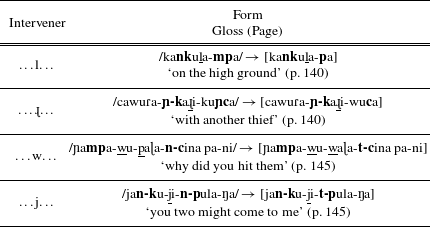
In (3), N2 modification is local: only a single vowel intervenes between NC1 and NC2. N2 modification can also be non-local, but as previewed, the applicability of non-local N2 modification depends on the nature of the material that intervenes between NC1 and NC2. If the intervening material contains only [+continuant] segments (i.e. vowels, glides, and liquids), N2 modification is obligatory. Data illustrating this are in Table 2.
[+continuant] segments can intervene in N2 modification (data from McConvell Reference McConvell1988).

The …ɻ…and …w…forms in Table 1 display lenition of postvocalic morpheme-initial /p/ and /k/ to [w]; this process is ‘fairly general’ (McConvell Reference McConvell1988: 139) and applies outside of the NC1…NC2 context (e.g. /waɭu+kaci/
 $\rightarrow$
[waɭu-waci] ‘fireplace’, McConvell Reference McConvell1988: 139). These forms show that, for the purposes of N2 modification, underlying and derived [w]s behave alike: N2 modification applies across a [w] regardless of whether it is underlyingly /w/, /p/, or /k/. The …l…form shows us, however, that lenition does not apply to singleton stops that result from N2 deletion: underlying /kankula-mpa/ surfaces as [kankula-pa], and the singleton [p] resulting from N2 deletion does not lenite further to [w] (*[kankula-wa]). McConvell (Reference McConvell1988: 144) analyzes this interaction as a result of rule ordering: lenition feeds N2 modification. While interesting, this pattern is not relevant to the generalization of interest (that N2 modification applies across all surface [+continuant] segments), and is not addressed further.
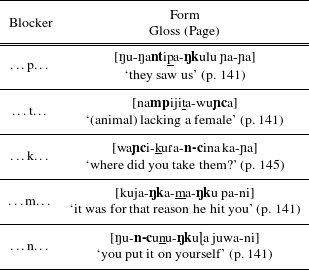
If however the material that intervenes between NC1 and NC2 contains one or more [-continuant] consonants (i.e. a nasal consonant or oral stop), N2 modification does not occur (Table 3).
[-continuant] segments block N2 modification (data from McConvell Reference McConvell1988).

To summarize, illicit NC1…NC2 in Gurindji is repaired by either deleting or denasalizing N2. N2 modification is obligatory when all segments intervening between the two NCs are [+continuant], but blocked when one or more [-continuant] segments intervene. The question, then, is why some intervening segments block N2 modification but others do not.
2.3 Proposed interpretation
In this subsection, I argue that we can make sense of the facts summarized above by appealing to two independent but interacting processes: long-distance regressive [nasal] spreading initiated by coda nasals, and a dispreference for anticipatory nasalization preceding onset nasals.
2.3.1 Nasal spreading
Although McConvell (Reference McConvell1988, Reference McConvell1993) does not discuss the phonetics of nasality in Gurindji, the set of segments that can intervene in N2 modification is reminiscent of cross-linguistic generalizations regarding the typology of [nasal] spreading. The sets of segments that participate in nasal spreading processes are subject to implicational laws, schematized in (4) (see e.g. Schourup Reference Schourup1973, Cohn Reference Cohn1993, Walker Reference Walker1998, also Pulleyblank Reference Pulleyblank1989): in a given language, if nasality is able to spread through a segment with some value x, then it is also able to spread through all segments with values equal to or lower than x, where x is roughly equivalent to the segment’s compatibility (articulatory or perceptual) with nasalization (see Schourup Reference Schourup1973: 533; Walker Reference Walker1998: 69–84).

The proposed interpretation of the Gurindji data in Section 2.2 takes seriously the link between (4) and the set of possible interveners in nasal cluster dissimilation. Let us assume that Gurindji has a process of long-distance nasal spreading that is capable of affecting liquids, vowels and glides, as in Kpelle (Niger–Congo, Welmers Reference Welmers1962; see Walker (Reference Walker1998: 90–92) for other examples).Footnote [4] This proposal is illustrated with /kajiɾa+mpal/ (‘across the north,’ McConvell Reference McConvell1988: 138): [nasal] spreads regressively from N2 until blocked by [k] (5). (It should be noted at this point that the claim that Gurindji exhibits a process of regressive [nasal] harmony is supported by phonetic data in only a limited way. While work by Ennever (Reference Ennever2014) suggests that vowels preceding NCs may be nasalized, it has not been shown that this nasalization is consistent, or that it can propagate through multiple preceding segments. For more discussion on this point see Section 2.4.)

Assuming that such a process exists, we turn now to the context of interest: a word containing two NCs. If NC1 and NC2 are separated by only vowels, approximants, or liquids, full application of regressive [nasal] spreading in this context would result in nasalization of the vowel following NC1, as schematized for /kankula-mpa/ (‘on the high ground,’ McConvell Reference McConvell1988:140).

There is reason to believe that nasalized vowels are dispreferred following NCs. Beddor & Onsuwan (Reference Beddor, Onsuwan, Solé, Recasens and Romero2003) show that an important perceptual cue to the contrast between NCs and plain nasal consonants (Ns) is the quality of the following vowel: NCs are most accurately identified as NCs when followed by oral vowels, and Ns as Ns when followed by nasal vowels. Importantly, NCs followed by nasal vowels are regularly misidentified as Ns. Evidence that this difficulty translates into a typological dispreference comes from languages in which phonemically nasal vowels are banned following NCs (e.g. Acehnese, Durie Reference Durie1985; Páez, Jung Reference Jung2008). The hypothesis is that the source of the ban for NC1…NC2 sequences in Gurindji and elsewhere is not a dispreference for multiple NCs per se, but rather a dispreference for NCṼ – which full application of regressive [nasal] spreading, in an NC1…NC2 context, would create (as in (6); see also Herbert Reference Herbert1977, Jones Reference Jones2000, Stanton Reference Stanton2018a).
Let us assume, then, that full application of [nasal] spreading is banned in Gurindji NC1…NC2 contexts when it would create an NCṼ sequence. Faced with this impossibility, the language has several different options for forms like /kankula-mpa/. One is to spread [nasal] partway (7).

The solution in (7) is myopic: [nasal] spreads as far as it can, even though it is eventually blocked. The solution that Gurindji prefers, however, is not myopic. The attested /kankula+mpa/
 $\rightarrow$
[kankula-pa] shows us that Gurindji’s preferred solution is deletion of the [nasal] trigger, which aborts the spreading process before it begins. The way in which trigger deletion is implemented varies depending on whether NC2 is homorganic or heterorganic (as previewed above; see (8)–(9)), but the end result is the same: eradication of the [nasal] trigger, through deletion of either the [nasal] feature or of the segment that hosts it, prevents [nasal] spreading from occurring.

As discussed above, I assume that [-continuant] segments block [nasal] spreading. In /nampijita-wuɲɟa/ ‘(animal) lacking a female’ (McConvell Reference McConvell1988: 141), for example, regressive spreading of [nasal] from NC2 is arrested by the presence of an intervening /t/ (so /nampijita-wuɲca/
 $\rightarrow$
[nãmpijitã-w̃ũɲca]). Trigger deletion is unnecessary, as the post-NC1 vowel is not at risk of becoming [nasal].
In sum, positing regressive [nasal] spreading allows us to make sense of the set of interveners in Gurindji N2 modification. The segments that can intervene ([+continuant] segments) propagate [nasal]; the segments that cannot ([-continuant] segments) block its spread. A summary of the proposed interpretation, with schematic forms, follows. Full spreading occurs when NC is preceded by [+continuant] segments; partial spreading occurs when NC is preceded by a singleton [-continuant] segment; and trigger deletion occurs when NC is preceded by [+continuant] segments and another NC.

2.3.2 Nasalization avoidance
If above interpretation of the data is correct, additional questions arise. If [nasal] spreads regressively, why are only coda nasals triggers (i.e. why is NC1…NC2, but not NC1…N2V, dispreferred)? And why do onset nasals act like singleton stops in blocking the spread of nasality?
One answer to the first question is inspired by claims that some kinds of long-distance spreading are perceptually conditioned: harmony serves to enhance perception of the spreading feature(s) (e.g. Suomi Reference Suomi1983, Kaun Reference Kaun1995, Walker Reference Walker2005). Arguments in favor of this conclusion come from in part from weak trigger effects (term from Walker Reference Walker2005), where spreading is triggered by those segments on which the spreading feature is independently believed to be less perceptible. For example, the generalization that rounding harmony is favored when the trigger is non-high can be linked to the observation that rounding contrasts are harder to perceive for non-high vowels (Kaun Reference Kaun1995).
Building on arguments that nasal harmony is perceptually motivated (e.g. Cole & Kisseberth Reference Cole, Kisseberth, Samiian and Schaeffer1995, Sanders Reference Sanders2003, Walker Reference Walker2014), we can view Gurindji’s restriction of [nasal] triggers to coda nasals as a weak trigger effect. Assuming that the contrast between nasal and oral consonants (Ns and Cs) is in part cued by coarticulatory nasalization, an N that induces some degree of nasal coarticulation will be more distinct from a C than an N that does not. Whether or not an N is able to induce coarticulatory nasalization, and in which directions, is dependent on its syllabic role.Footnote
[5]
I focus on two contexts: coda position, where anticipatory coarticulation is possible (ṼNC); and intervocalic position, where anticipatory and perseveratory coarticulation are possible (ṼNṼ). Assuming that an N triggering nasal coarticulation on both sides is more distinct from a C than is an N triggering coarticulation on only one, we expect coda Ns to be less distinct from coda Cs than intervocalic Ns are from intervocalic Cs (
 $\unicode[STIX]{x1D6E5}$
ṼNṼ–VCV
 ${>}$
 $\unicode[STIX]{x1D6E5}$
ṼNC–VCC, where
 $\unicode[STIX]{x1D6E5}$
= perceptual distance).
The proposal, then, is that only coda Ns trigger [nasal] spreading in Gurindji because regressive spreading is necessary in this context to license an otherwise perceptually weak N–C contrast. The contrast between word-medial onset Ns and Cs, on the other hand, is not in need of further enhancement. The claim that Ns must spread nasality in some direction to remain distinct from Cs is corroborated by facts about Gurindji’s phonotactics: word-initial NCs, which cannot spread [nasal] progressively, are banned; word-initial Ns, which can spread [nasal] progressively, are permitted. (Framed in this way, the notion that [nasal] must spread in some direction in order to survive is an example of what Mullin & Pater (Reference Mullin and Pater2015) term the use it or lose it problem, in which a given feature deletes if it is unable to spread.)
A possible answer to the second question – why should onset nasals block propagation of [nasal]? – builds on observations in the literature that anticipatory nasalization is dispreferred in many languages of the area (see e.g. Butcher (Reference Butcher1999: 481) on Warlpiri and Kunberlang). Why might this be? A partial answer comes from the fact that perceptual cues to nasal place contrasts lie in part in the anticipatory VN transitions (Harrington Reference Harrington1994). Acoustic effects of anticipatory nasalization, however, render these place cues less perceptible (Repp & Svastikula Reference Repp and Svastikula1988). It is possible to view the failure to nasalize a pre-N vowel as an enhancement effect, which serves to improve or maintain cues to nasal place contrasts. The idea is that Gurindji belongs to this class of languages in which anticipatory nasalization is dispreferred, potentially for perceptual reasons.
The following, then, is the proposal regarding the distribution of anticipatory nasalization in Gurindji. Vowels preceding onset nasals must not be nasalized, as nasalization would render cues to nasal place contrasts less distinct (as discussed above,
 $\unicode[STIX]{x1D6E5}$
VNṼ–VMṼ
 ${>}$
 $\unicode[STIX]{x1D6E5}$
ṼNṼ–ṼMṼ). This dispreference for anticipatory nasalization is what causes onset nasals to block propagation of [nasal]. Vowels (and potentially other material) preceding coda nasals however must be nasalized, as nasalization in this context is necessary to maintain sufficiently distinct contrasts between nasal and oral stops (
 $\unicode[STIX]{x1D6E5}$
ṼN–VC
 ${>}$
 $\unicode[STIX]{x1D6E5}$
VN–VC). In other words, propagation of [nasal] is allowed in Gurindji only when the nasal is in coda position, or when cues to the N–C contrast are reduced. For suggestive evidence that a similar distribution of anticipatory nasalization is attested in Yindjibarndi, another Pama–Nyungan language, see Stanton (Reference Stanton2018a).Footnote
[6]
A final note: while it is unusual for [nasal] stops to block [nasal] harmony, it is not unattested. In Mehináku (Arawak), [nasal] spreads through approximants and the laryngeal [h], but is blocked by obstruents, nasals, and liquids (Corbera Mori Reference Corbera Mori2008: 71–72). Whether or not the Mehináku pattern could also be linked to a dispreference for anticipatory nasalization remains to be seen.
2.4 On the phonetics of Gurindji nasalization
If the proposed interpretation of Gurindji nasal cluster dissimilation is correct, it makes non-trivial predictions regarding the phonetics of anticipatory nasalization in Gurindji. The first prediction is that all [+continuant] segments preceding a coda nasal are nasalized. The second prediction is that no segments preceding an intervocalic nasal, [+continuant] or otherwise, are nasalized.
Are the predictions borne out? The information available at present is suggestive but incomplete. Ennever (Reference Ennever2014: 97), in investigating the acoustic properties of intervocalic NCs in Gurindji, notes that in a number of tokens ‘…the [nasal] antiresonance [of the nasal consonant] is in fact pre-empted in the preceding vowel… where a clear white space can be seen extending in at those specified frequencies. In those cases…[the velum] is…lowering earlier and giving the preceding vowel a distinct nasalized quality.’ While Ennever does not document the existence of nasal spreading over larger distances, he also does not rule it out: in a discussion of potential cues to the contrast between Ns and NCs, he notes that a ‘closer investigation of how far nasalization can spread and in what direction (progressive or regressive)’ is a potential topic for future research (p. 108). Thus while further work is necessary to verify the existence of regressive [nasal] spreading in Gurindji, the available data are not inconsistent with its existence.
The reader may however be suspicious about the possibility that [nasal] spreading exists in Gurindji but has not yet been detected, and wonder if there is a reason why we might expect this phonetic property to have been overlooked. To this question I have no answer, except to note that which topics are addressed in a phonological description depends a great deal on the scope of the project and the questions the author seeks to answer. In Storto’s (Reference Storto1999) description of Karitiâna (Tupí), for example, allophonic nasalization of vowels by nasal consonants is not discussed, as the description focuses more on documenting allophonic oralization of nasal consonants. Everett’s (Reference Everett2007) description of Karitâna however contains a detailed description of vowel nasalization, as one of his main points of interest is the relationship between vowel nasalization and consonant oralization (see esp pp. 141–142). Given that McConvell’s (Reference McConvell1988) focus is on the relevance of consonantal strength hierarchies to the Gurindji data, and that his (Reference McConvell1993) focus is on justifying an analysis in which orality spreads, we cannot expect that [nasal] harmony should have been discussed in either paper – not because it does not exist, but because its existence was not directly relevant to questions that interested McConvell in Reference McConvell1988 and Reference McConvell1993. Similarly, Ennever (Reference Ennever2014) cannot have been expected to document a long-distance nasal spreading process, as his focus was on stop lenition.
In sum, while the available data are suggestive, further study is necessary to determine if the interpretation of the data proposed in this section is correct. If can be shown that it is not, all conclusions drawn from this point forward will have to be reconsidered.
3 Analysis of the Gurindji pattern
So far, I have proposed that coda nasals in Gurindji trigger regressive [nasal] spreading. But if full application of [nasal] spreading would result in nasalization of a post-NC vowel, the [nasal] trigger is destroyed. Section 3.1 outlines an analysis of this pattern in parallel OT (Prince & Smolensky Reference Prince and Smolensky2004). Section 3.3 verifies that the analysis cannot be replicated in Harmonic Serialism (HS), a serial version of OT that precludes the existence of non-myopic patterns (e.g. McCarthy Reference McCarthy2009, Reference McCarthy, Goldsmith, Hume and Wetzels2011). Some implications of the proposed analysis are discussed in Section 3.2.
3.1 Proposed analysis
To begin, I analyze the hypothesized distribution of anticipatory nasality in Gurindji (I do not address or analyze the distribution of perseveratory nasalization here, as it not crucial to the analysis). The general dispreference for anticipatory nasalization is formalized as *ṼN (11), and the preference for vowels preceding coda nasals to be nasalized is enforced by *VN]𝜎 (12).

To derive the result that vowels are nasalized before coda nasals only, *VN]𝜎 must dominate *ṼN (13)–(14).Footnote [7]

The next component of the analysis is a constraint driving [nasal] spreading. The sequential markedness constraint in (15) does this by banning sequences of [+continuant] segments in which the first is oral and the second is nasal (for previous analyses of unbounded spreading that employ sequential markedness constraints see Pulleyblank Reference Pulleyblank2002, Mahanta Reference Mahanta2007, a.o.). Note that (15) builds the fact that [-continuant] segments block [nasal] spreading into its definition: *[
 $\emptyset$
nasal,+cont][nasal,+cont] encourages regressive [nasal] spreading until [nasal] reaches a [-continuant] segment, at which point the markedness constraint is satisfied, and further spreading is not motivated.Footnote
[8]
(Here, [
 $\emptyset$
nasal] means the absence of [nasal], i.e. that the segment is oral.)

An implicit claim here is that a vowel nasalized by a following coda nasal, and not the coda nasal itself, triggers [nasal] spreading. While this is not crucial, there is precedent: bidirectional [nasal] spreading in Capanahua has been argued to be triggered by allophonically nasalized vowels, not the consonants that nasalize them (Safir Reference Safir1982). Beyond Capanahua, there are a number of languages where [nasal] spreading is triggered by nasal vowels, to the exclusion of nasal consonants; examples are Pame Otomi (Gibson Reference Gibson1956) and Lamani (Trail Reference Trail1970) (see Walker Reference Walker1998 for others).
The general preference for [nasal] spreading reveals several crucial rankings between the pro-spreading constraint, *[
 $\emptyset$
nasal,+cont][nasal,+cont], and various faithfulness constraints. *[
 $\emptyset$
nasal,+cont][nasal,+cont] must dominate Dep-Link[nasal] (16), as [nasal] spreading results in new links between a [nasal] autosegment and segments in the spreading domain. ([nasal] spreading occurs at the expense of other constraints as well, such as *[nasal,+cont] – penalizing nasalized continuants, which do not occur except when compelled by nasal spreading – but I do not include these below.)

As [nasal] spreading is generally preferred to destruction of the [nasal] trigger, we know that several faithfulness constraints are active. Denasalization (as in heterorganic clusters; NK
 $\rightarrow$
TK) is dispreferred by Max-Link[nasal], which disprefers deleting links attached to a [nasal] autosegment (17); deletion of the trigger segment (as in homorganic clusters; NT
 $\rightarrow$
T) is dispreferred by high-ranked Max-Segment, which disprefers deletion of segments (18).

These constraints perform the same function in the analysis – both militate against deletion of the trigger’s [nasal] feature – and from this point forward, I refer to them together as Max. The interactions among the proposed constraints are illustrated in (19). In this tableau and the following, I refer to *[
 $\emptyset$
nasal,+cont][nasal,+cont] (15) as Spread, to save space.

Candidate (19a), where the pre-NC vowel is oral, violates high-ranked *VN]𝜎. Candidate (19b), where the pre-NC vowel is nasalized, violates Spread, as the nasalized vowel immediately follows a non-nasal continuant. In candidate (19c), trigger deletion violates Max. Candidate (19d), where harmony needlessly targets a voiceless stop, incurs a gratuitous violation of Dep-Link[nasal]. Thus candidate (19e), where [nasal] spreads regressively until the oral stop, is optimal.
This is the hypothesized normal case. In NC1…NC2 sequences, however, spreading of [nasal] is dispreferred when full application would result in the nasalization of a post-NC vowel. I formalize this dispreference for NCṼ sequences as *NCṼ (20).Footnote [9]

The preference for trigger deletion relative to violation of *NCṼ reveals several crucial rankings. First, *NCṼ must dominate the Max, as deletion of the [nasal] trigger is preferred to nasalization of a post-NC vowel (for example, [kãnkula-pa]
 $\succ$
*[kãnkũl̃ã-mpa]). In addition, the harmony-driving constraint, Spread, must dominate Max and Dep-Link[nasal], as trigger deletion is preferred to incomplete spreading of [nasal] (e.g. [kãnkula-pa]
 $\succ$
*[kãnkul̃ã-mpa]). *VN]𝜎, which mandates that pre-NC vowels must be nasalized, must also dominate Max and Dep-Link[nasal], as trigger deletion is preferable to a situation in which a coda nasal is preceded by an oral vowel. A grammar with these rankings predicts trigger deletion (21). (From this point forward, I leave low-ranked Dep-Link[nasal] out of the tableaux, to save space.)

Candidate (21a), where the pre-NC vowel is oral, violates *VN]𝜎. Candidate (21b), where the pre-NC vowel is nasalized, violates Spread. Candidate (21c), where [nasal] spreading applies incompletely, also violates Spread. Candidate (21e), in which spreading applies fully, violates *NCṼ. The optimal candidate here, then, is (21d): given the ranking in (21), the only way to avoid violating all of the top-ranked constraints is to destroy the [nasal] trigger. Note that although the tableau in (21) does not consider the candidate [kãnkula-ppa], where N2 simply loses its [nasal] feature (as is attested when NC2 is heterorganic, e.g. /ɲampa-n-pula ɲa-ɲa/
 $\rightarrow$
[ɲampa-t-pula ɲa-ɲa] ‘what did you two see?’, McConvell Reference McConvell1988: 138), this candidate would receive the same violation profile as does candidate (21d), given the above constraints. The difference between these two ways to satisfy the top-ranked constraints is not crucial, and I do not analyze it here.
Note that (21) does not take into account all possible ways of satisfying NCṼ; other possible repairs include deleting N1 (*[kakũl̃ã-mpa]) or C1 (*[kanũl̃ã-mpa]). I assume that these repairs are ruled out by a constraint that bans the deletion of root material; this is independently well motivated in Gurindji, as N2 modification is banned when N2 is root-internal ([tampaŋ kaɾiɲa], not *[tampa kaɾiɲa]; ‘he died,’ McConvell Reference McConvell1988: 137).Footnote [10] In addition, it would also be possible to remove the motivation for harmony by deleting C2 (resulting in *[kankula-ma]); I assume that this is ruled out by a constraint that penalizes deletion of oral stops.Footnote [11]
A summary of the ranking arguments illustrated in (20) and (21) above is provided in (22).

McConvell (Reference McConvell1988: 144–145) notes that when a word contains three NCs, the second one undergoes N2 modification (e.g. /waɲci-ŋka-nta/
 $\rightarrow$
[waɲci-ka-nta], which-Loc-2p.s., ‘where are you lot?’). As shown in (23), the present analysis predicts this: N2 modification of NC2 is the most economical way to satisfy all high-ranked constraints.

Some discussion is necessary here about morphological restrictions on N2 modification. As stated in Section 2.2, N2 modification only applies when N2 is part of a suffix: while underlying /kankula+mpa/ is realized as [kankula-pa], underlying /tampaŋ kaɾiɲa/ is realized faithfully. Given this, it is possible to analyze the variation between [-mpa] and [-pa] (for example) as phonologically conditioned allomorphy, rather than N2 modification per se. The analysis, informally, would go as follows: [-mpa] is the default exponent of the locative suffix, appearing in the majority of phonological contexts. When however the suffix attaches to a root of the form …NC…[+cont]…, [-pa] is chosen instead. The explanation behind the appearance of the [-pa] allomorph, given the current interpretation of the data, is also crucially non-myopic. The [-mpa] suffix would trigger a regressive [nasal] spreading process that, when applied fully, would create an illicit NCṼ sequence. The allomorph [-pa] is chosen to avoid this outcome. Thus even though this analysis would differ slightly in implementation from the analysis proposed above, in both cases [nasal] spreading in Gurindji is non-myopic: its application depends on the satisfaction of a local phonotactic, *NCṼ.
3.2 On sequential markedness constraints
The sequential markedness constraint introduced above, *[
 $\emptyset$
nasal,+cont][nasal, +cont], builds blocking effects into its definition. [nasal] is only required to spread from one [+continuant] segment to another; in contexts where a non-continuant precedes a continuant, spreading is not motivated.
It is more standard to assume that blocking in nasal spreading is regulated by a hierarchy of feature co-occurrence constraints that ban the combination of [nasal] and sets of other features (abbreviated as in (24)).

Blocking occurs when a general Spread[nasal] constraint, promoting [nasal] spreading (regardless of segmental context), is interleaved within this hierarchy.Footnote
[12]
If *NasLiquid
 $\gg$
Spread[nasal], for example, nasal spreading is blocked by obstruents, fricatives, and liquids; if *NasObsStop
 $\gg$
Spread[nasal], nasal spreading is blocked only by obstruents.
In addition to correctly predicting implicational generalizations regarding the typology of blocking segments, this fixed hierarchy is claimed to correctly predict other generalizations. For example, if some class of segments x contrasts for nasality, then some other class of segments y must also contrast for nasality, where *Nas-x
 $\gg$
*Nas-y in the scale above (Schourup Reference Schourup1973, Cohn Reference Cohn1993, Walker Reference Walker1998, also Pulleyblank Reference Pulleyblank1989). In addition, as noted by Wilson Reference Wilson2003, the ability of [nasal] to dock on a certain class of segments also follows the hierarchy in (24): if [nasal] can dock on a segment in the x class, it can also dock on a segment in the y class, where again *Nas-x
 $\gg$
*Nas-y.
It should be noted, however, that some of these generalizations are based on very little data or have substantial exceptions.Footnote
[13]
For example, there has been no systematic study of [nasal] docking; Wilson (Reference Wilson2003: 14) notes only that all patterns he knows are consistent with (24). And aside from the typology of blockers in [nasal] spreading, evidence for the fully stratified ranking in (24) is sparse: contrastively nasalized glides are rare, it is unclear that contrastively nasalized liquids or fricatives exist (Cohn Reference Cohn1993), and the sole piece of evidence for *NasLiquid
 $\gg$
*NasGlide comes from Zoque (Wonderly Reference Wonderly1951), where a [nasal] prefix nasalizes a word-initial glide
 but deletes before a word-initial liquid ([nasal] + /l/
 $\rightarrow$
[l], *[l̃]). In addition, the typology of blockers does not always match up with the typology of segment inventories (Flemming Reference Flemming, Hayes, Kirchner and Steriade2004: 264–266). With two possible exceptions (see Walker Reference Walker1998: 79–81), laryngeals (e.g. [h], [ʔ]) pattern with vowels in that they are frequent targets of [nasal] spreading. If *NasLaryngeal is low-ranked, as suggested by its propensity to undergo [nasal] spreading, languages exhibiting contrastively nasalized laryngeals should be common. But this prediction is incorrect, as contrastively nasalized laryngeals are extremely rare, if not unattested; in the two known cases, the contrast is acoustically realized on a following vowel (see Ladefoged & Maddieson Reference Ladefoged and Maddieson1996, Walker & Pullum Reference Walker and Pullum1999 on Kwangali; and Blust Reference Blust1998, Walker & Pullum Reference Walker and Pullum1999 on Seimat).
Wilson (Reference Wilson2003) and McCarthy (Reference McCarthy2009) argue that building the definition of blockers into the harmony constraints (as *[
 $\emptyset$
nasal,+cont][nasal,+cont] does) loses the explanation for parallels between the typology of blockers in nasal spreading, contrasts in nasality, and the ability of [nasal] to dock on certain segments. To the extent that these parallels exist, they are predicted by (24). But whatever the status of (24), it cannot account for the interpretation of the Gurindji data in Section 2: the necessary analysis of blocking by [-continuant] segments is incompatible with the fact that trigger deletion occurs at all. We can analyze the fact that oral stops block spreading, for example, with a general spreading constraint (definition in (25) adapted from Wilson Reference Wilson2003: 2) ranked beneath *NasObsStop. For incomplete spreading to be preferred to trigger deletion, Max must dominate Spread-L[nasal]. A tableau for hypothetical /pawanta/ is in (26).

But the ranking Max
 $\gg$
Spread-L[nasal], while necessary to account for myopic blocking by oral stops, is inconsistent with the occurrence of trigger deletion when the alternative is nasalizing a post-NC vowel. Partial [nasal] spreading is only one strategy used to avoid nasalization of inhospitable segments, but the analysis sketched in (26) prevents the possibility of others. The fact that myopic blocking and trigger deletion co-exist in Gurindji, given the interpretation of the data in Section 2, cannot be predicted by any analysis claiming that all blocking effects are the result of interleaving a more general Spread constraint within the hierarchy in (24). To analyze myopic blocking, it must the case that Max
 $\gg$
Spread-L[nasal]; to analyze trigger deletion, it must be the case that Spread-L[nasal]
 $\gg$
Max. Put simply, a ranking paradox emerges.
The Gurindji pattern as interpreted in Section 2, then, stands as an argument that sequential markedness constraints like *[
 $\emptyset$
nasal,+cont][nasal,+cont] have a place in Con: analysis of mixed blocking effects is impossible without them. Whether nasal harmony processes ought to be analyzed using sequential markedness constraints more generally is a question I leave for future work.
3.3 Evaluation must be global
So far, I have shown that the trigger-deletion interpretation of the Gurindji pattern can be derived in a framework that allows global evaluation of surface candidates. The next step in the argument is to show that the pattern cannot be derived when the domain of evaluation is restricted, e.g. to adjacent segments within a surface candidate. This subsection considers one instantiation of such a framework, the Harmonic Serialist analysis of long-distance spreading processes (McCarthy Reference McCarthy2009, Reference McCarthy, Goldsmith, Hume and Wetzels2011), and shows that it cannot generate the pattern.
To rule out the possibility of non-myopic spreading, McCarthy (Reference McCarthy2009) presents a proposal with three components. The first, that features are privative, is assumed here for [nasal] and needs no further comment. The second is a new variety of harmony-driving constraint, Share([F]), where [F] stands for any feature that can spread. Since the discussion in this paper focuses solely on [nasal] spreading, I introduce only a specific instantiation of this constraint, Share[nasal] (27).

To avoid certain pathologies of the Share([F]) constraints, McCarthy argues that the analysis of spreading must be couched in Harmonic Serialism, a serialist implementation of OT in which Gen can make only one change at a time. Though the question of what constitutes one change is debated, McCarthy (Reference McCarthy2009) proposes that, regarding autosegmental structure, the following operations count as a single change: (i) inserting a feature and a single association line linking it to some pre-existing structure; (ii) inserting a single association line linking two elements of pre-existing structure; (iii) deleting a feature and a single association line linking it to some pre-existing structure, and (iv) deleting an association line linking two elements of pre-existing structure.
These assumptions make analysis of the Gurindji pattern impossible. To see why, consider first how a successful derivation of  would proceed. The fact that [nasal] is allowed to spread shows us that Share([nasal]) dominates Dep-Link[nasal] (28). In the first stage of the derivation, high-ranked Share([nasal]) motivates spreading [nasal] one segment to the left; candidates where [nasal] spreads further than one segment to the left are not considered, as the change between input and output is not gradual and therefore prohibited by Gen. Below, violations of Share([nasal]) are annotated with pairs of segments that are not both linked to [nasal].Footnote
[14]

In the second step of the derivation, [nasal] spreads to [ɾ], to more fully satisfy Share([nasal]) (30).

Steps 3–5 of the derivation proceed similarly, with [nasal] spreading one segment to the left at each step. The final result of Step 5 is in (30); I assume that further spreading of [nasal] to the voiceless stop is prohibited by a feature co-occurrence constraint (e.g. *NasObsStop).

Problems arise when we try to account for deletion of the [nasal] trigger in the NC1…NC2 forms. If we begin with the input /kankula+mpa/, then the ranking established above, Share([nasal])
 $\gg$
Dep-Link([nasal]), requires [nasal] to spread from NC2 to the preceding vowel, and from that vowel to the preceding approximant (31). (The tableau below is Step 3 of the derivation, as I assume that the vowels preceding NC1 and NC2 are nasalized in Steps 1 and 2.)

At the next step, however, we see that further satisfaction of Share([nasal]) can only occur at the expense of *NCṼ, the markedness constraint that blocks full application of [nasal] spreading. Assuming that *NCṼ dominates Share([nasal]) (as in Section 3.1), harmony can apply no further.

Here, the derivation converges: [nasal] cannot spread to the post-NC1 vowel, and no constraint can motivate undoing the [nasal] spreading that has already occurred. In other words, the analysis predicts that partial spreading should be the optimal state of affairs, as deletion of the existing links between [nasal] and segments in the input to (32) would result in gratuitous violations of Share([nasal]). The desired result, that deletion of the [nasal] trigger is preferable to partial [nasal] spreading in Gurindji, cannot be derived. This is of course the expected result, as McCarthy’s (Reference McCarthy2009) proposal is designed to preclude the possibility of non-myopic patterns.Footnote [15]
If the interpretation of the Gurindji pattern proposed in Section 2 is correct, this poses a substantial problem for McCarthy’s (Reference McCarthy2009) proposal, and more generally any proposal that precludes the possibility of non-myopic spreading. This is because the ability of [nasal] to spread from some segment z to another segment y is dependent on whether it will be able to further spread to w: any successful analysis of this pattern must be one in which evaluation is global.
4 Alternatives
The analysis of Gurindji N2 modification proposed above is successful, as it makes sense of the constraints on interveners. But it is also surprising: trigger deletion is a type of non-myopic pattern, and non-myopic patterns are often argued to be unattested (e.g. Wilson Reference Wilson2003, McCarthy Reference McCarthy2009). This section discusses two alternative interpretations of the data and argues that neither is more desirable.
4.1 Nasal cluster dissimilation as a co-occurrence restriction
An alternative analysis of the Gurindji data could claim that N2 modification is driven by a co-occurrence constraint that prohibits multiple NCs from occurring within a single word.Footnote [16] This constraint, *NC…NC, is defined in (33) (following Suzuki Reference Suzuki1998).

A form like /kanka+mpa/ would be penalized by *NC…NC; the fact that /kanka+mpa/ surfaces as [kanka+pa] shows that *NC…NC dominates Max-Segment, which penalizes the change (34).

There are however a number of arguments that is not the correct analysis of the pattern attested in Gurindji, or of nasal cluster dissimilation more generally. Below I outline three such arguments.
4.1.1 Asymmetries in the typology of dissimilation
Nasal cluster dissimilation does not fit comfortably within the larger typology of dissimilation. Dissimilatory processes tend to target segments that share one or more features (like [+labial] or [+spread glottis]). NCs can, but are not necessarily, treated as single segments by the language’s phonology (e.g. Riehl Reference Riehl2008); in Gurindji, many of the NCs involved in nasal cluster dissimilation are heterorganic and likely clusters (McConvell Reference McConvell1988: 142–143; McConvell Reference McConvell1993: 20–24). Regardless of the segment vs. cluster status of an NC, however, they are most easily characterized using a sequence of features (e.g. Steriade Reference Steriade, Huffman and Krakow1993a; see Anderson Reference Anderson1976 on difficulties of representing NCs with one feature matrix). In Bennett’s (Reference Bennett2015) survey of long-distance dissimilatory processes, the only dissimilation patterns listed that target sequences of features involve NCs (35).

Why should NCs be the only exception to the generalization that dissimilatory processes target segments? Even if an answer were obvious, asymmetries in the typology of nasal cluster dissimilation would go unexplained under an analysis in which they are motived by a co-occurrence constraint. For example, with few and likely explicable exceptions, languages that ban NC1VNC2 also ban NC1VN2V.Footnote [17] The results in (36) are from Stanton (Reference Stanton2018a); see also Herbert (Reference Herbert1977, Reference Herbert1986).

If nasal cluster dissimilation is motivated by a co-occurrence constraint, the source of the generalization in (36) is unclear. As NC1VN2V does not violate *NC…NC, it needs no repair. One must then explain, under an analysis where *NC…NC is responsible for the ban on NC1VNC2, why repair of NC1VN2V should imply satisfaction of *NC…NC. Furthermore, even if it were possible to formalize a co-occurrence constraint that could penalize both *NC…NC and *NC…N, without further amendment this constraint would penalize both *N…NC and *NC…N. This, however, is not the empirical result we want: in languages where NC…N is banned, N…NC is generally licit.
The implicational generalization in (36) is, however, predicted by an account under which the dispreference for NC1VNC2 is due to coarticulatory nasalization on the vowel, which compromises cues to the contrast between NC1 and a plain nasal. Relevant here is a cross-linguistic asymmetry regarding the amount of nasalization induced by onset and coda nasals: when a difference exists, vowels are more nasalized before coda than before onset nasals (see Schourup Reference Schourup1973, Diakoumakou Reference Diakoumakou2004, Jeong Reference Jeong2012, Stanton Reference Stanton2018b for summaries), as diagrammed schematically below.

Recall that one of the most important cues to the N–NC1 contrast is the quality of the following vowel: NC1 is identifiable as such when preceding an oral vowel, but consistently misidentified as N when preceding a nasal vowel (Beddor & Onsuwan Reference Beddor, Onsuwan, Solé, Recasens and Romero2003). Assuming this effect is gradient, and that the greater the amount nasalization in the vowel following NC1, the less distinct NC1 will be from N, we expect the contrast between NC1 and N to be more distinct in NC1VN2V (where the vowel is less nasalized, (39)) than it is in NC1VNC2 (where the vowel is more nasalized, (38)). For results from a perceptual study that are consistent with this assumption, see Stanton (Reference Stanton2018a).

If the constraint that disprefers NC1VN2(C) sequences is a constraint on the distinctiveness of the N–NC1 contrast (as discussed above; also Stanton Reference Stanton2018a), then we might expect for any distinctiveness constraint that penalizes N–NC1 in NC1VN2V (where it is more distinct) to also penalize N–NC1 in NC1VNC2 (where it is less distinct). Framed this way, the generalization that repair of NC1VN2V implies repair of NC1VNC2 is just one instantiation of a more general observation that a dispreference for some contrast x–y in a context where the cues to the contrast are readily available implies a dispreference for x–y in all contexts where the cues are less available (Steriade Reference Steriade1997).
In addition, the dispreference for NC…N relative to N…NC is predicted by the account outlined above. In NC…N, the contrast between NC and a plain nasal consonant is compromised by anticipatory nasalization from N (see (38)–(39)). But in N…NC, this problem does not arise. The generalization that repair of NC1VN2V implies repair of NC1VNC2 is only one fact about the typology of nasal cluster dissimilation that a contrast-based analysis predicts, but a co-occurrence-based analysis has trouble accounting for. Others exist; see Stanton (Reference Stanton2018a) for discussion and analysis.
4.1.2 Constraints on interveners
Recall that whether or not nasal cluster dissimilation is attested in Gurindji depends on the nature, and not the amount, of intervening material. If the intervening material contains only continuants, NC1…NC2 is banned (40). If it contains one or more non-continuants, NC1…NC2 is licit (41).

This sensitivity to the identity of the material between the two NCs does not resemble what we know about the typology of blocking in dissimilation. While it is common for dissimilatory processes to fail to apply (or apply less regularly) as the offending segments grow further apart (e.g. Suzuki Reference Suzuki1998, Zymet Reference Zymet2014), it is not clear that any attested dissimilatory pattern is sensitive to the identity of the intervening material. Every clear case of blocking in dissimilation (i.e. those cases discussed in Bennett Reference Bennett2015’s Chapter 8) can be analyzed as an interaction among competing co-occurrence constraints (Stanton Reference Stanton, Jesney, O’Hara, Smith and Walker2017; cf. Suzuki Reference Suzuki1998, Bennett Reference Bennett2015); the Gurindji pattern, however, cannot be analyzed in this way. Dissimilatory processes tend to care about how much but not what material intervenes, but N2 modification in Gurindji displays the opposite preference.
4.1.3 Constraints on interveners, II
So far, the arguments in this section have amounted to the following: if nasal cluster dissimilation in Gurindji is driven by a co-occurrence constraint, it is an unusual kind of co-occurrence restriction. But the argument can be made stronger by showing that the co-occurrence-based analysis fails on its own terms.
Up to this point, we have focused only on repairs to NC1…NC2. But as predicted by the analysis in Section 3.1, the more accurate description of the pattern is that Gurindji disprefers NC1…N2 in all contexts where N2 is in coda position, including when N2 is word-final (in certain morphological contexts). Take for example the suffix /-jin/, which is usually realized faithfully (kuɭa-jin ‘from the south’, McConvell Reference McConvell1988: 147). When the /n/ in /–jin/ serves as N2 in an NC1…[+cont]…N2 sequence, it denasalizes. (Note that the analysis of N2 deletion vs. N2 denasalization outlined in Section 2.2 correctly predicts that N2 denasalization is the preferred repair to NC1VN2, since deletion of the nasal would result in the deletion of its place features.) This instance of N2 denasalization can also be non-local, and it obeys the familiar constraints on interveners (42).

If a constraint of the form *X…X motivates nasal cluster dissimilation in Gurindji, *NC…NC cannot be the correct constraint, as it will not penalize NC1…N2 (42). The examples of N2 modification in (42) diagnose a restriction on multiple coda nasals within the same word, as in (43).

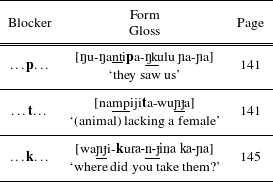
Appealing to structural position when assessing similarity is not an unprecedented move. For example: to explain some complexities that arise in the analysis of Kikongo nasal harmony, Rose & Walker (Reference Rose and Walker2004: 510–512) argue that nasals sharing a syllabic role (or, alternatively, a vocalic context) are more similar than nasals that do not. But while redefining the co-occurrence constraint as (43) is not in itself problematic, the consequences of this move are, as it becomes much more difficult to state a coherent generalization regarding the set of possible interveners. Notice that, in the forms in (42), stops do not block N2 denasalization: the stop that immediately follows N1 does not prevent denasalization from occurring. Elsewhere, however, we have seen that stops do block N2 modification; relevant data from Table 3 is summarized in Table 4.
Segments that block N2 modification (data from McConvell Reference McConvell1988).

The contrast between the data in (42) and Table 3 is diagrammed schematically below: a post-N1 stop does not block N2 modification (44a), but a stop in any other position does (44b).

To analyze (44), we could propose one of two modifications: (i) only intervocalic stops block N2 modification, or (ii) two stops block N2 modification (one on its own is transparent). In both cases, it is necessary to claim that stops sometimes, but not always, block N2 modification; in neither case is it clear what the analysis of this fact would be. Under an analysis in which the dispreference for NC1…N2 in Gurindji is driven by a co-occurrence constraint, it is difficult if not impossible to state a coherent generalization regarding the set of interveners.
4.2 Nasal cluster dissimilation as spreading of [-nasal]
A second alternative analysis of the Gurindji facts, proposed by McConvell (Reference McConvell1993), claims that [
 $\pm$
nasal] is a bivalent feature, and that N2 deletion and denasalization arise as a consequence of progressive [-nasal] spreading. In /kankula-mpa/, for example, [-nasal] spreads from the second /k/ and denasalizes /m/, resulting in a geminate [pp] (that is later simplified to singleton [p]) (45).

McConvell proposes that oral and nasal stops block spreading due to a constraint on line crossing: [-nasal] is blocked from further propagation when it encounters a segment specified as either [-nasal] or [+nasal]. (A necessary assumption here is that oral stops are [-nasal] and nasal stops are [+nasal]; all other segment types in Gurindji are unspecified for [
 $\pm$
nasal].) Thus in /ŋu-ŋantipa-ŋkulu/ (from [ŋu-ŋantipa-ŋkulu ɲa-ɲa] ‘they saw us’, Table 3), the [-nasal] feature that spreads from /t/ is blocked by [-nasal] [p] (45); in /ŋanta-ɳa-ŋku/ (from [ŋanta-ɳa-ŋku ja-n-ku] ‘I want to go to you’, Table 3), [-nasal] does not reach /ŋ/ because its propagation is blocked by [+nasal] /ɳ/.Footnote
[18]

This analysis is in some ways preferable to the analysis proposed above, as we do not have to posit the existence of a [nasal] spreading process for which there is only partial phonetic evidence. But even taking this consideration into account, there are reasons why the trigger-deletion analysis proposed in this paper is preferable to the analysis schematized in (46)–(47). One of these is the fact that McConvell’s (Reference McConvell1993) analysis, in its present form, does not generate the observed data. For example, there is no component of the analysis mandating that an onset nasal stop block [-nasal] spreading, but that a coda nasal consonant undergo. Nor is there a reason provided as to why post-nasal stops – but not word-initial or intervocalic ones – trigger [-nasal] harmony. In other words, the analysis does not capture the fact that the status of an oral or nasal consonant as a trigger or target of [-nasal] harmony depends on its position with respect to other [
 $\pm$
nasal] stops.
While an elaboration of McConvell’s (Reference McConvell1993) analysis could potentially fix these problems, there are more general issues with the proposal that [-nasal] can spread. Steriade (Reference Steriade1993b) claims that [-nasal] spreading, long-distance or otherwise, is unattested; spreading of [+nasal] is however quite frequent. Allowing [-nasal] to spread predicts patterns like in (48) (adapted from Steriade Reference Steriade1993b: 335), where [-nasal] spreads from stressed oral vowels. If the stressed vowel is oral, all following segments must be oral; if the stressed vowel is nasal, the following segments can be either oral or nasal, as [+nasal] does not spread.

While (48) is unattested, the mirror-image situation – where [+nasal] but not [-nasal] spreads from stressed vowels – is relatively common, attested in Guaraní (e.g. Rivas Reference Rivas, Kaisse and Hankamer1975) and Urak Lawoi’ (Hogan Reference Hogan1988), among others. The broader fact that there are many patterns where [+nasal] must be realized over a multi-segment domain, but none where [-nasal] must be, suggests that [+nasal] but not [-nasal] can spread. Put differently, the option to spread [-nasal] does not appear to be one that languages take advantage of.
Thus if [-nasal] spreading is the correct analysis of N2 modification in Gurindji and other languages, it would be the only known example of [-nasal] spreading. Given that it is possible to reanalyze the data as an example of the typologically more common process of [+nasal] spreading, this may be a desirable move. (A proponent of the [-nasal] spreading analysis could argue that this argument can be reversed, as allowing [-nasal] spreading would allow us to avoid making the claim that [+nasal] harmony can be triggered by only coda nasals, and that non-myopic patterns exist. The first claim does not seem so far-fetched: while this pattern is otherwise unattested, the two components necessary to generate it – [+nasal] spreading and greater nasalization preceding coda nasals – are. The second claim, that non-myopic patterns exist, is backed up by the discussion below. By contrast, the claim that [-nasal] spreading is possible has no other precedent.)
5 Discussion and conclusions
This paper has shown that nasal cluster dissimilation in Gurindji can be analyzed as an example of trigger deletion, a type of non-myopic pattern where a spreading trigger deletes when full application of spreading is impossible. Though phonetic evidence that NCs trigger regressive [nasal] spreading is only partial, I have argued that this is a plausible interpretation of the data. Similar patterns attested in other Eastern Ngumpin languages (Mudburra and Ngarinyman: see McConvell Reference McConvell1988, Reference McConvell1993; Nichols Reference Nichols2016) make the same points as the Gurindji pattern.Footnote [19]
If the interpretation of the Gurindji pattern proposed in Section 2 is correct, it stands as an argument for global evaluation. As demonstrated in Section 3.3, in frameworks that preclude non-myopia, the only outcome that can be derived in NC1…NC2 contexts is partial spreading (49). This is, however, not the desired result: instead, the spreading process is aborted through deletion of the trigger when its domain contains certain kinds of material.

In the following subsections, I summarize what is currently known regarding the typology of non-myopic processes, with the aim of showing that, even if the proposed interpretation of Gurindji nasal cluster dissimilation is later shown to be incorrect, there is still substantial evidence that the correct theory of the phonological grammar must be one in which surface candidates are globally evaluated. A pattern in Romanian that resembles the well-known sour grapes pathology (Steriade Reference Steriade2016) is discussed in Section 5.1; other apparently non-myopic processes are briefly summarized in Section 5.2. While it has been shown that some of these patterns can be analyzed in frameworks that preclude global evaluation, this is not true for all.
5.1 Across-the-board raising in Romanian
The term sour grapes (name from Padgett Reference Padgett, Beckman, Walsh-Dickey and Urbanczyk1995) describes a type of non-myopic pattern in which a language chooses not to initiate a spreading process, based on the knowledge that some restriction will eventually cause spreading to fail. Such patterns are commonly argued to be unattested (though cf. Bickmore & Kula Reference Bickmore and Kula2013 on Copperbelt Bemba), and their apparent absence is often used as a reason to exclude the possibility of non-myopia more generally (e.g. McCarthy Reference McCarthy2009: 3–4). This subsection summarizes work by Steriade (Reference Steriade2016) which shows that a productive process with a similar character exists in Romanian.
In modern Romanian, two morphological contexts cause an input /a/ to raise to output [ʌ]. The first, in (50): if a stem [a] loses primary stress under suffixation, that vowel is realized as [ʌ] in the suffixed form. That loss of stress is necessary in this context is exemplified by (50d), where an [a] that does not lose stress does not raise. The second, in (51): a stressed [a] in the stem raises when the feminine plural suffix ([–i], realized as  in clitic-group final position) is added. The fact that only (formerly) stressed [a]s raise is illustrated in (50e) and (51c), where a pretonic [a] fails to raise given addition of the same suffixes that motivate raising elsewhere. (A note on Steriade’s sources of data, reproduced here: D = dexonline.ro, a large online dictionary; G = searches performed on Google, when a dictionary entry was not available.)

Both [a]-raising processes are productive, with some caveats regarding register (nonce derivatives must belong to the casual register) and morphology (at least some part of the nonce derivative must signal that it belongs to the native lexicon).
Consider now what happens when the [a] forced to raise by (50) or (51) is a member of a string of [a]s. Given that raising targets only one vowel, and that stressless [a]s do not raise ((50e), (51c)), we would expect only the targeted [a] to raise. What we find, however, is that if one [a] in a sequence of [a]s raises, all must raise (subject to constraints discussed below). (52) illustrates, with examples from both kind of [a]-raising.

It is crucial that the string of [a]s is uninterrupted; if the [a]s are interrupted by a vowel with a different quality, only the (formerly) stressed [a] raises. The data in (53) thus provide evidence that [a]-raising does not target all [a]s in the stem; what is special about the forms in (52) is that the [a] forced to raise is part of an uninterrupted sequence of [a]s.

Steriade (Reference Steriade2016) analyzes (52) as an across-the-board shift, enforced by a base-derivative correspondence constraint (see Benua Reference Benua1997): if two vowels in some base are identical for F1 (or [
 $\pm$
low], [
 $\pm$
high]), then their correspondents in a derivative must also be identical for F1.
Of interest here are the ways in which this across-the-board raising process interacts with phonotactic constraints on the distribution of [ʌ]. Here I focus on a prohibition on [ʌ] in onsetless syllables, abbreviated as *#ʌ.Footnote [20] As shown in (54), the ban on onsetless [ʌ] prevents [a]-raising from occurring when the targeted vowel is in an onsetless syllable. As shown in (55), this same ban prevents across-the-board raising of an initial onsetless [a] adjacent to the targeted [a].

Crucial to this discussion is the behavior of words in which the onsetless [a] and the [a] targeted for [a]-raising are non-local. As shown in (56), in this situation, across-the-board [a]-raising is not initiated: only the morphologically motivated [a]-raising occurs.

When framed in derivational terms, this pattern is clearly non-myopic: in words that contain multiple [a]s ([a1a2á3], where á3 is the vowel targeted for morphological [a]-raising), whether or not a2 raises is crucially dependent on whether or not a1 is able to raise. If a1 is able to raise, then a2 raises, as in (52); if however a local phonotactic prevents a1 from raising, then a2 does not raise (56). The generalization that across-the-board [a]-raising is only initiated if each [a] in a sequence of [a]s can undergo is reminiscent of the schematic sour grapes patterns argued to be pathological in much of the literature on unbounded spreading.
Steriade (Reference Steriade2016) shows that the pattern described here can be easily derived in parallel OT, given the existence of a (i) a transderivational constraint demanding that a sequence of vowels identical for F1 in the base is identical for F1 in the derivative, and (ii) local phonotactics that govern the distribution of [ʌ] (e.g. *#ʌ). Like the proposed Gurindji pattern, the Romanian pattern cannot be analyzed in any framework that prohibits global evaluation. The inability of such theories to analyze the patterns found in Gurindji and Romanian is due to the simple fact that, in both cases, what happens at step x of the derivation is dependent on what will happen at some later step y.
5.2 Other apparent cases of non-myopia
In addition to the Romanian pattern summarized above, there are several other cases that have a non-myopic character, in that full application of an unbounded spreading process depends on the satisfaction of other constraints. (For discussion of additional patterns that bear a less close relation to the cases already discussed, see Walker Reference Walker2014 and Ryan Reference Ryan2017 on non-local trigger–target relations.) In these four remaining cases, spreading only occurs if the spreading feature succeeds in reaching some targeted position over the course of the derivation. If the targeted position is absent or otherwise inaccessible, then spreading fails. This type of pattern is schematized below.Footnote [21]

One pattern of this kind comes from metaphony in two Italian dialects: Central Veneto and Grado (Walker Reference Walker2010, though cf. Mascaró Reference Mascaró2016). In these languages, a regressive raising process triggered by post-tonic high vowels is initiated only if it ultimately succeeds in raising the stressed vowel. For example: stressed /e/ is capable of raising to [i], but stressed /ɛ/ is not (see Walker Reference Walker2010 for more details). In an [é1e2i3] string, both [é1] and [e2] raise, yielding [í1i2i3]. In [ɛ́1e2i3], however, neither raises, yielding [ɛ́1e2i3]. This process is non-myopic: whether or not [e2] raises depends on whether the preceding stressed vowel is also able to raise. A second pattern of this kind comes from Kinyarwanda sibilant harmony, where regressive retroflexion harmony spreads regressively only if a possible undergoer resides within the harmony domain (Walker, Byrd & Mpiranya Reference Walker, Byrd and Mpiranya2008, Hansson Reference Hansson2010). This process is also non-myopic: whether or not retroflexion spreading propagates regressively depends on whether or not it will reach a desirable target. And finally, a third pattern with this character comes from bounded tone spreading in Copperbelt Bemba (Bickmore & Kula Reference Bickmore and Kula2013, Jardine Reference Jardine2016), where a high tone spreads to the end of the word (/bá-ka-fik-a/
 $\rightarrow$
[bá-ká-fíká] ‘they will arrive’, Bickmore & Kula Reference Bickmore and Kula2013: 110), unless the final vowel already hosts a high tone, in which case bounded ternary spread occurs (e.g. /bá-ka-londolol-a kó/
 $\rightarrow$
[bá-ká-lóòndòlòl-à kó] ‘they will introduce them,’ Bickmore & Kula Reference Bickmore and Kula2013: 111). The choice between bounded and unbounded spread is thus non-myopic: unbounded spreading occurs unless full application would cause two [high] autosegments to be associated to adjacent vowels.
These patterns are however unlike the Gurindji and Romanian patterns discussed above, as they are examples of bounded harmony, and it has been shown that cases of apparently non-myopic bounded harmony can be derived without making use of global evaluation. For example, Kimper (Reference Kimper2012) shows that the metaphony patterns of Central Veneto and Grado can be derived in Harmonic Serialism, assuming that metaphony directly targets the stressed vowel (and that raising subsequently applies to the vowels that intervene between the stressed and the final vowel); Pater (Reference Pater2018) provides a similar analysis for Copperbelt Bemba. Such analyses are not available for Gurindji or Romanian, however, as there is no sense in which spreading occurs to satisfy some goal.
5.3 Summary
Evidence from Gurindji and others suggests that non-myopic patterns exist, and that a successful theory of the phonological grammar must be able to account for the existence of myopic and non-myopic spreading. This desideratum supports models of the grammar like OT (Prince & Smolensky Reference Prince and Smolensky2004), in which well-formedness is assessed over entire surface candidates; it disqualifies models like Serial Harmony (McCarthy Reference McCarthy2009), where non-myopia is impossible.
But this conclusion perhaps raises more questions than it answers. In particular: if non-myopic processes are possible, why are they not widespread? Why, in the vast majority of cases, is spreading myopic? I leave this and other questions to future work, but note that even the small class of non-myopic patterns summarized above has implications for our understanding of the nature of the phonological grammar. One of the most basic desiderata of a theory of phonology is that it should predict all existing patterns; this includes the non-myopic ones.