Introduction
The dynamic and uncertain contemporary career landscape has emphasized the significance of proactive career behaviors (PCBs) for individuals’ career sustainability (Akkermans & Hirschi, Reference Akkermans and Hirschi2022). PCBs refer to behaviors that individuals consciously engage in to achieve their career objectives (De Vos, De Clippeleer, & Dewilde, Reference De Vos, De Clippeleer and Dewilde2009). They typically include career planning, skill development, and networking behaviors (King, Reference King2004; Taber & Blankemeyer, Reference Taber and Blankemeyer2015). Studies have found that PCBs are positively related to sustainable career outcomes such as subjective career success (De Vos, De Clippeleer, & Dewilde, Reference De Vos, De Clippeleer and Dewilde2009; Seibert, Kraimer, & Crant, Reference Seibert, Kraimer and Crant2001) and perceived employability (Chughtai, Reference Chughtai2019).
While studies have found that PCBs are predictors of subjective career success and perceived employability, they have mostly focused on the direct relationships between them (Forret & Dougherty, Reference Forret and Dougherty2004; Valls, González-Romá, Hernandez, & Rocabert, Reference Valls, González-Romá, Hernandez and Rocabert2020; Wang, Yu, & Xi, Reference Wang, Yu and Xi2019). The questions of how and under what conditions individuals’ PCBs yield these career outcomes have long been overlooked. Scholars have emphasized the need for a more fine-grained understanding of the relationship between career proactivity (e.g., PCBs) and career outcomes (Akkermans & Hirschi, Reference Akkermans and Hirschi2022). Gaining insights into the psychological processes underlying the translation of PCBs into career sustainability not only deepens our understanding of why individuals engage in PCBs but also provides valuable guidance for organizations with regard to supporting employees’ career development and enhancing their productivity.
Accordingly, the present study aims to explore the psychological processes and contextual conditions through which individuals’ PCBs lead to two crucial sustainable career outcomes: subjective career success and perceived employability. Subjective career success depicts a comprehensive understanding of career success as it refers to individuals’ evaluation of achieving personally meaningful career outcomes (Spurk, Hirschi, & Dries, Reference Spurk, Hirschi and Dries2019) and reflects individuals’ satisfaction with tangible career achievements (e.g., objective indicators such as high-level salaries and promotions) (Ng, Eby, Sorensen, & Feldman, Reference Ng, Eby, Sorensen and Feldman2005). Perceived employability, on the other hand, refers to individuals’ belief in their ability to maintain their current job or secure desirable job opportunities (Rothwell & Arnold, Reference Rothwell and Arnold2007). These two outcomes are related to employees’ happiness and productivity, respectively, which are key indicators of a sustainable career and are important to employees and their organizations (De Vos, Van der Heijden, & Akkermans, Reference De Vos, Van der Heijden and Akkermans2020). Drawing upon the conservation of resources (COR) theory, individuals actively strive to obtain and foster resources (Hobfoll, Halbesleben, Neveu, & Westman, Reference Hobfoll, Halbesleben, Neveu and Westman2018). Subjective career success and perceived employability represent valued resources sought by individuals (Hobfoll, Reference Hobfoll1989). In this study, we expect that PCBs, as proactive resource acquisition behaviors, positively contribute to individuals’ subjective career success and perceived employability.
Furthermore, drawing on the socially embedded model of thriving (SEMT) and COR theory, we propose that thriving at work acts as a psychological process that translates PCBs into these two sustainable career outcomes. Thriving at work is a shared experience that encompasses vitality and learning (Spreitzer, Sutcliffe, Dutton, Sonenshein, & Grant, Reference Spreitzer, Sutcliffe, Dutton, Sonenshein and Grant2005). According to the SEMT, proactive behaviors such as exploration, task focus, and heedful relating are important predictors of thriving at work (Spreitzer et al., Reference Spreitzer, Sutcliffe, Dutton, Sonenshein and Grant2005). Specifically, career planning includes exploration activities; skill development involves self-development that facilitates task completion; and networking behaviors potentially create an atmosphere of trust among individuals, thus benefiting heedful relating (Chughtai, Reference Chughtai2019). Therefore, we propose that PCBs predict thriving at work. Moreover, experiencing thriving leads individuals to feel energized and have a sense of learning (Spreitzer et al., Reference Spreitzer, Sutcliffe, Dutton, Sonenshein and Grant2005), job satisfaction, and positivity toward self-development (Kleine, Rudolph, & Zacher, Reference Kleine, Rudolph and Zacher2019). These feelings represent psychological resources and human capital, according to COR theory (Hobfoll, Reference Hobfoll1989), which, in turn, contribute to subjective career success and perceived employability. In conjunction with the preceding analysis, we expect that thriving at work serves as a mediator between PCBs and the two sustainable career outcomes.
In addition, the role of individuals’ PCBs is likely to be influenced by stakeholders in organizations, such as leaders (De Vos, Van der Heijden, & Akkermans, Reference De Vos, Van der Heijden and Akkermans2020). The SEMT suggests that the influence of proactive behaviors on thriving at work depends on contextual factors, such as decision-making discretion, an atmosphere of trust/respect, and extensive information sharing (Spreitzer et al., Reference Spreitzer, Sutcliffe, Dutton, Sonenshein and Grant2005). Humble leadership creates an environment that facilitates the emergence of these contextual factors. Humble leadership is characterized by mutual respect, mentoring, and coaching (Oc, Bashshur, Daniels, Greguras, & Diefendorff, Reference Oc, Bashshur, Daniels, Greguras and Diefendorff2015). A humble leader often fosters a climate of trust, facilitates learning, and provides developmental feedback to employees (Owens & Hekman, Reference Owens and Hekman2012), which may create supportive conditions that enable employees who engage in PCBs to experience thriving at work. Furthermore, employees who thrive tend to exhibit passion and experience a feeling of learning at work, leading to a more positive assessment of their subjective career success and employability. Thus, we hypothesize that humble leadership acts as a moderator between PCBs and thriving at work, and between PCBs and the two career outcomes through thriving at work. Specifically, under humbler leaders, employees who conduct PCBs develop a greater sense of thriving at work, subjective career success, and perceived employability.
To examine these relationships, we conducted a two-wave employee survey in a Chinese IT company. This study extends prior research on PCBs in two ways. First, drawing on the SEMT and COR theory, this study expands our current knowledge by clarifying the mechanisms that explain how PCBs contribute to sustainable career outcomes, a topic that has hitherto been neglected. Specifically, thriving at work is identified as a psychological mechanism that helps explain the associations between PCBs and both subjective career success and perceived employability. Second, this study enriches our knowledge of the boundary conditions that influence the impact of PCBs by examining the interactive role of employees’ PCBs and key stakeholders, such as humble leaders, in shaping positive psychological states (e.g., thriving at work) and perceived employability. By empirically demonstrating the moderating role of humble leadership, our findings answer the call to investigate the role of key stakeholders (e.g., leaders) in individuals’ sustainable career development (De Vos, Van der Heijden, & Akkermans, Reference De Vos, Van der Heijden and Akkermans2020).
Theory and hypothesis development
PCBs, subjective career success, and perceived employability
PCBs refer to intentional career-related actions aimed at achieving individuals’ career goals, which generally consist of activities related to career planning, skill development, and networking efforts behaviors (De Vos, De Clippeleer, & Dewilde, Reference De Vos, De Clippeleer and Dewilde2009; King, Reference King2004; Taber & Blankemeyer, Reference Taber and Blankemeyer2015). Drawing upon COR theory, individuals endeavor to acquire, nurture, and safeguard resources (Hobfoll, Halbesleben, Neveu, & Westman, Reference Hobfoll, Halbesleben, Neveu and Westman2018). PCBs are considered to be resource-gaining behaviors because they enable individuals to obtain career resources such as those pertaining to career goals, human capital, and social capital. In line with the COR theory, we posit a positive association between PCBs and subjective career success. First, career planning involves self-defined career goal setting, which provides individuals with psychological resources that are positively associated with career satisfaction (Seibert, Kraimer, & Crant, Reference Seibert, Kraimer and Crant2001). Second, skill development indicates human capital improvement that contributes to the ability to obtain salary and promotions in organizations (Seibert, Kraimer, & Crant, Reference Seibert, Kraimer and Crant2001), thereby facilitating subjective career success (Ng et al., Reference Ng, Eby, Sorensen and Feldman2005). Third, networking behaviors help individuals access career information and resources, thus enabling individuals to make more informed career choices and decisions and to experience a greater sense of career success (De Vos, De Clippeleer, & Dewilde, Reference De Vos, De Clippeleer and Dewilde2009).
Moreover, we posit a positive relationship between PCBs and perceived employability. First, through career planning, individuals explore the job market and set challenging career goals for themselves, which enhance their access to career information and the development of effective career strategies. These resources contribute to individuals’ perceived employability (Chughtai, Reference Chughtai2019). Second, engaging in skill development increases individuals’ knowledge and skills at work, consequently enhancing their perceived employability (Chambel, Sobral, Espada, & Curral, Reference Chambel, Sobral, Espada and Curral2015). Third, networking behaviors provide individuals with social capital, including potential job opportunities and expanded professional networks, all of which are valuable resources that increase the likelihood of being employed (Harari, McCombs, & Wiernik, Reference Harari, McCombs and Wiernik2021). Accordingly, we propose the following hypotheses:
Hypothesis 1a: PCBs are positively related to subjective career success.
Hypothesis 1b: PCBs are positively related to perceived employability.
PCBs as predictors of thriving at work
Thriving at work is a psychological experience that denotes a sense of shared vitality and learning (Spreitzer et al., Reference Spreitzer, Sutcliffe, Dutton, Sonenshein and Grant2005). The experience of ‘vitality’ reflects individuals’ affective sense of being energized and passionate about their work (Spritzer, Porath, & Gibson, Reference Spritzer, Porath and Gibson2012). The feeling of ‘learning’ captures individuals’ continuous acquisition and utilization of skills and knowledge, representing the cognitive aspect of the growth experience (Kleine, Rudolph, & Zacher, Reference Kleine, Rudolph and Zacher2019; Porath, Spreitzer, Gibson, & Garnett, Reference Porath, Spreitzer, Gibson and Garnett2012). Thriving at work is socially embedded because it emerges from the interactions among personal characteristics, behaviors, and social contexts. The SEMT suggests that three types of agentic behaviors promote thriving at work: exploration (e.g., taking risks and seeking growth in new directions), task focus (e.g., focusing on goals or work tasks), and heedful relating (e.g., connecting with others). These agentic behaviors are facilitated by environmental features such as autonomy in decision-making, extensive information sharing, and an atmosphere of trust/respect (Jiang, Reference Jiang2017; Spreitzer et al., Reference Spreitzer, Sutcliffe, Dutton, Sonenshein and Grant2005).
Based on the SEMT, we predict that PCBs, as significant agentic career behaviors, play a pivotal role in fostering thriving at work (Niessen, Sonnentag, & Sach, Reference Niessen, Sonnentag and Sach2012). First, individuals who engage in career planning actively explore their career goals and adopt strategies to accomplish them, leading to perceptions of decision-making discretion and a sense of meaning in career development (Magnuson & Starr, Reference Magnuson and Starr2000). According to the SEMT, decision-making discretion and a sense of meaning are likely to enhance feelings of vitality. In addition, career planning involves the acquisition of new knowledge regarding future job prospects, which is positively correlated with the perception of learning. Moreover, career planning is linked to individuals’ psychological capital, which further contributes to their experiences of learning and vitality in the workplace (Flinchbaugh, Luth, & Li, Reference Flinchbaugh, Luth and Li2015; Kleine, Rudolph, & Zacher, Reference Kleine, Rudolph and Zacher2019; Paterson, Luthans, & Jeung, Reference Paterson, Luthans and Jeung2014).
Second, engaging in skill development fosters a sense of passion and self-endorsement as individuals seek broader information and acquire new skills and knowledge for the purpose of self-improvement (Smale et al., Reference Smale, Bagdadli, Cotton, Dello Russo, Dickmann, Dysvik and Unite2019). This situation, in turn, promotes feelings of vitality and learning. Previous studies have indicated a favorable relationship between the gaining of knowledge and skills and thriving at work, thus highlighting the positive association between skill development and thriving at work (Major, Turner, & Fletcher, Reference Major, Turner and Fletcher2006).
Third, individuals who engage in networking behaviors proactively establish new connections with others and gain relational resources, such as emotional support and work-related feedback from colleagues (Ren & Chadee, Reference Ren and Chadee2017). These resources contribute to heedful relating among individuals, which is associated with feelings of thriving (Spreitzer et al., Reference Spreitzer, Sutcliffe, Dutton, Sonenshein and Grant2005). Accordingly, we put forth Hypothesis 2.
Hypothesis 2: PCBs have a positive association with thriving at work.
The mediating effect of thriving at work in the relationships between PCBs and both subjective career success and perceived employability
According to COR theory, initial resource gains lead to further resource gains (Hobfoll, Reference Hobfoll2001). Building upon this theory, we propose that individuals who experience thriving at work tend to perceive subjective career success and employability. Thriving at work represents a crucial psychological resource that promotes individuals’ subjective career success. When employees feel energized and have a sense of learning at work, they tend to be more satisfied with their current jobs (Jiang, Di Milia, Jiang, & Jiang, Reference Jiang, Di Milia, Jiang and Jiang2020), careers (Jiang, Jiang, & Nielsen, Reference Jiang, Jiang and Nielsen2021), and work experience (Judge & Klinger, Reference Judge and Klinger2008; Ryan & Frederick, Reference Ryan and Frederick1997). This enhanced satisfaction contributes to their perception of success in their careers (Ng & Feldman, Reference Ng and Feldman2014). Moreover, thriving employees exhibit higher levels of job performance (Frazier & Tupper, Reference Frazier and Tupper2016; Gerbasi, Porath, Parker, Spreitzer, & Cross, Reference Gerbasi, Porath, Parker, Spreitzer and Cross2015; Walumbwa, Muchiri, Misati, Wu, & Meiliani, Reference Walumbwa, Muchiri, Misati, Wu and Meiliani2018), which provides them with additional psychological resources, such as a sense of pride or accomplishment in their job performance, that positively influence subjective career success (Dai & Song, Reference Dai and Song2016; Hobfoll, Reference Hobfoll2001).
In addition, individuals who experience thriving at work are expected to have higher confidence in their perceived employability. Perceived employability is a crucial career resource that refers to individuals’ perceived possibility of staying in the current organization or receiving job opportunities from another employer (Rothwell & Arnold, Reference Rothwell and Arnold2007). Empirical research has suggested that the sense of vitality experienced in thriving at work motivates individuals to develop and leverage psychological and social resources, thus enhancing their career adaptability and increasing their employability in the dynamic labor market (Jiang, Reference Jiang2017). Moreover, the feeling of learning associated with thriving at work increases individuals’ feelings of competence and efficacy (Klassen & Chiu, Reference Klassen and Chiu2010), and thriving employees exhibit positive attitudes toward self-development (Paterson, Luthans, & Jeung, Reference Paterson, Luthans and Jeung2014). Consequently, these resources, including enhanced career adaptability, capability, efficacy, and a sense of self-development, contribute to individuals’ confidence in their perceived employability.
Drawing upon the previous analysis in Hypothesis 2, we propose that PCBs promote feelings of thriving at work. Furthermore, a sense of thriving leads to an accumulation of psychological resources, including job and career satisfaction, a sense of self-improvement, and career adaptability, all of which contribute to individuals’ positive evaluations of their career success and employability. Thus, we hypothesize that thriving at work acts as a mediator between PCBs and both subjective career success and perceived employability.
Hypothesis 3a: Thriving at work acts as a mediator between PCBs and subjective career success.
Hypothesis 3b: Thriving at work acts as a mediator between PCBs and perceived employability.
The moderating effect of humble leadership
The SEMT suggests that the relationship between individuals’ agentic behaviors and thriving at work is influenced by environmental characteristics such as abundant information sharing, decision-making autonomy, and an atmosphere of trust/respect (Spreitzer et al., Reference Spreitzer, Sutcliffe, Dutton, Sonenshein and Grant2005). Individuals’ career behaviors are inevitably influenced by significant stakeholders, particularly their leaders in the workplace (De Vos, Van der Heijden, & Akkermans, Reference De Vos, Van der Heijden and Akkermans2020). Therefore, we anticipate that employees who engage in PCBs experience a stronger feeling of thriving at work when their leaders exhibit humbler traits.
Humble leadership, which has been characterized as a bottom-up approach, is viewed as capable of legitimizing followers’ growth and development (Owens & Hekman, Reference Owens and Hekman2012) and fostering followers’ learning orientation (Owens, Johnson, & Mitchell, Reference Owens, Johnson and Mitchell2013). Humble leaders typically possess interpersonal characteristics that involve accurate self-perceptions, recognition of followers’ contributions and strengths, and a teachable attitude (Owens, Johnson, & Mitchell, Reference Owens, Johnson and Mitchell2013). By legitimizing followers’ developmental journeys, humble leaders acknowledge and value followers’ strengths and contributions while caring about their development and growth (Owens, Johnson, & Mitchell, Reference Owens, Johnson and Mitchell2013; Vera & Rodriguez-Lopez, Reference Vera and Rodriguez-Lopez2004). Drawing upon the SEMT, we propose that employees who engage in PCBs may be more motivated to feel a sense of thriving at work under the guidance of a humble leader. Specifically, humble leadership is positively related to followers’ self-efficacy (Ding & Chu, Reference Ding and Chu2020) and encourages followers to set ambitious career goals (Ma, Ganegoda, Chen, Jiang, & Dong, Reference Ma, Ganegoda, Chen, Jiang and Dong2020), thereby fostering a supportive climate for followers’ PCBs and further encouraging them to experience a feeling of thriving at work. Moreover, humble leaders encourage feedback seeking and social learning among team members (Owens & Hekman, Reference Owens and Hekman2016), thus creating additional learning opportunities and relational resources for employees who engage in skill development and networking behaviors. These opportunities and resources, in turn, enhance their feelings of energy and learning to thrive at work (Spritzer, Porath, & Gibson, Reference Spritzer, Porath and Gibson2012).
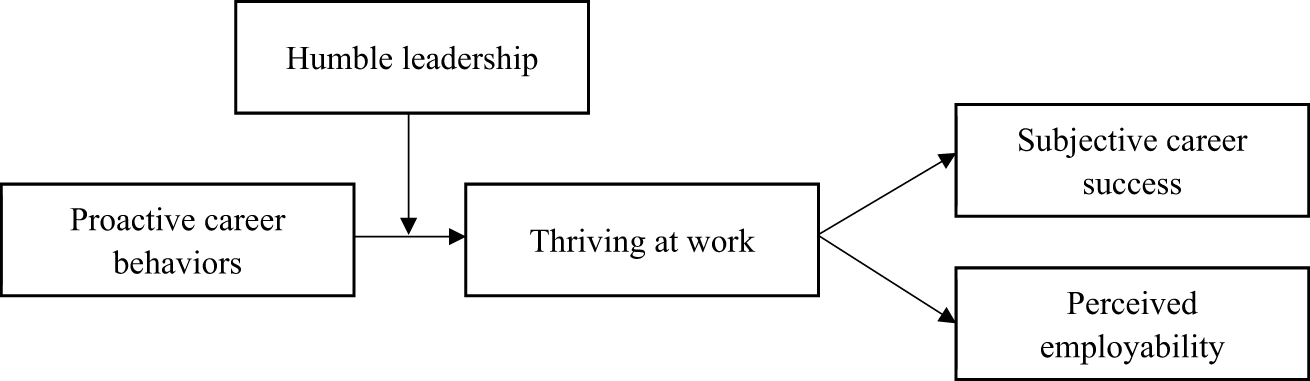
Furthermore, we contend that the indirect relationships between PCBs and employees’ subjective career success and their perceived employability through thriving at work can be moderated by humble leadership. Humble leaders foster trust in their employees (Nielsen, Marrone & Slay, Reference Nielsen, Marrone and Slay2010) and cultivate strong leader–member relationships (Owens, Johnson, & Mitchell, Reference Owens, Johnson and Mitchell2013), which creates resources such as a supportive and trusting atmosphere for employees. According to COR theory, these resources allow employees who engage in PCBs to feel more supported by their leaders and then gain a stronger experience of thriving at work. Consequently, the energized and learning experience of thriving at work may further boost employees’ subjective career success and perceived employability. In summary, we expect that in the context of a humbler leader, employees who engage in PCBs are more inclined to experience a feeling of thriving at work, leading to higher perceptions of career success and employability. Accordingly, we posit Hypotheses 4a, 4b, and 4c and the conceptual model (Fig. 1).
Hypothesis 4a: Humble leadership moderates the relationship between PCBs and thriving at work such that this relationship is stronger when humble leadership is high rather than low.
Hypothesis 4b: Humble leadership moderates the indirect relationship between PCBs and subjective career success through thriving at work such that this indirect relationship is stronger when humble leadership is high rather than low.
Hypothesis 4c: Humble leadership moderates the indirect relationship between PCBs and perceived employability through thriving at work such that this indirect relationship is stronger when humble leadership is high rather than low.
Methods
Sample and data collection
The study sample consisted of employees from a Chinese IT company. With the support of the company’s human resource management department, we recruited 400 participants who voluntarily agreed to participate in a two-wave survey administered over a 2-month interval. To ensure data confidentiality and matching, we asked all participants to provide the final four digits of their cellphone number during the two-wave survey. We provided participants with the assurance that these data would solely be utilized for research objectives, and we offered them a cash reward upon completion of all the questionnaires.
The conceptual model.

At Time 1, a paper-based questionnaire focusing on demographic information, PCBs, and thriving at work was distributed to 400 participants. A total of 315 participants (response rate = 79%) responded to the questionnaire at Time 1. Two months later, at Time 2, a follow-up questionnaire assessing subjective career success, perceived employability, and humble leadership was administered. Due to the impact of the COVID-19 pandemic, some employees were working remotely at this time and were thus unable to complete the second round of the survey. Ultimately, 228 participants provided effective responses in the second-round survey, resulting in a response rate of 72%.
In the final sample (n = 228), 22.8% (n = 52) of participants were female and 77.2% (n = 176) were male; most participants were in the age range of 30–35 years (SD = 0.73). In terms of education, 5.7% (n = 13) of participants had completed high school, 39.9% (n = 91) had completed college, 29.4% (n = 67) had a bachelor’s degree, and 25% (n = 57) had a master’s degree. Organizational tenure was concentrated in the range of 4–6 years (SD = 1.08).
Measures
All items other than the demographic variables were measured on a 5-point Likert scale, ranging from ‘strongly disagree’ (1) to ‘strongly agree’ (5). Employing a translation and back-translation procedure as suggested by Brislin (Reference Brislin, Triandis and Berry1980), we translated all the items from English into Chinese to ensure semantic equivalence. Initially, two bilingual researchers translated the items from English to Chinese, after which two researchers independently performed the back-translation of the Chinese questionnaires into English. Based on a comparison between the original and back-translated English versions, the Chinese questionnaires were further revised. A pilot study involving MBA students (N = 30) was conducted to confirm the clarity of the items, and all participants demonstrated a clear understanding.
PCBs
PCBs were measured using nine items, including items pertaining to career planning, skill development, and networking behaviors, which were originally developed by Strauss, Griffin, and Parker (Reference Strauss, Griffin and Parker2012) and revised by Chughtai (Reference Chughtai2019). Each subscale comprised three items. An example is the item ‘I am involved in career path planning’ (Cronbach’s α = 0.90).
Thriving at work
Thriving at work was assessed using 10 items developed by Porath et al. (Reference Porath, Spreitzer, Gibson and Garnett2012), which captured both a sense of learning and vitality. An example is the item ‘I find myself learning often’ (Cronbach’s α = 0.86).
Subjective career success
Subjective career success was measured using an 8-item scale derived from Greenhaus, Parasuraman, and Wormley (Reference Greenhaus, Parasuraman and Wormley1990) and Nabi (Reference Nabi1999), which was also used by Rothwell and Arnold (Reference Rothwell and Arnold2007) in their empirical study. The items ‘I am satisfied with the progress I have made toward meeting my goals in terms of income’ (Cronbach’s α = 0.94) are two examples.
Perceived employability
Participants’ perceived employability was assessed using an 11-item scale developed by Rothwell and Arnold (Reference Rothwell and Arnold2007). This scale includes items such as ‘My personal networks in this organization help me in my career’ (Cronbach’s α = 0.88).
Humble leadership
Humble leadership was assessed using the 9-item humble leader behaviors scale developed by Owens, Johnson, and Mitchell (Reference Owens, Johnson and Mitchell2013), which includes three components. An example is the item ‘The leader often compliments others on their strengths’ and ‘The leader is open to the ideas of others’ (Cronbach’s α = 0.96).
Control variables
Control variables including gender, age, education level, and organizational tenure were considered. Previous studies have indicated that age is relevant to career success (Eby, Butts, & Lockwood, Reference Eby, Butts and Lockwood2003) and perceived employability (Wittekind, Raeder, & Grote, Reference Wittekind, Raeder and Grote2010). Gender is related to networking and career success (Woehler, Cullen-Lester, Porter, & Frear, Reference Woehler, Cullen-Lester, Porter and Frear2021). Education level and organizational tenure can be regarded as forms of human capital that are related to both subjective career success (Ng & Feldman, Reference Ng and Feldman2014) and perceived employability (Wittekind, Raeder, & Grote, Reference Wittekind, Raeder and Grote2010). Therefore, these variables were controlled for in the subsequent analyses.
Results
Confirmatory factor analysis (CFA), common method variance (CMV) test, and convergent validity
Before testing the research hypotheses, we conducted CFA by using Mplus 8.0 software to examine the validity of the measurement model. Table 1 presents the results of the CFA.
Results of confirmatory factor analysis

Note. All χ2 differences are significant at p < .01.
** p < 0.05; CFI = comparative fit index; TLI = Tucker–Lewis index; RMSEA = root mean square error of approximation; PCBs = proactive career behaviors; TW = thriving at work; SCS = subjective career success; PE = perceived employability; HL = humble leadership.
The results of CFA indicated that the five-factor model (Model 1, in which all the scale items loaded on their corresponding constructs) had a good fit to the data (χ2 = 1192.976, df = 682, comparative fit index (CFI) = 0.924, Tucker–Lewis index (TLI) = 0.917, root mean square error of approximation (RMSEA) = 0.057, standardized root mean squared residual (SRMR) = 0.057). In contrast, the four-factor model (Model 2, in which the items for PCBs and thriving at work loaded on one factor), the three-factor model (Model 3, in which the items for PCBs and thriving at work loaded on one factor, while the items for subjective career success and perceived employability loaded on another factor), the two-factor model (Model 4, in which the items for PCBs and thriving at work loaded on one factor, while the items for subjective career success and perceived employability as well as humble leadership loaded on another factor), and the one-factor model (Model 5 with all items on a factor) fitted the data relatively poorly. These results indicate that the responses reported by participants are distinct (Anderson & Gerbing, Reference Anderson and Gerbing1988).
Given that the data collected were self-reported, which may entail CMV, we conducted Harman’s one-factor test to examine the effects of CMV. The results showed that no single factor (26.60% of the cumulative total variance was explained by the largest common factor) exceeded 50% of the variance in all the relevant items (Podsakoff, MacKenzie, Lee, & Podsakoff, Reference Podsakoff, MacKenzie, Lee and Podsakoff2003). In addition, we employed the method of controlling for the effects of an unmeasured latent methods construct (ULMC) to assess CMV bias. We constructed an unmeasured latent factor by loading all indicators of the five variables based on the original measurement model (i.e., the five-factor model) (Podsakoff et al., Reference Podsakoff, MacKenzie, Lee and Podsakoff2003; Williams, Vandenberg, & Edwards, Reference Williams, Vandenberg and Edwards2009). The results of CFA of the six-factor model with the unmeasured latent factor (χ2 = 1172.100, df = 670, CFI = 0.927, TLI = 0.920, RMSEA = 0.056, SRMR = 0.055) fit the data better than the original measurement model, but the change in the fit indices was slight and nonsignificant (Δχ2 = 20.876, df = 12, p > .05). Both Harman’s one-factor test and ULMC analysis indicate that there were no severe problems with CMV in the data.
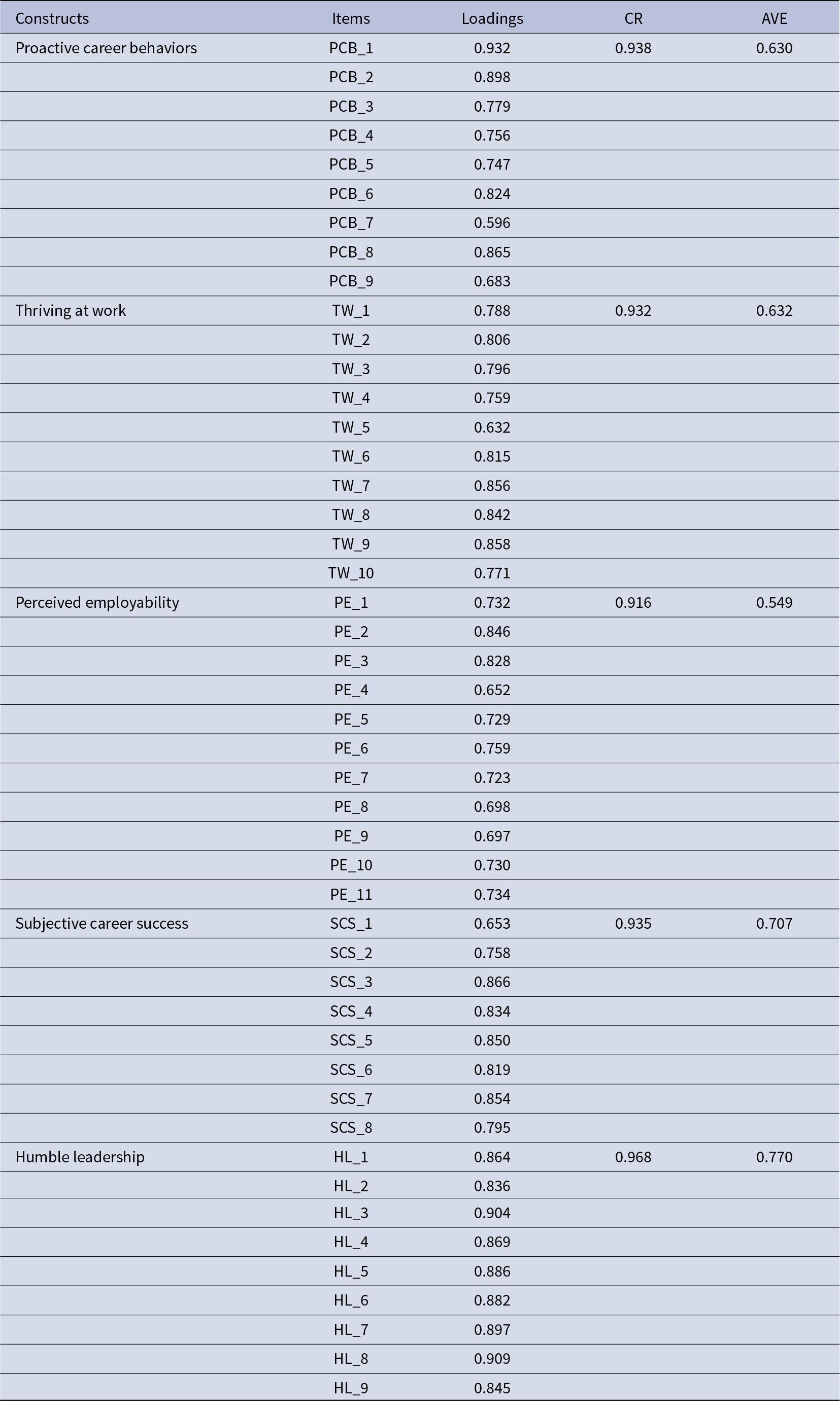
To confirm the convergent validity, we calculated the composite reliability (CR) and average variance extracted (AVE) of each construct. The CR was assessed to gauge the extent of reliability, which in turn reflects a component of convergent validity. AVE is a composite indicator of convergence, reflecting the mean amount of variance extracted from the items loading on a specific construct (Fornell & Larcker, Reference Fornell and Larcker1981). Table 2 provides an overview of the items loadings, CR, and AVE in this study. The results demonstrated that all CR values were above the cut-off value of .70 (the lowest CR value was 0.916 for perceived employability) (Hair, Risher, Sarstedt, & Ringle, Reference Hair, Risher, Sarstedt and Ringle2019) and that the AVE values were above 0.50 (the lowest AVE value was 0.549 for perceived employability) (Fornell & Larcker, Reference Fornell and Larcker1981), indicating sufficient convergent validity among the constructs.
Results of items loadings, composite reliability, and average variance extracted

Note. n = 228. AVE = (summation of the square of the factor loadings)/{(summation of the square of the factor loadings)/(summation of the error variances)}. CR = (square of the summation of the factor loadings)/{(square of the summation of the factor loadings)/(square of the summation of the error variance). AVE = average variance extracted; CR = composite reliability; PCBs = proactive career behaviors; TW = thriving at work; SCS = subjective career success; PE = perceived employability; HL = humble leadership.
Descriptive correlations and discriminant validity
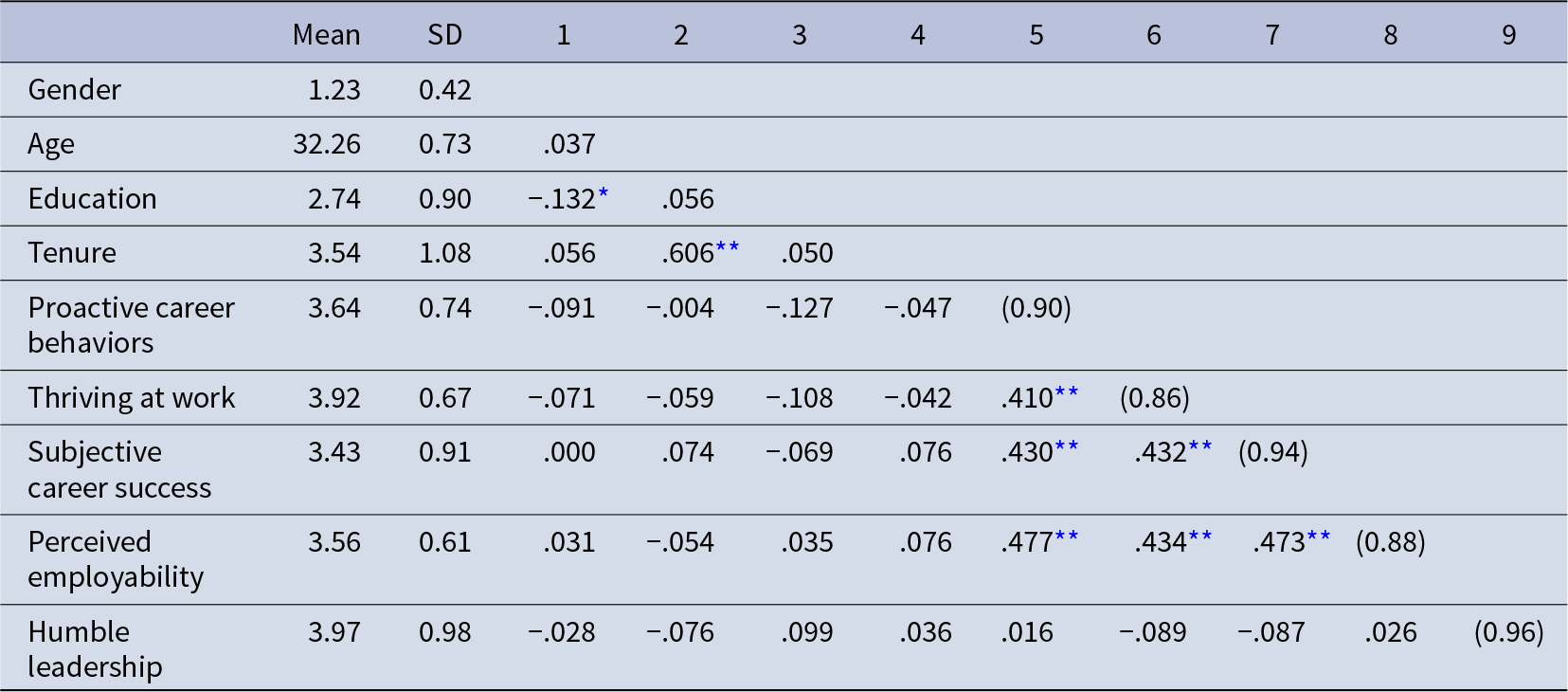
Table 3 displays means, standard deviations, and correlations for the research variables. There was a positive association between PCBs and thriving at work (r = 0.41, p < .01), subjective career success (r = 0.43, p < .01), and perceived employability (r = 0.48, p < .01). Thriving at work exhibited positive correlations with subjective career success (r = 0.43, p < .01) and perceived employability (r = 0.43, p < .01). Humble leadership was not found to correlate with any of the other variables.
Descriptive statistics

Note. n = 228. Coefficient αs are in parentheses on the diagonal. The demographic information, measures of proactive career behaviors, and thriving at work were accomplished at Time 1. Subjective career success, perceived employability, and humble leadership were measured at Time 2.
* p < .05, **p < .01.
To confirm the discriminant validity that assesses the degree to which a construct is distinct from others, we compared the square roots of the AVE value for each construct with the correlations among them. The results showed that the discriminant validity of the constructs was ideal, in that for all five focal constructs the square roots of the AVE values were greater than the correlations among them (Fornell & Larcker, Reference Fornell and Larcker1981).
Hypothesis testing
We performed linear regression using SPSS 24.0 software to test our hypotheses. All the covariates, including gender, age, education, and the average organizational tenure, were included in the data analysis. We standardized the variables and multiplied PCBs and humble leadership to create an interaction term. The outcomes of these analyses can be found in Table 4.
Results of regression analysis

Note. n = 228.
* p < .05; **p < .01. PCBs*HL = Proactive career behaviors × Humble leadership.
Hypotheses 1a and 1b suggested a positive association between PCBs and subjective career success and perceived employability. In Model 2-1 of Table 4, the findings indicate a positive relationship between PCBs and employees’ subjective career success (β = 0.43, p < .01), thereby supporting Hypothesis 1a. Model 3-1 indicates a positive association between PCBs and employees’ perceived employability (β = 0.51, p < .01), thus supporting Hypothesis 1b. Hypothesis 2 posited a positive relationship between PCBs and thriving at work. The results from Model 1-1 supported this hypothesis, showing a significant positive association between PCBs and employees’ thriving at work (β = 0.40, p < .01).
Hypothesis 3a predicted that thriving at work would serve as a mediator between PCBs and subjective career success. Model 2-2 shows that when both PCBs and thriving at work were included in the regression equation, the association between thriving at work and employees’ subjective career success remained positive and significant (β = 0.31, p < .01), whereas the effect of PCBs on subjective career success also remained significant (β = 0.31, p < .01) but was slightly weaker compared to Model 2-1 (β = 0.43, p < .01). This finding suggests that employees’ thriving at work partially mediated the association between PCBs and subjective career success, thus supporting Hypothesis 3a.
Hypothesis 3b predicted that thriving at work would mediate the association between PCBs and perceived employability. Model 3-2 shows that when the regression equation included both PCBs and thriving at work, thriving at work was positively and significantly related to perceived employability (β = 0.29, p < .01); while PCBs remained significantly related to perceived employability (β = 0.39, p < .01), the effect was weaker than in Model 3-1 (β = 0.51, p < .01). This finding suggests that thriving at work partially mediated the association between PCBs and perceived employability, thus supporting Hypothesis 3b.
To further confirm Hypotheses 3a and 3b, we employed PROCESS analysis (Bolin, Reference Bolin2013) using SPSS to assess the significance of the indirect effects. PCBs had significant indirect effects on subjective career success (effect = 0.15; 95% CI = [0.06, 0.33]) and employees’ perceived employability (effect = 0.10; 95% CI = [0.04, 0.17]) through thriving at work, as the bootstrap intervals did not include zero; thus, Hypotheses 3a and 3b were supported.
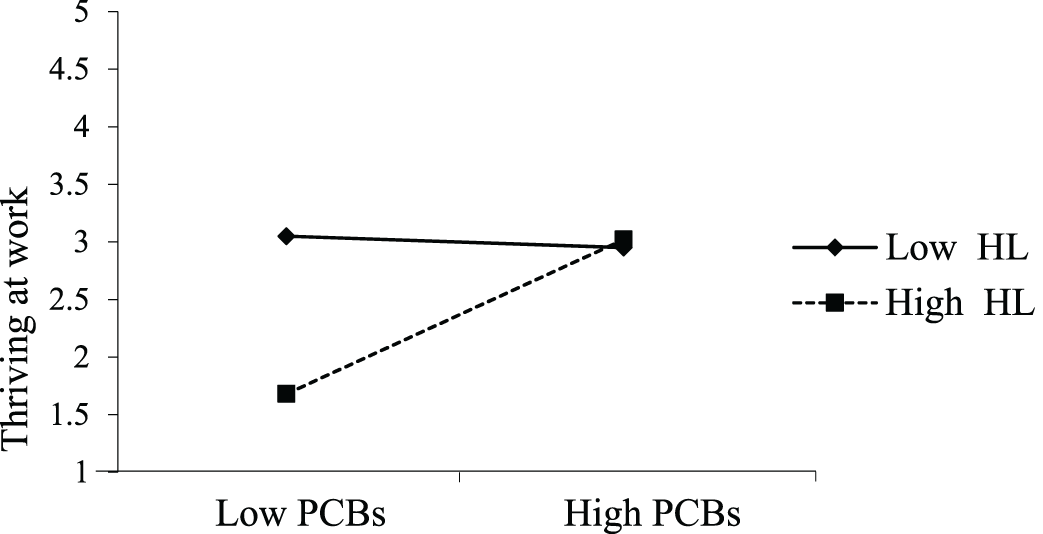
Hypothesis 4a predicted that humble leadership would moderate the relationship between PCBs and thriving at work. We employed a three-step hierarchical regression analysis to examine this hypothesis. Model 1-3 suggested that the interaction effect formed by PCBs × humble leadership with regard to predicting thriving at work was significant (β = 0.72, ΔR2 = 0.02, p < .01). Figure 2 displays the interaction plot, revealing that the positive association between PCBs and thriving at work is stronger when humble leadership is high (i.e., M + 1 SD) (slope = 0.67, p < .01) compared to when it is low (i.e., M − 1 SD) (slope = −0.05, p > .05), thus supporting Hypothesis 4a.
The interactive effect of proactive career behaviors and humble leadership on thriving at work.

Hypotheses 4b and 4c hypothesized that the indirect relationships between PCBs and employees’ subjective career success (Hypothesis 4b) as well as perceived employability (Hypothesis 4c) through thriving at work were stronger when humble leadership was high rather than low. We examined this prediction using a bootstrap method via PROCESS in SPSS (Model 7, Hayes, Reference Hayes2013). The results show that humble leadership’s moderated mediating effect on the indirect relationship between PCBs and subjective career success was not statistically significant (index = 0.026; 95% CI = [−0.014, 0.062]) as the bootstrap interval included zero; thus, Hypothesis 4b was not supported. However, the moderated mediating role of humble leadership in the indirect association between PCBs and perceived employability was significant (index = 0.032; 95% CI = [0.001, 0.063]), as the bootstrap interval did not include zero; thus, Hypothesis 4c was supported.
Discussion
Rapid changes in the work environment and employment relationships have increased the importance of individuals’ engagement in PCBs to maintain sustainable careers (Jiang, Wang, Li, Peng, & Wu, Reference Jiang, Wang, Li, Peng and Wu2022). This study aimed to investigate the psychological mechanism that explains the positive associations between PCBs and two critical sustainable career outcomes (i.e., employees’ subjective career success and perceived employability). Drawing upon the SEMT and COR theory, the study found that employees who engage in PCBs experience a feeling of thriving at work, leading to improved subjective career success and perceived employability. In addition, under the condition of humble leadership, employees who engage in PCBs feel more thriving at work, leading to a heightened sense of employability. These findings contribute to the literature on PCBs in the following ways.
First, this study extends previous research by examining the mechanisms through which PCBs contribute to sustainable career outcomes such as subjective career success and perceived employability. Prior research has predominantly concentrated on the direct impacts of PCBs on career outcomes (Chughtai, Reference Chughtai2019; Seibert, Kraimer, & Crant, Reference Seibert, Kraimer and Crant2001; Smale et al., Reference Smale, Bagdadli, Cotton, Dello Russo, Dickmann, Dysvik and Unite2019). However, a more fine-grained understanding of the relationship between PCBs and career outcomes is needed and called by career researchers (Akkermans & Hirschi, Reference Akkermans and Hirschi2022). Responding to this call, our study, based on the SEMT and COR theory, reveals that PCBs foster employees’ subjective evaluation of their career success and employability by promoting their thriving at work. This study highlights the psychological mechanism underlying the positive impacts of PCBs on sustainable career outcomes. Thriving at work is a crucial psychological resource for individuals’ sustainable development in the dynamic and uncertain career environment, and it enables individuals to maneuver and adapt to their work contexts and to advance their own development (Spreitzer et al., Reference Spreitzer, Sutcliffe, Dutton, Sonenshein and Grant2005). The findings improve our understanding of how PCBs translate into the two sustainable career outcomes. Moreover, by integrating thriving at work into the study of career behaviors, this research advances interdisciplinary knowledge interactions among the fields of career management, organizational behavior, and industrial psychology, based on the significance of thriving at work in these domains (Kleine, Rudolph, & Zacher, Reference Kleine, Rudolph and Zacher2019; Shahid, Muchiri, & Walumbwa, Reference Shahid, Muchiri and Walumbwa2021).
Second, this study enriches the research on the conditional factors underlying the effects of PCBs by investigating the moderating role of humble leadership. Previous studies have primarily treated leadership (e.g., servant leadership) as a predictor of PCBs (Chughtai, Reference Chughtai2019; Wang, Yu, & Xi, Reference Wang, Yu and Xi2019). Our research suggests that leaders, as key stakeholders in individuals’ career paths, not only influence PCBs directly but also serve as boundary conditions that facilitate or hinder the effects of PCBs. According to the SEMT, humble leadership fosters an atmosphere of trust and support for employee development, which enhances the levels of thriving at work exhibited by employees who engage in PCBs. Our study responds to concerns regarding the lack of an investigation of contextual factors in PCBs studies (Smale et al., Reference Smale, Bagdadli, Cotton, Dello Russo, Dickmann, Dysvik and Unite2019) by shedding light on the important role of leadership in the association between employees’ career behaviors and psychological state at work.
Meanwhile, this study provides empirical support for the argument that the interaction between individuals’ PCBs and key stakeholders (e.g., leaders) significantly impacts their career sustainability (De Vos, Van der Heijden, & Akkermans, Reference De Vos, Van der Heijden and Akkermans2020). Humble leadership reinforces the indirect association between PCBs and perceived employability mediated by thriving at work. Humble leaders are highly concerned about the growth and development of their employees (Owens & Hekman, Reference Owens and Hekman2012). In line with COR theory, humble leadership can serve as a special resource that creates a supportive environment for employees’ PCBs to obtain more resources such as thriving at work. Given that thriving at work itself represents human sustainability and is associated with growth and health (De Vos, Van der Heijden, & Akkermans, Reference De Vos, Van der Heijden and Akkermans2020; Kleine, Rudolph, & Zacher, Reference Kleine, Rudolph and Zacher2019; Spritzer, Porath, & Gibson, Reference Spritzer, Porath and Gibson2012), thriving employees exhibit higher productivity and employability, indicating the sustainability of their careers. Therefore, our findings highlight the critical role that the interaction between employees’ PCBs and their leaders plays in their career sustainability, particularly in terms of employability.
It should be noted, however, that the interaction between employees’ PCBs and leaders varies across different sustainable career outcomes. Our study found that the indirect effects of PCBs on employees’ subjective career success were not enhanced by humble leadership. We suspect that excessive humility on the part of the leaders might create an atmosphere of low enthusiasm and energy, which could negatively impact employees’ sense of thriving and hinder subjective career satisfaction. Moreover, if leaders are overly humble about their achievements, employees may develop a more conservative perception of their own career achievements, thereby reducing career satisfaction. It is therefore important to look closely at the role of leaders, such as the potential inverted U-shaped effect of humble leadership in the relationship between PCBs and career success.
Practical implications
The present study holds valuable practical implications for both employees and organizations. First, the findings highlight the importance of engaging in PCBs to enhance employees’ thriving at work, subjective career success, and perceived employability. To promote thriving at work, employees are encouraged to actively plan their careers, develop task-related skills, and build social networks both within and outside their organizations. These PCBs contribute to a feeling of vitality and growth, which in turn fosters employees’ career success and employability.
Second, organizations can play an important role in facilitating employees’ thriving at work and supporting their career sustainability. Given that thriving at work is a key driver of performance and long-term success (Kleine, Rudolph, & Zacher, Reference Kleine, Rudolph and Zacher2019), organizations are advised to implement initiatives that promote employees’ thriving at work. These initiatives can include providing career planning courses, offering skill development training programs, and fostering a culture that values social networking and collaboration. By supporting employees’ PCBs and creating an environment conducive to thriving, organizations can enhance employees’ job satisfaction, productivity, and long-term career prospects. Furthermore, this study emphasizes the importance of humble leadership with regard to amplifying the positive impacts of PCBs on thriving at work and perceived employability. Leaders can contribute to employees’ thriving by engaging in humble behaviors, such as providing constructive performance feedback, appreciating followers’ strengths and contributions, and actively supporting followers’ career development. Humble leaders create a climate of trust, respect, and support, which empowers employees who engage in PCBs to thrive and enhance their employability. Therefore, organizations should invest in leadership development programs that cultivate humble leadership qualities and encourage leaders to create a nurturing environment for their employees’ career growth.
Limitations and directions for future research
A number of limitations are worth noting, and future research directions deserve further exploration. First, given that all the variables in this study are highly correlated with self-perception or evaluation, we collected data from self-reports. Although we administered the survey in two waves to reduce the CMV and the results of Harman’s one-factor test and ULMC showed that the study exhibited no serious problem with CMV, a longitudinal design could be adopted to capture the dynamic effects of PCBs more accurately in future research. For instance, diary studies could provide insights into the fluctuations that occur in the sense of thriving at work among individuals who engage in PCBs (Ohly, Sonnentag, Niessen, & Zapf, Reference Ohly, Sonnentag, Niessen and Zapf2010), thus bolstering the validity of the conclusions.
Second, this study investigated the psychological mechanisms that explains how PCBs translate into two sustainable career outcomes. However, the partial mediating role of thriving at work suggests the possible existence of other mediating factors. Future research could explore other potential mechanisms, such as person-job fit and need satisfaction, to enhance our comprehension of the relationship between PCBs and career outcomes. These mechanisms may shed light on how proactive behaviors are translated into favorable career outcomes (Zhang & Parker, Reference Zhang and Parker2019).
Third, the indirect links between PCBs and subjective career success were not strengthened by humble leadership. The results suggest that humble leadership plays a different role in the relationship between PCBs and different career outcomes. Future research could explore the role of humble leadership in the relationships between career behaviors and outcomes in further detail, including the potential inverted U-shaped effects on the relationships between career behaviors and outcomes. Furthermore, in addition to leadership, the conceptual model of sustainable careers encompasses various contextual factors, such as work-related contexts (e.g., HRM practices), private life contexts (e.g., friends and family), and temporal changes (e.g., career shocks), which may act as boundary conditions for the effects of PCBs (De Vos, Van der Heijden, & Akkermans, Reference De Vos, Van der Heijden and Akkermans2020). It would be beneficial for future research to examine these contextual factors to improve our understanding of the boundary conditions that influence the translation of PCBs into career outcomes.
Conclusion
In the contemporary landscape of boundaryless and protean careers, employees are increasingly expected to take a proactive approach to their career development (Jiang et al., Reference Jiang, Wang, Li, Peng and Wu2022; Smale et al., Reference Smale, Bagdadli, Cotton, Dello Russo, Dickmann, Dysvik and Unite2019). PCBs, which are characterized by self-initiation and future orientation, have received considerable scholarly attention (Akkermans & Kubasch, Reference Akkermans and Kubasch2017). However, prior research has predominantly concentrated on the direct impacts of PCBs on career outcomes, necessitating a deeper understanding of the underlying mechanisms that elucidate how PCBs contribute to sustainable career outcomes such as subjective career success and perceived employability (Akkermans & Hirschi, Reference Akkermans and Hirschi2022). Drawing on the SEMT and COR theory, this study identifies thriving at work as a psychological mechanism that translates PCBs into two sustainable career outcomes. Furthermore, this study emphasizes the crucial role of humble leadership in enhancing the associations among employees’ PCBs, their sense of thriving at work, and perceived employability. In summary, by shedding light on the significance of psychological experiences, particularly thriving at work, and the influence of key stakeholders such as leaders, this study provides insights into the pathways through which employees who engage in PCBs attain sustainable career outcomes.
Acknowledgements
The authors would like to thank the editors and anonymous reviewers for their helpful comments, as well as their peers who gave advice on the research and writing.
Competing interests
The authors declare no conflict of interest.
Xinling Jiang is currently a PhD candidate in School of Labor and Human Resources, Renmin University of China (RUC), and has been a visiting researcher at School of Business and Economics, Vrije Universiteit Amsterdam, the Netherlands. Her research areas include proactive career behaviors, career shocks, sustainable career development, and HRM practices.
Jinzhao Qu is currently a PhD candidate at School of Labor and Human Resources, Renmin University of China (RUC), and a visiting researcher at School of Business and Economics, Vrije Universiteit Amsterdam, the Netherlands. Her research areas include humble leadership, relational energy, and staff innovation.
Meng Lei is currently a PhD candidate at School of Labor and Human Resources, Renmin University of China (RUC), and has been a visiting researcher at University of Innsbruck, Austria. Her research areas include HRM at platform organizations, star employees, paradox theory, and institutional theory.
Wenxia Zhou is currently a full professor at School of Labor and Human Resources, Renmin University of China (RUC). Her research interests include career management, HRM practices, and organizational behavior.