Implications
The improvement of muscle fatty acid (FA) profile in lambs through increased polyunsaturated fatty acid (PUFA) concentration achieved in the present study adds to the growing body of evidence supporting the replacement of monoculture pasture with biodiverse mixtures. By including a greater proportion of species that were found to promote PUFA supply to ruminant tissues, such as selfheal and birdfoot trefoil, biodiverse seed mixtures could be formulated to optimise the FA profile of resulting ruminant food products. However, the seemingly low persistence of these species within a competitive mixed sward remains a challenge to commercial uptake.
Introduction
There is increasing interest in low-input biodiverse pasture as a sustainable forage for grass-based ruminant production systems (Luescher et al., Reference Luescher, Mueller-Harvey, Soussana, Rees and Peyraud2014). However, to date, little work has focused on the ability of individual plants within biodiverse pastures to beneficially modify the FA profile of ruminant food products, with the aim of increasing monounsaturated fatty acid (MUFA) and PUFA and decreasing saturated fatty acid (SFA) concentrations (Elgersma, Reference Elgersma2015). Certain plant species (Asteraceae, Apiaceae, Rosaceae, Cyperaceae) have been positively correlated with PUFA in milk (Collomb et al., Reference Collomb, Bütikofer, Sieber, Jeangros and Bosset2002). In ruminant muscle, biodiverse systems have been associated with enhanced PUFA concentrations in lambs (Whittington et al., Reference Whittington, Dunn, Nute, Richardson and Wood2006; Campidonico et al., Reference Campidonico, Toral, Priolo, Luciano, Valenti, Hervas, Frutos, Copani, Ginane and Niderkorn2016) and Lourenço et al. (Reference Lourenço, Van Ranst, De Smet, Raes and Fievez2007) reported increased concentrations of docosahexaenoic acid (a very long-chain (VLC) n-3 PUFA) in the intramuscular fat of lambs grazing a biodiverse pasture compared with an intensive ryegrass pasture. However, few studies have attempted to relate species composition within a biodiverse sward to the FA supplied by the plants and their potential to alter the composition of ruminant food products. Identifying which species have the most potential for improving the resulting FA composition in ruminant products could aid in designing targetted seed mixtures for this purpose. For example, red clover (Trifolium pratense) and certain other perennial forage species contain enhanced levels of polyphenol oxidase (PPO), which can prevent lipolysis and subsequent rumen biohydrogenation of plant PUFA (Dewhurst et al., Reference Dewhurst, Shingfield, Lee and Scollan2006; Lee et al., Reference Lee, Theobald, Gordon, Leyland, Tweed, Fychan and Scollan2014). In addition, plants containing condensed tannins may protect PUFA from biohydrogenation, and thus enhance PUFA concentration in ruminant products (Campidonico et al., Reference Campidonico, Toral, Priolo, Luciano, Valenti, Hervas, Frutos, Copani, Ginane and Niderkorn2016; Girard et al., Reference Girard, Dohme-Meier, Silacci, Kragten, Kreuzer and Bee2016a). However, the degree of PUFA protection can be influenced by the concentration, chemical structure and degree of polymerisation of the condensed tannins, which can vary both within and between plant species (Azuhnwi et al., Reference Azuhnwi, Boller, Dohme-Meier, Hess, Kreuzer, Stringano and Mueller-Harvey2013). This may explain why certain tannin containing species appear to affect FA profile to a greater extent than others. Girard et al. (Reference Girard, Dohme-Meier, Wechsler, Goy, Kreuzer and Bee2016b) observed that sainfoin (Onobrychis viciifolia) raised PUFA concentration in cheese to a greater extent than birdsfoot trefoil (Lotus corniculatus), with both providing similar amounts of α-linolenic acid (18:3n-3) to the animal. Therefore, the objectives of the present study were to (i) determine the impact of a range of species on PUFA biohydrogenation in vitro and (ii) determine the impact of increasing pasture botanical biodiversity by including selected plant species, on the FA profile of lamb meat.
Material and methods
Experiment 1: In vitro biohydrogenation of selected species
Sample collection
Six ‘candidate’ plant species – birdsfoot trefoil (L. corniculatus), knapweed (Centaurea nigra), ribwort plantain (Plantago lanceolata), red clover (T. pratense), selfheal (Prunella vulgaris) and yarrow (Achillea millefolium) – were selected from a larger group of species, due to containing relatively high concentrations of 18:2n-6 and 18:3n-3, and being relatively easy to establish (Kliem et al., Reference Kliem, Deaville, Morgan and Givens2006). The entire above-ground plant material of each plant was collected from one of several already established plots on four separate occasions during the growing season (Kliem et al., Reference Kliem, Deaville, Morgan and Givens2006), mixed well and transported to the laboratory. Samples were stored at −20°C before being lyophilised and milled (<1 mm).
In vitro biohydrogenation
To Wheaton flasks (capacity 125 ml), 1.0 g (±0.01 g) of each freeze-dried and milled sample were accurately weighed in triplicate, and 90 ml of a reduced anaerobic buffer (Theodorou et al., Reference Theodorou, Williams, Dhanoa, McAllan and France1994) added. Flasks were warmed to 39°C before inoculation with 10 ml strained bovine rumen fluid collected ~2 h post-feeding from two lactating dairy cows receiving a total mixed diet comprising 50 : 50 forage : concentrate (dry matter (DM) basis), with the forage portion being predominantly maize silage. Flasks were loosely stoppered and vented via a needle. Flasks were incubated at 39°C with regular mixing by agitation of the bottles. Three flasks per plant species were removed following 0, 3, 6, 9, 12, 24 and 48 h incubation, flask contents were frozen at −20°C and then lyophilised. Lyophilised residue was mixed and stored at −20°C before subsequent FA analysis.
Fatty acid analysis
Fatty acid analysis of the whole plant material before in vitro biohydrogenation was performed on triplicate sub-samples of freeze-dried plant material, using a method based on Sukhija and Palmquist (Reference Sukhija and Palmquist1988) with toluene for extraction and 2% (v/v) sulphuric acid in methanol for methylation. Resulting FA methyl esters (FAME) were analysed on a Varian 3400 CX Gas Chromatograph (Varian Inc., Palo Alto, CA, USA) equipped with a flame-ionisation detector, using a temperature programme (Shingfield et al., Reference Shingfield, Ahvenjärvi, Toivonen, Ärölä, Nurmela, Huhtanen and Griinari2003). Identification of FAME peaks was completed using a known external standard (GLC463, Nu-Chek Prep., Waterville, MN, USA). Individual FA concentrations were normalised according to the total lipid content, determined as ether extract (MAFF, 1986). The contents of individual FA were reported on an oven DM basis following measurement of the residual DM content of the freeze-dried samples (after oven drying at 100°C for 18 h).
Biohydrogenation residues were analysed for FA composition using a method based on Folch et al. (Reference Folch, Lees and Stanley1957) and methylated using a bi-methylation method (base-catalysed then acid-catalysed) derived from Kramer and Zhou (Reference Kramer and Zhou2001). A known amount of internal standard (heneicosanoic acid methyl ester, H3265; Sigma-Aldrich, Dorset, UK) was added before methylation in order to quantify FAME. Extracted FAME were analysed as described above. The FA profiles were expressed as total mg/flask. Results for 18:2n-6 and 18:3n-3 were used to calculated the extent of in vitro biohydrogenation for each plant based on the disappearance of 18:2n-6 and 18:3n-3.
Data analysis
Flask contents of selected FA were analysed for effects of plant, time and their interaction by means of the Mixed model in SAS (v9.4, SAS Institute, Cary, NC, USA), which included within sampling time comparison of plant least squares means (analysed using the PDIFF function). Results were considered significantly different when P<0.05. Curves (constructed using the mean of three flasks over the entire incubation period from 0 to 48 h) describing the rate and extent of in vitro biohydrogenation (disappearance of 18:2n-6 and 18:3n-3) were fitted to the exponential model of Ørskov and McDonald (Reference Ørskov and McDonald1979) using SigmaPlot (Systat Software Inc., London). Hydrogenation of FA was described by the equation P t =x+ye −zt , where P t is the amount (mg) of FA present at incubation time t, x the non-hydrogenated FA fraction (mg), y the hydrogenated fraction (mg) and z the fractional rate of disappearance of y (/h). Curve parameters were compared as in Boufaïed et al. (Reference Boufaïed, Chouinard, Tremblay, Petit, Michaud and Bélanger2003); effective disappearance (ED) and rumen bypass (BP) of 18:2n-6 and 18:3n-3 were calculated using a rumen fractional passage rate (k) of 0.03/h (Alcaide et al., Reference Alcaide, García and Aguilera2000). This rate describes the passage of small particulate matter in sheep.
Experiment 2: Fatty acid profile of lamb
Plant species and establishment of biodiverse pastures
The same six species assessed in vitro in Experiment 1 were established within a permanent, perennial ryegrass-based sward at the University of Reading. In the previous 5 years the sward had been used to graze sheep and had received ~100 kg fertiliser nitrogen/ha per year. The site was divided into 10 plots (5×2 arrangement; each 60×29 m) allocated in a paired block design to either the biodiverse or a control (no additional species sown) treatment. Blocking was completed to account for potential variation in background conditions. The biodiverse plots were power harrowed before under-sowing at ~5 kg seed/ha, twice the recommended seed rate (Department for Environment, Food and Rural Affairs, 2004). The weight of each species within the seed mixture was as follows: birdsfoot trefoil (19%), knapweed (24%), ribwort plantain (32%), red clover (13%), selfheal (10%) and yarrow (2%; Emorsgate Seeds, Norfolk, UK). These proportions were used so that the same number of seeds per gram was included of each species. Establishment of the six ‘sown’ species was completed using 0.75 and 0.25 of the total seed amount (5 kg) in spring and autumn, respectively. Owing to poor establishment of the biodiverse pastures a further ~5 kg seed/ha was applied in late autumn. After sowing the biodiverse plots were rolled and then left undisturbed for at least 6 weeks. The control pastures received 100 kg fertiliser nitrogen/ha in the 1st year but no additional fertiliser was applied to the biodiverse pastures.
Immediately before the start of the grazing study in the following spring, both the biodiverse and control plots were assessed for species richness as determined by the number and abundance of different sown and unsown plant species, and assessment of contribution to the overall biomass. This was achieved by estimating the number of different species and percentage ground cover of vascular plant species in 12 randomly positioned 50×50 cm quadrats within each plot (areas within 1 m of the fences were excluded from the sampling). Simultaneously, 10 random samples per plot were obtained by harvesting the above-ground plant matter that were pooled within plots, frozen (−20°C), freeze-dried and milled, and stored at −20°C and subsequently analysed for FA analysis, as per the process described for whole plants in Experiment 1.
Experimental animals and the grazing study
In total, 50 greyface Mule×Texel castrated male lambs from an early lambing flock were weaned in April of the grazing year and given a forage-based diet until the start of the grazing study in mid-May. The lambs were weighed before the study (mean weight±SEM: 26.8±0.39 kg), and five lambs were randomly allocated to each plot to ensure a similar mean live-weight within each plot and across the two treatments (26.8 and 26.7 kg for biodiverse and control pastures, respectively). Lambs had access to water ad libitum, and were weighed weekly, with live-weights recorded. The grazing period continued for a minimum of 50 days (mean±SEM, control 64.7±0.93 days, biodiverse 64.3±0.93 days) after which time animals reaching the target weight of 45 kg or attaining optimum body condition score by palpation of the loin area were selected for slaughter. A total of three lambs from each plot were slaughtered. Animals were transported to the University of Bristol for slaughter, which occurred according to European Union Welfare guidelines. On arrival animals were stunned by captive bolt followed by abrupt exsanguination. Carcases were prepared and graded, and tissue samples were taken for study from musculus longissimus thoracis and musculus semimembranosus, and subcutaneous fat from above m. longissimus thoracis. Samples were stored frozen at −20°C until required for FA analysis.
Fatty acid analysis
Prior to analysis tissue samples were partially defrosted at room temperature for ~30 m and prepared by cutting into ~1 cm3 pieces, and blended to a homogeneous paste in a food processor within 2 m. Subsequently, FA in samples were extracted using the Folch et al. (Reference Folch, Lees and Stanley1957) method followed by a base-catalysed methylation as described for in vitro samples in Experiment 1. For FA extraction, 2.0 g of each tissue (in duplicate) were homogenised in chloroform/methanol (2 : 1, v/v) using an IKA® Ultra-Turrax dispersal tool (IKA®-Werke GmbH & Co., Staufen, Germany). After washing the extract with saline solution, the solvent was removed under vacuum at 40°C using a rotary evaporator and the remaining lipid extract was re-suspended in hexane. Fatty acid methyl esters were analysed as outlined previously, FA contents and profiles were obtained for each sample, and were expressed as mg/100 g fresh tissue.
Data analysis
Live-weight was analysed using the Mixed procedure of SAS (SAS version 9.4; SAS Institute), with a model that included fixed effects of time, treatment and time×treatment interaction (including time as a repeated measurement), and random effects of plot and lamb within plot. Pasture total lipid, FA content and species richness were analysed using a two-way ANOVA, with fixed effects of treatment and block. Tissue FA were analysed using the Mixed procedure of SAS with a model including fixed effects of treatment, block and treatment×block interaction. Results were considered significantly different where P<0.05, and tendencies were reported where P was between 0.05 and 0.1.
Results
Experiment 1
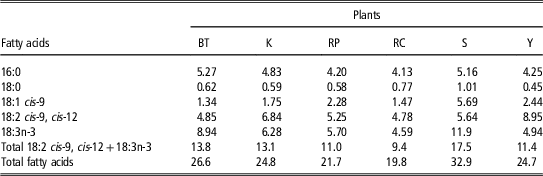
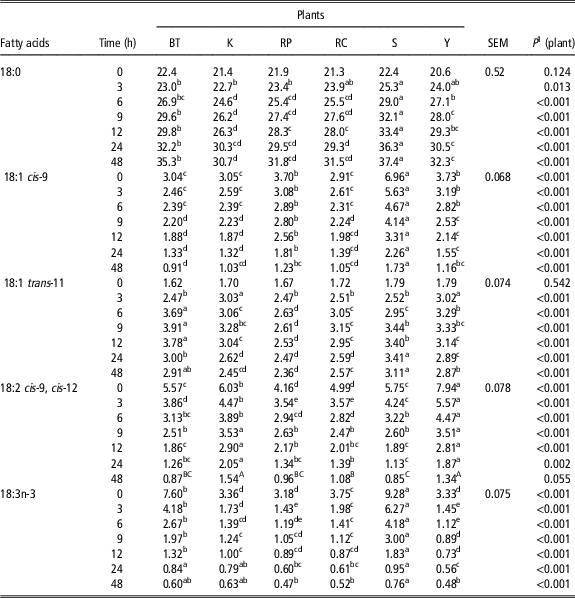
Of the six plant species, selfheal contained the highest amount of total FA and ribwort plantain the least (Table 1). Yarrow was particularly high in 18:2n-6, and selfheal contained the greatest quantity of 18:3n-3 (Table 1). The effect of the six selected plant species on in vitro flask contents of selected FA are reported in Table 2. There were effects (P<0.001) of plant, time and plant×time interaction for all FA presented in Table 2. At 0 h incubation, all flasks contained similar amounts of 18:0 (P=0.124), but over time flask contents increased (P<0.001). The interaction between plant and time for 18:0 reflected a lag in 18:0 accumulation for knapweed, and the greatest (P<0.05) 18:0 accumulation at 48 h for selfheal and birdsfoot trefoil. For cis-9 18:1, at 0 h incubation there was a difference (P<0.001) between plants, most probably due to the high content in selfheal (Table 2). Over time this decreased (P<0.001) for all flasks, but again the rate of disappearance varied between plants, with this being lowest for red clover after 3 h of incubation. Flask contents of trans-11 18:1 were similar across all plants at time 0 h (P=0.542), but over time contents increased (P<0.001) to a peak between 6 and 12 h before decreasing again. The greatest amount of trans-11 18:1 was measured in flasks containing birdsfoot trefoil.
Selected fatty acid content of six plants selected for in vitro biohydrogenation incubations (mixture of four different sampling times; mg/g dry matter)

BT=birdsfoot trefoil; K=knapweed; RP=ribwort plantain; RC=red clover; S=selfheal; Y=yarrow.
Flask content (mg) of selected fatty acids over a 48 h in vitro incubation

BT=birdsfoot trefoil; K=knapweed; RP=ribwort plantain; RC=red clover; S=selfheal; Y=yarrow.
1 Significance of the effect of plant within sampling time. There were effects (P<0.001) of plant, time and plant×time interaction for all fatty acids presented.
a,b,c,d,e,A,B,CValues within rows with different superscript letters are significantly different (P<0.050).
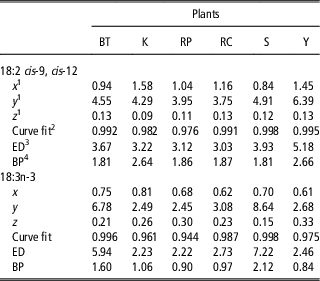
There were differences (P<0.001) between plants for both 18:2n-6 and 18:3n-3, at 0 h incubation. Over time both decreased (P<0.001) but at different rates. According to the disappearance curves, knapweed contained the highest amount of non-hydrogenatable 18:2n-6 and selfheal the lowest (Table 3). The ED of the hydrogenatable fraction was highest for yarrow, with yarrow and knapweed containing the highest amount of BP 18:2n-6. Selfheal contained the highest amount of hydrogenatable 18:3n-3, but had the lowest rate of 18:3n-3 disappearance of all plants. Due to this the ruminal bypass 18:3n-3 was highest for selfheal.
Curve fit parameters for the disappearance of 18:2n-6 and 18:3n-3 over time

BT=birdsfoot trefoil; K=knapweed; RP=ribwort plantain; RC=red clover; S=selfheal; Y=yarrow.
1 Using the equation P t =x+ye −zt , where P t is the amount (mg) of 18:2n-6 or 18:3n-3 present in the flasks at time t, x the non-hydrogenatable fraction (mg), y the hydrogenatable fraction (mg), z the rate of disappearance of fraction y (/h) and t the incubation time (h; Ørskov and McDonald, Reference Ørskov and McDonald1979).
2 R 2 value for the curve fit.
3 Effective disappearance (mg/g DM) of 18:2n-6 or 18:3n-3 using a ruminal rate of passage (k) of 0.03 (Alcaide et al., Reference Alcaide, García and Aguilera2000).
4 Potential ruminal bypass (mg/g DM) of 18:2n-6 or 18:3n-3.
Experiment 2
Pasture botanical composition and lamb performance
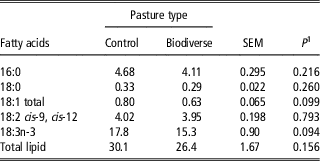
The number of different species (both sown and unsown) was higher in the biodiverse than the control pastures when expressed per quadrat (P<0.016) and per plot (P<0.019). However, birdsfoot trefoil was not recorded in any of the biodiverse pastures. The mean contribution of the sown and unsown (non-grass species) plant species to the overall biomass was 25.4% in the biodiverse pastures. This contribution was largely comprised of ribwort plantain. The total lipid and FA composition of the conventional and biodiverse pastures immediately prior to start of the lamb grazing study is presented in Table 4. There were no statistically significant (P>0.05) differences in the individual FA contents of the two pasture types. The predominant FA was 18:3n-3 and accounted for ~50% of the total FA.
Mean fatty acid contents (mg/g dry matter) of the control and biodiverse pastures before the commencement of the lamb grazing study

1 Significance of the effect of pasture type.
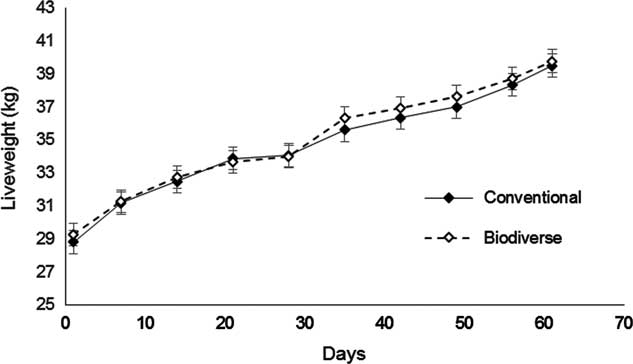
Live-weight change of the lambs grazing the conventional and biodiverse pastures is summarised in Figure 1 and demonstrates an effect of time (P<0.001) but no effect (P=0.717) of treatment, with no interaction (P=0.773). Overall mean live-weight gains were 10.2 and 10.0 kg (±1.91 SEM) over the grazing period for conventional and biodiverse groups, respectively.
The mean live weight of lambs grazing either a control or biodiverse pasture over a 60-day study period. Mixed model analysis concluded an effect (P<0.001) of time but no effect of treatment (P=0.717) or time×treatment interaction (P=0.773).

Fatty acid composition of tissues
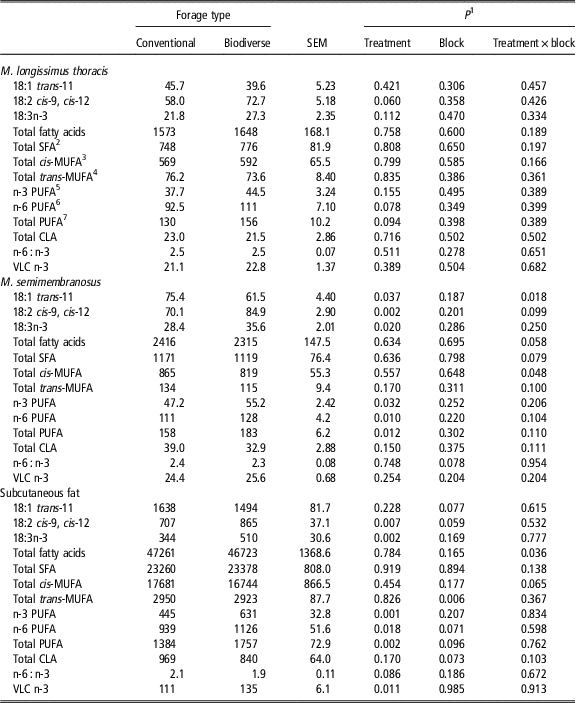
The summary of the amounts of key FA groups in all three tissues analysed are reported in Table 5 (for full details of FA content, see Supplementary Tables S1 to S3). The total FA content of m. longissimus thoracis was similar for the lambs grazing the biodiverse and control pastures: mean 1573 and 1648 mg/100 g tissue, respectively. The amount of 18:2n-6 tended to be higher (P=0.060) in m. longissimus thoracis from the lambs grazing the biodiverse pasture, however, other differences in FA content and profile were small. A significant block and block×treatment effect (P<0.05) was recorded for 22:2 cis-13, cis-16, due to the higher level of this FA in one of the blocks.
Fatty acid composition (mg/100 g tissue) of tissues from lambs grazing control and biodiverse pasture

SFA=saturated fatty acids; MUFA=monounsaturated fatty acids; PUFA=polyunsaturated fatty acids; CLA=conjugated linoleic acid; VLC=very long chain.
1 Significance of the effect of treatment, block, treatment×block interaction.
2 Sum of 12:0, 13:0, 14:0, 15:0, 16:0, 17:0, 18:0, 18:0, 19:0, 20:0, 22:0, 24:0.
3 Sum of cis-9 12:1, cis-9 14:1, cis-9 15:1, cis-9 16:1, cis-10 17:1, cis-9 18:1, cis-11 20:1, cis-13 22:1, cis-15 24:1.
4 Sum of trans-9 16:1, trans-6-8 18:1, trans-9 18:1, trans-10 18:1, trans-11 18:1, trans-12 18:1, trans-13-14 18:1.
5 Sum of 18:3n-3, 20:5n-3, 22:3n-3, 22:5n-3, 22:6n-3.
6 Sum of 18:2 trans9, trans12, 18:2 cis9, cis12, 20:2n-6, 20:3n-6, 22:2n-6, 22:4n-6.
7 Sum of n-3 and n-6 PUFA.
The total FA content was numerically higher in the m. semimembranosus than in the m. longissimus thoracis tissue (Table 5). A lower (P<0.04) content of trans-11 18:1 was found in m. semimembranosus from lambs grazing the biodiverse pasture (Table 5). At the same time 18:2n-6 and 18:3n-3 concentrations were higher (both P<0.02), resulting in a higher total n-3 and n-6 PUFA content in tissue from lambs grazing biodiverse pasture. Block×treatment effects were recorded for a number of FA, mainly due to some blocks having different mean values from the remaining blocks, which magnified any subtle treatment differences.
Subcutaneous fat contained 47 261 and 46 723 mg total FA/100 g tissue from lambs grazed control and biodiverse pastures, respectively (Table 5). The content of trans-10 18:1, trans-12 18:1, 19:0, 18:2 cis-9, cis-12, 18:3n-3, 20:3n-6, 24:0/20:5n-3, 22:5n-3, and total n-3, n-6 and VLC n-3 PUFA were all higher (P<0.05) in subcutaneous fat from lambs grazed on biodiverse pasture compared with control pasture (Supplementary Table S3).
Discussion
In vitro biohydrogenation
It has been suggested (Dewhurst et al., Reference Dewhurst, Scollan, Youell, Tweed and Humphreys2001) that the proportion of leaf in the whole plant DM is an important determinant of FA concentration due to forage lipids being predominantly of leaf origin (Harfoot, Reference Harfoot1981). Differences in leaf : stem ratios between plant species may explain some of the differences in plant FA contents observed. The in vitro biohydrogenation characteristics were similar for the six plant species studied. Selfheal and birdsfoot trefoil displayed the greatest accumulation of 18:0 but these plants contained the greatest initial amounts of total PUFA. Rate of disappearance of 18:2n-6 was similar for all plants apart from knapweed (mean of plants excluding knapweed, 0.12 mg/h, knapweed 0.09 mg/h). This may indicate that knapweed exerts some other effect on rumen microbes and/or their enzymes, either by inhibiting the initial lipolysis or biohydrogenation itself. Indeed, knapweed resulted in a lower accumulation of both trans-11 18:1 and 18:0 which suggests less biohydrogenation. Kumarasamy et al. (Reference Kumarasamy, Middleton, Reid, Nahar and Sarker2003) found that serotonin conjugates extracted from the seeds of knapweed had antimicrobial activity. These conjugates may also be present in other fractions of knapweed and therefore conferring potential antimicrobial effects.
For 18:3n-3, both selfheal and birdsfoot trefoil displayed similar high values for ED compared with the other plants, and yet the accumulation of 18:0 for birdsfoot trefoil did not increase at the same rate as that of selfheal. This may be due to birdsfoot trefoil inhibiting the intermediary pathways of biohydrogenation, through, for example, the presence of condensed tannins. After ingestion some condensed tannins from birdsfoot trefoil remain free and unbound that may inhibit the extracellular enzyme action of certain bacteria (Barry and Manley, Reference Barry and Manley1986). Min et al. (Reference Min, Barry, Attwood and McNabb2002) found that including birdsfoot trefoil in the diet of sheep decreased the population of the rumen bacteria Butyrivibrio proteoclasticus, which is one of the few bacterial species that conducts the final step of rumen biohydrogenation of 18:3n-3 (converting trans-11 18:1 to 18:0). However, if condensed tannins affect bacterial biohydrogenation in this way, no reduction in the initial rate of disappearance of both 18:2n-6 and 18:3n-3 was observed in the present study. No estimate of the tannin content or that of other polyphenols was completed in the present study but it is highlighted as an area of future study. When a rumen passage rate of 0.03/h (rate at which small particles leave the rumen of sheep) was applied, the amount of 18:3n-3 by-passing hydrogenation was numerically higher for selfheal and birdsfoot trefoil. However, this observation is likely to reflect the higher initial concentration of 18:3n-3 in these plants.
Compared with previous in vitro research, red clover did not appear to perform better than other species in terms of ED and by-pass of 18:2n-6 and 18:3n-3. Van Ranst et al. (Reference Van Ranst, Vandewalle, Gadeyne, De Riek and Fievez2013) reported lower lipolysis and biohydrogenation of 18:3n-3 and 18:2n-6 with silages containing increasing amounts of red clover, which may have been due to the presence of PPO within the red clover. In the present study however, red clover was being compared not with ryegrass but with other species which may have exerted similar biohydrogenation-inhibiting effects. An in vivo study reported higher concentrations of 18:3n-3 in rumen fluid following the feeding of a 50 : 50 grass : red clover silage to lambs, compared with a 100% grass silage, suggesting PPO as a possible reason (Campidonico et al., Reference Campidonico, Toral, Priolo, Luciano, Valenti, Hervas, Frutos, Copani, Ginane and Niderkorn2016). However there was no difference between the grass : red clover silage and grass : sainfoin silage treatments, with sainfoin suggested as having a different mechanism of action for inhibiting biohydrogenation.
Using biodiverse pasture to alter the fatty acid profile of tissues
To accelerate the assembly of a species-rich community within grassland, deliberate under-sowing permanent pasture with selected plant species is required. Establishment of the biodiverse pastures over ~12 months significantly increased the number of different ‘sown’ and unsown species present in the experimental plots as compared with the control pastures. On average the biodiverse pastures were shown to contain an average of 16 different plant species per plot, compared with nine for control pastures. However, despite the higher species richness, the most abundant species, and concomitant contributor to the overall plant biomass, was ribwort plantain. The abundance of the remaining species was low and therefore made a substantially smaller contribution to the available biomass available for grazing. Other studies carried out with the aim of introducing different species to create biodiverse pastures have been, for example, 4 years in duration (e.g. Hopkins et al., Reference Hopkins, Pywell, Peel, Johnson and Bowling1999; Pywell et al., Reference Pywell, Bullock, Hopkins, Walker, Sparks, Burke and Peel2002). Therefore a longer period of establishment is required to enable some slower growing species to proliferate following initial sowing in order to create a truly biodiverse pasture.
The m. semimembranosus total FA concentrations were lower than those measured by Whittington et al. (Reference Whittington, Dunn, Nute, Richardson and Wood2006) comparing different biodiverse systems with a control pasture. The m. longissimus thoracis total FA concentration was similar to that observed by Lourenço et al. (Reference Lourenço, Van Ranst, De Smet, Raes and Fievez2007) comparing an intensive ryegrass pasture with an established biodiverse pasture. There were few differences in the FA profile between the pasture treatments for m. longissimus thoracis. Lourenço et al. (Reference Lourenço, Van Ranst, De Smet, Raes and Fievez2007) observed a number of differences in this tissue between animals grazing biodiverse or intensive Lolium perenne-based pastures, including a higher 18:2n-6 resulting in an increased n-6 : n-3 ratio for the biodiverse treatment. In the study of Lourenço et al. (Reference Lourenço, Van Ranst, De Smet, Raes and Fievez2007) the lambs grazed the biodiverse pastures for a period of 12 weeks (84 days) compared with 50 days in the present study. This shorter grazing period may reflect some of the differences in the results recorded although a minimum of 50 days grazing is generally recommended in order to detect differences in muscle phospholipids (Wood, personal communication). Another reason for the lack of effect in the present study is low establishment of biodiverse species.
Musculus semimembranosus contains a higher amount of phospholipids, which have a higher PUFA content (De Smet et al., Reference De Smet, Raes and Demeyer2004). The differences in n-6 PUFA content observed in the present study for the lambs grazing biodiverse pastures are similar to those observed by Whittington et al. (Reference Whittington, Dunn, Nute, Richardson and Wood2006), however these authors did not observe increases in n-3 FA that were recorded in the present study with the biodiverse treatment. These differences in intramuscular FA concentrations suggest an increased availability of both 18:2n-6 and 18:3n-3 for tissue incorporation. This may reflect a reduction in rumen biohydrogenation of these dietary FA for the lambs grazing biodiverse pastures. The lower trans-11 18:1 concentration further illustrates this point, as this is a key intermediate of the biohydrogenation of both PUFA. There are several possible explanations for this. Inhibition of initial lipolysis of plant lipids prior to rumen biohydrogenation (this may have been the mechanism of action observed during in vitro biohydrogenation of knapweed and selfheal) may have contributed to this effect. In addition, inhibition of biohydrogenation before the hydrogenation step that synthesises trans-11 18:1 and/or increased rate of passage for animals consuming biodiverse pasture may have resulted in greater amounts of PUFA escaping rumen biohydrogenation. However, the mechanism(s) underlying the finding of the present study are unclear and should be an area of further investigation.
Total FA concentration was greatest in the subcutaneous fat. Subcutaneous fat total FA content was lower than that observed by Enser et al. (Reference Enser, Hallett, Hewitt, Fursey and Wood1996; 70 572 mg/100 g tissue) and Lourenço et al. (Reference Lourenço, Van Ranst, De Smet, Raes and Fievez2007; 60 900 to 66 900 mg/100 g tissue). This might reflect the lighter carcass weight and therefore level of finish, but may also reflect slight difficulty in separating the subcutaneous fat from muscle. Subcutaneous fat was more susceptible to dietary change, due to the higher total FA concentration when compared with muscle. trans-10 18:1 and trans-12 18:1 tend to arise following biohydrogenation of 18:2n-6 (Jouany et al., Reference Jouany, Lassalas, Doreau and Glasser2007). The reason for greater amounts of these FA in subcutaneous fat of lambs grazing the biodiverse pasture is unclear, especially as we hypothesise that biohydrogenation of dietary PUFA may have been lower with biodiverse pastures. It may reflect FA differences for deposition into subcutaneous tissue. Subcutaneous fat from biodiverse treatment lambs contained higher amounts of both 18:2n-6 and 18:3n-3 than control lambs, as well as a higher VLC n-3 FA. There is evidence to suggest that in ruminant animals, 18:2n-6 is preferentially deposited in phospholipids compared with 18:3n-3 (De Smet et al., Reference De Smet, Raes and Demeyer2004), which would suggest a lower n-6 : n-3 ratio in subcutaneous fat than the lean muscle tissues. However in the present study the ratio of n-6 : n-3 were similar for all the tissues studied.
Increasing human consumption of 18:3n-3 has been suggested as a means of increasing synthesis of VLC n-3 FA through tissue elongation and desaturation. Burdge and Calder (Reference Burdge and Calder2005) concluded that due to poor efficiency of conversion, 18:3n-3 appears to be a limited source of VLC n-3 FA in humans, and consumption of preformed VLC n-3 FA is a more efficient means of attaining recommended intake levels. The efficiency of conversion of 18:3n-3 to VLC n-3 FA in ruminant meat has not been measured, but increasing 18:3n-3 consumption by ruminants has lead to increased amounts of VLC n-3 FA in lean tissues (Scollan et al., Reference Scollan, Choi, Kurt, Fisher, Enser and Wood2001; Wachira et al., Reference Wachira, Sinclair, Wilkinson, Enser, Wood and Fisher2002). In the present study, the only tissue to display an increase in VLC n-3 FA when lambs grazed biodiverse pasture was subcutaneous fat, which is likely to be consumed in variable amounts, according to consumer preference, alongside muscle tissue.
In conclusion, the results of the present study suggest that it is possible to manipulate the FA concentration and profile of muscle and subcutaneous fat in lamb by grazing biodiverse pastures. Grazing lambs on the biodiverse pastures established within our project increased overall PUFA content (~30 mg/100 g tissue) of lamb muscle. The three tissues analysed had varying responses to diet reflecting the presence of different lipid classes in each of the tissues. Differences reported from the in vivo study may have been more pronounced if the biodiverse species had established at the expected density, especially as the more promising species from the in vitro study were not present within the in vivo study pastures.
Acknowledgements
This study was supported by the Rural Economy and Land Use programme (joint collaboration between ESRC, BBSRC and NERC), project ‘Implications of a nutrition driven food policy for land use and the rural environment’ (RES-224-25-0073). The authors gratefully acknowledge staff at the Centre for Dairy Research Meat and Growth Research Unit for their technical contributions and care of the experimental animals.
Declaration of interest
The authors declare no conflicts of interest.
Ethics statement
Donor cows for rumen fluid in Experiment 1 were licensed and monitored by the Home Office under the Animals (Scientific Procedures) Act 1986.
Software and data repository resources
Data are stored on a secure server at the University of Reading.
Supplementary material
To view supplementary material for this article, please visit https://doi.org/10.1017/S1751731118000265