Introduction
Yoruba traditions identify the city of Ile-Ife in south-western Nigeria as the ancestral home of the Yoruba and the mythic birthplace of several of their deities. It is ascribed a pivotal role in the early development of political leadership and ritual authority in the Nigerian forest zone (Akinjogbin Reference Akinjogbin1992; Ogundiran Reference Ogundiran2005). The famous copper alloy and terracotta heads and figures, some of which were deposited in shrines at Ile-Ife between the twelfth and fifteenth centuries AD, are interpreted as representations of rulers, priests and other notables from the period of the city's florescence as a regional power (Willett Reference Willett1967; Drewal & Schildkrout Reference Drewal and Schildkrout2009; Blier Reference Blier2014). A dominant feature of many of these figures is the abundance of beads depicted in headdresses, crowns, necklaces, armlets and anklets. Many of these were almost certainly made of glass, as glass beads have been found in shrine sites and associated with the sculptures themselves. They are also found in great profusion, along with cullet and glass-encrusted crucibles, in Igbo Olokun (Figure 1), which was evidently a workshop area for bead production.
Map showing the earthen walls of Ile-Ife and sites within the immediate vicinity of the city that are mentioned in the text (modified from Willett Reference Willett2004). The inset Google Earth image shows the National Commission for Museums and Monuments fenced reserve and location of excavated units.

The most frequently reported beads from Igbo Olokun are small (<5mm diameter) blue beads cut from drawn canes (tubes). Some are dichroic, appearing blue in reflected light and yellow-green in transmitted light (Davison et al. Reference Davison, Giauque and Clark1971). Ige (Reference Ige2010) notes the association of this kind of bead, known as segi, with divination. In Yoruba society, beads are charged with ase (vital force); they are medicines (ogun) that act on worldly or otherworldly forces (Euba Reference Euba1982, Drewal & Schildkrout Reference Drewal and Schildkrout2009: 126). The ability of segi and other beads to link the human and the divine, and to protect, heal and empower, may have been a key factor in the consolidation of ritual authority in the early Yoruba city of Ile-Ife. It may also explain the enduring attraction of Igbo Olokun as a source of glass, even for modern bead makers. Atlantic trade networks introduced new value systems in which beads became more important as repositories of wealth (Ogundiran Reference Ogundiran2002).
In the twentieth century, Ife bead technology included shaping and drilling recycled glass and beads (lapidary technique), or melting powdered glass (Fagg & Willett Reference Fagg and Willett1960; Adeduntan Reference Adeduntan1985; Eluyemi Reference Eluyemi1987). Historically, Igbo Olokun was quarried for the glass for these re-workings. It has been, extraordinarily, the site of activities related to glass bead production for almost a thousand years, and provides a unique window on the history of glass in West Africa and beyond. Its significance was considerably augmented by recognition that the composition of the main glass type identified at Ife is unique to south-western Nigeria and therefore probably the product of a local primary glass-making industry, possibly in or near Ile-Ife itself (Freestone Reference Freestone2006; Lankton et al. Reference Lankton, Ige and Rehren2006).
In order to document and better understand the history of glass production activities at Igbo Olokun, Babalola (Reference Babalola2015) undertook excavations in several locations in 2011–2012, intensively sampling an area that yielded large quantities of glass beads, production debris and crucibles. Here, we offer an overview of those excavations and the material recovered, summarise the results of compositional analyses on the glass and crucibles, and discuss the historical implications of these results.
Investigations of glass at Ile-Ife
Frobenius (Reference Frobenius1913) provided the first published observations of Igbo Olokun, where his numerous exploratory shafts in search of terracotta and copper alloy sculptures encountered pits up to 7m deep containing glass-encrusted crucibles (Figure 1). He also reported extensive local quarrying for old glass in “trenches 5 to 15 feet deep” (Frobenius Reference Frobenius1913: 93). This probably involved shallow digging to expose the red-orange, sterile, lateritic clay at a depth of 0.3–0.7m, allowing easy identification of the dark grey fill of deeper pits that were associated with crucibles and glass (Drewal & Schildkrout Reference Drewal and Schildkrout2009: 129). Crucibles and crucible fragments had ritual value and were often dug up and placed in shrines throughout Ile-Ife (Fagg & Willett Reference Fagg and Willett1960), a practice with considerable time depth.
Garlake (Reference Garlake1974) found crucible fragments incorporated in a potsherd pavement at the shrine at Woye Asiri. At this site, drawn glass beads and crucible fragments from well-defined contexts were associated with charcoal dated to the eleventh to fourteenth centuries AD. The only other solid association of glass with a well-dated context (fourteenth–fifteenth century) is at Obalara's Land, another shrine site painstakingly excavated by Garlake (Reference Frobenius1977). These dates are consistent with thermoluminescence dates (thirteenth–fifteenth century) on clay cores of the famous cast metal figures of an oni (paramount ruler) and a royal couple recovered from Ita Yemoo Shrine 1 (Willett Reference Willett1959, Reference Willett2004; Willett & Fleming Reference Willett and Fleming1976). All are depicted with masses of small beads assumed to have been glass. The oft-cited, late-first-millennium dates at Orun Oba Ado for glass from a series of pits reputed to contain the heads of Benin kings must be regarded with caution in view of their contextual ambiguity and Willett's (Reference Willett1971: 366) practice of collecting charcoal throughout the fill of each pit for radiocarbon analysis.
Published details on glass-production sites are rare. The extensive excavations by Fagg, Murray and Willett at Igbo Olokun were never published (Willett Reference Willett1960). Eluyemi (Reference Eluyemi1987) was the first to describe the full corpus of glass beads (n=188) from an excavation in Igbo Olokun, confirming the general impression of predominantly small (<5mm diameter), blue, tubular and cylindrical beads. He excavated 14 shallow, clay-lined furnaces close to the surface, and mentioned production debris, tuyères and crucible fragments, but provided no details. Similarly, details on glass-production materials are lacking in the report of a probable glass workshop at Ayelabowo, 1.5km south-east of Igbo Olukun (Adeduntan Reference Adeduntan1985).
Much of the research on Ife glass has focused on compositional analyses. Davison's (Reference Davison1972) pioneering study identified two major compositional groups: a soda-lime glass (>8% by weight (wt) Na2O) that could have been produced in the Mediterranean area or the Middle East; and an unusual, low-soda (<8% wt) glass with extremely high levels (>10% wt each) of lime and alumina (HLHA—high-lime, high-alumina). Several crucible glass and cullet samples from Willett's Igbo Olokun excavations were of this latter type. Most of the glass beads, crucibles and cullet from Ife that were analysed by Davison (Reference Davison1972) came from the important shrine site of Ita Yemoo and the pits at Orun Oba Ado (Willett Reference Willett1959, Reference Willett1960, Reference Willett2004). Unfortunately, these samples are also virtually devoid of information regarding archaeological context. Samples from both sites included HLHA and soda-lime glass. The significance of the HLHA composition could not be appreciated until the comparative database on glass composition and source areas was more fully developed (e.g. Brill Reference Brill1999; Lankton & Dussubieux Reference Lankton and Dussubieux2006; Brill & Stapleton Reference Brill and Stapleton2012). In a landmark article, Lankton et al. (Reference Lankton, Ige and Rehren2006) recognised HLHA glass as unique to south-western Nigeria.
Two other unusual types of glass bead found at Ife, but with unknown origins, are those made of a low-soda, low-lime, high-alumina glass (Brill & Stapleton Reference Brill and Stapleton2012: 175) and those made of a low-soda, high-lime (12–20% wt), low-alumina (<4% wt) glass (Davison Reference Davison1972: tab. 20; Lankton et al. Reference Lankton, Ige and Rehren2006). Yet a fifth glass type, used to make very large, coarsely drawn beads, closely resembles the mineral soda-lime bikini glass historically produced by Nupe glassmakers in west-central Nigeria (cf. Brill & Stapleton Reference Brill and Stapleton2012: 175; see also Robertshaw et al. Reference Robertshaw, Weise, Dussubieux, Lankton, Popelka-Filcoff and Glascock2009a).
Our excavations at Igbo Olokun aimed to recover more substantive evidence for changes in raw glass sources and bead technologies over time, as well as providing details of the production activities that took place. Reconstructing the chronology of production at such a significantly disturbed site is, however, a major challenge. The magnitude of local quarrying for beads and crucible fragments has been enormous. Frobenius (Reference Frobenius1913: 93) reported systematic trenching of the site. In the 1950s, Fagg and Murray dug 80 shafts in search of intact contents in the deep, bell-shaped pits that Frobenius first described, and found none (Willett Reference Willett1960). There can be no doubt that the deposits of Igbo Olokun have been subjected to extensive digging, backfilling and disturbance, leading Davison (Reference Davison1972: 47) to conclude that “this is no site at which to investigate the Ife glass industry”. Nevertheless, the surface concentrations of glass-production debris at the site made it the logical focus of our investigation.
Igbo Olokun excavations
Igbo Olokun is located adjacent to the outermost, earthen city wall, approximately 2km from central Ile-Ife. Until recently, it was a forested, sacred grove (igbo) that housed shrines at which the goddess Olokun was worshipped. According to oral traditions, Olokun was the deified wife of an early paramount ruler (oni) of Ife, and the first to manufacture glass beads in Igbo Olokun (Eluyemi Reference Eluyemi1987). Frobenius (Reference Frobenius1913: 93) described Olokun Grove as a vast, heavily forested expanse; Willett (Reference Willett1960: 241) estimated its size as three-quarters of a mile by half a mile. By the 1980s, land speculation and municipal encroachment had reduced the sacred grove to a small fraction of its former extent (Eluyemi Reference Eluyemi1987) and, today, only a small plot measuring 21 × 48m remains enclosed and protected by the National Commission for Museums and Monuments (NCMM).
In 2011–2012, four units (IO-A, IO-B, IO-C and IO-D, all measuring 1 × 3m) were excavated. They were all located within, or adjacent to, the fenced Olokun reserve (Babalola Reference Babalola2015). These proved to be extremely rich in glass beads and debris, including crucibles. Almost 13 000 beads were recovered, using 1.2mm mesh for screening. In addition, the excavations yielded 812 crucible fragments, 403 fragments of ceramic cylinders, almost 3kg of glass waste and cullet, and approximately 14 000 potsherds.
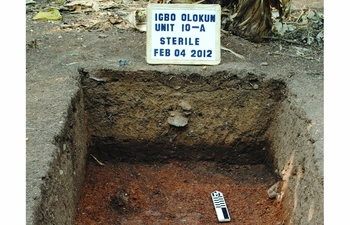
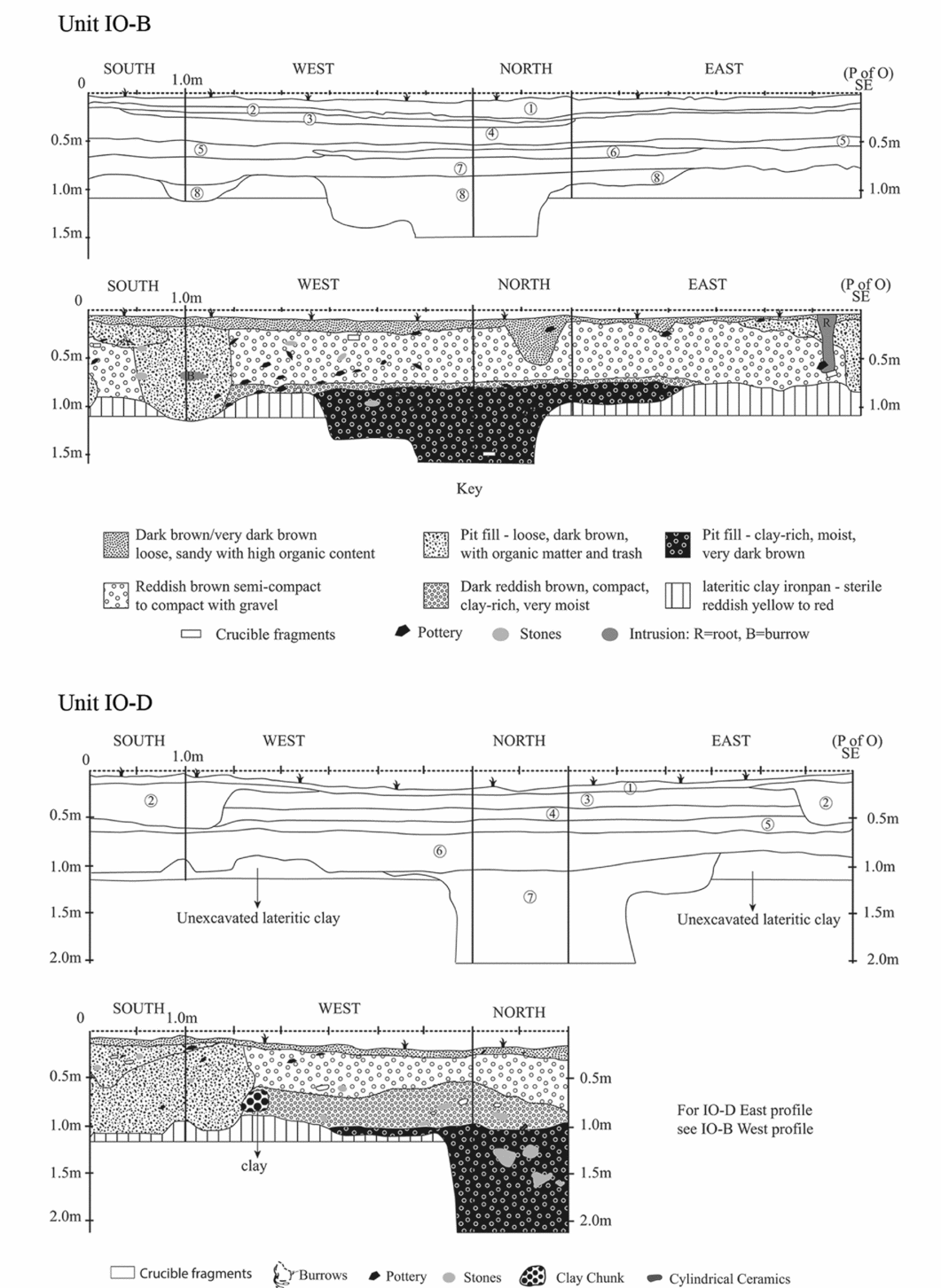
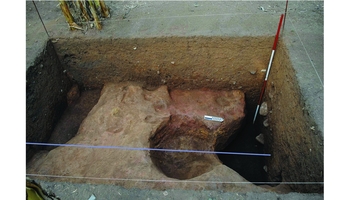
In all of the units, culture-bearing deposits either rested on top of, or in pits dug into, the natural lateritic clays and gravels that derive from the weathering of metamorphic schist and gneiss basement rocks in the region. This sterile, extremely compact, reddish-orange clay was reached at a depth of between 0.5 and 1.2m. In all but unit IO-A, the sterile clay surface was uneven, and penetrated by pits and channels, reflecting various episodes of digging. Above the sterile clay in all units were reddish-brown, loam or heavy loam deposits, generally compact with varying amounts of gravel and evidence for disturbance or secondary deposits. The red clays and gravel in these deposits derive from the incorporation of the natural basement clay, either as building material or as waste from pits dug through it. Directly overlying the sterile clay in most, but not all, areas were moist, clay-rich, very dark brown deposits that also characterised the fill of the pits dug into the sterile clay (Figure 2). The tops of the units comprised a 10–25cm-thick layer of brown soil with lots of organic matter, modern refuse and root penetration by banana plants and other vegetation. Rubbish pits or accumulations were encountered in most of the units, but some were very difficult to detect until they penetrated the sterile clay layer (Figure 3; note in Figure 4 that the pit that cut shallowly into the laterite on the western side of the unit does not show any obvious signs of pit fill in the western profile).
Unit IO-A, showing unusually clear stratigraphy of the orange-brown sterile lateritic clay, with gravel intrusions, and the moist, dark deposits that characteristically fill pits dug into sterile lateritic clays at Igbo Olokun (photograph by A.B. Babalola).

Natural stratigraphy and excavated levels of unit IO-B (top) and adjoining unit IO-D (below).

Three pits with dark fill were encountered in adjoining units IO-B and D (Figure 4); the northernmost one was excavated to a depth of 2.2m without reaching the bottom. It was a bell-shaped pit and appeared to have a passage leading into the north-west wall of the unit. As with all levels and pits in all of the units, it contained crucible fragments, beads, pottery and glass debris, but not in any notable concentrations or associated with any elements that would provide a clue as to the original function of the pit. A recent radiocarbon date from a depth of 1.4m in the pit indicates that it had been emptied and refilled sometime in the eighteenth or nineteenth century.
Pits 1 (central), 2 (north) and 3 (south) in unit IO-B (east half) and its western expansion, IO-D. The blue line indicates the original boundary between them (photograph by A.B. Babalola).

The lack of any spatial focus or notable artefact concentrations combined with the high level of comminution of both potsherds and crucible fragments throughout these units suggest that deposits had experienced a substantial amount of churning. It is not possible to claim that any of the glass and production materials were in primary contexts, and no ash deposits or intact furnace linings were found in the excavated units. The abundance of glass-production debris and the presence of vitrified clay fragments indicate, however, that these areas were in, or very near, a zone of glass workshops. This is especially the case for units IO-B, C and D.
Glass and glass-production debris
Glass beads
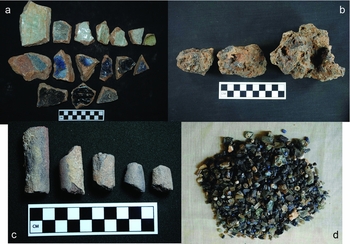
The glass bead assemblages from units IO-B, C and D were studied in full (Figure 5). They were extremely homogeneous throughout. Seventy per cent of the 10 574 beads are short, drawn cylinders or oblates (following Wood's (Reference Wood2011) descriptive categories); the remainder are tubes, most with cut ends that were not smoothed by heating. Ninety per cent of the beads have diameters of less than 5mm. The bead colours include various shades of blue or blue-green (75%), clear glass or clear coated, reddish-brown (10%), green (5%) and yellow or multicoloured (2–3%) glass. Dichroic blue beads, so prominent in the samples Davison (Reference Davison1972; see also Davison et al. Reference Davison, Giauque and Clark1971) analysed, constituted only 2.2% of the assemblage. Corrosion was noted on only 10% of the beads.
Finds from Igbo Olokun excavations: a) crucible fragments; b) vitrified clay; c) ceramic cylinders; and d) glass bead production debris (photographs by A.B. Babalola).

Crucibles
Most of the 812 crucible fragments recovered are relatively small, with almost a third measuring less than 40mm across. Only a handful of rim and base fragments were identified, but these confirmed that the crucibles were of similar shape—ovoid, with a restricted simple rim (with a mouth diameter of 80–120mm) and flat base—to the eight complete crucibles from Ile-Ife illustrated by Willett (Reference Willett2004). Those crucibles ranged in height from 170–330mm. Fabric colour varies from grey to white or off-white, and the composition indicates fabrication from kaolin-rich, high-alumina clays. About two-thirds of the fragments have a 1–10mm-thick layer of melted glass on their interior surfaces; in over 90% of these, the glass colour is blue, green or blue-green. These were vessels in which glass was melted in preparation for drawing into tubes.
Glass waste
Three kilograms of glass waste were recovered from the four units. The presence of collapsed tubes, tube ends and droplets suggests that molten glass was drawn on site. Cut tube ends and mis-cut bead discs indicate the process of cutting glass canes into beads (Francis Reference Francis1991). Overheated and fused beads were found alongside finished, well-rounded examples, the result of reheating to smooth cut ends. It is, however, puzzling that so much waste glass and cullet was discarded, rather than recycled into subsequent batches.
Vitrified production debris
Chunks of shiny, vitrified, vesicular material were common in the four excavation units. The main constituent is heavily vitrified clay with quartz grain inclusions. This might be the material identified as iron slag in Eluyemi's (Reference Eluyemi1987: 197, 200) excavations at Igbo Olokun.
Ceramic cylinders
These rods, which are invariably broken, taper at one end, and frequently show signs of vitrification, resembling an off-white or grey encrustation on the exterior surface. Willett (Reference Willett2004) suggests that these were used to manipulate crucible lids by slotting them into holes on the lid surface. We recovered one lid fragment with two holes of corresponding size from the excavations.
Compositional analysis
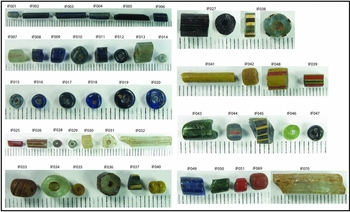
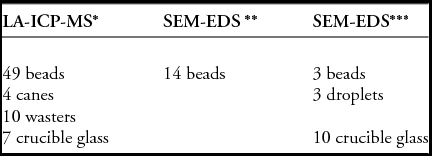
The aim of our analysis was to characterise the glass beads and production materials, and identify the probable source areas of the raw glass in the samples. Samples were selected to represent material from all excavation units, levels, bead shapes and colour categories (Figure 6). Table 1 lists the samples submitted for analysis.
A selection of the Igbo Olokun bead samples analysed by Laser Ablation Inductively Coupled Plasma Mass Spectrometry (LA-ICP-MS) (photographs by A.B. Babalola).

Types of glass analysis performed and sample materials used.

*Laure Dussubieux, Field Museum, Chicago.
**J. Meen, University of Houston.
***Thilo Rehren, UCL-Qatar.
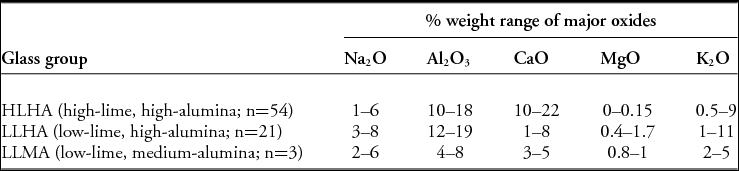
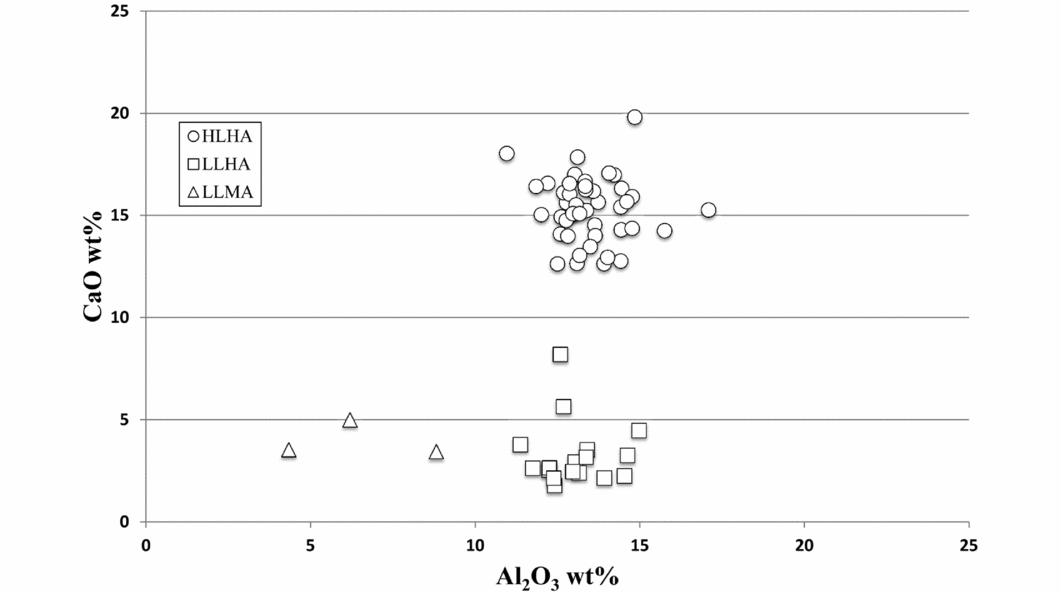
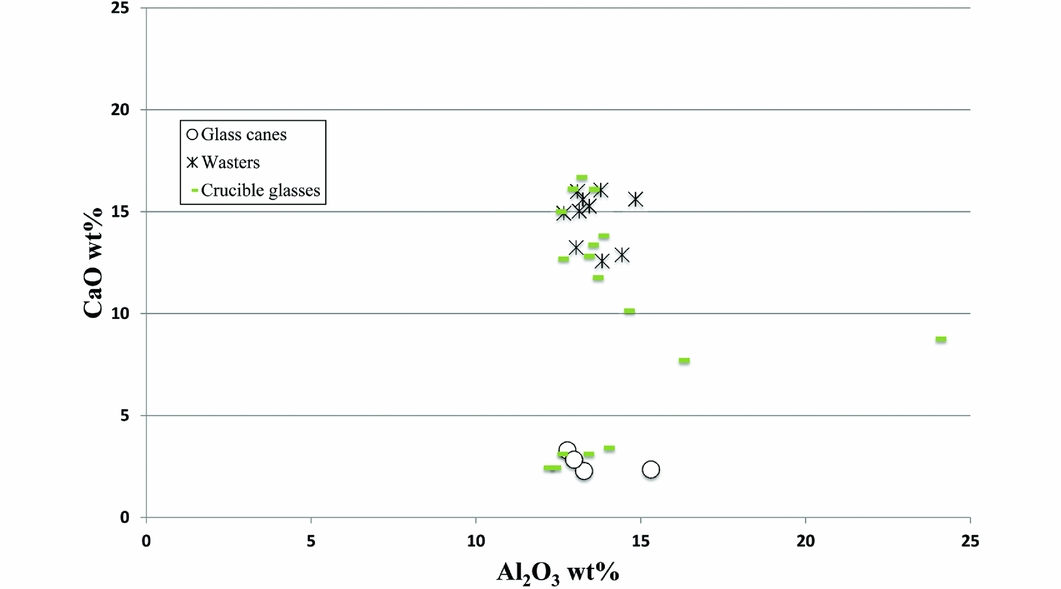
The full results of the analysis (presented in Babalola Reference Babalola2015; Dussubieux Reference Dussubieux2015) will be published in detail elsewhere (Babalola et al. forthcoming a&b). It may be said in summary, however, that none of our samples contained soda-lime glass. All of the crucible glass and wasters, and all but three of the beads, are low-soda, low-magnesia glasses with alumina levels that exceed 10% (Table 2). The two dominant subgroups are HLHA, predominantly blue, blue-green and dichroic beads, and a lower lime (1–8% wt) subgroup (LLHA—low-lime, high-alumina) of mainly red, yellow, black and white glass (Figures 7 & 8). As Lankton et al. (Reference Lankton, Ige and Rehren2006: 111) pointed out with regard to HLHA glass, there is no known source in Europe, the Middle East or Asia for glass of this composition, suggesting that it was produced locally. Three outlier beads have a composition (LLMA—low-lime, medium-alumina) that does not match any currently known source area for raw glass.
Ranges of major oxides by % weight in the three groups of low-soda, low-magnesia Igbo Olokun glass.

The ratio of alumina to lime content (% weight) of Igbo Olokun glass beads.

The ratio of alumina to lime content (% weight) of glass-production debris (including glass canes, wasters and crucible glass) from Igbo Olokun.

It appears that glass beads of various colours (although predominantly blue) were being produced almost exclusively from low-soda, high-alumina glass in workshops near the excavation units in Igbo Olokun. Lankton et al. (Reference Lankton, Ige and Rehren2006) and Ogundiran and Ige (Reference Ogundiran and Ige2015) note that the geology of the Ile-Ife area provides high-alumina sand deposits that could have been exploited by Ife glassmakers. The cobalt colourant for the blue glass may also come from local sources (Lankton et al. Reference Lankton, Ige and Rehren2006; Ogundiran & Ige Reference Ogundiran and Ige2015). Recently, a pegmatite-filled silo that may have been used in glass-making in the seventeenth to eighteenth centuries was excavated at Osogbo, 45km north of Ife (Ogundiran Reference Ogundiran2014; Ogundiran & Ige Reference Ogundiran and Ige2015). Pegmatite provides the balanced total amounts of soda and potassium—which together act as fluxing agents—and the high alumina levels that characterise the glass at both Osogbo and Igbo Olokun. Snail shell, also found in the Osogbo deposits, has been proposed as the most probable source of lime (Ogundiran & Ige Reference Ogundiran and Ige2015). The Osogbo research provides evidence in support of Freestone's (Reference Freestone2006) hypothesis that Yoruba glassmakers were adding nearly pure calcium carbonate to immature granitic sand to make raw glass, without the need for other fluxing materials, such as plant or wood ash or mineral soda, that were commonly added elsewhere in the Old World.
Origins of Ife glass
The origin and antiquity of this unique glass-making recipe are key questions for the history of glass. Primary glass-making is usually a transferred technology. It spread widely in the Mediterranean and Western Asia after its initial invention in the first half of the second millennium BC, but in the mid first millennium BC, Chinese craftsmen independently developed a radically different glass recipe (barium-lead-silica) in response to soda-lime beads that they imported from the West (Freestone Reference Freestone2006: 140). Did African craftsmen do the same, by inventing an indigenous glass recipe through efforts to imitate imported glass?
Imported soda-lime glass beads appear to have reached West Africa in small quantities before the mid first millennium AD, and then became much more common from the sixth to ninth centuries (McIntosh Reference McIntosh1995; Nixon Reference Nixon2008, Reference Nixon2009; Robertshaw et al. Reference Robertshaw, Magnavita, Wood, Melchiorre, Popelka-Filcoff, Glascock, Magnavita, Kote, Breunig and Ide2009b; Cissé et al. Reference Cissé, McIntosh, Dussubieux, Fenn, Gallagher and Smith2013). Nearly all of the examples analysed so far that have come from West African sites of this early period are drawn beads of glass fluxed with soda derived from plant ash—a raw glass composition characteristic of sites located east of the Euphrates at this time. A few beads made of soda-lime glass fluxed with natron have also been identified (Cissé et al. Reference Cissé, McIntosh, Dussubieux, Fenn, Gallagher and Smith2013). This glass was produced at Syro-Palestinian workshops for almost two millennia until the recipe switched to plant ash beginning around the eighth century AD. Between the seventh and tenth centuries, large numbers of soda-lime beads reached the site of Gao on the Niger Bend (Cissé et al. Reference Cissé, McIntosh, Dussubieux, Fenn, Gallagher and Smith2013). Farther south, at Kissi, soda-lime glass beads, woollen textiles and imported brass were found in graves dated to the sixth to seventh centuries AD (Magnavita Reference Magnavita, Magnavita, Kote, Breunig and Ide2009).
This period of increased interaction and movement of goods, people and technologies offers a context for envisioning the origins of Ile-Ife glass and bead making. Beyond handling exotic glass beads, Ife merchants may have seen or heard accounts of workshops and techniques on their travels. Craftsmen may have spent time in distant workshops before returning home. Any of these scenarios may have sparked local innovation in raw glass production, bead technology or both. Drawn bead technology for mass production was highly developed, if not invented, in India, as early as the fourth century BC. It was transferred not long after, probably through Indian glassworkers, to Southeast Asia (Lankton et al. Reference Lankton, Dussubieux and Gratuze2008). By the mid first millennium AD, drawn glass beads made from raw glass with a variety of compositions had spread widely along trade networks from Korea and Japan to East and West Africa (Francis Reference Francis2002). Although the database is currently small, evidence for the production of drawn beads using locally produced glass in the Nigerian forest adds a fascinating chapter to this history. In order to write this chapter, we need well-dated sequences of beads and associated material culture at Ile-Ife and other Nigerian sites. While these are largely lacking at present, a key datum is the chronology of glass production at Igbo Olokun.
Dating bead production at Igbo Olokun
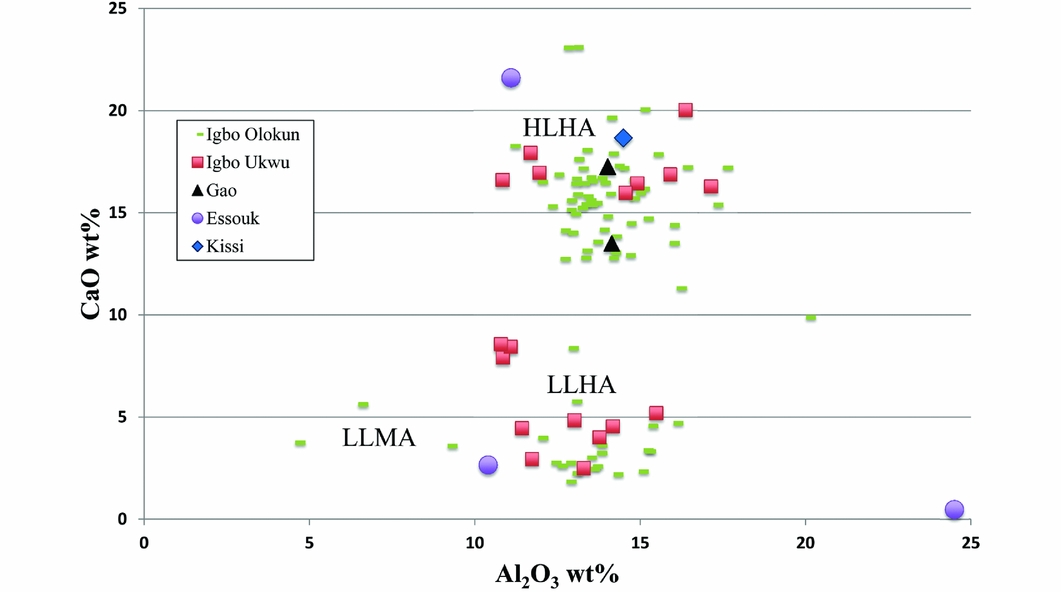
The Igbo Olokun excavations provide the first dates relating to the production of drawn HLHA and LLHA glass beads at the site. Despite traces of modern refuse disposal and considerably disturbed deposits, the pottery assemblage from all four excavated units is dominated by the vessel forms and the carved wooden and rolled twine roulette decoration that Garlake (Reference Garlake1974, Reference Frobenius1977) identified as characteristic of Ife pottery from the eleventh to fifteenth centuries AD at Woye Asiri and Obalara's Land (Figures 9 & 10). Charcoal from the fill at the top of the deep pit (0.70m depth) in unit IO-B produced an AMS date of 840±30 BP (Beta 319447: 1058–1264 cal AD at 95.4% probability—all dates calibrated in OxCal v4.2 using the IntCal13 curve; Bronk Ramsey Reference Bronk Ramsey2009; Reimer et al. Reference Reimer, Bard, Bayliss, Beck, Blackwell, Bronk Ramsey, Buck, Cheng, Edwards, Friedrich, Grootes, Guilderson, Haflidason, Hajdas, Hatté, Heaton, Hoffmann, Hogg, Hughen, Kaiser, Kromer, Manning, Niu, Reimer, Richards, Scott, Southon, Staff, Turney and van der Plicht2013). We believe that the charcoal is part of production debris, which may have originally been deposited in the deep pit but was dug out and redeposited in the eighteenth to nineteenth centuries, as indicated by an AMS date of 70±30 BP (Beta 319449: 1691–1924 cal AD at 95.4% probability) from a depth of 1.43m in the same pit fill. Basal deposits in unit IO-C were dated by AMS on charcoal to 570±30 BP (Beta 319448: 1304–1423 cal AD at 95.4% probability). These dates are consistent with five radiocarbon dates that fall in the eleventh to fifteenth centuries at Ayelabowo. Over 300 crucible fragments and several dozen glass beads were recovered from excavations at this site, but no details have been published on the provenience or context of the dated charcoal or its association with the various finds (Adeduntan Reference Adeduntan1985). HLHA beads have been identified at other West African sites, including Essouk, Gao Ancien, Kissi, Kumbi Saleh, Igbo Ukwu and Diouboye (Figure 11). None is from a context securely dated to before the tenth–eleventh century AD (Davison Reference Davison1972: 265; Lankton et al. Reference Lankton, Ige and Rehren2006: 126–27; Lankton Reference Lankton2008; Robertshaw et al. Reference Robertshaw, Magnavita, Wood, Melchiorre, Popelka-Filcoff, Glascock, Magnavita, Kote, Breunig and Ide2009b; Brill & Stapleton Reference Brill and Stapleton2012; Wood Reference Wood2016).
Common vessel and rim forms identified by Garlake from eleventh- to fifteenth-century deposits in Ife and their presence/absence as recorded at Igbo Olokun, Igbo Rudi (post fifteenth-century) and Osogbo, a seventeenth–eighteenth-century site. (Vessel forms were reproduced with permission from Garlake Reference Frobenius1977: fig. 13.)

Common decorative motifs at Ife sites and Osogbo.* Ladder carved roulette (illustrated) is more common than chevron and other carved motifs at Ife and Woye Asiri. It is absent at Igbo Rudi.

Comparison of alumina and lime content of West African glass beads with the following levels of other major oxides, normalised by weight: Na2O <9%, MgO <1.7%, K2O <10% (data for beads from other sites provided by P. Robertshaw).

Luminescence dating (OSL/IRSL/TL) on five crucible fragments from the Igbo Olokun units returned unexpectedly ancient dates, ranging from the early second to the mid first millennium BC (Babalola Reference Babalola2015: appendix E). There is currently no evidence for glass south of the Sahara or for drawn glass bead technology at such an early date. The fact that two crucible fragments from the same level (6) of adjoining units (IO-B and D) produced dates that differ by over a millennium indicates the need to discern what factors might be contributing to such anomalous results. Some of the possible factors affecting the luminescence dating of these samples are discussed in the online supplementary material.
Conclusions
The excavations at Igbo Olokun, and the analysis of the glass beads, production debris and crucible fragments presented here, offer the first detailed view of glass and bead technologies at this site. Dating evidence based upon pottery form and decoration and radiocarbon dating of charcoal supports an eleventh- to fifteenth-century chronology for the large-scale production of beads cut from fine, drawn canes. All stages of glass bead making, from the drawing of melted glass to cutting the canes and reheating the cut beads, are represented in the production debris. The glass is distinguished from Old World soda-lime and potash glasses by the contrasting levels of soda and potassium (under 9% wt each), and very high levels of alumina. Of the two main varieties present, HLHA glass was used almost exclusively for blue and blue-green beads (some dichroic) and for a distinctive bead with reddish-brown glass over a colourless core. Beads made from LLHA glass are other colours. Ige (Reference Ige2010) proposes that lime levels were controlled by the amount of ritually potent snail shell added, with blue HLHA beads created for ritual use by priests.
The masses of small beads depicted on oni figures were, presumably, predominantly blue glass. These beads were traded widely in the early second millennium, if not slightly earlier. They are present in the Upper Senegal region near the Bambuk goldfields, at Saharan entrepôts and along the Niger River, extending well into the forest. While the eleventh to fifteenth centuries may have been the floruit of the drawn glass bead industry at Igbo Olokun, the history of glass in Ile-Ife is much more extensive, and includes compositions that remain poorly documented and understood. Key evidence for better understanding the lengthy history of glass use and manufacture in the Nigerian forest probably lies within the vast former expanse of this important site.
Acknowledgements
Funding for fieldwork, glass bead analysis and illustration was provided by Rice University through a Social Science Research Institute Dissertation Grant to Abidemi Babalola, and by supplemental funds from Jeffrey Fleisher and Susan McIntosh. Analysis of glass bead debris was facilitated by a pre-doctoral fellowship to Babalola in the UCL Qatar laboratories, supported by the Qatar Foundation, which also funded TL/OSL dating of several crucible fragments. Babalola extends his gratitude for this support and for the support of numerous individuals at Ile-Ife, especially Adisa Ogunfolakan. Thanks are also extended to Jeffrey Fleisher, James Lankton, Peter Robertshaw, Marilee Wood and two anonymous reviewers for their helpful comments on drafts of this article. David Killick provided useful insights on the TL dates.
Supplementary material
To view supplementary material for this article, please visit https://doi.org/10.15184/aqy.2017.80