1 Introduction
1.1 Understanding lenition
This paper has two objectives. First, we provide results on a pattern of Spanish /s/ realization for which experimental data are currently unavailable. Specifically, we document a case of consonantal allophony in /sp st sk/ clusters in south-central Peninsular Spanish (henceforth, SCPS), which may be described as the variable use of alveolar fricatives, velar fricatives, glottal fricatives, and segmental deletions in coda position. Second, we consider to what extent this diversity of /s/ realizations constitutes a lenition process in Spanish.
In broadest terms, the concept of lenition encompasses phonological change that is potentially indicative of consonantal weakening. Processes described as ‘lenition’ generally involve a decrease in the degree of constriction of a consonantal segment, a change in or loss of place of articulation, and/or the addition of voicing (Recasens Reference Recasens2002), though not all segmental alterations along these lines are inherently indicative of weakening (Lavoie Reference Lavoie2001: 6; Recasens Reference Recasens2002). Although there is not complete consensus on which specific changes constitute a lenition process (e.g. Lavoie Reference Lavoie2001, Bauer Reference Bauer2008), it may be understood as a decrease in effort or an increase in the sonority of a segment, with lenited segments presumed to be moving towards an end point of total deletion. These changes may manifest as categorical phonological alternations (e.g. consonantal assimilations) and/or as gradient phonetic weakening; in most cases changes occur intervocalically and in weak contexts, such as in coda position or in unstressed syllables (Lavoie Reference Lavoie2001). In the case of consonantal assimilation, the assimilated segment's loss of place features may justify categorizing the process as lenition (see Szigetvári Reference Szigetvári, de Carvalho and Scheer2008). The debate over what constitutes a lenition process has generated theoretical interest as well, with multiple views proposed to motivate and explain the observation of segmental weakening within a speech community (Kirchner Reference Kirchner1998, Reference Kirchner, Hayes, Kirchner and Steriade2004; Kingston Reference Kingston, Colantoni and Steele2008). For example, researchers working in the Articulatory Phonology model (Browman & Goldstein Reference Browman and Goldstein1989, Reference Browman, Goldstein, Mattingly and Studdert-Kennedy1991, Reference Browman, Goldstein, Port and van Gelder1995) understand the phonological grammar as operating on a system of abstract articulatory gestures, which are dynamically defined along spatial and temporal dimensions to produce a constriction in the vocal tract. Lenition from this perspective would then result from the reduced magnitude of such a gesture or the increased overlap of consecutive gestures (e.g. Browman & Goldstein Reference Browman and Goldstein1992, Parrell Reference Parrell2011). In this paper we consider the application of these general principles of lenition to Spanish coda /s/ as it relates to the variety spoken in south-central Spain. Specifically, our own casual observation shows that in cities like Madrid and Toledo, speakers often produce /s/ as [x] in /sk/ clusters and [h] (or deletion) in /sp/ clusters, whereas /s/ reduction seems uncommon in /st/ clusters. Interested in uncovering the exact acoustic correlates of these /s/ variants and learning if social and linguistic factors govern their distribution, we conducted an instrumental analysis of these three clusters for a sample of speakers from Toledo, Spain, asking to what extent the attested allophony constitutes a case of lenition. In Section 1.2 we proceed with a more thorough description of coda /s/ as it relates to Peninsular Spanish generally and to the south-central sub-variety specifically.
1.2 Spanish coda /s/
Coda /s/ is perhaps the dominant sociolinguistic variable in Spanish phonology. Many accounts of /s/ variation in Spanish approach weakening of this phoneme in categorical terms, acknowledging three possible phonetic realizations: voiceless alveolar fricative [s], voiceless glottal fricative [h], and deletion Ø (e.g. Cedergren Reference Cedergren1973; Terrell Reference Terrell and Sankoff1981; Lipski Reference Lipski1984, Reference Lipski1994; Carvalho Reference Carvalho2006). Thus, for a word such as pasta ‘pasta’ the three realizations would be [p a st a], [p a h t a], or [p a t a]. This classification of /s/ has led many researchers to generalize two types of Spanish varieties: retention varieties and weakening varieties (Carvalho Reference Carvalho2006: 90). In retention varieties (conservative varieties in Carvalho's terms), speakers produce the alveolar fricative in most contexts of coda /s/, whereas in weakening varieties (advanced varieties in Carvalho's terms) speakers favor the glottal fricative or deletion, although alveolar fricatives are not uncommon in formal registers (e.g. Alba Reference Alba2003). In Spain, northern and central varieties are typically considered retention varieties, whereas southern varieties spoken in Andalusia, Extremadura, Murcia, and parts of Castile-La Mancha are considered weakening varieties (Lipski Reference Lipski, Hualde, Olarrea and O'Rourke2012: 5). There is also evidence for /s/ lenition in certain northern areas and in central areas such as Madrid (Calero Fernández Reference Calero Fernández1993, Momcilovic Reference Momcilovic2009).
Although [s], [h] and Ø are the most frequently attested realizations of coda /s/, they are far from the only variants observed. For example, in the varieties of Spanish spoken in northern and central Spain the phonemes /s/ and /θ/ are often realized as a tap before apical consonants (neutralizing with the phonemic rhotic tap), as in /l o s l u n e s/ [l oɾl u n e s] ‘Mondays’ (Moreno Fernández Reference Moreno Fernández and Alvar1996: 218). Additionally, /s/ may assimilate in place and/or manner to a following voiced stop. This may lead to the production of geminates, as in /a sk o/ [a k k o] ‘disgust’, or of voiceless fricatives in some areas of southern Spain, e.g. /l a s b a k a s/ [l aɸa k a h] ‘the cows’ (see Penny Reference Penny2001: 122–125 for a complete review). The deletion of /s/ has also provoked quality differences in the previous vowel in Eastern Andalusian and Murcian Spanish, for which historical /a s e s o s/ have become /æ ɛ ɔ/ (see, for example, Hernández-Campoy & Trudgill Reference Hernández-Campoy and Trudgill2002). Based on data covered in the Atlas Lingüístico de la Península Ibérica, Catalán (Reference Catalán1989) proposed five levels of coda /s/ lenition in Spain based on geographic and linguistic correlates. In the most extreme cases, speakers may delete /s/ completely, as in areas of Andalusia, Extremadura, and Murcia. In areas located within the Castile-La Mancha autonomous community, /s/ lenition is more variable across speakers and linguistic contexts (García Mouton & Moreno Fernández Reference García Mouton and Fernández2003), and the approximate northern limit of this phenomenon appears to run through rural areas of northern Madrid (Fernández Sevilla Reference Fernández Sevilla1980, Catalán Reference Catalán1989).
Within Spain, the situation in Andalusian Spanish has received the most attention in the /s/ lenition literature (e.g. Moya Corral Reference Moya Corral1979, Carbonero Cano Reference Carbonero Cano1982, Villena-Ponsoda Reference Villena-Ponsoda2008). Recent instrumental analyses have focused on the acoustic properties of /s/ + voiceless stop sequences (i.e. /sp st sk/ clusters) in Western Andalusian Spanish in particular. In this sub-variety, speakers produce /sp st sk/ clusters with longer voice onset time (VOT) than in intervocalic stops, especially when the fricative is deleted prior to the stop closure (Torreira Reference Torreira, Sagarra and Toribio2006, Reference Torreira, Prieto, Mascaró and Solé2007, Reference Torreira2012; Parrell Reference Parrell2012; Ruch & Harrington Reference Ruch and Harrington2014). That is, although a word like /p a st a/ can be variably pronounced as [p a st a] or [p a h t a], [p a t h a] with post-aspiration is most common. Using Articulatory Phonology (Browman & Goldstein Reference Browman and Goldstein1989, Reference Browman, Goldstein, Mattingly and Studdert-Kennedy1991, Reference Browman, Goldstein, Port and van Gelder1995), Torreira (Reference Torreira2012) and Parrell (Reference Parrell2012) present evidence that post-aspiration occurs when the relationship between the glottal spreading of phonological /s/ and the oral closure of the voiceless stop shifts from anti-phase (sequential) to in-phase (simultaneous) (but see Ruch & Harrington Reference Ruch and Harrington2014).
In the present study we extend the experimental scope of /sp st sk/ clusters to the area of south-central Spain, which borders Castile and León to the north, Andalusia to the south, Extremadura to the west, and Valencia to the east. The variety of Spanish spoken in this region is generally considered Castilian or Peninsular Spanish. Descriptions of /s/ realization in south-central Spain are not scarce, but the published research that we are aware of has certain limitations such as not basing its findings on acoustic data (e.g. Alvar Reference Alvar1996: 215–223; García Mouton & Moreno Fernández Reference García Mouton and Fernández2003; Momcilovic Reference Momcilovic2009). Momcilovic (Reference Momcilovic2009: 37) reported 12.9% use of ‘assimilated’ variants in /sC/ clusters in conversational Madrid Spanish but did not provide quantitative data on which onset consonants are more likely to induce such assimilated productions. Sánchez-Muñoz (Reference Sánchez-Muñoz, Chand, Kelleher, Rodríguez and Schmeiser2004) was more precise on this point: this author documented four coda /s/ variants in SCPS (i.e. [s], [x], [h], and Ø) and showed that velar fricatives occur in 24.2% of /sk/ clusters. Two native speakers of Spanish transcribed the data, but Sánchez-Muñoz (Reference Sánchez-Muñoz, Chand, Kelleher, Rodríguez and Schmeiser2004) did not provide information on the methodology used to classify /s/ variants. A further limitation is that the researcher used a reading task to elicit data from a sample of six speakers, and it is well-known that speakers typically resort to prescriptive norms in such speaking situations (File-Muriel Reference File-Muriel2010). At this stage, going beyond an impressionistic description of scripted data seems important to gain a more complete view of the facts for SCPS coda /s/. In Section 1.3 we continue with a more detailed review of methodological approaches to analyzing coda /s/ in Spanish.
1.3 Methodological considerations in the study of Spanish coda /s/
Although it was not always made explicit, until recently most researchers relied primarily on auditory analysis of speaker data to categorize production as [s], [h], or Ø. In spite of the large database of findings based on this methodology, such impressionistic analysis protocols are not without their problems (Poplack Reference Poplack1979). This is because impressionistic coding is often highly subjective, with different researchers classifying tokens with similar phonetic properties as different /s/ variants (File-Muriel & Brown Reference File-Muriel and Brown2010: 47). Recognizing the limitations of auditory analysis, File-Muriel & Brown (Reference File-Muriel and Brown2011) reject symbolic representations of /s/ pronunciation (i.e. based on tripartite classification of [s] vs. [h] vs. Ø) and analyze its realization in gradient terms. In doing so, they remove subjective coding of /s/ production and rely exclusively on acoustic data to understand /s/ lenition. Specifically, File-Muriel & Brown extracted data on center of gravity, duration, and percent voicing for each /s/ token and submitted these measures as dependent variables in their statistical analysis. They based their analysis on the assumption that lenited tokens of phonological /s/ have shorter durations, lower center of gravity, and greater voicing, whereas retained tokens have longer durations, higher center of gravity, and less voicing.
On the other hand, Erker (Reference Erker2012) emphasized the benefits of an ‘integrated’ approach to Spanish /s/ that combines categorical and continuous data. In his analysis of /s/ in the Spanish of New York, Erker showed that discrete coding of /s/ realization (i.e. ‘retention’ or ‘lenition’) and instrumental analysis based on continuous measures (i.e. fricative duration and center of gravity) produced complementary information on the nature of /s/ variation. Specifically, Erker's discrete analysis generated important data on regional leveling in New York Spanish, whereas his gradient (phonetic) analysis generated unique insight into intergenerational patterns of /s/ production for Hispanic New Yorkers. Since, to our knowledge, this is the first quantitative acoustic analysis of coda /s/ in SCPS, we opted for an integrated approach to our data analysis: we coded /s/ variants discretely and also gathered continuous acoustic measurements. By this method, we hoped to generate an ample set of results with the goal of completely describing coda /s/ in a relatively undescribed language variety.
Given this background, we proposed the following research questions:
-
1. What is the frequency of use of alveolar, velar, and glottal fricatives/deletions in SCPS /sp st sk/ clusters (when viewed in discrete terms)?
-
2. What combination of social and linguistic factors influence /s/ realization in /sp st sk/ clusters?
-
3. What are the acoustic correlates of /s/ variants in /sp st sk/ clusters?
2 Method
2.1 Participants and recordings
Twelve male and twelve female speakers of SCPS were recruited for participation in this study. Their ages ranged from 19 to 25 years, mean age 21.9 years. All speakers were students at the Universidad de Castilla-La Mancha in Toledo, Spain and lived in Toledo or in a town no farther than 30 km from Toledo. All subjects were born and raised in their hometown and reported that their mother and father were native residents of the greater Toledo area. The city of Toledo is located in central Spain, with a population of approximately 85,000 inhabitants. Although it is relatively close to the country capital Madrid (it is 70 km south of this metropolis), residents of Toledo indicate that they self-identify as ‘Manchegos’ and even acknowledge that one frequently stereotyped characteristic of their speech is fricative velarization in /sk/ clusters. Although previous sociophonetic research employs the gentilicium ‘Manchego’ to refer to this variety (e.g. Henriksen Reference Henriksen2012, Reference Henriksen2013, Reference Henriksen2014a, b), we knew that some of the patterns attested in our corpus are also prevalent in Madrid Spanish (e.g. Momcilovic Reference Momcilovic2009). We therefore chose the more general term ‘south-central Peninsular Spanish’ for our study.
All participants were recorded in a quiet classroom of the Universidad de Castilla-La Mancha campus in Toledo, Spain. Speakers were asked to narrate the children's picture book Frog, Where Are You? (Mayer Reference Mayer1969) in a natural way as if they were speaking to a friend. Each narration lasted approximately four to five minutes. The data were recorded with a Marantz Pmd620 digital recorder and a Shure WH20 head-mounted microphone; sound files were digitally transferred in .wav format onto a laptop computer and were analyzed with the acoustic analysis software Praat (Boersma & Weenink Reference Boersma and Weenink2015). Auditory inspection of all 24 recordings revealed phonetic and phonological properties that are characteristic of northern and central varieties of Peninsular Spanish: contrast between /s/ and /θ/, a strong post-velar pronunciation of the /x/ phoneme, and merger of the palatal /ʝ/ and /λ/ phonemes (Hualde Reference Hualde2005: 20–21). A total of 805 tokens of /s/ + voiceless stop clusters were produced across the full speaker sample (mean = 33.5 tokens/speaker). There were 126 /sp/ clusters, 355 /st/ clusters, and 324 /sk/ clusters.
2.2 Data analysis
We carried out our instrumental analysis in two phases. First, we conducted a discrete analysis based on the frequency of occurrence of four /s/ variants ([s], [h], [x], Ø) in order to learn about patterns of variant use in /sp st sk/ clusters. Second, we conducted a phonetic analysis in which we extracted data on three acoustic properties typically associated with /s/ lenition in Spanish in order to learn about patterns of variant realization of coda /s/.
2.2.1 Discrete analysis
In the discrete analysis we coded /s/ based on auditory and visual inspection of each sound file, paying close attention to the ‘fricative’ segment to determine its place of articulation. To do this, both authors reviewed all sound files together and provided one of three labels for each coda /s/: alveolar fricative, velar fricative, or glottal fricative/deletion. We collapsed the [h] and Ø variants into a single category, based on the perceptual findings of Díaz-Campos & File-Muriel (Reference Díaz-Campos and File-Muriel2004). Knowing that the acoustic differences between [x] and [h] can be subtle, we established certain guidelines to aid our judgments for this portion of the instrumental analysis. In addition to using auditory impressions to distinguish between these two categories, we looked for concentrated bands of high intensity frication in the spectrogram for [x], corresponding to spectral peaks (generally around 1,000 and 4,000 Hz), which contrasted with the diffuse frication observed for [h]. Velar fricatives were longer in duration and also presented less clear formant structures than glottal fricatives, which often appeared as a more direct continuation of the preceding vowel. In order to assess consistency in the analysis, an interrater reliability test was performed with a third linguist who has considerable experience in spectrographic analysis. We conducted the reliability test for a random selection of 100 /s/ tokens (approximately one-eighth of the full corpus). The reliability for the raters was found to be Kappa = 0.87 (p ≤ .001), 95% confidence interval (CI) (0.83, 0.91); this is considered almost perfect agreement.
At this juncture we should acknowledge File-Muriel & Brown's (Reference File-Muriel and Brown2011) argument in favor of using gradient acoustic measurements instead of the categorical [s], [h], Ø system for coding Spanish /s/. Although the former approach might have been ideal, when we began this study we knew to expect four variants ([s], [h], [x], Ø) from our speakers and did not know whether the velar fricative would pattern neatly according to the continuum proposed by File-Muriel & Brown. For example, initial inspection of pilot data led us to believe that velar realizations of /s/ in /sk/ clusters were especially long in duration, similar in this respect to alveolar fricatives and distinct from the temporally truncated glottal fricatives. We also knew that center of gravity was a useful metric for classifying consonants according to place of articulation, yielding lower values in guttural consonants like our velar and glottal fricatives (Shadle Reference Shadle1985, Gordon, Barthmaier & Sands Reference Gordon, Barthmaier and Sands2002), and as such may not be as effective in gauging the extent to which velar fricatives constitute lenition variants. In effect, we did not have clear judgments about the extent to which velar fricative realizations constitute instances of lenition and therefore could not establish a priori whether they would behave like alveolar fricatives or glottal fricatives on all acoustic measures.
Following our discrete coding, we tagged each /s/ token for four independent variables: three linguistic factors (following consonant, stress, and word position) and one social factor (gender).
The following consonant was coded based on the place of articulation of the stop consonant: bilabial, dental, or velar. Brown (Reference Brown, Collentine, García, Lafford and Marcos Marín2009) and File-Muriel (Reference File-Muriel2010) revealed an effect of place of articulation of the following segment on /s/ realization, supporting the prediction by Méndez Dosuna (Reference Méndez Dosuna, Luis and Melena1985) that the order of diffusion of /s/ lenition proceeds from sC[l a b i a l] sequences (where weakening is most likely) to sC[d o r s a l] sequences to sC[c o r o n a l] sequences (where it is least likely). We also coded each token for the stress of the syllable in which /s/ occurred: atonic (e.g. es.tás ‘be-prs;2sg’) or tonic (e.g. és.ta ‘this.one;f’). This coding choice is motivated by several studies that observe preferential /s/ lenition in atonic position (e.g. Poplack Reference Poplack1979, Alba Reference Alba and Alba1982, Brown Reference Brown, Collentine, García, Lafford and Marcos Marín2009, File-Muriel & Brown Reference File-Muriel and Brown2011; but see File-Muriel Reference File-Muriel2010), a result in agreement with a broader finding that consonants in atonic syllables tend to be produced with less articulatory effort and diminished acoustic cues than those in tonic syllables (e.g. Beckman Reference Beckman1999). We also labeled each token based on word position (word-internal or word-final), since lenition variants are typically more prevalent in word-final position (e.g. Brown Reference Brown, Collentine, García, Lafford and Marcos Marín2009, Momcilovic Reference Momcilovic2009). The one social variable that we examined was speaker gender. One clear trend from varieties of Spanish that undergo /s/ lenition is that female speakers favor retention variants, whereas male speakers favor lenition variants (e.g. Fontanella de Weinberg Reference de Weinberg and Beatriz1973, Terrell Reference Terrell and Sankoff1981, Stewart Reference Stewart1999, File-Muriel Reference File-Muriel2010).
2.2.2 Phonetic analysis
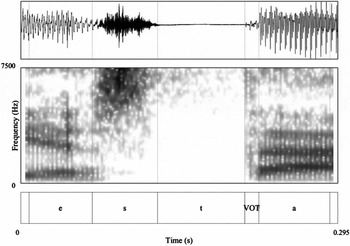
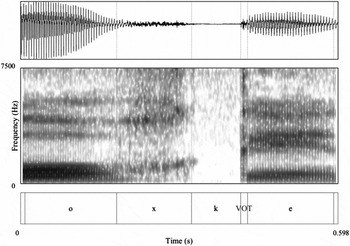
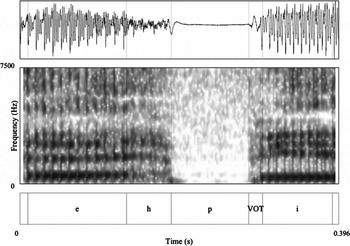
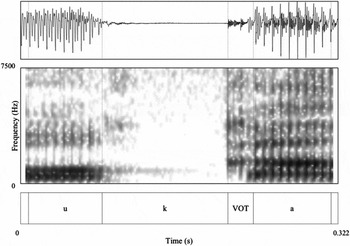
For our phonetic analysis, we extracted three acoustic measurements for each /sp st sk/ cluster. Though additional metrics are employed in the study of Spanish /s/ lenition (e.g. Torreira & Ernestus Reference Torreira and Ernestus2012), we followed Erker (Reference Erker2010) and File-Muriel & Brown (Reference File-Muriel and Brown2010, Reference File-Muriel and Brown2011) in limiting our analysis to the following variables: duration, percent voicing, and center of gravity. These measures should be sufficient to assess the phonetic behavior of [x] variants with respect to the known continuum between ‘retention’ [s] and ‘lenition’ [h]/Ø variants. In order to conduct this analysis, we manually segmented all instances of /s/ + voiceless stop clusters in Praat (Boersma & Weenink Reference Boersma and Weenink2015). For each production, we segmented the fricative (when present), the stop closure, and the VOT. In Figures 1–4 we show examples of an alveolar fricative, a velar fricative, a glottal fricative, and a complete deletion (all of which presumably derive from phonological /s/), respectively.
Waveform and spectrogram for [e s.ꞌt a] está ‘he is’. Coda /s/ produced as alveolar fricative [s].

Waveform and spectrogram for [ꞌo x.k e] of bosque ‘forest’. Coda /s/ produced as velar fricative [x].

Waveform and spectrogram for [e h.ꞌp i] of despide ‘he says good-bye’. Coda /s/ produced as glottal fricative [h].

Waveform and spectrogram for [u.ꞌk a] of buscando ‘looking for’. Complete deletion in coda /s/.

A few comments are necessary regarding the period of sporadic noise in the closure of the velar consonant in Figure 4. We did not classify such periods of sporadic noise as part of a fricative consonant because they were not characterized by the diffuse overall frication typical of [h], and were visually distinctive from what we deemed to be [x] (i.e. what we judged as sporadic noise had less intense frication that was not concentrated in two bands). We recognize that the difference between the residual/sporadic noise of a stop closure and the weak frication of a fricative consonant is difficult to discern solely from the spectrogram, and this was additional motivation for combining glottal fricatives and segmental deletions in the discrete analysis.
Our first acoustic metric was duration. Duration measurements were extracted in milliseconds for the fricative portion (when present), oral closure, and voice onset time (VOT) of each token. The fricative portions of Figures 1–3 are labeled as [s], [x], and [h], respectively. One segmentation issue concerned where to label the onset and offset points of glottal fricatives, as in Figure 3. In such tokens we labeled the point where F2 showed a clear decrease in energy as the beginning. For the ending point, we encountered an issue similar to Torreira (Reference Torreira, Sagarra and Toribio2006, Reference Torreira, Prieto, Mascaró and Solé2007) – there were moments of spurious energy that appeared well into the period of stop closure. We noticed similar moments of spurious energy in the closure of CV.CV words (i.e. in which coda /s/ was not present in the phonological representation), thus we considered this energy as an indicator of perturbations not attributable to glottal frication and labeled the ending point with reference to high frequencies (4000–5000 Hz).
The closure duration of each stop consonant was defined as the time period from the end of frication until the start of the release burst. For those tokens in which speakers did not produce a fricative consonant for coda /s/, we labeled the start of the closure at the point in which there was a decrease in formant intensity corresponding to the previous vowel. The VOT of each token was measured from the start of its release burst to the last downward zero crossing before a full glottal cycle in the waveform (see also Torreira Reference Torreira, Sagarra and Toribio2006: 115; Parrell Reference Parrell2012: 40).
The second acoustic metric was percent voicing, or the percentage of voiced frication, which we extracted from the Praat Voice Report. Following File-Muriel & Brown (Reference File-Muriel and Brown2011), we developed a script that placed each fricative segment within the middle two-thirds of the Praat Editor Window. It was necessary to maintain a consistent fricative duration relative to the Editor Window since the space taken up by a sound within this window can affect the Voice Report. Whereas other researchers opt for a discrete, binary coding of /s/ voicing (e.g. Torreira & Ernestus Reference Torreira and Ernestus2012), we chose a continuous metric here (e.g. File-Muriel & Brown Reference File-Muriel and Brown2011, Hualde & Prieto Reference Hualde and Prieto2014) since complete, uninterrupted voicing was unlikely due to the following voiceless consonant (for a review of acoustic metrics relating to fricative voicing in Spanish, see Gradoville Reference Gradoville and Alvord2011 or Eager Reference Eager2015). We understand higher percent voicing values as a correlate of lenition, since weakening of the alveolar fricative arises when the coarticulatory pressure of the preceding vowel and the glottis must adapt conflicting configurations (Hoole Reference Hoole, Hardcastle and Hewlett1999).
The third acoustic metric was center of gravity (also known as ‘centroid’), which quantifies the spectral distribution and amplitude of turbulent noise by reporting the weighted average of frequency peaks over a specified duration (Forrest et al. Reference Forrest, Weismer, Milenkovic and Dougall1988, Zsiga Reference Zsiga1993, Jongman, Wayland & Wong Reference Jongman, Wayland and Wong2000). To calculate center of gravity, a Praat script automatically divided each fricative into ten sub-intervals so that the middle 60% could be submitted to the centroid calculation. We limited analysis to the middle 60% of the spectrum to mitigate the influence of surrounding segments at the onset and offset of each fricative. Following File-Muriel & Brown (Reference File-Muriel and Brown2011: 228), the center of gravity calculation was limited to frequencies above 750 Hz with a pass Hann band filter to exclude the energy produced through glottal pulsing. It should be made clear that we extracted center of gravity measurements taking into account the known correlation between constriction frontness and center of gravity, namely that /s/ typically has higher centroid values than /ʃ/ and /x/ (Gordon et al. Reference Gordon, Barthmaier and Sands2002). As mentioned in Section 1.3, research on Spanish /s/ typically interprets lower center of gravity values as a correlate of /s/ lenition since glottal fricatives are characterized by lower centroid values than alveolar fricatives (e.g. File-Muriel & Brown Reference File-Muriel and Brown2011).
3 Results
3.1 Discrete analysis
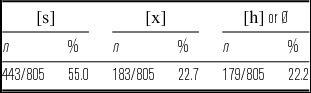
In Table 1 we summarize the distribution of alveolar fricative, velar fricative, and glottal fricative/deletion variants for our corpus of 805 coda /s/ tokens. Overall, alveolar fricatives were the most common, produced in more than half of the sample. Velar fricatives and glottal fricatives/deletions comprised the remainder of the corpus, each produced at similar rates.
Occurrences of /s/ variants across all speakers.

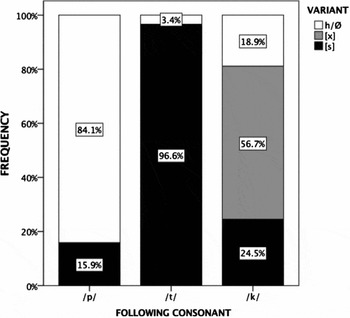
Keeping in mind our initial intuition that SCPS coda /s/ realization is influenced primarily by the place of articulation of the following stop consonant, in Figure 5 we plot the distribution of all tokens based on the variable following consonant. The graph shows that /sp/ clusters favor glottal fricatives/deletions (84.1%), /st/ clusters favor alveolar fricatives (96.6%), and /sk/ clusters favor velar fricatives (56.7%). Alveolar fricatives (24.5%) and glottal fricatives/deletions (18.9%) are also not uncommon in /sk/ clusters. It is important to point out that velar fricatives do not occur in /sp st/ clusters.
Distribution of coda /s/ variants based on following consonant.

For the statistical analysis, we fit two logistic regression models. We first fit a binomial regression model to all /sp st/ cluster tokens, and then fit a multinomial logistic regression model to all /sk/ cluster tokens. We kept these analyses separate since, based on the data from Figure 5, /sp st/ clusters allow for a two-category dependent variable (i.e. [s] or [h]/Ø), whereas /sk/ clusters allow for a three-category dependent variable (i.e. [s], [x], or [h]/Ø). We fit both models using the GENLINMIXED command in SPSS (version 22.0), which enables inclusion of random speaker and word effects in its models. There were four predictor variables: following consonant, stress, word position, and gender. In these and in all the models presented in this paper, we initially included single crossed-random intercepts of word and speaker and subsequently retained word in the analysis whenever the estimates of covariance parameters returned a significant outcome of variability in word effects. For our two logistic regression models, there was no evidence of variability in word effects; we therefore report our results based on the models that included speaker as the single random intercept. A total of 482 /sp st/ tokens were included in the binary logistic regression, and a total of 323 /sk/ tokens were included in the multinomial logistic regression. Both fitted models presented evidence of significant predictive power: F(6,12) = 8.890, p ≤ .001 and F(4,52) = 31.423, p ≤ .001, respectively.
In Table 2 we present the results from fitting the binomial logistic regression model (for /sp st/ clusters) to the outcome measuring coda /s/ ([h]/Ø vs. [s]). The alveolar fricative outcome of the dependent variable was selected as the reference category for these comparisons. We report adjusted odds ratio (AOR) estimates for the four predictor variables, their confidence intervals, and their significance values. The results indicate highly significant effects of following consonant, and marginal effects of stress and word position. When examining the odds ratios and significance levels, the predictor following consonant clearly stands out as the strongest. This is because for this predictor speakers were considerably more likely to use [h]/Ø when the following consonant was /p/ (AOR = 2815.745, CI = 657.079, 12066.151), compared to when it was /t/. As for the predictors stress and word position, there was a trend toward using [h]/Ø in stressed syllables compared to unstressed syllables (AOR = 2.686, CI = 0.999, 7.225) and in word-final position compared to word-medial position (AOR = 4.374, CI = 0.810, 23.626). The predictor gender did not show a significant relationship with coda /s/.
Adjusted odds ratios (AORs) for all predictors in binomial logistic regression analysis for /sp st/ clusters, modeling the probability of [h]/Ø vs. [s]. REF refers to the reference category selected for comparisons within each predictor. Statistically significant effects are highlighted in bold.

In Table 3 we present the results from the multinomial logistic regression model (for /sk/ clusters only) for the outcomes measuring [h]/Ø vs. [s] and [x] vs. [s], respectively. The model revealed significant effects of stress in both comparisons: AOR = 0.234, CI = 0.126, 0.433 for [h]/Ø vs. [s], and AOR = 0.225, CI = 0.126, 0.401 for [x] vs. [s]. In both instances, speakers were more likely to produce [h]/Ø or [x] (compared to [s]) in unstressed syllables.
Adjusted odds ratios (AORs) for all predictors in multinomial logistic regression analysis for /sk/ clusters, modeling the probability of [h]/Ø vs. [s] and of [x] vs. [s]. REF refers to the reference category selected for comparisons within each predictor. Statistically significant effects are highlighted in bold.

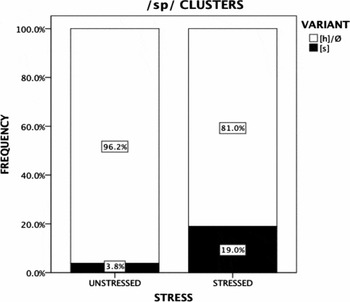
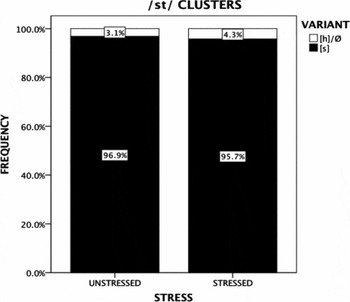
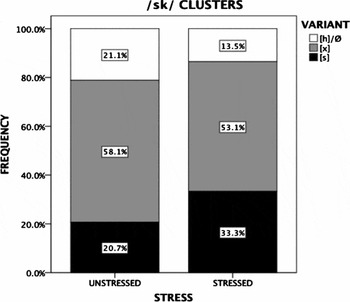
Given the effect of stress in both models, in Figures 6, 7, and 8 we plot the effect of this variable based on cluster type. There we see that [h]/Ø and [x] variants are more common in unstressed syllables for /sp sk/ clusters. For /st/ clusters there is no clear effect of stress, most likely because [s] variants were produced almost categorically in this context.
Distribution of coda /s/ variants based on stress for /sp/ clusters.

Distribution of coda /s/ variants based on stress for /st/ clusters.

Distribution of coda /s/ variants based on stress for /sk/ clusters.

3.2 Phonetic analysis
In this section we report the results of our instrumental analysis, based on three phonetic properties of /s/ realization: duration, percent voicing, and center of gravity. For the statistical analyses, we initially fit three linear mixed-effects models (LMEMs) with variant ([s], [x], and [h]) as a fixed factor and speaker and word as single crossed-random intercepts. All models were fitted using the MIXED procedure in SPSS (version 22), and degrees of freedom for approximate F-statistics for the fixed effects were computed using a Satterthwaite approximation (these degrees of freedom were used to determine p-values for F-statistics). The dependent variables were fricative duration, percent voicing, and center of gravity. For these three LMEMs there was significant evidence of variability in word effects; we therefore report our results based on the models that included speaker and word as random effects variables. For this portion of the phonetic analysis, we examined 686 tokens (segmental deletions were discarded for obvious reasons). Of the 179 total [h]/Ø tokens, we performed a follow-up auditory and acoustic inspection in order to eliminate segmental deletions for the purposes of the first portion of the phonetic analysis. In total, there were 119 tokens judged to be segmental deletions, leaving 60 glottal fricative tokens available for acoustic analysis (443 [s] + 183 [x] + 60 [h] = 686 tokens).
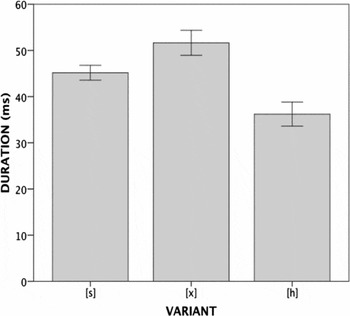
In Figure 9 we report the results on fricative duration for alveolar fricatives, velar fricatives, and glottal fricatives produced as coda /s/. Velar fricatives have the longest duration (M = 51.6 ms, SD = 10.1 ms), followed by alveolar fricatives (M = 43.8 ms, SD = 9.9 ms), and then glottal fricatives (M = 36.1 ms, SD = 10.5 ms). The shorter result for glottal fricatives is expected, since these constitute lenited variants (File-Muriel & Brown Reference File-Muriel and Brown2011). The LMEM returned a significant effect of the fixed factor variant: F(2,384.666) = 12.052, p ≤ .001. All pairwise comparisons of these means based on the fitted model were found to be significant after applying a Bonferroni adjustment for the multiple comparisons: [s] vs. [x] (t = 2.755, p = .033); [s] vs. [h] (t = 4.312, p = .001); and [x] vs. [h] (t = 5.510, p ≤ .001).
Mean fricative duration (ms) based on coda /s/ variant.

In Figure 10 we show data based on the percentage of segmental voicing for each fricative. Velar fricatives have the highest percent voicing (M = 38.51, SD = 23.19), followed by glottal fricatives (M = 23.07, SD = 3.35) and alveolar fricatives (M = 6.45, SD = 19.09). These differences were statistically significant based on the fixed factor variant, F(2,259.128) = 66.841, p ≤ .001. Two pairwise comparisons of these means based on the fitted model were found to be significant after applying a Bonferroni adjustment for the multiple comparisons: [s] vs. [x] (t = 11.096, p ≤ .001) and [s] vs. [h] (t = 6.122, p ≤ .001).
Mean percentage voicing based on coda /s/ variant.

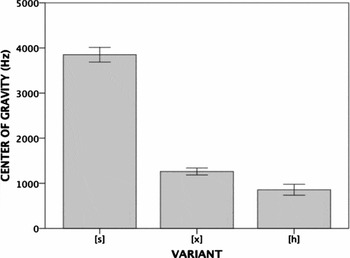
For the third acoustic measurement, we show center of gravity results in Figure 11. On average, centroids were highest for [s] (M = 3849.66, SD = 173.34) and were considerably lower for [x] (M = 1260.93, SD = 177.01) and [h] (M = 856.80, SD = 189.48). The LMEM returned a significant effect of the fixed factor variant: F(2,318.665) = 167.110, p ≤ .001. All pairwise comparisons were found to be significant after applying a Bonferroni adjustment: [s] vs. [x] (t = 15.284, p ≤ .001); [s] vs. [h] (t = 14.293, p ≤ .001); and [x] vs. [h] (t = 3.283, p = .033).
Mean center of gravity (Hz) based on coda /s/ variant.

Following the initial output of acoustic results (based on data in Figures 9–11), we fit three LMEMs to determine the effects of following consonant, variant, and the following consonant × variant interaction on fricative duration, closure duration, and VOT duration in /sp st/ clusters. We fit three additional LMEMs to determine the effect of variant on fricative duration, closure duration, and VOT duration in /sk/ clusters. We report these results to understand whether there is the possibility of a trading relation between /s/ realization and closure/VOT duration on the one hand (e.g. Ruch & Harrington Reference Ruch and Harrington2014) and durational differences based on stop consonant on the other. For the three LMEMs based on /sp st/ clusters we did not find significant evidence of variability in word effects and therefore included speaker as the single random effects variable. For the three LMEMs based on /sk/ clusters we found significant evidence of variability in word effects and therefore retained word in addition to speaker as random effects variables in those models. Also, for this second portion of the phonetic analysis (for closure and VOT durations), we included segmental deletions since deletion was a possible outcome in all cluster types.
In Figure 12 we show that across all clusters, glottal fricatives are shortest in duration. Fricative consonants were also generally longer when preceding dorsal consonants than when preceding labial or coronal consonants. The LMEM for /sp st/ clusters did not return significant effects of following consonant F (1,395.959) = .472, p = .492; variant F (1,397.340) < 1; or the following consonant × variant interaction F (1,394.644) < 1. The LMEM for /sk/ clusters returned a significant result of variant, F(2,245.524) = 3.228, p = .041, and two pairwise comparisons of means were found to be significant after applying a Bonferroni adjustment: [h]/Ø vs. [s] (t = 2.120, p = .041) and [h]/Ø vs. [x] (t = 2.525, p = .030).
Mean fricative duration (ms) based on cluster and coda /s/ variant.

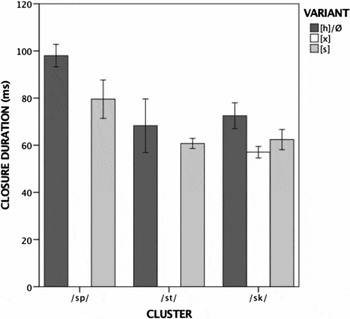
In Figure 13 we report the results on closure duration. First, analyzing across clusters, bilabial stop closures were generally longer than alveolar and velar stop closures, as to be expected (Maddieson Reference Maddieson, Hardcastle, Laver and Gibbon1997). Second, analyzing within clusters, closures were longer when preceded by glottal fricatives/deletions than by alveolar or velar fricatives. Both trends proved statistically significant in the LMEM for /sp st/ clusters, which returned significant effects of following consonant F (1,472.718) = 42.366, p ≤ .001 and variant F (1,470.840) = 8.295, p = .004, but not the following consonant × variant interaction F (1,470.810) = 3.444, p = .064. The LMEM for /sk/ clusters returned a significant effect of variant, F(2,299.111) = 28.183, p ≤ .001, and two pairwise comparisons of means were found to be significant after applying a Bonferroni adjustment: [h]/Ø vs. [s] (t = 5.210, p ≤ .001) and [h]/Ø vs. [x] (t = 6.433, p ≤ .001).
Mean stop closure duration (ms) based on cluster and coda /s/ variant.

Figure 14 shows results for VOT. One clear finding is that dorsal consonants yield the highest VOT values, followed by coronal and labial consonants. This is an expected result, since from an articulatory perspective there is a trading relation between closure duration and VOT duration such that dorsal consonants typically require shorter closures, but longer VOTs (Fischer-Jørgensen Reference Fischer-Jørgensen and Lehiste1954, Maddieson Reference Maddieson, Hardcastle, Laver and Gibbon1997). As a second finding, VOT values are highest when speakers produce [h]/Ø. Our statistical analysis revealed that both trends were significant. Specifically, the LMEM for /sp st/ clusters returned a significant effect of the fixed factors following consonant (F (1,478.063) = 16.452, p ≤ .001) and variant (F (1,476.912) = 17.700, p ≤ .001), but not the following consonant × variant interaction (F (1,477.693) = 1.189, p = .276). The LMEM for /sk/ clusters returned a significant effect of variant, F(2,277.924) = 7.186, p = .001, and one pairwise comparisons of means was found to be significant: [h]/Ø vs. [s] (t = 3.150, p = .001).
Mean VOT (ms) based on cluster and coda /s/ variant.

To summarize the results of the phonetic analysis, we first uncovered different distributions for each acoustic measure (fricative duration, relative voicing, and center of gravity) as they relate to the /s/ variants observed in SCPS /sp st sk/ clusters. As for the velar fricative, conflicting patterns emerge: it has the longest segmental duration (a correlate of consonantal strengthening) yet is most likely to retain voicing from the previous vowel (a correlate of consonantal weakening). In terms of center of gravity, velar fricatives show considerably lower values than alveolar fricatives, but this result most likely reflects their dorsal place of articulation (Gordon et al. Reference Gordon, Barthmaier and Sands2002). Regarding our follow-up analysis on the effects of variant and following consonant on duration measures (fricative duration, closure duration, VOT duration), our results revealed longer stop closures as well as longer VOTs when speakers produce [h]/Ø.
4 Discussion
4.1 Answering the research questions
In this study we found that SCPS speakers produce four possible phonetic variants in coda /s/ position: alveolar fricative, velar fricative, glottal fricative, or deletion. To the best of our knowledge, this is the first acoustic analysis (using quantifiable, instrumental data) to document this four-way system of /s/ realization in Spanish /sp st sk/ clusters. In response to our first research question on the relative frequency of /s/ variants in SCPS, alveolar fricatives constitute the most common realization of /s/, comprising more than half of our corpus. Although we can attribute the higher overall rate of [s] production to the greater preponderance of /st/ clusters in our corpus, we should mention that this variant is not completely absent from /sp/ and /sk/ clusters, where it is used at 15.9% and 24.5%, respectively. Velar fricatives and glottal fricatives/deletions each accounted for approximately one-quarter of the full corpus. The velar fricative appeared in /sk/ clusters, but never in /st/ and /sp/ clusters, indicating a pattern of segmental coarticulation whereby voiceless velar fricatives precede dorsal consonants. Sociolinguistic studies of Peninsular Spanish show that speakers do use the velar fricative in clusters other than /sk/ (e.g. in phrases such as ¡Vamos E sp aña! ‘Let's go, Spain!’), but this may be more common in affected speech or in specific social contexts (Wright Reference Wright2012). Ultimately, we may benefit from analysis of conversational data to assess the full scope of consonant reduction in SCPS (e.g. Torreira & Ernestus Reference Torreira and Ernestus2011, Reference Torreira2012).
For our second research question on the linguistic/social predictors of SCPS /s/, the findings of our logistic regressions (based on the discrete coding) suggest that following stop consonant is the most robust predictor of /s/ realization: /st/ favors alveolar fricatives, /sk/ favors velar fricatives, and /sp/ favors glottal fricatives/deletions. This is not the first study to indicate a strong effect of the following phonological context on Spanish coda /s/ (see Méndez Dosuna Reference Méndez Dosuna, Luis and Melena1985, Brown Reference Brown, Collentine, García, Lafford and Marcos Marín2009, File-Muriel Reference File-Muriel2010). In a study of /s/ across post-consonantal contexts, Brown (Reference Brown, Collentine, García, Lafford and Marcos Marín2009) shows that following /t/ most commonly favors /s/ retention when compared to all other following consonants (a finding supporting the claim that Spanish adopts regressive assimilatory processes to a greater extent than progressive assimilatory processes; Schwegler, Kempff & Ameal-Guerra Reference Schwegler, Kempff and Ameal-Guerra2010: 243–246; File-Muriel & Brown Reference File-Muriel and Brown2011: 239). Concerning the effect of stress, there was a significant trend toward using [x], [h], and Ø in unstressed position compared to [s]; this is in line with other studies that report weakening effects in unstressed syllables (Alba Reference Alba and Alba1982, File-Muriel & Brown Reference File-Muriel and Brown2011). Interestingly, velar fricatives patterned similarly to glottal fricatives/deletions on this variable.
It is important to highlight that neither regression model returned a significant effect of gender. A follow-up analysis of gender patterns for our speakers shows that, when combining across all clusters, men used the [h]/Ø variants at a rate of 24.0%, whereas women did so at a rate of 20.5%. These differences are not as robust as in previous studies on /s/ lenition. For example, in Madrid Spanish men lenite /s/ in 47.5% of cases, whereas women do so at rates of 20.0% (Momcilovic Reference Momcilovic2009). Furthermore, our analysis did not reveal a clear gender distribution when examining use of [x] in /sk/ clusters: women produced the velar fricative at a rate of 58.4%, whereas men did so at a rate of 55.2%. All in all, the response to our second research question is that two linguistic factors (place of articulation of the following consonant and stress) contribute to /s/ production in SCPS /sp st sk/ clusters. Although these results bear out some patterns of /s/ lenition in pan-Hispanic pronunciation, we note certain incongruities, namely we do not find the significant effects for word position or gender typical of lenition varieties.
We developed our third research question to understand the acoustic correlates of /s/ variants as they relate to principles of lenition in Spanish /s/ research. For alveolar fricatives, we expected to find long durations, less voicing, and high centroid values, whereas for glottal fricatives, we expected to find short durations, more voicing, and low centroid values (File-Muriel & Brown Reference File-Muriel and Brown2011, Erker Reference Erker2012). Our results were consistent with these predictions, confirming that glottal fricatives constitute substantially lenited versions of coda /s/ (we recall also from Section 2.2.2 that we expected lower center of gravity among glottal fricatives as they lack an acoustic source of high-frequency energy, unlike alveolar fricatives). For alveolar fricatives, our mean centroid value of 3850Hz was lower than the mean value of 5700Hz reported in File-Muriel & Brown (Reference File-Muriel and Brown2010, Reference File-Muriel and Brown2011) for Caleño Spanish. This most likely relates to a well-known dialectal difference in the articulation of /s/ across Spanish varieties, with apico-alveolar /s/ being preferred in northern and central Spain and predorso-alveolar or predorso-dental /s/ being used in southern Spain and almost all of Latin America (see Hualde Reference Hualde2005: 48– 49). Regarding /s/ duration, we showed that fricatives were generally longer before /k/ than before /p t/; this contradicts the finding of Méndez Dosuna (Reference Méndez Dosuna, Luis and Melena1985) that [s] is longer in duration before /p t/ than before /k/.
For velar fricatives, the results do not convey a clear story in terms of their acoustic correlates. This is because velar fricatives were the longest of the three segments (even more than alveolar fricatives) yet showed the greatest voicing overlap with the previous vowel (even more than glottal fricatives). Although it could be argued that longer velar fricative durations are influenced by the following homorganic consonant, we would point out that velar fricative durations were very similar to those of alveolar fricatives in /sk/ clusters (see Figure 12). Velar fricatives also generated intermediate center of gravity values between their alveolar and glottal fricative counterparts, but this is likely an artifact of their place of articulation (Shadle Reference Shadle1985, Jongman et al. Reference Jongman, Wayland and Wong2000, Gordon et al. Reference Gordon, Barthmaier and Sands2002). It is certainly possible to interpret the velar fricative as a product of lenition by using decrease in gestural magnitude as the sole criterion – there is one fewer supraglottal gesture in a [x k] sequence than in a [sk] sequence. We nevertheless remain hesitant to treat [x] as entirely lenited due to the aforementioned finding of longer duration.Footnote 1
In summary, our data point to SCPS occupying an intermediate status on the retention–lenition continuum. The fact that SCPS speakers show high rates of [h]/Ø in /sp/ clusters and assimilated variants in /sk/ clusters is a clear indicator of a lenition pattern. The shorter durations and higher voicing values of glottal fricatives offer additional empirical evidence in favor of this position. However, speakers show an almost categorical preference for [s] in /st/ clusters, and only some of the linguistic/social factors that typically influence /s/ lenition in Spanish proved significant in our statistical models. Additionally, phonetic analysis revealed that the velar fricative displayed similarities with both glottal and alveolar fricatives. In the next section we provide some useful connections with other language varieties in order to help explain our data better.
4.2 Broader connections
Recall that previous research has proposed that the sound change in Western Andalusian Spanish from pre-aspirated stops (e.g. [h t]) to post-aspirated stops (e.g. [t h ]) results from a shift in the gestural organization between the glottal spreading of the /s/ gesture and the oral constriction of the stop gesture (e.g. Torreira Reference Torreira, Sagarra and Toribio2006, Reference Torreira, Prieto, Mascaró and Solé2007, Reference Torreira2012; Parrell Reference Parrell2012; Ruch & Harrington Reference Ruch and Harrington2014). As understood within the Articulatory Phonology framework, post-aspiration occurs when the relationship between these gestures reorganizes from sequential (anti-phase) to simultaneous (in-phase) (but see Ruch & Harrington Reference Ruch and Harrington2014). Within this literature, there is discussion concerning the relation between the relative duration of the fricative consonant (when present), the stop closure, and the VOT. This is because there are conflicting positions on whether stop closure durations should remain constant as speakers shift from pre-aspiration to post-aspiration. For Western Andalusian Spanish, the stop closure is in a trading relationship with VOT: speakers produce a /st/ sequence with a long closure and short VOT or (more commonly) with a short closure and a long VOT. For SCPS the outcome was longer stop durations as well as longer VOTs in lenited tokens (i.e. [h]/Ø), compared to non-lenited tokens (i.e. [s]). The VOT values of non-lenited tokens were comparable to those reported in previous studies on intervocalic stops and stops in /lC/ clusters (e.g. Torreira Reference Torreira, Sagarra and Toribio2006). However, the VOT values of lenited tokens were not as long as those of lenited tokens in Western Andalusian Spanish.Footnote 2 For example, Torreira (Reference Torreira, Sagarra and Toribio2006, Reference Torreira, Prieto, Mascaró and Solé2007) found average VOT scores of approximately 30 ms (for /sp/) to 50 ms (for /sk/). In our study, we found shorter VOT means in lenited /s/ + voiceless stop clusters: approximately 20 ms (for /sp/) to 35 ms (for /sk/). One possible explanation for this different set of results is that the SCPS situation may reflect an earlier stage of /s/ lenition whereby, when /s/ lenites, stop closure and VOT are lengthened as compensatory mechanisms. Closure duration and VOT duration enter in a trading relationship (like Western Andalusian Spanish), but the longer closure is the dominant cue at the earliest stages of lenition (unlike Western Andalusian Spanish, where the longer VOT is now the dominant cue). Subsequent VOT lengthening and closure shortening have not occurred in SCPS, but we have acoustic evidence of how speakers of Western Andalusian Spanish may have initiated the change toward longer VOTs in the first place: in /s/ + voiceless stop clusters which undergo /s/ lenition (via deletion or pre-aspiration), speakers already produce slightly longer VOTs than in non-lenited clusters. As a follow-up to this proposal, it would be necessary to compare lenited clusters to singleton intervocalic stops, perhaps in a more controlled experimental setting.
What factors may have led to the system of coda /s/ in SCPS? Although we lack the necessary diachronic data to answer this question completely, an informative parallel may be the distribution of coda /s/ in Sanskrit as relates to the ‘Visarga Rule’ (see, among others, Zwicky Reference Zwicky1965, Steriade Reference Steriade1982, Méndez Dosuna Reference Méndez Dosuna, Luis and Melena1985, Padgett Reference Padgett1994). According to the Visarga Rule, word-final /s/ assimilated in place to following /p k/, yielding [ɸp] and [x k], respectively. The sequences [ɸp] and [x k] were alternate realizations of pre-aspirated [ḥp] and [ḥk] that resulted from the overlap of aspiration and the oral closure gesture (Padgett Reference Padgett1994: 505). Of note, /st/ clusters yielded [st] in Sanskrit, similar to SCPS. Recategorization of [ḥ] as [ɸ] or [x] seems a reasonable hypothesis on the origin of the Visarga Rule. Given the status of [h] as a placeless consonant, we might posit that in /V1 sCV2/ sequences (realized as [V1 hCV2]) the formant cues from V1 into the glottal fricative are weak (Klatt & Stevens Reference Klatt and Stevens1969). Consequently, the second consonant of the cluster (i.e. /p t k/) may exert more influence on V1, giving evidence in formant transitions that the intervening fricative is labial, alveolar or velar, respectively. For SCPS, one possibility is that [x k] productions originated due to such a place of articulation assimilation between overlapping gestures of the /s/ and /k/ phonemes, a consequence of the debuccalization process that underlies /s/ lenition generally (see Sánchez-Muñoz Reference Sánchez-Muñoz, Chand, Kelleher, Rodríguez and Schmeiser2004, Bradley Reference Bradley2014, Ruch & Harrington Reference Ruch and Harrington2014). When high airflow from the laryngeal abduction gesture overlaps with the dorsal constriction gesture for [k], a voiceless velar fricative may be produced prior to the stop consonant. What remains to be understood is why assimilation does not occur in /sp/ clusters in our data, yielding [h p] rather than the Sanskrit outcome [ɸp]. Nonetheless, our proposal that the SCPS and Sanskrit systems develop from a conventionalization of overlaps between glottal and supraglottal gestures may help to shed light on the relationship between gestural overlap and its influence on lenition.
5 Conclusion
To conclude, /s/ lenition in Spanish is arguably one of the most researched aspects of Spanish phonological structure. However, something that was not understood from a quantitative acoustic perspective was the status of /s/ lenition in varieties which use voiceless velar fricatives in addition to alveolar fricatives, glottal fricatives, and deletions. Specifically, in areas within south-central Spain, speakers trend toward alveolar fricatives in /st/ clusters, velar fricatives in /sk/ clusters, and glottal fricatives or deletions in /sp/ clusters. Although this precise distribution is below the awareness of most native speakers, they do use the velar fricative when imitating the regional accent and reference its use in metalinguistic commentary. The only previous study that went beyond impressionistic description of these facts is Sánchez-Muñoz (Reference Sánchez-Muñoz, Chand, Kelleher, Rodríguez and Schmeiser2004), in which SCPS /s/ variants were classified discretely based on the auditory classification of two transcribers. On a descriptive level, our paper represents an attempt to obtain more detailed data through an objective, acoustic analysis based on discrete classification of coda /s/. In our view, our analysis more fully describes the character and the scope of /s/ lenition in SCPS (notwithstanding our limited focus on /sp st sk/ clusters). We have also offered a view of how our data speak to broader issues in lenition and coarticulation, suggesting that SCPS occupies a position between the endpoints of the Spanish retention–lenition continuum.
Acknowledgements
We gratefully acknowledge three anonymous reviewers and JIPA Editor Amalia Arvaniti for their insightful feedback that has helped to restructure this article into its current format. We likewise thank Pam Beddor, Andries Coetzee, Lorenzo García-Amaya, Rich File-Muriel and Hanna Ruch for their comments on previous versions of our manuscript, and Ian Calloway for his editorial assistance. All shortcomings are our own.