BACKGROUND
The English subjunctive is one of those tenacious linguistic forms widely considered to have been battered, but not yet broken, by change. Apparently once robust (e.g., Auer, Reference Auer, Dalton-Puffer, Kastovsky, Ritt and Schendl2006, Reference Auer2009; Moessner, Reference Moessner, Mair and Reinhard2006, Reference Moessner2010), alterations to the inflectional paradigm resulted in a system so reduced that, in Present-Day English (PDE), it can only be morphologically distinguished in three forms, often referred to as the be subjunctive, as in (1,2), the past or were subjunctive (3,4), and the noninflected or morphological subjunctive (5,6).Footnote 1 Permissible contexts for its use, equally scarce, are now largely confined to three: subordinate clauses introduced by a mandative trigger (the mandative subjunctive [MS; 1,3,5]), following certain adverbial subordinators (the adverbial subjunctive [AS; 2,4,6]), and fixed or formulaic expressions (e.g., be that as it may, as it were, God forbid). Even in these restricted contexts, it has long been qualified as “in disuse” (Sweet, Reference Sweet1898), “moribund” (Fowler, Reference Fowler1965), “fossilized” (Quirk, Greenbaum, Leech, & Svartvik, Reference Quirk, Greenbaum, Leech and Svartvik1985), or “almost extinct” (Givón, Reference Givón1993), when not altogether discounted as a category of English (Palmer, Reference Palmer1984).
(1) I think it's important that the individual be [SUBJ] close to my age range. (QEC.126.1151)Footnote 2
(2) But whether there be [SUBJ] such a proof, that must be left to the Jury. (CED.Trials.D4TSIDNE)
(3) How I wish I were [SUBJ] 40 years younger. (ARCHER.1937whar_x7a)
(4) And do you confess it as if it were [SUBJ] a sin? (CED.Trials.D3TSLING)
(5) And they were demanding that the attendant give [SUBJ] them directions in French. (QEC.209.956)
(6) If he thinks himself innocent, I think it is best, and if he refuse [SUBJ] it, his sentence is from himself. (CED.Comedies.D5CHOADL)
But Övergaard's (Reference Övergaard, Edlund and Persson1992) quantitative comparison of MS use in the Brown corpus of American English (AmE) and the LOB corpus of British English (BrE), both made up of texts published in 1961, turned this received wisdom on its head. She declared not only that the subjunctive occurred at a rate “much higher than might be expected” (cited in Övergaard, Reference Övergaard1995:1), but that it was actually the norm in AmE. This led her to infer that a retrograde change had occurred. Noting that much was known about the history of MS but little about its present and recent past, she undertook a second study (Övergaard, Reference Övergaard1995) to determine at what point during the twentieth century this “revival” had begun gathering momentum. The results she reported were startling: they suggested that the subjunctive was already relatively healthy (at 32%) in noun clauses headed by a mandative trigger as far back as 1900, that it had doubled in rate by 1920, and by 1990 had become nearly categorical, at 99% (1995:39)! Övergaard further qualified this unusually vigorous change as a purely American initiative, with BrE lagging far behind.
There has been no dearth of studies of the English subjunctive since Övergaard's, in many varieties and corpora, and, while some results do not fully jibe with hers, there is nonetheless overwhelming consensus on the following points: the demise of MS has been reversed, AmE initiated and is still leading the change (currently at completion, according to Övergaard) and the subjunctive is now the “norm” in AmE (e.g., Algeo, Reference Algeo and Blank1992; Berg, Zingler, & Lohmann, Reference Berg, Zingler and Lohmann2019; Crawford, Reference Crawford, Rohdenburg and Schlüter2009; Hornoiu, Reference Hornoiu2019; Hundt, Reference Hundt, Lindquist, Klintborg, Levin and Estling1998a, Reference Hundt1998b, Reference Hundt, Rohdenburg and Schlüter2009; Johansson & Norheim, Reference Johansson and Norheim1988; Kjellmer, Reference Kjellmer, Rohdenburg and Schlüter2009; Leech, Hundt, Mair, & Smith, Reference Leech, Hundt, Mair and Smith2009; Nichols, Reference Nichols1987; Schlüter, Reference Schlüter, Rohdenburg and Schlüter2009; Serpollet, Reference Serpollet, Rayson, Wilson, McEnery, Hardie and Khoja2001).Footnote 3 So widely have these findings been espoused that their implications have generated considerable scholarly attention to auxiliary issues like colonial lag, distinguishing revival from retention and the directionality of linguistic change (e.g., Hundt, Reference Hundt, Rohdenburg and Schlüter2009; Kjellmer, Reference Kjellmer, Rohdenburg and Schlüter2009; Leech et al., Reference Leech, Hundt, Mair and Smith2009; Serpollet, Reference Serpollet, Rayson, Wilson, McEnery, Hardie and Khoja2001).
Missing from all this activity has been any sustained analysis of subjunctive use in AmE speech (e.g., Auer, Reference Auer2009; Berg et al., Reference Berg, Zingler and Lohmann2019; Grund & Walker, Reference Grund, Walker, Kytö, Rydén and Smitterberg2006; Hoffmann, Reference Hoffmann1997; Hundt, Reference Hundt and Deshors2018; Mahmood, Mahmood, & Saheed, Reference Mahmood, Mahmood and Saeed2011). And what little oral data has been analyzed (e.g., Berg et al., Reference Berg, Zingler and Lohmann2019; Leech et al., Reference Leech, Hundt, Mair and Smith2009) is rarely representative of ordinary spoken usage.
In this paper, we address this lacuna by carrying out systematic quantitative analyses of subjunctive selection in a large corpus of spontaneous present-day North American English (PDNAmE) speech. Finding scant evidence of the subjunctive, contra the claims of Övergaard and others, we sought to contextualize the contemporary situation by replicating our analyses on the speech-like portions of English corpora dating back to the sixteenth century. In lieu of change, this revealed that MS was sparse and sporadic as far back as Early Modern English (EME) and has remained that way ever since. Comparison with adverbial contexts reveals a different diachronic trajectory, which nonetheless culminates in the same result: the subjunctive is not only extremely rare in PDNAmE, but largely lexically constrained, damaging to any claims of its robustness or productivity. We implicate methodological inconsistencies in the disparities between the findings reported here and the consensus in the literature with respect to the evolution and current status of the subjunctive in PDNAmE.
THE FRAMEWORK
Our approach in this paper is variationist and comparative. The variationist perspective rests on the observation that, in discourse, speakers engage in choices among different ways of expressing the same referential value or grammatical function. The key theoretical construct of this paradigm is the linguistic variable (Labov, Reference Labov1966/1982), made up of the set of these alternating variants. In this study, the variable is expression of the subjunctive; its major variants, subjunctive and indicative, alternate in the embedded clause with no apparent change in meaning. This is illustrated in (7)-(8) for mandative contexts and in (9)-(10) for adverbial contexts.
(7) Every night I pray that I will sleep well, and that everything go [SUBJ] well for me. (QEC.039.674)
(8) I'm just gonna light my candles and uh- say my prayers for everybody, and uh- hope and pray that everything is [ind] well. (QEC.191.825)
(9) […] So that it looked in the x-ray as though it were [SUBJ] an inch and a half apart. (ARCHER.1936fitz_x7a)
(10) She said Mama blabs as though she was [ind] the Queen of England […] (ARCHER.1970zind_d8a)
The major methodological tenet of this framework, and one which is core to the work reported here, is the Principle of Accountability (Labov, Reference Labov1972). This involves consideration of all the relevant tokens of the variable under study, including all those that could have occurred in the variable context even if they did not, as opposed to some ill-defined subset of them. Adherence to the Principle of Accountability is perhaps what most distinguishes the current analysis from its predecessors.
THE PROBLEM
Although this is barely alluded to in the literature (Hoffmann [Reference Hoffmann1997] is a notable exception), an accountable study of the subjunctive is fraught with practical difficulties (see Poplack, Reference Poplack, Laeufer and Morgan1992; Poplack, Lealess, & Dion, Reference Poplack, Lealess and Dion2013 for discussion). First, there is the issue of defining the specific set of variants that may alternate with no change in referential meaning. Traditional accounts of mood alternation insist that the very act of selecting one variant over another is motivated by the goal of expressing only one of the contrasting meanings they are said to embody. In the case of the subjunctive, those meanings, typically pertaining to the desires, fears, emotions, or hopes of speaker or subject, cannot be readily detected in running discourse, nor can the analyst ascertain if they are interpreted as such by the interlocutor. This makes it virtually impossible to circumscribe a semantically based variable context, that is, one in which subjunctive and indicative can be shown to alternate with no change in referential meaning. Fortunately, however, in PDE, variant alternation (whether to express distinct meanings or not) is currently only admissible under a subjunctive trigger (underlined in examples 1–6).Footnote 4 Thus, if it were possible to establish the set of subjunctive triggers, this could be construed as the locus of variation, and variant selection could be examined under each. But, as already demonstrated for Romance (Digesto, Reference Digesto2019; Kastronic, Reference Kastronic2016; Poplack, Reference Poplack, Laeufer and Morgan1992; Poplack et al., Reference Poplack, Lealess and Dion2013; Poplack, Torres Cacoullos, Dion, Berlinck, Digesto, LaCasse, & Steuck, Reference Poplack, Torres Cacoullos, Dion, Berlinck, Digesto, LaCasse, Steuck, Ayres-Bennett and Carruthers2018; Roussel, Reference Roussel2020) and is also amply evident with respect to English, there is no consensus in either the prescriptive or descriptive literature on how the set of triggers is to be constituted, and even less on which should be deemed worthy of study. As a result, the number of triggers actually analyzed in studies to date ranges from four (e.g., Leech et al., Reference Leech, Hundt, Mair and Smith2009) to more than one hundred (e.g., Berg et al., Reference Berg, Zingler and Lohmann2019; Crawford, Reference Crawford, Rohdenburg and Schlüter2009), for reasons dictated as often by convenience as by more principled criteria.
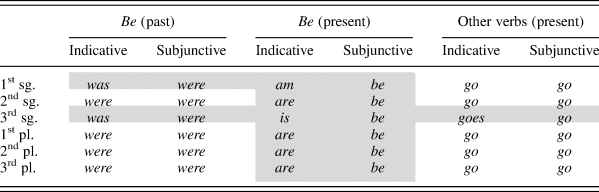
Another issue concerns apprehending the variants. As a result of the inflectional changes mentioned above, the PDE subjunctive suffers from “paradigmatic poverty” (Leech et al., Reference Leech, Hundt, Mair and Smith2009:51) and, as such, it is often impossible to tell whether it was selected or not. Table 1 highlights the contexts in which the morphology of the embedded verb can be distinguished; everywhere else, the subjunctive is ambiguous with the indicative.
Contexts in which the subjunctive and the indicative are morphologically distinct (shaded)

The scholarly treatment accorded these ambiguous forms varies considerably: some analysts (e.g., Ruohonen, Reference Ruohonen2018) simply consider any variant embedded under a presumed trigger to constitute a token of the subjunctive. This misleadingly inflates subjunctive rates, since overtly marked tokens are, in actuality, vanishingly rare in comparison with their unmarked counterparts. To complicate matters, many (e.g., Auer, Reference Auer, Dalton-Puffer, Kastovsky, Ritt and Schendl2006, Reference Auer2009; Crawford, Reference Crawford, Rohdenburg and Schlüter2009; Fillbrandt, Reference Fillbrandt2006; Grund & Walker, Reference Grund, Walker, Kytö, Rydén and Smitterberg2006; Mahmood et al., Reference Mahmood, Mahmood and Saeed2011; Övergaard, Reference Övergaard1995; Peters, Reference Peters, Peters, Collins and Smith2009; Schlüter, Reference Schlüter, Rohdenburg and Schlüter2009; Schneider, Reference Schneider, Bautista, Llamzon, Sibayan and Gonzalez2000, Reference Schneider and Bautista2011) consider a variety of other modal variants to convey subjunctive “meaning” when embedded under a subjunctive trigger. Most prominent among them is should, but also sometimes included are can, could, will, might, and may, among others (see Huddleston & Pullum [Reference Huddleston and Pullum2002:996–8] for further discussion). Predictably, such cross-study discrepancies in the number and identity of triggers and variants, and especially in the treatment of ambiguous forms, represent a major problem for the Principle of Accountability. Predetermined limits on the number and identity of triggers and tokens per trigger further restrict our understanding of the place of the subjunctive in PDE. Moreover, the frequent absence of any diachronic component makes it difficult, if not impossible, to assess claims regarding revival or demise—two competing types of change. All of this has made it impossible to get a fair idea of where, when, and even if the subjunctive is being used in many cases, let alone to replicate previous work.
THE METHOD
In this study, we address these lacunae by making use of methodology—novel in this context—jointly informed by the Principle of Accountability and the recognition that the subjunctive is only one of a set of variants available for selection under specific triggers when these occur in a legal subjunctive-selecting context—the variable context, in variationist terminology.
Absent any general consensus on precisely which triggers could potentially prompt an embedded subjunctive, we first compiled a list of uses cited in grammars and as many published linguistic studies as we could locate. Assuming the accuracy of these reports, they may be interpreted to mean that subjunctive is or was a legal variant in the context invoked in some variety of the English language at some point in time. Casting such a wide net in circumscribing the variable context enables consideration of the largest possible portion of the “subjunctive-selecting space,” in turn dictated by our goal of increasing access to the relevant data, rather than imposing arbitrary limits on it a priori. This greatly enhanced our capacity to track the trajectory of both variants and triggers over space and time.Footnote 5 In an abundance of caution, we also searched our data for all occurrences of be and were occurring in the variable (i.e., subjunctive-selecting) context, noted the trigger associated with each, and added any novel ones. This resulted in a pool of 330 triggers, to our knowledge the largest to be systematically analyzed in this connection.
The variable context circumscribed here includes all clauses embedded under one of the 240 mandative and 90 adverbial triggers identified, the former headed by an overt or null complementizer that. As is standard in variationist research, a number of contexts were excluded at the outset from the quantitative portions of the analysis. Such exclusions are typically comprised of invariant cases (e.g., fixed expressions like please God), incomprehensible, inaudible, or otherwise doubtful tokens (e.g., false starts),Footnote 6 and, most pertinent here, ambiguous tokens. In contrast to many studies (e.g., Crawford, Reference Crawford, Rohdenburg and Schlüter2009; Övergaard, Reference Övergaard1995; Serpollet, Reference Serpollet, Rayson, Wilson, McEnery, Hardie and Khoja2001; Vlasova, Reference Vlasova2010), counted as the subjunctive variant here are only unambiguous instantiations of this form (highlighted in Table 1).
The rates reported in ensuing sections are based on the proportion that the subjunctive represents out of the total of subjunctive + indicative + should variants embedded under each trigger. Although we reserve judgment as to whether the latter constitutes a proper variant of the subjunctive variable in the strict sense of the term, we nonetheless include it here for purposes of comparison, since should is reported to be the preferred option in BrE (e.g., Hundt, Reference Hundt, Rohdenburg and Schlüter2009; Johansson & Norheim, Reference Johansson and Norheim1988; Leech et al., Reference Leech, Hundt, Mair and Smith2009; Quirk et al., Reference Quirk, Greenbaum, Leech and Svartvik1985; Serpollet, Reference Serpollet, Rayson, Wilson, McEnery, Hardie and Khoja2001).Footnote 7 Rate of subjunctive selection, and dispersion of this variant across the set of subjunctive triggers constituting the variable context, can together be construed as a measure of productivity.
THE DATA
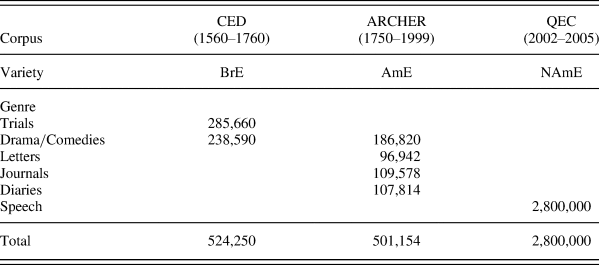
Our data, described in Table 2, enable us to evaluate claims concerning the twentieth-century revival of MS in NAmE empirically by tracing its trajectory over a period of nearly five centuries. PDNAmE is represented by the Quebec English Corpus (QEC; Poplack, Walker, & Malcolmson, Reference Poplack, Walker and Malcolmson2006), a compilation of spontaneous speech totaling approximately 2.8 million words, collected between 2002–2005 from 183 anglophone Canadians residing in the provinces of Quebec and Ontario. Participants are stratified according to a variety of sociodemographic factors;Footnote 8 most pertinent for present purposes is their generally high educational level (90% having completed secondary or better). This ensures that the vast majority would have had at least some exposure to the subjunctive, if only through formal instruction, and could therefore be expected to make some use of it, linguistic context and community norms permitting.
Number of words searched in each corpus by genre

Diachronic data come from the Corpus of English Dialogues (CED; Kytö & Culpeper, Reference Kytö and Walker2006), covering the EME period (1560–1760), and the AmE subsample of A Representative Corpus of Early English (ARCHER 3.2, 2013), roughly covering the Late Modern English (LME) period (1750–1999). Although both are comprised of various genres of written documents, to enhance comparison with our PDNAmE spontaneous speech data, we retained only the most speech-like (trials, comedies) and informal (letters, diaries, journals).
The trial transcriptions represent actual speech events recorded by scribes, while the drama/comedies contain dialogue written by a third party meant to represent the spoken language of the time (Culpeper & Kytö, Reference Culpeper and Merja2010). We appealed to extralinguistic information to ensure that the speakers and writers retained were the most likely to have produced informal speech (or surrogates thereof). This meant, for example, excluding the speech of judges, lawyers, and court employees at the outset, and including only that of actors from the drama/comedies genre. In all cases, only instances of actual dialogue or ego-documents were considered.
Of course, even such precautions are no guarantee that the materials we analyzed are representative of actual speech, especially of earliest times. Therein lies the intractable “bad data” problem (Auer, Peersman, Pickl, Rutten, & Vosters, Reference Auer, Peersman, Pickl, Rutten and Vosters2015; Labov, Reference Labov1994) inherent to (socio)historical linguistics. Nonetheless, these are the text types that are recommended for reconstructing orality in historical sources: they “are usually close to speech and relatively unaffected by conventions of writing” (Auer et al., Reference Auer, Peersman, Pickl, Rutten and Vosters2015:7). The language of letters, diaries, and journals is likewise considered to be “as close to actual speech as possible, only in written form” (Sević, Reference Sević and Beedham1999:340; cf. also Elspaß, Reference Elspaß, Hernández-Campoy and Conde-Silvestre2012; van der Wal & Rutten, Reference van der Wal, Rutten, van der Wal and Rutten2013, as cited in Auer et al., Reference Auer, Peersman, Pickl, Rutten and Vosters2015). As with any historical research, comparison of these materials with urban twenty-first century English must of course be effected with caution, but these caveats are far outweighed by the breadth of information about the direction, type, and even existence of language change afforded by the deep diachronic perspective adopted here (see also Auer, Reference Auer2009; Elsig & Poplack, Reference Elsig and Poplack2006; Hundt, Reference Hundt, Rohdenburg and Schlüter2009; Poplack & Malvar, Reference Poplack and Malvar2007).
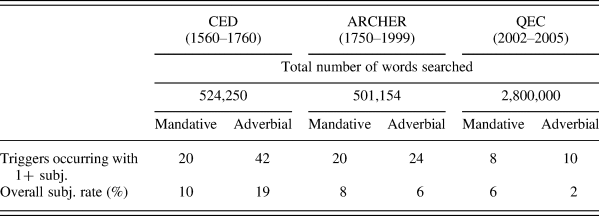
Table 2 details the number of words per text type searched in each corpus. In all, we combed nearly four million words for lexical items that could potentially trigger the subjunctive if they occur in a subjunctive-selecting context. We located more than two hundred thousand of them, but only 919 unambiguous tokens of the subjunctive. This means that this variant appeared in no more than 0.5% of the contexts in which it could have occurred in all three corpora combined! In what follows, we detail what the distribution of these tokens across triggers and time periods reveals about the diachronic developments culminating in contemporary PDNAmE. To our knowledge, this is the most comprehensive study of the development and present status of this form currently available.
Close examination of these datasets enabled us to classify each of the 330 triggers as belonging to one of three categories: (1) never appeared in the variable context; (2) appeared in the variable context but never co-occurred with the subjunctive; and (3) appeared in the variable context and co-occurred at least once with the subjunctive or should. Consideration of all three of these contexts enables us to track two types of change: one affecting the pool of triggers hosting the subjunctive, and the other the strength of association with the subjunctive in those triggers that persist over time. By tracing their trajectory back to EME, we reconstruct the directionality, extent, and even existence of change in subjunctive use in both mandative and adverbial contexts.
THE MANDATIVE SUBJUNCTIVE IN PRESENT-DAY NORTH AMERICAN ENGLISH (PDNAME)
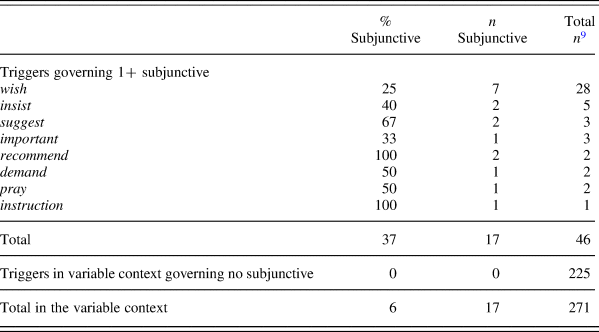
A systematic search of the entire 2.8 million-word QEC, making use of the methods described above, turned up a MS rate of 37% (Table 3) under triggers governing at least one subjunctive. This is well below the 99% rate reported by Övergaard (Reference Övergaard1995) for 1990, but as we will see, it is still highly inflated vis-à-vis the rate obtained by following the Principle of Accountability. For one thing, only eight of the 240 mandative triggers we searched co-occurred with a subjunctive even once, and only wish did so more than twice. Moreover, each of these triggers is itself very rare, all but wish and insist occurring three times or fewer in the variable context.
Rate of subjunctive with mandative triggers in PDNAmE

It stands to reason that at least some of the triggers prevalent in the past would no longer be so, as already suggested by Rütten (Reference Rütten2015), and we, in fact, found no attestations of beseech, bid, charge, desire, plead, or resolve (among others) in the QEC. But unexpectedly, even common PDE triggers like necessary, proper, or urge do not figure here either. Closer inspection shows that they are of course present in the QEC; they simply did not appear in subjunctive-selecting contexts. One interpretation of these facts is that the observed dearth of subjunctives is due to a combination of the infrequency of triggers that do appear and their rarity in the appropriate context. This would be consistent with Övergaard's claim that the subjunctive itself is healthy; these speakers simply would not have had the opportunity to use it. But this leaves unanswered the question of why so few subjunctive triggers occur in legal contexts. One possibility (e.g., Leech et al., Reference Leech, Hundt, Mair and Smith2009; Los, Reference Los, Lenker and Meurman-Solin2007) is that speakers seek to avoid the subjunctive by replacing the context that forces a choice between it and a competing variant with a different one altogether. Such avoidance strategies are exemplified in the infinitival, prepositional, and gerundival clauses in (11–13).
(11) To me it's important to teach it [versus that it be/is taught] the right way. (QEC.069.1374)
(12) I recommended him for the job [versus that he get(s) the job]. (QEC.314.1285)
(13) And the oldest boy, he insisted on her coming [versus that she come(s)] in. (QEC.037.1337)
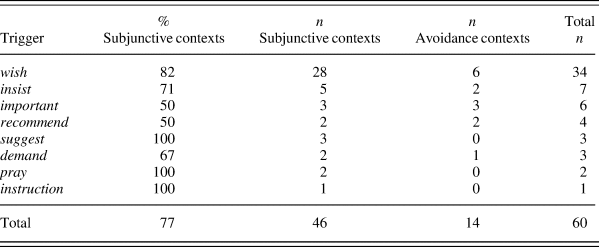
To test the likelihood of avoidance, we extended our search to every construction in which each of the eight triggers governing at least one unambiguous subjunctive appeared. The results, displayed in Table 4, show no such tendency. On the contrary, speakers consistently choose as much if not more of the subjunctive-selecting context than the alternative; although, as we saw, they avoid choosing the subjunctive variant in it. This is not what we would expect if speakers were aware of the subjunctive but just not quite sure where or how to use it.
Distribution of avoidance and subjunctive contexts by trigger: PDNAmE

Summarizing, on the one hand we have Övergaard's report of 99% subjunctive use in AmE by 1990; on the other, our NAmE data, collected fifteen years later, shows 37%—if we (misleadingly) calculate subjunctive rates only on the basis of the eight triggers that co-occurred with a subjunctive at least once. But a truer measure of the vigor of the form, and one complying with the Principle of Accountability, would calculate its rate in all contexts in which it could have occurred whether or not it did. Those results appear in the row labeled “total in the variable context” in Table 3. Now it is plain that the subjunctive is vestigial at best, at a rate of only 6%.Footnote 10 How can we contextualize this result? To apprehend the diachronic developments giving rise to the current situation, we traced the trajectory of the 240 mandative triggers we identified back to EME.
THE DIACHRONIC DEVELOPMENT OF THE MANDATIVE SUBJUNCTIVE
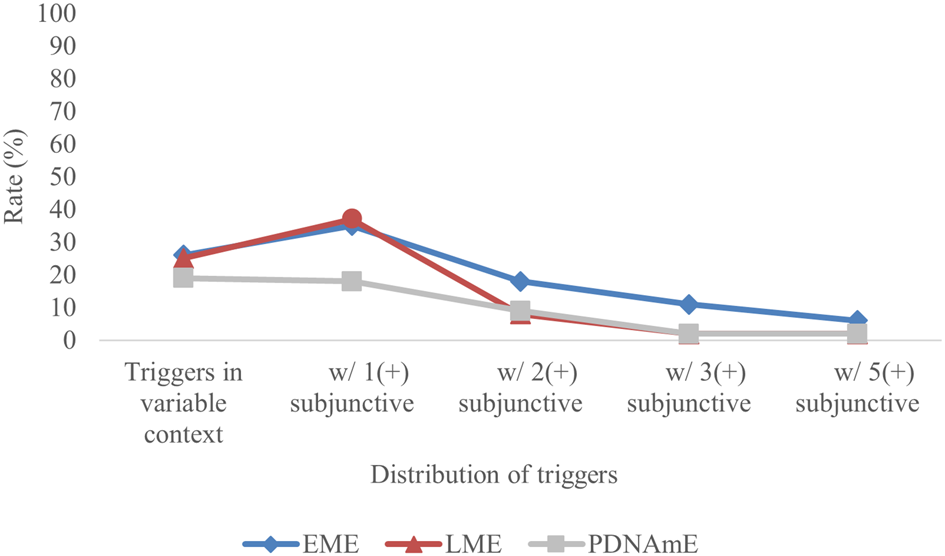
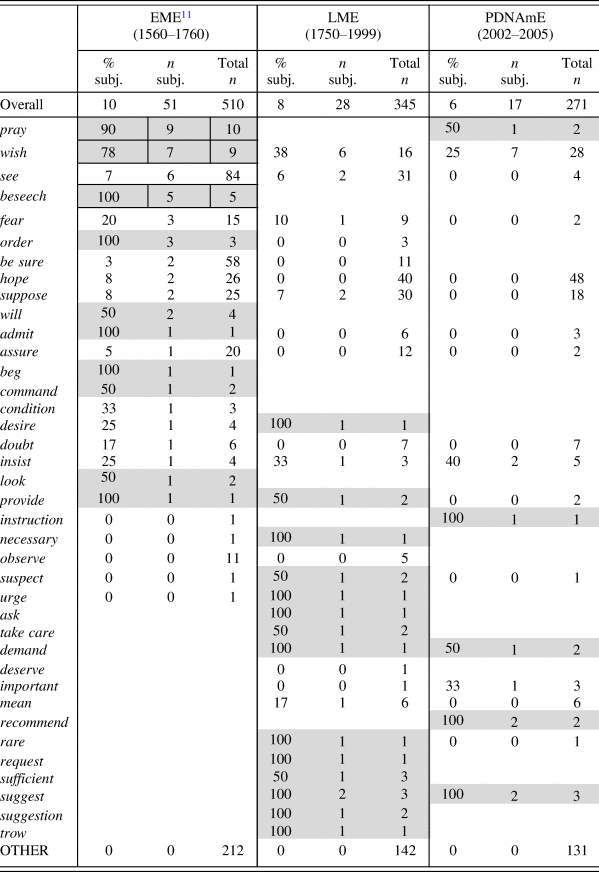
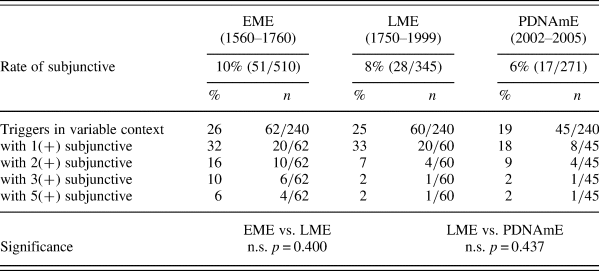
Table 5 displays variant choice for every trigger hosting at least one subjunctive in one of the three periods studied. In this and ensuing tables, blank cells indicate that the trigger in question did not occur in the variable context in the time period in question. Triggers that appeared in the variable context but never governed a subjunctive are grouped under other. Triggers that did not appear in the variable context in any of the three time periods are not included. Unless otherwise indicated, shaded cells indicate an association between trigger and subjunctive, based on a cooccurrence rate of 50% or more. Boxed-in cells indicate a substantive association, as instantiated by a minimum occurrence rate of five tokens per trigger in addition to the 50% cooccurrence rate with the subjunctive variant. Table 6 and Figure 1 summarize those findings, and Table 7 assesses the statistical significance of differences among corpora according to trigger and overall rate of subjunctive.
Distribution of mandative triggers occurring within the variable context according to their propensity to host a subjunctive.

Distribution of variants by mandative trigger (1560–2005)

Distribution of mandative triggers occurring within the variable context according to their propensity to host a subjunctive

Rate of subjunctive with adverbial triggers in PDNAmE

In EME, the overall rate of subjunctive selection was 10% (51/510). At this time, as depicted in Table 6 and Figure 1, only a quarter of the potential subjunctive triggers occurred in the variable context, and only a third of those triggers co-occurred even once with a subjunctive. Half (50%, n = 10/20) governed no more than two subjunctives; in fact, only four (beseech, pray, see, wish) co-occurred with one five times or more.
Already, at this stage, the only MS triggers showing any sort of association, which we define (generously!) as a co-occurrence rate of 50% or more with the subjunctive, were themselves very rare, if not singletons. The sole exceptions are pray (n = 10, 90% subjunctive) and wish (n = 9, 78% subjunctive). Highly frequent triggers (like see or be sure), on the other hand, tend to govern only a few subjunctives.Footnote 12 In EME then, only a minority of the contexts that could have hosted a subjunctive did so even once, and, more tellingly, in just about all of them the subjunctive was by far the minority variant (Tables 5 and 6, Figure 1).
The situation in LME remains virtually unchanged. In overall rate, subjunctive has if anything declined (to 8%). Again, only a quarter of potential triggers appeared in the variable context, and only a third of those triggered a subjunctive even once. In fact, all but one (95%, n = 19/20)—wish—did so two times or less.
By PDNAmE, even fewer triggers are appearing in eligible contexts, and even fewer of those trigger a subjunctive. In this connection, it is particularly noteworthy that even the low overall rate of 6% exaggerates both the extent and the productivity of the subjunctive in the community: more than 80% of the seventeen tokens featuring a subjunctive in PDNAmE were uttered by speakers over the age of seventy. In addition, of the eight triggers that do co-occur with a subjunctive, only wish does so more than twice, and all but one of these tokens (86%, n = 6/7) occur in the construction I wish I were, illustrated in (14). The ten remaining subjunctive occurrences are scattered across the remaining seven triggers (e.g., 15).
(14) […] I wish I were [SUBJ] twenty-one. (QEC.029.1083)
(15) My husband insisted that she go [SUBJ] to French school. (QEC.119.58)
Summarizing the data in Tables 5 and 6, out of 240 potential triggers, only a quarter occurred in the variable context in EME. Since then, the number of triggers has declined by a third, and those actually hosting even one subjunctive have declined by nearly two thirds. It is also telling that only two triggers persisted in governing at least one subjunctive across all three periods (insist and wish; Table 5). Yet statistical tests (Table 6) reveal that there are virtually no significant differences across corpora/time periods in terms of overall rate of subjunctive use (Fisher's Exact Test [two-tailed] at the 0.05 level). This is true regardless of how overall rate is calculated.Footnote 13 We conclude that MS was already both sparse in terms of rate and sporadic in terms of triggers in spoken EME and congeners, and, far from reviving over the course of the twentieth century, has remained that way ever since.
THE ADVERBIAL SUBJUNCTIVE IN PRESENT-DAY NORTH AMERICAN ENGLISH (PDNAME)
Available findings suggest that, like MS, AS is more frequent in NAmE than in BrE (e.g., Brinton, Reference Brinton and Dossena2015; Leech et al., Reference Leech, Hundt, Mair and Smith2009), but in contrast to MS, is actually decreasing across time.Footnote 14 And, instead of leading the change, as has been claimed with respect to the MS “revival,” NAmE is said to be lagging BrE in the decline of AS (e.g., Brinton, Reference Brinton and Dossena2015; Leech et al., Reference Leech, Hundt, Mair and Smith2009). In order to better apprehend the diachronic trajectory of AS in PDNAmE, we apply the methodology described above to the ninety adverbial triggers that we identified as eligible to co-occur with the subjunctive.
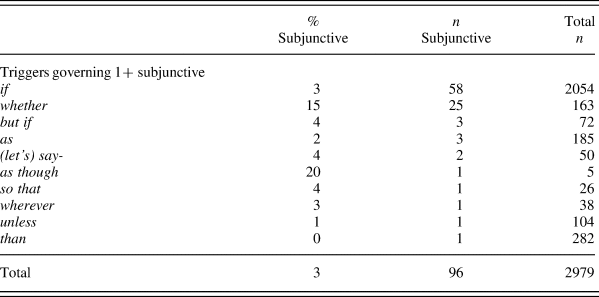
Our search of the QEC corpus (Table 7) revealed an overall subjunctive rate of only 3% among adverbial triggers that co-occurred with a subjunctive at least once. Not only does this again represent a mere fraction of the 99% rate reported by Övergaard (Reference Övergaard1995) for MS in the late twentieth century, it is also well below the rates reported for AS in PDNAmE by Leech et al. (Reference Leech, Hundt, Mair and Smith2009; 74% for AmE), and Brinton (Reference Brinton and Dossena2015; 21–55% for AmE and 20–51% for CdnE). Only ten of the ninety triggers searched co-occurred with a subjunctive even once, and only if and whether did so more than three times. Even more telling, although every verb in the English language is eligible to be embedded under an adverbial trigger, virtually all actual occurrences of the subjunctive are restricted to forms of be (99%, n = 95/96); more than two thirds of those (70%, n = 67/96) are tokens of past subjunctive were. Indeed, the overall rate of the past subjunctive (were) under adverbial triggers (4%, n = 67/1616) is more than five times that of present subjunctives (0.7%, n = 29/4087), though both contexts remain extremely rare in PDNAmE. We take this as a first suggestion that AS is highly restricted, if not fossilized, in PDNAmE.
As was the case with MS, certain triggers reported to have co-occurred with a subjunctive in the past (e.g., ere, lest) are rarely, if at all, used in PDNAmE, whether in subjunctive-selecting contexts or elsewhere. But here too, even common PDE triggers like although, before, since, and until, which do appear frequently in eligible contexts, fail to co-occur with a subjunctive even once in the speech of the relatively highly educated participants we studied.
In order to contextualize this result, we again reconstruct the diachronic events that led to the present situation by tracing the trajectory of all ninety adverbial triggers back to EME.
THE DIACHRONIC DEVELOPMENT OF THE ADVERBIAL SUBJUNCTIVE
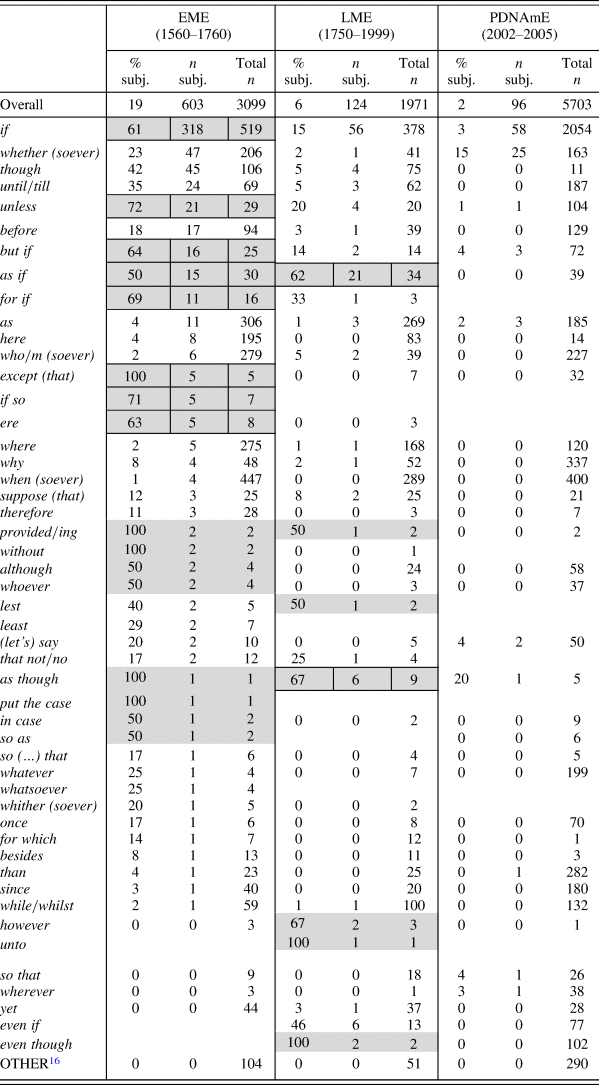
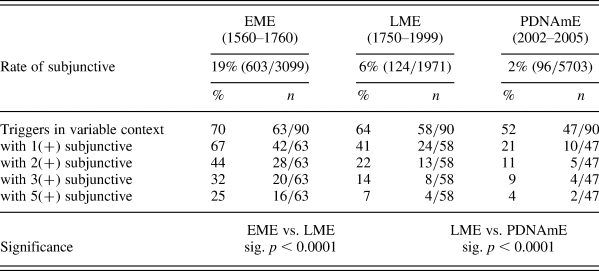
Table 8 displays variant choice for every adverbial trigger hosting at least one subjunctive in one of the three periods studied. Table 9 assesses the statistical significance of differences in overall subjunctive rate across corpora and summarizes the findings. Table 10 provides overall co-occurrence rates of subjunctive with the triggers that persist over all three time periods.
Distribution of variants by adverbial trigger (1560–2005)Footnote 15

Distribution of adverbial triggers occurring within the variable context according to their propensity to host a subjunctive

Rate of subjunctive with adverbial triggers that persist across all three time periods. Shaded cells indicate a co-occurrence rate of 50% or more with the subjunctive

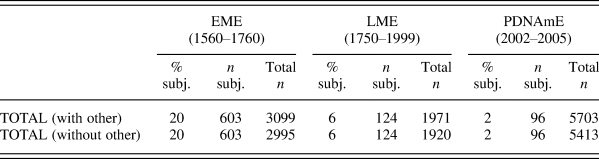
Unlike MS, which we have seen to remain infrequent but stable across time, we observe a statistically significant decline in rate of AS (from 19% in EME > 6% in LME > 2% in PDNAmE), as shown in Table 9 (Fisher's Exact Test (two-tailed) at the 0.05 level).
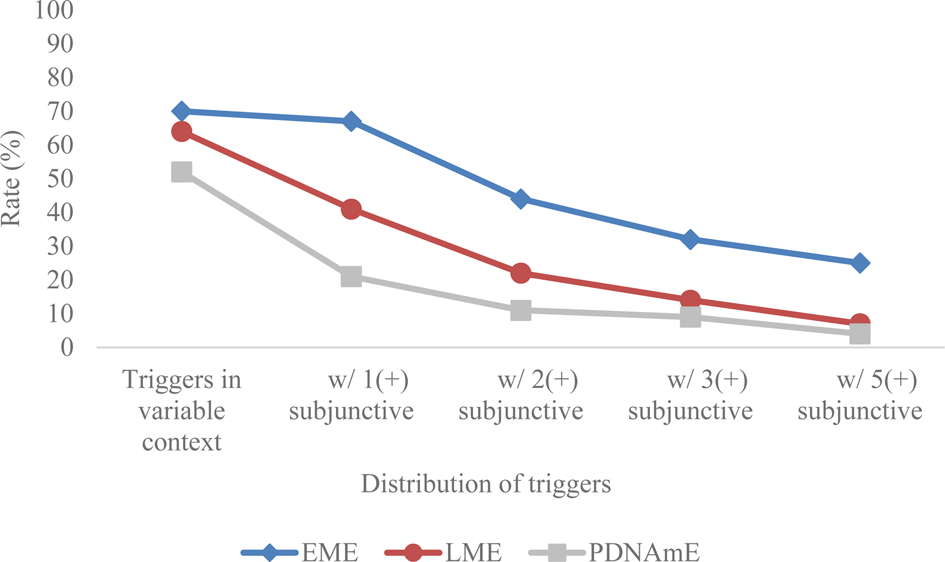
Table 9 and Figure 2 show that, in EME, many (70%) of the subjunctive-selecting adverbial triggers we identified in fact occurred in the variable context, and a subjunctive was selected in nearly one out of every five of them (19%, n = 603/3099). However, harbingers of the current situation were already visible: although two thirds (67%) of those triggers co-occurred at least once with a subjunctive, only one quarter did so even moderately frequently. And triggers that are both “frequent” (by our generous definition of five occurrences or more) and associated with the subjunctive (co-occurrence rate of 50% or more) were already limited to various forms of if (if, as if, but if, for if, if so), unless, ere, and except.
Distribution of triggers occurring within the variable context according to their propensity to host a subjunctive.

By LME, we observe a slight decrease (to 64%) in the number of triggers that appear in the variable context, but the most drastic changes reside in the decline of (1) overall subjunctive rate (down to 6% from 19% in EME); and (2) the proportion of triggers that co-occur with at least one subjunctive (down to 41% from 67% in EME). Moreover, consideration of more hospitable contexts (those hosting at least two subjunctives) reveals them to dwindle by a full half in each period. Only seven triggers (as if, as though, even though, however, lest, provided, unto) display associations with the subjunctive of 50% or greater, and of these, only as if and as though occur in the variable context three times or more (16–17).
(16) Hate novel as if it were [SUBJ] a personal foe. (ARCHER.192xpowe_y7a)
(17) Yet people walked over it, as though the spot were [SUBJ] common […] (ARCHER.188xsmit_j6a)
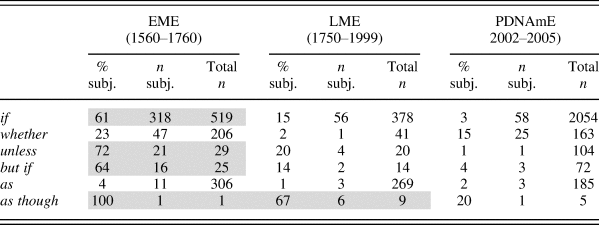
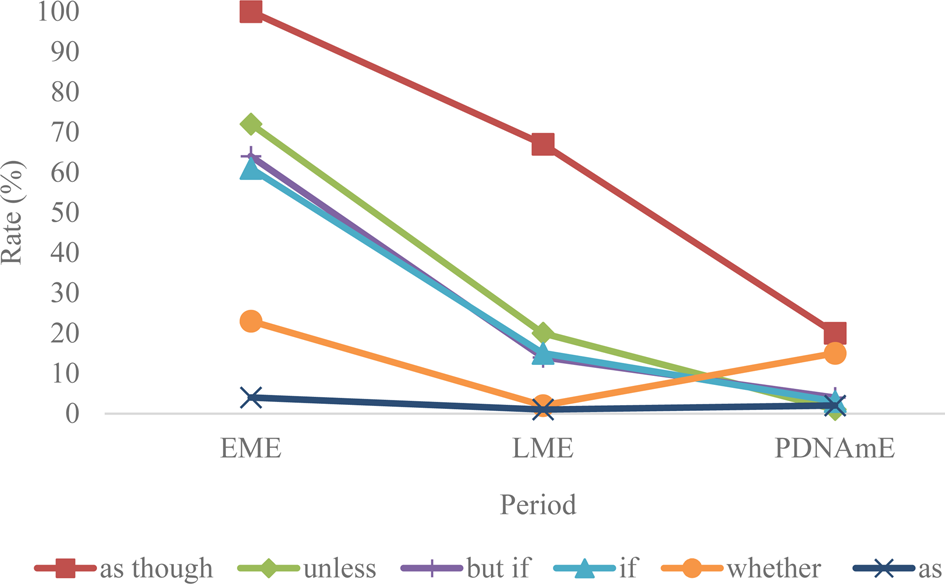
By PDNAmE, even fewer triggers appear in eligible contexts (n = 47), and even fewer of those select at least one subjunctive (n = 10). Only six of those triggers have persisted with the subjunctive across all three time periods (Table 10, Figure 3), but here too, with the exception of whether, the rate of subjunctive with each declines steadily, showing scant evidence of any revival in late LME (see Brinton [Reference Brinton and Dossena2015] for discussion). Today, the only triggers that co-occur with the subjunctive more than three times are if and whether, and those rarely, with rates of 3% and 15% respectively.
Rate of subjunctive with adverbial triggers that persist across all three time periods.

As further confirmation of their highly restricted nature, we note that 92% (n = 23) of those co-occurring with whether were produced in the construction whether it be (18,19) and nearly half of these (n = 11) were uttered by the same two speakers. The sole occurrence of the subjunctive under whether in LME also appeared in a similar construction (20). In fact, at 23%, it was already the minority variant in EME, displaying signs of encroaching fossilization, since the majority of embedded verbs (68%, n = 32/47) were be, although those tokens did feature a wider variety of embedded subjects than was the case thereafter.
(18) It's compulsory that they have one arts credit, whether it be [SUBJ] music, instrumental or sorry, vocal instrumental […] (QEC.313.336)
(19) It's uh- one of our aims, our goals in the schools, uh- whether it be [SUBJ] my daughter's school, or the one I'm working at […] (QEC.069.495).
(20) […] the complete envelopment of individual masses of the copper by the rock, point to a common and contemporaneous origin, whether that be [SUBJ] referable to the agency of caloric or water. (ARCHER 3.2. 1820scho_j5a)
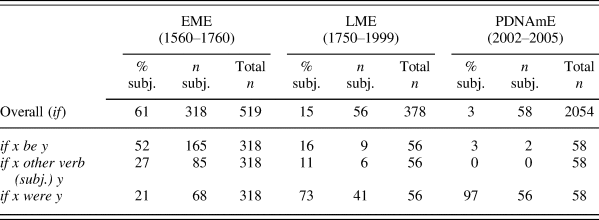
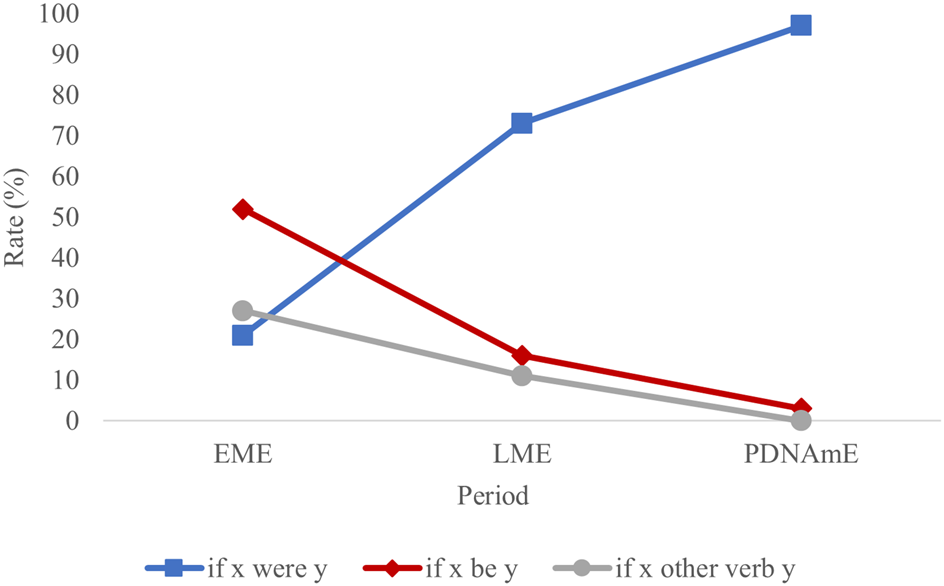
Likewise for if, all but one (97%, n = 56/58) appear in the construction if x were y (21). This is in stark contrast to EME, where if x were y was the minority construction. The other two possibilities, if x be y and if x other verb (subj.) y (22, 23), were more frequent in EME, as shown in Table 11 and Figure 4.
(21) No one says a word and it just makes you realize, if it weren't [SUBJ] for the bloody politicians, we would be just fine. (QEC.171.572)
(22) If you be [SUBJ] your own judge you will judge so, go on. (CED.Trials.D3TLILBU)
(23) Good sooth sometimes I can tell you: – yet, if any man strike [SUBJ] me, I have a weapon too Sir. (CED.Comedies.D3CTB)
Rate of subjunctive with if according to construction type/embedded verb across all three time periods

Rate of subjunctive with if according to construction type/embedded verb across all three time periods.

SHOULD
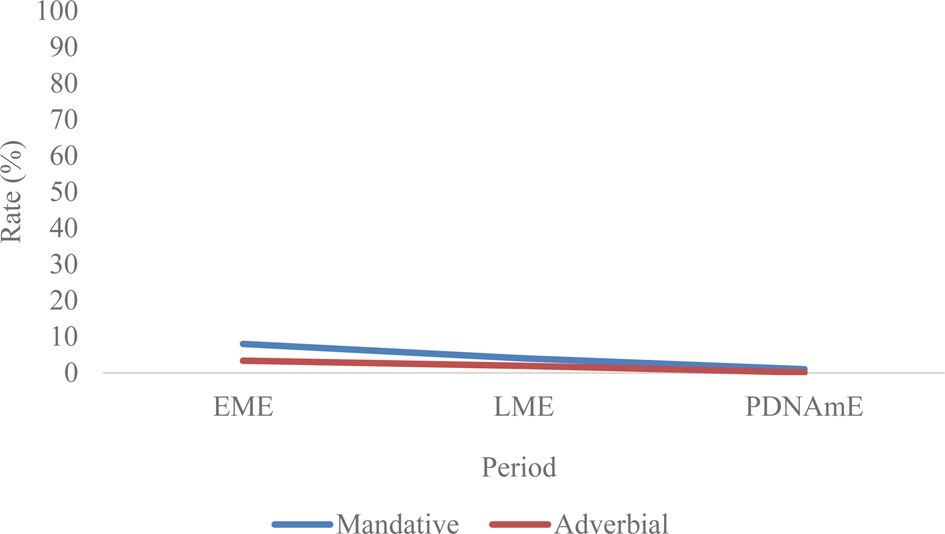
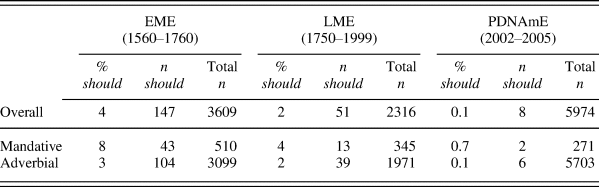
We noted above that we were agnostic as to whether should constitutes a subjunctive variant in the technical sense of the term, despite its preferred status in this context in British English (e.g., Hundt, Reference Hundt, Rohdenburg and Schlüter2009; Johansson & Norheim, Reference Johansson and Norheim1988; Leech et al., Reference Leech, Hundt, Mair and Smith2009; Quirk et al., Reference Quirk, Greenbaum, Leech and Svartvik1985). For PDNAmE, this remains a moot point: having analyzed should for comparative purposes, we can now confirm that, at present, it is by far the minority option in PDNAmE, echoing findings of Waller (Reference Waller2017) and Hundt (Reference Hundt and Deshors2018) (who also reported a decline in the use of this variant since the mid-twentieth century), and apparently always has been. Indeed, our results show that should is currently virtually nonexistent in both mandative and adverbial contexts (Table 12, Figure 5), having declined significantly from already low levels since EME.Footnote 17
Rate of should out of all variants over time.

Rate of should out of all variants over time

DISCUSSION
In sum, systematic quantitative analysis of PDNAmE as actually spoken by educated native speakers of English offers strong confirmation of Sweet's (Reference Sweet1898) observation that the subjunctive is “in disuse.” Not only are its rates of occurrence extremely low across triggers that appeared in the variable context (6% for MS and 2% for AS), but even these exaggerate the extent and productivity of this variant: over 80% of the seventeen tokens of MS found in a large corpus of spoken NAmE were uttered by speakers older than seventy, and a third of those were confined to the expression I wish I were. Use of AS is even rarer and more restricted, limited for all intents and purposes to two triggers (whether and if), under each of which it is basically constrained to a single construction: whether it be, and if x were y. Only their diachronic trajectories of development differ somewhat. Under adverbial triggers, though never particularly robust, the subjunctive was once at least moderately attested in speech, at a rate of 19% in EME, with two thirds of the triggers appearing in eligible contexts (67%, n = 42/63), co-occurring at least once with that variant. But during the nineteenth and twentieth centuries, both the number of triggers governing a subjunctive even once, as well as its overall rate under each, declined significantly, resulting in the current PDNAmE rate of 2%. In contrast, the dearth of MS has remained unchanged since EME. These results are particularly compelling considering that the PDNAmE corpus is nearly six times the size of the speech-like portions of CED and ARCHER sampled (Table 13).
Summary of results according to relative size of corpus used in each period

These results are antithetical to claims that MS has “revived” in NAmE, and that it is now the “norm.” They do support the prevailing wisdom that AS has declined but are at odds with the suggestion (e.g., Brinton, Reference Brinton and Dossena2015; Leech et al., Reference Leech, Hundt, Mair and Smith2009) that NAmE is lagging behind BrE in that change. On the contrary, our results demonstrate that use of AS in NAmE speech is surpassingly inferior to what has been reported for BrE. More important, the rare contexts in which it is selected are essentially limited to whether it be, and if x were y. These account for the vast majority (82%, n = 79/96) of subjunctive occurrences in PDNAmE; yet even here, rather than fossilizing (e.g., Peters, Reference Peters1998:101), subjunctive remains the minority variant (whether it be: 36%; if x were y: 27%; see also Brinton [Reference Brinton and Dossena2015] for the same conclusion). As such, there is little reason to expect that these expressions will ever constitute a bastion of AS.
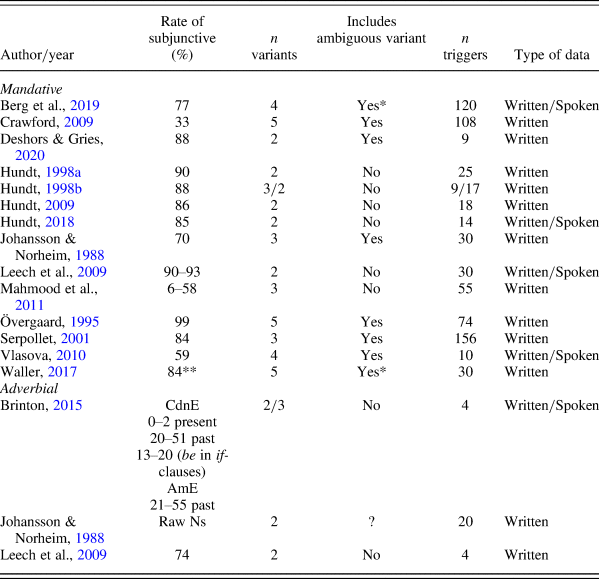
How can the differences between what is reported here and in much of the existing literature be explained? We implicate methodological discrepancies, in particular violations of the Principle of Accountability. These are summarized in Table 14 for a selection of quantitative corpus-based studies of subjunctive use in PDNAmE. First, disparities in both the number and identity of triggers analyzed—ranging from over 100 (e.g., Crawford, Reference Crawford, Rohdenburg and Schlüter2009) to only four (e.g., Leech et al., Reference Leech, Hundt, Mair and Smith2009)—are heavily represented. The built-in inconsistencies among triggers in frequency and strength of association with the subjunctive revealed above practically guarantee that results will vary wildly, depending on which ones are selected for study.
Summary of methodological decisions of selected quantitative corpus-based studies of the subjunctive in PDNAmEFootnote 18

Note: *identifies studies in which ambiguous tokens were included but presented independently of the other variants, thereby enabling the reader to calculate the overall rate of unambiguous subjunctive. ** Rate of subjunctive excluding ambiguous variants calculated by us.
Differences of opinion over what counts as a subjunctive variant also detract from the comparative endeavor. When the quantitatively preponderant ambiguous forms (e.g., I insist that they come) are included, as did Övergaard and many others, subjunctive rates will necessarily be grossly exaggerated. Limiting the analysis only to triggers that governed at least one subjunctive also inflates rates unduly—in the present study, from 6% to 37%. Additional differences in data extraction criteria, data sampling procedures, and data calculation techniques have all contributed to rendering attempts at comparison unreliable at best. To make matters worse, many endorsements of the MS revival scenario (e.g., Haegeman, Reference Haegeman1986; Johansson & Norheim, Reference Johansson and Norheim1988; Kjellmer, Reference Kjellmer, Rohdenburg and Schlüter2009) are lacking the crucial diachronic component, without which change cannot be established. And the recent (welcome!) introduction of sophisticated statistical tools to explain the relative contributions of internal and external factors to variable subjunctive selection (targeting AmE MS in particular; e.g., Berg et al., Reference Berg, Zingler and Lohmann2019; Deshors & Gries, Reference Deshors and Gries2020; Hundt, Reference Hundt and Deshors2018; Ruohonen, Reference Ruohonen2018) has been equally hampered by the methodological disparities that characterize the remainder of the literature (Table 14).
But perhaps the greatest distinction between our study and the others resides in the nature of the data analyzed. The great majority of theirs is written (see Table 14 for selected examples). Granted, many text types (newspapers, fiction, plays, literary texts, academic prose, etc.) are represented, but few of them, by their authors’ own admission, bear much resemblance to spontaneous speech. Nor, to our knowledge, have any of the diachronic studies of NAmE corpora like CED or ARCHER pinpointed the development of either MS or AS in specifically speech-like genres.
The theoretical, analytical, and methodological differences among corpus linguistics studies, coupled with predictable disparities in their results, sometimes for the same data (e.g., Johansson & Norheim, Reference Johansson and Norheim1988; Mahmood et al., Reference Mahmood, Mahmood and Saeed2011; Serpollet, Reference Serpollet, Rayson, Wilson, McEnery, Hardie and Khoja2001), mean that the situation of the subjunctive in the prototypical corpus data is still unclear. We hope that systematic, replicable, variationist work such as that showcased here will one day pin down the trends of subjunctive use in those documents too. Whatever transpires on that front, however, will not detract from what the present work has taught us about PDNAmE speech. There is virtually no subjunctive to speak of in this variety, and our work on the speech-like portions of the diachronic corpora shows that its heyday, if ever there was one, would have predated PDNAmE by at least four centuries. Should methodological advances succeed one day in confirming a “revival” in the texts making up those corpora, we will know to identify it as an externally imposed change in writing style to which speech has remained impervious. In the interim, the moral of this story is that, even in quantitative studies, we must be wary of the repercussions that disparate data, methods, and analytical preferences can have for detecting the directionality, extent, and even existence of language change.
Acknowledgments
This research was generously supported by a SSHRC Doctoral Fellowship grant to Kastronic and a SSHRC Insight grant to Poplack. Poplack holds the Canada Research Chair in Linguistics. We are most grateful to Sebastian Hoffmann, Nuria Yáñez-Bouza, David Denison, Merja Kytö, Hendrik De Smet, and Stefan Dollinger for their help in accessing the ARCHER, CONCE, CLMETEV, and CONTE corpora respectively; to Erik Smitterberg for graciously carrying out preliminary searches of CONCE; to Laurel Brinton, Edgar Schneider, and Sebastian Hoffmann for promptly sending papers; and especially to Christian Mair, who facilitated this work in ways too numerous to detail. We thank Julia Charlebois for her help in summarizing literature and searching, extracting, and coding data, and Nathalie Dion for her organizational prowess. Two anonymous reviewers provided comments that substantially improved this manuscript.
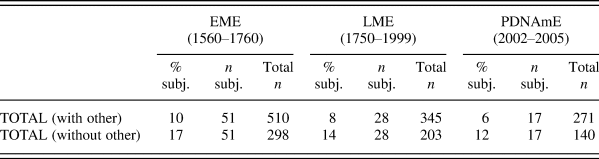
Overall rates of MS with and without the triggers that never governed a subjunctive

Differences among data sets, according to Fisher's Exact Test (two-tailed) at the 0.05 level

Overall rates of AS with and without triggers that never governed a subjunctive

Differences among data sets, according to Fisher's Exact Test (two-tailed) at the 0.05 level