Introduction
The adequate and successful establishment of a seedling is a determining feature for the propagation of a plant species, with seed germination being the most critical phase in the plant life cycle (Nambara and Nonogaki, Reference Nambara and Nonogaki2012; Rajjou et al., Reference Rajjou, Duval, Gallardo, Catusse, Bally, Job and Job2012; Bewley et al., Reference Bewley, Bradford, Hilhorst and Nonogaki2013; Nonogaki, Reference Nonogaki2014). For germination, seeds must be appropriately developed, generally including maturation drying and, if so, released from their dormancy events. Thus, mature quiescent seeds only need to be hydrated under conditions, such as suitable temperatures and oxygen levels, that encourage metabolism (Bove et al., Reference Bove, Jullien and Grappin2001; Bewley et al., Reference Bewley, Bradford, Hilhorst and Nonogaki2013). On the other hand, dormancy mechanisms are present in many seeds to avoid germination under unfavourable environmental conditions for the future life of the newborn individual (Finch-Savage and Leubner-Metzger, Reference Finch-Savage and Leubner-Metzger2006; Penfield, Reference Penfield2017). Even more crucial are the dormancy mechanisms during seed development, where they act to avoid germination on the mother plant, which is usually known as vivipary or pre-harvest sprouting in the case of cereal seeds (Bewley et al., Reference Bewley, Bradford, Hilhorst and Nonogaki2013; Penfield, Reference Penfield2017; Matilla, Reference Matilla2020).
Physiologically, seed germination implies the expansion process restarting the growth of the embryonic axis (Ax), and which is completed by radicle emergence through the seed covering layers (Bewley and Black, Reference Bewley and Black1994; Kucera et al., Reference Kucera, Cohn and Leubner-Metzger2005). During development, the plant hormone abscisic acid (ABA) is the primary known inhibitor of seed germination, thus avoiding vivipary (Kermode, Reference Kermode2005; Bewley et al., Reference Bewley, Bradford, Hilhorst and Nonogaki2013). On the other hand, maturation is not mandatory for the germination process as there is ample evidence that the seed, or at least the embryo therein, can germinate during development under appropriate in vitro conditions (Bewley and Black, Reference Bewley and Black1994; Bewley et al., Reference Bewley, Bradford, Hilhorst and Nonogaki2013).
Soybean seeds [Glycine max (L.) Merr.] are histologically completed at around 21 d after anthesis (DAA), reach physiological maturity (PM) at around 45 DAA and finally desiccate, completing development. These seeds develop inside a pod that constitutes the first protection, surrounding and sheltering them from the environment, thus blocking exogenous water access. From the end of histodifferentiation to PM, the water content of seeds decreases linearly from over 80% to about 60% (Crookston and Hill, Reference Crookston and Hill1978; Itoyama et al., Reference Itoyama, Nakagawa, Ariyoshi, Ario, Yuasa, Iwaya-Inoue and Ishibashi2020). Despite being hydrated, developing seeds do not germinate in planta even though they can be induced to germinate in vitro, removing them from their pods and incubating them adequately in water. However, germination rates of these immature seeds are lower than those of mature seeds (Miles et al., Reference Miles, TeKrony and Egli1988; Gosparini et al., Reference Gosparini, Busilacchi, Vernieri and Morandi2007). The Ax ABA content (ABAa) is considered the main factor controlling in vitro germination of developing soybean seeds (Gosparini et al., Reference Gosparini, Busilacchi, Vernieri and Morandi2007). ABAa was the highest at 25 DAA and progressively decreased below a non-inhibitory threshold, known as critical ABA (ABAc), at around PM (Gosparini et al., Reference Gosparini, Busilacchi, Vernieri and Morandi2007). Thus, from 25 to 45 DAA, the older the seeds, the faster they germinate, indicating that germination constraints are gradually removed during development (Gosparini et al., Reference Gosparini, Morandi and Cairo1997). On the other hand, although ABAa does not constitute an impediment to germination from PM onwards, exogenous ABA can still block germination of these mature soybean seeds by restraining the necessary expansion process in the Ax to complete germination (Montechiarini, Reference Montechiarini2018). More precisely, ABA would restrain the Ax growth potential by avoiding cell wall loosening in a specific zone of the Ax identified as the elongation zone (EZ) (Maidl Souza et al., Reference Maidl Souza, Topham and Bassel2017; Montechiarini et al., Reference Montechiarini, Delgado, Morandi, Carrillo and Gosparini2020). In a recent survey, Montechiarini et al. (Reference Montechiarini, Delgado, Morandi, Carrillo and Gosparini2020) studied mature (DM) soybean Ax growth, focusing on the expansion process in the EZ during germination; in particular, on the expansin proteins, the primary agent which promotes cell wall remodelling required in all plant expansion processes (Cosgrove, Reference Cosgrove2000; Hernández-Nistal et al., Reference Hernández-Nistal, Martín, Esteban, Dopico and Labrador2010; Nambara and Nonogaki, Reference Nambara and Nonogaki2012; Cosgrove, Reference Cosgrove2016; Xu et al., Reference Xu, Lantzouni, Bruggink, Benjamins, Lanfermeijer, Denby, Schwechheimer and Bassel2020). The abundantly expressed expansin EXP1 gene (Glyma17g37990; Lee et al., Reference Lee, Ahn, Song, Choi and Lee2003; Zhu et al., Reference Zhu, Wu, Song, Yin, Qin, Yan and Hu2014; Sangi et al., Reference Sangi, Santos, Alexandrino, Da Cunha, Coelho, Ribeiro, Lenz, Ballesteros, Hemerly, Venâncio, Oliveira and Grativol2019) was up-regulated in distilled water and down-regulated by exogenous 50 μM ABA, which was inhibitory for soybean Ax growth. Additionally, EXP1 transcript levels also correlated with the ABA effect on Ax growth during the time window of ABA responsiveness until around the 6th hour of imbibition (Montechiarini et al., Reference Montechiarini, Delgado, Morandi, Carrillo and Gosparini2020). However, how endogenous ABAa and EXP1 expression levels change during development and germination of soybean Ax remains uncertain.
Additionally, in most mature dispersal units of angiosperms, the embryo is surrounded by the endosperm tissue and the seed covering layers. These tissues can also constitute other significant controllers of seed germination, basically imposing a constraint to radicle protrusion (Yan et al., Reference Yan, Duermeyer, Leoveanu and Nambara2014). Regarding the seed coat (SC), several effects have been attributed to its restrictive role on seed germination, such as reducing water uptake, mechanical restraints to radicle protrusion and limitation of exchange with the environment (Smýkal et al., Reference Smýkal, Vernoud, Blair, Soukup and Thompson2014). Notably, in non-endospermic Fabaceae seeds, the hard, water-impermeable cell layer in the SC provides mechanical and chemical protection for the embryo (Rubio de Casas et al., Reference Rubio de Casas, Willis, Pearse, Baskin, Baskin and Cavender-Bares2017). Wild soybean (Glycine soja) seeds possess a dormancy mechanism imposed by the hard SC, avoiding water uptake (Chandra et al., Reference Chandra, Yadav, Poonia, Yashpal, Rathod, Kumar, Lal and Talukdar2017). However, the years of selection through domestication have turned this hard SC into one that regulates the uniformity of water imbibition rather than the water entrance itself in cultivated soybean seeds (G. max; Koizumi et al., Reference Koizumi, Kikuchi, Isobe, Ishida, Naito and Kano2008). Therefore, although specific environmental conditions can still induce hard seed production in some varieties (Kebede et al., Reference Kebede, Smith and Ray2014), it is accepted that there are no restrictions to germinate in dry, mature soybean seeds (Sakamoto et al., Reference Sakamoto, Abe, Kanazawa and Shimamoto2004; Chandra et al., Reference Chandra, Yadav, Poonia, Yashpal, Rathod, Kumar, Lal and Talukdar2017). Nevertheless, as the seed develops and matures, the functions of the soybean SC change dramatically. In dry, mature seeds, the SC is a tough and dry cover of dead cells that encapsulates and protects the embryo (Mc Donald et al., Reference Mc Donald, Vertucci and Roos1988; Miller et al., Reference Miller, Bowman, Gijzen and Miki1999; Qutob et al., Reference Qutob, Ma, Peterson, Bernards and Gijzen2008), whereas, during development, the SC is a green living tissue that is metabolically highly active (Morandi et al., Reference Morandi, Schussler and Brenner1990; Miller et al., Reference Miller, Bowman, Gijzen and Miki1999). Whether SC would contribute to the control of developing soybean seed germination remains to be ascertained.
In the present work, we studied the endogenous ABAa contents and the extent of EXP1 gene expression at the EZ in germination of developing 25–45 DAA soybean seed. We also explored the role of SC in that process. Results showed that ABAa and EXP1 inversely changed both throughout seed development and during in vitro incubation. During development, while ABAa progressively decreased until reaching a critical non-inhibitory germination value (ABAc) at around maturity (45 DAA onwards), the EXP1 gene was concomitantly increased at the EZ, with the older seeds accumulating higher EXP1 levels. During incubation, ABAa continued decreasing until ABAc at early ages (25–40 DAA) while EXP1 levels were further increased at all ages, with younger seeds experiencing higher expression levels, and thus resulting in high total EXP1 levels, which were also increased with age. The SC did not affect ABAa evolution during incubation but constituted an osmotic and physical barrier to developing soybean seed germination. Taken together, ABAa and EXP1 concertedly control cell wall loosening that promotes Ax growth while the SC independently work by delaying radicle protrusion, and last probably avoiding vivipary.
Materials and methods
Plant material and growing conditions
Soybean [G. max (L.) Merr.] plants, cv. Williams 82, were grown in the greenhouse in 0.8-dm3 pots filled with 3:1 (v/v) humus-rich soil and perlite. Seeds were treated with the fungicide tiabendazol [2-(4-tiazolin)-bendimidazol] before sowing. Pots were over-seeded, and at the unifoliate leaf stage, seedlings thinned to obtain one uniform seedling per pot. The average temperatures during day and night were 25 ± 4 and 15 ± 4°C, respectively, and the photoperiod was the natural one for the latitude (33°1′S) and varied between the sowing date (20 April; 11 h 57 min) and harvest date for fruits of 45 DDA (15 July; 11 h 05 min). The mean photosynthetic active photon flux density (maximum daily values averaged throughout the growing season) was 700 μE m−2 s−1 (400–700 nm), measured with a LI-COR 185a radiometer and 190-s sensor (LI-COR Ltd, Lincoln, Nebraska, USA).
Fruit harvest at intervals after anthesis (DAA)
Uniform, synchronously growing fruits were harvested during development at 25, 30, 35, 40 and 45 DAA and superficially disinfected by immersion in 0.5% (w/v) sodium hypochlorite for 10 min and washed twice in sterile distilled water. Seeds were separated from their fruits under a laminar flow hood, sterilized by immersion in 0.25% (w/v) sodium hypochlorite for 1 min and washed twice in sterile distilled water. At each age, three structures were analysed: seeds (Se, whole seeds), embryos (Em, seeds without SC) and Ax (embryos without cotyledons). Em and Ax were manually dissected using a surgical blade. The age of each structure corresponded to the DAA of its respective fruits at the time of harvest.
Germination assays
Highly uniform Se, Em and Ax at 25, 30, 35, 40 and 45 DAA were used. Two germination assays were performed in the dark at 27 ± 1°C in sterilized Petri dishes on top of three filter papers saturated with 8 ml of the different incubation media, which were renewed daily. Percentages of germination (%G) were recorded at different incubation times depending on the experiments. Seeds were considered germinated when the radicle protruded through the SC. Em and Ax were considered germinated when an enlargement ≥2 mm of the radicle extreme was recorded. The viability of non-germinated Se, Em and Ax after germination assays was assessed by topographical tetrazolium test (ISTA, 2016).
The first assay was carried out to compare germination performance among Se, Em and Ax at 25, 30, 35, 40 and 45 DAA. Six replicates each of 20 Se, Em and Ax at all ages were incubated in distilled water for 168 h. The time required for 50%G (t50) was used as a measure of the germination rate.
The second assay was conducted to evaluate the necessary growth potential to germinate for Ax and Se of 45 DAA (when ABAa is below its inhibitory threshold). Three replicates each of 20 Ax and Se at 45 DAA were incubated in distilled water (control; Ψw = 0 MPa) and Polyethyleneglycol 8000 (PEG) solutions of different water potentials (Ψw = −0.125, −0.25, −0.5, −1 and −1.5 MPa; Michel, Reference Michel1983) for 168 h.
ABA extraction and quantification
Six replicates each of Se, Em and Ax at 25, 30, 35, 40 and 45 DAA were collected at 0, 12, 24, 48, 72, 96, 120, 144 and 168 h of incubation in the dark at 27 ± 1°C in distilled water. The structures were manually dissected using a surgical blade, and the respective organs (SC, cotyledons and Ax) were frozen in liquid N2 and lyophilized. The dry weight (DW) of the organs was determined separately in a Precisa 205 A SuperBal – series scale (10−5 g) and then kept at −70°C until ABA analyses. ABA quantification was carried out according to Gosparini et al. (Reference Gosparini, Busilacchi, Vernieri and Morandi2007) by a solid-phase radioimmunoassay based on the use of the monoclonal antibody DBPA1, raised against S-(+)-ABA (Vernieri et al., Reference Vernieri, Perata, Armellini, Bugnoli, Presentini, Lorenzi, Ceccarelli, Alpi and Tognoni1989a) in a liquid scintillation analyser Mod 1600 TR Packard (PerkinElmer, Waltham, MA, USA). The mean ABAc for Ax, Em and Se at each age was calculated according to Gosparini et al. (Reference Gosparini, Busilacchi, Vernieri and Morandi2007). For 25 and 30 DAA, these ABAc values were calculated taking into account just Em and Ax since t50 was not reached for Se during the experiment.
Total RNA isolation and cDNA synthesis
At least three axes of soybean seeds, each at 25, 30, 35, 40, 45 and >60 (DM) DAA were collected at 0 h and at different incubation times (depending on the analysed age) in the dark at 27 ± 1°C in distilled water. Then, axes were manually dissected using a surgical blade to obtain the EZ, and the extremes (the plumule and the radicle) were discarded. The EZ were immediately frozen in liquid N2 and stored at –70°C until RNA purification. Total RNA isolation and cDNA synthesis were carried out according to Montechiarini et al. (Reference Montechiarini, Delgado, Morandi, Carrillo and Gosparini2020).
EXP1 mRNA expression analysis
Quantitative real-time PCR reactions (qPCR) were carried out according to Montechiarini et al. (Reference Montechiarini, Delgado, Morandi, Carrillo and Gosparini2020) in a Rotor-Gene Q Series (Qiagen®, Hilden, Germany), using cDNA from the EZ of Ax at different DAA and incubation times, Forward (5′-GCCCTTCCTAACAACAATGG-3′) and Reverse (5′-CATGGAACCCTTTGAAATAGC-3′) primers specifically designed for EXP1, and Glyma05g37470 as a reference gene (Li et al., Reference Li, Fan, Zhang and Fu2012). Reactions were carried out with three biological replicates. EXP1 expression levels in the EZ were determined at 25, 30, 35, 40, 45 and >60 DAA and normalized against the levels measured at 25 DAA. They were also measured at 25, 30, 35, 40 and 45 DAA after different incubation times in distilled water and normalized against the respective levels measured at 0 h. Intervals of EXP1 expression determination during incubation depended on the germination times at each age; the older the Ax, the shorter they were. Results were analysed with REST 2009 software (https://www.gene-quantification.de/rest-2009.html) based on the statistical model Pair Wise Fixed Reallocation Randomisation Test© (Pfaffl et al., Reference Pfaffl, Horgan and Dempfle2002).
Water content and water potential (Ψw) of Ax
The water content was measured in triplicates at 25, 30, 35, 40 and 45 DAA of ten isolated Ax and ten Ax from whole Se (Ax–Se) after 0, 6, 12, 24 and 48 h of incubation. Before measurements, Se were manually dissected using a surgical blade to obtain Ax–Se. The water content was measured as the difference between fresh and dry weight at each incubation time by using a Precisa 205 A SuperBal – series scale (10−5 g).
The Ψw were measured by triplicate at 25, 30, 35, 40 and 45 DAA on five isolated Ax and five Ax from whole Se (Ax–Se) after 0, 6, 12, 24 and 48 h in distilled water or until the size of the Ax exceeded the chamber capacity. Measurements were made using C-52 sample chambers with a microvoltmeter Wescor HR-33 T in the psychrometric mode (Wescor Inc., Logan, UT, USA).
Fresh weight, dry weight and water content of seeds
Fresh and dry weights (mg) were measured on 40 Se each at 25, 30, 35, 40 and 45 DAA in a Precisa 205 A SuperBal – series scale (10−5 g), before and after reaching constant weight, during 48 h in an oven at 70°C, respectively. The water content (%) was calculated on a fresh weight basis.
Mechanical resistance of SCs
The SC of 100 Se each of 25, 30, 35, 40 and 45 DAA was carefully separated manually using a surgical blade and tested to determine the pressure necessary to protrude it on the micropylar area. Measurements were performed using a Texture Analyser device (TA.XTplus, Stable Micro Systems Texture Technologies®, Scarsdale, NY), equipped with an ad-hoc puncture rounded-end probe with a 0.5 mm radius end. The results were analysed by ANOVA and LSD test (P < 0.05).
Results
Germination of Ax, Em and Se
In order to compare germination performance of Ax, Em and Se of 25, 30, 35, 40 and 45 DAA, we analysed the times of the start of germination, %G and t50 during 168 h of incubation in distilled water. At 25 DAA, germination started after 12, 24 and 72 h of incubation for Ax, Em and Se, respectively (Fig. 1a). At 30 DAA, Ax started to germinate before 12 h, Em after 12 h and Se after 48 h of incubation (Fig. 1b). At 35 DAA, Ax germinated from the beginning of incubation, Em from 12 h and Se from 24 h of incubation (Fig. 1c). At 40 DAA, both Ax and Em germinated almost simultaneously from the commencement of incubation, while Se followed after 12 h (Fig. 1d). At 45 DAA, all structures germinated from the beginning of incubation; Em germinated almost as fast as Ax and both of them faster than Se (Fig. 1e). At each age, Ax and Em reached the same maximum %G (70, 96, 90, 97 and 100%G at 25, 30, 35, 40 and 45 DAA, respectively), whereas these values were the lowest for Se (17, 45, 68, 70 and 88%G at 25, 30, 35, 40 and 45 DAA, respectively). The t50 for Ax and Em were 93.3 and 91.2, 90.5 and 104.7, 60.0 and 73.8, 22.6 and 23.8 and 10.4 and 17.3 h at 25, 30, 35, 40 and 45 DAA, respectively. The t50 for Se was 126.9, 78.7 and 61.1 h at 35, 40 and 45 DAA, respectively. Se of 25 and 30 DAA did not reach 50%G during the experiment (Fig. 1).
Germination (%) time-course of isolated soybean Ax, isolated soybean Em and whole soybean Se harvested at 25 (a), 30 (b), 35 (c), 40 (d) and 45 (e) DAA and incubated in distilled water at 27 ± 1°C, in the dark. Points represent the means ± SE for six replicates of 20 structures. If not shown, SE was within the data point. The dotted line corresponds to 50% germination (t50).

In general, the older the structures, the faster germinated and in a higher %G (Fig. 1 and Supplementary Fig. S1). It could be related to the ABAa in these structures as development progressed. On the other hand, at each age, Ax and Em germinated faster than Se, thus evidencing a possible additional effect on the SC delaying germination.
ABAa and EXP1 transcript abundance at the EZ during development
ABAa and the relative EXP1 transcript abundance at the EZ were measured throughout development to study their participation in developing soybean Ax germination. ABAa at 25, 30, 35, 40 and 45 DAA was 14.5, 13.6, 5.1, 4.6 and 1.8 μg ABA g−1 DW, respectively (Fig. 2). ABAa at 45 DAA (PM) was non-inhibitory for germination, as was established by Gosparini et al. (Reference Gosparini, Busilacchi, Vernieri and Morandi2007). EXP1 expression in the EZ determined at 25, 30, 35, 40, 45 and >60 DAA, normalized against the levels measured at 25 DAA, differed significantly (P < 0.05) and progressively increased with age (Fig. 2). These increases were similar at 30, 35 and 40 DAA (ranging from ~6 to 10 fold) and much higher at 45 DAA (~160 fold) and at >60 DAA (~325 fold).
Endogenous ABA (μg g−1 DW) in the soybean embryonic axis (ABAa) and expression of EXP1 in the EZ at 25, 30, 35, 40, 45 and >60 DAA relative to 25 DAA, as determined by qPCR. qPCR analyses normalized to the reference gene Glyma05g37470. Error bars represent the means ± SD of three biological replicates. *Significant difference (P < 0.05).

ABA content of Ax, cotyledons and SC and EXP1 abundance at the EZ during incubation
ABAa evolution for Ax, Em and Se and EXP1 expression at the EZ for Ax at 25, 30, 35, 40 and 45 DAA were analysed during 168 and 48 h of incubation, respectively, in distilled water to evaluate the effect of ABAa and EXP1 on the germination performance.
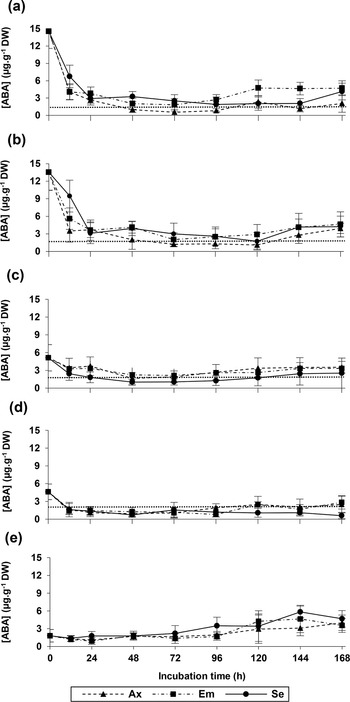
From 25 to 40 DAA, ABAa decreased in all structures, with the main decline occurring during the first 12–24 h; the higher ABAa at harvest, the faster it declined (Fig. 3). At 45 DAA (PM), ABAa had already reached the critical non-inhibitory level before incubation and it slightly increased in all structures during incubation, following de novo synthesis associated with radicle growth, as previously described by Iglesias and Babiano (Reference Iglesias and Babiano1997) and Gosparini et al. (Reference Gosparini, Busilacchi, Vernieri and Morandi2007). The mean ABAc (Fig. 3, horizontal dotted line) was 1.3 ± 0.9; 1.9 ± 0.8; 1.9 ± 0.9 and 2.1 ± 0.7 μg ABA g−1 DW at 25, 30, 35 and 40 DAA, respectively. This ABAc was reached, on average, at 72, 60, 36 and 12 h of incubation for all the respective structures of 25, 30, 35 and 40 DAA (Fig. 3). Also, for each DAA interval, the ABA contents of cotyledons (Supplementary Fig. S2) and SC (Supplementary Fig. S3) were, on average, 3.5 and 4.5 times higher than ABAa, respectively, and both concentrations declined similarly to that of ABAa during incubation.
Endogenous ABA (μg g−1 DW) time-course in the embryonic axis (ABAa) of isolated soybean Ax, isolated soybean Em and whole soybean Se harvested at 25 (a), 30 (b), 35 (c), 40 (d) and 45 (e) DAA and incubated in distilled water at 27 ± 1°C, in the dark. Points represent the means ± SE of six replicates. If not shown, SE was within the data point. The dotted line indicates the mean ABAc for Ax, Em and Se at 25, 30, 35 and 40 DAA. At 45 DAA, the ABAa at harvest has already found below ABAc.

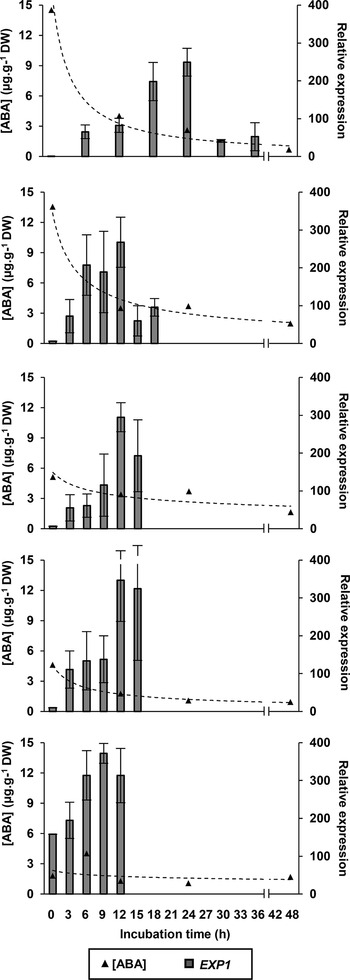
During incubation, EXP1 expression determined in the EZ at each DAA, normalized against the respective initial levels (0 h of incubation), increased significantly (P < 0.05) from the beginning of incubation. These increases were the highest at 25 DAA (~50–250 fold), similar at 30, 35 and 40 DAA (~8–45 fold), and the lowest at 45 DAA (~2 fold). For better understanding, the EXP1 expression data were analysed compared to 25 DAA considering both the accumulation of EXP1 throughout development (Fig. 2) and the induction of EXP1 expression during incubation. Then, the highest total EXP1 levels were 249.3, 268.0, 294.6, 346.3 and 371.8-fold at 25, 30, 35, 40 and 45 DAA, respectively, increasing with age (Fig. 4).
Endogenous ABA (μg g−1 DW) in the soybean embryonic axis (ABAa), and expression of EXP1 in the EZ at 25 (a), 30 (b), 35 (c), 40 (d) and 45 (e) DAA during incubation in distilled water, relative to 25 DAA before incubation. Relative expression values shown correspond to EXP1 expression levels both accumulated throughout development and up-regulated during incubation.

Ax growth potential at 45 DAA in solutions of different water potentials (Ψw)
Ax and Se of 45 DAA (free of inhibitory ABAa) were incubated for 168 h in solutions of decreasing water potentials to further explore the SC effect on Ax growth potential.
Ax started to germinate between 6 and 12 h in PEG solutions of 0, −0.125, −0.25 and −0.5 MPa. Maximum %G observed was 100% in 0 and −0.125 MPa between 12 and 24 h, 90% in −0.25 MPa at 24 h and 100% in −0.5 MPa at 48 h (Fig. 5a). Meanwhile, Se started to germinate at 24 h in 0, −0.125, −0.25 MPa and, at 120 h in −0.5 MPa. Maximum %G registered for Se was 100% in 0 MPa at 120 h, 90% in −0.125 and −0.25 MPa at 168 h and 20% in −0.5 MPa at 144 h (Fig. 5b). Neither Ax nor Se germinated in −1 and −1.5 MPa (Fig. 5).
Germination (%) time-course of isolated soybean Ax (a) and whole soybean Se (b) harvested 45 DAA and incubated in aqueous solutions of PEG 8000 of 0 (control), −0.125, −0.25, −0.5, −1 and −1.5 MPa, at 27 ± 1°C in the dark. Points represent the means ± SE for three replicates of 20 structures. If not shown, SE was within the data point.

Water content and water potential (Ψw) of Ax during incubation
To evaluate the permeability effect of the SC, the evolution of water content and Ψw for isolated Ax (in direct contact with the incubation medium) and Ax from whole Se (Ax–Se) incubated in distilled water were explored during 48 h of incubation. The initial water content of both isolated Ax and Ax–Se depended on the stage of seed development (Supplementary Table S1), ranging from 72 to 58% from 25 to 45 DAA (Fig. 6, 0 h). At all ages, isolated Ax gained more water and did it faster than Ax–Se (Fig. 6). The Ψw of both isolated Ax and Ax–Se at 25, 30, 35, 40 and 45 DAA (Supplementary Fig. S4, 0 h) were maintained relatively constant (ranging from −0.93 to −1.15 MPa). During incubation, while the Ψw of isolated Ax showed a rapidly increasing peak during the first 6 h, the Ψw of Ax–Se increased slowly and at a lower rate (Supplementary Fig. S4).
Water content (%) time-course of isolated soybean Ax and soybean Ax from whole seeds (Ax–Se) harvested at 25 (a), 30 (b), 35 (c), 40 (d) and 45 (e) DAA, and incubated in distilled water at 27 ± 1°C, in the dark. Water content was calculated on a fresh weight basis. Points represent the means ± SE for ten replicates. If not shown, SE was within the data point.

SC mechanical resistance
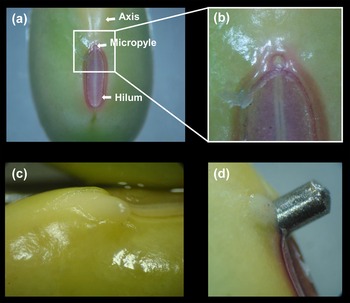
The mechanical resistance of the SC was analysed at 25, 30, 35, 40 and 45 DAA on the micropylar area, where radicle protrusion normally occurs (Fig. 7). The minimum pressure to penetrate the soybean SC in the micropylar area (Fig. 7d) increased from 25 to 45 DAA (Table 1), and significantly from 35 DAA onwards (P < 0.05).
Digital images of the hilum and the micropyle of the SC of a developing soybean seed using a 2× objective (a) with 3× scanning zoom (b). Digital images of the radicle protrusion (c) and the mechanical puncture with an ad-hoc puncture rounded-end probe with 0.5 mm radius end (d) on the micropylar area of the SC of developing soybean seed.

Rupture pressure (MPa) on the micropylar area of SCs of soybean seeds harvested at 25, 30, 35, 40 and 45 DAA

The results are the means ± SE of 100 replicates. Different letters indicate significant differences (P < 0.05).
Discussion
Seed germination implies an expansion process restarting the growth of the Ax and which is completed by radicle emergence through the seed covering layers (Bewley and Black, Reference Bewley and Black1994; Kucera et al., Reference Kucera, Cohn and Leubner-Metzger2005). Although soybean seeds germinate fast and uniformly without restrictions at maturity, germination is avoided in planta during development. In the present work, we show that developing Se, Em and Ax of 25, 30, 35, 40 and 45 DAA were able to germinate in vitro, with germination performances increasing with DAA (Fig. 1 and Supplementary Fig. S1). Additionally, at all ages, Ax and Em showed similar germination behaviours and both always germinated faster than the respective Se (Fig. 1). It is indicated that (1) the growth of Ax was not impaired by the removal of the cotyledons, (2) the mobilization of the main storage reserve from cotyledons necessary to support the subsequent growth of the seedling, was not involved in the expansion process that drives germination and (3) the SC would negatively affect developing seeds germination. Last, these results support that the molecular events on germination could appropriately be analysed from the isolated Ax, and also highlight the participation of the SC by delaying developing soybean seed germination.
ABAa and EXP1 involvement in germination of developing soybean seed
The ABAa is mainly responsible for inhibiting Ax growth in developing soybean seeds, with younger seeds containing higher ABAa and thus undergoing stronger inhibitory effects. At around PM (45 DAA), ABAa drops below a critical non-inhibitory threshold (ABAc) (Gosparini et al., Reference Gosparini, Busilacchi, Vernieri and Morandi2007). At earlier ages (25–40 DAA), this non-inhibitory ABAa is rapidly reached during in vitro incubation. In the present work, it was demonstrated that these results were valid not only for Se but also for Em and Ax of the same age (Figs 2 and 3). Moreover, the mean ABAc values for these three structures increased with age (Fig. 3, dotted line), thus confirming that sensitivity of Ax to ABA diminished slowly during development, as was reported by Gosparini et al. (Reference Gosparini, Busilacchi, Vernieri and Morandi2007). The ABAa evolution throughout development was then associated with germination performances of all structures, with rates and %G increasing with DAA (Fig. 1). ABA blocks seed germination by restraining the expansion process necessary for the Ax growth (Bewley, Reference Bewley1997; Kucera et al., Reference Kucera, Cohn and Leubner-Metzger2005; Gimeno-Gilles et al., Reference Gimeno-Gilles, Leliévre, Viau, Malik-Ghulam, Ricoult, Niebel, Leduc and Limami2009; Hernández-Nistal et al., Reference Hernández-Nistal, Martín, Esteban, Dopico and Labrador2010), more precisely, on cells of the EZ (Sliwinska et al., Reference Sliwinska, Bassel and Bewley2009; Maidl Souza et al., Reference Maidl Souza, Topham and Bassel2017; Montechiarini et al., Reference Montechiarini, Delgado, Morandi, Carrillo and Gosparini2020). Mounting evidence supports a down-regulation effect by exogenous ABA on expansins in the inhibition of germination of mature seeds of Medicago truncatula (Gimeno-Gilles et al., Reference Gimeno-Gilles, Leliévre, Viau, Malik-Ghulam, Ricoult, Niebel, Leduc and Limami2009) and Cicer arietinum (Hernández-Nistal et al., Reference Hernández-Nistal, Martín, Esteban, Dopico and Labrador2010). In particular, it was demonstrated in soybean that an expansin gene (EXP1) expressed at the EZ during mature Ax germination was correlated with Ax growth, being transcriptionally up-regulated during imbibition in water and down-regulated by exogenous ABA (Montechiarini et al., Reference Montechiarini, Delgado, Morandi, Carrillo and Gosparini2020). Also, transcripts of EXP1, as well as from other genes encoding cell wall remodelling proteins that act secondarily on cell expansion processes (such as cellulases, xyloglucan endotransglucosylase hydrolase), were found among the long-lived mRNAs required for seed germination (Sangi et al., Reference Sangi, Santos, Alexandrino, Da Cunha, Coelho, Ribeiro, Lenz, Ballesteros, Hemerly, Venâncio, Oliveira and Grativol2019; Montechiarini et al., Reference Montechiarini, Delgado, Morandi, Carrillo and Gosparini2020; Sano et al., Reference Sano, Rajjou and North2020; Xu et al., Reference Xu, Lantzouni, Bruggink, Benjamins, Lanfermeijer, Denby, Schwechheimer and Bassel2020). In the present work, we showed how EXP1 mRNA increasingly accumulated at the EZ throughout development (Fig. 2). Related to 25 DAA, the EXP1 expression level was increased ~6–10 fold between 30 and 40 DAA, ~160 fold at 45 DAA (PM) and ~325 fold at drying maturity (DM >60 DAA). Taken together, these results show that, as development progresses less ABAa and more EXP1 accumulate, thus suggesting the progressive ability of Ax with age to develop the growth potential required to complete germination. Additionally, a peak of EXP1 expression was observed from PM, becoming much higher at DM (Fig. 2). During this last dehydration phase, more precisely after PM and before DM, it has currently been accepted that the quality of soybean seed is defined (Zanakis et al., Reference Zanakis, Ellis and Summerfield1994) with specific metabolic activities oriented to increase seed desiccation tolerance, vigour and longevity (Bewley et al., Reference Bewley, Bradford, Hilhorst and Nonogaki2013). Moreover, plants of Arabidopsis ectopically expressing an expansin protein increased germination under osmotic stress (Lü et al., Reference Lü, Kang, Jiang, Dai, Gao and Zhang2013). Therefore, Finch-Savage and Bassel (Reference Finch-Savage and Bassel2016) identified expansins as good candidate targets of seed quality and vigour. In soybean, this accumulation of EXP1 mRNA observed between PM and DM (Fig. 2) could, thus, contribute to quality improvement, promoting seeds to germinate quickly after rehydration. This topic, however, deserves further research.
In addition, many of the long-lived mRNAs indispensable for the germination of mature soybean (Montechiarini et al., Reference Montechiarini, Delgado, Morandi, Carrillo and Gosparini2020) and Arabidopsis (Sano et al., Reference Sano, Rajjou and North2020) seeds and immature rice embryos (Sano et al., Reference Sano, Ono, Murata, Yamada, Hirasawa and Kanekatsu2015) did not only accumulate during development but were also enhanced during imbibition. Similarly, our results showed that, while ABAa progressively decreased (Fig. 4), EXP1 abundance in the EZ significantly increased during incubation at all ages, following a similar expression pattern to that of dry, mature Ax (Montechiarini et al., Reference Montechiarini, Delgado, Morandi, Carrillo and Gosparini2020) and resulting in the highest expression levels at 25 DAA (~50–250 fold), similar and intermediate at 30, 35 and 40 DAA (~8–45 fold) and the lowest at 45 DAA (~2 fold). Even more interestingly, the more EXP1 transcripts accumulated throughout development (Fig. 2) the lower induction of expression during incubation. Thus, taking into account the EXP1 levels both accumulated throughout development and expressed during incubation, high total EXP1 levels were reached, progressively increasing with age (249.3, 268.0, 294.6, 346.3 and 371.8-fold at 25, 30, 35, 40 and 45 DAA, respectively; Fig. 4).
Taken together, these results highlight the need of reducing ABAa and achieve high levels of EXP1 for germination to occur. Then, Ax of 45 DAA, with ABAa below ABAc and high EXP1 accumulated during development, would be better prepared to develop the Ax growth potential and rapidly germinate. By contrast, the delay in the germination of immature axes (25–40 DAA) could be associated with the additional incubation time required to reduce its ABAa and increase the EXP1 expression at the EZ. ABAa could restrain cell wall loosening by directly down-regulating EXP1 expression at the EZ or, it might act through its interaction with other possible controllers, more probably gibberellins (GA), and thus indirectly inhibiting germination. The ABA-GA antagonism is well known in mature seed germination (Liu and Hou, Reference Liu and Hou2018; Shu et al., Reference Shu, Zhou, Chen, Luo and Yang2018; Gazara et al., Reference Gazara, de Oliveira, Rodrigues, Nunes da Fonseca, Oliveira and Venancio2019), but fewer reports exist about it during seed development (Liu and Hou, Reference Liu and Hou2018). During imbibition, results with dry, mature soybean Ax demonstrated that as the ABA pathway is inactivated, up-regulation of the GA pathway occurs simultaneously (Bellieny-Rabelo et al., Reference Bellieny-Rabelo, De Oliveira, Da Silva Ribeiro, Pessoa Costa, Oliveira and Venancio2016; Gazara et al., Reference Gazara, de Oliveira, Rodrigues, Nunes da Fonseca, Oliveira and Venancio2019). During seed development, whereas genes of ABA metabolism and signalling were described as accumulating among long-lived mRNAs in rice (Sano et al., Reference Sano, Ono, Murata, Yamada, Hirasawa and Kanekatsu2015), Arabidopsis (Nakabayashi et al., Reference Nakabayashi, Okamoto, Koshiba, Kamiya and Nambara2005) and soybean (Bellieny-Rabelo et al., Reference Bellieny-Rabelo, De Oliveira, Da Silva Ribeiro, Pessoa Costa, Oliveira and Venancio2016), non-detectable levels were found for those related to biosynthesis and GA-responsiveness (Sano et al., Reference Sano, Rajjou and North2020), resulting in low GA levels at this early stage (Liu and Hou, Reference Liu and Hou2018). In particular, although ABA-responsiveness elements were not found in this soybean EXP1 gene (Glyma17g37990), a cis-element related to gibberellin-responsiveness was identified among the 36 regulatory elements reported by Zhu et al. (Reference Zhu, Wu, Song, Yin, Qin, Yan and Hu2014). Thus, the involvement of GA in the control of EXP1 expression in developing soybean seed germination remains to be assessed. Additionally, while ABA would be the major inhibitor and GAs the main promoter of seed germination, other possible controllers in the modulation of EXP1 expression on developing soybean seed germination could not be ruled out and deserve further studies.
SC involvement in developing soybean seed germination
The seed covering layers can also control seed germination by preventing the embryo from developing enough pressure to grow and thus, generating a barrier opposing radicle protrusion (Finch-Savage and Leubner-Metzger, Reference Finch-Savage and Leubner-Metzger2006; Steinbrecher and Leubner-Metzger, Reference Steinbrecher and Leubner-Metzger2017, Reference Steinbrecher and Leubner-Metzger2018). Since the endosperm tissue has already reabsorbed into the cotyledons of 25–45 DAA soybean seeds (Smýkal et al., Reference Smýkal, Vernoud, Blair, Soukup and Thompson2014; Yan et al., Reference Yan, Duermeyer, Leoveanu and Nambara2014), the only seed covering layer enveloping the embryo is the SC, which constitutes a permeability barrier to water and physical resistance to Ax growth. Although the presence of the SC delaying germination of dry, mature soybean seeds were proposed (Valio, Reference Valio1986), the SC is not considered an impediment for germination in domesticated soybean seeds (Sakamoto et al., Reference Sakamoto, Abe, Kanazawa and Shimamoto2004; Chandra et al., Reference Chandra, Yadav, Poonia, Yashpal, Rathod, Kumar, Lal and Talukdar2017). In developing soybean seeds, our results showed that, when SC was removed, the Em and Ax germinated earlier, faster and in a higher proportion than Se of the same age, with the t50 of Se being always the longest in 35, 40 and 45 DAA and not reached after 168 h of incubation at 25 and 30 DAA (Fig. 1). Additionally, at each age, ABAa dropped similarly for Ax, Em and Se during incubation (Fig. 3), indicating that the SC did not affect ABAa evolution and ABA movement from cotyledons and SC to the Ax was negligible, despite having higher initial ABA concentrations (Supplementary Figs S2 and S3, 0 h incubation). On the other hand, studies in Brassica napus embryos (Schopfer and Plachy, Reference Schopfer and Plachy1985) and developing embryos of Medicago sativa (Xu et al., Reference Xu, Coulter and Bewley1990) indicated that the osmotic environment and ABA together control seed germination, but their actions appear to be essentially independent (Hilhorst, Reference Hilhorst1995). While ABA prevented cell wall loosening, the osmoticum impaired Ax water uptake. In developing soybean seeds, the SC determines the apoplastic interface (AI) between it and the Em, where osmotically active compounds (mainly sucrose) are continuously downloaded from the mother plant to nourish the embryo. This osmotic gradient could reduce the rate of water uptake by the Ax–Se. In the present work, Ax and Se of 45 DAA (free of the inhibitory ABA effects) showed a differential behaviour under incubation in PEG solutions of different Ψw. Whereas Ax germinated faster and more uniformly, Se germinated slowly and to lower %G (Fig. 5). Moreover, although both Ax and Se were still capable of developing the growth potential necessary for germination at Ψw = −0.5 MPa, Ax started germination at 12 h and reached 100%G at 48 h while Se started germination at 120 h and just reached 20%G after 144 h (Fig. 5). At that age (45 DAA), with ABAa below ABAc and the highest accumulated EXP1 level at the EZ, the SC turns out to be the most important controller and therefore, these results clearly show the role of the SC in delaying radicle protrusion from whole seeds. Additionally, at all DAA and in water incubation, while isolated Ax (in direct contact with the medium) rapidly increased their Ψw during the first 6 h, Ax from incubated whole seeds (Ax–Se) did it more slowly (Supplementary Fig. S4).
Discrepancies have been reported after Ψw measurements in embryos during development. They were argued to be caused, among other factors, by the hydraulic pressure generated upon the Ax in the intact seed; this pressure is released when the embryo is excised, resulting in a lower Ψw value (Bradford, Reference Bradford1994). Nevertheless, in our experiments, isolated Ax gained water faster than Ax–Se (Fig. 6), thus supporting the Ψw data. Also, the Ψw measurements confirmed the stability of Ψw throughout Ax development (Supplementary Fig. S4a–e, 0 h of incubation), as reported by Morandi et al. (Reference Morandi, Schussler and Brenner1990) and Egli and Tekrony (Reference Egli and Tekrony1997). Further research will be necessary to weigh the real contribution of the osmolarity and the permeability associated with the SC in the control of developing soybean seed germination. Nevertheless, both properties would operate limiting the ability of Ax to develop enough growth potential and at least, partially explain the germination delay in Se of all ages. This delay becomes even more pronounced at earlier ages. At these stages of development, the highest EXP1 levels reached during incubation resulted comparatively lower than those at older ages (Fig. 4). Then, even though other non-explored factors must be involved, it is probable that these lower total EXP1 levels contribute to restraining the Ax growth potential to protrude the SC and, consequently, to the poorer germination performances observed in younger Se.
Another interesting result associated with the SC was the rupture pressure on the micropylar area (Fig. 7d), which was high and significantly increased from 25 to 45 DAA (Table 1). This fact has not been previously reported and supports the participation of the SC mechanical resistance in the delay of germination during development. Thus, the SC could contribute to the control of developing soybean seed germination by physical and osmotically impairing Ax growth and mechanically restraining radicle protrusion.
Concluding remarks
In summary, we conclude that ABAa and the EXP1 gene concertedly work to control the growth potential of the soybean Ax. ABAa is responsible for restraining cell wall loosening required for the cell expansion process. While the ABAa naturally decreased in planta until non-inhibitory ABAa at around PM (45 DAA), this ABAc was reached during in vitro incubation at earlier ages (25–40 DAA). In turn, the EXP1 gene expressed at the EZ of the Ax was found to be involved in the promotion of the expansion process on germination. The EXP1 levels were the lowest at 25 DAA and naturally accumulated in planta peaking from PM onwards. Besides, EXP1 levels were up-regulated during in vitro incubation at all ages. It appeared that certain high levels of EXP1 expression are required for soybean seed germination, regardless of seed age (25–45 DAA). Since EXP1 transcript levels increased along seed development, young seeds needed longer and mature seeds needed shorter periods to achieve such levels, thus probably explaining the length of the lag phase for the start of germination. These novel findings further support the role of ABAa and EXP1 in developing soybean seed germination by, at least partially, controlling cell wall remodelling to complete germination. On the other hand, while the SC did not affect ABAa evolution during incubation, our results indicate that it would physically regulate Ax water uptake and, at the same time, constitute a mechanical barrier of increasing magnitude opposing radicle protrusion. In older seeds, with lower ABAa and higher total EXP1 levels, the higher mechanical resistance on the SC would mainly restrain the radicle protrusion. By contrast, at earlier stages, the higher ABAa and lower EXP1 total levels would be mainly responsible for reducing the Ax growth potential thus delaying protrusion, despite the lower mechanical resistance on the SC.
We, therefore, propose independent mechanisms of action for these controllers by restraining the in planta and in vitro developing soybean seed germination. These findings could contribute to gain a better insight into the physiological mechanisms that prevent vivipary. Furthermore, they could be useful to accelerate the in vitro germination of immature seeds and thus to improve the efficiency of soybean breeding programmes by reducing the time required to develop new cultivars.
Supplementary material
To view supplementary material for this article, please visit: https://doi.org/10.1017/S0960258522000022.
Acknowledgements
The authors gratefully acknowledge Dr. Paolo Vernieri for providing the antibody DBPA1; Dr. Néstor Carrillo and Eng. Ricardo Martignone for critically reading the manuscript; Professor Berta Pizzo for her valuable assistance with the redaction of this paper and Dr. Mauro Perini, Dr. Ignacio Sin, Dr. Gustavo Martínez and Dr. Pedro M. Civello for technical support with the rupture pressure measurement.
Financial support
This work was supported by the Universidad Nacional de Rosario (AGR310) and the Consejo Nacional de Investigaciones Científicas y Técnicas (PUE 0043).
Conflict of interest
The authors declare that they have no conflict of interest.