




No CrossRef data available.
The German Twin Crisis of 1931
Published online by Cambridge University Press: 01 September 2004
Abstract
Using information on banks' balance sheets, I analyze the causal links between the banking and currency problems in the German crisis of 1931. I find that the crisis had two independent causes: Political shocks triggered a run on the Reichsmark; and the excessive risk-taking by banks that were “too big to fail” led to a run on banks. Due to the high level of foreign debt in the banking system, the run on the currency and the deposit withdrawals reinforced each other in a vicious circle and resulted in a banking panic and the abandonment of the gold standard.
Information
- Type
- ARTICLES
- Information
- Copyright
- © 2004 The Economic History Association
The twin crisis of 1931 hit the German economy with an unprecedented fierceness, at a time when the country was facing a deep recession with more than four million people being unemployed and increasing political tensions, both within the country and in the international sphere. German banks experienced several weeks of heavy deposit withdrawals, impairing their liquidity positions. At the same time, the Reichsbank suffered from reserve losses due to a run on the German currency. The crisis culminated in the breakdown of Danatbank, the second largest German bank, and a subsequent general banking panic, which was only stopped through the declaration of a bank holiday. A little later, the Reichsbank suspended the free convertibility of the Reichsmark into gold and set an end to the gold standard in Germany. For several weeks, the German payments system operated on a restricted scale. The largest banks were reconstructed, helped by public capital injections. Negotiations with foreign creditors resulted in a moratorium on part of the international debt. In 1932 reparations and interallied debts were canceled completely; shortly after, Germany defaulted on most of its foreign debt. The crisis gave rise to the creation of a national banking supervision and to a new banking law that turned the banking sector into one of the most regulated sectors in the German economy. Capital flows remained restricted for years, and the full convertibility of the currency was not reached until long after the war.
The simultaneous occurrence of disturbances in the banking sector and currency turmoil is one striking feature of the German crisis. Such phenomena have been referred to as “twin crises” since they gained some prominence in connection with the Scandinavian and Asian crises in the 1990s.1
James (End, p. 53) rightly observes that many of the so-called twin crises were also accompanied by fiscal crises, such that they may be described more accurately as “triplet crises.”
Kaminsky and Reinhart, “Twin Crises”; and Bordo et al., “Is the Crisis Problem.”
Bordo et al., “Is the Crisis Problem.”
Due to its two different origins, the theoretical literature on twin crises is quite complex: One strand is based on the literature on currency crises and tries to integrate a banking sector into macroeconomic models, whereas the other strand starts from microeconomic models on bank runs, placing them into an open-economy context. This whole literature has been subsumed under the name “third-generation models,” as a continuation of the well-known first- and second-generation models of currency crises.
Broadly, the literature contains four explanations for the observed interdependence of banking and currency crises. The explanations are complementary rather than mutually exclusive: a conflict of goals at the central bank, the coincidence of capital flows, balance-sheet effects, and common third factors.4
The terms “banking crisis” and “currency crisis” are used as followed in this article: In a banking crisis, depositors at many banks run on their banks to convert deposits into cash, leading to the suspension or breakdown of a significant part of the banking system. In a currency crisis, a large number of holders of the domestic currency convert it into foreign currency, provoking the devaluation of the currency or a restriction of convertibility.
A central bank that wants to stabilize the exchange rate and at the same time act as a lender of last resort to the banking system faces a conflict of goals: Whereas the defense of a fixed peg in case of a speculative attack requires a tight monetary policy with higher interest rates, which is harmful for banks, the rescue of troubled banks entails the provision of liquidity and lower interest rates, which may not be consistent with maintaining the fixed peg.5
Velasco, “Financial Crises”; and Chang and Velasco, “Financial Fragility.”
Dooley, “Model”; and Flood and Marion, “Model.”
In other models, banking and currency crises are linked through a coincidence of capital flows: Whereas a banking crisis implies an outflow of funds from the banking system, a currency crisis entails the conversion of domestic into foreign currency, often in connection with capital outflows from the domestic country. These two types of capital movements can be intertwined: A run on the currency can translate into a run on banks if agents withdraw their deposits from banks to convert them into foreign currency. Similarly, a run on banks translates into a run on the currency, if depositors decide to reinvest their funds abroad.7
Miller, “Speculative Currency Attacks”; and Goldfajn and Valdés, “Capital Flows.”
Alternatively, a devaluation can directly impair the condition of banks through balance-sheet effects: If banks have net foreign-currency liabilities, a devaluation erodes bank capital directly through the revaluation of assets and liabilities and through rising interest payments on foreign-currency debt (in terms of domestic currency). In addition, banks are affected indirectly through an increase in the default rates of nonfinancial firms with net foreign-currency liabilities.8
There is a large new literature that integrates these balance-sheet effects. Examples are Krugman, “Balance Sheets”; Burnside, Eichenbaum, and Rebelo, “On the Fundamentals”; Schneider and Tornell, “Balance Sheet Effects”; and Aghion, Bacchetta, and Banerjee, “Currency Crises.”
Finally, the coincidence of banking and currency problems may be explained by common third factors, such as a real asset shock.9
See, for example, Allen and Gale, “Optimal Currency Crises,” where crises are modeled as risk-sharing devices.
The moral-hazard argument was introduced into the discussion by Diaz-Alejandro, “Good-Bye.” The argument became a popular explanation for the Asian crisis. See, for example, Krugman, “What happened to Asia?”; Corsetti, Pesenti, and Roubini, “Paper Tigers?”; Bordo et al., “Is the Crisis Problem”; and Dooley, “Model.” In fact, many of the models mentioned before also contain some kind of government insurance.
The most well-known empirical paper on twin crises was written by Graciella Kaminsky and Carmen Reinhart.11
Kaminsky and Reinhart, “Twin Crises.”
Similar results have been found by Glick and Hutchison, “Banking and Currency Crises.”
In this study I focus on one particular crisis, namely the German crisis of 1931. Although there exists an abundant literature on the German crisis, most of it appeared well before the emergence of the theoretical literature on twin crises.13
The classic reference is Born, Deutsche Bankenkrise, which contains a thorough account of the crisis. Other important references are Hardach, Weltmarktorientierung; James, “Causes,” Reichsbank, and German Slump; Kindleberger, World; Temin, Lessons; Balderston, “German Banking,” Origins, and “Banks”; Borchardt, Perspectives; and Eichengreen, Golden Fetters. Recent contributions include Petri, “Causes”; and Ferguson and Temin, “Made in Germany.”
Born, Deutsche Bankenkrise, called his famous narrative “The German Banking Crisis of 1931.” Similarly, Priester, Geheimnis; Lüke, Von der Stabilisierung; and James, “Causes,” Reichsbank, and German Slump, typically refer to the crisis as a banking crisis.
See, for example, Enquête-Ausschuß, Untersuchung.
Hardach, Weltmarktorientierung.
A notable exception is the work by Harold James.
Balderston, “Banks,” p. 64.
Ferguson and Temin, “Made in Germany.”
Hence, the German crisis had two independent causes. First, political shocks and the desperate fiscal situation shattered investors' confidence in Germany's ability and willingness to service its foreign debt and in its commitment to the gold standard, thus translating into a run on the Reichsmark. Second, the excessively risky business policies of the largest German banks—who were subject to an implicit guarantee because they were “too big to fail”—induced large-scale deposit withdrawals that were independent of the currency situation. The moral-hazard problem was exacerbated by the high levels of banks' short-term foreign debt. As the withdrawals of foreign deposits tended to translate into pressure on the currency, the Reichsbank could not credibly commit to the gold standard without at the same time committing to support those banks holding huge amounts of foreign debt. However, the credibility of these commitments hinged on the availability of foreign support in case of a crisis, especially because foreign deposits were mostly denominated in foreign currency. Political shocks made this support unlikely, rendering the German financial system inherently unstable.
Over the course of the crisis, the banking and currency problems became increasingly intertwined, as the run on the currency and the withdrawals at German banks were reinforcing each other. The vicious circle was fed by the Reichsbank's generous liquidity support to basically insolvent banks, which contributed to the exhaustion of the Reichsbank's reserves. In July 1931 the Reichsbank had no choice but to abandon both the banking system and the currency in the absence of international support. Still, the Reichsbank may have laid the foundations of the German crisis by allowing—or even promoting—the build-up of high levels of short-term foreign debt in the banking sector.
In summary, my findings are supportive of the strand of the recent literature that stresses the importance of moral hazard in the explanation of twin crises. However, I will also show that the conflict of goals of the central bank and the coincidence of capital flows played an important role, whereas balance-sheet effects were not prominent in the German crisis. In addition, my results stress the mutual reinforcement of currency and banking problems, which result in a vicious circle similar to the one described by Kaminsky and Reinhart.20
Kaminsky and Reinhart, “Twin Crises.”
James, End, p. 53; and Eichengreen, Golden Fetters, p. 264. For a detailed analysis of the Austrian crisis, see Schubert, Credit-Anstalt Crisis.
James, End, p. 57; and Eichengreen, Golden Fetters, p. 270.
DATA AND METHODOLOGY
The most important data sources used in this study are the balance sheets of German banks before and during the crisis of 1931.23
The data sources are described in more detail in the Appendix.
Monthly balances always referred to the end of the respective month.

They do not include savings banks, mortgage banks, and cooperative banks, or smaller credit banks. The data are supplemented by monthly figures on the aggregate evolution of deposits at savings banks and by annual data on all major bank groups. However, as the focus is on the interaction of banking and currency problems, most of the article concentrates on the credit banks, which were holding most of the banking sector's foreign debt.25
Information on the other bank group with high foreign debt, the private bankers, is very fragmentary.
The balance-sheet data have hardly been used in the literature. In particular, the literature has completely neglected the individual balance-sheet information on banks other than the Berlin great banks.26
The only exception is Petri, “Causes.” Balderston, Origins and “Banks,” also makes extensive use of the monthly balance sheet data, but he neglects the individual data on banks other than the great banks.
Another obstacle in the analysis of the German crisis has been the lack of data on banks' foreign debt, which cannot be extracted from the monthly balance sheets. However, monthly reporting banks had to report their levels of foreign debt confidentially to the Reichsbank on a quarterly basis. I collected these data from the Reichsbank's archival material.27
The data on foreign debt used in this study can be found in the following files from the Bundesarchiv Berlin, Reichsbank (hereafter BAB RB) R2501: 6479, 6482, 6484, 6491-2, 6559, 6634, 6709, 6746, 7712.
Examples are Balderston, “Banks”; and Petri, “Causes.”
The distinction between domestic and foreign depositors is not sufficient to determine the direction of causality between the currency and the banking problems if these occur simultaneously. What we would like to know is whether the crisis was caused by doubts about the stability of the currency that translated into deposit withdrawals at German banks (as claimed by Balderston or Ferguson and Temin), or by doubts about the stability of banks that translated into a run on the currency. I tackle this problem from two directions: first, by comparing the currency and banking problems in the years before the 1931 crisis with the turbulences during the crisis itself, and second, by exploiting the heterogeneity of different banks and bank groups. The analysis of the early crises will help to identify the causes of the 1931 crisis because they can more easily be identified as either banking or currency events. I establish patterns of deposit and reserve changes for the early crises, which can then be compared to the patterns observed in the 1931 crisis. In addition, I exploit the heterogeneity of different banks and bank groups. Doubts about the stability of the currency should affect those banks most strongly that have the most mobile depositors (these would be, first of all, foreign depositors), whereas doubts about the stability of banks should show up in withdrawals at those banks that have weak liquidity and solvency positions. This offers a natural way to distinguish between the competing interpretations.29
In contrast, Ferguson and Temin, “Made in Germany,” put a lot of emphasis on the distinction between (medium-term) time deposits and sight deposits. Because the medium-term category contains the bulk of foreign deposits, it is difficult to separate the effects of maturity from the effects of foreign or domestic ownership. In addition, it is not clear whether the maturities in the balance sheets refer to the original or the residual term, and whether the banks really insisted on the contractual term of deposits. Therefore, my procedure seems to constitute a clearer test for the hypothesis to be tested.
THE GERMAN BANKING SECTOR
Structure of the German Banking Sector
The German banking sector was dominated by the great banks in Berlin, which accounted for more than 20 percent of the banking sector's total balance sheet in the 1920s (Table 1).30
See Guinnane, “Delegated Monitors,” for an interesting account of the evolution of different bank groups in Germany until 1914.
The Berlin great banks were universal banks: Besides the “traditional” banking activities, such as taking in deposits and extending loans, they were participating in investment banking and in international finance. While Deutsche Bank und Disconto-Gesellschaft (hereafter Deutsche Bank), Darmstädter und Nationalbank (Danatbank), Dresdner Bank, and Commerz- und Privat-Bank (Commerzbank) maintained widespread networks of branch offices, Berliner Handels-Gesellschaft (BHG) and the publicly owned Reichs-Kredit-Gesellschaft (RKG) did not maintain branch offices. The great branch and nonbranch banks also differed substantially in their deposit and loan structures: The clientele of the branch banks was mixed due to their presence in both large towns and rural areas, whereas the great nonbranch banks worked mostly with a relatively small number of wealthy and rather homogeneous clients on both the asset and the liability sides of their balance sheets. Thus, average deposits and average loans were much higher at the nonbranch banks than at the branch banks.31
Enquête-Ausschuß, Bankkredit.
The largest of them, Bayerische Hypotheken- und Wechselbank, had total assets of 952 million Reichsmark in November 1929 and was, hence, larger than each of the great nonbranch banks (compare Table 1).
The portfolios of small private bankers, cooperative banks, and savings banks were completely different: These banks were small and locally orientated and their average deposits and loans were small. The “little saver” was rather to be found at these banks than at the larger banks, even though the competition for these customers increased in the 1920s. The savings banks had their own central institutes, the Girozentralen, which managed the savings banks' mandatory liquidity reserves, served as central clearing organizations, and helped in the provision and investment of funds. Staatsbanken and Landesbanken belonged directly to the German states. Because their activities were similar to the ones of the Girozentralen, I subsume the three bank groups under one group called SLGs. The clientele of the SLGs consisted mainly of public nonbanks and public or private banks. Only at the public banks, the business with public entities played a significant role.
Major Changes in the 1920s
After the dramatic shrinkage of the banking system between 1913 and 1924, the second half of the 1920s saw a rapid expansion of the banking sector: Total assets increased by a factor of five between 1924 and 1930. This expansion had three noteworthy characteristics: First, it took place in an environment of intensifying competition; second, it was to a large extent financed by foreigners; and third, it was accompanied by increased risk-taking by banks, particularly by the great branch banks. I will describe each of these factors in turn before showing the links between them.
The intensification of competition in the banking sector was a consequence of the First World War and the following hyperinflation: By 1925, the total balance sheet of all banks had shrunk to one-fourth of the 1913 level (in real terms). Not all banks groups had been hit equally strongly: Assets at mortgage and savings banks had fallen by more than 90 percent, resulting in sharply reduced market shares.33
However, both bank groups were able to recoup part of their former market shares over the second half of the 1920s.
Enquête-Ausschuß, Bankkredit, p. 8.
Hardach, “Zwischen Markt und Macht,” p. 925.
Born, Deutsche Bankenkrise, p. 24; and Guinnane, “Delegated Monitors,” p. 117.
Balderston, “German Banking,” p. 570.
At the same time, concentration increased, especially because of the acquisition activities of the great branch banks: Between 1914 and 1928 these banks swallowed 210 smaller banks.38
Enquête-Ausschuß, Bankkredit, p. 10.
The intensification of competition was a major determinant of banks' behavior in the 1920s. On the one hand, the battle for scarce deposits prompted the credit banks to raise part of their funds abroad; on the other hand, the erosion of rents in banking induced a general increase in risk-taking.
The most striking feature of the evolution of banks in the 1920s was the explosion of short-term foreign debt, which increased by a factor of 7.4 between 1925 and 1929. In 1929, 18 percent of all deposits in the banking sector were foreign.39
James (German Slump, p. 298) has argued that part of the “foreign” deposits was German capital that was exported for tax evasion purposes and then re-lent. Unfortunately, a breakdown into true foreign deposits and re-imported German capital is unfeasible.
BAB RB, R2501/6634, p. 155. In contrast, 44 percent of total foreign debt of the German economy was long-term at the end of 1928 (Deutsche Bundesbank, Deutsches Geld- und Bankwesen, p. 331).
Hardach, Weltmarktorientierung, pp. 57, 77; and Enquête-Ausschuß, Reichsbank, p. 81.
Enquête-Ausschuß, Reichsbank, p. 113; and Hardach, Weltmarktorientierung, p. 60. Some authors such as Schuker, American “Reparations”; and more recently Heyde, Ende; and Ritschl, Deutschlands Krise, have argued that the increase in private debt was welcomed by the German authorities because private creditors could be played off against public creditors, serving the goal of getting rid of the reparations' burden. However, there also were opposing forces in Germany to this type of strategy, most notably Reichsbank president Hjalmar Schacht, who thought that the smooth reparations transfer that was made possible only by the high volumes of foreign debt detracted from the goal of the cancellation of reparations (Ritschl, Deutschlands Krise, p. 127).
Foreign debt was anything but equally distributed across banks: At the end of 1929, 82 percent of foreign deposits were held by monthly reporting banks and another 17 percent by private bankers. The remaining banks' foreign debt was negligible. The great Berlin banks alone accounted for 73 percent of total foreign deposits, 42 percent of their deposits were foreign (Table 2). For other reporting credit banks, the latter ratio was somewhat smaller (27 percent), but showed a strong dispersion, while foreign debt at the SLGs was close to zero. Hence, the expansion of foreign bank debt can entirely be attributed to two bank groups, credit banks and private bankers. Looking at the great banks separately, we find that the great banks without branches held higher shares of foreign deposits than the other great banks. In absolute terms, however, these banks' foreign debt was relatively small compared to the branch banks'; for example, the foreign debt of RKG and BHG each amounted to only 17 percent of the foreign debt held by Deutsche Bank.

Besides foreign debt, German banks also held considerable foreign claims, which amounted to 42 percent of foreign liabilities in 1928.43
Enquête-Ausschuß, Bankkredit, p. 81.
Ibid., pp. 96, 147.
Ibid., p. 147. This does not mean, however, that banks did not bear any currency risk, since currency risk often reappears as default risk in case of a devaluation.
The third remarkable factor was the increase in banks' risk-taking. In general, risk-taking can take two different forms: The first concerns the degree of maturity transformation and, thus, the risk of illiquidity, the second concerns the riskiness of the banks' assets and the levels of equity, and therefore the risk of insolvency. The banks who suffered most in the 1931 crisis, the great branch banks, were also the ones who were most vulnerable before the crisis with respect to both risk aspects.
After stabilization, first-order liquidity had been very high compared to the prewar period.46
First-order liquidity is defined as

.

BILLS OF EXCHANGE AS SHARES OF LIQUID ASSETS
As has been forcefully argued by Knut Borchardt and Richard Tilly, one of the reasons for the extraordinary success of universal banking in Germany had been the “virtually unlimited access to the Reichsbank's discounting facilities,” which induced German banks to finance illiquid long-term projects that otherwise would have been considered too risky.47
Tilly, “German Banking,” p. 144. Borchardt, “Währung”; and Tilly, ibid.
Hardach, “Zwischen Markt und Macht,” p. 917.
BAB RB, R2501/6462, p. 26.
Ibid., R2501/6462, p. 31.
In fact, the great branch banks frequently declared that the liquidity of banks was the sole responsibility of the Reichsbank because of the social costs of large bank failures (Enquête-Ausschuß, Untersuchung, part 1, vol. 1, p. 485; and Feldman, “Jakob Goldschmidt,” p. 319).
Note, however, that in 1931 the shares of bills of exchange in liquid assets were still well below the ones obtained in 1913, underlining the importance of the regime switch in monetary policy in 1924.
Remarkably, the share of bills in liquid assets at the great branch banks was particularly large (Table 3). The highest share could be found at Deutsche Bank (72.7 percent). In contrast, the great nonbranch banks and the largest provincial banks held on average much smaller shares of their liquidity in bills. The high reliance on bills of exchange at the great branch banks was coupled with particularly low levels of expanded cash liquidity (Table 3).53
Expanded cash liquidity is defined as

.

The deterioration in liquidity positions was accompanied by a steady decline in equity ratios (Figure 2). The figure shows that the decline was most pronounced at the great banks where the equity ratio decreased from 19.5 percent in 1913 to 6.7 percent in 1929. In addition, equity ratios at the great banks were on average much smaller than at the other credit banks. A lower equity ratio indicates higher risk-taking and it also implies stronger incentives for taking risks.

EVOLUTION OF EQUITY RATIOS
Again the great branch banks stand out, as their equity ratios were particularly low (Table 4). In November 1929 Danatbank had the lowest (4.8 percent) and Dresdner Bank the third lowest (5.7 percent) equity ratio of all reporting credit banks, while the equity ratio of Barmer Bank-Verein was as high as 12 percent. The smaller credit banks had even higher equity ratios. Table 4 also shows that the decline in equity ratios was more pronounced at the great branch banks than at the great nonbranch banks and the large provincial banks.

Finally, there is some anecdotal evidence that risk-taking increased in the 1920s, and particularly so at the great branch banks. One striking feature was the common practice of extending loans large enough to lead a bank into distress in case of default. The most famous example is the 48 million Reichsmark loan of Danatbank to Nordwolle, which corresponded to 40 percent of Danatbank's equity. In addition, it seems that the great branch banks' monitoring was particularly poor. Deutsche Bank, for example, was involved in a series of financial scandals in the middle of the 1920s, which started a public discussion on whether Deutsche Bank was paying enough attention to monitoring its debtors.54
Feldman, “Deutsche Bank,” pp. 231, 271.
Feldman, “Jakob Goldschmidt,” p. 317.
Die Wirtschaftskurve, April 1931.
It, hence, seems that the great branch banks were particularly vulnerable with respect to their liquidity and their solvency positions even before the crisis had started. One may argue that there was no need for the great branch banks to have the same liquidity and capital buffers as the other banks, because they were more diversified on both the asset and the liabilities sides due to their branching networks. Although it is true that branching protected these banks from local asset or liquidity shocks, a branching network was of little help against an economy-wide crisis or against sudden withdrawals of foreign debt. The severity of the crisis to come could hardly have been expected, but capital reversals had happened in 1924 and 1927, and were not unlikely to happen again. Therefore, a cautious banker would have made provisions against this eventuality by holding higher levels of liquidity.57
The bankers seem to have been well aware of the dangers of short-term foreign debt (see Stucken, “Deutsche Bankenkrise,” p. 395; and Feldman, “Jakob Goldschmidt,” p. 318).
Too Big to Fail?
The observed increase in banks' risk-taking has often been attributed to the intensification of competition in the banking sector.58
Born, Deutsche Bankenkrise, p. 24; Lüke, Von der Stabilisierung, p. 227; and Balderston, “German Banking,” p. 570.
Boyd and Gertler (“Role”) have documented a similar moral-hazard problem at U.S. commercial banks in the 1980s.
With respect to liquidity, the moral-hazard problem arose directly from the implicit liquidity guarantee of the Reichsbank. In fact, the issue of moral hazard had already been fiercely debated before the war, when the generous liquidity provision of the Reichsbank had induced German banks to sharply reduce their liquidity reserves.60
James, “Reichsbank,” p. 42.
Hardach, “Zwischen Markt und Macht,” p. 918.
These were exactly the arguments used later to justify the public interventions. See, for example, Enquête-Ausschuß, Untersuchung, part 1, vol. 1, p. 394; and the quote by Dietrich, minister of finance, in Hardach, “Zwischen Markt und Macht,” p. 931.
I would like to stress one special aspect in which the great branch banks were too big to fail, namely their high levels of foreign debt, particularly in comparison with the Reichsbank's reserves. Foreign deposits at the great branch banks exceeded the Reichsbank's reserves by 70 percent at the end of 1929 and were almost seven times as high as the “free” reserves above the statutory 40-percent gold cover. Due to the high levels of foreign debt, withdrawals of deposits at the great branch banks would tend to translate into pressure on the German currency because foreign creditors were likely to transfer the withdrawn funds abroad. This could easily lead to a demand for gold large enough to exhaust the Reichsbank's reserves. Therefore, the central bank had an incentive to prevent withdrawals from banks holding foreign debt if it wanted to protect the stability of the gold standard, in turn increasing the banks' incentives to attract short-term debt.63
This microeconomic moral-hazard problem may have been exacerbated by a moral-hazard problem at the macroeconomic level, namely the Reich's incentive to attract private foreign debt as a means to drive out reparations. I thank an anonymous referee for bringing this point to my attention.
This is one of the central themes in Eichengreen's Golden Fetters.
James, “Causes,” p. 69, and “Reichsbank,” p. 57.
The intensification of competition probably exacerbated the moral-hazard problem. Before the war, high rents in banking may have restrained banks from taking excessive risks because they ran the risk of loosing these rents—the bank's “charter value” in economic parlance—in case of default.66
This argument runs along the same lines as the one by Keeley (“Deposit Insurance”), who tried to explain the apparent absence of excessive risk-taking at American banks in the decades after World War II in spite of the existing deposit insurance, and the reemergence of bank failures in the 1980s.
There remains one unresolved question with respect to the moral-hazard explanation. Why did the great nonbranch banks or the large provincial banks not take comparably high risks as the great branch banks? Looking at Tables 1 and 2, we find that these banks were not really large compared to the great branch banks. Therefore, these banks could be less sure that they would be “saved” in case of a crisis. In addition, the monitoring of the great nonbranch banks by their depositors presumably was much better than at other banks because there were relatively few large depositors.
We can conclude that the evidence is consistent with excessive risk-taking at the great branch banks due to an implicit Reichsbank guarantee and an increasingly competitive environment. This behavior was even reinforced during the crisis.
PRECURSORS OF THE 1931 CRISIS
The macroeconomic climate started to deteriorate in 1927 when the German stock market crashed after the Reichsbank's announcement to restrict lending through the discount window to curb stock market speculation. The “Black Friday” of May 1927 marked the beginning of a long-lasting downturn in the stock market. The shortage of domestic funds promoted a further increase in short-term foreign debt; long-term bonds were unattractive due to the existing double taxation.67
Hardach, Weltmarktorientierung, p. 80.
The slowdown in growth has traditionally been attributed to a sharp drop in net investment. Recent research has challenged this view, claiming that it was the low productivity of investment, rather than its level, which caused the slowdown in growth (Spoerer, “Weimar's Investment”).
These macroeconomic developments increased the vulnerability of both the banking system and the currency. Banks' balance sheets were weakened by falling stock prices and deteriorating loan portfolios, whereas the stability of the currency was threatened by gold outflows. However, the vulnerability of the Reichsmark had increased even before the onset of gold outflows. In the years after the stabilization of the Reichsmark, capital imports had been so large that the Reichsbank's reserves had increased strongly, with the gold cover being well above the level of 40 percent required under the gold exchange standard. However, the simultaneous increase in short-term foreign debt had been so strong that reserves amounted to only 18 percent of short-term debt at the end of 1930, compared to a level of 57 percent in 1926. Hence, a reversal of short-term capital flows could easily overthrow the German currency.
There were three episodes of financial turmoil before the 1931 crisis. An analysis of these episodes is essential for an understanding of the 1931 crisis for two reasons: First, the situations of the banking sector and the Reichsbank at the outset of the 1931 crisis were strongly influenced by these crisis episodes. Second, the early crises will help to identify the causes of the 1931 crisis, because the former can more easily be identified as either banking or currency events, while the latter is characterized by the simultaneity of banking and currency events. Through the analysis of the early crises, I will establish patterns of deposit withdrawals and reserve changes that will be compared to the ones observed in 1931.
Currency Problems
Before 1931 there were two episodes in which the currency situation became acutely unstable, with gold reserves and the gold cover collapsing (Figure 3). The two crises have many similarities. Both episodes were triggered by political events, the first by the imminent breakdown of reparations negotiations in the spring of 1929, the second by the governmental crisis in July 1930 and particularly by the Reichstag elections in September 1930. As can be seen from Figure 3, the gold cover plummeted, almost touching the 40 percent boundary in April 1929. Increases in the discount rate could not stop the outflow of reserves, and the Reichsbank started to restrict lending through the discount window in April 1929. Interestingly, these restrictions were again applied selectively, favoring the Berlin banks, and in particular the great banks.69
Evidence on this discrimination can be found in the Reichsbank's internal documents (BAB RB, R2501/6484, p. 179).
Hardach, Weltmarktorientierung, pp. 113, 121.

THE REICHSBANK'S GOLD COVER AND THE EVOLUTION OF TOTAL DEPOSITS
The currency disturbances were accompanied by declines in deposits (Figure 3). The currency circulation decreased as well, which suggests that there was no substitution of deposits into Reichsmark. As there are no indications of a flight into stocks, bonds, or real assets either, it seems that the funds were transferred abroad. This is consistent with the observed gold outflows during the crises. The declines in deposits were common to almost all bank groups. Only at the savings banks, total deposits did not decrease during the two crisis episodes, but continued to grow until the end of May 1931. A decomposition of deposits shows, however, that the savings banks' giro deposits declined in both the spring of 1929 and the fall of 1930 and that the growth rates of savings deposits decreased in both episodes. Hence, the impact of the crisis episodes was discernible at all bank groups, while the magnitude of deposit losses differed across bank groups.
How did foreign creditors react during the two crisis episodes? Figure 4 shows that domestic and foreign deposits at monthly reporting banks generally moved in the same directions, but that foreign deposits tended to swing more strongly in both directions.71
James (“Causes,” p. 77, and German Slump, p. 298) has argued that a large part of “foreign” withdrawals represented German capital flight. Due to the lack of data on this issue, I cannot separate this kind of capital flight from true foreign withdrawals.
The fears that made investors transfer their capital abroad were in principle relevant for both foreign and domestic depositors. However, the transfer of funds was probably more costly for domestic than for foreign creditors. Moreover, we would expect large investors to have lower transaction costs relative to their investment sum. Therefore, domestic capital flight should have occurred mostly at large firms and among wealthy individuals.
This has also been noted by Balderston, Origins, p. 165. He argues that domestic and foreign “speculative” balances were mostly held by the great banks. Moreover, firms that had borrowed directly from foreign banks also tended to bank with the great banks (Balderston, Origins, p. 164).

EVOLUTION OF DIFFERENT TYPES OF DEPOSITS AT SELECTED BANK GROUPS (December 1928 = 100)
The timing of the crises suggests that the deposits withdrawals were a consequence of the currency problems and not vice versa. The crises started immediately after political shocks and ended when the political situation calmed down.74
Hardach, Weltmarktorientierung, pp. 113, 121.
Magazin der Wirtschaft, various dates. See also Enquête-Ausschuß, Bankkredit, p. 99; and Balderston, Origins, p. 166.
In spring 1929, banks' claims towards foreigners increased, whereas in fall 1930, they decreased only slightly.
Banking Problems
The third crisis episode originated from problems in the financial sector, namely the breakdown of “Frankfurter Allgemeine Versicherungs-AG” (FAVAG), the second largest German insurance company, in August 1929. The collapse was followed by a stock market crash and the failures of a number of banks connected with the FAVAG through affiliation or business relations. The number of failing banks in the fourth quarter of 1929 was so high that it even exceeded the number of failures in the stabilization crisis of 1924.77
Gold, “Bankinsolvenzen,” reports 87 bank failures in the fourth quarter of 1929. Only two of them belonged to the monthly reporting banks, indicating that most of the failing banks were small.
Ibid., p. 451.
Feldman, “Deutsche Bank,” p. 274.
Interestingly, the crisis can hardly be detected in the aggregate deposit series (Figures 3 and 4). Only domestic deposits of monthly reporting banks show a slight decrease, while deposits at savings banks and foreign deposits increased strongly.80
Note also that there is no “unusual” movement in aggregate deposits at the time of the Wall Street crash in October 1929. Therefore, the direct impact of the crash does not seem to have been very strong as has already been noticed by Balderston, Origins, p. 158.
The history of failures has been described in some detail by Gold, “Bankinsolvenzen.”

BILL HOLDINGS OF THE REICHSBANK AND OF MONTHLY REPORTING BANKS (million Reichsmarks)
Hence, this episode differs from the two other episodes in that deposit withdrawals were restricted to a relatively small part of the banking sector and that they were not accompanied by currency problems. It seems that depositors (correctly) perceived that the FAVAG scandal and the following bank failures were idiosyncratic events. They reacted by withdrawing deposits from “bad” banks and redepositing their funds at other banks that were believed to be solvent. If there was any contagion at all, it was restricted to certain localities and types of banks.82
Gold (“Bankinsolvenzen”) presents some evidence that there was local contagion (as in Kassel) and bank-group specific contagion (as for the civil servants banks), which may have induced the failures of solvent banks, but this concerned only a relatively small share of the bank failures.
Evolution of Balance Sheets
The crisis of 1930 left its marks on banks' balance sheets. Deposits at monthly reporting banks fell by 5.8 percent from their peak in June 1930 till the end of the year (Table 5). The time period between the fall 1930 crisis and the 1931 crisis is usually characterized as a phase of returning optimism and economic revival.83
Temin, Did Monetary Forces, p. 172; Borchardt, Perspectives, p. 146; and Ferguson and Temin, “Made in Germany,” p. 5.
Ritschl (Deutschlands Krise, p. 120) names the Young plan as one reason for the drying-up of foreign capital inflows to Germany as of 1930 because it provided for a reversal of the seniority of private and public (i.e., reparations) claims, thus at once increasing the credit risk for private creditors.

With respect to domestic deposits, the strongest withdrawals were found at the great nonbranch banks (Table 5). This was mainly driven by a sharp decrease in interbank deposits, which dropped by more than 20 percent, while the respective drop at the great branch banks was below 7 percent. In addition, interbank deposits constituted a much larger share of domestic deposits at the nonbranch banks (33.2 percent in June 1930) than at the branch banks (14.5 percent). It is unlikely that the high withdrawals of domestic interbank deposits at the nonbranch banks were driven by doubts about their stability because the nonbranch banks were generally recognized to be sound.85
See, for example, Balderston, Origins, p. 164.
How can we explain the high withdrawals of foreign deposits at the great branch banks? The answer may lie in the combination of a deterioration in the great branch banks' liquidity and earnings positions and an increasingly instable political environment, which shattered investors' confidence in the Reichsbank's ability and willingness to support these banks in times of crisis.
As in earlier years, the great branch banks stood out with respect to their weak liquidity positions, but the difference had become much more pronounced (Table 6, compare Table 3). First-order liquidity had decreased at all bank groups apart from the SLGs. In contrast, the evolution of expanded cash liquidity and the shares of bills were very heterogeneous. Most dramatic was the situation at Danatbank and Dresdner Bank where expanded cash liquidity had dropped sharply, while the shares of bills had soared. Instead of increasing liquidity in light of the apparent volatility of their deposits, these banks had allowed their liquidity ratios to decline even more. In contrast, Deutsche Bank had been able to stabilize its expanded cash liquidity (but at a low level) and had somewhat reduced its share of bills. BHG experienced a reduction in its expanded cash liquidity and an increase in the share of bills, but both ratios were still relatively strong. The best performance could be found at RKG. Overall, the liquidity positions of the great nonbranch banks, and also at the other reporting credit banks, were much stronger than at the great branch banks. In November 1930 the great branch banks' cash plus deposits at other banks covered on average less than 10 percent of their short-term liabilities. Almost 70 percent of their liquidity consisted of bills, indicating that they depended more than before on the implicit liquidity guarantee by the Reichsbank.

The long downturn had also impaired banks' earnings, and again the great branch banks seem to have been hit more strongly than other bank groups. Even though all great banks showed profits in their annual accounts of 1930, it was widely believed that the great branch banks had incurred losses in 1930.86
Die Bank, 4 April 1931.
The banks' desperate situations also showed up in a collapse of their stock prices. It became common practice at the great branch banks to buy up their own shares when the share prices came close to their par values. The extreme case was Danatbank, which had bought up more than 50 percent of its own shares by the middle of 1931.87
Own shares amounted to 35 million Reichsmarks at Danatbank (corresponding to a share of 58.3 percent relative to its total capital stock), 37 million at Commerzbank (49.3 percent), 34 million at Dresdner Bank (25.4 percent), and 35 million at Deutsche Bank (12.3 percent) (Born, Deutsche Bankenkrise, pp. 127, 168–70).
Lüke, Berliner Handels-Gesellschaft, p. 226.
We can conclude that the great branch banks' absolute and relative liquidity and earnings positions deteriorated substantially in the years before 1931. In addition, the great branch banks decreased their equity cover by buying up huge amounts of own shares. If the implicit guarantee of the Reichsbank had still been credible, there would have been no need to withdraw deposits. However, the fall 1930 crisis had made clear that the Reichsbank may not be able to fulfill this guarantee.89
The Reichsbank's internal documents show that the Reichsbank had planned to impose credit restrictions primarily in Berlin and primarily on the great banks in the fall 1930 crisis (BAB RB, R2501/6484, p. 167). These credit restrictions never materialized.
The failure of the Young bond issue and the somewhat lengthy negotiations about the Lee Higginson loan had shown quite plainly that Germany had exhausted its credit capacity.
THE TWIN CRISIS OF 1931
The German crisis is frequently said to have started on 11 May with the publication of huge losses at “Österreichische Creditanstalt,” the largest and most renowned Austrian bank, and the following runs on Austrian banks.91
Born, Deutsche Bankenkrise, p. 66; and Eichengreen, Golden Fetters, p. 270. In contrast, Hardach, Weltmarktorientierung; James, “Causes”; and Ferguson and Temin, “Made in Germany,” place less emphasis on the impact of the Austrian crisis on German banks.
Severe pressure on the currency and heavy deposit withdrawals accompanied these events (Figure 3). Within the first two weeks of June, the Reichsbank's reserves fell by more than one-fourth and the gold cover dropped from 59.5 percent on 30 May to 48.8 percent on 15 June, inducing the Reichsbank to increase the discount rate by 2 percentage points. At the same time, banks suffered from heavy deposit withdrawals, and the Reichsbank discounted large amounts of bills to keep the banking system liquid (Figure 5). As reserve losses continued and the gold cover approached 40 percent, the Reichsbank decided once again to impose discount restrictions. Again these restrictions were applied only outside of Berlin to ensure that foreign creditors, whose deposits were mainly at the great Berlin banks, were in any case satisfied when they wished to withdraw their deposits.92
Luther, Vor dem Abgrund, p. 172.
Lüke, Von der Stabilisierung, p. 288.
Hardach, Weltmarktorientierung, p. 137.
Because of the simultaneity of the currency and the banking problems, it is difficult to decide whether the deposit withdrawals at German banks were merely the consequence of the run on the Reichsmark, or whether the withdrawals of deposits were caused by fears about banks' solvency and liquidity, inducing investors to transfer their funds abroad and thereby endangering the gold standard. One way to distinguish between these two competing explanations is to use our knowledge about the events that occurred before 1931: We have seen that there were two episodes (spring 1929, fall 1930) that fit the currency-type explanation quite well and there was one episode (the FAVAG crisis) that can best be interpreted as a banking event. I will pinpoint similarities and differences between the earlier crises and the 1931 crisis, stressing that the latter contained elements of a currency and of a banking crisis. Then I will try to tie up the two threads explaining the complex interrelation between the two phenomena.
Currency Crisis
The events of 1931 show a number of similarities to the earlier episodes of currency turmoil. The currency problems started in June and were triggered by a political shock, namely the reparations memorandum, which raised new fears of a German moratorium or debt default. Shortly after, the gold cover plummeted, and so did deposits (Figure 3). The deposit withdrawals again affected all bank groups, but were stronger than in earlier years (Table 7).95
In Table 7, domestic acceptances and domestic interbank deposits are excluded, because acceptances showed a very peculiar pattern related to the Reichsbank's policy, while interbank deposits decreased sharply at all bank groups due to a general scramble for liquidity. In what follows, I describe the evolution of both types of deposits separately.

High gold outflows indicate that a large share of the withdrawn funds was transferred abroad, but there also was an increase in currency circulation from June on, suggesting a flight into German cash. Part of the increased currency circulation probably reflected capital flight as there were numerous reports about people crossing German borders with suitcases stuffed with bank notes.96
James, German Slump, p. 300.
As before, the great banks experienced the highest withdrawals, but this time even the savings banks experienced deposit losses. Moreover, the decrease in foreign deposits was particularly strong: From March till June, total foreign deposits of monthly reporting banks fell by 21.2 percent, foreign cash loans even by 32.3 percent; domestic nonbank deposits showed only a mild decline in June, and collapsed no earlier than July (Table 8). According to archival material from the Reichsbank, German capital flight started no earlier than in the middle of June.97
BAB RB, R2501/6492, p. 205.

These observations suggest the following interpretation: As in earlier periods of political uncertainty, foreign and, to a lesser extent, domestic investors started to move their money out of Germany, which showed up in reserve losses at the Reichsbank. The run on the Reichsmark translated into a run on German banks, with the causality running from the currency crisis to the banking crisis. This, in fact, is the preferred interpretation of the 1931 crisis in basically all recent studies on the crisis.
However, there are a number of differences between the 1931 crisis and the earlier episodes, suggesting that this is not the whole story. One important difference is that there was a strong heterogeneity of deposit withdrawals across banks. Moreover, the crisis did not end when the political crisis was settled. Instead, the currency events were increasingly superimposed by problems in the banking sector. Another difference is that the German government apparently had exhausted its credit capacity, showing up in a refusal of further international loans. International loans had played a major role in calming down financial markets in the earlier episodes. These differences may explain why the outcome of the 1931 crisis was so much worse than in the other crises.
Banking Crisis
When two exceptional events happen in short succession, it is tempting to conclude that the event that happened first triggered the event that followed after. Therefore, it has long been uncontroversial that the German crisis was triggered by the Austrian banking crisis in May 1931.98
The most prominent exposition of this view is by Born, Deutsche Bankenkrise, p. 64. Again it was Hardach (Weltmarktorientierung, p. 126) who challenged the traditional perception. He claimed that the reparations memorandum in the beginning of June was the decisive date.

EVOLUTION OF DIFFERENT TYPES OF DEPOSITS AT MONTHLY REPORTING BANKS (March 1931 = 100)
The evolution of deposits at different banks and bank groups was very heterogeneous. Although some banks like Danatbank and Dresdner Bank had already lost fairly high shares of their deposits in May, BHG and RKG were able to increase their deposits (Table 7).99
It has often been argued that the deposit withdrawals in May were domestic rather than foreign because the reserves at the Reichsbank increased slightly in May (James, Reichsbank, p. 186). Table 8 refutes this statement. In fact, it seems that the capital outflows were compensated by surpluses in the German current account (BAB RB, R2501/6495, p. 75).
However, the high foreign withdrawals at RKG are somewhat surprising, especially in the light of the concurrent increase in domestic nonbank deposits of 22.1 percent after March.
It is possible that investors bought bonds or shares, but this is very unlikely given the bad shape of the German bond and stock markets.
Deposit withdrawals accelerated sharply in June. This acceleration was driven almost entirely by foreign deposits at the great banks, which decreased by 21.9 percent in the month of June. As discussed, the acceleration of withdrawals presumably was related to the concurrent political and currency problems. The largest part of domestic withdrawals seems to have taken place no earlier than July, again indicating the slower mobility of these deposits. However, the heterogeneity of deposit withdrawals persisted. Table 8 shows that domestic nonbank deposits at BHG were rising sharply in June, while the total of domestic deposits at the great banks remained roughly constant in June. The steep decline in domestic deposits in July seems to have been common to all great banks. However, the level of domestic deposits at the great nonbranch banks at the end of July was almost 10 percent above the level of March 1931 and not much below the level obtained in June 1930. At the great branch banks, the level of domestic nonbank deposits at the end of July was 18.7 percent below the level of March 1931, and even 24.4 percent below the level of June 1930. Thus, the total amount of domestic withdrawals was much larger at the great branch banks than at the large nonbranch banks. The strongest withdrawals were again found at Danatbank and Dresdner Bank who lost 32.5 percent and 26.1 percent of their domestic nonbank deposits between March and July 1931, which has to be attributed to their involvement in the Nordwolle scandal. As in the fall of 1929, domestic depositors distinguished clearly between banks they considered to be risky, and banks they considered to be safe. The same is true for foreign deposits, even though the difference in withdrawals between the great branch and nonbranch banks amounts to only 6 percentage points as of 10 July 1931, relative to March 1931. However, we have seen that the discrimination against the great branch banks by foreign depositors had begun much earlier. Between June 1930 and 10 July 1931, foreign deposits declined by 43.5 percent at the great branch banks, and only by 24.4 percent at the great nonbranch banks. This indicates that both domestic and foreign depositors had lost their confidence in the safety of their deposits at the great branch banks. These observations underline the protracted nature of the banking problems: Instead of a sudden panic, there was a gradual shift away from the great branch banks, which started long before the final panic. Therefore, the crisis looks very differently from an American-style banking panic, as the ones observed regularly in the nineteenth century. However, this is not sufficient to dismiss the claim made in this article that weaknesses in the banking sector contributed significantly to the outbreak and the severity of the crisis.102
In my view, Ferguson and Temin, “Made in Germany,” stick too closely to the narrow view of an American-style banking crisis, which explains the easiness with which they reject the existence of an independent banking crisis.
The high deposit withdrawals put a lot of pressure on the banks' liquidity positions. As most advances were frozen, banks had to reduce their cash holdings and their interbank claims in order to meet deposit withdrawals.103
The absence of a marked decrease in advances has been used as an argument against the banking-crisis view (ibid., p. 19). This interpretation neglects the fact that banks had alternative sources of liquidity, namely the withdrawal of interbank deposits and, most importantly, the discounting of bills at the Reichsbank. Both sources were used extensively in the crisis.

DISCOUNT LOANS BY THE REICHSBANK TO BANKS IN BERLIN AND IN THE GERMAN PROVINCE DURING THE 1931 CRISIS
Remarkably, the Reichsbank also discounted bills that were generally not acceptable for discount104
Born, Deutsche Bankenkrise, p. 117.
BAB RB, R2501/6492, p. 204.
These events show some similarities with the earlier episode of banking turbulence: Again there were certain banks which had run into trouble due to risky business policies, and again depositors seem to have distinguished between these banks and the remaining banking system. However, the protagonists in the 1931 crisis were very different from the ones in the FAVAG crisis. This time, the problem banks were no small, insignificant banks, but two of the major players in the banking system, Danatbank and Dresdner Bank, who moreover held huge amounts of foreign debt. Instead of letting these insolvent banks fail, the Reichsbank exhausted its reserves by supporting them. In fact, the Reichsbank explicitly violated Bagehot's rules by discounting poor quality bills on a large scale.106
Ibid., R2501/6495, pp. 57, 72.
The banking panic started only after the breakdown of Danatbank. Karl Erich Born reports that “as soon as the close-down of Danatbank became known, a run on banks and savings banks by the domestic public set in.”107
Born, Deutsche Bankenkrise, p. 107.
Analysis of the Twin Crisis
The preceding analysis has shown that there were two concurrent threads of actions, whose origins were largely independent. Political shocks provoked capital outflows and deposit withdrawals at many banks, and the Nordwolle scandal led to withdrawals at the main creditor banks of Nordwolle and to further capital outflows. However, the two strands became increasingly intertwined over the course of the crisis, and it is this interweavement, which makes the 1931 crisis so interesting for economic study.
At first glance, it seems that the banking panic of 13 July was triggered by the breakdown of Danatbank. The literature on contagion in banking distinguishes two channels of how individual bank failures can spread to the whole banking system, the first operating through information, the second through interbank liabilities. The first channel is based on the idea that the failure of one bank contains information on the value of assets at other banks.108
The first channel has been modeled by Chen, “Banking Panics.”
A formal model of the second channel can be found in Allen and Gale, “Financial Contagion.”
Only at the SLGs did domestic interbank liabilities play an important role; more than one half of total deposits were interbank liabilities. At credit banks, less than 10 percent of total deposits were domestic interbank deposits.
Instead, it seems that the banking panic and the breakdown of Danatbank were triggered by the tightening of the Reichsbank's discount restrictions on 10 July, which had become necessary because the Reichsbank had exhausted its “free” reserves. The strict implementation of discount restrictions meant that the Reichsbank withdrew its support from the banking system and that it would not serve as a lender of last resort, even if a bank was able to present bills that were in principle eligible for discount. Thus, the liquidity risk of all banks—solvent or insolvent—jumped up, which triggered the general banking panic.
The proponents of the currency-type explanations of the German crisis blame the political disturbances in the beginning of June for the exhaustion of reserves at the Reichsbank. According to this view, the crisis was not caused by contagion from Danatbank, but by a macroeconomic shock that hit all banks at the same time. Indisputably, this explanation has some truth to it. However, this explanation is incomplete for two reasons. First, it neglects that part of the banking problems was unrelated to the currency problems. The comparison of different bank groups suggests that an important part of the withdrawals was triggered by doubts about the great branch banks' conditions. Hence, the great branch banks' risky business policies contributed to the exhaustion of the Reichsbank's reserves over and above the effect that the political shock had had. Second, the currency crisis explanation takes the vulnerability of German banks to a run on the currency as given instead of viewing it as the result of the banks', and especially of the great banks', decision to attract huge amounts of short-term foreign debt. Some banks, such as BHG, had taken precautions against sudden outflows of “hot” foreign money by holding comparatively high levels of liquidity and, in fact, managed to stay liquid in spite of heavy deposit withdrawals. At the great branch banks, however, high levels of short-term foreign debt went along with extremely low liquidity ratios, which made their situations particularly precarious. Therefore, it is not adequate to picture the great branch banks as mere victims of a macroeconomic shock.
Despite their particularly risky business policies, the great branch banks enjoyed preferential treatment by the Reichsbank. I have argued that the great banks were subject to a moral-hazard problem because they were “too big to fail.” Already in earlier crises, these banks had been granted privileged access to liquidity. But in the crisis of 1931, the Reichsbank went farther than that: It provided liquidity to insolvent banks, such as Danatbank, thereby endangering its ability to serve as a lender of last resort to solvent, but illiquid banks. Even when Danatbank was on the brink of collapse, the Reichsbank kept on discounting its bills.
By absorbing the Reichsbank's “liquidity” (foreign currency), the great branch banks exerted an external effect on all other banks. This effect was still exacerbated by the reluctance of the great branch banks to draw on their accounts held abroad to obtain foreign currency. The great banks preferred purchasing foreign exchange on credit at the Reichsbank to using up their own foreign-currency reserves. In the Reichsbank's records this shows up in the frequently made complaint that the great branch banks had used the Reichsbank not as a lender of “last,” but as a lender of “first” resort.111
BAB RB, R2501/6492, p. 209.
The Reichsbank's policy had its costs. It distorted competition to the advantage of the great branch banks, which furthered the crowding out of regional and local credit banks and of private bankers. In the crisis, it forced solvent, but illiquid banks for which the Reichsbank's discount window was closed to liquidate assets at high costs, and possibly drove some of them into insolvency. The Reichsbank itself wrote in October 1931 that “it can easily happen that healthy parts of the economy are demolished because its weakest parts … are protected by special governmental measures for the sake of their general economic significance; this is, for example, also the case with Danatbank and Dresdner Bank.”112
Ibid., R2501/6496, p. 18.
The final question is why the German crisis ended in a general banking panic and the abandonment of the gold standard. This stands in stark contrast to the literature that predicts that there is either a currency or a banking crisis, depending on whether the central bank acts as a lender of last resort or not. However, the scope for lender-of-last-resort activities was limited because a large proportion of banks' deposits was denominated in foreign currency. Moreover, deposit withdrawals and reserve losses reinforced each other in a kind of vicious circle due to a coincidence of capital flows, which is depicted in Figure 8: Deposit withdrawals from weak banks translated into reserve losses and threatened the stability of the currency, while capital outflows induced by the currency disturbances implied deposit withdrawals and threatened the stability of banks. In turn, both resulted in further capital outflows and deposit withdrawals.

THE VICIOUS CIRCLE OF TWIN CRISES
This vicious circle meant that in July 1931 the Reichsbank faced a dilemma: It could either continue to provide liquidity to the banking system risking a deviation from the gold cover prescribed by law or it could—as it actually did—curtail lending to banks, thereby risking the breakdown of the banking system. However, none of these measures were suited to putting an end to deposit withdrawals and reserves losses. In the absence of capital controls, further provision of liquidity would have led to an exhaustion of the Reichsbank's gold reserves that covered banks' short-term foreign debt by less than one third in the middle of July.113
Born, Deutsche Bankenkrise, p. 101. The Reichsbank's reserves amounted to 1.5 billion Reichsmark on 15 July. Banks' short-term debt amounted to 5.5 billion Reichsmark at the end of July (Enquête-Ausschuß, Untersuchung, part 2, p. 462). Total German short-term debt even amounted to 13.1 billion Reichsmark.
Hence, the German experience suggests that with high levels of foreign and foreign-currency debt in the banking system, a central bank cannot choose between the stability of the banking system and the currency because of its limited ability to serve as a lender of last resort and because of the mutual reinforcement of deposit withdrawals and reserve losses. In the absence of capital controls, only an “international lender of last resort” could have prevented the German collapse.
CONCLUSION
My article has shown that—contrary to most of the recent literature—the German crisis of 1931 cannot be described as a pure currency crisis with the banking crisis as a mere corollary. It is true that political shocks and the fiscal crisis shattered investors' confidence in the stability of the Reichsmark and in Germany's ability and willingness to service its foreign debt, which led to a run on the German currency and strong capital outflows, translating into deposit withdrawals at German banks. However, this alone cannot explain the occurrence and the severity of the crisis. The political crisis was accompanied by severe problems in the banking sector that were independent of the currency disturbances. The risky business policies of the great branch banks induced deposit withdrawals at these banks and provoked further capital outflows. The Reichsbank reacted to the withdrawals by discounting huge amounts of bills to sustain the banking system's liquidity. However, the Reichsbank's role as a lender of last resort to the banking system increasingly clashed with its objective of safeguarding the stability of the Reichsmark. Therefore, the Reichsbank started to implement discount restrictions, which were, however, applied selectively. In particular, the Reichsbank continued to discount bills at the great branch banks and explicitly violated Bagehot's rules by discounting poor quality bills on a large scale. Instead of letting insolvent banks such as Danatbank fail, the Reichsbank exhausted its reserves by supporting them. The Reichsbank seems to have hoped until the very end that foreign support would emerge and that the crisis would subside as the earlier crises had. Therefore, the breakdown of Danatbank was delayed until reserves had breached the mandatory gold cover. Only then did the Reichsbank rigorously curtail lending to all banks, which triggered the breakdown of Danatbank and the general banking panic, as the liquidity risk of all banks—solvent and insolvent—jumped up at the Reichsbank's announcement not to serve as a lender of last resort. Because deposit withdrawals and reserve losses were tied together in a vicious circle and foreign support was unobtainable, the banking panic translated into a run on the German currency and resulted in the abandonment of the gold standard.
I have argued that the German crisis was not simply the result of a macroeconomic shock, but that both the Reichsbank and the great branch banks were accessories to the crisis. The great branch banks exhibited moral hazard because they felt they were “too big to fail”. In the environment of fierce competition and eroding rents of the 1920s, this moral-hazard problem showed up in excessive risk-taking in the form of low liquidity, risky loan policies, and small equity covers. Due to the banks' high levels of foreign debt, the central bank had an incentive to prevent withdrawals from these banks if it wanted to protect the stability of the gold standard. The risk of withdrawals of “hot” foreign money was shifted to the Reichsbank, as the Reichsbank could not credibly commit to the gold standard without at the same time committing to assist these banks in time of need. The credibility of this commitment depended, however, on the availability of foreign support in case of a crisis, which became unlikely as political tensions increased.
The question then arises whether the German crisis could have been avoided. In the crisis itself, the Reichsbank had few choices. However, it is very possible that an early discontinuation of support to insolvent banks such as Danatbank would have prevented the outbreak of the crisis. In any case, it would have reduced the costs for the remaining banking sector. Yet, the roots of the crisis were laid long before the outbreak of the crisis by founding Germany's reconstruction after the war on volatile short-term foreign debt. Political measures contributed to the shift towards short-term debt, which proved to be fatal with hindsight. In addition, the moral-hazard problem increased the great branch banks' incentives to attract short-term foreign debt. The Reichsbank did little to prevent the risk increase in the great branch banks' balance sheets. Moreover, it promoted the concentration movement and embraced the ever more prominent role played by the great banks. When the crisis arrived, the Reichsbank's preferential treatment of the great branch banks vindicated the banks' behavior.
In light of these findings, it is misguided to describe the Reichsbank as a “textbook example” of a central bank that was solely concerned with maintaining the stability of the currency while abstaining from any support to the banking sector.114
This view has been expressed, among others, by Ferguson and Temin, “Made in Germany,” p. 40.
There are three important lessons to be learned from the German experience: First, the crisis highlights the dangers of building up high levels of short-term foreign indebtedness in the banking system. A reversal of capital flows threatens not only the stability of the currency, but also the banking system, because the country enters a vicious circle that can only be broken by an international lender of last resort. Second, the German experience shows that implicit guarantees can have much the same effects as explicit systems of deposit insurance. Especially in times of intensifying competition, the importance of prudential regulation of banks cannot be overstated, particularly for banks that are “too big to fail.” Finally, a selective lender-of-last-resort policy that supports weak banks at the expense of stronger banks potentially entails high costs for the economy because it distorts competition in the banking sector and because it sets bad incentives for the privileged banks.
Appendix: Data Sources
The major data sources used in this study are the balance sheets of monthly reporting banks that were published in Deutscher Reichs-und Preußischer Staatsanzeiger. The publication of interim balance sheets started in 1911. At first, banks published five balance sheets per year, using a balance-sheet scheme prescribed by the Reichsbank. Monthly publication started only in March 1928. No balances were provided in December and January to avoid interference with the annual balances, but December figures can partly be added from Deutsche Bundesbank, Deutsches Geld- und Bankwesen, Die Bank, and Enquête-Ausschuß, Untersuchung.115
However, the annual balances may suffer from “window dressing.”
Monthly deposits of savings banks are taken from Institut für Konjunkturforschung, Konjunkturstatistisches Handbuch 1933 and 1936, which also contain monthly figures on the currency circulation, exchange rates, and stock prices. Weekly data on Reichsbank reserves and the currency circulation are taken from James, Reichsbank, p. 358. Detailed data on the characteristics of different bank groups are contained in Enquête-Ausschuß, Bankkredit. Another rich data source is Deutsche Bundesbank, Deutsches Geld- und Bankwesen, which has annual data on banks' balance sheets, foreign debt, the balance of payments, and other macroeconomic variables. Additional statistical information can be found in Enquête-Ausschuß, Untersuchung. Moreover, I made use of the following files from the Reichsbank's archival material (R2501), located in the Bundesarchiv Berlin-Lichterfelde: 6462, 6484, 6479, 6482, 6484, 6491–92, 6494–96, 6501, 6557–59, 6572, 6574, 6631, 6634, 6709, 6746, 6925, 6984, 7712.
All banks providing intermediate—not necessarily monthly—balance sheets were also required to report their foreign deposits and foreign claims confidentially to the Reichsbank on a quarterly basis. These data were never published, but they are partly available in the Reichsbank's archival material. Yearly data on foreign deposits of certain bank groups are provided by Deutsche Bundesbank, Deutsches Geld- und Bankwesen. Data on the evolution of foreign acceptance loans can be obtained from monthly balance sheets for monthly reporting banks, but the other type of foreign loans is hidden in the balance-sheet position “other deposits.” I have merged the different data sources and tried to reconcile the inconsistencies in the data, generally by replacing older figures by newer ones. Hereby, I was able to construct series that give a relatively complete picture of the evolution of foreign debt on a quarterly basis. I disregarded the data on foreign debt in Magazin der Wirtschaft because they appeared to be inconsistent with the remaining data. It should be noted, however, that these numbers indicated the correct order of magnitude of foreign debt at the great banks. Hence, the public was well informed about the high levels of foreign debt at these banks.
I would like to thank Martin Hellwig for his encouragement and advice. I also thank Michael Bordo, Christoph Buchheim, Timothy Guinnane, Gerd Hardach, Martin Summer, seminar participants at the University of Mannheim, the International Monetary Fund, Deutsche Bundesbank, and Oesterreichische Nationalbank, and conference participants at the Verein für Socialpolitik as well as three anonymous referees for helpful comments and suggestions.
References
Aghion Philippe,
Philippe Bacchetta, and
Abhijit Banerjee.
2001
“Currency Crises and Monetary Policy in an Economy with Credit Constraints.”
European Economic Review
45,
no. 7
1121–
50.Google Scholar
Allen Franklin, and
Douglas Gale.
2000
“Optimal Currency Crises.”
Carnegie-Rochester Conference Series on Public Policy
53,
no. 0, December
177–
230.Google Scholar
Allen Franklin, and
Douglas Gale.
2000
“Financial Contagion.”
Journal of Political Economy
108,
no. 1
1–
33.Google Scholar
Balderston Theo.
1991
“German Banking between the Wars: The Crisis of the Credit Banks.”
Business History Review
65,
no. 3
554–
605.Google Scholar
Balderston Theo.
1993
The Origins and Course of the German Economic Crisis 1923–1932.
Berlin:
Haude & Spener,
Balderston Theo.
1994
“The Banks and the Gold Standard in the German Financial Crisis of 1931.”
Financial History Review
1
43–
68.Google Scholar
Bank Die,
various dates.
Borchardt Knut.
1976
“Währung und Wirtschaft.”
In Währung und Wirtschaft in Deutschland 1876–1975
, edited by Deutsche Bundesbank,
3–
55.
Frankfurt am Main:
Fritz Knapp-Verlag,
Borchardt Knut.
1991
Perspectives on Modern German Economic History and Policy.
Cambridge:
Cambridge University Press,
Bordo Michael,
Barry Eichengreen,
Daniela Klingebiel, and
Maria Soledad Martinez-Peria.
2001
“Is the Crisis Problem Growing More Severe.”
Economic Policy: A European Forum
0,
no. 32
51–
75.Google Scholar
Born Karl Erich.
1967
Die deutsche Bankenkrise 1931.
München:
Piper,
Boyd John H., and
Mark Gertler.
1994
“The Role of Large Banks in the Recent U.S. Banking Crisis.”
Federal Reserve Bank of Minneapolis Quarterly Review
18,
no. 1
2–
21.Google Scholar
Bundesarchiv Berlin,
Reichsbank (BAB RB).
Berlin-Lichterfelde.
Burnside Craig,
Martin Eichenbaum, and
Sergio T. Rebelo.
2000
“On the Fundamentals of Self-Fulfilling Speculative Attacks.”
NBER Working Paper No. 7554,
Cambridge, MA,
Chang Roberto, and
Andrés Velasco.
2000
“Financial Fragility and the Exchange Rate Regime.”
Journal of Economic Theory
92,
no. 1
1–
34.Google Scholar
Chen Yehning.
1999
“Banking Panics: The Role of the First-Come, First-Served Rule and Information Externalities.”
Journal of Political Economy
107,
no. 5
946–
68.Google Scholar
Corsetti Giancarlo,
Paolo Pesenti, and
Nouriel Roubini.
1999
“Paper Tigers? A Model of the Asian Crisis.”
European Economic Review
43,
no. 7
1211–
36.Google Scholar
Deutsche Bundesbank.
1976
Deutsches Geld- und Bankwesen in Zahlen 1876–1975.
Frankfurt am Main:
Fritz Knapp Verlag,
Deutscher Reichs- und Preußischer Staatsanzeiger,
various dates.
Diaz-Alejandro Carlos.
1985
“Good-Bye Financial Repression, Hello Financial Crash.”
Journal of Development Economics
19
1–
24.Google Scholar
Dooley Michael P.
2000
“A Model of Crises in Emerging Markets.”
Economic Journal
110
256–
72.Google Scholar
Eichengreen Barry.
1992
Golden Fetters: The Gold Standard and the Great Depression, 1919–1939.
New York, Oxford:
Oxford University Press,
Enquête-Ausschuß.
1929
Die Reichsbank.
Verhandlungen und Berichte des Unteraus-schusses für Geld-, Kredit- und Finanzwesen (V. Unterausschuß).
Berlin:
Mittler & Sohn,
Enquête-Ausschuß.
1930
Der Bankkredit.
Verhandlungen und Berichte des Unterausschusses für Geld-, Kredit- und Finanzwesen.
Berlin:
Mittler & Sohn,
Enquête-Ausschuß.
1933
Untersuchung des Bankwesens 1933.
Untersuchungsausschuß für das Bankwesen 1933, part 1, vols. 1 and 2, and part 2.
Berlin:
Carl Heymanns Verlag,
Feldman Gerald D.
1994
“Jakob Goldschmidt, the History of the Banking Crisis of 1931, and the Problems of Manoevre in the Weimar Economy.”
In Zerrissene Zwischenkriegszeit. Wirtschaftshistorische Beiträge,
edited by Christoph Buchheim,
Michael Hutter, and
Harold James,
307–
27.
Baden-Baden:
Nomos Verlagsgesellschaft,
Feldman Gerald D.
1995
“Die Deutsche Bank vom Ersten Weltkrieg bis zur Weltwirtschaftskrise 1914–1933.”
In Die Deutsche Bank 1870–1995,
edited by Lothar Gall,
Gerald D. Feldman,
Harold James,
Carl-Ludwig Holtfrerich, and
Hans E. Büschgen,
137–
314.
München:
Beck,
Ferguson Thomas, and
Peter Temin.
2003
“Made in Germany: the German Currency Crisis of July 1931.”
Research in Economic History
21
1–
53.Google Scholar
Flood Robert P., and
Nancy Marion.
2001
“A Model of the Joint Distribution of Banking and Exchange-Rate Crises.”
International Monetary Fund Working Paper No. 01/213,
Washington, DC,
Glick Reuven, and
Michael Hutchison.
1999
“Banking and Currency Crises: How Common are Twins?”
Pacific Basin Working Paper No. 99–07,Google Scholar
Gold Ernst Adolf.
1931
“Die Bankinsolvenzen seit der Stabilisierung und ihre Ursachen.”
Zeitschrift für handelswissenschaftliche Forschung
25
450–
71.Google Scholar
Goldfajn Ilan, and
Rodrigo O. Valdés.
1997
“Capital Flows and the Twin Crises: The Role of Liquidity.”
International Monetary Fund Working Paper No. 97/87,
Washington, DC,
Guinnane Timothy W.
2002
“Delegated Monitors, Large and Small: Germany's Banking System, 1800–1914.”
Journal of Economic Literature
40,
no. 1
73–
124.Google Scholar
Hardach Gerd.
1976
Weltmarktorientierung und relative Stagnation: Währungspolitik in Deutschland 1924–1931.
Berlin:
Duncker Humblot,
Hardach Gerd.
1995
“Zwischen Markt und Macht: Die deutschen Banken 1908–1934.”
In Wirtschaft, Gesellschaft, Unternehmen,
edited by W. Feldenkirchen,
F. Schönert-Röhlk, and
G. Schulz
Vierteljahresschrift für Sozial- und Wirtschaftsgeschichte, Beiheft 120,
914–
38.
Heyde Philipp.
1998
Das Ende der Reparationen: Deutschland, Frankreich und der Youngplan 1929–1932.
Paderborn, München, Wien, Zürich:
Schöningh,
1933
Institut für Konjunkturforschung.
Konjunkturstatistisches Handbuch 1933.
Hamburg:
Hanseatische Verlags-Anstalt,
1936
Institut für Konjunkturforschung.
Konjunkturstatistisches Handbuch 1936.
Hamburg:
Hanseatische Verlags-Anstalt,
James Harold.
1984
“The Causes of the German Banking Crisis of 1931.”
Economic History Review
38
68–
87.Google Scholar
James Harold.
1985
The Reichsbank and Public Finance in Germany 1924–1933: A Study of the Politics of Economics during the Great Depression.
Frankfurt am Main:
Fritz Knapp Verlag,
James Harold.
1986
The German Slump: Politics and Economics, 1924–1936.
Oxford:
Clarendon Press,
James Harold.
1998
“Die Reichsbank 1876 bis 1945.”
In Fünfzig Jahre Deutsche Mark: Notenbank und Währung in Deutschland seit 1948,
edited by Deutsche Bundesbank.
München:
C.H. Beck'sche Verlagsbuchhandlung (Oscar Beck),
James Harold.
2001
The End of Globalization: Lessons from the Great Depression.
Cambridge, MA:
Harvard University Press,
Kaminsky Graciella L., and
Carmen M. Reinhart.
1999
“The Twin Crises: The Causes of Banking and Balance-of-Payment Problems.”
American Economic Review
89,
no. 3
473–
500.Google Scholar
Keeley Michael C.
1990
“Deposit Insurance, Risk, and Market Power in Banking.”
American Economic Review
80,
no. 5
1183–
200.Google Scholar
Kindleberger Charles P.
1986
The World in Depression 1929–1939, 2nd edition.
Berkeley:
University of California Press,
Krugman Paul.
1999
“Balance Sheets, the Transfer Problem, and Financial Crises.”
International Tax and Public Finance
6,
no. 4,
459–
72.Google Scholar
Lüke Rolf E.
1956
Die Berliner Handels-Gesellschaft in einem Jahrhundert deutscher Wirtschaft 1856–1956.
Berlin:
Brüder Hartmann,
Lüke Rolf E.
1958
Von der Stabilisierung zur Krise.
Zürich:
Polygraphischer Verlag,
Luther Hans.
1964
Vor dem Abgrund.
Frankfurt am Main, Berlin:
Verlag Ullstein,
Magazin der Wirtschaft,
various dates.
Miller Victoria.
1996
“Speculative Currency Attacks with Endogenously Induced Commercial Bank Crises.”
Journal of International Money and Finance
15,
no. 3
383–
403.Google Scholar
Petri Martin H.
1998
“The Causes of the German Banking Crisis of July 1931 Viewed from Bank Balance Sheets and the Contemporary Financial Press.”
Ph.D. diss.,
University of California,
Berkeley,
Priester Hans E.
1932
Das Geheimnis des 13. Juli: ein Tatsachenbericht von der Banken-krise.
Berlin:
Stilke,
Ritschl Albrecht.
2002
Deutschlands Krise und Konjunktur 1924–1934: Binnenkonjunktur, Auslandsverschuldung und Reparationsproblem zwischen Dawes-Plan und Transfersperre,
Jahrbuch für Wirtschaftsgeschichte, Beiheft 2.
Berlin:
Akademie Verlag,
Schneider Martin, and
Aaron Tornell.
2000
“Balance Sheet Effects, Bailout Guarantees and Financial Crises.”
NBER Working Paper No. 8060,
Cambridge, MA,
Schubert Aurel.
1991
The Credit-Anstalt Crisis of 1931.
New York:
Cambridge University Press,
Schuker Stephen A.
1988
American “Reparation.” to Germany, 1919–33: Implications for the Third-World Debt Crisis.
Princeton, NJ:
Princeton Studies in International Finance,
Spoerer Mark.
1997
“Weimar's Investment and Growth Record in Intertemporal and International Perspective.”
European Review of Economic History
1,
no. 3
271–
97.Google Scholar
Stucken Rudolf.
1968
“Die deutsche Bankenkrise von 1931.”
Kredit und Kapital
1
390–
404.Google Scholar
Temin Peter.
1976
Did Monetary Forces Cause the Great Depression?
New York:
Norton,
Temin Peter.
1989
Lessons from the Great Depression.
Cambridge, MA:
MIT Press,
Tilly Richard H.
1986
“German Banking, 1850–1914: Development Assistance to the Strong.”
Journal of European Economic History
15,
no. 1
113–
52.Google Scholar
Velasco Andrés.
1987
“Financial Crises and Balance of Payment Crises: A Simple Model of the Southern Cone Experience.”
Journal of Development Economics
27,
no. 1–2
263–
83.Google Scholar
1931
Wirtschaftskurve, Die,
April
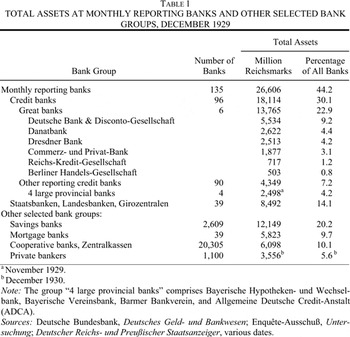
TOTAL ASSETS AT MONTHLY REPORTING BANKS AND OTHER SELECTED BANK GROUPS, DECEMBER 1929
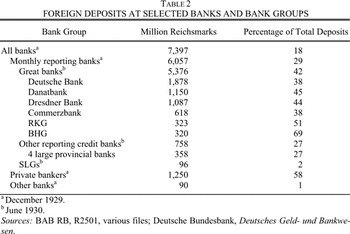
FOREIGN DEPOSITS AT SELECTED BANKS AND BANK GROUPS
BILLS OF EXCHANGE AS SHARES OF LIQUID ASSETS
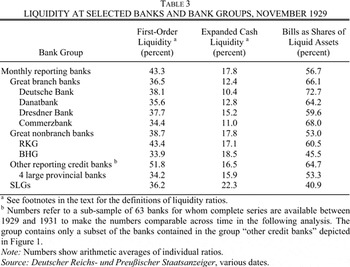
LIQUIDITY AT SELECTED BANKS AND BANK GROUPS, NOVEMBER 1929
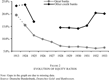
EVOLUTION OF EQUITY RATIOS
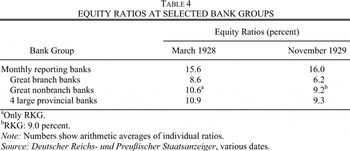
EQUITY RATIOS AT SELECTED BANK GROUPS
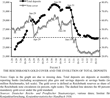
THE REICHSBANK'S GOLD COVER AND THE EVOLUTION OF TOTAL DEPOSITS
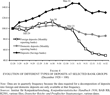
EVOLUTION OF DIFFERENT TYPES OF DEPOSITS AT SELECTED BANK GROUPS (December 1928 = 100)
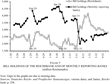
BILL HOLDINGS OF THE REICHSBANK AND OF MONTHLY REPORTING BANKS (million Reichsmarks)
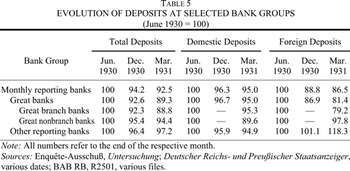
EVOLUTION OF DEPOSITS AT SELECTED BANK GROUPS (June 1930 = 100)
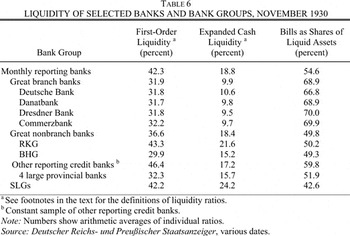
LIQUIDITY OF SELECTED BANKS AND BANK GROUPS, NOVEMBER 1930
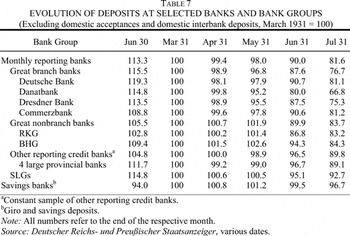
EVOLUTION OF DEPOSITS AT SELECTED BANKS AND BANK GROUPS (Excluding domestic acceptances and domestic interbank deposits, March 1931 = 100)
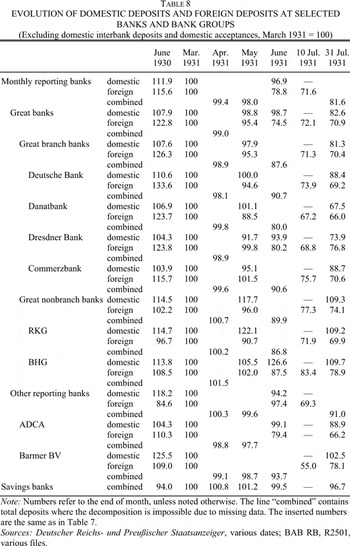
EVOLUTION OF DOMESTIC DEPOSITS AND FOREIGN DEPOSITS AT SELECTED BANKS AND BANK GROUPS (Excluding domestic interbank deposits and domestic acceptances, March 1931 = 100)
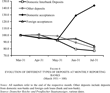
EVOLUTION OF DIFFERENT TYPES OF DEPOSITS AT MONTHLY REPORTING BANKS (March 1931 = 100)
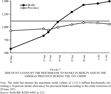
DISCOUNT LOANS BY THE REICHSBANK TO BANKS IN BERLIN AND IN THE GERMAN PROVINCE DURING THE 1931 CRISIS
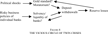
THE VICIOUS CIRCLE OF TWIN CRISES
 You have Access
- 96
- Cited by