1. Introduction
The transition from restricted to universal literacy in Europe took place during the 19th century, thus coinciding with fundamental economic and political transformations. Together with other backward economies, Spain experienced a delayed and geographically uneven spread of literacy, resulting in very poor average levels of human capital (Núñez, Reference Núñez1992). While literacy was almost universal in Britain and France, at least one-third of the Spanish population was still illiterate in 1930 (Tortella, Reference Tortella1994).Footnote 1 Likewise, internal regional differences on literacy rates, already high in 1860, also widened during the second half of the 19th century and the first decades of the 20th century.
Given that human capital has been extensively associated with different factors affecting long-term economic development,Footnote 2 unveiling the causes behind the dissimilar trajectories on the transition from restricted to universal literacy becomes crucial. Studying the historical experience of European countries from the middle of the 19th century onwards, Sandberg (Reference Sandberg1982) argues that a relatively high level of human capital was a pre-condition for modern economic growth.Footnote 3 Deficient levels of schooling actually seem to have prevented Spain from achieving higher economic growth rates before the Civil War (O'Rourke and Williamson, Reference O'Rourke and Williamson1997; Tortella, Reference Tortella1994).Footnote 4 It is therefore important to understand why Spain was a laggard in terms of educational attainments.
Broadly speaking, the slow growth of the stock of human capital during the early stages of economic modernisation in Spain has been associated with weak levels of economic development, together with a low commitment of Spanish institutions to primary education (Núñez, Reference Núñez2003b). This paper adds to these explanations by analysing the links between the existence of common lands and the provision of education in the early stages of economic development in Spain. Some authors have actually pointed out the role of the commons in contributing to financing the local supply of primary schooling (García and Comín, Reference García and Comín1995; Iriarte, Reference Iriarte, Sebastián and Uriarte2003; Linares, Reference Linares2006; Núñez, Reference Núñez1991). Given the different regional paths, the privatisation of these collective resources throughout the 19th and early 20th centuries provides an excellent case study to test these arguments. In order to assess the distinctive impact of common lands on human capital, this paper exploits geographical variation over time by collecting a panel dataset at the provincial level on three different periods: 1860, 1900 and 1930. Three main conclusions emerge from the empirical analysis. First, common lands positively contributed to achieving significantly higher levels of both schooling expenditure and literacy rates. By supporting both municipal and households’ incomes, these collective resources sustained not only the local supply of education but also the demand for it, although their influence decreased over time. Second, either low levels of economic development during this period prevented human capital from growing endogenously or demand factors were not as important as previously argued. Lastly, although the active intervention of the central government was crucial to promote education, its effort was not enough and human capital in Spain lagged behind most European countries. The rest of the paper is organised as follows. Section 2 reviews the elements behind the historical transition from restricted to universal literacy. Section 3 discusses the potential role that common lands played in this context. While Section 4 describes the methodology employed to test the hypothesis outlined here, Section 5 reports the results of the empirical analysis. Finally, the last section presents the conclusions.
2. The literacy transition: a supply- or demand-driven process?
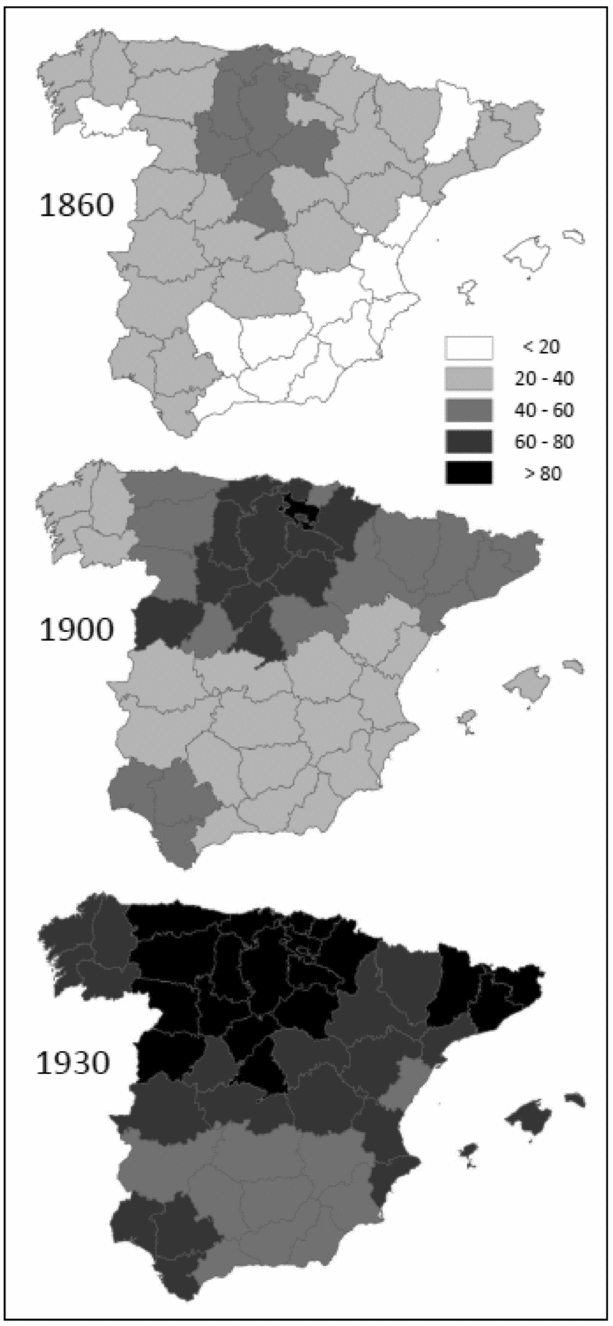
Leaving aside North America, the transition from restricted to universal literacy first took place in Northwestern Europe, hand-in-hand with the establishment of a system of formal schooling and growing economic development (Easterlin, Reference Easterlin1981; Núñez, Reference Núñez2003a; Sandberg, Reference Sandberg1982). Spain, however, experienced a delayed and geographically uneven spread of literacy (Núñez, Reference Núñez1992, Reference Núñez2003b). Although growing, Spanish educational attainments diverged from the levels achieved by the most developed nations during the second half of the 19th century and only began to converge during the first decades of the 20th century. These improvements were also subject to frequent interruptions and setbacks, especially between 1870 and 1910 (Núñez, Reference Núñez and Morilla2010: 253). Likewise, regional differences on literacy rates, already high in 1860, widened during the second half of the 19th century and the first decades of the 20th century (see Figure 1). Even though educational attainments were improving everywhere, the early stages of economic modernisation resulted in a huge educational gap between Northern and Southern Spain.Footnote 5
The literacy transition in Spain (percentage of population literate). Source: Núñez (Reference Núñez1992).

The demand for education has been considered as a crucial element in the rise of human capital during this period. Only when the returns to education were large enough were investments made to acquire it (Galor and Weil, Reference Galor and Weil1999; Núñez, Reference Núñez2003a; Reis, Reference Reis, Allen, Bengtsson and Dribe2005). The rate of return to education, and thus the incentives to invest in it, depends on its potential benefits and actual costs. In this sense, apart from the direct costs of schooling, the opportunity cost of forgoing work is crucial in household behaviour. Literacy and primary schooling had a higher economic value for the average individual in more market-oriented economies and in the growing non-agricultural sector (Lucas, Reference Lucas2002; Sandberg, Reference Sandberg1982). More developed societies also had more resources to invest in education. The relationship between industrialisation and literacy, however, is not so clear. Although some scholars argue that literacy was related to the British industrial revolution, other researchers have pointed out to stagnating, or even falling, literacy rates during that period, especially in industrial areas (Mitch, Reference Mitch1992; Schofield, Reference Schofield1973).Footnote 6 According to Galor (Reference Galor2011), the acceleration of technological progress during the second phase of industrialisation gradually increased the relative importance of human capital. Likewise, an unequal access to land may have also influenced the demand for education. The existence of credit market imperfections disproportionately affects the lower classes’ capacity to invest in human capital (Galor and Zeira, Reference Galor and Zeira1993). Moreover, while small and middle size farmers positively valued education, landless labourers, due to scanty economic prospects, did not see any economic advantage from investing on it (Núñez, Reference Núñez, Jerneck, Mörner, Tortella and Åkerman2005: 132).Footnote 7 Since the decision to invest in education is generally taken by the parents, their educational levels, particularly those of the mothers, significantly influenced the demand for education for the next generation (Pérez Moreda, Reference Pérez Moreda1997). Lastly, life expectancy, by determining the time horizon of the investment, also affects the potential benefits that can be reaped off from investing in education (Galor, Reference Galor2011: 52; Núñez, Reference Núñez, Jerneck, Mörner, Tortella and Åkerman2005: 131).
Although demand factors are crucial, the supply side, by affecting the costs of education, plays an important role in determining the levels of human capital (Lindert, Reference Lindert2003; Núñez, Reference Núñez2003a; Reis, Reference Reis, Allen, Bengtsson and Dribe2005). The public provision of free and compulsory primary schooling significantly reduced the direct cost of education, while at the same time it tried to prevent child labour. The first serious attempt to promote primary schooling in Spain was the Moyano Act in 1857 (Núñez, Reference Núñez1992: 216–226).Footnote 8 However, although it theoretically established compulsory education (and free for those who could not afford it), its enactment was not fully effective until the early 20th century. Recent research has shown that an unequal distribution of land property rights negatively influences human capital formation (Deininger and Squire, Reference Deininger and Squire1998; Engerman and Sokoloff, Reference Engerman and Sokoloff2000; Galor et al., Reference Galor, Moav and Vollrath2009). Landholding elites are likely to block the implementation of educational reforms in order to both preserve the power relations status quo and reduce the mobility of the rural labour force. Although the backwardness of the economy obviously limited the spending capacity during this period, the low levels of public expenditure on schooling evidenced the lack of commitment of the Spanish government and local elites to primary education, partly explaining the deficient primary educational system (Comín, Reference Comín1988; Núñez, Reference Núñez1991, Reference Núñez, Jerneck, Mörner, Tortella and Åkerman2005). The finance of schooling was actually left to municipal councils and, therefore, their capacity to fund primary education became crucial. Núñez (Reference Núñez1991) has shown that schooling expenditures per capita were already geographically uneven in 1860 and these regional differences had increased in 1930. A related problem was the low quality of school teaching. The ratio students per teacher worsened throughout the 19th century, probably up to around 1910 (Núñez, Reference Núñez1992: 237). The material conditions of the schools were deficient and teachers’ low salaries and social status prevented attracting qualified and motivated professionals (Núñez, Reference Núñez, Jerneck, Mörner, Tortella and Åkerman2005: 130). Although it soon became obvious that municipalities could not afford supporting a well-functioning primary education system, the central government was too slow to intervene: it was only in 1902 when, together with the creation of the Ministry of Public Instruction and Arts, it took care of the salaries of school teachers (Núñez, Reference Núñez1991). However, given that the central state limited itself to cover schooling expenditures, without readjusting the pre-existing disequilibria, the problems regarding the uneven regional distribution of schooling expenditures persisted well into the first decades of the 20th century. Furthermore, the problem with primary education was not only of lack of resources but also of allocation between educational levels. Those regions where elites were powerful enough gave priority to secondary and university level expenditures, thus negatively affecting primary schooling (Núñez, Reference Núñez1991).Footnote 9
However, apart from government intervention, other elements should also be taken into account when explaining the supply of education. Although demographic growth in Spain was relatively slow, the proportion of schooling-age population was significantly larger than in other countries (Núñez, Reference Núñez, Jerneck, Mörner, Tortella and Åkerman2005: 131). This trend put an extra pressure on the Spanish educational system, making it more difficult to increase schooling expenditures per capita.Footnote 10 It may be the case, nonetheless, that the supply of education enjoyed increasing returns to scale, so the extra demographic burden may have been offset by the increasing productivity arising from size (Pérez Moreda, Reference Pérez Moreda1997: 249). Likewise, although distance to the school is likely to have played a negative influence in areas with dispersed settlements, especially in the context of a steep orography, the one-teacher per village policy, related also to the role that the local parish had on imparting education, may have benefited small villages (Pérez Moreda, Reference Pérez Moreda1997: 249; Sarasúa, Reference Sarasúa and Martínez-Carrión2002: 569–570). Lastly, inherited historical factors, such as somewhat different legal systems or cultural values, may have also played a role in the different regional paths followed by educational attainments in Spain during this period (Pérez Moreda, Reference Pérez Moreda1997; Reher, Reference Reher1997).
3. Commons and human capital
Commons have been traditionally regarded as inefficient and privatisation has been usually regarded as a precondition to foster economic growth (North and Thomas, Reference North and Thomas1977). The negative view surrounding the communal regime has nonetheless been subjected to revision by a new wave of empirical research that considers common property regimes to be efficient and sustainable, thus revaluating the role that common resources had for the local communities that managed them (Allen, Reference Allen1992; De Moor, Reference De Moor2009; De Moor et al., Reference De Moor, Shaw-Taylor and Warde2002; Ostrom, Reference Ostrom1990). The reassessment of the commons has focused on their impact on agricultural productivity and inequality (Allen, Reference Allen1992, Reference Allen2003; Humphries, Reference Humphries1990; Neeson, Reference Neeson1993), but their potential contribution to human capital has hardly been explored.
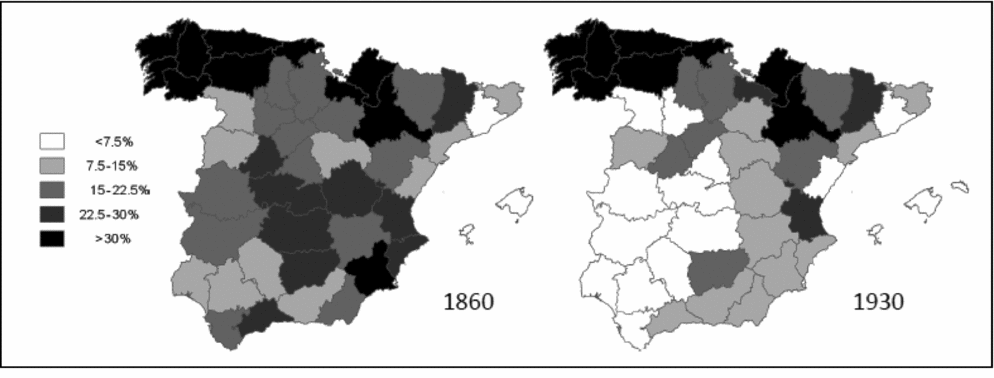
Common lands were a key component in the organic-based Spanish preindustrial economy (Balboa, Reference Balboa1999; Iriarte, Reference Iriarte2002; Jiménez Blanco, Reference Jiménez Blanco2002). The communal regime in Spain involved two main types of access to the land: a direct but regulated access for all members of the community (bienes comunales) or a temporary cession of user rights to particular individuals in exchange for a monetary income (bienes de propios). Apart from providing pasture to support livestock, which in turn supplied agriculture with fertiliser and workforce, these comunales constituted a source of complementary income by providing animal proteins, wood, and fuel, among other products, including the possibility of temporary cropping. The bienes de propios, on the other hand, played a fundamental role in the finances of local institutions, which was particularly important given that municipalities were responsible for the provision of basic public services. However, the transformations caused by the transition to capitalism, and the emergence of a new liberal state, triggered the gradual dismantling of the communal regime throughout the 19th and early 20th centuries (Iriarte, Reference Iriarte2002). The degree of common land persistence was nonetheless fairly different depending on the region being analysed (GEHR,Footnote 111994). As shown in Figure 2, the dismantling of the communal regime was particularly intense in the half south of the country, while common land persistence was especially high in North-western Spain.Footnote 12
Common land persistence in Spain (percentage of total area). Source: Artiaga and Balboa (Reference Artiaga and Balboa1992), GEHR (1994) and Gallego (Reference Gallego2007). No data for the Basque Country are available.
During the 19th century, municipalities were indeed responsible for the provision of elementary education and their financial capacity was crucial when it came to funding schooling expenditures.Footnote 13 It has been argued that both the backwardness of Spanish literacy and its uneven regional spread are partly explained by the fiscal problems of these local institutions (García and Comín, Reference García and Comín1995; Núñez, Reference Núñez1991). The monetary income derived from the cession of user rights on the commons actually constituted a fundamental component of the municipal budget (Bernal, Reference Bernal1978; García and Comín, Reference García and Comín1995; Iriarte, Reference Iriarte, Sebastián and Uriarte2003; Linares, Reference Linares2006).Footnote 14 In 1858, revenues obtained from the commons met 32.4% of the municipal budget (García and Comín, Reference García and Comín1995: 95).Footnote 15 It should be noted that these figures reflect the national average and therefore hide the importance of the commons in those municipalities that had preserved them, especially in the rural areas. In the province of Seville, for instance, despite being one of the areas that most suffered privatisation prior to the Disentailment Act of 1855, the income generated by the commons still provided the 100% of the ordinary revenue in 66% of the municipalities in 1849 (Bernal, Reference Bernal1978: 307).Footnote 16
The financial difficulties of municipalities during the 19th century are well known by the historiography (García and Comín, Reference García and Comín1995; Moral Ruíz, Reference Moral Ruíz and Alonso1986). The privatisation of common lands meant a loss of assets that negatively influenced their economic viability and the possibility to meet the increase in expenditures required by the functions on education, among other basic public services, which they were suppose to carry out (Iriarte, Reference Iriarte, Sebastián and Uriarte2003; Jiménez Blanco, Reference Jiménez Blanco2002: 169; Linares, Reference Linares2006).Footnote 17 In Seville, for instance, the revenues generated by common lands were reduced by 70% between 1821 and 1849, a situation that aggravated later as a result of the General Disentailment Act of 1855 (Bernal, Reference Bernal1978: 302).Footnote 18 The financial problems of municipalities negatively influenced the provision of local public goods, especially of education (García and Comín, Reference García and Comín1995). Most of the municipal budget on education was devoted to the payment of local teachers, which did not prevent their wages from being extremely low. In addition, the delays in paying the wages of the local teachers were widespread. A high proportion of these teachers had no official certificates and a great deal of villages did not have an adequate building devoted to the school.
Although literacy improved in the whole country during the period analysed here, the gap between Northern and Southern Spain increased (Núñez, Reference Núñez1992). The provision of schooling, measured by the number of schools and teacher per population, and the public expenditures in education per capita, were indeed higher in the northern half of the Peninsula, which also coincided with the geography of common land persistence. The diverse survival of the commons may therefore partly contribute to explaining the dissimilar funding capacity of municipalities that led to a considerable regional variation in the provision of schooling (Collantes, Reference Collantes2004; Núñez, Reference Núñez1992; Sarasúa, Reference Sarasúa and Martínez-Carrión2002). In the province of Cádiz, for instance, most of the teachers’ salaries came from revenues generated by the commons in 1840 (Bernal, Reference Bernal1978: 303). Furthermore, municipalities frequently financed schooling directly through the commons by allocating a plot of land to the maintenance of the teacher or by providing the building where lessons were given (Sarasúa, Reference Sarasúa and Martínez-Carrión2002: 580–581).Footnote 19
However, apart from contributing to the supply of education by financing public services, the income generated by the commons allowed the reduction of the fiscal burden supported by the community (García and Comín, Reference García and Comín1995; Iriarte, Reference Iriarte, Sebastián and Uriarte2003; Linares, Reference Linares2006). The privatisation of these collective resources coincided with the increasing expenditures that municipalities had to face to provide new public services. These two combined factors not only influenced the provision of education and other public goods, such as medical care and poor relief, but also forced local institutions to increase taxes. Poorer households were especially affected by this process due to the regressive nature of a fiscal system built mostly around taxing consumption goods.Footnote 20 This consequence was by no means unexpected for the contemporaries. The parliamentary debates about the convenience of privatising common lands carried out between 1835 and 1855 reflect the concern that depriving local communities from these resources would necessarily force municipalities to increase local taxes (Gómez Urdañez, Reference Gómez Urdañez2002: 144). Municipal budgetary problems also meant that local public goods, especially schooling, were sometimes funded through neighbours’ extraordinary contributions (Sarasúa, Reference Sarasúa and Martínez-Carrión2002: 581).Footnote 21
Likewise, the dismantling of common lands not only influenced the municipal financial capacity and the level of local taxes, but it also directly affected households’ incomes. As explained above, common lands provided pasture, fertiliser, wood, fuel, among other products, including the possibility of temporary cropping. The loss of these sources of complementary incomes, by reducing disposable income, increased the relative cost of education, thus reducing the demand for education, particularly for the less favoured groups. The widespread conflict and resistance that privatisation generated strongly points to the crucial role that commons played on securing the subsistence of rural households and the negative impact that privatisation had on their living standards (Cobo et al., Reference Cobo, Cruz and González de Molina1992; De la Torre and Lana, Reference De la Torre and Lana2000).
Lastly, the privatisation of common lands could also have indirectly influenced human capital through its effect on inequality. The way through which privatisation was implemented is likely to have increased, or at least consolidated, the concentration of landholding by an elite, thus contributing to social polarisation and the proletarisation of agricultural labour (Linares, Reference Linares2001; Moral Ruíz, Reference Moral Ruíz1979). According to the arguments outlined in Section 3, an unequal distribution of land property rights negatively affected human capital formation through both the supply and the demand for education. Not only did landless labourers not see any economic advantage from investing on it, but also landholding elites blocked the implementation of educational policies.
4. Methodology and data
In order to test the hypothesis outlined above regarding the distinctive impact of common lands on human capital in Spain, this paper exploits geographical variation over time by collecting a panel dataset at the provincial level on three different periods: 1860, 1900 and 1930. Literacy rates and schooling expenditures have been widely employed as indicators of educational attainments, especially in developing countries (Núñez, Reference Núñez2003a). These indicators are particularly suitable for studying the evolution of education in the early stages of economic modernisation because most of the human capital embodied in the Spanish population during this period was due to elementary schooling (Núñez, Reference Núñez, Jerneck, Mörner, Tortella and Åkerman2005: 130). Data for these variables are taken from Núñez (Reference Núñez1991, Reference Núñez1992).Footnote 22 Although highly correlated, analysing both indicators is especially meaningful because the ability to read and write evaluates an educational output, while schooling expenditures measure an input.Footnote 23 In this sense, while literacy is the result of demand and supply factors, schooling expenditures mostly reflect supply considerations, which partly allow distinguishing the role that common lands played on these two different dimensions.Footnote 24
It is important to note that migration processes may have biased these indicators. The importance of internal migratory patterns increased from mid-19th century onwards and accelerated in the first decades of the 20th century (Silvestre, Reference Silvestre2005). Although relatively low in international terms, emigration abroad followed a delayed but similar trend (Sánchez Alonso, Reference Sánchez-Alonso2000). Regional differences in migratory behaviour were large throughout this period. In this regard, higher literacy rates not only allow acquiring the necessary information about potential destinations but also increase the potential returns of migrating (Gould, Reference Gould1980). Regions with superior educational attainments actually enjoyed higher rates of both internal and international migration before the Civil War (Collantes, Reference Collantes2004; Núñez, Reference Núñez2003b; Sánchez Alonso, Reference Sánchez-Alonso2000).Footnote 25 Drawing on military records, Quiroga (Reference Quiroga2003: 600) finds that average literacy rates for internal emigrants between 1893 and 1899 were at least 25% higher than for those who stayed in their province of origin. Therefore, the actual literacy rates would have been higher if migration had not taken place. The role of outmigration in schooling expenditures is, on the other hand, less clear. Although it reduces pressure on local resources, it also diminishes the potential to generate income given that the most skilled were those who often made the move. Similar arguments can be made about the receiving areas. However, the capacity of the existing urban educational system to meet a growing stock of potential students due to a high inflow of migrants could have been compromised (Núñez, Reference Núñez2003a: 547–548). In order to account for this potential bias, both internal and international migration rates will be included in the analysis (Mikelarena, Reference Mikelarena1993).Footnote 26
The stock of common lands was already geographically diverse in 1860. The privatisation that took place from that date onwards under the General Disentailment Act accentuated these differences, especially from 1860 to 1900 when sales were widespread. Common lands are measured as the proportion of common lands over the total provincial area (GEHR, 1994). The Galician case is nonetheless problematic. Given their particular legal characteristics, a large part of the commons in this region did not belong to the municipalities but to the neighbours themselves (Artiaga and Balboa, Reference Artiaga and Balboa1992; Balboa, Reference Balboa1999).Footnote 27 This means that these collective resources did not contribute to funding municipalities.Footnote 28 In order to minimise this problem, only those Galician commons belonging to the municipalities will be considered in the analysis. Furthermore, in order to further test the robustness of the general results, the Galician provinces will also be excluded from the empirical analysis.
The panel data collected allow carrying out an econometric analysis in order to assess the distinctive impact of common lands on education. A fixed-effects model accounts for unobserved time-invariant provincial heterogeneity, thus partly addressing the potential omitted variable problem. This specification also permits including time dummies to account for the evolution of the Spanish economy and the establishment of a mass public schooling system, which was mostly implemented from the early 20th century onwards.Footnote 29 Also, interacting the variable of interest with time-period dummies allows assessing whether the effect of the existence of common lands on human capital varied over time as the Spanish economy evolved.
The main potential concern here is the possibility that both the privatisation of common lands and the changing educational attainments were the result of another time-variant unobserved factor, thus affecting our estimates. Other processes were taking place around the same time, which may be correlated with common land persistence and human capital indicators. As explained above, the actual educational levels are the result of a complex web of supply and demand factors. In order to overcome the omitted variable problem, a host of controls that take into account other potential determinants of human capital are included in the investigation. On the one hand, the demand for education is considered by employing different proxies of economic development. Income per capita is calculated from recent estimates of gross domestic product at the provincial level and population figures (Nicolau, Reference Nicolau, Carreras and Tafunell2005; Rosés et al., Reference Rosés, Martínez-Galarraga and Tirado2010). Urbanisation and industrialisation are measured as the proportion of population living in cities bigger than 5,000 inhabitants and the gross value added by non-agricultural activities per capita respectively (Rosés et al., Reference Rosés, Martínez-Galarraga and Tirado2010; Tafunell, Reference Tafunell, Carreras and Tafunell2005). The importance of the agricultural sector is proxied by the proportion of the male active population working on agriculture (Erdozáin and Mikalerena, Reference Erdozáin and Mikelarena1999).Footnote 30 Inequality in access to the land is measured through the fraction of landowners over active agricultural population (Dirección General del Instituto Geográfico y Estadístico, 1863, 1922).Footnote 31 The importance of the parents, especially of the mothers, is taking into account by interacting the actual literacy rates with the inverse of the gender educational gap (Núñez, Reference Núñez1992). In addition, given that the returns on education also depend on the time horizon of the investment, life expectancy is also included in the model (Dopico, Reference Dopico1987; Dopico and Reher, Reference Dopico and Reher1998). On the other hand, supply factors are also considered. In this regard, the impact of demographic pressures is proxied by population density (INE, 2001; Nicolau, Reference Nicolau, Carreras and Tafunell2005). The potential influence of the population settlement pattern is already accounted for by including provincial fixed effects. Similarly, regional-specific factors arising from somewhat different legal systems or cultural values are also taken into account by this specification. Summary statistics of the dependent and independent variables are reported in the Appendix.
5. Results
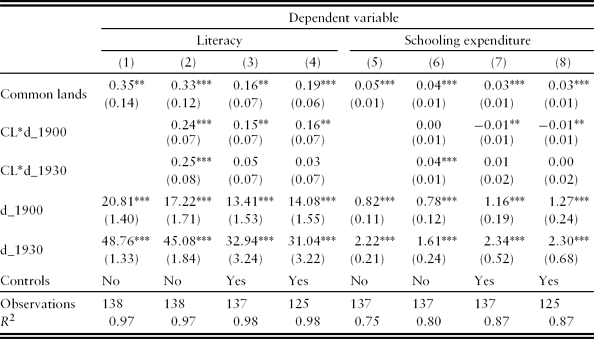
Table 1 reports the results of the empirical analysis. All regressions include province fixed effects and time dummies. Columns (1) and (5) present the baseline specification assessing the relationship between the persistence of common lands and human capital indicators. The remaining columns introduce the variable of interest interacted with time-period dummies to allow the effect of common lands to vary over time as the Spanish economy evolved. In addition, columns (3) and (7) introduce the controls explained above, thus taking into account other potential determinants of human capital. Lastly, given the conceptual ambiguity of the Galician commons, columns (4) and (8) further test the robustness of the results by excluding the Galician provinces from the empirical analysis. Since migration rates turned out to be statistically insignificant in all specifications and did not affect the outcome of the analysis, they have been removed from the reported results.
Commons and human capital
Note. Robust standard errors are given in parentheses; ** or *** denotes significance at 5% or 1% level. All regressions include provincial fixed effects. For simplicity, the intercept is not reported. Controls include income per capita, population density, agricultural population, urbanisation, industrialisation, access to land, parents’ literacy and life expectancy.
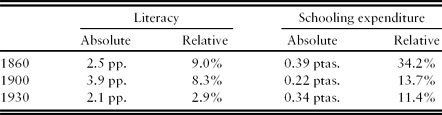
The presence of common lands is shown to be positive and significantly related to both literacy rates and schooling expenditures per capita. These estimates are robust even when adding the series of controls explained above and the Galician provinces are excluded.Footnote 32 The impact of the persistence of common lands on human capital is relatively important in economic terms, although it decreases over time (see Table 2). According to the estimates in columns (4) and (8), a one standard deviation in the stock of common lands in 1860 meant literacy and schooling expenditure to be an average of 2.5 percentage points and 0.39 pesetas per capita higher, respectively. Given that the average level of literacy and schooling expenditure in 1860 were 27.7 percentage points and 1.14 pesetas per capita, these figures represent 9% and 34.2% of those levels in that order. This result points to the important role these collective resources played in the funding of education at the municipal level in the period prior to 1860. As expected, the lower influence of the commons on literacy reflects the fact that, while schooling expenditure mostly reflects supply side considerations, literacy is the outcome of a wider set of supply and demand factors, thus leaving less room to the contribution of the commons.
Evolution of the estimated influence of common lands
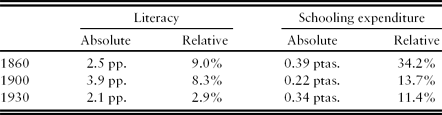
Note. Literacy is measured in percentage points (pp.) and schooling expenditure per capita in pesetas (ptas.). The effect is computed using one standard deviation in the stock of common lands. These estimates only reflect the national average and therefore underestimate the influence of the commons in those areas that had preserved them.
The impact of the commons on these variables changed between 1860 and 1900, coinciding with the further privatisation of these resources under the General Disentailment Act, which took place from 1855 onwards. In this sense, while the relationship between common lands and literacy levels grew even stronger, their effect on schooling expenditure was somewhat diminished.Footnote 33 Two factors explain the fact that despite the estimated impact of the commons on the supply of schooling was significantly reduced, their effect on literacy levels actually increased. On the one hand, the privatisation process that took place during this period mostly affected those commons which were being rented privately – the so-called bienes de propios – which especially contributed to the municipal budget (Linares, Reference Linares2001; Sanz Fernández, Reference Sanz Fernández, Garrabou and Sanz1985).Footnote 34 Therefore, given the limitations on schooling expenditure, the privatisation process further constrained the transition to universal literacy by creating a bottleneck in the supply of schooling.Footnote 35 On the other hand, the literature has stressed that the second half of the 19th century was a difficult period for the bottom half of the population (Martínez Carrión, Reference Martínez-Carrión and Martínez-Carrión2002; Pérez Moreda, Reference Pérez Moreda and Anes1999). The privatisation of common lands certainly made things worse. These collective resources became a crucial source of complementary incomes in those areas that were more successful in resisting privatisation pressures (Iriarte, Reference Iriarte2002; Jiménez Blanco, Reference Jiménez Blanco2002). Therefore, by complementing households’ incomes, commons distinctively contributed to sustaining the demand for education.
The influence of the commons on educational human capital continued evolving during the first decades of the 20th century. On the one hand, their absolute contribution to fund schooling expenditure recovered the levels of 1860. Together with a larger effort by municipal authorities to provide education during the 1920s, this is likely due to the greater importance that monetary revenues obtained from the commons gained during the first decades of the 20th century (GEHR, 2002; Iriarte, Reference Iriarte, Sebastián and Uriarte2003; Núñez, Reference Núñez1992: 307).Footnote 36 On the other hand, their effect on literacy rates decreased from the previous period, reflecting the fact that the role of the commons in complementing households’ incomes declined as the economy modernised. However, although still noticeable in absolute terms, given that the levels of both variables had increased over time, the relative effect of these collective resources on both literacy rates and schooling expenditure did not recover the levels achieved in previous periods.Footnote 37 A more intensive process of economic development provided alternative, and more important, sources of income to both municipalities and households, which, together with the increasing intervention of the state in the supply of education, meant that common lands became relatively less and less important over time.Footnote 38
6. The literacy transition: economic modernisation or state intervention?
Interestingly, the results reported in Table 1 also allow assessing the relative importance of these two processes, economic modernisation and state intervention, in the transition to universal literacy in Spain. The coefficients of the time-period fixed effects illustrate that as the country developed, both indicators of human capital greatly improved, especially during the first decades of the 20th century. If we compare the coefficients of the time dummies before and after including the host of controls, the distinctive impact of the modernisation process and the increasing role of the state can be distinguished. In columns (2) and (6), the time dummies capture the combined impact of both processes. Literacy rates increased throughout the whole period, although the increase is almost two times larger between 1900 and 1930 than during the previous period. Schooling expenditures grew evenly during the whole period. Columns (3) and (7) add the set of controls reflecting the ongoing modernisation process visible in growing incomes, urbanisation and industrialisation levels, together with other demographic and economic factors. The coefficient on the dummy variable now reflects the rise in literacy and schooling expenditure that is not explained by the model and can therefore be attributed to the efforts of the state to improve the provision of education. The comparison between these pairs of columns unveils interesting conclusions.
On the one hand, regarding literacy rates, the effect of the dummy for 1900 hardly changes when controls are included, which means that economic modernisation barely had any effect on human capital and that most of those 17 percentage points increase on literacy rates between 1860 and 1900 were due to state intervention. This situation changed during the first decades of the 20th century. Although the state was still responsible for a larger share of the now higher increases in literacy rates, economic modernisation began to play a significant role in pushing human capital forward.Footnote 39 On the other hand, although schooling expenditures per capita grew evenly during both periods, the results evidence that the process of structural change triggered off by economic modernisation had negative consequences on the supply of primary education. The coefficient of the time dummies increases significantly after including the set of controls, implying that the financial effort of municipalities and the state was partly offset by other negative processes at play. In this sense, accelerating population and urbanisation growth is likely to have put more pressure on the scarce resources available (Lindert, Reference Lindert2003: 343; Núñez, Reference Núñez and Morilla2010: 256).
These results therefore strongly confirm the crucial role of public institutions in providing education, especially in the first stages of economic development. It is worth noting that the contribution of the public sector to literacy rates and schooling expenditure remained roughly unchanged both between 1860 and 1900 and between 1900 and 1930.Footnote 40 This points to the robustness of these results since the role of the state in providing education, at the local or national level, is reflected first on schooling expenditures, which is then translated into literacy rates, a measure that reflects the interaction of supply and demand factors. Although there is evidence of some improvements, the modernisation of the Spanish economy was not enough to foster an endogenous increase in human capital indicators. Economic development only translated into a noticeable increase in literacy rates from 1900 onwards and, even then, its contribution was significantly lower than that of the public sector. Therefore, either demand forces were too weak or their role in promoting educational human capital was not as important as it has been suggested.
However, given the low levels of human capital in Spain relative to neighbouring countries, it can be argued that the public effort was not enough either. Likewise, given that the contribution of the public sector to both literacy levels and school expenditure is similar throughout the whole period, it seems that the Law of 1902, by which the central government took care of teachers’ salaries, thus releasing municipalities from that responsibility, did not significantly succeed in promoting human capital indicators. In this sense, Núñez (Reference Núñez1991: 145) argues that the centralisation of schooling expenditure was not able to alter previous trends because it limited itself to meeting the pre-existing budget without either improving it or adjusting its uneven regional distribution.Footnote 41 According to this author, an oversized secondary and tertiary educational sector, mostly benefiting the sons of the elites, prevented more public resources to be devoted to schooling. In this sense, while there was a wide gap between Spain and other European countries in terms of investment on primary schooling, the difference is hardly significant in secondary education and even positive at the university level (Núñez, Reference Núñez and Morilla2010: 247–252). The distribution of public expenditures among the different educational levels was thus not only unequal but also inefficient given the importance of primary schooling for economic growth in developing countries (261–264).
Several authors have pointed to the lack of interest of the elites to educate the masses, reflecting the high degree of inequality in the Spanish economic and political arena (Núñez, Reference Núñez1992; Pérez Moreda, Reference Pérez Moreda1997; Reher, Reference Reher1997). In this regard, Easterlin (Reference Easterlin1981: 14) claims that a decisive commitment to mass education only happens when ‘a major shift in political power and associated ideology in a direction conducive to greater upward mobility for a wider segment of population’ has taken place. Similarly, Acemoglu and Robinson (Reference Acemoglu and Robinson2000) link the extension of voting rights to the spread of educational policies. Despite the establishment of universal male suffrage in 1890, that shift does not seem to have occurred in Spain or was only slowly coming about due to the unequal distribution of wealth and the shortcomings of the political regime. Political and economic elites firmly controlled the Spanish political system by widespread vote buying, coercion and mass fraud, together with promises of individual or collective favours, although these practices weakened over time, especially after the turn of the century (Curto-Grau et al., Reference Curto-Grau, Herranz-Loncán and Solé-Ollé2012; Moreno-Luzón, Reference Moreno-Luzón2007). Lindert's arguments (Reference Lindert1994, Reference Lindert1996) regarding the importance of the degree of political participation in determining the patterns of the provision of public goods are especially relevant here. Powerful elites indeed tend to block the implementation of institutions promoting human capital (Easterly, Reference Easterly2007; Lindert, Reference Lindert2003; Mariscal and Sokoloff, Reference Mariscal, Sokoloff and Haber2000). Although it is true that relevant steps were taken, the Spanish political system, kidnapped by oligarchic interests and restricted political representation, somewhat precluded higher levels of human capital formation. As shown here, the privatisation of common lands from 1860 onwards, which principally benefited the well-off, and their negative effects on the supply and demand for education highlight only another way through which an unbalanced political system hindered economic development.
7. Conclusion
Common lands played a crucial role in the functioning of the rural communities in pre-industrial Spain. They complemented households’ incomes by providing pasture, fertiliser, wood, and fuel, among other different goods and services, as well as offering the possibility of temporary cropping. The commons were also a critical asset for the local municipal councils, given that they constituted an important source of revenue. Although less important over time, these functions contributed to sustaining both the demand and the supply of education during the early stages of economic development when neither the slow rates of structural change were able to maintain an endogenous increase of human capital, nor the intervention of the state was decisive enough to bring Spanish educational attainments in line with other European countries.
The historical experience of the developed countries should serve to prevent the repetition of the same mistakes in the developing world today. As mentioned above, the historical revision of the modernisation process in Europe has shown that the privatisation of common lands was not, as long-term believed, a pre-condition for promoting economic growth. Enclosures in Britain did not increase agricultural productivity but redistributed income from peasants to large landlords, thus contributing to the pauperisation of an important part of the population. A well-functioning primary education system is essential for sustained economic growth but the diffusion of higher levels of human capital in many parts of the world is still a formidable endeavour (Colclough and Lewin, Reference Colclough and Lewin1993; Easterlin, Reference Easterlin1981). Given the crucial role of local institutions in providing schooling during the 19th century and the, although threatened, still large stock of common and public resources managed at the local level in developing countries (Lindert, Reference Lindert2003: 333; Ostrom, Reference Ostrom2010), exploring the links and potentialities between them and the supply and demand for education at the local level may prove a beneficial agenda for the years to come.
Acknowledgements
An earlier version of this article was presented in Madrid and Barcelona. I am grateful for all the comments received in those occasions, as well as for those received from the editor, Geoffrey M. Hodgson, and two anonymous referees. Robert Allen and Tine de Moor also provided me with useful comments and suggestions. This research has benefited from financial support from the ESRC, Nuffield College and the Spanish Ministry of Science and Innovation (Projects HAR2012-30732 and ECO2012-33286).
Appendix