




No CrossRef data available.
The Globalization of American Law
Published online by Cambridge University Press: 09 March 2004
Abstract
A substantial body of research suggests that the United States has a distinctive legal style characterized by detailed rules, extensive transparency requirements, adversarial procedures for dispute resolution, costly legal contestation involving many lawyers, and frequent judicial intervention in administrative affairs. Recently, scholars of comparative law and public policy have asked whether this American legal style is spreading around the world. Some scholars have argued that legal styles are converging on an American model, while others have argued that distinctive national legal styles will persist. This article addresses this emerging debate. We argue that American legal style is spreading to other jurisdictions. However, we depart from predominant explanations, which attribute convergence to international regulatory competition or emulation. Instead, we argue that economic liberalization and political fragmentation have undermined traditional approaches to regulation and have generated functional pressures and political incentives to shift toward American legal style.The authors thank Kenneth Abbott, Ward Bower, Kent Calder, Robert G. DeLaMater, Tom Ginsburg, Jack Goldsmith, Milton Heumann, Mark D. Hunsaker, Nicolas Jabko, Robert Kagan, Susan Lawrence, Kathleen McNamara, Michael Paris, Mark Ramseyer, Amy Searight, Anne-Marie Slaughter, Tatsushi Terada, David Vogel, Albert Yoon, and participants in presentations at the 2001 International Studies Association Convention, the 2001 American Political Science Association Convention, Northwestern University's Center for International and Comparative Studies, the University of Chicago Law School, and Princeton University's Center of International Studies for their comments on earlier versions of the article. The authors thank Rachael Snyder, Fatima Khan, Hisako Yamamoto, Masako Ishiwata, and Kei Yamaguchi for their research assistance and Akiko Tsuda, Akemi Ideuchi, and Mio Kato for secretarial assistance. Kelemen thanks the Frank Kneller Fund at Rutgers University and the Center of International Studies at Princeton University for financial support. Views expressed herein are those of the authors alone and are not necessarily those of any institutions with which they are affiliated.
Information
- Type
- Research Article
- Information
- Copyright
- © 2004 The IO Foundation and Cambridge University Press
A substantial body of research on comparative public policy and law suggests that the U.S. approach to making and implementing regulatory policies is distinctive.1
See Kagan and Axelrad 1997 for a review of comparative studies of U.S. legal style.
See Wiegand 1991 and 1996; Shapiro 1993 and 1996; Trubek et al. 1994; Dezalay 1996; Galanter 1992 and 1996.
See Drezner 2001; Garrett 1998.
In this article, we hope to advance the debate regarding the globalization of law and to link it to broader debates on globalization and policy convergence. Existing studies of the globalization of law have identified a host of factors that may encourage the spread of American legal style, including economic liberalization, the globalization of markets, growing distrust of government bureaucrats, heightened judicial activism, the globalization of U.S. law firms, and the international influence of American legal education.6
Some scholars have focused on the spread of American-style adversarial legalism (See note 3) while others focus specifically on the spread of American-style judicial review. See Shapiro and Stone 1994; Stone Sweet 2000; Tate and Vallinder 1995. On judicial globalization more generally, see Slaughter 2000.
Rather, we argue that the shift toward American legal style is better explained by the confluence of two largely domestic factors: economic liberalization and political fragmentation.7
We take economic liberalization and political fragmentation as exogenous, and for our purposes they can be viewed as domestic processes, though we recognize that they may stem in part from international pressures.
In this respect, our argument fits Simmons and Elkins's 2001 category of explanations for convergence based on similar but uncoordinated responses to common domestic political and economic conditions.
We focus on the recent spread of American legal style across advanced industrialized democracies.9
Previous waves of globalization of law include the spread of Roman law across Europe—see Wiegand 1991—and the spread of European legal models to Asia and Africa in the colonial era—see Mommsen and De Moor 1992. The current globalization of American law also affects some developing countries, but this process falls beyond the empirical scope of this article.
It may be the case that the globalization of American law is a limited phenomenon, affecting only the most internationalized areas of regulation and legal practice. However, we argue that the globalization of American law is having a more profound effect, encouraging a transformation in patterns of interest group representation and policymaking by replacing informal, opaque, cooperative processes with formal, transparent, and adversarial ones. Some observers would applaud such Americanization as enhancing transparency, accountability, and legal certainty. Others, however, would view such a shift as the regrettable spread of an “American Disease” of excess lawyers and litigation.
The remainder of this article is divided into four sections. The first section explores the notion of American legal style in more detail, considers alternative arguments that might explain the spread of American legal style, and details our own explanation. The second section examines the spread of American legal style to the EU, including case studies of products liability law and securities regulation. The third section examines the same issues in Japan. The final section concludes.
Explaining the Globalization of American Law
American Legal Style
Legal style is a complex, multifaceted concept, for which the existing literature on comparative law and regulation offers no widely shared definition. Our working definition of American legal style focuses on the two most fundamental distinguishing characteristics of American law: the emphasis on enforcing legal norms through (1) transparency and (2) broad empowerment of private actors to assert legal rights. The central role of transparency manifests itself throughout American law and legal practice in the prevalence of highly detailed, transparent legal rules and regulatory procedures, extensive disclosure requirements, and the active use of formal implementation and enforcement proceedings by regulators. Transparency regulates by deterring actions that are unlikely to withstand public scrutiny and by arming a wide array of actors with otherwise unavailable information. In addition to transparency provisions, a variety of other aspects of the American legal system empower private actors to assert their rights through adversarial legal contestation. A multitude of statutes and vast body of case law establish causes of action and enforceable rights for private parties, while liberal discovery rules, lax standing (locus standi) requirements, class action lawsuits, contingency fee arrangements, and an abundance of lawyers facilitate the exercise of those rights. This pattern of law and legal practice encourages a central role for lawyers in advising clients on meeting disclosure requirements, in advocating clients' policy interests in the course of regulatory proceedings, and in representing clients in legal contestation.
These two characteristics of American legal style clearly manifest themselves in the areas of securities regulation and products liability law. The hallmarks of U.S. securities regulation reflect the broader patterns of American legal style. First, U.S. securities regulation focuses on regulating the quality of mandatory disclosure by issuers through strict disclosure requirements, not on regulating the quality of investments.10
Loss and Seligman 1998, 171.
Products liability law also reflects many of the central attributes of American legal style. The U.S. product liability regime relies heavily on the threat of litigation by private parties to identify defective products and to punish their manufacturers and sellers. Strict liability, which emerged as the dominant doctrine in the 1960s, relieved injured consumers of the burden of proving negligence on the part of the manufacturer, requiring instead that they simply prove a “defective product”11
Generally, a product may be defective because of improper design or manufacture, or inadequate warnings.
Explaining the Spread of American Legal Style
The most common explanations for policy convergence do not provide an adequate explanation for the globalization of American legal style. One common explanation for convergence is the “race-to-the-bottom,” or competition in laxity.12
See Swire 1996; and Drezner 2001 for overviews of the race-to-the-bottom literature.
Drezner 2001, 77. The dynamics in such situations resemble those of a “suasion game.” See Martin 1992, 778.
Neither of these forms of regulatory competition provides a sufficient explanation for the globalization of American law. A race-to-the-bottom explanation would require that foreign jurisdictions emulate U.S.-style regulations in an effort to make themselves more attractive to mobile targets of regulation. This argument presumes that the United States has lower standards, which is clearly not true in many areas. In securities law and products liability law, U.S. standards arguably impose higher costs on firms. More generally, many critics argue that American legal style is excessively costly, conflictual, and slow, and such critics have often looked to Western Europe and Japan for models of more cooperative, informal, and inexpensive approaches to law and regulation.15
See Epp 1992; Galanter 1996; Kagan 1997.
As for the race-to-the-top argument, non-U.S. firms forced to meet U.S. legal or regulatory requirements that are stricter than those in their home markets (for example, automobile emissions standards) in order to access the U.S. market might encourage the adoption of U.S. regulations at home. This dynamic may explain foreign adoption of particular U.S. laws or regulatory standards.16
See Simmons 2001, 609–11; Vogel 1995.
Swire 1996, 85.
Finally, another set of explanations for policy convergence focuses on policy emulation among nations. Rooted in sociological institutionalism, emulation arguments suggest that convergence may occur as governments model their policies after those of salient global leaders or those advocated by international governmental organizations.18
These arguments do not provide a convincing explanation for the spread of American legal style. Certainly, U.S. policies serve as a salient reference point for many governments, and emulation of U.S. policies has occurred in some policy areas; however, governments throughout the Organization for Economic Cooperation and Development (OECD) have been eager to avoid adopting American legal style in a broader sense. Indeed, during the U.S. recession of the early 1990s, many critics inside and outside the United States contended that the inflexibility, stringency, and litigiousness characteristic of American legal style were to blame for America's lackluster economic performance.19See Epp 1992; Galanter 1996; Kagan 1997.
We maintain that neither regulatory competition between governments nor policy emulation provide adequate explanations for the spread of American legal style. While race-to-the-top dynamics and emulation have played a role in the adoption of some U.S. laws, these dynamics cannot explain the general shift to U.S. legal style across a broad range of policy areas, and cannot explain far-reaching changes in legal practice. Rather, we argue that the shift toward U.S. legal style has been driven primarily by increasing economic liberalization and political fragmentation. The spread of U.S. law firms to foreign jurisdictions, itself a product of economic liberalization, has served as a catalyst accelerating the process.
Economic Liberalization
During the past twenty years, a wave of deregulation and trade liberalization has swept across OECD economies, opening international markets for capital, goods, and services. We take economic liberalization as an exogenous force that has affected national legal and regulatory systems across OECD countries. Liberalization allows new actors, both foreign and domestic, into previously closed markets and allows both new and existing actors to participate in new areas of economic activity where markets were previously nonexistent. The resulting increase in the number and diversity of participants undermines informal systems of regulation based on closed insider networks and trust. Furthermore, new markets may not have established regulatory channels to implement regulatory objectives effectively. When governments find that their closed, informal, and opaque approaches to regulation have become unworkable, they seek other means by which to pursue their regulatory goals. Therefore, liberalization leads to more than simple deregulation; it also creates pressure for re-regulation to enable governments to enforce norms in a liberalized environment.20
See Vogel 1996; Moran 1991.
Political Fragmentation
Systems of informal regulation are most likely to be found in political systems in which political authority is concentrated in the hands of a small number of likeminded veto players.22
Tsebelis 2002, 235–39.
Ramseyer and Rosenbluth 1993, 107–19.
See Shapiro 1981; Moe and Caldwell 1994; Ferejohn 1995; Cooter and Ginsburg 1996.
By contrast, as political authority becomes more fragmented, judicialization becomes a more attractive means by which political principals can control bureaucratic agents. As fragmentation increases (that is, as the number of veto players increases), assembling the political coalitions necessary to rein in the bureaucracy (for example, to pass new legislation) becomes more difficult. Recognizing the likelihood of political gridlock and the durability of legislation, lawmakers have an incentive to draft legislation in a manner that will insulate their policies against potential manipulation by the bureaucracy (bureaucratic drift) or by political forces that may come to power later (political drift).25
Lawmakers also recognize that the fragmentation of power insulates the judiciary against easy legislative overrides and other forms of political backlash and that courts may, therefore, be willing to play an active role in constraining bureaucratic discretion.26See Shapiro 1981; Moe and Caldwell 1994; Ferejohn 1995; Cooter and Ginsburg 1996.
Finally, fragmentation of political authority also encourages adversarial legalism by creating multiple openings through which interest groups can access political power. The existence of multiple access points encourages groups to engage in political and legal forum-shopping and multipronged lobbying and litigation strategies.28
Weaver and Rockman 1993, 445–61.
The highly fragmented U.S. system, which institutionally combines separation-of-powers, bicameralism, and federalism, has encouraged the development of adversarial legalism. While the degree of fragmentation of power varies considerably across EU member-states and Japan, we expect that increases in the degree of political fragmentation in these polities will encourage a shift from opaque, informal regulatory policy approaches to more transparent, formal, and adversarial approaches resembling the American model.
American Law Firms
The entry of American corporate law firms into foreign jurisdictions plays an important role in accelerating the process of Americanization. As part of economic liberalization, governments are pressured to open up their markets for legal services. Economic liberalization also stimulates greater demand for cross-border legal services. When American law firms enter foreign markets, they bring with them American legal practices and forms of organization. Their experience with adversarial legalism and their expertise in mega-lawyering techniques,29
including multijurisdictional litigation, lobbying, and the drafting of detailed contracts suited to liberalized markets,30 give them a number of advantages vis-à-vis their foreign competitors. Moreover, the size and worldwide presence of American firms enable them to provide a range of legal services that smaller, local law firms cannot match. The influx of American law firms into foreign legal markets introduces a competitive dynamic that pressures local law firms to reorganize along the lines of American firms. As the structures and practices of foreign law firms begin to resemble their American counterparts in important respects, the spread of American legal style accelerates. While economic liberalization and political fragmentation are the primary underlying causes of Americanization, the spread of American law firms is a vital catalyst that hastens the spread of American legal practices.Americanization of Law in the EU
Legal Style in Europe
Despite the diversity of European legal styles,31
a number of common attributes distinguish European from American legal styles. While lawyers and courts in Europe have played a vital role in protecting individual rights, they have played a much weaker role than their U.S. counterparts in the development and implementation of regulatory policy. In many European states, interest group representatives and government bureaucrats have developed and implemented regulatory policies in concert.32For a review of comparative studies, see Kagan and Axelrad 1997.
See Vogel 1986; Vogel 1996.
Trubek et al. 1994, 422.
Americanization in the EU
The three factors we highlight above have converged to incite dramatic shifts in European legal and regulatory style since the mid-1980s. First, the economic liberalization that has come with the construction of the EU's internal market has run head-on into the informal, cooperative systems of regulation prevalent in most EU member-states. In a host of areas ranging from telecommunications to competition to environmental policy, deregulation and the opening of markets have undermined established systems of regulation at the national level and led to calls for re-regulation at the EU level. However, given the diversity of players in these liberalized markets, the style of regulation that has developed at the EU level does not resemble the informal, corporatist patterns of regulation that were common in many member-states. With its growing emphasis on openness and transparency in regulatory processes and judicialized enforcement, policymaking in Brussels looks more like that in Washington, D.C., than that in Berlin or Paris.37
Second, the transfer of regulatory authority to the EU level has led to an increasing fragmentation of political authority, along both vertical and horizontal dimensions. Authority in many policy areas is divided vertically between the EU and member-state governments, and authority is divided horizontally at the EU level between the Council of Ministers, the European Commission, and the European Parliament. Public distrust of distant, potentially unaccountable Eurocrats in Brussels, coupled with member-states' distrust of one another's opaque regulatory practices, has led to increased demands for transparency and public participation in EU regulatory processes.38
This fragmentation of power and distrust has encouraged the production of detailed laws with strict goals, deadlines, and procedural requirements,39See Prechal 1995, 15–18, 109–13; Franchino 2001, 174.
Majone 1996, 280.
Dehousse 1992, 392.
Finally, the influx of American law firms to the European market has played a powerful role in transforming legal practice in the EU. During the 1960s and 1970s, a number of American firms followed their multinational clients abroad and established offices in Europe, primarily in London, Paris, and Brussels. This trend accelerated dramatically from the mid-1980s, as American law firms anticipated that the EC's single market initiative would create opportunities for lucrative legal, lobbying, and advocacy work in which they might possess an advantage relative to European firms.45
See Goebel 1989, 475–81; Spar 1997, 13; Trubek et al. 1994, 432.
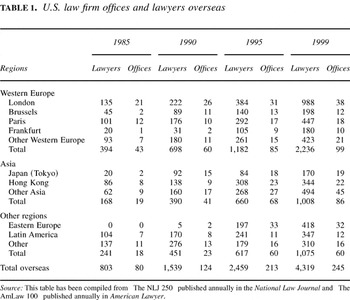
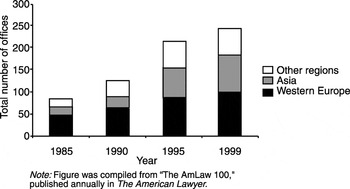
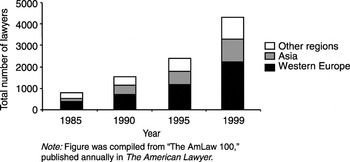
Table 1 and Figures 1 and 2 show the dramatic increase in the presence of American law firms in Europe. Between 1985 and 1999 the number of offices of American law firms in Western Europe more than doubled, from forty-three to ninety-nine. The total number of lawyers employed by American firms in Western Europe increased nearly six-fold in the same period, from 394 to 2,236. Though these figures demonstrate a marked expansion of American law firms, they greatly underestimate the impact of American firms in three respects. First, much of the legal work done for clients in the EU is handled in the American firms' home offices in the United States. Second, this data ignores the activities of American accounting firms, which in some countries—such as France—are authorized to provide legal services and have emerged as major competitors to European firms.46
Trubek et al. 1994, 434–35.
New York Law Journal, 15 November 1999, S6.
See New York Times, 4 August 2000, C3; The Battle of the Atlantic, Economist, 26 February 2000; Financial Times, 18 July 2000, 12.
U.S. law firm offices and lawyers overseas


U.S. law firm offices overseas

Lawyers employed by U.S. firms overseas
Securities Law in the EU
Before the 1980s, securities exchanges in Europe relied on flexible, informal self-regulation based largely on trust between repeat market players. While the degree of government regulation of securities markets varied across EU member-states, in all cases exchanges were granted considerable autonomy.49
See Karmel 1999, 30; Vogel 1996, 94–98.
Warren 1994, 185.
Since the early 1980s, the EU has transformed its regulatory regime for securities, and its efforts have intensified with a series of initiatives during the past five years. Economic liberalization, political fragmentation, and the activities of American law firms are all acting to reshape the EU's emerging regulatory regime along American lines. The contours of the new approach to securities regulation reflect the hallmarks of U.S. securities regulation identified above: detailed law focusing on disclosure, transparent regulatory processes, and an adversarial, judicialized approach to enforcement with an increased emphasis on private enforcement.
The liberalization of European financial markets simultaneously undermined existing national systems of securities regulation and created pressures for new forms of EU-level regulation. Liberalization accelerated rapidly beginning in the mid-1980s as some national governments started lifting restrictions on cross-border capital movements. The EU quickly stepped in to promote financial market liberalization as part of its single market program, and adopted a series of directives culminating in a 1988 directive calling for the complete liberalization of capital movements by 1990. Cross-border activity increased dramatically in the 1990s as investors, firms, and financial service providers sought opportunities outside their home markets. Not only did the number and diversity of players in securities markets increase, but new trading platforms were also established.51
Finally, the introduction of the Euro radically accelerated the process of market integration.52See The Economist, 3 March 2001, 63–65; Financial Times, 6 February 2001, 6.
From the outset, this market liberalization was coupled with an effort spearheaded by the European Commission to re-regulate at the EU level. The Commission recognized that the informal, opaque regulatory practices common in most member-states were incompatible with a truly Europeanized securities market. If existing regulatory schemes persisted, they would discriminate against outsiders and prevent the establishment of a single market for financial services. If member- states unilaterally adopted more transparent, codified regulatory requirements, divergence between these national requirements would continue to fragment the market.53
Warren 1994, 186.
See Lannoo 2001; Karmel 1999.
Despite the establishment of these minimal standards, regulatory barriers continued to fragment national markets in important respects. In the run up to the launch of the Euro, the member-states called on the Commission to table an action plan to improve the single market in financial services. The 1999 Financial Services Action Plan set out a schedule for the adoption of forty-two new measures to make the single market in financial services a reality by 2005.55
The EU has already completed most of the Action Plan's measures, and the Internal Market Directorate General has issued a series of new proposals aimed at enhancing market transparency.56 In 2000, the Council also convened a “Committee of Wise Men”—headed by Alexandre Lamfalussy—to propose institutional reforms to improve the securities regulatory process. Following the Lamfalussy report's suggestions, the EU established a pair of regulatory committees. The European Securities Committee (ESC) was given the power to issue implementing measures on the basis of EU legislation, and some observers view it as an embryonic SEC.57Lannoo 2002, 13.
The CESR replaced the Forum of European Securities Commissions (FESCO), a weaker cooperative body established by national regulatory authorities in 1997 without any formal EU mandate.
The politics surrounding the establishment of the new securities committees and the adoption of the most recent securities directives illustrate how political fragmentation is influencing the EU's emerging regulatory regime. First, the European Parliament has applied its legislative power to demand that the new securities committees be structured in a transparent, democratically accountable manner.59
The Parliament blocked the establishment of the ESC until it secured the assurance that it would be fully informed of upcoming ESC decisions in time to make its views heard. Second, the Parliament has proposed hundreds of amendments to securities directives, attempting to constrain bureaucratic discretion and to force regulators to protect consumer interests. The Lamfalussy Report had called for the adoption of broad “framework directives” that would leave detailed implementing measures to expert Committees.60Lannoo 2002, 11–12.
Beyond the increases in centralized enforcement by the Commission, there are clear signs of increased efforts by private parties (that is, shareholders) to take legal action to enforce securities regulations. U.S. institutional investors in Europe have begun employing their shareholder activism techniques, including litigation.61
Shareholder activism groups have emerged in a number of EU member- states, including France and Germany.62See ibid., 647–54; Business Week, 19 March 2001, 20.
Financial Times, 15 October 2001, 22.
See Financial Times, 26 January 2001, 6; Financial Times, 27 November 2001, 18.
American law firms active in European securities markets have accelerated the Americanization of securities regulation in the EU. American law firms are active players in European securities markets, advising clients in many of Europe's largest initial public offerings, mergers, and acquisitions. In many areas, these firms have shifted legal practice in a more American direction than that required by the content of EU directives and regulations. The Americanization of legal practice is evident in the most common type of international offerings: those that include offers of unregistered securities to institutional investors outside of the issuer's home jurisdiction pursuant to a “professionals exemption.” In such transactions, European institutional investors now prefer U.S.-style disclosure documents when making large purchases of equity securities offered by European issuers.65
This preference reflects, at least in part, the fact that U.S.-trained lawyers—brought in for many of the deals by U.S. investment banks or European firms—have over time aligned the standard of disclosure with U.S. transactions for comparable deals. Finally, some prominent American firms have even played a role in shaping the substance of new regulations in Europe including, for example, Germany's Neuer Markt's latest regulations for IPO prospectuses, which brought the Neuer Markt closer to U.S. standards.66Financial Times, 30 August 2001, 27.
Products Liability Law in the EU
Traditionally, plaintiffs in EU member-states could make product liability claims under general principles of civil law, such as breach of contract or tort. Tort claims generally required proof of negligence or intentionality. Presumption of negligence and reversal of burden of proof were available in some jurisdictions, but no systems were based primarily on strict liability.67
A variety of legal rules and institutions created impediments to, and decreased the potential payoffs of, products liability litigation. Impediments common to most member-states included limited discovery procedures and the absence of contingency fee arrangements and class actions. The expected benefits of product liability litigation were dampened by the fact that damage awards remained low (in part because judges, rather than juries, determined awards), punitive damages were nearly nonexistent, and many of the costs associated with medical treatment and missed work were covered by national medical and social welfare systems. Also, many member-states imposed a “loser pays” system. As a result of these factors, product liability litigation was uncommon.Beginning with the adoption of the Product Liability Directive in 1985, the EU has moved the substance of EU products liability law much closer to that found in the United States. However, despite the adoption of much of the substance of American products liability law, the practice of products liability law in the EU has not yet been Americanized. Product liability litigation remains rare, class actions are unavailable in most member-states, and the massive damage awards common in the United States are altogether absent. Economic liberalization and political fragmentation in the EU have encouraged the introduction of central aspects of American products liability law into European law; however, American law firms remain absent from this area of law in the EU and have therefore played no role in stimulating Americanization of legal practice. Moreover, a variety of legal rules and institutions that increase costs and decrease potential rewards continue to discourage product liability litigation in the EU.
In the wake of the thalidomide tragedy of the early 1960s, national governments across the EU dramatically increased their efforts to protect consumers from unsafe products. These efforts coincided with the ongoing liberalization of trade in the common market. National product safety standards and product liability regimes threatened to undermine the common market by creating regulatory barriers to trade. To protect the common market, the European Commission had a strong incentive to promote harmonization of product safety regulations and products liability law at the European level.68
Hodges 2000, 171–77.
Stapleton 2002, 1231.
In 1976, the Commission proposed a directive establishing strict liability for defective products.70
After being blocked by some member-states for a decade, a compromise was reached and the Council adopted the Product Liability directive in 1985.71 The directive reflected many legal concepts of U.S. products liability law, including the doctrines of strict liability and joint-and-several liability, as well as expansive definitions of liable parties and the notion of a “defect.” However, the Directive also sought to avoid the perceived excesses of the U.S. system. To satisfy those member-states concerned about the negative impact of the directive on European manufacturers, the directive included a mandatory time limit on claims and optional provisions concerning damage ceilings, the developmental risks defense, and liability for primary, unprocessed agricultural products. The directive left questions of nonmaterial damages, such as psychological pain and suffering, and punitive damages entirely to the member-states.Debate over the directive subsided after its passage but resurged in the wake of the “mad cow” crisis concerning the safety of beef products. Initially, the EU adopted an amendment to the directive mandating strict liability for damages caused by primary agricultural products.72
Hodges 2000, 183.
Opinion of 5.11.98 (O.J. C 359 of 23.11.98).
While the dearth of systematic, comparative data makes it difficult to assess the impact of the directive, it is evident that the introduction of strict liability under the directive has not yet stimulated the torrent of litigation, the high costs and the unpredictability associated with the American system.76
Hodges 2000, 184.
E.U. Reform Debated, Business Insurance, 20 March 2000, available at 〈www.businessinsurance.com〉. Accessed 1 February 2003.
While economic liberalization and political fragmentation encouraged the Americanization of the substance of EU products liability law, patterns of legal practice across the EU have resisted such change. The institutional impediments and financial disincentives outlined above continue to discourage product liability litigation. Moreover, as of yet American law firms have made no inroads into European legal services markets in the area of products liability, and thus have played no role in stimulating a shift in legal practice. In 2002, the Commission proposed a directive that aimed to improve access to justice by strengthening legal aid across the EU for both individuals and public interest organizations, and that also called for the adoption of a “loser pays” system with exceptions for weaker parties in areas such as consumer protection law.79
If adopted, such reforms promise to increase incentives for aggrieved consumers to pursue products liability litigation.The combination of economic liberalization, political fragmentation, and the influx of American law firms has stimulated a considerable Americanization of legal style in the EU across a wide range of issue areas. Economic liberalization has undermined national systems of regulation, and the political fragmentation built into the EU's institutional structure has encouraged the development of a regulatory style that emphasizes transparency, detailed codification of rules and procedures, and judicial enforcement more than did traditional national styles of regulation in EU member-states. Competition from American and British law firms has stimulated a wave of reorganization and consolidation among continental European firms, which are increasingly adopting the structures and practices developed by corporate law firms in the United States decades ago. A major reorientation of securities regulation has taken place since the mid-1980s, emphasizing disclosure and transparency. The substance of products liability law has moved in an American direction as well. However, changes in the practice of products liability law remain minimal, because the existence of alternative compensation mechanisms, restrictions on class actions and punitive damage awards, and the absence of American law firms in this field continue to limit the emergence of the more litigious aspects of an American-style product liability regime.
Neither regulatory competition nor policy emulation provides adequate explanations for these developments. Only in the area of securities regulation can one make a plausible argument that regulatory competition has played a significant role in encouraging Americanization,80
and even in this area, concerns regarding competition with American securities markets have been secondary to purely ‘domestic’ (European) motivations for reform.81Karmel 1999, 10–12.
Americanization of Law in Japan
Japanese Legal Style
Postwar Japan has relied heavily on an informal regulatory style, in which government bureaucrats use informal, flexible “administrative guidance” to steer the affairs of firms and pursue their regulatory goals.82
See Duck 1996; Upham 1987 and 1996; Okimoto 1989, 158; Kagan 2000.
Political leaders have consistently sought to discourage litigation and to channel policy disputes away from courtrooms and into informal, nontransparent bureaucratic settings.85
Most notably, the government has discouraged litigation by limiting the number of lawyers in Japan. Until recent reforms, only approximately 700 students per year passed the entrance exam for the Supreme Court's Legal Research and Training Institute, which one must attend to become a lawyer (bengoshi). Foreign lawyers were excluded almost entirely from practicing law in Japan until 1986.86Hall 1997, 24.
Henderson 1996, 30–40.
Americanization in Japan
In the 1990s, the confluence of pressures created by economic liberalization and political fragmentation led to a significant Americanization of Japanese legal style across a number of policy areas. Since the early 1980s, Japan has undertaken a massive economic liberalization across a wide range of economic sectors. This liberalization has introduced new players, both foreign and domestic, into previously sheltered markets. The increasing diversity of players undermined traditional Japanese approaches to regulation based on close ties between insiders in the Iron Triangle. Foreign firms did not fit within these frameworks and, backed by their home governments, demanded regulatory clarity, “level playing fields,” and the removal of “unfair trade barriers.” Domestic players who stood to benefit from liberalization regularly invoked this foreign pressure (gaiatsu) as a justification for the reforms they sought.88
See Vogel 1996, 38; Sobel 1994, 106–10.
While economic liberalization by itself provided a vital impetus for reform, it was only after economic liberalization combined with a marked increase in political fragmentation that Japanese legal style moved dramatically in an American direction. The watershed in terms of political fragmentation came in 1993 with the election of the first non-LDP government of the postwar era and the subsequent reform of the electoral system in 1994. In 1993, the LDP was ousted from government after nearly forty years of uninterrupted dominance and was replaced by a coalition government headed by Prime Minister Morihiro Hosokawa. The new coalition government took power having made a commitment to reforming Japan's electoral system within one year. They quickly replaced the existing single nontransferable vote, multimember district electoral system with a new system based on a combination of single-member districts and proportional representation.89
See Curtis 1999, 137–70; Sakamoto 1999, 99–133.
The LDP's 1993 loss and the subsequent electoral reform encouraged a shift in Japanese legal style in two ways. First, the end of LDP dominance increased the degree of political uncertainty. Before 1993, LDP leaders, who could reasonably expect their party to maintain control indefinitely, controlled the bureaucracy through a variety of informal incentive structures backed by ongoing monitoring.90
LDP leaders had no incentive to establish formal, codified administrative procedures and to invite judicial review. After the LDP's 1993 defeat and the 1994 electoral reform, however, leaders of the LDP and those of other parties were faced with great uncertainty regarding future electoral outcomes. The opposition parties who suddenly found themselves in power had a great incentive to codify administrative procedures and invite judicial review to increase the accountability and transparency of the bureaucracy that had for so long been tightly linked to the LDP. Even LDP leaders had an incentive to formalize and judicialize mechanisms of bureaucratic control, as the LDP's existing informal mechanisms were no longer viable in light of the new electoral uncertainty. The electoral reform had a second effect on the incentives of politicians that encouraged a shift in legal style. While Japan's traditional electoral system had encouraged LDP politicians to target specific, narrow business constituencies, the new electoral system gave politicians greater incentives to appeal to large portions of the electorate with policies favoring diffuse public interests.91 As a result, politicians had an incentive to open up regulatory processes to previously excluded interest groups such as consumers and environmentalists.The Hosokawa coalition seized on its newfound power to increase the accountability and transparency of the bureaucracy. The 1993 Administrative Procedures Law (APL) aimed to codify administrative procedures and increase transparency.92
Duck 1996, 1729–40.
The wave of reform did not end with the fall of Hosokawa, but persisted through the shifting LDP-led coalition governments of the mid-1990s and through the LDP's return to power following the 1996 election. In 1998, the government of Prime Minister Ryutaro Hashimoto presented a Disclosure of Information Act to the Japanese Diet as part of a series of reforms intended to increase the transparency and accountability of the bureaucracy.93
Proponents of government accountability had pushed for a freedom of information law modeled on the U.S. 1976 Freedom of Information Act for more than twenty years, but the LDP had consistently blocked such proposals.94Los Angeles Times, 11 May 1999, A1.
Changes in the regulation of nonprofit organizations provide another example of the trend toward Americanization. Traditionally, nonprofit organizations in Japan could acquire and maintain legal status only with the explicit permission of the competent bureaucratic authority. Many groups were denied legal standing, while those that won it were subject to ongoing supervision. The tight restrictions on nonprofit organizations helped the LDP to keep outsiders from interfering with the closed, informal decision-making processes that went on within the Iron Triangle. In 1998, pressured by its coalition partners—the Social Democratic Party (SDP) and Sakigake—the LDP agreed to a Nonprofit Organization (NPO) Law that permits groups to gain legal status without bureaucratic screening and to maintain status without administrative guidance.95
Economic liberalization also allowed American law firms to enter the Japanese market, and these firms soon played a catalytic role in the Americanization of Japanese legal style. In the early 1980s, as Tokyo emerged as a world financial center, American law firms sought to enter the Japanese market. The Foreign Lawyers Special Act of 1986 opened the Japanese legal services market to foreign firms, subject to numerous restrictions.96
Subsequent reforms over the course of the 1990s eased some of these restrictions, but foreign law firms are still prohibited from hiring Japanese lawyers or from formally merging with Japanese firms.97See Hall 1997, 25–29; Henderson 1997, 66–67.
International Financial Law Review, November 2001, 6.
As various reforms aimed at increasing transparency and bureaucratic accountability and empowering private actors to exercise legal rights have increased the need for lawyers in Japan, the government has undertaken reforms to increase the number of legal professionals. During the past decade, the Supreme Court Legal Research Institute has nearly doubled the number of would-be lawyers that complete its training course each year. In June 2001, the Cabinet-appointed Judicial Reform Council issued a report calling for a complete overhaul of the nation's legal system, including the establishment of American-style law schools, tripling the number of students who qualify for the bar annually, and a variety of measures that would lower litigation costs and facilitate citizens' access to legal services. The government of Prime Minister Junichiro Koizumi endorsed the plan in 2001 and pledged to follow its recommendations.99
“Major legal reform handed to Koizumi,” Japan Times, 13 June 2001; Nikkei Weekly, 30 October 2000, 6.
Securities Regulation in Japan
Although Japan emerged from the Allied occupation after World War II with a statutory infrastructure for securities regulation similar to that of the United States, securities regulation in Japan has differed markedly from that in the United States. First, the regulatory regime has focused not on disclosure but on “merit” standards, reducing risk by limiting new entrants, and restricting the range of permissible investment products. Second, securities regulation by the Ministry of Finance (MOF) has been marked by opacity and infrequent resorting to formal rules and procedures. Finally, privatization of enforcement has been limited in comparison to the United States.
The U.S. effort during its postwar occupation to institute an American-style regulatory regime for securities in Japan largely failed. The 1948 Securities and Exchange Law (SEL) foisted on Japan was patterned after the U.S. regulatory regime and provided for an independent Japanese securities and exchange commission, as well as civil liability for misleading and false registration statements. However, the Japanese commission was disbanded as soon as the Peace Treaty was signed in 1951, and its powers transferred to the Finance Management Bureau of the MOF. Instead of adopting the U.S. approach focusing on disclosure, the MOF amended the SEL and regulated securities to restrict the number of players and control the types of investments investors could make. Organizations such as the Tokyo Stock Exchange and the Japan Association of Securities Dealers—which engage in self-regulation (jishu kisei) subject to MOF guidance—also emphasized merit regulation rather than disclosure.100
The MOF's regulatory practices were notoriously opaque.101
Vogel 1996, 170.
The threat of private litigation played virtually no role in encouraging compliance with securities regulation in Japan. Between 1950 and 1990, shareholders filed fewer than twenty derivative suits in Japan.102
Before 1989, there was little incentive for “insiders” to refrain from using nonpublic information to their advantage, as Japan effectively lacked an insider trading regime.103Since the mid-1980s, Japan has shifted toward an American approach to securities regulation emphasizing disclosure by issuers, transparency of regulators, and enforcement by private parties. This shift has been spurred on by a combination of the factors we identify above. The increasing diversity of players (particularly foreign ones) active in Japan's securities markets, which has accompanied the liberalization of Japanese financial markets since the mid-1980s, rendered the MOF's informal, opaque style of regulation increasingly untenable. Throughout the 1980s and 1990s, the U.S. government pressured Japan to open its securities markets to U.S. firms and to increase the transparency of its regulatory processes. While pressure from the U.S. government played a role in prying open the sheltered Japanese securities markets, it was ultimately the general increase in investors and financial service providers active in Japanese markets that undermined Japan's traditional approach to securities regulation.104
Sobel 1994, 97–98, 106–110.
The pressure for a fundamental reorientation of Japan's approach to securities regulation finally became overwhelming after the ongoing impact of economic liberalization was coupled with the impact of political fragmentation in the mid-1990s. The political fragmentation that occurred after 1993 encouraged the Japanese government both to increase the transparency of the MOF's regulatory practices and to promote decentralized enforcement by shareholders. The MOF had been under pressure to delegate much of the regulation of the securities industry to an independent agency since financial scandals involving securities houses had come to light in 1991. Initially, the MOF was able to resist such pressure, and it maintained control over the new Securities and Exchange Surveillance Commission (SESC) that was established in 1992 in response to the scandals. However, in 1998, after another set of high-profile scandals, opposition parties pressured the Hashimoto government into transferring control of the SESC to an independent body, the Financial Supervisory Agency.105
Bullock 2000, 58–59.
Securities Agencies Vow to Cooperate, Nikkei Weekly, 18 December 2000.
The regulatory process has also become more transparent. In 1992, provisions were instituted to replace the administrative circular notices issued by regulators with formal orders and regulations based on specific statutory provisions. In May 1998, MOF announced that it would end the practice of sending individual order and injunction notices to financial institutions, and switch to open publication of ordinances clearly showing requirements for authorization. Today, regulatory proposals are widely publicized for comment, and in 2001 the government instituted a system in which ministries and agencies publicize their interpretations of the law at the request of companies and individuals.107
Business Guidelines to be Aired, Nikkei Weekly, 15 January 2001.
Along with greater focus on disclosure and transparency in regulation, the government has promoted enforcement by private actors. In 1993, the Commercial Code was amended to make derivative suits easier and less costly, and damage amounts were increased.108
West 1994, 1436–66.
Business Week, 5 February 2001, 25.
Products Liability Law in Japan
Until recently, a number of statutory barriers discouraged potential product liability plaintiffs in Japan, so much so that between 1945 and 1990 only 150 product liability cases were decided in Japan.111
The few consumers who did bring product liability cases did so under negligence-based tort law, which required that they prove negligence on the part of manufacturers.112See Marcuse 1996, 370–71; Cohen 1997, 133–37.
Marcuse 1996, 389.
Cohen 1997, 128, 132.
Marcuse 1996, 377–78.
The idea of adopting a products liability law based on strict liability had been debated since the early 1970s, but government and business leaders consistently opposed the idea, arguing that it would encourage frivolous litigation and maintaining that the government's strict product standards provided consumers with adequate protection.116
Cohen 1997, 133, 144–48.
Ibid., 148–54.
The political fragmentation that came with the election of the first non-LDP government since the 1940s finally tipped the balance. Consumer groups, who had long felt neglected by the LDP, had been important backers of the Hosokawa coalition. Shortly after taking office, the new coalition pushed through a new Product Liability (PL) Law, which went into effect at the start of 1994.118
Ibid.
It remains too early for a definitive assessment of the impact of the new PL law; however, initial evidence suggests that it may usher in profound changes. While the new PL law has not stimulated a flood of litigation or huge settlement amounts, it has stimulated a dramatic increase in public interest in product liability, as evidenced by the unprecedented sales of books on products liability law, and has already led to a marked increase in the number of product liability suits.119
See Nottage 2000, 217; Rothenberg 2000, 489–90, 506.
See Rothenberg 2000, 496–501; Cohen 1997, 164–66; Wall Street Journal, 8 March 1994, A13.
Cohen 1997, 162–63.
Ibid., 169–71.
While economic liberalization and political fragmentation both played important roles in stimulating the reform of Japanese products liability law, American lawyers have played only a marginal role. The U.S. law firms with a presence in Japan primarily represent corporate entities, whereas products liability claims are typically brought in the name of injured individuals. Accordingly, the influence of American law firms on Japanese legal style has been limited mostly to advocating for general reforms in the legal profession, such as increases in the number of lawyers.
In Japan, economic liberalization coupled with the increasing political fragmentation following the weakening of the LDP monopoly and reform of the electoral system in the early 1990s has led to significant changes in regulatory style. In areas ranging from administrative procedures, to the regulation of nonprofit organizations, to securities regulation and product liability, reforms have decreased bureaucratic discretion and increased transparency. Reforms are also gradually increasing the ability of Japanese citizens to assert their rights in court. These changes have gone further in securities regulation—where economic liberalization has had a stronger impact and where American law firms have stimulated shifts in legal practice—than in products liability. In both areas, the development of American legal style continues to be stunted by the dearth of lawyers; however, major reforms are underway aimed at increasing the ranks of the legal profession and at facilitating litigation in other ways. The timing and scope of these changes cannot be explained adequately by regulatory competition or policy emulation. Only in the area of securities regulation can one make a powerful argument that adoption of U.S.-style laws was driven by competition with, or emulation of, U.S. securities markets. However, even in this area, the impact of regulatory competition and emulation was only indirect. Advocates of securities reform in Japan were able to strengthen their position by shifting blame for the cost of reform to “foreign pressure,” but the most significant moves toward American legal style came only after political fragmentation disrupted cozy relationships between the LDP, the MOF, and the securities industry, and after American law firms began employing American-style legal practices in Japan.
Conclusions
American legal style is going global, but the pace and scope of its expansion varies across countries and issue areas. In both the EU and Japan, the shift toward American legal style is being driven by increasing economic liberalization and political fragmentation. Economic liberalization encouraged the spread of American legal style not because it pressured policymakers to adopt more internationally competitive American practices, but because it undermined traditional, informal, opaque approaches to regulation and pressured governments to resort to more formal, transparent, adversarial, American-style processes. Political fragmentation added a vital set of political incentives for the Americanization of law. Only when the increasing fragmentation of political institutions created incentives for lawmakers to judicialize policy-implementation and enforcement processes did we observe significant shifts toward American legal style. Finally, economic liberalization unleashed a transnational force—American law firms—which accelerated the globalization of American law in the areas where they were active by spreading their practices and pressuring foreign legal service industries to adopt them.
Despite all of these pressures, neither in Japan nor in the EU has the shift toward American legal style led to the extremes of American-style litigiousness. Entrenched institutional impediments to litigation—such as restrictive rules of standing, the absence of class actions, and limited damage awards—discourage litigation in many areas. Governments in the EU and Japan continue to be eager to avoid the notorious excesses of the American system, and they are well positioned to do so. Nevertheless, the spread of American legal style in both the EU and Japan is substantial and ongoing, and because it is rooted in fundamental changes in political institutions and economic structures, it is unlikely to be reversed.
The political consequences of the globalization of American law will be far-reaching. The shifts in legal style we describe above promise to erode the power of closed networks of political and business elites in shaping policy—by increasing openness and transparency, and by empowering a broader range of political interests to challenge bureaucratic malfeasance and corporate misconduct. But enhanced openness, transparency, and judicial enforcement come at a steep price. The shift to American legal style also promises to increase the role of lawyers and costly, protracted litigation, while undermining traditions of trust and cooperative relationships between stakeholders in policymaking processes—the very attributes of policymaking in Western Europe and Japan that scholars and practitioners have long admired.
References
REFERENCES
Abel, Richard.
1994.
Transnational Law Practice.
Case Western Reserve Law Review
44:737–870.Google Scholar
Alter, Karen.
1998.
Who Are the “Masters of the Treaty”?: European
Governments and the European Court of Justice.
International Organization
52 (1):121–47.Google Scholar
Alter, Karen.
2001.
Establishing the Supremacy of European Law.
Oxford:
Oxford University Press.
BEUC (The European Consumers' Organisation).
2000.
Response to the Commission's Green Paper on Liability for Defective
Products. BEUC/016/2000.
Available from European Commission Web site at
〈http://europa.eu.int/comm/internal_market/en/goods/liability/replies.htm〉.
Accessed 20 August 2003.
Black, Donald.
1976.
The Behavior of Law.
New York:
Academic Press.
Bullock, Robert.
2000.
Market Opening in Japan. In
New Perspectives on U.S.-Japan Relations, edited by
Gerald Curtis,
39–81.
Tokyo:
Japan Center for International Exchange.
Cohen, Jason.
1997.
The Japanese Product Liability Law.
Fordham International Law Journal
21:108–89.Google Scholar
Commission of the European Communities (Commission).
1976.
Proposal for a Directive on Strict Liability for Defective
Products.
O.J. (C 241).
Commission of the European Communities (Commission).
1999a.
Financial Services Action Plan.
COM (1999) 232 final, 11 May 1999.
Commission of the European Communities (Commission).
1999b.
Green Paper on Liability for Defective Products.
COM (1999) 396 final, 28 July 1999.
Commission of the European Communities (Commission).
2000.
Progress on Financial Services: 2nd Report.
COM (2000) 336 final. 30 May 2000.
Commission of the European Communities (Commission).
2001.
Report from the Commission on the Application of Directive 85/374
on Liability for Defective Products.
COM (2000) 893, 31 January 2001.
Commission of the European Communities (Commission).
2002a.
Financial Services Action Plan, Sixth Report.
COM (2002) 267, 3 June 2002.
Commission of the European Communities (Commission).
2002b.
Commission Proposal for a Council Directive to Improve Access to
Justice in Cross-Border Disputes.
COM (2002) 13. Unpublished.
Cooter, Robert, and
Tom Ginsburg.
1996.
Comparative Judicial Discretion.
International Review of Law and Economics
16 (3):295–313.Google Scholar
Council of Ministers.
1985.
Council Directive 85/374 on the Approximation of the Laws,
Regulations and Administrative Provisions of the Member States Concerning
Liability for Defective Products.
O.J. (L210/29).
Curtis, Gerald.
1999.
The Logic of Japanese Politics.
New York:
Columbia University Press.
Dezalay, Yves.
1996.
Between the State, Law and the Market. In
International Regulatory Competition and Coordination, edited by
William Bratton et al.,
59–87.
Oxford:
Oxford University Press.
Drezner, Daniel.
2001.
Globalization and Policy Convergence.
International Studies Review
3 (1):53–78.Google Scholar
Duck, Ken.
1996.
Now That the Fog Has Lifted: The Impact of Japan's
Administrative Procedures Law.
Fordham International Law Journal
19:1686–763.Google Scholar
Epp, Charles.
1992.
Do Lawyers Impair Economic Growth?
Law & Social Inquiry
17 (4):585–623.Google Scholar
European Parliament.
2001.
Resolution on the Final Report of the Committee of Wise Men on the
Regulation of European Securities Markets,
RSP/2001/2530, 15 March 2001.
Ferejohn, John.
1995.
Law, Legislation and Positive Political Theory. In
Modern Political Economy, edited by
Jeffrey Banks and
Eric Hanushek,
191–215.
New York:
Cambridge University Press.
Finnemore, Martha.
1996.
National Interests and International Society.
Ithaca, N.Y.:
Cornell University Press.
Franchino, Fabio.
2001.
Delegation and Constraints in the National Execution of EC Policies.
West European Politics
24 (4):169–92.Google Scholar
Galanter, Marc.
1983.
Mega-Law and Mega-Lawyering in the Contemporary United States. In
The Sociology of the Professions, edited by
Robert Dingwall and
Philip Lewis,
152–76.
London:
MacMillan Press.
Galanter, Marc.
1992.
Law Abounding: Legalisation Around the North Atlantic.
Modern Law Review
55 (1):1–24.Google Scholar
Galanter, Marc.
1996.
The Assault on Civil Justice. In
Legal Culture and the Legal Profession, edited by
Lawrence Friedman and
Harry Scheiber,
79–116.
Boulder, Colo.:
Westview Press.
Garrett, Geoffrey.
1998.
Global Markets and National Politics: Collision Course or Virtuous
Circle?
International Organization
52 (4):787–824.Google Scholar
Garrett, Geoffrey,
R. Daniel Kelemen, and
Heiner Schulz.
1998.
The European Court of Justice, National Governments and Legal
Integration in the European Union.
International Organization
52 (1):149–76.Google Scholar
Goebel, Roger.
1989.
The Internationalization of Law and Legal Practice.
Tulane Law Review
63:443–523.Google Scholar
Goldthorpe, John.
1984.
Order and Conflict in Contemporary Capitalism.
New York:
Oxford University Press.
Haley, John.
1978.
The Myth of the Reluctant Litigant.
Journal of Japanese Studies
4 (2):359–89.Google Scholar
Hall, Ivan.
1997.
Cartels of the Mind.
New York:
Norton.
Harlow, Carol.
1999.
Citizen Access to Political Power in the European Union.
EUI Working Paper RSC No. 99/2. Florence,
Italy:
European University Institute.
Hayward, Jack.
1982.
Mobilising Private Interests in the Service of Public Ambitions. In
Policy Styles in Western Europe, edited by
Jeremy Richardson,
111–40.
London:
George Allen & Unwin.
Henderson, Dan.
1997.
Role of Lawyers in Japan. In
Japan, Economic Success and Legal System, edited by
Harald Baum,
27–67.
New York:
Walter de Gruyter.
Hodges, Christopher.
2000.
Product Liability in Europe.
Business Law International
3:171–91.Google Scholar
Horn, Murray.
1995.
The Political Economy of Public Administration.
Cambridge:
Cambridge University Press.
Jackson, Howell, and
Eric Pan.
2001.
Regulatory Competition in International Securities Markets:
Evidence from Europe in 1999-Part I.
Business Lawyer
56:653.Google Scholar
Kagan, Robert.
1997.
Should Europe Worry About Adversarial Legalism?
Oxford Journal of Legal Studies
17 (2):165–84.Google Scholar
Kagan, Robert.
2000.
Comparing National Styles of Regulation in Japan and the U.S.
Law & Policy
22 (3–4):225–44.Google Scholar
Kagan, Robert.
2001.
Adversarial Legalism.
Cambridge, Mass.:
Harvard University Press.
Kagan, Robert, and
Lee Axelrad.
1997.
Adversarial Legalism: An International Perspective. In
Comparative Disadvantages? Social Regulations and the Global
Economy, edited by
Pietro Nivola,
146–80.
Washington, D.C.:
Brookings Institution Press.
Karmel, Roberta.
1999.
The Case for a European Securities Commission.
Columbia Journal of Transnational Law
38:9–43.Google Scholar
Kelemen, R. Daniel.
2000.
Regulatory Federalism: EU Environmental Policy in Comparative
Perspective.
Journal of Public Policy
20 (2):133–67.Google Scholar
Kelemen, R. Daniel.
2002.
The Politics of Eurocratic Structure: The New European Agencies.
West European Politics
25 (4):93–118.Google Scholar
Kissane, Mary.
1997.
Global Gadflies: Applications and Implications of U.S.-Style
Corporate Governance Abroad.
New York Law Journal of International and Comparative Law
17:621–75.Google Scholar
Kitschelt, Herbert,
Peter Lange,
Gary Marks, and
John Stephens, eds.
1999.
Change and Continuity in Contemporary Capitalism.
New York:
Cambridge University Press.
Lannoo, Karel.
2001.
Updating EU Securities Market Regulation.
Brussels:
Centre for European Policy Studies.
Lannoo, Karel.
2002.
Supervising the European Financial System.
CEPS Policy Brief No. 21. Brussels:
Centre for European Policy Studies.
Laurence, Henry.
1999.
Spawning the SEC.
Indiana Global Legal Studies Journal
6:647–83.Google Scholar
Lehmbruch, Gerhard, and
Philippe C. Schmitter.
1982.
Patterns of Corporatist Policy Making.
London:
Sage Publications.
Loss, Louis, and
Joel Seligman.
1998.
Securities Regulation.
3rd ed.
New York:
Aspen Publishers.
Majone, Giandomenico.
1996.
Regulating Europe.
New York:
Routledge.
Marcuse, Andrew.
1996.
Why Japan's New Products Liability Law Isn't.
Pacific Rim Law and Policy
5:365–98.Google Scholar
Martin, Lisa.
1992.
Interests, Power and Multilateralism.
International Organization
46 (4):765–92.Google Scholar
McCubbins, Matthew,
Roger Noll, and
Barry Weingast.
1987.
Administrative Procedures as Instruments of Political Control.
Journal of Law Economics and Organization
3 (2):243–77.Google Scholar
McCubbins, Matthew,
Roger Noll, and
Barry Weingast.
1989.
Structure and Process, Policy and Politics: Administrative
Arrangements and the Political Control of Agencies.
Virginia Law Review
75:431–82.Google Scholar
Meyer, John W.,
John Boli,
George Thomas, and
Francisco Ramirez.
1997.
World Society and the Nation-State.
American Journal of Sociology
103 (1):144–81.Google Scholar
Milhaupt, Curtis.
1994.
Managing the Market: The Ministry of Finance and Securities
Regulation in Japan.
Stanford Journal of International Law
30:423–82.Google Scholar
Miyazawa, Setsuo.
2001.
The Politics of Judicial Reform in Japan.
Asian-Pacific Law & Policy Journal
2 (2):89–121.Google Scholar
Moe, Terry.
1990.
The Politics of Structural Choice. In
Organization Theory from Chester Barnard to the Present and Beyond,
edited by
Oliver Williamson,
116–53.
New York:
Oxford University Press.
Mommsen, Wolfgang, and
Jaap De Moor, eds.
1992.
European Expansion and Law.
New York:
Berg Publishers.
Nottage, Luke.
2000.
The Present and Future of Product Liability Dispute Resolution in
Japan.
William Mitchell Law Review
27:215–35.Google Scholar
Okamura, Kazumi, and
Chieko Takeshita.
1989.
Laws and Regulations Relating to Insider Trading in Japan.
Tokyo:
Commercial Law Center.
Okimoto, Daniel.
1989.
Between MITI and the Market.
Stanford, Calif.:
Stanford University Press.
Pekkanen, Robert.
2000.
Japan's New Politics: The Case of the NPO Law.
Journal of Japanese Studies
26 (1):111–43.Google Scholar
Pollack, Mark.
1997.
Delegation, Agency and Agenda Setting in the European Community.
International Organization
51 (1):99–134.Google Scholar
Prechal, Sacha.
1995.
Directives in European Community Law.
Oxford:
Oxford University Press.
Ramseyer, J. Mark.
1994.
The Puzzling (In)Dependence of Courts.
The Journal of Legal Studies
23:721–47.Google Scholar
Ramseyer, J. Mark, and
Frances Rosenbluth.
1993.
Japan's Political Marketplace.
Cambridge, Mass.:
Harvard University Press.
Repeta, Lawrence, and
Jody Chafee.
1998.
Japanese Government Information: New Rules for Access.
Available from Japan Information Access Project Web site
〈http://www.jiaponline.org/publications/docs/1998/june/joho.pdf〉.
Accessed 30 September, 2003.
Richardson, Jeremy, ed.
1982.
Policy Styles in Western Europe.
London:
George Allen & Unwin.
Rosenbluth, Frances, and
Michael Thies.
2001.
The Electoral Foundations of Japan's Financial Politics.
Policy Studies Journal
29 (1):23–37.Google Scholar
Rothenberg, Phil.
2000.
Japan's New Products Liability Law.
Law and Policy in International Business
31 (2):453–516.Google Scholar
Sakamoto, Takayuki.
1999.
Building Policy Legitimacy in Japan.
New York:
MacMillan Press.
Sarumida, Hiroshi.
1996.
Comparative Institutional Analysis of Product Safety Systems in the
U.S. and Japan.
Cornell International Law Journal
29:79–145.Google Scholar
Schwarze, Jürgen, ed.
1996.
Administrative Law under European Influence.
London:
Sweet and Maxwell.
Shapiro, Martin.
1992.
The Giving Reasons Requirement.
University of Chicago Legal Forum
179–220.
Shapiro, Martin.
1993.
The Globalization of Law.
Indiana Journal of Global Studies
1 (1):37–64.Google Scholar
Shapiro, Martin.
1996.
The Globalization of Judicial Review. In
Legal Culture and the Legal Profession, edited by
Lawrence Friedman and
Harry Scheiber,
119–35.
Boulder, Colo.:
Westview Press.
Shapiro, Martin.
1998.
Globalization and Freedom of Contract. In
The State and Freedom of Contract, edited by
Harry Scheiber,
269–98.
Stanford, Calif.:
Stanford University Press.
Shapiro, Martin, and
Alec Stone.
1994.
The New Constitutional Politics of Europe.
Comparative Political Studies
26 (4):397–420.Google Scholar
Simmons, Beth.
2001.
The International Politics of Harmonization.
International Organization
55 (3):589–620.Google Scholar
Simmons, Beth, and
Zachary Elkins.
2001.
Globalization and Policy Diffusion: Explaining Three Decades of
Liberalization. In
Governance in a Global Economy: Political Authority in Transition,
edited by
Miles Kahler and
David Lake.
Princeton, N.J.:
Princeton University Press.
Slaughter, Anne-Marie.
2000.
Judicial Globalization.
Virginia Journal of International Law
40:1103–24.Google Scholar
Sobel, Andrew.
1994.
Domestic Choices, International Markets.
Ann Arbor:
University of Michigan Press.
Spacone, Andrew.
2000.
Strict Liability in the European Union.
Roger Williams University Law Review
5:341–84.Google Scholar
Stapleton, Jane.
2002.
Bugs in Anglo-American Products Liability.
South Carolina Law Review
53:1225–61.Google Scholar
Stone Sweet, Alec.
2000.
Governing with Judges.
Oxford:
Oxford University Press.
Streeck, Wolfgang, and
Philippe Schmitter.
1991.
From National Corporatism to Transnational Pluralism: Organized
Interests in the Single European Market.
Politics and Society
19 (2):133–65.Google Scholar
Swire, Peter.
1996.
The Race to Laxity and the Race to Undesirability.
Yale Journal on Regulation
14:67–110.Google Scholar
Tate, C. Neal, and
Torbjörn Vallinder, eds.
1995.
The Global Expansion of Judicial Power.
New York:
New York University Press.
Trubek, David,
Yves Dezalay,
Ruth Buchanan, and
John Davis.
1994.
Global Restructuring and the Law.
Case Western Law Review
44:407–98.Google Scholar
Tsebelis, George.
2002.
Veto Players.
Princeton, N.J.:
Princeton University Press.
Upham, Frank.
1987.
Law and Social Change in Postwar Japan.
Cambridge, Mass.:
Harvard University Press.
Upham, Frank.
1996.
Privatized Regulation: Japanese Regulatory Style in Comparative and
International Perspective.
Fordham International Law Journal
20:396–511.Google Scholar
van Waarden, Frans.
1995.
Persistence of National Policy Styles. In
Convergence or Diversity?, edited by
Brigitte Unger and
Frans van Waarden,
333–72.
Aldershot, England:
Avebury.
Vogel, David.
1986.
National Styles of Regulation: Environmental Policy in Great
Britain and the U.S.
Ithaca, N.Y.:
Cornell University Press.
Vogel, David.
1995.
Trading Up: Consumer and Environmental Regulation in a Global
Economy.
Cambridge, Mass.:
Harvard University Press.
Vogel, Steven.
1996.
Freer Markets, More Rules.
Ithaca, N.Y.:
Cornell University Press.
Warren, Manning.
1994.
The European Union's Investment Services Directive.
University of Pennsylvania Journal of International Business Law
15:181–220.Google Scholar
Weaver, R. Kent, and
Bert Rockman, eds.
1993.
Do Institutions Matter? Government Capabilities in the United
States and Abroad.
Washington, D.C.:
Brookings Institution.
West, Marc.
1994.
The Pricing of Shareholder Derivative Actions in Japan and the U.S.
Northwestern University Law Review
88:1436.Google Scholar
West, Marc.
2001.
Why Shareholders Sue: The Evidence from Japan.
Journal of Legal Studies
30:351–82.Google Scholar
Wiegand, Wolfgang.
1991.
The Reception of American Law in Europe.
American Journal of Comparative Law
39 (2):229–49.Google Scholar
Wiegand, Wolfgang.
1996.
Americanization of Law: Reception or Convergence? In
Legal Culture and the Legal Profession, edited by
Lawrence Friedman and
Harry Scheiber,
137–52.
Boulder, Colo.:
Westview Press.
U.S. law firm offices and lawyers overseas
U.S. law firm offices overseas
Lawyers employed by U.S. firms overseas
 You have
Access
- 68
- Cited by