Health technology assessment (HTA) refers to a multidisciplinary process aimed at exploring evidence and providing information on the clinical and economic aspects, and the broader impact (including social, ethical, and organizational issues) of a technology to inform and support decision making regarding health policies (Reference Gagnon1).
Within the centralized French system, HTA is conducted mainly at the national level by the French National Authority for Health (HAS). For medical devices, applying for assessment at the HAS can lead to several funding solutions ranging from standard reimbursement to specific supplementary payments. These supplementary payments, dedicated to technological innovations, are paid on top of the diagnosis-related group (DRG) tariff (Reference Scheller-Kreinsen, Quentin and Busse2). They cover innovative medical devices previously assessed by the HAS and registered on a specific list (liste en sus) funded by the National Health Insurance (Reference Scheller-Kreinsen, Quentin and Busse2). This payment instrument has been established as an incentive for the adoption and use of innovations within hospitals. In fact, the high level of requirements for HTA submission does not make this funding opportunity easily available for innovative medical devices in an early stage of diffusion.
Moreover, due to growing budget constraints and increased pressure on the use of resources, HTA methods have been adopted at the hospital level to promote evidence-based decision making (Reference Gagnon1). In France, limitations of the national HTA process in terms of scope and timeline have also reinforced the need for some local tools tailored to the hospital context to support decisions about the adoption of new technologies and innovative medical devices in particular.
The first hospital-based HTA (Hb-HTA) unit was created in the 1980s, the Assistance Publique – Hôpitaux de Paris (AP-HP), which played a key role in the diffusion of health technology assessment concepts and practices within hospitals across Europe (Reference Bodeau-Livinec, Simon, Montagnier-Petrissans, Joël and Féry-Lemonnier3). This unit, called CEDIT (Comité d'Evaluation et de Diffusion des Innovations Technologiques – Committee for the Assessment and Dissemination of Technological Innovations), was one of the founding members of the International Network of Agencies for Health Technology Assessment (INAHTA) (Reference Hailey and Menon4). In the first years of the twenty-first century, the scope of CEDIT changed and became dedicated to larger equipment such as the surgical robot or computed tomographic scanner.
In 2003, to handle specific activities regarding sterile medical device adoption policies at the hospital level, the AP-HP set up a medical device committee (Comité des Dispositifs Médicaux Stériles – CODIMS) in addition to CEDIT (Reference Beaussier, Junot, Lancrenon and Faure5). This multidisciplinary committee is composed of clinicians, pharmacists, and administration managers or representatives. The role of CODIMS is to support hospital managerial decisions on sterile medical devices by performing Hb-HTA and issuing recommendations on their use within the AP-HP (Reference Martelli, Billaux and Borget6). CODIMS approval is a prerequisite for adoption of sterile medical devices. Approximately sixty medical devices are assessed each year by CODIMS, of which eleven to fifteen are reported as being innovative medical devices (Reference Beaussier, Junot, Lancrenon and Faure5;Reference Boudard, Martelli, Prognon and Pineau7). The assessment procedure is based on a critical review of the available clinical evidence and on an estimation of the economic impact (Reference Beaussier, Junot, Lancrenon and Faure5). CODIMS acts only upon requests from clinicians and medical staff; manufacturers cannot ask for their medical devices to be assessed by CODIMS. In fact, manufacturers are not involved in the assessment process itself. However, they must still provide clinical data and defend the added benefit of their product through the submission of a value proposition summary as requested by CODIMS.
CODIMS often experiences difficulty in performing Hb-HTA because of methodological weaknesses in the clinical studies submitted by manufacturers (Reference Beaussier, Junot, Lancrenon and Faure5;Reference Boudard, Martelli, Prognon and Pineau7). Several surveys have highlighted the lack of high-level clinical evidence for innovative medical devices at the time of CODIMS assessment (insufficient follow-up to assess long-term safety, small population studied, missing data, etc.) (Reference Beaussier, Junot, Lancrenon and Faure5;Reference Boudard, Martelli, Prognon and Pineau7). This appears to be a consequence of insufficient regulation of medical devices (Reference Beaussier, Junot, Lancrenon and Faure5;Reference Boudard, Martelli, Prognon and Pineau7). Application for CE marking requires manufacturers to justify the clinical effectiveness of a device, but European directives do not provide clear instructions regarding the required level of evidence of clinical data. As illustrated in a report from the French Ministry of Economic and Financial Affairs, the complexity of the medical devices regulatory environment does not help manufacturers to correctly address payers’ expectations and creates disparities among companies (8). The scope of activity differs greatly between small- and medium-sized enterprises (SMEs) and globalized ones. For example, due to limited resources, SMEs are more focused on research and development activities, and struggle to gain access to the hospital market (8).
With a network comprising thirty-nine healthcare facilities, the AP-HP appears to be the most attractive hospital market in France for innovative medical devices, which cannot be reached without CODIMS approval. Thus, achieving CODIMS assessment is a key step for manufacturers in securing diffusion of their devices. The objectives of the pilot survey we conducted were to explore manufacturers’ insights on the CODIMS assessment process and to compare their surrounding hospital market access strategies.
METHODS
Design of the Survey
The study was designed as a qualitative two-step pilot survey combining passive and active data collections to explore and capture manufacturers’ feedback and positions. This mixed method, which uses two approaches sequentially, enabled us to simultaneously answer exploratory and confirmatory questions and, thereby, verify and generate theory about the market access strategies of medical device manufacturers (Reference Creswell, Klassen and Plano Clark9).
As CODIMS only assesses few innovative medical devices each year (between eleven and fifteen), a small panel of manufacturers was identified based on CODIMS assessment reports. The panel was limited to nine manufacturers who were randomly selected and included different types and sizes of companies (i.e., large enterprises or SMEs).
The first step of the survey consisted of retrospective, semi-structured phone interviews aimed at gathering the manufacturers’ insights on the CODIMS assessment process. The interview guide was designed on the basis of relevant topics concerning Hb-HTA and market access strategies (see Supplementary Table 1). Open-ended and closed questions covering four topics were included: (i) the company, (ii) medical device features, (iii) market access strategy, and (iv) the assessment process. A descriptive analysis was performed using the data recorded during the interviews.
The second step of the survey consisted of a prospective and iterative questionnaire inspired by the Delphi method and submitted online to manufacturers through SurveyMonkey®. The aim was to explore hospital market access strategies and to determine whether there was a common trend between the manufacturers included in the panel. The questionnaire comprised five questions regarding (i) studies considered for CE marking application, (ii) coverage opportunities, (iii) Hb-HTA process initiation and clinicians’ involvement, (iv) studies considered for Hb-HTA submission, and (v) Hb-HTA criteria. The questionnaire was administered to all the participants, and for each question, the manufacturers were asked to rank the different suggestions according to their priorities.
A collective ranking was obtained from the individually ranked lists by summing the weights attributed to each proposition. The higher the weight, the more the suggestion was considered a priority for the manufacturers. This process was repeated over two rounds to check whether a consensus would arise or not. Then, concordance among the panelists' ranking was verified by calculating W Kendall's coefficient (Reference Chaves, Mazzon and de Souza10). The interpretation of the W values was as follows: W values below 0.10 were considered very low; W values from 0.11 to 0.30 were considered low; W values from 0.31 to 0.50 were considered moderate; W values from 0.51 to 0.70 were considered high; and W values from 0.71 to 0.90 were considered very high (Reference Schmidt11).
RESULTS
Survey
The entire survey was conducted between August and October 2014. Of the nine manufacturers included in the panel, eight (89 percent) completed the retrospective phone interview. Then, five manufacturers (56 percent) answered the prospective questionnaire during the first round, and only four (44 percent) answered during the second round.
Retrospective Phone Interviews
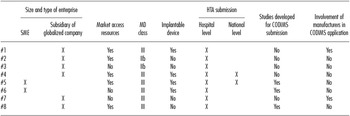
Six of the companies (75 percent) were subsidiaries of globalized companies, and two of the companies (25 percent) were SMEs. Regarding market access activities, five of the companies (63 percent) had either a specific department or at least some dedicated resources. The companies’ representatives involved in the survey were product managers (n = 2), marketing managers (n = 4), or market access managers (n = 2). Six of the medical devices assessed by CODIMS were class III devices and two were class IIb. Moreover, four were implantable devices. The main results are presented in Table 1.
Main Results from Phone Interviews

The retrospective analysis of the market access strategy revealed that between national and hospital HTA processes, CODIMS submission was the most favored strategy. For two of the eight innovative medical devices, HTA submission at the hospital and national levels were targeted in parallel. For the other six, CODIMS submission was planned first. Due to the specificity of the French system and the difficulty of achieving reimbursement at the national level, some of the manufacturers focused on Hb-HTA submission because they considered health technology adoption at the hospital level as a preliminary step that allowed for innovation diffusion and evidence generation before submission at the national level. However, for three devices, hospital market access and CODIMS submission were targeted first simply because there were no appropriate funding opportunities available at the national level.
When considering CODIMS submission, only three of the eight manufacturers interviewed stated that specific studies tailored to the hospital context had been developed. The five other manufacturers considered that their clinical data were consistent enough or that they did not have sufficient resources to conduct specific studies.
At the initiation of the process, when an assessment request was submitted by a clinician, the manufacturers were not very involved. Only two of the manufacturers were contacted by the requesting clinician to assist him in filling in the CODIMS application form.
The respondents also found that the executive staff of CODIMS did not always provide either sufficient information on the state of the assessment process or an explanation of the final decision. This makes it difficult for the manufacturers to gain a clear understanding of CODIMS expectations.
Prospective Questionnaire
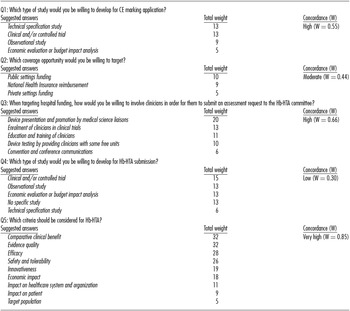
As illustrated in Table 2, for three questions, concordance between the panelists' responses was either high (studies considered for CE marking application and CODIMS process initiation) or very high (Hb-HTA criteria). For the coverage opportunities and the studies considered for Hb-HTA submission, concordance was moderate and low, respectively.
Results from the Prospective Questionnaire: Total Weight Attribution and Concordance Level of Manufacturers' Ranking

Note. The total weight was obtained by summing the ranking score attributed by each manufacturer to each proposition. The higher the weight, the more the suggestion was considered a priority for the manufacturers.
Coverage Opportunities
Divergent positions were recorded when considering coverage opportunities for innovative medical devices. Some manufacturers stated they will first look for public setting funding and others look for national reimbursement, but concordance among the panelists' responses was only moderate (W = 0.44).
Hb-HTA Process Initiation and Clinicians’ Involvement
Delivering information to clinical staff and enrolling clinicians in clinical trials seemed to be the most widespread method of initiating an Hb-HTA process (high concordance W = 0.66). Alternatively, education and training programs, device testing or communications were also considered effective opportunities to reach clinicians.
Studies considered for CE Marking Application and Hb-HTA Submission
Regarding CE marking application, the manufacturers formulated a consensual ranking (high concordance W = 0.55) and acknowledged that technical specifications and clinical evidence are of primary importance for achieving CE marking. However, when targeting Hb-HTA submission, the manufacturers reported that they had no clear perception of CODIMS requirements regarding types of studies and levels of evidence. Consequently, they did not reach a consensus (low concordance W = 0.30).
Ranking of Hb-HTA Criteria
Of the listed criteria, the manufacturers considered comparative clinical benefit and evidence quality the primary criteria to take into account when conducting Hb-HTA (very high concordance W = 0.85). In contrast, criteria such as target population and impact on patient were reported as less important in the hospital context.
DISCUSSION
Based on the results of this global survey, we can now outline major trends regarding manufacturers’ market access strategies and insights into the CODIMS assessment process.
According to the manufacturers, one major issue is that, in France, the complexity and timeline of HTA procedures at the national level do not match the current state of the medical device market and its increasing turnover. Conversely, we note that Hb-HTA processes appear more flexible, rapid, and timely (Reference Vestergaard, Ehlers and Kidholm12;Reference Sampietro-Colom, Lach and Cicchetti13). Hb-HTA submission seems to be increasingly considered a viable market access and coverage opportunity.
However, the relationship between Hb-HTA committees and manufacturers still needs to be strengthened. Connections with clinicians are usually achieved by manufacturers, but CODIMS expectations remain difficult to understand. Manufacturers wish they could be more involved to raise their awareness of each step of the procedure and to build mutual-trust relationships. As stated in the guiding principles issued by the European AdHopHTA project, transparency as well as involvement of relevant stakeholders is a core feature of the Hb-HTA process (Reference Sampietro-Colom, Lach and Cicchetti13). In addition, sharing of information would be profitable for both sides as it would help manufacturers to better understand CODIMS expectations and then provide relevant data to justify the added benefit of their medical devices. Manufacturers acknowledge that Hb-HTA processes should remain independent, but they could be considered valuable partners. Increasingly, companies develop internal HTA capacity and gain experience in conducting HTA processes. Deeper involvement of industry stakeholders could lead to better HTA outcomes and higher assessment quality (14).
Our study also raised the issue of cooperation between local and national HTA bodies. From an industry perspective, although Hb-HTA submission has become increasingly targeted, registration on the list of qualified devices for reimbursement is a major opportunity and remains the ultimate goal in France. We noted that assessment by CODIMS and adoption within the AP-HP are mainly considered as an alternative and as a first opportunity for market penetration and innovation diffusion. Hb-HTA is viewed as a process of applied clinical research that allows for evidence generation to support HTA submission at the national level. Collaboration between the HAS and hospital committees has already been advocated by the French national audit office for social affairs and health (Inspection Générale des Affaires Sociales – IGAS) (Reference Morel, Kiour and Garcia15). IGAS has called for the development of an HTA network that is led by the HAS and composed of Hb-HTA units from university hospitals. The objective would be to clarify the role and the area of expertise of each structure to better coordinate their activities. However, such an endorsement of Hb-HTA activities would also require that Hb-HTA units such as CODIMS clearly state their process and work together to define a common methodology. Even if methods and tools have been described and shared elsewhere in France, this might be an impeding factor at this stage of Hb-HTA practice diffusion (Reference Martelli, Billaux and Borget6;Reference Vestergaard, Ehlers and Kidholm12;Reference Sampietro-Colom, Lach and Cicchetti13;Reference Sampietro-Colom, Morilla-Bachs, Gutierrez-Moreno and Gallo16).
The limitations of this pilot study, whose objective was to draw a preliminary picture of the medical device industry's viewpoint, concern the small size of the panel and the selection process. Consequently, to strengthen the reliability of our findings, we aim to conduct a more exhaustive study including manufacturers for whom an innovative medical device has been assessed by several internal committees of university hospitals in France over the past 5 years. In addition, our intention is also to counterweight manufacturers’ viewpoint by running a similar survey from CODIMS perspective and attempt to identify opportunities for partnership.
CONCLUSION
Despite some limitations, this pilot study is, to our knowledge, the first to explore manufacturers’ viewpoints on the Hb-HTA processes and to address medical device market access issues from a new perspective. The results of our study reaffirm the primary role of hospitals in innovation diffusion and the need for better coordination between HTA activities performed at the local and national levels. Based on the same observation, the project AdHopHTA has been funded by the European Union to foster the application of high-quality HTA within hospitals and to develop tools for improving collaboration among national and regional HTA agencies (Reference Sampietro-Colom, Lach and Cicchetti13).
SUPPLEMENTARY MATERIAL
Supplementary Table 1: https://doi.org/10.1017/S0266462317000368
CONFLICTS OF INTEREST
The authors have nothing to disclose.