INTRODUCTION
No study has ever been conducted in France on the place of death of adolescents (hospital, home, palliative care unit), and no study has ever been conducted in France or elsewhere on the factors influencing the choice of the place of death, apart from a simple description. However, this question is essential to meet the needs of young patients and their families at the end of life.
With the development of palliative care, multidisciplinary teams and health care networks allowing the maintenance of cancer patients at home, the issue of the place of end of life and death has started to be discussed in the literature, usually from a descriptive and epidemiological point of view, but also presenting relevant qualitative data to allow a better response to the needs of patients and their families. Among the issues raised in the context of pediatric palliative care, one study analyzed the time spent at home and in hospital by children and adolescents at the end of life, regardless of the underlying disease (Feudtner et al., Reference Feudtner, DiGiuseppe and Neff2003). The authors demonstrated that adolescents and young adults spent a large proportion of time at home during their last year of life, in contrast with younger children, and highlighted the need to take this element into account in the organization of end-of-life care, which must be adapted to the patient's and the family's needs. Retrospective studies conducted on families concerning the patient's and the family's perception of the place of end-of-life care demonstrated the benefits of maintenance at home at the end of life for adults. Families perceived the end of life as being more serene when it took place at home, due to the feeling that it corresponded to the patient's wishes (Phipps & Braitman, Reference Phipps and Braitman2004). These authors also emphasized the difficulties that this can cause for the family, away from and sometimes isolated from the medical environment (Phipps & Braitman, Reference Phipps and Braitman2004), but also a greater satisfaction with care by members of the family, who have a positive perception of home care and who are satisfied that the medical team respected the patient's wishes (Teno et al., Reference Teno, Clarridge and Casey2004).
A recent study among cancer patients and their families (Choi et al., Reference Choi, Chae and Lee2005) demonstrated that about one half of patients and one half of their families expressed the desire for maintenance at home at the end of life, essentially to keep the family together and to maintain the patient's usual environment. According to these authors, these elements would be influenced by the social environment, the place of residence, and the importance of the patient's support network. Several studies investigating the factors influencing the place of end-of-life care have identified various factors, some of which appear to be culturally independent. A Japanese study conducted among adult cancer patients (Fukui et al., Reference Fukui, Fukui and Kawagoe2004) identified certain factors predictive of the place of death: clinical characteristics of the disease, the support provided by the health care system (information on end of life, home nursing visits), the role of the family and their status in terms of psychological distress, support capacity, and assistance in relation to the disease. An American retrospective study (Bruera et al., Reference Bruera, Russell and Sweeney2002) demonstrated the influence of the type of cancer on the place of death (patients with hematological malignancies more frequently died in hospital), that ethnic factors influenced the choice of place of death, and that a lower socioeconomic level was associated with a higher hospital death rate. A Swedish study of home palliative care in cancer patients (Ahlner-Elmqvist et al., Reference Ahlner-Elmqvist, Jordhoy and Jannert2004), in contrast with the previous studies, did not demonstrate any correlation between the patient's preference for home care and sociodemographic or medical characteristics. More patients receiving home palliative care died at home, and these authors emphasized the correlation between death at home and the fact of living together with someone. According to Cantwell et al. (Reference Cantwell, Turco and Brenneis2000), the best predictive factor is the patient's and family's wishes, whereas in a study by Van den Eynden et al. (Reference Van den Eynden, Hermann and Schrijvers2000), patients reported that their choice of place of palliative care was influenced by psychological factors in 41% of cases and symptoms in 32% of cases.
Several studies have provided interesting data on the place of death and factors influencing the choice of the place of death in teenagers and young adults. A British study conducted in 2003 by Higginson and Thompson collected data derived from death registries of children and young adults (0 to 24 years) dying from cancer in England and Wales between 1995 and 1999. The authors provided detailed epidemiological data on this population (n = 3197) and emphasized the high proportion of deaths at home (52% among children aged 0 to 15 years and 30% in adolescents aged 16 to 24 years). According to these authors, a lower social class, living in an area of high childhood poverty, and the tumor site (brain tumors accounted for about one half of deaths in hospital) reduced the likelihood of home death. This study did not provide any qualitative data able to refine these results. An American study (Feudtner et al., Reference Feudtner, Silveira and Christakis2002) demonstrated similar factors that appeared to be related to the place of death in children aged 0 to 18 years who died between 1980 and 1998, regardless of the disease (n = 31,455). This study also reported a large number of home deaths, as more than 40% of children over the age of 1 year died at home, mostly from chronic diseases. The authors also noted an increase in the number of home deaths in adolescents and young adults (21% in 1980 to 43% in 1998). Age at the time of death (children under the age of 1 year mainly died in hospital), place of residence (distance from large towns is a factor which reduces the likelihood of home death), and lower social level decrease the likelihood of home death. These authors emphasized the need for further studies to clarify these data.
Two American studies provide interesting data on children and adolescents dying from cancer: a recent study (Bradshaw et al., Reference Bradshaw, Hinds and Lensing2005) demonstrated a link between type of tumor and place of death (patients with solid tumors more frequently died at home, related to the slower rate of progression at the terminal phase of solid tumors and brain tumors). This study confirmed the results of another study (Klopfenstein et al., Reference Klopfenstein, Hutchison and Clark2001) demonstrating that 64% children and adolescents died at home and that factors decreasing the likelihood of home death were younger age, the diagnosis, which is often age-related (younger children have a higher rate of lymphoma and leukaemia), and nonsolid tumors. These authors emphasized that the majority of families in which the child or adolescent died at home chose this place of death and therefore had access to home care, but also that adolescents need to be involved in the decision concerning the place of end-of-life care to allow better adaptation to the situation. Another study provided an assessment of the preferences of adolescents concerning their end-of-life care (Hinds et al., Reference Hinds, Drew and Oakes2005). The authors recruited 20 cancer patients between the ages of 10 and 20 years and demonstrated that 90% of them accurately identified their own death and realized that they were involved in an end-of-life decision. These authors also demonstrated the importance of the parents' wishes and the adolescents' concerns about their family's suffering and consequently their consideration of their parents' wishes in their decision, which can therefore be discussed with the medical team and the family.
However, some studies have shown that families are very dissatisfied with the communication with the medical team at the end of life: discussion of the prognosis, treatments, feeling that the family's wishes are disregarded, and lack of support during bereavement (Contro et al., Reference Contro, Larson and Scofield2002). Communication with adolescents and young adults at the end of life also remains an obstacle to organization of care. Parents and adolescents describe their difficulties in communicating with doctors concerning the disease (Young et al., Reference Young, Dixon-Woods and Windridge2003), and a study of parents who lost an adolescent from cancer showed that almost one third of parents discussed the subject of death with their child (Kreicbergs et al., Reference Kreicbergs, Valdimarsdottir and Onelöv2004). According to these authors, the factors facilitating discussion of death with the adolescent are the feeling that the child is aware of his or her imminent death, a more advanced age, and the importance of religious beliefs. These authors noted that some parents who did not talk about death with their child regretted it later, especially when the child appeared to be aware of the prognosis and when the child was older. These communication difficulties concerning the end of life with the medical team or within the family are probably factors that interfere with the choice of the place and modalities of end of life, which remains a central ethical issue for palliative care.
This type of study, combining epidemiological data and qualitative data, has not been conducted in the French population, despite the development of home care networks proposed to patients at the end of life, especially in oncology. Similarly, no specific studies of the factors influencing the choice of the place of death in adolescents and young adults have been conducted in the French population, although this patient population often has access to home care.
In the present article, we studied the place of death of adolescents and young adults treated in our institution and tried to identify some of the determinants of the choice of place of death. As it was the very first study on this topic in France, we decided to refer to an exploritory method for our investigation. As our study was qualitative as the whole, a thematic analysis was performed.
METHODS
Participants
Our inclusion criteria consisted of being parents and/or partners of adolescents and young adults aged of 15 to 25 years of age who died at Institut Curie (cancer center) between 2000 and 2003. Among the 81 families that met these selection criteria, 21 families (26%) agreed to participate in the interview between October 2005 and April 2006. We met with both parents of 17 families, and the other 4 families were composed of one father and three mothers. The reasons for these four single-parent families were that two mothers were widows, one was divorced, and the father's wife was not available. No partner of a deceased patient was included in the study. Most of the families who refused to participate in this study reported the difficulty of having to return to the Institut Curie to talk about these painful events. The ethics committee of our institution as well as a national authority approved this research.
Study Procedure
We contacted each family meeting our selection criteria by letter signed by the attending physician. Each family was able to refuse the telephone interview by sending an e-mail or by contacting us by phone on reception of this letter. In the absence of signs of refusal during the fortnight after sending the letter, the families concerned were contacted by the investigating psychologist to present the protocol and ensure that the families wanted to participate. When the family agreed to participate, a semi-structured interview was held in the Institut Curie psycho-oncology unit. This interview was recorded then transcribed for analysis.
Analysis
The following data were collected through both a semi-structured interview and medical files: sociodemographic (age, gender, mean age) and medical (type of cancer, place of death, the end-of-life care).
The interview also allowed us to tackle the following themes:
• Psychological preparation for death
• Information concerning home care
• The role of the attending physician
• Personal preferences concerning end-of-life care and place of death
• Anxieties/fears concerning end of life
• Representations of quality of care administered at home/in hospital
• Influence of beliefs and cultural background
• Help at the end of life
• Support after death
• Families' suggestions concerning end-of-life care.
The semi-structured interview used was conceived especially for this research. First, clinicians who had great experience in pediatric oncology and supportive pllliative care met together in order to determine of the main themes to tackle. Second, they all came to a consensus on the themes that were most relevant for this research. Finally, the themes determined to be the most relevant were tested through a pilot study before use in the research investigation.
Then, a thematic analysis was performed. Traditionally, the thematic analysis consists of an inductive or bottom-up way and a theoretical or deductive or top-down way. An inductive approach means the themes identified are strongly linked to the data themselves (as such, this form of thematic analysis bears some similarity to grounded theory; Rice & Ezzy, Reference Rice and Ezzy1999). Conversely, a theoretical thematic analysis would tend to be driven by the researcher's theoretical or analytic interest in the area (Charmaz, Reference Charmaz1990; Annells, Reference Annells1996).
In our study analysis, we coded for a quite specific research question (which maps onto the more theoretical approach), but the specific research question evolved through the coding process (which maps onto the inductive approach).
RESULTS
Objective DataFootnote 1
The study sample consisted of the families of 21 subjects (12 boys and 9 girls) with a mean age of 19 ± 5 years. Nine (43%) patients were treated in the medical oncology department and 12 (57%) were treated in the paediatric oncology department. Nineteen (90.5%) died in hospital whereas only 2 (9.5%) died at home. The types of cancer were distributed as follows: Ewing sarcoma: 7 (33.3%); osteosarcoma: 6 (28.6%); rhabdomyosarcoma: 3 (14.3%); chondosarcoma: 1 (4.7%); neuroblastoma: 1 (4.7%); malignant temporal tumor: 1 (4.7%); neuroectodermal tumor: 1 (4.7%); pulmonary adenocarcinoma: 1 (4.7%).
Subjective Data
Death: Information and Representations
Eighteen out of 21 (86%) families said that they had been informed by doctors about their child's imminent death. Nineteen out of 21 (90%) families declared that they had been able to mentally represent their child's death before the event.
According to the parents, 18 out of 21 children were able to envisage their own death. The 18 children who, according to the parents, were able to represent their own death were children from families that had also envisaged their child's death. Only one child whose family had been able to envisage the child's death was apparently unable to represent his own death. Nineteen out of 21 families doubted the possibility of cure at some time during the course of the disease. Only one child doubted the possibility of cure, although the family had not expressed such doubts.
Obstacles to Talking about Death
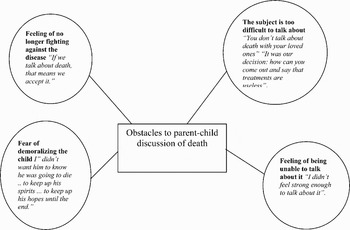
A qualitative analysis of the parents' discourse was conducted to identify themes related to the issues addressed by this study. One of the questions concerned the possible obstacles to talking about death by the family and the young patient. Figure 1 presents several elements of reply to this question. Four main responses were collected. They were (1) feeling of no longer fighting against the disease, (2) fear of demoralizing the child, (3) the subject being too difficult to talk about, and (4) feeling of being unable to talk about it.
Obstacles to parent–child discussion of death.

Choice of Place of Death
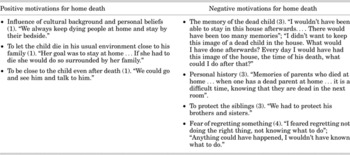
Nineteen out of 21 (90%) families declared that they did not really choose their child's place of death. Death usually occurred suddenly before the parents had time to really make a decision. However, all reported that, if they had had the choice, they would nevertheless have preferred that their child die in hospital. In the case of the two young patients who died at home, the family's wishes were respected. In both cases, the family and the young patient were in agreement as reported by parents. For one of these two families, this choice was influenced by their beliefs and cultural background.
Another question concerned the motivations that determine the choice of place of death. Although most families in this sample did not really choose the place of death, some interesting elements are presented in Table 1. The left column describes the parents' positive motivations for preferring their child to die at home and the right column describes their negative motivations. The frequency of the parents' responses is shown in parentheses.
Parents' motivations concerning their child's place of death

Most young patients did not express their feelings on this subject. Two young adults expressed their preference, but no objective conclusions could be drawn.
The frequency of the parents' responses is shown in parentheses.
According to parent's perceptions, the fear of subsequently regretting their decision seemed to play a role in the choice of place of death. Similarly, when the adolescent or young adult had brothers and sisters, the parents were concerned about preserving them from an event which, according to the parents' representations, could be traumatic. Note that, in most cases, the parents did not discuss this issue with the patient's brothers and sisters.
A more surprising finding was the parents' feeling that if the young patient died at home, the image of their dead child would be more present and more persistent. Very logically, parents who preferred their child to die at home wanted to keep their child close to them for as long as possible so that the child could die in a familiar environment. The cultural background and personal beliefs influenced the choice of place of death for a Mediterranean family for whom the wake and all associated funeral rites were considered to be important.
Place of End-of-Life Care
Three out of 21 (14%) families had access to palliative care and 9 out of 21 (43%) families had access to home hospitalization. Three out of 21 (14%) families were informed about the palliative care mobile unit and 9 out of 21 (43%) families were informed about the existence of home hospitalization. These services were only used by those families informed about the availability of these services.
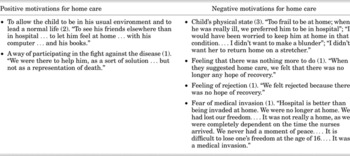
What are the determinants of the choice of end-of-life care at home or in hospital? Several elements in response to this question are presented in Table 2.
Parents' motivations concerning end-of-life care

Parents are motivated to maintain their child at home for as long as possible to allow the child to remain in the home environment at the end of life surrounded by family and friends. For the family, maintenance of the patient at home constitutes a way of continuing to fight against the disease, which depends on each person's subjective perceptions of the disease, treatment, and the capacity to fight against the cancer.
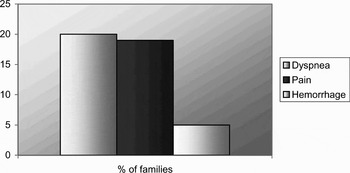
The child's physical state largely determined the place of end-of-life care. It is obviously not reassuring for the parents to see their child physically deteriorate, suffer, or experience certain particularly distressing symptoms for the patient and the family, such as dyspnea. During the interview, parents reported dyspnea and pain as the most distressing symptoms (Fig. 2).
The most distressing symptoms for the family.

Some parents also reported that home care represented the end of curative treatment and consequently the approaching death of their child. One family expressed a feeling of rejection, as they had placed great hopes in the hospital and the medical team. In this particular case, the family experienced their child's return home as a form of abandonment, a rupture that was difficult to integrate psychologically.
Most parents reported that their children had expressed the desire to stay at home for as long as possible, which confirms the observations reported by clinical oncologists and psychologists caring for adolescents in our institution.
One family justified their and their child's decision to refuse home care because of their fear of medical invasion of the home (changing nursing staff, bulky and noisy machines).
Representations of Quality of Care in Hospital and at Home
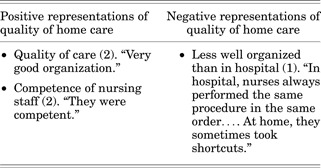
Families were also asked about their representation of the quality of care in hospital (see Table 3) and at home (see Table 4), as this question was related to the choice of the place of end-of-life care. It is a widely held belief in France that the hospital is the site of best medical care. Three families spontaneously expressed the idea that the best care is obtained only in hospital. The fact that personnel are always available in the hospital in the event of a problem is certainly reassuring for the parents. According to several parents, the young patients had established relationships of confidence with the nursing staff, which helped to maintain their hopes of cure and reinforced their positive vision of the quality of hospital care. Negative representations tended to be anecdotal and were expressed by several families who encountered difficulties with the nursing staff.
Representations of quality of hospital care

Representations of quality of home care

As was brought out by our interview, parent's representations of the quality of care at home differed according to each family's experience and especially the way in which this experience was interpreted by the family. Young patients did not express their views on this subject. Our thematic analysis suggests that these representations are also influenced by other factors such as correct functioning of machines, the presence of the symptoms described above (dyspnea and pain), and fear of not knowing what to do in the case of a problem.
Our interview revealed that the level of satisfaction with the care and support provided at the end of life was higher in parents whose child was treated in the Pediatric Oncology Department. The parents emphasized the nursing staff's capacity for listening and their reassuring presence.
According to the parents' comments during the interview, adolescents appeared to reject the hospital during their disease (unpleasant treatments, time spent away from home and family, etc.), although, paradoxically, at the end of life it was often the patient who wanted to return to the hospital. According to the parents, this request to return to the hospital was motivated by the desire to have the greatest chance of cure. For example, one of the families reported: “He wanted to return to hospital two days before his death. … He thought that if he had any chance of surviving, it was in hospital.”
Psychological Management of the Parents after the Child's Death
Although interviews with the parents highlighted the strong demand for psychological support during the terminal phase of the child's disease and after the child's death, the results show that no family attended a bereavement group and that only 3 out of 21 (14%) families consulted a mental health care professional.
Improvements Proposed by Families
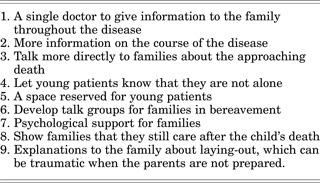
At the end of the interview, each family was asked to suggest any improvements that could be made to the management of adolescents and young adults at the end of life as well as their own needs concerning their bereavement. The various themes raised by the families are summarized in Table 5.
Needs of families in nine points

In hindsight, families reported a need for more information about the disease, although, at the time, families did not always request this information. Families asked for psychological support and wanted to participate in bereavement groups, although paradoxically, as mentioned above, very few families actually used these forms of support. Finally, preparation for the child's death was considered to be a necessity in hindsight, as discussed in more detail below.
DISCUSSION
The representation, firmly implanted in France, that only the hospital can save lives seems present at all ages, even in adolescents and young adults, as our results emphasized.
In this population, the choice of place of death and end-of-life care was rarely discussed with the child, as all issues related to death were eluded. Parents said, “It was impossible to talk about that” and “We talked about everything except for that.” It is very interesting that the only two families who were able to discuss the probable death with their child were those for whom their and their child's decision was respected, as the child died at home.
In France, as in most Western countries, death is a subject of taboo that is very rarely or never discussed with the family even when the dying person is an adult. It is often easier for a patient to discuss this question with a physician than with his closest relatives. Most of the studies on this topic involve adults even older. Everyone pretends to ignore the fact that they are going to die one day. Chevalier-Verjus (Reference Chevalier-Verjus and Ferragut1995) said that talking about death was a “transgression.” Therefore, when the “unthinkable,” the “unimaginable” occurs, the death of a child, it is a catastrophe.
Rando (Reference Rando1988) used the term “anticipatory grief” to describe a “normal disinvestment in all hopes, projects, expectations, needs in relation to the person who is going to die.” This obviously does not mean a loss of interest in the person himself, but a preparation for the future permanent loss.
Our study proved that a major difficulty, in addition to absence of preparation for bereavement and death, is erroneous beliefs concerning life and bereavement. A preventive approach could consist of working with parents on their representations of death and end of life and trying to modify some of their distressing representations by cognitive restructuring.Footnote 2
In France, bereaved parents now have access to group or individual support after their child's death, although as our results showed, few actually make use of these services. Psychological support is also sometimes proposed before the child's death, but once again few parents regularly accept this support.
Another question emerges at this stage of our discussion: If so few people seek psychological support before and after their child's death, why do the majority of patients successfully deal with their bereavement (with varying degrees of difficulties and over a variable time)? The explanation is clearly complex and multifactorial. Factors related to the individual (fragility vs. psychological resources) but also to the environment (presence or absence of social support) could help to explain this observation. In view of the importance of social support at the end of life, it is possible that the relationship with a kind, qualified nursing team, on which the family can depend when the child is dying and/or before, could constitute a factor of prevention of complicated bereavement (Mangan et al., Reference Mangan, Taylor and Yabroff2003).
In our study, the level of satisfaction with the care and support provided at the end of life was higher in parents whose child was treated in the Pediatric Oncology Department. This unit has a stable and specialized personnel, which appears to promote quality care of young patients at the end of life and constitutes a valuable support for the family just before or in some cases even after the child's death. According to the parents, this higher level of satisfaction was related not so much to the quality of technical procedures as to the human qualities of the nursing staff. The parents emphasized the nursing staff's capacity for listening and their reassuring presence. This also explains partly why more parents whose child was treated in the Pediatric Oncology Department agreed to participate in this survey.
This observation also raises the question of the specificity of management of adolescents and young adults. Should specific units be created composed of oncologists, radiotherapists, trained nurses, psychologists, and psychiatrists specialized in the management of cancer in particular age groups?
Of course, our study suffered some limitations. The main limitation was that a large part of our data constituted a retrospective reconstruction by the parents. Therefore, even though they are interesting, our results should be treated with caution. Moreover, we can think that parents who accepted our invitation to participate to this study probably constituted a “special population.” A prospective study that could évaluate the evolution of the representations (home vs. hospital's care) in patients who are going to die versus those who are more stable would be interesting. Moreover, we think that today with the development of an outpatient clinic in our institution, the number of death at home might be higher.
In summary, this first exploratory qualitative French study on the place of death of adolescents and young adults with cancer identified several factors that may influence the choice of place of death, although in practice, few families were actually offered this choice (due to the difficulty of talking about death with the family and medical factors related to the end of life). We have considered the importance of representations and beliefs concerning life and death that at least partly determine the possibility for families to discuss the question of the place of death. The support given to families before and after the child's death is not exclusively the role of psychologists or psychiatrists, as it is often primarily derived from the presence of a kind nursing team able to listen to the suffering family.
Although progress has been made in France over recent years, there is considerable room for improvement of the palliative care of adolescents and young adults to more effectively meet the needs of these young patients and their families at the end of life.
ACKNOWLEDGMENTS
This research was financed by Fondation de France. The authors thank Doctor L. Mignot, Head of the Department of Medical Oncology, and Doctor J. Michon, Head of the Department of Paediatric Oncology, for their support during this research, as well as all pediatricians of the Institut Curie Department of Pediatric Oncology for their collaboration that allowed us to conduct this first French study on this subject.