

INTRODUCTION
Studies of organizational justice and behavioural ethics are two important fields that use empirical research strategies to build knowledge about the moral dimension of organizations. Specifically, studies of organizational justice investigate employees’ perceptions of workplace fairness, and include studies of group-based phenomena called justice climates (Li & Cropanzano, Reference Li and Cropanzano2009). Behavioural ethics studies examine individuals’ moral behaviours as influenced by organizational and social contexts; that is ethical work climates (Victor & Cullen, Reference Victor and Cullen1988). The two fields have progressed independently, but both relate to the organization's moral dimension, guiding managers and employees in their actions and reactions. Our primary aim in this article is to integrate these two fields to better understand, and ultimately manage, the moral dimensions of organizational life.
Theoretical perspectives on morality in organizational contexts have been somewhat ethnocentric. The increasing relevance of value diversity, originating from differences in organizational members’ sociocultural backgrounds (Mazur, Reference Mazur2010), raises important questions about how firms can ethically manage diverse workforces both domestically and transnationally. Thus we aim to integrate justice and ethical work climates in the context of cultural diversity in contemporary organizations. Specifically, we examine the Chinese business context and propose that cultural diversity is integral to theories pertaining to the moral dimensions of work and organizations.
We first briefly review the literatures on justice and ethical work climates followed by a discussion of their conceptual similarities and differences. We use the term moral climate to describe organizational members’ shared perceptions about the moral dimensions of their organizations. We identify ethical work climate as primarily concerned with the normative elements of an organization's moral climate; that is, employees’ perceptions of how they should act. We position justice climate as primarily concerned with evaluative elements of the organization's moral climate; that is, how justly employee perceive the organization and its managerial agents treat them.
Next, we examine dimensions of culture that influence individual-level values and might influence ethical and justice climates, from both insider and outsider perspectives (Jia, You, & Du, Reference Jia, You and Du2012; Leung, Reference Leung2012; Van de Ven & Jing, Reference Van de Ven and Jing2012). A range of cultural constructs and methodological approaches are likely to be important in the Chinese business context because they may reflect non-Western definitions of wrongdoing and perceptions of justice. Overall, our goal is to promote cross-fertilization among the constructs of justice climates, ethical work climate, and cultural diversity. We conclude by suggesting opportunities for advancing theory and research in relation to our integrated model and the potential for greater exploration of the role of cultural diversity in relation to the moral climates of organizations.
THEORETICAL BACKGROUND
Justice Climate
Work on organizational justice has contributed to our understanding of how justice in the workplace can influence employees’ attitudes and behaviours (Colquitt, Reference Colquitt2001). Justice referents can be distributive, procedural, and interactional (often split into interpersonal and informational justice) (cf. Bies & Moag, Reference Bies, Moag, Lewicki, Sheppard and Bazerman1986; Cobb, Folger, & Wooten, Reference Cobb, Folger and Wooten1995; Greenberg, Reference Greenberg1990; Novelli, Kirkman, & Shapiro, Reference Novelli, Kirman, Shapiro, Cooper and Rousseau1995; Stephens & Cobb, Reference Stephens and Cobb1999). Although a substantive review of these constructs is beyond our scope here, we note that they essentially reflect employee perceptions of how justly managerial agents treat them both in relation to processes such as communication and decision-making, and the outcomes of processes such as resource allocation or career progression.Footnote [1]
Perceptions of justice have been found to have instrumental, relational, or principle-based effects on employee attitudes and behaviours. Employees perceive that justness affects their economic ends, their relational standing, and identity. Justice is such an important principle prima facie that when powerful leaders fail to act justly, employees respond negatively.
Psychological climate reflects individual-level evaluative perceptions of the work environment while organizational climate reflects group-level assessments (Martin, Jones, & Callan, Reference Martin, Jones and Callan2005). Consistent with the organizational climate approach, and emerging from the organizational justice literature, is growing work on justice climate; that is, ‘distinct group-level cognition about how a work group as a whole is treated’ (Naumann & Bennett, Reference Naumann and Bennett2000: 882). Consequently, the literature also discusses distributive, procedural, informational, and interpersonal justice climates at the group level (Colquitt & Greenberg, Reference Colquitt, Greenberg, Gilliland, Steiner and Skarlicki2001).
Empirical work includes investigations of justice climate antecedents, impacts on individuals, groups, and organizations, mediating roles in process models of antecedents and outcomes, and moderating factors (Li & Cropanzano, Reference Li and Cropanzano2009). The literature also reports various interactions between climates at different levels (e.g., Aquino, Tripp, & Bies, Reference Aquino, Tripp and Bies2006; Spell & Arnold, Reference Spell and Arnold2007) and the ‘strength’ of the climate, that is, how homogeneous group members’ perceptions are regarding the climate referent (Li & Cropanzano, Reference Li and Cropanzano2009). Overall, the literature suggests that relationships between justice climate, its antecedents, and effects are complex; many variables play significant roles in shaping evaluations of organizational justice.
Behavioural Ethics and Ethical Work Climate Theory
Behavioural ethics comprises studies of ‘individual behaviour [as it is]. . . subject to or judged according to generally accepted moral norms of behaviour’ (Trevino, Weaver, & Reynolds, Reference Trevino, Weaver and Reynolds2006: 952). The dominant paradigm in business ethics focuses on actual behaviour rather than on normative discussions of ideal behaviour (De Cremer, van Dick, Tenbrunsel, Pillutla, & Murnighan, Reference De Cremer, van Dick, Tenbrunsel, Pillutla and Murnighan2011). Behavioural ethics in the business context thus focuses on ‘how people in business and organizational settings behave and make decisions that have moral consequences and moral connotations’ (De Cremer et al., Reference De Cremer, van Dick, Tenbrunsel, Pillutla and Murnighan2011: S3) including such behaviour characterized in this special issue as ‘detrimental citizenship behaviour’ (Pierce & Aguinis, Reference Pierce and Aguinis2014).
In this article we focus less on ethical behaviour and more on a key sociocontextual antecedent of ethical behaviour in organizations: ethical work climate. Since the concept's introduction (Victor & Cullen, Reference Victor, Cullen and Frederick1987, Reference Victor and Cullen1988), so much research has been generated that it is considered one of the most influential concepts in the business ethics field (Martin & Cullen, Reference Martin and Cullen2006). The dominant approach to the concept of ethical work climates is understood to be:
[g]roups of prescriptive climates reflecting the organizational procedures, policies, and practices with moral consequences. Such climates arise when members believe that certain forms of ethical reasoning or behaviour are expected standards or norms for decision-making within the firm. (Martin & Cullen, Reference Martin and Cullen2006: 177)
From that perspective, ethical work climates indicate the perceptions of groups of employees rather than the actual ethics regarding formal and informal procedures, policies, and practices.
Functionally, members of workgroups look to ethical work climates for guidance regarding the question ‘What should I do?’ (Victor & Cullen, Reference Victor and Cullen1988: 101). Thus, ethical work climates are normative structures and processes for forming employees’ moral perspectives regarding moral obligations or responsibilities that prescribe, permit, or proscribe behaviours. Reflecting this, Victor and Cullen's framework proposes that ethical work climates influence three factors: workgroup decision making when facing ethical dilemmas, ethical values of group members, and normative criteria used in making decisions (Martin & Cullen, Reference Martin and Cullen2006). Accordingly, ethical work climates are important antecedents to understanding ethical behaviours of individuals and groups in organizations.
Victor and Cullen (Reference Victor and Cullen1988) built on the concept of ethical work climates by developing and empirically testing a theoretical typology that draws on normative philosophical and psychological theories, and includes both an ethical criterion dimension and a locus of analysis dimension. The ethical criterion, drawing on developmental psychology (Kohlberg, Reference Kohlberg1984), explains that rationality guides moral reasoning based on maximizing self-interest, on joint interest maximization, and on principle-driven approaches. The locus of analysis dimension draws on referent group theory (e.g., Gouldner, Reference Gouldner1957; Merton, Reference Merton1968) to identify the individual, local, or cosmopolitan reference group that models the acceptable mode of ethical reasoning (Victor & Cullen, Reference Victor and Cullen1988). Groups using a local locus draw their ethical reasoning from the organization or other groups within the organization. Groups using an individual locus see ethical reasoning as personal or individual; they use their own reasoned values and norms for making moral judgments. Individual and cosmopolitan loci, however, come from outside the organization. Workgroups taking a cosmopolitan locus refer to community norms, professional codes of ethics, and legal authorities relevant to their organization or workgroup roles and goals.
By combining the ethical criterion and locus of analysis dimensions, Victor and Cullen (Reference Victor and Cullen1988) derived nine theoretical ethical work climates: self-interest, company profit, efficiency, friendship, team interest, social responsibility, personal morality, company rules and procedures, and laws and professional codes. Empirically tested in four U.S. organizations of varying size and industry, evidence supported five types of ethical climate: instrumental, caring, independence, law and code, and rules.
Scholars investigating ethical work climates have sought to explore the antecedents and consequences of ethical work climates, and work on ethical climate is thus voluminous and expanding. Victor and Cullen's approach dominates the literature (cf., Begüm Ötken & Cenkci, Reference Begüm Ötken and Cencki2012; Özera & Yilmaz, Reference Özer and Yilmaz2011; Silén, Svantesson, Kjellström, Sidenvall, & Christensson, Reference Silén, Svantesson, Kjellström, Sidenvall and Christensson2011; Tseng & Fan, Reference Tseng and Fan2011; Wang & Hsieh, Reference Wang and Hsieh2012), but modifications have been suggested.
Most important are suggestions that Victor and Cullen defined ethical work climate too narrowly, that concentrating on moral judgment ignores four important dimensions of an ethical work climate (Arnaud, Reference Arnaud2010; Arnaud & Schminke, Reference Arnaud, Schminke, Gilliland, Steiner and Skarlicki2007). These dimensions are (i) collective moral sensitivity – the norms of moral awareness and concern, (ii) collective moral judgment – the norms of moral reasoning (equivalent to Victor and Cullen's definition of an ethical work climate), (iii) collective moral motivation – the value an organization puts on morality, and (iv) collective moral character – norms of responsibility and virtues such as courage and perseverance associated with adhering to ethical actions despite other imperatives. We suggest that recognizing multidimensionality in ethical work climates, which is supported by empirical studies (Arnaud, Reference Arnaud2010; Arnaud & Schminke, Reference Arnaud, Schminke, Gilliland, Steiner and Skarlicki2007), enriches the theoretical breadth of Victor and Cullen's original concept.
Conceptual Similarities and Differences between Justice and Ethical Work Climates
Justice climate and ethical work climate have obvious similarities. First, both are forms of workgroup climate (Martin & Cullen, Reference Martin and Cullen2006; Naumann & Bennett, Reference Naumann and Bennett2000) involving shared perceptions held by a group about the formal and informal policies, procedures, and actual practices that they perceive an organization rewards, supports, allows, and expects. ‘[W]ork climates are framed broadly in terms of organizational norms and conventions that are seen by organizational actors to exist within the structure and procedures of the organization’ (Martin & Cullen, Reference Martin and Cullen2006: 177). ‘[S]ince climate perceptions represent meaning derived from the organizational context, they form the basis for individual and collective response’ (Naumann & Bennett, Reference Naumann and Bennett2000: 881). Both approaches accept that organizations may have many climates at the workgroup level and, by extension, the entire organization. In addition, the reference to shared meanings indicates that work climates are manifestations of a firms’ culture or cultures. That is, climates help create an organization's culture by answering, at the group level, the question ‘how are things done around here’? (Schminke, Arnaud, & Kuenzi, Reference Schminke, Arnaud and Kuenzi2007).
Second, both justice and ethical work climates refer to shared perceptions about the moral dimensions of organizational activity. In both cases significant research has been devoted to establishing antecedents and outcomes of these climates. For example, both research streams point to outcomes such as job satisfaction and organizational commitment, organizational citizenship behaviour, and dysfunctional or retributive behaviours (Leung, Reference Leung2008; Martin & Cullen, Reference Martin and Cullen2006; Naumann & Bennett, Reference Naumann and Bennett2000). Both approaches also emphasise the concept of ‘strength’ to reflect the extent to which there is variability in group members’ perceptions as an important influence on these outcomes.
However, the two types of climate also have differences, most fundamentally in orientation or focus. Ethical work climate points primarily to normative criteria; the perceived norms that workers believe they are expected to follow. Justice climate is more concerned with evaluation that employees make of the fairness shown by supervisors and managers.
Thus, an ethical work climate is best seen as shared perceptions held by a group of employees regarding the firm's normative moral expectations: how they believe their employer expects them to make decisions and judgments when they face ethical dilemmas and issues. The ethical work climate literature (e.g., Ambrose, Arnaud, & Schminke, Reference Ambrose, Arnaud and Schminke2008; Deshpande, Joseph, & Shu, Reference Deshpande, Joseph and Shu2011; Elci & Alpkan, Reference Elci and Alpkan2009; Fritzsche, Reference Fritzsche2000; Lemmergaard & Lauridsen, Reference Lemmergaard and Lauridsen2008; Peterson, Reference Peterson2002; Wang & Hsieh, Reference Wang and Hsieh2012) frequently points to this normative orientation, for example, by quoting or paraphrasing the statement that ethical climate is about the ‘shared perceptions of what is ethically correct behaviour and of how ethical situations should be handled’ (Victor & Cullen, Reference Victor, Cullen and Frederick1987: 51–52).
The multidimensional approach – collective moral sensitivity, moral judgment, moral reasoning, and moral motivation – also casts ethical work climate as a normative mechanism (Schminke et al., Reference Schminke, Arnaud and Kuenzi2007). These collective perceptions relate to how morally aware, motivated, and responsible employees are expected to be, as well as what norms of judgment they are expected to follow and what virtues they are expected to develop and express. Thus, ethical work climate represents employees’ shared perceptions of ‘the content and strength of the prevalent values, norms, attitudes, and behaviours of the members of a social system’ (Arnaud, Reference Arnaud2010: 348) and ‘norms for moral sensitivity, moral judgment, moral motivation, and moral character’ (Arnaud, Reference Arnaud2010: 352).
In contrast, justice climate is focused on evaluative rather than normative mechanisms; that is, employees’ shared cognitions about whether they or others are being treated according to specific standards of justice. Hence, justice climate answers the evaluative question: how justly do employees believe they are treated?
The organizational justice literature explains that an evaluative orientation determines how justice climates are perceived. Summarizing the literature, Colquitt and Greenberg (Reference Colquitt, Greenberg, Gilliland, Steiner and Skarlicki2001) showed that different individuals evaluate justice in varying degrees according to deontic, instrumental, and relational explanations (following Folger, Reference Folger, Gilliland, Steiner and Skarlicki2001). Variations in the explanations differ depending on factors such as gender, culture, and focus; that is, whether the focus is on justice in a specific decision or on overall organizational justice, and whether heuristic decision making shortcuts are being used.
Apparently justice climate research has not yet included in-depth studies of group-level explanations about why justice or fairness is important. Such studies might illuminate factors driving differences in perceptions within and across groups. The focus would be on group evaluations or group-level perceptions and resulting judgments about fair treatment for the whole workgroup (Naumann & Bennett, Reference Naumann and Bennett2000). In this characterization, justice climate emerges as ‘members interact with each other, observe each other's behaviour, and engage in collective sense making, [which is] a tendency that may ultimately lead to the development of shared perceptions on how to evaluate justice-triggering events’ (Li & Cropanzano, Reference Li and Cropanzano2009: 566–567).
AN INTEGRATIVE MODEL
Although ethical work climate and justice climate are both concerned with shared understandings of the moral aspects of employees’ organizational experience, each has a slightly different focus, which we posit as normative and evaluative distinctions. The distinction is not intended to represent a mutually exclusive division. Employees can use norms as a base for evaluating the actions of others, including managers. Evaluations then play a role in constructing and institutionalizing norms. Thus, ethical climates could serve not only as normative guides but also for evaluation. Justice climates, especially over time, will generate norms. We draw an abstract, idealized normative/evaluative distinction between ethical and justice climates, summarizing a difference but not providing an absolute dichotomy. We cannot empirically assume actual degrees to which ethical climates prompt evaluation and justice climates prompt ‘normativeness’.
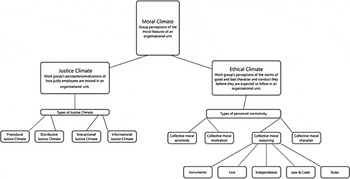
Based on our analysis of the similarities and differences between these two traditions, we developed an integrative framework of an organization's moral climate. The integrative framework is more expansive than either justice or ethical climate alone; it allows a multidimensional and hierarchical structure of climates. Figure 1 depicts this framework.
Integrative model of moral climates (incorporating elements of Victor and Cullen's (1988) five empirical types of moral reasoning)

At the top of the framework, ‘moral climate’ refers to the workgroup climate that members perceive regarding the organization's moral facets. We use the term moral to distinguish it from other climates, including the legal climate. The various facets of an organization's moral climate include its ethical work and justice climates. As described, ethical work climate refers to the norms and rules of conduct and character that employees perceive they are expected to follow. There are potentially many ethical work climates across an organization, each organized around organizational units such as particular locations, departments, teams or even shifts.
We propose that an organization's overarching ethical work climate depends on the accumulation and interaction of these ethical work climates. We include Schminke et al.'s (Reference Schminke, Arnaud and Kuenzi2007) four dimensions but re-name them as types of perceived normativity to differentiate them from the dimensions of strength, level, and locus of analysis. We use the term collective moral sensitivity to refer to the visibility or profile of ethics employees perceive their organization fosters, their perceptions of how aware they are supposed to be about the moral life of the organization, and the alternative ways they should address issues. We use collective moral motivation to refer to employees’ perceptions of the priority or value their employer expects them to give to the moral values and how motivated they should be to address ethical issues. We use collective moral reasoning to identify the norms, rules, and approaches to moral decision making that employees believe their employer expects. Finally, we use collective moral character to refer to their expectations about enacting virtues such as courage, integrity, and perseverance in carrying out a particular moral decision. Each perceived normativity can be articulated in various ways. In Figure 1 we include Victor and Cullen's five empirical moral reasonings as examples of possible articulations.
An organization's justice climate reflects employees’ perceptions of whether their rights are being met regarding equitable distributions of goods, equitable procedural treatments, or access to honest information and respect. As we discuss later, juxtaposing organizational justice with the notion of rights potentially raises interesting questions regarding cross-cultural research and employee diversity, especially for countries outside the pervasive Western rights tradition.
As Figure 1 depicts, the overarching justice climate of an organizational unit can be articulated in terms of justice climates including the four established justice foci: distributive, procedural, interactional, and informational. As with ethical work climates, the reference to an organization unit suggests that employees’ overarching evaluations of justice in the whole or parts of the organization could be investigated. We might ask: overall do managers in your organization, department, or work unit treat you justly? Do your supervisors, or managers, or senior executives generally uphold workers’ rights? Multilevel theory and methodology advocates careful consideration of whether the ethical issues of interest focus on the individual or the group (or both), and selection of an appropriate measurement and analytical strategy (Li & Cropanzano, Reference Li and Cropanzano2009).
Finally, although not explicitly depicted in Figure 1, we suggest that both ethical work and justice climates can vary in locus of analysis and strength. That is, ethical work climates, in addition to varying along Victor and Cullen's (Reference Victor and Cullen1988) locus of analysis dimension, can vary in strength when employees ponder how they are morally expected to act. Likewise justice climates can vary in strength and in terms of the loci of analysis; that is, when employees ponder whether they are treated justly, which hierarchical level of management do they observe in making that judgment? Justice climates also vary in terms of strength; that is, the degree to which employees concur that they are being treated justly or not. We suggest some similarity exists between the concept of level used in the justice climate literature and the use of the moral sensitivity and moral motivation forms of perceived normativity in the ethical work climate literature. For example, a group could perceive high expectations for them to be sensitive to the organization's moral life and to address moral issues. However, the use of the concept of level is clearly not identical across the two types of moral climate. In addition, we suggest that no equivalent can be found to Victor and Cullen's ethical criterion dimension, which is relevant to the determination of the types of ethical work climates associated with the collective moral reasoning form of perceived normativity.
In sum, our integrated model points to a very rich overarching organizational moral climate as summarized in Figure 1. Other morally relevant climates may exist, but ethical work (normative) and justice (evaluative) climates potentially have a major impact on organizational structures, dynamics, and outcomes. In response to recent calls for expanded international research in ethical climate theory (Simha & Cullen, Reference Simha and Cullen2013), we now consider how elements of cultural diversity might be integrated in our moral climate framework.
Cultural Diversity and Moral Climates
Given the rapid globalization of business and increasing diversification of the labour force, understanding how cultural diversity affects the evolution of moral climates has become more salient. Cultural diversity is a challenging concept to capture and measure in the context of business and organizational research. Unravelling the ways diverse cultures affect organizational outcomes in and across different communities is complex. The challenge is compounded by the myriad ways diversity is expressed from the individual level in communities and organizations to the complex and multilayered inter-relations in groups. Differences in language, nonverbal communication styles, stereotypes, and status inequalities are some of the more obvious issues in culturally diverse workforces (Rowney & Taras, Reference Rowney and Taras2008). At a deeper level, a diversity of cultural norms, values, and beliefs, whether at one geographical worksite or across different sites in different countries, will undoubtedly affect organizational outcomes in ways that homogeneous cultures do not (Cooke & Rousseau, Reference Cooke and Rousseau1988; Hofstede, Reference Hofstede1980; Suzuki, Reference Suzuki1997). It is thus imperative for any researcher trying to understand ethics in organizations to consider the role that cultural diversity might play in shaping employees’ and managers’ intentions, actions, and relationships.
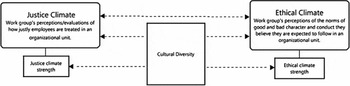
In organizations, cultural factors might influence the relationships between justice climates and ethical work climates at both individual and workgroup levels. Specifically, individuals from societies with different value systems bring those perceptions to the workplace, so their perceptions of a just or ethical climate will reflect their cultural values. Figure 2 highlights the potential for examining cultural diversity as an important influence on the strength of moral climates.
Role of cultural diversity on moral climates

Regarding workforce diversity, increasingly diverse cultural values in many organizations are likely to affect an organization's ethical work and justice climates and its overall moral climate. For example, at the individual level, different external-to-the-firm normative criteria, such as unique social, historical, and religious backgrounds, will likely influence perceptions. Particularly considering religion's impact on ethical work climates and collective moral reasoning, workgroups dominated by individuals with strong religious views might logically have a stronger cosmopolitan locus and be expected to rely more on benevolent criteria. In contrast, secular groups may rely more on the individual locus and principles criteria and thus may be more likely to generate an independent ethical work climate. The differences may flow to outcomes such as organizational citizenship behaviours (OCB) and employee wellbeing, or might modify the relationship between ethical work and justice climates. For example, a positive correlation has been identified between religiosity and OCB, wellbeing, and various other outcomes (Kutcher, Bragger, Rodriguez-Srednicki, & Masco, Reference Kutcher, Bragger, Rodriguez-Srednicki and Masco2010).
In addition, workforce diversity is likely to affect within-group homogeneity or concordance among employees’ perceptions (climate strength). Weak justice climates will cause significant variations between individuals in the group regarding questions of fairness (Li & Cropanzano, Reference Li and Cropanzano2009). Indeed, negative relationships have been found between values diversity and cohesion in workgroups (Harrison, Price, & Bell, Reference Harrison, Price and Bell1998; Stahl, Maznevski, Voigt, & Jonsen, Reference Stahl, Maznevski, Voigt and Jonsen2010). Hence the relationship between values diversity and the strength of justice climates is likely to be significant. Ethical climates may also vary in strength and a group's level of cultural diversity may be an important antecedent of the level of heterogeneity in perceptions regarding normativity.
Turning to how various dimensions of national culture might influence individual cultural values and, by extension, perceptions and evaluations of ethical work climates, we echo recent calls for research exploring cross-cultural aspects of organizational justice and for integrating theories of culture and justice (e.g., Shao, Rupp, Skarlicki, & Jones, 2011; Simha & Cullen, Reference Simha and Cullen2013).
Cross-cultural diversity have been conceptualized and researched in various ways. Almost all management theories reflect Western values and philosophies (Li, Leung, Chen, & Luo, Reference Li, Leung, Chen and Luo2012; Tsui, Reference Tsui2007), but two dominant approaches have surfaced in recent calls for contextualization in Chinese and other non-Western management research (Leung, Reference Leung2012). Much of Chinese management literature applies Western theories to firms operating in China to offer insights into customs and practices in the Chinese environment (e.g., Kim & Wright, Reference Kim and Wright2011; Shapiro, Von Glinow, & Xiao, Reference Shapiro, Von Glinow and Xiao2007). The dimensional theory of culture dominates the traditional approach and emphasizes cultural differences across national borders as primary antecedents of different management styles and employee behaviours (Hofstede, Reference Hofstede1980, Reference Hofstede2001). Such research produces theories of Chinese management from the ‘outside-in’, largely imposing extant Western theories in a local context and sometimes involving a comparative perspective to modify and revise Western theories (Li et al., Reference Li, Leung, Chen and Luo2012).
On the other hand, some have criticized Hofstede's cultural paradigm (e.g., Fang, Reference Fang2003, Reference Fang2010; Holden, Reference Holden2002; McSweeney, Reference McSweeney2002) as an inadequate bipolar cultural paradigm in an ‘increasingly borderless and wireless workplace, marketplace, and cyberspace. . . The paradigm is essentially a pre-globalization and pre-Internet phenomenon’ (Fang, Reference Fang2012: 26–29). In response, an ‘inside-out’ approach is suggested to fully explain non-Western phenomena. Chinese theories of management are less common in the literature, despite acknowledgement that ‘indigenous research in non-Western cultures. . . has immense potential to contribute to universal theories. . . . by offering brand new theories’ (Li et al., Reference Li, Leung, Chen and Luo2012: 7). Indigenous research is defined as
. . .the study of a unique local phenomenon or a unique element of any local phenomenon from a local (native as emic) perspective to explore its local relevance, and, if possible, its global relevance as well. (Li, Reference Li2012:850)
Here, a local perspective is considered a defining element of indigenous research, extending beyond multicultural comparative studies (e.g., Whetten, Reference Whetten2009) that do not always involve a local perspective (Li et al., Reference Li, Leung, Chen and Luo2012; Tsui, Reference Tsui2004). ‘Instead of homogenizing management research by trying to adapt and apply foreign theories and methods that are not sensitive to local contexts, we should encourage its heterogeneity by developing indigenous management theories, methods, and institutions’ (Van de Ven & Jing, Reference Van de Ven and Jing2012; 124).
Moral climate and cultural diversity can be approached from either perspective, or indeed both. As Western researchers observing management practice in the Chinese context, we are, by definition, outsiders in the process. Thus, we first adopt an outside-in perspective and consider that organizations must face cultural diversity if they operate across national borders (Hofstede, Reference Hofstede1980, Reference Hofstede2001). Multinational companies will likely face employee groups with different perceptions of moral climates. Second, many modern nation states have numerous regions with their own cultural norms and values. An organization operating across regions will need managers who can handle diverse group identities with complex perceptions in the development of moral climates. Third, within any single site, managers will face culturally diverse workforces and employees with varying intensity of identification with any single cultural group. Some will take their cultural identity lightly; for others culture will be a central self-identity marker so that cultural identity will profoundly affect perceptions of moral obligations and just treatment.
Focusing at the level of cross-national cultural diversity, we use China as an example illustrating the possible relationships between cultural diversity and moral climates initially through the prism of the individualism-collectivism dimension (Hofstede, Reference Hofstede1980), the cross-cultural universalism-particularism construct (Trompenaars, Reference Trompenaars1993), and the ascription versus achievement-orientation (Trompenaars & Hampden-Turner, Reference Trompenaars and Hampden-Turner2007). Cognizant that we bring an outsider perspective, we qualify our discussion by explicitly acknowledging that our approach is only one of many for theorizing Chinese management practice.
China's economic power and global presence has grown exponentially in the last 30 years. It has the largest population of any country, an enormous labour force, and the world's second largest economy. It is both an enormous consumer market and a huge exporter of manufactured goods (Li, Reference Li2011; Lu Reference Lu2009). Studying cultural diversity impacts on moral climates in Chinese workplaces could be very fruitful and of practical importance, especially for overseas companies wishing to expand their operations into China. Studies assessing cultural values in management and organizations have frequently focused on individualism/collectivism cultural dimensions; that is, individual identities developed through individual accomplishment or through group identification (Hofstede, Reference Hofstede1980). People in individualistic societies will, for example, prioritize individual rights and interests over group interests and goals. They will focus on self-fulfilment and work autonomy and will be more strongly influenced by attitudes than by collective norms (Triandis, Reference Triandis2001). Thus, a managerial approach might seem legitimate to individualistic Western cultures but completely illegitimate to more collectivist Chinese cultures (Zhang & Zhang, Reference Zhang and Zhang2006). However other cross-cultural differences have also been shown to play a role in organisational justice research. A recent U.S./Chinese comparative study found that the relationship between distributive justice and OCB increased in strength along with masculinity and power distance (Schilpzand, Martins, Kirkman, Lowe, & Chen, Reference Schilpzand, Martins, Kirkman, Lowe and Chen2013).
Potential implications of value diversity for the development of moral climates are likely to be significant. In the West, predominantly individualist cultural norms may dominate moral climates. For example, in individualist cultures such as the U.S. and Australia, punishment is usually seen as directly retributive; individual wrongdoers are expected to suffer, often by being removed from the group to prevent recidivism. In contrast, collectivist societies such as China view punishment as a route to rehabilitation or as a deterrent for the group; wrongdoers are expected to make reparations, publicly acknowledge the wrongdoing, and seek forgiveness (Rowney & Taras, Reference Rowney and Taras2008). Considering respective evaluative justice climates, people will perceive justice in the workplace depending on their cultural values. People from individualist cultures would likely disapprove of public or collective punishment, while people from collectivist cultures would view the punishment as reasonable and fair. Thus, we see the potential influence of individualist and collectivist cultural values on employee expectations about how they should behave and their evaluations of fairness.
Universalism/particularism, another cultural construct that reflects applications of rules of moral and ethical behaviour, is likely to impact organizational moral climates (Trompenaars, Reference Trompenaars1993; Trompenaars & Hampden-Turner, Reference Trompenaars and Hampden-Turner2007). North American and European cultures are more likely to adopt a universalist approach, emphasizing equal applications of rules, laws, and contracts. In contrast, countries such as China, Taiwan, and Indonesia are more likely to be particularist cultures, emphasizing relationships and treating each situation differently according to the individuals and their circumstances (Trompenaars, Reference Trompenaars1993).
Chinese culture's particularistic nature is perhaps most clearly exemplified in the practice of guanxi, or the norms surrounding relationships between parties, which stems from the fundamental Confucian assumption that individuals exist in relation to others (Chai & Rhee, Reference Chai and Rhee2010; Luo, Huang, & Wang, Reference Luo, Huang and Wang2012; Yang, Reference Yang1994). Extending this concept, guanxi also enshrines the notion of social order, both hierarchically in terms of superior-subordinate relationships and horizontally in terms of the closeness of the individual in relation to others (Chen & Chen, Reference Chen and Chen2004; Park & Luo, Reference Park and Luo2001; Peng & Luo, Reference Peng and Luo2000). On the positive side, guanxi comprises reciprocal exchange and perceived positive attributes (Han & Altman, 2009). In terms of justice and ethics, guanxi also involves expectations regarding the moral principles covering interactions between individuals. These particularistic expectations are markedly different from those in universalistic Western cultures.
Certain forms of guanxi may be problematic from a normative perspective, such as the close association of particular types of guanxi with corruption and bribery (Chen, Chen, & Xin, Reference Chen, Chen and Xin2004; Yi & Ellis, Reference Yi and Ellis2000) or ‘backdoor guanxi’ (Bedford, 2011) and perceived unfairness and supervisor-targeted impression management (Han & Altman, 2009). The discovery that guanxi has been abused in Taiwan prompts managers and employees operating in Confucian cultures to be wary when their Chinese colleagues and business partners are practicing guanxi (Hwang, Goleman, Chen, Wang, & Hung, Reference Hwang, Goleman, Chen, Wang and Hung2009). In addition, when faced with guanxi-related ethical dilemmas, Chinese employees at lower Kohlbergian stages of moral reasoning saw guanxi behaviour in a more positive light than those at higher stages (Ho & Redfern, Reference Ho and Redfern2010). These examples suggest that guanxi and China's particularistic culture is likely to have an impact on employees’ understandings of how they are supposed to act from an ethical perspective, as well as their evaluations of the justice of managerial actions and decisions. That is, guanxi and particularism are likely to have important implications for our proposed model of moral climates within organizations.
Another way to look at cultural diversity's potential consequence is to consider the distinction between achievement and ascription orientation (Trompenaars & Hampden-Turner, Reference Trompenaars and Hampden-Turner2007). Where achievement-oriented cultures value accomplishments and demonstration of knowledge, ascription-oriented cultures conversely value formal titles and respect hierarchy. The latter culture defines status by religion, origin, or age and is strongly oriented toward moral principles governing individual relationships (cf. Pan, Rowney, & Peterson, Reference Pan, Rowney and Peterson2012; Redding & Wong, Reference Redding, Wong and Bond1986). In the Chinese culture, status is derived from interpersonal relationships, familial ranking, and societal position. Confucianism teaches that older and more experienced employees should hold formal positions of power in a defined social order and will make management decisions (Chai & Rhee, Reference Chai and Rhee2010; Pan et al., Reference Pan, Rowney and Peterson2012) so that Chinese employees are likely to evaluate more positively decisions made by older and more senior managers. Justice climates, moreover, will likely reflect this deference to age and experience at a group level. Likewise with ethical climates, Confucian values suggest that for Chinese employees, respect for age and experience will be a strong ethical norm. That is, ethical work climates could be more strongly characterized by a commitment to older individuals who have seniority.
In sum, the cultural factors we have discussed distinguish workplaces in China from those in Western countries such as the U.S., the United Kingdom, and Australia, and are likely to impact organizational moral climates. The relationship between cultural diversity and moral climates in countries such as China is worthy of in-depth study, with the caveat that our research agenda has a distinctly outside-in perspective reflecting Western theories of Chinese management. Cultural context in this sense is defined in terms of difference from familiar Western cultural dimensions, not necessarily ‘inquir[ing] or appreciat[ing] the unique cultural values, interests and knowledge of the indigenous people’ (Van de Ven & Jing, Reference Van de Ven and Jing2012: 125). The alternative is to conduct indigenous research that aims to generate new theoretical insights from the insider perspective. Cultural context in this approach is defined through the perspectives of indigenous participants and researchers closely engaged with key stakeholders as participants in a collective learning process (Van de Ven & Jing, Reference Van de Ven and Jing2012). To understand complex issues in their particular contexts, a deep and reflexive approach to research in indigenous communities is required; that is, ‘engaged scholarship’ (Van de Ven, Reference Van de Ven2007).
One implication of adopting an insider approach through engaged scholarship is the likelihood of building new and context-emic theories with both local and global relevance (Leung, Reference Leung2008, Reference Leung2012; Li et al., Reference Li, Leung, Chen and Luo2012; Van de Ven & Jing, Reference Van de Ven and Jing2012; Yang, Reference Yang2000). Methodologies such as grounded theory could be adopted to study the development of moral climates in their unique context. Similarly, more traditionally defined ‘scientific studies’ (Tsui, Reference Tsui2004: 501) of moral climate might be complemented by stakeholder advice and/or the input of collaborators as co-producers of knowledge in the field. Action research, where the researcher is embedded in the study situation for the purpose of generating practical solutions to specific problems, is a promising inside-out approach to studying ethical work and justice climates and identity in the Chinese context.
We have discussed briefly three selected cultural dimensions: individualism/ collectivism, universalism/ particularism, and achievement/ ascription-orientation. From an outsider perspective, these are but a few of the many cultural dimensions that could be investigated to evaluate their influences on ethical work and justice climates. We acknowledge the limitations of such an etic approach to culture and offer some methodological options for conducting context-emic (inside-out) research in this domain. In the next section we turn more generally to recommendations for further research.
DISCUSSION
Agenda for Future Research
We have described a model of organizational moral climates by integrating the constructs of justice climate and ethical work climate. We also argue that cultural diversity, no matter how defined and from whose perspective, will impact moral climates. We suggest that many useful paths may emerge from our integrated model. Here we confine ourselves to identifying possibilities for research into the relationship between justice and ethical climates and potential cross-cultural influences related to Chinese culture.
One area of potentially fruitful research lies in the relationship between ethical work climates and justice climates. Two studies investigated relationships between ethical work climates and types of justice but neither examined justice climates (Lau & Wong, Reference Lau and Wong2009; Luria & Yagil, Reference Luria and Yagil2008). Investigation of the convergent and discriminant validity of justice climate and ethical climate measures could be undertaken to determine whether empirical support can be found for our theoretically posited evaluative-normative distinction. Inspection of questionnaire content in The Ethical Climate Questionnaire (Victor & Cullen, Reference Victor and Cullen1988) and the Ethical Climate Inventory (Arnaud, Reference Arnaud2010), and reproduced scales designed to measure procedural and interactional justice (Li & Cropanzano, Reference Li and Cropanzano2009: 591–594), appear to generally support our distinctions. However, scale development and assessment of alternative measurement models could also be undertaken to better capture these distinctions.
Furthermore, we suggest that the perceived expectations regarding moral behaviour and conduct that a firm's management may have of employees (ethical work climate) are likely to interact with group evaluations regarding fair treatment. For example, members of a workgroup who perceive that they are expected to act toward others in accord with a particular norm may become disheartened or even cynical if they believe their managers do not treat them in accord with the norm. The impact of managers’ failure to act justly could be exacerbated if in doing so they breach their own communicated expectations.
Alternatively, justice climates may be antecedents to ethical work climates. Intuitively, it is logical that the path will flow from ethical work climates to justice climates. After all, why would experiences of injustice alter what a group sees as the organization's expectations? The answer, of course, is that experiences of injustice may cause the group to see that the legitimacy of their current ethical work climate is undermined. Ethical work climates are formed by employees’ perceptions of what is expected of them; they may take managers’ unjust actions, as opposed to their edicts, as indicating the ‘real’ value managers put on justice. They might say ‘well he/she says being fair is important but he/she is never fair with us, so why should we be fair with others’?
Turning to cross-cultural influences, important paths for research could be further developed that investigate the influence of particular national cultures on justice and ethical work climates. The identification of the cosmopolitan locus of analysis (Victor & Cullen, Reference Victor and Cullen1988) clearly points to the effect that broader social, cultural, and political norms may have on forms of moral reasoning. In addition, interesting research could be conducted on the impact of diverse social, cultural, and political norms on justice climates. For example, the dominant rights language in Western countries should not be assumed to dominate moral and political discourse in countries such as China. If rights-based orientations are indeed less dominant in China, Chinese employees will have significantly different evaluations of justice.
More broadly, Western and Chinese business professionals may benefit from research exploring the impact of Chinese cultural norms, such as guanxi, on Chinese employees’ reactions when there is a difference between what they are expected morally to do and whether they believe that their managers act justly. Guanxi, a norm that has received a great deal of research attention (Chen, Chen, & Huang, Reference Chen, Chen and Huang2013; Luo et al., Reference Luo, Huang and Wang2012), is likely to be a significant factor affecting ethical work climates and justice climates. Whereas in Western countries personal nonwork-based reciprocity is unlikely to be a basis for determining organizational justice and ethics, guanxi is potentially a legitimate basis for justice evaluations in China. Also of interest are the interactions between guanxi at individual and organizational levels. A recent comprehensive review of qualitative, quantitative, multilevel and multidisciplinary guanxi research specifically called for more research examining cross-domain guanxi (Chen, Chen, & Huang, Reference Chen, Chen and Huang2013).
A final focus worthy of future investigation is the impact of change on the relationships between cultural diversity and moral climates. ‘Acculturation’ processes have generally considered how contact and integration with new cultures changes individual attitudes and behaviour patterns. Alternatively, the concept of ‘reciprocal acculturation’ may be particularly relevant in organizational settings where group-level changes in norms and values might be seen at varying levels of cultural diversity (Padilla & Perez, Reference Padilla and Perez2003). Thus, the relationship between cultural values, cultural diversity, and moral climates is not necessarily static. We suggest that research investigating how acculturation might affect moral climates would provide potentially important insights into the ways that norms are institutionalized and the ways practices are evaluated. Such research should be conducted from both insider and outsider perspectives to challenge prevailing Western-centric theorizing.
CONCLUSION
Ethical work and justice climates are important fields of research for behavioural scientists. We integrate their similarities and differences into a preliminary model of organizational moral climate and suggest that it may provide the answers to two important questions that employees may ponder. To judge the organization's ethical work climate, employees may ask ‘morally, how are we supposed to act’? To judge the justice climate, they may ask ‘are employees treated justly’? The answers can have significant impacts on behaviour and on organizational outcomes. Future research should discover how these questions might interrelate. In addition, we argue that cultural diversity is likely to interact significantly with moral climates. We have suggested a range of issues related to the integration of cultural diversity that are worthy of further study.