Healthcare workers (HCWs) are on the front line of the coronavirus disease 2019 (COVID-19) pandemic and are at high risk of infection. During the first month of the epidemic, 20% of HCWs treating COVID-19 patients in Italy were infected. 1 In the United States as of April 16, 2021, HCWs accounted for 10.6% of all COVID-19 cases. 2 Moreover, quarantining of exposed HCWs depletes the medical work force, threatening hospitals’ ability to provide services during the pandemic.
On December 1, 2020, the World Health Organization (WHO) recommended universal masking of staff, patients, and visitors in healthcare facilities in settings with community severe acute respiratory coronavirus virus 2 (SARS-CoV-2) transmission. 3 The WHO cited 2 studies finding that universal mask use reduced COVID-19 infections among HCWs, one conducted in 12 Massachusetts hospitals Reference Wang, Ferro, Zhou, Hashimoto and Bhatt4 and the other in a North Carolina health system, Reference Seidelman, Lewis and Advani5 but noted that more research is needed.
Here, we report on a country-level intervention to protect HCWs and preserve the healthcare work force during the first wave of COVID-19 in Israel. The intervention, mandated by the Israel Ministry of Health (MOH), consisted of universal masking and standardized criteria for SARS-CoV-2 exposure and quarantine. The study period was March 8 to May 1, 2020. We hypothesized that the MOH regulations would lead to a decrease in the incidence of HCWs who were infected by SARS-CoV-2 at work and a decrease in the prevalence of HCWs placed in quarantine because of exposure to a COVID-19 case.
Methods
We followed the Guidelines for Outbreak Reports and Intervention Studies of Nosocomial Infection (ORION). Reference Stone, Cooper and Kibbler6 Supplementary Table S1 (online) lists the guidelines’ elements and where they appear in this article.
Intervention
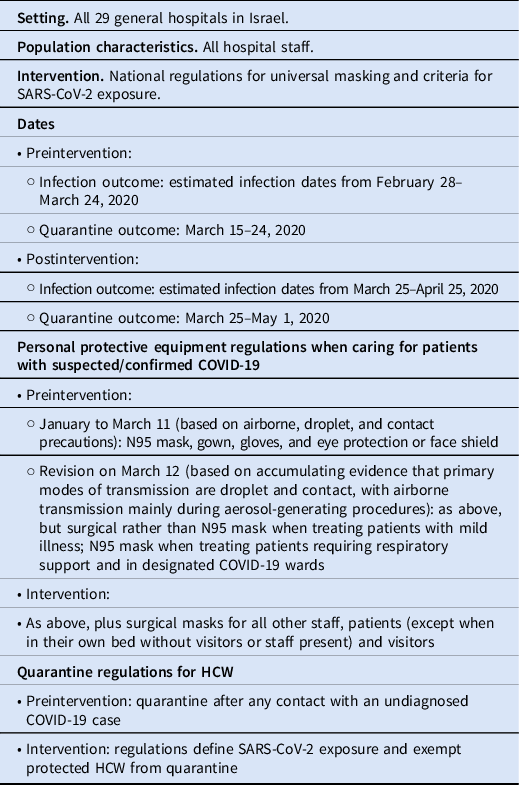
The intervention is summarized in Table 1. On March 25, the MOH mandated universal face mask use by all staff, patients, and visitors in general hospitals to prevent exposure to people with undiagnosed asymptomatic or mildly symptomatic COVID-19. Also on March 25, regulations were issued defining what constitutes SARS-CoV-2 exposure among HCWs and stating that HCWs who are adequately protected at the time of exposure to a confirmed COVID-19 case do not require quarantine (Supplementary Fig. S1 online). Until then, every discovery of a previously undiagnosed COVID-19 case led to the quarantine of all HCWs who had been exposed. The 2 new regulations on March 25 were complementary; universal masking was intended to minimize the likelihood of unprotected exposure.
Summary of the Intervention to Prevent SARS-COV-2 Infection and Exposure Leading to Quarantine Among Healthcare Workers (HCWs) in General Hospitals

Context of the intervention
The first case of COVID-19 in Israel was diagnosed on February 21, 2020, in an Israeli citizen who had vacationed on the Diamond Princess cruise ship. Schools were closed on March 12, and on March 15, gatherings were limited to 10 people. A national state of emergency was declared on March 19, with people instructed to leave their homes only if necessary. On March 25, movement was restricted to 100 m from home, except for essential activities. Mask use was mandated on April 12.
Study design
We conducted a retrospective before-and-after intervention study without a control group. The intervention was implemented as a public health effort to prevent nosocomial spread of nCOVID-19, not as research. To contribute to the body of knowledge on best practices for protecting HCWs from COVID-19, we report our results.
Settings
The study was conducted across all 29 acute-care hospitals in Israel.
Outcomes
The 2 outcomes were (1) incident COVID-19 infections among HCWs acquired at work or from an unknown source and (2) prevalence of HCWs in quarantine or isolation. Both were measured daily. We included infections acquired from an unknown source to avoid underestimating the number of work-related infections.
Data sources
Data on cases of COVID-19 among HCWs in general hospitals were available from the MOH Department of Epidemiology beginning on March 8, 2020. Reports on the prevalence of HCWs in general hospitals who were in quarantine or isolation (not reported separately) were available from the Department of Epidemiology beginning on March 11, 2020. Consecutive daily reporting began on March 15. Data from epidemiological investigations of the source of HCW infections were available from the National Center for Infection Control (NCIC) in the MOH. We obtained data from the MOH Emergency Preparedness Branch on 2 potential confounders: the daily number of incident COVID-19 infections in the general population and the daily prevalence of COVID-19 hospitalizations in Israel. Data collection for this study ended on May 1, 2020.
Definitions
The term healthcare worker refers to all employees in general hospitals. We defined a cluster as 2 or more HCWs in the same department who tested positive within 14 days, except for HCWs in the same department diagnosed on the same day and exposed to the same COVID-19 patient. We defined partial PPE use as not using PPE during every contact with COVID-19 patients or not wearing all elements of PPE. When we state that an HCW was “infected by” a coworker or a patient, this is shorthand for “an epidemiological investigation determined that the HCW’s most likely source of infection was” a coworker or a patient.
Classification of infection source
The MOH Department of Epidemiology compiled data from district health departments, which investigated COVID-19 cases and classified the infection source as work, community, or unknown. Our analysis included only HCWs who, based on this initial classification, were definitely or possibly infected at work or from an unknown source. The NCIC further investigated most HCW infections that were not community acquired, using data obtained from investigations conducted by hospitals’ infection control units and from telephone interviews with infected HCWs. Two authors reviewed these data to determine the source of infection using predefined criteria (Supplementary Table S2 online).
Statistical analysis
We performed separate interrupted time-series analyses for the 2 outcomes using the itsa command in Stata software. Reference Linden7 We performed an unadjusted analysis and an analysis that controlled for daily new COVID-19 cases countrywide and prevalence of COVID-19 hospitalizations. We analyzed the infection outcome separately for HCWs infected at work and from an unknown source. For this outcome, we had data on the testing date. We were interested in the date of infection, which we estimated using the incubation period reported by Backer et al. Reference Backer, Klinkenberg and Wallinga8 We randomly assigned incubation periods in a normal distribution ranging from 2 to 11 days, with a median of 6 days. We estimated the date of infection as the testing date minus 1 day (the presumed lag between onset of symptoms and testing) minus the incubation period. Analyses were conducted using Stata version 14.2 software (StataCorp, College Station, Texas).
Ethics
This research was approved by the jurisdictional institutional review board. MOH databases were established for surveillance purposes and were exempt from informed consent requirements.
Results
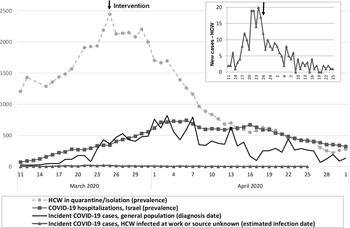
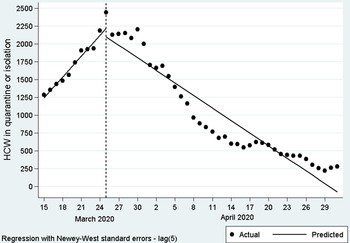
Before the intervention, the number of HCWs in general hospitals infected at work or from an unknown source was increasing and peaked at 20 new infections per day (Fig. 1). The daily prevalence of HCWs in general hospitals who were in quarantine or isolation was also rising and peaked at 2,444. After the intervention, there was a sharp and sustained drop in both the incidence of infections among HCWs and the prevalence of HCWs in quarantine or isolation. In the last 7 days of observations, the mean daily number of new infections was 1 and the mean prevalence of HCW in quarantine or isolation was 306. These decreases were attained despite increases in new COVID-19 cases in the general population and in the prevalence of COVID-19 hospitalized patients during the first 2 weeks after the intervention.
COVID-19 in the population and in healthcare workers (HCWs) in general hospitals, Israel, March 11–May 1, 2020. The intervention introduced on March 25 consisted of regulations requiring universal masking in general hospitals and defining criteria for what constitutes HCW exposure to SARS-CoV-2 and when quarantine is required.

Infections among HCWs in general hospitals
In total, 283 HCWs in general hospitals tested positive for SARS-CoV-2 from March 8 to May 1 whose source of infection was classified as work related (n = 170, 60.0%), possibly work related (n = 7, 2.5%), or unknown (n = 106, 37.5%). Estimated dates of infection ranged from February 28 to April 25. Of the 283 HCWs, 186 (65.7%) worked in positions with direct, prolonged patient contact (physicians, nurses, or nurses’ aides) and 97 (34.3%) worked in other positions. Of 267 HCWs (94.3%) whose department was recorded, only 24 (9.0%) worked in designated COVID-19 units.
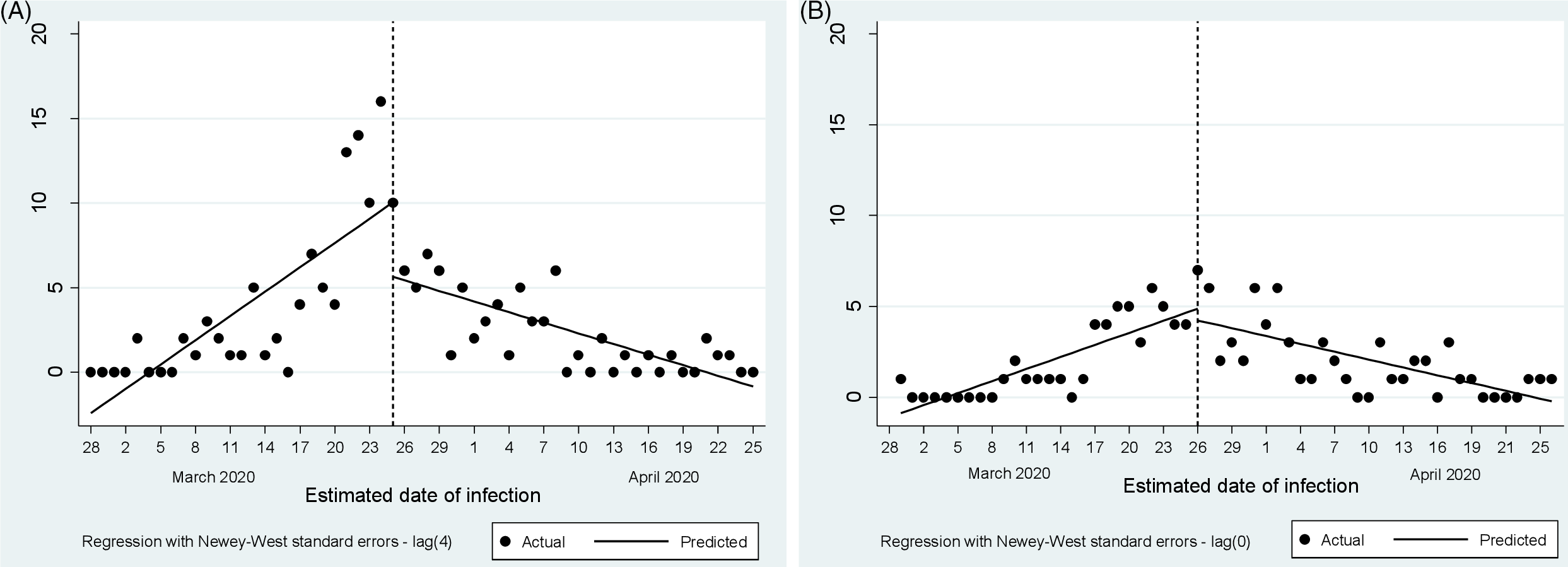
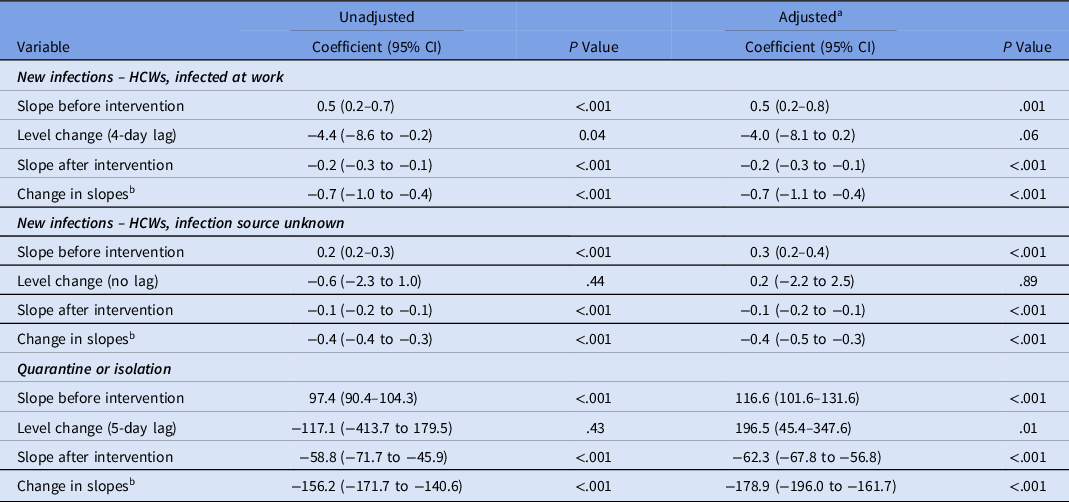
The effect of universal masking on the incidence of infection among HCWs is shown in Figure 2 and Table 2. Incidence rose in the preintervention period. The intervention led to a drop in the level of new infections, followed by a steady decrease. The pattern was less pronounced among HCWs whose source of infection was unknown, suggesting that some were infected outside of work where the intervention had no impact.
The effect of universal masking on the incidence of general hospital healthcare workers (HCWs) who were infected by SARS-CoV-2 at work (A) or from an unknown source (B). Unadjusted interrupted time-series analysis.

The Effect of New Regulations on Healthcare Workers (HCWs) in General Hospitals: Their Incidence of COVID-19 and Their Prevalence in Quarantine or Isolation Because of SARS-CoV-2 Exposure

a Adjusted for daily new cases of COVID-19 in the general population and daily prevalence of hospitalized COVID-19 patients in Israel.
b Slope after intervention, relative to the preintervention period.
HCWs in general hospitals in quarantine
The effect of universal masking, definitions of SARS-CoV-2 exposure, and criteria for quarantine on the prevalence of HCWs in quarantine or isolation is shown in Figure 3 and Table 2. The number of HCWs in quarantine or isolation increased in the preintervention period and decreased sharply in the postintervention period.
The effect of universal masking, definitions of SARS-CoV-2 exposure, and criteria for quarantine on the prevalence of general hospital healthcare workers (HCWs) in quarantine or isolation. Unadjusted interrupted time-series analysis.

Sources of infection
An in-depth epidemiological investigation was conducted for 213 HCWs (75.3%). Only 19 (8.9%) worked in a dedicated COVID-19 unit. Most were infected by a coworker (57.7%) or the source was not determined definitively but was narrowed to either a coworker or the community (2.3%). In most of these cases, there was a history of contact without masks in the staff room with a coworker who was later discovered to be SARS-CoV-2 positive. In 16.9% of cases, the investigation was unable to pinpoint the infection source. A hospitalized patient was determined to be the source of an HCW’s infection in 20 cases (9.4%). Questioning about PPE use at the time of exposure revealed that three-quarters of transmissions from patients occurred when no PPE or partial PPE was used. In 5 cases (2.3% of all investigated cases) an HCW was infected by a patient despite reported full PPE use during all encounters. None of these HCWs reported torn or defective PPE.
We identified 27 clusters of infected HCWs. Only 2 of them occurred in designated COVID-19 units. In 21 clusters, transmission was from HCW to HCW (ie, no patient or community exposures were identified). The 21 clusters ranged in size from 2 to 11 (median, 3) and involved 86 HCWs (40% of HCWs whose infection source was investigated). In one example, 2 operating room nurses whose infection source was undetermined tested positive on the same day. Nine other operating room personnel who had unprotected interactions with these nurses were diagnosed with COVID-19 over the following 12 days.
Discussion
In the COVID-19 pandemic, protecting HCW health is crucial for maintaining a functioning healthcare system. We found that a national regulation requiring universal masking of staff, patients, and visitors significantly reduced COVID-19 infections among HCWs in general hospitals in Israel. We also found that universal masking, together with a regulation that defined what constitutes COVID-19 exposure for HCWs and which exposures necessitate quarantine, significantly reduced the number of HCWs in general hospitals who were placed in quarantine or isolation. The initial decreases in infections and quarantine among HCWs were achieved at a time when COVID-19 cases and hospitalizations were rising in the general population.
Several previous studies have demonstrated the effectiveness of universal masking. Wang et al Reference Wang, Ferro, Zhou, Hashimoto and Bhatt4 compared SARS-CoV-2 positivity among symptomatic HCWs in 12 Massachusetts hospitals before and after the adoption of universal masking for HCWs and patients. Before the intervention, HCW positivity increased by 1.2% per day on average, reaching a peak of 21.3%. After implementation of universal masking, positivity fell to 11.5%, a decrease of 1.7% per day relative to the preintervention period. In a North Carolina health system, work-related COVID-19 infections among HCWs plateaued after the adoption of universal masking, even as HCW infections acquired in the community or from an unknown source continued to rise. Reference Seidelman, Lewis and Advani5 In 1 Paris hospital that adopted universal masking for HCWs only, positivity among symptomatic HCWs declined as compliance with universal masking and other PPE requirements improved. Reference Contejean, Leporrier and Canouï9 The fact that universal masking was found to be effective in Israel, the United States, and France implies that this intervention is generalizable to different populations. Klompas et al Reference Klompas, Morris, Sinclair, Pearson and Shenoy10 suggested that, beyond providing a physical barrier, universal masking may reduce “transmission of anxiety” and serve as a visual reminder of the need for other protective measures, such as social distancing. Reference Klompas, Morris, Sinclair, Pearson and Shenoy10 Conversely, universal masking could do more harm than good by creating a false sense of security that weakens compliance with other infection control measures Reference Klompas, Morris, Sinclair, Pearson and Shenoy10 ; our study and those cited above do not support this concern.
Universal masking is not a substitute for full PPE use during care of suspected or confirmed COVID-19 patients. Israel’s PPE guidelines are consistent with those of the WHO. 11,12 In our study, 2.3% of COVID-19 infections among HCWs were acquired during patient care despite reported use of undamaged PPE. The results of studies of work-related COVID-19 among HCWs vary widely. In a survey of 960 HCWs who treated COVID-19 patients in Hubei province, none tested positive on serial SARS-CoV-2 PCR tests taken 14 days after finishing patient care. Reference Zhao, Liang and Luo13 In contrast, a study of nearly 100,000 HCWs in the United States and United Kingdom who reported using adequate PPE found that HCWs who treated documented COVID-19 patients had a 4.8 times higher risk of a positive SARS-CoV-2 test. Reference Nguyen, Drew and Graham14 Adequacy of PPE referred only to availability. Unmeasured variables such as the consistency and completeness of PPE use, type of PPE used during high-risk procedures, and exposures to asymptomatic coworkers may explain the conflicting impressions of PPE effectiveness gained from these 2 studies.
We found that 58% of infected HCWs were infected by a coworker, typically during contact without masks outside of patient care areas during breaks or meals. Other studies Reference Seidelman, Lewis and Advani5,Reference Contejean, Leporrier and Canouï9,Reference Çelebi, Pişkin and Bekleviç15–Reference Gagneux-Brunon, Pelissier and Gagnaire17 and anecdotal reports Reference Morice18 have similarly found that coworkers are a common source of HCW COVID-19 infections. In a French hospital in which all symptomatic HCWs were tested for SARS-CoV-2, the rate of infection was significantly lower among HCWs working in dedicated COVID-19 wards. The researchers hypothesized that an HCW’s perceived risk of infection is higher in COVID-19 wards, leading to greater compliance with social distancing between coworkers. Reference Gagneux-Brunon, Pelissier and Gagnaire17 We found that only 9.0% of infected HCWs worked in COVID-19 units and only 7% of clusters of infected HCWs occurred in COVID-19 units. A Cochrane review Reference Houghton, Meskell and Delaney19 suggests steps that might improve HCW compliance with masking and social distancing in situations not involving direct care of COVID-19 patients, including more comfortable and better-fitting masks, ward managers who model mask use and social distancing, unambiguous guidelines, and messaging to increase awareness that staff had been infected by their coworkers.
In Israel, universal masking combined with uniform guidance on what constitutes COVID-19 exposure for an HCW and when quarantine is required significantly reduced the prevalence of HCWs in quarantine. Before the intervention, the daily number of HCWs in general hospitals who were in quarantine peaked at 2,444—an unsustainable level if hospitals were to continue to function during this period of heightened demand. Mass exposure of HCWs to SARS-CoV-2 forces healthcare systems to make difficult decisions. In mid-April 2020, the US newspaper Government Executive reported that some Veterans’ Affairs facilities, facing a staffing crisis, were requiring HCWs to continue working following unprotected exposure to a COVID-19 patient until they developed symptoms. Reference Katz20 This approach compromises patient safety. In one study conducted in a London hospital, 15% of COVID-19 infections among inpatients were found to be probably or definitely nosocomial; asymptomatic HCWs were one likely source of infection. Reference Rickman, Rampling and Shaw21
Our study has several limitations. First, we classified the source of HCW infections based on epidemiological investigations. Misclassifications may have occurred, leading to an underestimation or overestimation of the proportion of infections that were acquired at work and those transmitted from a patient. To limit underestimation of work-related infections, we included in our analysis HCWs whose infection source was classified as unknown. Second, data on HCWs in quarantine or isolation did not distinguish between HCWs sent into quarantine because of exposure at work versus in the community. Therefore, part of the observed decline in the number of HCWs in quarantine or isolation after March 25 may be explained by fewer opportunities for community exposure following restrictions placed on activity. These data also did not distinguish between quarantine and isolation. However, because the number of infections among HCWs was small compared to the number of HCWs in quarantine or isolation, quarantine accounts for the vast majority. Third, our count of infected HCWs did not include those without symptoms; there was no national recommendation to screen asymptomatic HCWs for SARS-CoV-2 unless they had been exposed to a confirmed case. Fourth, we measured the intervention’s effect over a short period of time, when HCW awareness (and fear) of COVID-19 was high.
In conclusion, we demonstrated at the country level that universal masking in general hospitals reduced the risk of hospital-acquired COVID-19 among HCWs. Universal masking combined with uniform definitions of HCW exposure and criteria for quarantine reduced the prevalence of HCWs temporarily removed from the workforce. Our findings support the WHO endorsement of universal masking in healthcare settings.
Acknowledgments
Financial support
No financial support was provided relevant to this article.
Conflict of interest
All authors report no conflicts of interest relevant to this article.
Supplementary material
To view supplementary material for this article, please visit https://doi.org/10.1017/ice.2021.207