Research based on the transformational-leadership theory (Bass, Reference Bass1985), has emphasized the importance of examining leadership styles in police settings (e.g., Álvarez, Lila, & Castillo, Reference Álvarez, Lila and Castillo2012; Densten, Reference Densten2003; Murphy & Drodge, Reference Murphy and Drodge2004). A positive relationship has been generally found between transformational leadership styles and followers’ satisfaction in all contexts, as well as between the perception of the leader’s effectiveness and the extra effort informed by followers (Álvarez et al., Reference Álvarez, Lila and Castillo2012; Avolio & Yammarino, Reference Avolio and Yammarino2002; Bass & Riggio, Reference Bass and Riggio2006; Lowe, Kroeck, & Sivasubramaniam, Reference Lowe, Kroeck and Sivasubramaniam1996). Literature points out that transformational leadership is the most effective leadership style, in accordance with the Full Range of Leadership model by Avolio and Bass (Reference Avolio and Bass1991) (e.g., Álvarez et al., Reference Álvarez, Lila and Castillo2012). However, this is not the case in all contexts; for example, in contexts with stable systems and a high level of regulation (strong situations), such as military contexts, the leaders’ transactional active behaviors (contingent reward and management by exception-active) are perceived to be the most effective by followers (Álvarez et al., Reference Álvarez, Lila and Castillo2012; Antonakis, Avolio, & Sivasubramaniam, Reference Antonakis, Avolio and Sivasubramaniam2003). Furthermore, police forces have been described as organizations who face or may face extreme situations (high-reliability organizations), and so leaders in police settings require specific characteristics. Additionally, it has been pointed out that there is a shortage of literature dealing with these extreme contexts (Hannah, Uhl-Bien, Avolio, & Cavarretta, Reference Hannah, Uhl-Bien, Avolio and Cavarretta2009).
Moreover, several works highlight the limited evidence available on differences in leadership styles considering the rank and status of the leader (Bass & Riggio, Reference Bass and Riggio2006). Some authors such us Avolio, Zhu, Koh, and Bhatia (Reference Avolio, Zhu, Koh and Bhatia2004), underline the need for further research on how leaders influence far/close followers.
On the other hand, the need to carry out leadership research from a theorically and methodologically appropriate perspective has been noted (e.g., Chun, Yammarino, Dionne, Sosik, & Moon, Reference Chun, Yammarino, Dionne, Sosik and Moon2009), especially in police contexts (Densten, Reference Densten2003). Avolio, Sosik, Jung, and Berson (Reference Avolio, Sosik, Jung, Berson, Borman, Ilgen and Klimoski2003) point out the shortage of studies focused on high-rank leaders in the organizations under study. Chun et al. (Reference Chun, Yammarino, Dionne, Sosik and Moon2009) describe two weaknesses in the current leadership research: on the one hand, studies have mainly focused on the leaders’ characteristics and, more often than not, the social relationships between leader and followers have been neglected (Howell & Shamir, Reference Howell and Shamir2005); on the other hand, there is a trend to consider the organizational distance and hierarchical level in terms of leader-follower distance. However, high leadership levels do not necessarily represent great distances between leader and followers (Chun et al., Reference Chun, Yammarino, Dionne, Sosik and Moon2009). With regard to the latter, Yammarino (Reference Yammarino, Bass and Avolio1994) stated that, in organizations, the rank-distance factor affects the perceptions and type of leadership, either directly or indirectly. This distance (known as dyadic by authors like Antonakis & Atwater, Reference Antonakis and Atwater2002) is the separating distance between leader and follower. Yammarino (Reference Yammarino, Bass and Avolio1994) referred to interaction and direct leadership distances when there is a maximum distance of two ranks in groups who work in production with face-to-face relationships (such as the local police services), and includes 3-rank distances for those situations in which the team is not directly related with production.
The organization structure of local police in the Valencian Community (Spain) is defined by a strong hierarchy reflected in its six levels or ranks, from the lowest to the highest: constable, officer, inspector, intendent, chief intendent and general intendent (In Spanish: agente, oficial, inspector, intendente, intendente principal and intendente general). These ranks, and the high level of regulation which prevails in these institutions, provided us with a simple and reliable way of interpreting the organizational distances.
In response to the research demands both in relation to context (Densten, Reference Densten2003; Hannah et al., Reference Hannah, Uhl-Bien, Avolio and Cavarretta2009) and to the examination of multiple organization levels (Chun et al., Reference Chun, Yammarino, Dionne, Sosik and Moon2009; Densten, Reference Densten2003) through rank distances, the objective of this study was twofold: Firstly, we explored the differences in leadership styles between leaders in different ranks; secondly, we analyzed if there were any differences in the perception of the styles according to the organizational distance separating the follower reporting from the leader reported.
Method
Participants and Procedure
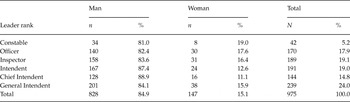
The sample was representative of the universe of local policemen and policewomen from the Valencian Community (Spain) and it was composed of 975 local police officers (Men = 828, Women = 147) managed by 42 police leaders from 42 different towns, with a sampling error of .03.
The ages of participants were distributed as follows: 8.3% 25 years old or under, 58.8% between 25 and 35 years old, 19.4% between 36 and 45 years old, 1.3% over 55 years old, and 1.3% did not report their age.
A stratified cluster random sampling was applied by local police leader rank (or police station leaders, as it is the case in towns with more than one police station) and by gender of the respondent, thus guaranteeing representativeness of both strata. Therefore, the sample has been stratified by leader ranks (see Table 1).
Description of sample in the study

In each location the staff leader was contacted by telephone to inform him/her about the objective of the research and to agree on a date for the visit and administration of the questionnaires. All the members of each staff, except from the leader, were invited to fill in the questionnaire. Participation was anonymous and voluntary.
Instrument
The Spanish version (Molero, Recio, & Cuadrado, Reference Molero, Recio and Cuadrado2010) of the Multifactorial Leadership Questionnaire Rater Form (MLQ-5X-Short©, Bass & Avolio, Reference Bass and Avolio1995) was administered. This instrument consists of 45 items, 36 of which describe nine leader behaviors with four items each: idealized influence (behavior), idealized influence (attributed), inspirational motivation, intellectual stimulation, individualized consideration, contingent reward, management-by-exception active, management-by-exception passive, and laissez-faire. The remaining nine items include information on three outcome factors: the follower’s extra effort as a result of the leader behaviors (three items), effectiveness of the high ranks leadership (four items) and satisfaction with the high rank police leadership (two items). The questionnaire starts with the stem: “My leader…” and the answers are collected with a 5-point Likert response scale ranging from 0 (never) to 4 (almost always). Some examples of the items are: “Is effective in meeting my job-related needs”, “Heightens my desire to succeed”, and “Is effective in meeting organizational requirements”.
Results
The results of the factorial validity of the MLQ-5X showed an appropriate fit both for the leader behaviors model, χ2(558) = 2264.90, p < .001; NNFI = .98; RMSEA = .074, and for the outcomes model, χ2(24) = 83.13, p < .001; NNFI = .99; RMSEA = .038. Internal consistency reliability was satisfactory (α = .70 to .92). For more details (i.e. factor loadings and results of an alternative model to the data) see Álvarez et al. (Reference Álvarez, Lila and Castillo2012).
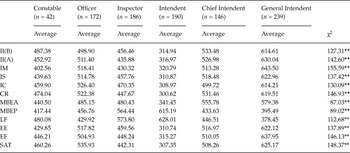
Significant differences between the followers’ perceptions according to the leader’s rank and for all the leadership behaviors and outcomes were tested. Given the size difference between groups, a Levene's test for homogeneity of variances was performed previously. The results confirmed the differences between the variances of almost all the groups and, therefore, a non-parametric technique for testing average differences between independent samples was applied (Kruskall-Wallis test). Post-hoc comparisons were performed with Tamhane´s T2 test. The results showed significant differences between ranks both in leader behaviors and outcome factors (see Table 2).
Kruskall-Wallis test for MLQ 5X variables by police leader rank

II(B) = Idealized Influence (Behavior); II(A) = Idealized Influence (Attributed); IM = Inspirational Motivation; IS = Intellectual Stimulation; IC = Individualized Consideration; CR = Contingent Reward; MBEA = Management-By-Exception (Active); MBEP = Management-By-Exception (Passive); LF = Laissez-Faire; EE = Extra Effort; EF = Effectiveness; SAT = Satisfaction; **p < .01.
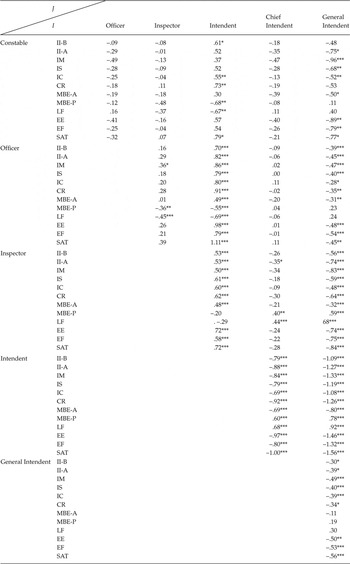
The results showed that the behaviors related to the transformational leadership style (idealized influence-behavior, idealized influence-attributed, inspirational motivation, intellectual stimulation and individualized consideration) were more strongly perceived in general intendents in comparison to leaders from any of the other ranks (constable, officer, inspector, intendent or chief intendent), except from the non-statistically significant difference between general intendents and constables in idealized influence-behavior. This trend was also found when comparing transactional leadership active behaviors (contingent reward and management-by-exception-active) across the different leader ranks. Exceptions can be found when comparing the ranks of general intendent and constable in contingent reward, and general intendent with chief intendent in management-by-exception-active. By contrast, the lowest average obtained by the general intendent rank appeared when compared to inspectors and intendents in passive behaviors (management-by-exception-passive and laissez-faire), except from the comparisons in both behaviors with constable, officer and chief intendent that were not statistically significant. With regard to the followers’ extra effort, the perceived leader’s effectiveness and the satisfaction with the leader, these variables also showed higher values in the group of general intendents than in the rest of leader ranks (see Table 3).
Average differences (I-J) (Tamhane´s T2 test) between ranks for the leadership behavior and outcome variables

*** p < .001; ** p < .01; *p < .05. II(B) = Idealized Influence (Behavior); II(A) = Idealized Influence (Attributed); IM = Inspirational Motivation; IS = Intellectual Stimulation; IC = Individualized Consideration; CR = Contingent Reward; MBEA = Management-By-Exception (Active); MBEP = Management-By-Exception (Passive); LF = Laissez-Faire; EE = Extra Effort; EF = Effectiveness; SAT = Satisfaction.
The opposite case to general intendents was found in the group of intendents when compared to the rest of leader ranks. Intendents obtained lower averages in transformational leadership behaviors than leaders in other ranks, except from the comparison between intendent leaders and constable leaders, which only showed significant differences in idealized influence-behavior and individualized consideration. Along this line, intendent leaders obtained lower averages in transformational leadership active behaviors than the other ranks, except from leader constables in management-by-exception-active behavior, which didn’t show statistically significant differences. Additionally, with regard to passive behaviors, intendents showed higher averages than the other ranks, except from the comparison with leader inspectors, which did not yield any statistically significant differences. Differences between leader officers and leader inspectors were only found in inspirational motivation behavior in favor of officers and in both passive behaviors with the highest average for the inspectors. Finally, non-statistically significant differences were found between the perceptions in the two basic ranks (constable and officer) (see Table 3).
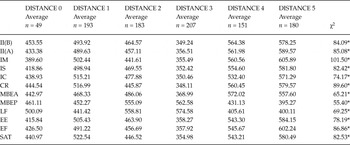
Furthermore, the possible differences in perceptions of leadership behavior and outcome factors according to the distance between the respondent rank and the evaluated leader rank were examined. The following distances were assigned: 0 to follower-leader at same rank, 1 to one-rank follower-leader distances, 2 to two-rank distances, 3 to three-rank distances, 4 to four-rank distances, and 5 to five-rank follower-leader distances (such as the distance existing between a follower constable and a leader general intendent) (see Table 4). Kruskall-Wallis test performed according to rank distance between follower and leader showed the existence of significant differences in all leadership behaviors.
Kruskall-Wallis test for MLQ 5X variables by follower-leader rank distance

II(B) = Idealized Influence (Behavior); II(A) = Idealized Influence (Attributed); IM = Inspirational Motivation; IS = Intellectual Stimulation; IC = Individualized Consideration; CR = Contingent Reward; MBEA = Management-By-Exception (Active); MBEP = Management-By-Exception (Passive); LF = Laissez-Faire; EE = Extra Effort; EF = Effectiveness; SAT = Satisfaction; **p < .01.
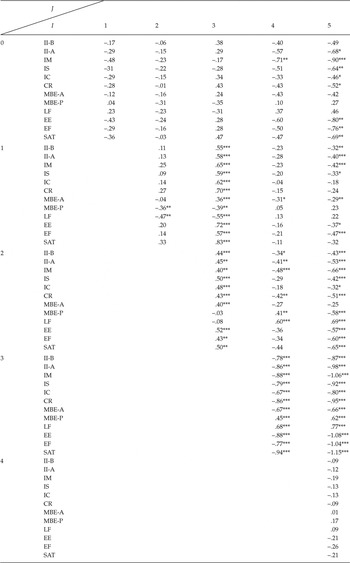
Post hoc analyses (see Table 5) showed that there were no statistically significant differences between followers’ perceptions on any leadership behavior or outcome when comparing groups of four and five-rank distances. This same tendency could be observed in the comparison between groups with one and two-rank distances, except from passive behaviors (management-by-exception passive and laissez faire) with the two-rank distance perceived as less passive than the one-rank distance. It could be observed a clear trend of perceiving the five-rank distance leaders with a higher transformational and transactional active leadership than the leaders at a distance of three ranks or less (see exceptions in Table 5). This tendency reverses to the opposite direction in the passive leadership behaviors (management-by-exception passive and laissez faire) for the comparison between the five-rank distance and the two and three-rank distances. As for the outcome variables, five-rank distances showed a clear trend of generating higher follower’s extra effort, higher satisfaction with the leader and leadership was perceived as more efficient when compared to distances of three ranks or less (see exceptions in Table 5).
Average differences (I-J) (Tamhane´s T2 test) of follower-leader distances for the leadership behavior and outcome variables

*** p < .001; ** p < .01; *p < .05. II(B) = Idealized Influence (Behavior); II(A) = Idealized Influence (Attributed); IM = Inspirational Motivation; IS = Intellectual Stimulation; IC = Individualized Consideration; CR = Contingent Reward; MBEA = Management-By-Exception (Active); MBEP = Management-By-Exception (Passive); LF = Laissez-Faire; EE = Extra Effort; EF = Effectiveness; SAT = Satisfaction.
By contrast, the three-rank distance leadership showed a clear trend of being perceived as less transformational and transactional active, that is, more passive, and with low levels in the outcome variables when compared to the rest of distances, except from the comparison with zero-rank distance (see exceptions in Table 5).
With regard to the rest of differences between distances, it was observed that the significant differences tended to be in terms of more transformational and transactional active in favor of the greatest distance in the pair (except from the comparisons already mentioned with three-rank distance).
Discussion
Based on the transformational leadership theory (Bass, Reference Bass1985) and centering on the local police milieu, this study analyzed the differences in leadership styles according to the rank of the leaders and the organizational follower-leader distance.
General intendent leaders (the highest rank) showed transformational and transactional active behaviors more frequently and passive behaviors less frequently than the other ranks, scoring higher in terms of extra effort, leadership effectiveness and satisfaction with the leader. These results are consistent with the above-mentioned issues based on the transformational leadership theory (Bass, Reference Bass1985) and in line with past researches (e.g., Lowe et al., Reference Lowe, Kroeck and Sivasubramaniam1996), and additionally, confirm the differences according to rank highlighted by authors such as Densten (Reference Densten2003). The explanation of these results could be based upon the general intendents’ highest level of formal education in comparison to the other ranks, not only because of the university degree, which is also preceptive to access the rank of chief intendent, but also because of the specific training in management techniques received when obtaining the rank. The profile of these leaders corresponds to professionals with many years of experience in the police force; with a deep insight into the culture of the organization and who are trained to perform at the maximum level of the scale. This is not the only explanation; the staff structure itself (according to Spanish Law n° 4455, 07.03.2003) allows general intendents to lead very well-defined police networks, where there are followers with high levels of experience and training, thus allowing the leader to safely delegate more functions and spend more time in proactive leadership and planning, which in turn increases their chances to lead with transformational behaviors and a more up-to-date management style (Rippy, Reference Rippy1990). Additionally, these results are comparable with previous studies in the police context which confirm that transformational leadership styles in the highest ranks are more common due to the inner characteristics of the position (Densten, Reference Densten2003).
In contrast, the same explanation could be used conversely to understand the data collected from the leader intendents’ followers, since the results showed that they generally perceived less transformational and transactional active leadership behaviors and more passive behaviors than the other ranks, with lower scores in their followers’ extra effort, effectiveness and satisfaction (with the exceptions described in the results section). Although intendents’ experience in the police force is similar to general intendents’, the formal education required is not (they are required to have a university certificate instead of university degree), nor is the specific training in managing techniques so in-depth. Additionally, staffs managed by intendents are, in some cases, larger than those managed by chief intendents and general intendents. These are oversized staff, with horizontal structural growths and with “flatter” structures. According to Robbins (Reference Robbins2004), this type of structure with wide spans of management tends to overburden the leaders who, as a consequence, “do not have enough time to perform the necessary leadership and management” (p. 430). The leader cannot resort to such a wide structure of staff because those subordinates do not have the necessary competences to delegate daily matters without the leaders’ supervision. Therefore, the leader ends up trying to take up all the work and the management style is perceived by followers as being passive, less efficient and less satisfactory than that pertaining to groups lead by those of other ranks, thus lowering the followers’ extra effort levels. A suggestion to solve this situation would be to adjust staff dimensioning, with more rational levels of leader ranks and more opportunities to delegate to followers with more competencies.
Similarly, the differences found between leader officers and leader inspectors can also be explained. Leader inspectors may manage larger staffs than some intendents and chief intendents within smaller communities. This effect is the same as that which takes place with intendents but on a lesser scale. In terms of the leader inspectors, these normally have some “reliable officers” who help them to manage the staff, but when there is over-dimensioning, it can be found again that, in comparison to staffs led by officers (much less numerous and, in general, with a more rational dimensioning), leader officers are perceived as less passive than inspectors.
With regard to follower-leader rank distances, we wanted to determine if rank distance could affect the followers’ perception of their leaders, thus gaining a deeper insight into the leadership styles, since a certain hierarchical level does not necessarily inform about the organizational distance between the leader and the follower who perceives his/her leader behaviors (Chun et al., Reference Chun, Yammarino, Dionne, Sosik and Moon2009). Consistent with the results highlighted by Bass and Riggio (Reference Bass and Riggio2006), our study has showed that followers evaluating a leader who was at a distance of five ranks perceived him/her to be more transformational and transactional active, less passive, reporting higher levels of extra effort, satisfaction with the leader and leader’s effectiveness. This trend became blurred when comparing four-rank distances, two-rank distances, one or same-rank distances. Although differences were found, the trend previously described prevailed. According to Shamir (Reference Shamir1995), greater follower-leader distances tended to increase the optimal styles perceived in the leader, which, in turn, could promote an indirect leadership style, as Yammarino (Reference Yammarino, Bass and Avolio1994) called it. Additionally, Yammarino (Reference Yammarino, Bass and Avolio1994) points out that the greatest follower-leader distances allow for a greater manipulation of impressions, thus explaining the optimum perception of leaders at great distances (four and five ranks) compared to the other distances, an effect not observed in the medium distance (three) with more frequent face-to-face interactions. No differences were found between the small-distances (two ranks or fewer) followers’ perceptions on the leader behavior, with frequent face-to-face interactions and direct leadership styles (Yammarino, Reference Yammarino, Bass and Avolio1994).
With regard to differences in leadership perception between small distances (from zero to two-ranks) and medium distances (three-ranks), we found that significant differences showed better outcomes for small distances than medium distances. These results were not consistent with the common trend that points out that the greater the leader-follower distance, the higher the perception of transformational leadership behaviors (Yammarino, Reference Yammarino, Bass and Avolio1994; Shamir, Reference Shamir1995). A possible explanation is the existence of a “difficult follower-leader distance”, which does not benefit from the great-distance advantages, with little contact, nor from the small-distance advantages, with closer relations through frequent exchange (Shamir, Reference Shamir1995).
In relation to the practical implications from this research, it has been found that in very hierarchical and mechanized structures, such as local police forces, it is advisable not to overburden leaders by imposing “flat” designs with very few leaders in charge of many followers, since the present study has found in these circumstances that leaders become less efficient, followers less satisfied and with a lower tendency to perform extra effort behaviors. Additionally, leaders within these designs are also perceived as being less transformational than leaders in smaller organizational structures or who delegate more responsibilities among intermediate leaders. As for the research, this study contributes to taking up an uncommon path by analyzing the leadership differences according to organizational distances and their comparison to the traditional distances according to organizational levels.
Another implication refers to the design of future research on leadership (in our opinion, it can also be extrapolated to other research contexts where a leader is evaluated by his/her followers). It would be advisable to bear in mind the factor of organizational distance between the follower respondent and the leader whose leadership behaviors are evaluated. To solve the possible intervention of the distance variable, we suggest two possible design strategies in future research. On the one hand, to try as hard as possible to perform studies on immediate leaders, or leaders separated by an organization distance of a two-level maximum. On the other hand, we should point out one limitation in the present study: if one wishes to assess an organization as a whole, and to study also great distances between the respondent and the object of perception, it would be advisable to elaborate designs including the evaluated leaders’ self-perception to compare it to the followers’ perceptions, thus enabling a more exact picture of the reality we aim to study.