Mental health services in developed nations have a recovery orientation (Australian Government Department of Health, 2013; Farkas, Reference Farkas2007; Smith-Merry, Sturdy, & Freeman, Reference Smith-Merry, Sturdy and Freeman2010). In this context, ‘recovery’ does not mean being symptom-free, but instead indicates that a person is ‘living a satisfying, hopeful and contributing life even with the limitations caused by illness’ (Anthony, Reference Anthony1993, p. 975). Almost half of all Australians (45.5%) report experiencing a mental disorder at some point in their lifetime (Australian Bureau of Statistics, 2010). The most prevalent of these conditions are anxiety disorders (14.4%), affective (mood) disorders (6.2%), and substance use disorders (5.1%) (Australian Bureau of Statistics, 2010). Psychotic disorders occur less frequently and are estimated to have a one-month prevalence of 3.1 cases per 1,000 of population (Australian Government Department of Health, 2011). Therefore, there is a need for research that addresses recovery supports for those living with mental illness.
In Australia, the most commonly used mental health services are provided by General Practitioners (GPs) (25%), psychologists (13%), and ‘others’ (17%) (Australian Bureau of Statistics, 2010). For people with severe illnesses, treatment typically involves psychopharmacological and psychosocial interventions aimed at symptom reduction and functional recovery (e.g., antipsychotic medication, specialist psychiatric services, and engagement with social agencies) (Keks & Hope, Reference Keks and Hope2007; McGorry, Killackey, & Yung, Reference McGorry, Killackey and Yung2007). Work participation is also an intervention for recovery from mental illness (Australian Government Department of Health, 2013). This might be the case because ‘work’ as therapy provides time structure, identity, and social contact (Morris, Waghorn, Robson, Morre, & Edwards, Reference Morris, Waghorn, Robson, Morre and Edwards2014; Shepherd, Boardman, Rinaldi, & Roberts, Reference Shepherd, Boardman, Rinaldi and Roberts2014). However, we could not find any studies that had examined the relationship between the theoretical components of recovery in a ‘work-as-therapy’ context. Therefore, this study explored the relationship between the constructs of hope, social inclusion, and mental wellbeing in a sample of people recovering from severe mental illness through engagement in work.
In Australia, the Fourth National Mental Health Plan (NMHP; Australian Health Ministers, 2009) sets social inclusion as its first priority and prescribes vocational rehabilitation and employment as key actions and outcomes. Undergirding the NMHP's imperatives is evidence that employment generally has a positive effect on mental health and wellbeing (Andresen, Oades, & Caputi, Reference Andresen, Oades and Caputi2003) and promotes recovery in people with psychiatric disability (Gilbert et al., Reference Gilbert, Marwaha, Milton, Johnson, Morant, Parsons and Cunliffe2013), including those with schizophrenia (Boardman, Grove, Perkins, & Shepherd, Reference Boardman, Grove, Perkins and Shepherd2003; Drake & Whitley, Reference Drake and Whitley2014).
Components of the Recovery Paradigm
Research has identified the core components of recovery, such as hope, social inclusion or connection, empowerment, and wellbeing, with ‘hope’ being the first and central requirement (Gallagher & Lopez, Reference Gallagher and Lopez2009; Jacobson & Greenley, Reference Jacobson and Greenley2001). When empowered by hope, people ‘feel capable of expanding their personal abilities. . .’ (Resnick, Rosenheck, & Lehman Reference Resnick, Rosenheck and Lehman2004, p. 540) to overcome the functional limitations of mental illness (Iyer, Rothmann, Vogler, & Spaulding, Reference Iyer, Rothmann, Vogler and Spaulding2005). However, questions remained as to the relationship between ‘hope’, ‘social inclusion’, and ‘mental welling’.
Snyder defined hope as a person's ‘perceived ability or internalized belief that he or she can produce goals, pathways, and agency’ (Snyder, Lehman, Kluck, & Monsson Reference Snyder, Lehman, Kluck and Monsson2006, p. 89). Social inclusion refers to ‘participation in community life’ (Le Boutillier et al., Reference Le Boutillier, Leamy, Bird, Davidson, Williams and Slade2011, p. 3). Mental wellbeing is ‘personal growth, self-acceptance, autonomy, positive relationships, environmental mastery, and purpose in life’ (Andresen et al., Reference Andresen, Oades and Caputi2003, p. 591). The World Health Organisation proposes that positive mental health is evidenced when ‘individuals realize their abilities, cope with the normal stresses of life, [and] work productively and fruitfully’ (World Health Organisation, 2004, p. 10). Therefore, for adults, participation in work is both a rehabilitation strategy to promote recovery, and a means of demonstrating that recovery is being achieved.
Recovery outcomes have been shown to be moderated by severity of psychological distress (Resnick et al., Reference Resnick, Rosenheck and Lehman2004). For instance, outcomes in the presence of more severe disorders may be limited by the side effects of antipsychotic medication; noncompliance with prescribed treatments; the recurrence of positive symptoms and hospitalisation; the development of dual diagnoes and assoicted illnessness such as HIV and Hepatitis C; and, psychosocial problems such as family disruption, homelessness, and incarceration (Drake et al., Reference Drake, McHugo, Xie, Fox, Packard and Helmstetter2006; Resnick et al., Reference Resnick, Rosenheck and Lehman2004). Investigating the impact of severity of illness on recovery in a ‘work-as-therapy’ context would address a gap in knowledge regarding these relationships.
Supported Employment
Supported employment as ‘services to support the employment of persons with disabilities: (a) for whom competitive employment at or above the relevant wage is unlikely; and (b) who, because of their disabilities need substantial ongoing support to gain or retain paid employment’ (Australian Government, 1986). In other words, supported employment is about receipt of assistance to gain and retain employment that returns a productivity-based wage (i.e., a wage adjusted in accordance with the person's capacity to work at the able-bodied rate) (see also Wehman, Reference Wehman2012).
Disability Support Pension (DSP; Australian Government Department of Employment, 2016) services support people to engage in the recovery process through participation in structured programmes, skills training, and social contact (Australian Government Department of Human Services, 2016). Their role in the content of recovery from mental illness with work participation has not been investigated.
Aim and Goals of the Study
The aim of this study was to explore the relationships between hope, social inclusion, and mental wellbeing in a sample of people recovering from mental illness via supported employment. The study sought to address the following questions: Are hope, social inclusion, and mental wellbeing related and improved by participation in supported employment? Does the severity of a person's mental health condition impact their level of recovery? And, does social inclusion mediate the relationship between hope and mental wellbeing?
We predicted a positive relationship between hope, social inclusion, and mental wellbeing and that our sample would report higher scores on these variables than a general outpatient clinical sample. We also predicted a negative relationship between these variables and psychological distress. Additionally, we proposed that hope and social inclusion would predict mental wellbeing and that social inclusion would mediate the relationship between the other two constructs.
Method
Participants and Setting
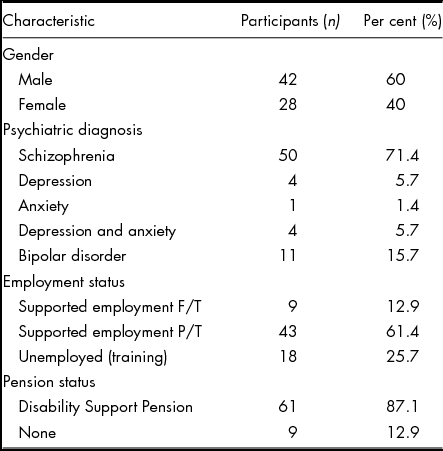
A total of 70 people with mental illness were participants (females = 40%, age range 21–73 years; Mage = 45.5, SD = 11.96) (see Table 1). They were accessed through an Australian Disability Enterprise where they were receiving productivity-based wages. The mean duration of engagement in the employment programme was 48.43 months (SD = 68.78; range = 1– 372). Full-time employees (n = 9) had a mean duration of engagement of 66.67 months (SD = 75.67; range = 6–240); for part-time employees (n = 43), the mean was 64.47 months (SD = 73.36; range = 2–372). All participants engaged in the pre-employment vocational training programme (n = 18) had attended for one month only.
Participant Characteristics

Note: N = 70.
Measures
The following measures were utilized for the data collection: the State Hope Scale (SHS; Snyder et al., Reference Snyder, Sympson, Ybasco, Borders, Babyak and Higgins1996); the Social Inclusion Scale (SIS; Secker, Hacking, Kent, Shenton, & Spandler, Reference Secker, Hacking, Kent, Shenton and Spandler2009); the Warwick-Edinburgh Mental Wellbeing Scale (WEMWBS; Tennant et al., Reference Tennant, Hiller, Fishwick, Platt, Joseph, Weich and Stewart-Brown2007); and the Kessler Psychological Distress Scale (K10; Kessler et al., Reference Kessler, Barker, Colpe, Epstein, Gfroerer, Hiripi and Zaslavsky2003).
State Hope Scale (SHS; Snyder et al., Reference Snyder, Sympson, Ybasco, Borders, Babyak and Higgins1996)
The State Hope Scale (SHS; Snyder et al., Reference Snyder, Sympson, Ybasco, Borders, Babyak and Higgins1996) was designed to assess current goal-directed thinking and was used in this study to measure state hope. The scale contains six items distributed across two subscales that measure agency: the individual's current belief in their ability to initiate and maintain goal-directed behaviour (e.g., ‘At the present time, I am energetically pursuing my goals’), and pathway: the individual's current belief in their ability to generate routes to their goals (e.g., ‘I can think of many ways to reach my current goals’). Items are rated on an 8-point Likert scale from 1 (definitely false) to 8 (definitely true). A total State Hope score is the sum of all responses that can range from 6 to 48, with higher scores indicating higher levels of current hopeful thinking. The reported mean score in a sample of normally functioning adults (N = 444) is M = 37.25 (SD = 6.33; Snyder et al., Reference Snyder, Sympson, Ybasco, Borders, Babyak and Higgins1996). The reported mean total score in a sample of outpatients with a mental disorder (n = 98; 62% taking psychotropic medication) is M = 23.3 (SD = 9.8; Irving et al., Reference Irving, Snyder, Cheavens, Gravel, Hanke, Hillberg and Nelson2004). The SHS has demonstrated validity and reliability; Snyder et al. (Reference Snyder, Sympson, Ybasco, Borders, Babyak and Higgins1996) reported high internal consistency with Cronbach's alphas for the overall scale ranging from .79 to .95, and the agency and pathway subscales ranging from .79 to .95 and .74 to .93, respectively. Good test–retest reliabilities of .48 to .93 have also been reported (Snyder et al., Reference Snyder, Sympson, Ybasco, Borders, Babyak and Higgins1996). The current study achieved a Cronbach's alpha of .86 for total scores, indicating high internal consistency.
Social Inclusion Scale (SIS; Secker et al., Reference Secker, Hacking, Kent, Shenton and Spandler2009)
The Social Inclusion Scale (SIS; Secker et al., Reference Secker, Hacking, Kent, Shenton and Spandler2009) was desiged to measure self-perceived levels of social inclusion and was used for that purpose in this study. The scale contains 17 items distributed across three subscales that measure social isolation (e.g., ‘I have felt terribly alone and isolated’), social relations (e.g., ‘I have been involved in a group, club or organization that is not just for people who use mental health services’) and social acceptance (e.g., ‘I have felt accepted by my family’). Participants rate each item on a 4-point Likert scale from 1 (not at all) to 4 (yes, definitely) to indicate how much each statement has applied to them over the previous three months. Four items on the Social Inclusion Scale are negatively formulated and reverse scored. A total Social Inclusion score is the sum of all responses that can range from 17 to 68, with higher scores indicating higher perceived levels of social inclusion. The reported mean total SIS score in a sample of nonclinical healthy adults (N = 103) is M = 60.06 (SD = 7.84) (Wilson & Secker, Reference Wilson and Secker2015; C. Wilson, personal communication, February 21, 2017). The reported mean total SIS score in a sample of outpatients with a diagnosed severe mental disorder (n = 48) is M = 17.12 (SD = 7.27; Margrove, SE-SURG, Heydinrych, & Secker, Reference Margrove, SE-SURG, Heydinrych and Secker2013). Secker et al., (Reference Secker, Hacking, Kent, Shenton and Spandler2009) found the SIS to have acceptable validity and reliability. This included positive correlations with measures of empowerment and mental health functioning, and overall good internal consistency (Cronbach's alpha = .95). The social isolation, social relations, and social acceptance subscales have each demonstrated an acceptable level of reliability, with Cronbach's alphas of .75, .76, and .70, respectively. In the current study, a Cronbach's alpha of .78 was achieved, indicating an acceptable level of internal consistency.
Warwick-Edinburgh Mental Wellbeing Scale (WEMWBS; Tennant et al., Reference Tennant, Hiller, Fishwick, Platt, Joseph, Weich and Stewart-Brown2007)
The Warwick-Edinburgh Mental Wellbeing Scale (WEMWBS; Tennant et al., Reference Tennant, Hiller, Fishwick, Platt, Joseph, Weich and Stewart-Brown2007) was desiged to measure self-perceived mental wellbeing and was used for that purpose in this study. The scale contains 14 items focused wholly on positive aspects of mental health (e.g., ‘I've been feeling useful’). Items are rated on a 5-point Likert scale from 1 (none of the time) to 5 (all of the time). A total Mental Wellbeing score is the sum of all responses that can range from 14 to 70, with higher scores reflecting higher levels of mental wellbeing. For nonclinical healthy adults (N = 60), a reported average total WEMWBS is M = 50.4 (SD = 8.4) (Maheswaran, Weich, Powell, & Stewart-Brown, Reference Maheswaran, Weich, Powell and Stewart-Brown2012). The reported mean total score in a sample of outpatients diagnosed with schizophrenia, bipolar disorder, depression and anxiety disorders (n = 145) is M = 40.30 (SD = 9.2; Maheswaran et al., Reference Maheswaran, Weich, Powell and Stewart-Brown2012). The scale has shown good content validity, a single factor structure, and excellent reliability (Stewart-Brown et al., Reference Stewart-Brown, Platt, Tennant, Maheswaran, Parkinson, Weich and Clarke2011). Tennant et al. (Reference Tennant, Hiller, Fishwick, Platt, Joseph, Weich and Stewart-Brown2007) report a Cronbach's alpha of .89 and test–retest reliability of .83 over a one-week period. In the current study, a Cronbach's alpha of .92 indicated strong internal consistency.
Kessler Psychological Distress Scale (K10; Kessler et al., Reference Kessler, Barker, Colpe, Epstein, Gfroerer, Hiripi and Zaslavsky2003)
The Kessler Psychological Distress Scale (K10; Kessler et al., Reference Kessler, Barker, Colpe, Epstein, Gfroerer, Hiripi and Zaslavsky2003) was designed to measure global psychological distress and was used for that purpose in this study. The scale consists of 10 items asking respondents how often they have felt nonspecific symptoms of psychological distress in the past four weeks (e.g., ‘In the past four weeks, about how often did you feel nervous?’). A total Psychological Distress score is the sum of all response that can range from 10 to 50, with higher scores indicating a greater degree of psychological distress. Suggested score ranges for likely severity of a mental disorder are 20–24 mild; 25–29 moderate; >30 severe. The K10 has demonstrated reliability and validity as a screening tool for mental disorders (Cornelius, Groothoff, van der Klink, & Brouwer, Reference Cornelius, Groothoff, van der Klink and Brouwer2013). High internal reliability, with a reported Cronbach's alpha of .93, has been reported (Kessler et al., Reference Kessler, Barker, Colpe, Epstein, Gfroerer, Hiripi and Zaslavsky2003). In the current study, the Cronbach's alpha for total scale scores was .94.
Qualitative Data
In order to gain insight into the subjective experience of participation in an employment-based mental health recovery programme, participants were invited to record written feedback comments in response to the following open-ended questions:
-
1. ‘Please describe your experiences of participating in a recovery programme’.
-
2. ‘Please comment on what you have found helpful about this programme’.
-
3. ‘Please comment on what you have not found helpful about this programme’.
Procedure
The University's Human Research Ethics Committee approved the study (approval number HE13-075).
Recruitment was from three Australian Disability Enterprises (Australian Government Department of Social Services, 2016) that employ people with psychiatric disability, either part- or full-time on a productivity-based wage, and one pre-employment skills programme, all located in Sydney, Australia. All participants provided implied informed consent through their anonymous completion of a battery of psychometric measures and open-ended questions. To invite participation, the second author visited each site and held an information session about the study. Hard copies of questionnaires and an Information Sheet for Participants (detailing the study and outlining the informed consent process) were made available at each site along with a secure box for depositing completed responses. No incentives were offered. The boxes were cleared after several weeks. In total, approximately 200 people were invited to participate producing a response rate of 38%.
Data Analysis
A standard multiple regression was used to examine the effect of hope and social inclusion on mental wellbeing. Mediation analysis was utilised to test for the effects of the hypothesised indirect role of social inclusion in the relationship between hope and mental wellbeing. This analysis was undertaken using the PROCESS macro developed by Hayes (Reference Hayes2013). This approach conducts the same set of analyses recommended by Baron and Kenny (Reference Baron and Kenny1986) for assessing mediation, but includes accelerated bootstrap confidence intervals (BCa CIs), which show less bias than Sobel's test for assessing the significance of the indirect path (Preacher & Hayes, Reference Preacher and Hayes2008).
Thematic analysis (Braun & Clarke, Reference Braun and Clarke2006) was utilised to construct themes from the qualitative data. The following steps were engaged: coding the material, identifying key themes, summarising the associated networks, and interpretation of themes.
Results
Descriptive Statistics
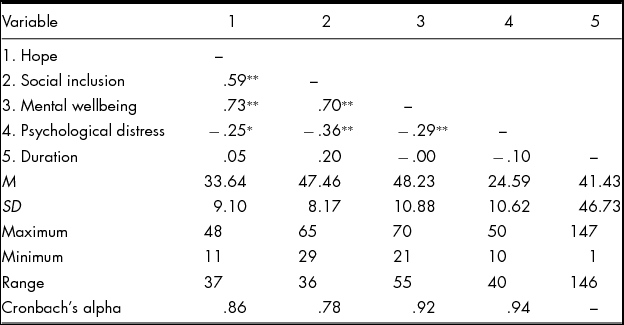
Table 2 shows the mean scores and standard deviations for the study variables. Overall, the sample had a mild to moderate level of psychological distress (M K10 score = 24.59, SD = 10.62). The mean scores on measures of hope, social inclusion, and mental wellbeing were significantly higher than those reported from samples of outpatients with mental disorders (see details in Measures section). The mean total mental wellbeing score was not different from that reported by healthy adults.
Differences between the Mean Scores on Measures of the Key Variables in this Study Compared to those Found in Published Studies of Mental Disorder and Healthy Adult Samples

Note: † references for these statistics are reported under each measure in the Methods section.
The relationships between hope, social inclusion, mental wellbeing, and psychological distress were investigated using Spearman's Rank Order Correlation coefficient. There was a strong positive correlation between hope, social inclusion and mental wellbeing and a small to medium negative correlation between each of these variables and psychological distress (see Table 3) (Cohen, Reference Cohen1988). These findings indicate that the components of recovery decease as psychological distress increases.
Summary of Descriptive Statistics, Inter-Correlations, and Cronbach's Alpha for Scales Measuring the Key Variables in this Study

Notes: N = 70, Spearman correlation coefficients, * p<.05 (one-tailed) **p <.01 (one-tailed).
Predicting Mental Wellbeing from Hope and Social Inclusion
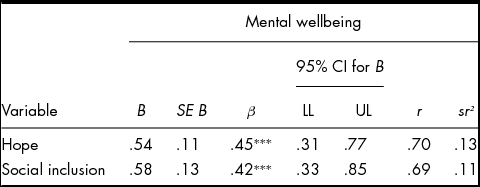
Standard multiple regression analysis was used to test the hypothesis that hope and social inclusion would predict mental wellbeing. The results of the regression (see Table 4) showed that the two predictors explained 60.6% of the variance in mental wellbeing (R² = .606, F (2, 67) = 51.46, p <. 001). Hope (β = .45, p <.001) and social inclusion (β = .42, p <.001) each accounted for significant independent proportions of this variance, explaining 13.2% and 11.3%, respectively. Thus, the hypothesis that hope and social inclusion would predict mental wellbeing was supported.
Standard Multiple Regression Analyses Predicting Mental Wellbeing from Measures of Hope and Social Inclusion

The Mediating Role of Social Inclusion on Hope and Mental Wellbeing
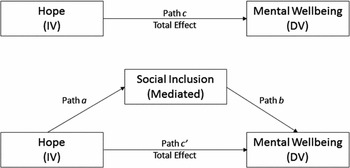
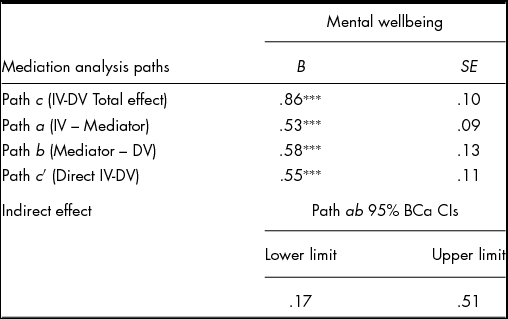
To determine whether the relationship between hope (independent variable; IV) and mental wellbeing (dependent variable; DV) was mediated by social inclusion (Mediator), a mediation analysis was conducted. All components of the model, shown in Figure 1, were assessed.
Illustration of the mediation analysis pathways between hope, social inclusion, and mental wellbeing.

The bootstrap unstandardized beta (B) coefficients for each relationship in the model are reported in Table 5. It was found that hope significantly predicted mental wellbeing (Total Effect, Path c). Hope also significantly predicted social inclusion (Path a), and social inclusion significantly predicted mental wellbeing (Path b). As both the a-path and b-paths were significant, mediation analyses were run and confirmed the mediating role of social inclusion in the relationship between hope and mental wellbeing (Path ab, the Indirect Effect). The estimated accelerated bootstrap confidence intervals (BCa CIs) for this effect, based on 5,000 replications, did not span zero, indicating that the effect was significant. Within this analysis, the Direct Effect of hope on mental wellbeing remained significant (Path c′), signifying that social inclusion was a partial mediator of this relationship and accounted for approximately one-third of the total effect PM = .36 (PM = ratio of the indirect effect to the total effect).
Summary of Mediation Analyses Examining the Relationship Between Hope (IV), Social Inclusion (Mediator), and Mental Wellbeing (DV)

Notes: N = 70; B = unstandardized beta coefficients; SE = standard errors; BCa CIs = bias corrected and accelerated confidence intervals based on 5,000 bootstrapped samples; *** p <.001.
Feedback Comments from Participants
Analysis of the written feedback comments from participants produced two global themes: namely, engagement in productivity-based supported employment produces areas of satisfaction and dissatisfaction. The underlying organising themes were ‘psychosocial benefits of work’ and ‘manifest benefits of work’. Basic themes contributing to the ‘psychosocial benefits’ were positive interpersonal interactions (‘talking to other people’, ‘enjoy working with others’, ‘I felt like I belong and am welcome’); mental wellbeing (‘It helps me with my depression’, ‘it helps me feel far less isolated’, ‘it has helped stabilise my life’); structured activity (‘it gives me a reason to get up and out’; ‘developed a routine’; ‘new sense of trust and responsibility’); education (‘It exercises my brain, it teaches me and gives me skills’, ‘improving my skills’); shared purpose (‘being part of a group’, ‘self-satisfaction’); and, hope for the future (‘finding there is a purpose in life subsequent to trauma’, ‘it is helping me in my future”, ‘it has given me some hope’). The basic theme under ‘manifest benefits of work’ was dissatisfaction with the productive-based wage and the earning constraints of supported wage employment (‘I want more money’, ‘Not paid enough’).
Discussion
This study explored the relationships between hope, social inclusion, and mental wellbeing in a sample of people in recovery from mental illness and participating in supported employment. Most of the participants (87%) were receiving a disability pension secondary to severe mental illness (71.4% had a diagnosis of schizophrenia). Accordingly, their productivity-based earnings were capped.
The sample was found to have mild to moderate symptoms of psychological distress but, in accordance with recovery theory, mean scores on measures of recovery (i.e., hope, social inclusion, and mental wellbeing) were significantly higher than those reported by outpatient clinical samples. Further, this study's participants’ mean mental wellbeing score was not significantly different to that of healthy adults. These findings could be interpreted in two ways: (a) people with higher scores on indicators of recovery are those who engage in employment; or (b) engagement in employment produces higher scores on indicators of recovery.
The literature supports both of the above statements. Published theoretical and empirical studies have shown that ‘hope’ provides the impetus for participation in socially inclusive activities (including employment) and greater mental wellbeing follows hope and social inclusion (Australian Health Ministers, 2009; Cheavens, Feldman, Gum, Michael, & Snyder, Reference Cheavens, Feldman, Gum, Michael and Snyder2006; Kirst, Zerger, Harris, Plenert, & Stergiopoulos, Reference Kirst, Zerger, Harris, Plenert and Stergiopoulos2014). Other studies have revealed that interventions (including employment) can increase hope and wellbeing outcomes in people afflicted by a wide range of physical and mental health conditions (e.g., Cheavens et al., Reference Cheavens, Feldman, Gum, Michael and Snyder2006; Gallagher & Lopez, Reference Gallagher and Lopez2009; Irving et al., Reference Irving, Snyder, Cheavens, Gravel, Hanke, Hillberg and Nelson2004). Thus, the results of this study potentially support each of the above findings but its cross-sectional design prevents examination of directional effects.
Mean scores on measures of recovery were positively correlated and had an inverse relationship with level of psychological distress. This latter finding is consistent with research showing that as severity of illness increases, people face greater challenges to social engagement and recovery (Resnick et al., Reference Resnick, Rosenheck and Lehman2004). Therefore, while it is generally agreed that ‘hope’ is necessary for recovery, it may be that interventions are needed to create a threshold level of hope sufficient for behavioural activation. The overarching implication is that recovery services should vary according to the severity of a person's illness.
Hope and social inclusion were found to predict mental wellbeing, with social inclusion partially mediating the relationship between the other two constructs. As suggested above, these findings indicate that while hope alone can lead to greater mental wellbeing, an additional mechanism for achieving and strengthening this outcome is participation in socially inclusive activities. In combination, these findings support the recovery–orientation of mental health services offered in most developed countries (Anthony, Reference Anthony1993; Farkas, Reference Farkas2007) and the goals of the Australian National Mental Health Plan (Australian Health Ministers, 2009) in particular.
Finally, feedback comments revealed that participation in a supported employment programme delivers a number of known benefits of work. These include the opportunity for positive interpersonal interactions, education, a shared purpose and time structure (Creed & Macintyre, Reference Creed and Macintyre2001). Participants’ comments align with theories such as Jahoda's Latent Deprivation (Jahoda, Reference Jahoda1982) and Fryer's Agency Restriction models (Creed & Macintyre, Reference Creed and Macintyre2001) that document the psychosocial and manifest (financial) benefits of employment. The only point of dissatisfaction reported by participants was the low level of remuneration (due to the productivity-based wage), which may limit their capacity to achieve the full mental health benefits of employment (Morris et al., Reference Morris, Waghorn, Robson, Morre and Edwards2014). That said, excluding the 18 participants who were engaged in the one-month pre-employment vocational training programme, on average the others had been employed by the ADE for more than five years. Therefore, being under no obligation to work, this finding suggests that the benefits of work outweighed participants’ concerns about low wages.
Limitations of the study. This study has limitations that include a cross-sectional design, the lack of a matched nonemployed clinical sample, and the absence of information about people who choose not to participate or withdrew from the supported employment programme. These elements constrain the interpretation of some results and prevent the assessment of causative relationships. Future studies that utilise control groups and a prospective design could expand these findings and confirm the direction of the identified relationships.
Conclusions
We conclude from the findings of this study that supported employment provides an opportunity for social inclusion that significantly mediates recovery and facilitates a healthy level of mental wellbeing. Further, this occurs even in the presence of ongoing symptoms and dissatisfaction with income.
Acknowledgements
The authors thank RichmondPRA, https://www.richmondpra.org.au/, for permission to recruit participants from within their recovery programmes.
Declaration of Interest Statement
The authors report no conflicts of interest.