INTRODUCTION
Most species show preference for one or more habitat types (Morris, Reference Morris1987). One basic way of assessing habitat preference of a species is to compare the proportion of the different habitat types it uses to what is available (Neu et al., Reference Neu, Byers and Peek1974; Thomas & Taylor, Reference Thomas and Taylor1990; Garshelis, Reference Garshelis, Boitani and Fuller2000). Thus, a disproportional use of some habitat types may indicate a species preference for certain habitats. Many factors can influence cetacean distribution and these factors can be divided into five groups (according to Davis et al., Reference Davis, Fargion, May, Leming, Baumgartner, Evans, Hansen and Mullin1998): physical–chemical (e.g. surface water temperature and salinity), climatological (e.g. frontal systems and wind), geomorphological (e.g. depth and slope of bathymetry), biotic (e.g. presence of predators or prey) and anthropogenic (e.g. presence of boats and human-made noise).
The Guiana dolphin, Sotalia guianensis (P.J. van Bénéden, 1864), occurs in the coastal waters of the western Atlantic Ocean from Honduras to southern Brazil (Simões-Lopes, Reference Simões-Lopes1988; Borobia et al., Reference Borobia, Siciliano, Lodi and Hoek1991; Silva & Best, Reference Silva and Best1996). On a regional scale, the species seems to occur at higher densities in protected bays and estuaries, and in areas that are adjacent to large river mouths (Rossi-Santos et al., Reference Rossi-Santos, Wedekin and Sousa-Lima2006). These highly productive systems are interspaced by habitats where the species is poorly documented or where it occurs at low densities (Rossi-Santos et al., Reference Rossi-Santos, Wedekin and Sousa-Lima2006). Norte Bay, southern Brazil, is the southernmost limit of its distribution (Simões-Lopes, Reference Simões-Lopes1988). Low water temperature has been suggested as limiting the distribution of the Guiana dolphin in the southernmost part of its range (Borobia et al., Reference Borobia, Siciliano, Lodi and Hoek1991). A long-term resident population that exhibits high site fidelity is found there (Flores, Reference Flores1999). Long-range movements have not been observed for the species, and the spatial distribution of the Norte Bay population appears to be restricted to an area along the western side of the bay (Wedekin et al., Reference Wedekin, Daura-Jorge, Piacentini and Simões-Lopes2007). Mechanisms underlying the heterogeneous distribution of the Guiana dolphin in Norte Bay are not known. In other studies along the coast, the heterogeneous distribution of the Guiana dolphin has been linked to water depth, slope of the sea-floor, bottom roughness and distance from shore (Cremer, Reference Cremer2000; Bonin, Reference Bonin2001; Di Beneditto et al., Reference Di Beneditto, Ramos and Lima2001; Edwards & Schnell, Reference Edwards and Schnell2001b; Lodi, Reference Lodi2003).
Flores & Bazzalo (Reference Flores and Bazzalo2004) found that individual home ranges of the Guiana dolphin in Norte Bay overlapped extensively. Groups sizes also were larger than those observed in other areas where the species has been studied (Daura-Jorge et al., Reference Daura-Jorge, Wedekin, Piacentini and Simões-Lopes2005). Larger group size may be a response to aggression by the larger bottlenose dolphins (Tursiops truncatus) that also inhabit the bay (Wedekin et al., Reference Wedekin, Daura-Jorge and Simões-Lopes2004) or may be related to geographical location since this area is at the furthest limit of the species range (Daura-Jorge et al., Reference Daura-Jorge, Wedekin, Piacentini and Simões-Lopes2005). Availability of food may also influence group size. The species has a varied diet in Norte Bay that includes at least 16 species of fish, but also a shrimp and a squid (Daura-Jorge et al., in press) and many foraging strategies are used by the dolphins (Rossi-Santos & Flores, Reference Rossi-Santos and Flores2009).
Research efforts in most parts of its range are lacking and the IUCN classifies the Guiana dolphin as ‘Data Deficient’. In Norte Bay, the Guiana dolphin is affected by impacts from tourism, artisanal fisheries, mariculture and urban expansion (Wedekin et al., Reference Wedekin, Da-Ré, Daura-Jorge and Simões-Lopes2005). Although a marine protected area was created to ensure protection of the Guiana dolphin population (Anhatomirim MPA), it was created without complete knowledge about the species distribution (Wedekin et al., Reference Wedekin, Daura-Jorge, Piacentini and Simões-Lopes2007) and it was never implemented effectively. One of the goals of this study is to assess habitat preference and describe the spatial distribution of the Guiana dolphin in Norte Bay. Another goal was to explore annual spatial use and habitat preference variation, since many species may show distinct patterns of habitat use in different years (Löhmus, Reference Löhmus2003). Distribution and habitat preference studies are essential for defining critical habitat areas, and for informing effective conservation strategies concerning protection of the species.
MATERIALS AND METHODS
Study area
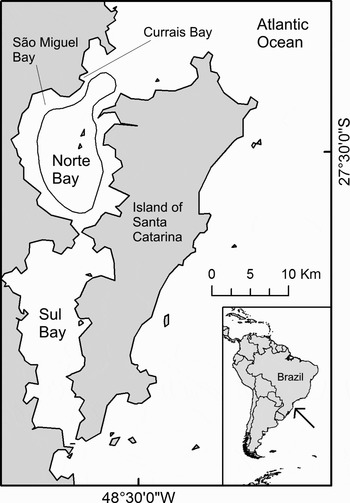
The predominant coastal marine habitats of south-eastern Brazil consist of bays and lagoons (Knoppers et al., Reference Knoppers, Ekau, Figueiredo, Soares-Gomes, Pereira and Soares-Gomes2002). The island of Santa Catarina is an important geographical feature forming two protected bays, Sul Bay and Norte Bay, which are located between the island and the mainland (Figure 1). Sul Bay is more elongated than Norte Bay, its depths are more heterogeneous, and its communication with the open sea is narrow at its southern extremity (Melo et al., Reference Melo, Martins and Franco1997). Norte Bay (27°30′S and 48°32′W), in contrast, is more uniform and shallow, with a wide (>5 km) communication with the open sea. The bays communicate with each other through a narrow and deep channel (21 m deep). Mean depth of Norte Bay is 3.5 m (DHN, 1977). Norte Bay's margins are composed of rocky shores, sandy beaches and mangrove forests. Its coastline is complex, with diverse small inlets (such as Currais and São Miguel bays), islands, submerged and apparent rocks. The land around Norte Bay is undergoing a steady process of urban encroachment. Organic pollution is intense near urban zones (Cerutti, Reference Cerutti1996).
Bays of the island of Santa Catarina, south-eastern Brazil. Black line shows pre-defined route frequently travelled in the study area in Norte Bay.

Sea surface temperature, water transparency and salinity among different sites inside Norte Bay are uniform (Cerutti, Reference Cerutti1996). Norte Bay is a coastal bay which is greatly influenced by the adjacent open seawater (Cerutti, Reference Cerutti1996). The bay undergoes a seasonal fluctuation in water temperature ranging from 15 to 29°C (Cerutti, Reference Cerutti1996). Based on the water temperature, two seasons occur in the bay: (1) a cold season from April to September, when temperatures are below the annual mean (25°C); and (2) a hot season from October to March, when temperatures are above the annual mean.
Data collection
The resident population of Guiana dolphins was studied from September 2000 to December 2005 from a 5-m sailboat with a 5-hp outboard motor. Surveys were made following a pre-defined route travelling counter-clockwise around the bay at a constant speed of 5 knots. Whenever possible, the sails were used as the propulsion force of the research vessel. When a group of dolphins was sighted, their geographical positions were recorded (GPS) at 5-minute intervals and the group was followed for as long as possible. The first year of study (2000) was excluded in order to avoid errors associated with the lack of experience of the observers.
Since we usually found groups of dolphins in the same areas, generally the whole bay was not covered during one day. To avoid any bias related to heterogeneous effort in different areas, we also searched for dolphins on alternative survey routes. For example, the eastern section of the bay was heavily sampled, even considering that the presence of the dolphins in this area was not probable. In the last year (2005), a second diesel-powered wooden boat navigated the entire route around the bay while the sailboat followed the same survey protocol as above. The observers aboard the second boat never found additional groups. Furthermore, after finishing the focal-group and moving to other locations, other groups were never encountered (see Daura-Jorge et al., Reference Daura-Jorge, Wedekin, Piacentini and Simões-Lopes2005 for a discussion about group dynamics of Norte Bay). A group was considered any aggregation of dolphins observed in apparent association and frequently, but not always, engaged in the same behaviour, such as feeding and travelling (adapted from Shane, Reference Shane, Leatherwood and Reeves1990).
Data analysis
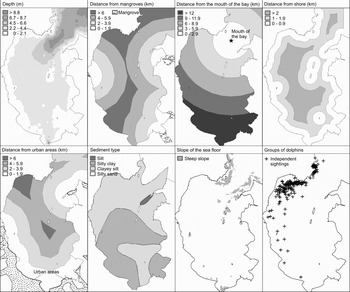
A geographical information system (GIS) was used to integrate seven variables of the habitat (Figure 2): depth, bottom sediment size, distance from mangroves, distance from shore, distance from the mouth of the bay, distance from urban areas and slope of the sea-floor. Each variable was reclassified into categories (e.g. within the depth variable the habitat was classified from 0.0 to 0.99 m, and so on).
Habitat variables (and respective types) in Norte Bay, south-eastern Brazil.

Bathymetry of the bay was obtained through the digitization of the Norte Bay Nautical chart (scale 1:100,000; nautical chart no. 1903; DHN, 1977). After each depth point was plotted, the inverse distance weighed (IDW) interpolation method was used to create a raster model of the bottom of the bay. Slope of the sea-floor was obtained from this model. Mangrove forests and urban coverage were identified by a geo-referenced Landsat image of the study area. The distances from habitat variables such as mangrove forests, mouth of the bay, urban areas and coastline were obtained after the creation of buffers around these features. Finally, variation in the bottom sediment size of the study area was obtained from Leal et al. (Reference Leal, Nunes, Oliveira, Oliveira, Gré and Bonetti-Filho1999), who classified the sediments based on the triangle of Shepard (Reference Shepard1954). The program ESRI Arcview 3.1 and the extension Spatial Analyst were used for all GIS operations.
A correlation analysis among the habitat variables was performed. One hundred points were randomly distributed in the study area and classified regarding each variable. The data were then standardized and compared two by two with Pearson correlations.
Independence between successive locations (absence of autocorrelation) is a premise of most methods used to assess home range and habitat preference (Neu et al., Reference Neu, Byers and Peek1974; Byers et al., Reference Byers, Steinhorst and Krausman1984; Swihart & Slade, Reference Swihart and Slade1985; Harris et al., Reference Harris, Cresswell, Forde, Trewhella, Woollard and Wray1990). The method we used, with geographical positions recorded at 5-minute intervals, produced highly autocorrelated data. To minimize this potential problem, the approach that time to independence may be regarded as the time necessary for an animal to transverse its home range was used (Swihart & Slade, Reference Swihart and Slade1985; Rooney et al., Reference Rooney, Wolfe and Hayden1998). The distance between the extreme points of the largest seasonal group home range of the species in Norte Bay (winter of 2002) was estimated to be 20 km (Wedekin et al., Reference Wedekin, Daura-Jorge, Piacentini and Simões-Lopes2007). Considering that the daily mean speed of dolphins in our study area was around 4 km/h (Daura-Jorge et al., Reference Daura-Jorge, Wedekin and Simões-Lopes2004), but dolphins can reach a travel speed of up to 23 km/h (Edwards & Schnell, Reference Edwards and Schnell2001a), a reasonable speed is 10 km/h. Based on the distribution of the dolphins and their rate of movements in Norte Bay (20 km divided by 10 km/h), a conservative time to independence was considered to be two hours. So we sub-sampled the observed groups eliminating all records between every 2-hour interval. Based on the high sociality bounds of the southernmost population of the Guiana dolphin (discussed in Daura-Jorge et al., Reference Daura-Jorge, Wedekin, Piacentini and Simões-Lopes2005) and the long life expectancy of the species (~30 years; Rosas et al., Reference Rosas, Barreto and Monteiro-Filho2003), we believe that few individuals accrued into our dataset during the data collection.
To assess sample size sufficiency for each year, the size of the minimum convex polygon (MCP) constructed with independent sightings of groups within a year was plotted against the successive number of geographical positions used (Stickel, Reference Stickel1954). The size of the distribution (MCP) ceases to increase (the curve reaches an asymptote) when an adequate sample size is obtained, or the addition of new dolphin sightings does not affect the size of the distribution. This procedure was done using the Arcview extension ‘Animal Movement Analyst Extension’ (Hooge & Eichenlaub, Reference Hooge and Eichenlaub1997).
Habitat preference here is defined as the disproportional use of a particular habitat type based on its availability in the study area (Neu et al., Reference Neu, Byers and Peek1974). We used two approaches to test habitat preference of the Guiana dolphin. Overall habitat preference was tested through the ‘Neu Method’ (Neu et al., Reference Neu, Byers and Peek1974; Byers et al., Reference Byers, Steinhorst and Krausman1984). This method was used to test the null hypothesis that the relative frequency of use of different habitat types (observed) was similar to the relative frequency of habitats available to the dolphins (expected) through a χ2 goodness-of-fit test. The χ2 tested all habitat classes simultaneously. If we reject the null hypothesis through the χ2-test, the use of habitat types will then be compared to the availability of each habitat class separately using a Bonferroni z-statistic. Bonferroni simultaneous confidence intervals were constructed for each habitat class of a variable following Byers et al. (Reference Byers, Steinhorst and Krausman1984). When the expected frequency of use of a habitat type did not fall within the confidence intervals, that habitat type was considered to be avoided or preferred by the dolphins. All sample size recommendations were used in the χ2-test (see Alldredge & Ratti, Reference Alldredge and Ratti1986), including using one or more expected observations in each habitat class, and at least 20% of all classes containing more than five expected observations.
Differences in spatial distribution among years were compared using 4 km2 grid cells that covered the area used by the dolphins in Norte Bay. To group similar years, the number of independent sightings of dolphins in each cell per year was used in a cluster analysis. Euclidean distance was used as a distance coefficient, and Unweighted Pair-Group Method using Arithmetic averages (UPGMA) was used to cluster the data.
A simple habitat preference index (HI) was used (adapted from Ingram & Rogan, Reference Ingram and Rogan2002) for among-years comparisons of habitat preference. The HI was calculated by dividing the relative frequency of use of each habitat class by the dolphins, by the relative frequency of availability of that habitat class. When the HI is lower than one, dolphins avoided that habitat class, and when HI was higher than one, dolphins preferred it.
For the visualization of differences in spatial distribution among years we used the independent observations and kernel density for estimation of the area used by the dolphins each year (fixed kernel 95%) and its respective core area (fixed kernel 50%) using the Animal Movement Arcview Extension (Hooge & Eichenlaub, Reference Hooge and Eichenlaub1997). The smoothing parameter was calculated through the ‘least square cross-validation’ procedure (Worton, Reference Worton1989).
RESULTS
Sample characteristics
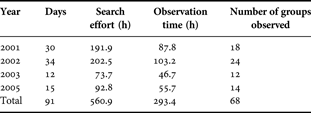
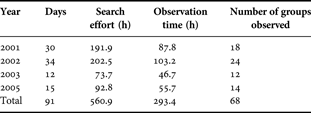
Due to the small sample size, the year 2004 was excluded from the among year comparisons. From 2001 to 2005, 91 surveys were conducted, and 68 groups of dolphins were observed. No groups were sighted in 23 surveys (25% of the total). A total of 561 hours on effort were spent in the field, of which 293 hours were of observation of dolphins (52.3%; Table 1). The average observation time per group was 4.25 hours (range = 1.75 to 8.08). The size of the distribution (through MCP) stabilized for all years indicating an adequate sample.
Sampling effort of the Guiana dolphin in different years in Norte Bay, south-eastern Brazil.
Habitat preference
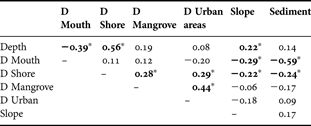
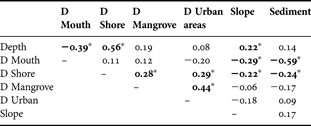
Although some correlations between habitat variables were significant, they were all weak (Table 2). The strongest correlations were between distance from the mouth of the bay and sediment size (negative), and between depth and distance from shore (positive).
Correlation coefficient between habitat variables in Norte Bay. Significant Pearson correlations are in bold and marked with an * (P < 0.05).
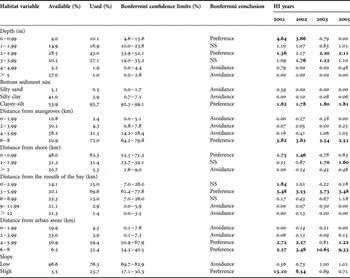
Guiana dolphins did not use all habitat types equally (Table 3). All χ2-tests showed disproportional use of different habitat classes by the dolphins in Norte Bay: depth (χ2 = 96.41, df = 5, P < 0.001); bottom sediment size (χ2 = 145.13, df = 2, P < 0.001); distance from mangroves (χ2 = 332.26, df = 3, P < 0.001); distance from shore (χ2 = 33.80, df = 2, P < 0.001); distance from the mouth of the bay (χ2 = 331.69, df = 4, P < 0.001); distance from urban areas (χ2 = 383.90, df = 3, P < 0.001); and slope of the sea-floor (χ2 = 248.33, df = 1, P < 0.001). The results obtained through the method by Neu et al. (Reference Neu, Byers and Peek1974) were consistent with the habitat index (HI).
Availability and use of habitats by the Guiana dolphin in Norte Bay, and habitat index (HI) for different years of study. HI in bold indicate preference, and italics indicate avoidance. NS, not significant.

Guiana dolphins preferred steeper sloping areas even though this class of habitat was not common in the study area. The shallow waters of Norte Bay (<3 m deep) were also preferred by the dolphins while the deeper regions of Norte Bay (>4 m deep) were used less intensively by the dolphins than expected. The sediments of the bottom of Norte Bay are predominantly silty clay and clayey-silt. Dolphins more intensively used the clayey-silt sediments, while bottoms with silty sand and silty clay were used less. Pure silt bottoms comprised less than 1% of the study area and were thus excluded from the analysis. The areas surrounding the mouth of the bay were preferred by the dolphins, but the channels and areas further from the mouth were not preferred. The waters closer to mangroves and urban areas also were rarely used by the dolphins, while the waters closer to the coast (<2 km) were used more frequently.
Among years comparison
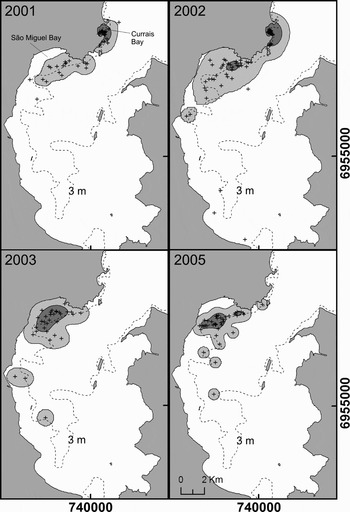
From 2001 to 2005 (excluding 2004), there was a shift in the patterns of spatial distribution and habitat use by the dolphins (Figure 3). Two groups of years had similar spatial use patterns as evidenced by the cluster analysis (Cophenetic coefficient = 0.995): (a) 2001 and 2002; and (b) 2003 and 2005. Accordingly, HI for years with similar spatial use patterns were alike, following the same general pattern of habitat preference.
Independent sightings (crosses) of the Guiana dolphin in Norte Bay and kernel 50% (dark grey) and 95% (light grey) among years. UTM coordinates.
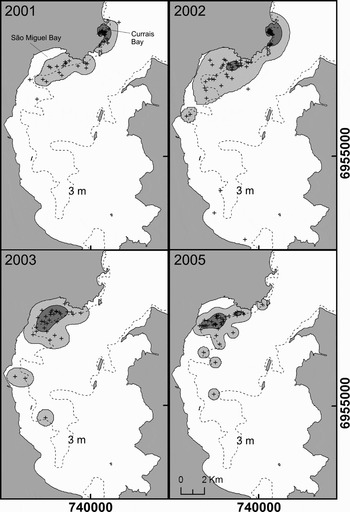
In the years 2001 and 2002, dolphins concentrated their activities in a small inlet (Currais Bay) near the mouth of Norte Bay. Dolphins more intensively used areas that were closer to shore and had steeper slopes, like those habitat characteristics of Currais Bay. The dolphins often were observed moving during the day from Currais Bay to more internal waters of another shallow inlet (São Miguel Bay) inside Norte Bay. In later years (2003–2005), dolphins were observed not using Currais Bay anymore, concentrating their activities in São Miguel Bay. Areas further from the coast and from areas of urban encroachment (São Miguel Bay) were preferred in the last years.
DISCUSSION
Habitat preference
The resident population of dolphins in Norte Bay spend more than 80% of their time feeding or foraging (Daura-Jorge et al., Reference Daura-Jorge, Wedekin, Piacentini and Simões-Lopes2005). For the bottlenose dolphin in coastal waters, foraging appears to be the main force that drives habitat preference in certain areas (Hastie et al., Reference Hastie, Wilson, Wilson, Parsons and Thompson2004). Thus, interpretation of species–habitat relationships in most coastal dolphin species is linked to foraging and the main mechanism that governs spatial use is prey.
In this study, it was shown that at least seven habitat variables were linked to Guiana dolphin distribution in Norte Bay. The ranking in habitat selection by Guiana dolphins was, in order of preference: (1) a steeply sloping sea-floor; (2) areas further from urban areas; (3) areas further from mangroves; (4) areas near the mouth of the bay; (5) shallow waters; (6) clayey-silt sediments; and (7) areas close to shore.
Many other species of small cetaceans have been observed to concentrate in steeper sloping areas (Selzer & Payne, Reference Selzer and Payne1988; Baumgartner, Reference Baumgartner1997; Ingram & Rogan, Reference Ingram and Rogan2002; Hastie et al., Reference Hastie, Wilson, Wilson, Parsons and Thompson2004). Steeper sloping areas have been cited in other studies as important Guiana dolphin habitats along the southern part of its distribution (Cremer, Reference Cremer2000; Bonin, Reference Bonin2001). On the eastern coast of Brazil, however, Guiana dolphins have been observed to use flatter areas (Rossi-Santos, Reference Rossi-Santos2006).
In coastal waters, the variation in depth is not as great as it is on the continental slope, where many cetacean prey aggregate (Selzer & Payne, Reference Selzer and Payne1988; Baumgartner, Reference Baumgartner1997). At least three explanations have been proposed as to why cetaceans aggregate in steep sloping coastal waters (see Wilson et al., Reference Wilson, Thompson and Hammond1997; Hastie et al., Reference Hastie, Wilson and Thompson2003, Reference Hastie, Wilson, Wilson, Parsons and Thompson2004): (1) steeper sloping bottoms increase aggregation or concentrate prey; (2) increased aggregation of larger prey; and (3) better conditions to capture prey (such as barriers to corral prey).
Two types of steeper sloping bottoms exist in Norte Bay. Steep margins (from zero to 4–5 m deep) were used by Guiana dolphins to herd fish schools while feeding cooperatively (L.L. Wedekin and F.G. Daura-Jorge, personal observations). These steep margins are found from Currais Bay to the northern limit of São Miguel Bay. The other type of steeply sloping bottom is the mouth of the bay and the southern channel, which has a depth gradient of approximately 10 m, which were not used by the dolphins.
The mouths of estuaries have been described as important core habitats of the bottlenose dolphins (Ballance, Reference Ballance1992; Wilson et al., Reference Wilson, Thompson and Hammond1997; Allen et al., Reference Allen, Read, Gaudet and Sayigh2001; Ingram & Rogan, Reference Ingram and Rogan2002). Along the eastern coast of Brazil, the mouth of the Caravelas River estuary has been described as a core area for the Guiana dolphin (Rossi-Santos, Reference Rossi-Santos2006). In Norte Bay, Guiana dolphins did not use the deeper waters of the channel, where currents were stronger (Melo et al., Reference Melo, Martins and Franco1997) and sediments were larger (with a higher proportion of sand). Dolphins preferred the areas that surrounded the mouth of the bay. The large channel and small tidal variation in the area preclude the formation of tidal fronts, which may promote the concentration of dolphin's prey (Mendes et al., Reference Mendes, Turrell, Lütkebohle and Thompson2002). Thus, the probable mechanism promoting the intense use of this area by the dolphins is habitat complexity, favouring certain feeding strategies.
Curiously, areas nearer to mangroves were used less intensively by the dolphins in Norte Bay. Mangroves are nursery areas for fish and other marine organisms, and they improve marine productivity of coastal areas through the input of organic material in the water (Sasekumar et al., Reference Sasekumar, Chong, Leh and d'Cruz1992). In Babitonga Bay, south-eastern Brazil, Guiana dolphins preferred areas near to mangroves, probably taking advantage of the marine productivity of these areas (Cremer, Reference Cremer2000). The Norte Bay may be enriched by the mangrove organic output, but the areas adjacent to the mangrove are flat and probably do not represent the best conditions for foraging dolphins. In Florida, bottlenose dolphins do not use seagrass habitats, even though these are areas where fish are most abundant. Instead, dolphins choose areas where foraging conditions are better and where prey is larger (Allen et al., Reference Allen, Read, Gaudet and Sayigh2001). Another possibility is that the areas near mangroves are also close to urban areas (positive correlation), both observed to be used less intensively by the dolphins.
Larger sediments, with a sand component, which were observed and correlated with the deeper channel of the mouth of the bay, were rarely used by the dolphins. Guiana dolphins used the areas with finer sediments, especially clayey-silt regions. Stagnant waters with silty clay sediments, near mangroves in the inner regions of the bay, were also not used. In Paraty Bay a similar pattern was found, although the method of sediment classification was not the same as used here (see Leal et al., Reference Leal, Nunes, Oliveira, Oliveira, Gré and Bonetti-Filho1999).
Studies about habitat use of Guiana dolphin indicate that the species uses shallow near-shore waters more intensively than other deeper areas (Cremer, Reference Cremer2000; Bonin, Reference Bonin2001; Di Beneditto et al., Reference Di Beneditto, Ramos and Lima2001; Edwards & Schnell, Reference Edwards and Schnell2001b; Lodi, Reference Lodi2003; Rossi-Santos, Reference Rossi-Santos2006). Since depth and distance from shore are usually correlated, it is difficult to determine what habitat characteristic is more important in shaping the distribution of the Guiana dolphin. The species occurs in shallow waters far from the coast (more than 70 km), in the northern Abrolhos Bank region, eastern Brazil (Borobia et al., Reference Borobia, Siciliano, Lodi and Hoek1991; Rossi-Santos et al., Reference Rossi-Santos, Wedekin and Sousa-Lima2006). This suggests that the limiting factor of its offshore distribution is depth. This pattern of habitat use is similar to that observed for the Indo-Pacific humpback dolphin (Karczmarski et al., Reference Karczmarski, Cockcroft and McLachlan2000; Atkins et al., Reference Atkins, Pillay and Peddemors2004; Parra et al., Reference Parra, Schick and Corkeron2006), which inhabits the coastal waters of the western Pacific and Indian Oceans. The Guiana dolphin, despite its wide latitudinal distribution in the western Atlantic Ocean, may be considered a habitat specialist. The ecological niche of the species may be defined by a narrow strip of coastal shallow waters (<30 m) bordering the coastline. Since the coastal zone is subject to intense human activity and impact, the habitat specificity of this species makes it particularly vulnerable to human threats.
Several habitat alterations, such as organic/chemical pollution of the water and embankment/land reclamation, may result from urban encroachment. Organic pollution from human sewage was observed near urban areas of Norte Bay (Cerutti, Reference Cerutti1996). Furthermore, in the last 50 years, two large bridges were built in the channel between Sul and Norte Bays, as well as four large embankments and other several small physical alterations. Dolphins rarely used the southern part of Norte Bay where all these alteration took place, possibly corresponding to substantial habitat loss/degradation for the species. Azevedo et al. (Reference Azevedo, Oliveira, Viana and Van Sluys2007) also suggested that degraded areas were not used by Guiana dolphins in the Guanabara Bay (south-eastern Brazil). Although data of historical distribution of the dolphins in Norte Bay are not available to support this hypothesis, the strong effect of distance from urban areas on dolphins' distribution suggests that dolphins may be severely affected by human encroachment and its negative consequences to the marine environment.
Among years comparison
Two inlets were preferred by the dolphins in different years: Currais Bay was used more intensively in the first years of this study, and in previous years (Flores, Reference Flores1999). Habitat characteristics that were preferred in Currais Bay were the near-shore shallow waters, and steeply sloping areas. Currais Bay consists of a small and protected basin with stagnant waters facing towards the mouth of Norte Bay (DHN, 1977; Melo et al., Reference Melo, Martins and Franco1997). The shoreline slopes abruptly to 5 m of depth. Systematic trawling in the mouth of Norte Bay (adjacent to Currais Bay) revealed the highest abundance and biomass of the cutlass fish (Trichiurus lepturus), the most important and larger prey of the Guiana dolphin in Norte Bay (Daura-Jorge, Reference Daura-Jorge2007; Daura-Jorge et al., in press). The cutlass fish can reach more than 2 m in length and inhabits the water column (Szpilman, Reference Szpilman2000). Dolphins were possibly pushing fish shoals into this inlet where they could use the steep slopes of the sea-floor and the shoreline as barriers to aid catching fish (L.L. Wedekin and F.G. Daura-Jorge, personal observations).
In recent years, dolphins more intensively used the flatter and wider waters of São Miguel Bay. Dolphins used waters further from the coast and from the mouth of Norte Bay. Trawling surveys in São Miguel Bay revealed a higher abundance of small bottom-dwelling fish (e.g. Scianidae) and small shoaling fish from the water column (e.g. Engraulidae), all of which are also important prey items of the dolphins in the area (Daura-Jorge, Reference Daura-Jorge2007; Daura-Jorge et al., in press). Recently, the cutlass fish fisheries collapsed in our study area resulting in the decrease in abundance of this important prey for the dolphins (Daura-Jorge et al., Reference Daura-Jorge, Wedekin and Hanazaki2007). The collapse of the cutlass fish populations in the study area is consistent with the switch in foraging strategy and habitat use of the dolphins. Different habitats may favour different assemblages of prey and different foraging strategies by the dolphins. Furthermore, a major factor behind the year-effects on the habitat preference of many animal groups is the fluctuations in prey base (Löhmus, Reference Löhmus2003). Thus, habitat use and preference shifts were likely driven by changes in major prey abundance.
Although the prey hypothesis is supported by the existing knowledge of our study area, we cannot rule out that the changes in spatial distribution that we had observed were human-induced. The response of a species to human disturbance depends on the trade-off between the available resources of an area (e.g. food) and the intensity of disturbance (Gill & Sutherland, Reference Gill, Sutherland, Gosling and Sutherland2000). Responses of wildlife to disturbance vary, but avoidance of disturbed areas does occur (Clemmons & Buchholz, Reference Clemmons, Buchholz, Clemmons and Buchholz1997). In Babitonga Bay, a similar change in spatial distribution was reported for this species (Cremer et al., Reference Cremer, Hardt, Tonello, Simões-Lopes and Pires2004). It was suggested that these changes were due to the construction of a ship harbour, which produced intense noise near an area heavily used by the dolphins.
In Norte Bay, the resident population has been subjected to approaches by tourist vessels of various sizes and types. In the years before this study was conducted, this type of tourism has undergone substantial growth (in litt., Administration of the Fortress of Anhatomirim). The population of dolphins coexisted in Currais Bay with intense boat traffic during the first three years of our study (2000 to 2002), including the year where the area received more visitors in the last decade (2001). Likely, the dolphin's tolerance of the boat traffic was probably influenced by the abundance of their prey in this inlet. Although we strongly encourage the regulation of tourism, our data suggest that prey shifts (possibly caused by overfishing) are the main factors contributing to changes in spatial distribution from 2001 to 2005. Human-related habitat alterations throughout the range of this species probably affect dolphins' ecology in many ways and, thus, must be evaluated and mitigated to conserve its critical habitats.
ACKNOWLEDGEMENTS
This article was part of a masters degree thesis in zoology at Universidade Federal do Paraná, Brazil. We would like to thank all the people who helped in the surveys to collect data, especially Alexandre Paro, Luis Augusto Costa, Pedro Volkmer de Castilho, Roberto Fusco Costa and Vitor Piacentini. The comments by André Barreto, Emygdio Monteiro-Filho, Holly Edwards and two anonymous referees greatly improved the manuscript. The Conselho Nacional para o Desenvolvimento Científico e Tecnológico (CNPq) provided two master scholarship grants to L.L.W. and F.G.D.-J., and grant CNPq-PQ 304698/2006-7 to P.C.S.-L. The Fundação para o Apoio à Pesquisa Científica e Tecnológica de Santa Catarina (Funcitec), Socioambiental Consultores Associados Ltda. and Mercury Motores do Brasil financially supported this project.