Introduction
Giant reed (Arundo donax L.), also called Spanish cane, wild cane, or giant cane, is a tall, perennial rhizomatous plant with bamboo-like culms. In recent years, A. donax has been considered as a potential bioenergy feedstock for biological fermentation (biogas and bioethanol) or direct combustion (Corno et al. Reference Corno, Pilu and Adani2014), in the interest of decreasing the use of fossil fuel–based energy sources. Arundo donax has high productivity with low to moderate nutrient, water, and input requirements compared with traditional energy crops (Corno et al. Reference Corno, Pilu, Tambone, Scaglia and Adani2015). It has comparable or greater yields for bioenergy than other similar energy crops such as miscanthus (Miscanthus spp.) or miscane (Saccharum hybrid × Miscanthus spp.) and is a better option than the former species for the production of particle board, paper, and xylo-oligosaccharides (Burner et al. Reference Burner, Hale, Carver, Pote and Fritschi2015; Ge et al. Reference Ge, Xu, Vasco-Correa and Li2016). The combustion of this species also has potential for electricity generation, although fuel cost subsidies would be necessary to justify its use (Melane et al. Reference Melane, Ham and Meincken2017).
Management Implications
Arundo donax (giant reed) produces stems and leaves with good qualities for use as a feedstock for the bioenergy industry. However, this species is also considered an invasive plant that could threaten wildlands and natural areas if it escapes planted areas. Control and eradication strategies are needed to prevent A. donax spread beyond cultivation, particularly into surrounding natural areas. In addition, control strategies are also needed to reduce the number of volunteer A. donax in the following crop as quickly as possible to decrease the risk of dispersion through subsequent crops of other species. In this study, we tested the efficacy of nine different strategies to control this species. We found that the use of opaque tarps, glyphosate applications, or the combination of tarp + glyphosate were the most effective strategies to control A. donax within a single year. However, glyphosate application timing was important to maximize control. When glyphosate was applied later than September (October 6), it provided a lower percentage of control than when the same glyphosate dose was divided into two or three applications over the growing season, probably because larger plants are more difficult to kill and/or plants had already started dormancy onset. However, a very early fall single application (in September) improved A. donax control and was similar to the split applications. To maximize control with the use of tarps, tarps resistant to tears and water and solar damage are desirable, because surviving plants were found where tarp tears occurred. Rhizome digging with soil tillage (sweep plow) was not as effective as other strategies, but it should be considered when the use of tarps or glyphosate is not possible. Stem cutting alone in spring did not provide any control of volunteer A. donax plants.
Limited genetic variability of A. donax (Ahmad et al. Reference Ahmad, Liow, Spencer and Jasieniuk2008; Canavan et al. Reference Canavan, Paterson and Hill2017; Malone et al. Reference Malone, Virtue, Williams and Preston2017; Mariani et al. Reference Mariani, Cabrini, Danin, Piffanelli, Fricano, Gomarasca, Dicandilo, Grassi and Soave2010) and the lack of documented pollen and seed production (Balogh et al. Reference Balogh, Herr, Czakó and Márton2012; Lewandowski et al. Reference Lewandowski, Scurlock, Lindvall and Christou2003) indicate that it predominantly reproduces and spreads vegetatively (Saltonstall et al. Reference Saltonstall, Lambert and Meyerson2010). Arundo donax has high photosynthetic capacity, when compared with C4 bioenergy grasses, despite being a C3 species (Rossa et al. Reference Rossa, Tuffers, Naidoo and von Willert1998; Webster et al. Reference Webster, Driever, Kromdijk, McGrath, Leakey, Siebke, Demetriades-Shah, Bonnage, Peloe, Lawson and Long2016). The stomatal control of A. donax has been shown to be responsible for the high water-use efficiency of this species (Haworth et al. Reference Haworth, Marino, Cosentino, Brunetti, De Carlo, Avola, Riggi, Loreto and Centritto2018). High yields (around 12000 kg dry matter ha−1) have been found in semiarid environments with water stress (irrigation only during the year of establishment) and no fertilizer inputs (Cosentino et al. Reference Cosentino, Scordia, Sanzone, Testa and Copani2014). Arundo donax is adapted to broad environmental conditions (CABI 2018; Ge et al. Reference Ge, Xu, Vasco-Correa and Li2016), including land not suitable for food production, such as marginal fields and saline soils (up to 15 g L−1), where an A. donax crop might improve farm income. The establishment of A. donax crops in marginal fields could be a solution to the controversy of future food security, in relation to the use of highly productive arable lands for energy crops instead of food crops (Bonfante et al. Reference Bonfante, Impagliazzo, Fiorentino, Langella, Mori and Fagnano2017; Nackley and Kim Reference Nackley and Kim2015).
Some other characteristics of A. donax that might make it attractive to grow as a crop are: (1) A. donax, as well as other grass energy crops, captures more carbon (Cattaneo et al. Reference Cattaneo, Barbanti, Gioacchini, Ciavatta and Marzadori2014a) than woody crops established in the same locations, therefore providing further reductions in greenhouse gas emissions (Nocentini and Monti Reference Nocentini and Monti2017); (2) A. donax also increases soil organic carbon, soil nitrogen, microbial biomass, and earthworm activity and reduces soil erosion compared with annual energy crops (Cattaneo et al. Reference Cattaneo, Di Gennaro, Barbanti, Giovannini, Labra, Moreno, Benitez and Marzadori2014b; Chimento et al. Reference Chimento, Almagro and Amaducci2016; Emmerling et al. Reference Emmerling, Schmidt, Ruf, von Francken-Welz and Thielen2017; Fagnano et al. Reference Fagnano, Impagliazzo, Mori and Fiorentino2015); and (3) A. donax is also useful for wastewater treatment and phytomanagement of contaminated soils (Ahmed Reference Ahmed2016; Barbosa et al. Reference Barbosa, Boléo, Sidella, Costa, Duarte, Mendes, Cosentino and Fernando2015; Fiorentino et al. Reference Fiorentino, Ventorino, Rocco, Cenvinzo, Agrelli, Gioia, Di Mola, Adamo, Pepe and Fagnano2017; Kausar et al. Reference Kausar, Mahmood, Raja, Khan, Sultan, Gilani and Shujaat2012; Nsanganwimana et al. Reference Nsanganwimana, Marchand, Douay and Mench2014) and as an algicide (Hong et al. Reference Hong, Hu, Sakoda and Sagehashi2010; Patiño et al. Reference Patiño, Rashel, Rubio and Longing2018). In addition, A. donax biomass might be used in container construction and paper production (Abrantes et al. Reference Abrantes, Amaral, Costa, Shatalov and Duarte2007; Garcia-Ortuño et al. Reference Garcia-Ortuño, Carbonell-Barrachina, Andreu-Rodriguez, Ferrandez-Garcia, Calin-Sanchez, Ferrandez-Villena and Ferrandez-Garcia2013), and its presence might provide habitat for other species, such as the white-collared seedeater (Sporophila torqueola Bonaparte) (Woodin et al. Reference Woodin, Skoruppa, Blacklock and Hickman1999).
Some of the traits that A. donax exhibits that make it ideal as a bioenergy crop, including its rapid growth, high productivity, low management input requirements, and resistance to biotic and abiotic stresses, are also commonly associated with invasive plants (Low et al. Reference Low, Booth and Sheppard2011; Raghu et al. Reference Raghu, Anderson, Daehler, Davis, Wiedenmann, Simberloff and Mack2006). Invasive success of grasses is due to their propensity toward vegetative reproduction, which helps in the first stages of invasion because there is no necessity for outbreeding (Barrett et al. Reference Barrett, Colautti and Eckert2008). Moreover, its ability to respond to different environmental conditions, together with low genetic and phenotypic variability, lends A. donax a high environmental tolerance (Quinn and Holt Reference Quinn and Holt2008).
Arundo donax is included as one of the world’s worst alien species in the Global Invasive Species Database (International Union for Conservation of Nature 2011), and it is listed as a noxious weed in California, Colorado, Nebraska, Nevada, and Texas in the United States (Morgan and Sytsma Reference Morgan and Sytsma2015). Arundo donax is associated with the reduction of riparian native species (Cushman and Gaffney Reference Cushman and Gaffney2010; Herrera and Dudley Reference Herrera and Dudley2003) and is fire adapted, creating an invasive plant–fire regime cycle that can threaten riparian ecosystems (Coffman et al. Reference Coffman, Ambrose and Rundel2010). However, the invasive ability of this species depends highly on riparian corridors, fires, and human transportation for initial introduction (Coffman et al. Reference Coffman, Ambrose and Rundel2010; Mann et al. Reference Mann, Kyser, Barney and DiTomaso2013a). Therefore, it could be limited, if prevention steps were to be enacted: i.e., cultivation away from water streams or wildlife-protected areas and limited to human-dominated landscapes, where it is well adapted (Malone et al. Reference Malone, Virtue, Williams and Preston2017; Saltonstall et al. Reference Saltonstall, Lambert and Meyerson2010). The spread beyond the margins of a field is attributed to rhizomatous growth, dispersal of rhizome segments, or layering (formation of adventitious roots from mature stem tips or nodes) (Balogh et al. Reference Balogh, Herr, Czakó and Márton2012; Haddadchi et al. Reference Haddadchi, Gross and Fatemi2013; Mann et al. Reference Mann, Kyser, Barney and DiTomaso2013a).
Although prevention is the most effective and least expensive approach, there is a need to develop A. donax management strategies within the context of bioenergy production. Control and, ultimately, eradication of A. donax might be difficult because of its invasive condition as a nonnative species in North America (Myers et al. Reference Myers, Savoie and van Randen1998). Anderson et al. (Reference Anderson, Voigt, Bollero and Hager2011) found that eradication of Miscanthus × giganteus after its crop termination required at least two growing seasons. Several studies have been conducted to evaluate A. donax management options. Insects, such as the midge Lasioptera donacis Coutin and the wasp Tetramesa romana Walker can reduce A. donax populations (Goolsby and Moran Reference Goolsby and Moran2009; Goolsby et al. Reference Goolsby, Vacek, Salinas, Racelis, Moran and Kirk2017; Moore et al. Reference Moore, Watts and Goolsby2010). Jiménez-Ruiz and Santín-Montanyá (Reference Jiménez-Ruiz and Santín-Montanyá2016) found that the use of opaque tarps during the period of rhizome growth over two growing seasons can control this species in riparian areas of Spain. Physical control methods consist of destroying the tissues or depleting the reserves of plants by digging, cutting, pulling, and mowing (Enloe and Loewenstein Reference Enloe and Loewenstein2015). Lowrey and Watson (Reference Lowrey and Watson2004) found that A. donax can be controlled by excavating the entire plant. Several studies have been conducted on chemical control of A. donax. Spencer et al. (Reference Spencer, Tan, Liow, Ksander, Whitehand, Weaver, Olson and Newhouser2008) reported that a single late-season foliar application of glyphosate at concentrations of 3% or 5% was the most effective and consistent treatment for controlling A. donax in California. In areas where foliar applications are risky or restricted, injections of glyphosate solutions directly into A. donax stems (5 ml stem−1) reduced the number of live stems by 80% at 1 yr after application (Spencer Reference Spencer2014). Santín-Montanyá et al. (Reference Santín-Montanyá, Jiménez, Ocaña and Sánchez2013) found that after initial cutting, the use of glyphosate and profoxydim provided 90% and 50% control of A. donax, respectively. Other herbicides such as triclopyr, asulam, imazapyr, trifloxysulfuron, azimsulfuron, cyhalofop-butyl, and penoxsulam did not provide effective control (Odero and Gilbert Reference Odero and Gilbert2012; Santín-Montanyá et al. Reference Santín-Montanyá, Jiménez, Ocaña and Sánchez2013; Spencer Reference Spencer2014; Spencer et al. Reference Spencer, Tan, Liow, Ksander and Whitehand2009). Other practices, such as defoliation and leaf damage, have also been evaluated but were not found to be effective for controlling this species (Spencer Reference Spencer2012).
The objective of this study was to evaluate the efficacy of nine strategies to eradicate A. donax as soon as possible after the termination of its production as a potential bioenergy crop in northeastern Oregon. In recent years, an experimental A. donax crop was shown to be an agronomically viable option as a potential biomass source for the generation of electricity in the Columbia Basin region of Oregon (Bechtoldt et al. Reference Bechtoldt, Horneck and Wysocki2014). The production termination in the experimental A. donax field was performed with tillage using a sweep plow, which resulted in an incomplete kill and regrowth. Therefore, the control strategies were implemented on volunteer A. donax that survived that initial control strategy.
Materials and Methods
Site Description
The study was conducted during two growing seasons (2016 to 2018) at the Hermiston Agricultural Research and Extension Center, located 1.6 km south of Hermiston, OR (45.8293°N, 119.2904°W, at 160-m elevation) in a 1.0-ha area within a 1.6-ha field that previously was an A. donax crop. The crop was established in a pivot-irrigated field in 2011 and maintained in production until 2015. The soil is an Adkins fine sandy loam (coarse-loamy, mixed, superactive, mesic Xeric Haplocalcids), with a gravelly substratum, 0% to 5% slope, 6.1 to 6.5 pH, and 1% to 2% organic matter in the surface horizon. Mean annual precipitation and temperature are 260 mm (250 and 278 mm in 2016 and 2017, respectively) and 11.5 C (11.9 and 10.5 C in 2016 and 2017, respectively). Arundo donax plants were established from rhizomes collected near the Santa Ana River (Riverside, CA) and transplanted in July 2011 in a 90 cm by 90 cm grid.
Control Strategies and Experimental Design
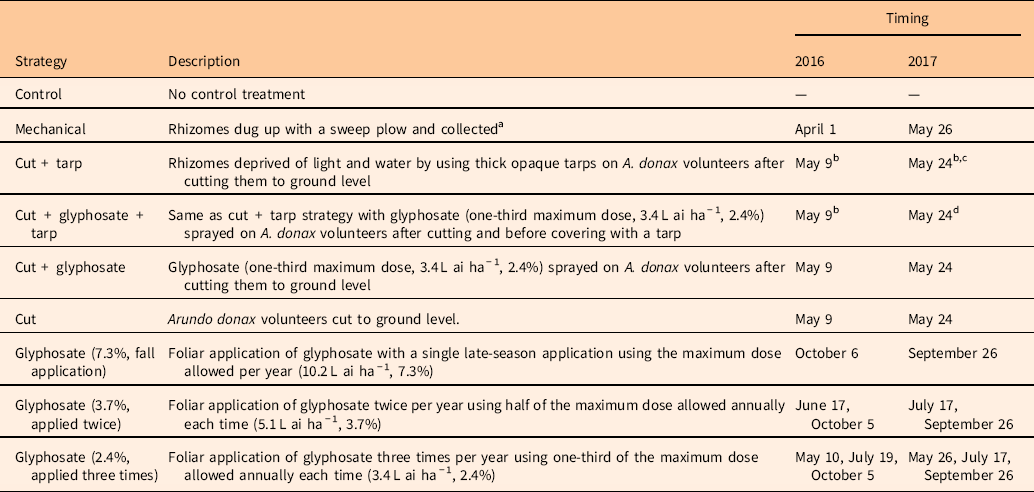
The last harvest of the A. donax field was in February 2015. After harvest, the field was tilled with a sweep plow to bring the rhizomes to the surface to desiccate them. The control strategies of this study were conducted on volunteer A. donax that had survived the mechanical operation conducted to terminate the crop, and consequently, the plants had already suffered some level of stress in 2015. Nine control strategies were evaluated in both years. The strategies included mechanical, physical, and chemical practices, either alone or in combination (Table 1). The mechanical practices consisted of digging rhizomes with a Noble sweep plow (Noble Equipment Ltd, Box 780, Nobleford, AB T0L1S0, Canada) (30-cm deep) in both years and after rhizome collection and destruction in 2016. Mechanical practices also consisted of cutting plants to ground level with a weed trimmer (John Deere 30cc, two-stroke engine, with a polycut mowing head). The physical practices were based on the use of thick opaque tarps (Hygrade Blue Poly 5-mm tarp) covering the entire plot after plants were cut to ground level. Tarps were fastened to the ground with tent pegs, and their edges were buried with soil in the first growing season. Tarps were left on plots 18 wk in 2016 and 16 wk in 2017 until plant survival evaluation (end of summer). The chemical control practices consisted of the use of glyphosate (Gly Star® Original, Albaugh, 1525 NE 36th Street, Ankeny, IA 50021) at different doses and application times: maximum dose applied once per year (10.2 L ai ha−1, 7.3% v/v), half the maximum dose applied twice (5.1 L ai ha−1, 3.7% v/v), and one-third the maximum dose applied on three dates (3.4 L ai ha−1, 2.4% v/v) (Table 1). Glyphosate was applied using a CO2-operated backpack sprayer (8002VS TeeJet® nozzles, 50-mesh screens), with a 2.4-m (in 2016) and 2.75-m (in 2017) boom, delivering 140 L ha−1 at 441 kPa of pressure. One untreated plot was included per replication to compare the effectiveness of the control practices and to detect natural mortality. The plots were not irrigated. The average plant height at the different chemical treatments was 1.52 m, 0.91 m, and 0.31 m for the single fall application, the first application when glyphosate was applied twice (3.7%), and the first application when glyphosate was applied three times (2.4%), respectively, for both years. The average plant height at the second application when glyphosate was applied twice (3.7%) and at the second and third applications when glyphosate was applied three times (2.4%) was lower than 0.30 m for those plants that survived the first application in those control strategies for both years.
Control practices performed on Arundo donax in Hermiston, OR, from 2016 to 2018.

a Collection of rhizomes was performed only in 2016.
b The tarp was placed 2 d after cutting.
c A mowing operation was performed 2 d after cutting (and before tarps were placed) with a Woods Brush Bull Extreme mower BB48 to remove a tumble mustard (Sisymbrium altissimum L.) infestation.
d The tarp was placed 15 d after cutting.
The experimental design was a randomized complete block design with three replications in 2016 and six replications in 2017. In the first growing season (2016 to 2017), the plot size was 12.2 m by 30.5 m. In the second growing season (2017 to 2018), the plots were smaller (3.05 m by 12.2 m) than in the previous season, because they were established in the control plots from 2016, where plants were left untreated, and in the plots with the cut treatment (Table 1), also from 2016, where plants had not been affected by the treatment.
Data Sampling and Statistical Analysis
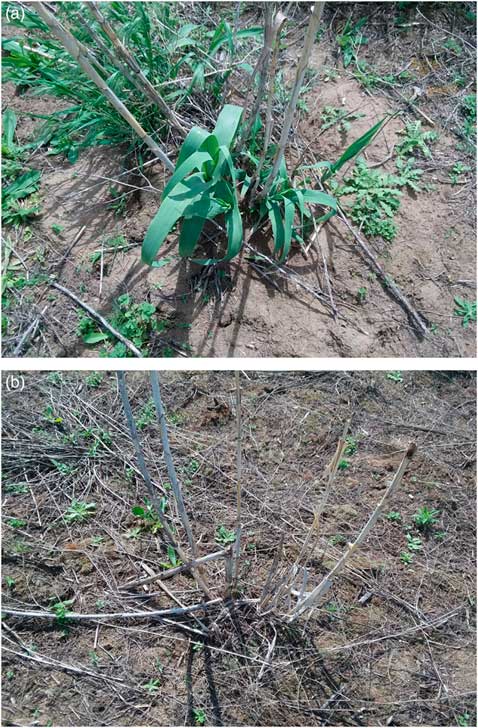
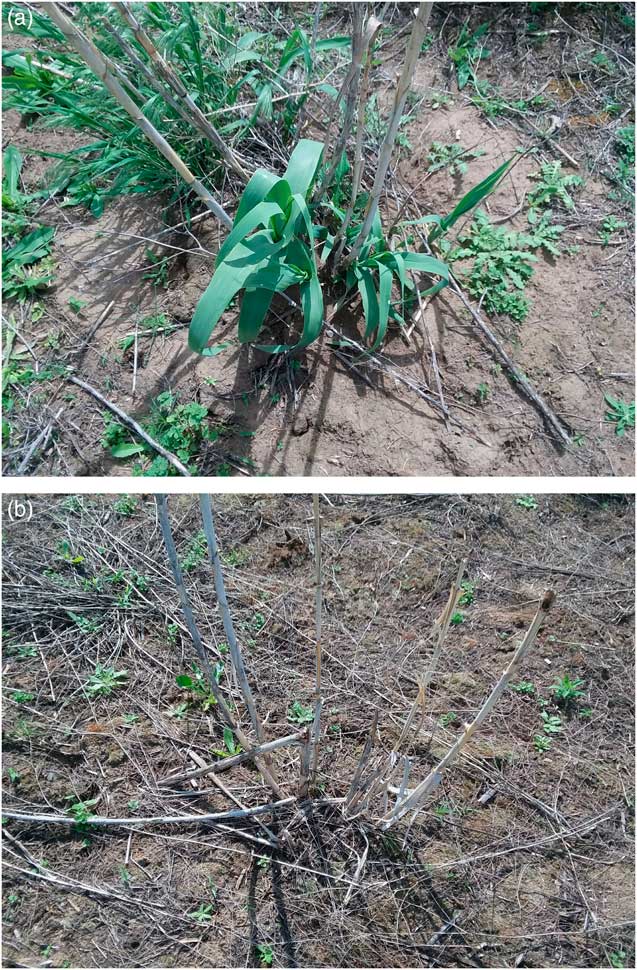
Volunteer A. donax were counted in each plot to assess the initial population before conducting any control treatment. This initial sampling occurred on April 27, 2016 (except for the mechanical treatment that was carried out on April 1) and on May 3, 2017. Living volunteers were counted in each plot in early fall (September 22, 2016, and October 26, 2017) and the following spring (May 3, 2017, and May 8, 2018) to evaluate treatment efficacy before and after winter kill. Volunteers were considered to be alive when greenness in leaves and/or stems was present. A group of leaves or stems that clearly belonged to a plant, normally at the base of A. donax carcasses, was counted as a volunteer (Figure 1A).
(A) Living and (B) dead volunteer Arundo donax.
Treatment efficacy was evaluated by comparing the mean difference between initial (spring sampling before treatments) and final (spring sampling after treatments) numbers of volunteer A. donax plants in each growing season and control strategy, using paired data tests (significance at P < 0.05). A paired t-test was used in the first growing season because of the normality of the data, and a Wilcoxon signed-rank test was used in the second growing season because of the nonnormality of the data. To determine differences in treatment efficacy, a generalized mixed model was fit to the experimental data with a Poisson distribution using the ‘lme4’ package (Bates et al. Reference Bates, Maechler, Bolker and Walker2015) in R software (R Core Team Reference Core Team2016). The number of surviving volunteers the following spring was the response variable, the treatment was a fixed effect, and replication was included as a fixed factor in the first year and a random effect in the second year. Analyses were performed by year due to the different number of replications and plot sizes each year. The offset function was included to compensate for different initial number of volunteer A. donax (starting point) and to account for overdispersion. In the second growing season, control strategies, including glyphosate at 3.7% applied twice and glyphosate at 2.4% applied three times, were not included in the generalized mixed model due to the total control from those strategies. A post hoc Tukey test (P < 0.05) was conducted using the ‘lsmeans’ package of R to determine differences between control strategies (Lenth Reference Lenth2016).
Results and Discussion
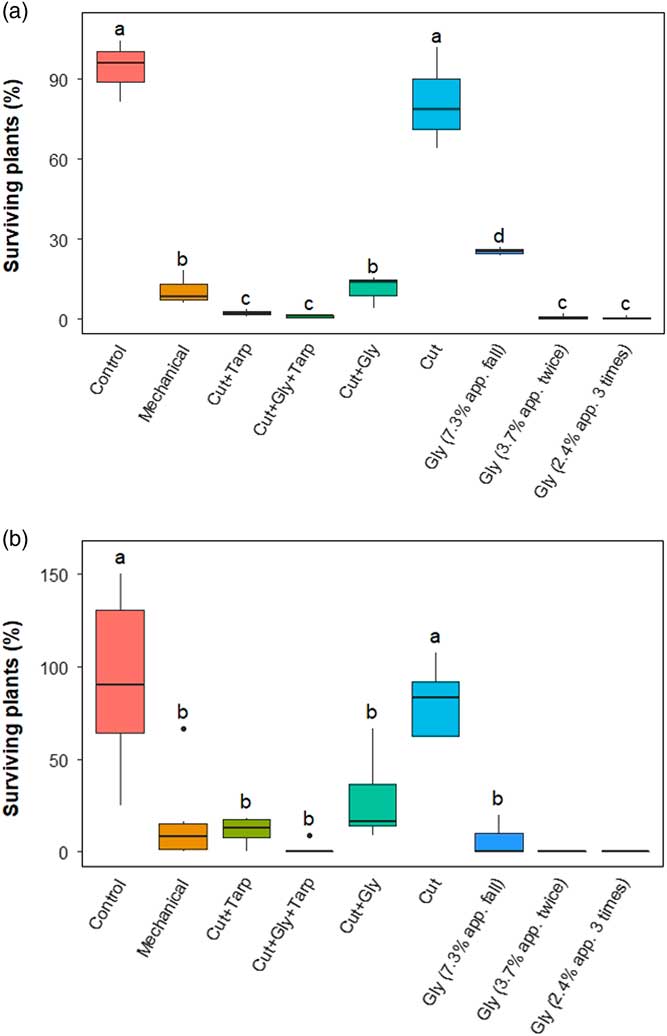
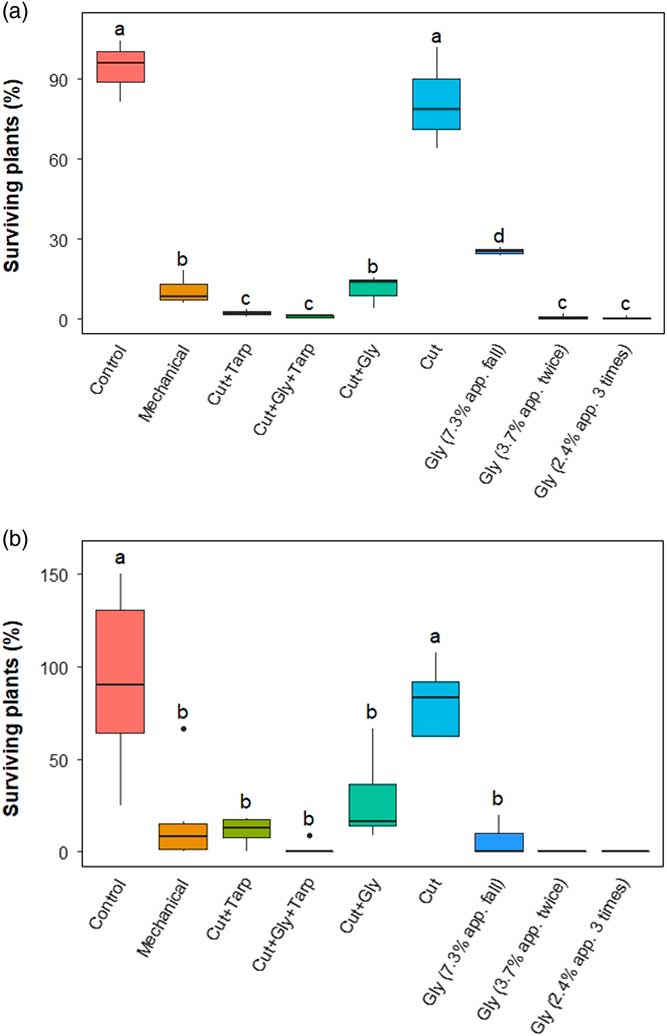
In both years, the control strategies had a significant influence (P < 0.001) on A. donax survival in the spring following treatment (Figure 2). The number of volunteer A. donax plants was significantly reduced by all control strategies, except for the strategy of a single plant cutting in spring (Table 2; Figure 2).
Percentage of surviving volunteer Arundo donax in the spring following treatments: (A) first growing season (2016–2017); (B) second growing season (2017–2018). Letters indicate significant differences (P < 0.05) between treatments according to a Tukey post hoc analysis. Percentages greater than 100% indicate that population of volunteer A. donax was increased rather than reduced. Note: The mechanical treatment varied slightly between years; please refer to Table 1 or the text for clarification and descriptions of treatments. Gly, glyphosate.
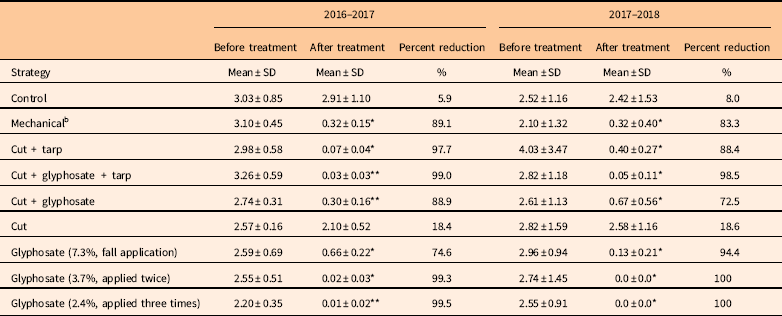
Mean Arundo donax plant counts (plants 10 m−2) and percentage of change between samplings (spring sampling before control strategy implementation and spring sampling in the following growing season) for each growing season and strategy.Footnote a

a Significance codes for P-values obtained after the paired t-test and Wilcoxon signed-rank test are: *P < 0.05; **P < 0.01.
b The mechanical treatment varied slightly between years (Table 1).
In the first growing season (2016 to 2017), the control strategies that performed best to control this species were those including a tarp treatment, such as cut + tarp with 97.7% control or cut + glyphosate + tarp with 99% control, and those strategies using split glyphosate applications, such as glyphosate at 3.7% applied twice with 99.3% control or glyphosate at 2.4% applied three times with 99.5% control (Figure 2A). When glyphosate was applied at the maximum dose (7.3%) late in the season, the average control of volunteer A. donax plants was 74.6%. Control with the mechanical strategy and with the cut + glyphosate at 2.4% was approximately 89% (Table 2).
In the second growing season (2017 to 2018), all control strategies, without considering the control and the cut treatment alone, did not show significant differences for reducing the volunteer A. donax infestation (Figure 2B). Contrary to the first growing season, all strategies based only on glyphosate applications were not significantly different and controlled volunteer A. donax between 94% and 100%. The higher efficacy of the single glyphosate application in fall 2017 compared with fall 2016 might have been due to the earlier application of the herbicide in the second year (October 6, 2016, vs. September 26, 2017). The control strategy cut + tarp + glyphosate provided control similar to the chemical strategies (98.5%), as was the case in the first year. Although, the mechanical, cut + tarp, and cut + glyphosate control strategies were not significantly different from the chemical (using only glyphosate) and cut + tarp + glyphosate control strategies, the control achieved was 83.3%, 88,4%, and 72.5%, respectively.
In general, control strategies tested in this study resulted in good to excellent control of volunteer A. donax plants coming from a former crop produced for biomass in northeastern Oregon. However, A. donax eradication did not occur with any treatment tested in one single year. The effectiveness of the different control strategies is likely based on their ability to affect rhizomes, because A. donax is a perennial species that reproduces by the rhizome buds (Decruyenaere and Holt Reference Decruyenaere and Holt2001; Saltonstall et al. Reference Saltonstall, Lambert and Meyerson2010). Strategies including a tarp were very effective in the control of volunteer A. donax, independent of whether they were used together with glyphosate or not (especially in the first growing season). The use of a tarp (also known as solarization) causes an increase in the temperature of the soil upper layer, especially if moisture is present, resulting in damage of rhizomes by heat (Rubin and Benjamin Reference Rubin and Benjamin1984). The likely increase in temperature in the shallow soil layers could have caused the death of the A. donax rhizomes. Other rhizomatous perennial grasses, such as johnsongrass [Sorghum halepense (L.) Pers.] and bermudagrass [Cynodon dactylon (L.) Pers.], were killed when soil was heated for 30 min at relatively low temperatures (30 to 40 C) using tarps (Rubin and Benjamin Reference Rubin and Benjamin1984). Similarly, Elmore et al. (Reference Elmore, Roncoroni and Giraud1993) and Law et al. (Reference Law, Bhavsar, Snyder, Mullen and Williams2008) reported control of S. halepense and C. dactylon using tarps. In addition to increasing soil temperature, solarization increases toxic gasses such as ethylene as a result of organic matter decomposition (Rubin and Benjamin Reference Rubin and Benjamin1984), which could be another factor affecting the rhizomes. Furthermore, using opaque tarps could also contribute to the control of volunteer A. donax plants due to limited light availability. Decruyenaere and Holt (Reference Decruyenaere and Holt2005) found that A. donax was able to grow in the absence of light for up to 100 d. Tarps covered plots in our study for 112 to 126 d. In addition, tarps might act as a physical barrier stopping A. donax sprout development. We did not observe 100% control using tarps, mainly because some tears occurred in the tarps, opening holes where moisture (by rainfall) and light could penetrate and thus favor the growth of volunteer A. donax. Volunteers that were observed in plots with tarps in this study were located in places where there were holes or tears. The tears/holes in the tarps were probably caused by abrasion from the cut plants of A. donax under the stretched tarp, particularly when wind produced slight tarp movements. The sun or moisture might also have accelerated the deterioration of tarps. A more rugged tarp material might have helped to achieve better control of A. donax with this practice. However, using tarps in extensive areas is not possible, not only due to the high cost, but also for the more complicated management, particularly where A. donax might encroach into riparian or other areas that have an irregular terrain and the presence of other woody plants. This implies that tarps can only be used in small areas where former crops were planted, such as field edges, irrigation structure surroundings, or other specific areas where A. donax needs to be controlled.
The use of glyphosate was found to be a good method for controlling A. donax, either alone or combined with other control practices. The results obtained with glyphosate in this study were supported by other studies carried out in the greenhouse (Santín-Montanyá et al. Reference Santín-Montanyá, Jiménez, Ocaña and Sánchez2013) or riparian areas of California (Spencer et al. Reference Spencer, Tan, Liow, Ksander, Whitehand, Weaver, Olson and Newhouser2008). The injection of glyphosate directly into the plants offered similar control, with a reduction of more than 80% (Spencer Reference Spencer2014). Application timing influenced glyphosate efficacy on A. donax control. Spencer et al. (Reference Spencer, Ksander, Tan, Liow and Whitehand2011) and Decruyenaere and Holt (Reference Decruyenaere and Holt2001) found the fall to be the best time to control A. donax with glyphosate (a phloem-mobile, basipetally translocated herbicide), because in late summer or early fall, carbohydrates move from leaves to rhizomes to store reserves before onset of winter dormancy. In this study, a single maximum dose of glyphosate applied late in the season did not result in as great a level of control as when the same dose was split during the season. However, this may be a result of glyphosate being applied too late, particularly in one of the years. Control improvement was observed when the fall application occurred slightly earlier, allowing for a longer period between the glyphosate application and the beginning of winter dormancy. Minimum temperatures were at or below freezing (≤0 C) in the nights after glyphosate application in 2016, whereas similar low temperatures were not reached until the eighth night after glyphosate application in 2017. According to Spencer et al. (Reference Spencer, Ksander, Tan, Liow and Whitehand2011), in California, where the fall season is warmer than in northeastern Oregon, the best time to control A. donax with glyphosate is September. However, the colder fall season in northeastern Oregon could cause dormancy in this species to occur earlier than in California, and a late-summer herbicide application might have produced greater control. Although there are studies showing the effect of nitrogen availability on A. donax rhizome dormancy (Decruyenaere and Holt Reference Decruyenaere and Holt2005), there are no studies, that we are aware of, reporting the effect of temperature on rhizomes of this species. Loddo et al. (Reference Loddo, Masin, Otto and Zanin2012) showed that minimum temperatures were an important factor limiting rhizome sprouting of S. halepense. The higher control found when glyphosate was applied before fall, particularly with split applications, seems to support the concept that herbicide translocation to rhizomes might happen before dormancy begins or that rhizome dormancy starts as early as end of July in northeastern Oregon.
Cutting volunteer A. donax to ground level did not control this species, because a single cutting did not seem to affect the rhizomes. However, control with a single cutting could be improved if it was repeated or conducted later in the season. In this study, the cut was performed in May, which allowed plants plenty of time to regrow and provide carbohydrates to the rhizome. If the cutting had been conducted in late summer, plants might not have sufficiently regenerated from rhizomes, as indicated by Bechtoldt et al. (Reference Bechtoldt, Horneck and Wysocki2014). Glyphosate applied after stem cutting in spring improved A. donax control, as was found in a previous greenhouse study (Santín-Montanyá et al. Reference Santín-Montanyá, Jiménez, Ocaña and Sánchez2013). Consequently, it is possible that a control strategy of cut + glyphosate application later in the growing season may produce better results than the same strategy in spring. Otherwise, according to the fall sampling (where spring and summer chemical treatments were evaluated), stem cutting seemed to increase the glyphosate effect. Glyphosate applied at 2.4% in spring after cutting provided 77% control, whereas glyphosate at 2.4% applied in spring and summer (as part of the control strategy of glyphosate at 2.4% applied three times) on entire plants provided 79% control, and glyphosate applied at 3.7% in late spring or early summer (as part of the control strategy of glyphosate at 3.7% applied twice) on entire plants provided 38% control. In contrast, Spencer et al. (Reference Spencer, Tan, Liow, Ksander, Whitehand, Weaver, Olson and Newhouser2008) did not find differences between a glyphosate application and a glyphosate application + stem bending and breaking.
The similar control obtained by collecting the rhizomes after digging them up (first growing season) or by leaving them on the surface (second growing season) after soil tillage in the mechanical control strategy suggests that most of the surviving plants come from rhizomes that are not brought to the surface with tillage and are able to sprout. In the second year, a critical number of rhizomes exposed to surface conditions could have been damaged by high temperatures and dryness. However, Santín-Montanyá et al. (Reference Santín-Montanyá, Jimenéz, Vilán and Ocaña2014) dehydrated A. donax rhizomes for 7 d in an oven at 60 C and found that the lack of moisture in the rhizomes can be overcome by this species. Mann et al. (Reference Mann, Kyser, Barney and DiTomaso2013b) reported similar results for A. donax and Miscanthus × giganteus. The control in the mechanical option could also have been influenced by cutting rhizomes. The tillage could have broken the rhizomes and affected fragment size; fragments must be a certain size for suitable establishment. The initial size of A. donax rhizomes was found to be related to the level of sprouting (Santín-Montanyá et al. Reference Santín-Montanyá, Jimenéz, Vilán and Ocaña2014) and yield biomass (Copani et al. Reference Copani, Cosentino, Testa and Scordia2013). Estrada et al. (Reference Estrada, Wilson, NeSmith and Flory2016) and Peng et al. (Reference Peng, Li, Yang, Zhi, Li and Guo2017) found that rhizome segments containing three or more nodes significantly enhanced the establishment of invasive species such as alligator weed [Alternanthera philoxeroides (Mart.) Griseb.] and cogongrass [Imperata cylindrica (L.) P. Beauv.]. Mechanical practices causing rhizome fragmentation might also contribute to the spread of the species, as was found for S. halepense, another rhizomatous grass (Andújar et al. Reference Andújar, Ruiz, Ribeiro, Fernández-Quintanilla and Dorado2011).
Our results indicate that adequate control of A. donax can be achieved over a very short period. However, cutting plants to the soil surface in spring does not provide control, except when cutting is combined with application of glyphosate or/and a tarp covering. The use of tarps over cut plants and the chemical control with glyphosate were the best treatments to control volunteer A. donax plants and to prevent dispersion. Herbicide application timing was important for maximizing glyphosate efficacy. These results were based on volunteer A. donax plants that were terminated with tillage the previous season, which is the practice preferred by growers in the region. The results could be different if these control strategies are used to terminate the A. donax crop, in other words, A. donax plants that have not suffered a previous stress. Scouting the fields after a weed control measure looking for plant escapes is a recommended practice, but it is even more important when the plant is an invasive species such as A. donax.
Acknowledgements
The authors wish to thank Portland General Electric for the funds received to conduct this study. We also thank Carol Mallory-Smith and Andy Hulting for their professional advice to conduct this research, Tim Weinke and Alan Wernsing for their help in implementing some of the treatments, and Richard Smiley for his comments to help improve the text. No conflicts of interest have been declared.