José Manuel Rodríguez Delgado (1915–2011), the most influential Spanish neuroscientist in the second half of the twentieth century, emigrated from Spain (under Franco’s regime) to USA in 1950, where he developed a brilliant career at Yale University until his return to Spain in 1972. His scientific career is supported by the hundreds of research papers he has published in prestigious journals, including Nature and Science, as well as the large number of research projects, funded by major US government agencies (Delgado, Reference Delgado1965b, Reference Delgado1982a, Reference Delgado1982b), in which he has taken part.
The present study revises J. M. R. Delgado’s work within the American historical-scientific context in which it was developed and the evolution of its influence in the period between 1954 and 2013. For this purpose, a quantitative impact analysis of his works was carried out, measuring the number of citations that his work obtained in scientific literature. With the intention of extracting more information on Delgado’s work, an auxiliary analysis was performed in which the number of citations received by one of his most influential articles (Delgado et al., Reference Delgado, Roberts and Miller1954) was compared to the number of citations received by another article (Olds & Milner, Reference Olds and Milner1954), published the same year and in keeping with its purpose and methodology.
Behavioral Sciences at Yale in the mid-twentieth century
When J. M. R. Delgado joined the physiology laboratory at Yale in 1950, physiologists’ and behavioural psychologists’ interests had begun to coalesce. Despite the initial lack of colaboration amongst them (with the exception of reflexologists), the emergence of new methods and the establishment of a renewed conception of the subject matter favored the intersection of their research. While many physiologists began to use behavioral analysis techniques, psychologists were increasingly more interested in the physiological substrate underlying behavior, particularly in the field of learning (Valenstein, Reference Valenstein1973a, Reference Valenstein and Valenstein1973b, Reference Valenstein1974). Reknown researchers such as the Nobel laureate physiologist, Walter R. Hess, and the influential psychologist, Clark L. Hull, at Yale University, contributed to this approach. W. R. Hess arose interest in the study and neurolocalization of various psychological functions, employing new techniques such as electrical brain stimulation (Hess, Reference Hess1962, Reference Hess1964); C. L. Hull placed the study of motivation, particularly drive reduction (Hull, Reference Hull1943), at the forefront of scientific research. Although Hull did not directly examine the physiological substrate of behaviour, he transmitted such effort to several of his disciples, especially to Neal E. Miller (Spence, Reference Spence1952), who would later become a close associate of Delgado.
When the Spanish scientist arrived at Yale School of Medicine, John Fulton was the Head of the Physiology Department, and prestigious researchers such as R. B. Livingston, B. K. Anand or P. MacLean were academic members of the Department. Delgado had the opportunity to collaborate with these researchers between 1947 and 1953 (Delgado, Reference Delgado1982b) and had the privilige of acknowledging them as his mentors (Delgado, Reference Delgado1952). The Yale physiologists were especially interested in unraveling the functional relationships of the brain, using injury and/or electrical and chemical stimulation techniques. They were fascinated by the possibility of finding physiological correlates for complex behaviors, as well as by the study of the functions of the temporal lobes, the motor cortex and the limbic system. They became exceptional spectators to the findings of MacLean (Reference MacLean1949) about the limbic structures related to emotional and motivational systems.
In this context, it is necessary to mention the National Institute of Mental Health (NIMH), to understand the mentioned confluence between physiology and psychology. The NIMH, created in 1949, was largely responsible for the establishment of a “golden era” of American psychology after World War II, by generously funding research lines that drew the interests of both disciplines closer. For example, in 1953, the NIMH funded the Behavioral Laws of Motivation and Conflict project with over half a million dollars. This project was carried out by N. E. Miller at Yale, where he focused on the study of the physiological and biochemical basis of motivation and reinforcement (Rice, Reference Rice, Pickren and Schneider2005). One of the results of this project was Delgado et al. (Reference Delgado, Roberts and Miller1954) article, to which later reference will be made.
In short, when Delgado arrived at Yale on a two-year James Hudson Brown scholarship, the situation was very favorable for the development of his own research line and he was soon to emerge as a notable figure, with a meteoric career: Assistant Professor (1953–1955), Associate Professor (1955) and Full Professor of Physiology and Psychiatry (1966) at the age of 51 years. In addition, he was considered at that time as a “magician of technology” (Blackwell, Reference Blackwell2014) for the development, among others instruments, of the “stimoceiver”, a device capable of bidirectionally communicating and electrically stimulating brain areas capable of producing changes in behavior.
Delgado’s contributions during the 50’s immediately opened new research pathways for physiologists and psychologists. In the early fifties, Delgado used the developments in brain stimulation by Hess, improving them and applying them to the brain stimulation of unanesthetized animals with free movement (Delgado, Reference Delgado1952). Although the study was implemented primarily for cat behavior, Delgado outlined in this article the relevant modifications for its application on mice. Moreover, he reported that it had been successfully used in the examination of the behavior of monkeys and dogs, and stressed the importance that this technique could have on learning research and its psychiatric and medical applications (Delgado, Op. Cit.). These innovations were used, among others, by Peter Milner at McGill University (Squire, Reference Squire2014). Similarly, when Neal E. Miller reviewed the state of affairs in relation to “the New Approaches to motivation and reward” (Miller, Reference Miller1958, p. 100), and emphasized the transcendental for that company’s “combination of behavioral and psysiological techniques” (Ibidem), he did not hesitate to refer to the “Delgado-type electrodes” (p. 102) as a prototypic instrument for electrical brain stimulation. Years later, Miller (Reference Miller and Valenstein1973) recognized that Delgado’s contribution was key in his study of avoidance learning.
The aknowledgements of Delgado’s work succeeded each other during the next decade, such as the Guggenheim Fellowship grant in 1963 or conferences as guest speaker at the most prestigious scientific societies. Another important example is the invitation he received in 1965 to give the James Arthur lecture on the evolution of the human brain in the American Museum of Natural History. To illustrate the importance of such achievement, it suffices to note some of the previous speakers who were honored: John F. Fulton (1940), James W. Papez (1943), Karl S. Lashley (1945), Warren S. McCulloch (1946), Donald O. Hebb (1949), Harry F. Harlow (1951), Horace W. Magoun (1954) and Roger W. Sperry (1964).
The impact of Delgado’s work finally transcended the academic sphere when The New York Times dedicated one of their covers to him in 1965 (Osmundsen, May 17, p. 1), in what was billed as a scientific revolution which would entail a deep impact on what is now known as Neuroscience (Martínez-Sánchez & Palmero, Reference Martínez-Sánchez and Palmero2004).
No evidence suggested that, after contributing decisively to lay the groundwork for many later scientific developments, his influence and recognition would fade, as noted by Faria (Reference Faria2013b). In fact, Horgan (Reference Horgan2005) mentions that, after his return to Spain, “his reputation in the US faded, not only from public memory but from the minds and citation lists of other scientists” (p. 68).
In order to test this hypothesis, an analysis of the number of citations received by Delgado between 1954 and 2013 was performed. In addition, an analysis of the citations received by one of his most visible publications (Delgado et al., Reference Delgado, Roberts and Miller1954) was carried out in comparison to those citations received by another article (Olds & Milner, Reference Olds and Milner1954) published the same year, assuming that such comparison fits historical and theoretical reasons.
Method
Procedure
In order to assess the visibility of Delgado’s work throughout the second half of the twentieth century and the early twenty-first century, a search was performed using the program ‘Publish or Perish’, which uses the Google Schlolar database to yield all citations received by an author for the selected time period. The search was conducted on January 22, 2014.
To perform a comparative analysis of the temporal evolution of Delgado’s presence in the literature, the citations received by another publication by the famous American psychologist James Olds (Thompson, Reference Thompson1999), which is comparable to Delgado’s article in its scientific nature, were examined for the same time period. Old’s article was selected because, similarly to Delgado’s article, the paper studies the relationships between learning, motivation and its neurological bases, it stems from the same theoretical premises and uses similar methods. Moreover, both articles saw the light at the end of 1954.
After computing the total number of citations for both articles, a linear regression analysis was performed in order to assess the relationship between the citations received by each authors’ work and the time elapsed since its publication. In addition, an interrupted time series analysis was performed to compare the evolution of the trend in citations for each article, dividing them into two time periods of similar length (1955–1983 and 1984–2013), in order to check whether the visibility of both papers was comparable in both periods.
Results
The total number of citations received by the authors yielded 5181 citations, distributed amongst 220 articles in the case of Delgado, and 8744 citations amongst 143 articles for Olds’ article. The subsequent detailed analysis reported that the historical luck that followed both authors was not parallel.
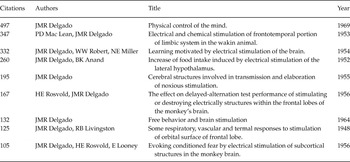
Table 1 shows all of Delgado’s articles that have been cited 100 times or more.
Delgado’s articles with 100 or more citations

The most cited work is the book Physical control of the mind (all citations for its two editions of 1969 and 1971 have been grouped together, since they did not differ in any essential aspect). The rest of them, except for an article in 1964, were published in the fifties, historical period in which Delgado defined an undisputed research front in the field of psychophysiological research, as previously mentioned.
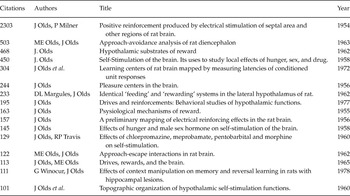
With regard to Olds’ article, and following the same parameters, Table 2 shows the obtained results.
Olds’ articles that obtained 100 or more citations

The first observation to be made, for its significance, pertains to the extraordinary visibility of Olds and Milner’s (1954) article, whose scientific impact is beyond doubt. In fact, Delgado’s top nine articles scoring 100 or more citations do not sum up to the citations obtained by this first article listed in Table 2. The difference between the citations received by the two authors is so great that it does not merit further consideration. It is also noted that the period that the articles with over 100 citations spans over virtually the Chicago psychologist’s entire academic life.
With the intention of verifying the historical evolution of Delgado’s visibility, in comparison to Olds, a single article from each author was selected. With a total of 2303 citations, Olds and Milner’s article was selected. Regarding Delgado’s most cited article, it suffices to note that it was co-authored by Paul D. MacLean. However, for the reasons aforementioned, the second article was selected, the one published in 1954 with Roberts and Miller as coauthors, which, as of January 22, 2014, had amounted 332 citations.
When comparing the evolution of both articles, considering the entire 1955–2013 period, an opposite temporary pattern in the number of citations was observed; That is, while a positive trend was observed for James Olds’ work, R 2 = .495, F(1, 57) = 57.76, p < .001, ß = .709, Delgado’s work followed a significantly decreasing trend in citations over time, R 2 = .371, F(1, 57) = 35.14, p < .001, ß = –.618.
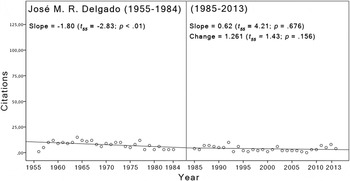
Subsequently, a time series analysis was performed in order to identify temporary change patterns in the citations for both studies. As can be observed in Figure 1, the evolution of Delgado, Roberts and Miller’s article draws a significant reduction in the trend in number of citations during the 1955–1984 period (slope = –1.80; t 55 = –2.83; p < .01), while in the second set of data covering the 1985–2013 years, no change in this trend (slope = .062; t 55 = 4.21; p = .676) can be observed. When both periods were compared, the results did not yield significant changes between them (Estimated change = 1.216; t 55 = 1.43; p = .156), which shows that the number of citations was maintained over time.
Annual evolution and comparison of the number of citations obtained by the article Learning motivated by electrical stimulation of the brain between the periods of 1955–1984 and 1985–2013.

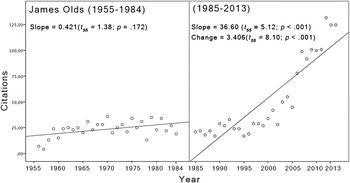
Meanwhile, Figure 2, based on the evolution of Olds and Milner’s article, shows that during the 1955–1984 period there was no significant increase in the number of citations received (slope = .0421; t 55 = 1.38; p = .172), while in the second (1985–2013) period, the increase was significant (slope = 5.12; t 55 = 5.12; p < .001). When both time periods were compared, the results pointed towards a significant increase in the number of citations received in the second period in comparison to the first period (Estimated change = 3.40; t 55 = 8.10; p < .001).
Annual evolution and comparison of the number of citations obtained by the article Positive reinforcement produced by electrical stimulation of septal area and other regions of rat brain between the periods of 1955–1984 and 1985–2013.

Discussion
The main objective of this work was to test Delgado’s visibility between 1955 and 2013; in addition, one of Delgado’s most influential articles was compared with another article by James Olds, which was considered to be very similar in subject and in method. Both studies showed that attraction and avoidance, reinforcement and punishment, beyond being part of the speculation of a hedonistic philosophy, had become scientific proof of the existence of brain centers that largely regulate the emotional and motivational systems. In fact, Delgado’s work (Delgado et al., Reference Delgado, Roberts and Miller1954) proved the existence of neuroanatomical centers at the base of certain emotional responses which participate in the learning process. The authors showed that electrical stimulation produced emotional responses of escape, acquiring the same functional value as those caused by natural stimuli. On the other hand, Olds and Milner’s (1954) article described the structures capable of reinforcing behaviour through (auto) electrical brain stimulation.
The results of the present study show that the number of citations for Delgado et al.’s article significantly decreased between 1955 and 2013, while citations for Olds and Milner’s work have progressively increased in a significant way.
We understand that there may be multiple reasons that explain the fact that two articles published in parallel, using similar techniques, based on the same theoretical premises and strongly contributing to the advancement of knowledge in psychology, have had a very unequal temporal evolution. It is clear that the cause cannot be attributed to the fact that, at the time of publication, Delgado’s work was not well known by the scientific community interested in the subject. A simple review of the references in Olds and Milner’s (1954) article proves that Delgado’s work was known as five of the seventeen references included articles by Delgado.
The main reason for the gradual reduction of the visibility of Delgado’s work can plausibly be explained by other factors (Faria, Reference Faria2013b). In our opinion, the publication of the book Physical control of the mind (Delgado, Reference Delgado1969), is one of the main causes of this downfall.
In his lecture at the American Museum of Natural History (Delgado, Reference Delgado1965a), Delgado addressed the problem of the “Evolution of physical control of the brain” in order to “project cerebral evolution toward the future without losing touch with the solid ground of experimentation” (Delgado, Reference Delgado1965a, p. 1). Delgado was well aware that “Learning, emotions, drives, memory, consciousness, and other phenomena which in the past belonged only in the realm of philosophy are now the subjects of neurophysiological experimentation.” (Op. cit., p. 2). He also stressed the need for more funds and personnel to be allocated to brain research and he addressed the fears that brain manipulation could lead to: The feasibility of mass control of behavior by brain stimulation is very unlikely, and the application of intracerebral electrodes in man will probably remain highly individualized and restricted to medical practice.” (p. 50).
In Physical control of the mind, Delgado had largely abandoned the caution that fueled his lecture, his anchoring to the “solid ground of experimentation” (Delgado, Reference Delgado1965a, p. 1) had evaporated at some points and even from the very title of the book, he dared to change the “physical control” reference from “the brain” to “the mind”. Apparently, neither the title of the book, nor its arguments, or the historic moment in which they were to be discussed were the most suitable (Blackwell, Reference Blackwell2012, Reference Blackwell2014; Fins, Reference Fins2003, Reference Fins2004, Reference Fins, Krames, Peckham and Rezai2009).
It seems that the attacks received by Delgado, due to his connection to certain medical practices, which had begun to be seriously questioned during the seventies in America, did not allow his academic future to soar as would have been expected. After Petter Breggin in 1972 named Delgado as “the theoretician of the lobotomists, the great apologist for Technologic Totalitarianism” (Breggin, 1972/Reference Breggin and Edwards1982, p. 380), he became the central character of many of the stories which warned of the danger of the US government implementing the mind control techniques that Delgado discussed (eg., Bowart, Reference Bowart1978) on its citizens. These stories were not far-fetched, considering the CIA documents declassified in 1976 that disclosed the existence until 1973 of scientific projects as sinister as MK-ULTRA (S. Rep. No. 94–755, 1976).
Howerver, Delgado’s legacy was not only haunted by conspiracy theories of this nature, which caused growing social alarm. Rigorous research such as Valenstein’s (Reference Valenstein1973a) work may be perfectly interpreted as being full of scientific reason against the popular and mediatic hysteria with respect to the real possibilities of brain manipulation of emotions and behaviors. The ‘Foreword’ of the aforementioned book warns the reader from the first paragraph:
In this time of anguished reappraisal of the human society it is little wonder that the subject to of this book, the control of human behavior by electrically stimulating or surgically destroying parts of the brain, has aroused intense public interest and anxiety (Nauta, Reference Nauta and Valenstein1973, p. vii).
Valenstein’s (Reference Valenstein1973a) book examined in great detail the state of this scientific question, arguing that the public alarm generated was entirely unjustified, given that, in any case, the experimental evidence didn’t allow to draw conclusions that supported the brain control of animal behavior, much less the control of human behaviour. Besides admonishing journalists, novelists and other ominous people who warned against the dangers of the imminent new “electrohierarchical” society, Valenstein did not forget to denounce the direct responsibility of certain scientists who had promoted such beliefs. In this context, Delgado reappeared throughout the book, sometimes mentioned directly and other times in a veiled manner, as one of the responsible scientists (see Valenstein, Reference Valenstein1974).
Delgado’s disgrace, besides being tainted with largely justified ethical prejudice, could also be the result of internal disputes and other interests within the Department of Physiology at the Yale School of Medicine. This is evidenced by the fact that his promotion to full-professor was constantly hampered by Carlton C. Hunt, director of the department, who alluded to ethical reservations generated by Delgado’s work. Hunt’s problem was, according to himself, that Delgado had “strong social support” in Yale (Hunt, Reference Hunt and Squire2006, p. 369). Therefore, the final compromise was to promote him to full-professor, but in the Department of Psychiatry.
Other factors may have contributed to the questioning of Delgado’s work. For example, the appearance in 1957 of experimental data which supported the use of Levodopa in the treatment of Parkinson’s Disease (Carlsson, Lindqvist, & Magnusson, Reference Carlsson, Lindqvist and Magnusson1957), making the emerging use of intracranial electrical stimulation techniques in various medical applications (Gardner, Reference Gardner2013) unnecessary, should not be ignored. Nevertheless, history can be sometimes stubborn, as in the mid-eighties (Benabid, Pollak, Louveau, Henry, & de Rougemont, Reference Benabid, Pollak, Louveau, Henry and de Rougemont1987) deep brain stimulation techniques were developed, which are now progressively becoming the treatment of choice for Parkinson’s disease and chronic pain (Bittar et al., Reference Bittar, Kar-Purkayastha, Owen, Bear, Green, Wang and Aziz2005) and are showing promising results in the treatment of Depression (Christopher et al., Reference Christopher, Leykin, Appelbaum, Holtzheimer, Mayberg and Dunn2012) and Obsessive-Compulsive disorders (Bergfeld, Mantione, Hoogendoorn, & Denys, Reference Bergfeld, Mantione, Hoogendoorn and Denys2013).
Perhaps, all of the above explain the fact that currently Delgado’s name is scarcely cited and that historiography has relegated him to the role of Miller’s “collaborator” in the research on escape behaviour (Haan, Reference Haan2010), or that he has been demonized by the potential unethical uses related to his research (Mashour, Walker, & Martuza, Reference Mashour, Walker and Martuza2005). In other cases, his fate was even worse, if possible. For example, more recently, (Snyder, Mayes, & Spencer, Reference Snyder, Mayes and Spencer2009) he was openly referred to as an example of what not to do in relation to the ethical principles that govern scientific research and the dissemination of its results. In the chapter that the book devoted to Delgado, which, at times, sounds like a “vendetta”, he is termed as a showman (term also used by Fins, Reference Fins2004; or “theatrical” in the words of Sironi, Reference Sironi2011) as well as proud and arrogant. As if this were not enough, it states that he sought funding and fame (to inflate his ego) in unorthodox ways; it even talks about his habit of not citing colleagues working in the same field of specialization (eg, Robert G. Heath, de Tulane University; see, Baumeister, Reference Baumeister2000), trying to gain priority over the discoveries; finally, the book insinuates the possibility that Delgado married his wife for reasons related to his unspeakable goals, “Stoddard’s father, Mr. Carlos F. Stoddard, initially served in the University’s development office, but by 1964 he rose to become the Director of Endowment and Gifts for Yale University, a powerful position reporting to the President of the university” (Snyder, Reference Snyder, Snyder, Mayes and Spencer2009, p. 29).
In summary, the main objective of the present article was to check, using statistical techniques, whether the figure of José Manuel Rodríguez Delgado had disappeared over time with a higher intensity than would be expected, based on the historical significance of his findings. The results quantitatively confirm this impression and objectively confirm the progressive oblivion of his work. The reasons that justify this are many and are related to ethical considerations related to scientific research, and other reasons of social and personal character. However, despite his pronounced oblivion, Delgado’s work opened thriving lines of brain research, and promising techniques, which are increasingly used for the treatment of many diseases and have their origin in his methods (Coffey, Reference Coffey2009; Faria, Reference Faria2013a, Reference Faria2013b; Hariz, Reference Hariz2012; Hariz, Blomstedt, & Zrinzo, Reference Hariz, Blomstedt and Zrinzo2010; Krack, Hariz, Baunez, Guridi, & Obeso, Reference Krack, Hariz, Baunez, Guridi and Obeso2010).