Introduction
Cinara cedri Mimeur, 1936 (Hemiptera: Aphidoidea: Lachnidae) is an important pest of Cedrus deodara, C. libani, C. brevifolia and C. atlantica (Fabre et al., Reference Fabre, Chalon, Chizky and Robert1988; Yu and Wang, Reference Yu and Wang2014; Binazzi et al., Reference Binazzi, Sabbatini and Roversi2015). At present, C. cedri are widely distributed all over the world, including Europe (Spain, Italy, France, Britain, etc.), Asia (China, Iran and Turkey), the United States, Argentina and Morocco (Blackman and Eastop, Reference Blackman and Eastop2013; Huang et al., Reference Huang, Wu, Sun and Du2017; Şükran and Mustafa, Reference Şükran and Mustafa2019). In China, C. cedri is an important invasive pest, with reports of damage caused by this species in Beijing, Shandong, Henan and Shaanxi provinces (Yu and Wang, Reference Yu and Wang2014; Tian, Reference Tian2018; Zhang, Reference Zhang2016). The adults and nymphs of C. cedri cause damage by sucking the sap from the 1–2 years old shoots and leaves of cedar trees (Lin and Lei, Reference Lin and Lei2018; Şükran and Mustafa, Reference Şükran and Mustafa2019). A large amount of honeydew secreted by C. cedri was accumulated on the shoots and leaves of cedar trees, which caused the stomata and lenticels to be blocked. In the period of peak abundance of C. cedri occurrence, sooty mold can also occur, which has a serious impact on the normal growth and development of cedar trees (Zhang, Reference Zhang2016; Tian, Reference Tian2018). At present, only a few studies on C. cedri biological characteristics are available (Yu and Wang, Reference Yu and Wang2014; Tian, Reference Tian2018; Şükran and Mustafa, Reference Şükran and Mustafa2019). It was observed in Beijing, Henan and Shandong provinces of China in both spring and autumn seasons, but was more serious in spring (Yu and Wang, Reference Yu and Wang2014; Huang et al., Reference Huang, Wu, Sun and Du2017; Tian, Reference Tian2018). In addition, the populations overwintered as eggs with nymphs hatching during the first week of April in the Isparta region in Turkey. The adult stage was reached through four nymphal instars over 7 to 10 days (Şükran and Mustafa, Reference Şükran and Mustafa2019).
Temperature is one of the most important factors influencing most biological processes of insects, including their growth, development and reproduction (Clissold and Simpson, Reference Clissold and Simpson2015; Cao et al., Reference Cao, Li, Yang, Meng, Wang, Shang and Gao2018; Wang et al., Reference Wang, Walter and Furlong2020). Generally, the developmental and reproductive rates of insects differ with temperature (Fand et al., Reference Fand, Sul, Bal, Minhas and Córdoba-Aguilar2015; Krechemer and Foerster, Reference Krechemer and Foerster2015; Shi et al., Reference Shi, Gadi, Chen and Ge2017). The time spent in developmental stages of an insect at a constant temperature can be used to generate developmental rate curves, suitable for modeling and predicting development time as a function of temperature (Southwood, Reference Southwood1966; Zou et al., Reference Zou, Xi, Liu, Song, Xin and Xia2018; Hirotsugu and Norio, Reference Hirotsugu and Norio2019). These models can also be used to calculate the developmental threshold temperature, optimum temperature and thermal accumulation of insect, contributing to models to predict the geographic distribution and phenology in a region (Riahi et al., Reference Riahi, Shishehbor, Nemati and Saeidi2013; Guo et al., Reference Guo, Men, Yu, Chen, Zhou, Zhuang, Wang and Li2016). In addition, life tables can be used to evaluate the comprehensive effects of temperature on the development, survival and reproduction of insects (Michèle et al., Reference Michèle, Brodeur and Cloutier2003; Farhadi et al., Reference Farhadi, Allahyari and Chi2011; Ren et al., Reference Ren, Tu, Ge, Zhao and Zhang2016). The effect of temperature on the growth and development of C. cedri is not fully studied. Consequently, the effects of temperature on development and reproduction of C. cedri on C. deodara were evaluated in the laboratory in this study.
Materials and method
Insects
C. cedri adults were collected from Cedrus deodara (Roxb.) G. Don in the campus of Shandong agricultural university in Tai'an Shandong province, China and were used to establish a laboratory colony. The aphid adults reared in a Petri dish (12 cm diameter) with a branch of C. deodara (1 cm diameter, 10 cm length). The Petri dishes were kept in an incubator (PQX-330A-3H) at a constant temperature and relative humidity (25 ± 0.5°C, 70 ± 5% RH) and photoperiod (16:8, L:D).
Observation on life history of C. cedri
From November 2018 to March 2020, three cedar plants that were harmed by C. cedri were randomly selected on the campus of Shandong Agricultural University to investigate and record the aphid morphology and development state of C. cedri once a week. According to the survey data, the life history chart of C. cedri was drawn.
Development and reproduction at constant temperatures
A branch segment of C. deodara was placed in a Petri dish (12 cm diameter), and the branch was wrapped in mud at both ends to reduce water loss. Five Petri dishes were prepared, and a group of 50–100 female adult aphids were placed in each Petri dish and used to produce offspring at a constant temperature 25°C for 4 h. After 4 h, 450 first instars were placed in 15 Petri dishes on average with a branch segment of C. deodara, 30 first instars in each Petri dish. The first-instar nymph was reared and observed at five different incubators with five constant temperatures, 10 ± 0.5, 15 ± 0.5, 20 ± 0.5, 25 ± 0.5 and 30 ± 0.5°C, 70 ± 5% RH and a 16:8 (L:D) h photoperiod, and each temperature treatment group contained three Petri dishes. Each developmental stage from first-instar nymph to adult was observed daily, and the developmental times, prenatal period, birth period, postpartum period, molt, death and births of C. cedri were recorded until the adult aphid died.
Life tables
A life table was constructed from the observed survival and fecundity rates for individuals. Parameters at constant temperatures were calculated and analyzed using the methods of Chi (Reference Chi1988, Reference Chi2012), including the age-stage survival, intrinsic rate of increase (r), the net reproductive rate (R0), the finite rate of increase (λ) and the generation time (T). The calculation formulae were as follows:


where w represents the maximum age; x represents the age; lx represents the survival rate of a newborn first instar at age x and mx represents the average number of offspring produced by each female aphid at age x.
Statistical analysis
The developmental time, prenatal period, birth period, postpartum period and fecundity at different temperatures were compared using one-way analysis of variance followed by Tukey's HSD tests to obtain the significance of differences (P < 0.05). Linear regression, quadratic regression and logistic regression curve models were used to fit the relationship between development rate and temperature to select the best result. All statistical analyses were performed using software SPSS 19.0.
The effective accumulated temperature (K) and lower developmental threshold temperature (C) were calculated from the following formulae (Qiu et al., Reference Qiu, Zhou, Luo and Xu2012; Cao et al., Reference Cao, Li, Yang, Meng, Wang, Shang and Gao2018):


where V (1/developmental duration) is the developmental rate in days at temperature T (°C), K is the required heat units in degree-days (DD) for effective accumulation and C (°C) is the minimum developmental threshold.
Results
Life history of C. cedri
C. cedri has a holocyclic life cycle on C. deodara (fig. 1). It overwinters on the needles of C. deodara by fertilized eggs. The eggs developed into apterous fundatrix in mid-March of the following year. The number of aphids increased sharply after the fundatrix developed into adult aphids and began to reproduce fundatrigenia parthenogenetically. In mid-April, the fundatrigenia produced alate and apterous viviparous female aphids, but the number of alate viviparous female was small. With the increase of temperature, the proportion of alate viviparous female aphids increased gradually. The aphids reproduced parthenogenetically several generations and began to over-summer in late-July. The population began to increase in mid-September. The aphids continued to reproduce parthenogenetically until the emergence of the sexuales in mid-November. After mating, sexuales laid fertilized eggs on cedar needles to overwinter. The newly laid eggs are brownish yellow, and then gradually turn to black.
Life history of C. cedri on C. deodara.

Effects of temperature on the development of C. cedri
Over the range of temperatures tested, C. cedri fed on the branch of C. deodara successfully developed from first-instar nymph to adult. With the increase of environmental temperature from 10 to 30°C, the developmental duration was significantly shortened. The developmental times from 10 to 30°C for first-instar nymph ranged from 7.71 to 2.84 days (F 4,289 = 512.25, P < 0.001), for second-instar nymph ranged from 7.52 to 3.18 days (F 4,287 = 529.84, P < 0.001), for third-instar nymph ranged from 7.71 to 3.16 days (F 4,284 = 448.94, P < 0.001), for fourth-instar nymph ranged from 7.47 to 4.09 days (F 4,282 = 184.70, P < 0.001), for adult aphid ranged from 36.30 to 12.19 days (F 4,133 = 314.76, P < 0.001), for entire developmental stage from 66.10 to 25.63 days (F 4,132 = 747.59, P < 0.001), respectively (table 1).
Developmental duration of C. cedri at five constant temperatures fed on C. deodara

Mean ± SE (days), with the same column the values with different letters are significantly different (one-way analysis of variance followed by Tukey's HSD tests, P < 0.05).
Relationship between the developmental rate and temperature
There was a significant positive correlation between the developmental rates and temperature, which was in accordance with the quadratic regression model (table 2). Among the different developmental stages of C. cedri, the lowest value for the lower thermal threshold for development (C) was 4.13°C for the first-instar nymph, and the highest C value was 8.95°C for the fourth-instar nymph. The effective accumulative temperature value (K) was 521.2 DD for C. cedri to complete the whole generation (table 2).
Relationship between temperature and developmental rate of C. cedri

V is the developmental rate and T is the temperature (°C), C for the lower thermal threshold for development (°C) and K is the effective accumulative temperature (DD).
Effects of temperature on the survival and fecundity of C. cedri
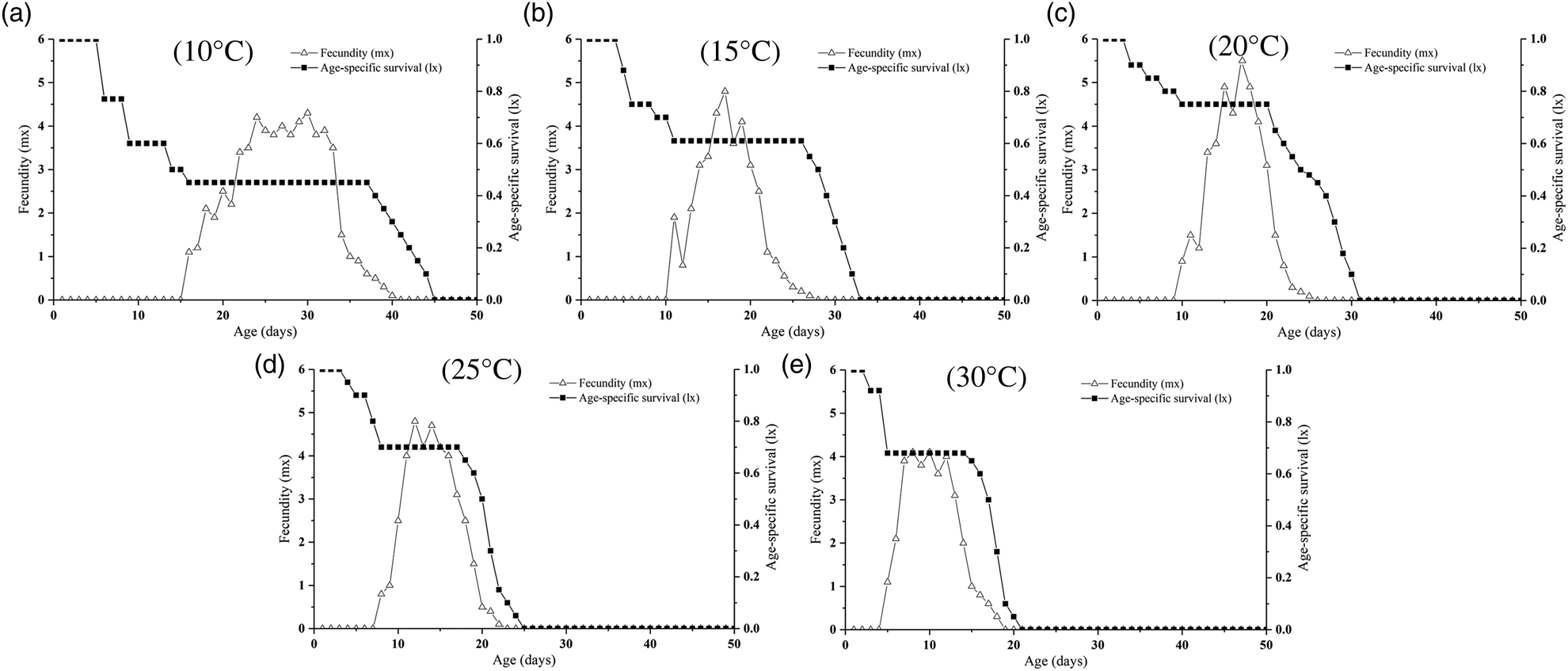
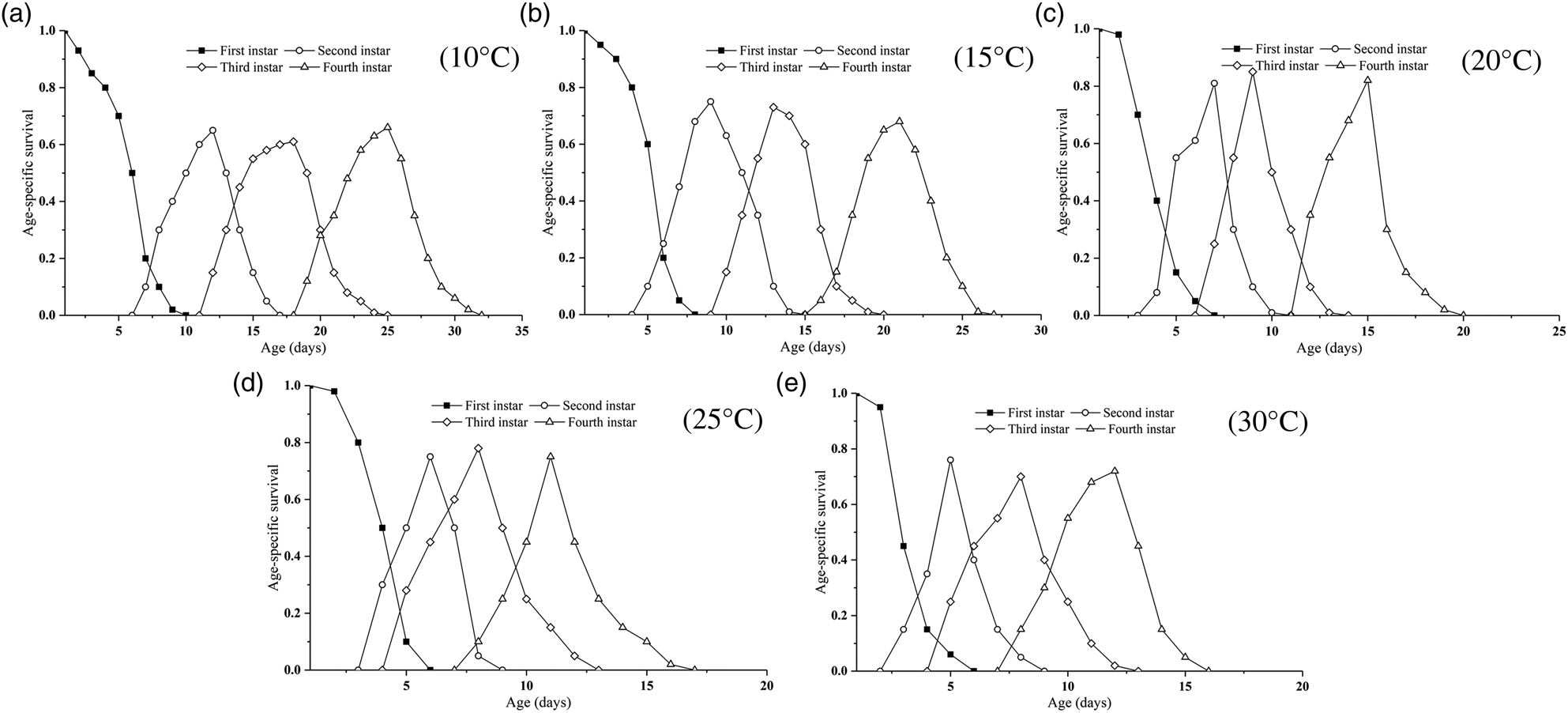
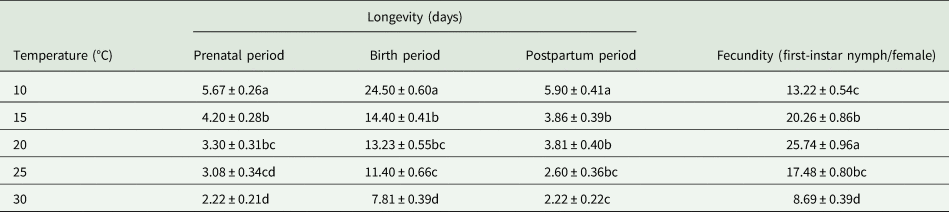
Generally, C. cedri showed similar patterns of age-specific fecundity on C. deodara at five different temperatures (fig. 2a–e). After the beginning of the birth period, the estimated number of first-instar nymphs laid per day peaked at different days. Female adult mortality was initially low, but survival began to decline sharply after day 39 at 10°C, day 28 at 15°C, day 26 at 20°C, day 21 at 25°C and day 17 at 30°C. In addition, the survival times of C. cedri nymph decreased with the increase of temperature, and the highest survival rate of C. cedri nymph occurred at 20°C (fig. 3a–e). Different temperatures significantly affected the prenatal period (F 4,130 = 24.11, P < 0.001), birth period (F 4,130 = 148.98, P < 0.001), postpartum period (F 4,130 = 18.10, P < 0.001) and fecundity (F 4,130 = 168.23, P < 0.001) of female C. cedri. Prenatal period, birth period, postpartum period decreased progressively as temperature increased. Prenatal period, birth period and postpartum period from 30 to 10°C were 2.22 to 5.67, 7.81 to 24.56 and 2.22 to 5.90 days, respectively (table 3). Female adult of C. cedri showed different fecundity performances at different temperatures, and the fecundity of C. cedri reached the maximum at 20°C, which was 25.74 first-instar nymphs/female.
Age-specific survival (lx) and fecundity (mx) of C. cedri on C. deodara at five different temperatures ((a) 10°C; (b) 15°C; (c) 20°C; (d) 25°C; (e) 30°C).

Age-specific survival of C. cedri nymphs on C. deodara at five different temperatures ((a) 10°C; (b) 15°C; (c) 20°C; (d) 25°C; (e) 30°C).

Longevity and fecundity of C. cedri females at different temperatures fed on C. deodara

Mean ± SE with the same column the values with different letters are significantly different (one-way analysis of variance followed by Tukey's HSD tests, P < 0.05).
Effects of temperature on the life table parameters of C. cedri
Temperature significantly affected the population parameters of C. cedri (table 4). With the increase of environmental temperature, the generation time (T) was shortened from 48.56 ± 3.15 at 10°C to 20.09 ± 2.76 at 30°C. The value of net reproductive rate (R 0), intrinsic rate of increase (r), finite rate of increase (λ) increases first and then decreases with the increase of temperature, and reached a maximum value at 20°C (19.06 ± 2.05, 0.11 ± 0.03 and 1.12 ± 0.02, respectively).
Life-table parameters of C. cedri at five constant temperatures fed on C. deodara

Discussion
Temperature, as an important ecological factor, has a significant impact on the development duration, fecundity and population dynamics of insects (Campbell et al., Reference Campbell, Frazer, Gilbert, Gutierrez and Mackauer1974; Özder and Ozgur, Reference Özder and Ozgur2013; Cao et al., Reference Cao, Li, Yang, Meng, Wang, Shang and Gao2018). A large number studies have shown that the developmental duration of insects shortens with the increase of temperature over the appropriate temperature range (Cui et al., Reference Cui, Zhu, Bi, Xu, Gao and Shi2018; Abu Alloush, Reference Abu Alloush2019). In this study, developmental duration of each developmental stage of C. cedri was shortened as the temperature increased from 10 to 30°C. However, C. cedri could complete its whole growth and development process at 30°C. This may be because the maximum temperature in the design of this experiment has not yet reached the temperature that limits the development of C. cedri. Although the appropriate temperature will promote the growth and development of insects, the development of insects will be delayed, stagnated or the insects may die if the temperature exceeds the developmental temperature (Davidson, Reference Davidson1994). A piece of white paper (1 m × 1 m) was hung under the branches of C. deodara in August 2019 (average temperature 32°C). After a week of observation, it was found that there was no honeydew on the white paper indicating that the aphid activity was less. This may be due to the high temperature, coupled with increased rainfall, which causes C. cedri dormant or diapause. Therefore, the tolerance of C. cedri to high temperature needs further study.
In addition, the temperature can significantly affect the longevity of female adult aphids of C. cedri. With the increase of temperature, the longevity of C. cedri decreases gradually, the longevity at 10°C is 36.30 days, and the longevity at 30°C is only 12.19 days. Guo (Reference Guo2012) found that the adult aphid longevity of Aphid gosypii Glover decreased from 11.25 to 3.00 days with increasing temperature in the range of 18–30°C. Durak and Borowiak-Sobkowiak (Reference Durak and Borowiak-Sobkowiak2013) found that the adult aphid longevity of Cinara cupressi was also related to temperature, and the adult aphid longevity was 40.4 days at 25°C and 25.1 days at 28°C.
There are some differences in the developmental threshold temperature of different species of aphids, but most of them are around 4°C (Shao et al., Reference Shao D, Duan L and Duan J2017). In this study, the results showed that the developmental threshold temperature of first-instar nymph, second-instar nymph, third-instar nymph, fourth-instar nymph and adult aphid is 4.13, 5.83, 6.50, 8.95 and 5.65°C, respectively. The eggs of C. cedri have hatched by the middle of March in Tai'an, Shandong province. The temperature in the middle of March is 6–16°C, which is close to the developmental threshold temperature of C. cedri. Combined with the annual average temperature in Shandong province, the theoretical generation of C. cedri is estimated to be 7–8 generations per year. However, the generations of aphids are affected by climate change under field conditions (Beetge and Krüger, Reference Beetge and Krüger2019).
The best indicator to measure the relationship between insect population growth and the temperature is intrinsic growth rate, which can generally reflect the effects of temperature on insect development, reproduction and survival. Typically, the intrinsic growth rate of aphid population is the highest in the temperature range of 25–30°C (Gilbert and Raworth, Reference Gilbert and Raworth1996; Özder and Ozgur, Reference Özder and Ozgur2013), such as Schizolachnus pineti in 24–36°C (Holopainen and Kainulainen, Reference Holopainen and Kainulainen2004) and Cinara pinea in 21°C (Shao et al., Reference Shao D, Duan L and Duan J2017). In this study, the intrinsic growth rate of C. cedri is the highest at the temperature of 20°C. The results of this study are consistent with maximum populations occurring in the cooler months of spring.
Financial support
This study was supported by the Tai'an Science and Technology Development Plan Project (201640576), and the Shandong Agricultural Science and Technology Innovation (Forestry Science and Technology Innovation) Project (2019LY003).
Conflict of interest
The authors declare that they have no conflict of interest.
Ethical standards
This paper does not contain any studies with human participants or animals performed by any of the authors.