Introduction
Designers make many decisions throughout the design process. These decisions, and the reasons behind them, form the design rationale (DR) for the system or artifact created. DR includes potentially useful information such as the alternative designs considered, reasons for and against these alternatives, questions raised during the process and the procedure followed to answer them, and the final decision made. This information has many potential uses. For example, understanding past decisions can help predict the results of new decisions in similar situations (Brazier et al., Reference Brazier, van Langen and Treur1997). The rationale provides a record of what the original designers of a system intended, which helps new designers joining the team remain consistent with that intent. The rationale can also be used to improve design processes (King and Bañares-Alcántara, Reference King and Bañares-Alcántara1997) and support design reuse (de Medeiros and Schwabe, Reference de Medeiros and Schwabe2008). If the rationale was available, designers and re-designers would be able to take this information into account when revising earlier decisions or making new ones.
There are many possible uses of DR, but it is often not captured explicitly because of perceptions that it is expensive and time-intensive (Burge and Brown, Reference Burge, Brown and Gero2004). It is often captured implicitly, however, and potential sources include e-mail discussions between design contributors, transcripts of design discussions, project specifications, and domain-specific documents, such as software bug reports. DR could be manually extracted from these text documents, but this task is considered tedious and time-consuming. A preferable approach would be to have automated extraction tools to identify and extract the DR from existing documents. The extracted rationale could then be structured and formatted as needed, a process called “incremental formalization” (Shipman and McCall, Reference Shipman and McCall1994).
We have been investigating techniques for mining rationale from text documents using text mining techniques to classify sentences as rationale. These techniques use features found in the documents being classified as an input into machine learning classifiers to build models that can be used to classify additional data. Document features that can be used include parts-of-speech (verbs, nouns, adverbs, etc.), word combinations (n-grams), sentence length, and domain-specific terminology. Finding good feature sets for text mining is a critical part of this process. The feature sets available for text mining are numerous, and it is difficult to determine which ones will have the most predictive power. While it is sometimes possible to use all of the features when text mining, this can cause problems when irrelevant features, features that do not relate to whether a sentence contains rationale or not, are used and less, then optimal results are returned. Using all of the features is also very expensive when considering the time and space requirements of a text mining algorithm.
Feature sets can be selected using statistical techniques (such as chi-squared, document frequency, mutual information, and term strength) (Aghdam et al., Reference Aghdam, Ghasem-Aghaee and Basiri2009). Alternative approaches use nature-inspired algorithms such as ant colony optimization (ACO) and genetic algorithms (GAs). These algorithms perform a broader search of the feature space by introducing randomness along with the knowledge from previous iterations to search for more optimal feature sets (Aghdam et al., Reference Aghdam, Ghasem-Aghaee and Basiri2009).
In the work described in this paper, we decided to compare two different evolutionary algorithms – ACO (Dorigo, Reference Dorigo1992) and GAs (Holland, Reference Holland1975/1992). ACO simulates the process that ants take to find food sources, while GAs mimic the process of natural selection by representing solutions as chromosomes and evolving them over multiple generations (iterations).
This work addresses the following research questions:
1. Does using evolutionary algorithms for feature selection improve performance when identifying rationale compared to building classifiers without feature selection?
2. How does the classification performance of the ACO selected feature set compare to the GA selected feature set?
We measure performance using the F-1 measure, the harmonic mean of the precision and recall. The F-1 measure takes into account false positives and false negatives. This makes it a better representation of how successful a classifier is than measuring accuracy, which can give misleading results if a dataset is imbalanced (Skiena, Reference Skiena2017). For example, if 10% of the instances belong to the target category and all instances are given a negative classification, then the accuracy would be 90% even though none of the target instances were found.
The remainder of the paper is structured as follows: The “Related research” section describes related work in feature set selection and rationale extraction. The “Approach for mining rationale” section describes our approach which includes how we prepared our training data, a description of the “pipeline” we used to integrate evolutionary algorithms for feature selection with a classifier to extract rationale, our approach to using ACO for feature selection, and how we used a GA for feature selection. The “Results” section gives the results of our experiments, and the “Conclusions and future work” section summarizes our results and plans for future work.
Related research
DR is an active area of research in many domains, including Human–Computer Interaction (Moran and Carroll, Reference Moran and Carroll1996), Software Engineering (Dutoit et al., Reference Dutoit, McCall, Mistrik and Paech2006; Burge et al., Reference Burge, Carroll, McCall and Mistrik2008), and Engineering Design (Chung and Bañares-Alcántara, Reference Chung and Bañares-Alcántara1997; Lee, Reference Lee1997; Burge and Bracewell, Reference Burge and Bracewell2008). Here, we are focusing on work in two areas: feature set selection and rationale extraction.
Feature set selection
Text mining models work on looking for patterns of text features (specific words, parts-of-speech, etc.) that indicate if the rationale is present. Features that are irrelevant (those without any correlation to the classification goals) can confuse classifiers that will try to fit to them and lead to sub-optimal performance then if only a subset of the features were used. Feature selection refers to the process of choosing which features are most likely to be predictive.
Many variations of ACO algorithms are having success over nonevolutionary methods when applied to feature selection for classification problems. Al-Ani (Reference Al-Ani2005) used ACO to select feature sets for speech segment and image texture classification. He compared results using ACO with results from a GA. ACO slightly outperformed the GA with a classification accuracy of 0.842 versus the GA accuracy of 0.835. We cannot compare these results to ours since we chose to use the F-1 measure rather than accuracy since accuracy can produce misleading results in imbalanced datasets.
Aghdam et al. (Reference Aghdam, Ghasem-Aghaee and Basiri2009) used the ACO algorithm to reduce the dimensionality of the search space for a text categorization problem. They compared the performance of their ACO-based approach to GA, chi-squared (CHI), and information gain (IG), on the Reuters-21578 benchmark dataset. In the experiments, ACO outperformed all other methods. They calculated a Macro-F1 score (an F-1 measure that calculates a score for multiclass classification by equally weighting all classes). Their experiments resulted in Macro-F1 scores of 0.784 with ACO, 0.763 with GA, 0.709 with CHI, and 0.698 with IG. They also calculated Micro-F1 scores (a measure that gives the highest weights to more common classes) of 0.891 with ACO, 0.864 with GA, 0.822 with CHI, and 0.809 with IG.
Saraç and Özel (Reference Saraç and Özel2014) used the ACO for web page classification. They worked with a very high-dimensional feature space that consisted of pairs of “tagged terms” (e.g., <url><term>). For each of the five datasets examined, they achieved better F-measures by using ACO selected features. The ACO had an average F-measure of 0.952, compared to 0.684 without feature selection. They also implemented ACO with an ant feature subset construction method that reduced unnecessary computation by choosing features in groups rather than individually. We integrated this approach into our ACO as well.
GAs are also used in feature selection. Ozyurt (Reference Ozyurt2012) used a GA-based feature selection technique to classify biomedical literature. Mukherjee et al. (Reference Mukherjee, AL-Fayoumi, Mahanti, Jha and Al-Bidewi2010) used a GA to select optimal features for classifying e-mails. They form chromosomes from topics in the document and select the “parents” for the next generation by randomly choosing half of the chromosomes with the highest fitness.
Hybrid algorithms capture the best features of multiple algorithms. Zaiyadi and Baharudin (Reference Zaiyadi and Baharudin2010) performed feature subset selection by hybridizing ACO with IG. They used this technique to reduce the dimensionality of feature space for text document categorization by using IG as the heuristic desirability measure for each ant. Ali and Shahzad (Reference Ali and Shahzad2012) combined ACO with symmetric uncertainty (SU) (a variation of IG). In the ACO-SU algorithm, the fitness is calculated by weighting the length of the chosen subset and the sum of the SU for all the features chosen in the subset. We have inspired these two methods and used the IG statistic of chi-squared as our measure of a heuristic value.
Some hybrid algorithms combine GAs and ACO algorithms. Basiri and Nemati (Reference Basiri and Nemati2009) did this by having ants select a population and then applying selection, mutation, and crossover. They then exchanged poor performing individuals with better ones found by the GA. This hybrid algorithm performed better ACO alone. Roeva et al. (Reference Roeva, Fidanova and Atanassova2013) combined ACO and GAs by using ACO to generate an initial population for the GA, so the GA could start with a population that was nearer to an optimal solution than one selected randomly. This allowed them to reduce computational time by using smaller populations.
Jiang et al. (Reference Jiang, Liu, Zhu and Zhao2009) hybridized the GA with a taboo search algorithm for feature subset selection for text categorization. They incorporated the taboo search's memory function into the GA's evolution-based search.
Rationale extraction
Liang et al.’s work (Reference Liang, Liu, Kwong and Lee2012) extracted DR from patent documents. They used a three-tiered model to capture issues, design solutions, and artifacts. They started by identifying artifacts using a modified PageRank (Brin and Page, Reference Brin and Page1998) algorithm on frequently appearing words. Issue summarization was then done by using issue language patterns in the manifold ranking. The final step identified reason sentences and paired them with the remaining solution sentences to create reason-solution pairs. This was done using reason language patterns. They achieved a 0.185 F-measure for artifact identification, a 0.520 F-measure for issue summarization, and a 0.562 F-measure for reason-solution extraction.
López et al. (Reference López, Codocedo, Astudillo and Cysneiros2012) worked on recovering DR from existing software documents, as well as representing the rationale and integrating the rationale with a software tool. They use ontology-based extraction of software design rationale, where the ontologies relate concepts of software architectures and thesauri of relevant terms. They used documents for designs of a security clearing system to evaluate their tool and achieved an F-measure of 0.5 for recovering rationale, beating the F-measure for manual recovery of 0.42 and taking less time.
Mao et al. (Reference Mao, Mercer and Xiao2014) looked for argument rationale in the Wikipedia article for deletion discussion forums. Their main goal was to identify direct imperative arguments. They achieved an F-measure of 0.7874 on the Wikipedia data.
Kurtanovic and Maalej (Reference Kurtanovic and Maalej2018) used Amazon reviews of software products as a source of user rationale. They trained their classifiers on a set of influential terms, review metadata, and a syntax tree of the review text. They were looking for five categories of rationale: issues, describing problems with the software; alternatives, which could refer to alternative software products, alternative versions of the software, alternative features of a different type of software, and other types of alternatives; criteria, which include usability, reliability, performance, supportability, and other criteria; decisions, which include acquiring software, relinquishing software, switching software, and other decisions; and justifications, which are sentences that justify other sentences that contain purpose clauses, reason clauses, and independent clauses. They evaluated seven different classification algorithms. The algorithms, features, and preprocessing step combinations were combined randomly, and they evaluated between 10,109 and 17,457 different configurations. The evaluation was done using cross-validation rather than holding out data for testing. They were able to get F-1 measures of 0.77 for issues, 0.82 for alternatives, 0.77 for criteria, 0.83 for decisions, and 0.74 for justifications.
Alkadhi et al. (Reference Alkadhi, Nonnenmacher, Guzman and Bruegge2018) used machine learning techniques to classify Internet Relay Chat (IRC) messages into those with rationale and those without. They achieved an F-1 measure of 0.61 for classifying messages with rationale at the message level. This was done using 3-fold cross-validation where each fold consisted of messages from a different project. The classifier with the best results was multinomial Naïve Bayes.
Rogers et al. (Reference Rogers, Gung, Qiao and Burge2012) experimented with using two feature sources – ontologies (vocabularies of potential arguments and domain terminologies) and a small set of linguistic features (modal auxiliaries, adverbial clauses, and projective clauses). They used these features with a large number of different classifiers to identify DR in Chrome bug reports. The best F-1 measure achieved with ontologies was 0.597 for binary classification (rationale/not rationale). This small set of linguistic features resulted in an F-1 measure of 0.336. Expanding to a larger set of linguistic features and a more rigorously annotated dataset produced better results; improving the F-1 measure to 0.676 for binary classification and 0.569 for the argumentation subset (binary classification of rationale excluding the questions, answers, and procedures that commonly occurred along with boilerplate text making them easier to identify) (Rogers et al., Reference Rogers, Qiao, Gung, Mathur and Burge2014). Our earlier work using GAs and WEKA (Waikato Environment for Knowledge Analysis) for feature selection and classification (Rogers et al., Reference Rogers, Justice, Mathur and Burge2016) resulted in F-1 measures of 0.576 for the argumentation subset of the Chrome bug reports (using 10-fold cross-validation). This was not the same implementation of the GA described in this paper and used fewer document features.
McCall (Reference McCall2018) also extracted the rationale from design discussions. This was done by building an Argumentative Semantic Grammar, ASGARD (Argumentative, Semantic Grammar for Analysis of Rationale for Design). This grammar contained rules for parsing text and forming it into a version of the PHI (Procedural Hierarchy of Issues) schema (McCall, Reference McCall1991). This grammar was customized for the particular design transcript, so more testing is needed to see how it generalizes to other documents.
A final set of papers refers to arguments in legal texts, which tend to have a higher density of rationale [about 50% for legal texts (Palau and Moens, Reference Palau and Moens2009) compared to 11% for bug reports (Rogers et al., Reference Rogers, Qiao, Gung, Mathur and Burge2014)]. Prakken et al. (Reference Prakken, Reed and Walton2003) explored the formalization of rationale arguments in legal texts, using common legal argumentation structures as a base. Moens et al. (Reference Moens, Boiy, Palau and Reed2007) explored the automatic extraction of rationale arguments from legal texts, experimenting with a number of different feature sets. They found that the best performing feature sets were unigrams, bigrams, word couples, and combinations including the three, with F-measures ranging from 0.704 to 0.738. Palau and Moens (Reference Palau and Moens2009) built on the previous rationale argumentation work by adding a context-free grammar to automatically structure argumentation text, obtaining around 60% accuracy.
Approach for mining rationale
DR could appear in a variety of different types of text documents. Some are domain neutral, such as meeting transcripts, meeting minutes, e-mail messages, discussion boards, and design documentation. Others are more domain-specific, such as the bug reports used in software development projects. Our eventual goal would be to take a potentially large number of documents and extract the rationale, so it would be available to engineers to assist with making and revising decisions.
We followed a text mining process that used a set of data labeled as rationale to train a classifier that could then be used to classify additional data. The following sections describe how we prepared our training data, a description of our general pipeline used to build the classifiers, and then the two specific feature selection algorithms used in this work.
Training data
We annotated documents with rationale using GATE (General Architecture for Text Engineering) (Cunningham et al., Reference Cunningham, Maynard and Bontcheva2011) with by having two researchers annotate and a third researcher adjudicate using a process described in Rogers et al. (Reference Rogers, Qiao, Gung, Mathur and Burge2014). We also used GATE to automatically annotate the parts-of-speech from the Penn Treebank (Marcus et al., Reference Marcus, Marcinkiewicz and Santorini1993) and custom features specific to this project: ontology terms (Burge, Reference Burge2005; Rogers et al., Reference Rogers, Gung, Qiao and Burge2012), sentence length (Rogers et al., Reference Rogers, Qiao, Gung, Mathur and Burge2014), and acronyms (Mathur, Reference Mathur2015).
The experiments described here worked with two different datasets. The first consisted of bug reports for the Chrome web browser that were provided for the Mining Software Repositories Mining Challenge (http://2011.msrconf.org/msr-challenge.html). We selected 200 bug reports from this repository. Our second dataset consisted of transcribed design discussions that took place during the Studying Professional Software Designer (SPSD) project. These two datasets provide two different views of rationale sources in the category of design communication (Shipman and McCall, Reference Shipman and McCall1997) where one is asynchronous (bug reports) and the other synchronous (discussion transcripts). The bug reports are a type of document specific to a domain (software engineering), while design discussion transcripts are more domain neutral, although these specific transcripts involved discussions between software developers.
The data wasannotated looking for specific types of rationale [adapted from Burge and Brown (Reference Burge and Brown2003)]:
• Requirements – statements referring to functionality that the software was required to have;
• Decisions – statements that indicated what issue had to be resolved;
• Alternatives – different options for resolving the issue described by a decision;
• Arguments – reasons for or against an alternative;
• Assumptions – claims made where the author indicated uncertainty;
• Questions – questions posed that indicate where more information is needed to make a decision;
• Procedures – description of actions needed to gain information required to answer a question or make a decision;
• Answers – answers to questions posed in the rationale.
A sentence can be classified as more than one type of rationale.
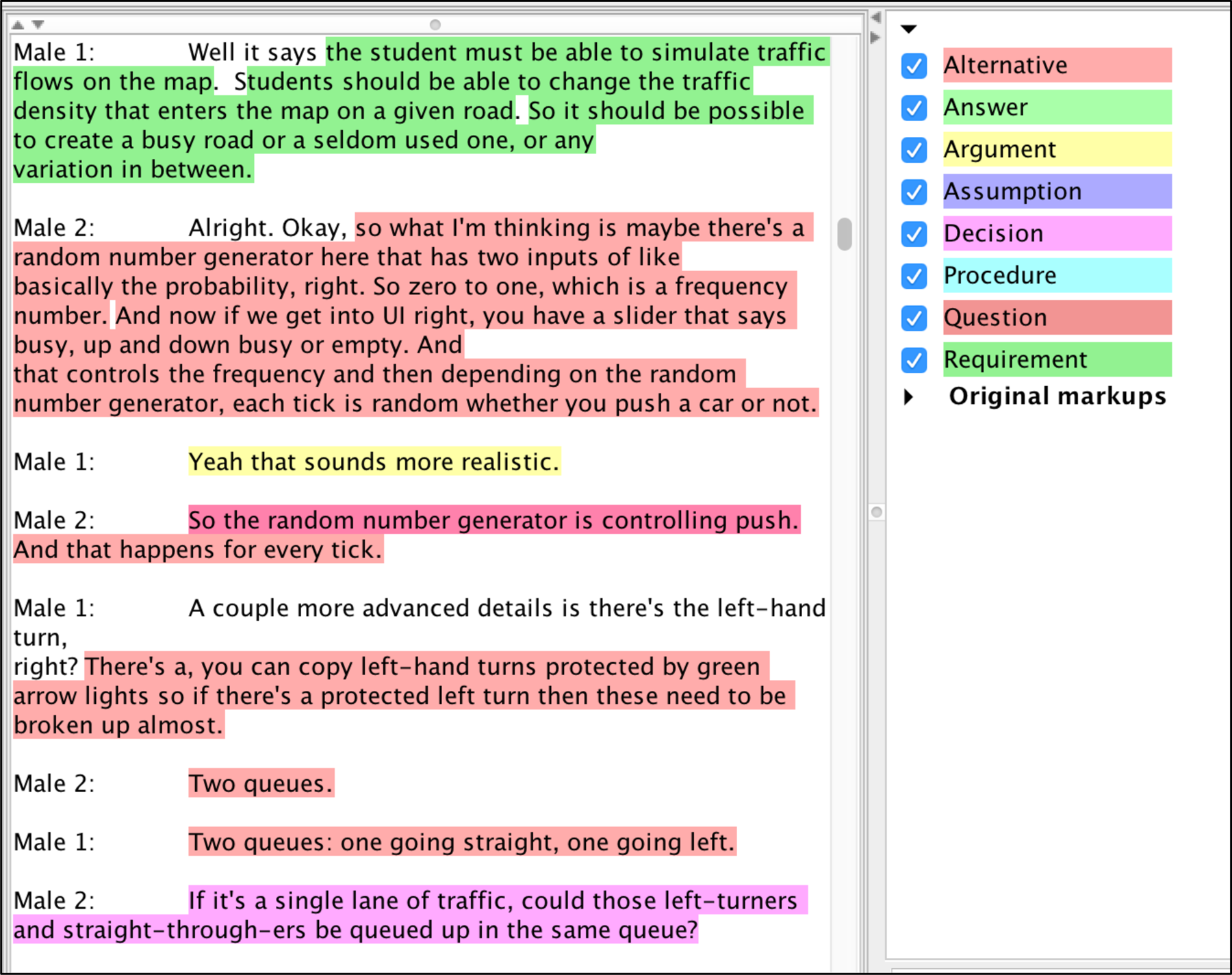
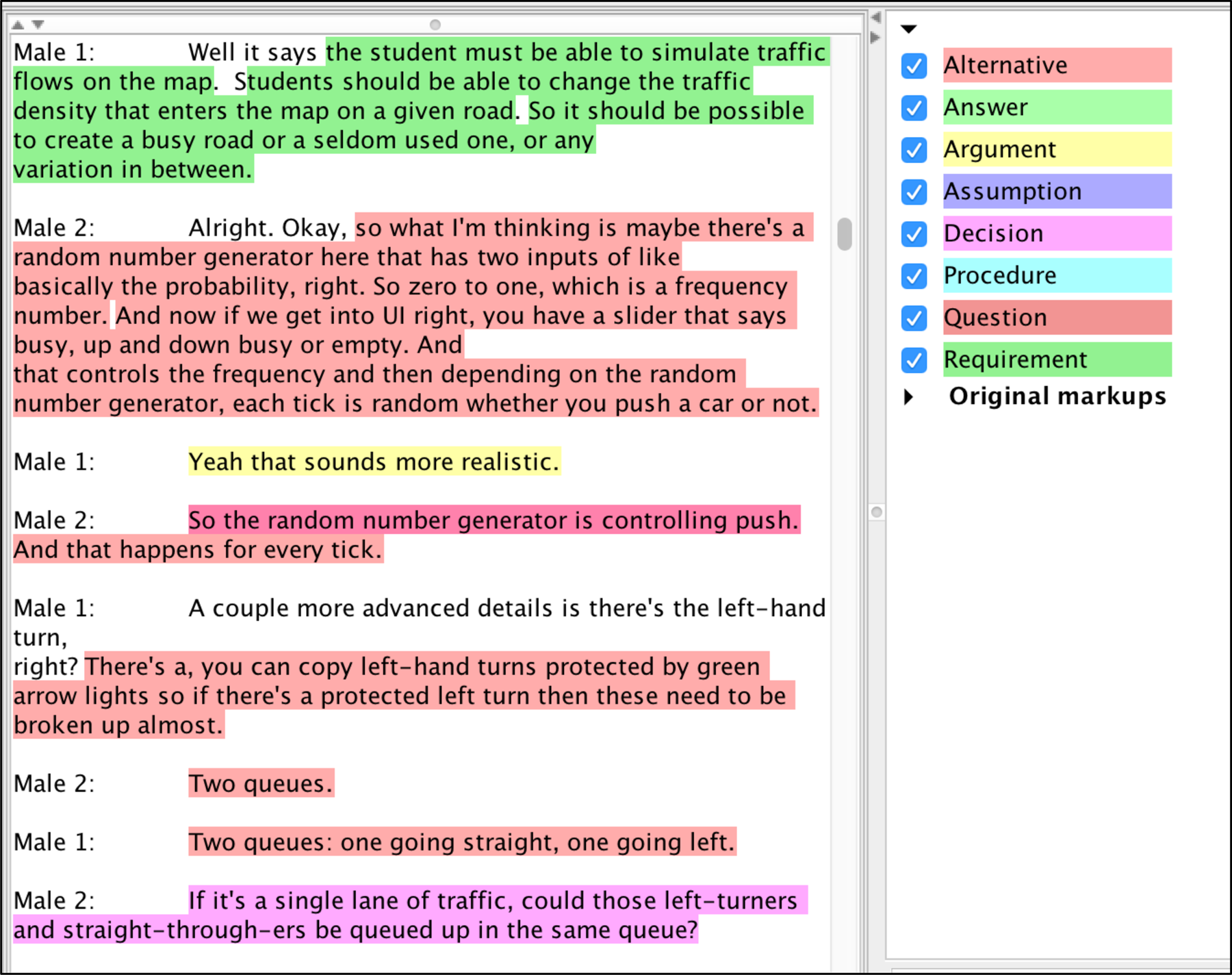
Figure 1 shows some example annotations inside GATE, the tool that was used to annotate the documents. This example shows a selection from the SPSD dataset.
Annotated document in GATE.
The experiments described in this paper were designed to look for five different classification targets:
• Binary rationale – a sentence was either rationale (any one of the above types) or nonrationale.
• Argumentation subset – a sentence was either argumentation (a requirement, decision, alternative, argument, or assumption) or not.
• Decisions – a sentence was a decision or not.
• Alternative – a sentence was an alternative or not.
• Arguments-all – a sentence was a requirement, argument, or assumption or not.
The argumentation subset classification was used to compare results that included questions, procedures, and answers to those that did not. Questions, procedures, and answers frequently appeared in the boilerplate, common text at the start of each bug report. This made them easier to classify than the argumentation. The arguments-all classification was used because determining if an argument referred to a requirement, assumption, or something else was subjective. What might be a requirement for the author of a bug report (for example) might not actually be a requirement for the system being described.
Pipeline for text processing and model building
For our earlier work (Rogers et al., Reference Rogers, Justice, Mathur and Burge2016), we built the GATE_WEKA pipeline, which started with exported GATE XML files and automatically ran WEKA tests as specified by the user. This has a number of limitations, not the least of which were feature set size limitations imposed by WEKA. For this work, we built a new pipeline that was no longer GA-specific, so we could use the same pipeline for both the ACO and GA-based subset selection algorithms.
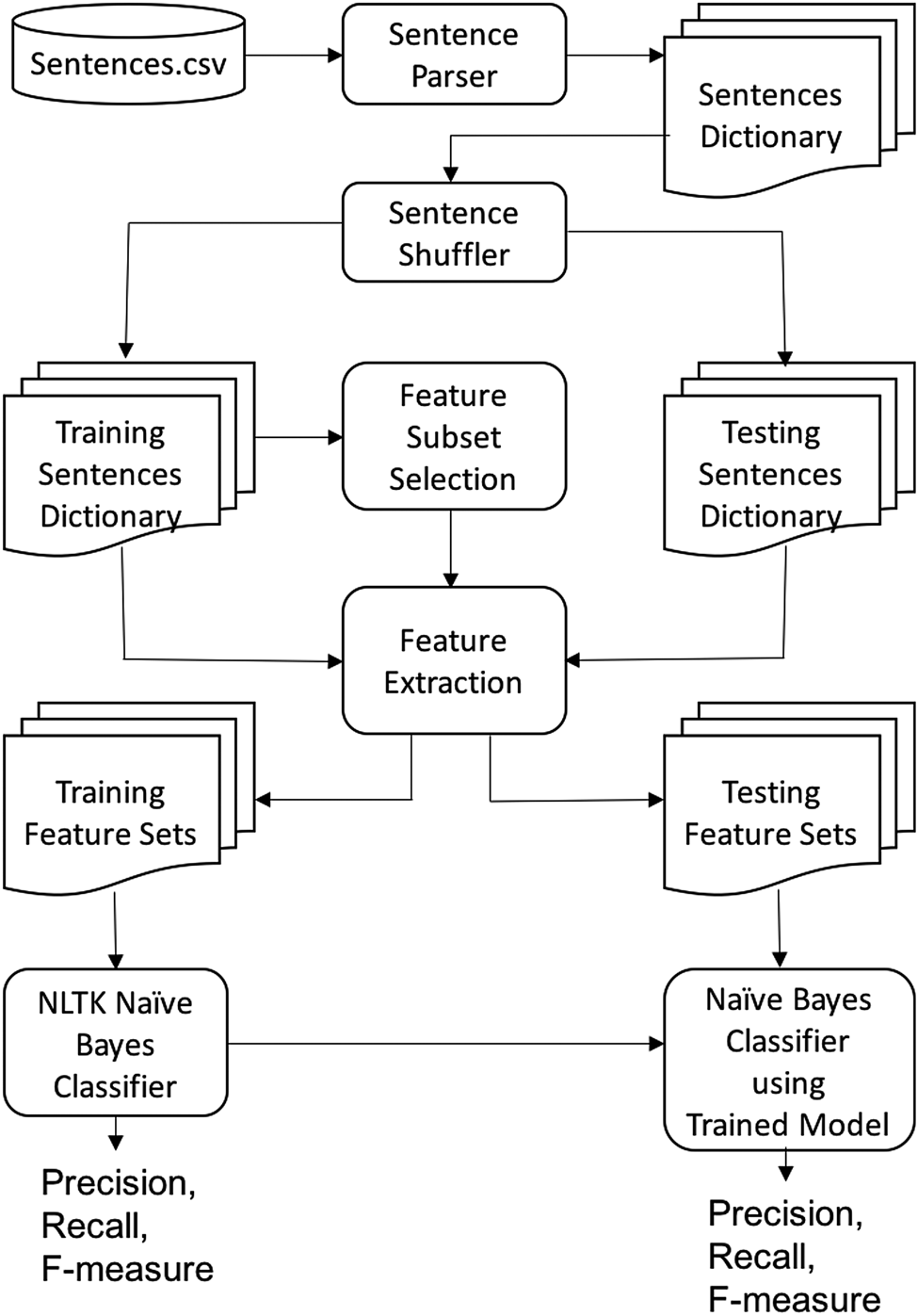
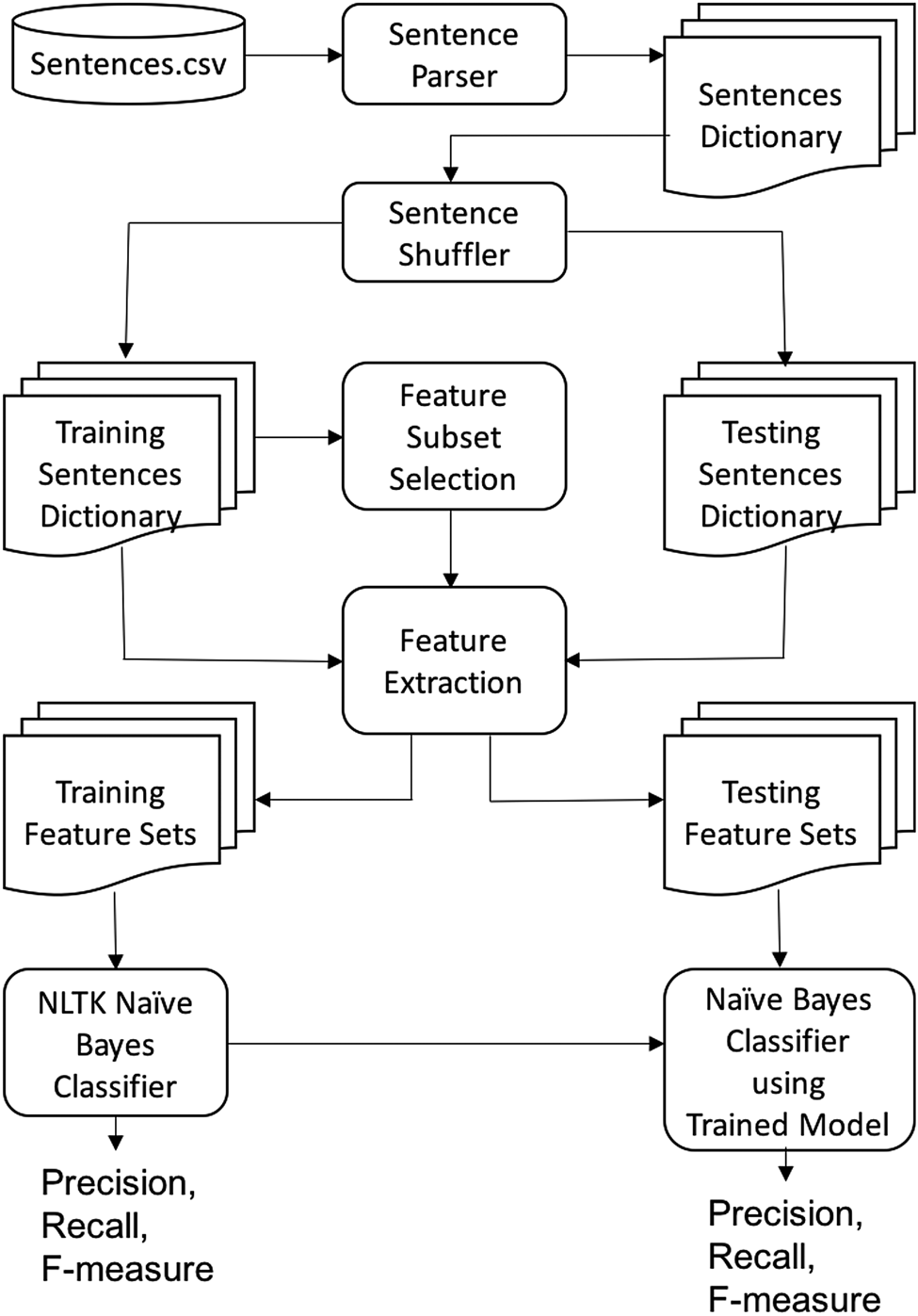
Figure 2 shows the pipeline for building classifiers. The following paragraphs describe each major component.
Pipeline for classifier building (Lester and Burge, Reference Lester and Burge2018).
Sentence parser
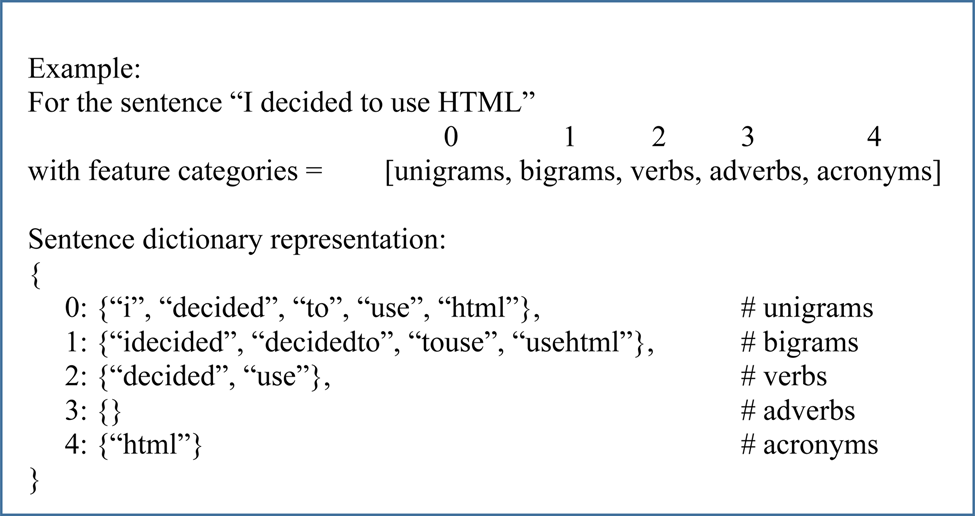
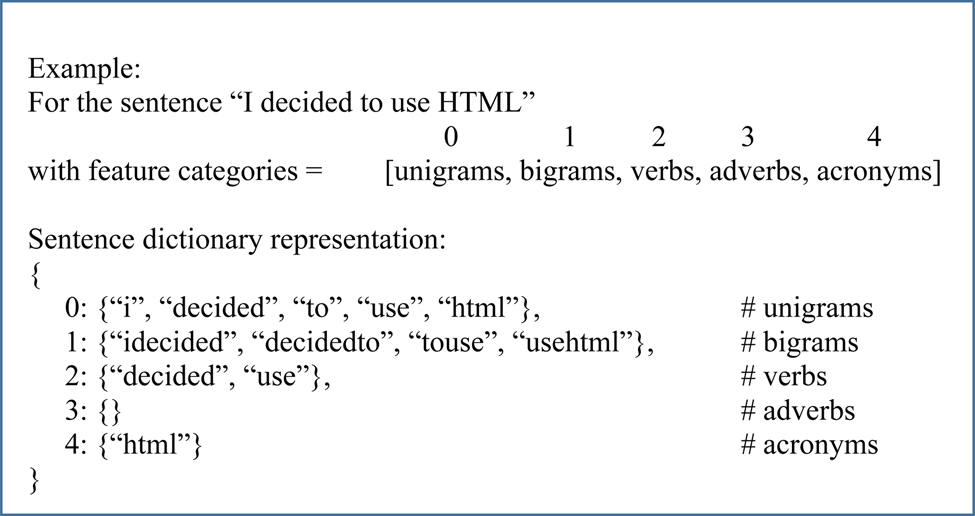
The input to the pipeline is a file (sentences.csv) that contains the features extracted from each sentence along with its rationale annotations. The sentence parser uses the sentence.csv file to create a sentence dictionary data structure for each sentence (Fig. 2). The dictionary structure organizes all the features where each (key, value) pair holding information about an individual feature category. The key is the ID of the feature category, and the value is the set of all feature instances of that feature category for that sentence. With a dictionary structure, each category can be accessed in constant time, allowing the feature set to be created from a simple union of instances from each category in the chosen subset of categories. In addition to discrete feature types, such as verbs and adverbs, we also used n-grams of words and feature types (as shown in Fig. 3). We captured features from adjacent sentences since context is likely to be important in identifying rationale.
Sentence dictionary representation.
We split the data into training (70%) and test (30%) sets, being careful to not have sentences in the same bug report or transcript appear in training and test. The corresponding entries from the sentence dictionary are written into either the Training Sentences File or the Test Sentences File.
Feature subset selection
This component is implemented using either the ACO or GA, as described in “ACO for feature selection” and ”GAs for feature selection” sections. The common aspects to these algorithms are that they iteratively search for a feature subset, train a classifier using those features, and then use the results of the training to choose features for the next iteration. This is done using the Training Sentences File.
Classifier building and evaluation
The optimized feature sets are used to train an NLTK Naïve Bayes classifier using 10-fold cross-validation. After training, we test the classification model using the training set (the 30% of the sentences pulled out before training).
We performed a number of preliminary experiments using different classifiers to select the one to use in our approach. Many did not successfully complete training on our data. Of those that did, the NLTK Naïve Bayes classifier achieved the best F-1 measure.
ACO for feature selection
In 1990, Deneubourg et al. (Reference Deneubourg, Aron, Goss and Pasteels1990) showed that foraging ants find the shortest path between their nest and a food source by using pheromone trails. Ants lay down pheromone trails as they forage for food and these are reinforced as they travel to and from food sources. Dorigo (Reference Dorigo1992) showed that computer simulation of an ant colony can model this process; a method known as the ACO metaheuristic. Many different variations of the ACO were developed, including a version of the ACO for subset problems (Leguizamon and Michalewicz, Reference Leguizamon and Michalewicz1999). We applied ACO to our feature subset selection problem by having each ant construct a subset of features where pheromone trails are applied feature components instead of connections between components using some measure of heuristic desirability of each feature.
Feature subset problems can be considered combinatorial optimization problems. To do this, we map the combinatorial optimization problem to a problem characterized by a finite set C = {c 1, c 2, …, cn} of components, where n is the number of components. Artificial ants perform randomized walks on a completely connected graph G c = (C, L) whose nodes are the components C, and the set L fully connects the components of C. The graph G c is called a construction graph, and the elements of L are called connections (Dorigo and Stützle, Reference Dorigo and Stützle2004). These walks form the solutions. Artificial ants construct solutions, constrained so that components are only added to the current solution if the resulting solution is feasible (Dorigo and Stützle, Reference Dorigo and Stützle2004). Each component ci∈C is associated with a pheromone trail τi and a heuristic value ηi. Each ant updates the pheromones, which constitute a global, long-term memory of good solutions found throughout the search procedure. Pheromone trails evaporate over time to avoid converging to sub-optimal local extrema. We also use a heuristic value which captures information about the problem obtained from a source other than the ants (such as the cost of adding a component to the solution).
Simulated ants move by applying a probabilistic transition rule, which is a function of the locally available pheromone trails, problem constraints, and heuristic values. After a solution has been built, the pheromone levels of the components along their path are updated based on solution quality. Quality (fitness) is evaluated using the Naïve Bayes algorithm. Dorigo explains his algorithm by saying, “It is important to note that ants act concurrently and independently and that although each ant is complex enough to find a (probably poor) solution to the problem under consideration, good-quality solutions can only emerge as the result of the collective interactions among the ants” (Dorigo and Stützle, Reference Dorigo and Stützle2004).
ACO is traditionally applied to ordering problems such as the traveling salesperson problem, where the goal is to find the shortest path that visits all the cities (Dorigo and Stützle, Reference Dorigo and Stützle1999). The ACO can also be used to solve subset problems (Leguizamon and Michalewicz, Reference Leguizamon and Michalewicz1999). In our problem, we are looking for subsets of features. This means that nodes in the graph represent features and the solution is the set of features chosen by the ant. Solutions are constructed by applying a probabilistic transition rule were ants add available features to their current subset until meeting a stopping criteria. Pheromone trails are associated with components (features), not connections.
ACO has been applied to many different types of subset problems (Dorigo and Stützle, Reference Dorigo, Stützle, Gendreau and Yves Potvin2010), including the Multiple Knapsack problem (Leguizamon and Michalewicz, Reference Leguizamon and Michalewicz1999), Set Covering problem (Lessing et al., Reference Lessing, Dumitrescu and Stützle2004), and Maximum Clique problem (Solnon and Fenet, Reference Solnon and Fenet2006). ACO has been further extended to a wide range of machine learning problems, including learning the structure of a Bayesian network (de Campos et al., Reference de Campos, Fernández-Luna, Gámez and Puerta2002) and learning rules in a Fuzzy system (Casillas et al., Reference Casillas, Cordón and Herrera2000).
Implementing the ACO requires defining the following critical components (Dorigo et al., Reference Dorigo, Maniezzo and Colorni1996; Aghdam et al., Reference Aghdam, Ghasem-Aghaee and Basiri2009; Basiri and Nemati, Reference Basiri and Nemati2009; Kanan et al., Reference Kanan, Faez and Hosseinzadeh2007):
1) Graphical representation of the problem: A fully connected graph with nodes and edges between nodes representing the discrete search space of the problem (Basiri and Nemati, Reference Basiri and Nemati2009). It must be able to represent a solution to the problem. For our problem, each node is a feature category and traversing connections means selecting the category.
2) Feasible solution construction constraint: A mechanism to make sure only feasible solutions are built (Basiri and Nemati, Reference Basiri and Nemati2009). In our case, we stop after a pre-specified number of nodes has been chosen, with each one chosen by satisfying the probabilistic transition rule.
3) Heuristic desirability: A “measure of goodness” (Kanan et al., Reference Kanan, Faez and Hosseinzadeh2007) of adding any component to a partially constructed solution. Because this is a subset problem, the heuristic value is associated with a feature instead of the edge between two features (Leguizamon and Michalewicz, Reference Leguizamon and Michalewicz1999). We defined local importance (LI) as the heuristic measure and calculated LI as the highest chi-squared statistic of all terms in a feature category.
4) Pheromone update rule: A rule for updating pheromone levels – a strategy for increasing pheromone concentration for previously successful solutions, and an evaporation rule to globally decrease pheromone levels over time (Kanan et al., Reference Kanan, Faez and Hosseinzadeh2007) This constitutes the autocatalytic feedback process. Because this is a subset problem, the pheromone value is associated with a feature rather than the edge between two features. The pheromone update rule for an ant is shown below, where pheromone of feature i is being updated from
 $T_i\to {T}^{\prime}_i{\rm \;}$, with ρ representing the pheromone evaporation rate. Our ACO implementation follows the standard method of selecting the k best ants (those whose solutions had the highest fitness) and updating the paths they took (Kanan et al., Reference Kanan, Faez and Hosseinzadeh2007), to reinforce the success of these best paths.
For each feature f i, the new pheromone level for an ant in the set of k best ants is given as follows:
$$\Delta T_i = \displaystyle{{{\rm fitness}\lpar {{\rm ant}} \rpar - {\rm worst}_{{\rm fitness}}} \over {\mathop {\max} \limits_{\,j = 1:k} \lpar {{\rm fitness}\lpar j \rpar -{\rm worst}_{{\rm fitness}}} \rpar }},$$where ρ is the evaporation rate.$$T_i^{\prime} = \lpar {1-\rho} \rpar {\rm {^\ast}\;} T_i + \Delta T_i{\rm\comma \,}$$We chose 20 as the number k, 0.1 as the pheromone evaporation rate (ρ), and our fitness function used the NLTK Naïve Bayes classifier.
5) Probabilistic transition rule: A solution construction rule that computes the probability of an ant next moving to a new node in the graph (Basiri and Nemati, Reference Basiri and Nemati2009). In our implementation, each ant chooses p features that maximize updated selection measurement (USM).
$${\rm USM}_i^{s_j} = \left\{ {\matrix{ {\displaystyle{{{(T_i)}^\eta {({\rm LI}_i^{s_j} )}^\kappa} \over {\sum\nolimits_{g\notin S_j} {{(T_g)}^\eta} {({\rm LI}_g^{S_j} )}^\kappa}}} & {{\rm if}\,i\notin S_j} \cr 0 & {{\rm otherwise}} \cr}}. \right.$$


The USM of feature i with respect to S j (the subset of ant j): T i is the pheromone level of feature f i; η is the relative weight of pheromone intensity; LIi is the local importance of feature f i; and κ is the relative weight of local importance.
We chose 1 as the initial pheromone level (T i), and 1 and 2 as the relative weights of pheromone intensity (η) and local importance (κ), respectively. These were determined experimentally to decrease the speed of convergence, so ants did not get stuck in poor local optima.
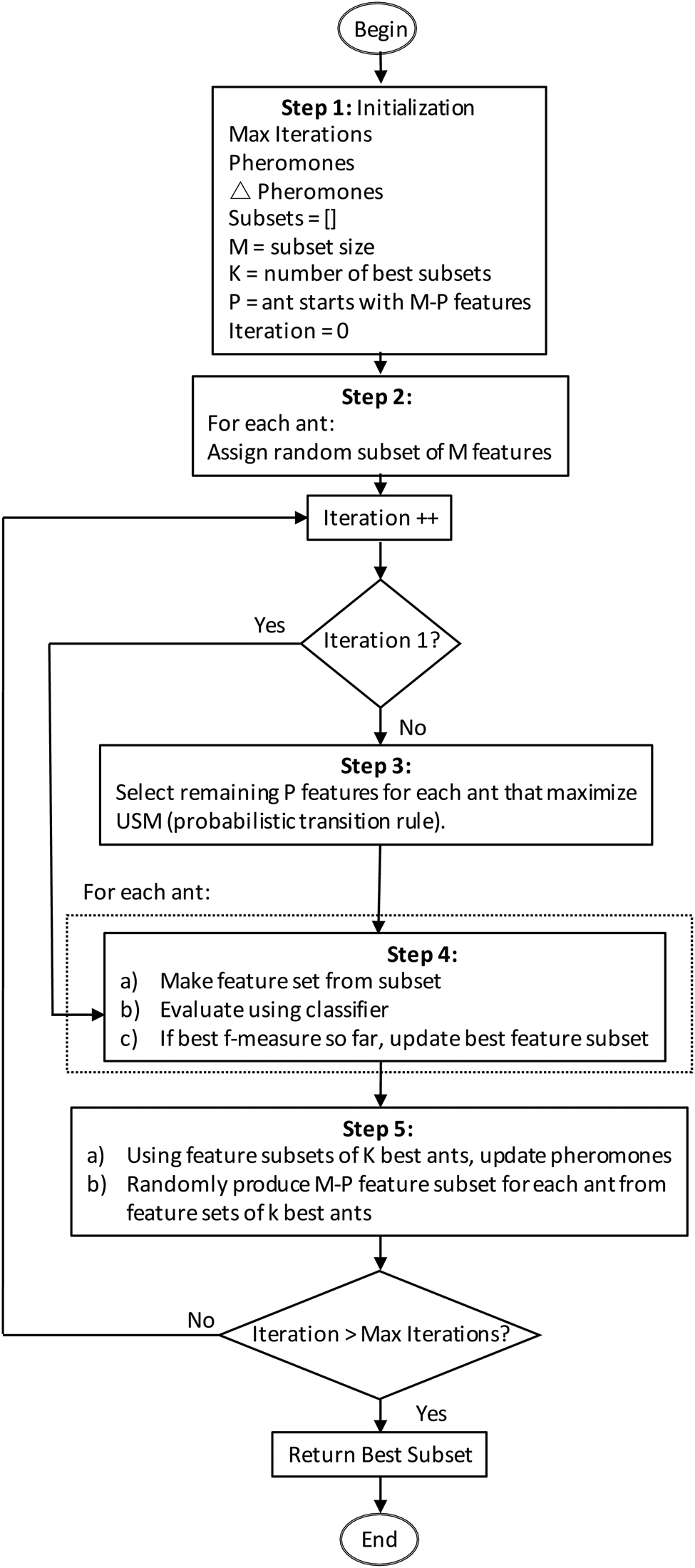
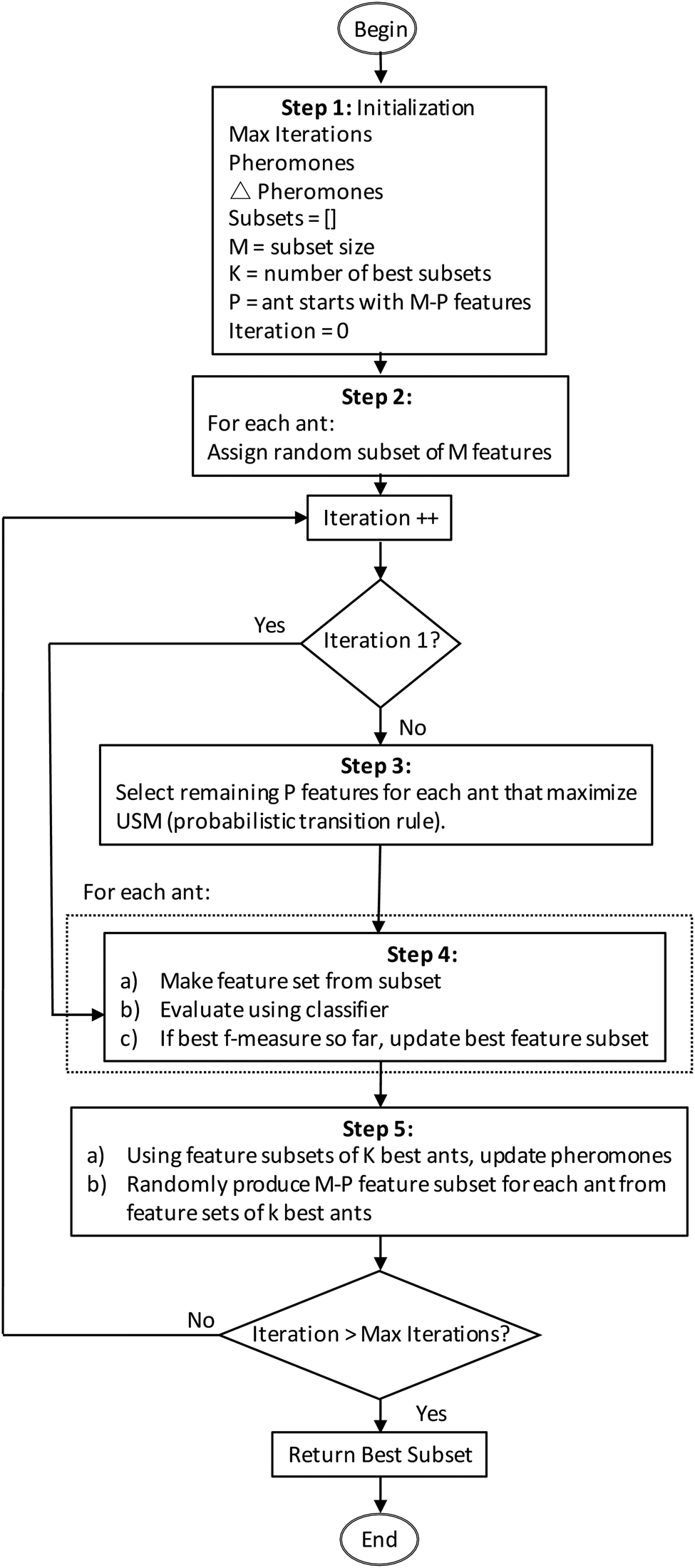
Figure 4 shows the diagram of our ACO implementation; based on an algorithm outlined by Al-Ani (Reference Al-Ani2005). We chose 100 as the number of ants (NA) and 40 as the number of iterations. When selecting each ant's features for the next iteration, we chose three-fourths from the features used in the 20 best ants, and the remaining one-fourth from features currently not assigned to the ant that maximize the update selection rule (USM). Most of the ACO parameters were chosen to be consistent with parameters used by the GA (100 ants to be similar to 100 chromosomes, 40 iterations for each algorithm, 20 best ants to be similar to the feature subset size used in the GA).
ACO flow chart (Lester and Burge, Reference Lester and Burge2018).
GAs for feature selection
The GA (Holland, Reference Holland1975/1992) is a method inspired by natural selection that uses a population of candidate solutions (chromosomes) that are evolved over a number of generations (iterations). During each iteration, their fitness is evaluated, and the successful solutions are combined and/or mutated to create new solutions. This repeats until a stopping criteria is met, and the best solutions are returned as potentially optimal solutions (Martin-Bautista and Vila, Reference Martin-Bautista and Vila1999). The GA can be applied to the feature selection problem by having chromosomes represent candidate subsets of features and using the F-measure of classifying sentences with only features from the selected subset as a measure of fitness.
In a successful run of a GA, the population of chromosomes converges so that each individual has a very similar genotype, and the chosen chromosome is a near-optimal solution to the central optimization problem (Anderson and Ferris, Reference Anderson and Ferris1994). GAs are superior to traditional search methods in that they explore more solutions to the optimization problem in parallel, and therefore are less likely to become trapped in local sub-optimal areas of the search space (Atkinson-Abutridy et al., Reference Atkinson-Abutridy, Mellish and Aitken2004).
A GA implementation must define the following components:
1) Chromosome representation: Chromosomes represent potential solutions to the optimization problem, and each gene represents one feature category. These chromosomes contain a fixed length list of feature categories that represent a candidate feature subset. If a feature category is included as a gene in a chromosome, all instances of features in that category will be considered relevant and included in the resultant classifier (Martin-Bautista and Vila, Reference Martin-Bautista and Vila1999). Each chromosome represents an unordered set of feature categories; therefore, the order of the genes does not matter. The initial population of chromosomes has randomly selected features and is evolved using selection, crossover, and mutation.
Figure 5 shows an example chromosome with the feature categories. Some categories include n-grams (denoted by (n) prefix) and instances from adjacent sentences (denoted by {m} prefix).
2) Fitness function: The fitness function is used to evaluate how good each solution (chromosome) is. We used the NLTK Naïve Bayes classifier and computed the F-measure.
3) Selection process: A process for choosing which chromosomes are used to create new solutions. Parent chromosomes with the highest fitness (for our case, the average Naïve Bayes F-measure over 10-fold cross-validation) are chosen to “reproduce” in every next generation (Goldberg, Reference Goldberg1989). This is an example of truncated selection (Mukherjee et al., Reference Mukherjee, AL-Fayoumi, Mahanti, Jha and Al-Bidewi2010), where only the top chromosomes can be selected for reproduction.
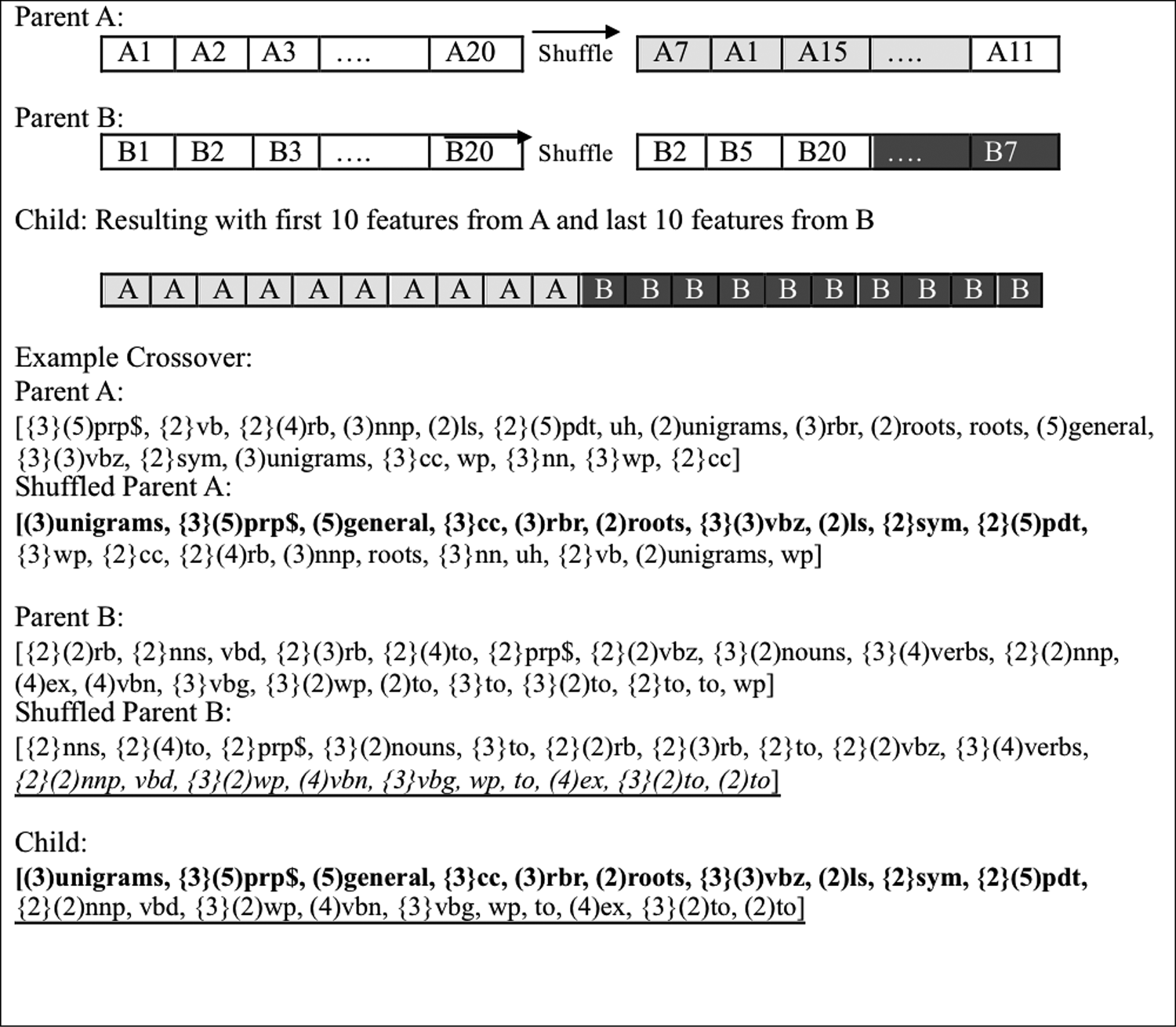
4) Crossover and mutation algorithms: The algorithms that decide how to create the next generation of solutions. Crossover (depicted in Fig. 6) is performed by randomly selecting two different parents from the pool of chromosomes chosen to repopulate the next generation. Then, half of the categories from each parent are randomly selected and combined into a new set representing the “child” chromosome with any duplicate categories removed. If duplicate features are removed, we randomly add features from the set of all features until the pre-determined chromosome length has been reached. We use this method because the feature order is not relevant (Dorigo and Stützle, Reference Dorigo and Stützle2004). Also, if the parents contain too many duplicate features, that indicates that the solutions are converging and no longer evolving, so adding randomly selected features introduces more variation to continue searching the feature space. The mutation was performed by first determining if mutation should occur (with a mutation rate of 10%) and then randomly choosing one feature in the chromosome to be replaced with a randomly selected feature not already in the chromosome.
Chromosome structure.

Crossover example.
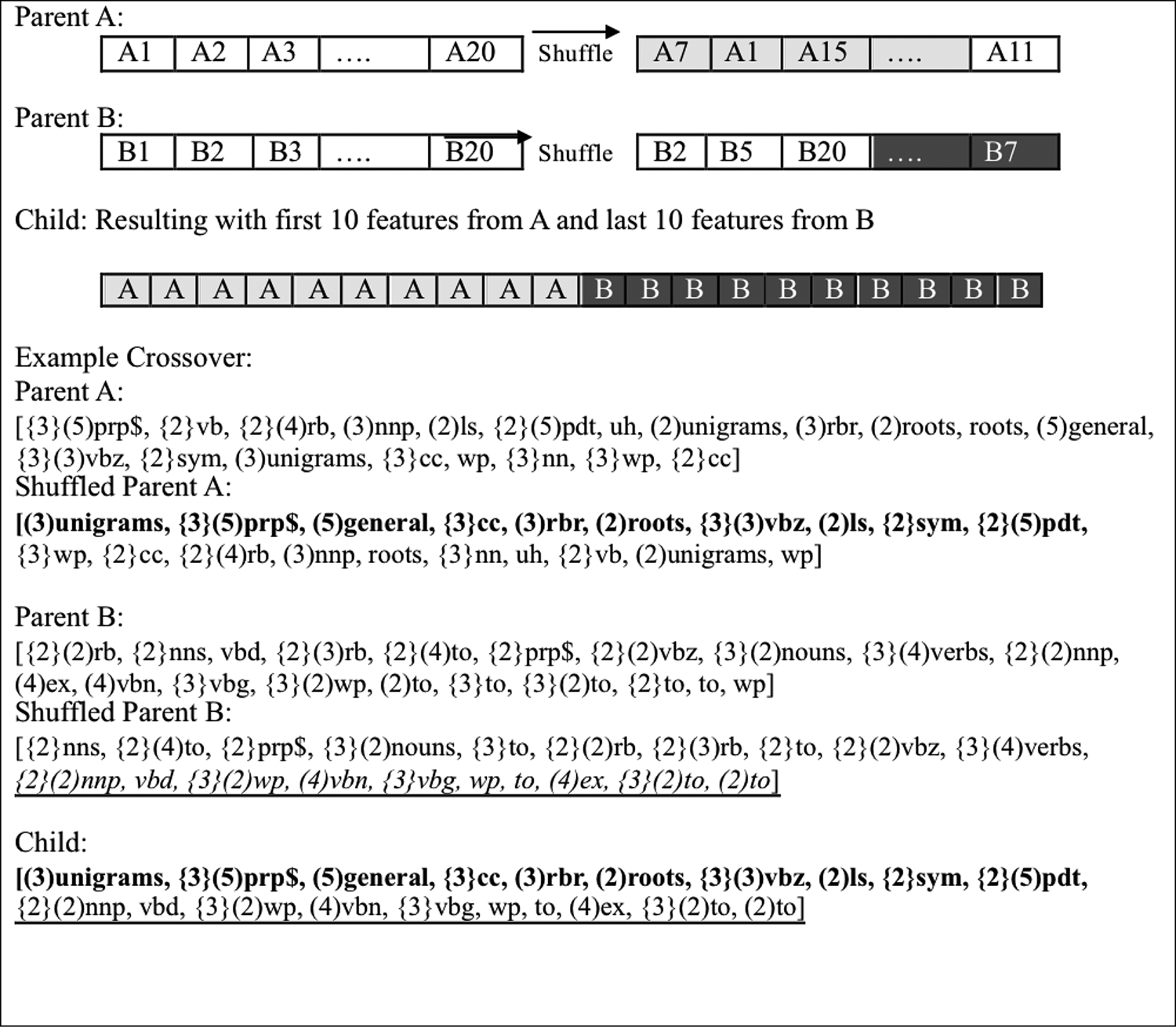
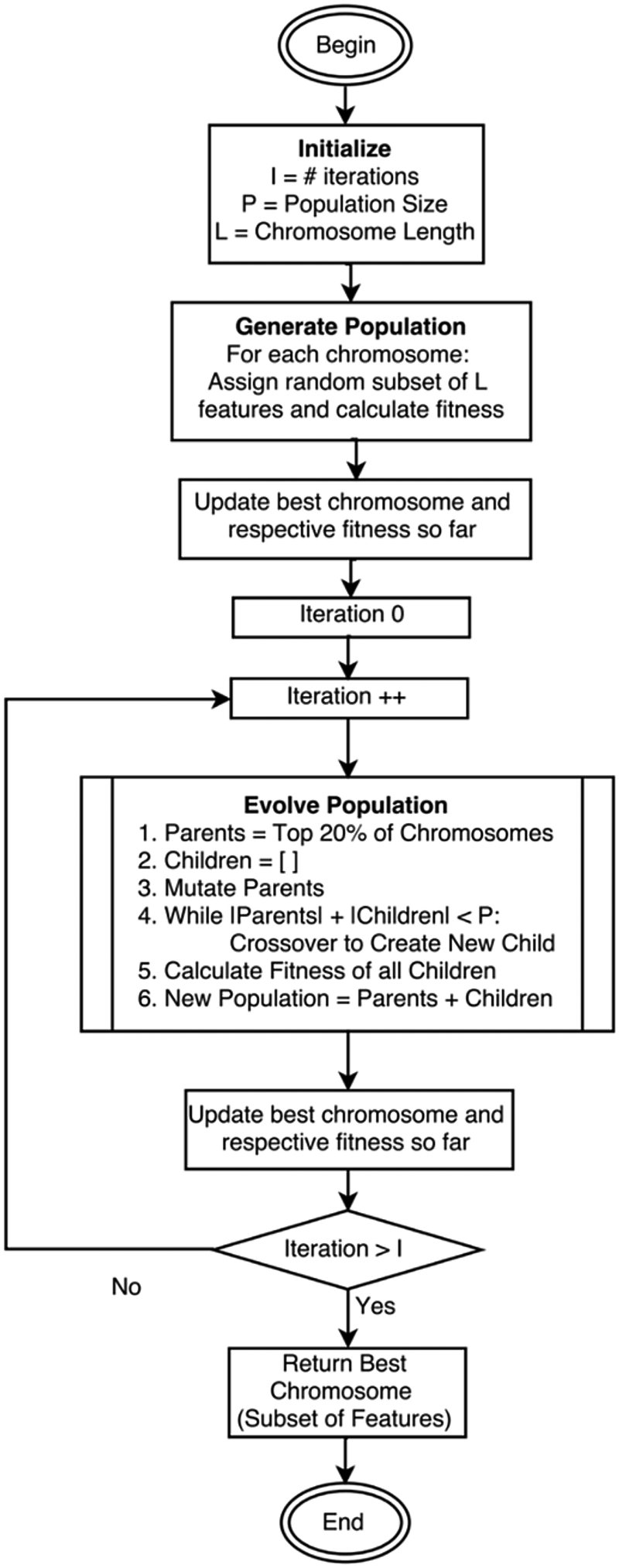
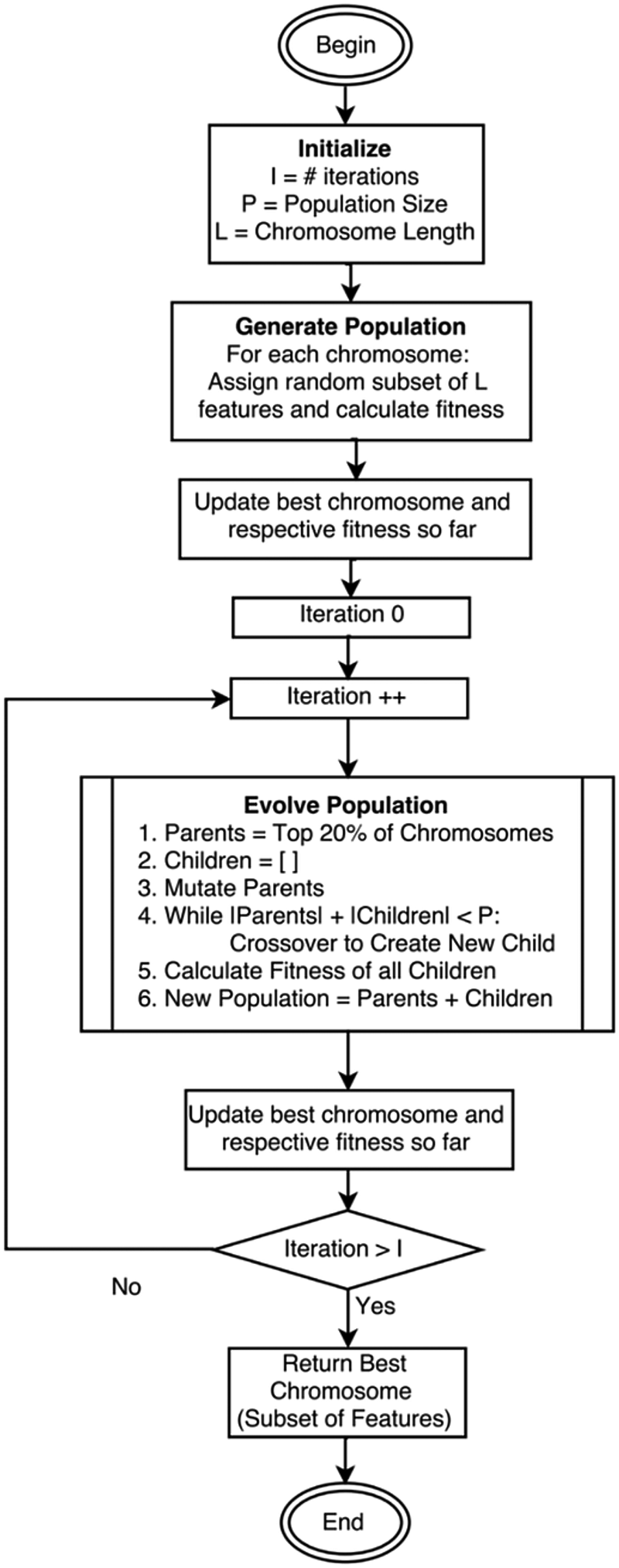
Figure 7 shows the diagram of the GA feature subset selection algorithm run for the experiments. For our experiments, we used 40 iterations (I), a population size of 100 (P), a feature subset size of 20 (L), a mutation rate of 10%, and a retention rate of 20%.
Genetic algorithm process.
Results
For this paper, we performed experiment trials on different rationale categories with the two feature selection algorithms. The GA and ACO introduce randomness into the process, so different trials resulted in different classification results. The results reported are the best of the trials for each experiment, based on predictive ability assessed by classifying hold-out test data (Kohavi and John, Reference Kohavi and John1997). The standard deviation of the trial results is also given.
We ran baseline experiments using all feature categories, so we could compare those results with those using feature selection. We calculated the inter-annotator agreement by comparing annotations of two researchers. This measure represents an estimate of F-measure achievable manually. Any overlapping annotations were considered a match (Rogers et al., Reference Rogers, Qiao, Gung, Mathur and Burge2014). We used the F-measure instead of the Cohen's kappa because it was better suited for analyzing text with overlapping annotations (Hripcsak and Rothschild, Reference Hripcsak and Rothschild2005).
Each experiment outputs the best feature subset at each iteration along with their F-measure for training and test. Training scores are the result of 10-fold cross-validation over the training sentences with the Naïve Bayes classifier, using the subset of features generated at the final iteration of feature selection. Validation scores are based on training a Naïve Bayes classifier with the training sentences, and evaluating this classifier over all the test sentences – still using just the subset of features chosen at the final iteration of the feature selection algorithm.
Dataset 1: Chrome bug reports
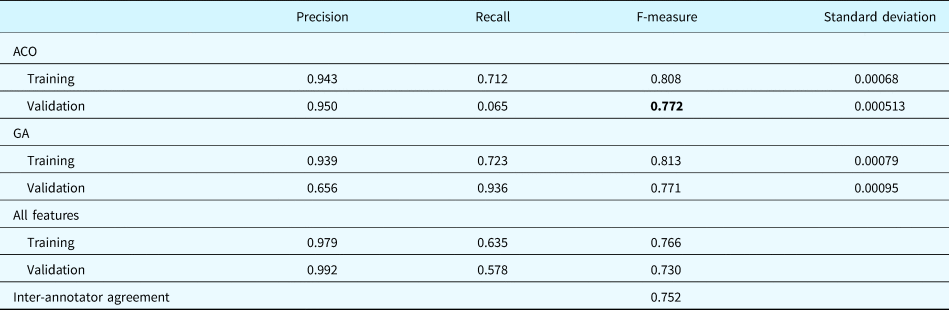
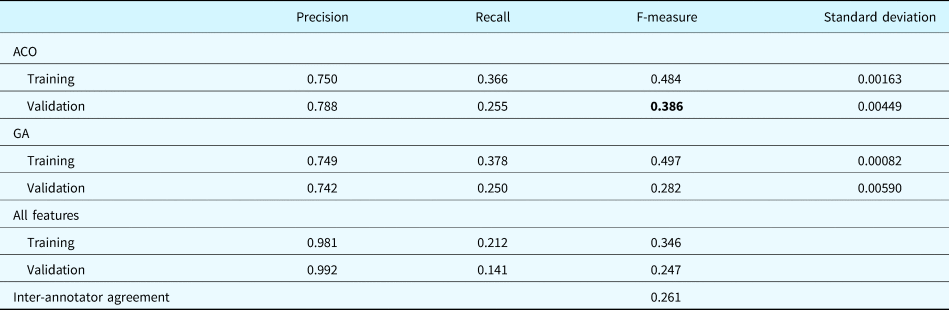
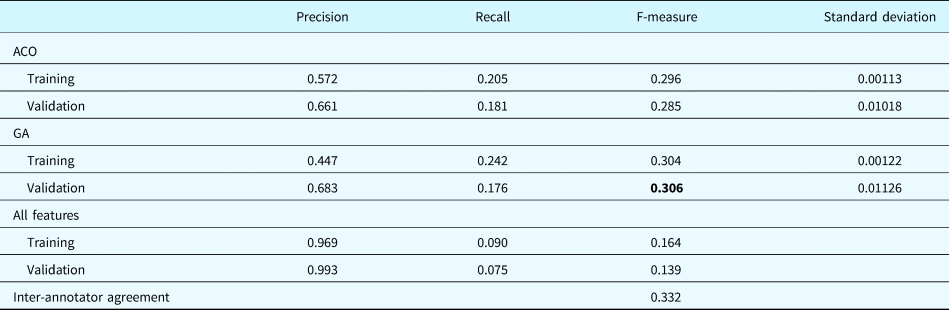
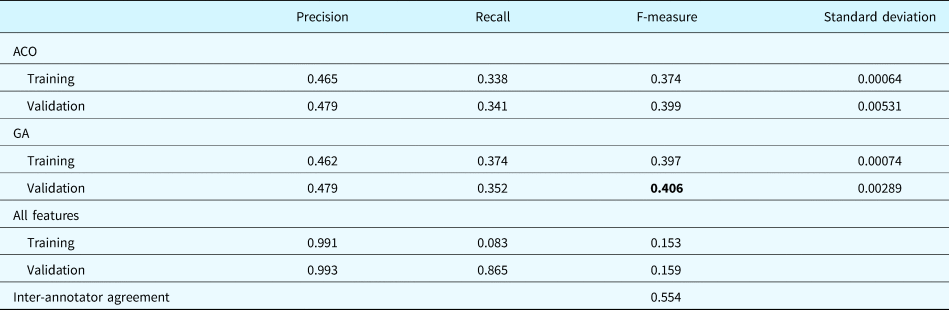
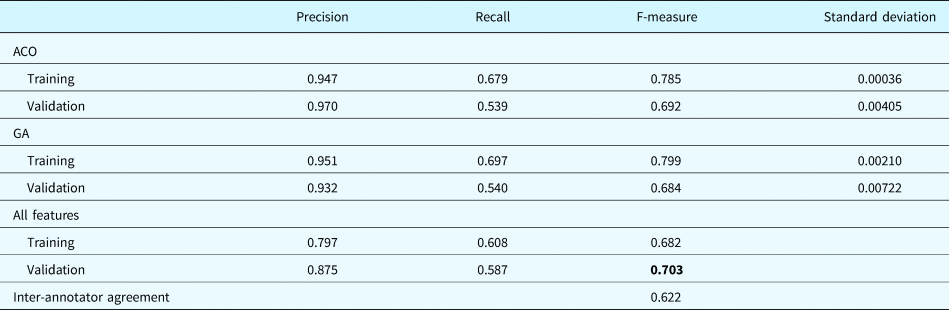
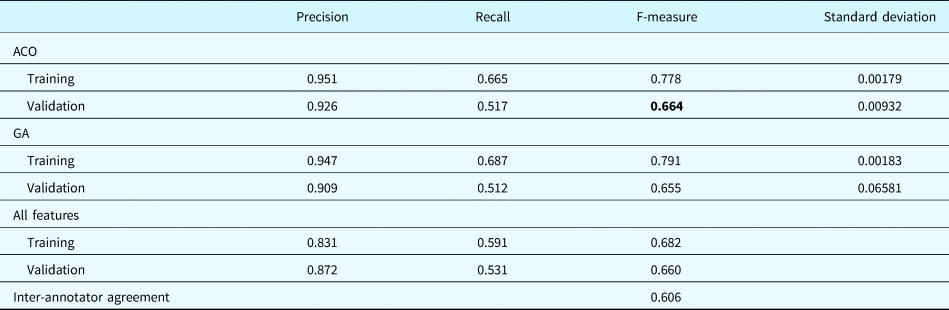
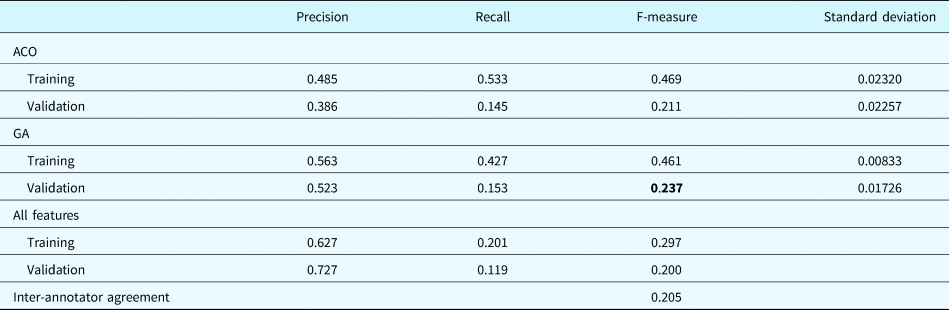
Binary rationale and alternatives had higher F-1 measure validation scores from the model generated with the ACO than with the GA. All the rest had higher F-1 measure validation scores from the model generated with GA than with ACO. Every rationale subclass had higher validation scores from the model generated with feature selection than with using all features. In the tables below, the highest validation score is bolded, to indicate the best model created. For the features identified by the ACO, the largest difference between the training and validation results was 0.098, with an average difference of 0.052. For the features identified by the GA, the largest difference was 0.215 (for arguments-all), with an average difference of 0.079. Using all features had the largest difference of 0.099 and an average difference of 0.049 (Tables 1–5).
Binary rationale (all rationale subclasses)
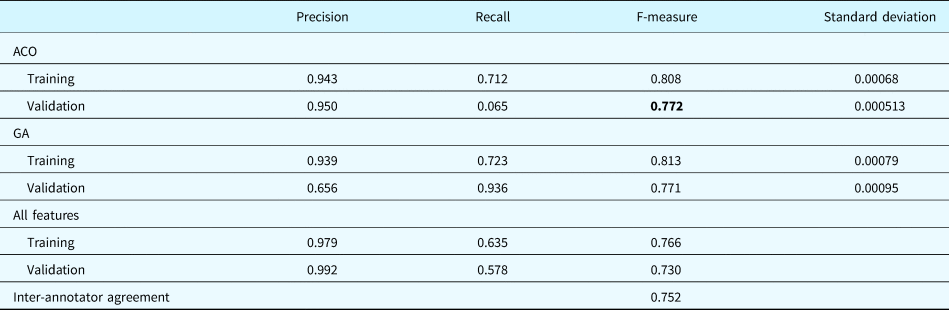
The percentage of sentences with this classification: 17.4%.
Argumentation subset (alternative, argument, assumption, decision, and requirement)
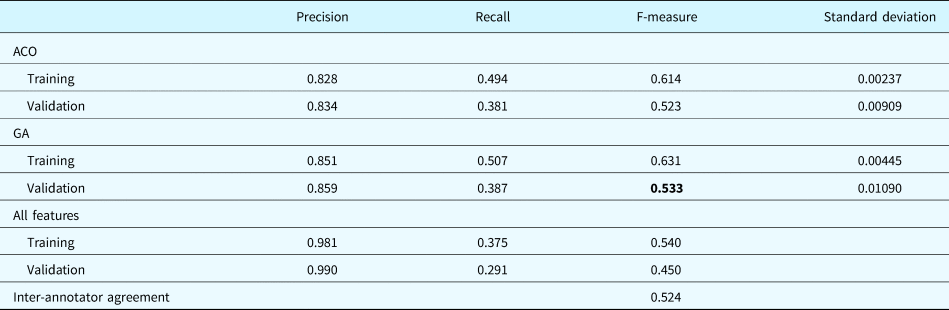
The percentage of sentences with this classification: 9.5%.
Arguments-all (requirement, argument, and assumption)
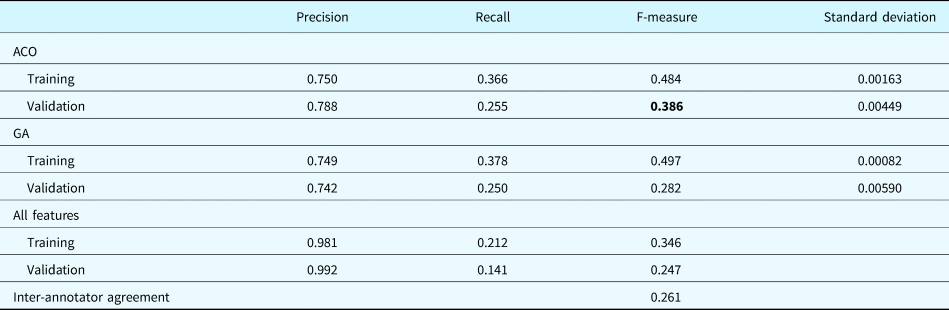
The percentage of sentences with this classification: 5%.
Alternative
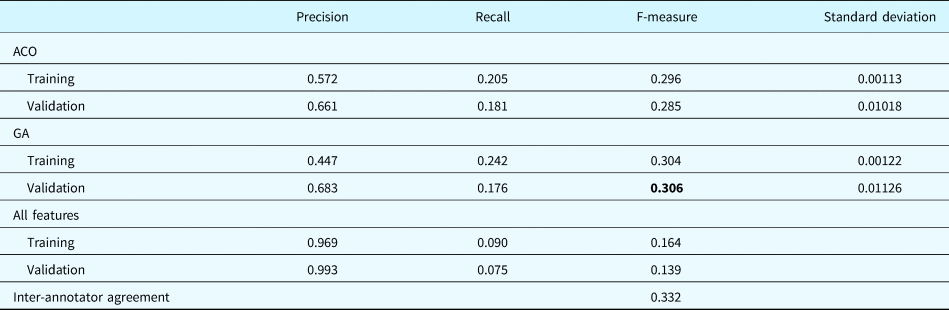
The percentage of sentences with this classification: 2.7%.
Decision
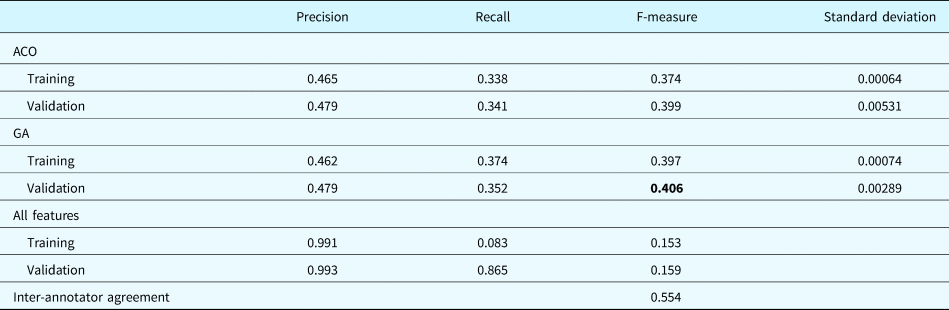
The percentage of sentences with this classification: 2.5%.
Dataset 2: studying professional software designers
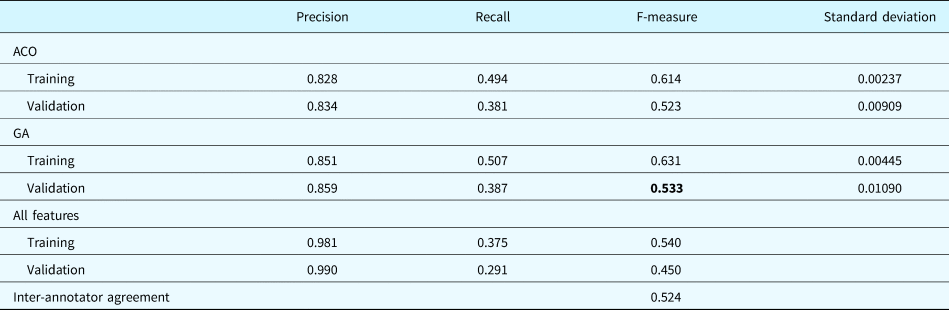
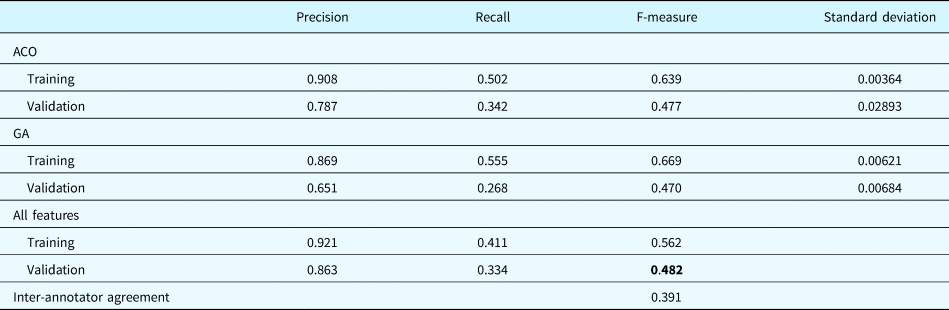
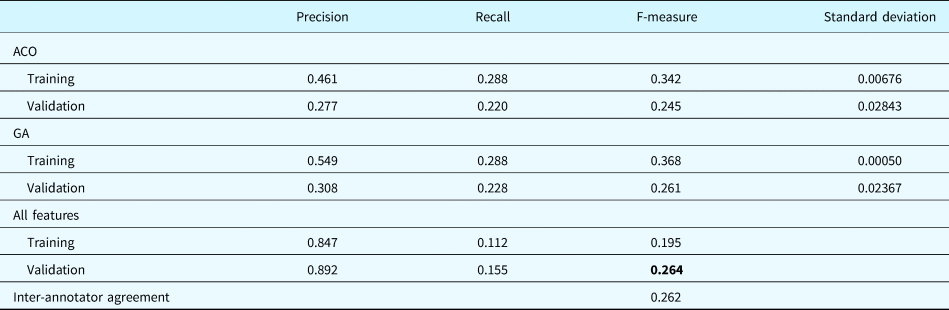
Binary rationale, the argumentation subset, and alternatives had a higher validation F-measure from the model generated with the ACO than with the GA. The rest had a higher validation F-measure from the model generated with the GA than with the ACO. For binary rationale, alternatives, and decisions, using all features gave a better validation F-measure than either the GA or ACO. In the tables below, the highest validation score is bolded, to indicate the most representative model created. For the features identified by the ACO, the largest difference between the training and validation results was 0.258, with an average difference of 0.163. For the features identified by the GA, the largest difference was 0.224 (for arguments-all), with an average difference of 0.158. Using all features had the largest difference of 0.091 and an average difference of 0.018 (Tables 6–10).
Binary rationale (all rationale subclasses)
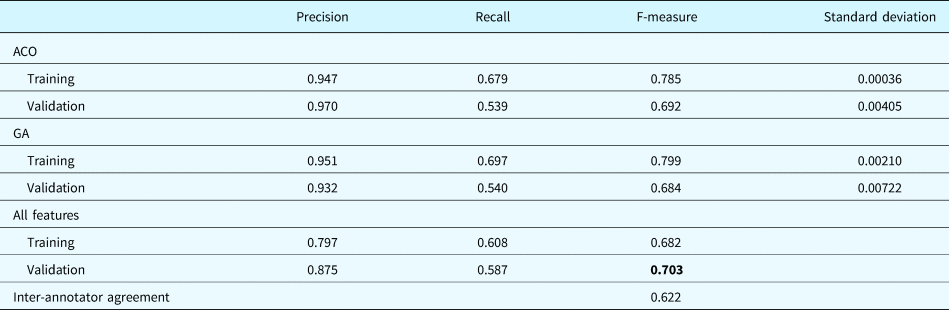
The percentage of sentences with this classification: 53.5%.
Argumentation subset (alternative, argument, assumption, decision, and requirement)
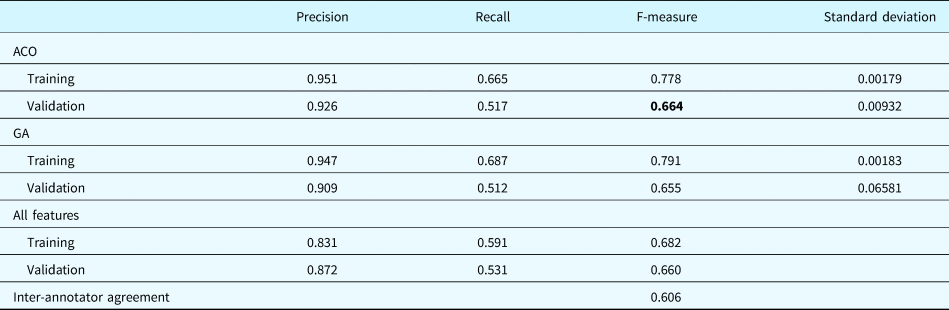
The percentage of sentences with this classification: 50.8%.
Arguments-all (requirement, argument, and assumption)
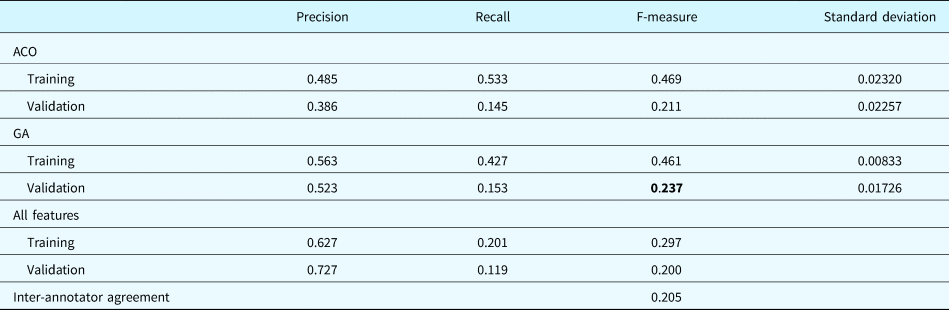
The percentage of sentences with this classification: 11.2%.
Alternative
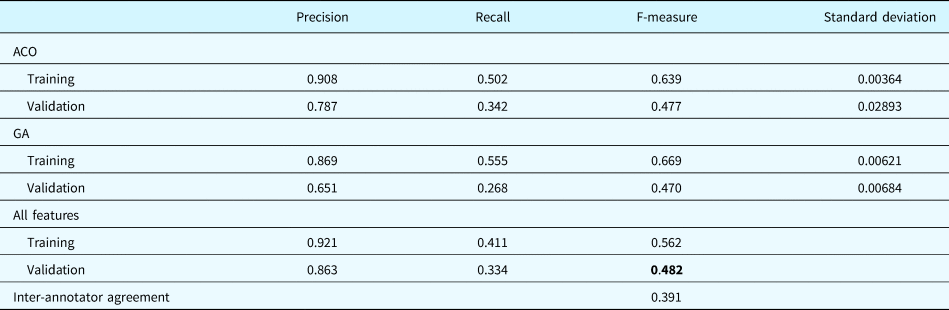
The percentage of sentences with this classification: 32.1%.
Decision
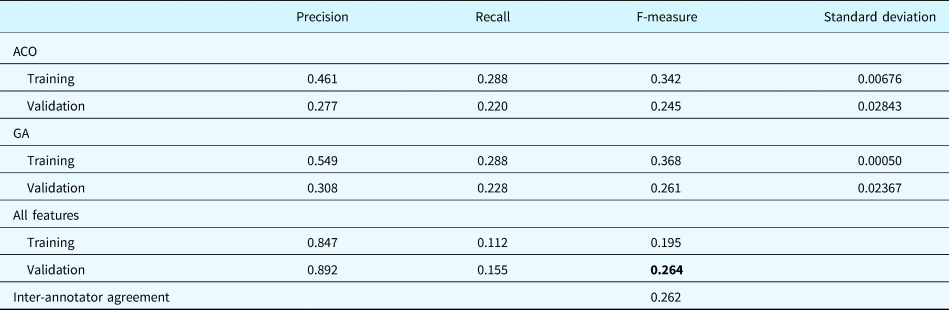
The percentage of sentences with this classification: 9.8%.
Conclusions and future work
The results given above evaluated the rationale identified using the machine learning models against the annotated documents used as test and training data. We would like to add another level of verification by looking at correctly and incorrectly classified sentences manually. This is still in progress since it requires re-building the documents (pre-processing converts them into collections of features, so they are no longer human-readable) and importing them into a tool that can be used by humans.
The results presented here show that rationale identification is a challenging task, even for humans. In some cases, our models did better than the humans, as shown by the examples where it did better than the inter-annotator agreement.
In our study, we answered two research questions:
1. Does using evolutionary algorithms for feature selection improve performance when identifying rationale compared to building classifiers without feature selection?
For the larger bug report dataset, the validation F-measures were higher with feature selection than without. Results were less clear for the smaller SPSD dataset. Thus, the hypothesis that there are irrelevant, redundant features that hurt classification is supported for the bug report data but not necessarily for the smaller dataset. Further, we achieved a better F-measure for most inter-annotator agreement F-measures. The exceptions were BR-Decision, BR-Alternative, and SPSD-Decision. For BR-Arguments-all, the ACO was within 0.001 of the AI. This suggests that automatic identification may be as effective as manual identification for the broader categories of rationale.
We noticed that in some experiments, the validation score was higher than the training score. This may be because of the number of sentences used to train each model. The training models use 10-fold cross-validation of training sentences, meaning each model is trained with 9/10 of 70% of the sentences – 63% of the sentences. The models used to evaluate the test scores are trained with all of the training sentences – or 70% of the sentences. This may be why the test scores sometimes surpass the training scores since the model learns over more total instances. This is one possible explanation, but it is also possible that some of the faults lies in the random split of the training and test sentences.
2. How does the classification performance of the ACO selected feature set compare to the GA selected feature set?
In “Dataset 1: Chrome bug reports” and “Dataset 2: studying professional software designers” sections, we compared the results of the ACO and GA experiments for both datasets. For the BR dataset: binary rationale and arguments-all had higher validation F-measures from the model generated with the ACO than with the GA. For the SPSD dataset: the argumentation subset and alternatives had higher validation F-measure from the model generated with the ACO than with the GA. Thus, for 6 out of 10 different experiments, the GA outperformed the ACO. The results from the ACO and GA were generally very close. For the BR dataset, the average difference in validation F-measure was 0.035. For the SPSD dataset, the average difference in validation F-measure was 0.014.
Since the ACO performed comparably to the GA, and took half the time on average to run on the large BR dataset, the ACO may be preferable to the GA if training time is a concern. For the larger bug report dataset, the F-measure with feature selection was higher than without feature selection; however, this was only the case with some of the rationale categories for the smaller SPSD dataset.
As mentioned above, we are currently in the process of studying the misclassified sentences to see if there might be features in common that we should be adding to our feature sets that might help us improve performance. We are examining both the false negatives and false positives. Another way to evaluate our work would be to have domain experts look at the classified rationale to see if what we did capture, although not complete, might still be sufficient to help a developer. For the broader rationale categories, the precision was better than the recall – is some rationale better than none? Other interesting experiments that could be performed include looking at how features interact and a sensitivity analysis to determine if some features are more important than others.
A potential future extension of this work is integrating automatic design rationale capture algorithms into a tool for software engineers. We are working on importing the classification results into a rationale structuring and presentation tool, C_SEURAT (Collaborative Software Engineering Using Rationale) and will use this to study if partially captured rationale is easier to work with than starting with documents where no rationale is indicated.
Acknowledgements
We thank Miami University graduate students Michelle Flowers, John Malloy, Tanmay Mathur, and Benjamin Rogers and undergraduate students James Gung, and Yechen Qiao for their assistance in annotating the data used in these experiments and Wesleyan student Connor Justice for creating the sentences.csv file. Miriam Lester was supported by a fellowship from the American Association of University Women (AAUW). The SPSD data was produced in design sessions funded by the National Science Foundation (NSF) (award CCF-0845840). We thank the workshop organizers, André van der Hoek, Marian Petre, and Alex Baker for granting access to the transcripts. The data annotation work was supported by NSF CAREER Award CCF-0844638 (Burge). Any opinions, findings, and conclusions or recommendations expressed in this material are those of the author(s) and do not necessarily reflect the views of the NSF.
Miriam Lester is currently working as a Software Engineer at YouTube. She received her MA in Computer Science at Wesleyan University, with support from the AAUW Selected Professions Fellowship. Her research focused on machine learning and natural language processing.
Miguel Guerrero is an undergraduate student at Colorado College. Miguel's interests include the role of software in ideation, turning natural language into formal logic, algorithmic art, and game design.
Janet E. Burge is an Associate Professor in the Colorado College Department of Mathematics and Computer Science. Dr. Burge's major research interests are in Software Engineering and Artificial Intelligence. Her primary research area is in Design Rationale, with a focus on Design Rationale for Software Maintenance. Dr. Burge is a co-author of the book Rationale-Based Software Engineering. She has worked in industry as a researcher and software developer for over 20 years. She received her PhD and MS in Computer Science from WPI, and her BS in Computer Science from Michigan Technological University.