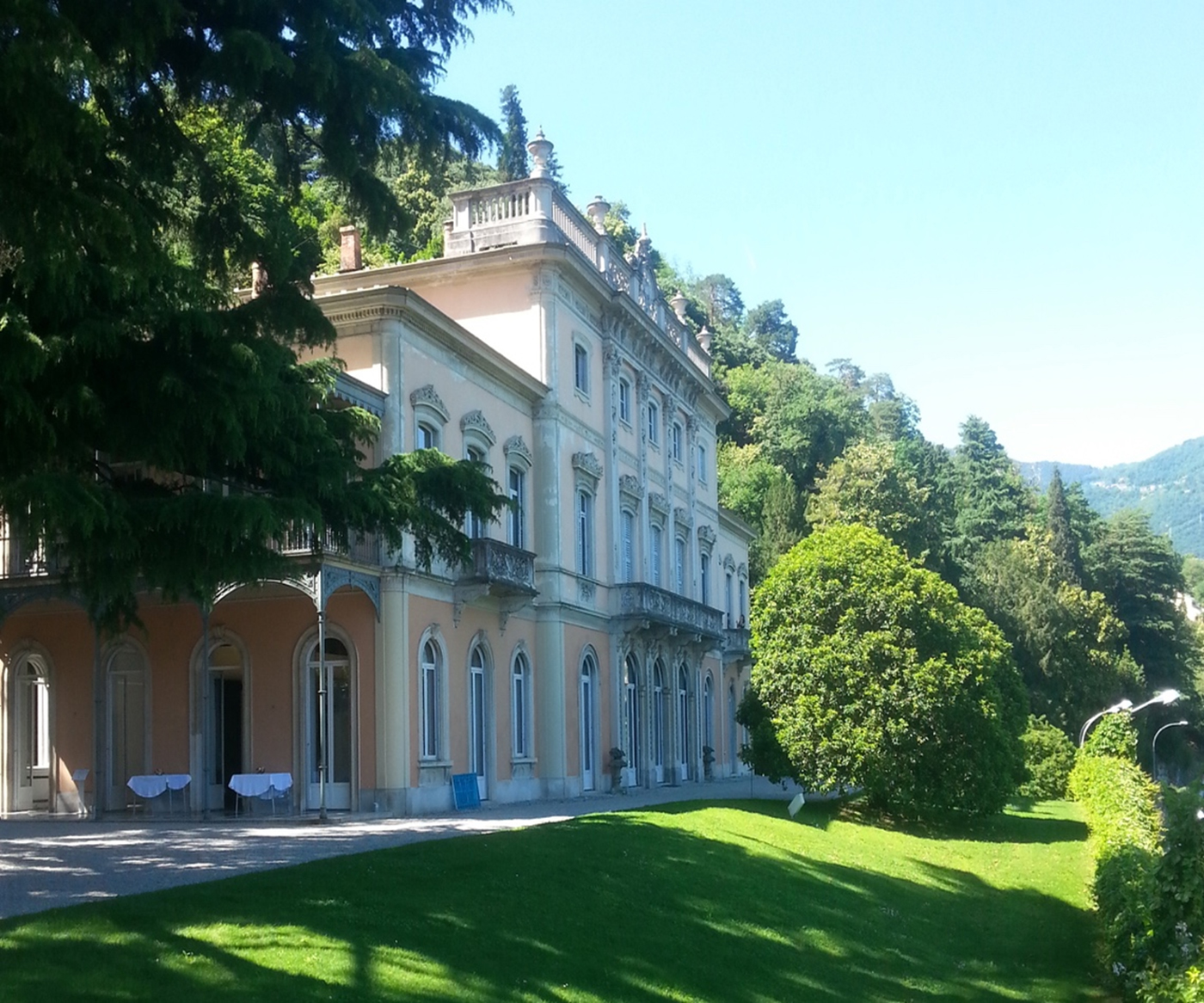
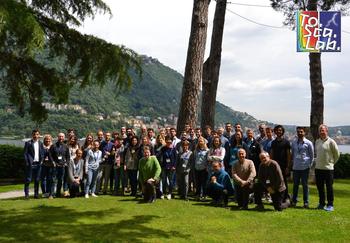
Advanced courses in scattering methods are not typically delivered in Academia and often require the organization of specific events, targeted to Ph.D. students, postdocs and young researchers at the very beginning of their scientific careers. Thanks to the efforts of Lake Como School for Advanced Studies and scientists from University of Insubria and the Institute of Crystallography of the Italian National Research Council (IC-CNR), it was possible to organize, in late May 2019, a successful Summer School in Como, in the beautiful location of the 18th century Villa del Grumello (see Figure 1). This event was labelled “To.Sca.Lake 3.0: Total Scattering for Nanotechnology on the Como Lake”, following the previous two editions [To.Sca.Lake – May 2015 (Masciocchi et al., Reference Masciocchi, Bertolotti and Guagliardi2015) and To.Sca.Lake 2.0 – May 2017 (Masciocchi et al., Reference Masciocchi, Ferri, Bertolotti and Guagliardi2017)], while adding some new topics and hands-on sessions to the schedule. More than 50 participants from 16 Countries worldwide (Italy, Switzerland, Germany, Denmark, Spain, United Kingdom, Croatia, Poland, Czech Republic, Israel, Iran, India, USA, Brazil, South Africa, Costa Rica) attended the School. Figure 2 portrays the Group Photo.
The conference venue, the 18th Century Villa del Grumello, facing the Como Lake.

The group photo of the To.Sca.Lake 3.0 Summer School. In the Inset, the To.Sca.Lab logo.

The organization of the To.Sca.Lake 3.0 falls well within the educational activities of the To.Sca.Lab. project (see also toscalab.uninsubria.it), a joint laboratory co-founded in 2013 by University of Insubria and the Institute of Crystallography of the Italian CNR, merging experimental and theoretical expertise in chemistry, crystallography and physics, within a unified project based on scattering techniques (from X-rays to visible light).
With respect to the previous two editions of the school, already including, as lecturers, world renowned experts in the fields of forefront scattering methods and of nanomaterials preparation, the 2019 event involved some important novelties. To.Sca.Lake 3.0 was indeed primarily devoted to the development of the so-called “complex-modeling” principles for nanostructures characterization: in order to obtain unique structural and microstructural insights on complex materials, infrastructures that can combine information from different techniques and models into a coherent framework are needed (Farrow et al., Reference Farrow, Shi, Juhás, Peng and Billinge2014). Indeed during the To.Sca.Lake 3.0 the combined use of various complementary scattering techniques, such as Rietveld refinement carried on simultaneously in real and reciprocal space or the use of the Debye Scattering Equation (DSE) to model both Small Angle (SAXS) and Wide Angle (WAXS) datasets, has been presented. Moreover, a completely new hands-on session on a computer program dedicated to the modeling of SAXS data of inorganic nanoparticles, developed at Aarhus University by Professor J.S. Pedersen, and distributed for the first time to the school attendees, has been proposed during the last edition, jointly with other popular software: Debussy (Cervellino et al., Reference Cervellino, Frison, Bertolotti and Guagliardi2015) and PDFGui (Farrow et al., Reference Farrow, Juhas, Liu, Bryndin, Bozin, Bloch, Proffen and Billinge2007).
On the first day of the School, four introductory presentations, providing some fundamental concepts toward the comprehension of total scattering approaches, were delivered. Hans-Beat Bürgi (University of Bern and Zurich, Switzerland) gave a exhaustive lecture on diffuse scattering measurements and data interpretation in ionic and molecular crystals, thanks to the development of the so-called 3D-ΔPDF method applied to single crystals characterized by disorder and defects; Antonio Cervellino (Paul Scherrer Institute, Villigen, Switzerland) presented the theoretical basis of radiation-matter interaction, and the rigorous derivation of the Debye Scattering Equation - DSE (Debye, Reference Debye1915), together with the most important computational aspects related to its implementation (Cervellino et al., Reference Cervellino, Giannini and Guagliardi2006). This theoretical approach was further complemented by the talk of Ruggero Frison (EMPA, Zurich, Switzerland), treating experimental procedures and pitfalls concerning X-ray total scattering data collection and reduction. Simon J.L. Billinge (Columbia University and Brookhaven National Laboratory, New York, USA) presented the theoretical basis of the 1D-PDF method, together with technical aspects and some advanced scientific results obtained in the field of inorganic nanoparticles characterization. One of the last breakthroughs of the method here presented was the development of the so-called “structure/cluster-mining” approach, to automate and manage structural model selection and PDF refinements; a first application of this method to the determination of structure and morphology of very small metallic nanoparticles (Banerjee et al., Reference Banerjee, Liu, Jensen, Juhás, Lee, Tofanelli, Ackerson, Murray and Billinge2019), as well as its most recent development for the automatic space group determination from PDF data (Yang et al., Reference Yang, Juhás, Terban and Billinge2019), were presented. The last lecture of the day, held by Maksym V. Kovalenko (ETH Zurich, Switzerland), was devoted to the fascinating world of inorganic nanoparticles (mainly Cd- and Pb-based chalcogenide semiconductors in form of quantum dots), with an overview on the synthetic methods and their interesting technological applications.
On the next day, Jan Skov Pedersen (Aarhus University, Denmark) presented the theoretical basis of SAXS techniques, and some recent applications of such technique to determine the size, morphology and growth mechanism of inorganic nanoparticles, as well as to characterize biological systems. His lecture was followed by the second talk from Maksym V. Kovalenko, dedicated to the 2D and 3D self-assembly of inorganic nanocrystals in the form of ordered superlattices. Afterwards, Antonella Guagliardi (Institute of Crystallography – CNR and To.Sca.Lab, Como, Italy) presented some innovative methodological aspects related to the use of the DSE approach, jointly modeling SAXS and WAXTS data to account for size, morphology and structural defects of nanocrystals; thus, it was shown that this method is capable to retrieve complementary information from different length scales, particularly useful when dealing with highly defective materials (Moscheni et al., Reference Moscheni, Bertolotti, Piveteau, Protesescu, Dirin, Kovalenko, Cervellino, Pedersen, Masciocchi and Guagliardi2018). Norberto Masciocchi (University of Insubria and To.Sca.Lab, Como, Italy) later offered a rich overview of most recent applications of the DSE-based modeling approach on metal chalcogenides (Bertolotti et al., Reference Bertolotti, Dirin, Ibáñez, Krumeich, Cervellino, Frison, Voznyy, Sargent, Kovalenko, Guagliardi and Masciocchi2016a; Reference Bertolotti, Moscheni, Migliori, Zacchini, Cervellino, Guagliardi and Masciocchi2016b; Reference Bertolotti, Moscheni, Guagliardi and Masciocchi2018a; Reference Bertolotti, Proppe, Dirin, Liu, Voznyy, Cervellino, Billinge, Kovalenko, Sargent, Masciocchi and Guagliardi2018b; Ulbrich et al., Reference Ulbrich, Bertolotti, Masciocchi, Cervellino, Guagliardi and Campos2018), lead halide perovskite nanocrystals (Bertolotti et al., Reference Bertolotti, Protesescu, Kovalenko, Yakunin, Cervellino, Billinge, Terban, Pedersen, Masciocchi and Guagliardi2017), metallic nanoparticles (Bertolotti et al., Reference Bertolotti, Dirin, Ibáñez, Krumeich, Cervellino, Frison, Voznyy, Sargent, Kovalenko, Guagliardi and Masciocchi2016a; Reference Bertolotti, Moscheni, Migliori, Zacchini, Cervellino, Guagliardi and Masciocchi2016b), metallorganic (Cervellino et al., Reference Cervellino, Maspero, Masciocchi and Guagliardi2012; Bertolotti et al., Reference Bertolotti, Maspero, Cervellino, Guagliardi and Masciocchi2014; Mason et al., Reference Mason, Oktawiec, Taylor, Hudson, Rodriguez, Bachman, Gonzalez, Cervellino, Guagliardi, Brown, Llewellyn, Masciocchi and Long2015) and organic compounds (Hasa et al., Reference Hasa, Giacobbe, Perissutti, Voinovich, Grassi, Cervellino, Masciocchi and Guagliardi2016). A lecture integrated by a computational demo session was then provided by Arnt Kern (Bruker AXS GmbH, Karlsruhe, Germany), who discussed and showed the possibility of performing simultaneous Rietveld refinements of real (1D-PDF) and reciprocal space diffraction data with the new release of the TOPAS program. The use of the 1D-PDF for the structural determination of organic materials, as well as for qualitative phase identification of amorphous compounds, were the topics of the following lecture, provided by Martin U. Schmidt (Goethe-Universität, Frankfurt am Main, Germany). The lecture of Detlef Beckers (Malvern-Panalytical, the Netherlands) closed the day, presenting the possibility of using laboratory instruments for collecting high quality X-ray scattering data for 1D-PDF applications.
On the third day of the School, four technical presentations were proposed by Mirko Gianesella (Bruker AXS, Germany), Dubravka Sisak-Jung (Dectris, Switzerland), Detlef Beckers (Malvern-Panalytical, the Netherlands) and Vladislav Minhoukov (X-Spectrum, Germany), all raising a wide interest in the audience. Finally, a session dedicated to short presentations by the young attendees of the school was organized, with nine oral presentations of the highest levels, accompanied by a permanent poster session, with additional contributions on show during the entire duration of the School.
The third and fourth days of To.Sca.Lake 3.0 were dedicated to hands-on computational exercises on the modelling of WAXTS data both in real space, using the PDFGui program (Farrow et al., Reference Farrow, Juhas, Liu, Bryndin, Bozin, Bloch, Proffen and Billinge2007), and in reciprocal space, with the Debussy Suite of programs (Cervellino et al., Reference Cervellino, Giannini and Guagliardi2010, Reference Cervellino, Frison, Bertolotti and Guagliardi2015). The attendees, who were instructed on how to install the required software on their own laptops before the School began, were initiated and guided through the modelling of 1D-PDF and reciprocal space total scattering data, in order to extract structural and microstructural information of nanosized materials. These two parallel tutorial sessions were mastered by Simon J.L. Billinge (Columbia University and Brookhaven National Laboratory, U.S.) and Maxwell W. Terban (Max Plank Institute, Germany) and by the Debussy Team (Antonella Guagliardi – IC CNR, Italy, Federica Bertolotti – University of Insubria, Italy, Ruggero Frison – EMPA, Switzerland and Antonio Cervellino – PSI, Switzerland).
The following afternoon session was dedicated to an original tutorial session on the WLSQ_SAXS program, recently developed by Jan Skov Pedersen and Sebastian D. Madsen at Aarhus University, for the treatment of SAXS data of inorganic nanoparticles; this new release includes the possibility of modeling anisotropic form factors, polydispersity and different types of structure factors describing particles aggregation and nanocrystals faceting. Some of the data proposed during this hands-on session were also used to perform a joint SAXS/WAXTS tutorial with the Debussy Suite of programs.
The last day of the school was devoted to light scattering techniques, nicely introduced by Fabio Ferri (University of Insubria and To.Sca.Lab, Como, Italy), who described the basics of Static and Dynamic Light Scattering methods. His lecture was supplemented by light-scattering live experiments on several colloidal samples, such as lead and cadmium chalcogenide quantum dots (the X-ray scattering data of which were used during the joint SAXS/WAXTS analysis) and lead halide perovskite nanocrystals.
ACKNOWLEDGEMENTS
We are heartily indebted to several public bodies and private companies for their financial help, which made it possible to host several young attendees through partial grants. Gathered in a non-ordered list: Lake Como School for Advanced Studies, To.Sca.Lab, University of Insubria, DSCTM-CNR, the INSTM Consortium, the Italian Crystallographic Association, the European Crystallographic Association, the International Union of Crystallography, and, as generous commercial sponsors, Bruker AXS, Malvern-Panalytical, Dectris, Excelsus and X-Spectrum. The International Center for Diffraction Data (ICDD) sponsored the attendance of a few participants, by assigning them a special prize (see Figure 3).
The awardees of the ICDD grants. Left to the right: Pryank Shyam (India), Sara Cerra (Italy), Volodymyr Medviediev (Poland) and Jonas Palle (Denmark). In the rightmost portion, the School Directors, Professor Norberto Masciocchi and Dr. Antonella Guagliardi.