Introduction
He was accustomed on most occasions to speak Persian, and while he was eating his dinner, two hours were devoted by him to the perusal (from standard historical works) of the actions of the Kings of Persia and Arabia, religious works, traditions and biography. Footnote 1
No-one needs to be reminded of the charismatic nature of Tipu Sultan of Mysore (r. 1782–1799). Regarded by some as a fanatic Muslim and brutal tyrant, for others he was a martyr and national hero whose wars against the British foreshadowed the historic uprising of 1857. Following his death in 1799, his name became a byword in the West for exotica and Eastern luxury. The fashion for “Tipumania” gave rise to large numbers of publications, paintings, and the collection of associated artefacts.Footnote 2 Accounts of Tipu's fabulous wealth extended to descriptions of his library which was said to include volumes “richly adorned and beautifully illuminated in the manner of the Roman missals”.Footnote 3
Over the past few years I have been attempting to establish as far as possible exactly what Tipu Sultan's collection consisted of in 1799 and where it is located today.Footnote 4 Of an estimated 2000Footnote 5 volumes, 469 were transferred between 1806 and 1808 from the College of Fort William, where the collection had been deposited, to the library of the East India Company in London.Footnote 6 In 1836 the oriental collections of the College Library were disbanded and 308 further items were sent to London while the remainder was given to the Asiatic Society of Bengal. These were duplicate texts of which an unspecified number originated from Seringapatam. In total, therefore, approximately 600 or 30 per cent of the original collection can be reckoned to be in the British Library today. The rest are presumed to remain in Kolkata at the Asiatic Society of Bengal, though several have found their way into private hands and continue to re-emerge in institutions worldwide.
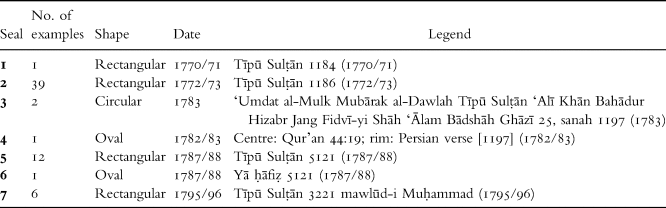
By now I have examined some 535 out of the British Library manuscripts and a few in other collections, but have been surprised overall at how few of the volumes actually contain the seal of Tipu Sultan himself. So far I have found seven different seals in 59 volumes, some containing more than one impression (see Table below).
summarising the different seals of Tipu Sultan arranged in chronological order

What is striking is the use of these different seals, all of which have been used for official purposes, except for nos. 1 and 2 which pre-date Tipu's accession to the throne and appear to have been personal seals. Seals 3 to 7 are official seals dating from his reign either according to the hijri era: nos. 3 and 4, or according to the muhammadi or mawludi era:Footnote 7 nos. 5–7. I discuss these below according to usage rather than chronologically.
Tipu Sultan's official seals
Seal 3
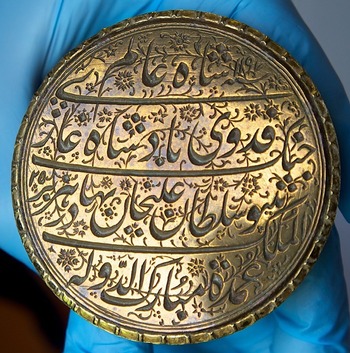
Hyder ʻAli died at the beginning of December 1782 and was succeeded by his son Tipu Sultan whose formal accession to the throne was 3 Bahari ah 1197 (April/May 1783).Footnote 8 Shortly after this he sent a request to the Mughal Emperor Shah ʻAlam II (r. 1760–1806) to establish his formal legitimacy as successor to his father. Later that year, according to the contemporary author David Price who had been at Seringapatam in the capacity of Prize Agent for the Bombay Army,Footnote 9 Tipu received a sanad granting him the titles ʻUmdat al-Mulk Mubārak al-Dawlah Tīpū Sulṭān ʻAlī Khān Bahādur Hizabr Jang, Fidvī-yi Shāh ʻĀlam Pādshāh Ghāzī (‘Pillar of the Kingdom, Blessed of the State, Tipu Sultan ʻAlī Khān Bahādur, Lion in Battle, Servant of Shah ʻAlam the Victorious King’), dated ah 1197 in the 25th regnal year of Shah ʻAlam (1783). In a contemporary account in Marathi by an officer attached to Tipu's TreasuryFootnote 10 the mission actually returned in 1784, bringing a palanquin and various gifts including the standard of the order of the fish (māhī u marātib). Presumably the seal matrix now preserved at Quex Park, Kent also arrived at that time as part of the official despatch.Footnote 11
Seal 3: mirror image of John Powell Powell's seal-matrix, acquired at some point before 1823. The seal reads ʻUmdat al-Mulk Mubārak al-Dawlah Tīpū Sulṭān ʻAlī Khān Bahādur Hizabr Jang Fidvī-yi Shāh ʻĀlam Pādshāh Ghāzī 25, sanah 1197 ‘Pillar of the Kingdom, Blessed of the State, Tipu Sultan ʻAlī Khān Bahādur, Lion in Battle, Servant of Shah ʻAlam the Victorious King, [Regnal Year] 25, Year 1197 (1783).’ Photo courtesy of the Powell-Cotton Trust.

The only example of this seal that I have come across is a wax impression of this matrix preserved at the National Museum of Scotland.Footnote 12 Perhaps, in view of the uncompromisingly subservient status it bestowed on Tipu Sultan as a vassal of the Mughal Emperor Shah ʻAlam, it fulfilled a purely ceremonial function and was not widely used.
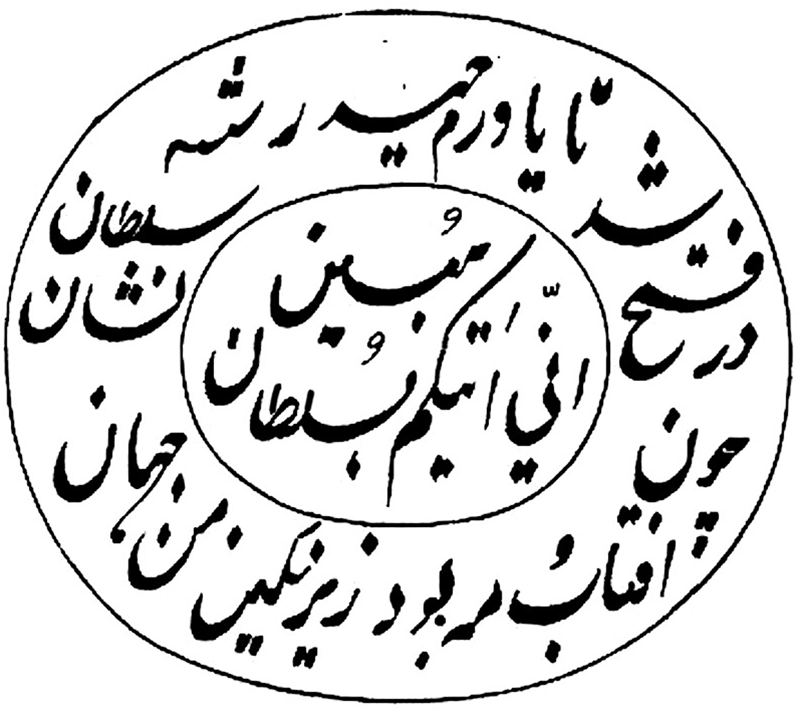
Seal 4: Tipu Sultan's oval shaped state seal. From Dirom, A narrative, p. 287.

Seal 4
Another seal dating from the same period is what Alexander Dirom terms Tipu Sultan's “Great Seal of State”.Footnote 13 He writes that it was adopted soon after Hyder ʻAli's death and was used in all Tipu's public despatches. Oval-shaped, in the centre it contains a quotation from the Qur'ān (Sūrah 44, verse 19): “Behold, I have come to you with clear authority”Footnote 14 and round the edge a Persian verse which traces his royal descent playing on the names of his grandfather Fath Naik and his father Hyder ʻAli: “From conquest [fatḥ], and the protection of the Royal Hyder comes my title of Sultan; and the world, as under the sun and moon, is subject to my signet”.Footnote 15 The date, according to Dirom,
…may be found by taking the letters of the Arabic Sentence, in their numerical Capacity, and the middle letter, as implied, by the word Der from the first three words of more than one Syllable of the Couplet, viz. T from Fittah, A from Ta Yeawerum, and Y from Hyder, which completes the Date. Footnote 16
The numeric value of the Arabic quotation is 786 which added to ت 400 + ا 1 + ی 10 makes a total of 1197 (ad 1782/83). To date I have not found an exact copy of this seal. However, a similarly inscribed matrix is preserved in the Royal Collection.Footnote 17 Apparently presented by Richard Wellesley, 1st Marques Wellesley, it was believed to have been the private seal of Tipu Sultan. Made of gold and inset with a dark red cornelian, the engraved inscription is identical to that of Dirom's ‘Great Seal’ though it is clearly dated 1217 of the mawludi era (1789/90).
Seal 5
Within a few months of ascending the throne Tipu instigated calendrical changes by renaming the twelve months and the year names of the 60 year cycle, while still also using the traditional hijri era for the year.Footnote 18 However in his fifth regnal year, he established a new lunisolar system which he called muhammadi or mawludi,Footnote 19 ie. dating from the supposed spiritual or actual birth of the Prophet which was reckoned to be thirteen years before the hijra. A further innovation was to record the numbers from right to left instead of the usual way round, from left to right.Footnote 20
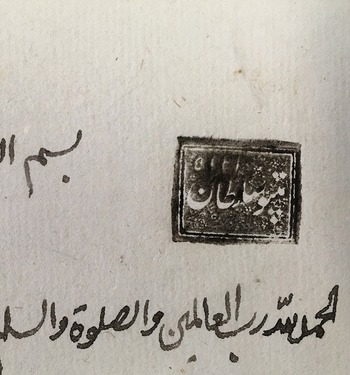
Seal 5: official seal inscribed Tīpū Sulṭān 5121 ie. AM 1215 (1787/88) in Mu'ayyid al-mujāhidīn (‘The holy warrior's assistant’), an official collection of 104 sermons in verse to be read at prayers, composed by order of Tipu Sultan by Zayn al-ʻĀbidin Mūsavī Shūshtarī. This manuscript, copied by the author, is dated 27 Ramazan 1221 muhammadi corresponding to 7021 (ie 1207) hijri (8 May 1793). IO Islamic 447, f. 1v. Courtesy The British Library Board.

The reasons for establishing this new era are not clear but KirkpatrickFootnote 21 mentions a letter dated 29 Izadi (11th month) of the year Dalv, ie. at the beginning of 1787, written shortly before the change, in which Tipu Sultan had requested information from scholars as to the exact dates of the birth, mission and flight of the Prophet.
The new system was judged to begin with the month Ahmadi 1215, year Sha, which commenced on the 20 March 1787.Footnote 22 The new seal was no doubt created to mark the new era and it continued to be used during the following years. It is found at the head or to the right side of documents and official manuals written at Tipu Sultan's request.Footnote 23 It reads Tīpū Sulṭān, 5121, i.e. am 1215 (1787/88) and measures 19 x 15 mm (interior measurement: 16 x 13 mm). In his Oriental Fragments dedicated to David Price (mentioned above), Edward Moor describes a ring which was apparently “found among the booty captured with Seringapatam”Footnote 24 which was purchased “at the prize sales” by David Price. The ring, he described, was “cut on deep red, liver-coloured, cornelian, set in gold”. The ring was still in Price's possession in 1834 when Moor published his description, and its impression, no. 2 of plate III, proves it to be the matrix of this seal which so far has been found in twelve different manuscripts in the collection.
Seal 7
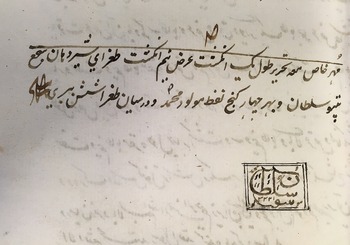
In 1796 another seal was introduced. A description of this seal is given in Ẓavabiṭ-i Sulṭānī (‘Royal regulations’), issued, according to the introduction, on 21 Haydari, year Hirasat, am 1224 corresponding to 19 Rabiʻ I, ah 1211 (22 September 1796). Several copies exist of this official handbook which describes the correct royal insignia to be used in seals and standards, and the form of official cyphers to be used in different government departments.Footnote 25 Instructions are issued for the ‘special seal’ (muhr-i khāṣṣ) to measure one finger (angusht) by half with the tughra Tipu Sultan in the shape of a tiger's (shīr Footnote 26) mouth, and the four corners to carry the letters Maw lū d-i Muḥammad. The tughra was also to contain six tiger (babrī) stripes. Although the regulations were drawn up in am 1224, the example illustrated in the manuscript itself (Fig. 4) dates from the preceding year.
Instructions for Tipu Sultan's ‘special’ (muhr-i khāṣṣ) seal (seal 7) from Chapter 1 of Ẓavabiṭ-i Sulṭānī (‘Royal regulations’). IO Islamic 2379, f. 4r. Courtesy The British Library Board.

Seal 7 inscribed Tipū Sulṭān 3221 mawlūd-i Muḥammad, ie. am 1223 (1795/96) heading a copy of Mufarriḥ al-qulūb (‘Heart's rejoicing’), a collection of mixed Persian and Dakhni songs collected for Tipu Sultan by Hasan ʻAli ʻIzzat and completed in ah 1199 (1784/85). The annotations here identifying Tipu's seal and tughra are by the previous owner William Kirkpatrick. IO Islamic 1638, f. 1v. Courtesy The British Library Board.

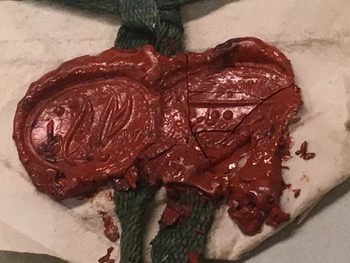
Wax sealing (no 6) inscribed yā ḥāfiẓ 5121, ie. AM 1215 (1787/88). IO Islamic 4683. Courtesy The British Library Board.

The design of this new seal is another example of Tipu's fondness for the tiger motif. Dated am 1223 (1795/96), it measures 19 x 15 mm (interior measurement: 17 x 13 mm) and like its predecessor (Seal 5) of am 1215 (1787/88) is found on documents and government manuals of which multiple copies exist.
Seal 6
A unique example of a further seal is found in a wax sealing attached to a document dated 15 Ahmadi, Shadab, am 1226 (April 1798). The left-hand part is inscribed yā ḥāfiẓ, and the right-hand side is dated am 1215 (1787/88), quite a few years earlier than the document to which it is connected. There were no doubt other seals of this type, but by virtue of their ephemeral nature they have not survived.
Tipu's personal seals
More interesting are what appear to be personal seals of Tipu Sultan, predating his accession to the throne at the end of 1782. With the exception of Seal 1 (below) and one other example, they occur in literary and historical works which are without any official status.
Seal 1
The earlier of these is a unique example occurring on a contract (iqrārnāmah) which was discovered by William Kirkpatrick (1754–1812). As Military Secretary to the Governor-General Lord Wellesley, Kirkpatrick was commissioned to examine all the documents discovered at Seringapatam in 1799. The contract itself was published in facsimile and translated in full in his Select Letters Footnote 27 and the original is preserved as part of the Marsden collection at SOAS (MS 12869A).Footnote 28
Seal 1: the earliest of Tipu's seals, inscribed Tīpū Sulṭān 1184 (1770/71) on an undated contract (SOAS MS 12869A). Courtesy SOAS Library.

This extraordinary document records a formal agreement between Tipu and his father that he will not steal, commit fraud, accept gifts, deceive or intrigue on pain of death. Although it is undated and may not be actually be in Tipu's handwriting, it is headed by his seal dated ah 1184 (1770/71). The seal measures 14.5 x 11 mm (interior measurement: 13 x 9 mm).
Seal 2
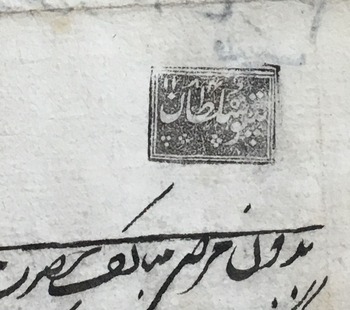
The most commonly occurring and in many ways the most interesting of all Tipu's seals is a similar, but slightly larger, seal of 1186 (1772/73), which, with one exception,Footnote 29 was used in literary manuscripts in his collection. Measuring approximately 16 x 12 mm (interior measurement: 14 x 11 mm) it occurs in 39 out of all the manuscripts examined so far. Unlike most ownership seals which are placed either on an empty page before the beginning of the text or at the end next to the colophon, this seal is always positioned immediately above or in the right hand margin of the opening.
A full list of manuscripts in which it occurs can be found as an appendix at the end of this article.
Out of the total number of manuscripts, fourteen are volumes of poetry by Amir Khusraw, ʻAttar, Rumi, Jami, Talib Amuli, Hasan Dihlavi, Nasafi, Zulali, Kamal Khujandi, ʻUrfi, Ahsan Allah and others—but surprisingly not established favourites such as Firdawsi and Hafiz nor Saʻdi. Other works with Tipu's seal include histories, biographies, dictionaries, and works on Islam. All the volumes bearing his seal are in Persian except for three in Arabic which also include Persian translations. This is in marked contrast to the rest of his collection which is made up of approximately 36 per cent Arabic works as compared with 60 per cent Persian. Not only does this indicate a preference for Persian but it suggests that Tipu Sultan's knowledge of Arabic might have been quite limited.
It is not known when nor from whom these manuscripts were acquired. The oldest, the Haylājnāmah (‘Life of al-Ḥallāj’) attributed to ʻAttar,Footnote 30 dating from 1496, had belonged to the Qutb Shahs of Golconda and includes the seals of Muhammad Quli Qutb Shah (r. 1580–1612) and his successor Muhammad Qutb Shah (r. 1612–26). At least eight manuscripts had belonged to Nawab ʻAbd al-Vahhab Nasir al-Dawlah Nusrat Jang of Chittoor, brother of Muhammad ʻAli Nawab of the Carnatic, whose property was confiscated in 1780 by Hyder ʻAli when he was taken prisoner with his family and sent to Seringapatam.Footnote 31
For the most part these volumes are very ordinary, only two could be described as of exceptional quality. Since there were many other deluxe volumes in his collection which did not carry his seal, we can perhaps assume that it was the content that Tipu especially valued and that the volume was actually read or particularly favoured in some way.
The Masnavīyāt-i Ẓafar Khān
One example which stands out is the Royal Asiatic Society manuscript Masnavīyāt-i Ẓafar Khān (‘Poems of Zafar Khan’), RAS Persian 310.Footnote 32 This manuscript contains two poems, Jilvah-i nāz (‘Glorious lustre’) and Maykhānah-i rāz (‘Tavern of secrets’) by Ahsan Allah known as Zafar Khan, and was copied by the author and dated 26 Zu ’l-Hijjah 1073 (1 August 1663) at Lahore, just a few days before his death.Footnote 33 The author, a distinguished Mughal courtier, was at different times Governor of Kabul, Kashmir and Sind, and was besides a noted patron of letters, poets and artists as well as a poet in his own right.
In addition to the volume's importance as an autograph copy, it contains six double paintings by one of Jahangir's favourite artists, Bishan Das,Footnote 34 painted around 1645 during Shah Jahan's visit to Kashmir. This is documented in two inscriptions on a flyleafFootnote 35 by Zafar Khan's son, Inayat Khan, who was Shah Jahan's librarian and chronicler. He tells us that the paintings were by Bishan Das whom he describes as his father's employee: “It has nine illustrations”, he wrote, “all two-pages which together make eighteen pages. The calligraphy is priceless and the value of the remaining decoration is 400 RS”.
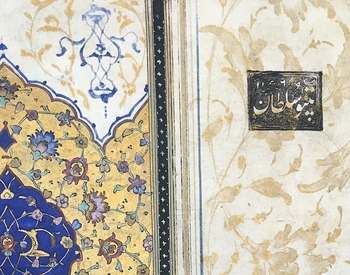
Although this manuscript had been long noted on account of its outstanding paintings and illuminationFootnote 36 the seal on folio 1v (Fig. 8) had defied identification. It was the discovery of a volume described as “Julweh Naz wa Meykhaneh Raz beautifully illuminated with paintings” in a list of books compiled in 1799 which first attracted my attention.Footnote 37 This list had been compiled by Capt. David Price and Samuel Ogg, Prize Agents for the Bombay and Madras Armies who had been tasked in 1799 with making an inventory of the Library and selecting books to be sent to the East India Company Court of Directors in London and the Asiatic Society of Bengal in Kolkata. The volume was mentioned again eight years later and recorded as “lost by the death of Mr Elliott Student of the College” in a list of sixteen books intended for London but “which are not to be found”.Footnote 38
Seal 2: Tipu's personal seal inscribed Tīpū Sulṭān 1186 (1772/73), placed in the right hand margin of the opening of the Dīvān of Muḥammad Ṭālib Āmulī, court poet of the Mughal Emperor Jahangir. Dated circa 1637. BL IO Islamic 3474. Courtesy The British Library Board.

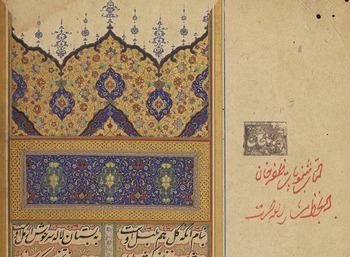
Tipu Sultan's seal of 1186 (1772/73) placed in the right margin of the opening of Zafar Khan's masnavi Jilvah-i nāz. Underneath an annotation by one of Tipu Sultan's clerks describing the manuscript as an autograph. RAS Persian 319, f. 1v. Courtesy of the Royal Asiatic Society.

Comparison of the seal with other examples has confirmed the provenance. Additionally the handwriting of the inscription underneath, with its distinctive backward turning ‘k’, appears identical to that found in volumes of Tipu's documents.Footnote 39
The manuscript was presented to the Royal Asiatic Society in 1834 by Charles Joseph Doyle (1787–1848) Military Secretary to the Governor-General Lord Moira (later Marquess of Hastings) from 1813 to 1823. Possibly he had purchased this book in Kolkata from the estate of the unfortunate Mr Elliott.
Conclusion
Unfortunately, there exists no dedicated study of the portion of Tipu Sultan's collection which remains in the Asiatic Society Kolkata, but the sample preserved in the British Library is sufficiently substantial to allow conclusions to be made. On the basis of acquisition notes which, if dated, usually predate Tipu Sultan's accession in 1782, it would seem likely that the major part of the collection was acquired during Hyder ʻAli's reign. This is also supported by the evidence of previous owners’ seals, of which the latest is dated 1777. The presence of Tipu's ‘library’ seal of 1772/73, however, on a number of literary items reflects his personal ownership even if some of the manuscripts were acquired as a result of his father's military campaigns. Similarly the absence of Tipu's ‘official’ sealsFootnote 40 on works of this kind may reflect a particular usage of the library seal. Given Tipu's known literary interests, it indicates his personal choice of reading matter and he may have continued to use it this way throughout his reign.
Appendix
List of manuscripts known to contain Tipu's Library seal
• IO Islamic 241 (Ethe 1516). Qiṣṣah-i Khvurshīd va Māh, a mystical masnavi by Muḥammad Sharīf Badāʻī Nasafī, copied by Muḥammad Beg Shāmlū. Early 18th century with an illuminated heading and flowers marking the end of each verse. Former owner Shāh Muḥyī ʾl-Dīn.
• IO Islamic 279 (Ethe 1202). Maṭlaʻ al-anvār by Amīr Khusraw. Copied for Mīr Sirāj al-Dīn on 14 Zu ’l-Qaʻdah 1169 (10 August 1756).
• IO Islamic 329 (Ethe 910). Dīvān-i Aḥmadī attributed to the Sufi writer Aḥmad-i Jām Zhandahpīl (1048–1141). Early 18th century with illuminated heading. Former owner Sayyid Shah ʻAbd Allāh Qādirī, his undated seal: Sayyid Shāh Muḥammad ʻAbd Allāh Qādirī.
• IO Islamic 386 (Ethe 1218). Nuh sipihr by Amīr Khusraw. 18th century copy. Former owner Naṣīr al-Dawlah Bahādur Nuṣrat Jang, his seal dated 1186 (1772/3).
• IO Islamic 403 (Ethe 1494). Sabʻ Sayyārah, here called Āshūbnāmah, seven masnavis by Zulālī, lacking part of the prose introduction at the beginning. Possibly 17th century.
• IO Islamic 482 (Ethe 158). Rawz̤at al-shuhadā, a history of the martyrdom of ʻAli and his family by Ḥusayn Vāʻiẓ Kāshifī. 18th century copy lacking final pages.
• IO Islamic 776 (Ethe 1048). Haylājnāmah, the life of the Sufi Manṣūr al-Ḥallāj attributed to ʻAṭṭār. Copy dated 2 Safar 902 (10 October 1496). Former owners Muhammad Quli Qutb Shah, Sultan of Golconda (r. 1580–1612), his successor Muhammad Qutb Shah (r.1612–26), his seal dated 1021 (1612/13) and Saʻādat ʻAlī Khān, his seal dated 1176 (1762/63).
• IO Islamic 827 (Ethe 22). Majmaʻ al-ansāb, an incomplete copy of the general history abridgement to 736/1335 by Muḥammad ibn ʻAlī Shabānkārah’ī. Copy dated 14 Rajab 1027 (7 July 1618). Illuminated heading. Former owner Abu'l-Qāsim, his seal dated 1056 (1646/47).
• IO Islamic 905 (Ethe 2034). Juz’īyat va Kullīyāt, mixed prose and verse on the spiritual aspects of the human body by Ẓiyā al-Dīn Nakhshabī. Copy dated 19 Shavval year 41 [of Aurangzeb] (11 May 1697).
• IO Islamic 925 (Ethe 1279). Dīvan-i Kamāl by Kamāl al-Dīn Khujandī. Copy dated 6 Rabiʻ I 1085 (20 June 1674) by Shaykh Kālī. Former owner Naṣīr al-Dawlah Bahādur Nuṣrat Jang, his seal dated 1186 (1772/73).
• IO Islamic 1141 (Ethe 190). Fatḥnāmah-i Ṣāḥibqirānī, a simplified version of ʻAlī Yazdī's Ẓafarnāmah. Copy dated 6 Zu ’l-Hijjah 982 (15 March 1575).
• IO Islamic 1316 (Ethe 2045). Riyāz̤ al-inshā, a volume of model epistolography by the Bahmanid minister Maḥmūd Gāvān Khvājah Jahān (d. 1481). Possibly 17th century. Former owners Abū Ḥāmid ibn Shaykh Maḥmūd known as Shaykh Ḥamīd and Muḥammad Taqī ibn Muḥammad Shafīʻ al-Gīlānī al-Muṣṭafīkhānī.
• IO Islamic 1334 (Ethe 1212). Qir'ān al-saʻdayn by Amīr Khusraw. 18th century copy.
• IO Islamic 1364 (Ethe 1461 and 1641). Qaṣīdas by the poet ʻUrfī and the Dīvān of Nāṣir ʻAlī, dated 21 Muharram 1143 (6 August 1730).
• IO Islamic 1405 (Ethe 598). Majmaʻ al-hudā, lives of the prophets, Imams and other holy men by ʻAlī ibn Ḥasan al-Zavvārī. Possibly dating from the 16th century, illuminated heading. Former owner, court servant Rūḥ Allāh Khān khānah'zād-i ʻĀlamgīr Shāh year 11, 1079 (1668/69).
• IO Islamic 1637 (Ethe 1227). Dīvān-i Ḥasan Dihlavī. 18th century. Former owner ʻAbd al-Vahhāb Khān Bahādur Nuṣrat Jang, his seal dated 1174 (1760/61).
• IO Islamic 1662 (Loth 138). Kalimāt-i Murtaz̤avī, the 100 sayings of ʻAli in Arabic, with a Persian paraphrase in couplets. A beautifully illuminated copy, perhaps dating from the 17th century. Former owners ʻAbd al-Razzāq Khān, his seal dated 1187 (1773/74) and his father ʻAbd al-Vahhāb Khān servant of Muḥammad Shāh Bādshāh Ghāzī, his seal dated 1157 (1744). Also includes genealogical notes written by Ghulām Muḥammad Khān, a distant cousin of ʻAbd al-Vahhāb.
• IO Islamic 1682 (Ethe 2393). Kanz al-lughāt, an Arabic-Persian dictionary by Muḥammad ibn ʻAbd al-Khāliq ibn Maʻrūf. Copied by Muḥammad ibn ʻAbd al-Shukūr of Shahjahanpur, Bihar on 27 Jumadi II year 38 (12 February 1695).
• IO Islamic 1687 (Ethe 2116). Munsha'āt-i Bīdil, letters of the philosopher poet Bīdil. 18th century copy by Qādir Muḥyī ’l-Dīn Khān the governor (qilʻah dār) of Calicut.
• IO Islamic 1741 (Ethe 857, 2774, 2786, 2787). Majmūʻah-i chand risālah, a collection of four works including two treatises on archery, copied circa 1771 (dated watermark) by Abū ’l-Ḥasan ibn Muḥammad Ṣadīq at Haydarnagar (Bednur).
• IO Islamic 1794 (Ethe 2499). Burhān-i qātiʻ, the well-known Persian dictionary compiled by the 17th century lexicographer Muḥammad Ḥusayn ibn Khalaf Tabrīzī Burhān who wrote under the patronage of Qutubshah ruler ʻAbd Allah (r. 1626–72). Copied 20 Safar 1178 (19 August 1764), in the fort of Kolar by Shaykh Burhān al-Dīn ʻAbbāsī.
• IO Islamic 1865 (Ethe 1529). The final part (rubāʻīyāt) of the Dīvān of Muḥammad Ṭālib Āmulī, poet laureate of the Mughal Emperor Jahangir. Copy dated 1 Jumadi I 1047 (21 Sept 1637), including an illuminated heading and decorated opening. Follows on from IO Islamic 3474 below. Previous owner Naṣīr al-Dawlah Bahādur Nuṣrat Jang, his seal dated 1186 (1772/73).
• IO Islamic 1873 (Ethe 2043, 2257, 2258). A composite volume containing the Manāẓir al-inshā, an authoritative treatise on prose composition by the Bahmanid minister Maḥmūd Gāvān Khvājah Jahān (see also IO Islamic 1316 above), and two short treatises on astronomy. Copied by Ghulām Shaykh Najm Khaṭīb al-Murshidī. Former owner ʻAbd al-Vahhāb Khān Bahādur Nuṣrat Jang, his seal dated 1175 (1761/62).
• IO Islamic 2029 (Ethe 605). Tārīkh-i Mūsavī, on the life of Moses by Mu’in al-Miskīn, dated 23 Ramazan 906 (11 April 1501).
• IO Islamic 2124 (Ethe 1875, 579). Javāhir-i khamsah, a Persian version of his Arabic treatise by the 16th century Sufi saint Muḥammad Ghaws Gwaliyārī. Illuminated heading. Copied by Muḥammad Vāṣil Bayg Qādirī and dated 8 Safar 1173 (1 October 1759). Followed by a short treatise Risālah-i Afghānān, on the origins of the Afghans.
• IO Islamic 2162 (Ethe 1885). Durr al-majālis, legends relating to the prophets and Sufi saints by Sayf al-Ẓafar Nawbahārī. Copy possibly dating from the16th or early 17th century. Former owners: Ḥasan Muḥammad son of Dāvaljī and Dūst Muḥammad ibn ʻAbd al-Ghanī, his inscription dated 19 Shavval 1125 (8 November 1713).
• IO Islamic 2223 (Ethe 1228). Jām-i jam by Awḥadī Marāghah’ī, a treatise on mysticism in masnavi form. Copy dated 23 Rabiʻ II 1169 (26 Jan 1756) by Mīr Najm al-Dīn al-Ḥusaynī for Mīr Sirāj al-Dīn copied from a book belonging to Hazrat Nawab Dilāvar Khān Bahādur in the district (qasbah) of Sira (Karnataka).Footnote 41
• IO Islamic 2266 (Ethe 1545, 1650). Volume containing a selection from the Dīvān of the Safavid poet Jalāl Asīr of Isfahan and the popular poem Nayrang-i ʻishq, here titled simply Masnavī, by the Mughal poet Ghanīmat Kunjāhī. Copy completed 11 Rajab year 29 of Muhammad Shah (19 July 1747) on commission for Mīr Muḥammad Muḥsin, his seals dated 1156 (1743/44).
• IO Islamic 2270 (Ethe 2576). Tarjumah-i Kanz al-daqā’iq, a Persian translation of al-Nasafī's Arabic treatise on Hanafi law, here ascribed to Naṣr Allāh ibn Jamāl Izdī. Possibly 18th century.
• IO Islamic 2341 (Loth 191). Bāb al-akhbār, a collection of traditions by Aḥmad ibn ʻAbd Allāh with a Persian translation. Copy dated 1 Muharram 1157 (15 February 1744).
• IO Islamic 2352 (Loth 372). A compilation consisting of miscellaneous prayers and translations added at different times. Former owner Kanīz Fāṭimah, her seal dated 1169 (1755/56).
• IO Islamic 3302 (Ethe 2490). Farhang-i Jahāngīrī by Jamāl al-Dīn Ḥusayn Injū. Copied on 17 Rabiʻ II 1047 (8 September 1637). Illuminated heading. Previous owner: Khudābakhsh ibn ʻAbd al-Ṣamad, his seal dated 1099, RY 31 (1687/88).
• IO Islamic 3311 (Ethe 1078). Mas̱navī-yi maʻnavī by Rūmī. Illuminated heading. Perhaps seventeenth century?
• IO Islamic 3349 (Ethe 2155). Akhlāq-i Nāṣirī, on ethics by Nāṣir al-Dīn Ṭūsī, copy dated 7 Zu'l-Hijjah 1041 (25 June 1632). Previous owners: Naṣīr al-Dawlah Bahādur Nuṣrat Jang, his seal dated 1186 (1772/73) and before him Ghulām Valī who had also owned two other manuscripts.
• IO Islamic 3360 (Ethe 2155). The first part of Jāmī's first dīvān. Illuminated heading. Perhaps seventeenth century?
• IO Islamic 3376 (Ethe 1548). Ghazalīyāt-i Jalāl Asīr by Jalāl Asīr of Isfahan, completed by Qalandar on 23 Zu'l-Hijjah regnal year 24 of ʻAlamgīr (14 Jan 1681).
• IO Islamic 3474 (Ethe 1527). Dīvān by Muḥammad Ṭālib Āmulī, court poet of the Mughal Emperor Jahangir. The first of a two-volume set, consisting of ghazals, of which the second, IO Islamic 1865 above, is dated first Jumadi I 1047 (21 Sept 1637). Illuminated heading. Former owner: Naṣīr al-Dawlah Bahādur Nuṣrat Jang, his seal dated 1186 (1772/73).
• IO Islamic 4683. A collection of orders (ḥukmnāmah), four of which carry Tipu's 1186/1772 seal in documents dating from 1783 to 1785 - thus predating his first official seal of 1787.
• RAS Per 310. Masnavīyāt-i Ẓafar Khān. Two poems, Jilvah-i nāz and Maykhānah-i rāz by Ẓafar Khān Aḥsan, copied by the author and dated 26 Zu'l-Hijjah 1073 (1 August 1663) at Lahore. Includes 6 out of an original 9 double paintings by Bishan Das painted circa 1645 during Shah Jahan's visit to Kashmir.