INTRODUCTION
Hiatella is a widespread common bivalve that inhabits cold and temperate waters of the world's oceans. These molluscs occur in the subtidal zone living in rhizoids of macrophytes, beneath the stones and in rock crevices.
The taxonomic composition of Hiatella remains a matter of discussion. It is still unclear whether this genus includes several species or only one widely distributed species (Ockelmann, Reference Ockelmann1958; Keen, Reference Keen1971; Simone & Penchaszadeh, Reference Simone and Penchaszadeh2008). The taxonomic identification of species within the genus is traditionally based on the shell shape and characteristics of shell sculpture, but these characters can only be found in relatively young individuals; the shell of adult molluscs is typically distorted due to their lifestyle (Hunter, Reference Hunter1949).
Most authors emphasize an extremely complicated synonymy of the genus and confused state of hiatellid taxonomy (Strauch, Reference Strauch1968; Keen, Reference Keen1971; Yonge, Reference Yonge1971; Simone & Penchaszadeh, Reference Simone and Penchaszadeh2008). After the key representatives had been described, the genus was expanded with a considerable number of species, most of which were in fact inadvertent redescriptions of already known species. The situation was further complicated by exceptionally high geographic and biotopical variability of shell shapes in these molluscs, which often prompted several redescriptions of the same species (Strauch, Reference Strauch1968; Simone & Penchaszadeh, Reference Simone and Penchaszadeh2008).
The analysis of representatives of the genus living in British waters allowed Jeffreys (Reference Jeffreys1869) to draw a conclusion that the genus contains only one species, Saxicava rugosa (=Hiatella rugosa) (Linnaeus, 1767), comprising a great number of varieties. Similar conclusions were made by researchers working in the North and Baltic Seas (Meyer & Möbius, Reference Meyer and Möbius1872). Considerable variability of characters, particularly shell spines, was noted (Hägg, Reference Hägg1904; Odhner, Reference Odhner1914). In the first half of the 20th century, a number of authors subdivided the genus into several species. Lamy (Reference Lamy1921) identified three Hiatella species in the North Atlantic: Saxicava arctica (Linnaeus, 1767), S. rugosa and S. pholadis (Linnaeus, 1771). In Winckworth's revision (Winckworth, Reference Winckworth1932), Hiatella was subdivided into two species: H. arctica and H. gallicana (Lamarck, 1818). The observations of Lebour and Jørgensen on larval development also supported the distinction of two Hiatella species (Lebour, Reference Lebour1938; Jørgensen, Reference Jørgensen1946). It was, therefore, generally accepted that the genus Hiatella includes two species: H. arctica with an angular spinous shell and H. gallicana (rugosa) with a less angular shell (Hunter, Reference Hunter1949). Some malacologists also recognized the third species, H. pholadis, with a gaping triangular shell (Lamy, Reference Lamy1921; Oldroyd, Reference Oldroyd1978).
In the second half of the 20th century, however, the opinions of malacologists have differed. Although the traditional system proposed by Winckworth (Reference Winckworth1932) was still in use, it was also suggested that the species arctica, gallicana and pholadis might be invalid. Some authors still dispute the taxonomic validity of the best known members of the genus (Ockelmann, Reference Ockelmann1958; Beu, Reference Beu1971; Savage & Goldberg, Reference Savage and Goldberg1976).
Two species of the genus Hiatella have been described from the White Sea. Hiatella arctica was described in the early 20th century (Deryugin, Reference Deryugin1928) and was long thought to be the only member of the genus in the White Sea. The second species was initially identified in 2006 (Naumov, Reference Naumov2006) as H. pholadis, but was later shown to be H. gallicana based on the analysis of larval development and juvenile morphology (Lezin et al., Reference Lezin, Flyachinskaya, Khalaman, Naumov, Alekseev and Sukhotin2010). These molluscs inhabit similar biotopes and differ in the development of shell sculpturing and in the timing of spawning periods (Naumov, Reference Naumov2006; Lezin et al., Reference Lezin, Flyachinskaya, Khalaman, Naumov, Alekseev and Sukhotin2010; Naumov et al., Reference Naumov, Flyachinskaya and Khalaman2010).
In the White Sea, the spawning season of Hiatella lasts from June to November (Matveeva & Maksimovich, Reference Matveeva and Maksimovich1977; Flyachinskaya & Lezin, Reference Flyachinskaya and Lezin2006, Reference Flyachinskaya and Lezin2008). During this period, two population peaks of planktonic larvae and settlement can be observed (Günther & Fedyakov, Reference Günther and Fedyakov2000; Naumov et al., Reference Naumov, Flyachinskaya and Khalaman2010). The molluscs that settled in August have well-developed spines and ridges in the posterior portion of the shell and can be identified as H. arctica (Flyachinskaya & Lezin, Reference Flyachinskaya and Lezin2006, Reference Flyachinskaya and Lezin2008). Individuals of Hiatella that completed their metamorphosis in autumn have smooth shells and belong to the second species (Lezin et al., Reference Lezin, Flyachinskaya, Khalaman, Naumov, Alekseev and Sukhotin2010; Naumov et al., Reference Naumov, Flyachinskaya and Khalaman2010).
Preliminary observations have shown that the formation and prominence of shell sculpture in juveniles of Hiatella depend on temperature conditions (Flyachinskaya & Lezin, Reference Flyachinskaya, Lezin and Asanovitch2012). It was argued that the formation of major species characters of Hiatella, the spines and ridges on the shell, is dependent on temperature regime during the period of mollusc development. The study reported here was designed to test this hypothesis.
MATERIALS AND METHODS
Material sampling and maintenance
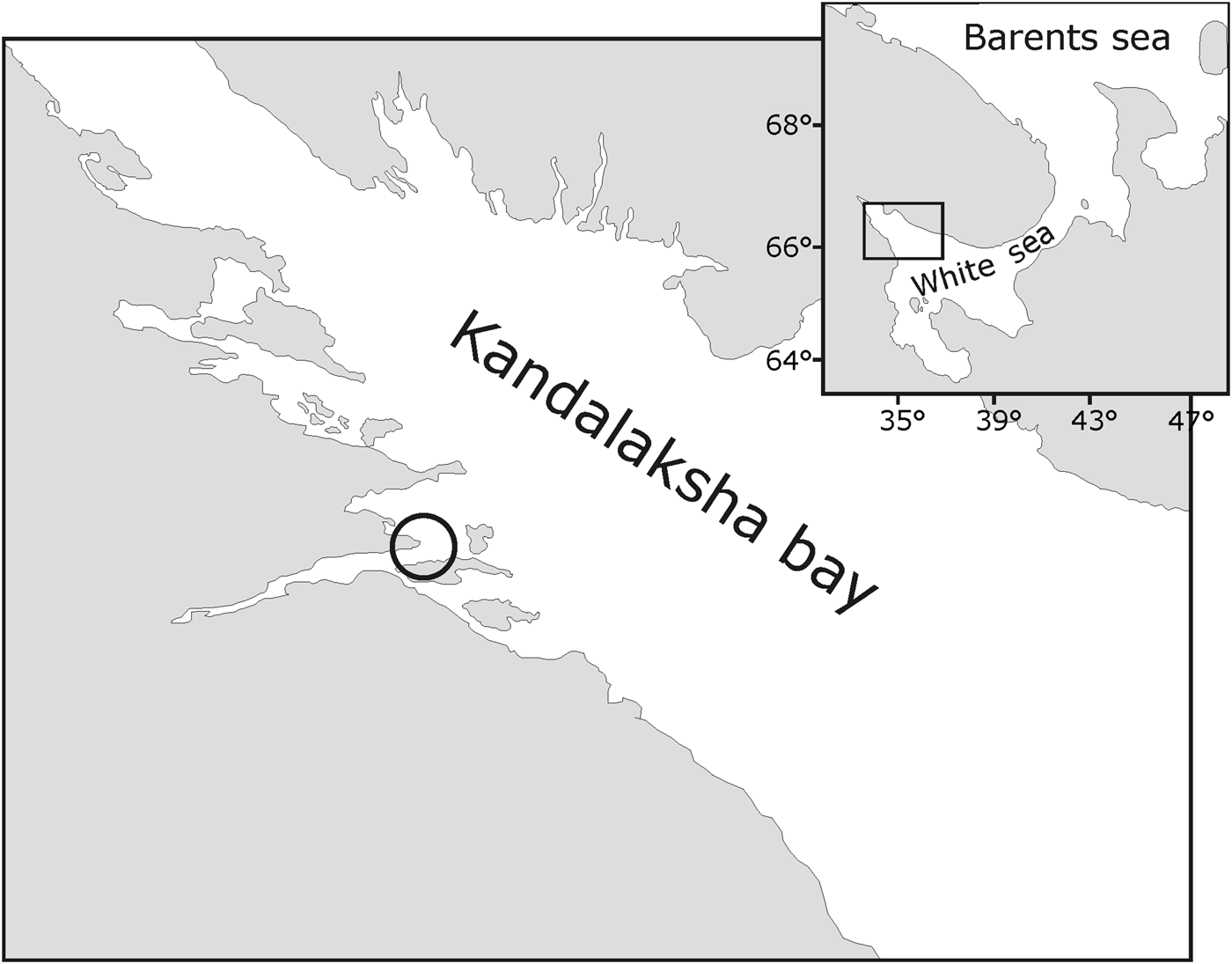
The study was conducted at Kandalaksha Bay of the White Sea. The late stages of Hiatella larvae were used in laboratory experiments. The larvae were taken from plankton in summer–autumn of 2013.
Plankton samples were taken in Chupa Inlet near the White Sea Biological Station, Zoological Institute of the Russian Academy of Sciences (66°20.230′ N 33°38.972′ E) (Figure 1). Plankton were collected from June to October using a Juday net with a 100-μm mesh.
Research area map.

Late-stage Hiatella larvae were sorted from plankton samples in the laboratory and maintained under laboratory conditions with continuous aeration and a density of 1–2 individuals per 1 mL of water.
Experiments
Two series of Hiatella larvae collected at different time periods were used in the experiments. The first series was obtained in August, over the period corresponding to the settlement peak of H. arctica. The second series was collected in late September, during the active settlement of H. gallicana. Both series were subdivided into three groups, which were maintained at different water temperatures:
+5°С – corresponds to the average water temperature in the White Sea in late September–October (settlement season of H. gallicana) (Berger et al., Reference Berger, Dahle, Galaktionov, Kosobokova, Naumov, Rat'kova, Savinov and Savinova2001)
+12°С – corresponds to the average water temperature in the White Sea in August (settlement season of H. arctica) (Berger et al., Reference Berger, Dahle, Galaktionov, Kosobokova, Naumov, Rat'kova, Savinov and Savinova2001)
+8°С – was selected as an average between the first two water temperatures.
The experiment, therefore, involved six groups of Hiatella larvae divided into two series. The larvae in each group were placed into 50-mm Petri dishes with a stocking density of 20 individuals per dish. Each group included 60 individuals. Petri dishes with molluscs were placed in thermostats at the temperatures indicated above. The larvae were kept at constant temperature, illumination and water salinity. The water was changed and the molluscs were fed at regular intervals. The experiment was stopped when all larvae completed metamorphosis and reached a shell size of 700 μm. This final size was selected, because at this size the juveniles clearly display all elements of shell sculpture.
After the experiment, the development of sculpture on the shell surface was visually evaluated in all experimental animals. For this purpose, the development of sculpture elements (ridges and spines in the posterior portion of the shell valves) was examined under a Leica MZ9.5 microscope (×20–50).
Early shell morphology and shell analysis
The young individuals of H. arctica have two pronounced ridges: one along the dorsal shell margin and the other along the lateral shell surface. After the metamorphosis, the upper ridge forms a row of well-developed needle-shaped spines (Lebour, Reference Lebour1938; Hunter, Reference Hunter1949). A similar structure on the lateral ridge develops when the mollusc attains a size of 400–700 μm (Flyachinskaya & Lezin, Reference Flyachinskaya and Lezin2006, Reference Flyachinskaya and Lezin2008). The juveniles of H. gallicana have smooth shells without apparent spines or ridges. In rare cases, several slight knobs can emerge on the upper (dorsal) ridge (Lebour, Reference Lebour1938). The lateral ridges are formed only in very rare cases and never bear any additional structures (Lebour, Reference Lebour1938; Hunter, Reference Hunter1949).
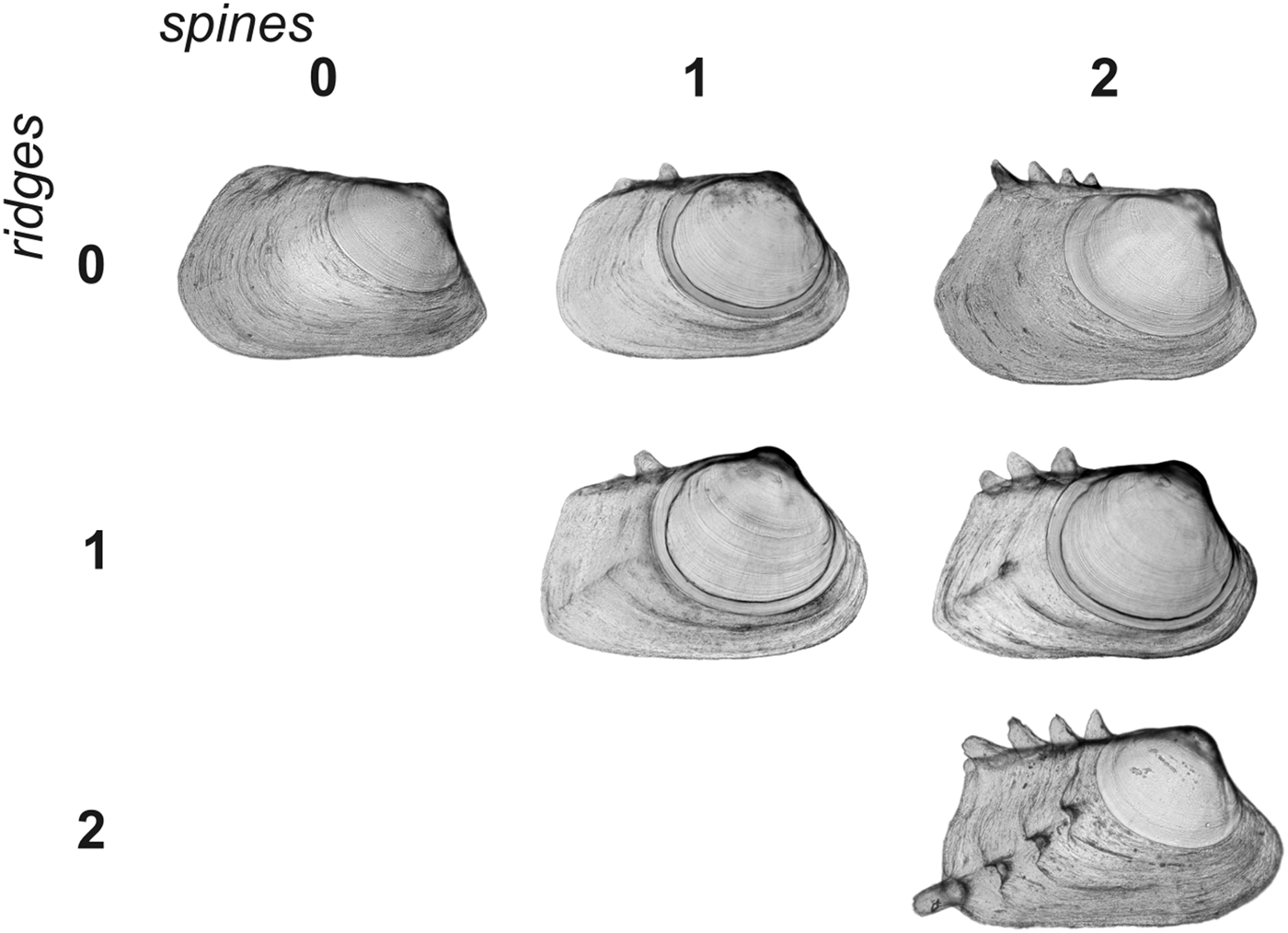
The juveniles reared in the laboratory showed the shell sculpture developed to various degrees. The following 3-point scale was used to evaluate the results of the experiment: 0 – the character is completely absent; 1 – the character is incompletely developed; 2 – the character is clearly evident. Accordingly, three degrees of character prominence were defined for each character (Figure 2):
Variants of shell sculpture in the experimental molluscs. 0; 1; 2 – gradation of sculpture elements.
Spines
0 – the spines are absent, shell surface is smooth.
1 – the spines are short, poorly developed. The spines look like knobs, their number is fewer than in H. arctica. Only the dorsal edge of the shell bears the sculpture, lateral projections are absent.
2 – there are two rows of well-developed long spines.
Ridges
0 – shell surface is smooth, ridges are absent.
1 – Only the lateral ridge is formed. The ridge is poorly developed and smoothed.
2 – There are well-developed dorsal and lateral ridges.
Each mollusc was evaluated individually for the extent of development of ridges and spines using this 3-point scale.
Statistics
Kruskal–Wallis tests were used to compare the extent of development of spines and ridges on the shells of Hiatella at different temperatures and in different seasons.
RESULTS
The molluscs showed wide variability of shell sculpture both in summer and autumn experimental series. All variations in shell sculpture, from a complete absence of ridges and spines to their maximum development, were present.
Summer experiments
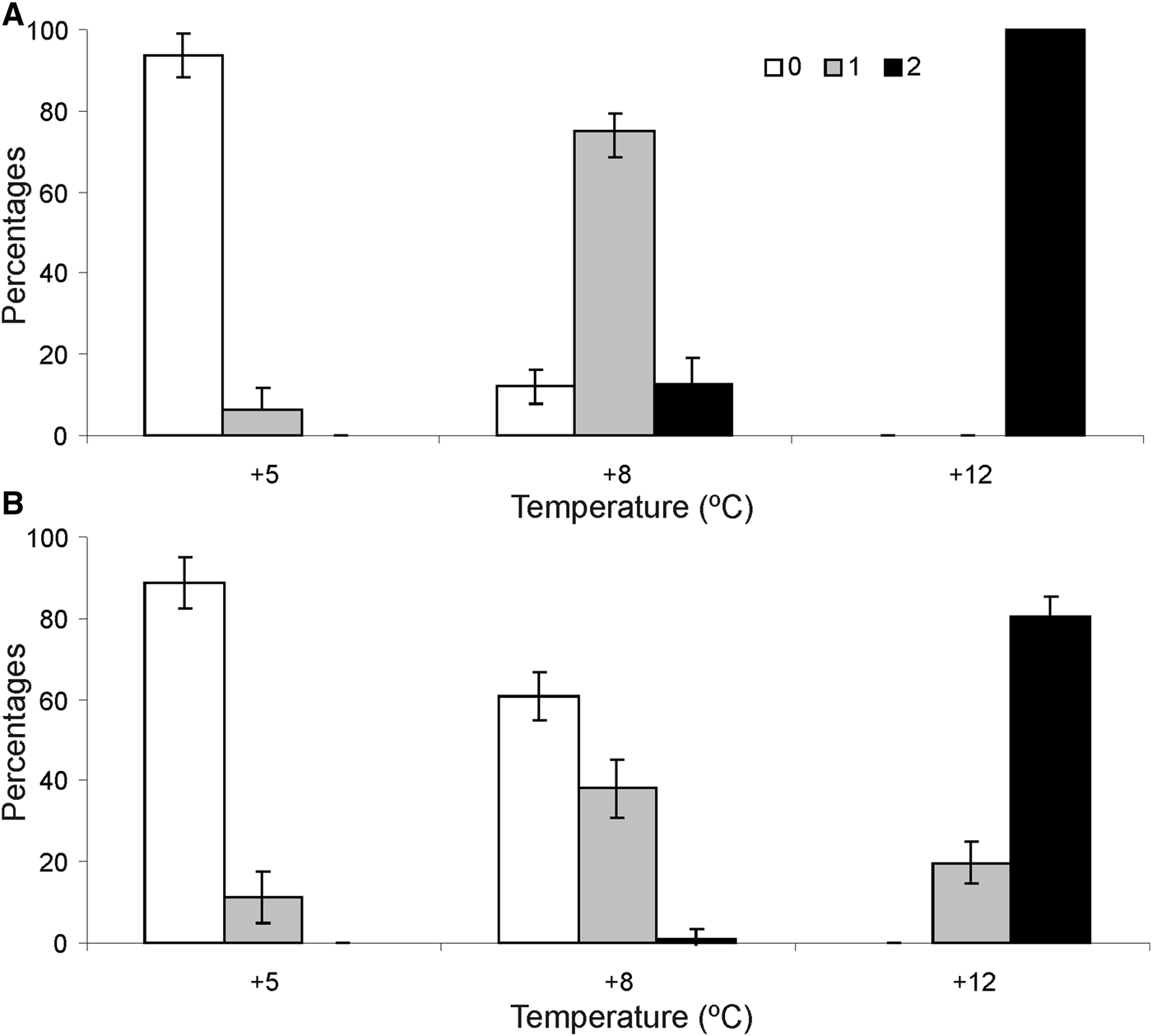
In summer experiments, most molluscs reared at 5°С formed smooth shells (Figure 3A). The proportion of individuals that lacked spines entirely was 93% and the remaining individuals bore small knobs in the upper row (score of 1 on the 3-point scale for sculpture development). Similar results were obtained from the analysis of ridge development: most individuals had smooth shells without ridges and 10% of molluscs displayed a poorly developed dorsal ridge (Figure 3B). When Hiatella were reared at 12°С, all molluscs developed two rows of long spines on the shell (Figure 3A). The majority (up to 80%) of individuals developed two pronounced ridges in the posterior portion of the shell, and about 20% of molluscs formed only the upper ridge.
Ratio of molluscs with different variants of spines (A) and ridges (B) in three temperature conditions in summer experiments. 0–2 – gradations of sculpture elements manifestation. 95% confidence intervals of means are presented.
When Hiatella were maintained at the intermediate temperature of +8°С, the shell sculpture was more diverse. The most numerous (up to 75%) were individuals with a single row of poorly developed spines. The proportion of spineless Hiatella and the animals with a well-developed sculpture was 12% for each category (Figure 3A). In this group the ridges were poorly developed, and the most abundant were individuals with smooth shells and poorly developed upper ridge (Figure 3B). The individuals with two well-developed ridges were very rare.
Autumn experiments
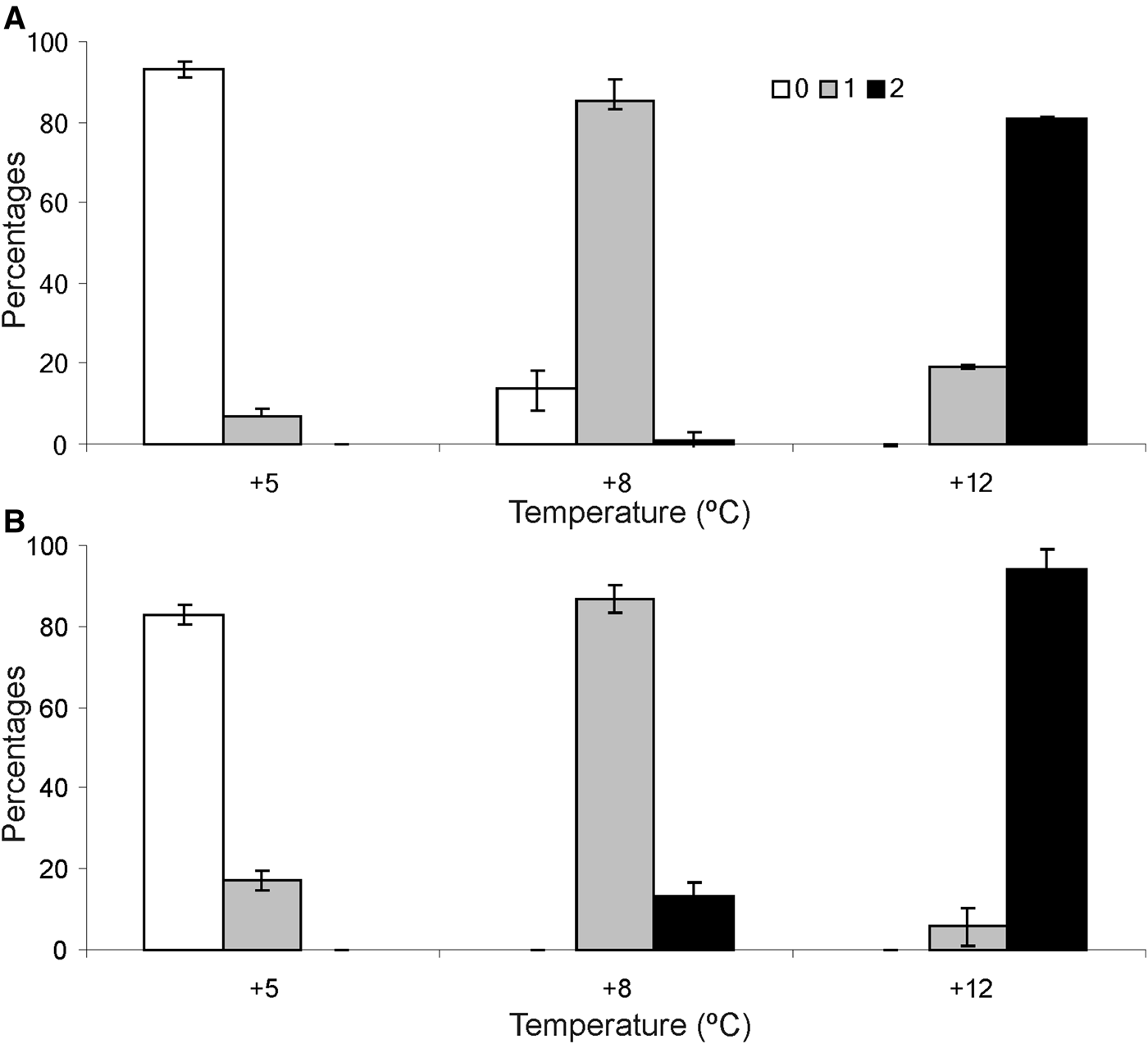
In the experiments conducted in autumn the molluscs with smooth shells were also the most abundant among the animals reared at 5°С (Figure 4). 93% of individuals had no spines on their shells, and the remaining 7% developed a single row of poorly developed spines (Figure 4A). The majority (80%) of Hiatella had smooth shells without ridges, and 20% developed the dorsal ridge (Figure 4B).
Ratio of molluscs with different variants of spines (A) and ridges (B) in three temperature conditions in autumn experiments. 0–2 – gradations of sculpture elements manifestation. 95% confidence intervals of means are presented.
When the molluscs were maintained at 12°С, most animals formed well-developed shell sculptures with two rows of long spines and two ridges. Up to 80% of individuals bore two rows of long spines on their shells. The remaining 20% of individuals had a single row of dorsal spines (Figure 4A). A great majority of molluscs formed two well-developed ridges in the posterior portion of the shell and 5% of individuals had only the dorsal ridge (Figure 4B). No molluscs in this group had smooth shells without sculpturing.
The individuals with poorly developed shell sculptures were the most numerous among the molluscs maintained at the intermediate temperature of +8°С. Most individuals had a single row of poorly developed spines, and up to 14% of molluscs had no spines (Figure 4A). Only a very few individuals with two rows of spines were observed in this group. Most molluscs developed only the dorsal ridge, and 14% had both dorsal and lateral ridges (Figure 4B). There were no animals with smooth shells without ridges.
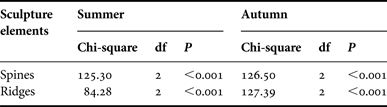
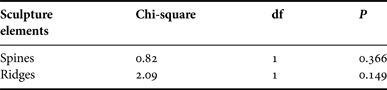
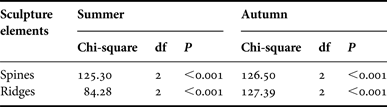
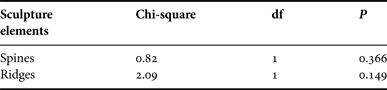
The degree of development of both spines and ridges on the shell in animals reared at different temperatures was significantly different both in summer and autumn experiments (Table 1). In contrast, the comparison of molluscs from the summer and autumn experimental series did not reveal any statistically significant differences in the development of sculpture elements (Table 2).
Results of Kruskal–Wallis test for the evaluation of statistically significant differences of ridges and spines values between different temperatures in different seasons.
Results of Kruskal–Wallis test for the evaluation of statistically significant differences of ridges and spines values between seasons.
In summary, the analysis of relative numbers of molluscs with different shell sculptures in the experimental groups shows that at 5°С the majority of Hiatella formed smooth shells without spines or ridges. This sculpture morphology is typical for H. gallicana, which develops and lives at +5°С. Hiatella that developed at 12°С formed shells with two well-developed ridges and two rows of long spines. A well-developed shell sculpture is characteristic of H. arctica that develops and settles in summer at high water temperatures. The molluscs reared at 8°С showed a wide range of shell sculptures, often having a combination of traits characteristic of both species.
DISCUSSION
The taxonomy of the genus Hiatella is based on the characters of the shell. The shell of adult Hiatella is typically distorted because of their lifestyle: sculptural elements are lost and species identification is difficult or impossible (Hunter, Reference Hunter1949; Abbott, Reference Abbott1955; Ockelmann, Reference Ockelmann1958; Beu, Reference Beu1971). For this reason, only young individuals that have an undamaged shell with intact sculpture can be unambiguously identified (Hunter, Reference Hunter1949; Abbott, Reference Abbott1955; Simone & Penchaszadeh, Reference Simone and Penchaszadeh2008).
Initially, the shell shape and sculpture (the presence of ridges and spines in the posterior portion of the shell) were regarded as distinguishing characters for varieties and species within the genus (Jeffreys, Reference Jeffreys1869). After Winckworth's revision (Winckworth, Reference Winckworth1932), the presence or absence of two ridges and two rows of spines on the shell have begun to be used as primary taxonomic characters for Hiatella species (Lebour, Reference Lebour1938; Abbott, Reference Abbott1955; Keen, Reference Keen1971; Yonge, Reference Yonge1971; Oldroyd, Reference Oldroyd1978). Many authors, however, have pointed out an extremely high variation of these characters and the existence of intermediate forms that cannot be clearly identified (Odhner, Reference Odhner1914; Thiele, Reference Thiele1928; Hunter, Reference Hunter1949; Micali & Solustri, Reference Micali and Solustri2004). Some authors have described series showing continuous variability in shell sculpture from the arctica to rugosa (gallicana) form (Hägg, Reference Hägg1904, Ockelmann, Reference Ockelmann1958).
Genetic differences of Hiatella species were investigated by the example of H. arctica and H. striata (Fleuriau, 1802) (=gallicana) in the Mediterranean Sea (Oberlechner, Reference Oberlechner2008). Two fragments of the mitochondrial genome were used as genetic markers. The obtained results showed no genetic differences between species of Hiatella. All analyses showed conspecificity of specimens with a maximum genetic divergence of 2.7% (Oberlechner, Reference Oberlechner2008). Similar results were obtained for H. arctica and H. gallicana in the White Sea (Flyachinskaya & Lezin, Reference Flyachinskaya, Lezin and Asanovitch2012).
It has been repeatedly argued that the development of shell sculpture and the shape of the shell in Hiatella reflect primarily the conditions of the microbiotope, in which the mollusc lives, rather than species distinctions (Hägg, Reference Hägg1904; Hunter, Reference Hunter1949). The results of this study suggest that conchological parameters of Hiatella can also be affected by the temperature at which the animal has developed. Juveniles reared under different temperature regimes formed shells with spines and ridges differing in size and number or even those that lacked these elements entirely.
Changes in shell morphology induced by environmental conditions, including temperature, is a fairly widespread phenomenon in various molluscan groups. These changes can occur in the shape of the shell, its microstructure, the morphology of individual shell layers and the relationships of these layers (Dodd, Reference Dodd1964; Grégoire, Reference Grégoire1964; Taylor & Reid, Reference Taylor and Reid1990; Cohen & Branch, Reference Cohen and Branch1992; Olson et al., Reference Olson, Kozdon, Valley and Gilbert2012). Changes can also involve elements of shell sculpture. There is evidence that gastropods living in different biotopes and under different temperature regimes can exhibit markedly different shell sculptures (Phillips et al., Reference Phillips, Campbell and Wilson1973; Vermeij, Reference Vermeij1973; Britton, Reference Britton1995; De Wolf et al., Reference De Wolf, Backeljau, Van Dongen and Verhagen1998).
In the White Sea Hiatella live at depths from 5 to 80 m. Maximal densities were observed at 10 and 40–50 m (Naumov et al., Reference Naumov, Flyachinskaya and Khalaman2010). Hiatella have two settlement peaks: one occurring in the summer and the other in the autumn (Günther & Fedyakov, Reference Günther and Fedyakov2000). It was shown that two reproductive peaks were caused by spawning of two species living at different depths and in different biotopes (Naumov, Reference Naumov2006; Naumov et al., Reference Naumov, Flyachinskaya and Khalaman2010). Published data show that one of these species, H. arctica, lives in the White Sea at shallow depths about 10 m, on rocky substrates and stones. The spawning of H. arctica occurs in summer (Flyachinskaya & Lezin, Reference Flyachinskaya and Lezin2008; Naumov et al., Reference Naumov, Flyachinskaya and Khalaman2010). The other species inhabits muddy substrates at depths 40–50 m and spawns in late summer to early autumn (Naumov et al., Reference Naumov, Flyachinskaya and Khalaman2010). The present study was conducted on Hiatella larvae collected in summer and autumn, i.e. during the spawning periods of both species. At different temperature regimes the same larval material produced molluscs with species characteristics of both H. arctica and H. gallicana. Consequently, the designation of molluscs inhabiting these two biotopes as two distinct species is doubtful. We think that two peaks of larval population during the spawning season are produced by the groups of Hiatella inhabiting the two biotopes at different depths. Differences in the timing of spawning periods can be explained by different temperature regimes in these biotopes. In our opinion different morphology of young molluscs is caused by different temperature conditions during their settlement and early development.
A highly variable shell shape, considerable variation in sculpture elements and existence of intermediate forms in Hiatella have frequently raised doubts about adequacy of the characters used for identification of the species within this genus (Hunter, Reference Hunter1949; Ockelmann, Reference Ockelmann1958; Simone & Penchaszadeh, Reference Simone and Penchaszadeh2008; Micali & Solustri, Reference Micali and Solustri2004). The lack of clear boundaries between species and existence of intermediate forms have led several authors to doubt the validity of individual species (Hunter, Reference Hunter1949; Ockelmann, Reference Ockelmann1958; Keen, Reference Keen1971; Simone & Penchaszadeh, Reference Simone and Penchaszadeh2008). Some authors believe that most of the described species in the genus Hiatella are in fact subspecies or varieties of one or two widely distributed and variable species (Meyer & Möbius, Reference Meyer and Möbius1872; Ockelmann, Reference Ockelmann1958; Beu, Reference Beu1971). Our results confirm that the main distinguishing characters of H. arctica and H. gallicana are taxonomically unreliable. The same larval material reared under different temperature regimes produces molluscs that show taxonomic characters of two different species and cannot be identified using standard criteria. Therefore, the presence, number and prominence of spines and ridges on the shell reflect phenotypic variability caused by the temperature regime under which the animal has developed.
Thus, we can assume that the examined molluscs belong to one species of Hiatella. Earlier the precarious status of the species H. gallicana and its belonging to the species H. arctica has been repeatedly pointed out (Jeffreys, Reference Jeffreys1869; Hägg, Reference Hägg1904; Keen, Reference Keen1971). Our results support this point of view. It is concluded that specimens of the White Sea Hiatella should be identified as H. arctica including both spinous and smooth individuals.
The results of this study confirm previously made suggestions about an invalid taxonomic status of such species as H. arctica, H. gallicana, H. rugosa and H. pholadis (Jeffreys, Reference Jeffreys1869; Beu, Reference Beu1971; Keen, Reference Keen1971) and emphasize the need for a detailed taxonomic revision of the genus Hiatella.
CONCLUSIONS
The present study indicates that the shell sculpture of Hiatella, which is a diagnostic species character, develops to various degrees at different temperatures.
1. At +12°С, growing molluscs formed ridges and two rows of spines on the shell, which is typical for H. arctica. At +5°С, the molluscs developed smooth shells like those of H. gallicana.
2. Number and size of shell sculpture elements reflect phenotypic variability and cannot be used as taxonomic feature.
3. It is concluded that Hiatella molluscs in the White Sea should be identified as H. arctica.
ACKNOWLEDGEMENTS
We wish to express our gratitude to Dr A.A. Sukhotin (ZIN RAS) for his assistance in our work and his help in preparing the manuscript. This study was partly supported by the programmes of the Presidium of the Russian Academy of Sciences ‘Zhivaya Priroda’ and ‘Arctica’.