INTRODUCTION
The Great Barrier Reef Marine Park is a large multi-use marine park extending approximately 2300 km along the north-east coast of Queensland Australia. The Great Barrier Reef Marine Park Authority (GBRMPA) manages the Park, with the primary goal of preserving and protecting the outstanding natural values of the Great Barrier Reef (Craik Reference Craik1992). Activities such as fishing, diving, boating, tourism and research are permitted in the Park, but are regulated through a system of zoning and management plans. In July 2004, the GBRMPA implemented the Great Barrier Reef Marine Park Zoning Plan 2003 (GBRMPA 2003), which increased no-take (i.e. no fishing) areas from 4.5 % to 33 %of the total Park area. The aim of the new zoning plan was to increase the protection of biodiversity in the Park and maintain the health and resilience of the ecosystem by ensuring that representative areas of each of the 70 major bioregions within the Park were included in a network of highly-protected areas (Fernandes et al. Reference Fernandes2005). An extensive public education and consultation process, which informed the public about the need for the rezoning, allowed members of the public to have input into the size and location of new zones, and provided opportunities for comment on draft zoning plans, preceded implementation of the plan. During the public education and consultation process, the GBRMPA held approximately 600 public meetings and received over 31 000 written submissions (Jago et al. Reference Jago, Day, Fernandes, Thompson, Hall, Sampson, Cameron, Russell, Lowe, Day, Senior, Monk and Neal2007). The 2004 rezoning of the Great Barrier Reef Marine Park is a successful example of implementing an extensive system of no-take marine reserves in a wealthy developed nation (Fernandes et al. Reference Fernandes2005). The lessons learned from the rezoning continue to be used to help design and implement marine reserves throughout Australia and elsewhere in the developed world.
Recreational fishing is a popular activity in the Great Barrier Reef Marine Park, and the Park encompasses a large percentage of the area available to recreational fishers in the local area. With over 180 000 active recreational fishers living in the region adjacent to the Park (McInnes Reference McInnes2006), the recreational fishing community was arguably the largest group to be potentially impacted by the increase in no-take areas under the 2004 rezoning. Likewise, many recreational fishers stand to benefit should the increased no-take areas eventually result in improved recreational fishing in the Park. Anecdotal evidence from a number of sources (for example public media, recreational fishing media, comments made at public meetings) suggests that there was a high level of opposition among recreational fishers towards the zoning plan before its implementation, and that significant dissatisfaction remained within the recreational fishing community four years after implementation of the plan.
The need for public support for conservation efforts is well established. Public support can increase the likelihood that conservation initiatives will be successfully implemented, and increase compliance with resulting regulations. Conversely, public opposition can result in significant delays in developing and implementing conservation policies (Helvey Reference Helvey2004), force changes to initiatives that reduce their effectiveness (Suman et al. Reference Suman, Shivlani and Milon1999), decrease compliance with regulations (Salz & Loomis Reference Salz and Loomis2004) and reduce public support for agencies responsible for natural resource management. If recreational fishers in the Great Barrier Reef Marine Park feel alienated by the recent rezoning process, encouraging their compliance with the new zoning plan could be difficult and continued opposition by recreational fishers could jeopardize future conservation initiatives in the Park.
Marine protected areas (MPAs) are increasingly used as a conservation tool in locations where recreational fishing has significant social and economic importance. Consequently, engaging recreational fishers in the MPA planning and management process and generating their support for marine conservation is becoming increasingly important. Recreational fishers have an inherent interest in conservation of the fisheries resources they depend on (Arlinghaus Reference Arlinghaus2006) and therefore have the potential to be strong supporters of conservation efforts, including MPAs (Salz & Loomis Reference Salz and Loomis2004; Granek et al. Reference Granek, Madin, Brown, Figueira, Cameron, Hogan, Kristianson, de Villiers, Williams, Post, Zahn and Arlinghaus2008). A better understanding of how recreational fishers form attitudes towards MPAs would assist efforts to generate and maintain support from the recreational fishing community. In this study, we measured recreational fishers’ attitudes towards the 2004 rezoning of the Great Barrier Reef Marine Park. We then modelled fishers’ level of support for the zoning plan as a function of their beliefs about the necessity of the plan, its conservation value, the adequacy of the public consultation process and the impact of the zoning plan on their fishing activity.
METHODS
The target population for the study was active recreational fishers aged 15 years or over residing within 50 km of the Great Barrier Reef Marine Park coastline. We defined active recreational fishers as individuals who went recreational fishing in the Great Barrier Reef Marine Park between February 2006 and March 2007. We used a combination of telephone and mail surveys to collect data from fishers.
We surveyed recreational fishers residing within the study area by telephone in February and March, 2007. We selected a simple random sample of residential telephone numbers from the current White Pages directories for the study region. We excluded duplicate numbers and mobile numbers from the sampling frame prior to sample selection. We made up to six attempts to contact each sampled household before replacing non-contactable households with alternates.
We asked the individual who answered the telephone in each household whether anyone in the household had done any recreational fishing, crabbing or prawning in the Great Barrier Reef Marine Park during the previous 12 months. When more than one fisher lived in the household, a random fisher was selected for interview. When the selected fisher was not available for interview, survey staff made an appointment and called the fisher back at the selected time.
Fishers were administered a brief survey about their Great Barrier Reef Marine Park fishing activity and opinions on the 2004 zoning plan. At the conclusion of the survey, we asked respondents if they would be willing to participate in a follow-up mail survey to collect further data about their opinions of the zoning plan. Names and addresses were collected from those who agreed. In total, we contacted 13 435 households throughout the study area, resulting in 9756 telephone interviews (73%) in which the respondent provided at least household-level information about fishing activity (or lack thereof). These contacts resulted in 1743 full telephone interviews with active recreational fishers and a sample of 1532 fishers who agreed to participate in the follow-up mail survey.
We developed an 11-page self-administered questionnaire in consultation with the Great Barrier Reef Marine Park Authority, the Queensland Department of Primary Industries and Fisheries and CapReef (a community-based research and monitoring programme in the Great Barrier Reef Marine Park led by local recreational fishers). We used survey procedures similar to those recommended by Salant and Dillman (Reference Salant and Dillman1994), although we did not send an introductory letter prior to the first survey because we had previously contacted fishers by telephone. A total of 800 completed mail surveys were returned. After excluding non-deliverable surveys (n = 35) and individuals who contacted the survey team to inform us that they were not able to complete the survey for various reasons (n = 20), we achieved an effective response rate of 55% for the mail survey.
To test for non-response bias in the mail survey, significant differences between mail survey respondents and non-respondents were tested on the following variables measured in the telephone survey: (1) importance of fishing as an outdoor activity; (2) number of days recreationally fished in the Great Barrier Reef Marine Park during the previous 12 months; (3) level of familiarity with the 2004 zoning plan; (4) opinion about whether rezoning the Great Barrier Reef was a good or bad idea; (5) opinion about the amount of no-take zones in the area where the fisher usually fishes; (6) perceived effect of the rezoning plan on recreational fishing activity; (7) perceived effect of the rezoning plan on the sustainability of the Great Barrier Reef; (8) opinion about the level of consideration given to the concerns of recreational fishers in the consultation process; (9) age; and (10) gender. T-tests were used for continuous variables and Kruskal-Wallis tests were used for ordinal variables (α = 0.05).
Results of the non-response check revealed that mail survey respondents were older (46.5 years versus 41.1 years; p < 0.0001) and were more likely to rate fishing as their most important outdoor activity (51% versus 42%; p = 0.0003) compared to non-respondents. Respondents were more likely than non-respondents to be very or somewhat familiar with the 2004 zoning plan (73% versus 57%; p = 0.0001), believe that the zoning plan had negatively affected their fishing activity (31% versus 24%; p = 0.005), and disagree that the concerns of recreational fishers had been adequately considered in the rezoning process (49% versus 40%; p = 0.0003). These results indicate that older and more committed fishers, and those who believe they have been negatively impacted by the rezoning, are slightly overrepresented in the mail survey.
Dependent variables: attitudes towards the zoning plan
We measured fishers’ general attitude towards the 2004 zoning plan by asking ‘Do you believe rezoning the Great Barrier Reef Marine Park was a very good idea, a good idea, a bad idea, a very bad idea, or neither a good nor bad idea?’. To produce discrete groups for further analysis, responses were subsequently collapsed into three categories (good idea, neutral, bad idea). We measured fishers’ specific attitude towards the 2004 zoning plan by asking ‘How supportive of the 2004 zoning plan are you today?’ and recording their answers on a five point response scale (1 = strongly supportive; 2 = somewhat supportive; 3 = neutral; 4 = somewhat opposed; 5 = strongly opposed). The five point scale was subsequently collapsed into three categories (support, neutral, oppose) for further analysis.
We created two additional dependent variables to examine incongruence between general and specific attitudes towards the zoning plan. First, we separated respondents into two groups based on their response to the general attitude question (group 1 = fishers who believed the rezoning was a ‘good idea’; group 2 = fishers who did not believe the rezoning was a good idea (i.e., ‘bad idea’ and ‘neutral’ responses). For each group, we created a new variable that indicated whether fishers’ specific attitude was congruent with their general attitude (believe the rezoning was a good idea, support the zoning plan) or incongruent with their general attitude (believe the rezoning was a good idea, did not support the zoning plan).
Independent variables: beliefs about the rezoning
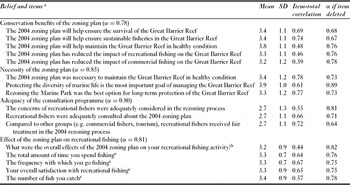
We measured fishers’ beliefs about four specific dimensions of the zoning plan and the rezoning process: (1) conservation benefits of the plan; (2) necessity of the plan; (3) adequacy of the public consultation programme; and (4) impacts (positive and negative) of the zoning plan on their recreational fishing activity. We measured each belief with a series of individual questions that we subsequently averaged to create a single variable for each belief (Table 1). The individual questions we used to measure beliefs were measured on five point response scales; the belief variables created by averaging the individual questions were then rounded to the nearest whole number to provide a five point ordinal measure of each belief (where 1 = belief of low conservation value/necessity/adequacy of consultation, or strong positive impact on fishing, and 5 = belief of high conservation value/necessity/adequacy of consultation, or strong negative impact on fishing). Reliability analysis indicated an acceptable level of internal consistency for each of the belief variables (Cronbach's alpha > 0.75 for all) (Table 1).
Descriptive statistics and reliability analysis for the variables used to measure fishers’ beliefs about the 2004 Great Barrier Reef Marine Park zoning plan. Item wording is identical to the survey. aItems measured on a five-point scale with response categories ranging from (1) strongly disagree to (5) strongly agree, except where indicated. bMeasured on a five-point scale with response categories ranging from (1) very positive to (5) very negative. cMeasured on a five-point scale with response categories ranging from (1) strongly increased to (5) strongly decreased.

We used proportional odds logistic regression models to test the combined effects of fishers’ beliefs about the conservation value of the zoning plan, the necessity of the zoning plan, the adequacy of the consultation programme, and the impact of the zoning plan on their fishing activity on their general and specific attitudes towards the zoning plan. We used binary logistic regression models to test the effects of the four belief variables on probability of incongruence between general and specific attitudes towards the zoning plan for each of the two general attitude groups (i.e. ‘good idea’ and ‘not good idea’ groups). For each logistic regression model, we removed any non-significant variables (i.e. p > 0.05) and refitted the model. Odds ratios were used as a measure of effect size for each dependent variable, and concordance statistics (i.e. Somer's D, c and per cent concordance) were used to assess the predictive accuracy of each model.
RESULTS
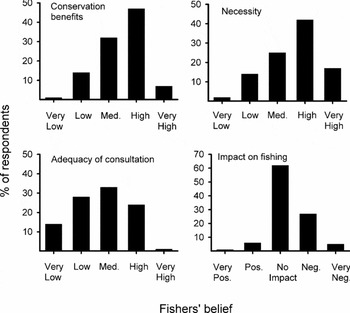
Recreational fishers had positive attitudes towards the rezoning of the Great Barrier Reef Marine Park. Most (68%) fishers believed that rezoning the Great Barrier Reef Marine Park was a ‘good idea’, and a majority (57%) also expressed ‘support’ for the zoning plan that was implemented in 2004. Approximately 20% of recreational fishers believed that rezoning the Great Barrier Reef Marine Park was a ‘bad idea’ and 31% were ‘opposed’ to the 2004 zoning plan. Most recreational fishers believed that the 2004 zoning plan was highly necessary (59%) and that the plan had significant conservation benefits (55%); few fishers believed that the consultation process was highly adequate (25%) (Fig. 1). The majority of fishers reported that generally the plan had no impact on their recreational fishing activity; however approximately 30% of fishers believed that the plan negatively impacted their fishing activity (Fig. 1).
Recreational fishers’ beliefs about four dimensions of the 2004 Great Barrier Reef Marine Park zoning plan.

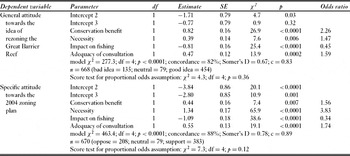
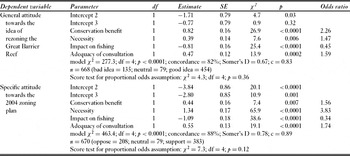
Fishers’ general and specific attitudes towards the zoning plan were significantly influenced by their beliefs about the conservation benefits of the plan, the necessity of the zoning plan, the adequacy of the consultation programme and the impacts of the zoning plan on their recreational fishing activity (Table 2). Logistic regression models revealed that fishers were significantly more likely to believe that rezoning the Great Barrier Reef was a ‘good idea’ and significantly more likely to ‘support’ the plan if they believed that rezoning the Marine Park was necessary, the zoning plan had high conservation benefits or the consultation programme was adequate. Conversely, fishers were significantly less likely to believe that the rezoning was a ‘good idea’ and significantly less likely to express ‘support’ for the zoning plan if they believed that the plan had negative impacts on their fishing activity. Belief about the necessity of the zoning plan had the strongest influence on general attitude towards the idea of the rezoning, whereas belief about the conservation value of the plan had the strongest influence on level of support for the zoning plan. Classification statistics indicate that the logistic regression models for general and specific attitudes have a high level of predictive accuracy (Table 2).
Results of the proportional odds logistic regression analysis testing the effects of beliefs about the 2004 Great Barrier Reef Marine Park zoning plan on recreational fishers’ general and specific attitudes towards the plan.
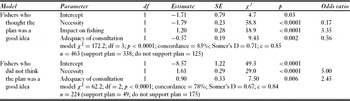
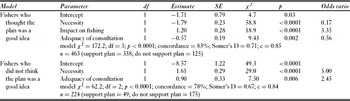
There was a substantial level of incongruence between fishers’ general attitude towards the rezoning and their level of support for the 2004 zoning plan. Of those fishers who believed that rezoning the Great Barrier Reef Marine Park was a ‘good idea’, 27% did not express ‘support’ for the zoning plan that was implemented. Likewise, of those fishers who did not believe that rezoning the Great Barrier Reef Marine Park was a ‘good idea’, 22% expressed ‘support’ for the zoning plan. Logistic regression models revealed that fishers who believed that rezoning the Great Barrier Reef Marine Park was a ‘good idea’ were less likely to express ‘support’ for the zoning plan if they did not believe that rezoning the marine park was necessary, the consultation programme was adequate or the zoning plan had negative impacts on their fishing activity (Table 3). Likewise, fishers who did not believe that rezoning the Park was a ‘good idea’ were more likely to express ‘support’ for the zoning plan if they believed that the rezoning was necessary and the consultation programme was adequate (Table 3). There was no influence of belief about the conservation benefits of the zoning plan on incongruence between general and specific attitudes towards the plan. Belief about the impact of the zoning plan on fishing activity did not influence incongruence between general and specific attitudes for fishers who did not believe rezoning the Park was a good idea. Classification statistics indicate that the logistic regression models for incongruence between general and specific attitudes have a high level of predictive accuracy (Table 3).
Results of the binary logistic regression analysis testing the effects of beliefs about the 2004 Great Barrier Reef Marine Park zoning plan on congruence between recreational fishers’ general and specific attitudes towards the plan.
DISCUSSION
We found substantial support for biodiversity conservation efforts among Great Barrier Reef Marine Park recreational fishers. The majority of fishers we surveyed believed that the Park needed to be rezoned to increase its protection, were supportive of the 2004 zoning plan and believed that implementation of the zoning plan would help ensure the sustainability of the Great Barrier Reef and the fisheries it supports. In addition to valuing aquatic resources for the fishing opportunities they provide, recreational fishers in Queensland also place high conservation, existence, bequest and education values on aquatic environments (Sutton Reference Sutton2006a). Consequently, many Great Barrier Reef recreational fishers are willing to forego access to some areas in support of efforts to increase long-term protection of the Reef because these conservation efforts are consistent with the multiple values they hold towards the marine environment. Although fishers’ level of support for the zoning plan (57%) could have been higher, results suggest that efforts by the Great Barrier Reef Marine Park Authority to educate the public about the need for the rezoning, solicit input about new no-take areas and generate support from stakeholders have had a positive impact on many recreational fishers (see Fernandes et al. Reference Fernandes2005 for details about the rezoning process). These findings highlight the importance of incorporating recreational fishers and their values in management of the fisheries resources on which they depend.
Support for the 2004 zoning plan among recreational fishers was higher than suggested by anecdotal evidence (from the media and public meetings). Previous research found that recreational fishers with negative opinions about management actions are the ones most likely to express their opinions at public meetings and through the media (Sutton Reference Sutton2006b, Sutton Reference Sutton2008). Clearly, negative opinions about the 2004 zoning plan expressed publicly by some recreational fishers do not represent the diversity of opinions held by the recreational fishing community, nor do they represent the opinions of the majority of fishers. Our findings support the recommendations of other authors that assessment of stakeholders’ attitudes and perceptions regarding marine protected areas should include surveys or other representative methods (Wolfenden et al. Reference Wolfenden, Cram and Kirkwood1994; Cocklin et al. Reference Cocklin, Craw and McAuley1998; Suman et al. Reference Suman, Shivlani and Milon1999; Salz & Loomis Reference Salz and Loomis2004). Furthermore, we suggest that collection of attitude and perception data earlier in the rezoning process would have facilitated the engagement of recreational fishers in the process (Day et al. Reference Day, Tanzer, Chadwick, Fernandes, Jago, Day, Senior, Monk and Neal2007) and would have given managers a better understanding of how to increase support from the recreational fishing community.
We were able to accurately predict recreational fishers’ attitudes towards the zoning plan based on their beliefs about the necessity of the plan, its conservation benefits, the adequacy of the consultation process and the impacts of the plan on their fishing activity. These results demonstrate that Great Barrier Reef recreational fishers evaluate conservation and management initiatives in broad terms, considering not only the impacts of management actions on their fishing activity, but also the long-term conservation and environmental outcomes of decisions and the adequacy of the process used to develop and implement specific policies. These results provide clear guidance for managers aiming to generate support for conservation and management initiatives from recreational fishers. First, managers must ensure that the recreational fishing community understands the rationale behind management decisions and the expected conservation, environmental and fishery benefits of any proposed management actions. Second, when possible, efforts should be made to minimize or mitigate the impacts of any management changes on recreational fishers and their fishing activity. Finally, attention needs to be paid to the consultation process to ensure that the recreational fishing community feels they have been adequately engaged in the decision-making process. Significant efforts were made by the GBRMPA to address each of these issues during the rezoning process, with varying degrees of success (Fernandes et al. Reference Fernandes2005; Day et al. Reference Day, Tanzer, Chadwick, Fernandes, Jago, Day, Senior, Monk and Neal2007; Jago et al. Reference Jago, Day, Fernandes, Thompson, Hall, Sampson, Cameron, Russell, Lowe, Day, Senior, Monk and Neal2007). Our findings, combined with the lessons learned from the rezoning process (Fernandes et al. Reference Fernandes2005; Day et al. Reference Day, Tanzer, Chadwick, Fernandes, Jago, Day, Senior, Monk and Neal2007; Jago et al. Reference Jago, Day, Fernandes, Thompson, Hall, Sampson, Cameron, Russell, Lowe, Day, Senior, Monk and Neal2007), provide valuable information that should be incorporated into MPA design and implementation planning.
Finding better ways to engage the recreational fishing community in management of the Great Barrier Reef and its fisheries should be a priority for management agencies. Previous research demonstrated that the consultation methods used during the rezoning process (i.e. public meetings and submission programmes) do not provide access to a representative sample of recreational fishers and can provide biased or misleading information to managers (Sutton Reference Sutton2006b). Furthermore, research conducted with a limited sample of recreational fishers shortly after implementation of the zoning plan suggested that recreational fishers were generally dissatisfied with the consultation process due to perceptions that: (1) the outcomes of the rezoning process were predetermined; (2) recreational fishers were not treated fairly compared to other stakeholders; and (3) there was insufficient feedback about how information provided by recreational fishers was used in the rezoning process (Teh-White et al. Reference Teh-White, Houston, Baxter, Levine and White2004). Our results confirm fishers’ dissatisfaction with the level of consideration given to the needs of the recreational fishing community, and that this dissatisfaction led to reduced support for the plan. Clearly, fishers’ perceptions of the decision-making process can be as important in determining their attitudes as the outcomes of the decision itself (Daigle et al. Reference Daigle, Loomis and Ditton1996). Whereas the benefits of engaging stakeholders in the MPA planning and management process are understood (Helvey Reference Helvey2004; Granek et al. Reference Granek, Madin, Brown, Figueira, Cameron, Hogan, Kristianson, de Villiers, Williams, Post, Zahn and Arlinghaus2008; Klein et al. Reference Klein, Chan, Kircher, Cundiff, Gardner, Hrovat, Scholz, Kendall and Airame2008), developing effective consultation and engagement methods for management of the Great Barrier Reef and its fisheries has been a challenge (Jago et al. Reference Jago, Day, Fernandes, Thompson, Hall, Sampson, Cameron, Russell, Lowe, Day, Senior, Monk and Neal2007). Community-based monitoring of fisheries resources by recreational fishers is one tool for on-going engagement that has shown considerable promise in the five years since implementation of the new zoning plan (Granek et al. Reference Granek, Madin, Brown, Figueira, Cameron, Hogan, Kristianson, de Villiers, Williams, Post, Zahn and Arlinghaus2008; CapReef 2009). However, more research is needed to understand recreational fishers’ expectations regarding their engagement in Great Barrier Reef management and the methods that would help meet these expectations.
A substantial number of recreational fishers agreed in principal with the idea of rezoning the Park, but did not subsequently support the zoning plan that was implemented. This discrepancy was offset somewhat by support for the zoning plan from some fishers who did not agree in principal with the idea of the rezoning; however the result was an 11% difference between general support for the rezoning and specific support for the 2004 zoning plan. These results are both encouraging and cautionary for environmental managers; encouraging because they demonstrate that it is possible to generate support from individuals who do not support a policy in principal, but cautionary because results also show that it is possible to lose the support of individuals even when they agree in principal with a policy decision. Our results suggest that emphasis on promoting the necessity of a policy change, minimizing its impacts on affected stakeholders and promoting engagement that meets stakeholder needs and aspirations can be instrumental in maintaining the support of those who agree with a policy, and in gaining the support of those who do not. If Great Barrier Reef managers are interested in increasing support for the 2004 zoning plan among recreational fishers, an obvious starting point would be those fishers who believed the rezoning was a good idea in principal but who did not support the plan that was implemented.
The timing of our study (three years after implementation of the new zoning plan) and our focus on active Great Barrier Reef fishers have implications for interpretation of our results. First, our data provide no information on fishers who have ceased fishing in the Great Barrier Reef Marine Park in response to the zoning plan. While we believe that the proportion of fishers displaced by the zoning plan was probably small (due to the large number of potential substitute areas that remained open to recreational fishing (Gentner & Sutton Reference Gentner, Sutton and Aas2008)), displaced fishers would clearly have different perceptions of the costs and benefits of the plan than fishers included in this study. Second, recreational fishers in this study had three years to adapt to the new zoning and observe its immediate impacts, both positive and negative. Consequently, it is likely that fishers’ attitudes and perceptions regarding the plan have changed since its implementation. Unfortunately, no data were collected prior to or immediately after the plan's implementation that allow us to understand how or why attitudes and perceptions have changed in the intervening three years, or how many fishers ceased fishing in the Park due to the zoning plan. It is also likely that fishers’ perceptions of the costs and benefits of the zoning plan will continue to change into the future as fishers continue to adapt to the plan, and as its potential ecological benefits are (or are not) realized (Flood & Cocklin Reference Flood and Cocklin1992). Continued monitoring of the variables measured in this study will be necessary to understand how and why fishers’ attitudes and perceptions of the zoning plan change over time, and whether the zoning plan will likely cause fishers to cease fishing in the Park in the future. Continued investigation of recreational fishers’ attitudes, perceptions, values and aspirations will also be vital for ensuring that the recreational fishing community is meaningfully engaged in Great Barrier Reef conservation and management.
As the largest consumptive user group of the marine environment in many areas, recreational fishers are key stakeholders in conservation and management of marine biodiversity. With the marine environment under increasing threat from multiple sources, the ability of managers to generate support from the recreational fishing community will be vital for the success of conservation initiatives. Our results indicate that recreational fishers can be strong supporters of marine conservation efforts if management initiatives are consistent with their values and if efforts are made to engage them in the decision-making process. The information we have provided about how recreational fishers form attitudes towards no-take areas in the Great Barrier Reef Marine Park should lead to improved engagement of the recreational fishing community in conservation of marine biodiversity. We encourage management agencies to continue to support research aimed at understanding various Great Barrier Reef Marine Park stakeholder groups in support of marine biodiversity conservation efforts.
ACKNOWLEDGEMENTS
The Australian Government's Marine and Tropical Sciences Research Facility administered in north Queensland by the Reef and Rainforest Research Centre and the CRC Reef Research Centre provided funding. Surveys were conducted with human ethics approval from James Cook University. We are grateful to all of the survey participants, and to the associate editor and three anonymous reviewers who commented on the manuscript.