INTRODUCTION
Executive functioning (EF) is a broad construct encompassing higher-order neurocognitive processes involved in planning, selection, and execution of purposeful, goal-directed, future-oriented, and socially informed action (Suchy, Reference Suchy2015). Detection of executive dysfunction in neuropsychological evaluations is important for two main reasons. First, deficits on EF tests are characteristic of many clinical populations (for reviews, see Cummings & Miller, Reference Cummings and Miller2007; Suchy, Reference Suchy2015); thus, poor EF performance has diagnostic implications. Second, EF test performance is particularly associated with the ability to perform instrumental activities of daily living (Bell-McGinty, Podell, Franzen, Baird, & Williams, Reference Bell-McGinty, Podell, Franzen, Baird and Williams2002; Chaytor & Schmitter-Edgecomb, Reference Chaytor and Schmitter-Edgecombe2003; Insel, Morrow, Brewer, & Figueredo, Reference Insel, Morrow, Brewer and Figueredo2006; Kraybill, Thorgusen, & Suchy, Reference Kraybill, Thorgusen and Suchy2013); thus, EF performance is often the clinical basis for recommendations about patients’ independent functioning. While EF measurement is important in all clinical assessments, it is particularly relevant for older adults. Executive weaknesses emerge in the early stages of many neurodegenerative conditions of old age, such as frontotemporal and vascular dementias (for reviews, see Engelborghs et al., Reference Engelborghs, Maertens, Nagels, Vloeberghs, Mariën, Symons and De Deyn2005; Lezak, Howieson, Bigler, & Tranel, Reference Lezak, Howieson, Bigler and Tranel2013).
This issue is further compounded by age-related EF declines, even among high functioning, healthy older adults (Baudouin, Clarys, Vanneste, & Isingrini, Reference Baudouin, Clarys, Vanneste and Isingrini2009; Hedden & Gabrieli, Reference Hedden and Gabrieli2004; Krampe, Reference Krampe2002; Mitsis, Reference Mitsis2004). Thus, superimposing subtle preclinical decline due to a neurodegenerative process over normal age-related changes can lead to an increased risk for functional lapses in daily life (Kraybill & Suchy, Reference Kraybill and Suchy2011; Kraybill et al., Reference Kraybill, Thorgusen and Suchy2013; Mitchell & Miller, Reference Mitchell and Miller2008; Razani et al., Reference Razani, Casas, Wong, Lu, Alessi and Josephson2007; Royall, Palmer, Chiodo, & Polk, Reference Royall, Palmer, Chiodo and Polk2004, Reference Royall, Palmer, Chiodo and Polk2005). Thus, EF assessment has clear clinical utility, particularly for older adults. However, assessment is hampered by the fluctuating nature of EF. Across adulthood, EF (more so than other cognitive domains) fluctuates somewhat with transient mood states (Martin & Kerns, Reference Martin and Kerns2011; Oaksford, Morris, Grainger, & Williams, Reference Oaksford, Morris, Grainger and Williams1996), sleep quality (Benitez & Gunstad, Reference Benitez and Gunstad2012; Sutter, Zollig, Allemand, & Martin, Reference Sutter, Zöllig, Allemand and Martin2012), and acute or chronic pain (Nes, Roach, & Segerstrom, Reference Nes, Roach and Segerstrom2009; Jongsma et al., Reference Jongsma, Postma, Souren, Arns, Gordon, Vissers and van Goor2011; Karp et al., Reference Karp, Reynolds, Butters, Dew, Mazumdar, Begley and Weiner2006).
Furthermore, older adults show greater intra-individual variability in EF (for a review, see West, Reference West2001; West, Murphy, Armilio, Craik, & Stuss, Reference West, Murphy, Armilio, Craik and Stuss2002) and related domains (e.g., sustained attention; Parasuraman & Giambra, 1991) than younger adults. In fact, greater intra-individual variability across cognitive domains (including EF) is a proposed indicator of poorer neurological health in older adults (Bielak, Hultsch, Strauss, MacDonald, & Hunter, Reference Bielak, Hultsch, Strauss, MacDonald and Hunter2010; Hultsch, MacDonald, Hunter, Levy-Bencheton, & Strauss, Reference Hultsch, MacDonald, Hunter, Levy-Bencheton and Strauss2000).
One well-documented source of EF fluctuations is recent engagement in expressive suppression. Expressive suppression is an emotion regulation strategy involving effortful control of facial affect and other automatic expressions of emotion (Gross, Reference Gross1998). Although adaptive in moderation (Gross, Reference Gross2007), expressive suppression is consistently associated with performance decrements on subsequently administered tests of logic and reasoning, cognitive extrapolation, response inhibition, and working memory (for a review, see Baumeister & Alquist, Reference Baumeister and Alquist2009; Inzlicht & Gutsell, Reference Inzlicht and Gutsell2007; Schmeichel, Reference Schmeichel2007; Schmeichel, Vohs, & Baumeister, Reference Schmeichel, Vohs and Baumeister2003), demonstrating the “depleting” effect of expressive suppression on EF. Additionally, EF depletion appears to occur in daily life, as higher than usual self-reported engagement in expressive suppression on the day of testing is associated with poorer performance on EF tests (Franchow & Suchy, Reference Franchow and Suchy2015; Niermeyer, Franchow, & Suchy, Reference Niermeyer, Franchow and Suchy2016). However, this research is entirely based on young adult samples.
There are several reasons to question whether young adult findings would generalize to older adults. On the one hand, presumably in part due to practice, healthy older adults appear more successful in their emotion regulation efforts than young adults (Carstensen, Pasupathi, Mayr, & Nesselroade, Reference Carstensen, Pasupathi, Mayr and Nesselroade2000; Charles, Reynolds, & Gatz, Reference Charles, Reynolds and Gatz2001). Consequently, emotion regulation in general may not be as executively demanding for themFootnote 1 . Additionally, older adults report less frequent expressive suppression, possibly due to higher rates of proactive coping and positive re-framing to avoid emotional upset (John & Gross, Reference John and Gross2004; Lang, Staudinger, & Carstensen, Reference Lang, Staudinger and Carstensen1998). On the other hand, compared to younger adults, older adults’ EF is more negatively affected by unpleasant autonomic arousal (Riediger et al., Reference Riediger, Wrzus, Klipker, Müller, Schmiedek and Wagner2014). This is relevant, since expressive suppression is associated with increased autonomic activity (Ohira et al., Reference Ohira, Nomura, Ichikawa, Isowa, Iidaka, Sato and Yamada2006). In sum, the impact of expressive suppression on older adults’ EF is not known.
Aside from unknown generalizability of EF depletion to older samples, there is also limited evidence regarding the specificity of depletion to EF (vs. other neurocognitive processes). EF encompasses higher-order neurocognitive processes (e.g., response selection, cognitive flexibility, to name a few) dependent on many lower-order component processes (e.g., perception, graphomotor speed, to name a few; Goldberg & Bilder, Reference Goldberg and Bilder1987; Stuss, Picton, & Alexander, Reference Stuss, Picton and Alexander2001; Suchy, Reference Suchy2015). Thus, selection of appropriate actions in response to a given stimulus (i.e., EF process) relies on accurate perception (i.e., lower-order component process) of that stimulus. This distinction has important diagnostic ramifications, especially in assessment of older adults (for a review, see Levy & Chelune, Reference Levy and Chelune2007; Schoenberg & Duff, Reference Schoenberg and Duff2011). Since there is considerable overlap between EF and component processes at cognitive (Stuss et al., Reference Stuss, Picton and Alexander2001) and neurologic levels (Luria & Haigh, 1992), it is standard practice to control for lower-order component processes to isolate EF (Lezak et al., Reference Lezak, Howieson, Bigler and Tranel2013). Importantly, due to this overlap, it is possible that the apparent depletion of EF actually reflects the depletion of underlying lower-order processes. Unfortunately, past research on EF depletion has not controlled for component processes, with the exception of one study from our laboratory, which did demonstrate that unusually high expressive suppression depletes EF, but not component processes (Franchow & Suchy, Reference Franchow and Suchy2015).
PURPOSE OF THE CURRENT STUDY
The purposes of this study were to determine (a) whether performance on standard clinical measures of EF is depleted by expressive suppression in older adulthood; and (b) whether this effect is unique to EF tests (relative to tests of lower-order component processes). To these ends, we administered a battery of standard clinical tests of EF and component processes to a sample of community-dwelling older adults. We then experimentally manipulated expressive suppression to induce executive depletion, and re-tested EF and lower-order component processes. Based on converging evidence for an EF depletion effect across young adult samples (including experimental paradigms and self-report methods), we hypothesized that expressive suppression would deplete EF resources, but not lower-order component processes. To our knowledge, the current study is the first to examine EF depletion in older adults. Therefore, we elected to use an experimental paradigm to more directly test the impact of expressive suppression on EF. Considering that we would normally expect improved performance on repeat cognitive testing (i.e., a practice effect; Lezak et al., Reference Lezak, Howieson, Bigler and Tranel2013), depletion could be indicated either by poorer performance or by an attenuated practice effect on post-manipulation testing.
METHODS
Participants
Participants were community-dwelling older adults recruited from a senior health fair and from a university program for older learners. Interested individuals provided contact information in person or by email and completed eligibility screening by phone. Individuals with a self-reported history of dementia or mild cognitive impairment, uncorrected vision or hearing impairments, color-blindness, left-handedness (due to evidence of differing cognitive profiles of left-handed individuals; Gunstad, Spitznagel, Luyster, Cohen, & Paul, Reference Gunstad, Spitznagel, Luyster, Cohen and Paul2007; Szaflarski et al., Reference Szaflarski, Binder, Possing, McKiernan, Ward and Hammeke2002), and motor dysfunction in the right hand/arm (precluding completion of speeded graphomotor tasks; see Measures) were excluded from participation. To minimize prior exposure to our measures, individuals reporting recent participation in cognitive testing (in other research or clinical evaluations) were also excluded.
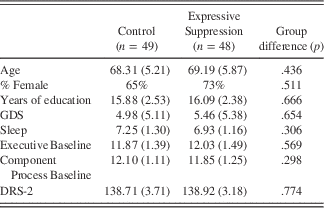
The total tested sample included 107 older adults. One participant reported red/green color blindness during the course of testing and was excluded from analyses. Additional three tested participants were excluded from analyses because they reported the following potentially confounding conditions in a comprehensive medical history questionnaire: a history of occipital stroke (n=1), hereditary motor neuropathy (n=1), and essential tremor (n=1). Six additional participants were eliminated from analyses because they failed to follow instructions to suppress or react naturally per their assigned experimental condition (see Preliminary Analyses). The final sample used in principal analyses was 97 adults (69.1% female, 94.8% Caucasian). Mean age was 68.74 years (SD=5.54; Range=60–86) and mean educational attainment was 15.98 years (SD=2.45; Range=11–21). Participants were pseudo-randomly assigned to either the Expressive Suppression (n=48) or the Control conditions (n=49). Pseudo-random assignment ensured group comparability on demographic characteristics (see Table 1). As seen in Table 1, groups did not differ on demographic variables, baseline cognition, or factors known to affect state cognition (depressive symptoms and sleep on the night before testing).
Participant demographics and descriptive data by experimental condition

Note. N=97; GDS=Geriatric Depression Scale total raw score (out of a possible 30); Sleep=self-reported hours of sleep in the 24 hr before testing; Executive Baseline=Pre-manipulation composite (arithmetical mean) of 8 executive scaled scores from the Delis Kaplan Executive Function System battery (DKEFS); Component Process Baseline=Pre-manipulation composite (arithmetical mean) of four lower-order component process scaled scores from the DKEFS; DRS-2=Dementia Rating Scale 2nd edition total raw scores (of a possible 144).
Procedures
The study was approved by the university Institutional Review Board. All procedures were in compliance with APA ethical standards. Before testing, participants were pseudo-randomly assigned to either the Expressive Suppression or Control conditions for the executive depletion task. Default group assignment was determined randomly (via online random order generator), with later participants assigned to ensure group comparability (in age, sex, and years of education). Following informed consent procedures, participants completed an approximate 4-hr-long study session (including neuropsychological tests) one-on-one with an examiner in the Executive Laboratory in the Social and Behavioral Sciences building at the University of Utah. Baseline testing included measures of global cognitive status, EF, and lower-order component processes. Participants then underwent experimental manipulation as part of either the Suppression or the Control condition (see Experimental Manipulation section). The same EF and lower-order component-process measures administered at baseline were then repeated in post-manipulation testing to directly measure the depleting impact of expressive suppression on each domain. At the end of the visit, participants were given the option of receiving written and oral feedback regarding their general cognitive status (i.e., consistent with similar-aged peers vs. somewhat below expectations vs. seriously below expectations) and were reimbursed $40 for participation.
Measures
General cognitive status
Participants completed the Dementia Rating Scale, 2nd edition (DRS-2) (Jurica, Leitten, & Mattis, Reference Jurica, Leitten and Mattis2001), as an estimate of general cognitive status, to ensure group comparability. The DRS-2 is an extensively validated screening battery assessing cognition in the domains of attention, initiation/perseveration, visuospatial construction, concept formation, and memory in persons over age 60 (Brown et al., Reference Brown, Rahill, Gorell, McDonald, Brown, Sillanpaa and Shults1999; Kovner et al., Reference Kovner, Lazar, Lesser, Perecman, Kaplan, Hainline and Napolitano1992; McDaniel & McLaughlin, Reference McDaniel and McLaughlin2000). Total score across these domains reflects global cognitive ability, with lower scores indicating greater impairment suggestive of a cognitive disorder (Jurica et al., Reference Jurica, Leitten and Mattis2001). Previous research suggests that the total score is sensitive to individual differences in non-clinical samples (Suchy, Kraybill, & Franchow, Reference Suchy, Kraybill and Franchow2011).
Depression
The Geriatric Depression Scale (GDS) is a widely used self-report screening measure for depression in older adults (Yesavage, Reference Yesavage1988). The GDS was administered to characterize the sample and to ensure that groups were comparable in depressive symptoms. Participants indicated the applicability of 30 depressive symptoms to their feelings during the previous week in yes/no format.
Executive-functioning composite
The Delis-Kaplan Executive Function System battery (D-KEFS) is a well-validated, widely used battery of EF (Delis, Kaplan, & Kramer, Reference Delis, Kaplan and Kramer2001; Delis, Kramer, Kaplan, & Holdnack, Reference Delis, Kramer, Kaplan and Holdnack2004). Participants completed 4 subtests: (1) Trail Making Test, (2) Verbal Fluency, (3) Design Fluency, and (4) Color-Word Interference. As in previous research (Franchow & Suchy, Reference Franchow and Suchy2015; Kraybill & Suchy, Reference Kraybill and Suchy2011; Kraybill et al., Reference Kraybill, Thorgusen and Suchy2013), scores were combined into a single composite score reflecting the arithmetical mean of the following age-corrected scaled scores: Trail Making Test: Letter Number Sequencing (Time to Complete), Verbal Fluency: Letter Fluency (Total Correct), Verbal Fluency: Category Switching (Total Correct), Design Fluency: Filled Dots (Total Correct), Design Fluency: Empty Dots (Total Correct), Design Fluency: Switching (Total Correct), Color-Word Interference: Inhibition (Time to Complete), and Color-Word Interference: Inhibition/Switching (Time to Complete). Selected subtests rely on a variety of aspects of EF (initiation, response selection, error monitoring, working memory, cognitive flexibility, and generative fluency) to a greater degree than do control conditions designed to isolate relevant lower-order component processes (see below). Importantly, a similar D-KEFS composite score was found to be sensitive to EF depletion associated with self-reported expressive suppression in young adults (Franchow & Suchy, Reference Franchow and Suchy2015). Baseline and post-manipulation executive composite scores demonstrated acceptable internal consistency reliability in this sample (baseline Cronbach’s α=.658; post-manipulation Cronbach’s α=.736).
Component-process composite
In addition to their well-known executive components, the Trail Making and Color-Word Interference subtests of the D-KEFS also include conditions designed to measure lower-order component processes. Lower-order component processes, such as basic perception, numeric sequencing, graphomotor speed, and visual scanning, consist of processes that are needed for performance of EF tests but are distinct from the EF construct. To generate the component-process composite score, we computed the arithmetical mean of the following age-corrected scaled scores (reflecting time to complete each condition): Trail Making Test (Visual Scanning, Number Sequencing, Letter Sequencing, and Motor Speed) and Color-Word Interference (Color-Naming and Word-Reading). Baseline and post-manipulation composites demonstrated acceptable internal consistency reliability in this sample (baseline Cronbach’s α=.672; post-manipulation Cronbach’s α=.701).
Experimental Manipulation
Based on prior methods (e.g., Muraven, Tice, & Baumeister, Reference Muraven, Tice and Baumeister1998; Schmeichel et al., Reference Schmeichel, Vohs and Baumeister2003), participants underwent experimental manipulation designed to invoke depletion in the Expressive Suppression group but not in the Control group. Specifically, all participants viewed affect-inducing video clips (without audio). Participants in the Expressive Suppression group were instructed to not reveal (via facial expression or any other observable signals) any reactions while watching the clips. In contrast, participants in the Control group were instructed to simply view the videos and react naturally (i.e., freely express their reactions), as if watching TV at home.
Stimuli
Clips were edited into two videos with a combined 5 min viewing time: Video A (2.5 min of disgusting content) and Video B (2.5 min of amusing content). All clips were gathered from material readily available on the internet, including material shown on popular television shows and news. Video A included disgust-inducing images; for example, people with various physical abnormalities and injuries or those engaging in activities such as eating non-food items (including one previously validated clip taken from the film Pink Flamingos; Gross & Levenson, Reference Gross and Levenson1995). Disgusting images are commonly used in experimental manipulations of expressive suppression and are associated with reliably high autonomic responses as well as subjective unpleasant emotional experience (Gross, Reference Gross1998). Video B consisted of amusing images, including people and animals in physically comedic situations. Amusing images were included to induce positively valenced responses with physiologic similarities to disgust (Demaree, Schmeichel, Robinson, & Everhart, Reference Demaree, Schmeichel, Robinson and Everhart2004; Hubert, Möller, & de Jong-Meyer, Reference Hubert, Möller and de Jong-Meyer1993). Videos were viewed in counterbalanced order across participants and groups.
Validity Check
To ensure that participants in each condition followed instructions, they were video-recorded and later rated on their level of observable reaction to each video on a Likert-type scale (1- No observable reaction to 5- Constant reactions that were poorly controlled). Due to technical difficulties and/or examiner error, recordings were unavailable for 4 participants (Control n =1, Expressive Suppression n =3). To ensure that the Expressive Suppression condition was more effortful than the Control condition, participants were asked to respond to the following question immediately after the videos: “How difficult was the video-viewing task?” in a Likert-style format (1- Not at all difficult, 2- Somewhat difficult, 3- Fairly difficult, 4- Very difficult, 5- Extremely difficult). To further check compliance with task instructions, participants in both conditions also answered the following question in a free-response format: “What was your approach to completing this [video viewing] task? Please describe how you went about watching the videos in the space below.”
RESULTS
Preliminary Analyses
Manipulation check
Based on their responses to manipulation check questions, three participants in the Control condition spontaneously suppressed their affect (against instructions) and were eliminated from further analyses. Similarly, three participants in the Expressive Suppression condition reported a lack of regulatory effort of any kind (No strategy) and were eliminated from further analyses. The remaining participants in the Expressive Suppression condition were significantly more likely to report some form of suppression (i.e., effort focused on regulating their facial expression), as compared to participants in the Control condition who reported either no strategy or indicated that they responded naturally, per task instructions (χ2=30.38; df=1; p<.001). Video-recordings of the remaining participants in the Expressive Suppression group were coded by blinded raters as exhibiting lesser level of reactivity to both the disgusting and amusing films, regardless of presentation order, compared with those in the Control group, consistent with task instructions (all t values >4.8, all p values <.001, all Cohen’s d values >1.4). Among retained participants, consistent with differences in observed affect, participants in the Expressive Suppression group rated the video viewing task (across disgusting and amusing films) as significantly more difficult overall (t =2.05; df=94; p=.043; Cohen’s d=.41).
Zero-order correlations
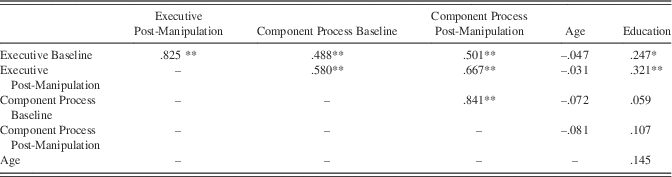
Zero-order correlations among cognitive composite scores and demographics are presented in Table 2. As can be seen, correlations among EF and lower-order component process performances were high, as would be expected. As would be expected, age was unrelated to cognitive performance, as age-corrected scaled scores were used when creating composites. Educational attainment was related to the EF, but not the lower-order component-process composite.
Zero order correlations between cognitive composites and demographics

Note. N=97; Executive baseline= Pre-manipulation composite (arithmetical mean) of 8 executive scaled scores from the Delis Kaplan Executive Function System battery (DKEFS); Executive Post-Manipulation= Post-manipulation composite (arithmetical mean) of the same 8 executive scaled scores from the DKEFS; Component Process Baseline= Pre-manipulation composite (arithmetical mean) of 4 lower-order component process scaled scores from the DKEFS; Component Process Post-Manipulation= Post-manipulation composite (arithmetical mean) of the same 4 lower-order component process scaled scores from the DKEFS; Education= years of education completed; **p<.01 (two-tailed), *p<.05 (two-tailed).
Principal Analyses
Impact of expressive suppression
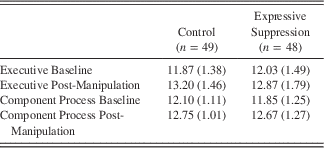
First, to examine the impact of expressive suppression on test performance, we computed a difference score between post-manipulation testing and baseline testing (i.e., a practice effect), one each for the EF and the lower-order component-process composite. Descriptive statistics for EF and component-process composites at baseline and post-manipulation are in Table 3.
Descriptive statistics for executive and lower-order component composites at baseline and post-manipulation

Note. N=97; Executive Baseline= Pre-manipulation composite (arithmetical mean) of 8 executive scaled scores from the Delis Kaplan Executive Function System battery (DKEFS); Executive Post-Manipulation= Post-manipulation composite (arithmetical mean) of the same 8 executive scaled scores from the DKEFS; Component Process Baseline= Pre-manipulation composite (arithmetical mean) of 4 lower-order component process scaled scores from the DKEFS; Component Process Post-Manipulation= Post-manipulation composite (arithmetical mean) of the same 4 lower-order component process scaled scores from the DKEFS.
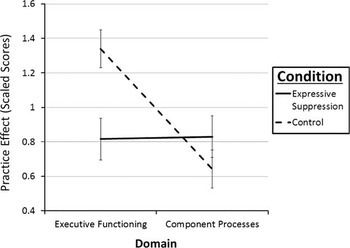
Next, to determine whether expressive suppression affected EF and lower-order component processes differentially, we examined the calculated practice effects for the two cognitive domains in a single analysis. Specifically, we conducted a mixed model repeated-measures analysis of variance (ANOVA) with the practice effects as the dependent variables, domain (EF vs. lower-order component process) as the within-subjects factor, and experimental condition (Expressive Suppression vs. Control) as the between-subjects factor. Results indicated a two-way interaction between domain and experimental condition [F(1,93)=13.18; p<.001; Partial Eta Squared=.124], suggesting that the size of the practice effect for each domain was differentially impacted by expressive suppression (see Figure 1). Additionally, there was a main effect of domain, with EF exhibiting greater practice effect overall as compared to component processes [F(1,93)=12.21; p<.001; Partial Eta Squared=.116].
The figure illustrates mean practice effects (i.e., differences between post-manipulation and baseline age-corrected composite scores) by domain (executive suppression vs. component process) and condition (control vs. expressive suppression). Relative to controls, participants in the expressive suppression condition showed an attenuated post-manipulation practice effect on executive measures only. Error bars reflect 1 standard error of measurement.

Lastly, to unpack the interaction findings, we conducted two independent sample t tests, using EF and component-process practice effects as dependent variables and experimental condition as the independent variable. The results confirmed that, as expected, the groups differed on EF (t=2.86, df=93, p=.005, Cohen’s d=.59), but not on component processes (t=1.37; df=93; p=.173; Cohen’s d=.28). Specifically, while the Control groups’ EF score improved on average by 1.34 (SD=.78) scaled score points, the Expressive Suppression group’s EF score only improved by .82 (SD=1.00) scaled score points on average.
Supplementary analyses, controlling for covariates
Because the size of practice effect can be affected by demographics and general cognitive status (Heaton et al., Reference Heaton, Temkin, Dikmen, Avitable, Taylor, Marcotte and Grant2001; Hultsch et al., Reference Hultsch, MacDonald, Hunter, Levy-Bencheton and Strauss2000; Mitrushina & Satz, Reference Mitrushina and Satz1991), we repeated the above analyses, including age, education, gender, and general cognitive status as covariates. The ANOVA results once again yielded a two-way interaction between domain and experimental condition [F(1,89)=14.20; p<.001; Partial Eta Squared=.138], showing that our findings could not be explained by demographics or cognitive status.
DISCUSSION
The current study was designed to investigate whether expressive suppression differentially depletes EF in older adulthood. The key finding is that, among cognitively healthy older adults, EF is susceptible to depletion via expressive suppression. Specifically, participants suppressing affect during emotionally evocative videos showed an attenuated practice effect on post-manipulation EF performance relative to controls. This group difference was significant even after accounting for demographics and general cognitive status. In contrast, expressive suppression did not impact lower-order component processes. To our knowledge, this is the first study to examine EF depletion in older adults. Importantly, the effect was detectable on standardized tests used by neuropsychologists in research and clinical settings.
Implications for Neuropsychological Assessment
This experimental demonstration of depletion supports non-psychometric sources of variability, or fluctuations, on EF tests in non-demented older adults that can bias performance on a given test day, consistent with the known impact of situational factors in general (Benitez & Gunstad, Reference Benitez and Gunstad2012; Jongsma et al., Reference Jongsma, Postma, Souren, Arns, Gordon, Vissers and van Goor2011; Martin & Kerns, Reference Martin and Kerns2011) and of suppression in particular (for a review, see Baumeister & Alquist, Reference Baumeister and Alquist2009). Patients and participants arrive for testing amidst many known and unknown acute personal stressors. If they attempt to hide their upset (i.e., by engaging in expressive suppression), as would be socially appropriate, their test performance on a “bad day” might well be an under-estimate of their capacity. This notion is consistent with prior research demonstrating that participants under conditions of stereotype threat who spontaneously regulate expressions of anxiety in response to threat priming perform more poorly on cognitive tests than their non-regulating peers (Johns, Inzlicht, & Schmader, Reference Johns, Inzlicht and Schmader2008).
Importantly, the latter research demonstrates that it is not the negative affect conferring risk for depletion, but rather the act of suppressing that affect. By the same token, testing on an unusually good day or in artificial conditions minimizing upset (as testers consistently aim to achieve in neuropsychological assessments) could over-estimate a person’s capacity under more emotionally evocative conditions (i.e., bad days) in daily life. For example, many patients with traumatic brain injuries perform reasonably well in the structured testing environment despite self and/or family reports of disorganization, poor emotion regulation, and other dysexecutive behavior at work and at home (Dawson, Levine, Schwartz, & Stuss, Reference Dawson, Levine, Schwartz and Stuss2000; Levine, Dawson, Boutet, Schwartz, & Stuss, Reference Levine, Dawson, Boutet, Schwartz and Stuss2000; Ruff, Reference Ruff2005). Both under and over-estimation of EF have important implications. For example, a neuropsychologist might over-pathologize the results of a patient assessed on a bad day, while overestimating the functionality of another patient assessed on a particularly good day (since that patient may exhibit EF deficits when having a bad day at home).
FUTURE DIRECTIONS
If EF performance varies due to dynamic demands on the regulatory system in older adults, then depletion may explain inconsistent findings with regard to age-related EF decline. Specifically, while disproportionate EF decline with age is generally accepted (for a review, see Salthouse, Reference Salthouse2004), other findings suggest that apparent EF inefficiencies are attributable to declines in lower-order component processes (Mayr, Reference Mayr2001; Meiran & Gotler, Reference Meiran and Gotler2001; Reimers & Maylor, Reference Reimers and Maylor2005). Current results suggest that executive lapses (e.g., due to depletion not accounted for in these studies) might help explain inconsistencies in findings. Relatedly, increasing variability on EF tests with increasing age (for a review, see West, Reference West2001) supports the notion that executive decline in healthy aging is marked by instability, rather than stable and linear loss of EF, similar to the pattern observed in other clinical populations with mild EF weaknesses (Gamaldo, An, Allaire, Kitner-Triolo, & Zonderman, Reference Gamaldo, An, Allaire, Kitner–Triolo and Zonderman2012; Pietrzak et al., Reference Pietrzak, Snyder, Jackson, Olver, Norman, Piskulic and Maruff2009).
In addition to the implications for understanding cognitive aging and variable test performance, temporary depletion may contribute to functional lapses in daily life (e.g., traffic accidents, medication mistakes). In fact, at least some research supports the notion that depressed older adults are more susceptible to functional lapses (Bruce, Seeman, Merrill, & Blazer, Reference Bruce, Seeman, Merrill and Blazer1994; Gallo, Rabins, Lyketsos, Tien, & Anthony, Reference Gallo, Rabins, Lyketsos, Tien and Anthony1997), and engagement in expressive suppression may well underlie this association. The relevance of depletion as a mechanism for such lapses depends on how the effect operates outside of the laboratory. External validity depends, for example, on the length of depleted states; the more lasting, the greater likelihood that it interferes significantly with older adults’ daily functioning. Previous research suggests that a depleted state may persist for some time after the initial regulatory demand, at least within the same 24-hr period (Franchow & Suchy, Reference Franchow and Suchy2015; Niermeyer et al., Reference Niermeyer, Franchow and Suchy2016).
However, unlike the current study, the two latter studies used a self-report method to examine depleted states; a more specific estimate of the magnitude and persistence of the effect may differ depending on age, method of depletion, and other factors, representing important topics of future research. The functional impact of depletion may also depend on whether certain aspects of EF are disproportionately affected. EF is comprised of several executive subdomains (Suchy, Reference Suchy2015), with some subdomains affected by depletion more than others. Research suggests that executive cognitive functions (responsible for reasoning and problem solving) and response selection (responsible for inhibition of inappropriate behaviors) may be particularly vulnerable. Specifically, depletion is mostly manifest on tests of reasoning or problem solving (for a review, see Baumeister & Alquist, Reference Baumeister and Alquist2009; Schmeichel et al., Reference Schmeichel, Vohs and Baumeister2003), or in poor behavioral choices such as breaking diets, impulsive spending, or inappropriate sexual behavior (Baumeister, Bratslavsky, Muraven, & Tice, Reference Baumeister, Bratslavsky, Muraven and Tice1998; Muraven et al., Reference Muraven, Tice and Baumeister1998). However, other aspects of EF have not been carefully examined. Since virtually all research has been done with younger adults, it is also unclear whether the specific EF processes disrupted by expressive suppression change over the lifespan. Future research is needed to examine these and other mechanistic questions about EF depletion across lifespan.
If assessment of EF depletion in older adulthood is cognitively and/or functionally informative, a more practical method of measurement will be needed. While an experimental manipulation captures the phenomenon most directly, researchers and clinicians may easily imagine logistical and ethical constraints on purposefully upsetting vulnerable populations for assessment purposes. Our previous research with younger adults captured expressive suppression via self-report on a Likert-type scale (Franchow & Suchy, Reference Franchow and Suchy2015; Niermeyer at al., 2016). Such approach has the potential to be more practical while minimizing patient discomfort. However, self-report only provides information about the regulatory burden on any given day, not the susceptibility to depletion for any given patient. Future studies should explore other assessment options.
An implication of these findings for clinicians is that EF vulnerability to state fluctuations (such as depletion) represents an additional factor limiting the validity of test scores as a stable and accurate reflection of EF. Research with cognitively compromised patients is needed to determine the clinical relevance of depletion. A strength of the current study is the demonstration of depletion on EF performance across tasks that have long been foundational to EF assessment in neuropsychology (i.e., trail making, verbal fluency, design fluency, and Stroop tasks). However, future studies should examine whether depletion replicates with other EF measures as well as the “depletability” of performance on individual tests.
Limitations of the Current Study
The current study has several limitations. First, the generalizability of our results to the general population of cognitively healthy older adults may be limited, since the current sample is more highly educated than the general US population (Ewert & Kominski, Reference Ewert and Kominski2014), and is, therefore, likely to be unusually high functioning. Most of the sample completed at least some college, and the average educational attainment was the equivalent of a bachelor’s degree (16 years). In addition to being somewhat more educated, our sample was homogeneous demographically, with the majority identifying as Caucasian. Notably, controlling for demographics (age, education, gender) and cognitive status did not change results. However, it is possible that differences in depletion exist based on ethnic, cultural, socioeconomic, and religious factors not measured in this sample. Future studies should examine depletion in larger, more demographically representative samples of older adults.
Second, while our groups were comparable on a range of potentially confounding variables (demographics, cognitive status, depressive symptoms, and sleep in the previous 24 hr), state variables other than engagement in expressive suppression not measured in the current study might have produced or inflated our effect. For example, by chance, the magnitude of autonomic responses to the videos could have differed by group. Since unpleasant autonomic arousal is associated with EF decrements (Riediger et al., Reference Riediger, Wrzus, Klipker, Müller, Schmiedek and Wagner2014), such group differences could explain our findings. Thus, more thorough assessment of physiologic and emotional states before and after experimental manipulation should be included in future studies. Additionally, we did not assess whether depletion is attributable to exertion of mental effort inherent in suppressing. Thus, future studies should include experimental conditions controlling for more neutral forms of mental effort, such as thought suppression tasks (Wegner, Shortt, Blake, & Page, 1990).
Similarly, if the suppression group by chance exerted greater effort at baseline, they may have evidenced smaller practice effect due to fatigue. These and other relevant state variables should be examined in future research. Third, the present study has limited external validity due to the inherent differences between suppression in experimental versus real-life scenarios, and the restricted range of examined emotions. For example, the current manipulation alerts participants to the impending need to suppress, unlike dynamic regulatory conditions in daily life. That said, even in daily life many situations exist in which one knows ahead about the need to engage in expressive suppression, such as job interviews or planned encounters with unpleasant individuals. Whether planned versus dynamic types of regulation are differentially depleting is an important topic of future research.
Additionally, the present study used only two emotions: disgust and amusement. Disgusting stimuli are commonly used in this line of research, as disgust is associated with reliably high autonomic response and consistent subjective unpleasant emotional experience (Gross, Reference Gross1998), while amusing stimuli offer positively valenced counterpart of similar intensity to disgust (Hubert et al., Reference Hubert, Möller and de Jong-Meyer1993). The present study does not address whether regulation of less-intense negative and positive affect is similarly depleting, or does it address whether regulation of disgust versus amusement has differentially depleting impact; this, too, is an important question for future research.
Fourth, although EF depletion is statistically significant in the current study, the effect size is small. The difference of 1.36 EF scaled score points gained in the control group versus .8 EF scaled score points gained in the experimental group does not amount to a practical or detectable difference in clinical assessments. Effect size might be improved in the absence of within-session practice effects or with naturally occurring expressive suppression (rather than under artificial experimental conditions). In fact, self-reported expressive suppression in daily life yielded a much larger effect (2 scaled scores) (Franchow & Suchy, Reference Franchow and Suchy2015). Future studies may wish to obtain baseline performances on a different day or to match control and experimental groups on education or global cognitive status in place of the same-session baseline testing. Alternatively, a tempered depletion effect in older adulthood might reflect the improved mastery of emotion regulation among older adults on average (John & Gross, Reference John and Gross2004; Lang et al., Reference Lang, Staudinger and Carstensen1998). Additional research is needed to determine the size and relevance of depletion in later life.
ACKNOWLEDGMENTS
The authors have no financial or any other kind of personal conflicts with this manuscript. This research received no specific grant from any funding agency, commercial or not-for-profit sectors. Portions of this study were presented as an abstract at the meeting of the International Neuropsychological Society (2016).