


Background
Interpersonal psychotherapy (IPT) was initially developed by Klerman and colleagues (Klerman, Dimascio, Weissman, Prusoff and Paykel, Reference Klerman, Dimascio, Weissman, Prusoff and Paykel1974) for the treatment of depression in adults. It aims to reduce depression by building social support, enhancing the quality of interpersonal relationships, and assisting individuals to deal effectively with interpersonal conflicts, transitions and losses. The limited evidence to date with adolescents suggests that IPT produces significantly greater reductions in depressive symptoms than a wait-list (Rosselló and Bernal, Reference Rosselló and Bernal1999), a clinical monitoring condition (Mufson, Weissman, Moreau and Garfinkel, Reference Mufson, Weissman, Moreau and Garfinkel1999), and treatment-as-usual (Gunlicks-Stoessel, Mufson, Jekal and Turner, Reference Gunlicks-Stoessel, Mufson, Jekal and Turner2010; Mufson, Dorta, et al., Reference Mufson, Dorta, Wickramaratne, Nomura, Olfson and Weissman2004). Comparison with cognitive behaviour therapy (CBT) indicated equivalence in one study (Rosselló and Bernal, Reference Rosselló and Bernal1999) but slight superiority of CBT in another (Rosselló, Bernal and Rivera-Medina, Reference Rosselló, Bernal and Rivera-Medina2008).
From a theoretical perspective, IPT proposes that the development and maintenance of depression are influenced by interpersonal issues that involve problematic relationships (role disputes), major interpersonal loss (grief) and disruption to social roles (role transitions), in addition to interpersonal deficits (Markowitz and Weissman, Reference Markowitz and Weissman2012). Furthermore, IPT recognizes that positive social support reduces the impact of interpersonal stressors and major life transitions upon emotional distress (Stuart, Reference Stuart2008).
Recent IPT theorists have expanded on the initial conceptual framework of IPT to draw upon theories relating to attachment and communication. For example, Stuart (Reference Stuart2008) and Ravitz, Maunder and McBride (Reference Ravitz, Maunder and McBride2008) proposed that our internal working models of relationships, established as a consequence of early attachment experiences, tend to be activated in the developmental stages of new relationships and during times of interpersonal stress, when people require support and reassurance. These internal working models are proposed to influence our expectations of, and behaviour within, relationships (Stuart, Reference Stuart2008). People with secure attachment styles are proposed to be more able to communicate their needs clearly and effectively to others, and to develop more robust, close relationships and strong social support networks. In contrast, those with an insecure-anxious attachment style tend to respond to difficult situations with excessive reassurance seeking, leading others to withdraw from and avoid that person. Similarly, those with an insecure-avoidant attachment style are less likely to seek help, to self-disclose information, or trust in intimate relationships and, in turn, are less likely to establish supportive social networks. Taken together, the consequential relationship difficulties and lack of social support for those with insecure-anxious and insecure-avoidant attachment styles are proposed to increase the risk of depression. A key focus of IPT is therefore to increase interpersonal responding that leads to positive relationship outcomes, and thereby to more positive internal working models of relationships (secure rather than insecure attachment).
The question arises, however, as to whether IPT is actually successful in producing changes in these interpersonal factors. There appears to be minimal research examining this issue (Stuart, Reference Stuart2008), particularly with adolescents. In terms of interpersonal factors such as social support, interpersonal skills, and relationship quality, IPT has been shown to be associated with significant improvements in general social functioning (Mufson et al., Reference Mufson, Weissman, Moreau and Garfinkel1999; Rosselló and Bernal, Reference Rosselló and Bernal1999). Findings have been conflicting, however, in relation to specific aspects of social functioning, with significant improvements being found in relationships with peers in two studies evaluating IPT with adolescents (Mufson et al., Reference Mufson, Weissman, Moreau and Garfinkel1999; Young et al., Reference Young, Makover, Cohen, Mufson, Gallop and Benas2012) but not in another (Mufson, Dorta, et al., Reference Mufson, Dorta, Wickramaratne, Nomura, Olfson and Weissman2004). None of these studies found significant improvements in relationship with family, a finding consistent with that of Rosselló and Bernal (Reference Rosselló and Bernal1999) who did not find improvements in family emotional intensity and criticism following IPT with adolescents.
The only study involving adolescents that we could find that specifically reported the impact of IPT upon family conflict was reported by Young, Gallop and Mufson, Reference Young, Gallop and Mufson2009. This trial of a preventive intervention using an adolescent skills training version of IPT with young people identified with elevated depressive symptoms showed significant reductions in mother-child conflict over time, an effect that was not evident in a school-counselling comparison condition.
In relation to proposed changes in attachment, there has been minimal research to determine whether IPT is effective in changing attachment style among depressed adolescents. Although attachment style was initially posited to be a stable construct (Bowlby, Reference Bowlby1988), current theories generally accept, on the basis of empirical evidence, that attachment style is potentially modifiable in response to evidence from life experiences, including psychotherapies, that counter beliefs and internal working models regarding relationships (Davila, Burge and Hammen, Reference Davila, Burge and Hammen1997; Ravitz et al., Reference Ravitz, Maunder and McBride2008; Stefini et al., Reference Stefini, Horn, Winkelmann, Geiser-Elze, Hartmann and Kronmuller2013; Travis, Bliwise, Binder and Horne-Moyer, Reference Travis, Bliwise, Binder and Horne-Moyer2001). IPT is not the only intervention that includes enhancement of secure attachment style among its goals. Studies have demonstrated significant changes in attachment style following participation in IPT and transference-based psychotherapy in adults, with problems such as depression, binge eating or personality disorders (Keating et al., Reference Keating, Tasca, Gick, Ritchie, Balfour and Bissada2014; Levy et al., Reference Levy, Meehan, Kelly, Reynoso, Weber and Clarkin2006; Maxwell, Tasca, Ritchie, Balfour and Bissada, Reference Maxwell, Tasca, Ritchie, Balfour and Bissada2014; Ravitz et al., Reference Ravitz, Maunder and McBride2008; Tasca, Balfour, Ritchie and Bissada, Reference Tasca, Balfour, Ritchie and Bissada2007). With children, there has been much less research, but a recent study by Stefini et al. (Reference Stefini, Horn, Winkelmann, Geiser-Elze, Hartmann and Kronmuller2013) involving a large group of children with a range of emotional disorders indicated marked increases in the proportion with secure rather than insecure attachment following long-term psychodynamic psychotherapy. Changes in attachment style, as reflected by increase in secure attachment to mother and appraisals of a class teacher as a security-enhancing figure, were also noted in an open trial of a psychological intervention for adolescents diagnosed with learning disabilities that aimed to target both academic and emotional functioning (Klomek et al., Reference Klomek, Kopelman-Rubin, Al-Yagon, Mufson, Apter and Erlich2013). The interpersonal components of that intervention were adapted from IPT-A. Thus, although there has been minimal research to date, there is some evidence to support the proposition that IPT-A will result in increases in secure attachment style.
It is also important to examine mechanisms of therapeutic action in order to better understand the processes by which treatments have their clinical impact. Interpersonal theory of IPT would suggest that changes in depression in response to IPT would be mediated by changes in interpersonal factors and attachment style. With adults, there is some evidence to support this proposition, with two studies showing that improvements in family social support and anxious attachment style mediate improvements in depression in adults following IPT (Tasca et al., Reference Tasca, Balfour, Ritchie and Bissada2007; Toth et al., Reference Toth, Rogosch, Oshri, Gravener-Davis, Sturm and Morgan-Lopez2013). With adolescents, however, there do not appear to be any studies that have examined whether changes in interpersonal factors and attachment style are associated with changes in depression in response to IPT-A.
The present research focused specifically upon adolescents and examined whether the proposed interpersonal underpinnings of depression change in response to IPT, in a way that would be predicted by interpersonal theories and conceptual models. Specifically, it was hypothesized that completion of an IPT treatment program would be associated with enhancement of interpersonal and communication skills and quality of personal relationships, a decrease in interpersonal conflict between the adolescents and their parent(s), an increase in secure attachment style, and a reduction in insecure attachment style. Furthermore, it was proposed that changes in interpersonal variables would be associated with changes in depression. It was not possible in the present study to provide a full test of mediation as, in order to do so, we would have required a no intervention control group or an intervention that did not change interpersonal variables, and this was not included in the design. Nevertheless, information about the association between changes in interpersonal constructs and changes in depression will contribute to our understanding of the mechanisms of action of IPT. In any test of mediation it is first necessary to establish that the intervention is associated with changes in both depression and the interpersonal variables that the intervention purports to change. It must then be shown that individuals who show the strongest changes in depression tend also to show the strongest change in the interpersonal variables (Kazdin, Reference Kazdin2007). Thus, the present study provides some first steps towards understanding the mechanisms of action of IPT-A.
The study draws on a sample of adolescents who participated in either group-based or individual-based IPT treatment in a previous randomized controlled trial comparing these two therapy formats (O’Shea, Spence and Donovan, Reference O’Shea, Spence and Donovan2015). That earlier paper indicated significant improvements in depressive symptoms for both IPT formats, but did not examine the impact upon interpersonal outcomes.
Method
Participants
The sample included 39 adolescents aged 13 to 19 years (M = 15.33, SD = 1.37), of whom 6 were male and 33 were female. All had a primary diagnosis of major depressive disorder (MDD) as determined by the Schedule for Affective Disorders and Schizophrenia for School-Age Children - Epidemiological version, 5th edition (K-SADS-E; Orvaschel and Puig-Antich, Reference Orvaschel and Puig-Antich1994). Exclusion criteria included undergoing psychological or pharmacological treatment for depression currently or in the past month; currently reporting suicidal intentions or severe ideation; a Bipolar I or II diagnosis; a history of chronic medical illness or psychosis; and significant developmental delay. Referrals came from school guidance officers, other mental health professionals, teachers and parents.
Seventy-six percent of the sample was born in Australia, 51.3% were living in families with both biological parents, 23.1% resided in single-parent families, 20.5% lived with a parent and step-parent, and 5.1% were living out of home. In addition to a primary diagnosis of MDD, 23 (58.9%) of participants were assessed as having at least one comorbid diagnosis, and 10 (25.6%) held two or more comorbid diagnoses. Specifically, 16 (41%) presented with one or more anxiety disorder, 9 (23%) with alcohol or substance abuse, 2 (5%) with oppositional defiant or conduct disorder, 3(8%) with attention deficit hyperactivity disorder, and 2 (5%) with bulimia nervosa. More detailed demographic information is provided in O’Shea et al (Reference O’Shea, Spence and Donovan2015).
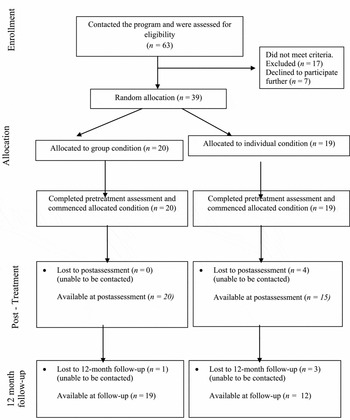
Figure 1 presents a flow diagram of participant progression through the different phases of the study. Following a parent-completed telephone screening interview, adolescents and their parents provided written informed consent to participate in the study. After determining eligibility and reconfirming willingness to participate, 39 participants were allocated, using randomized blocks of 6–8 participants, to either group IPT (IPT-A-GRP, N = 20) or individual IPT (IPT-A-IND, N = 19). A more detailed description of the method, including therapist training, can be found in O’Shea et al., (Reference O’Shea, Spence and Donovan2015).
Flow diagram of participants’ progress through the study

Measures
Evaluation interviews (youth) and questionnaires (parent and youth) were completed at pretreatment, immediately following treatment, and 12 months posttreatment.
Measures relating to depression
The Schedule for Affective Disorders and Schizophrenia in School-Age Children Epidemiological Version – 5th Revision (K-SADS-E; Orvaschel and Puig-Antich, Reference Orvaschel and Puig-Antich1994) was used to confirm a diagnosis of MDD. The K-SADS-E is a structured interview assessing psychological disorders in children and adolescents aged 6 to 18 years according to the Diagnostic and Statistical Manual of Mental Disorders-IV (DSM-IV; American Psychiatric Association, 1994). It has strong psychometric properties, with an inter-rater agreement of .73 and a test-retest reliability of .90 (Kaufman, Birmaher, Brent and Rao, Reference Kaufman, Birmaher, Brent and Rao1997; Klein, Dougherty and Olino, Reference Klein, Dougherty and Olino2005). Interviewers were blind to experimental condition and assessment time-point.
The Beck Depression Inventory-II (BDI-II; Beck, Steer and Brown, Reference Beck, Steer and Brown1996) assessed youth self-report of depressive symptoms. Total scores range from 0 to 63, with higher scores indicating higher levels of depressive symptoms. The BDI-II has been identified as a sensitive instrument for detecting depressive symptoms in adolescents (Atlas and DiScipio, Reference Atlas and DiScipio1992), with strong psychometric properties and good convergent validity (Barrera and Garrison-Jones, Reference Barrera and Garrison-Jones1988).
Measures of interpersonal factors
Interpersonal skills
Interpersonal skills were assessed using both youth and parent versions of the Social Skills Questionnaire (SSQ; Spence, Reference Spence1995). The SSQ consists of 30 items that are positively phrased and require respondents to rate how true each item is for the adolescent from 0 (not true) to 2 (mostly true). Total scores are produced by summing the items to produce a possible minimum score of zero and maximum score of 60 on each measure. Both parent and child versions have demonstrated good psychometric properties (Spence, Reference Spence1995).
Relationship quality
The quality of relationships with peers was assessed using the Social Competence with Peers Questionnaire (SCPQ; Spence, Reference Spence1995). The parent and child versions contain nine and ten items respectively, and respondents are asked to rate how true each item is for the adolescent from 0 (not true) to 2 (mostly true). Higher scores reflect greater social competence.
The quality of relationship between the young person and his/her parents was assessed using parent and youth reports on the 20-item version of the Conflict Behavior Questionnaire (CBQ; Robin and Foster, Reference Robin and Foster1989). This scale assesses positive and negative interactions between the adolescent and his/her parents over the previous 3 weeks. The primary caregiver completed the parent version of the CBQ, and the adolescent completed two versions of the CBQ: first in relation to their mother and then to their father. Each item is scored as either 0 (false) or 1 (true), giving a possible total score ranging from 0 to 20, with higher scores indicating higher levels of interpersonal conflict. The CBQ has demonstrated strong internal consistency and test-retest reliability (Robin and Foster, Reference Robin and Foster1989).
Attachment style
The Attachment Style Questionnaire (ASQ; Feeney, Noller and Hanrahan, Reference Feeney, Noller, Hanrahan, Sperling and Berman1994) is a 40-item self-report measure completed by the adolescent that assesses attachment style across the dimensions of Secure (8 items) and Insecure attachment (32 items: Discomfort with closeness (10), Need for approval (7), Preoccupation with relationships (8), and Relationships as secondary (to achievement) (7)). Participants are asked to rate the degree to which they agree with each item from 1 = totally disagree to 6 = totally agree. Examples of items include “I find it hard to trust other people”, “I worry about people getting too close”, and “I prefer to keep to myself”. Scores range from 8–48 for secure and from 32–192 for insecure dimensions. Sub-scores were computed for Insecure-avoidant attachment (Relationships as secondary and Discomfort with closeness: scores ranging from 17–102) and Insecure-anxious attachment (Need for approval plus Preoccupation with relationships: scores ranging from 15–90). The ASQ has been found to have good psychometric properties with young people (Feeney et al., Reference Feeney, Noller, Hanrahan, Sperling and Berman1994).
Content of the intervention
Treatment took place at either the School of Psychology Clinic, University of Queensland or in the counseling services facilities of a State High School. The study was conducted in compliance with the University of Queensland Human Ethics Committee.
The individual IPT sessions followed a detailed protocol adapted from Mufson, Moreau, Weissman and Klerman (Reference Mufson, Moreau, Weissman and Klerman1993) and comprised 12 sessions, conducted once per week over 12 weeks, with sessions lasting 50–60 minutes, with one therapist to each client. Four maintenance sessions were provided during the 12-month follow-up period. Full details regarding the intervention are provided in O’Shea et al. (Reference O’Shea, Spence and Donovan2015). The content of the group IPT sessions closely mirrored the individual sessions but was adapted for group delivery, taking into account the recommendations of Mufson, Gallagher, Dorta and Young (Reference Mufson, Gallagher, Dorta and Young2004) and Wilfley, MacKenzie, Welch, Ayres and Weissman (Reference Wilfley, MacKenzie, Welch, Ayres and Weissman2000). Treatment was conducted by five psychologists who were trained in IPT methods using the training approach outlined by Rounsaville, Chevron, Weissman, Prussof and Frank (Reference Rounsaville, Chevron, Weissman, Prussof and Frank1986).
Results
Analyses
Treatment effects were analysed using an intent-to-treat (ITT) approach. Participants’ missing data were replaced using the last observation carried forward (LOCF) method. Missing data at postassessment or follow-up were replaced with the value scored on that variable at the preceding measurement occasion. All participants attended more than 75% of therapy sessions. The effect of therapy format (group versus individual) was examined in all analyses but given that no significant differences in depression outcomes were evident for depression (O’Shea et al., Reference O’Shea, Spence and Donovan2015) or interpersonal variables, the present paper reports outcomes for the combined samples.
A series of repeated measures ANOVAs, using a 2 (treatment format: group or individual delivery) x 3 (time: pretreatment, posttreatment and 12-month follow-up) design, was used to examine whether improvements in the interpersonal variables occurred following treatment.
Analyses to examine the association between changes in interpersonal variables and changes in depression used residual change scores, rather than simple difference scores over time. Residualized change scores were used for this part of the analysis because they adjust for pretreatment variance and control for the correlation between pretreatment and posttreatment scores (Manning and Du Bois, Reference Manning and Bois1962). Residualized change scores were created by regressing posttreatment scores on pretreatment scores, with the process being repeated by regressing 12-month follow-up scores on pretreatment scores. The associations between residual change scores for depression, based on BDI-II, and interpersonal variables were examined using linear regression analyses, controlling for age, gender, and therapy format (group vs individual treatment), based on our a priori hypotheses that change in interpersonal factors would be associated with change in depression.
Impact on depression
The findings of the study with respect to depression were reported previously (O’Shea et al., Reference O’Shea, Spence and Donovan2015), but are repeated here in brief to demonstrate the extent of change in clinical diagnosis of depression and depressive symptoms prior to examining change in interpersonal variables. In all instances there were no significant differences in outcome by therapy format (group vs individual) and therefore the findings for separate groups are not presented in the paper.
Clinical diagnosis and depression symptoms
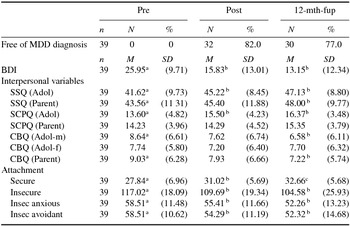
As shown in Table 1, 39 (82%) of participants in the combined sample no longer met criteria for MDD at posttreatment. At 12-month follow-up, 39 (77%) no longer had a MDD diagnosis. Repeated measures ANOVA revealed significant reductions in BDI-II scores over time for participants in general, F (2, 36) = 16.77, p < .001, η2 = .48. Simple contrasts indicated that the significant reductions in depression occurred from pre to posttreatment and pretreatment to 12-month follow-up but not from posttreatment to 12-month follow-up, suggesting that treatment benefits were maintained but not improved upon over time (see Table 1).
Outcome for depression, interpersonal and attachment variables

Notes: SSQ-C = Social Skills Questionnaire – Parent Version; SCPQ-A = The Social Competence with Peers Questionnaire – Adolescent Version; SCPQ-P = The Social Competence with Peers Questionnaire – Parent Version; CBQ (Parent) = Conflict Behaviour Questionnaire completed by primary caregiver; CBQ (m) = Conflict Behaviour Questionnaire completed by adolescent in relation to their mother; CBQ (f) = Conflict Behaviour Questionnaire completed by adolescent in relation to their father.
Different letters in superscript represent significant simple time contrasts between occasions
Impact on interpersonal variables
Interpersonal skills and relationship quality
Repeated measures ANOVAs revealed significant time effects for adolescent-reported social skills, F (2, 36) = 13.72, p < .001, η2 = .27, parent-reported social skills, F (2, 36) = 7.97, p < .001, η2 = .31, adolescent-reported social competence with peers, F (2, 36) = 6.98, p = .003, η2 = .28, youth-rated conflict with mother, F (2, 36) = 4.11, p = .025, η2 = .19, and parent-rated parent-adolescent conflict, F (2, 36) = 3.78, p = .03, η2 = .17. However, there were no significant improvements over time for parent-reported social competence with peers, F (2, 36) = 2.18, p = .13, η2 = .11, or adolescent-rated conflict with father, F (2, 36) = 0.35, p = .71, η2 = .01.The results of simple time contrasts are shown in Table 1.
Attachment style
There were significant changes over time for secure, F (2, 36) = 13.20, p < .001, η2 = .42, and insecure attachment, F (2, 36) = 7.23, p = .002, η2 = .29. Significant changes over time were evident for both the insecure-anxious, F (2, 36) = 6.61, p = .002, η2 = .15, and the insecure-avoidant subscales, F (2, 36) = 5.81, p = .005, η2 = .14. The results of simple time contrasts between pretreatment, posttreatment and 12-month follow-up are shown in Table 1.
Association between changes in depression and changes in interpersonal variables
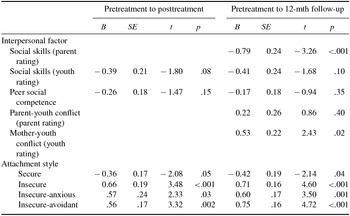
The results of stepwise, linear regression analyses from pre to posttreatment and pretreatment to 12-month follow-up are shown in Table 2, with residual change score for depression symptoms as the dependent variable. Interpersonal variables were only examined for association with changes in depression if they had been shown to change significantly over time.
Results for separate regression analyses for the association between change in interpersonal variables and changes in depression

Note: Controlling for age, gender and treatment condition (group versus individual IPT)
Interpersonal skills and relationship quality
Age, gender and treatment format (group versus individual IPT) were entered as control variables at Step 1, followed by entry of the residual change score for the interpersonal variable of interest at Step 2 in the prediction of changes in depression from pre to posttreatment. These analyses were then repeated for the prediction of changes in depression from pretreatment to 12-month follow-up. At Step 1, there were no significant associations between age, gender, or treatment format, and change in depression from pre to posttreatment or from pretreatment to 12-month follow-up.
The results for entry of the residualized change score at Step 2 for each interpersonal variable are shown in Table 2. From pre to posttreatment, no significant associations were found between changes in depression and changes in the interpersonal variables examined. However, from pretreatment to 12-month follow-up, improvement in parent-reported social skills, B = −.79, t = −3.26, p < .001, and decreases in youth-reported conflict with their mother, B = .53, t = 2.43, p = .02, were significantly associated with reductions in depression over this period. When changes in interpersonal skills and relationship quality variables from pretreatment to 12-month follow-up were entered into the equation simultaneously at Step 2, these variables together were significantly associated with change in depression over the same period, R 2 Δ = .39, FΔ(5,30) = 4.14, p = .006.
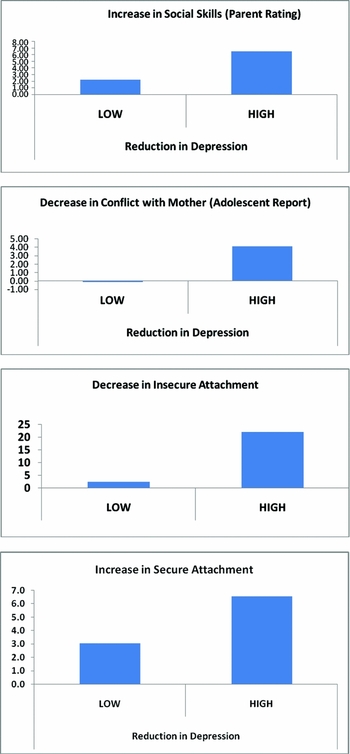
To illustrate, Figure 2 shows the level of change in parent-rated social skills and adolescent-rated conflict with mother for participants who showed a high level of change in BDI-II (≥12; N = 20) compared to those who showed a lower level of change in BDI-II (<12; N = 19).
Changes in interpersonal variables by level of reduction in depression from pretreatment to 12-month follow-up

Attachment style
From pre to posttreatment, change in secure attachment style, B = −.36, t = −2.08, p = .046, and change in total insecure attachment style, B = .66, t = 3.48, p = .001, were significantly associated with change in depression symptoms. Adolescents who reported greater increases in secure attachment and greater decreases in total insecure attachment style were more likely to report greater reductions in depressive symptoms. When secure and insecure attachment scores were entered into the equation simultaneously at Step 2, they explained a significant proportion of variance in change in depression, R 2 Δ = .25, FΔ(2,33) = 6.054, p = .006. Table 2 also shows the results for changes in the two insecure attachment subtypes in predicting change in depression. Change in both insecure-anxious, R 2 Δ = .13, FΔ(1,34) = 5.42, p = .03, and insecure-avoidant attachment styles, R 2 Δ = .23, FΔ(1,34) = 11.04, p = .002, were associated with changes in depression from pre to posttreatment.
The pattern of results was closely mirrored in relation to changes from pretreatment to 12-month follow-up. Again, changes in both secure, B = −.42, t = −2.14, p = .04, and insecure, B = .71, t = 4.60, p = .001, attachment styles were associated with changes in depression over this period, and when entered together into the equation at Step 2, explained a significant proportion of variance in change in depression scores, R 2 Δ = .37, ΔF(2,33) = 10.38, p < .001. In terms of subtypes of insecure attachment, both Insecure-anxious, R 2 Δ = .25, FΔ(1,34) = 12.24, p = .035, and Insecure-avoidant attachment styles, R 2 Δ = .38, FΔ(1,34) = 22.32, p < .001, were associated with changes in depression from pretreatment to 12-month follow-up. To illustrate, Figure 2 shows the level of change in secure and insecure attachment style, from pretreatment to 12-month follow-up, for participants who showed a high level of change in CES-D (≥12; N = 20) over this period compared to those who showed a lower level of change in CES-D (<12; N = 19).
Discussion
Consistent with theoretical models of IPT, the results of this study demonstrated significant improvements in interpersonal constructs following participation in IPT. Improvements in adolescent reports of their social skills and social competence with peers were found from pre to posttreatment and these effects were maintained at 12-month follow-up. In addition, significant improvements in adolescent reports of conflict with their mother, and parental report of parent-adolescent conflict were evident from pretreatment to 12-month follow-up. Also, in line with predictions, significant changes in youth-reported attachment style were found, with increases in secure attachment and decreases in both Insecure-anxious and Insecure-avoidant attachment styles. Thus, consistent with hypotheses, IPT was associated with subsequent changes in the interpersonal dimensions that were proposed to be targeted during treatment. Although there were some differences in results between parent and youth report, improvements in interpersonal functioning were evident in the reports of both parents and youths. Where differences were evident there are plausible explanations. For example, improvements in reports of the quality of peer relationships were found in adolescent – but not parent –report. It is possible that this reflects a lower level of awareness by parents of their adolescent's interpersonal relationships outside the home.
When the hypothesized associations between changes in interpersonal constructs and changes in depression were examined, the findings were partially consistent with predictions. From pre to posttreatment, changes in interpersonal skills and relationship quality were not significantly associated with changes in depression, but those who reported greater increases in secure attachment and decreases in insecure attachment were more likely to show greater reductions in depression. Furthermore, from pretreatment to 12-month follow-up those who showed greater improvements in social skills (as judged by a parent), greater reductions in conflict with their mother (youth report) and greater changes in attachment style tended to be those who showed greater reductions in depression.
The results are interesting from various perspectives. The finding of significant changes in attachment style add to the emerging body of evidence that suggests that this construct, at least as measured by questionnaires such as the ASQ, is potentially modifiable in children, as with adults, in response to a psychotherapy such as IPT. While significant changes in attachment style following psychotherapy have been demonstrated in a small number of studies in adults, there has been minimal research with children and adolescents and, to our knowledge, this has been limited to psychoanalytic therapy (Stefini et al., Reference Stefini, Horn, Winkelmann, Geiser-Elze, Hartmann and Kronmuller2013).
The findings also raise interesting questions with respect to potential mechanisms of action. Although the study design did not enable direct assessment of mediation, the finding that changes in parent-adolescent conflict and parent-reported social skills were only associated with changes in depression in the analyses for pretreatment to 12-month follow-up and not for pre to posttreatment suggests that these interpersonal variables are unlikely to mediate change in depression. Significant reductions in depression were already evident at posttreatment, prior to the changes in family conflict and parent-rated social skills that only emerged at follow-up. We must consider the possibility that improvements in interpersonal functioning could be a consequence rather than a cause of reductions in depression. The changes in interpersonal variables and depression could also be occurring independently in response to treatment, or could both reflect the passage of time or non-specific factors, rather than being a consequence of treatment. Further research is needed that includes a more rigorous examination of the relationship between change in interpersonal factors and change in depression in response to IPT-A. Such research should also address the temporal sequence of changes in the mediator and outcome measures, using more frequent assessment of both sets of variables during and after treatment.
It is also interesting to speculate whether the concurrent changes in attachment style and depression reflect mediation. Again, the current design does not enable us to examine directions of causality in these inter-relationships and future research should clarify this issue. Nevertheless, the finding is consistent with a mediational model, and provides a signpost for future research.
Strengths and limitations
The study is innovative in that there is minimal research examining whether changes in attachment style and interpersonal competence occur following IPT with depressed adolescents and whether such changes are associated with reductions in depression. The use of multiple informants is a strength in that significant associations between variables cannot simply be attributed to reporter bias and common method variance. The finding of a significant association between level of change in depression (youth report) and change in social skills (parent report) is thus important.
A further strength of the study lies in the use of a representative clinical sample. The participants reported relatively high levels of depression prior to treatment, consistent with clinical samples reported elsewhere in the adolescent IPT literature (Mufson, Dorta, et al., Reference Mufson, Dorta, Wickramaratne, Nomura, Olfson and Weissman2004; Mufson et al., Reference Mufson, Weissman, Moreau and Garfinkel1999) and all met criteria for a DSM-IV diagnosis of MDD ascertained by standardized clinical interview. The current study also avoided the stringent inclusion and exclusion criteria that characterize many efficacy studies, and included young people with a broad range of co-morbid psychological problems. As such, the results are generalizable to many clinic situations in which young people present.
There are, however, methodological limitations that must be acknowledged as they restrict the conclusions that can be drawn. Most important was the absence of a waitlist control condition or comparison group to determine whether the significant changes in interpersonal factors could be attributed specifically to the treatment rather than to the passage of time and, similarly, whether the association between change in interpersonal factors and change in depression reflected a mediational process rather than merely a statistical association.
The relatively small sample size of the present study was also a limitation and future studies need to include sufficient numbers to enable examination of factors that may moderate the potential mediating effect of interpersonal change, such as age, gender, socio-demographic characteristics and co-morbidity.
Implications for treatment
Despite the methodological limitations, the present study presents some interesting and valuable findings that will inform our clinical practice in the treatment of depression in young people. The results demonstrate that depressed young people do show improvements in interpersonal skills, quality of interpersonal relationship, and secure attachment style following IPT and these are important outcomes in their own right. The significant association, in the longer-term, of these interpersonal changes with reductions in depression also suggests the value of exploring strategies that could further improve interpersonal outcomes and potentially lead to greater reductions in depression.
Conclusion
The results are consistent with the view that IPT is effective in producing significant change in the interpersonal constructs that are proposed to underlie depression, and which IPT aims to change during the course of treatment. Significant improvements in social skills, social functioning, and the quality of parent-adolescent relationships, together with significant increases in secure attachment style and decreases in insecure attachment styles were evident following IPT for depressed adolescents. Furthermore, the levels of change in the interpersonal constructs of parent-reported social skills, quality of the parent–adolescent relationship, and attachment style were associated with level of change in depressive symptoms from pretreatment to 12-month follow-up. Changes in attachment style also predicted changes in depression from pre to posttreatment. The study represents a preliminary investigation in this area and highlights directions for future research.
Acknowledgements
The authors wish to acknowledge funding for this research study from the Australian Rotary Health Research Fund and beyondblue: the national depression initiative.
Conflict of interest: The authors have no conflicts of interest with respect to this publication.



Comments
No Comments have been published for this article.