1. Background
The creation of the World Trade Organization (WTO) in 1995 and, in this context, of the General Agreement on Trade in Services (GATS) was a landmark event in the history of the multilateral trading system. Five years later, as provided for in GATS Article XIX:1, a new round of services negotiations was launched ‘with a view to achieving a progressively higher level on liberalization’. This particular mandate reflects a prevailing opinion, towards the end of the Uruguay Round (1986‒1993/94) that, while a lot of negotiating energy had been absorbed by the conceptual challenges associated with the peculiarities of services trade, the trade commitments offered had ultimately remained shallow.
The new services round was later integrated, at the WTO's Fourth Ministerial Conference in Doha (November 2001), into the broadly defined Doha Development Agenda (DDA). From a GATS' perspective, this proved a mixed blessing, however, since the negotiations repeatedly fell victim to disagreement over other issues, mostly associated with agriculture. At the same time, actual access conditions to many services markets improved significantly, driven in particular by technical innovations, not least the emergence of new communication technologies, and subsequent policy changes. In turn, this increased the sense of frustration among many Members, and their service operators, about the lack of tangible progress in Geneva.Footnote 1
It was not before end-2011 that a WTO Ministerial Conference acknowledged and reacted upon the (non-)events in the DDA: ‘The negotiations are at an impasse’. By the same token, Ministers re-confirmed their commitment to work actively towards a successful multilateral conclusion, emphasizing the need for Members ‘to more fully explore different negotiating approaches while respecting the principles of transparency and inclusiveness'.Footnote 2 Many governments had already started exploring options, however. The stalemate in the DDA certainly contributed to the rapid proliferation of Regional Trade Agreements (RTAs) covering services, from no more than four in 2000 to close to 120 by mid-2014 (excluding the EC Treaty and subsequent EC enlargements).
Given its sheer size, TISA certainly is the most ambitious services-related project launched in recent years. It currently involves some 50 WTO Members (counting the EU member states individually)Footnote 3 and covers close to 70% of world services trade (BOP basis). However, what are the implications for those Members that have not (yet) decided to join or, like China, that have not (yet) been accepted by all TISA participants?
Realistically there are two options to implement a negotiating result. TISA participants could either opt for:
(i) coordinated improvements of their respective GATS schedules which, owing to the Most-Favoured-Nation (MFN) requirement, would equally benefit all WTO Members (‘MFN-based Plurilateralism’ as applied in the Uruguay Round-extended negotiations on basic telecommunication and financial services, both concluded in 1997) or
(ii) conclusion of a Regional Trade Agreement pursuant to Article V (Economic Integration) of the GATS. This would not preclude MFN-based application at a later stage, contingent on the participation of a ‘critical mass' of WTO Members, which are usually expected to cover some 90% of world services trade. Of course, individual participants would remain free to extend any TISA-negotiated improvements on an autonomous basis to non-participants, or even improve their GATS schedules accordingly.
The TISA parties seem to favour, with differences in emphasis, the second option. The question remains in this case, whether additional countries that did not participate in the initial negotiations, deliberately or otherwise, would really want to join at a later stage and accept the outcome as is. This certainly cannot be taken for granted. It needs to be acknowledged, nevertheless, that the parties regularly inform other WTO Members, via the Council for Trade in Services, of their negotiating progress. While this ensures a degree of transparency and contrasts favourably with other RTA-related initiatives, this is owed in part to the unique size of the project, but does not confer any influence on its future course.Footnote 4
Hypothetically, there are two more options to implement TISA on an exclusive, i.e. non-MFN, basis: the adoption of a waiver pursuant to Article IX:3 of the WTO Agreement or the creation of a closed plurilateral agreement modelled on the Agreements on Trade in Civil Aircraft and on Government Procurement.Footnote 5 However, both approaches do not appear to be particularly realistic. A waiver would need to be adopted by a three-quarters majority of Members in the event of ‘exceptional circumstances'. If intended for a period exceeding one year, the waiver would be subjected to annual review by the Ministerial Conference or, on its behalf, the WTO's General Council. The only conceivable precedent so far, since the WTO's entry into force, is a waiver allowing for the preferential treatment of services or service suppliers from least developed countries. Adopted by the Eight Ministerial Conference in December 2011,Footnote 6 it has not yet led to any policy adjustments. A new plurilateral agreement would prove even more difficult to achieve. Pursuant to Article X:2 of the WTO Agreement, a consensus decision by WTO Members would be required.
The following discussion on the compatibility of TISA with GATS, based on currently available evidence (May 2015), starts from the assumption of an RTA-based outcome of the ongoing negotiations, i.e. option (ii). Section 2 thus provides a brief overview of potentially relevant GATS provisions. It is followed by examples of what might be considered aberrations in current RTAs involving TISA participants. The focus is on so-called GATS-minus commitments, which fall below the levels of liberalization bound by the respective Members in their GATS schedules of commitments. This is complemented in Section 3 by cases where the framework provisions of existing RTAs between TISA parties departed from the definitions and general obligations and disciplines as contained in Parts I and II of the GATS. The ensuing questions and concerns are similar to those associated with GATS-minus commitments, although it remains open at present, of course, whether and to what extent the respective provisions will be replicated in TISA. Section 4 therefore concentrates on the European Union's initial TISA offer, published recently, and examples of minus commitments it contains. This section is complemented by references to an additional element of legal uncertainty: the apparent tension between, on the one hand, the intended exclusion of audiovisual services from TISA coverage and, on the other hand, the preferences that the European participants (EU, Iceland, Liechtenstein, Norway, and Switzerland) mutually extend to these services in various contexts.
The concluding section briefly summarizes the risks associated with the proliferation of legally shaky RTAs, and draws attention to the possibility (or rather, necessity) of ensuring compatibility with existing access bindings and other treaty obligations under the GATS. Weakening these obligations would be inconsistent with the liberalization requirements that the GATS, in Article V, imposes on the RTA parties and, thus, could open the door for legal challenges from third countries. Second, and certainly more importantly from a systemic perspective, the proliferation of RTAs that are irreconcilable, in various ways, with the parties' WTO/GATS obligations results in the emergence of parallel treaty networks. From a certain point, the WTO may no longer serve as the linchpin of the international trading system.Footnote 7
2. The GATS framework conditions for RTAS: Article V (Economic Integration)
2.1 Expected levels of liberalization
GATS Article V:1 permits Members, notwithstanding the MFN requirement, to participate in agreements liberalizing trade in services on a preferential basis. This presupposes that at least two conditions are met: first, the agreements must have ‘substantial sectoral coverage’ and, second, they must provide for the ‘absence or elimination of substantially all discrimination, in the sense of Article XVII, between or among the parties in the sectors covered’ (emphasis added).Footnote 8 Both conditions obviously offer significant scope for interpretation.
The Appellate Body, in its ruling on Turkey–Textiles, opined on the significance of a similar provision in Article XXIV:8(a)(i) of the GATT. It requires that customs unions and free trade areas eliminate duties and other restrictive regulations on ‘substantially all the trade’ between the constituent territories. According to the Appellate Body, neither the GATT Contracting Parties nor WTO Members ‘ever reached an agreement on the interpretation of the term “substantially” … It is clear, though, that “substantially all the trade” is not the same as all the trade, and also that “substantially all the trade” is something considerably more than merely some of the trade.’Footnote 9 Apparently, there is not a lot to be gained from these observations.
A footnote related to the condition, in GATS Article V:1(a), to provide for ‘substantial sectoral coverage’ offers little clarification either, but rather raises new questions. It reads: ‘This condition is understood in terms of number of sectors, volume of trade affected and modes of supply. In order to meet this condition, agreements should not provide for the a priori exclusion of any mode of supply.’ However, how much additional flexibility is associated with the terms ‘should not provide’ as opposed to ‘shall not provide’? And what is meant by barring the a priori exclusion of any mode of supply? Is it already sufficient for an RTA party to simply replicate, possibly with some marginal improvements, its GATS commitments under a particular mode?
In the current context, at least two more Article-V provisions deserve attention as well:
(i) Article V:2 stipulates that In evaluating whether an RTA precludes or eliminates ‘substantially all discrimination’ within the meaning of Article V:1(b), its relationship with a wider process of economic integration or trade liberalization ‘may’ be considered. This obviously implies that agreements covering both goods and services trade, as they are usually concluded, must not necessarily meet the same standards as a services-only RTA, such as TISA.Footnote 10 Remarkably, however, the drafters left considerable scope for discretionary application (‘consideration may be given’).
(ii) Pursuant to Article V:3(a), developing countries ‘shall be provided flexibility’ in meeting the two basic conditions referred to in Article V:1, particularly in achieving ‘the absence or elimination of substantially all discrimination’. Although this provision, intended to address development-related concerns, is couched in clearer terms, it remains open what degree of flexibility is deemed appropriate in individual cases.
2.2 Minimum requirements
Despite the uncertainties surrounding the benchmark conditions for GATS-compatible RTAs, there are minimum requirements that are obviously applicable in all cases: the respective concessions must at least be at the level of the party's GATS commitments. Indeed, it is hardly conceivable that an agreement aimed at ‘liberalizing trade in services', which is required to provide for ‘the absence or elimination of substantially all discrimination’ between its parties, would allow for the introduction of new discriminatory measures at the regional level. More specifically, taking account of the structure of GATS and potentially relevant dispute rulings, there is an additional range of (potential) constraints:
(i) Contrasting from the GATT, the GATS also covers, under mode 3 (commercial presence), the conditions governing foreign investors' access to and operations in their host markets. Once an investor is established within the RTA area, the distinction between the RTA-external and -internal trade regimes becomes blurred. The consequences of GATS-minus commitments are not confined to suppliers owned by persons of the parties involved and their services, but could affect as well third-party owned suppliers operating within the respective territories. Thus, what at first glance might appear to be ‘inter se’ modifications between the signatories of an RTA, could well affect ‘the enjoyment by the other parties of their rights under the [multilateral] treaty’, i.e. the GATS, pursuant to Article 41 of the Vienna Convention on the Law of Treaties. And these rights are protected under the Convention. This implies, in turn, that re-negotiations of affected GATS commitments, pursuant to GATS Article XXI, would be necessary to prevent any GATS-minus provisions from arising. However, apart from the somewhat special case of EC enlargements, the Article has not yet been invoked in the context of RTAs.Footnote 11
(ii) Circumscribing the scope of the measures that parties to a customs union, pursuant to Article XXIV of the GATT, are allowed to take, the Appellate Body established two conditions. According to its decision on Turkey‒Textiles, these are, first, that the measures are introduced upon formation of a customs union that fully meets the relevant requirements and, second, that the formation of the union would otherwise have been prevented.Footnote 12 Given the similarities between the respective treaty provisions (Article XXIV:5 of GATT and Article V:1 of GATS), it would be difficult to argue that the same type of necessity criterion would not be applicable to measures taken in connection with an RTA in services. In turn, however, this would cast serious doubts on the permissibility of GATS-minus provisions in trade between the parties.Footnote 13
(iii) In its decision on China‒Publications and Audiovisual Products, the Appellate Body commented on the principle of progressive liberalization which, in its view, was reflected in the structure of the GATS. Further: ‘We do not consider that the principle of progressive liberalization lends support to an interpretation that would constrain the scope and coverage of specific commitments that have already been undertaken by Members and by which they are bound.’Footnote 14 Though the respective ruling revolved around the continued application of existing sector commitments should new product variants emerge over time, it is barely conceivable that inconsistencies between GATS and RTA commitments would be assessed from a different perspective and be considered reconcilable with the principle of progressive liberalization.
(iv) The GATS-related elements of an earlier dispute concerning Canada's import regime for motor vehicles (Canada–Autos) touched upon the fact that service suppliers of one party to the North American Free Trade Agreement (NAFTA), the United States, benefitted from more favourable conditions than suppliers of the other party, Mexico. The panel examining the case took the view that this difference in treatment was incompatible with Canada's GATS obligations: ‘Although the requirement of Article V:1(b) is to provide non-discrimination in the sense of Article XVII (National Treatment) … it would be inconsistent with this provision if a party to an economic integration agreement were to extend more favourable treatment to service suppliers of one party than … to service suppliers of another party to that agreement.’Footnote 15 Again, in view of this ‒ strict ‒ interpretation of Article V:1(b) it is hardly conceivable that the GATS could be deemed to offer scope for the discrimination of services or service suppliers of other RTA parties vis-à-vis those from third countries.
In this context, it is also important to keep in mind that it is not the actually applied trade regime which ultimately matters, but the provisions of the respective agreements. Article V:1 clearly requires the latter to live up to the conditions of ‘substantial sectoral coverage’ and avoidance of ‘substantially all discrimination’ between the parties.
In the light of the two latter dispute rulings, additional questions arise. In particular, what is the legal status of RTA-internal MFN clauses, which exclude other RTAs from their scope, or cover only future agreements a party might conclude after the entry into force of the agreement concerned? Are such exclusions of other agreements, and any more favourable conditions they might entail, compatible with the principle of progressive liberalization?Footnote 16 And, further, if an RTA party is prohibited from applying different conditions of access vis-à-vis individual partners of the same agreement ‒ because of the perceived inconsistency with the principle of non-discrimination ‒ would this party still be free, nevertheless, to vary trading conditions in the RTAs it signs over time with other countries? How would the panel on Canada‒Autos have argued had Canada concluded two separate agreements with the US and Mexico, respectively?
The panel obviously interpreted the obligation to provide for the absence or elimination of ‘substantially all discrimination’ as an absolute requirement that needs to be met by each RTA party in its relations with all other parties. Alternatively, it would have been conceivable that this obligation be considered as a minimum that must be achieved erga omnes, but could be surpassed vis-à-vis individual co-signatories depending, for example, on the value of their concessions or a party's overriding policy interests. One might wonder whether the panel's interpretation, which could prove relevant for quite a number of other RTAs as well, will prevail in the long run (see also Section 5.2).
3. Aberrations (‘GATS-minus' commitments) in current agreements
The existence of GATS-minus commitments is ignored in many studies dealing with RTAs in services.Footnote 17 This may be for various reasons ‒ non-familiarity with the concept, doubts about its relevance, hesitations to venture into uncharted territory, etc. ‒ but cannot certainly be attributed to a lack of relevant information. There is clear evidence of the existence of such minus commitments at least as far as OECD countries and two additional WTO Members (India and China) are concerned. They were found in the vast majority of the then 56 RTAs involving these countries which the OECD Secretariat examined about five years ago,Footnote 18 and they have occasionally also been documented and discussed in the context of the WTO's Transparency Mechanism for Regional Trade Agreements.Footnote 19
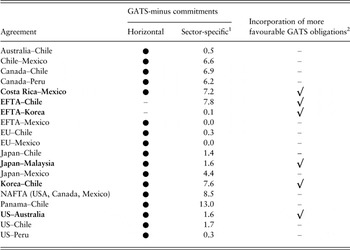
Table 1 provides an overview of the share of GATS-minus elements in selected RTAs involving TISA parties only.Footnote 20 Given the key role of national treatment as a determinant of GATS-compatible RTAs, the focus is on comparing the respective RTA commitments with entries in the parties' GATS schedules, consolidating the four modes of supply. In this context, a distinction is made between commitments inscribed in the horizontal section of the schedules, thus applying across all scheduled sectors, and those undertaken at the sectoral level.Footnote 21 Interestingly, not a single agreement within this sample is completely free of GATS-minus elements at both levels.
GATS-minus commitments in RTAs among TISA Participants (National Treatment, per cent)

Notes: 1 On average across the participating Members, accounting for all four modes of supply.
2 In the form of explicit cross-references or broadly phrased MFN clauses that do not exclude particular measures or levels of government.
The table covers those RTAs that were operational at the time when the underlying study by Miroudot et al. (supra n. 18) was conducted.
Source: Adlung and Mamdouh, supra n. 20, pp. 212ff.
According to an earlier study identifying patterns of minus commitments, more generous national-treatment exemptions for subsidies clearly prevailed among the limitations scheduled on a horizontal basis.Footnote 22 They could be traced in about three-quarters of the RTAs contained in the OECD Secretariat's dataset of 2011. The typical picture: while many GATS schedules exclude foreign-established service suppliers and their produce from non-discriminatory access to subsidies under mode 3, the respective RTA commitments not only replicate this limitation, but also exclude services imported cross-border under mode 1 or consumed abroad under mode 2 from national treatment and, possibly, further obligations. Among the RTAs listed in Table 1, the discrepancy is particularly obvious in the European Union's Agreements with Mexico (signed in December 1997) and Chile (November 2002). While the EC's GATS schedule of 1994 only exempts subsidies for branches, but not for subsidiaries, of non-EC companies as well as any R&D subsidies from national treatment under mode 3, the trade-in-services parts of the two RTAs completely exclude subsidies from all obligations, including MFN and national treatment, under any of the four modes.Footnote 23 In turn, Mexico's and Chile's GATS schedules are even more ‘liberal’ than the EC's schedule insofar as they do not feature horizontal limitations for subsidies at all.Footnote 24 Against this backdrop, could it credibly be claimed that the two RTAs eliminate substantially all discrimination in the sense of Article XVII?
Particularly frequent among the sector-specific minus commitments in RTAs are reductions in sectoral coverage compared to the corresponding commitments under the GATS. More than half of the RTAs covered by the dataset contain at least one such case. In this particular context, however, the two above agreements are not suitable examples. While the EU–Chile agreement does not provide for minus commitments related to reductions in sectoral coverage, the EU–Mexico RTA is completely free of any minus commitments at the sectoral level. Yet, as far as the EU is concerned, the picture has changed in more recent RTAs. Typically, agreements like that with Korea (signed in October 2010) limit the coverage of commitments on ‘Health Services and Social Services' to ‘privately funded services', thus excluding, inter alia, services funded via public health insurance schemes. Depending on the structure of the respective national health systems, which varies widely between EU members, this exclusion could prove commercially highly significant. However, it is absent from the current EC 12 schedule as submitted at the end of the Uruguay Round.
It might be argued that the focus on GATS-minus elements provides a distorted picture insofar as no attention is paid to the progress made in terms of possibly many other RTA commitments that improve on what had been inscribed in GATS schedules. Indeed, a closer look at the underlying dataset shows that the average share of the sector-specific GATS-minus commitments, 4%, is dwarfed by a far higher share of GATS-plus elements, which may exceed 60%.Footnote 25 Nevertheless, the purpose of this article is not to provide a broad comparison of RTA with GATS commitments, but to identify elements, GATS-minus commitments, that are incompatible with the benchmarks of GATS Article V and, thus, would compromise its applicability.
Minus commitments have not necessarily been scheduled on purpose. A number of cases is certainly attributable to the complexity of the GATS and the resulting problems of interpretation and government-internal coordination. Indeed, where the GATT essentially provides for one legitimate instrument of protection, tariffs, the GATS allows for six types of market access limitations and a virtually unlimited number of national-treatment restrictions (see Appendix). And it would not be surprising if some of them had escaped the attention of the ministries and agencies overseeing the respective sectors when they may have been involved, in the early 1990s, in setting up a country's schedule. Ten or 15 years later, when RTAs in services started to proliferate, new teams in the same administrations might have taken a fresh look in the light of the then prevailing policy objectives and concerns. In particular, new paradigms and associated demands ‒ for example, the perceived need to retain ‘policy space’ in socially or environmentally sensitive areas or to address stability-related concerns in financial services ‒ had emerged over time.
Quite a number of the agencies involved might not have been aware of the existence and/or implications of relevant GATS commitments and the need, if some are considered to be over-ambitious, to re-negotiate these in the first place. Moreover, it is questionable, to say the least, whether the rules governing re-negotiations of existing GATS commitments, under Article XXI, effectively serve their purpose. Interested governments may indeed be deterred by the potentially burdensome and time-consuming procedures, compounded by doubts about other Members' readiness to cooperate in good faith.Footnote 26
Concerns related to the retention of ‘policy space’ may have prompted the exclusion of subsidies from national-treatment obligations in the horizontal (cross-sectoral) section of schedules, as described above, which can be found in about three-quarters of the underlying dataset.Footnote 27 Likewise, they may explain the elimination of ‘sensitive’ sectors or sector segments from RTA schedules, which account for the majority (55%) of the sector-related GATS-minus commitments, followed by the introduction of a diverse range of new limitations (33%).Footnote 28
Increasing political sensitivities and/or regulatory concerns might also be among the factors contributing to a slight increase of minus commitments over time, from 3.6% in the RTAs concluded before 2005 to 4% since (1996–2011).Footnote 29 In addition, a closer look at the underlying dataset reveals a somewhat higher share of GATS-minus commitments in North–South than in North–North RTAs. In turn, this may be due to the fact that the GATS commitments undertaken by developing countries, though fewer in numbers, are not normally subject to as many limitations as those scheduled by northern countries (i.e. OECD members), which both sides might have taken as a starting point or, at least, as a source of inspiration for the RTAs concerned.Footnote 30
From a sector perspective, the services most affected by minus commitments are financial services, accounting for close to 40% of the total, followed by communication services (25%) and business services (20%).Footnote 31 The underlying motivations apparently differ. In financial services, certainly under the impression of the recent crisis, the commitments are more carefully hedged, in particular through the introduction of qualifications concerning the admission of new financial services. In communications, the minus elements tend to be more technical in nature, reflecting the use of more narrowly defined sector classifications that may result from the adoption of an RTA partner's classification scheme as a common basis.Footnote 32 Finally, a significant number of RTA commitments on business services contain new restrictions in the form of approval or residency requirements, which, in part, may be intended to accommodate vested interests. These are particularly difficult to resist if relevant restrictions are already contained in the partners' GATS schedule.
However, such sectoral differences in GATS-minus entries are not completely unexpected, given the ‘hierarchy’ of current commitments. While tourism is by far the most frequently committed sector under the GATS, showing up in 95% of current schedules, it is followed, far ahead of other sectors, by financial, communication, and business services.Footnote 33 The fact that tourism has drawn very few minus commitments is not surprising insofar as the GATS-scheduled entries in this sector look very straightforward, signalling the widespread absence of regulatory problems, public policy concerns, or protective interests.
Of course, it could be credibly argued, as indicated before, that a variety of GATS-minus commitments might not have been intended by the parties involved. On the other side, had these been firmly determined to avoid such commitments, there would have been an easy solution: the inclusion of a simple cross-reference that ensures the precedence of any more favourable GATS commitments. Such a cross-reference would also avoid, in the wake of future WTO negotiations, RTA commitments being surpassed by new GATS commitments should Members heed the mandate of Article XIX:1 and move towards ‘a progressively higher level of liberalization’. However, relevant provisions, including in the form of MFN clauses that clearly extend to the GATS, feature in only one-third of the sample of RTAs contained in Table 1.
A case in point is the Economic Partnership Agreement (EPA) between Japan and Malaysia. Like some other agreements involving Japan (e.g., with the Philippines and with Brunei), it provides that ‘[i]n the event of any inconsistency between this Agreement and the WTO Agreement, the WTO Agreement shall prevail to the extent of the inconsistency’ (Article 11:2). A similar purpose might be served by a provision in the Australia–US Free Trade Agreement (AUSFTA), which stipulates that the agreement ‘shall not be construed to derogate from any international legal obligation between the Parties that entitles goods or services, or suppliers of goods or services, to treatment more favourable than that accorded by this Agreement’.Footnote 34 Many other RTAs, including agreements involving the EU and the US, contain references to WTO obligations and commitments without, however, clearly ensuring that these prevail over possibly weaker or inconsistent RTA provisions.Footnote 35
Available evidence suggests that the existence of comprehensive MFN clauses is negatively correlated, overall, with an agreement's content of GATS-minus elements.Footnote 36 In other words, the stronger the potential impact of such clauses, the less they are being used. And this might be more than mere coincidence. It could imply that GATS-minus commitments cannot be attributed only to ignorance or lack of experience, but that they also reflect, in a number of cases at least, a deliberate policy choice.
4. Departures from GATS definitions and framework provisions
The aberrations which can be observed in comparisons between RTAs and the GATS are not confined to the trade commitments assumed by the parties. Quite a number of RTAs also depart from the Agreement's definitional scope, in Part I, as well as from its ‘General Obligations and Disciplines' in Part II which establish the legal framework for services trade among WTO Members. Yet, like minus commitments, these departures and their potential relevance under the GATS have drawn little attention in the literature.Footnote 37
To name just a few cases in recently concluded agreements involving TISA participants:
(i) Article I:1 of the GATS extends the definitional scope of the Agreement to ‘measures by Members affecting trade in services'. In turn, this is supposed to mean measures taken by ‘central, regional or local governments and authorities' (Article 1:3(a)(i)). However, a significant number of RTAs scale down the regional extension of their obligations and commitments. A case in point, among many others, is the recently signed Comprehensive Economic and Trade Agreement (CETA)Footnote 38 between Canada and the EU, which excludes, inter alia, existing measures, not further specified, maintained by local governments from all substantively significant trade commitments, i.e., Most-Favoured-Nation (MFN) treatment, market access, and national treatment. How can such exclusions be reconciled with the liberalizing mandate in Article V:1?Footnote 39
(ii) Article I:3(c) exempts governmental services from GATS coverage. Such services are defined to mean ‘any service which is supplied neither on a commercial basis, nor in competition with one or more service suppliers'. There is at least one agreement involving two TISA participants, the EU and Costa Rica, which modifies this exclusion as follows: ‘“Economic activity” does not include activities carried out in the exercise of governmental authority, for example, activities carried out neither on a commercial basis nor in competition with one or more economic operators' (emphasis added).Footnote 40 This obviously widens the range of services that are exempt from the scope of this RTA as compared to the GATS and adds an additional degree of uncertainty to what is already quite vaguely defined in Article I:3(c).Footnote 41
(iii) Since the entry into force of the GATS, i.e. for over 20 years, WTO Members have been negotiating on the question of emergency safeguard measures pursuant to the mandate in GATS Article X. Virtually no progress has been made in these negotiations, however, comparable to those in three more rule-making areas which are equally mandated in the Agreement itself (Article VI:4 on domestic regulation (see below), Article XIII on government procurement, and Article XV on subsidies). Interestingly, the EU recently reserved the right, under CETA, to take what are called ‘temporary safeguard measures' in case that capital or payment flows ‘cause or threaten to cause serious difficulties for the operation of the economic and monetary union of the European Union’ (Exceptions, Article X.03).Footnote 42 Moreover, the question arises why in relation to Canada the exception provision contained in the GATS Annex on Financial Services, the so-called ‘prudential carve-out’, a modified version of which shows up in CETA as well, was deemed insufficient.Footnote 43 Another GATS-minus element worth mentioning is the omission from CETA of a potentially restraining provision which requires that, if non-conforming measures are taken for prudential reasons, ‘they shall not be used as a means of avoiding the Member's commitments or obligations under the Agreement’.
(iv) The negotiating mandate in GATS Article VI:4 concerns the creation of disciplines preventing domestic regulations – i.e., measures relating to qualification requirements and procedures, technical standards, and licensing requirements – from constituting ‘unnecessary barriers to trade in services'. To further clarify this concept, the Article lists three sets of criteria the future disciplines are expected to satisfy, including the (in-)famous necessity test according to which regulatory requirements should ‘not be more burdensome than necessary to ensure the quality of the service’.Footnote 44 Indeed, this is the only element in these provisions that relates to regulatory content and not only to procedural and administrative issues. Article VI:5 specifies rules of conduct that need to be respected in the interim. Accordingly, Members should not apply new regulations that nullify or impair existing specific commitments in a manner which is inconsistent with the negotiating criteria laid down in Article VI:4 and could not have been reasonably expected at the time the commitments were made. These rules have not apparently created any frictions among WTO Members to date. It seems, nevertheless, that many RTAs have focused only on procedural disciplines, improving transparency, avoiding excessive fees, or undue delays, etc., rather than on ensuring a proper balance, commensurate with necessity-related criteria, between regulatory purpose and the resulting trade effects.Footnote 45 In a similar vein, a current negotiating proposal for TISA would water down, reportedly, the ‘necessity test’ governing regulatory content to a simple best-endeavours clause.Footnote 46 An additional variant of GATS-minus provisions of a regulatory nature can be found in CETA, which, unlike the GATS, expressly exempts certain sectors from the chapter on Domestic Regulation. On the EU side, these include health, education, and social services. Such modifications are somewhat surprising insofar as regulations governing merchandise trade, including trade in pharmaceuticals or in food products, as covered by the Agreements on Technical Barriers to Trade (TBT) and Sanitary and Phytosanitary Measures (SPS), have long been subject to requirements, including necessity tests, similar to those now apparently deemed unacceptable for services.Footnote 47
(v) Pursuant to Article XVII, a Member extending national treatment is required to dispose of all measures that accord foreign services and service suppliers less favourable treatment than that accorded to its own like services and suppliers. Thus, while granting market access under Article XVI consists of the absence of six specified types of measures, Article XVII hinges on a Member's compliance with an abstract criterion: no discrimination between like services and service suppliers (see Appendix). Yet, a significant number of RTAs have employed similar, but not necessarily equivalent concepts of ‘likeness', to establish the relevant benchmarks for national treatment. Typically, RTAs promoted by the US refer to the treatment extended in ‘like circumstances' to foreign as compared to domestic service providers, while the national-treatment standard in CETA hinges on the treatment of the two groups in ‘like situations'.Footnote 48 Such situations are not further defined, and one might wonder how many of them actually exist if the specific conditions of a transaction and any associated policy objectives and constraints are taken into account. In turn, this begs the question whether such modifications of the likeness criterion are compatible with the requirement for RTAs, in GATS Article V:I, to provide ‘the absence or elimination of substantially all discrimination, in the sense of Article XVII’.Footnote 49
It is not yet possible to judge if such provisions will find their way into TISA. Nevertheless, given their use in various recent RTAs signed by TISA participants, their reappearance cannot be precluded. If so, however, this could cast a shadow on the GATS-compatibility of the entire project. Article V is an exception clause that allows Members, in specified circumstances, to depart from the MFN requirement of the GATS. Yet it does not provide carte blanche for whatever departures from the Agreement's key obligations. If Members were free to reduce its definitional scope, introduce new safeguard-type provisions, water down substantive regulatory requirements, modify the national-treatment standard, and so forth as they see fit, the Agreement would end up in smoke.
While there is little information at present about the ultimate shape of TISA's definitional and legal framework, a few Members have published first offers that provide a more concrete foretaste of the scope and depth of the commitments that might ultimately emerge. The following observations are based on the EU's initial offer.
5. Prospects for TISA – a look at the EU offer and beyond
5.1 Specific commitments: Still GATS-minus?
At an early stage of the TISA project, the European Commission has set the bar quite high: ‘The objective … should be to negotiate an ambitious agreement that is compatible with the General Agreement on Trade in Services (GATS), which would attract broad participation and which could be multilateralized at a later stage.’Footnote 50 Yet this may need to be balanced with some more modest declarations, underlining that ‘the EU makes efforts to ensure that the TISA is compatible with the General Agreement on Trade in Services (GATS)’.Footnote 51 It is not quite clear, however, whether the latter statement refers predominantly to the choice of the scheduling approach – positive (GATS-type) versus negative (NAFTA-type) listing – or whether it alludes to substance as well.
In any event, it needs to be acknowledged that the EU's initial offer dispenses with some hitherto frequently used GATS-minus elements.Footnote 52 In particular, subsidies are no longer generally exempt from national treatment under modes 1 and 2 as has been the case in the CARIFORUM EPA or, more recently, in the Free Trade Agreement with Korea.Footnote 53 In contrast, however, sector-related minus commitments have been retained, including for educational and hospital services, and even added for some member States. Cases in point are an EU-wide reduction in scope of the commitments for health services to privately funded services and the introduction, also EU-wide, of a concession requirement for the participation of private operators in the health and social network, combined with the possibility of an economic needs test (mode 3), a newly introduced and not further defined concession requirement for private providers participating in the education network (mode 3), an authorization requirement for the exercise of management functions in the French health sector (mode 3), as well as a nationality requirement for providers of medical, dental, and veterinary services in France (mode 3).Footnote 54
Of course, such restrictions may be needed, as emphasized by the European Commission on various occasions, to retain flexibility in pursuit of overriding health, education, or social policy objectives. It is difficult to understand, however, why these considerations would matter predominantly vis-à-vis preferential trading partners, but less so in relation to third countries under GATS commitments. As has been emphasized elsewhere, the GATS makes a clear structural distinction between liberalization, in the sense of Articles XVI and XVII (see Appendix), and the (de-)regulation of services markets. Members remain free, regardless of the levels of access provided, to decide the shape and content of their regulatory frameworks.Footnote 55 It is not immediately evident, to say the least, why more flexibility might be required under RTAs.
Moreover, in addition to the GATS-minus elements noted above, the EU's current TISA offer contains various reciprocity provisions which might prove difficult to reconcile with basic GATS framework obligations. In one case, in particular, the entry explicitly refers to the treatment of ‘third-country nationals'.Footnote 56 Its existence could be due, however, to administration-internal verification problems that might be solved as the negotiations continue.
The scheduling principles agreed for TISA apparently sought to compromise between two alternative approaches, positive listing (GATS-type) and negative listing (NAFTA-type). While in the former context, commitments on market access and national treatment are assumed only in the sectors listed in the respective Members' schedules and only to the extent that no limitations have been attached, the latter approach is based on the principle that market access and national treatment are liberalized across all sectors as long as no reservations for existing and/or future measures are listed in annexes. For TISA, participants agreed to grant market access only in selected sectors, possibly combined with limitations, while national-treatment obligations are to be assumed across the board as long as no reservations are taken. Based on current RTAs, it may be assumed that negative listing ultimately results in significantly more ambitious commitments than GATS-type positive listing.Footnote 57 On the other hand, it also entails the risk that, with a view to avoiding unintentionally liberal commitments, administrations prefer to play safe and opt for potentially excessive reservations.Footnote 58
The combination of the two scheduling approaches could result in problems of interpretation which are potentially more serious than those associated with conventional GATS schedules. It is evident from these schedules that Members' understanding of whether a particular measure is inconsistent with unrestricted market access or national treatment, and thus needs to covered by a limitation under either of them, may differ significantly. Nevertheless, this does not really matter as long as the limitation shows up in either of the two columns, market access or national treatment, which form part of GATS schedules as well as the fully GATS-based RTAs.Footnote 59 However, it may escape coverage in a TISA schedule if the measure is deemed by the Member concerned to fall under market access in a sector not subject to commitments. There is simply no need in this case to inscribe a limitation since no access obligations are assumed from the outset. In contrast, if the same measure were considered to be inconsistent with the (horizontally applicable) national-treatment obligation, it would consequently be scheduled to provide cover should some foreign presence be granted on an autonomous basis. The Member concerned would then be protected regardless of interpretational subtleties; and such borderline cases are quite numerous as current GATS schedules suggest.Footnote 60
5.2 An additional stumbling block: audiovisual services (?)
According to the panel's decision in Canada–Autos (Section 2.2, indent (iv)), it is inadmissible if a party to an RTA does not treat the other parties on a par. In other words, there must be no discrimination within the RTA-covered territory. However, this cannot be ensured under TISA if the European participants, as repeatedly confirmed, insist on the exclusion of audiovisual services while, at the same time, they mutually extend preferences under the European Convention on Transfrontier Television and other instruments. It would be interesting to learn why, should the administrations in Bern, Brussels, Liechtenstein, Oslo and Reykjavik have reflected on the panel's decision, they are not convinced of its relevance for TISA and, by the same token, other RTAs that might lead to similar discrepancies in treatment among participating countries.
In this particular case, it might be argued that, unlike the Canadian measures, the preferences exchanged by the EU and its European partners are covered by exemptions from MFN treatment. These are included in the respective lists submitted under Article II:2 of the GATS,Footnote 61 and might be deemed to apply in trade among RTA parties as well. Doubts remain, however. GATS Article V:1(b) specifies several measures which are excepted from the requirement for RTAs to provide for the ‘absence or elimination of substantially all discrimination’. Accordingly, Members may still adopt measures permitted under Article XI (Payments and Transfers), Article XII (Restrictions to Safeguard the Balance of Payments), Article XIV (General Exceptions), and Article XIVbis (Security Exceptions). Exemptions from MFN treatment are not mentioned in this context which might imply, in turn, that they would not provide cover for the preferences in treatment extended among the European TISA partners.
It may be worth adding that this issue does not appear to arise in the negotiations currently conducted between the EU and US on a Transatlantic Trade and Investment Partnership (TTIP) since the trade and investment regimes are homogenous on both sides. The same should apply, of course, to other such agreements as well.Footnote 62
6. Looking ahead: how to deal with incompatibility
The policy implications of GATS-deficient trade agreements might be viewed and assessed from at least three different angles. The focus could be either on treaty partners, third countries or the trading system overall.
Concerning treaty partners, it could be argued that these are free at any time to defend their rights in the WTO and call for compliance. This is true, of course. Nevertheless, it is quite unlikely to see many such initiatives as long as the agreements' GATS- or WTO-plus elements prevail, whether in the form of more liberal commitments, financial assistance, or other economic or political benefits. Since a complainant, whether successful or not, could not count on their continued extension, there is little incentive to launch a case.
Third countries whose investors are adversely affected could obviously insist as well on compliance with more liberal GATS provisions. Existing inconsistencies might even be used to challenge an RTA per se and call for the abolition of existing preferences, where these exist, or their multilateral extension. However, in the absence of excessive violations, who would want to start the ball rolling? Given the recent proliferation of RTAs, including agreements with shaky legal standing, the likelihood of such initiatives is becoming increasingly remote.
The real risk associated with the proliferation RTAs consists indeed of the emergence of a parallel system of trade rules that is irreconcilable with participants' WTO obligations and commitments. A point might be reached where the latter are deemed to count no more than those enshrined in the rapidly increasing number of RTAs which are intended, in part, to fill the vacuum created by the DDA's apparent inability to deliver.Footnote 63 On the other hand, however, it needs to be admitted that abstinence is no credible alternative either. This is true especially in services trade, where the gap between most commitments and actual access conditions has grown dramatically.
Rapid technical progress and subsequent policy adjustments have rendered large shares of the – already timid – current bindings, undertaken two decades ago, virtually irrelevant.Footnote 64 And there are additional sources of frustration. The stalemate in the DDA has not only infested the rule-making negotiations (Section 4, indents (iii) and (iv)), but also stifled attempts to address new challenges surrounding, for example, the treatment of state-owned enterprises, sovereign wealth funds, or cross-border data flows.
It is thus completely understandable if interested Members seek to explore options. Yet, in order for these to be viable in an increasingly integrated world economy, additional fragmentation must be avoided. If open-ended plurilateral solutions, modelled on the extended negotiations on basic telecommunications or financial services, are currently beyond reach, it appears imperative at least that the door be kept open for later multilateralization of whatever might be achieved. A ‘mega-regional’ like TISA, covering some 70% of world services trade, will send an important signal in this regard. There is nothing comparable in size, focus and composition.
Given its exclusive application to services, it may be easier for this project to be successfully concluded than broader-based initiatives which extend to merchandise trade and, thus, provide more scope for cross-sectoral ‘hostage taking’. Moreover, the fact that TISA unites many (self-avowed) stalwarts of multilateralism should, one might expect, help achieve a WTO/GATS-consistent outcome. At earlier stages of the DDA, when negotiating offers were exchanged, quite a number of current participants had argued strongly against any ‘backtracking’ of existing GATS commitments.Footnote 65 Are these objections still valid? The inclusion of a simple provision might help to dispel doubts: ‘In the event of any inconsistency between this Agreement and the WTO Agreement, the WTO Agreement shall prevail to the extent of the inconsistency.’
The prerequisite of a reasonably sustainable marriage…
Appendix: specific commitments under the GATS - a brief introduction
Pursuant to GATS Article XX:1 each WTO Member is required to submit a schedule of specific commitments governing its trade relations in services. In principle, the Member is free to select the sectors in which it assumes commitments and the respective levels of liberalization.
All commitments are specified with regard to four types of transactions: cross-border trade (mode 1), consumption abroad (mode 2), commercial presence (mode 3), and presence of natural persons (mode 4). While mode 1 corresponds to the traditional notion of imports into a Member's territory, mode 2 covers services supplied to a consumer who has moved abroad (e.g., a tourist, patient, or exchange student), mode 3 consists of foreign suppliers operating via branches, subsidiaries, etc., and mode 4 of foreign professionals being physically present in a Member's territory to provide their services. Reflecting this extension in modal coverage, obligations and commitments under the Agreement apply to both products, i.e. services, and their suppliers.
In assuming commitments under the four modes, Members need to specify the trading conditions with regard to two parameters: market access and national treatment. Market access consists of the absence of six categories of measures which are enumerated in GATS Article XVI:2(a)–(f). These are mostly quota-type restrictions (e.g., concerning the number of suppliers, their turnover or assets), but also include restrictions on the form of legal incorporation (e.g., joint venture requirements) and on foreign equity participation. In turn, national treatment is defined in GATS Article XVII as the absence of discrimination between foreign services and service suppliers and the Member's own like services and suppliers. Since no specific categories are listed, contrary to Article XVI, it is for the Member concerned to judge whether any conceivable departures are in place or under preparation.
In sectors subjected to commitments, the schedule must specify for all four modes the conditions of market access and national treatment. The spectrum of entries may vary between ‘unbound’ and ‘none’, indicating, respectively, the absence of any commitments or unlimited market access or national treatment. In most cases, commitments are of a partial nature, however, which means that the Member has reserved the right to depart for specified measures from unlimited market access or national treatment.
Apart from sector-related limitations, most schedules also contain limitations of a horizontal nature which apply across all scheduled sectors (e.g., concerning generally applicable foreign equity ceilings, exclusions of subsidies from national treatment, or restrictions governing access under mode 4).
Commitments are undertaken within a common framework of definitions and generally applicable trade obligations and disciplines. Some of these obligations and disciplines are unconditional in nature, meaning that they apply to all services falling under the GATS, regardless of the existence of specific commitments, while others are confined to scheduled sectors. The most relevant among the unconditional obligations is MFN treatment. Examples of conditional obligations include the requirement to operate measures of general applications in a reasonable, objective, and impartial manner (Article VI:1), to comply with a preliminary set of regulatory disciplines, pending the conclusion of ongoing negotiations on domestic regulation (Article VI:5, see also Section 4, indent (iv)), to prevent government-mandated monopolies from undermining existing commitments in areas where they compete (Article VIII:2), to refrain from imposing exchange restrictions (Article XI:1), and so forth.