INTRODUCTION
Archaeologists excavating ancient Maya sites have encountered assemblages of artifacts in locations that have proven difficult to interpret. Among the most controversial are “problematic deposits.” Problematic deposits have been interpreted in numerous ways, but they are usually seen as representative of activities that occurred just prior to, during, or after site abandonment. This association with abandonment is based on the fact that problematic deposits at many Maya sites are dated to the Terminal Classic period (~a.d. 750–900) and are typically the last evidence of occupation at the location.
In this paper, we discuss sixteen chert bifaces recovered from problematic deposits at the bases of two elite civic-ceremonial buildings—Structures A2 and A3—at the ancient Maya site of Cahal Pech, Belize (see Aimers and Awe [Reference Aimers and Awe2020] and Awe et al. [Reference Awe, Helmke, Aimers, Ebert, Stemp and Hoggarth2020] for detailed information of this context). Based on the results of stylistic, metric, and use-wear analyses performed on these chert artifacts, we surmise that the bifaces were likely produced locally, used during important hunting or warfare activities, and subsequently deposited during some type of celebratory, veneration, or pilgrimage-related rituals at these locations sometime around the Terminal Classic. These whole projectile points, most likely affixed to spearthrower darts, are believed to represent “success” at hunting or fighting. The number of points deposited may have had important symbolic meanings that further connected them to the supernatural or mythological worlds of the Maya.
WHAT IS A PROBLEMATIC DEPOSIT?
A “problematical” or “problematic deposit” originally denoted a special deposit that was neither a burial nor a cache, but whose function was unclear (Aimers et al. Reference Aimers, Hoggarth and Awe2020). More recently, the term has been applied to assemblages of artifacts of various types and conditions, including ceramics, lithics, skeletal remains, and other objects, typically recovered on the surfaces of the terminal phase of elite civic-ceremonial architecture, including monumental structures, residences, and plazas. Problematic deposits of different types have been reported on or near the surfaces of buildings, often at the base of structures, on staircases, in doorways and alleyways, or in the corners of buildings or rooms (see Mock [Reference Mock and Mock1998a:6] for liminal or transitional areas). Debate about the process of their accumulation has been divided between midden trash by those who abandoned a site or reoccupied an abandoned site (i.e., squatters; Aimers Reference Aimers, Inomata and Webb2003; Moholy-Nagy Reference Moholy-Nagy1997; Pendergast Reference Pendergast1979; Stanton and Magnoni Reference Stanton, Magnoni, Stanton and Magnoni2008; Stanton et al. Reference Stanton, Brown and Pagliaro2008; Thompson Reference Thompson1954), warfare (Brown and Garber Reference Brown, Garber, Kathryn Brown and Stanton2003; Chase and Chase Reference Chase, Chase, Kathryn Brown and Stanton2003, Reference Chase, Chase, Demarest, Rice and Rice2004; Inomata Reference Inomata, Inomata and Webb2003; Inomata and Stiver Reference Inomata and Stiver1998), the act of depositing materials around the time of site abandonment (peri-abandonment) as some form of dedicatory or termination rituals (Chase and Chase Reference Chase, Chase and Houston1998:301; Coe Reference Coe, Wauchope and Willey1965; Garber Reference Garber1983; Guderjan Reference Guderjan2004; Stanton et al. Reference Stanton, Brown and Pagliaro2008:237), or rituals related to propitiation of ancestors or deities associated with agricultural fertility (Awe et al. Reference Awe, Gibbs, Griffith, Brady and Prufer2005; Palka Reference Palka2014).
The presence of midden deposits, consisting of broken artifacts, animal bones, and other waste, within elite spaces is usually interpreted as evidence for the collapse of leadership at a site and the reoccupation and/or reuse of these spaces by commoners (Pendergast Reference Pendergast1979; Thompson Reference Thompson1954). Artifacts and bones found scattered and variously damaged on plaza floors and in or on civic-ceremonial buildings, however, especially in locations with evidence of burning and architectural destruction, are typically associated with warfare and rapid abandonment of a site (Brown and Garber Reference Brown, Garber, Kathryn Brown and Stanton2003; Inomata Reference Inomata, Inomata and Webb2003; Inomata and Stiver Reference Inomata and Stiver1998). Both of these processes for the accumulation of debris in elite spaces are the result of the loss of site leadership with the former possibly a consequence of the latter.
Dedicatory rituals may represent celebration after abandonment, such as feasting, or a return to abandoned places for the purpose of ritual veneration (Aimers Reference Aimers, Inomata and Webb2003; Clayton et al. Reference Clayton, David Driver and Kosakowsky2005; Harrison-Buck Reference Harrison-Buck and Harrison-Buck2012:108–109; Iannone et al. Reference Iannone, Houk and Schwake2016; Stanton et al. Reference Stanton, Brown and Pagliaro2008; Tsukamoto Reference Tsukamoto2017) involving the connection of the living Maya to their ancestors, their deities, their kin/ethnic groups, or their traditional lands. Houk (Reference Houk, Iannone, Houk and Schwake2016) even suggests that commoners may have returned to abandoned/terminated elite structures and continued to make offerings because these places were connected to the power of kings of the past. These ritual activities may have drawn Maya from different locations to a common place as forms of pilgrimage.
Termination rituals are assumed to end the “life” of a space or structure. The reasons for termination, whether reverential or desecratory, may affect the conditions of the objects. Desecratory termination may incorporate the destruction of locations by burning or damaging architectural features and/or burials, possibly associated with defeat in warfare (Demarest et al. Reference Demarest, O'Mansky, Wolley, Van Tuerenhout, Inomata, Palka and Escobedo1997; Garber Reference Garber1983; Golden et al. Reference Golden, Scherer, Kingsley, Houston, Escobedo, Iannone, Houk and Schwake2016; Harrison-Buck Reference Harrison-Buck and Harrison-Buck2012, Reference Harrison-Buck, Iannone, Houk and Schwake2016; Harrison-Buck et al. Reference Harrison-Buck, McAnany, Storey, Tiesler and Cucina2007; Iannone Reference Iannone2005, Reference Iannone2010; Inomata Reference Inomata, Inomata and Webb2003, Reference Inomata, Iannone, Houk and Schwake2016; Lamoureux-St-Hilaire et al. Reference Lamoureux-St-Hilaire, Macrae, McCane, Parker and Iannone2015; Mock Reference Mock and Mock1998b; Pagliaro et al. Reference Pagliaro, Garber, Stanton, Brown and Stanton2003; Palka Reference Palka, Inomata and Webb2003; Schwake and Iannone Reference Schwake, Iannone, Iannone, Houk and Schwake2016; Suhler and Freidel Reference Suhler, Freidel, Inomata and Webb2003; Yaeger Reference Yaeger, LeCount and Yaeger2010). Whether the product of desecratory or reverential termination, the conditions of the objects in problematic deposits can vary, with some being damaged or broken, conceivably on purpose, to “kill” them or remove their life-force (see Walker [Reference Walker, Skibo, Walker and Nielson1995] for “kratophanous material culture”). In addition to ritually removing the life-force from objects and locations during abandonment, Lamoureux-St-Hilaire and Iannone (Reference Lamoureux-St-Hilaire and Iannone2012:216; Lamoureux-St-Hilaire et al. Reference Lamoureux-St-Hilaire, Macrae, McCane, Parker and Iannone2015:553) suggest that termination may be related to social detachment from a place. Lamoureux-St-Hilaire et al. (Reference Lamoureux-St-Hilaire, Macrae, McCane, Parker and Iannone2015; see also Palka Reference Palka, Inomata and Webb2003) note that practices of abandonment by elites versus commoners may have differed, and that abandonment of different locations at a site may not have occurred simultaneously, suggesting portions of sites may have been abandoned or terminated while others continued to be used or were reoccupied at various points in time (Awe et al. Reference Awe, Helmke, Aimers, Ebert, Stemp and Hoggarth2020).
A final type of ritual is associated with pilgrimages to sacred landscapes to petition ancestors and particular deities during times of duress. These rituals were, and are, common across Mesoamerica (Palka Reference Palka2014) and have been recorded among the Lacandon, the Yucatec, Zinacantecos, and other lowland and highland Maya groups (Awe et al. Reference Awe, Gibbs, Griffith, Brady and Prufer2005; Brady Reference Brady1989; Brady and Peterson Reference Brady, Peterson and Fogelin2008; McGee Reference McGee1990; Palka Reference Palka2005, Reference Palka2014; Stanzione Reference Stanzione2003; Tozzer Reference Tozzer1941; Vogt Reference Vogt1969, Reference Vogt1976). The Zinacantecos and Lacandon, for example, will make pilgrimages to sacred landscapes during times of severe drought to petition rain deities and earth spirits to insure a productive harvest (McGee Reference McGee1990; Palka Reference Palka2014; Vogt Reference Vogt1969). The Chachac ceremony in the Yucatan is another example of these types of rituals, and so too are the many cave ceremonies that indigenous groups conducted and continue to conduct across the Maya world (Awe and Helmke Reference Awe and Helmke2015; Brady and Peterson Reference Brady, Peterson and Fogelin2008; Palka Reference Palka2014; Peterson Reference Peterson2006). In current examples of these rituals, the Maya often make offerings of various types of food, alcohol, cigarettes and cigars, burn candles and incense, spread pine needles and flowers over the ritual ground, and sometimes sacrifice chickens. In ancient times, offerings included most of the latter, but often also included human sacrifice, various types of chert bifaces, and the purposeful breaking of the various types of objects used in the ceremonies or those that contained offerings (Arden Reference Ardren2011; Brown Reference Brown2002; Palka Reference Palka2014). Chert bifaces, and chipped-stone artifacts in general, are particularly common in prehistoric cave and surface site deposits (Awe et al. Reference Awe, Helmke, Aimers, Ebert, Stemp and Hoggarth2020; Brown Reference Brown2000; Inomata Reference Inomata, Inomata and Webb2003; Peterson Reference Peterson2006; Sheets Reference Sheets, Hester and Shafer1991). At Chichen Itza, for example, just over 250 chipped-stone artifacts, the great majority represented by bifaces, were discovered in the cenote (Sheets Reference Sheets, Hester and Shafer1991:164). At surface sites, bifaces are reported in deposits excavated at Aguateca, Xunantunich, Baking Pot, Pook's Hill, Caracol, and Cahal Pech, among others (Awe et al. Reference Awe, Helmke, Aimers, Ebert, Stemp and Hoggarth2020; Inomata Reference Inomata, Inomata and Webb2003; Inomata and Stiver Reference Inomata and Stiver1998).
STRUCTURES A2 AND A3 AT CAHAL PECH: CONTEXT OF RECOVERY OF THE CHERT BIFACES
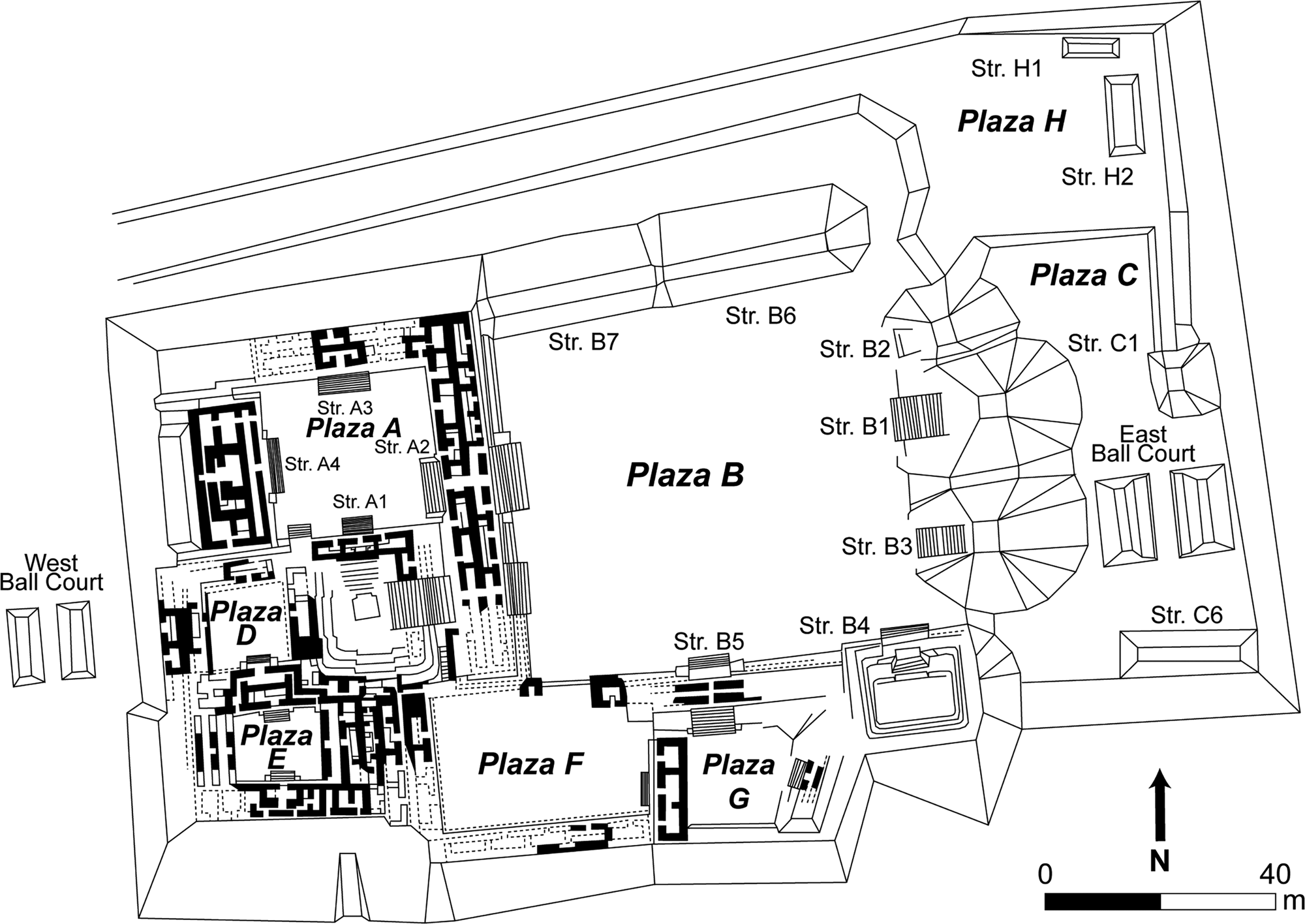
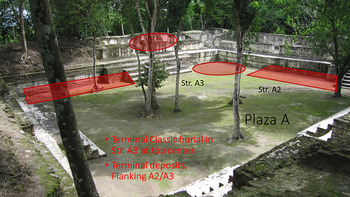
Cahal Pech is a minor center located in western Belize overlooking the modern town of San Ignacio. Thirty years of investigations by the Belize Valley Archaeological Reconnaissance (BVAR) Project (Awe Reference Awe1992, Reference Awe2013; Ebert et al. Reference Ebert, Culleton, Awe and Kennett2016) have confirmed that the site was continuously occupied from the end of the Early Preclassic until the Terminal Classic periods (1200 b.c.–a.d. 900). The site-core has an east-west orientation and contains eight courtyards. Plaza A, located on the western side of the site-core, is enclosed by three palatial or range-type buildings, and a single large temple pyramid (Structure A1) on the south side of the courtyard (Figure 1). The three, multi-roomed palaces are located on the east (Structures A2), north (Structure A3), and west (Structure A4) sides of the plaza. During the past 30 years, peri-abandonment deposits have been recovered on the eastern and western flanks of Structure A1, on the northeastern corner of A1, and on the flanks of stairside outsets of the three multi-roomed palaces bordering the courtyard. The problematic deposits containing the 16 chert bifaces were encountered just below the modern ground surface left (or north) of the stairside outset of Structure A2 and in the area where Structures A2 and A3 join at the northeast corner of Plaza A. A problematic deposit located left (or west) of the stairside outset of Structure A3 also contained seven chert bifaces that were unavailable for analysis (Figure 2). The deposits in all three locations ranged between 10 to 24 centimeters in depth, with the thickest parts concentrated around the stairsides of the Structure A2 staircase and in the corner where Structures A2 and A3 joined. The deposits were above the plaster surface of the terminal plaza floor, and were separated by a one- to two-meter space with no deposits between them. A layer of dirt (0.5 to two centimeters thick) also separated the deposits from the plaza floor, indicating that some time had elapsed between the final uses of the Plaza A buildings and the formation of the deposits. Some facing stones from the walls of the buildings were also found amidst the deposits, suggesting that the buildings had begun to fall into disrepair or collapse at the time the deposits were placed in Plaza A (Awe et al. Reference Awe, Helmke, Aimers, Ebert, Stemp and Hoggarth2020). The latter stratigraphic context is an important archaeological feature because it suggests that: (1) the buildings had begun to fall apart prior to the laying of the deposits, and (2) that the bifaces were not associated with the types of military events that caused site destruction at other Maya sites, including Dos Pilas (Demarest et al. Reference Demarest, O'Mansky, Wolley, Van Tuerenhout, Inomata, Palka and Escobedo1997) and Aguateca (Aoyama Reference Aoyama2009). It is therefore more likely that the deposits were placed in the locations in which they were discovered during or after site abandonment, much like above-floor deposits left by the Lacandon during ritual activities at sites such as Yaxchilan and Bonampak (Palka Reference Palka2014).
Map of the site core at Cahal Pech, Belize. Map by Claire Ebert.

Plaza A at Cahal Pech, Showing the locations of three problematic deposits in the courtyard and an intrusive child burial atop Structure A3. Photograph taken from the southwest corner of the plaza by Awe.

The problematic deposits contained large fragments of numerous broken ceramic dishes, bowls, jars, and censers. The fragments were in an excellent state of preservation with no wear along the broken edges, suggesting that they were not removed and redeposited from an earlier midden (Aimers and Awe Reference Aimers and Awe2020). A few fragments could be refitted, but almost all vessels appear to be fragmentary and incomplete. This pattern suggests that some fragments were likely removed and deposited elsewhere after the vessels were smashed in situ. Seven spindles whorls (five complete decorated and plain ceramic and two stone spindle whorls), six carved with various line and dot motifs and one a simple whorl, were also found. Additionally, several partially complete figurines and anthropomorphic and zoomorphic ocarinas and one complete ocarina were also recovered in the deposit. One of the figurines was a Middle Preclassic Savana Orange specimen likely recovered from elsewhere at the site and redeposited in front of Structure A2. All, except the complete figurine, had their heads broken off or “decapitated.” One ceramic flute fragment was also found in front of Structure A2. The deposits also contained numerous worked and unworked animal bones (including a feline tooth, deer bones, and a white-tailed deer antler), freshwater shells, fragments of human skeletal remains, several fragments of manos and metates, a carved fragment of a jade pendant, and one carved fragment of a jade mosaic mask or adorno. The lithics from the deposits included several obsidian blade fragments, some chert celt fragments, some chert debitage, and the 16 chipped chert bifaces discussed in this paper. The problematic deposits have been dated to the Terminal Classic period (~a.d. 750–900) based on ceramic affiliations with Spanish Lookout complex types in the Belize Valley (Aimers and Awe Reference Aimers and Awe2020; Gifford Reference Gifford1976) and by radiocarbon dates from human remains within intrusive burials containing similar ceramic assemblages (Awe et al. Reference Awe, Helmke, Aimers, Ebert, Stemp and Hoggarth2020).
Contemporaneous with the problematic deposits was an intrusive burial of a roughly seven- to nine-year-old child inside a bench within the central room of Structure A3 (Figure 2). The Maya had cut into the bench to deposit the child's body and some grave goods, and then filled the hole with dirt up to the level of the original plastered surface of the bench without resealing it with plaster. Two large limestone slabs were found over the section of the bench where the burial lay. The artifacts associated with the child included three ocarinas, two flutes, and four Spanish Lookout-phase (~a.d. 700–900) ceramic vessels (Aimers and Awe Reference Aimers and Awe2020; Awe et al. Reference Awe, Helmke, Aimers, Ebert, Stemp and Hoggarth2020). The dating of the burial based on the pottery support a Terminal Classic date (~a.d. 750–900).
LITHICS IN PROBLEMATIC DEPOSITS AND THE SIXTEEN CHERT BIFACES
Ceramics in problematic deposits at Maya sites have been the focus of much attention (Aimers Reference Aimers, Inomata and Webb2003; Brown and Garber Reference Brown, Garber, Kathryn Brown and Stanton2003; Clayton et al. Reference Clayton, David Driver and Kosakowsky2005; Culbert Reference Culbert1993; Freidel Reference Freidel, Freidel and Robertson1986; Guderjan and Hanratty Reference Guderjan, Hanratty, Iannone, Houk and Schwake2016; Houk Reference Houk, Iannone, Houk and Schwake2016; Lamoureux-St-Hilaire et al. Reference Lamoureux-St-Hilaire, Macrae, McCane, Parker and Iannone2015; Pendergast Reference Pendergast1979; Sullivan et al. Reference Sullivan, Houk, Zaro and Moats2013; Tsukamoto Reference Tsukamoto2017; Walker Reference Walker and Mock1998; Yaeger Reference Yaeger, LeCount and Yaeger2010), but chipped stone tools from these types of deposits have not received as much scrutiny (Chase and Chase Reference Chase, Chase, Kathryn Brown and Stanton2003; Guderjan et al. Reference Guderjan, Lichtenstein, Hanratty and Christie2003; Lamoureux-St-Hilaire et al. Reference Lamoureux-St-Hilaire, Macrae, McCane, Parker and Iannone2015; Moholy-Nagy Reference Moholy-Nagy1997, Reference Moholy-Nagy2003; Pagliaro et al. Reference Pagliaro, Garber, Stanton, Brown and Stanton2003; Ponce de León Reference Ponce de León and Braswell2003). Chert and obsidian flakes, obsidian blades, obsidian cores, and chert bifaces have also been recovered from burials, caches, and caves. In these contexts, they have often been associated with ritual deposition of different types. For example, lenses or layers of debitage and broken tools have been recovered above, and sometimes within, elite or royal tombs (Awe Reference Awe1992; Coe Reference Coe, Benson and Griffin1988; Eberl Reference Eberl2005; Fitzsimmons Reference Fitzsimmons2009; Moholy-Nagy Reference Moholy-Nagy1997). These lenses have frequently been interpreted as demarcating the threshold to the Underworld. Debitage or tool fragments from caves may have been left as offerings to the supernatural that accumulated over time (Brown Reference Brown2000; Prufer Reference Prufer2002, Stemp et al. Reference Stemp, Wrobel, Awe and Payeur2013).
In general, the specific quantities of the different types of stone tools from problematic deposits are not provided. Moreover, detailed descriptions of individual artifacts, including raw materials, types, metrics, and use-wear are also lacking (see Aoyama [Reference Aoyama1999, Reference Aoyama2005, Reference Aoyama2009] and Moholy-Nagy [Reference Moholy-Nagy2003] for exceptions). In this study, the 16 chipped chert bifaces recovered from the problematic deposits at Structures A2 and A3 at Cahal Pech are analyzed in terms of raw material, type/style, metrics, and use-wear. Seven of the 16 bifaces (Figure 3a–3g) were recovered in the deposit at the base of Structure A2 and nine (Figure 3h–3p) came from the deposit in the northeast corner of Structures A2 and A3 in Plaza A. The bifaces were clustered in proximity to each other, in an area no larger than two m2, but in no apparent distributional pattern or specific directional orientation. The numbers of bifaces in each cluster may also be significant when interpreting why these whole stone tools were found in the problematic deposits.
Sixteen chert bifaces recovered from problematic deposits (bifaces a–g) at the base of Structure A2 and (bifaces h–p) in the corner of Plaza A at the northeast juncture of Structures A2 and A3. Photograph by Stemp.

Raw Material
All 16 bifaces were chipped from cherts that are consistent with local varieties found as nodules near the Macal River and cobbles or lenses from limestone in the surrounding environs of the site. There is variation in color and grain size/texture and the quality of these cherts ranges from medium to high.
Types/Styles
The 16 bifaces are “pointed tools shaped from large flake banks by collateral bifacial percussion and pressure flaking” (Aoyama Reference Aoyama2005:294). They were subdivided into five different types or styles based on blade shape and variation in stem/base design. Of these, 10 are classified as stemmed: six are narrow blade, tapered stem (Figures 3b, 3e, 3i, 3j, 3o, 3p); two are narrow blade, straight stem (Figures 3k and 3l); one is wide blade, tapered stem (Figure 3a); and one is wide blade, straight stem (Figure 3m). Four are classified as lenticular, unstemmed (Figure 3d, 3f–3h), and one has a side-notched stem (Figure 3c). One biface could not be classified in this way because the proximal portion of the artifact is missing (Figure 3n). The 10 bifaces in our stemmed category are generally equivalent to Aoyama's (Reference Aoyama2005:297) “tapered” and “stemmed” points. Some of our lenticular, unstemmed bifaces, however, are different from Aoyama's (Reference Aoyama2005:294) “laurel-leaf” points, which he describes as “modified by marginal retouch rather than bifacial flaking and hav[ing] two bipointed ends.” No blade points (see Aoyama Reference Aoyama2005:294) were recovered in the problematic deposits in Plaza A at Cahal Pech.
Many chert bifaces that are stylistically similar to the artifacts from Structures A2 and A3 generally date to the Late Classic–Terminal Classic periods at numerous other sites, including Aguateca (Aoyama Reference Aoyama2005:296, Figures 3a–3f), Altar de Sacrificios (Coe Reference Coe1959:12–13, Figures 3e, 3i, 3j; Willey Reference Willey1972:162, 164, 165, 172, 173, Figures 140d–140g, 142, 143a, 143b, 144b, 144g, 152b, 152c, 154), Barton Ramie (Willey et al. Reference Willey, Bullard, Glass and Gifford1965:413, 414, 421, Figures 261c, 262a, 262g, 262h, 269a, 269b), Copan (Aoyama Reference Aoyama1999:186, Figure 9.2b, Reference Aoyama2005:299, Figure 4l), Dzibilchaltun and Rio Bec sites (Rovner and Lewenstein Reference Rovner and Lewenstein1997:72–76, Figures 10a, 10b, 10f, 10h, 11d–11f, 13b–13d, 13f, 13h, 14c, 14f, 14h), and Tikal (Moholy-Nagy Reference Moholy-Nagy2003:Figures 32r, 33j, 41j, 41m), among many others. Side-notched points are typically associated with the Early Postclassic at Colha (Hester and Shafer Reference Hester, Shafer, Hester and Shafer1991:157, Figure 2), and have been assigned a similar date at Altar de Sacrificios (Willey Reference Willey1972:162–163, Figures 140a, 141), and Dzibilchaltun and Rio Bec (Rovner and Lewenstein Reference Rovner and Lewenstein1997:76, Figures 14u–14w). Three of the bifaces (Figures 3k, 3o, and 3p) provide evidence for repair of one of their edges, resulting in the asymmetry of the bifaces’ outlines and the removal of one shoulder.
Metrics
Frequently, metrics have been used to assign chipped stone point function. Arrow points, which are affixed to thin, short, straight, fletched shafts projected using a bow, are usually described as small and light. Points for darts and spears are typically described as longer, wider, and heavier than arrow points. The delivery systems for dart points are distinguished from those for spear points based on the fact that the former are hafted to flexible shafts of variable lengths that are thrown using a rod or board with a hook or notch on the end (e.g., atlatl); whereas, the latter are affixed to long, straight, thick shafts that are thrown or thrust by hand.
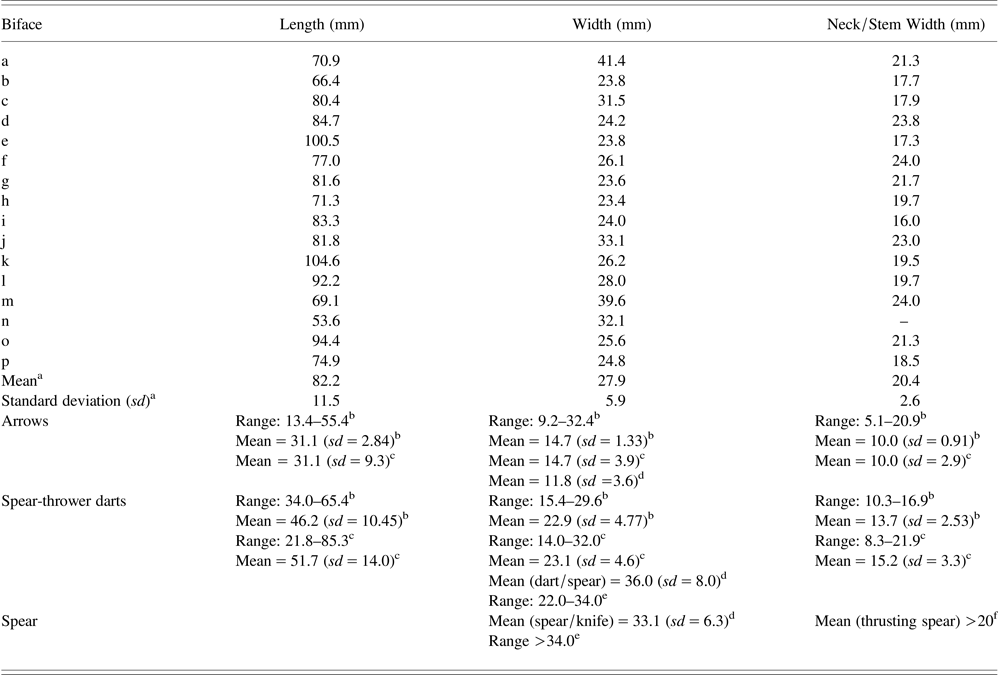
Based on point dimensions (Table 1), the 16 bifaces were too long to have served as effective arrow points using Thomas's (Reference Thomas1978) and Shott's (Reference Shott1997) comparative data. Many are also too wide or have neck/stem widths that exceed those normally associated with arrow points. Using Hildebrandt's and King's (Reference Hildebrandt and King2012) method of determining arrow versus dart points, which states that the sum of the neck/stem width and maximum thickness values on arrows should be less than 11.8 mm, none of the whole chert bifaces could be arrows because their neck/stem widths are greater than this threshold. Similarly, Aoyama's (Reference Aoyama2005; Aoyama and Graham Reference Aoyama and Graham2015) combined metric (mean) and use-wear analysis of bifaces from Copan also demonstrate that the bifaces from Structures A2 and A3 exceed the 11.8 mm mean width (sd = 3.6) for arrows.
Metrics for the 16 chert bifaces from the problematic deposits in Plaza A, Cahal Pech, and comparisons to point types associated with different delivery systems (arrow, dart, and spear).

a Calculations of mean and standard deviation (sd) do not include biface n.
b Metric data (n = 132 for arrows; n = 10 for darts) derived from Thomas (Reference Thomas1978).
c Metric data (n = 132 for arrows; n = 39 for darts) derived from Shott (Reference Shott1997).
d Metric data (based on use-wear analysis) derived from Aoyama (Reference Aoyama2005).
e Metric data (based on stemmed bifaces) derived from Rovner and Lewenstein (Reference Rovner and Lewenstein1997).
f Metric data derived from Gramly (Reference Gramly1984), Huckell (Reference Huckell1982), Hughes (Reference Hughes1998), and Shea (Reference Shea2006).
The metric data for the sixteen points, however, do support the use of the bifaces as spearthrower dart points based on Thomas's (Reference Thomas1978) and Shott's (Reference Shott1997) comparative data, and some could have served as spear points. Aoyama (Reference Aoyama2005:297; Aoyama and Graham Reference Aoyama and Graham2015:8) suggests that wider bifaces (mean widths of 36.0 mm) were potentially used as darts or spears by the Maya. By this measure, very few of the 16 bifaces from the problematic deposits would be considered dart or spear points. Rovner and Lewenstein (Reference Rovner and Lewenstein1997:79, Figure 17a), however, reported that stemmed bifaces from Dzibilchaltun and Rio Bec sites were either dart points (2.2–3.4 cm wide) or spear points/knives (more than 3.4 cm wide). Using the Rovner and Lewenstein (Reference Rovner and Lewenstein1997) metrics for comparison, 87.5 percent (14 of 16) of the bifaces from the problematic deposits in Plaza A would be classified as dart points and 12.5 percent (two of 16) would be classified as spear points or knives. Finally, using other ethnoarchaeological metric data (Gramly Reference Gramly1984; Huckell Reference Huckell1982; Hughes Reference Hughes1998; Shea Reference Shea2006) for comparison, seven of the bifaces (43.8 percent) with neck/stem widths exceeding about 20 millimeters might have been hafted as thrusting spear points. Overall, the combined metric data for the 16 points are most strongly consistent with their intended use as spearthrower dart points; however, we cannot completely discount the possibility that some were used as spear points based on the biface dimensions.
Macrowear and Microwear Analysis
Based on maximum biface width, Rovner and Lewenstein (Reference Rovner and Lewenstein1997:27–28; see Thomas Reference Thomas1978) proposed three functional categories for the Maya points from Dzibilchaltun and Rio Bec, including “arrow points,” which are narrow, small, and lightweight; “dart points,” which are medium-width, bifacial, and stemmed; and “spear points and knives,” which are bifacial and leaf-shaped. When Aoyama (Reference Aoyama2005:297) compared these functional categories to his wear analysis data from Aguateca, he found significant differences between the proposed function based on form and the actual damage patterns on the artifacts. His results demonstrate the need to also incorporate wear analysis of stone tools when commenting on function.
Usewear analysis of the 16 bifaces from Cahal Pech was undertaken using a Dino-Lite Edge AM4115ZT digital microscope at 20×, 40×, 100×, and 200× magnification. The points were examined for “diagnostic impact fractures” (DIFs) with specific identification of fracture initiations and terminations (Coppe and Rots Reference Coppe and Rots2017; Fischer et al. Reference Fischer, Hansen and Rasmussen1984; Rots Reference Rots, Iovita and Sano2016; Sano and Oba Reference Sano and Oba2015). DIFs are considered the product of use as a projectile or by thrusting. Although there has been some experimental work on correlating DIF types and fracture sizes with particular delivery systems (i.e., thrusting spears, hand-thrown spears, spearthrower darts, and arrows), multiple factors can influence the characteristics of the DIFs (e.g., impact angle, projectile velocity, and force of impact), and there has been minimal consistency in the results (Hutchings Reference Hutchings2011; Iovita and Sano Reference Iovita and Sano (editors)2016). Given that all but one of the bifaces were whole and none were barbed, transverse fractures of the biface blade, neck/stem bending fractures, or barb shear fractures were not documented (Dockall Reference Dockall1997; Odell and Cowan Reference Odell and Cowan1986; Titmus and Woods Reference Titmus and Woods1986).
Usewear analysis also included edge microflaking, striations, micropolish, and abrasion that could be used to identify tool motion or possible contact material type. In particular, the bifaces were examined for "microscopic linear impact traces" (MLITs) (see Fischer et al. Reference Fischer, Hansen and Rasmussen1984; Moss Reference Moss1983; Sano and Oba Reference Sano and Oba2015) associated with use as projectiles. MLITs are narrow, flat, bright, linear traces of polish that result from contact with a hard material, which, in many cases, is bone. Other use-related wear traces were recorded as well. The observation protocols involved the independent use-zone system and included comparisons to other experimental chert tools (Stemp Reference Stemp2001, Reference Stemp2004; Stemp et al. Reference Stemp, Helmke and Awe2010).
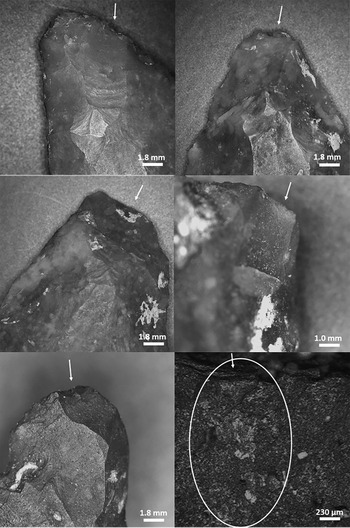
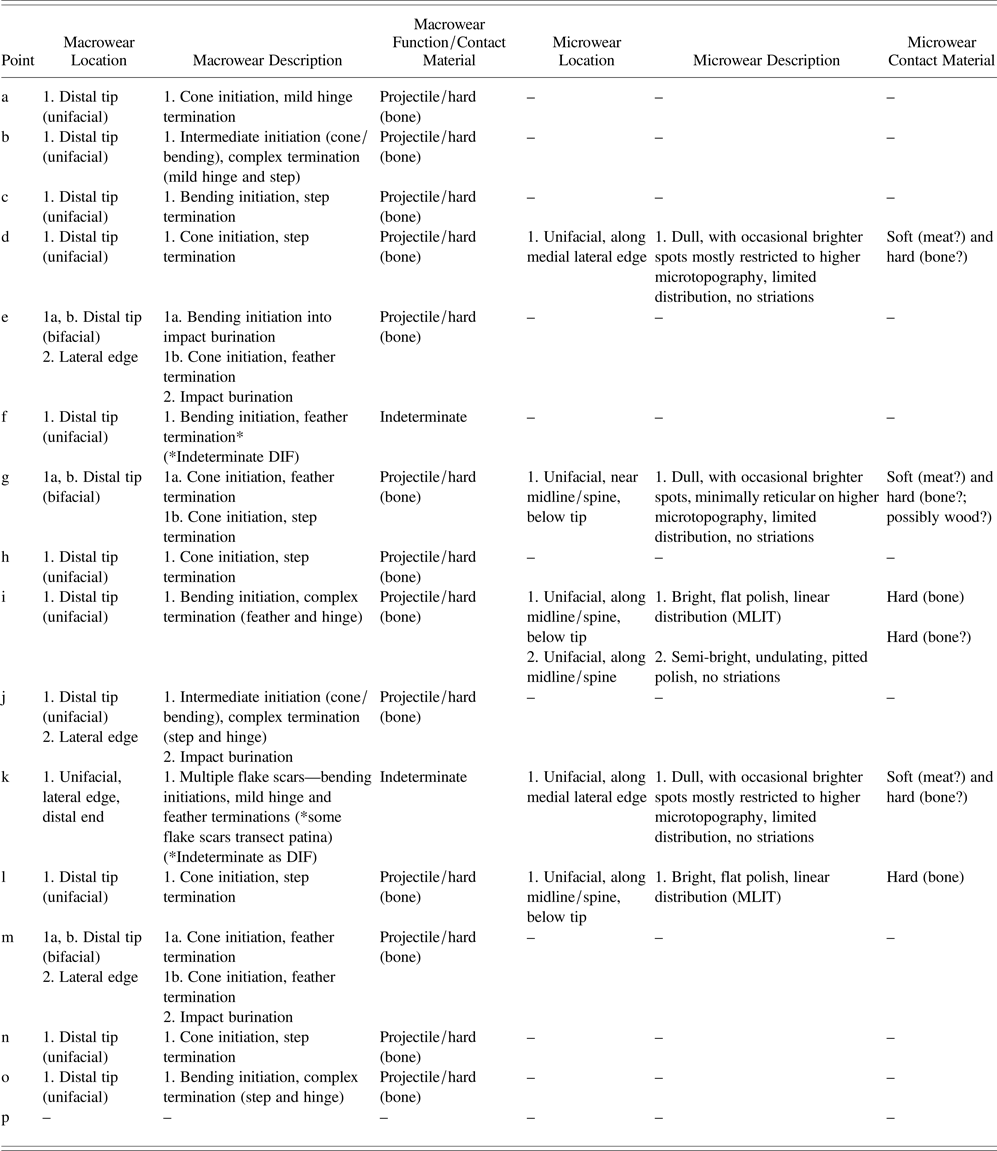
A significant number (13 of 16 or 81.3 percent) of the chert bifaces possessed macrowear consisting of one or more DIFs consistent with projectile impact and two points had microwear in the form of MLITs consistent with use as projectiles (Figures 4 and 5, Table 2). Only one biface had microwear on its lateral edge that was consistent with contact with a hard material, possibly bone (Keeley Reference Keeley1980:43; Stemp Reference Stemp2001:131–132), and three others possessed weak microwear polish either on a lateral edge or along the midline of the biface that was indeterminate in terms of identifying contact material. It is possible that these points with minimal wear development contacted soft tissue and possibly bone as projectiles. Even the biface (biface p) with no observable damage might have been used. Specifically, if it was a projectile point that only struck soft tissue (hide, skin, fat, or muscle), but not bone, then it is highly likely that no DIFs, MLITs, or other obvious use-related damage would be produced. Importantly, no use-related wear was found for cutting, sawing, or scraping/whittling.
Diagnostic impact fracture (use-related damage) on chert bifaces from the problematic deposits: (a) chert biface h (40 × magnification), (b) chert biface b (40×), (c) chert biface c (40×), (d) chert biface d (100×), and (e) chert biface e (40×). (f) Microscopic linear impact trace on chert biface i (200×). Photomicrographs by Stemp.

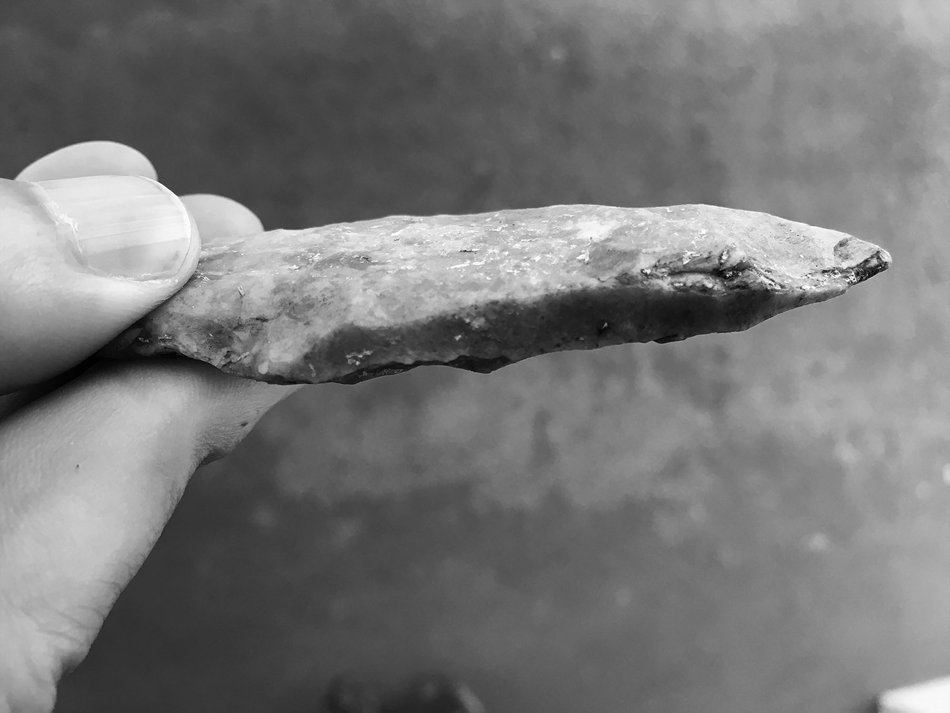
Example of a diagnostic impact fracture, specifically an impact-related burination along the lateral edge of chert biface j from the problematic deposits. Photograph by Stemp.

Summary of use-wear on the 16 chert bifaces from the problematic deposits from Plaza A, Cahal Pech, Belize. DIF, diagnostic impact fracture; MLIT, microscopic linear impact trace.

Symbolism/Ideology
The whole bifaces used as projectile points recovered in separate groups of seven and nine in the problematic deposits in Plaza A may be ideologically significant, if they were deposited together at the same time. As with all symbolic interpretations, however, this is difficult to confirm with absolute certainty. Nevertheless, there are multiple examples from Maya archaeology in which specific numbers have been considered symbolically meaningful by archaeologists. For example, Mathews and Garber (Reference Mathews and Garber2004:Figure 4) argued that nine chert flakes from a cache deposit at Blackman Eddy, Belize, are symbolic of the nine layers of the Underworld. Hruby (Reference Hruby2006:299, Figure 7.13) also reported nine obsidian eccentrics from two caches at Piedras Negras, Guatemala. Moreover, at Seibal, Guatemala, the 13 obsidian blades and blade segments included in Burial 104 were considered significant by Aoyama (Reference Aoyama, Levine and Carballo2014:151, Figure 5.10; Aoyama et al. Reference Aoyama, Inomata, Triadan, Pinzón, Palomo, MacLellan and Sharpe2017:416) for their relation to the 13 divisions of the Upperworld or the numbered coefficients of the Tzolk'in calendar.
Both seven and nine are believed to be symbolically connected to the Otherworld where the deities and ancestors reside. Nine Place and Seven-Black-Yellow Place are interpreted as two sacred locations in the Otherworld and are connected to concepts of portals that provided access for mortals (Freidel et al. Reference Freidel, Schele and Parker1993:269, 307, 372; Schele and Mathews Reference Schele and Matthews1998:99, 166, 350). Freidel et al. (Reference Freidel, Schele and Parker1993:307) further state that the Nine Place and Seven-Black-Yellow Place “glyphs, along with the old gods who hold up the bone throne, tell us that the power of war comes from the Otherworld.” As such, weapons of war would have been suitable offerings to Otherworld denizens. Associations with hunting are also plausible. The seventh day name (Manik’) in the Tzolk'in is represented by the glyph for deer (Miller and Taube Reference Miller and Taube1993:75), which is also the sign of the Lord of the Hunt. Deer were not only important for the elite in terms of diet, they have also been ideologically linked to fertility and life-renewal ceremonies (Brown Reference Brown2005; Emery Reference Emery, Jones O'Day, Van Neer and Ervynck2004; Pohl Reference Pohl, Leventhal and Kolata1983). Coincidentally, deer remains are among the most common faunal material recovered in the peri-abandonment deposits at Cahal Pech and in the Belize Valley in general (Burke et al. Reference Burke, Tappan, Wisner, Hoggarth and Awe2020).
DISCUSSION AND CONCLUSION
The two most important aspects of the bifaces discussed in this paper are: (1) they are whole, with one exception, and (2) most, possibly all, were used as projectiles. That they were most likely used for the same task prior to deposition suggests that they were not random points thrown into the deposit, nor were they points made specifically for deposition without having been used (see Barrett Reference Barrett2004). We believe the reason for their inclusion in the problematic deposits is specifically because they were “successfully” used as projectile points, meaning that they struck and/or killed their targets.
These chert bifaces do not appear to represent midden refuse given that only one of the sixteen (6.3 percent) is broken. One would expect more of these bifaces to be fragmentary if disposed of in a garbage dump. Although some of the other artifacts in the deposits are fragmentary, the types recovered have been argued to be very similar to those from similar deposits at many sites throughout western Belize (Awe et al. Reference Awe, Helmke, Aimers, Ebert, Stemp and Hoggarth2020). This suggests that the kinds of artifacts in problematic or peri-abandonment deposits were deliberately chosen for deposition following some consistent cultural rules observed by many Maya around the Terminal Classic. Moreover, most of the artifacts, including the bifaces, were found in deposits above a thin layer of soil that separated them from the plastered surface of the plaza, suggesting they accumulated following site abandonment. This thin layer of soil separating the deposits from the plaza floor also argues against rapid abandonment given the time necessary for the soil layer to naturally form.
Although most of the bifaces possess usewear consistent with projectile weapons, there is little in the way of other evidence for warfare in Plaza A, such as significant burning, damage to or defacement of buildings, or additional defensive features (Aoyama Reference Aoyama1999, Reference Aoyama2009; Chase and Chase Reference Chase, Chase, Kathryn Brown and Stanton2003; Demarest et al. Reference Demarest, O'Mansky, Wolley, Van Tuerenhout, Inomata, Palka and Escobedo1997; Inomata Reference Inomata, Inomata and Webb2003; Inomata and Stiver Reference Inomata and Stiver1998). Although some other lithic artifacts were recovered in the problematic deposits, few likely served as weapons based on typological evidence. Most of the other lithics consist of flake debitage. If warfare occurred in Plaza A, many more biface fragments of various forms of weaponry (i.e., arrows, spearthrower darts, or spears) would be expected (Aoyama Reference Aoyama2005:297, Reference Aoyama2009:127, Figure 6.7; Demarest et al. Reference Demarest, O'Mansky, Wolley, Van Tuerenhout, Inomata, Palka and Escobedo1997). Moreover, other types of weapons, like ground stone mace heads, were not recovered (Chase and Chase Reference Chase, Chase, Kathryn Brown and Stanton2003:181).
It is also unlikely that these bifaces are the result of desecratory termination. Despite the recovery of other broken artifacts, some human bone, and some evidence for burning, which might initially be interpreted as resulting from desecration, the fact that the architecture within Plaza A was not deliberately damaged/defaced seems to argue against the deposits being the result of desecration. Some of the architecture has collapsed, and the materials from the problematic deposit were found above and in between the cut stones that once formed part of Structures A2 and A3 (Awe et al. Reference Awe, Helmke, Aimers, Ebert, Stemp and Hoggarth2020). Maybe the fact that these bifaces were used as weapons could be associated with the “killing” of the buildings or the space in Plaza A as a symbolic form of termination, but this is difficult to substantiate given the contextual clues indicating collapsed architecture prior to deposit formation. The fact that most of these bifaces were not broken argues against the “killing” or the termination of the artifacts themselves to release their life-force (Jackson Reference Jackson2017:592; Walker Reference Walker and Mock1998), as may be the case for other artifacts in the problematic deposits.
We believe the 16 chert bifaces were most likely deposited as an intentional act along with other symbolically meaningful offerings. It may be that the points were still attached to their shafts when placed in the deposits, but the wood and binding materials have not survived. Selection and deposition of whole chert bifaces in ritually significant locations has been documented at Blue Creek, Belize, the Cenote of Sacrifice at Chichen Itza, Mexico, at Aguateca, Guatemala, and in several caves in western Belize (Aoyama Reference Aoyama2009; Barrett Reference Barrett2004; Coggins Reference Coggins1992; Peterson Reference Peterson2006; Sheets Reference Sheets, Hester and Shafer1991). Like the bifaces from the Plaza A problematic deposits, use-related wear on some bifaces from the Sacred Cenote at Chichen Itza indicates their use as weapons for projection (piercing) and cutting with the most common contact materials identified as hard unspecified, bone, soft unspecified, meat/animals, and stone (Sievert Reference Sievert1992:85–86, Tables 9.6 and 9.7). The sixteen bifaces might be similar to a cache of seven chert bifacial points (Aoyama Reference Aoyama2009:118–119, Table 5.18, Figure 5.52) found in the topsoil of the Stela Grieta at Barranca Escondida, Aguateca. Six of the seven points were complete and Aoyama (Reference Aoyama2009:118, 198, Appendix D, Table D73) identified the points as weapons based on usewear and posited that these artifacts may have been used in the a.d. 810 battle at Aguateca and then placed in the shallow cache as a dedication by the invaders or the inhabitants.
The 16 bifaces from the problematic deposits were used for either hunting or fighting, but we cannot assign a specific function based solely on their styles, metrics, or use-related wear (Chase and Chase Reference Chase, Chase, Kathryn Brown and Stanton2003:180). These stone points may have been left as offerings to denizens of the Otherworld as thanks for successful hunts (Brown Reference Brown2005; Tozzer Reference Tozzer1907:61) or in anticipation of success in this endeavor. As we noted above, recent analysis of the animal remains from the problematic deposits identified white-tailed deer as the dominant species. If the bifaces were fighting weapons, then they may have been the weapons of the victors that were offered in gratitude to the supernatural, rather than evidence for warfare in the plaza itself. We believe the bifaces represent one of many different kinds of offerings made by Maya visitors to Plaza A in the Terminal Classic. We believe the Maya perception of the meaning or the “power” of the location itself is what drew the objects in the problematic deposits together as deliberate offerings to supernatural entities or ancestors. The connection between this place and deified ancestors, or the supernatural, may explain why the whole used chert bifaces occur in the symbolically important quantities of seven and nine.
It is equally important to note that the bifaces, and Plaza A deposits in general, did not occur in isolation at the site. Awe et al. (Reference Awe, Helmke, Aimers, Ebert, Stemp and Hoggarth2020) describe several other peri-abandonment deposits, and evidence for additional cultural activity, in several other loci in the Cahal Pech site-core, and at other sites in western Belize. These other deposits contain similar types of artifacts to those found in the Plaza A deposits. Other types of related and contemporaneous activities include intrusive burials in buildings that were falling into disrepair. One example of the latter is the child burial discovered in Structure A3. The fragments of human remains, and the spindle whorls found in association with the bifaces, also have ritual associations. In Chiapas, for example, the Lacandon still leave fragments of human remains “arranged on the ground between the piles of bowls and god pots” at sacred landscapes (McGee Reference McGee1990:57). Brown (Reference Brown2002:241) reports a similar practice in highland Guatemala where “exhumed and re-interred human remains” are often placed in ritual deposits at shrine sites. In the case of spindle whorls, these very utilitarian implements are also imbued with considerable symbolic significance when discovered in sacred contexts. At Balankanche Cave, for example, 25 spindle whorls and 232 miniature manos and metates were discovered in a large chamber (Andrews Reference Andrews1970:45–52). Their presence in western Belize cave sites is also well known (Morehart Reference Morehart2002). What is perhaps less known is that Maya believe that rain clouds are “formed in caves from cotton spun by the daughters of the mountain gods (Stemp et al. Reference Stemp, Peuramaki-Brown and Awe2019; Vogt and Stuart Reference Vogt, Stuart, Brady and Prufer2005:177). Like the spindle whorls and fragments of human remains, therefore, our discovery of chert bifaces in the peri-abandonment deposits at Cahal Pech may be more closely associated with ritual activity than with other mundane events.
With more detailed analyses of lithic artifacts from problematic deposits, a better understanding of their reasons for inclusion in these locations will undoubtedly develop. We believe that an important reason for their inclusion in the deposits in Plaza A at Cahal Pech is that the bifaces were used. As such, determining whether stone tools were used or not may be critical to specific interpretations about lithic artifacts recovered from ritually significant deposits. Usewear analysis provides a means to comment on the functions of individual tools, potentially clarifying why the use of a particular type of tool mattered to the Maya when determining appropriate offerings. In this instance, a projectile point used successfully may have been the appropriate offering, whereas one that had not been used would not. Key to interpreting function based on usewear and the connection to ritual activity is reliable contextual information, which requires the careful excavation of problematic deposits.
RESUMEN
Los depósitos problemáticos son conjuntos que contienen diferentes tipos de artefactos y, algunas veces, restos humanos y faunísticos y que se recuperan típicamente en o cerca de las superficies de la fase terminal de la arquitectura cívica-ceremonial de élite en los antiguos sitios mayas. Estos contextos se datan frecuentemente para el periodo clásico terminal (~750–900 d.C.). Han sido interpretados ya sea como evidencia de abandono de un sitio, reocupaciones, guerra, rituales de dedicación o rituales de terminación. Los dieciséis bifaciales de sílex discutidos en este trabajo fueron recuperados de depósitos problemáticos en las bases de las Estructuras A2 y A3 en una plaza elite en el sitio de Cahal Pech, Belice. Artefactos de sílex en estos depósitos muy raramente se discuten en gran detalle. Con base en análisis estilísticos, métricas y de huellas de uso, se puede decir que estos artefactos fueron localmente producidos, usados durante importantes actividades de guerra o caza y subsecuentemente depositados durante algún tipo de evento ritual en la base de estas estructuras en el clásico terminal. Estos bifaciales fueron probablemente enmangados para ser usados como puntas de lanza y son representativos del “éxito” en la casa o pelea. La recuperación de armamentos en depósitos problemáticos que no es el resultado directo de la guerra es una observación importante dada la tendencia general para interpretar la presencia de proyectiles en depósitos problemáticos del periodo clásico terminal como evidencia de guerra. El hecho que estas puntas fueran recuperadas en grupos de siete y nueve podría indicar que tuvieron importantes significados simbólicos para los mayas que los conectaron a entidades o lugares sobrenaturales o mitológicas.
ACKNOWLEDGMENTS
Investigation of Plaza A at Cahal Pech was conducted by BVAR in conjunction with the Tourism Development Project of the Belize Ministry of Tourism and Culture. Additional funding for our investigations were provided from several sources including the National Science Foundation, the Social Sciences and Humanities Research Council of Canada, the Gordon Childe Fund of the University of London, and the Tilden Family Foundation. We would like to thank the Belize Institute of Archaeology for their continued support of our work at Cahal Pech, and Dr. Carolyn Audet, and Juan Luis Bonor for supervising the excavations in the plaza.