Healthcare-associated infections (HAIs) due to multidrug-resistant organisms (MDRO) are a threat to the US healthcare system. 1 The 1.4 million persons residing in nursing homes in the United States are an important consideration when evaluating HAIs and MDRO epidemiology. 2 , Reference Slayton, Toth and Lee 3 Nursing home residents are increasingly recognized as potential vectors of MDRO transmission.Reference Huang, Septimus and Kleinman 4 In addition, carbapenem-resistant Enterobacteriaceae (CRE) are a particular threat to the US healthcare system, 1 and there is increasing evidence that long-term care is associated with CRE colonization.Reference Slayton, Toth and Lee 3 Nursing home residents may be MDRO colonized;Reference Bonomo 5 however, prior investigations have predominantly focused on MRSA and on specific populations, such as those with dementia, and were conducted prior to emergence of CRE.Reference Murphy, Quan and Kim 6 , Reference Mitchell, Shaffer and Loeb 7 An assessment of MDRO colonization, including multiple MDROs and risk-factor assessment is important to understanding the scope of MDRO colonization. The main purposes of this investigation were (1) to evaluate the colonization prevalence of common and emerging MDROs, including methicillin-resistant Staphylococcus aureus (MRSA), vancomycin-resistant Enterococcus spp. (VRE), extended-spectrum β-lactamase–producing Enterobacteriaceae (ESBL), and CRE, and (2) to define resident characteristics associated with colonization.
METHODS
We conducted a serial point-prevalence study of MDRO colonization at 3 nursing homes in southern California. We conducted 6 point-prevalence samplings of 50 residents each at least 2 weeks apart at each facility from June through August 2015. Residents were selected by randomly sampling occupied beds at each facility. Residents under hospice care were excluded. If patients refused swabbing, we continued to randomly select participants until 50 residents had been swabbed. Residents could be sampled more than once if they remained in the facility over multiple surveillance periods. Combined axilla/groin swabs were assessed for MRSA, VRE, ESBL, and CRE, and bilateral nares swabs were assessed for MRSA. All swabs (BD BBL CultureSwab, Becton Dickinson, San Jose, CA) were processed within 6 hours of sampling. To screen for MDROs, we utilized Spectra MRSA chromogenic agar (Thermo Scientific, Waltham, MA) for MRSA, Campylobacter agar (BD BBL, Becton Dickson, Sparks, Maryland) with 10% sheep blood with vancomycin 10 µg, cephalothin 15 µg, trimethoprim 5 µg, polymyxin-B 2.5 units, amphotercin-B 2 µg for VRE, MacConkey agar (BD BBL, Becton Dickson, Sparks, Maryland) with a 2 µg cefpodoxime disk (BD BBL, Becton Dickson, Sparks, Maryland) for ESBL organisms, and MacConkey agar with a 2 µg meropenem disk (BD BBL, Becton Dickson, Sparks, Maryland) for CRE. Isolates on Spectra chromatic agar that were the typical denim blue color were not further confirmed. The identification of Enterococci isolated on Campylobacter agar was verified by matrix-assisted laser desorption ionization time-of-flight mass spectroscopy (MALDI-TOF-MS) using VITEK MS from BioMerieux (Durham, North Carolina). Vancomycin resistance was not confirmed because we have previously demonstrated the ability of this agar to detect VRE.Reference Shigei, Tan, Shiao, de la Maza and Peterson 8 MRSA isolates identified by the initial ESBL screen were further confirmed using MALDI-TOF-MS and the presence of an ESBL was confirmed by phenotypic testing using cefotaxime and ceftazidime with and without clavulanic acid. Isolates identified as a CRE in the initial screening were further identified by MALDI-TOF-MS and disk diffusion using meropenem. If needed due to a questionable result, the disk diffusion was repeated using meropenem, ertapenem, imipenem, and/or doripenem.
Resident characteristics were collected from the medical record using a standardized form. Medical devices (eg, central lines, urinary catheters, and other devices) were recorded by direct observation of the resident during surveillance. Additional variables included gender, MDRO history, total care requirement (bed bound), non-lucidity, incontinence, and presence of selected comorbidities (eg, diabetes, hemodialysis).
We conducted bivariate analyses using χ2 tests to evaluate the association of each characteristic with each MDRO outcome (MRSA, VRE, ESBL, CRE, and any MDRO). Variables were entered into multivariate logistic regression models using a criterion for entry of 0.1 and retained at α<0.05 based upon clinical relevance of the variables. Adjustments were made for repeated measures by generalized linear mixed models for analysis of resident characteristics. Statistical analyses were conducted using SAS version 9.3 (SAS Institute, Cary, NC). This study was approved by the University of California–Irvine and Providence Little Company of Mary Medical Center institutional review boards.
RESULTS
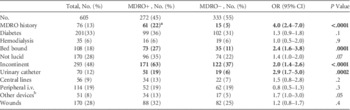
A total of 1,800 swabs were obtained from 605 residents: 82 patients were swabbed twice, 37 patients were swabbed 3 times, and 40 patients were swabbed ≥4 times. Resident characteristics are presented in Table 1. Overall, 45% (n=272) of residents were found to harbor ≥1 MDRO. MRSA was noted in 26% of residents (n=160): 20% of residents (n=121) in the nares, and 18% of residents (n=108) on the skin. Skin-only MRSA colonization was detected in 39 patients. ESBL colonization was found in 17% of residents (n=100); VRE was detected in 16% of residents (n=99); and CRE was detected in 1% of residents (n=5). Multiple MDRO colonization was detected: 12% of residents had 2 MDROs (n=70), and 2% of residents harbored 3 MDROs (n=11).
Patient Factors Associated with Any MDRO Colonization, Bivariate Analysis

NOTE. MDRO, multidrug-resistant organism; i.v., intravenous administration device.
a Bold font indicates statistical significance.
b Such as nasogastric tube, G-tube, J-tube, or surgical drains.
MDRO colonization differed by facility. MDRO colonization prevalence rates at Facility 1 were assessed as follows: any MDRO, 46% (n=138; range, 34%–60% during the 6 week surveillance period); MRSA, 38% (n=113; range, 28%–40%); VRE, 7% (n=22; range, 0%–16%); ESBL, 11% (n=33; range, 6%–18%); and CRE, not detected. MDRO colonization prevalence rates at Facility 2 were assessed as follows : any MDRO, 34% (n=102; range, 28%–48%); MRSA, 15% (n=45; range, 6%–22%); VRE, 19% (n=56; range, 10%–36%); ESBL, 8% (n=25; range, 6%–22%); and CRE, not detected. MDRO colonization prevalence rates at Facility 3 were assessed as follows : any MDRO, 57% (n=171; range, 48%–68%); MRSA, 34% (n=101; range, 30%–38%); VRE, 11% (n=33; range, 8%–16%); ESBL, 28% (n=83; range, 18%–36%); and CRE 2% (n=6; range, 0–4%).
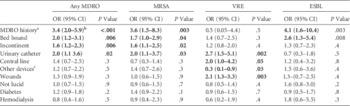
Patient characteristics are presented overall and stratified by any MDRO colonization (Table 1). Multivariate results are summarized in Table 2. Factors associated with CRE were not assessed due to low prevalence. Factors associated with any MDRO colonization included MDRO history, bed-bound status, incontinence, and urinary catheter. Similar factors were associated with MRSA and ESBL, although VRE colonization was associated with urinary catheters, central venous catheters, and wounds (Table 2).
Multivariate Logistic Regression for Factors Associated with Any MDRO, MRSA, VRE, and ESBL Colonization

NOTE. MDRO, multidrug-resistant organism; MRSA, methicillin-resistant Staphylococcus aureus; VRE, vancomycin-resistant Enterococci; ESBL, extended-spectrum β-lactamase–producing Enterobacteriaceae.
a Reflects history of the outcome MDRO.
b Bold font indicates statistical significance.
c Such as nasogastric tube, G-tube, J-tube, or surgical drains.
DISCUSSION
The burden and predictors of MDRO colonization in nursing homes remains poorly understood despite several studies suggesting that nursing home residents are at high risk for colonizationReference Bonomo 5 , Reference Murphy, Quan and Kim 6 and MDRO acquisition.Reference Slayton, Toth and Lee 3 – Reference Bonomo 5 , Reference Mitchell, Shaffer and Loeb 7 Evidence on MDRO prevalence and factors associated with MDRO colonization may help fuel much-needed strategies for infection prevention in nursing homes.Reference Smith, Bennett and Bradley 9
In a systematic assessment of 4 key MDROs in nursing home residents, colonization was common and exceeded colonization prevalence seen in acute-care hospitals, including intensive care units (ICUs).Reference Bonomo 5 , Reference Weintrob, Roediger and Barber 10 , Reference McKinnell, Huang, Eells, Cui and Miller 11 Not surprisingly, the burden of MRSA colonization was consistently high among all 3 facilities. Nares remained the dominant reservoir, raising important questions for nasal decolonization. Nares surveillance alone would have missed 24% of MRSA carriers (n=39) who were colonized only on the skin. The importance of non-nares testing for MRSA colonization has been previously notedReference McKinnell, Huang, Eells, Cui and Miller 11 and may be relevant for surveillance and infection control programs. VRE and ESBL colonization were prevalent in all 3 facilities, reinforcing the notion that nursing home patients are important MDRO reservoirs.Reference Slayton, Toth and Lee 3 – Reference Bonomo 5 CRE was seen in only 1 center, with only a 2% prevalence at that facility based on skin swabs alone.
Resident variables independently associated with any MDRO colonization included history of MDRO, bedbound status, urinary or fecal incontinence, and presence of an indwelling urinary catheter. The association of MDRO colonization with MDRO history was not surprising.Reference Bonomo 5 Our finding that patients with diminished functional status are at higher risk for MDRO colonization may prove helpful for targeted infection control interventions. It is reassuring that residents able to independently conduct their activities of daily living may be least likely to harbor transmissible pathogens. Previous hospitalization in an acute-care hospital and previous antimicrobial therapy have been previously associated with MDRO carriage and infection, but these variables were not included in our investigation.Reference Bonomo 5 While our observations may help identify patients at higher risk for MDRO colonization, the overall burden of MDROs is sufficiently high that universal approaches may be required as part of prevention efforts.
Our study is limited in that we tracked colonization, not subsequent infections. Nevertheless, MDRO colonization is a known risk factor for infection.Reference Bonomo 5 Future studies may wish to examine relationships between colonization and clinical infections with MDROs, antibiotic utilization, and hospital readmissions. Another limitation is that we did not conduct concomitant rectal surveillance for enteric MDROs. Thus, our measured prevalence of VRE, ESBL, and CRE may be underestimates. We performed a 1-time rectal surveillance (n=179) at 2 facilities and results did not differ markedly from our measured rates: MRSA, 17% rectal versus 28% multi-site swab; VRE, 9% rectal versus 12% multi-site swab; ESBL, 23% rectal versus 16% multi-site swab; and CRE, 2% rectal versus 1% multi-site swab. We do not know whether rectal surveillance identified the same or different carriers than our skin swabs due to de-identification of swabs at the time of collection. Future investigations may consider systematic rectal surveillance, if feasible.
In summary, MDRO colonization prevalence within nursing homes is very high, and these rates exceed published reports from other clinical care settings. Residents with total care needs and devices are at higher risk for MDRO colonization. The high burden of MDRO pathogens within the nursing home population strongly suggests that effective and practical infection prevention strategies are needed to protect the safety of this vulnerable population from MDRO acquisition and infection.
ACKNOWLEDGMENTS
We would like to acknowledge the efforts of our collaborating institutions, including Coventry Court Health Center (Shaun D. Dahl, NHA, MBA; Linda Budy, RN; Jeff DeGuzman, LVN), Fountain Care Center (Geovanny Fino, NHA), and Providence Little Company of Mary Transitional Care Center (Elva Sipin, NHA; Fe Mendez, RN; Cecile Chantrapornlert, RN; Cielito Franco, RN; Patricia Camacho, RN; Rommel Luzadas, RN; Jocelyn Moore, RN; Magie Fonacier, RN; Madonna Malixi, RN; Chita Romero, RN). We also appreciate the guidance and support of Richard Platt and the CDC Prevention Epicenter and Project Protect Steering Committee members.
Financial support: The project was sponsored through the CDC epicenters program (grant no. RFA-CK-11-0010501SUPP15 to S. Huang).
Potential conflicts of interest: S.H., R.S., K.K., T.D., L.H., A.G., M.E., and T.T. conduct clinical studies and trials in which participating hospitals and nursing homes receive contributed products from Sage Products, Molnlycke, 3M, and Clorox. J.M., L.M., E.P., K.E., and S.T. conduct clinical studies and trials in which participating hospitals and nursing homes receive contributed products from Sage Products, 3M, and Clorox.