I. INTRODUCTION
During the last two decades, the development of nanoporous carbon membranes (NCMs) has been rapidly increasing owing to their excellent gas permeation, thermal resistance, and chemical inertness. Reference Ismail, Rana, Matsuura and Foley1 NCMs have a wide range of potential applications, such as gas separation, membrane reactors, ultrafiltration, sensors, fuel cells, and so on. Reference Gogotsi, Nikitin, Ye, Zhou, Fischer, Yi, Foley and Barsoum2–Reference Jiang, Klauda and Sandler5 However, NCMs are still limited in bench-scale due to the restriction of several unresolved issues. The first and most important issue is how to reduce the production cost to compete with traditional membrane materials in the market. Reference Paul6,Reference Buonomenna, Yave and Golemme7 To attain it, one has to develop cheap precursor, or to remarkably improve the separation performance, to compensate for the production cost of NCMs. Up to now, a lot of precursors have been developed to prepare NCMs, including polyimide, phenolic resin (PR) and its derivatives (e.g., resorcinol–formaldehyde (RF)), polyfurfuryl alcohol, polyphenylene oxide, poly(vinylidene chloride-co-vinyl chloride), polypyrrolone, poly(phthalazinone ether sulfone ketone), etc. Among them, PR or RF is one type of inexpensive polymers with suitable features, such as high char yield and thermal stability, to be applied as NCMs. Reference Tin, Xiao and Chung8,Reference Salleh, Ismail, Matsuura and Abdullah9 Nevertheless, in recent years, PR (or RF) has not received much interest from membrane researchers. The reason lies in two aspects: (a) Poor membrane-forming ability of PR making it difficult to prepare defect-free carbon membranes; and (b) low permeability of the as-prepared carbon membranes resulting in unappealing for an industrial concern. Therefore, some modification methods, e.g., composition, have been applied in the preparation of PR- or RF-based NCMs. Reference Katsaros, Steriotis, Romanos, Konstantakou, Stubos and Kanellopoulos10–Reference Dong, Nakao, Nishiyama, Egashira and Ueyama12 For the composition method, a large variety of additives, such as zeolite, silica, porous carbon, polyethylene glycol, polyvinylpyrrolidone, cationic tertiary amines, and metals and their derivatives, can be adopted to modify the gas permeation property of NCMs. Reference Dong, Nakao, Nishiyama, Egashira and Ueyama12–Reference Hosseini and Chung20 However, in the case of PR, only thermal labile organic additives with good membrane-forming property seem to be practicable to produce NCMs. Reference Dong, Nakao, Nishiyama, Egashira and Ueyama12,Reference Zhang, Hu, Zhu and Zhu19 In addition, mechanical blending in common use intends to form porous aggregates in the matrix due to heterogeneous dispersion of a pore-forming agent during the formation of the membrane solution, which is adverse to the separation performance of NCMs.
Recently, some amphiphilic block copolymers, e.g., Pluronic F-127, have been frequently used as ideal additives to fabricate porous carbon materials. Pluronic F-127 is a kind of nonionic and surfactant polyol, which can facilitate the solubilization and dispersion of PR so as to form a uniform assembly structure. If F-127 were used as a co-precursor, a large amount of porosity would also be created in the resultant carbon materials by nearly complete decomposition from matrix during pyrolysis as shown in the following references. Liang et al. prepared a large-sized carbon film from RF resin blending with the block copolymer PS-P4VP. Reference Liang, Hong, Guiochon, Mays and Dai21 Song et al. utilized the assembly of a phenolic oligomer and a triblock copolymer F-127 in the preparation of NCMs. Reference Song, Feng, Fredin, Yager, Jones, Wu, Zhao and Vogt22 Kataoka et al. developed a formaldehyde vapor filtration method to produce NCMs from resorcinol and F-127 on the silica matrix surface. Reference Kataoka, Yamamoto, Inagi, Endo, Nakaiwa and Ohmori23 Nevertheless, so far only one report has ever mentioned the gas permeation behavior of F-127-based NCMs, which is governed by Knudsen diffusion mechanism for nitrogen. Reference Tanaka, Nakatani, Doi and Miyake24 This is by far the requirement for gas separation application.
In our previous work, an ideal O2/N2 selectivity of 3.3 was attained for NCMs that were prepared from RF resin blending with F-127 in the presence of HCl as catalyst. Reference Zhang, Shi, Wu, Wang and Qiu25 However, the thermoplastic property for RF resin made from catalyst HCl is detrimental to preserve the porosity in NCMs because of the occurrence of an undesired melting phase during pyrolysis. Here, we made an attempt to prepare NCMs from thermosetting RF resin blended with F-127 in the presence of a basic catalyst. The motivations of this work lie in: (1) Confirming the feasibility of F-127 for the additional contribution to porosity in the membrane matrix; and (2) investigating the effect of the catalyst type on the structure of RF resin/F-127-based NCMs.
II. EXPERIMENTAL
A. Materials
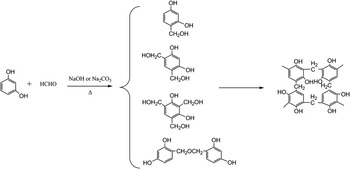
The starting material, RF resin, was synthesized by the polymerization of resorcinol (R) and formaldehyde (F) by catalyzing with NaOH or Na2CO3. The schematic diagram of this reaction mechanism is shown in Fig. 1. Reference Liu, Lei, Guo and Deng26 The polycondensation reaction of resorcinol and formaldehyde involves two main subreactions: Electrophilic addition and dehydration condensation. Under basic conditions, resorcinol reacts with formaldehyde to produce methylol compounds such as monomethylol resorcinol and dimethylol resorcinol. Reference ElKhatat and Al-Muhtaseb27 After the formation of methylol compounds, the condensation of derived dimers would be crosslinked and lead to form a 3D-network structure in the membrane matrix.
Mechanism for the formation route of RF resin by basic catalyst.

An aqueous formalin (38% formaldehyde in volume fraction), resorcinol, and ethanol with analytical grade were used as reactant F, R, and solvent, respectively. An amphiphilic ethylene oxide/propylene oxide block copolymer Sigma-Pluronic F-127 (EO106PO70EO106, M w = 12,600) was used as a pore-forming agent to blend with RF resin during polymerization.
B. Preparation of NCMs
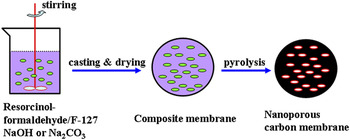
The flowchart for the fabrication of NCMs is illustrated in Fig. 2. A brown RF solution was first formed by dropping 4.4 g formalin containing 1.25 mmol NaOH (or 0.66 mmol Na2CO3) into 33 g R/ethanol (6.25 wt%) solution under magnetic stirring for 60 min. Then, 22 g F-127/ethanol solution (9.1 wt%) was further added to the above RF solution at 30 °C and magnetically stirred for 90 min to accomplish assembly, with the solution color gradually shifting from brown to claret. The as-obtained solution was rested overnight to defoam naturally. The membrane-casting process was performed by pouring the solution onto a horizontal glass plate at 25 °C, kept for 24 h, followed by drying at 100 °C for 24 h to complete curing (solidification). Finally, the freestanding semitransparent polymeric membranes were obtained after removing the glass plate. The as-prepared membranes were designated as PM-NaOH and PM-Na2CO3, referring to the used NaOH and Na2CO3 catalysts, respectively.
Formation procedure of NCMs.

The resultant polymeric membranes were carefully cut into circular shape with the diameter of approximately 3 cm for subsequent pyrolysis and gas permeation measurement. Then, the polymeric membranes were placed in the center of a horizontal furnace to conduct pyrolysis. The pyrolysis program was set from ambient temperature to 600 °C (or 800 °C) at a heating rate of 1 °C/min under a flowing nitrogen atmosphere. After holding at the final temperature for 180 min, the furnace was cooled down to ambient temperature naturally. The as-obtained NCMs with the color of shining black were marked as CM-NaOH or CM-Na2CO3. In most cases, NCMs were fabricated at the pyrolysis temperature of 600 °C in this work, except for particularly specified.
C. Characterization
The thermal stability of precursors was measured by a TGA 4000 (PerkinElmer Inc.) thermogravimetric analyzer at a heating rate of 20 °C/min from 30 to 800 °C in a flowing nitrogen atmosphere. A DSC instrument (Differential Scanning Calorimeter, Mettler, DSC 822e, Im Langacher, Greifensee, Switzerland) was used to evaluate the curing behaviors of RF resins in the temperature range of 5–280 °C at a heating rate of 10 °C/min under a nitrogen purge atmosphere. The microstructural morphology of NCMs was observed by JEOL JEM-2100 transmission electron microscopy (TEM; Tokyo, Japan) at 200 kV. An XRD-7000 x-ray diffraction (XRD) analyzer from Shimadzu Company (Cu target; Kyoto, Japan) was used to investigate the carbon structure of NCMs at 40 kV and 30 mA in the diffraction angle 2 theta range of 5–60° by a step size of 0.02°. The evolution of functional groups from polymeric membrane to NCMs was monitored by Thermo Nicolet Nexus 470 attenuated total reflectance-Fourier transformed infrared (ATR-FTIR) spectroscopy in the wave number range of 4000–680 cm−1. The porous structure information of NCM samples was obtained from the adsorption isotherms of nitrogen at −196 °C by a Micromeritics ASAP 2420 accelerated surface area and porosimetry system. Prior to measurement, all samples were degassed at 300 °C for more than 6 h. The organic fractions, including carbon, hydrogen, oxygen, and nitrogen of samples, were determined with a Euro EA-3000 elemental analyzer (Leeman Labs Inc.). The entire absolute element amounts were calibrated by standard unit gram to make comparison conveniently among different samples.
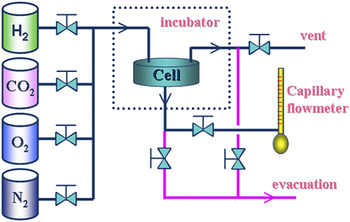
Single gas permeation for NCMs was tested by the conventional variable volume-constant pressure method. The experimental setup is schematically illustrated in Fig. 3. NCMs were sealed in a stainless steel membrane cell with glue and O-shaped gasket. During measurement, one ultrapurified gas (99.999%) directly supplied from gas cylinders, i.e., H2, CO2, O2 or N2, was introduced to the upper side of the membrane cell. The permeation process was conducted at 30 °C with the pressure difference of 0.035 MPa between the two sides of the membrane. The usage of such a low transmembrane pressure difference is due to the restriction of the fragility of NCMs. The flux of permeated gas was measured using a microflowmeter. The gas permeability was calculated according to the following equation (Eq. (1)):
 $$P = {{{\rm{Flux}}} \over {A \times {{\Delta p} \mathord{\left/ {\vphantom {{\Delta p} l}} \right. \kern-\nulldelimiterspace} l}}}\quad {\rm{,}}$$
where Δp, l, and A refer to the transmembrane pressure, the effective membrane thickness, and the permeating area, respectively.
Schematic of the experimental setup for gas permeation test.

Ideal permselectivity for gas pairs (e.g., A and B) was deduced from the ratio of their corresponding permeability, as shown in Eq. (2):
 $$\alpha = {{{P_{\rm{A}}}} \over {{P_{\rm{B}}}}}\quad {\rm{.}}$$
The detailed test procedure can be referred to our previous report. Reference Zhang, Wang, Zhang, Qiu and Jian28 To ensure good reproducibility, each of the permeation data was eventually determined by at least three replicative experiments.
III. RESULTS AND DISCUSSION
A. Thermal stability of precursors
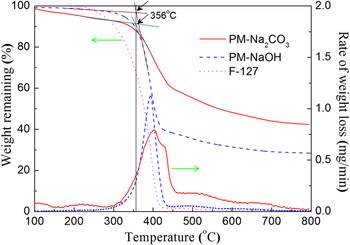
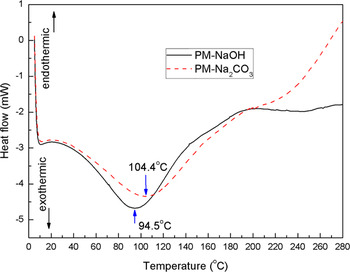
The investigation of thermal stability for precursors can give us important information on the evolution of microstructure and provide the reference program of pyrolysis to form NCMs. Figure 4 shows the curves of the thermal weight loss and derived rate for precursors PM-Na2CO3 and PM-NaOH. Usually, the thermal degradation temperatures at the weight loss percentage of 5% (Td5) and 10% (Td10) are selected as indicators to evaluate the thermal stability of polymeric materials. The Td5 and Td10 values for PM-Na2CO3 are correspondingly 220.7 and 342.3 °C, while those for PM-NaOH are correspondingly 325.3 and 353.7 °C. On the basis of those two indicators, it suggests that PM-NaOH owns higher thermal stability than PM-Na2CO3 in the early stage of pyrolysis. The larger weight loss for PM-Na2CO3 may be attributed to the removal of the remaining free resorcinol and formaldehyde formed by short of sodium carbonate catalyst that has been partly consumed for neutralizing the formic acid present in the formaldehyde. Reference Benk, Talu and Coban29 However, the weight loss order of the two precursors alters when the temperature elevates up to 362 °C. This order remains until to the final temperature of 800 °C. At this point, the char yields of PM-Na2CO3 and PM-NaOH are 42.4 and 28.5%, respectively. It is significant to determine the onset of decomposition temperature to get insight into the major degradation of molecular backbone for a polymer. As shown in Fig. 4, the onset temperatures were deduced at the intersection point of two extending linear sides of inflection in thermal degradation curves. We can see that PM-Na2CO3 and PM-NaOH almost present the same values around 356 °C, suggesting that they possess the similar main molecular structure as illustrated in Fig. 1. The difference in char yields between them can be ascribed to their molecular weight and polymerization degree. Benk et al. verified that PR produced by using a sodium carbonate catalyst probably was of higher molecular weight than that of the resins produced by using a sodium hydroxide catalyst. Reference Benk, Talu and Coban29 During the synthesis of RF resin, although higher pH value (i.e., NaOH) is favorable for the formation of methylol derivatives via the protonation of formaldehyde during the early stage of addition reaction, it would hinder the subsequent dehydration condensation reaction and consequently create a less-linked structure. Reference Job, Panariello, Marien, Crine, Pirard and Léonard30,Reference Lin and Ritter31 Thereby, the lower molecular weight and polymerization degree of PM-NaOH would result in lower char yield after pyrolysis. Reference Wei, Wang, Wang and Bai32 In this work, DSC was also applied for the two RF samples to investigate the curing behavior, as shown in Fig. 5. There is a broad exothermic peak in the temperature range of 30–200 °C for the curing process, during which methylene bridges and dibenzyl ether bridges (or the methylene bridges) are formed by the condensation of the methylol group with hydrogen of benzene ring and the condensation of two methylol groups. Reference Holopainen, Alvila, Rainio and Pakkanen33 The maximal positions of PM-NaOH and PM-Na2CO3 are correspondingly located at 94.5 and 104.4 °C, indicating that PM-NaOH can be easily cured at a low temperature. It may be ascribed to the higher molecular flexibility of PM-NaOH, owing to the lower molecular weight and polymerization degree making the molecular motion and reaction faster. Reference Munoz, Kua, Cardona and Rogers34
Thermal weight remaining and their rates of precursors.

The DSC spectra of precursors.

In summary, both of the precursor membranes undergo three thermal degradation stages. Below 300 °C, the minor weight loss is contributed by the release of adsorbed water and volatiles that is originated from the reactions of further crosslinking and solidification, hydroxymethyl with benzene, and condensation of hydrogen in benzene rings. Reference Christiansen35 The major thermal weight loss is happened to the two precursors in the temperature range of 300–450 °C. During this range, the reactions of dehydration and polycondensation occur to methyl groups and hydroxyl groups among inter- and intramolecules by releasing water. Meanwhile, the residue would condense into more stable crosslinked structure. Apart from those reactions, the nearly complete thermal decomposition of F-127 in precursor membranes can also make a great contribution to the weight loss around 400 °C, as shown in Fig. 4. Reference Xue, Tu and Zhao36–Reference Tanaka, Doi, Nakatani, Katayama and Miyake38 Thus, it was deduced that the incorporation of F-127 could unambiguously produce a large amount of additional pores in the membrane matrix of the resultant NCMs. When the temperature surpasses 450 °C, a secondary thermal weight loss appears due to the cleavage of resorcinol–formaldehyde molecules by the decomposition of methyl and dehydration of ether groups. Reference Zhou, Yoshino, Kita and Okamoto39 Eventually, the remaining matrix would gradually evolve into a porous carbon structure as the result of thermal degradation and polycondensation.
Moreover, the rate of weight loss curves could also justify the above analysis on the probable degradation behavior of the two precursors. The peak position located at 393.2 °C for PM-NaOH shifts to 405.8 °C for PM-Na2CO3. Besides, there is an additional small peak for PM-Na2CO3 ranging at 410–460 °C, which is partly overlapped by the large one. It proves that PM-Na2CO3 exhibits a little higher thermal stability than PM-NaOH during a major thermal degradation range owing to the higher molecular weight and polymerization degree of the former.
B. Evolution of functional groups
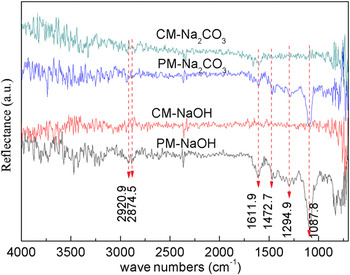
The chemical structure analysis of samples would probably give some useful clues to the catalyst effect on NCMs. As shown in Fig. 6, the FTIR spectra of the two polymeric membranes PM-NaOH and PM-Na2CO3 are almost identical, implying that they possess the similar main chemical structure. It is in good agreement with the previous conclusion from thermal degradation analysis. The reflectance bands at 2920.9 cm−1, 2874.5 cm−1, and 1472.7 cm−1 are associated with the stretching and scissoring vibrations of CH2 bonds. The bands at 1611.9 cm−1 and 3150–3384 cm−1 are assigned to the stretching vibrations of aromatic ring and OH bond, respectively. The above result reflects well the molecular structure of RF resin as shown in Fig. 1. In addition, the bands at 1294.9 cm−1 and 1087.8 cm−1 are due to the C–O–C stretching vibrations of methylene ether bridges in the crosslinking structure composed by RF resin and F-127. Reference Pekala40 It reveals that both of the catalysts have successfully synthesized RF resin. In contrast, NCM samples have more broad background in the FTIR spectra than their original polymeric membranes. The intensity for most of the reflectance bands of NCMs reduces or even disappears, except for the characteristics of aromatic rings. It implies that the initial polymer structure has been decomposed and converted into a condensed aromatic graphite-like carbon structure.
FTIR spectra of membrane samples.

C. Elemental analysis
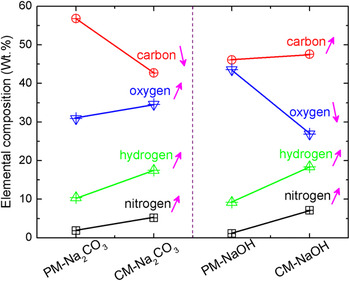
Elemental analysis could provide additional information on the evolution of microstructure from polymeric membranes to NCMs as the complementary of FTIR. As shown in Fig. 7, the composition order of the four detected organic elements for PM-Na2CO3 and PM-NaOH is: C > O > H > N, which is roughly in accordance with the molecular composition. The trace amount of N might be originated from the impurities in raw materials or preparation process. In comparison, the compositions of carbon and oxygen for PM-Na2CO3 are respectively 10% higher and 13% lower than those for PM-NaOH. When PM-Na2CO3 is converted into CM-Na2CO3, all the elemental compositions increase except for carbon. The reduction of carbon may be ascribed to the further removal of CO2 derived from the decomposition and oxygenation of catalyst Na2CO3 in the membrane. After the conversion from PM-NaOH to CM-NaOH, the compositions of carbon, hydrogen, and nitrogen increase, along with the reduction of oxygen. This oxygen reduction is due to the formation of water by consuming oxygen during pyrolysis. The different transitions of elemental compositions between the two precursors may also be caused by the variations of the char yield and crosslinking structure of them. Reference Munoz, Kua, Cardona and Rogers34 This conclusion has been evidenced by the previous thermogravimetric analysis (TGA).
Evolution of organic elemental compositions from polymeric membranes to carbon membranes.

D. Morphology observation
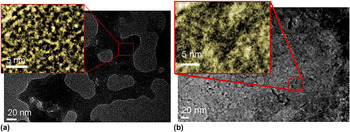
From TEM images (Fig. 8), we could easily observe the intuitive microstructural morphology of NCMs. The images show generally irregular pore networks of sizes below 1 nm in the membrane matrix. Compared with CM-NaOH, CM-Na2CO3 presents a sort of periodically ordered porous structure in some local domains. The difference in microstructure between CM-NaOH and CM-Na2CO3 might be related to the assembly structure of RF resin with F-127 and the thermal stability of their precursors. As has been discussed in previous TGA, the higher char yield of PM-Na2CO3 will deservedly lead to smaller shrinkage of resultant CM-Na2CO3 by maintaining the preformed assembly and crosslinking structure to a large degree. Therefore, CM-Na2CO3 possesses more ordered porous structure by preserving more preorganized well-ordered interpenetrating polymer networks.
TEM images of NCM samples. (a) CM-Na2CO3 and (b) CM-NaOH.

Nevertheless, the regularity of porous texture for present NCMs is inferior to typical ordered mesoporous carbons in the literature. Reference Lu, Kiefer and Schmidt41–Reference Fuertes43 This could be ascribed to the collapse of the preformed regular porous architecture after pyrolysis at such high temperature. This justifies the difficulty in the production of ordered NCMs due to the remarkable shrinkage of membrane parallel to the substrate during heat treatment, leading to the deformation of thin pore wall. Reference Tanaka, Nishiyama, Egashira and Ueyama44
E. Analysis of carbon structure
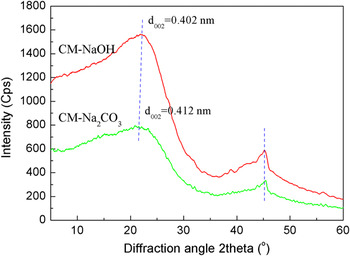
XRD is a powerful tool to characterize the microstructure of carbon materials. In Fig. 9, typical broad diffraction profiles for amorphous carbon could be found in two patterns. This is compatible with the observation from TEM. The diffraction angles of (002) plane located at the peak position of 21.5° for CM-Na2CO3 and 22.1° for CM-NaOH, from which the interlayer distance d 002 values are respectively calculated as 0.412 and 0.402 nm on the basis of well-known Bragg's equation. The present two d 002 values are much higher than 0.365 nm for pure PR-based carbon membranes in Zhang's report. Reference Zhang, Hu, Zhu and Zhu45 It suggests that the microstructure of present NCMs is less compact due to the creation of additional porosity by F-127. Judged by the indicative of d 002, CM-NaOH possesses higher degree of graphitization than CM-Na2CO3. This is in good agreement with the results of previous elemental analysis and TEM observation. Besides, the (110) or (100) diffraction peak of CM-NaOH positioning around 45° is more intense and symmetric than that of CM-Na2CO3, approving the claims on the microstructural difference between the two samples from (002) plane diffraction.
XRD patterns of NCM samples.

F. Investigation of porous texture
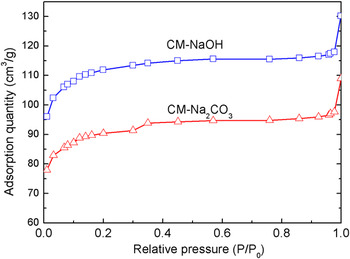
Nitrogen adsorption technique is a sophisticated tool to get insight into the pore information of porous materials. Under the temperature of liquid nitrogen, the adsorption quantity of nitrogen of a solid is determined with relative pressure (P/P 0), where P and P 0 are the partial pressure and saturated pressure of nitrogen, respectively. In Fig. 10, it can be found that the nitrogen adsorption quantity of CM-NaOH is much higher than that of CM-Na2CO3 at the same relative pressure. As the function of relative pressure, the nitrogen adsorption profiles show three sections: The increment (P/P 0 = 0–0.2), the plateau (P/P 0 = 0.2–0.97), and the steep (P/P 0 = 0.97–1.0). When the P/P 0 value is located in the range of 0.05–0.35, the character of adsorption behavior follows Brunauer–Emmett–Teller (BET) equation. While the P/P 0 is equal or greater than 0.4, the capillary condensation would occur in the porosity of particulate samples. This illustrates that the porous texture of the two NCM samples conforms to the proposed type I model as per IUPAC classification, in which exists ink-bottle-like pores. The steep curves at P/P 0 = 0.97–1.0 may be indicative of adsorption among the aggregated particles of samples.
Adsorption isotherms of nitrogen for NCM samples.

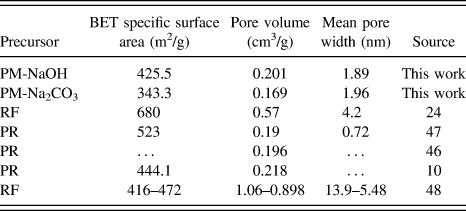
Based on the above adsorption isotherms, the parameters of the porous structure for the as-prepared NCMs were obtained as listed in Table I. The present parameters, including BET specific surface area, total pore volume, and mean pore width, are comparable to those NCMs made from PR or RF in Refs. Reference Katsaros, Steriotis, Romanos, Konstantakou, Stubos and Kanellopoulos10,Reference Tanaka, Nakatani, Doi and Miyake24,Reference Carretero, Benito, Guerrero-Ruiz, Rodríguez-Ramos and Rodríguez46,Reference Yoshimune, Yamamoto, Nakaiwa and Haraya47. Since CM-NaOH exhibits larger specific surface area and total pore volume than CM-Na2CO3, it may be favorable for gas permeation. At the same time, we could find the slightly smaller pore width for CM-NaOH than that for CM-Na2CO3. This evidences the larger shrinkage in the PM-NaOH matrix after pyrolysis as has been observed from TEM images. The difference in porous texture between the two NCMs is ascribed to the char yield, crosslinking structure, and polymerization degree of precursors, apart from the contribution of F-127 to the overall porosity of the resultant NCMs. It is reported that the variation of catalyst can adjust the consistent and curing accelerating effect on RF resin. Reference Munoz, Kua, Cardona and Rogers34,Reference Park, Ridel, Hsu and Shields48 Consequently, a less compact porous structure would be formed in CM-NaOH due to the deeper thermal degradation of PM-NaOH with less crosslinked molecular structure and lower polymerization degree.
Pore structure parameters of NCM samples based on nitrogen adsorption.

However, the “nominal” value of mean pore width from nitrogen adsorption technique seems too large to effectively discriminate special gas from a mixture. In fact, the values are the combination of both dead-end pores and open pores in samples. Thereby, the mean pore size as shown in Table I could be only served as an indicator for the change tendency of pore size rather than the realistic value. To compensate for this deficiency, the investigation of gas permeance is certainly regarded as the most suitable technique to insight into the porous texture and to determine the separation performance of NCMs.
G. Measurement of gas permeation
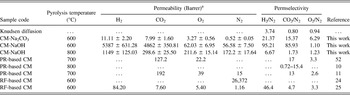
Table II shows the gas permeation data of NCMs in the present work. For comparison, the separation factors of Knudsen diffusion and some references were also listed. The gas permeation property for membrane materials includes two indicators: permeability and selectivity. An ideal membrane material should simultaneously present excellent high values of permeability and selectivity. However, it is very hard to attain this goal because the existence of a well-known trade-off relationship between the two indicators. If the permeability is improved for a membrane material, the corresponding selectivity will definitely diminish, and vice versa. Therefore, the two indicators of membrane materials have to be well balanced for practical reason. In the present work, all the selectivity of NCMs exceeds Knudsen diffusion factor as shown in Table II. This implies that the pore width calculated from nitrogen adsorption technique is insufficient for the determination of effective micropores close to gas molecular dimensions.
Gas permeance of NCMs.

a Note: 1 Barrer = 1 × 10⁻¹⁰ cm3 (STP) cm/cm2 s cmHg = 7.5 × 10⁻⁵ cm3 (STP) cm/cm2 s kPa.
Studies in the literature have shown that NCMs made from PR seem to be more suitable for the separation of a mixture with larger molecular dimensions, e.g., hydrocarbon. Reference Dong, Nakao, Nishiyama, Egashira and Ueyama12,Reference Tanaka, Yasuda, Katayama and Miyake49 However, the gas permeability for all the present NCMs complies with the reverse order of the kinetic diameters of the four tested gases, i.e., H2 (0.289 nm) > CO2 (0.33 nm) > O2 (0.346 nm) > N2 (0.364 nm). Judging from that, it deduces that the molecular sieving mechanism dominates the gas permeation through the present NCMs. Therefore, the present result is much better than the reported Knudsen diffusion for NCMs produced by a mixture of resorcinol/phloroglucinol/formaldehyde and Pluronic F-127 on α-alumina tube. Reference Tanaka, Nakatani, Doi and Miyake24
In contrast, the permeability of CM-Na2CO3 is higher than that of CM-NaOH by an order of 1–3 in magnitude under the same testing conditions. It implies that CM-NaOH is more abundant in porosity for gas permeation, which approves the above analysis from nitrogen adsorption technique. However, the porosity of CM-NaOH is mainly attributed to mesopores rather than micropores according to the report by Horikawa et al. Reference Horikawa, Hayashi and Muroyama50 This would probably diminish the molecular sieving ability of CM-NaOH for gas species with approaching molecular dimensions, e.g., O2/N2 gas pairs. In Table II, we can see that the gas permeation property for CM-Na2CO3 is comparable to that for NCMs prepared from RF resin catalyzed with HCl. Reference Zhang, Shi, Wu, Wang and Qiu25 In particular, CM-Na2CO3 is especially prominent for the separation of O2/N2 gas pairs, with an ideal O2/N2 selectivity of 6.29. The permselectivity of CM-NaOH for O2/N2 gas pairs is inferior to that of CM-Na2CO3, although it is close to reported data. Reference Katsaros, Steriotis, Romanos, Konstantakou, Stubos and Kanellopoulos10,Reference Fuertes and Menendez11,Reference Menendez and Fuertes51 Interestingly, the permeability of CM-NaOH is about 2–10 times higher than that of PR-based carbon membrane in the literature. Reference Menendez and Fuertes51 Unfortunately, the O2/N2 selectivity of approximately 1 for CM-NaOH might indicate that the dominant transport mechanism shifts from molecular sieving toward Knudsen diffusion to a certain degree. To clarify the exact reason, further work is needed to carry out to optimize the preparation procedure. Anyhow, the present CM-NaOH is more favorable for the separation of H2/N2 and CO2/N2 systems.
With an increase in the pyrolysis temperature from 600 to 800 °C, the gas permeability of CM-NaOH for H2 and CO2 significantly reduces due to the aggravation of aromatic polycondensation at elevated temperature, along with the increase in the permeability of O2 and N2 by 2–3 times. The abnormal behavior of O2 and N2 in CM-NaOH can be ascribed to the consequence of rearrangement reactions, e.g., recombination of neighboring carbon sheets, as found in our previous report. Reference Wang, Zhang, Qiu, Wu, Zhang and Cao52 Besides, those reactions could also significantly cause the reduction of porosity and molecular recognition (permselectivity) for NCMs as shown in Table II. Therefore, the pyrolysis temperature should not be set too high to achieve preferable separation performance for RF-based NCMs.
IV. CONCLUSIONS
NCMs were fabricated by the pyrolysis of RF resin blending with thermally labile F-127. The structure and property of NCMs can be tuned by adopting different catalysts. At the thermal degradation temperature of 800 °C, the char yields of precursors made from the NaOH and Na2CO3 catalysts are 28.5 and 42.4%, respectively. Higher thermal stability of the precursor is beneficial to retard the graphitization process and maintain the preformed crosslinking structure in NCMs. As such, NCMs made from catalyst NaOH have more porosity and higher separation performance for H2/N2 and CO2/N2 systems than those from catalyst Na2CO3. NCMs made from Na2CO3 are more favorable for the separation of O2/N2 gas pairs.
ACKNOWLEDGMENTS
This work was financially supported by the National Natural Science Foundation of China (20906063), the Liaoning Natural Science Foundation of China (20102170), the Program for Liaoning Excellent Talents in University (LJQ2012010), and the State Key Laboratory of Fine Chemicals (KF1107).