Introduction
Around the world, sacred sites are recognized as important centres of biodiversity conservation, despite this differing from their original purpose (Berkes Reference Berkes2009, Lowman & Sinu Reference Lowman and Sinu2017). India, particularly the south of India, has a history of local involvement in managing forests and natural resources (Nagendra & Gokhale Reference Nagendra and Gokhale2008). For instance, the Soppinabetta forests of the Western Ghats biodiversity hotspot in south India are portions of pristine natural forests allocated to farmers for sustainable use of resources from forests – leaf litter and green leaves – and production of agricultural crops, such as betel nut, rice and coffee (Nagendra & Gokhale Reference Nagendra and Gokhale2008, Sinu et al. Reference Sinu, Kent and Chandrashekara2012a). Since they have a direct use for farmers, they are still well protected, and therefore play a crucial role in conserving endemic and threatened biodiversity (Sinu et al. Reference Sinu, Kuriakose and Chadrashekara2011, Reference Sinu, Sinu and Chandrashekara2012b). Sacred groves (SGs) of India are another fine example of traditional management of forests. They generally forbid anthropogenic modification of forests, therefore maintain a structural integrity of a protected forest. The SGs of south India have primary or secondary forests or swamps (Bhagwat et al. Reference Bhagwat, Kushalappa, Williams and Brown2005, Prashanth Ballullaya et al. Reference Prashanth Ballullaya, Reshmi, Rajesh, Manoj, Lowman and Sinu2019). They were protected long ago by the pre-religious animistic tribal community to worship nature and its resources (Bhagwat et al. Reference Bhagwat, Kushalappa, Williams and Brown2005, Prashanth Ballullaya et al. Reference Prashanth Ballullaya, Reshmi, Rajesh, Manoj, Lowman and Sinu2019). This community later had local deities and Serpent Gods, and today has Sanskritized Hindu gods. This transformation in faith has modified the nature–human relationship among the local community (Landry-Yuan et al. Reference Landry Yuan, Ballullaya, Roshnath, Bonebrake and Sinu2020, Prashanth Ballullaya et al. Reference Prashanth Ballullaya, Reshmi, Rajesh, Manoj, Lowman and Sinu2019). Due to urbanization and population increases, SGs today exist in countryside (CS) and forest landscapes both within and outside the Western Ghats biodiversity hotspot. Studies suggest that SGs maintain a structural integrity and biodiversity different from that of adjoining used lands and protected forests (Bhagwat et al. Reference Bhagwat, Kushalappa, Williams and Brown2005; Boraiah et al. Reference Boraiah, Vasudeva, Bhagwat and Kushalappa2003, Brown et al. Reference Brown, Bhagwat and Watkinson2006, Chandrashekara & Sankar Reference Chandrashekara and Sankar1998, Rath et al. Reference Rath, Banerjee and John2020). Recently, studies have indicated a degradation of quality of SGs in some parts of south India for a variety of reasons, including growing disbelief in traditional cultural practices and rituals among youth, socio-economic changes and land-use change (see Prashanth Ballullaya et al. Reference Prashanth Ballullaya, Reshmi, Rajesh, Manoj, Lowman and Sinu2019 and references therein, Osuri et al. Reference Osuri, Madhusudan, Kumar, Chengappa, Kushalappa and Sankaran2014). This calls for regular monitoring of quantifiable and sensitive biodiversity and biotic interactions that can indicate the state of affairs in the forests.
Prey–predator interactions respond to various ecosystem processes and global changes including fragmentation and habitat deterioration (Posa et al. Reference Posa, Sodhi and Koh2007, Seifert et al. Reference Seifert, Lehner, Adams and Fiedler2015, Tvardikova & Novotny Reference Tvardikova and Novotny2012). It is suggested that prey–predator trophic function decreases with structural complexity of habitats (King et al. Reference King, Andersen and Cutter1998, Muiruri et al. Reference Muiruri, Rainio and Koricheva2016, Pocha & Simonetti Reference Pocha and Simonetti2013, Richards & Coley Reference Richards and Coley2007, Roels et al. Reference Roels, Porter and Lindell2018, Root Reference Root1973, Schuldt et al. Reference Schuldt, Both and Bruelheide2011, Zou et al. Reference Zou, Sang, Bai and Axmacher2013). Considering SGs are relatively pristine as depicted by other studies (Bhagwat et al. Reference Bhagwat, Kushalappa, Williams and Brown2005, Brown et al. Reference Brown, Bhagwat and Watkinson2006, Chandrashekara & Sankar Reference Chandrashekara and Sankar1998, Manoj et al. Reference Manoj, Rajesh, Prashanth Ballullaya, Meharabi, Shibil, Rajmohana and Sinu2017, Rajesh et al. Reference Rajesh, Prashanth Ballullaya, Surendran and Sinu2017) and prey–predator interaction is high in disturbed or degraded lands, we hypothesized that predation of artificial caterpillars would be high in CSs and less in SGs owing to structurally simple habitat of CSs.
Unlike parasitism, quantifying predation using natural caterpillars is arduous (Howe et al. Reference Howe, Lövei and Nachman2009). Among various methods, artificial caterpillars made with non-hardening modelling clay has proved to be the most reliable and easy method to study prey–predator interactions in invertebrates (Howe et al. Reference Howe, Lövei and Nachman2009). The impressions left on the model caterpillars are characteristically distinct to each predator group (Low et al. Reference Low, Sam, McArthur, Posa and Hochuli2014). Although concerns regarding the credibility of using results from artificial caterpillars exist, Sam et al. (Reference Sam, Koane and Novotny2015) showed that ant predation on model and real caterpillars were similar and the model caterpillars are useful to study predation. We compared the overall predation and predation by different taxa – arthropods, birds, lizards and mammals – as the predation marks allow us to distinguish the predator taxon.
Materials and methods
Study site
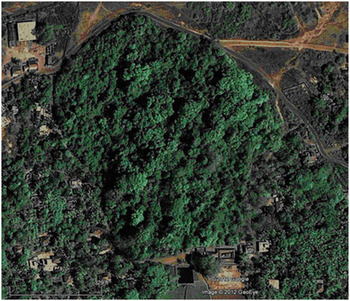
The study was conducted during January–March 2019 in 14 pairs of SG-CS in Kasaragod district (12o15.31′N, 75o07.59′E; 20 m asl) of the state of Kerala in south India. The adjoining orchards, with coconut (Cocos nucifera) and areca nut (Areca catechu) in the upper storey and banana plantains and vegetables in lower storey, were selected as the CS habitat. These two habitats were entirely different on structure and composition of vegetation (Figure 1). SGs had closed canopy, dense vegetation of tropical evergreen forest, and thick leaf litter bed on ground. CSs on the other hand had open canopy, relatively dense vegetation of simple stands, and bare ground. The minimum and maximum distances between the SG-CS pairs was 4 and 77 km. All the SGs included in this study contain secondary evergreen forests. The SGs are located in a matrix of agricultural landscape and small towns (Figure 1). More details on the study sites are given in Manoj et al. (Reference Manoj, Rajesh, Prashanth Ballullaya, Meharabi, Shibil, Rajmohana and Sinu2017) and Rajesh et al. (Reference Rajesh, Prashanth Ballullaya, Surendran and Sinu2017, Reference Rajesh, Prashanth Ballullaya, Unni, Surendran and Sinu2020).
An aerial picture of a sacred grove and orchards around SG (Google earth image).

Sampling method
We followed a customized method of Seifert et al. (Reference Seifert, Lehner, Adams and Fiedler2015) to study predation pressure using artificial caterpillars and Low et al. (Reference Low, Sam, McArthur, Posa and Hochuli2014) to identify the likely predators based on the bite marks. We used green, coffee brown and smoke grey artificial caterpillars (30 mm long, 5 mm diameter) made from oil-based non-toxic modelling clay (Peacock brand) to mimic the typical natural caterpillar colours in the study area (Anonymous, Wikimedia Commons). Within each habitat, 210 caterpillars of three colours (70 each) were placed on leaves (70), stems (70) and branches (70). In each site, 15 caterpillars of three colours were glued (Fevicol MR Brand) on the three substrates on a rotation basis in each habitat at a height of about 0.8–1.5 m above ground. The distance between bait trees was 10 m and the nearest bait tree in both the habitats was 50 m from the edge of SG. All the artificial caterpillars were retrieved after 48 h of placement.
Data analysis
The 14 SGs differed in terms of their area (4.1 ± 6.2 ha; mean ± SD), altitude (58 ± 47 m asl) and canopy cover (71 ± 42%). We, first, modelled the proportion of predated caterpillars on area, altitude and canopy cover of SGs using a Generalized Linear Model with binomial error as distribution and logit as link function, and confirmed that these were not predicting the predation rate of caterpillars (area: χ2 = 0.03, df = 1, P = 0.8; altitude: χ2 = 0.21, df = 1, P = 0.6; canopy cover: χ2 = 0.008, df = 1, P = 0.9). Therefore, we did not include any of these environmental variables as random factors in the predictive models that were used to study the effect of habitat on caterpillar predation. Neither the caterpillar colour (χ2 = 1.08, df = 2, P = 0.5) nor the position of caterpillar (χ2 = 1.94, df = 2, P = 0.38) predicted the predation rate of caterpillars. So, we pooled the colour and position of caterpillars before we took the data for analysing the effect of habitat type on caterpillar predation. We could not retrieve 4 and 11 caterpillars from SG (two sites) and CS (four sites), respectively, which we did not include in the analyses. Proportion of predated caterpillars was analysed using a GLM with habitat as the explanatory variable and proportion of predated caterpillars as the response variables. We used bionomial error as the distribution type and logit as the link function in the model that studied the effect of habitat type on proportion of predated caterpillars. We assessed the intensity of predation from the number of bite marks seen on the caterpillars. We ranked the arthropod predation intensity on a scale of 1–4 (1 = 1–25 marks; 2 = 25–50 marks; 3 = 50–100 marks; 4 = >100 marks). For other types of predators, we used the following scale to assess predation intensity: 1 = 1–2 bites; 2 = 3–4 bites; 3 = 5–6 bites; 4 = >7 bite marks. To understand if the intensity of predation was predicted by the habitat type, we modelled the predation intensity of each taxon on the habitat type using a Generalized Linear Model. We used only caterpillars having some bite marks for this analysis. We used Poisson error as the distribution type and log as link function in the model. The significance of the model was tested using Wald’s Chi-square test available in R-package ‘car’. All the analyses were performed in R 3.2.5.
Results
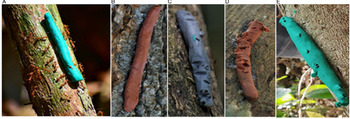
We encountered predatory bite marks of arthropods (ants, crickets, predatory wasps, beetles and flies), birds, reptiles and mammals (Figure 2). Predation marks were absent on 101 caterpillars. Bite marks of more than one predator were found on 42 caterpillars; but 90% of the caterpillars had only bite marks of two predators. In the entire study, 76% (n = 420) of the caterpillars were predated. Arthropods accounted for 67% (n = 366) of predation followed by birds (19%), lizards (10%) and mammals (3%).
(A) A group of foraging Oecophylla smaragdina attempting to prey upon an artificial caterpillar; (B) the ant predation marks; (C) bird bite marks; (D) mammal predation marks; and (E) reptile predation marks on artificial caterpillars installed in the present study.

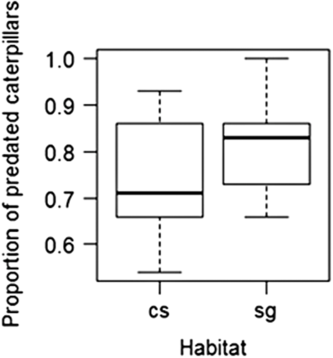
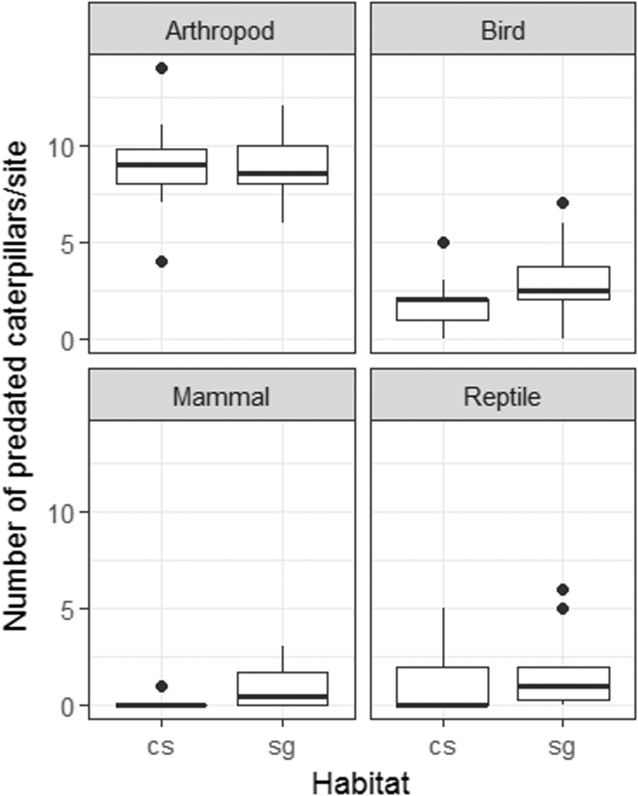
The probability of predation was not predicted by the habitat type either for overall predators (χ2 = 0.27, df = 1, P = 0.6) (Figure 3) or for any taxon (arthropod: χ2 = 0.04, df = 1, P = 0.8; mammal: χ2 = 0.43, df = 1, P = 0.5; birds: χ2 = 0.26, df = 1, P = 0.6; reptiles: χ2 = 0.08, df = 1, P = 0.7) (Figure 4). The intensity of predation for any taxon was also not predicted by habitat type (overall predators: χ2 = 2.62, df = 1, P = 0.10; arthropods: χ2 = 0.07, df = 1, P = 0.78; mammals: χ2 = 0.44, df = 1, P = 0.5; birds: χ2 = 0.05, df = 1, P = 0.82; reptiles: χ2 = 0.20, df = 1, P = 0.6).
The overall predation rate per site in countryside (CS) and sacred grove (SG).

The number of caterpillars predated per site by arthropods, birds, mammals and reptiles; CS, countryside; SG, sacred grove; N per site = 15 caterpillars.

Discussion
Sacred sites around the globe, while being self-enforced spiritual institutions, today are recognized indigenous community conserved areas and important centres of biodiversity conservation (Berkes Reference Berkes2009, Lowman & Sinu Reference Lowman and Sinu2017). In south India, it is demonstrated that SGs conserve primary and secondary evergreen forests or freshwater swamps, and have a biodiversity distinct from adjoining used land and protected land (Bhagwat et al. Reference Bhagwat, Kushalappa, Williams and Brown2005, Boraiah et al. Reference Boraiah, Vasudeva, Bhagwat and Kushalappa2003, Brown et al. Reference Brown, Bhagwat and Watkinson2006, Chandrashekara & Sankar Reference Chandrashekara and Sankar1998, Manoj et al. Reference Manoj, Rajesh, Prashanth Ballullaya, Meharabi, Shibil, Rajmohana and Sinu2017, Rajesh et al. Reference Rajesh, Prashanth Ballullaya, Surendran and Sinu2017). The religious sentiments and deity type play a large role for their conservation (Prashanth Ballullaya et al. Reference Prashanth Ballullaya, Reshmi, Rajesh, Manoj, Lowman and Sinu2019). However, land-use change, urbanization, temple construction and growing disbelief in cultural values among youth can pose major threats to the forests of SGs (Ormsby Reference Ormsby2011, Osuri et al. Reference Osuri, Madhusudan, Kumar, Chengappa, Kushalappa and Sankaran2014; Prashanth Ballullaya et al. Reference Prashanth Ballullaya, Reshmi, Rajesh, Manoj, Lowman and Sinu2019). Periodic monitoring of indicator taxa or ecosystem functions, such as herbivory, predation and parasitism can inform the current status of habitats.
In the present study, we considered prey–predator interaction to assess the quality of SGs, which is demonstrated to respond to habitat type and degradation and fragmentation of tropical forests (King et al. Reference King, Andersen and Cutter1998, Muiruri et al. Reference Muiruri, Rainio and Koricheva2016, Pocha & Simonetti Reference Pocha and Simonetti2013, Richards & Coley Reference Richards and Coley2007, Schuldt et al. Reference Schuldt, Both and Bruelheide2011, Zou et al. Reference Zou, Sang, Bai and Axmacher2013). We used artificial caterpillars to assess the rate of predation in SGs and adjoining disturbed habitat, CSs, with the expectation that SGs, because they are structurally complex, have less predation from opportunist predators, such as ants, birds, reptiles and mammals. Our results, however, revealed that the diversity of predators and the caterpillars that are preyed upon by various taxa are similar in both habitats. This suggests that SGs may not have a structural complexity different from that of adjoining used lands, as expected.
It is suggested that herbivores and predators, particularly opportunist predators, such as ants, and prey–predator trophic interaction imposed by arthropods and birds, are high in disturbed, structurally simple stands (King et al. Reference King, Andersen and Cutter1998, Muiruri et al. Reference Muiruri, Rainio and Koricheva2016, Pocha & Simonetti Reference Pocha and Simonetti2013, Richards & Coley Reference Richards and Coley2007, Schuldt et al. Reference Schuldt, Both and Bruelheide2011, Zou et al. Reference Zou, Sang, Bai and Axmacher2013). We selected 14 pairs of SGs and adjoining used lands for comparing predation rate and predation intensity on artificial caterpillars. SGs selected in the present study have fragments of forests and are structurally entirely different from the orchards around them (Chandrashekara & Sankar Reference Chandrashekara and Sankar1998). If prey–predator trophic interaction is high in disturbed simple stands, as suggested by other studies, predation level in SGs must be less than that encountered in CS. Our study suggests that the SGs in the state of Kerala may be functioning in the same way as used land in their vicinity.
Structurally complex habitats have less predation (Muiruri et al. Reference Muiruri, Rainio and Koricheva2016, Root Reference Root1973), due to poor assessment of prey (Muiruri et al. Reference Muiruri, Rainio and Koricheva2016) or smaller numbers of prey (Root Reference Root1973). We maintained a similar number of prey in both habitats and found no difference in predation rate or predation intensity from any predator taxon. This suggests that both the number and diversity of predators and prey assessment of predators are similar in both habitats. Our results both agree and contradict the findings of other studies (Posa et al. Reference Posa, Sodhi and Koh2007, Seifert et al. Reference Seifert, Lehner, Adams and Fiedler2015, Tvardikova & Novotny Reference Tvardikova and Novotny2012). The overall arthropod predation of caterpillars in the present study is similar to Tvardikova & Novotny (Reference Tvardikova and Novotny2012) and Seifert et al. (Reference Seifert, Lehner, Adams and Fiedler2015). Tvardikova & Novotny (Reference Tvardikova and Novotny2012) found more ant-predation in the smallest fragments of tropical lowland forests than in large secondary and primary forest fragments and montane forests. Seifert et al. (Reference Seifert, Lehner, Adams and Fiedler2015) also found more arthropod predation in CS than in the near natural tropical forest fragments in Costa Rica. However, our results disagree with Posa et al. (Reference Posa, Sodhi and Koh2007), who found higher arthropod predation in forest fragments than in rural areas. The forest fragments of SGs, however, may not comparable to forest fragments of any of these cited studies in terms of size of forest, but may be similar structurally. The SGs have a dense closed forest with a contiguous upper canopy layer and a thick litter bed. The CSs are orchards of coconut (Cocos nucifera) or areca nut (Areca catechu) with open canopy. This structural difference along with small patch size of SGs creates a high edge density. There is a difference in the composition of abiotic and biotic factors in these edges and this influence extends to both sides of the edge (Magura et al. Reference Magura, Tóthmérész and Molnár2001). Some specialized species might withdraw into the forest and generalists establish and spread to both sides of the edge (Peltonen et al. Reference Peltonen, Heliövaara and Väisänen1997, Rajesh et al. Reference Rajesh, Prashanth Ballullaya, Unni, Surendran and Sinu2020). For example, mammal predation of caterpillars was mostly restricted to SGs, with only one case noticed in CS. Our closer examination of bite marks of arthropods on caterpillars suggest that ants, particularly Oecophylla smaragdina (red weaver ant) and ants with large mandibles might be the predominant predators of caterpillars. They are arboreal in nature and forage in groups (Figure 2). Caterpillars attacked by O. smaragdina, therefore, are likely to have many bite marks. We encountered such caterpillars in both habitats. Oecophylla smaragdina is a highly competent tropical climate specialist predator with less shyness to disturbed habitats (Dad et al. Reference Dad, Akbar, Bharti and Wachkoo2019, Lach & Hoffmann Reference Lach and Hoffmann2011, Narendra et al. Reference Narendra, Gibb and Ali2011).
The method that Low et al. (Reference Low, Sam, McArthur, Posa and Hochuli2014) proposed to identify the likely predator with the help of bite marks was useful. Apart from ants, we could clearly identify bite marks of other common insect predators, such as predatory wasps, flies, crickets, beetles, and bugs (Low et al. Reference Low, Sam, McArthur, Posa and Hochuli2014). The bite marks of birds, reptiles and mammals are also distinguishable. We selected three colours of caterpillar after the reports that caterpillars in our study region are predominantly brown, brownish-black, grey and green (Anonymous, Wikimedia Commons). However, caterpillar predation was not predicted by the colour of caterpillars, as found by Seifert et al. (Reference Seifert, Lehner, Adams and Fiedler2015). This suggests that the predators are familiar with the caterpillars of these three colours in the study area.
Conclusions
Sacred groves may still be conserving rare and endemic flora and fauna and even functioning as refuges and green islets for climate and thermal resilient species in modified anthropogenic landscapes. However, anthropogenic factors including urbanization are a pressure for SGs. Inventorying plant diversity alone may not be sufficient to inform the current status of SGs; monitoring structural complexity, diversity of lower taxa and trophic interactions involving lower taxa as key players, periodically, may be required. Osuri et al. (Reference Osuri, Madhusudan, Kumar, Chengappa, Kushalappa and Sankaran2014) found that SGs of Kodagu – an adjoining district to our present study site in Karnataka state (~90 km away) – are either highly degraded or exist only on paper. Prashanth Ballullaya et al. (Reference Prashanth Ballullaya, Reshmi, Rajesh, Manoj, Lowman and Sinu2019) found that deity type of SGs predicts its quality. Rajesh et al. (Reference Rajesh, Prashanth Ballullaya, Surendran and Sinu2017) found that SGs in urban landscapes are under severe pressure from invasive ant species. Our study supports these studies, but with clear biological evidence that SGs of south India might have lost their glorious role in conserving biodiversity. Our study covered predation of artificial caterpillars, which is rendered primarily by generalists and opportunists, to draw this conclusion. We recommend monitoring abundance, richness and diversity of forest specialists and the functions they provide for our further understanding on the quality of SGs in conserving biodiversity.
Acknowledgements
We thank Kerala State Economic and Planning Affairs and Science Engineering Research Board, New Delhi for supporting this project through a grant-in-aid to PAS. TPR would like to thank e-grants for his PhD fellowship. We thank the owners of orchards and committee members of sacred groves for the permission to undertake this study in their sites. We also thank Prof. Ian Turner and Dr Alexander Mikheyev, the Editors of JTE and an anonymous reviewer for their valuable suggestions to improve the previous version of the manuscript.