Introduction
Scientific journals represent a cornerstone of paediatric cardiology, enabling formal, peer-reviewed dissemination of research, clinical innovation, and educational advancement. Editors occupy a vital position within this ecosystem, shaping the quality, tone, and direction of published scholarship. In paediatric and congenital cardiology, where research can frequently be limited by rare conditions, smaller patient cohorts (compared to adult literature), and rapidly evolving technologies, editorial judgement carries particular importance in discerning valid, significant work.
Recent paediatric cardiology literature has focused on training standards, competency-based education, and assessment frameworks for paediatric cardiology trainees.Reference McMahon, Tretter and Redington1–Reference McMahon, Voges and Jenkins3 However, little attention has been paid to the editors who curate this scholarly output and guide its interpretation. Editorial roles are often undertaken in parallel with demanding clinical, academic, and leadership responsibilities—this is also frequently done without formal training, protected time, or monetary compensation.
At a time of rapidly increasing manuscript volume, reviewer fatigue, and emerging use of artificial intelligence in publishing, understanding the sustainability of editorial roles has become a matter of urgency rather than academic interest. Understanding the lived experiences and challenges of paediatric cardiology editors is essential to ensuring the sustainability and quality of academic publishing in the specialty. To our knowledge, this is the first specialty-specific empirical study examining the experiences of paediatric cardiology journal editors.
Methods
Study design
This study employed a cross-sectional, anonymous survey design to explore the experiences, perceptions, and challenges of journal editors working within paediatric and congenital cardiology. The study incorporated both quantitative and qualitative components, enabling descriptive statistical analysis alongside inductive thematic exploration of free-text responses.
Survey development
The survey instrument was developed by three paediatric cardiology clinicians with expertise in medical education and academic publishing. Item development was informed by the study objectives and existing literature on academic publishing, peer review, and editorial roles. The questionnaire included a combination of Likert-scale items and open-ended questions to capture both structured responses and richer narrative insights.
The survey was reviewed iteratively by the study team for clarity, relevance, and face validity. Minor refinements to wording and structure were made prior to distribution to ensure interpretability across an international editorial audience. The final instrument is provided in the Appendix.
Survey content
The questionnaire explored the following domains:
-
• Motivations for undertaking editorial roles.
-
• Perceived workload and time commitment.
-
• Availability of protected time for editorial work.
-
• Experiences with peer review, including reviewer availability and quality.
-
• Attitudes towards journal impact factor and bibliometric measures.
-
• Perceived balance between educational value and metric-driven publishing.
-
• Reflections on sustainability and future needs in editorial practice.
Participants and recruitment
Eligible participants included editors and associate editors affiliated with peer-reviewed journals with a primary focus on paediatric and congenital cardiology. Initial contact was made with senior editors from three established journals (Pediatric Cardiology, Cardiology in the Young, and Congenital Heart Disease), who were invited to distribute the survey link to members of their respective editorial teams.
Participation was voluntary and anonymous. Because survey distribution occurred via editorial leads rather than a centralised mailing list, the total number of individuals invited could not be precisely determined. Consequently, an overall response rate could not be calculated. However, one participating journal reported distributing the survey to 21 editors, of whom 15 responded (response rate 71%), providing partial insight into engagement.
In total, 28 editors and associate editors completed the survey. Respondents represented a range of editorial roles and experiences within paediatric cardiology publishing, although detailed demographic data were not collected to preserve anonymity.
Data collection
The survey was administered electronically using SurveyMonkey. Responses were collected anonymously, and no identifiable personal data were recorded. Completion of the survey was taken to imply informed consent for participation and use of anonymised data for research purposes.
Data analysis
Quantitative analysis
Quantitative data from Likert-scale items were analysed descriptively using frequencies and percentages. Responses were grouped into three categories for reporting: agree/strongly agree, neutral, and disagree/strongly disagree. Given the exploratory nature of the study and the sample size, no inferential statistical analyses were performed.
Qualitative analysis
Free-text responses were analysed using inductive thematic analysis following the approach described by Braun and Clarke. Two researchers independently reviewed the data to generate initial codes. Codes were then compared and iteratively refined through discussion to develop candidate themes. Discrepancies were resolved by consensus, and themes were refined to ensure internal coherence and alignment with the dataset.
The analysis was conducted at a semantic level, focusing on explicit meanings expressed by participants rather than latent interpretation. Representative quotations were selected to illustrate key themes.
Ethical considerations
Ethical approval for the study was obtained from Children’s Health Ireland at Crumlin, Dublin, Ireland. Participation was voluntary, and all responses were anonymised prior to analysis. No patient data were involved in this study.
Reflexivity and study limitations
The study team included clinician-educators with experience in academic publishing, which may have influenced the interpretation of findings. Efforts were made to enhance analytical rigour through independent coding and iterative consensus-building.
Limitations inherent to the study design include the modest sample size, potential selection bias, and the inability to determine an overall response rate due to indirect survey distribution. These factors should be considered when interpreting the findings.
Results
A total of 28 editors and associate editors from three paediatric cardiology journals completed the survey. Quantitative responses were analysed descriptively, and qualitative free-text responses were examined using inductive thematic content analysis. Recurring themes related to editor motivation, workload, peer review challenges, perceptions of impact factor, and sustainability of editorial roles.
Editor motivation and professional identity
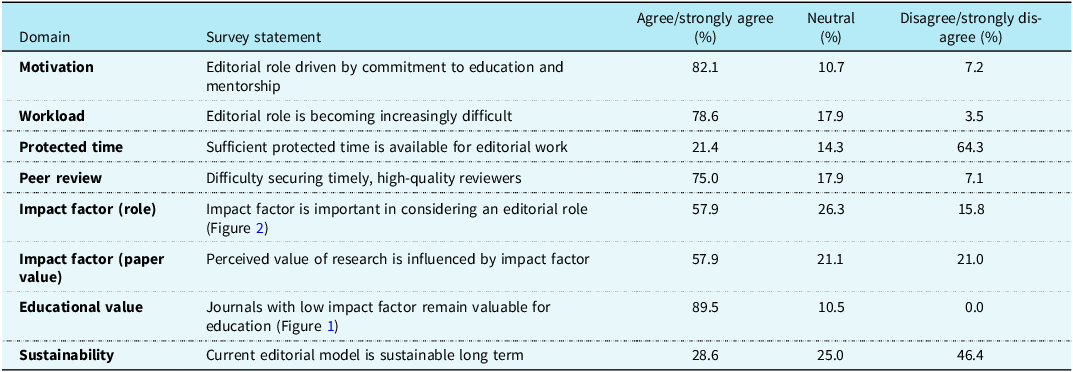
Editors consistently reported strong intrinsic motivation for their roles, particularly in relation to education, mentorship, and service to the paediatric cardiology community. A total of 82.1% of respondents agreed or strongly agreed that commitment to education and mentorship was a primary driver of editorial engagement (Table 1). Many respondents described editorship as an extension of their professional identity as clinician-educators rather than a career-advancing activity.
Summary of key quantitative responses from paediatric cardiology editors

Table 1. Long description
A table summarizing key quantitative responses from paediatric cardiology editors across various domains. The table has seven rows and four columns. The columns are labeled Domain, Survey statement, Agree/strongly agree (percent), Neutral (percent), and Disagree/strongly disagree (percent). The rows are labeled as follows: Motivation: Editorial role driven by commitment to education and mentorship, with 82.1 percent agreeing or strongly agreeing, 10.7 percent neutral, and 7.2 percent disagreeing or strongly disagreeing. Workload: Editorial role is becoming increasingly difficult, with 78.6 percent agreeing or strongly agreeing, 17.9 percent neutral, and 3.5 percent disagreeing or strongly disagreeing. Protected time: Sufficient protected time is available for editorial work, with 21.4 percent agreeing or strongly agreeing, 14.3 percent neutral, and 64.3 percent disagreeing or strongly disagreeing. Peer review: Difficulty securing timely, high-quality reviewers, with 75.0 percent agreeing or strongly agreeing, 17.9 percent neutral, and 7.1 percent disagreeing or strongly disagreeing. Impact factor (role): Impact factor is important in considering an editorial role, with 57.9 percent agreeing or strongly agreeing, 26.3 percent neutral, and 15.8 percent disagreeing or strongly disagreeing. Impact factor (paper value): Perceived value of research is influenced by impact factor, with 57.9 percent agreeing or strongly agreeing, 21.1 percent neutral, and 21.0 percent disagreeing or strongly disagreeing. Educational value: Journals with low impact factor remain valuable for education, with 89.5 percent agreeing or strongly agreeing, 10.5 percent neutral, and 0.0 percent disagreeing or strongly disagreeing. Sustainability: Current editorial model is sustainable long term, with 28.6 percent agreeing or strongly agreeing, 25.0 percent neutral, and 46.4 percent disagreeing or strongly disagreeing.
Responses are grouped into agree/strongly agree, neutral, and disagree/strongly disagree categories.
Illustrative comment:
“The most rewarding aspect is helping authors improve their work and contributing to education within the field.”
Workload and increasing editorial demands
A substantial majority of respondents perceived the editorial role as becoming increasingly challenging over time. Specifically, 78.6% of editors agreed or strongly agreed that the role is becoming more difficult, including 35.7% who strongly agreed and 42.9% who agreed, while 17.9% were neutral (Table 1).
Editors described balancing editorial responsibilities alongside full clinical workloads, teaching commitments, research activity, and administrative roles. Editorial work was frequently reported as occurring outside standard working hours, contributing to concerns regarding sustainability.
Peer review and reviewer fatigue
Reviewer fatigue emerged as a major challenge across respondents. This was supported quantitatively, with 75.0% of respondents reporting difficulty securing timely, high-quality reviewers (Table 1).
Illustrative comments included:
“It is increasingly difficult to find reviewers willing to commit.”
“Even when reviewers agree, reviews are often delayed or not completed.”
These challenges frequently required editors to adjudicate conflicting or incomplete reviews, further increasing workload.
Impact factor and editorial decision-making
Editors demonstrated a nuanced perspective on the role of impact factor.
When asked whether impact factor is important in considering an editorial role:
-
• 57.9% agreed or strongly agreed (42.1% agree; 15.8% strongly agree) (Figure 2; Table 1);
-
• 26.3% were neutral;
-
• 15.8% disagreed or strongly disagreed.
Similarly, regarding whether the value of a research paper is influenced by impact factor:
-
• 57.9% agreed;
-
• 21.1% were neutral;
-
• 21.0% disagreed or strongly disagreed.
These findings suggest that while impact factor is recognised as relevant, it is not universally prioritised.
Educational value versus metrics
There was strong consensus that educational value outweighs bibliometric indicators, with 89.5% of respondents agreeing or strongly agreeing that journals with low impact factor remain valuable for education (Figure 1; Table 1). Only 10.5% were neutral, and none disagreed.
This finding highlights the distinction between the acknowledged relevance of impact factor and the core editorial priority placed on educational value.
Illustrative comments:
“We must avoid becoming overly driven by metrics at the expense of educational value.”
“Journals should remain educational resources, not just vehicles for citation metrics.”
Sustainability and structural challenges
Across both quantitative and qualitative data, a consistent pattern emerged:
-
• High intrinsic motivation.
-
• Increasing workload.
-
• Significant peer review challenges.
-
• Limited structural or institutional support.
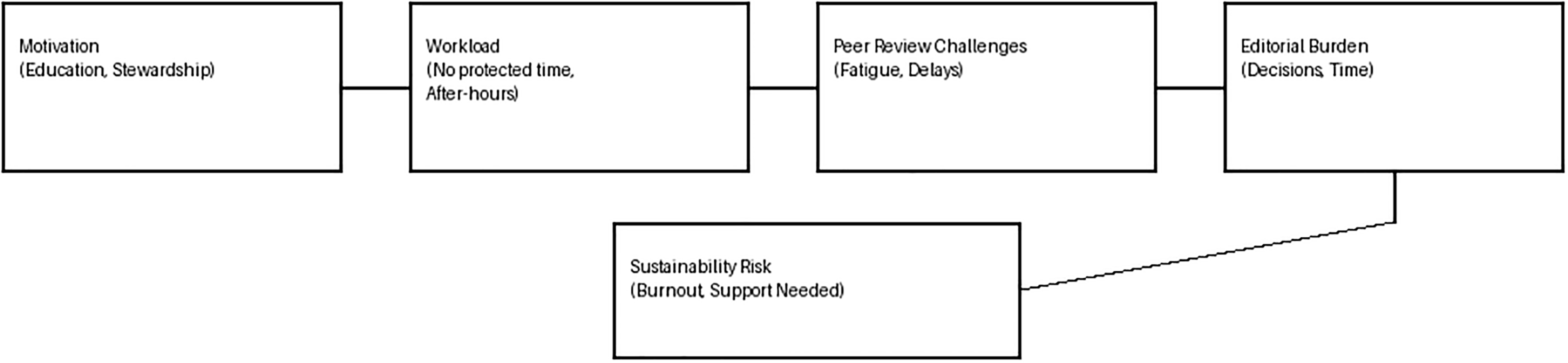
However, only 28.6% of respondents agreed that the current editorial model is sustainable, while 46.4% disagreed or strongly disagreed (Table 1). These interacting factors are conceptualised in Figure 3. The conceptual framework was developed based on recurrent and convergent themes identified through thematic analysis and refined through iterative author synthesis to illustrate the relationships between motivation, workload, peer review challenges, and sustainability.
Ethical responsibility and editorial judgement
Editors highlighted the ethical dimensions of their role, including:
-
• Ensuring transparency and conflict-of-interest disclosure.
-
• Managing borderline or incremental research.
-
• Protecting scientific integrity in small-sample or observational studies.
-
• Navigating artificial intelligence in research and peer review.
Several respondents emphasised the responsibility editors carry towards patients and families, particularly in paediatric research contexts.
Quantitative findings (Table 1) and graphical data (Figures 1 and 2) consistently demonstrate a pattern of strong intrinsic motivation, increasing workload, significant peer review challenges, and concerns regarding long-term sustainability.
Journals with low impact factor remain valuable for education and academic development. Bar chart shows responses from paediatric cardiology editors (n = 28) to the statement: “Journals with low impact factor can still be very valuable in terms of education and academic development.” The majority of editors agreed or strongly agreed with this statement, indicating that educational and academic value is not solely defined by impact factor metrics.

Impact factor is important in considering an editorial role. Bar chart illustrates responses from paediatric cardiology editors (n = 28) to the statement: “Impact factor of a journal is important for you to consider being an (associate) editor of the journal.” Responses demonstrate a broad distribution, with many editors agreeing that impact factor is relevant, while a substantial proportion remains neutral or disagree, reflecting a nuanced view of journal metrics in editorial decision-making.

Summary of key findings
Across domains, responses consistently demonstrated a convergence of strong professional commitment and increasing systemic pressures. Editors remain highly motivated by educational and scientific values but face growing challenges related to workload, reviewer fatigue, and sustainability of editorial roles.
Discussion
This study provides one of the first empirical insights into the lived experience of paediatric cardiology journal editors. Editors demonstrated strong professional commitment, with the majority identifying education and mentorship as central motivations. Editorship in this context appears fundamentally values-driven, grounded in academic stewardship and service to the specialty rather than career advancement. This aligns with broader developments in medical education, where professional identity formation and educational contribution are increasingly recognised as core components of academic practice.Reference McMahon, Tretter and Redington1–Reference McMahon, Voges and Jenkins3,Reference Martin, Blissett and Johnston4
This intrinsic motivation exists in clear tension with workload demands. Most respondents reported that the editorial role is becoming increasingly challenging, while only a minority described having sufficient protected time for this work. Editorial responsibilities were frequently undertaken alongside full clinical, academic, and administrative commitments, often outside standard working hours. These findings highlight a structural imbalance between expectations and institutional support, reflecting long-standing concerns regarding the recognition and resourcing of academic labour.Reference Grant5
Peer review emerged as a key pressure point within the editorial process. Most editors described difficulty securing timely, high-quality reviewers, with frequent declined invitations and delayed or incomplete reviews. These challenges increase editorial workload and often require additional adjudication and decision-making. This pattern is consistent with wider concerns regarding the sustainability of peer review systems. Tennant has highlighted the cumulative strain arising from increasing submission volumes and limited reviewer capacity,Reference Tennant6 while guidance from the Committee on Publication Ethics emphasises the importance of maintaining robust and reliable review processes despite these pressures.7
The relationship between editorial values and bibliometric measures was notably nuanced.8 Many editors acknowledged that impact factor influences editorial considerations; however, a substantially larger majority emphasised the continuing educational value of journals with lower impact factors. This divergence reflects a broader tension within academic publishing: editors operate within metric-driven systems but continue to prioritise educational value and scientific integrity.Reference Saha, Saint and Christakis9 This perspective is consistent with critiques of bibliometric indicators. Ioannidis has demonstrated that citation impact does not necessarily reflect methodological quality or clinical relevance,Reference Ioannidis, Boyack, Small, Sorensen and Klavans10 while Brembs has highlighted how journal rank can distort research incentives and contribute to selective reporting.Reference Brembs, Button and Munafò11 These findings reinforce the importance of editorial judgement as a safeguard against metric-driven distortions of scientific value.
Concerns regarding sustainability were evident across both quantitative and qualitative findings. Only a minority of respondents considered the current editorial model sustainable, while a substantial proportion expressed concern regarding its long-term viability. These concerns likely reflect the cumulative effects of increasing manuscript volume, reviewer fatigue, and limited institutional support. The conceptual framework presented in Figure 3 illustrates how strong intrinsic motivation may initially sustain editorial engagement but is progressively offset by escalating workload and structural constraints.
Conceptual framework illustrating relationships between editorial motivation, workload, peer review challenges, and sustainability in paediatric cardiology publishing. The framework is informed by recurrent themes identified through thematic analysis and refined through author synthesis. It illustrates how strong intrinsic motivation coexists with increasing workload and reviewer fatigue, contributing to escalating editorial burden and concerns regarding long-term sustainability in the absence of structural support.

Although these challenges are not unique to paediatric cardiology, they may be particularly pronounced within the specialty. Research in paediatric and congenital cardiology is often characterised by smaller patient populations, highly specialised methodologies, and a strong educational focus. Journals therefore serve dual roles as both research dissemination platforms and key educational resources. Maintaining high editorial standards in this context requires sustained effort and expertise, reinforcing the importance of supporting the editorial workforce.
Emerging technologies may offer potential avenues for support. Recent work has explored the role of large language models in evaluating research quality, suggesting that such tools may assist with preliminary appraisal or methodological screening.Reference Thelwall12 However, these approaches should be considered adjunctive rather than substitutive, given the complexity of editorial decision-making and the importance of clinical and contextual judgement. Similarly, innovations in peer review, including collaborative reviewer networks and structured training models, may help address reviewer fatigue while maintaining quality.Reference Recio-Saucedo, Crane and Meadmore13
Implications for the future
These findings highlight several practical priorities to support the sustainability of editorial work in paediatric cardiology. First, greater institutional recognition of editorial contributions is required. The mismatch between workload and protected time suggests that editorial roles remain insufficiently acknowledged within academic structures. Formal recognition within promotion and appraisal frameworks, alongside defined allocations of protected time, may represent achievable initial steps.
Second, there is a need to strengthen editorial development and support pathways. While formal training programmes may not be universally feasible, targeted initiatives—such as mentorship from senior editors, short workshops, or integration of editorial skills into existing academic development programmes—could provide practical and scalable support.
Third, addressing reviewer fatigue will require coordinated but incremental approaches. Expanding the reviewer pool through engagement of early-career clinicians and researchers, supported by structured guidance, may be particularly valuable. In parallel, process improvements—such as clearer reviewer expectations, recognition of reviewer contributions, and more selective triage of submissions—may help reduce unnecessary burden on reviewers and editors.
Finally, it is important to preserve the educational mission of paediatric cardiology journals. Despite increasing emphasis on bibliometric performance, editors consistently prioritise educational value and scientific integrity. Ensuring that editorial policies continue to support clinically relevant and educationally meaningful work will remain central to the role of journals within the specialty.
While no single intervention is likely to resolve the challenges identified, a combination of pragmatic, incremental changes across institutional, editorial, and peer review systems may help sustain editorial engagement and maintain the quality of scholarly publishing in paediatric cardiology.
Limitations
The relatively small sample size limits statistical generalisability, and findings should be interpreted as exploratory in nature. This study reflects the views of 28 respondents from three paediatric cardiology journals and may not capture the full range of perspectives globally. However, the included journals are broadly representative of paediatric cardiology publishing in terms of impact factor and scope, which may enhance the relevance of the findings within the specialty.
The total number of editors invited across all journals could not be precisely determined due to indirect survey distribution via editorial leads, limiting calculation of an overall response rate and introducing potential selection bias.
Responses were self-reported and may be influenced by respondent engagement and interest in editorial issues. Nevertheless, the consistency of themes across quantitative and qualitative data suggests that the findings reflect common experiences among paediatric cardiology editors.
Conclusion
Paediatric cardiology journal editors demonstrate strong intrinsic motivation and a clear commitment to education and scientific quality. However, this commitment exists alongside increasing editorial workload, persistent challenges in peer review, and limited institutional support.
These findings highlight a growing imbalance between the expectations placed on editors and the structures available to support them. While editorial roles remain central to maintaining the quality and educational value of the literature, current models place increasing strain on those undertaking this work.
Addressing these challenges will require greater institutional recognition of editorial contributions, including provision of protected time, alongside pragmatic innovation in peer review processes. Without such adjustments, the sustainability of editorial work—and the ability of journals to fulfil their educational and scientific mission—may be increasingly difficult to maintain.
Acknowledgements
The authors are very grateful to all the editors who participated in this study.
Financial support
This research received no specific grant from any funding agency, commercial or not-for-profit sectors.
Competing interests
None to report.
Ethical standard
Ethical approval was obtained to undertake the study from Children’s Health Ireland at Crumlin, Dublin, Ireland. There were no patients involved in this research.
Appendix A. Survey Instrument
Experiences and Sustainability of Editorial Roles in Paediatric Cardiology
This survey was designed to explore the experiences, motivations, and challenges of paediatric cardiology journal editors. Participation was voluntary and anonymous, and completion of the survey was taken to imply consent for the use of anonymised data for research purposes.
Section 1. Editorial Role and Background
-
1. What is your current editorial role? (Editor-in-Chief/Associate Editor/Section Editor/Other)
-
2. Years in editorial role
-
3. Approximate number of manuscripts handled per month
Section 2. Motivation for Editorial Work
Response options: Strongly Disagree/Disagree/Neutral/Agree/Strongly Agree
-
1. My editorial role is driven by a commitment to education
-
2. Mentorship of authors is an important motivation
-
3. Editorial work contributes to my professional identity
-
4. Editorial work is personally rewarding
-
5. Editorial work contributes to my career progression
Section 3. Workload and Time Commitment
Response options: Strongly Disagree/Disagree/Neutral/Agree/Strongly Agree
-
1. My editorial workload is manageable
-
2. The demands of my editorial role are increasing over time
-
3. Editorial work is frequently performed outside normal working hours
-
4. Editorial responsibilities compete with my clinical and academic duties
-
5. I feel under pressure due to editorial workload
Section 4. Protected Time and Institutional Support
Response options: Strongly Disagree/Disagree/Neutral/Agree/Strongly Agree
-
1. I have sufficient protected time for editorial work
-
2. My institution recognises editorial work as an academic contribution
-
3. Editorial responsibilities are considered in promotion or appraisal
-
4. I feel adequately supported by my institution
-
5. Lack of institutional support limits my effectiveness
Section 5. Peer Review and Reviewer Fatigue
Response options: Strongly Disagree/Disagree/Neutral/Agree/Strongly Agree
-
1. It is difficult to identify suitable reviewers
-
2. Reviewers frequently decline invitations
-
3. Reviews are often delayed
-
4. The quality of peer review is variable
-
5. Reviewer fatigue is a significant challenge
-
6. I frequently intervene due to incomplete or conflicting reviews
Section 6. Impact Factor and Bibliometric Consideration
Response options: Strongly Disagree/Disagree/Neutral/Agree/Strongly Agree
-
1. Impact factor is important when considering an editorial role
-
2. Impact factor influences editorial decision-making
-
3. Authors are strongly influenced by journal impact factor
-
4. Impact factor influences citation of research
-
5. The perceived value of research is influenced by impact factor
Section 7. Educational Value versus Metrics
Response options: Strongly Disagree/Disagree/Neutral/Agree/Strongly Agree
-
1. Journals with low impact factor remain valuable for education
-
2. Educational value should outweigh bibliometric metrics
-
3. Editorial decisions should prioritise clinical relevance
-
4. Metric-driven publishing can negatively impact research quality
Section 8. Sustainability of Editorial Role
Response options: Strongly Disagree/Disagree/Neutral/Agree/Strongly Agree
-
1. The current editorial model is sustainable
-
2. I am concerned about long-term sustainability
-
3. Increasing workload threatens editorial engagement
-
4. I would recommend an editorial role to colleagues
-
5. I intend to continue editorial work long term
Section 9. Ethical Responsibilities and Emerging Challenges
Response options: Strongly Disagree/Disagree/Neutral/Agree/Strongly Agree
-
1. Editorial work involves significant ethical responsibility
-
2. Managing borderline or low-quality research is challenging
-
3. Conflicts of interest are adequately managed
-
4. Artificial intelligence introduces new challenges
-
5. Editors play a key role in maintaining scientific integrity
Section 10. Open-Ended Questions
-
1. What is the most rewarding aspect of your editorial role?
-
2. What are the biggest challenges you face?
-
3. What changes would improve sustainability?
-
4. How do you see the future of peer review evolving?
-
5. Any additional comments?