Introduction
Asymptomatic bacteriuria (ASB) is common in older adults; however, its treatment in this population is not beneficial. Reference Nicolle, Gupta and Bradley1,Reference Trautner, Petersen, Hysong, Horwitz, Kelly and Naik2 Older individuals are more susceptible to adverse effects of antibiotics, including Clostridioides difficile infection and antimicrobial resistance. Reference Nicolle, Gupta and Bradley1–Reference Trautner4 Many older adults with ASB and new altered mental status (AMS) or a fall are empirically treated for presumed urinary tract infection (UTI), despite a 2019 update to the Infectious Diseases Society of America (IDSA) ASB guidelines recommending against this practice. Reference Nicolle, Gupta and Bradley1
A survey of clinicians working in multiple subspecialties revealed a gap in knowledge and practice related to testing and treatment for ASB in older adults with AMS or falls. Reference Smith, Nachimuthu, Flynn, Balasubramanyam, Negrete, Trautner and Al Mohajer5 We analyzed whether a change in the urinalysis (UA) and urine culture order set at an academic hospital improved diagnostic and antibiotic stewardship regarding ASB in this population.
Methods
Setting and participants
This retrospective quasi-experimental study included adult patients 65 years and older who presented to the Emergency Department (ED) at an academic hospital from July 2018 to February 2024. Case patients had one of the following ICD-9 or 10 diagnoses: AMS, encephalopathy, disorientation, delirium, transient alteration of awareness, unspecified symptoms and signs involving the nervous system, fall, syncope and collapse, dizziness and giddiness, weakness, or convulsions. Control patients had other ED diagnoses. Patients were excluded if they had positive non-urine cultures within 72 hours of ED presentation, if they received antibiotics other than those for UTI, or if they met at least 2 Systemic Inflammatory Response Syndrome criteria (temperature >100.4 °F or <96.8 °F, heart rate >90, respiratory rate >20 or PaCO2 <32 mmHg, white blood cell count >12,000/mm3, <4,000/mm3, or >10% bands). The study was approved by the Baylor College of Medicine Institutional Review Board.
Study intervention and outcomes
The intervention, implemented in June 2020, involved a change in the UA with reflex to urine culture order set that replaced “altered mental state, malaise or lethargy with no other identifiable cause” as an indication for UA with “elderly patients (≥65) with fever (≥99F) or leukocytosis (≥12,000) in the presence of new delirium or decline in functional capacity.” This change was accompanied by education provided through electronic and in-person presentations.
The primary outcome was whether urine studies were obtained within 24 hours of presentation to the ED. Older adults who presented with AMS or a fall (cases) were compared to those with other chief complaints (controls). Additional outcomes included antibiotic days of therapy (DOT) for suspected UTI, length of stay (LOS), and 30-day hospital readmission. Data were obtained from the electronic health record via Theradoc (Premier Inc).
Chart reviews were conducted for 100 case patients randomly selected from the pre-intervention period and 100 from the post-intervention period. Patients were matched by gender and evenly distributed across the pre- and post-intervention time periods. Indications for urine studies ordered before and after the intervention were compared.
Statistical analysis
The difference in differences (DID) technique was used to assess the impact of the intervention on cases vs. controls (treated*time), adjusted for covariates. Study outcomes were analyzed using logistic regression (urine studies ordered and 30-day readmission), linear regression (logarithmic values of LOS given non-normality), and zero-inflated negative binomials (DOT). All regression models were adjusted for age, gender, race, admit status, transplant, dialysis, malignancy, stroke, and the presence of a urinary catheter.
Results
The study included 31,626 patients, with 3,261 cases and 28,365 controls. Almost a third of case patients (31.5%) received urinary testing, and 5.9% received antibiotics. In comparison, 20.2% of control patients received urinary testing, and 6.3% received antibiotics.
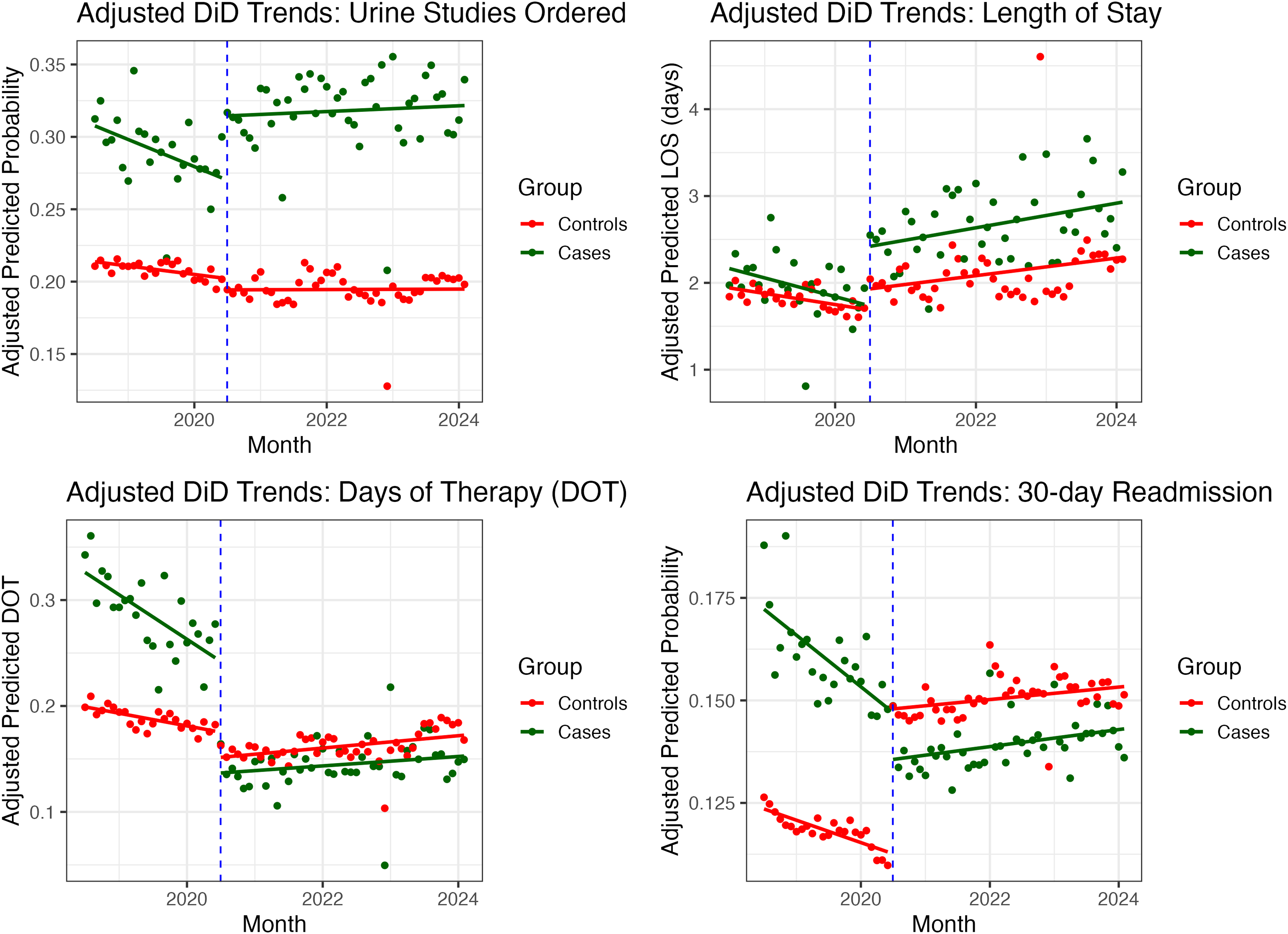
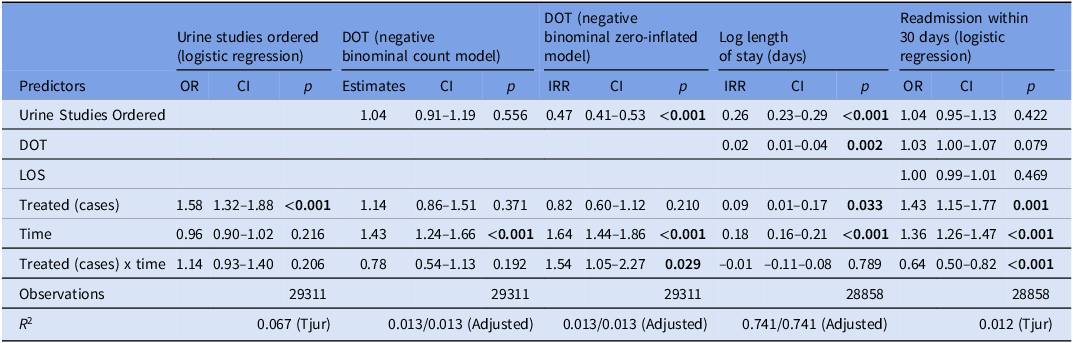
After adjusting for confounders, the intervention did not impact the percentage of patients who had urine studies ordered [(DID OR 1.14, 95% CI 0.93–1.40), (Figure 1, Table 1)]. The incident rate ratio (IRR) of not receiving antibiotics was similar before and after the intervention (IRR 0.78, 95% CI 0.54–1.13), while the antibiotic DOT a patient received increased after the intervention (IRR 1.54, 95% CI 1.05–2.27). The log LOS remained similar (ß = –0.01, P = 0.789) before and after the intervention; meanwhile, the 30-day readmission decreased (OR 0.64, 95% CI 0.50–0.82).
Difference-in-difference estimations for urine studies ordered, days of therapy (DOT), hospital length of stay (LOS), and hospital readmission, adjusted for potential confounders. Note: Blue dashed line represents the intervention (June 2020); cases are shown in green and controls in red.

Regression analysis for urine studies ordered, days of therapy (DOT), hospital length of stay (LOS), and hospital readmission*

Note. The zero-inflated model was used to analyze the count variable, days of therapy (DOT), given the high number of “zero” or null values/events. All models are adjusted for age, gender, race, admit status, transplant, dialysis, malignancy, stroke, and the presence of a urinary catheter.
* P-values are derived from adjusted regression models for a limited number of pre-specified outcomes; therefore, no correction for multiple comparisons was applied.
“Altered mental state, malaise or lethargy with no other identifiable cause” was the most used indication for urinalyses ordered for case patients prior to the intervention, while “dysuria, urinary urgency, frequency, suprapubic pain or tenderness” was the most used indication after the intervention.
Discussion
Changing indication options on the UA order set to be more concordant with updated IDSA guidelines did not significantly improve practice behavior related to testing and treatment for ASB in older adults with AMS or falls. Although there may have been a transient decrease in urine studies ordered around the time of the intervention, this effect was not statistically significant or sustained. While the AMS indication was used frequently before the intervention, it seems that providers continued to order urine studies for altered older adults after the intervention using different indications (e.g., dysuria). We were unable to collect data on whether patients with urine studies ordered had documented UTI symptoms, however, we would not expect the incidence of urinary symptoms to increase from 19% pre-intervention to 72% post-intervention, which was the observed increase in usage of the “dysuria” indication for urinalyses.
Other studies have found that interventions, including clinical decision support and education, improved diagnostic and antibiotic stewardship regarding ASB. Reference Keller, Feldman, Smith, Pahwa, Cosgrove and Chida6,Reference Watson, Trautner and Russo7 However, these studies had shorter post-intervention follow-up periods (one year vs. approximately three years in the current study) and did not focus specifically on bacteriuria in older adults with AMS or falls. Reference Keller, Feldman, Smith, Pahwa, Cosgrove and Chida6,Reference Watson, Trautner and Russo7 The discrepancy between our results and previous research may be explained by a lack of widespread knowledge about updated IDSA guidelines, or by concern that older, altered adults may not be able to communicate symptoms effectively. Reference Watson, Trautner and Russo7–Reference Dutta, Pasha and Paul10 Additionally, it is possible that clinical decision support and educational interventions improve stewardship in the short term, but that a more extended follow-up period revealed difficulty maintaining quality improvement outcomes, especially considering clinicians’ high cognitive loads. Institutional culture and common ordering practices may also play a role.
Limitations of this study include data collection from one academic medical center in Southeast Texas, potentially limiting generalizability elsewhere. Cases and controls were only matched by age, possibly predisposing to confounding effects. Due to differences in ICD-9 and ICD-10 coding, it is possible that some patients were incorrectly assigned to the control group. The timing of our intervention (June 2020) coincided with the early phase of the COVID-19 pandemic, potentially influencing patient populations presenting to the ED, clinician behaviors, and overall intervention uptake, introducing possible unmeasured confounding. We also observed some divergence in pre-intervention trends between groups, which may limit causal inference despite adjusted models. P-values were not adjusted for multiple comparisons, which may increase the risk of Type I error. The study’s strengths include a large sample size and use of a control group to establish a baseline for comparison.
In conclusion, modifying UA indications did not reduce testing or treatment for bacteriuria in older adults with AMS or falls. These results may be informative to providers considering implementing similar interventions. Prolonged or repetitive educational interventions may effectively improve long-term stewardship outcomes in this population, especially for providers with less exposure to guidelines. Reference Smith, Nachimuthu, Flynn, Balasubramanyam, Negrete, Trautner and Al Mohajer5
Financial support
B. W. T.’s work is supported in part by the US Department of Veterans Affairs Health Services Research and Development Service (grant no. CIN 13-413) at the Center for Innovations in Quality, Effectiveness, and Safety. All other authors have nothing to disclose.
Competing interests
All authors report no conflicts of interest relevant to this article.
Disclaimer
The content is solely the responsibility of the authors and does not necessarily represent the official views of the United States Government.