INTRODUCTION
The site of Ucanal is located in Peten, Guatemala, close to the contemporary border with Belize. In pre-Columbian times, the site was situated at the frontiers of two larger polities, Caracol and Naranjo, that were fierce enemies during much of the Late Classic period (ca. a.d. 600–830). Official histories inscribed in stone and displayed in public spaces reveal that the K'anwitznal polity, centered at the site of Ucanal, alternated political affiliations between these two larger political powers and as such served as a shifting frontier in their respective assertions for political authority and regional dominance. Political frontiers, however, were not necessarily manifestations of disjunctions, divisions, or differences between peoples, but also as places of articulation, interaction, and hybridity (Alvarez Reference Alvarez1995; Bhabha Reference Bhabha1994; Iannone Reference Iannone2010; Tenzin Reference Tenzin2017). Despite Ucanal's status as a political frontier during the Late Classic period, recent archaeological research at the site by the Proyecto Arqueológico Ucanal reveals that Ucanal's boundary status was just as much a bridge as an edge. We find that Ucanal was a convergence zone of interaction spheres and expressions of political, economic, and social affiliation. Such affiliations, however, were not static. Later in the Terminal Classic period (ca. a.d. 830–9510/1000), Ucanal shed itself of its subordinate political status, but continued to sit at a crossroads of diverse spheres of interaction. As such, our research contributes to a dynamic understanding of political frontiers whereby marginal entities take advantage of their in-between status to both persevere and recreate themselves anew.
BORDERS: EDGES AND BRIDGES
Borders, frontiers, and boundaries are generally characterized as areas between major political, economic, and cultural entities—the edges, limits, or ends of such entities. They are often highly contested, as states and political powers fight to gain authority or maintain control over these peripheral regions. In the Maya area during the pre-Columbian period, borders—physical manifestations of territorial division—were sometimes created through the construction of and symbolism surrounding defensive walls (Golden Reference Golden2010; Golden and Scherer Reference Golden and Scherer2013) and earthworks (Puleston and Callender Reference Puleston and Callender1967; Webster et al. Reference Webster, Murtha, Straight, Silverstein, Martinez, Terry and Burnett2007). Natural or sacred features, such as caves, cenotes, mountain tops, and shrine sites, also marked borders and boundaries of political territories, city limits, and community places and were forged through repeated visits and ritual circulations during key moments in the ceremonial calendar (Garcia-Zambrano Reference Garcia-Zambrano, Robertson and Fields1994; Halperin and Hruby Reference Halperin and Hruby2019; Hill Reference Hill1996; McAnany Reference McAnany1995:87). In contrast, frontiers, are the interstitial points between political, administrative, and cultural entities, what Kopytoff (Reference Kopytoff and Kopytoff1987:1–9) calls “internal frontiers”: ambiguous, anomalous, societies on the fringes of the metropoles. Our focus here is on the latter of these processes: the ways in which smaller political centers served as the critical sites of contestation and negotiations between larger political powers (Foias Reference Foias2013; Hammond Reference Hammond and Culbert1991; Iannone Reference Iannone2002; Marcus Reference Marcus, Sabloff and Henderson1993, Reference Marcus, Feinman and Marcus1998; Martin and Grube Reference Martin and Grube2000).
Rather than focus solely on the edges, limits, or ends of political powers, however, much recent research has underscored the creative, hybrid, and bridging roles of boundaries and border relationships in both ancient and contemporary political, economic, and cultural formations (Alvarez Reference Alvarez1995; Bhabha Reference Bhabha1994; Iannone Reference Iannone2010; LeCount Reference LeCount2017; Lightfoot and Martinez Reference Lightfoot and Martinez1995; Schortman and Urban Reference Schortman and Urban1994). For example, Tenzin's (Reference Tenzin2017) “convergence zone” concept highlights the ways in which frontiers were corridors of people and goods, places of cultural coexistence, heterogeneity, and hybridity, regions of overlapping and fragmented sovereignties, and important sites of innovations as documented with the Sino-Tibetan borderlands between the Chinese and Tibetan state. While central-place and world systems theories often focus on the dominating role the metropolis has on the periphery, those situated in-between power centers often engage in forms of “strategic marginality,” in which frontier and borderland peoples selectively and creatively affiliate themselves for political advantage. Likewise, Ogundiran's (Reference Ogundiran2014) study of Early Osogbo in Nigeria reveals that the political frontier between the metropoles of Old Oyo and Ife in Yorubaland was one of innovation and diversity. Rather than emulating a single dominant center, Early Osogbo possessed a more diverse ceramic assemblage than either metropolis as it comprised not only local ceramics but ceramic types from both of these larger centers. It was also an area of innovation as it initiated new practices, such as tobacco smoking and the monetization of the domestic economy, before the metropoles. In this sense, frontiers and borders exhibit bridging qualities that promote connections between different social, ethnic, and political groups and wherein diversity and innovation may flourish.
The social network analysis concept of “bridge,” a node that has weak ties (lacking in centrality) in relation to other nodes but is vital for connecting two or more clusters of nodes, is helpful for thinking about such frontier dynamics by highlighting the linking roles more peripheral entities may play (Musiał and Juszczyszyn Reference Musiał, Juszczyszyn, Nguyen, Kowalczyk and Chen2009). Unlike the use of the term “edge” to represent a border, boundary, or limit of political authority as used here, social network analysis uses the term to describe a vertex or vertices between nodes. Nonetheless, the application of social network analysis terms may be limiting for trying to draw out the tensions between multiple, nested, or overlapping boundaries. Parker (Reference Parker2006), for example, has suggested that borders be conceived not in singular terms, but as boundary sets: that is, their multiscalar and dynamic dimensions. Such a focus on multiple practices of affiliation at different scales highlights the ways in which politics, cultural groups, market spheres, local communities, and geopolitical territories come into tension with one another and dialectically produce new senses of self.
Furthermore, it is necessary to recognize the different degrees of engagement between dominant and peripheral centers (Foias Reference Foias2013). For example, Piedras Negras and especially Yaxchilan tightly controlled their peripheral polities and settlements during the Late Classic period. These peripheral sites expressed their allegiance to their respective capitals through the emulation of and adhesion to the dominant centers’ architecture, mortuary patterns, and ceramic types (Golden Reference Golden2010; Golden and Scherer Reference Golden and Scherer2013; Golden et al. Reference Golden, Scherer, Munoz and Vasquez2008). In turn, the boundaries between Piedras Negras and Yaxchilan were produced not only through their distinctive practices of affiliation expressed in ceramic production, funeral practices, and buildings, but in the construction of defensive features between the two geopolitical regions. In contrast, other provincial polities in the Maya area may have been “semi-autonomous buffer states” (Braswell et al. Reference Braswell, Prager, Bill and Schwake2004:200; Iannone Reference Iannone2010) or autonomous polities relatively free to engage with more powerful political centers and actors (Scarborough et al. Reference Scarborough, Valdez and Dunning2003). Thus, our investigations examine multiple lines of material evidence and multiple scales of interaction to underscore the different ways in which the site of Ucanal participated in the dynamics of political frontiers.
BETWEEN SUPERPOWERS: LATE CLASSIC NARANJO & CARACOL
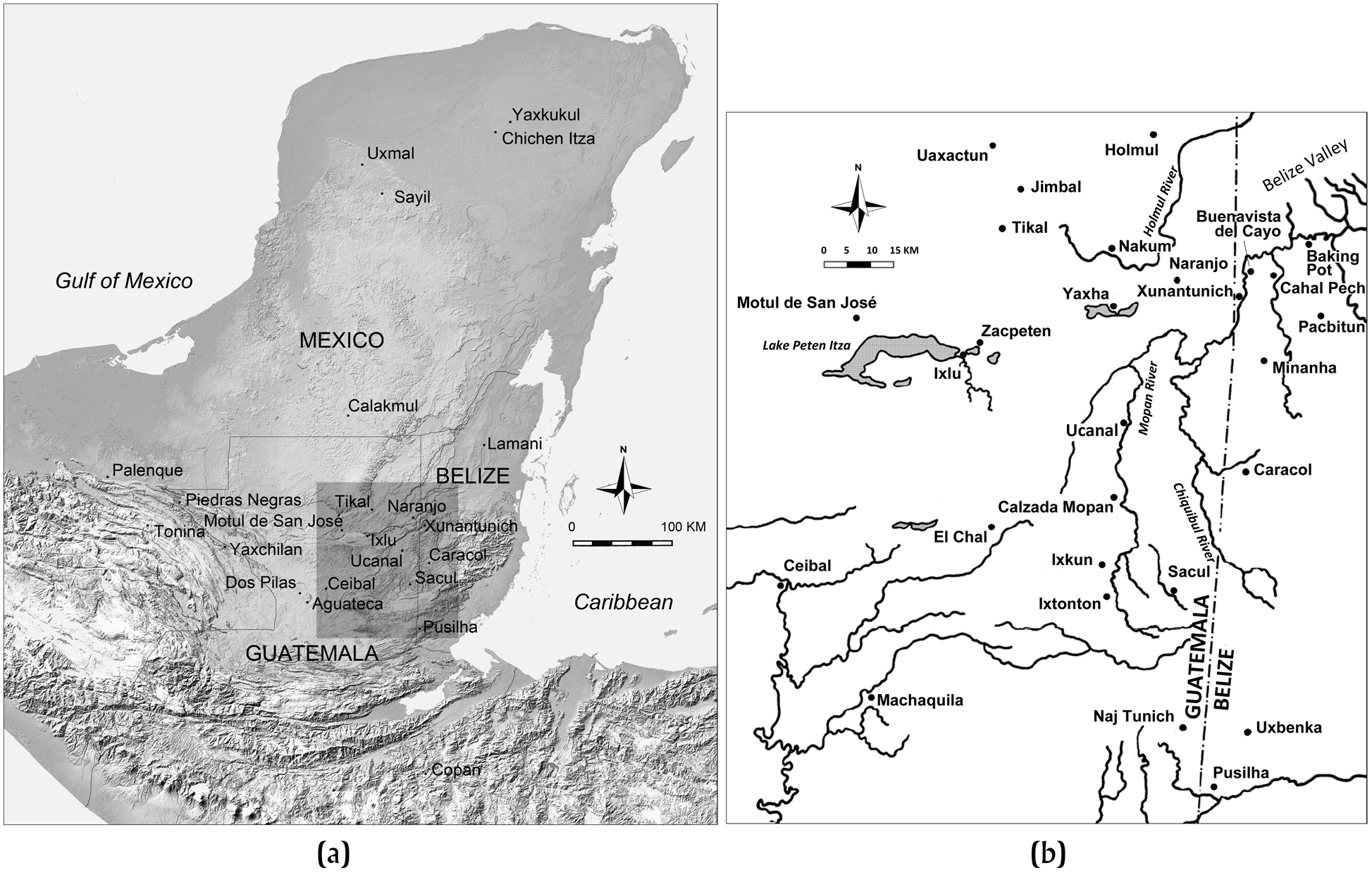
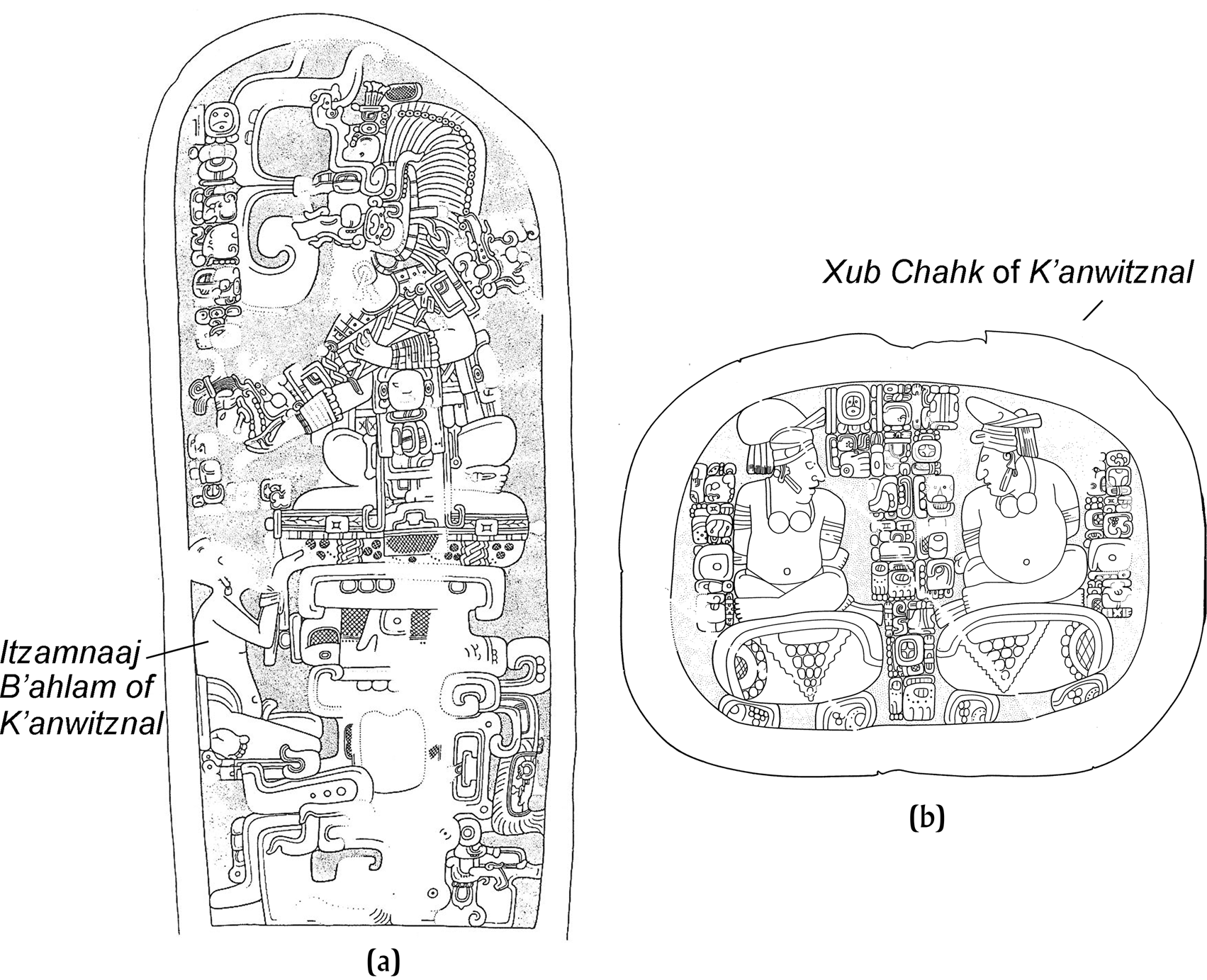
During much of Ucanal's political history, it was drawn in-between the power struggles of larger political powers (Figure 1). During the Early Classic period (ca. a.d. 300–600), Tikal ruler Siyaj Chan K'awiil II (a.d. 411–456) of the Kanu'l dynasty served as an overlord to a K'anwitznal ruler (Martin and Grube Reference Martin and Grube2000:34). Later during the Late Classic period (ca. a.d. 600–830), Ucanal fell to the kingdom of Naranjo between a.d. 698–744. Hieroglyphic texts on Naranjo Stela 22 detail that in a.d. 698, Naranjo attacked the K'anwitznal polity (Houston Reference Houston and Houston1983). In a.d. 702, Naranjo's ruler K'ahk’ Tiliiw Chan Chak took Itzamnaaj B'ahlam I of K'anwitznal captive (Figure 2a). As detailed on Naranjo Stela 2, K'ahk’ Tiliiw Chan Chak then oversaw the accession of Itzamnaaj B'ahlam II in a.d. 712 (Carter Reference Carter2016:244; Schele and Freidel Reference Schele and Freidel1990:189–192). Naranjo's ties with Ucanal are further underscored by an unprovenanced polychrome vessel produced in Naranjo style and chemically sourced to the Naranjo region (MS1684, Cabrito Cream polychrome, Cabrito Variety; Helmke et al. Reference Helmke, Polyukhovych, Reents-Budet and Bishop2017:11; Reents-Budet Reference Reents-Budet1994:360–361), but dedicated to Itzamnaaj B'ahlam of K'anwitznal, suggesting that a Naranjo king patronized the production of a drinking vessel that was gifted to either Itzamnaaj B'ahlam I, or more likely Itzamnaaj B'ahlam II, a probable son and successor. Naranjo's grip on Ucanal, however, may have loosened in a.d. 744, when Tikal invaded Naranjo (Martin Reference Martin, Macri and McHargue1996).
(a) Map of the Maya area with (b) inset map of eastern Peten and western Belize. Maps by Halperin.

Monuments referencing the K'anwitznal kingdom's subordinate status. (a) Naranjo Stela 22 (Schele drawing No. 7648; http://www.famsi.org). (b) Caracol Altar 23. Modified after Grube (Reference Grube, Chase and Chase1994:Figure 9.1).
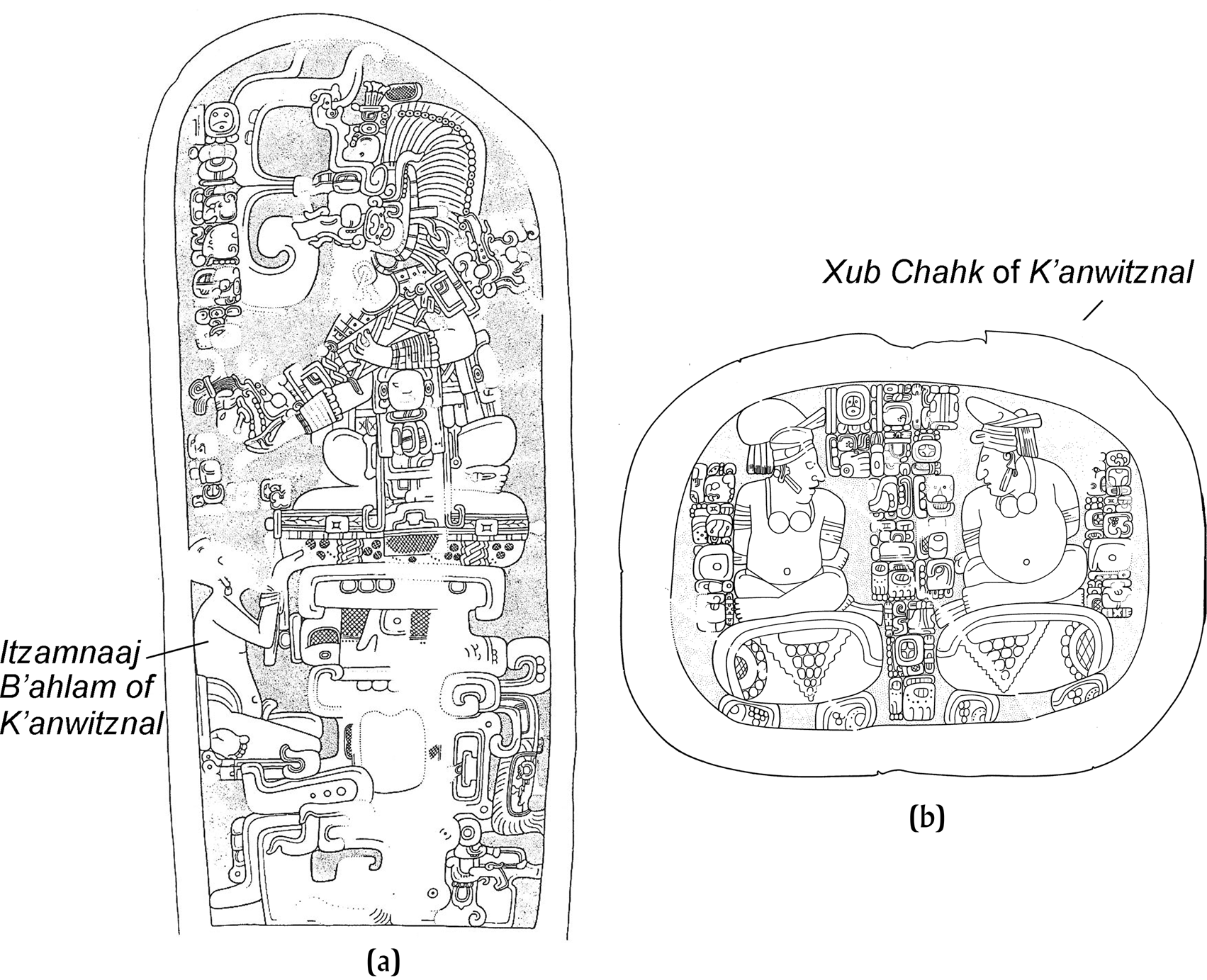
Throughout the Late Classic period, Naranjo was a staunch enemy of Caracol (from at least a.d. 626 onward; Helmke and Awe Reference Helmke and Awe2016; Martin Reference Martin2017; Martin and Grube Reference Martin and Grube2000). Thus, Ucanal, located almost equidistant between the two sites, was situated within a precarious position between these two larger polities (Figure 1). This precarious position was likely heighted by Ucanal's influential role over several small polities in southeast Peten, a region in which Caracol had political networks and may have increasingly sought to control (Carter Reference Carter2016). For example, Itzamnaaj B'ahlam II of K'anwitznal gave a feathered palanquin to the ruler of Sacul in a.d. 760. He is also mentioned on Stelae 4 and 5 of El Chal (Carter Reference Carter2016:245). Ucanal's ties to some of the southeastern Peten sites, however, may have faltered in a.d. 779 when K'iyel Janab of Sacul attacked or “burned” K'anwitznal (Carter Reference Carter2016:243–246). Indeed, Caracol did manage to defeat Ucanal at the end of the Late Classic period. As detailed in Caracol's Altar 23, in a.d. 800 Tum Yohl K'inich of Caracol captured the Ucanal king, Xub Chahk, who was depicted as a bound captive with a ruler from B'ital (Figure 2b; Martin and Grube Reference Martin and Grube2000:97). Four years beforehand, the same Ucanal king appears to have been captured and put on display by Yaxha's ruler K'inich Lakamtuun as seen on Yaxha Stela 31 in a.d. 796 (Stuart Reference Stuart2019).
The tenuous position Ucanal played between the two large superpowers is also evident in its possession of a carved stone monument, Misc. Monument 1, found by Graham (Reference Graham1978:107, 110, Reference Graham1980:152, 154) in Ucanal's Ballcourt #1. This monument is thought to have been part of a larger monumental program outlining Caracol ruler K'an II's conquest of Naranjo during the seventh century (Helmke and Awe Reference Helmke and Awe2016; Martin Reference Martin, Colas, Delvendahl and Schubart2000, Reference Martin2017). Naranjo, however, appears to have transported the sculptured panels from Caracol and placed 12 of the panels in illegible order on a hieroglyphic staircase at the site of Naranjo. Martin (Reference Martin, Colas, Delvendahl and Schubart2000, Reference Martin2017) and Helmke and Awe (Reference Helmke and Awe2016) argue that these panels were war trophies, perhaps related to an a.d. 680 sacking of Caracol by Naranjo. The fact that one of these panels was found at Ucanal suggests that Ucanal too was implicated in the conflict, either as a subordinate to Naranjo with some rights over the taking of war trophies from Caracol or as their own retaliation against Naranjo at the end of the Classic period.
While these monumental records indicate that Ucanal sat at the political frontiers of Naranjo and Caracol, archaeological research at the site of Ucanal by the Proyecto Atlas Arqueológico de Guatemala (1997–2000) directed by Juan Pedro Laporte, and the Proyecto Arqueológico Ucanal (PAU, 2014–2019) directed by Halperin and Garrido, have yet to uncover strong evidence of Ucanal's incorporation or emulation of either of the two larger polities. One of the most revealing expressions of political featly to, and alliance with Naranjo, was in the form of distinctive polychrome serving vessels, such as Cabrito Cream type vessels, some of which exhibit dancing Maize gods and dwarves in red and orange in what is termed the “Holmul dancer theme” (Helmke et al. Reference Helmke, Polyukhovych, Reents-Budet and Bishop2017; Reents-Budet Reference Reents-Budet1994:179–186, Reference Reents-Budet and Kerr2000). Naranjo elites frequently gifted these vessels to lords of subordinate centers, such as Buenavista del Cayo, Baking Pot, Xunantunich, Cahal Pech, Holmul, and Nakum. The unprovenienced vessel produced at Naranjo and dedicated to Itzamnaaj B'ahlam of K'anwitznal (MS1684) provides one example of such a practice more thoroughly documented at these other sites. Many of these subordinate sites, most notably Holmul and Buenavista del Cayo, also produced their own versions of Cabrito Cream polychrome pottery in the style of the pottery produced at Naranjo (Helmke et al. Reference Helmke, Polyukhovych, Reents-Budet and Bishop2017; Reents-Budet et al. Reference Reents-Budet, Bishop, Taschek and Ball2000). Ceramic analyses from materials recovered from the PAU excavations (2016–2018), as well as previous excavations by the Proyecto Atlas Arqueológico de Guatemala (Laporte Reference Laporte2007), however, reveal that Cabrito Cream polychrome pottery is rare, with only a single sherd conforming to this type to date. As such, local ceramic production in the Naranjo style was unlikely to have occurred at Ucanal.
Likewise, many traits specific to Caracol are relatively absent at Ucanal. Some of the most distinctive forms of local identity expression at Caracol and its subordinate satellite sites are face vessels and crude Jaguar God of the Underworld incensarios found in eastern shrine complexes, the use of Belize Red vessels within caches and burials, and the practice of caching small bowls with human fingers (Chase and Chase Reference Chase, Chase, Robertson and Fields1994, Reference Chase and Chase2004b, Reference Chase, Chase, Morris, Awe, Badillo and Thompson2012, Reference Chase and Chase2017). Thus far, caching practices at Ucanal do not exhibit any of these caching and offering traditions, practices that would have been highly meaningful and symbolically potent manifestations of social identity and affiliation. In fact, the emphasis on eastern shrine complexes at Ucanal is noticeably absent with less than one percent of the 681 architectural groups surveyed to date containing eastern shrines.
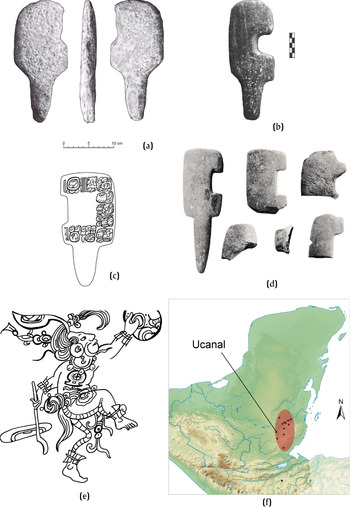
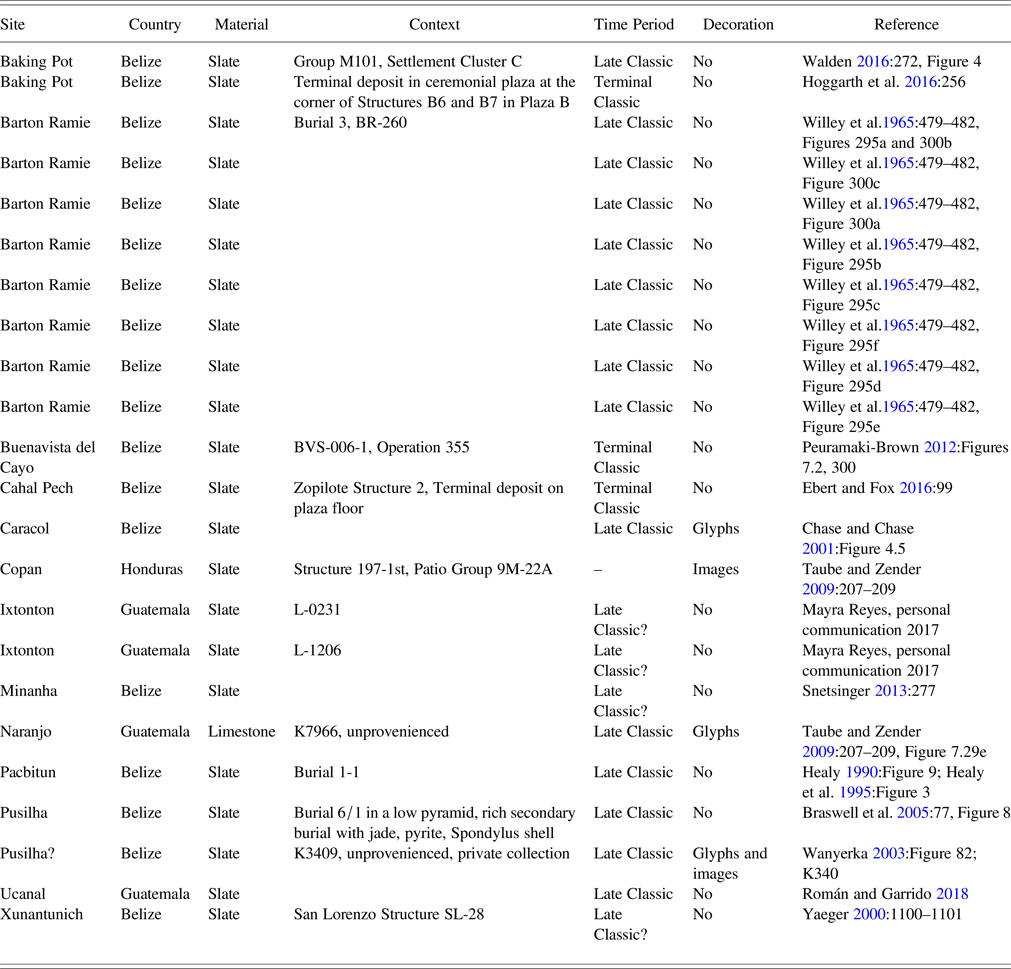
Nonetheless, the material culture of Ucanal residents indicate that the site sat a convergence zone of many different interaction spheres of varying scales, some of which included both Naranjo and Caracol. For example, Ucanal sat at the edge of an eastern Maya tradition involving the use of slate maces (Figure 3, Table 1). Distribution analyses reveals that such maces are found only in the eastern Maya lowlands, with a particularly strong presence in the Upper Belize Valley (Barton Ramie, Baking Pot, Buenavista del Cayo, Cahal Pech, Xunantunich, Minanha, Pacbitun), but also within and south of the Maya Mountains (Caracol, Pusilha, and Copan), and eastern Peten (Naranjo [limestone varieties], Ixtonton, and Ucanal).
Late Classic maces from the eastern Maya lowlands and instruments of ritual combat. (a) Slate mace from Ucanal (MCML-049; UCA14A-3-4-1105). Drawing by Luis F. Luin. (b) Slate mace from Pacbitun. After Healy et al. (Reference Healy, Awe, Iannone and Bill1995:Figure 3). (c) Limestone mace with glyphic inscription mentioning Naranjo king. After Grube (Reference Grube, Chase and Chase1994:Figure 10). (d) Slate maces from Barton Ramie, Belize. After Willey et al. (Reference Willey, William, Bullard, Glass and Gifford1965:Figure 295a). (e) Chahk with manopola in left hand and axe in right hand. Drawing by Halperin after K0521 (http://www.famsi.org). (f) Distribution of maces with concentrated zone in the eastern lowlands highlighted (see Table 1 for data). Map by Halperin.

Maces (i.e., short clubs and wrenches) from the Maya area.

Taube and Zender (Reference Taube, Zender, Orr and Koontz2009:207–209) have argued that these objects were used in ritual combat, similar to manopolas. If this is the case, we suspect that incised maces with hieroglyphic texts may have been largely ceremonial and rarely used for actual combat. In contrast, the undecorated ones often show signs of considerable wear in the form of markings from a sharp, pointed object. As such, it is likely that the maces were used for both bashing (offense) and shielding from a pointed object (defense from an axe or lance). Although depictions of such maces are absent in Maya iconography, it is common to see the deity Chak depicted with both a chert axe (offense) and manopola (offense and defense), suggesting that the combination of offensive and defensive weapons were used together during close-contact ritual combat (see also Taube and Zender Reference Taube, Zender, Orr and Koontz2009:Figures 7.11a and 7.12). The finding of an almost complete slate mace with a complete monolithic axe and chert celt from Barton Ramie's Burial 3, BR-260, may support the idea that axes and maces were used together (Willey et al. Reference Willey, William, Bullard, Glass and Gifford1965:479–482). Experimental studies, however, are needed to better understand their possible uses and pairing together. Regionalism in other types of sporting and ritual combat practices is noted for other areas of Mesoamerica, such as the use of stone hachas and yokes, which were concentrated along the Gulf coast and the Guatemalan Highlands (Shook and Marquis Reference Shook and Marquis1996).
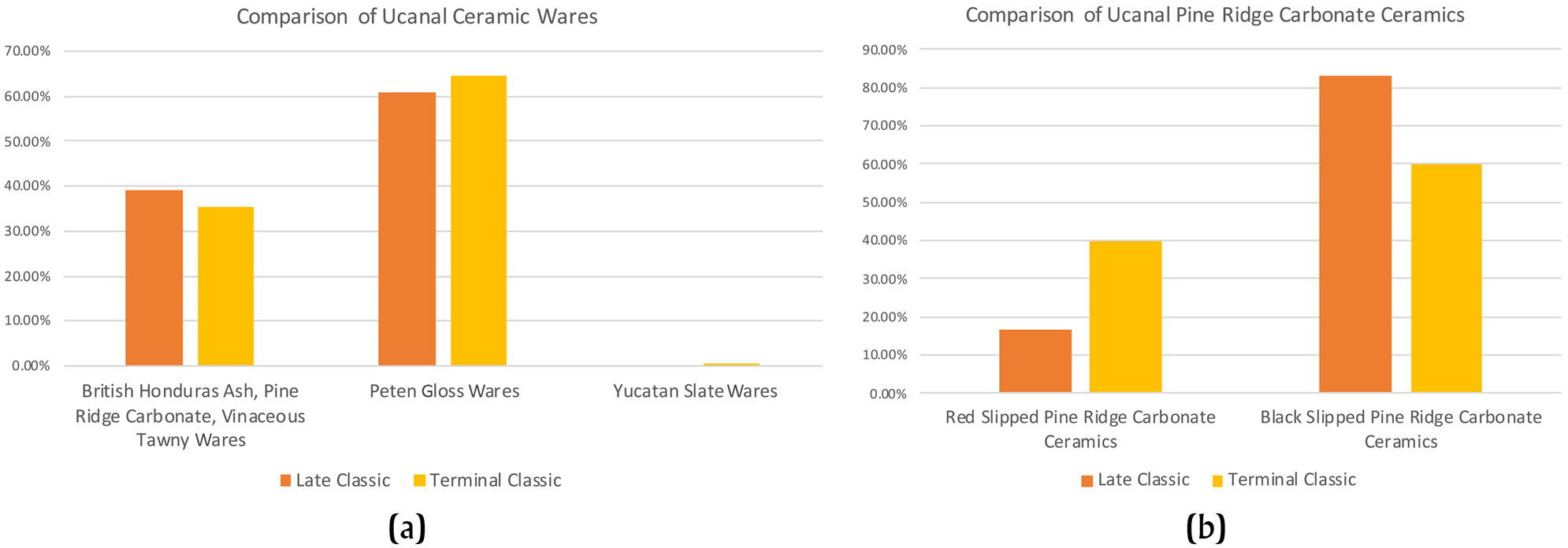
Ceramic analyses also indicate that Ucanal sat at the intersection of slipped and polychrome ceramic ware types that were popular among sites in Peten and sites in Belize (Figure 4a). Monochrome and polychrome ceramics from Ucanal include Tinaja, Harina, Azote, Remate, Maquina, Infierno, Achote, Juleki, Saxche-Veracal, Saxche-Palmar, and Zacatal ceramic groups (all part of Peten Gloss wares), which are the most common slipped ceramics among Peten sites. Ucanal, however, also possesses slipped ceramics that are common to western Belize: the Upper Belize River Valley, the Mountain Pine Ridge, and parts of the Maya Mountains. These ceramics include Pine Ridge Carbonates (e.g., Dolphin Head Red, Mount Maloney, and Garbutt Creek groups), British Honduras Ash Wares (e.g., Belize Red, Platon Punctated-incised, and Martins-incised) and Vinaceous Tawney wares (Chase and Chase Reference Chase, Chase, Morris, Awe, Badillo and Thompson2012; Gifford Reference Gifford1976; Kowakowsky Reference Kowakowsky2012; LeCount Reference LeCount1996; LeCount et al. Reference LeCount, Yaeger, Leventhal and Ashmore2002). Both the Belize- and Peten-based ceramic ware ceramics were found in all excavated contexts from elite, ceremonial, middle-status, to commoner household contexts.
Ucanal ceramic frequency comparisons (data from 2016–2018 field seasons). (a) Slipped ware comparisons. (b) Red-slipped (Garbutt Creek Red and Dolphin Head Red types) and Black-slipped (Mount Maloney) Pine Ridge Carbonate Ceramics. Graphs by Halperin.

Interestingly, Ucanal exhibits a high frequency of black-slipped Mount Maloney ceramic types in comparison to red-slipped Pine Ridge Carbonate vessels, such as Garbutt Creek and Dolphin Head Red types (Figures 4b and 5a). Mount Maloney ceramics are known to have been used overwhelmingly at the site of Xunantunich (over 94 percent of Pine Ridge Carbonates are Mount Maloney types) and its affiliated centers, such as Chan, Actuncan, and San Lorenzo (Kowakowsky Reference Kowakowsky2012; LeCount Reference LeCount2010a, Reference LeCount, LeCount and Yeager2010b:Tables 10.1, 10.2, 10.4, Reference LeCount2017:172–173). These vessels were not only the principal “workhorses” of quotidian cooking and food serving at these sites, they were also the choice vessels for socially and ritually significant cache deposits and burials offerings. In contrast, Mount Maloney ceramics comprise a small minority of the Pine Ridge Carbonate ceramics east and south of Xunantunich, such as at the sites of X-ual-Canil, Pacbitun, Baking Pot, and Caracol (Connell Reference Connell, LeCount and Yaeger2010:309). Unlike Ucanal, however, Xunantunich possesses very minor frequencies of Peten Gloss wares (less than 2.4 percent of all Late Classic ceramics) during the Late Classic period (LeCount Reference LeCount1996:Table 5.9, Reference LeCount1999:199). In turn, other Peten sites, such as Holmul and surrounding sites, which are located close to the Belize Valley, possess no Pine Ridge Carbonate, Vinaceous Tawny, or British Honduras Ash wares whatsoever during the Late and Terminal Classic period (Callaghan and Neivens de Estrada Reference Callaghan and de Estrada2016). Likewise, Southeastern Peten sites along the Mopan, Salispuedes, San Juan, Poxte, and Machaquila rivers explored by the Proyecto Atlas Arqueológico reveals that British Honduras Ash and Pine Ridge Carbonate wares (no Vinaceous Tawny reported) possess 0.84 percent of slipped wares during the Late Classic period and 2.76 percent of slipped wares during the Terminal Classic period (Laporte Reference Laporte2007:837–838, 1209–1218). Caracol possesses a mix of Peten gloss and Pine Ridge Carbonate, Vinaceous Tawny, and British Honduras Ash wares, but percentages of wares and their groups/types are not reported (Chase and Chase Reference Chase, Chase, Demarest, Rice and Rice2004a, Reference Chase, Chase, Varela and Foias2005, Reference Chase, Chase, Morris, Awe, Badillo and Thompson2012).
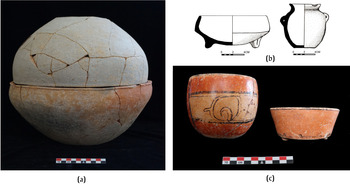
Ceramic vessels from Ucanal burials. (a) Late Classic Mount Maloney (top) and Garbutt Creek Red (bottom) bowls holding cremated individual, Burial 21-1. (b) Orange slipped Pine Ridge Carbonate bowl with inflexed rim (left) and miniature Mount Maloney jar (right) from Terminal Classic Burial 8-1. (c) Saxche Orange Polychrome (Late Classic Tepeu 1; left) and Xunantunich Black-on-Orange bowl (Late Classic Tepeu 2; right) from Burial 1-1. Photographs and drawings by Halperin.

The higher frequencies of Mount Maloney among Pine Ridge Carbonate wares at Ucanal are not surprising given Ucanal's physical proximity to Xunantunich along the Mopan River. In addition, the two sites possessed a special political relationship as recent excavations reveal that Xunantunich possessed two “war trophy” monuments from the same monumental program thought to have originated at Caracol's Structure B-5, similar to Naranjo and Ucanal mentioned earlier (Helmke and Awe Reference Helmke and Awe2016; Martin Reference Martin, Colas, Delvendahl and Schubart2000, Reference Martin2017). The smaller number of monuments from Xunantunich and Ucanal suggests that they were more minor players in the transport and display of conquest monuments than Naranjo.
Despite evidence of ties between Ucanal and Xunantunich, Ucanal inhabitants did not make strong symbolic statements of affiliations to any one site or region in the use of offering and cache vessels in burials. In fact, if ceramic style affiliations of particular regions were meaningful on a symbolic level, more effort appears to have been made to combine or juxtapose diverse style regions rather than represent a single one. For example, a Late Classic cremation burial, Burial 21-1, contained Garbutt Creek Red and Mount Maloney bowls placed lip-to-lip (Figure 5a), bringing together bowls affiliated with different regions of the Belize Valley as mentioned above. A Terminal Classic child burial, Burial 8-1, contained a miniature Mount Maloney jar and miniature Orange-slipped Pine Ridge Carbonate bowl (Figure 5b). Both of these vessels contained reddish-brown pastes with calcite and ferruginous temper typical of Pine Ridge Carbonate ceramics from the Belize Valley, but the small bowl has a form more typically found at Peten sites with an inflexed rather than an incurved rim (Fialko Reference Fialko, Varela and Foias2005:67; LeCount et al. Reference LeCount, Yaeger, Leventhal and Ashmore2002:50–51, Figures 7a and 7c; Sabloff Reference Sabloff and Willey1975). Likewise, a Late Classic (Tepeu 2) burial, Burial 1-1, contained a Tepeu 1 phase Saxche Orange Polychrome (Peten Gloss ware) bowl and a Xunantunich Black-on-Orange (Vinaceous Tawny ware) bowl, a type more common in the Upper Belize River Valley (Figure 5c; Gifford Reference Gifford1976:269–272; Smith and Gifford Reference Smith and Gifford1966:155).
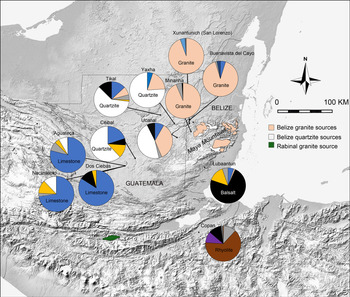
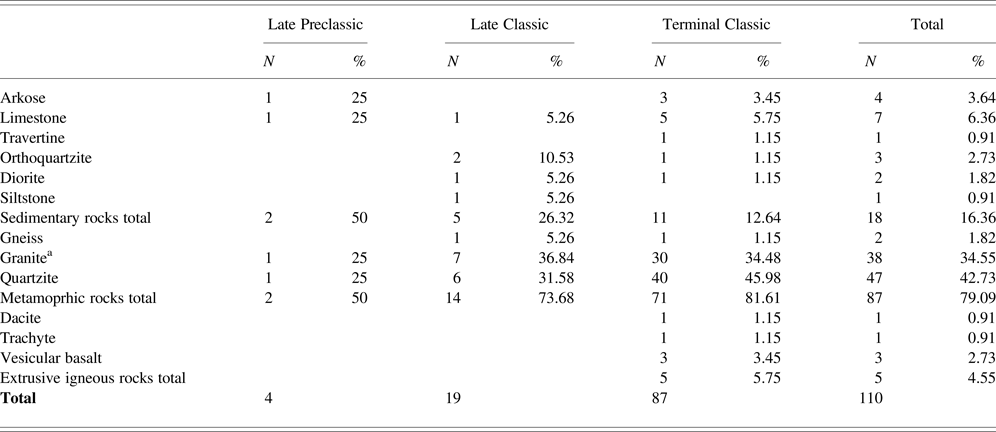
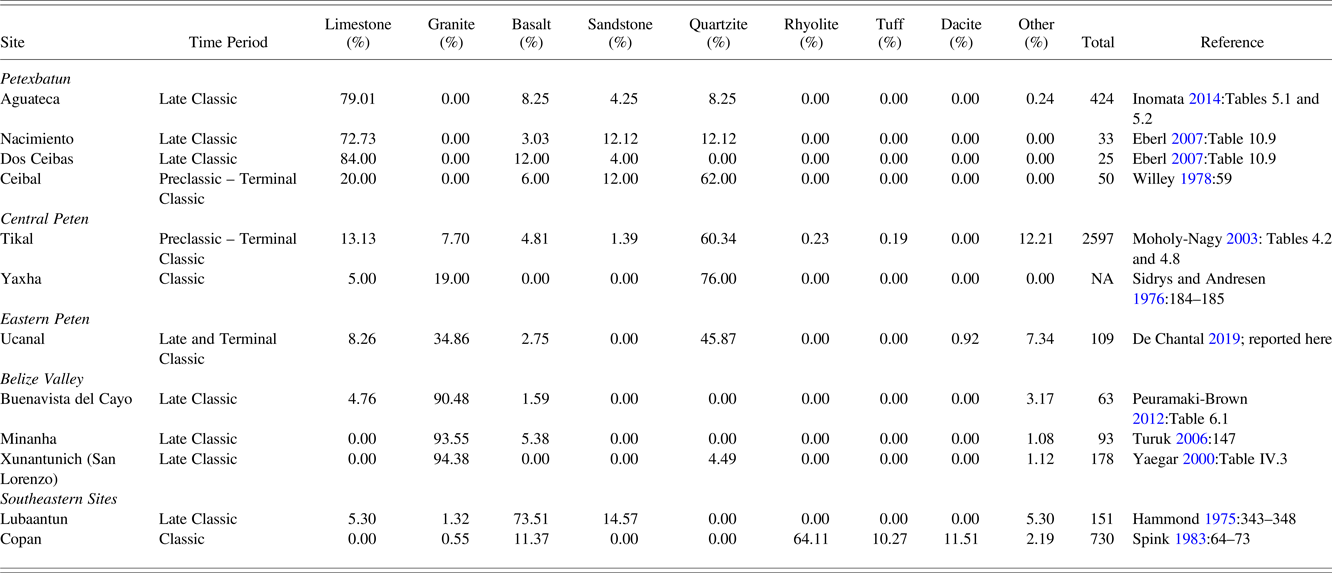
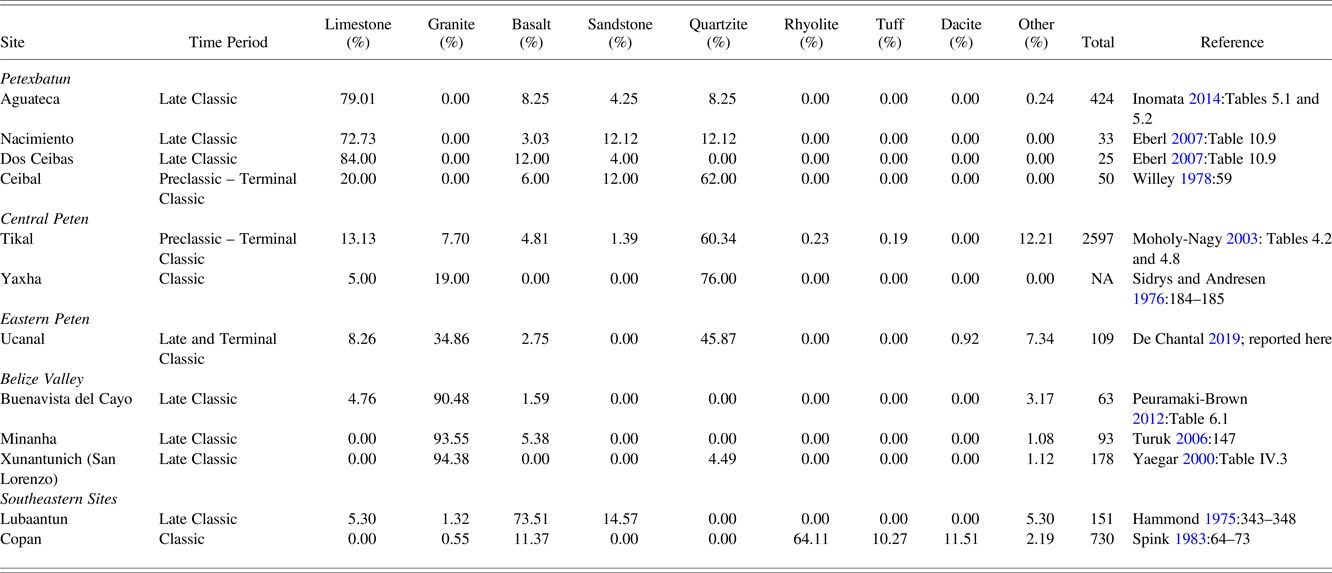
Analysis of ground stone artifacts also reveals that Ucanal sat at the intersection of the economic networks and/or cultural preferences of the Belize Valley and central Peten. Ucanal relied primarily on quartzite and granite mano and metates in roughly equal proportions (Table 2; De Chantal Reference De Chantal2019). As identified by chemical analyses and the pink-gray color characteristics of the granite, the granite manos and metates derive from three principal sources from the Maya Mountains: the Mountain Pine Ridge, Hummingbird/Mullins River, and Cockscomb Basin (Figure 6; De Chantal Reference De Chantal2019). Likewise, the closest known quartzite source to central Peten sites is located on the northern side of the Maya Mountains, between the Mountain Pine Ridge and Hummingbird/Mullins River batholiths (Dixon Reference Dixon1956:34–56; Vinson Reference Vinson1962; Wadell Reference Wadell and Morley1938). In contrast to the Ucanal ground stone, most central and southern Peten sites relied more heavily on quartzite and limestone for their manos and metates. Belize River Valley sites, located close to both quartzite and granite sources in the foothills of the Maya Mountains, almost predominately used granite manos and metates (Figure 6, Table 3). Since the Belize Valley sites are located relatively close to both granite and quartzite sources and both rocks are equally hard (quartzite being only half a point harder on the Mohs scale), the choice to use granite may have represented a cultural preference or an historically embedded network of greater importance. Although Ucanal continued to sit at a crossroads of interaction spheres later during the Terminal Classic period, the nature and directions of these interaction spheres changed as outlined below.
Map of the Maya area with mano and metate source distributions and granite and quartzite source locations highlighted (ground stone data in Table 3). Geologic source locations from Solari (Reference Solari, Gomez-Tuena, Ortega-Gutiérrez and Ortega-Obregon2011:Figure 1) and Cornec (Reference Cornec2003).

Raw material of Ucanal manos and metates (excavated during the 2016–2018 field seasons) by time period. Does not include other groundstone artifacts such as pestles, mortars, stone spindle whorls, slate mirror backings, sculpted jade, and hammerstones.
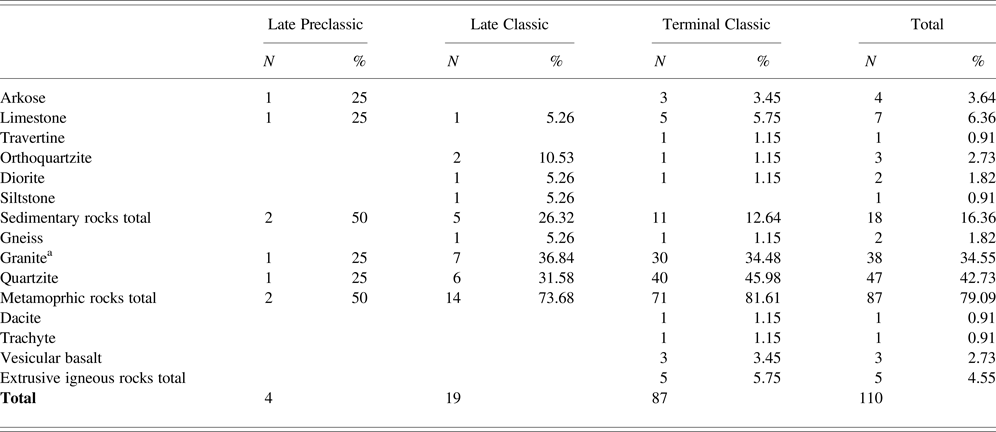
a Includes 3 granodiorite samples.
Raw materials of manos and metates from southern lowland sites.
AT A CROSSROADS BUT WITHOUT A CLEAR CENTER
At the beginning of the Terminal Classic period, Ucanal helped set up a new decentralized political order in Peten with a cohort of other previously subordinate political powers, such as Ceibal, Ixlu, Calzada Mopan, Nakum, and Jimbal. One day before the turning of baktun 10 in a.d. 830, the Ucanal lord Kan Ek’ Jo’ Pet helped oversee the arrival of Aj B'ahluun Ha'b’tal Wat'ul K'atel to Ceibal, an event that helped establish the site as the new seat of power in the Petexbatun region. During the Late Classic period, Ceibal was previously a small kingdom that had been under the grip of Dos Pilas and Aguateca (Schele and Mathews Reference Schele and Mathews1998:179–183).
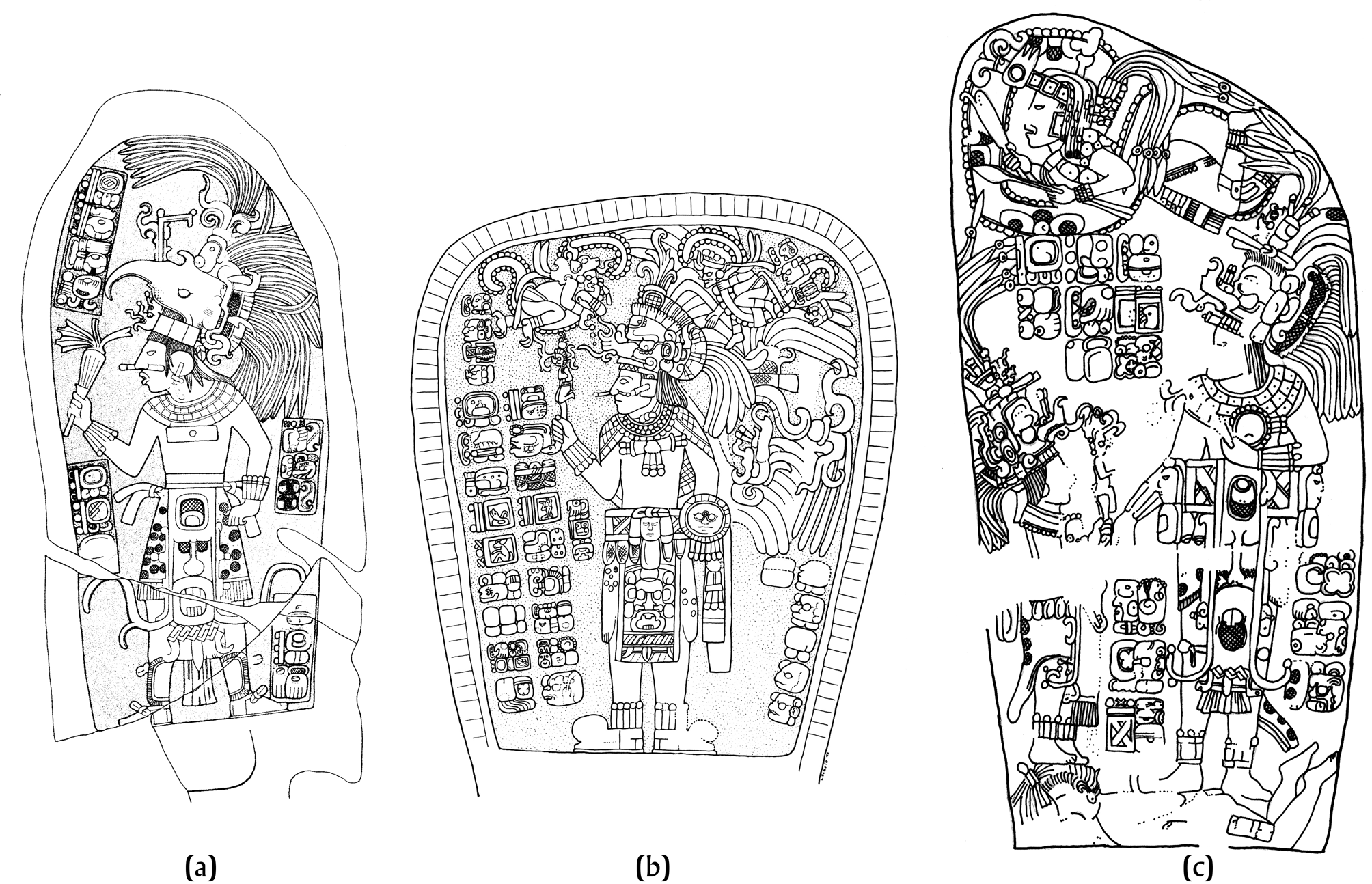
Many of these smaller political centers began to erect a new style of stela monument that broke earlier traditions by referencing foreign artistic and writing styles. These stelae (1) often contained figures floating in dotted “S”-shaped cloud scrolls above the ruler, (2) eclectically referenced foreign styles, (such as the use of central Mexican style atlatls), (3) featured rulers with tubular nose ornaments, and (4) showcased square-shaped glyphs, which are a reference to foreign, non-Maya writing systems from Mexico (Figure 7; Just Reference Just2007; Lacadena Reference Lacadena, Vail and Hernández2010; Proskouriakoff Reference Proskouriakoff and Wauchope1965; Rice and Rice Reference Rice, Rice, Demarest, Rice and Rice2004:204–220).
Terminal Classic monuments. (a) Machaquila Stela 5, a.d. 840. After Graham (Reference Graham1967:Figure 53). (b) Jimbal Stela 1, a.d. 879 (Schele drawing No. 2029; http://www.famsi.org). (c) Ucanal Stela 4, a.d. 849. After Graham (Reference Graham1980:Figure 2-159).

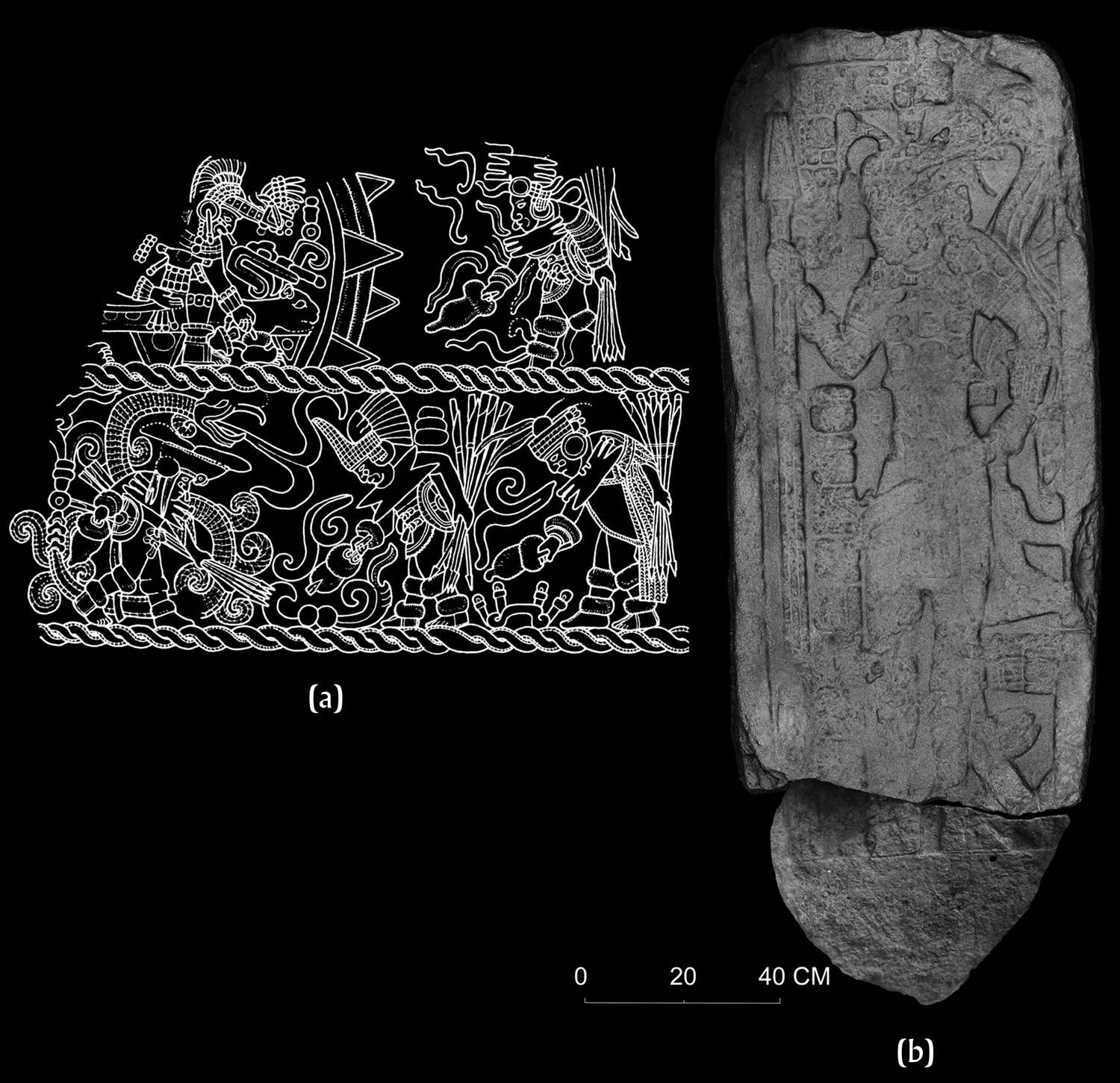
Although Ucanal's participation in this new monumental style is known primarily from Ucanal Stela 4 (Figure 7c; Graham Reference Graham1980:159–160), a stela recently discovered by the PAU in 2019, Stela 29, also conforms to this new style (Figure 8b; Halperin and Martin Reference Halperin and Martin2020). The simply adorned ruler on Stela 29 dons a central Mexican style atlatl (see comparative examples from Slater [Reference Slater2011] and Hruby [Reference Halperin and Hruby2019]) and holds three long darts, identified by the triangular shape of the stone point and their plurality since darts are almost always carried in multiples. The long length of the darts are a feature, in particular, of warriors from Chichen Itza (Figure 8a; Ringle Reference Ringle2009) and Cacaxtla (Brittenham Reference Brittenham2011). Classic-period depictions of Maya rulers, in contrast, commonly held a single spear, identified by the laurel-shape of the stone point. The ruler wears a warrior's shirt, what is known as ichachuipilli in Nahuatl (Anawalt Reference Anawalt1981:47–48). This short-sleeved shirt is decorated with dots or disc beads similar to the floating figure in Ucanal Stela 4, who also holds a central Mexican style atlatl and darts, and a figure Ringle (Reference Ringle2009:Fig.15c) calls “warrior B” on the Upper Temple of the Jaguars at Chichen Itza (see Halperin and Martin [Reference Halperin and Martin2020] for a more detailed description of Stela 29).
Terminal Classic iconography with central Mexican style darts and atlatl. (a) Detail from upper register, interior wall, Lower Temple of the Jaguars, Chichen Itza. Modified after Schele drawing No. 5019 (http://www.famsi.org). (b) Ucanal Stela 29. Photogrammetry reconstruction by Marion Radenne based on photographs by Halperin.

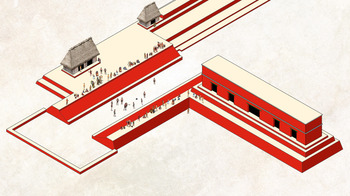
In addition to establishing a new monumental repertoire, flourishing Terminal Classic sites from the southern Maya lowlands began to adopt a new foreign style of ballcourt: courts with alleyways shaped in the form of a “T” (half-enclosed) or an “I” (enclosed on both sides). In contrast, the typical Classic-period ballcourt form in the southern Maya lowlands was an open-ended playing alley. Interestingly, the sites that possessed monuments or monumental artifacts with square-shaped glyphs (e.g., Jimbal, Ucanal, Ceibal, and possibly Calzada Mopan), also constructed “I” or “T”-shaped ballcourts (Figure 9; Laporte and Mejía Reference Laporte and Mejía2002; Roldán Reference Roldán, LaPorte and Escobedo1996; Willey et al. Reference Willey, Ledyard Smith and Sabloff1982). Although not a site that exhibited square-shaped glyphs, Xunantunich built a “T”-shaped ballcourt that also featured a circular ballcourt ring, a characteristic of courts from the northern Maya lowlands and other parts of Mexico (Awe et al. Reference Awe, Helmke, Slocum and Tilden2020). Indeed, enclosed “I” shape or half-enclosed “T”-shaped ballcourts are most commonly encountered outside the southern Maya lowlands. During the Late and Terminal Classic period, they appear at sites in Chiapas (e.g., Tonina and the Upper Grijalva Basin) and northern Yucatan, most notably at Chichen Itza, Sayil, and Yaxkukul (Montmollin Reference Montmollin1997; Scarborough Reference Scarborough, Scarborough and Wilcox1991; Smith Reference Smith2001; Taladoire Reference Taladoire1981; Taladoire and Colsenet Reference Taladoire, Colsenet, Scarborough and Wilcox1991). Other possible foreign influences in Ucanal's architecture include architectural groups with low, centrally located altars (Halperin and Garrido Reference Halperin and Garrido2019), and a sunken ceremonial patio in Ucanal's Group M (LaPorte and Meija Reference Laporte and Mejía2002:16).
Example of T-shaped ballcourt from the site of Ucanal. Reconstruction drawing by Luis F. Luin based on excavation data from the Proyecto Arqueológico Ucanal.

These monuments and architectural expressions suggest that Ucanal was part of a new cohort of baktun 10 polities, although no single one of these polities appear to have stood out to distinguish itself or dominate over the others. In contrast, more emphasis was placed on eclectically incorporating “international” influences and engaging in broad-reaching ties within and beyond the southern Maya lowlands (Halperin Reference Halperin2017; Halperin and Garrido Reference Halperin and Garrido2019; Just Reference Just2007; Nagao Reference Nagao, Diehl and Berlo1989; Ringle et al. Reference Ringle, Negrón and Bey1998). It was during this time period in which we see Yucatecan ceramic types (Puuc Red) at the site of Ucanal for the first time, although in very small percentages relative to other ceramic types (n = 39 sherds; 0.8 percent). The site also opened up stronger ties south of Peten, as attested to an increase in ground stone tools from the extrusive igneous source locations in highland Guatemala (Table 2). In general, the Terminal Classic period is known as a time in which new trade networks opened up (Demarest et al. Reference Demarest, Rice and Rice2004; Masson and Freidel Reference Masson and Freidel2002).
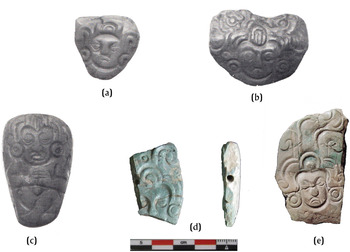
In addition, excavations at Ucanal's Group J recovered a carved jade pendant plaque and marine shell ornaments strewn on the surface of a Terminal Classic floor in front of Structure J-6 (Figure 10). This jade plaque is of the “drooping-mouth” style (Proskouriakoff Reference Proskouriakoff1974:97–98, Plate 53b; Smith and Kidder Reference Smith and Kidder1951:37), which often features a frontal view of a Maize god with a headdress of thick foliage and carved with tubular drills. Jade pendants in the “drooping mouth” style were part of Epiclassic and Terminal Classic elite networking and exchanges of inalienable objects throughout Mesoamerica. They have been documented primarily outside of Peten at sites such as Xochicalco, Morelos (Hirth Reference Hirth2000:Figure 9.3); Caxcatla, Puebla (Nagao Reference Nagao, Diehl and Berlo1989:Figure 8); Monte Alban, Oaxaca (Nagao Reference Nagao, Diehl and Berlo1989:90); San Geronimo, Guerrero (Hirth Reference Hirth2000:203); Chichicastenango, Guatemala (Digby Reference Digby1972:Plate XIVa); San Salvador, El Salvador (Digby Reference Digby1972:Plate XIVc); Tula, Hidalgo (Diehl Reference Diehl1983:Figure 51); Chichen Itza, Yucatan (Proskouriakoff Reference Proskouriakoff1974:Plate 53b); and Nebaj, in the Guatemalan Highlands (Smith and Kidder Reference Smith and Kidder1951:Figure 52g), although see also examples from Topoxte, Peten, Guatemala (Castillo Reference Castillo2005:TPV014, TPV037, TPV048) and Pusilha, Belize (Braswell Reference Braswell, Prager and Bill2005 et al.:Figure 11). Notably, the example from Ucanal closely resembles the examples from Chichen Itza (Proskouriakoff Reference Proskouriakoff1974:Plate 53b).
Jade pendant plaques in the “drooping-mouth” style from: (a) Chichicastenango (modified from Digby Reference Digby1972:PlateXIVa); (b) Oaxaca (modified from Digby Reference Digby1972:PlateXIVd); (c) San Salvador (modified from Digby Reference Digby1972:PlateXIVd); (d) Ucanal (photograph by Halperin); and (e) Chichen Itza (modified from Proskouriakoff Reference Proskouriakoff1974:Plate 53).

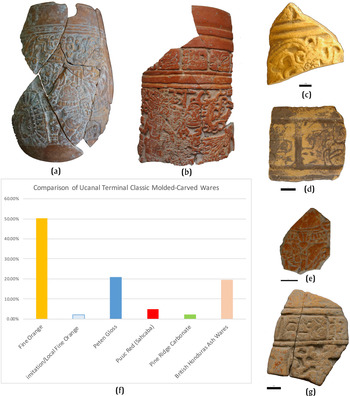
During the Terminal Classic period, Ucanal also continued to serve as a convergence zone of influence between eastern sites in Belize and sites in western Peten, although Ucanal appeared to forge slightly stronger ties with sites to the west. For example, Ucanal sat at the intersection of three molded-carved vessel traditions, (1) Ahk'utu’ molded-carved vases, which possess Pine Ridge Carbonate and British Honduras Ash pastes typically found at sites throughout Belize, (2) molded-carved vessels produced with Peten Gloss wares (what have often been called Portia Gubiado-Inciso or Sahcaba types) and found throughout central and eastern Peten, and (3) Pabellon molded-carved produced with Fine Orange pastes, ceramics produced in several locations in the western Maya lowlands, primarily at sites along the Usumacinta River (Figure 11; Bishop et al. Reference Bishop, Sears, Blackman and Cabos2012:2012; Foias and Bishop Reference Foias, Bishop, Varela and Foias2005; Helmke and Reents-Budet Reference Helmke and Reents-Budet2008; Ting Reference Ting2015; Ting et al. Reference Ting, Martinón-Torres, Graham and Helmke2015). These vessels were the quintessential feasting and food serving wares for elite and middle-status households, and likely served as highly symbolic gifts used to cement political and social alliances. The iconography, epigraphy, and vessel forms of those produced with Pine Ridge Carbonate and British Honduras Ash pastes differ from those produced with Peten Gloss and Fine Orange pastes (see descriptions in Helmke and Reents-Budet [Reference Helmke and Reents-Budet2008]). Although Ucanal possesses all three of these molded-carved ceramic types as well as a possible locally produced version of Fine Orange molded-carved, Pabellon molded-carved make up the largest frequency of these vessels at the site, suggesting that ties with Ceibal and other sites near and along the Usumacinta River to the west were particularly strong during this time. In contrast, the dwindling populations at the previously dominant Classic-period polities, such as Tikal and Naranjo, possessed very little to no Fine Orange vessels (Aquino Reference Aquino2007:602; Culbert Reference Culbert and Sabloff2003:62; Fialko Reference Fialko, Varela and Foias2005:66–67).
Comparison of molded-carved ceramics from Ucanal. (a) Pabellon molded-carved (UCA024). Photograph by Halperin. (b) Ahk'utu' molded-carved from LaBlanca, a site within 5 km of Ucanal (PLB009). Photograph by Halperin. Courtsey of Cristina Vidal-Lorenzo, Proyecto La Blanca. (c) Molded-carved vessel with British Honduras Ash paste (UCA340) Photograph by LeMoine. (d) Possible Ahk'utu' molded-carved with British Honduras Ash paste (UCA1296). Photograph by LeMoine. (e) Ahk'utu' molded-carved with Pine Ridge Carbonate paste (UCA818). Photograph by LeMoine. (f) Molded-carved vessels from Ucanal (2016–2018) with comparison of ware types in percent. Note that LaBlanca vessels are not included in graph. (g) Molded-carved with Peten Gloss paste (UCA148). Photograph by LeMoine. Black lines refer to 1-cm scale.

CONCLUSIONS
Epigraphic research reveals that the K'anwitznal polity was likely a political frontier between the warring political powers of Naranjo and Caracol, underscoring the critical role provincial polities played in the making—and unraveling of—larger, centralized polities. The type of boundary zone Ucanal embodied, however, was not a line between two entities or even an end point of a singular dominant polity. Rather, the site served as a dynamic convergence of political forces and cultural groups. While Kopytoff (Reference Kopytoff and Kopytoff1987:5) underscored that political frontiers often emulated their metropoles, and other Maya studies show that peripheral provincial polities’ political expressions, economic networks, and practices of affiliations had the potential to conform closely to the dominant center (Golden et al. Reference Golden, Scherer, Munoz and Vasquez2008; LeCount and Yaeger Reference LeCount and Yaeger2010), archaeological investigations at the site of Ucanal indicate that it straddled and mixed influences from multiple entities, serving more as a bridge more than an edge.
Ucanal took advantage of its positioning at the fringes of these larger polities to negotiate and network with a range of different political entities and actors. For example, although official written histories in stone do not often detail the relationships between subordinate polities, it is clear that during the Late Classic period, inhabitants at the site of Ucanal forged valuable political-economic relationships with Belize Valley sites, and in particularly Xunantunich to the northeast. In turn, Ucanal had strong relationships with southeastern Peten sites upstream on the Río Mopan. In considering multiple scales of interaction spheres, however, it is clear that Ucanal also sat on the western boundary of a larger sporting and ritual combat tradition of stone maces that included both Naranjo and Caracol as well as other sites in the eastern lowlands. Thus, while the K'anwitznal polity was in the unfortunate position to be caught in-between a tumultuous Classic-period political landscape, it also adopted the expressions and practices of multiple regions.
During the Terminal Classic period, Ucanal and other previously subordinate, provincial polities in Peten launched a new decentralized political order. Ucanal created new political ties to Petexbatun sites to the southwest as well as Yucatecan sites to the north. In addition, it forged economic networking ties to the Guatemalan Highlands. Similar to flourishing Epiclassic sites elsewhere in Mesoamerica (Brittenham Reference Brittenham2015; Hirth Reference Hirth2000; Kowalski et al. Reference Kowalski and Kristan-Graham2007; Nagao Reference Nagao, Diehl and Berlo1989; Ringle et al. Reference Ringle, Negrón and Bey1998), Ucanal's new political identity did not present itself as the inheritor of a single dominant power or region. Rather, Terminal Classic Maya centers emphasized their eclectic affiliations within a larger Mesoamerican world whereby the local was merged with multiple regions and foreign entities. In this sense, even though the K'anwitznal polity became an independent political power during this time, it continued to position itself at a crossroads of traditions and influences.
RESUMEN
El sitio arqueológico maya de Ucanal se encuentra en Petén, Guatemala, cerca de la frontera contemporánea con Belice. En la época precolombina, el sitio también se encontraba en las fronteras de algunos de los centros políticos más grandes, Naranjo en Petén Guatemala y Caracol, en Belice. Enredada entre estos centros dominantes y con lazos con los pueblos del Valle del Alto Belice, la región de Petexbatun en Guatemala, Yucatán y otros lugares, Ucanal era una zona de convergencia crítica de interacción política y cultural. Este documento sintetiza la investigación arqueológica del Proyecto Arqueológico Ucanal para subrayar las formas en que esta entidad política provincial, identificada epirográficamente como K'anwitznal, maniobraba dentro y entre diferentes afiliaciones culturales y redes políticas. Descubrimos que el papel del sitio como frontera política durante el período clásico tardío fue más un puente que un limite de interacciones. Durante el período posterior del clásico terminal, el reino K'anwitznal se independizó, pero continuó sirviendo como una convergencia crítica de influencias y esferas de interacción en toda el área maya y más allá.
ACKNOWLEDGMENTS
Research by the Proyecto Arqueológico Ucanal was funded by grants from the Social Science and Humanities Research Council of Canada (SSHRC/CRSH), the National Geographic Society Waitt Foundation, Fonds de Recherche du Québec—Société et Culture (FRQSC), San Diego Mesa College, and Université de Montréal. We thank our project excavators and personnel from San José, Barrio Nuevo San José, La Blanca, and Pichelito II for their expertise and assistance in the field. We also thank the students and professional archaeologists from Universidad de San Carlos de Guatemala (CUDEP and Guatemala City), Université de Montréal, San Diego Mesa College, University of West Florida, University of Mississippi, and University of Kentucky. We are grateful to the Departmento de Monumentos Prehistóricos y Coloniales from the Ministerio de Cultura y Deportes in Guatemala for their support and permission to work at Ucanal. Finally, we are grateful to three reviewers for their comments to the manuscript.