INTRODUCTION
The Mediterranean environment is characterised by irregular rainfall and terminal drought stress, and annual forage crops with autumn/spring cycles can have important roles in forage systems, to provide forage for grazing, hay or silage (Cazzato et al., Reference Cazzato, Laudadio and Tufarelli2012; Francia et al., Reference Francia, Pecchioni, Li Destri Nicosia, Paoletta, Taibi, Franco, Odoardi, Stanca and Delogu2006). Annual cereals, such as oat (A. sativa L.), barley (H. vulgare L.), emmer wheat (T. dicoccum Schrank) and triticale (xTriticosecale Wittmack), provide an important portion of the livestock diet when these cereals are harvested prior to maturity for their aerial total plant biomass, particularly for lactating dairy animals (Khorasani et al., Reference Khorasani, Okine, Kennelly and Helm1993). For the most effective use of this forage, the periods of highest forage biomass and quality need to be identified and synchronised with the increased livestock requirements during gestation and lactation. Many factors can affect cereal feed quality and yield, including plant species, genotype and stage at harvest, as well as environmental conditions and crop management. As reported by Lloveras and Iglesias (Reference Lloveras and Iglesias2001), to optimise the use of forage in animal feed, knowledge is required of the dynamics of dry-matter production and nutrient concentrations, and the nutrient distribution within the plants. Indeed, plants can change their allocation patterns in response to the environment, and such partitioning strategies are often considered to be genetically determined; i.e., species-specific or genotype-specific (Weiner, Reference Weiner2004).
Growth analysis is a widely used analytical tool for the characterisation of plant growth, and to compare growth differences due to environment and genotype (Tesar, Reference Tesar1984). Among the parameters typically calculated, the most important is the relative growth rate (RGR). This integrates all of the environmental and physiological factors that affect production. The leaf mass ratio (LMR), stem mass ratio (SMR) and relative elongation rate (RER) are also important indices to define plant growth characteristics. However, in most studies, plant growth is simply considered as the accumulation of dry matter, without considering the chemical composition of the biomass.
Cereals have always been considered chiefly as dietary energy sources, because of their high content of hydrolysable polysaccharides. However, they have recently received attention as sources of compounds with added health benefits for humans and animals, which include fructose polymers, such as fructans and FOS, and antioxidant molecules, such as glutathione, ascorbic acid, tocopherols, carotenoids and flavonoids (Adom et al., Reference Adom, Sorrells and Liu2003). Indeed, temperate cereals, such as barley, wheat and oats, are among the limited variety of plants that store fructans as a temporary carbohydrate reserve (Hendry and Wallace, Reference Hendry, Wallace, Suzuki and Chatterton1993; Ruuska et al., Reference Ruuska, Rebetzke, Van Herwaarden, Richards, Fettell, Tabe and Jenkins2006).
Biochemically, fructans are oligosaccharides or polysaccharides that consist of a single glucose residue that can be linked to varying numbers of fructose residues. One way to classify fructans is according to their degree of polymerisation: fructans with a degree of polymerisation >10 are polymeric fructans, and those with a degree of polymerisation <10 are FOS.
These sugars are a constitutive part of the central carbohydrate metabolism that supplies carbon for growth and respiratory processes in many fructan-storing species (Lattanzi et al., Reference Lattanzi, Ostler, Wild, Morvan-Bertrand, Decau, Lehmeier, Meuriot, Prud’homme, Schäufele and Schnyder2012). Furthermore, fructans are involved in protective mechanisms against abiotic stress, such as cold, salt and drought conditions, where they probably contribute to osmotic homeostasis and prevention of membrane damage (Vereyken et al., Reference Vereyken, Chupin, Demel, Smeekens and De Kruijff2001).
From a nutritional point of view, fructans have important effects on health due to their prebiotic activity. Indeed, increasing evidence suggests that fructans improve gastrointestinal health in human and animal models (Roberfroid, Reference Roberfroid2007). Fructans are non-digestible carbohydrates, and as such, they are exclusively fermented by colonic microbiota. As a consequence, they can have several beneficial effects, such as increased production of short-chain fatty acids, improved bioavailability of nutrients and reduced levels of blood cholesterol (van den Ende et al., Reference Van den Ende, Peshev and De Gara2011). In ruminant nutrition, a high fructan content leads to higher feed intake by animals, better weight gain, and higher milk production (Gallagher et al., Reference Gallagher, Cairns, Turner, Shiomi, Benkeblia and Onodera2007). Furthermore, a new approach in the feed supply chain has suggested that milk composition can be influenced by the availability and characteristics of the soluble carbohydrates in the animal diet (Leiva et al., Reference Leiva, Hall and Van Horn2000). This evidence opens up the potential for using cereals as natural FOS sources when fresh biomass is consumed by animals, as well as for FOS isolation to obtain alternative products for adding to human foods, in terms of nutritional value and health implications.
The aims of the present study were: (i) to determine the production and partitioning of dry matter and FOS content in different plant organs, from heading to seed maturation, of four cereal species grown in two environments; (ii) to define the growth stage to obtain fresh forage rich in FOS; and (iii) to identify which cereals can be recommended for commercial FOS production in the food industry.
MATERIALS AND METHODS
Experimental sites
The study was carried out during the 2008–2009 and 2009–2010 growing seasons, at the Cereal Research Centre (CRA-CER) in Foggia (Italy) (41°28′N, 15°34′E; 76 m a.s.l.) and at the Research Unit for Extensive Animal Husbandry (CRA-ZOE) in Bella (Potenza, Italy) (40°46′N, 15°32′E; 662 m a.s.l.). Four graminaceous species were evaluated at Foggia: oat (A. sativa L., cvs. ‘Flavia’ and ‘Genziana’), emmer wheat (T. dicoccum Schrank, cv. ‘Giovanni Paolo’), barley (H. vulgare L., cv. ‘Diomede’) and triticale (xTriticosecale Wittmack, cv. ‘Rigel’). Two of these were also evaluated at Bella: oat (cv. ‘Genziana’) and triticale (cv. ‘Rigel’).
The trials at Foggia were performed in loam soils that were classified as Grumic Calcic Vertisol (WRB 2007) with the following characteristics: 21% clay, 43% silt, 36% sand, pH 8 (in H2O), 15 mg kg−1 available P (Olsen method), 800 mg kg−1 exchangeable K (NH4Ac) and 21 g kg−1 organic matter (Walkey–Black method). The trials at Bella were performed in clay loam soils classified as Cambisol Luvisol (WRB 2007) with the following characteristics: 39% clay, 28% silt, 33% sand, pH 7.6 (in H2O), 8 mg kg−1 available P (Olsen method), 208 mg kg−1 exchangeable K (NH4Ac) and 14 g kg−1 organic matter (Walkey–Black method).
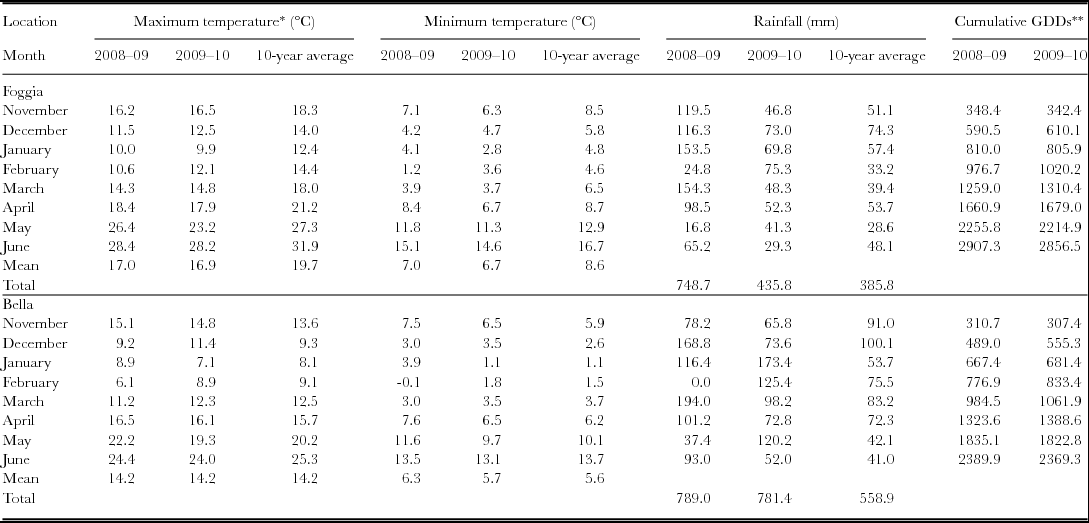
The environmental data for the two growing seasons are shown in Table 1, with the long term (10-year) averages for each location. All of the climatic data were obtained from an on-site weather station. The maximum and minimum temperatures were similar for the two years of the study for each site. The two years were cooler than the long-term average at Foggia, and they were particularly rainy for both locations (means above 10-year average, 54% for Foggia, 41% for Bella). The mean maximum and minimum daily temperatures were used to calculate the growing degree days (GDD; °Cd) with a 0 °C baseline temperature. Cumulative GDDs were calculated by adding up the daily values, starting from the sowing date.
Environmental data at Foggia and Bella during the growing seasons of four graminaceous species, as compared to the long-term (10-year) averages.

*Data derivated from on-site weather stations at Foggia and Bella.
**Calculated from 1 November, using the average daily temperature minus the base temperature of 0 °C.
Field experiments and crop management
At each site, the experimental design was as randomised complete blocks with four replications. Plots were 20 m long and consisted of 118 rows that were 0.17 m apart. The genotypes were sown in the second half of November at Foggia, and in the first half of December at Bella, for each year (2008 and 2009), at a seeding density of 400 viable seeds m−2. Before sowing, chemical fertiliser was applied to all of the plots at the following rates: 36 kg N ha−1 and 92 kg P ha−1. During plant tillering, the plots received in topdressing 52 kg N ha−1. Weeds were controlled with hand weeding when necessary.
Measurements and calculations
Different numbers of destructive harvests were carried out at weekly intervals (eight at Foggia and five at Bella during 2009, and six at each location during 2010), starting from the heading stage (from 22 April for oats, wheat and triticale, and from 14 April for barley at Foggia, and from 11 May for oat and triticale at Bella, as the means of the above years) up to the kernel-hard stage (Feekes scale, 10.1 and 11.3, respectively).
At each harvest, four random samples of 1 m2 from each plot (400 m2) were hand clipped to a 5 cm stubble height. The forage was removed and weighed, and a representative subsample of 50 shoots was weighed and used to assess the plant fraction weights after oven-drying at 60 °C for 48 h (stems, leaves, heads; g shoot−l). Another subsample was taken, divided by hand into the plant fractions, and cut into small pieces and immediately stored at −80 °C, for FOS determination.
Before the chemical analysis, the plant material was oven dried under vacuum at 40 °C for 48 h, and then ground using a cyclone mill with a 1-mm screen. Enzymatic methods were used for the determination of FOS content (% dry matter; Megazyme, according to AOAC International Method No. 999.03 (Reference Horwitz2005) and AACC International Method No. 32.32). This analysis involves the hydrolyses of starch and sucrose by specific enzymes (i.e., ß-amylase, pullulanase, maltase), removal of the reducing sugars by treatment with alkaline borohydride and inulinase treatment to hydrolyse fructans into glucose and fructose, which are then measured spectrophotometry at 410 nm.
At each harvest, the leaf to stem ratio (LSR, % by weight) was calculated for each genotype, for both years and for both locations. Based on the biometric and plant biomass parameters, LMR, SMR, RGR and RER were calculated for each genotype. LMR (g g−1) and SMR (g g−1) indicate the biomass allocation to leaves and stems, respectively, and these were calculated as the ratios of the leaves and stems, respectively, to total dry weight, for each harvested sample, and they are reported as means over the entire growing season. RGR (unit of dry mass increment per day, and per unit of total dry mass of plant) and RER (increase in length of the main shoot per unit shoot length per day) are measures of the efficiency of production and growth, and they were calculated following the functional approach described by Hunt (Reference Hunt1982). Both of these indices were derived by fitting quadratic regressions of ln (total plant dry matter or plant height) versus time for each genotype, year and location, using stepwise multiple regression with the equation y = b0 + b1T + b2T2, where y is the ln of the variable under consideration, and T is time. The plant biomass and elongation were ln-transformed to maintain the homogeneity of variance between sampling dates. Due to the different timings of the plant growth stages for the different species, the RGR and RER were calculated per GDD, to eliminate the effects of different temperatures at the time of plant development. Means of four replicates from each genotype and harvest were used for each year and location. The R 2 values of the polynomial fits varied from 0.90 to 1.00. The derivative of the function in relation to the time, allows determination of the rates of dry-matter accumulation (mg g−1 °Cd−1) and plant elongation (mm mm−1 °Cd−1) for the whole period comprised for each dataset.
An analysis of variance including the fixed factor genotype and the random factor year was carried out for each character measured or calculated. When F-tests were significant, the means were compared with the LSD values for p < 0.05. The RGR and RER differences were evaluated as Treatment × Time interactions in an analysis of variance, with ln (transformed data) as the dependent variable (Poorter and Lewis, Reference Poorter and Lewis1986). According to Peng et al. (Reference Peng, Niklas and Sun2011) and Gleason and Ares (Reference Gleason and Ares2004), the regression analyses were used to examine the relationships between ln (FOS content) and RGR in the plant fractions. All of the statistical analyses were performed with STATISTICA software (StatSoft version 7.1; StatSoft, Inc., Tulsa, OK, USA).
RESULTS
Dry-matter production
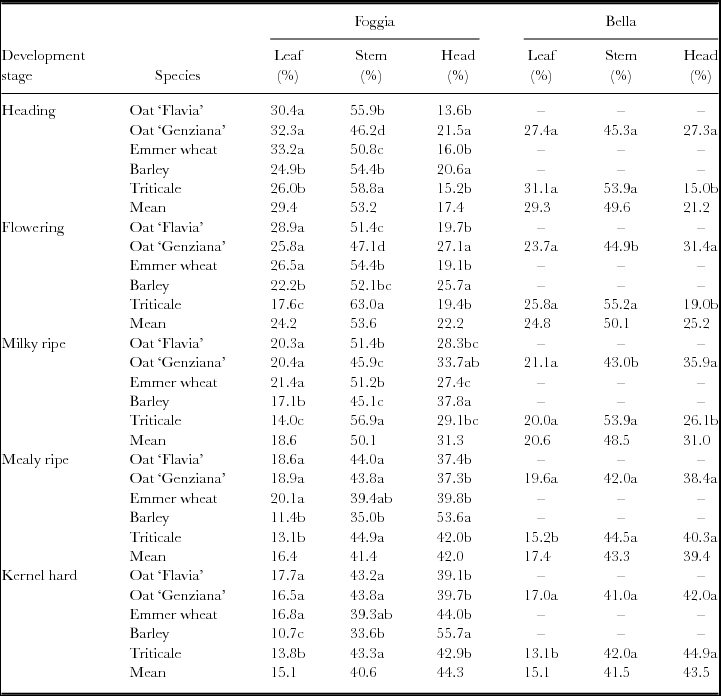
Figure 1a and Figure 1b shows the total aerial plant weights according to the physiological stage. As the pattern of dry-weight accumulation for each genotype did not vary significantly between years, the data presented in Figure 1 represent the means over both of the years together. The total dry-matter accumulation showed a linear increase for all species; however, the plant species showed different total amounts of dry matter produced, with more for triticale at both locations. With increasing total plant mass, a greater proportion of the biomass was allocated to stems and heads than to leaves. However, differences among the genotypes were also observed in the patterns of biomass allocation among the plant species (Table 2). The oat and emmer wheat at Foggia showed the highest leaf dry matter for all of the developmental stages (from 32% at heading, to 17% at kernel-hard stage, on average over genotypes). Also, at Bella, the oat cv. ‘Genziana’ showed the highest values for leaf dry matter (22%, on average over stages). The stem dry matter increased to its maximum values at the flowering stage, and then decreased. The highest values of stem dry matter were recorded for triticale in both locations (53% at Foggia, 50% at Bella, on average over stages). Furthermore, the highest contributions of the reproductive fractions to the total plant dry weights were recorded for barley at Foggia and oat cv. ‘Genziana’ at Bella.
Means over the years for dry-matter partitioning (% total) among the plant fractions during the spring growth at Foggia and Bella.

Within each developmental stage and plant fraction, means followed by the same letters are not significantly different, according to LSD test at p ≤ 0.05.
Patterns of dry matter accumulation (a, b) and FOS content (c, d) through the growth cycle of total plants of the cereal crops at Foggia (a, c) and Bella (b, d) for the experimental period (○−○, oat cv. ‘Flavia’; △−△, oat cv. ‘Genziana’; *−*, emmer wheat; ●–●, barley; ▲–▲, triticale). Data are means ± SE across the two years.

Crop growth characteristics
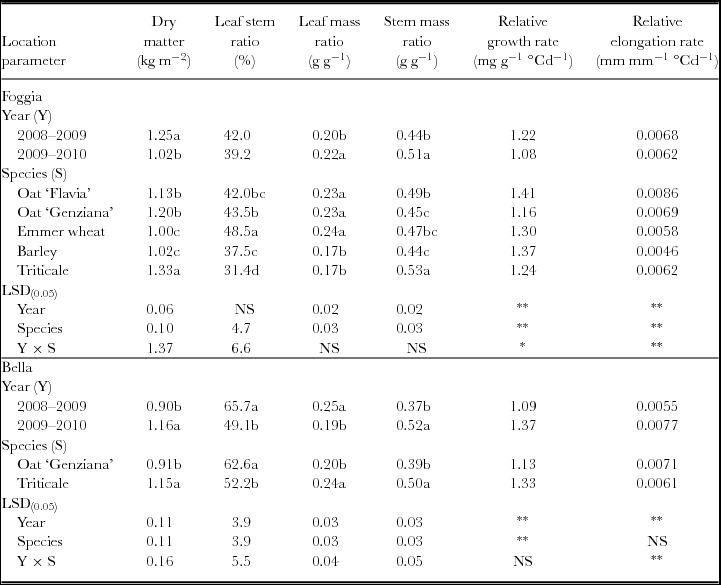
The years had significant effects on the total biomass accumulated at both locations. The first growing season (2008–2009) was more productive at Foggia, whereas the second season (2009–2010) was more productive at Bella (Table 3). Triticale showed the highest total dry matter across both seasons for both locations (1.33 kg m−2 at Foggia, 1.15 kg m−2 at Bella). The data indicate that the leaf/stem ratios varied considerably across species and environmental conditions: from 48.5% (emmer wheat) to 31.4% (triticale) at Foggia, and from 62.6% (oat) to 52.2% (triticale) at Bella. The five genotypes also differed markedly in both of the parameters for dry-matter distribution and for growth rates. Indeed, the highest LMR in oat and emmer wheat indicated that they had plants with more leaf mass (Table 3). The SMR indicated that the above-ground dry matter was partitioned preferentially into the stem tissue in all of the genotypes, with triticale showing the highest SMR. The RGR varied from the lowest of 1.13 mg g−1 °Cd−1 for oat cv. ‘Genziana’, to the highest of 1.41 mg g−1 °Cd−1 for oat cv. ‘Flavia’. Significant differences in the RER (p ≤ 0.05) were seen among the species only at Foggia, with the oats showing the greatest elongation of the internodes of the plants.
Dry matter production and growth parameters of the five cereals at Foggia and Bella for the 2008–2009 and 2009–2010 growing seasons.

Values within a column for each principal factor not followed by the same letter are significantly different at p ≤ 0.05.
NS, not significant.
*, p ≤ 0.05; **, p ≤ 0.01.
FOS content
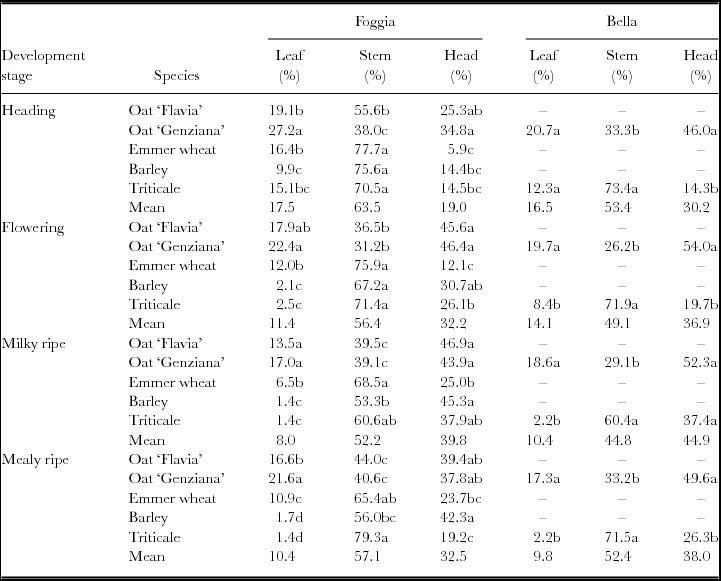
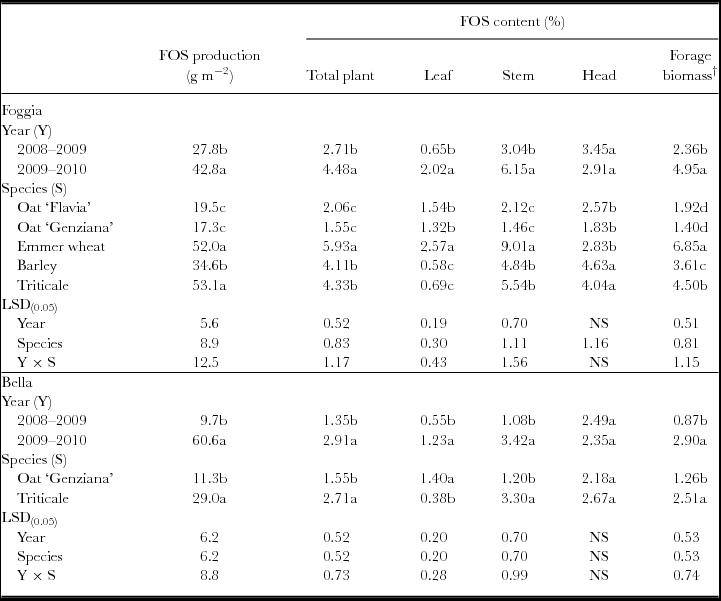
Our study demonstrates genotypic variation in the pattern of accumulation and depletion of the FOS content of the total plants (Figure 1c and Figure 1d). In particular, in emmer wheat and triticale, the FOS stored transiently in the total plant increased until the milky ripe stage, after which it progressively decreased, to reach the minimum at the end of the analysis period (mealy ripe stage). Oats and barley reached their highest FOS levels at heading and flowering, respectively. The proportion of the FOS content of the leaves and stems decreased from heading to milky ripe, whereas the maximum percent proportion was recorded for the heads at the same stage in all of the genotypes (Table 4). There were statistically significant differences in the partitioning of the FOS contents (p ≤ 0.05) in the different plant fractions of the five genotypes at each growing stage. Oat accumulated more FOS (% of total) in the leaf and head fractions than the other cereals for all of the developmental stages at both locations. Both FOS content (g m−2) and FOS levels (%) in total plants and their fractions, except for the head, were greatly influenced by the growing season (Table 5). Emmer wheat and triticale showed greater FOS production (g m−2) at the two locations. However, despite the same mean value for FOS production recorded for these two species at Foggia, only emmer wheat had a greater FOS concentration in leaves and stems (2.57%, 9.01%, respectively) and, as consequence, in forage biomass (6.85%).
FOS partitioning (% total) over the years among plant fractions during spring growth at Foggia and Bella.

Within each developmental stage and plant fraction, means followed by the same letters are not significantly different according to LSD test at p ≤ 0.05.
Means of FOS production and FOS content in total plant and plant fractions of the five cereals at Foggia and Bella for the 2008–2009 and 2009–2010 growing seasons.

†Forage biomass = leaf + stem.
Values within a column for each principal factor not followed by the same letter are significantly different at p ≤ 0.05.
NS, not significant; *, p ≤ 0.05; **, p ≤ 0.01.
Relationship between RGR and FOS content
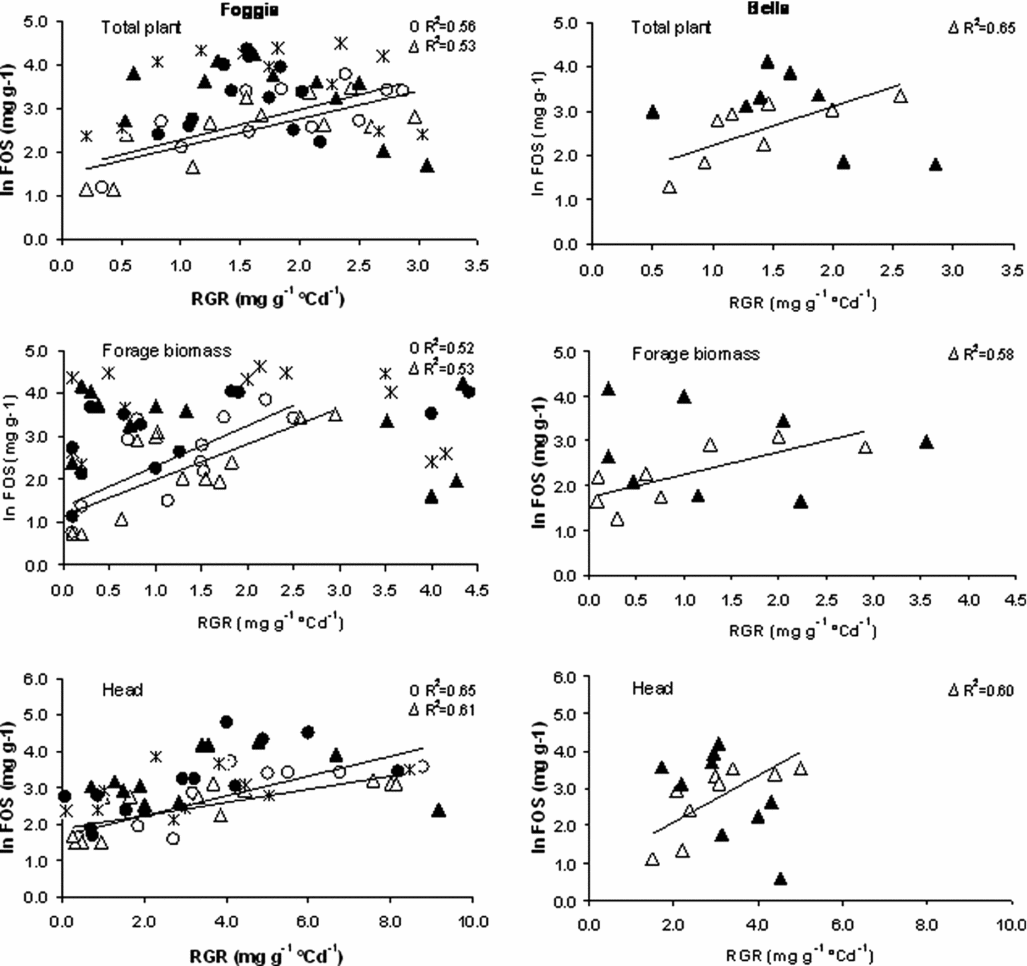
The changes in the estimated RGR with respect to the FOS content in the total plants, the forage biomass and the heads are shown in Figure 2. The RGR was significantly and positively correlated with the FOS content for both of the oat cultivars in all of the plant fractions (R 2 > 0.43; n = 8–9; p < 0.05). However, no significant correlations were seen for the other cereal species studied here.
Relationships between the relative growth rate (RGR) and fructo-oligosaccharides (FOS) content for total plants, forage biomass (leaves plus stems), and heads of the cereal crops at Foggia and Bella for the experimental period (○−○, oat cv. ‘Flavia’; △−△, oat cv. ‘Genziana’; *−*, emmer wheat; ●–●, barley; ▲–▲, triticale). The trend lines represent significant linear correlations (p < 0.05).

DISCUSSION
The total above-ground dry weight of the cereal crops studied here increased constantly after heading, and during this period the head dry matter increased linearly with accumulated temperature. Thus, the partitioning ratios (reproductive/total biomass) increased rapidly during seed setting. However, the genotypes showed different patterns of accumulation and partitioning of the assimilates within the plants. The final dry matter varied among genotypes, probably because it mainly results from a combination of the duration of the growth period and the RGR, and both these characteristics are specific for each genotype. Previously Schnyder (Reference Schnyder1993) indicated a genotypic variation for the efficiency of reserve use in grain filling in wheat and barley, and Juskiw et al. (Reference Juskiw, Helm and Salmon2000) showed that the quantity and the dry-matter distribution among leaves, stems and spikes were affected by genotype in different small-grain cereals. For all of the species, the dry matter in the vegetative parts was always greater than that in the reproductive parts. However, the differences in the partitioning of the accumulated dry matter resulted in significant changes in the LSR, LMR and SMR indices. In particular, the higher LSR and LMR in emmer wheat might positively influence the forage quality in terms of palatability. According to Calvière and Duru (Reference Calviere and Duru1999), the proportion of leaves in the biomass depends on the environmental conditions, although differences in morphology, phenology and reproductive behaviour of these species might also affect the LSR of the plants. The high SMR for triticale confirms the greater accumulation of stem dry matter in this species. Similarly, Ellen (Reference Ellen1993) reported that for barley, rye, triticale and wheat, the stems were the largest component of the above-ground biomass until three weeks after heading, when this began to decline; during this period, there was a rapid spike growth while the leaf weight decreased. The high value of stem dry matter recorded in triticale might be related to the efficiency in carbohydrate accumulation, particularly of fructans, as suggested by Schnyder (Reference Schnyder1993).
The plant growth characteristics can also change according to the species, genotype and environmental conditions. From a practical point of view, growth characteristics like RGR and RER are useful as efficiency indices of the plant. In particular, the RGR analyses how efficiently the existing crop produces additional biomass, regardless of the plant density. There are still strong differences in RGR between species when these are expressed per GDD. This suggests that other factors besides temperature determine the differences in the growth rates of the cereal species. However, the data for the RGR suggest that the amount of ‘initial capital’, that is the size of the assimilatory apparatus, has an important role in determining the yield potential of the cereal genotypes studied here. Indeed, a high RGR, as shown by the oat cv. ‘Flavia’, does not reflect on the dry-matter yield obtained. The higher values for dry-matter accumulation recorded for triticale were probably due to a greater initial biomass and a longer growing season, rather than to the RGR. Bassu et al. (Reference Bassu, Asseng and Richards2011) reported that triticale often out-yields other cereals in field experiments under different environmental conditions; this is probably due to earlier onset of the elongation phase and greater early vigour, which contribute to higher biomass accumulation.
Our study has demonstrated that the genotype, the developmental stage at harvest, and even more so, the environmental conditions, have great influence on the total FOS content and on their partitioning into all of the plant fractions. Furthermore, FOS accumulation in the plants during the growth period examined was not parallel to total dry-matter accumulation. We recorded marked differences for the patterns of accumulation and depletion of FOS between oats and the other cereal species, at all harvest times. Indeed, the maximum FOS content was reached at the early milky stage, and a marked reduction during the later phase of kernel filling was seen only for barley, emmer wheat and triticale. Similar results were reported by Dreccer et al. (Reference Dreccer, van Herwaarden and Chapman2009), Yang et al. (Reference Yang, Zhang, Wang, Zhu and Liu2004) and Wardlaw and Willenbrink (Reference Wardlaw and Willenbrink2000), in stems of wheat genotypes. Moreover, as observed by Takahashi et al. (Reference Takahashi, Chevalier and Rupp2001) in winter wheat cultivars, during the late and final phases of grain filling, the fructan content decreases, probably because the prevailing photosynthate might not have been adequate to supply the requirement of the grain for sucrose, and the stem reserves were used to maintain the rate of grain filling. Furthermore, Schnyder (Reference Schnyder1993) and Shiomi et al. (Reference Shiomi, Benkeblia, Onodera, Yoshihira, Kosaka and Osaki2006) showed that low molecular weight fructans, and mainly FOS, predominate in the stems of wheat and barley during the grain-filling period, and that this can contribute significantly to the final yield. We found high levels of FOS in both the stems and immature heads of barley, emmer wheat and triticale. High FOS contents in immature wheat kernels were also shown by D’Egidio et al. (Reference D’Egidio, Cecchini, Corradini, Canali, Cervigni and De Vita1999) and Paradiso et al. (Reference Paradiso, Cecchini, Greco, D’Egidio and De Gara2008), with maximum accumulation during the milky phase and a rapid decrease thereafter. This decrease can be partially explained by the accumulation of starch, which is the most prominent component of the mature wheat kernel (Xiong et al., Reference Xiong, Yu, Zhou, Zhang, Jin, Li and Wang2014).
There was no unique relationship between RGR and FOS concentration among these cereal species. These results possibly reflect differences in the capacity for FOS accumulation and mobilisation and the rate of plant growth. Only in oats, the coefficients of correlation between RGR and FOS are positive, which indicates that the faster the plant grows, the faster the accumulation of FOS.
These results clearly indicate that during the growing cycle of the forage cereals studied, the biomass FOS contents are a lot higher (from 1.3% to 6.9%, on average) than those reported in other plants of nutritional interest, which were reported as <1% in garlic, banana fruit, sugarcane, onion and tomato, by Spiegel et al. (Reference Spiegel, Rose, Karabell, Frankos and Schmitt1994). However, Paradiso et al. (Reference Paradiso, Cecchini, Greco, D’Egidio and De Gara2008) reported maximum values for fructan contents of about 11% and 16% on average for stems and grain, respectively, of 45 cultivars of durum wheat. Our experimental data suggest that these cereals, which are well adapted and widely cultivated in the area of the study, can be used for the production of green feed rich in FOS. The maturation stage in which the cereal plants have the highest nutritional value in terms of FOS contents were different across these species. In particular, oat and barley reached their highest FOS levels at heading and flowering, respectively, whereas for emmer wheat and triticale this was at the milky ripe stage. Generally, in the Mediterranean environment, the annual cereals used as green feed are harvested at the heading stage, when the high content of protein and the highly digestible fibre make them ideal forage for high milk production, rumen function, and animal health (Aksland et al., Reference Aksland, Fohner, Gomes and Jacobsen2010; Cazzato et al., Reference Cazzato, Tufarelli, Laudadio, Stellacci, Selvaggi, Leoni and Troccoli2013). However, Rosser et al. (Reference Rosser, Górka, Beattie, Block, McKinnon, Lardner and Penner2013) recently suggested the need to reconsider the recommendations for when annual cereal crops should be harvested for green feed. Their study showed that effectively degradable dry matter (an indication of ruminal digestibility) increases when the whole crop of barley, triticale and wheat are harvested at more advanced stages of maturity. This information allows management approaches to be developed for harvesting of high-quality forage that also takes into account the animal requirements under alternative feeding regimens that are rich in functional compounds. In particular, with its high yields of biomass and FOS, triticale harvested at the milky stage appears to be particularly suitable to this purpose.
Furthermore, these results suggest the potential for using forage cereals for the extraction of large amounts of FOS from vegetative tissue, to obtain alternative products for adding as functional food ingredients. Indeed, there is a strong interest in the application of fructans in the food industry, because of their dietary fibre characteristics and their prebiotic effects. Jenkins et al. (Reference Jenkins, Lewis, Bushell, Belobrajdic and Bird2011) reported that FOS from cereal sources, such as grain and stem of barley and wheat, show similar in vitro fermentation characteristics as inulin and oligofructose; this suggests that these plant fractions can be used as alternative sources of FOS in the diet. According to our data, barley, emmer wheat and triticale can be recommended for such commercial use, due to the high FOS levels in the total plant.
Acknowledgements
This study was supported by the Research Project OLLAT (Improvement of the milk quality through the feeding of the ruminants with cereals rich in fructo-oligosaccharides) funded by the Italian Ministry of Agricultural, Food and Forestry Policies.