INTRODUCTION
Recently, productivity and efficiency in dairy farming have gained in importance due to the increased cost of grain, following agricultural liberalization, and the rising cost of labour, machinery and buildings (Dillon et al. Reference Dillon, Roche, Shalloo, Horan and Murphy2005; Macdonald et al. Reference Macdonald, Penno, Lancaster and Roche2008). As a consequence of the great demand for food (FAO 2013) and the limited availability of agricultural land, interest in improving the efficiency of small-scale farms has intensified. Efficient use of farm resources such as forage is becoming increasingly important.
Dairy farming in Central Europe is mainly based on indoor-feeding (IF) due to the long dormancy period of vegetation in the winter. During the vegetation period, cows are kept on half-day pasture and partly fed green forage in the barn. In contrast, countries such as Ireland and New Zealand have adopted pasture-based feeding (PF) systems (Horan et al. Reference Horan, Dillon, Faverdin, Delaby, Buckley and Rath2005; Macdonald et al. Reference Macdonald, Penno, Lancaster and Roche2008), which are characterized by low direct and overhead costs. Pasture-based feeding systems (FSs) now also play an increasingly prominent role in pre-Alpine regions. Comprehensive research has recently investigated the suitability of different breeds of dairy cows in different production systems, such as PF, IF with total mixed rations (TMR) or IF with part-mixed ration (PMR) (Holden et al. Reference Holden, Muller and Fales1994; Horan et al. Reference Horan, Dillon, Faverdin, Delaby, Buckley and Rath2005; Burren et al. Reference Burren, Gazzarin, Keckeis, Kunz, Piccand, Pitt-Käch, Rieder, Roth, Schori, Thomet, Troxler, Wanner, Weilenmann, Roth and Kunz2010; Horn et al. Reference Horn, Steinwidder, Gasteiner, podstatzky, Haiger and Zollitsch2013). These studies have shown that the use of low-cost PF systems seems decisive for the survival of small-scale dairy farms in a highly competitive environment, especially when considering the rising cost of concentrate feed (Tozer et al. Reference Tozer, Bargo and Muller2003; Gazzarin & Lips Reference Gazzarin and Lips2007; Alqaisi et al. Reference Alqaisi, Steglich, Ndambi, Hemme and Hemme2011).
Notably, cows in PF production systems have lower milk solids content (Bargo et al. Reference Bargo, Müller, Delahoy and Cassidy2002; Vibart et al. Reference Vibart, Fellner, Burns, Huntington and Green2008). Lower feed efficiency has also been reported in PF compared with IF cows due to limited energy intake on the pasture (Kolver & Muller Reference Kolver and Muller1998). Comparison of the studies by Bargo et al. (Reference Bargo, Müller, Delahoy and Cassidy2002) and Fontaneli et al. (Reference Fontaneli, Sollenberger, Littell and Staples2005) confirms higher feed efficiency in IF systems.
To our knowledge, the existing literature lacks a whole-farm perspective on performance, efficiency, land productivity and labour income of the PF and IF systems that also considers the high European standards of environmental and animal welfare legislation. This gap is addressed in the current 3-year, full-lactation study.
On the basis of previous studies (Bargo et al. Reference Bargo, Müller, Delahoy and Cassidy2002; Fontaneli et al. Reference Fontaneli, Sollenberger, Littell and Staples2005; Vibart et al. Reference Vibart, Fellner, Burns, Huntington and Green2008), the following hypotheses were tested: (i) IF dairy cows are more efficient than PF dairy cows; (ii) based on a previous study (Münger & Jans Reference Münger and Jans2001; Hofstetter et al. Reference Hofstetter, Steiger Burgos, Petermann, Münger, Blum, Thomet, Menzi, Kohler and Kunz2011), the land productivity of the herds would be similar; and (iii) the labour income of the PF herd would be higher (Durgiai Reference Durgiai1996; Gazzarin & Schick Reference Gazzarin and Schick2004; Gazzarin et al. Reference Gazzarin, Ammann, Schick, Van Caenegem and Lips2005).
MATERIALS AND METHODS
Experimental site
The experiment was performed on a mixed farm belonging to the Vocational Education and Training Centre for Nature and Nutrition in Hohenrain, Lucerne, which is in the lowland region of Central Switzerland at 620 m above sea level. Annual precipitation was 1171 mm (sd=131 mm) and the mean air temperature 9·4 °C (sd=0·5 °C). In the vegetation period, the average precipitation was 946 mm and the mean air temperature 13·3 °C. Soils are medium–heavy, poor in humus, partly waterlogged, with sandy clay and brown earth. Dairy farming is the particular characteristic of land use in this region.
The botanical composition of the meadows was analysed in June 2010 using the method of Daget & Poissonet (Reference Daget and Poissonet1969). The swards of the IF systems, including the natural meadows, were on average composed of grasses (0·58), legumes (0·31) and herbs (0·11). On average, the pastures of the PF system consisted of 0·69 grasses, 0·22 legumes (only white clover, Trifolium repens) and 0·09 herbs. In the meadows, frequent grasses were perennial ryegrass (Lolium perenne) (0·31), smooth-stalked meadow grass (Poa pratensis) (0·22), rough meadow grass (Poa trivialis) and creeping bentgrass (Agrostis stolonifera). The forage growth period lasted from 10 March to 20 November.
Manure and chemical fertilizers were applied according to Swiss guidelines (Flisch et al. Reference Flisch, Sinaj, Charles and Richner2009), depending on the yield ability of the plots. On average, over three seasons, 177 kg N/ha, 128 kg P2O5/ha and 478 kg K2O/ha/year were applied to the IF agricultural land (AL) and 166 kg N/ha, 104 kg P2O5/ha and 434 kg K2O/ha/year to the PF AL.
Experimental design
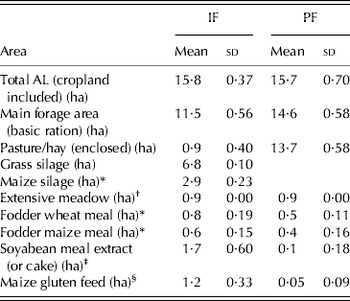
The study was conducted from 1 October 2007 to 31 December 2010. Two systems, IF with mixed ration and PF, were examined over 3 years and 3 months, which covered three full lactations. Each system was allocated c. 16 ha of AL (Table 1).
Agricultural land (AL) for the main forage and fodder crops for the energy and protein concentrate in hectares for the indoor-fed (IF) and pasture-fed (PF) herds, average from 2008 to 2010

* In 2008 the majority of the maize silage, fodder wheat and fodder maize meal were purchased.
† Ecological compensating area.
‡ The allocation for soyabean cake resulted from soyabean meal extract by an allocation of 67% and an output of 35·4 kg air-dried matter soyabean meal extract per ha.
§ The allocation was 6·4% and by output of 71·6 kg air-dried material maize per ha.
The IF herd consisted of 24 dairy cows fed on PMR; part of the concentrate was distributed separately from a concentrate dispenser. In contrast to a TMR FS, in which cows are offered all forages as a complete ratio mix ad libitum (Linn Reference Linn2013), PMR cows are fed a mixed basic ration, which is individually complemented by concentrate according to the requirements of each cow. In this herd, the target level was 8500 kg milk per lactation and cow in accordance with typical performance in local IF systems.
For PF, a seasonal, spring-calving, low-input, semi-continuous, pasture-based production system (Durgiai Reference Durgiai1996; Münger & Jans Reference Münger and Jans2001) with 28 dairy cows was established. In the PF herd, the target level was 6000 kg milk per lactation and cow, determined in accordance with previous pasture-based production system studies (Thomet et al. Reference Thomet, Piccand, Schori, Troxler, Wanner and Kunz2010; Hofstetter et al. Reference Hofstetter, Steiger Burgos, Petermann, Münger, Blum, Thomet, Menzi, Kohler and Kunz2011). At the beginning of each lactation, the PF cows were fed hay ad libitum, supplemented by limited amounts of concentrate.
The IF cows were housed in a free-stall barn during the whole lactation period, whereas the PF cows were kept in a free-stall barn during winter and the half-time grazing periods (early spring, late autumn). During the dry period, all cows were housed in a separate tied-stall barn.
Animals and animal measurements
Both herds included two breeds chosen to reflect the breeds generally used in corresponding FSs in Switzerland. As a result, herd composition partly differed between the two production systems.
On average, the IF herd consisted of 12·8 (sd=0·2) BS cows and 11·3 (sd=0·8) Swiss HF cows. The BS cows were 70 months old, had 3·6 lactations and a live weight (LW) of 697 kg. The HF cows were on average 64 months, had 3·1 lactations and an average LW of 700 kg. According to the herd-book data of the Swiss Brown Cattle Breeders’ Federation (Braunvieh Schweiz 2012), the total merit index (TMI), i.e. the complete breeding value, of the BS was 108. The TMI (ISEL, i.e. complete breeding value with a combination of different breed indexes, weighted according to its economic importance) of the HF cows was 1033 according to the herd-book data of the Swiss Holstein Federation (Holstein Switzerland 2014). The IF cows were artificially inseminated with semen from sires of the same breed over the whole year.
The PF herd contained 13·8 (sd=0·3) BS cows and 14·2 (sd=0·7) Swiss Fleckvieh (SF) cows. The BS cows were 55 months old, had 2·6 lactations and a LW of 607, whereas the SF cows were 52 months, had 2·6 lactations and a LW of 617 kg. The TMI was 97 for the BS cows and 98 for the SF cows according to the cooperative Swiss Herdbook Zollikofen, Switzerland (Swiss Herdbook 2013). All TMI are based on April 2011 calculations. Because the merit ratings of the BS IF and PF cows were not calculated separately, those for the BS IF cows were slightly overestimated and those for BS PF cows slightly underestimated. The insemination period for PF cows lasted from 20 April to 20 July: they were artificially inseminated until the end of May, and afterwards mated by an Angus bull. They always calved between February and mid-April.
Cows were replaced as necessary, mainly as a result of infertility. Five IF cows were replaced in 2008, four in 2009 and eight in 2010 due to reduced fertility (five), mastitis (six), limping (two) and other causes (four). Four PF cows were replaced in 2008 due to fertility problems and a further one due to bloat; six were replaced in 2009, three of which were due to infertility; another six were replaced in 2010, four of which were due to infertility. On average, there were five primiparous cows in the IF herd and six in the PF herd.
Reproduction events and parameters (e.g. postpartum (p.p.) days open, empty time, services per conception, pregnancy and calving and calf's birth weight) were recorded. From calving to pregnancy, the cows were examined gynaecologically by an experienced veterinarian every second week to assess the status of the reproductive tract function and detect possible health problems.
Every 4 weeks, all cows were weighed at 6·30 AM, CET/CEST, after milking using EC 2000, modified Tru-Test scales with a precision of 1% (Tru-Test Ltd, Auckland, New Zealand). Body condition score (BCS) was assessed every 2 weeks by the same scientist. The method of Edmonson et al. (Reference Edmonson, Lean, Weaver, Farver and Webster1989), using a scale of 1–5, was applied in a slightly modified form (Metzner et al. Reference Metzner, Heuwieser and Klee1993). Net energy for maintenance (MER) per day was calculated at 0·293 MJ net energy for lactation (NEL) × metabolic live weight (i.e. LW kg0·75), according to Agroscope Liebefeld-Posieux (ALP) (2008). The same MER calculation was conducted for both production systems.
Feeding and grazing systems
During lactation, the IF cows were fed a PMR consisting of maize and grass silage, and protein concentrate. The basic PMR, formulated for 27 kg milk/day, was distributed from a chopping mixer wagon (LUCLAR International) daily in summer, and every second day in winter. For a daily yield higher than 27 kg of milk, the IF cows were additionally fed a compound feed (CF), balanced according to individual requirements, from a concentrate dispenser (Lemmer Fullwood AG, Meierskappel, Switzerland). The ration and the amount of concentrate were calculated using the dairy ration analyser, a dairy feeding programme (CPM-Dairy, WexTech Systems Inc. 2006), and the nutrient requirements of dairy cattle (NRC 2001). During the vegetation period, IF cows grazed a siesta pasture for approximately 3 h/day. In the dry period, the IF cows were fed non-ventilated hay from the ecological compensation area and PMR leftovers in a tied-stall barn.
The PF cows were offered ad libitum access to barn-ventilated hay harvested from the surplus of the semi-continuous pasture. The amount of concentrate was limited to 4 kg concentrate per day at the beginning of the lactation (January–March). During the first month of the full-time grazing period, the PF cows were offered a maximum of 2 kg concentrate per day, supplemented by 4% magnesium oxide and mineral licks. The annual energy and protein concentrate limit was 8500 kg per PF herd. From March to mid-April and from mid-October to November, the cows spent half-days on the pasture and were additionally fed hay in the barn. From mid-April to mid-October, the cows grazed full-time except when they left the paddocks for c. 4 h/day for milking in the barn. In accordance with guidelines for pasture management from the Swiss Society for the Promotion of Fodder Production (Thomet et al. Reference Thomet, Hadorn, Jans, Troxler, Perler and Meili1999), the PF herd grazed in a semi-continuous system consisting of four paddocks. Hay was harvested for winter feed from each paddock at least once a year. During the dry period, the cows were fed non-ventilated hay from the ecological compensation area and straw in a tied-stall barn.
Forage storing, sampling and analysis
In accordance with the feeding programme based on milk performance and feeding requirements, the AL was compartmentalized into the required area for the different forages taking into account previous forage yields on the farm. Protein concentrate bought off the farm, i.e. soyabean or maize gluten feed, was converted into AL (Table 1) according to a study by Zimmermann (Reference Zimmermann2006). Maize and grass silage were stored in round and cube bales. Hay was stored in the barn and partly ventilated.
The pasture yields were measured using the method proposed by Corral & Fenlon (Reference Corral and Fenlon1978), modified by Mosimann (Reference Mosimann2001). It was measured at four different and separate sites (10×1·0 m), at the border of the four paddocks (14 daily measurements, N fertilizer input of 200 kg and P fertilizer input of 100 kg/ha and year). Forage yields were determined from the average of the four sites at the border of the four paddocks.
When harvesting grass silage and hay, five to seven samples of 0·25 m2 from each plot were cut at c. 60–70 mm above ground level with grass shears on the respective area to measure yields. The harvested yields were weighed using a Kern DE30K10 (Kern & Sohn GmbH, Balingen, Germany).
Every 2 weeks, pasture-grass samples were collected for nutritional analysis. The samples were cut at 30 mm above ground level on the stocked pastures with electric lawn scissors every six steps along the diagonal axis of the paddocks. Representative samples from the silage bales were collected 1 month before feeding. Maize silage samples were collected once in November, 6 weeks after harvesting. Each year, a mixed hay sample from each haystack was obtained by thrusting a lance diagonally in three different places.
The pasture forage was sampled from the beginning of April until the beginning of November. The collected forage (c. 1·5 kg of fresh pasture) was dried to a constant weight, one half at 55 °C and the other half at 105 °C in a forced-air oven for 24 h to determine dry matter (DM) content. Pasture-forage samples and all other forage samples were analysed at the forage testing laboratory of Dairy One (Ithaca, New York) in accordance with the official methods of analysis (AOAC 2005) method 989.03 using Near-Infrared Reflectance Spectroscopy (NIRS) (Foss NIR Systems Model 6500 with ISI II v1.5), following Van Soest et al. (Reference Van Soest, Robertson and Lewis1991).
Measurement of milk performance and milk solids
Procedure A4 of the Braunvieh Schweiz (2013) standard milk yield recording protocol and guidelines was followed to measure individual milk yield in the morning and in the evening. Measurements were conducted twice per month, using the Afimilk 2000 milk meter (Boutech AG, Baar, Switzerland). From 1 October to 31 December 2007, six measurements of the IF cows were taken. Twenty-two measurements of each were taken in 2008 and 2009 and 23 values were obtained for 2010. The lactation persistence was calculated as the percentage of the milk performance of the second 100 days in relation to the first 100 days milk performance. Analyses of fat, protein and lactose concentration of the BS and SF cows were performed at Qualitas AG Laboratory (Zug, Switzerland), in accordance with the recording protocol. Analyses of fat, protein and lactose concentration of the HF cows were performed at the laboratory of the Swiss HF breeders’ association in Posieux, Switzerland. The cows were milked at 5·15 AM and at 4 PM, CET/CEST, in a 2×5 herringbone milking parlour (Lemmer Fullwood AG, Meierskappel, Switzerland). Every month, tank milk samples of the two systems were taken and the fatty acid (FA) composition of the milk fat was analysed according to Collomb & Bühler (Reference Collomb and Bühler2000). Energy-corrected milk (ECM) was calculated according to Sjaunja et al. (Reference Sjaunja, Baevre, Junkkarinen, Pedersen, Setälä and van Arendonk1990) as (0·038 × g fat/kg milk+0·024 × g crude protein/kg milk +0·017 × g lactose/kg milk) × kg milk/3·14.
Feed intake, feed efficiency and productivity
The feed efficiency for both systems was calculated as kg ECM produced per kg of total dry matter intake (DMI). The net energy for lactation (in MJ NEL) per herd was calculated by multiplying the weighted yield of the feed by the corresponding energy value. For every cow and herd, the required daily and the consequent annual net energy was calculated by adding the kg of ECM × 3·14 MJ NEL and the maintenance energy requirement. Energy for calf growth during pregnancy was considered only for months 8 and 9, adding 11 and 18 MJ/day, respectively. Energy for the cow's growth was not considered.
The productivity of the AL was determined by dividing the annual ECM production per herd by the available area, including the ecological compensation area, in accordance with AGFF guidelines (AGFF 2002). The annual ECM from the basic ration was determined by the AL productivity minus the milk potential from concentrate using calculations as shown below.
Milk production potential (MPP) of a kg concentrate or forage (in DM)=corresponding MJ NEL/3·14 MJ NEL
ECM from basic ration (kg/ha)=ECM (kg/ha AL)−MPP total concentrate/ha AL
ECM from basic ration (kg/cow)=ECM (kg/cow)−MPP concentrate/cow
Cost and profitability
Accounting for the full cost analysis was done separately for the two systems and the two herds. All incomes, direct costs and most of the overhead costs were allocated to the respective accounts, which were audited by the agricultural fiduciary Agro-Treuhand Sursee (Sursee, Switzerland). Full cost analysis was conducted using International Farm Comparison Network (IFCN) methods.
The variable costs of the concentrate feed for the IF and PF systems were calculated by subtracting the proceeds of crop (wheat and maize meal) sales from costs of purchased concentrates. The net variable costs were subsequently debited against the IF account.
The fixed costs were allocated using standard costs from different calculation programmes (Gazzarin & Hilty Reference Gazzarin and Hilty2002; Gazzarin & Schick Reference Gazzarin and Schick2004; Hilty et al. Reference Hilty, Van Caenegem and Herzog2007). Machinery costs were allocated according to the time the tractors were used in each system, namely 302 h (0·76) for IF and 98 h (0·24) for PF.
The calculation of work time was done by combining measured work time in the present study with standard data from a previous analysis of similar production systems (Stark et al. Reference Stark, Schick and Moriz2009). The total AL in both systems was notionally divided into one-half rented and one-half owned areas. Rent for the AL was set at 666 €/ha and year, using standard values. Furthermore, the notional rent of owned land was calculated as opportunity costs in fixed costs. Overall, 0·8 of the total operating costs (e.g. telephone, insurance) were allocated to both systems.
Statistical analysis
Data were recorded from 1 October 2007 to 31 December 2010. Information about forage production, the calculation of DMI and productivity as well as costs and revenues of the two systems was compiled on an annual basis. The data are given as means and sd for the 3 years.
The annual period considered for the cow data in the PF system was from 1 January to 31 December each year. For the IF system, the data collection period was from 1 October to 30 September, except for the final year, which lasted until 31 December; data collection started earlier for this system due to the longer calving intervals.
Data for individual cows were recorded per lactation. Consecutive lactations of the same cow were treated as independent data. This simplification was necessary because some of the cows were replaced over time and because lactations of the IF cows were not synchronized, i.e. data did not have a classical repeated-measures structure.
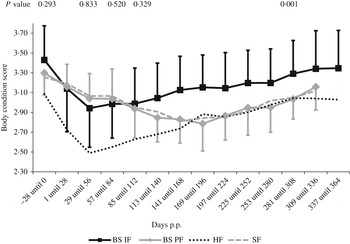
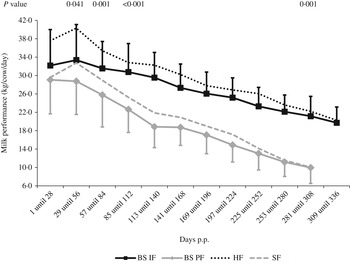
Each lactation was subdivided into time segments of 28 days, beginning p.p. Measurements for BCS and LW began 28 days prior to calving, and those for milk production began at calving. Measurements taken every 14 days were attributed to the 28-day segments for each cow according to calving date. For each time segment, moving averages from 14 days prior and up to 14 days after were calculated. Data from all time segments are represented graphically in Figs 1 and 2, but only data from four time segments (29–56, 57–84, 85–112 and 281–308 days), as well as total values per lactation, were tested statistically.
Course of the average Body Condition Scores (mean and sd) of the indoor and the pasture-fed cows during lactation in 2007–2010. Average measurements per period (n) were Brown Swiss (BS) IF 74, BS PF 85, Holstein–Friesian (HF) 64 and Swiss Fleckvieh (SF) 87.

Course of the average milk yields (kg ECM, mean and sd) of the indoor and the pasture-fed cows during lactation in 2007–2010. Average measurements (n) per period were: Brown Swiss (BS) IF 59, BS PF 70, Holstein–Friesian (HF) 55 and Swiss Fleckvieh (SF) 72.

The four groups of cows (two systems, each with two breeds) were compared using means and standard errors (s.e.) of the performances per lactation recorded from each group over the study period. However, the significance of the differences between the systems was tested using only data from BS cows. Fertility and milk variables were compared between the two FS and the years using two-way ANOVA, non-repeated-measures ANOVA for the reason given above.
The Pearson product–moment correlation was used to describe correlations between variables. All analyses were conducted using R-2.11.1 software by R Development Core Team (2012).
RESULTS
Forage yield and quality
The strongest average meadow growth of 105 kg DM/ha/day occurred at the beginning of May. The growth decreased at the end of May and in June. From July to mid-September, it increased again and reached 80 kg DM/ha/day before it decreased continuously throughout the autumn. The total yield, calculated according to Corral & Fenlon (Reference Corral and Fenlon1978), was 14·2 (sd=0·5) t DM/ha/year.
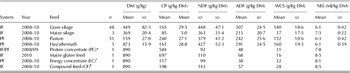
Table 2 shows the chemical composition and energy content of the basic ration and the concentrate of both systems from 2008 to 2010. The pasture had high crude protein (CP) content: from 2008 to 2010, the CP content of the pasture increased continuously (Table 3) with a significant difference between 2008 and 2010 (P<0·05). No significant differences were found between the years in terms of water-soluble carbohydrates (WSC), acid-detergent fibre (ADF) and NEL in the pasture. However, in 2009, the neutral-detergent fibre (NDF) content of the pasture was significantly lower compared with 2010 (P<0·05). A comparison between the spring and summer values showed significant differences in the dietary components of the pasture (ADF: P<0·001, NDF: P<0·01, WSC: P<0·001, NEL: P<0·001), except for CP (Table 3).
Chemical composition and energy content of the basic ration and of concentrate offered during the study to the indoor-fed (IF) and pasture-fed (PF) herds. Dry matter (DM); crude protein (CP); neutral detergent fibre (NDF); acid detergent fibre (ADF); water-soluble carbohydrate (WSC); net energy for lactation (NEL)

* 475 g/kg soyabean cake, 475 g/kg maize gluten feed, 35 g/kg mono-calcium phosphate and 15 g/kg calcium carbonate, salt and further minerals. In 2007, PF cows were fed PC.
† 487 g/kg maize meal, 487 g/kg wheat meal, 20 g/kg sugar beet molasses, 3 g/kg mono-calcium phosphate, 3 g/kg calcium carbonate.
‡ 358 g/kg maize and wheat meal, 157 g/kg soyabean cake, 77 g/kg maize gluten feed, 15 g/kg sugar beet molasses, 18 g/kg crystalline fat, 7 g/kg mono-calcium phosphate and 10 g/kg calcium carbonate.
Chemical composition and energy content of pasture offered per year and in spring and summer. Crude protein (CP), acid detergent fibre (ADF), neutral detergent fibre (NDF), water-soluble carbohydrate (WSC), net energy for lactation (NEL).

In 2008, 2009 and 2010, the energy content of grass silage was 6·1, 6·1 and 6·0 MJ NEL/kg DM, respectively, the average CP content was 164, 160 and 174 g/kg DM, the average ADF content was 312, 318 and 313 g/kg DM, and the average NDF content was 463, 491 and 470 g/kg DM.
The measured average annual yield of grass silage was 13·8 (sd=0·8) t DM/ha and for maize silage was 17·7 (sd=1·9) t DM/ha. The first cut comprised 4·8 t DM/ha, the second 2·7 t DM/ha, the third 2·7 t DM/ha, the fourth 2·0 t DM/ha and the fifth 1·6 t DM/ha of the grass silage.
The average annual yield of fodder wheat was 7·9 (sd=1·0) t air-dried matter/ha and of fodder maize 9·5 (sd=1·9) t air-dried matter/ha.
Feed intake, feed efficiency and productivity
The calculated energy intake in NEL of the IF herd was mainly based on grass silage (419 123 MJ), maize silage (334 448 MJ) and concentrate (202 357 MJ). Energy intake in NEL from pasture (46 360 MJ) and from hay from extensive meadows (32 785 MJ) was low. The calculated energy intake in NEL of the PF herd was based mainly on pasture (571 467 MJ) and hay (230 632 MJ); that from concentrate (63 048 MJ), hay from extensive meadows (37 797 MJ) and straw (6910 MJ) was low.
The annual DMI of the IF herd was 157·6 (sd=4·6) t and that of the PF herd 150·1 (sd=6·8) t. The total DMI of an IF cow, including the dry period, was 17·9 (sd=0·3) kg/day and of a PF cow 14·6 (sd=0·4) kg/day.
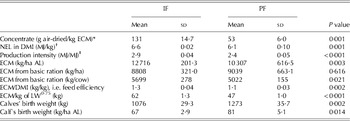
The IF herd had a higher-energy concentration in the feed and a higher production intensity compared with the PF herd (Table 4). The cows of the IF herd produced significantly more ECM per hectare AL and year (P<0·01) and significantly more ECM per kilogram of metabolic LW (P<0·001). The ECM from basic ration was higher in the PF system, but insignificant, whereas ECM from basic ration/cow was significantly higher in the IF system (P<0·05). The IF cows had a significantly higher feed efficiency (kg ECM/DMI) compared with the PF cows. The PF herd showed higher ECM performance per hectare and year from the basic ration, but this was insignificant. On average, the PF herd produced a significantly higher average calf birth weight kg/year (P<0·01) and kg/ha (P<0·05) than the IF herd.
Concentrate offered, energy content of offered ration, production intensity, land productivity, feed efficiency and average calf birth weight of the indoor-fed (IF) and pasture-fed (PF) herds, average from 2008 to 2010

* Energy and protein concentrate without added mineral nutrients.
† DMI; dry matter intake.
‡ Production intensity: Net energy total (NELtotal; kg ECM ×3·14 MJ) plus net energy for maintenance (NELmaintenance; kg metabolic LW ×0·293 MJ ×365)/NELmaintenance, (ALP 2008).
Grazing period, stocking rate, live weight and body condition score
On average, the full-time grazing period of the PF herd lasted 179 days and total grazing period 242 days. The average stocking rate in the IF herd was higher than that of the PF herd, at 2·1 v. 1·9 cows/ha of main forage area.
Before calving, no significant between-system differences were found in the LW (data not shown) and BCS (Fig. 1). However, in the segments at the beginning and end of lactation, the IF cows had significantly higher LW (segment 1: P<0·05, 2: P<0·01, 3: P<0·01 and 4: P<0·01). The lowest LW of the BS cows was observed at 58 (IF) v. 119 (PF) days p.p. (P<0·001), whereas that of BCS was seen at 92 (IF) v. 168 (PF) days p.p. (P<0·001), both significantly later in the course of lactation in the PF than in the IF cows. The LW loss of IF BS cows correlated negatively with milk protein content (Pearson's r=−0·59, n=18, P<0·01). Milk yield in the first segment of lactation correlated negatively with the lowest LW of BCS in the PF cows (r=−0·64, n=28, P<0·001), but was not significant for the IF cows of the BS breed. Milk yield in the second segment correlated negatively with the lowest LW of BCS in the PF cows (r=−0·56, n=28, P<0·01), but not in the IF cows.
Fertility
During the study, four of the IF cows calved in the first quarter of the year, 13 in the second, 34 in the third and 18 in the fourth. In contrast, seven of the PF cows calved in January, 47 in February, 25 in March and nine in April.
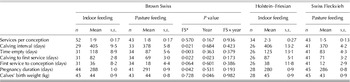
The PF cows had significantly shorter calving intervals, empty time and time from calving to first service (Table 5). The IF cows showed significantly shorter pregnancy duration (P<0·05), but the difference was only 3 days. No significant differences were found in services per conception and time from first service to conception. Time from calving to first service was significantly different across the years (P<0·05). Time from first service to conception correlated significantly with milk yield in the IF BS cows (r=0·53, n=17, P<0·01), but not in the PF cows. There was no significant difference in the average calf birth weight between the IF (44·2, sd=5·5 kg) and PF (43·4, sd=5·7 kg) cows.
Comparison of fertility dates between feeding systems and cow breeds. Mean and s.e. are given for each of the four cow groups

* FS, feeding system.
Milk performance and milk solids
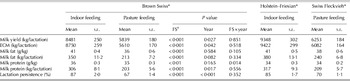
Significant differences (P<0·001) between the IF and PF cows of the BS breed were found in milk yield, milk fat, milk protein production (kg/lactation) and in lactation persistence in addition among the year (Table 6). Milk protein content is also different (P<0·01) between the FS. A significant interaction occurred between FS and year in milk protein content (g/kg) (P<0·05). The lactation curves of the average milk yields show the lactation persistence in particular (Fig. 2).
Comparison of milk production variables (milk yield and milk solids) between feeding systems and breeds in standard lactation. Mean and s.e. are given for each of the four cow groups

* n: BS IF; 32, BS PF; 29, HF; 30, SF; 38.
† FS, feeding system.
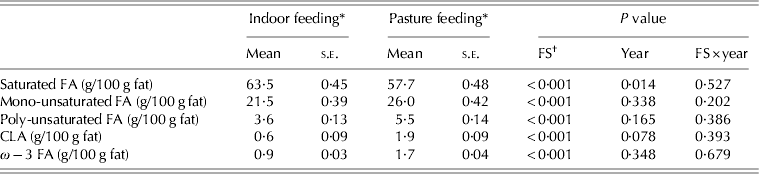
The milk solids (data not shown) indicate that the milk of the IF cows had a significantly higher fat content than that of the PF cows in segments 1, 2 and 3 (P<0·01), but not at the end of lactation. The milk from the PF system had significantly fewer saturated and more mono- and poly-unsaturated FA, as well as more conjugated linoleic acid (CLA) and more ω−3 FA than that of the IF system (Table 7). Insignificant differences in the average milk protein content were found at the beginning of lactation, in segment 1. Compared with PF, the IF cows showed a significantly higher milk protein content in segments 2 (P<0·05) and 3 (P<0·01), but a significantly lower protein content at the end of the lactation (P<0·01).
Saturated, mono- and poly-unsaturated fatty acids (FA), conjugated linoleic acid (CLA) and ω−3 FA of the cow milk fat from the feeding systems, average from 2008 to 2010
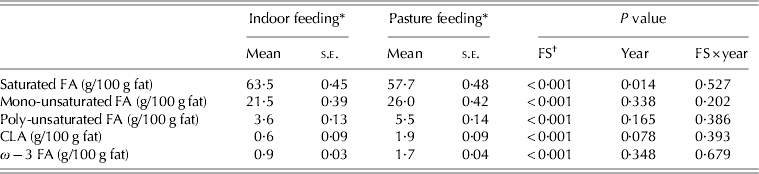
* n: for the IF system 12 each year; for the PF system 10 (2008), 11 (2009) and 11 (2010).
† FS, feeding system.
The PF BS cows showed a significant increase in milk urea content to a peak of 54·9 (s.e.=1·3) mg/dl on the 170th day of lactation (segment 1: P<0·01, segment 2: P<0·01), whereas the IF cows showed no significant fluctuation in the average of milk urea content, with a range of 25·0–28·4 mg/dl over the course of lactation. At the end of lactation, the urea content of the milk was similar in both herds. The milk sugar content of the IF BS cows decreased continuously from 48 g/l in the first segment to 45 g/l in the fourth. Compared with PF BS cows, the IF BS showed a significantly higher average milk sugar content at the end of lactation (P<0·01) and between days 57 and 84 of lactation (P<0·05).
Cost and profitability
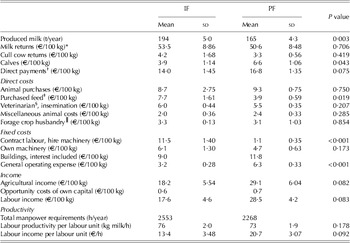
Significantly higher milk production was obtained from the IF herd than from the PF herd (P<0·01), but there was no significant difference in milk returns (€/100 kg). In contrast, the calves’ returns were significantly higher from the PF system compared with the IF system (P<0·05, Table 8). Direct costs of concentrate (P<0·05), hired labour and machinery costs (contract labour included) (P<0·001) were, however significantly lower for the PF herd. Neither equipment nor building costs reached statistical significant differences among the FS. Although the PF system had significantly higher operating costs (P<0·001), its labour income per hour still tended to be higher; this result, however, did not reach statistical significance (P<0·10).
Performance, direct and fixed costs, labour income and productivity of the indoor-feeding (IF) and pasture-based feeding (PF) systems, average from 2008 to 2010

* Average milk price/100 kg in 2008, 2009 and 2010 was 67·0, 52·0 and 51·2 € for the IF system and 64·5, 48·3 and 48·7 € for PF, respectively. Currency exchange rate: 1 CHF=0·8325€.
† Including ecological payments.
‡ Considered the inter-farm supply for cereals.
§ Monitoring of health included.
║ Own fodder crops, i.e. seed, fertilizer.
DISCUSSION
The principal aim of the current full-lactation study was to investigate the performance, land productivity and the agricultural and labour income of PF and IF dairy herds in a region with a limited vegetation period. This is the first such study to investigate differences in productivity and efficiency between BS, SF and HF cows in two different systems under equal conditions. The current market situation, with its risk of rising feed prices due to greater demand (FAO 2013), agricultural reforms, drought and ecological considerations may indicate that self-sufficient farming using local resources (e.g. pasture) on smallholder farms will become more important in the future.
Forage yield and quality
The average grass yields of the systems were typical for the Swiss lowlands (Thomet & Blättler Reference Thomet and Blättler1998; Hofstetter et al. Reference Hofstetter, Steiger Burgos, Petermann, Münger, Blum, Thomet, Menzi, Kohler and Kunz2011). Sufficient grass yield can be achieved in swards mixed with grass, herbs and legumes using moderate levels of N fertilizer (about 170 kg N/ha/year) according to Nyfeler et al. (Reference Nyfeler, Huguenin-Elie, Suter, Frossard and Lüscher2011). Nitrogen application in the present study was lower than that used in Moorpark, Ireland (McEvoy et al. Reference McEvoy, Kennedy, Murphy, Boland, Delaby and O`Donovan2008, Reference McEvoy, O`Donovan, Kennedy, Murphy, Delaby and Boland2009; Curran et al. Reference Curran, Delaby, Kennedy, Murphy, Boland and O`Donovan2010), but similar to that used in New South Wales, Australia (Fariña et al. Reference Fariña, Garcia, Fulkerson and Barchia2011) and in Florida, USA (Fontaneli et al. Reference Fontaneli, Sollenberger, Littell and Staples2005).
Compared with the average Swiss values (ALP 2008; Schori Reference Schori2009), maize silage and hay were higher in energy content, in NDF and ADF values, and grass had higher CP concentration. Crude protein in pasture was similar or higher compared to that reported by McEvoy et al. (Reference McEvoy, O`Donovan, Kennedy, Murphy, Delaby and Boland2009) and Curran et al. (Reference Curran, Delaby, Kennedy, Murphy, Boland and O`Donovan2010). Bargo et al. (Reference Bargo, Müller, Delahoy and Cassidy2002) reported higher values in pasture; Vibart et al. (Reference Vibart, Fellner, Burns, Huntington and Green2008) found lower CP and ADF values but higher NDF values. Differences in CP concentration may be due to grass composition, pasture management and N fertilization. Furthermore, differences in ADF, NDF and NEL may be explained by minor differences in the method of chemical analysis and different regression calculations for NEL. High CP in meadows and hay is partly explained by its high leguminous content (Nyfeler et al. Reference Nyfeler, Huguenin-Elie, Suter, Frossard and Lüscher2011). A potential explanation for increased CP concentration in pasture from 2008 to 2010 might be a corresponding increase in total harvested N over the 3 years, an improvement in pasture management, or adjustment of the swards to the PF systems.
The variation in chemical composition and energy content of pasture within the vegetation time, e.g. spring v. summer, was higher than the variation in nutrient values over the 3 years; similar data were shown by Fariña et al. (Reference Fariña, Garcia, Fulkerson and Barchia2011). Variation in grass content has an important impact on milk yields. No significant between-year differences were found, except for CP and NDF. As a result of this near-balanced data set, the PF herd data from different years has been pooled for analysis. The between-year variation of grass silage was smaller than the seasonal variation and the data set of the IF systems has also been pooled.
Feed intake, feed efficiency and productivity
The higher energy intake and the significantly higher production intensity in the IF herd resulted in higher feed conversion efficiency (kg ECM/kg DMI) and in more ECM/kg of metabolic LW. In contrast, with less feed intake, lower milk performances and lower production intensity the PF cows required a higher share of their energy intake for their MER. A higher energy requirement in the PF cows due to the physical activity on the pasture might have resulted in a lower coefficient of milk efficiency (Kaufmann et al. Reference Kaufmann, Münger, Rérat, Junghans, Görs, Metges and Dohme-Meier2011).
The feed conversion efficiency in the PF cows was slightly lower than the results of Schori & Münger (Reference Schori and Münger2010). Their average milk productivity per metabolic LW was consistent with previous studies (Steiger Burgos et al. Reference Steiger Burgos, Petermann, Hofstetter, Thomet, Kohler, Münger, Blum, Menzi and Kunz2007; Schori & Münger Reference Schori and Münger2010; Thomet et al. Reference Thomet, Piccand, Schori, Troxler, Wanner and Kunz2010). The feed conversion efficiency of the PF herd was also lower compared to the results of Fariña et al. (Reference Fariña, Garcia, Fulkerson and Barchia2011), who used more concentrate, a higher stocking rate and different ECM calculation methods. The clearly higher milk production of the IF cows led to the higher milk performance from the basic ration.
Productivity (kg ECM/ha AL) was high in the IF herd compared with the PF due to the higher energy and protein content of the feed ration, the higher feed intake and the higher milk production. The productivity of the PF herd was lower than the results reported by Hofstetter et al. (Reference Hofstetter, Steiger Burgos, Petermann, Münger, Blum, Thomet, Menzi, Kohler and Kunz2011), who used a rotational grazing system, and also lower than the findings of both McEvoy et al. (Reference McEvoy, O`Donovan, Kennedy, Murphy, Delaby and Boland2009) and Curran et al. (Reference Curran, Delaby, Kennedy, Murphy, Boland and O`Donovan2010). Their swards, however, were already adapted to the PF system, whereas the swards in the present study were used as semi-continuous pastureland for the first time. However, McEvoy et al. (Reference McEvoy, O`Donovan, Kennedy, Murphy, Delaby and Boland2009) and Curran et al. (Reference Curran, Delaby, Kennedy, Murphy, Boland and O`Donovan2010) used a stocking rate twice as large, did not analyse the whole lactation, and worked in more favourable climatic conditions.
The PF herd did not show a significantly higher productivity from the basic ration than the IF herd, but the performance/cow from basic ration was significantly higher (P<0·05) for the IF cows compared with the PF ones. The less-than-outstanding land productivity for the PF herd is probably related to the feed intake during the summer. It seems that the PF cows could not eat enough forage from the short swards offered in the experiment. This is in contrast to the comparative studies between continuous pasture and rotational grazing in Kent (UK) by Pulido & Leaver (Reference Pulido and Leaver2003) and in Switzerland by Münger & Jans (Reference Münger and Jans2001), who fed more concentrate, and in France by Hoden et al. (Reference Hoden, Fiorellei, Jeannin, Huguet, Muller and Weiss1987), who applied more N fertilizer. Further studies should investigate whether additional feed and the use of a rotational grazing system or other measures would improve the economic results of pasture land FSs.
Stocking rate, live weight and body condition score
In the present study, the stocking rate was defined as cows per hectare because it is based both on equal conditions regarding AL and cows suitable for the respective systems. However, if the appropriate stocking rate is considered to be 600 kg LW/ha, the calculated stocking rate would be 2·4 cows/ha for the IF farm and 2·0 cows/ha for the PF farm.
The LW loss in the IF cows corresponds with the findings of Fontaneli et al. (Reference Fontaneli, Sollenberger, Littell and Staples2005), but the PF cows in Fontaneli et al. (Reference Fontaneli, Sollenberger, Littell and Staples2005) showed 30 kg higher LW losses than our PF cows. The long-lasting LW loss of the PF cows during the summer probably resulted from lower seasonal yields, despite the fact that the stocking rate was consequently reduced, e.g. in 2010 from 4·1 cows/ha in April to 2·8 cows/ha in mid-June. In June and August, the pasture had a lower WSC concentration and lower energy content. Thus, energy intake and grass consumption were lower, in agreement with the results of Kolver & Muller (Reference Kolver and Muller1998). The low energy intake resulted in a relatively long-lasting energy deficiency over the summer. This might explain the lower fat and protein content in the milk of the PF cows at the beginning of lactation and until the 150th day of lactation.
Despite an absence of significant differences in daily LW loss among FS, a negative correlation between daily LW losses and milk protein content in the IF herd suggests a relationship between LW loss and protein content in the milk. No such correlation was found in the PF herd, which showed no pronounced decrease in daily LW losses over a short time. The significant negative correlation between milk performance in days 1–56 p.p. and the lowest LW for BCS suggests insufficient energy supply over the summer in the PF cows. No such correlation was found in the IF cows.
Fertility
Services per conception, especially in the IF cows, were high compared to results reported by Reist et al. (Reference Reist, Koller, Busato, Kupfer and Blum2000). The empty time of IF BS cows was 2 days shorter than the average for Swiss dairy cows in 2010/11 (Braunvieh Schweiz 2011). Compared with PF cows, IF cows showed significantly longer empty time and a tendency towards a longer time from first service to conception, but the differences between the systems were not significant. These findings are consistent with the studies of Vibart et al. (Reference Vibart, Washburn, Green, Benson, Williams, Pacheco and Lopez-Villalobos2012). A positive correlation between time from first service to conception and milk yield illustrates that dairy cows with high milk performance are disadvantaged with more services.
In the current PF system, the cows showed a higher number of services per conception, fewer days in the calving interval and less time empty compared to the results from a low-input production system in an Austrian Alpine region with Brown Swiss (BS) and adapted Holstein–Friesian (HF) cows (Horn et al. Reference Horn, Steinwidder, Gasteiner, podstatzky, Haiger and Zollitsch2013). This difference occurred even though these cows were fed more concentrate supplementation per year. According to the studies by Butler & Smith (Reference Butler and Smith1989), Barb & Kraeling (Reference Barb and Kraeling2004) and Butler (Reference Butler2005), a high daily LW loss in a short period of time until reaching the lowest point, as found in the IF BS cows (−1228 g/d), may result in longer empty time. The longer calving interval and longer empty time of the IF system is probably due to the temporally defined insemination period and the presence of a bull on the pasture in the PF system.
Due to the PF system's higher number of cows and a standard LW of 600 kg/cow, the PF herd produced higher average calf birth weight per AL compared with the IF herd. Fertility in the present study is similar to results from previous studies (Coleman et al. Reference Coleman, Pierce, Berry, Brennan and Horan2009; Vance et al. Reference Vance, Ferris, Elliott, McGettrick and Kilpatrick2012). More cows might be needed to provide stronger evidence regarding reproductive performance.
Milk performance and milk solids
The different lactation curves for the IF and PF cows are consistent with the results of Fontaneli et al. (Reference Fontaneli, Sollenberger, Littell and Staples2005) and Bargo et al. (Reference Bargo, Müller, Delahoy and Cassidy2002) and in accordance with the PF system of Fariña et al. (Reference Fariña, Garcia, Fulkerson and Barchia2011). In contrast to the study of Bargo et al. (Reference Bargo, Müller, Delahoy and Cassidy2002), the differences in milk production during the whole lactation were significant in the present study. The IF cows showed a stable course of the average milk urea content, which suggests that the feed ration was appropriate to requirements. In contrast, PF cows showed the typical peak of milk urea. Low WSC and low energy content in the grass during the summer partly explains the lower milk-fat-to-milk-protein ratio in PF cows compared with IF cows. The results showing higher milk performance and milk solids in the IF cows compared with the PF cows are broadly consistent with previous comparative studies (Fontaneli et al. Reference Fontaneli, Sollenberger, Littell and Staples2005; Vibart et al. Reference Vibart, Fellner, Burns, Huntington and Green2008, Reference Vibart, Washburn, Green, Benson, Williams, Pacheco and Lopez-Villalobos2012).
The higher content of CLA and ω−3 FA of the PF cows confirm the results of Dhiman et al. (Reference Dhiman, Arnand, Satter and Pariza1999), White et al. (Reference White, Bertrand, Wade, Washburn, Green and Jenkins2001) and Collomb et al. (Reference Collomb, Bisig, Bütikofer, Sieber, Bregy and Etter2008), regarding the positive influence of mountain pasture on milk quality in Switzerland. In particular, from April to October the PF cows showed fewer saturated but more unsaturated fatty acids, and more CLA and ω−3 FA compared with the cows fed on conserved forage (Wyss et al. Reference Wyss, Maurer, Frey, Reinhard, Bernet and Hofstetter2011).
The PF cows showed a constant increase in milk performance of about +200 kg ECM/cow/year and an increase in milk protein. This might be a result of an adaptation process of metabolism to the PF system and is consistent with results from a previous study (Hofstetter et al. Reference Hofstetter, Steiger Burgos, Petermann, Münger, Blum, Thomet, Menzi, Kohler and Kunz2011). However, it might also have been a consequence of improved management. The IF cows did not show this increase in milk performance in the study period.
The suboptimal feed and energy availability in the continuous pasture-FS, especially during the summer, resulted in lower milk performance and lactation persistence than in the IF system. The findings suggest that the PF cows were not able to exploit their genetic milk performance potential, which confirms the results of Australian HF cows with a slightly higher level of concentrate (Fulkerson et al. Reference Fulkerson, Davison, Garcia, Hough, Goddard, Dobos and Blockey2008). Additional feeding with energy-rich feed, e.g. coarse meal of maize ears, would have compensated but would have resulted in additional AL purchased outside the farm, which would not be consistent with a low-cost, self-sufficient PF system. Moving the cows to Alpine pasture might also be a management option to compensate such summer feed lack. Indeed, this is common practice in Alpine and pre-Alpine regions.
Economic efficiency
The higher milk price of the IF herd is explained by higher milk solids content and a more constant daily milk yield over the year. The higher milk fat quality (higher content of CLA and ω−3 fatty acids) in PF milk did not yield additional profits. The market demands a constant supply of milk, which PF inherently cannot provide due to seasonality.
The higher fixed costs in the IF system resulted especially from the higher machinery and conservation costs for maize and silage. The findings of the present study are consistent with simulation studies by Gazzarin et al. (Reference Gazzarin, Ammann, Schick, Van Caenegem and Lips2005; Gazzarin & Lips Reference Gazzarin and Lips2006) and retrospective observational studies by Hofstetter (Reference Hofstetter2010) and Gazzarin et al. (Reference Gazzarin, Brand, Albisser and Wettstein2011).
Previous calculations have concluded that PF and IF systems with the same AL appear to be on a par in terms of economic efficiency, but only if the IF cows show a considerably higher milk yield than in the present study (Gazzarin et al. Reference Gazzarin, Ammann, Schick, Van Caenegem and Lips2005; Gazzarin & Lips Reference Gazzarin and Lips2006). A difference in milk yield of more than 2500 kg milk per cow and lactation between PF and IF do not compensate for the higher fixed costs. This is explained by high variable costs for purchased concentrate and also the contractor costs of feed production, which can hardly be reduced by economies of scale. The higher milk price does not, however, compensate for the high total costs of IF, leading to a much lower net income.
Farms with limited AL should reduce their direct and fixed costs (i.e. feed and machinery) as a fast and targeted way to increase profits. The lower milk yield in PF cows is more than compensated for by the lower fixed costs and by a higher return in by-products such as more sales of surplus calves. The surplus calves will gain in importance due to increased demand for meat. Furthermore, a recent comprehensive, model-based study by Zehetmeier et al. (Reference Zehetmeier, Baudracco, Hoffmann and Heissenhuber2012) put the specialization in both dairy and beef production in terms of greenhouse gas emissions in question. Their findings showed higher human-edible efficiency, i.e. output human-edible protein/cow to input human-edible food, for dairy cows yielding 6000 kg of milk/year, e.g. the dual-purpose Fleckvieh breed, compared with dairy-only cows yielding 10 000 kg of milk/year, e.g. the HF breed. Due to the co-products they yield, dual-purpose cattle such as SF or Montbéliard might undergo a renaissance, especially for PF systems. Furthermore, higher returns from by-products will decrease the income risk of high milk price volatility.
CONCLUSIONS
The results of the present study suggest that IF cows are more efficient in terms of milk performance, milk fat and milk protein production compared with PF cows. The milk production performance and FA composition of milk from PF cows are affected by seasonal changes in the availability and nutritional content of grasses. The lower feeding intensity and the better animal welfare conditions probably resulted in PF cows showing a higher fertility than IF cows. Better commercialisation of the higher content of CLA and ω−3 FA of the PF system could result in a higher milk price.
The IF herds had higher land productivity than PF herds. However, to achieve a lactation performance of about 9000 kg ECM, soyabean meal and maize gluten constituted about 0·2 of the IF AL and this feed must usually be purchased, whereas a PF farm with a lactation performance of c. 6000 kg ECM is almost self-sufficient. The PF farm also achieved better economic results due to its lower costs. Within the current situation and the associated costs in Switzerland, the more economically interesting strategy would be to lower costs rather than to increase the milk yield. Furthermore, dual-purpose cattle in PF systems could have advantages regarding its lower use of human-edible food and the increasing global demand for meat.
Rising feed prices all over the world suggest that pasture-based dairy production systems could gain importance in the foreseeable future on AL with humid climate conditions. Pasture-land systems already dominate in countries such as Ireland or New Zealand. In an environment of rising input costs and milk price volatility, farmers are under pressure to improve their management systems and must therefore be able to accurately assess the profitability and risk impact of the system they are using. Future larger-scale and longer-term studies should supply further evidence for the economic efficiency of different production systems.
This study was funded by the Swiss Dairy Producers’ Association, the Central Swiss Dairy Producers’ Association, the Departments of Education & Culture and Building, Environment & Economics of the Canton of Lucerne, and AGFF Zurich. The authors also wish to thank our colleagues at our institutions and the staff at the experimental farm in Hohenrain, Switzerland, especially Josef Estermann. A part of this study was published in Agrarforschung Schweiz 2(9): 402–423, 2011.