While the study trip's purpose was to showcase the river regulation's progress, the Donauverein’s delegation had also accepted a petition from Linz's communal council to visit its unregulated local side branch, which flowed through the town's northern suburb.Footnote 4 The branch's stagnant, brackish water was threatening residents’ sanitation as well as navigational, commercial, and recreational interests. However, municipal resources alone were insufficient to implement technical plans that would eliminate these unfavorable hydrological conditions. Believing that the delegation represented the best chance to secure imperial funds to remedy this problem, the city's residents enthusiastically awaited the ship and its delegates’ arrival. Once the trip's participants disembarked at two o'clock, the mayor warmly greeted them with a speech before the sodden crowd, in which he heralded the study trip as Linz's best chance to improve the Danube. He optimistically projected that the study trip would be beneficial, saying to great applause that “never has success failed when proven forces unite for a good cause.”Footnote 5
Such shifting group identifications were a dynamic feature of the monarchy, one that several scholars have already brilliantly explored. Exploring behavior toward nationalism, Pieter M. Judson has argued recently in The Habsburg Empire: A New History that identities and identification can be better understood “in terms of the various situations or events that drove people to identify with one national group or another” and that it “helps to approach questions of identification by thinking more in terms of particular practices that expressed feelings of loyalty or commitment rather than in terms of people's fixed identities.”Footnote 7 Jeremy King has also cogently pointed out in Budweisers into Czechs and Germans: A Local History of Bohemian Politics, 1848–1948 that collective identities were prone to more cohesive elements than just ethnolinguistic identities, and that “if languages divided a population vertically, into protonational columns, then corporative and socioeconomic solidarities divided it horizontally, into Habsburg layers—and had far more institutional anchoring and sociopolitical significance.”Footnote 8
These processes, practices, and layers were not confined to the political or national realm but also extended to the physical-environmental spaces in the monarchy where socioeconomic interests and behaviors were embedded. Discussions regarding the Danube's regulation coalesced people at the local, regional, national, transnational, and imperial levels, whose shared interest in the river manifested itself in endeavors such as the 1884 Danube Study Trip.Footnote 9 These interactions and relations are important to highlight, as they played a crucial role in strengthening the monarchy's social and political bonds. Communities along the Danube relied on—and brought together—a combination of commercial, civil, and governmental resources and groups to address local and monarchy-wide concerns. Negotiations and interactions between these various groups indicated the presence of a robust civil society early in the nineteenth century well before the constitutional era. Petitions to county, provincial, and central governments in Budapest and Vienna contained expectations that the authorities would finance and implement plans to help the populace. Deliberations at all levels of government, even early in the century, sought to respond commensurately to the needs of local communities, presaging elements of later, liberal governance in the 1860s.Footnote 10
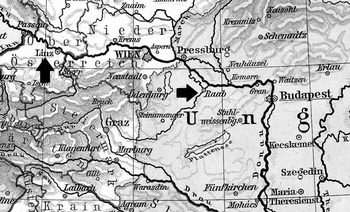
To explore these associations, this article studies the Danube's common, transnational influence on two riparian communities—Győr, Hungary, and Linz, Austria (see Figure 1). These two cities provide insight into the historical development of smaller, municipal populations on the river, outside the oft-compared imperial and royal metropoles, Vienna and Budapest. Despite one city being “Hungarian” and the other “Austrian,” both Győr and Linz were remarkably alike. They were both mid-sized cities in the monarchy, whose populations nearly tripled from the mid-nineteenth to early twentieth century as a result of internal migration, the incorporation of neighboring communes, and improved living standards.Footnote 11 As this article aims to demonstrate, their residents also displayed similar ingenuity and resilience in their efforts to maintain their historical position on the Danube in the face of changing circumstances in the nineteenth century.
Interestingly, one of the most crucial elements of these transformations was not political or economic in nature, but environmental. Negotiations, compromises, and legislative and commercial actions all had to take the Danube's mutable nature into consideration. Technical innovations and natural occurrences like floods and siltation constantly reshaped the river's hydrological conditions. These fluctuating circumstances fueled ever-evolving, fluid associations that were as likely to transcend as they were to adopt national loyalties to address changing hydrological conditions. While the Danube presented opportunities for many citizens, for some, it represented a source of inconvenience or even danger to overcome. Stakeholders presented these possibilities in stark contrasts—catastrophic commercial collapse versus collective growth, loss of livelihood versus reasonable accommodation, perpetual insecurity versus safety from floods and diseases, among many others.Footnote 12
These were not peripheral issues. By the beginning of the twentieth century, several million people lived in communities and cities on the monarchy's main river, and the so-called Donaufrage (Danube Question) filtered into discussions in newspapers, diets, commercial reports, and associational life.Footnote 13 Using the Danube as a category of analysis enables us to see how communities adapted to changes in their physical environs, flexibly relying on and interacting with each other, local authorities, transnational businesses, and national and imperial governments in a multifaceted process, which helped shape what contemporaries were already calling the “Danube Monarchy.”
The Danube's Early Influences in Linz and Győr
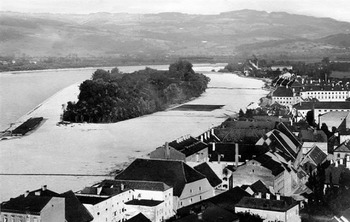
The Danube's hydrology—its flow and interplay with the adjacent land—influenced Linz's and Győr's unique historical development and reliance on the river. In Linz, a large flood in 1572 washed through town and created a side channel adjacent to the city (the very same one visited by the Donauverein study trip in 1884). A century later, a businessman founded a textile factory here, which led to the channel's nickname, the Fabrikarm or “factory arm” (see Figure 2). During the eighteenth century, at its height, the factory employed almost 50,000 workers and cottage industry weavers in the region—an impressive feat given that Linz's municipal population in 1822 was only around 20,000 people. The Fabrikarm facilitated ship traffic to and from the city, and it provided a convenient site for early industrial development.Footnote 14 The city held biannual markets, which drew merchants from around Europe, and its geographic location made it an ideal transit point for north-south overland and east-west river shipping routes.Footnote 15 Linz and the surrounding villages also provided a steady stream of sailors, boat-towing laborers, and shipbuilders for trade and navigation on the Danube.Footnote 16
Figure 2:Linz, Strasser Island, and the “Fabrikarm” in the Late Nineteenth Century. Source: Unknown photographer. Regulierung des Donauarmes bei Strasser-Insel. Photograph. 1890. Nordico Museum, Linz, Austria. Archival number: NA-021457.
Much like the flood that created Linz's local Fabrikarm, hydrological happenstance in the early modern period also ensured Győr's propitious placement on the Danube. Frequent flooding and sediment deposits downstream from Pozsony/Pressburg (modern-day Bratislava, Slovakia) forced the Danube to branch into three segments. Győr sat on so-called Mosoni Danube, the southernmost and most navigable branch in the braided stretch.Footnote 17 The Danube's navigability on this channel made Győr a dominant site for the river's burgeoning wheat trade following Hungary's liberation from the Ottomans in the late seventeenth and early eighteenth centuries. Crews towing shipments of wheat up the Danube from eastern Hungary and the Banat, on the monarchy's southeastern border with the Ottoman Empire, reached Győr, where they unloaded their wares and reloaded them onto smaller boats to continue up the Mosoni Danube or onto carts to pass over land to their ultimate destination, Vienna. This commercial route made Győr the largest transit point for Hungary's grain “exports” to Austria.Footnote 18
Residents in Linz and Győr relied on the Danube to power their mills, transport their ships, and aid metallurgical, textile, and other industrial processes for centuries, until steam power's introduction in the early nineteenth century gradually forced these practices to evolve or decline. Steam engines began powering ships in the late eighteenth century in England and America, and by 1813, Habsburg Emperor Francis I promised an imperial monopoly to any company or individual capable of sailing a ship up the Danube without the use of draught animals. In 1829, two Englishmen successfully established steam navigation on the monarchy's Danube and their new company, the k.k. erste priv. Donau-Dampfschiffahrts-Gesellschaft (Imperial-Royal Privileged Danube Steam Navigation Company or “DDSG”), started running its first steamboat, Franz I, regularly between Vienna and Pest in spring 1831.Footnote 19
The early years of steam travel marked a new era of transportation for individuals and communities reliant on the Danube. For Győr, located between Vienna and Pest, Franz I’s once-a-month stopovers expanded the city's commercial reach along the Danube, enlivening trade both north to Vienna and downstream to Semlin (modern-day Zemun, Serbia), a town on the Danube's southern bank across the Sava River from Belgrade.Footnote 20 In an 1833 letter to Palatine Joseph, Communications Minister István Széchenyi—a fervent proponent of steam navigation—noted that not only freight transport but also “passenger traffic from Győr to Semlin and back through Pest [was] … getting brisk.”Footnote 21 The local Győr papers ran advertisements for the DDSG. Linz's papers likewise covered steam navigation's rise in the early 1830s, describing steamships’ comfort and convenience for travel and trade. However, in contrast to Győr's early integration into the steamship network, steam engines were too weak to overcome the Danube's current upstream from Vienna, so Linz's merchants continued to ship wares downstream on traditional vessels for several more years. Passengers who wanted to travel down to Vienna could take the once-weekly Ordinäre ships that departed Linz on Friday and arrived in Vienna on Saturday. The trip cost 1 florin, 12 kreuzer, at a time when a worker's wages averaged 6 florins a month.Footnote 22
Steamship traffic renewed concerns over the sandbanks, shoals, and shallow water that had endangered ships’ progress for centuries, but the removal of which seemed steadily more urgent. Engineers, government officials, and companies feared that without more concerted interventions to eliminate such hindrances, steam navigation—and with it commercial growth—would suffer. The DDSG's business reports and Tafel der Statistik statistical records from the 1830s and 1840s were filled with complaints that DDSG ships were frequently stalled when seasonal and meteorological factors caused low or excessively high water levels, exacerbating already dangerous or unnavigable stretches.
Early on, both political and technical authorities proposed solutions to the precarious situation, suggesting the expenditure of millions of florins to regulate the more problematic Danube stretches.Footnote 23 On 5 July 1831, the Lieutenancy Council (Helytartótanács) in Buda issued a decree mandating the regulation of the main Danube bed between Pozsony/Pressburg and Gútor (later extended to Védek), which it estimated would cost almost 2 million florins.Footnote 24 To put this in perspective, the hydraulic engineering offices (Wasserbau-Direktionen) in the monarchy's other provinces had a combined total budget of 2 million florins in 1831; a sum equivalent to one-tenth of the currency value that the government had issued that year (19.9 million florins).Footnote 25 These transformations—regulation and steamships—were both meant to benefit cities along the Danube, but while industry in Linz adapted to early changes, Győr's commercial groups were threatened by the Hungarian government's planned engineering works. While the main bed's regulation would benefit navigation more generally, it would also enable steamships to bypass the narrower and shallower Mosoni channel upon which Győr was situated, threatening the city's privileged position, and thus its commercial livelihood.
Győr's residents’ fears were confirmed once regulation work began in earnest in the early 1840s. Although the regulation was only partially completed by the mid-1840s, the DDSG already considered changing its schedule, replacing Győr as its stopover station between Vienna and Pest with Gönyű—a city on the main, regulated channel.Footnote 26 DDSG head Joseph Voigt justified this decision to Communications Minister Széchenyi by complaining that the poor conditions in the “Győr channel” were slowing river traffic.Footnote 27 Győr's municipal authorities wrote to the DDSG administration and requested that the city remain on the company's travel route, citing its importance for the grain trade.Footnote 28 Győr's position nevertheless declined to the point that travel guides routinely skipped descriptions of it altogether in their overview of travels down the Danube, assuming that steamships would take a more common route along one of the more northern arms instead.Footnote 29
Fortunately, geopolitical interests soon provided a circuitous though temporary solution to the endangered trade route. On 2 July 1846, an article appeared in Győr's local German-language paper Vaterland advocating for the establishment of a national steamship company to develop Hungarian interests on the Danube. While some people in Győr believed a national company might address the city's siltation and navigation problems more attentively, opponents articulated grave concerns that Győr didn't have the capital to establish such a company, that ships would be expensive to maintain, and that the company would certainly fail if forced to compete with the DDSG.Footnote 30 Eager to counter what they perceived as the “Austrian” DDSG, Pest-based investors offered to provide the city with the requisite capital for a national company. Győr's merchants participated in negotiations but made it clear that they were primarily preoccupied with securing local interests, much to the chagrin of their nationally minded investors. Moreover, once the DDSG's administration learned of the rival overtures, it immediately sent its ship Argo to establish a new passenger line between Győr and Pest and offered additional support for the town's grain transports. Local interest in a “national” company died out immediately.Footnote 31
The DDSG's accommodations assuaged immediate passenger and freight concerns. Its extensive routes provided Győr's merchants with greater opportunities than a fledgling national company could, which kept the city rooted in monarchy-wide, rather than purely national, commerce. Residents continued to rely on the grain trade, and by the mid-nineteenth century, they had built 147 granaries in town, many as near to the riverfront as possible. According to some numbers, every tenth person in Győr lived off the Danube's grain commerce.Footnote 32 Unfortunately, by propping up the city's grain trade, steam navigation deterred the Győr city council or residents from properly investing in necessary solutions to the increasingly untenable siltation in its local Danube branch. Quite the contrary. One 1854 travel guide discussed how in the early 1850s, the DDSG was forced to construct tugboats, which drew less water, so they could sail up the shallow, sandbar-plagued Mosoni arm to Győr.Footnote 33
While Győr both benefited and struggled with early challenges that the Danube's physical transformation entailed, Linz's residents welcomed the early innovation less ambivalently. In September 1837, the townspeople greeted their first steamship, the DDSG ship Maria Anna, after it completed a successful, albeit labored, journey from Vienna to Linz.Footnote 34 The following spring, regular traffic from Linz to the imperial capital began, and by 1840 ships were departing each location every two days to bring passengers and wares back and forth.Footnote 35 The five steamships plying this stretch in 1840 hardly matched the annual freight load of the nonsteam traffic—one successful shipowner managed 350 ships between Persenbeug, Lower Austria, and Regensburg, Bavaria.Footnote 36 But in contrast to traditional towing methods, which took ships fourteen days to reach Linz from Vienna, the first steamship managed the trip in just fifty-five hours. The city's municipal authorities permitted the DDSG's ships to dock at a prominent landing place between the wooden bridge crossing the Danube and the mouth of the Fabrikarm, which provided easy access to Linz's market place.
Just as Győr's transregional grain trade characterized the physical layout and development of the riverfront, the burgeoning presence of steamships in Linz attracted new industrial interests to the river, which likewise expanded transregional associations along the Danube. Local shipwright Ignatz Mayer recognized the fundamental shift that steam power represented for the shipbuilding profession, and in 1840 he founded a shipyard in Linz's Fabrikarm designed to repair steamships.Footnote 37 Steamship traffic had increased dramatically within its first decade on the Danube; the DDSG's four ships transported 14,400 passengers in 1835 and by 1841 its sixteen ships transported 117,500 passengers. The DDSG's monopoly in the Habsburg Danube stretch limited domestic clientele to a single company, so Mayer grew his business connections by servicing ships from Württemberg and Bavaria as well. Mayer even struck up a personal partnership with a Bavarian steamship company in 1857.Footnote 38 By 1854, rather than just repairing steamships and constructing barges, the shipyard was building steamships as well. Business boomed and the shipyard's employment expanded from 200 men in 1854 to 550 men by 1869. Commercial rather than national principles drove the shipyard's success. In 1867, at the same time as the “acrimonious” Austro-Hungarian Compromise, the shipyard even built ships for a Hungarian steamship company. Mayer's enterprise raised his profile in the whole region, and beyond serving in Linz's communal council from 1848 to 1873, he was also politically engaged in the Upper Austrian Provincial Diet (Landtag) from 1866 to 1871 and the Imperial Parliament (Reichsrat) from 1866 to 1870.Footnote 39
Steamships drew more commercial-industrial interest to the Danube, expanded transregional associations, and inspired engineering projects to facilitate navigation.Footnote 40 By mid-century, the DDSG's passenger travel on the Danube stretch between Passau and Pest, including stopovers in Linz and Győr, stood at more than 300,000 people a year. The DDSG advertised its routes and rates extensively in the Győri Közlöny and Linzer Tages-Post. However, groups and industries connected to the Danube soon found the river's utility under siege from new technology usurping its role in transportation: railways. Győr's first train connection opened in 1855, connecting it to Vienna via Bruck an der Leitha. In 1858, the Kaiserin-Elisabeth-Westbahn connected Linz to Vienna.
The new infrastructure competed with passenger and freight traffic on the Danube and threatened to derail work on local regulation indefinitely. While the shift to rail transportation helped alleviate Győr's immediate shipping concerns, the town soon found itself in competition with Pest, a rising regional rival in grain processing and transportation. A rail line to Vienna provided Pest's milling industry direct access to Vienna's markets, which siphoned business from the river and superseded Győr as a point of transit for grain. A decade later, only half the amount of grain arrived in Győr via the Danube as had ten years earlier.Footnote 41 In December 1858, the local paper Győri Közlöny bemoaned the fact that the DDSG was halting its Mosoni branch traffic, due to the growing rail competition.Footnote 42 This complaint turned out to be premature, and the DDSG continued its services the following spring, but it gave voice to fears that the river's importance for the town was declining.
These changing circumstances led to a coalition of interested parties that mobilized to keep the Danube a relevant part of Győr's economic and social life. Rather than simply yielding to locomotive travel, residents—who had traveled on steamships for decades—clamored for more steamship connections. By the late 1850s, Győr's residents became upset that schedules had ships arriving back in town at two in the morning, and in April 1859, the paper aired residents’ grievances about stumbling home in the dark during the long walk from the steamship station.Footnote 43 When the DDSG directed its ships to depart a few hours earlier to address residents’ concerns, they next complained that arriving at midnight was not much better.
Likewise, falling grain shipments on the Danube prompted the Commercial Guild, an association of local merchants, to admonish the mayor's office for failing to dredge the Danube at Győr. Because the river's levels were too low to accommodate large grain ships arriving from downstream, the Guild argued that the city was losing money unloading larger ships and reloading grain and wares onto smaller ships to continue their journey. The Guild calculated that the 400 forints per boat lost in delays and labor costs would harm river commerce. Rather than framing the dilemma in purely hydrological terms, the Guild claimed that commerce's significance for the entire region meant that the Danube's maintenance was good “not only for the city's residents but for the entire public as well.”Footnote 44
Győr's local conditions deteriorated in the face of the local and national government's inaction, and finally the DDSG launched a ship to survey the Mosoni Danube in 1860 to determine where dredging work was necessary.Footnote 45 The company's action prompted the Győr city council to agree to cover dredging costs the following year. Before dredging could begin, however, floods in spring 1862 hit the entire monarchy, causing massive destruction. Reconstruction costs strained Győr's finances and disrupted its plans to clear the river. In response, the DDSG offered to help pay for the dredging.Footnote 46 Such magnanimity incidentally coincided with the arrival of a new steamship company in town, the Royal Bavarian Steam Navigation Company. The Bavarian company had recently started advertising their freight services in the Győri Közlöny in September 1861 and even employed a business representative in town; one of only four in Hungary.Footnote 47 The DDSG's offer to help clear the Danube—while certainly critical for its own operations—also likely sought to retain customers’ loyalty by ingratiating the company to the local community.
Despite the DDSG's active engagement with local communities, its thinly spread resources, diluted by its tendency to buy rival companies, left it vulnerable to shortcomings in its services. This left room for other commercial groups to compete for local markets. In August 1865, the Győri Közlöny published a series of articles from the paper Új Korszak (New Era), which again advocated the need for a specifically Hungarian steam navigation company. Unlike efforts in 1846, which failed to garner enough local interest, in 1865 a group of merchants from Győr founded the Győr Steam Navigation Company to combat the DDSG's unfavorable shipping rates, promote commerce, and enable the “reasonable transport of wares via steamship on the Danube and its tributaries.”Footnote 48 The company employed a large number of workers and crew, as it had five freight steamers, twenty-one tugboats, and an additional thirty-one wooden boats for trade.Footnote 49 It even commissioned a steamship from the shipyard in Linz.
The local company in Győr was one of many that emerged in the 1860s in response both to the loosening of the DDSG's imperial monopoly following the 1857 Danube Navigation Act and to the 1867 Compromise. While certain national companies sought to directly compete with the DDSG, most could not overcome its established position in the monarchy, which the post-Compromise Hungarian government strengthened by honoring an 1857 subsidy agreement with the company.Footnote 50 As a result, several national, Hungarian steamship companies went bankrupt in the 1860s and were forced to sell their ships to the DDSG. Most regional or local companies survived by catering to more specific local needs rather than overstretching themselves. The Győr Steam Navigation Company's general assembly concluded that cooperating rather than competing with the DDSG was the only way to protect its local interests.
While Győr's fortunes waxed and waned in the 1850s and 1860s, a singular hydrological event in Linz set off a cascading crisis for the town's residents and businesses for the next several decades, leading to a collaboration of local and imperial actors and companies to address the problem. A flood in 1864 tore a steamboat loose from its mooring near Linz and crashed it into the wooden bridge spanning the river, collapsing two of its yokes. Emperor Maximilian I had first permitted the bridge's construction in 1497, though floods and ice flows had periodically destroyed this bridge throughout its extensive history.Footnote 51 In the flood's aftermath, the communal council consented to rebuild the bridge out of iron, and in 1872 the bridge opened to great fanfare and celebration. However, the bridge's solid construction inadvertently and adversely affected the river's morphology. The bridge's pylons shifted the Danube's current away from the opening of the Fabrikarm, which resulted in the water level dropping in the channel. Factories, swimming facilities, mills, and the military barracks depended on the river's fresh-flowing water. Stagnant water endangered their functioning and livelihood.
Much like the delayed and insufficient investment in Győr's Danube regulation the decade before, Linz's residents initially also encountered disappointment from both public and private sources. In 1876, conditions in the Fabrikarm had become so bad that Linz's bathing facility manager turned to various authorities to intervene. The manager first requested an excavator from the Lower Austrian Danube Regulation Commission (DRC), which had just undertaken the regulation of the Viennese Danube from 1870 to 1875. When the DRC rejected the facility's request, it turned to the DDSG. The DDSG's management only agreed to sell rather than loan an excavator. The imperial-royal Interior Ministry even claimed that the channel's regulation, unlike the Danube in general, was a purely municipal matter.Footnote 52 The imperial government was not wholly indifferent: The Imperial War Ministry's Marine Section offered to help pay for sewage canals near its barracks on Strasser Island.
Local efforts to resolve the matter remained fruitless and even led to tensions between several groups in the Fabrikarm reliant on the riverine space. The increasingly unsanitary conditions forced Linz's bathing facility to temporarily move its position upstream above the bridge. However, this clashed with the newly established rowing club, which also wanted access to this river bank for its practices. Numerous, immobile businesses, such as the tobacco factory and various mills and industries, remained without a viable option. They relied on the channel to facilitate river traffic, power mills, and wash away effluent, and these businesses still had to find a solution to the channel problem.Footnote 53 Engineer Arthur Oelwein suggested that the only way to improve the channel's conditions would be to modify the whole main bed of the river, not unlike the massive engineering work at Vienna.Footnote 54
Eventually, after the Danube regulations at Vienna (1870–75) and Budapest (1871–75) were completed, more concerted action emerged from a variety of sources to petition for additional regulation in other Danube stretches in the monarchy. The river itself also served to galvanize action: A massive flood in 1876 was so destructive that fifteen thousand people on the Danube stretch between Pozsony/Pressburg and Pest lost their homes, while hussars—Hungarian cavalry members—rushed to Győr to aid rescue operations.Footnote 55 Provincial legislatures, citizens’ petitions, and commercial negotiations all pushed the authorities in Budapest and Vienna to turn their attention outside the capitals. These efforts gained support from companies and associations concerned with the Danube's improvement to protect citizens from floods and to promote navigation, most notably from the Donauverein.
Thanks to these efforts, the 1880s witnessed an uptick in funding efforts to regulate the Danube across the Habsburg monarchy, including at Linz and Győr. In 1885, the National Diet in Budapest passed Law VIII providing funds to regulate the river between Dévény (on the border to Austria) and Dunaradvány on Hungary's southern border.Footnote 56 The Reichsrat in Vienna also passed legislation jointly funding regulation projects with the Lower and Upper Austrian provincial governments in 1882 and 1886, respectively. The Reichsrat’s approval for Upper Austrian regulation was thanks, in part, to Linz's representative, Dr. Vielguth, who gave an impassioned speech in front of the Reichsrat in March 1886, arguing that the expenses were justified, not only because regulation would enhance regional connections, but because of the Danube's significance for the monarchy's cohesion. To great applause, he exhorted the chamber to act decisively, averring that the Danube was “the only great natural waterway, which runs through our entire empire from the west to the east, which connects the imperial capital with the capital cities of the other half of the empire … and thus should be restored and preserved, as it is a legitimate requirement for navigation.”Footnote 57
Municipal authorities at Győr and Linz viewed regulation as one element in the river's necessary transformation to modernize transportation at each location, but they also sought additional physical changes to the riverscape to ensure that their local practices could continue to exist and evolve with the times. As the monarchy's rail network widened, for example, both communities designed new transshipment hubs connecting rail and water traffic, which were meant to facilitate ties from the Danube to its commercial hinterlands. Linz's and Győr's municipal councils attempted to pursue regulation and transshipment hub projects simultaneously, and both turned to associational and commercial groups for their help advocating and petitioning provincial and imperial-royal governments to approve plans and provide funds.
In Győr, both the local commercial interests and the regional political authorities waded into discussions over how to implement their visions for the river. In 1881, the Győri Lloyd petitioned Győr's city council to set up public warehouses along the river to compete with Budapest's and Vienna's modern, commercial arrangements on the Danube.Footnote 58 In 1884, the local paper published the lord lieutenant's (főispán) opinion that public warehouses would advance the town's commercial goals. The főispán claimed that installing public commercial buildings at the river would help the town become the center of trade between the “east” and “west,” rhetoric that incidentally matched that of river regulators and city planners in Budapest, Vienna, and Linz.Footnote 59
Not only did the warehouses remain unbuilt, but slow progress on the river's regulation and quay construction ensured that floods remained more than a potential threat to the city. In January 1883, the Danube's flooding became international news, and images of Győr underwater appeared in the popular British weekly The Graphic.Footnote 60 One local paper, the Győri Közlöny, published an article with the title “Why did the Danube flood Győr?,” and what followed was a scathing indictment of the national government's slow work, as a result of which the author opined, “[W]e are facing the pernicious consequences of the imperfect, unfinished river regulation.”Footnote 61 Once again, the Danube forced residents to rearrange their physical constructs on the river. To reduce the risk of damages to the town's infrastructure, engineers ended a local rail stretch far enough from the river's banks to avoid future floodwaters’ reaches. The Győri Közlöny complained that merchants, passengers, and other residents in Győr found the arrangement to be inconvenient for passengers and merchants transferring between river and rail.Footnote 62
By contrast, in 1887, the city finally completed its transshipment hub in time for the opening of the Ebenfurt-Győr line. These factors lifted the Győr Steam Navigation Company's financial fortunes. Despite complaints at the company's 1891 shareholder meeting, which singled out conditions on the Mosoni branch as generally insufficient for large ships or large-scale freight shipments, the company reported a more than 13,000-forint profit for the year.Footnote 63 With the new transit facilities in Győr and an infusion of stocks and ships, the company expanded its operations significantly in the early 1890s; in 1890 alone it more than tripled its tonnage compared to the previous two decades’ annual average.Footnote 64 Eventually, the National Diet's funding also ensured that the Mosoni branch was regulated between 1886 and 1894.Footnote 65
A lack of institutional support in the 1870s bedeviled Linz's regulation and highlighted the need for municipalities to turn to imperial commercial and political structures to help them. It was only once transregional actors like the DDSG and Donauverein teamed up with the provincial and imperial governments that renewed interest and investment flowed to the region. Linz's regulation plans in the early 1880s went hand in hand with communal council plans to set up a transshipment hub. It was a costly and complex endeavor, which required the council to deploy several lobbying groups to help it secure imperial consideration and resources. Representatives from the communal council and Upper Austria's provincial diet enlisted the help of the Donauverein to speak with representatives from the Reichsrat and bureaucracy. In 1884, the association used the occasion of its Danube Study Trip to demonstrate the project's need and merit to the trip's participants. Not only were the local inhabitants thrilled by the trip's agenda, as evidenced by the current paper's introductory anecdote, but the trip also successfully convinced the imperial authorities in attendance to recommend to the Reichsrat that imperial funding be directed toward Linz.
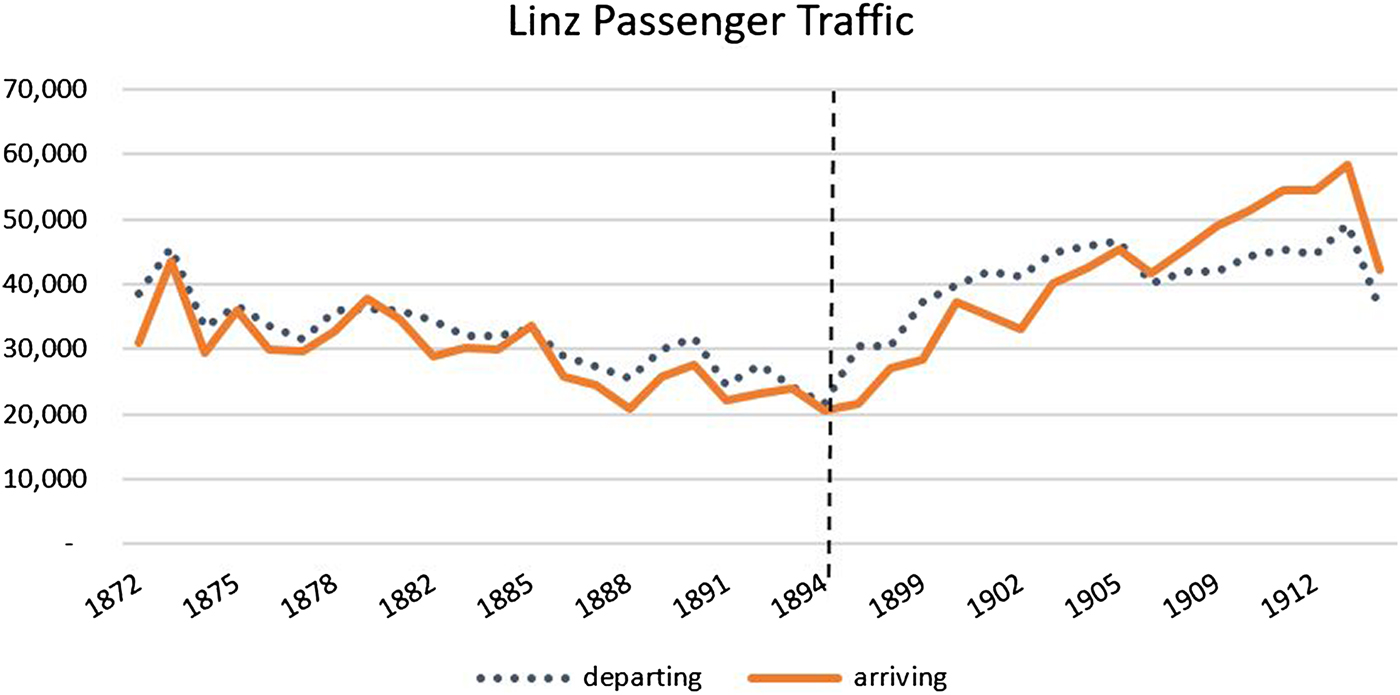
The final plans brought together funding from private and public sources and worked to ensure that businesses and groups on the Danube all had equal voice and equal access to the riverine space. Linz's communal council set up a municipal commission in 1884 to coordinate all regulation and transit hub plans with local industries in the Fabrikarm.Footnote 66 When the commission raised the idea of permanently closing off and filling in the Fabrikarm to create space for the proposed transshipment hub, the channel's business representatives responded that their livelihoods would end unless the city paid them an indemnity or could guarantee their transfer to another spot on the Danube.Footnote 67 By January 1887, the Upper Austrian provincial diet (Landtag) approved their contribution amount for the project on the condition that all types of boats—including nonsteamships like rafts and galleys—would be able to continue landing at Linz.Footnote 68 By July 1889, the k.k. Upper Austrian governor's office (Statthalterei) approved the first payment installment and eventually in spring 1890, the Danube's regulation began. According to the final plans, the Fabrikarm was filled in and the city relocated its businesses to various new locations on the main bed. Besides the imperial, provincial, and municipal funding for the regulation, two major companies in the monarchy, the k.k. State Railways and the DDSG—which both stood to profit from the new arrangements on the Danube—also contributed to the transshipment hub's construction costs. The new hub opened in 1894 and traffic on the river—both passenger and freight—increased markedly afterward (see Figure 3).
Figure 3:The Opening of Linz's Transshipment Hub in 1894 and Concomitant Rise in Passenger Traffic. Rechenschaftsbericht des Gemeinderathes der Landeshauptstadt Linz über seine Thätigkeit (Accounts Reports), compiled by the Linz Communal Council and published from 1876 onward.
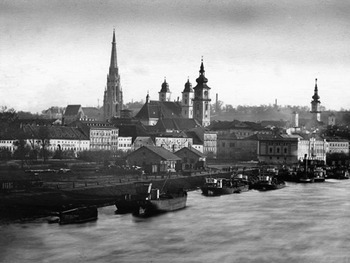
The new arrangements—the regulated Danube and newly opened transshipment hubs—helped to reverse a decades-long stagnation in DDSG passenger traffic in Austria. Moreover, both Győr and Linz attracted additional connections to the Danube. By 1896, Linz's newly opened hub attracted the attention of transregional and international businesses looking to capitalize on the Danube River's renewed and ostensibly more profitable usage. When the Linz communal council considered opening a public warehouse at the hub, letters flooded the mayor's office. Local agricultural companies; iron and weapons firms; numerous steamship companies from Bavaria, Austria, and Hungary; and even a milling company from Budapest all inquired about the space and conditions. In July 1897, interested parties from rail and water shipping companies to commercial offices, fruit merchants, millers, and representatives from the lumber industry all met at the DDSG's offices in Linz to discuss details for the warehouse's construction (see Figure 4).Footnote 69
Figure 4:Linz's Transshipment Hub (center), DDSG office (right), and Steamship Traffic. Source: Unknown photographer. Anlegestelle an der Unteren Donaulände. Photograph. 1903. Nordico Museum, Linz, Austria. Archival nummer: NA-051009.
National and imperial interests also converged on Győr, lifting its commercial prospects and drawing business back to the Danube. In the late 1880s, at the onset of new regulation works in Hungary, the Hungarian Minister for Public Works and Communication Gábor Baross pointed out Győr's commercial importance and remarked that the city's steam navigation would benefit from public warehouses on the river.Footnote 70 While these plans languished for several years, the new transshipment hub's boost to the Győr Steam Navigation Company's business in the early 1890s prompted the city council to approve warehouse construction in 1893. The opening of the public warehouses in 1899 contributed to the revival of Danube commerce in town. Steamship companies from Germany, Austria, and Hungary celebrated the new facilities. The Danube's proliferating commercial activity even encouraged the city to begin constructing a modern grain elevator adjacent the warehouses in March 1914 (see Figure 5).
Figure 5:Győr’s Mosoni Danube, the Landing Place (center right), and the Grain Elevator (far right). Üdvözlet Győrből, Révfalu és Dunapart [Greetings from Gyor, Révfalu, and Dunapart], early 1910s, Dr. Pál Kovács Library, Győr, Győri Szalon [Győr Salon], http://www.gyoriszalon.hu/news/7564/61/Elev%C3%A1tor-a-Mosoni-Duna-partj%C3%A1n.
In the monarchy's final few decades, the Danube's rapid transformations from the late nineteenth century translated into an integrated space, where monarchy-wide commercial ventures blossomed alongside new, recreational uses on the river. In 1894, the Győr Steam Navigation Company was folded into a newly formed national company, the Hungarian Royal River and Sea Navigation Joint Stock Company (Magyar Királyi Folyam- és Tengerhajózási Részvénytársaság, or MFTR). While Győr's merchants lost their regional autonomy, the new company continued to transport goods up the Danube to Vienna. In the monarchy's last few years, the MFTR and another, much smaller Hungarian company transported more than 20 percent of the freight traffic on the Austrian stretch of the river, an impressive value, given that the DDSG only transported 50 percent of this traffic (the rest was divided between Bavarian and Serbian steamship companies). Linz's Danube traffic also increased, thanks in part to the tireless petitions of citizens and associations, which not only desired more favorable local steamship connections, but also for decades had sought to encourage economic activity by promoting tourism in the region through so-called Förderung des Fremdenverkehrs movements.Footnote 71 While rowing clubs and swimming facilities had been established for decades in Győr and Linz, the newly regulated Danube riverfronts also offered new spaces for promenades and parks, which local “beautification associations” adopted and from where residents enjoyed new views of the river.






 You have
Access
On 15 June 1884, a steamship departed from Passau, located near the German Empire's border with the Habsburg monarchy, heading down the Danube to Vienna. As it passed into the monarchy, villages and towns near the river greeted it with flag-bedecked buildings as onlookers waved their handkerchiefs from the banks. When the steamship arrived at its first stop, the provincial capital of Upper Austria, Linz, it encountered a “thousand” spectators who had braved the rain and gathered under banners and flags to welcome the ship at the landing place.Footnote 1 While thousands of steamships and tens of thousands of passengers traveled this stretch of the Danube every year without such anticipation, the ship docking in Linz was carrying a special delegation.Footnote 2 Aboard were participants of the so-called Danube Study Trip, which the Danube Association (Donauverein) had organized to visit sites where Danube regulation work was underway.Footnote 3
While the study trip's purpose was to showcase the river regulation's progress, the Donauverein’s delegation had also accepted a petition from Linz's communal council to visit its unregulated local side branch, which flowed through the town's northern suburb.Footnote 4 The branch's stagnant, brackish water was threatening residents’ sanitation as well as navigational, commercial, and recreational interests. However, municipal resources alone were insufficient to implement technical plans that would eliminate these unfavorable hydrological conditions. Believing that the delegation represented the best chance to secure imperial funds to remedy this problem, the city's residents enthusiastically awaited the ship and its delegates’ arrival. Once the trip's participants disembarked at two o'clock, the mayor warmly greeted them with a speech before the sodden crowd, in which he heralded the study trip as Linz's best chance to improve the Danube. He optimistically projected that the study trip would be beneficial, saying to great applause that “never has success failed when proven forces unite for a good cause.”Footnote 5
The Donauverein’s delegation was formidably equipped to help Linz with its travails, as its diverse composition of parties represented political, commercial, and civil mobilization committed to the Danube's regulation. Delegates represented the Linz communal council as well as the Upper and Lower Austrian diets and Statthalter offices. Additional participants hailed from a dozen riparian communities, engineers from several cities, and members from chambers of commerce, industrial-commercial Gewerbevereine, and navigational associations, as well as from steamship companies from both halves of the monarchy, Austria and Hungary. Even envoys from the imperial-royal Commerce, Interior, and the War Ministries were in attendance.Footnote 6 Despite surface-level differences in socioeconomic backgrounds, professions, and languages, the assembled group of more than one hundred delegates was united by its common investment in the Danube's improvement at Linz and across the monarchy.
The Donauverein was far from alone in its pursuit of the Danube's regulation. Its members embodied far-reaching networks, which presented these hydraulic engineering projects as crucial for protecting riparian communities from floods and strengthening their commercial and navigational potential on the river. The Donauverein’s members, especially those from the governments, bureaucracies, and diets, envisioned the work as fulfilling monarchy-wide needs, which they hoped subsequently underpinned state-building efforts from the imperial to local level. Nevertheless, natural developments and technological innovations on the Danube—the two factors driving the river's transformation—did not touch all parts of the monarchy equally nor did they march invariably toward a promising feature. Unexpected or unadministered setbacks prompted more particularistic visions for the river. Groups therefore formed and re-formed, mobilizing local, regional, imperial, and commercial associations and connections as they saw fit to secure their agendas.
Such shifting group identifications were a dynamic feature of the monarchy, one that several scholars have already brilliantly explored. Exploring behavior toward nationalism, Pieter M. Judson has argued recently in The Habsburg Empire: A New History that identities and identification can be better understood “in terms of the various situations or events that drove people to identify with one national group or another” and that it “helps to approach questions of identification by thinking more in terms of particular practices that expressed feelings of loyalty or commitment rather than in terms of people's fixed identities.”Footnote 7 Jeremy King has also cogently pointed out in Budweisers into Czechs and Germans: A Local History of Bohemian Politics, 1848–1948 that collective identities were prone to more cohesive elements than just ethnolinguistic identities, and that “if languages divided a population vertically, into protonational columns, then corporative and socioeconomic solidarities divided it horizontally, into Habsburg layers—and had far more institutional anchoring and sociopolitical significance.”Footnote 8
These processes, practices, and layers were not confined to the political or national realm but also extended to the physical-environmental spaces in the monarchy where socioeconomic interests and behaviors were embedded. Discussions regarding the Danube's regulation coalesced people at the local, regional, national, transnational, and imperial levels, whose shared interest in the river manifested itself in endeavors such as the 1884 Danube Study Trip.Footnote 9 These interactions and relations are important to highlight, as they played a crucial role in strengthening the monarchy's social and political bonds. Communities along the Danube relied on—and brought together—a combination of commercial, civil, and governmental resources and groups to address local and monarchy-wide concerns. Negotiations and interactions between these various groups indicated the presence of a robust civil society early in the nineteenth century well before the constitutional era. Petitions to county, provincial, and central governments in Budapest and Vienna contained expectations that the authorities would finance and implement plans to help the populace. Deliberations at all levels of government, even early in the century, sought to respond commensurately to the needs of local communities, presaging elements of later, liberal governance in the 1860s.Footnote 10
To explore these associations, this article studies the Danube's common, transnational influence on two riparian communities—Győr, Hungary, and Linz, Austria (see Figure 1). These two cities provide insight into the historical development of smaller, municipal populations on the river, outside the oft-compared imperial and royal metropoles, Vienna and Budapest. Despite one city being “Hungarian” and the other “Austrian,” both Győr and Linz were remarkably alike. They were both mid-sized cities in the monarchy, whose populations nearly tripled from the mid-nineteenth to early twentieth century as a result of internal migration, the incorporation of neighboring communes, and improved living standards.Footnote 11 As this article aims to demonstrate, their residents also displayed similar ingenuity and resilience in their efforts to maintain their historical position on the Danube in the face of changing circumstances in the nineteenth century.
The Positions of Linz and Győr (RAAB) in relation to Vienna (WIEN), Bratislava (Pressburg), and Budapest. Source: “Österreichisch-ungarische Monarchie und die Schweiz, Staatenkarte.” Lange-Diercke Volkschulatlas. Braunschweig: Westermann Verlag, 1898–1904. © Westermann Gruppe.
Interestingly, one of the most crucial elements of these transformations was not political or economic in nature, but environmental. Negotiations, compromises, and legislative and commercial actions all had to take the Danube's mutable nature into consideration. Technical innovations and natural occurrences like floods and siltation constantly reshaped the river's hydrological conditions. These fluctuating circumstances fueled ever-evolving, fluid associations that were as likely to transcend as they were to adopt national loyalties to address changing hydrological conditions. While the Danube presented opportunities for many citizens, for some, it represented a source of inconvenience or even danger to overcome. Stakeholders presented these possibilities in stark contrasts—catastrophic commercial collapse versus collective growth, loss of livelihood versus reasonable accommodation, perpetual insecurity versus safety from floods and diseases, among many others.Footnote 12
These were not peripheral issues. By the beginning of the twentieth century, several million people lived in communities and cities on the monarchy's main river, and the so-called Donaufrage (Danube Question) filtered into discussions in newspapers, diets, commercial reports, and associational life.Footnote 13 Using the Danube as a category of analysis enables us to see how communities adapted to changes in their physical environs, flexibly relying on and interacting with each other, local authorities, transnational businesses, and national and imperial governments in a multifaceted process, which helped shape what contemporaries were already calling the “Danube Monarchy.”
The Danube's Early Influences in Linz and Győr
The Danube's hydrology—its flow and interplay with the adjacent land—influenced Linz's and Győr's unique historical development and reliance on the river. In Linz, a large flood in 1572 washed through town and created a side channel adjacent to the city (the very same one visited by the Donauverein study trip in 1884). A century later, a businessman founded a textile factory here, which led to the channel's nickname, the Fabrikarm or “factory arm” (see Figure 2). During the eighteenth century, at its height, the factory employed almost 50,000 workers and cottage industry weavers in the region—an impressive feat given that Linz's municipal population in 1822 was only around 20,000 people. The Fabrikarm facilitated ship traffic to and from the city, and it provided a convenient site for early industrial development.Footnote 14 The city held biannual markets, which drew merchants from around Europe, and its geographic location made it an ideal transit point for north-south overland and east-west river shipping routes.Footnote 15 Linz and the surrounding villages also provided a steady stream of sailors, boat-towing laborers, and shipbuilders for trade and navigation on the Danube.Footnote 16
Linz, Strasser Island, and the “Fabrikarm” in the Late Nineteenth Century. Source: Unknown photographer. Regulierung des Donauarmes bei Strasser-Insel. Photograph. 1890. Nordico Museum, Linz, Austria. Archival number: NA-021457.
Much like the flood that created Linz's local Fabrikarm, hydrological happenstance in the early modern period also ensured Győr's propitious placement on the Danube. Frequent flooding and sediment deposits downstream from Pozsony/Pressburg (modern-day Bratislava, Slovakia) forced the Danube to branch into three segments. Győr sat on so-called Mosoni Danube, the southernmost and most navigable branch in the braided stretch.Footnote 17 The Danube's navigability on this channel made Győr a dominant site for the river's burgeoning wheat trade following Hungary's liberation from the Ottomans in the late seventeenth and early eighteenth centuries. Crews towing shipments of wheat up the Danube from eastern Hungary and the Banat, on the monarchy's southeastern border with the Ottoman Empire, reached Győr, where they unloaded their wares and reloaded them onto smaller boats to continue up the Mosoni Danube or onto carts to pass over land to their ultimate destination, Vienna. This commercial route made Győr the largest transit point for Hungary's grain “exports” to Austria.Footnote 18
Residents in Linz and Győr relied on the Danube to power their mills, transport their ships, and aid metallurgical, textile, and other industrial processes for centuries, until steam power's introduction in the early nineteenth century gradually forced these practices to evolve or decline. Steam engines began powering ships in the late eighteenth century in England and America, and by 1813, Habsburg Emperor Francis I promised an imperial monopoly to any company or individual capable of sailing a ship up the Danube without the use of draught animals. In 1829, two Englishmen successfully established steam navigation on the monarchy's Danube and their new company, the k.k. erste priv. Donau-Dampfschiffahrts-Gesellschaft (Imperial-Royal Privileged Danube Steam Navigation Company or “DDSG”), started running its first steamboat, Franz I, regularly between Vienna and Pest in spring 1831.Footnote 19
The early years of steam travel marked a new era of transportation for individuals and communities reliant on the Danube. For Győr, located between Vienna and Pest, Franz I’s once-a-month stopovers expanded the city's commercial reach along the Danube, enlivening trade both north to Vienna and downstream to Semlin (modern-day Zemun, Serbia), a town on the Danube's southern bank across the Sava River from Belgrade.Footnote 20 In an 1833 letter to Palatine Joseph, Communications Minister István Széchenyi—a fervent proponent of steam navigation—noted that not only freight transport but also “passenger traffic from Győr to Semlin and back through Pest [was] … getting brisk.”Footnote 21 The local Győr papers ran advertisements for the DDSG. Linz's papers likewise covered steam navigation's rise in the early 1830s, describing steamships’ comfort and convenience for travel and trade. However, in contrast to Győr's early integration into the steamship network, steam engines were too weak to overcome the Danube's current upstream from Vienna, so Linz's merchants continued to ship wares downstream on traditional vessels for several more years. Passengers who wanted to travel down to Vienna could take the once-weekly Ordinäre ships that departed Linz on Friday and arrived in Vienna on Saturday. The trip cost 1 florin, 12 kreuzer, at a time when a worker's wages averaged 6 florins a month.Footnote 22
Steamship traffic renewed concerns over the sandbanks, shoals, and shallow water that had endangered ships’ progress for centuries, but the removal of which seemed steadily more urgent. Engineers, government officials, and companies feared that without more concerted interventions to eliminate such hindrances, steam navigation—and with it commercial growth—would suffer. The DDSG's business reports and Tafel der Statistik statistical records from the 1830s and 1840s were filled with complaints that DDSG ships were frequently stalled when seasonal and meteorological factors caused low or excessively high water levels, exacerbating already dangerous or unnavigable stretches.
Early on, both political and technical authorities proposed solutions to the precarious situation, suggesting the expenditure of millions of florins to regulate the more problematic Danube stretches.Footnote 23 On 5 July 1831, the Lieutenancy Council (Helytartótanács) in Buda issued a decree mandating the regulation of the main Danube bed between Pozsony/Pressburg and Gútor (later extended to Védek), which it estimated would cost almost 2 million florins.Footnote 24 To put this in perspective, the hydraulic engineering offices (Wasserbau-Direktionen) in the monarchy's other provinces had a combined total budget of 2 million florins in 1831; a sum equivalent to one-tenth of the currency value that the government had issued that year (19.9 million florins).Footnote 25 These transformations—regulation and steamships—were both meant to benefit cities along the Danube, but while industry in Linz adapted to early changes, Győr's commercial groups were threatened by the Hungarian government's planned engineering works. While the main bed's regulation would benefit navigation more generally, it would also enable steamships to bypass the narrower and shallower Mosoni channel upon which Győr was situated, threatening the city's privileged position, and thus its commercial livelihood.
Győr's residents’ fears were confirmed once regulation work began in earnest in the early 1840s. Although the regulation was only partially completed by the mid-1840s, the DDSG already considered changing its schedule, replacing Győr as its stopover station between Vienna and Pest with Gönyű—a city on the main, regulated channel.Footnote 26 DDSG head Joseph Voigt justified this decision to Communications Minister Széchenyi by complaining that the poor conditions in the “Győr channel” were slowing river traffic.Footnote 27 Győr's municipal authorities wrote to the DDSG administration and requested that the city remain on the company's travel route, citing its importance for the grain trade.Footnote 28 Győr's position nevertheless declined to the point that travel guides routinely skipped descriptions of it altogether in their overview of travels down the Danube, assuming that steamships would take a more common route along one of the more northern arms instead.Footnote 29
Fortunately, geopolitical interests soon provided a circuitous though temporary solution to the endangered trade route. On 2 July 1846, an article appeared in Győr's local German-language paper Vaterland advocating for the establishment of a national steamship company to develop Hungarian interests on the Danube. While some people in Győr believed a national company might address the city's siltation and navigation problems more attentively, opponents articulated grave concerns that Győr didn't have the capital to establish such a company, that ships would be expensive to maintain, and that the company would certainly fail if forced to compete with the DDSG.Footnote 30 Eager to counter what they perceived as the “Austrian” DDSG, Pest-based investors offered to provide the city with the requisite capital for a national company. Győr's merchants participated in negotiations but made it clear that they were primarily preoccupied with securing local interests, much to the chagrin of their nationally minded investors. Moreover, once the DDSG's administration learned of the rival overtures, it immediately sent its ship Argo to establish a new passenger line between Győr and Pest and offered additional support for the town's grain transports. Local interest in a “national” company died out immediately.Footnote 31
The DDSG's accommodations assuaged immediate passenger and freight concerns. Its extensive routes provided Győr's merchants with greater opportunities than a fledgling national company could, which kept the city rooted in monarchy-wide, rather than purely national, commerce. Residents continued to rely on the grain trade, and by the mid-nineteenth century, they had built 147 granaries in town, many as near to the riverfront as possible. According to some numbers, every tenth person in Győr lived off the Danube's grain commerce.Footnote 32 Unfortunately, by propping up the city's grain trade, steam navigation deterred the Győr city council or residents from properly investing in necessary solutions to the increasingly untenable siltation in its local Danube branch. Quite the contrary. One 1854 travel guide discussed how in the early 1850s, the DDSG was forced to construct tugboats, which drew less water, so they could sail up the shallow, sandbar-plagued Mosoni arm to Győr.Footnote 33
While Győr both benefited and struggled with early challenges that the Danube's physical transformation entailed, Linz's residents welcomed the early innovation less ambivalently. In September 1837, the townspeople greeted their first steamship, the DDSG ship Maria Anna, after it completed a successful, albeit labored, journey from Vienna to Linz.Footnote 34 The following spring, regular traffic from Linz to the imperial capital began, and by 1840 ships were departing each location every two days to bring passengers and wares back and forth.Footnote 35 The five steamships plying this stretch in 1840 hardly matched the annual freight load of the nonsteam traffic—one successful shipowner managed 350 ships between Persenbeug, Lower Austria, and Regensburg, Bavaria.Footnote 36 But in contrast to traditional towing methods, which took ships fourteen days to reach Linz from Vienna, the first steamship managed the trip in just fifty-five hours. The city's municipal authorities permitted the DDSG's ships to dock at a prominent landing place between the wooden bridge crossing the Danube and the mouth of the Fabrikarm, which provided easy access to Linz's market place.
Just as Győr's transregional grain trade characterized the physical layout and development of the riverfront, the burgeoning presence of steamships in Linz attracted new industrial interests to the river, which likewise expanded transregional associations along the Danube. Local shipwright Ignatz Mayer recognized the fundamental shift that steam power represented for the shipbuilding profession, and in 1840 he founded a shipyard in Linz's Fabrikarm designed to repair steamships.Footnote 37 Steamship traffic had increased dramatically within its first decade on the Danube; the DDSG's four ships transported 14,400 passengers in 1835 and by 1841 its sixteen ships transported 117,500 passengers. The DDSG's monopoly in the Habsburg Danube stretch limited domestic clientele to a single company, so Mayer grew his business connections by servicing ships from Württemberg and Bavaria as well. Mayer even struck up a personal partnership with a Bavarian steamship company in 1857.Footnote 38 By 1854, rather than just repairing steamships and constructing barges, the shipyard was building steamships as well. Business boomed and the shipyard's employment expanded from 200 men in 1854 to 550 men by 1869. Commercial rather than national principles drove the shipyard's success. In 1867, at the same time as the “acrimonious” Austro-Hungarian Compromise, the shipyard even built ships for a Hungarian steamship company. Mayer's enterprise raised his profile in the whole region, and beyond serving in Linz's communal council from 1848 to 1873, he was also politically engaged in the Upper Austrian Provincial Diet (Landtag) from 1866 to 1871 and the Imperial Parliament (Reichsrat) from 1866 to 1870.Footnote 39
Steamships drew more commercial-industrial interest to the Danube, expanded transregional associations, and inspired engineering projects to facilitate navigation.Footnote 40 By mid-century, the DDSG's passenger travel on the Danube stretch between Passau and Pest, including stopovers in Linz and Győr, stood at more than 300,000 people a year. The DDSG advertised its routes and rates extensively in the Győri Közlöny and Linzer Tages-Post. However, groups and industries connected to the Danube soon found the river's utility under siege from new technology usurping its role in transportation: railways. Győr's first train connection opened in 1855, connecting it to Vienna via Bruck an der Leitha. In 1858, the Kaiserin-Elisabeth-Westbahn connected Linz to Vienna.
The new infrastructure competed with passenger and freight traffic on the Danube and threatened to derail work on local regulation indefinitely. While the shift to rail transportation helped alleviate Győr's immediate shipping concerns, the town soon found itself in competition with Pest, a rising regional rival in grain processing and transportation. A rail line to Vienna provided Pest's milling industry direct access to Vienna's markets, which siphoned business from the river and superseded Győr as a point of transit for grain. A decade later, only half the amount of grain arrived in Győr via the Danube as had ten years earlier.Footnote 41 In December 1858, the local paper Győri Közlöny bemoaned the fact that the DDSG was halting its Mosoni branch traffic, due to the growing rail competition.Footnote 42 This complaint turned out to be premature, and the DDSG continued its services the following spring, but it gave voice to fears that the river's importance for the town was declining.
These changing circumstances led to a coalition of interested parties that mobilized to keep the Danube a relevant part of Győr's economic and social life. Rather than simply yielding to locomotive travel, residents—who had traveled on steamships for decades—clamored for more steamship connections. By the late 1850s, Győr's residents became upset that schedules had ships arriving back in town at two in the morning, and in April 1859, the paper aired residents’ grievances about stumbling home in the dark during the long walk from the steamship station.Footnote 43 When the DDSG directed its ships to depart a few hours earlier to address residents’ concerns, they next complained that arriving at midnight was not much better.
Likewise, falling grain shipments on the Danube prompted the Commercial Guild, an association of local merchants, to admonish the mayor's office for failing to dredge the Danube at Győr. Because the river's levels were too low to accommodate large grain ships arriving from downstream, the Guild argued that the city was losing money unloading larger ships and reloading grain and wares onto smaller ships to continue their journey. The Guild calculated that the 400 forints per boat lost in delays and labor costs would harm river commerce. Rather than framing the dilemma in purely hydrological terms, the Guild claimed that commerce's significance for the entire region meant that the Danube's maintenance was good “not only for the city's residents but for the entire public as well.”Footnote 44
Győr's local conditions deteriorated in the face of the local and national government's inaction, and finally the DDSG launched a ship to survey the Mosoni Danube in 1860 to determine where dredging work was necessary.Footnote 45 The company's action prompted the Győr city council to agree to cover dredging costs the following year. Before dredging could begin, however, floods in spring 1862 hit the entire monarchy, causing massive destruction. Reconstruction costs strained Győr's finances and disrupted its plans to clear the river. In response, the DDSG offered to help pay for the dredging.Footnote 46 Such magnanimity incidentally coincided with the arrival of a new steamship company in town, the Royal Bavarian Steam Navigation Company. The Bavarian company had recently started advertising their freight services in the Győri Közlöny in September 1861 and even employed a business representative in town; one of only four in Hungary.Footnote 47 The DDSG's offer to help clear the Danube—while certainly critical for its own operations—also likely sought to retain customers’ loyalty by ingratiating the company to the local community.
Despite the DDSG's active engagement with local communities, its thinly spread resources, diluted by its tendency to buy rival companies, left it vulnerable to shortcomings in its services. This left room for other commercial groups to compete for local markets. In August 1865, the Győri Közlöny published a series of articles from the paper Új Korszak (New Era), which again advocated the need for a specifically Hungarian steam navigation company. Unlike efforts in 1846, which failed to garner enough local interest, in 1865 a group of merchants from Győr founded the Győr Steam Navigation Company to combat the DDSG's unfavorable shipping rates, promote commerce, and enable the “reasonable transport of wares via steamship on the Danube and its tributaries.”Footnote 48 The company employed a large number of workers and crew, as it had five freight steamers, twenty-one tugboats, and an additional thirty-one wooden boats for trade.Footnote 49 It even commissioned a steamship from the shipyard in Linz.
The local company in Győr was one of many that emerged in the 1860s in response both to the loosening of the DDSG's imperial monopoly following the 1857 Danube Navigation Act and to the 1867 Compromise. While certain national companies sought to directly compete with the DDSG, most could not overcome its established position in the monarchy, which the post-Compromise Hungarian government strengthened by honoring an 1857 subsidy agreement with the company.Footnote 50 As a result, several national, Hungarian steamship companies went bankrupt in the 1860s and were forced to sell their ships to the DDSG. Most regional or local companies survived by catering to more specific local needs rather than overstretching themselves. The Győr Steam Navigation Company's general assembly concluded that cooperating rather than competing with the DDSG was the only way to protect its local interests.
While Győr's fortunes waxed and waned in the 1850s and 1860s, a singular hydrological event in Linz set off a cascading crisis for the town's residents and businesses for the next several decades, leading to a collaboration of local and imperial actors and companies to address the problem. A flood in 1864 tore a steamboat loose from its mooring near Linz and crashed it into the wooden bridge spanning the river, collapsing two of its yokes. Emperor Maximilian I had first permitted the bridge's construction in 1497, though floods and ice flows had periodically destroyed this bridge throughout its extensive history.Footnote 51 In the flood's aftermath, the communal council consented to rebuild the bridge out of iron, and in 1872 the bridge opened to great fanfare and celebration. However, the bridge's solid construction inadvertently and adversely affected the river's morphology. The bridge's pylons shifted the Danube's current away from the opening of the Fabrikarm, which resulted in the water level dropping in the channel. Factories, swimming facilities, mills, and the military barracks depended on the river's fresh-flowing water. Stagnant water endangered their functioning and livelihood.
Much like the delayed and insufficient investment in Győr's Danube regulation the decade before, Linz's residents initially also encountered disappointment from both public and private sources. In 1876, conditions in the Fabrikarm had become so bad that Linz's bathing facility manager turned to various authorities to intervene. The manager first requested an excavator from the Lower Austrian Danube Regulation Commission (DRC), which had just undertaken the regulation of the Viennese Danube from 1870 to 1875. When the DRC rejected the facility's request, it turned to the DDSG. The DDSG's management only agreed to sell rather than loan an excavator. The imperial-royal Interior Ministry even claimed that the channel's regulation, unlike the Danube in general, was a purely municipal matter.Footnote 52 The imperial government was not wholly indifferent: The Imperial War Ministry's Marine Section offered to help pay for sewage canals near its barracks on Strasser Island.
Local efforts to resolve the matter remained fruitless and even led to tensions between several groups in the Fabrikarm reliant on the riverine space. The increasingly unsanitary conditions forced Linz's bathing facility to temporarily move its position upstream above the bridge. However, this clashed with the newly established rowing club, which also wanted access to this river bank for its practices. Numerous, immobile businesses, such as the tobacco factory and various mills and industries, remained without a viable option. They relied on the channel to facilitate river traffic, power mills, and wash away effluent, and these businesses still had to find a solution to the channel problem.Footnote 53 Engineer Arthur Oelwein suggested that the only way to improve the channel's conditions would be to modify the whole main bed of the river, not unlike the massive engineering work at Vienna.Footnote 54
Eventually, after the Danube regulations at Vienna (1870–75) and Budapest (1871–75) were completed, more concerted action emerged from a variety of sources to petition for additional regulation in other Danube stretches in the monarchy. The river itself also served to galvanize action: A massive flood in 1876 was so destructive that fifteen thousand people on the Danube stretch between Pozsony/Pressburg and Pest lost their homes, while hussars—Hungarian cavalry members—rushed to Győr to aid rescue operations.Footnote 55 Provincial legislatures, citizens’ petitions, and commercial negotiations all pushed the authorities in Budapest and Vienna to turn their attention outside the capitals. These efforts gained support from companies and associations concerned with the Danube's improvement to protect citizens from floods and to promote navigation, most notably from the Donauverein.
Thanks to these efforts, the 1880s witnessed an uptick in funding efforts to regulate the Danube across the Habsburg monarchy, including at Linz and Győr. In 1885, the National Diet in Budapest passed Law VIII providing funds to regulate the river between Dévény (on the border to Austria) and Dunaradvány on Hungary's southern border.Footnote 56 The Reichsrat in Vienna also passed legislation jointly funding regulation projects with the Lower and Upper Austrian provincial governments in 1882 and 1886, respectively. The Reichsrat’s approval for Upper Austrian regulation was thanks, in part, to Linz's representative, Dr. Vielguth, who gave an impassioned speech in front of the Reichsrat in March 1886, arguing that the expenses were justified, not only because regulation would enhance regional connections, but because of the Danube's significance for the monarchy's cohesion. To great applause, he exhorted the chamber to act decisively, averring that the Danube was “the only great natural waterway, which runs through our entire empire from the west to the east, which connects the imperial capital with the capital cities of the other half of the empire … and thus should be restored and preserved, as it is a legitimate requirement for navigation.”Footnote 57
Municipal authorities at Győr and Linz viewed regulation as one element in the river's necessary transformation to modernize transportation at each location, but they also sought additional physical changes to the riverscape to ensure that their local practices could continue to exist and evolve with the times. As the monarchy's rail network widened, for example, both communities designed new transshipment hubs connecting rail and water traffic, which were meant to facilitate ties from the Danube to its commercial hinterlands. Linz's and Győr's municipal councils attempted to pursue regulation and transshipment hub projects simultaneously, and both turned to associational and commercial groups for their help advocating and petitioning provincial and imperial-royal governments to approve plans and provide funds.
In Győr, both the local commercial interests and the regional political authorities waded into discussions over how to implement their visions for the river. In 1881, the Győri Lloyd petitioned Győr's city council to set up public warehouses along the river to compete with Budapest's and Vienna's modern, commercial arrangements on the Danube.Footnote 58 In 1884, the local paper published the lord lieutenant's (főispán) opinion that public warehouses would advance the town's commercial goals. The főispán claimed that installing public commercial buildings at the river would help the town become the center of trade between the “east” and “west,” rhetoric that incidentally matched that of river regulators and city planners in Budapest, Vienna, and Linz.Footnote 59
Not only did the warehouses remain unbuilt, but slow progress on the river's regulation and quay construction ensured that floods remained more than a potential threat to the city. In January 1883, the Danube's flooding became international news, and images of Győr underwater appeared in the popular British weekly The Graphic.Footnote 60 One local paper, the Győri Közlöny, published an article with the title “Why did the Danube flood Győr?,” and what followed was a scathing indictment of the national government's slow work, as a result of which the author opined, “[W]e are facing the pernicious consequences of the imperfect, unfinished river regulation.”Footnote 61 Once again, the Danube forced residents to rearrange their physical constructs on the river. To reduce the risk of damages to the town's infrastructure, engineers ended a local rail stretch far enough from the river's banks to avoid future floodwaters’ reaches. The Győri Közlöny complained that merchants, passengers, and other residents in Győr found the arrangement to be inconvenient for passengers and merchants transferring between river and rail.Footnote 62
By contrast, in 1887, the city finally completed its transshipment hub in time for the opening of the Ebenfurt-Győr line. These factors lifted the Győr Steam Navigation Company's financial fortunes. Despite complaints at the company's 1891 shareholder meeting, which singled out conditions on the Mosoni branch as generally insufficient for large ships or large-scale freight shipments, the company reported a more than 13,000-forint profit for the year.Footnote 63 With the new transit facilities in Győr and an infusion of stocks and ships, the company expanded its operations significantly in the early 1890s; in 1890 alone it more than tripled its tonnage compared to the previous two decades’ annual average.Footnote 64 Eventually, the National Diet's funding also ensured that the Mosoni branch was regulated between 1886 and 1894.Footnote 65
A lack of institutional support in the 1870s bedeviled Linz's regulation and highlighted the need for municipalities to turn to imperial commercial and political structures to help them. It was only once transregional actors like the DDSG and Donauverein teamed up with the provincial and imperial governments that renewed interest and investment flowed to the region. Linz's regulation plans in the early 1880s went hand in hand with communal council plans to set up a transshipment hub. It was a costly and complex endeavor, which required the council to deploy several lobbying groups to help it secure imperial consideration and resources. Representatives from the communal council and Upper Austria's provincial diet enlisted the help of the Donauverein to speak with representatives from the Reichsrat and bureaucracy. In 1884, the association used the occasion of its Danube Study Trip to demonstrate the project's need and merit to the trip's participants. Not only were the local inhabitants thrilled by the trip's agenda, as evidenced by the current paper's introductory anecdote, but the trip also successfully convinced the imperial authorities in attendance to recommend to the Reichsrat that imperial funding be directed toward Linz.
The final plans brought together funding from private and public sources and worked to ensure that businesses and groups on the Danube all had equal voice and equal access to the riverine space. Linz's communal council set up a municipal commission in 1884 to coordinate all regulation and transit hub plans with local industries in the Fabrikarm.Footnote 66 When the commission raised the idea of permanently closing off and filling in the Fabrikarm to create space for the proposed transshipment hub, the channel's business representatives responded that their livelihoods would end unless the city paid them an indemnity or could guarantee their transfer to another spot on the Danube.Footnote 67 By January 1887, the Upper Austrian provincial diet (Landtag) approved their contribution amount for the project on the condition that all types of boats—including nonsteamships like rafts and galleys—would be able to continue landing at Linz.Footnote 68 By July 1889, the k.k. Upper Austrian governor's office (Statthalterei) approved the first payment installment and eventually in spring 1890, the Danube's regulation began. According to the final plans, the Fabrikarm was filled in and the city relocated its businesses to various new locations on the main bed. Besides the imperial, provincial, and municipal funding for the regulation, two major companies in the monarchy, the k.k. State Railways and the DDSG—which both stood to profit from the new arrangements on the Danube—also contributed to the transshipment hub's construction costs. The new hub opened in 1894 and traffic on the river—both passenger and freight—increased markedly afterward (see Figure 3).
The Opening of Linz's Transshipment Hub in 1894 and Concomitant Rise in Passenger Traffic. Rechenschaftsbericht des Gemeinderathes der Landeshauptstadt Linz über seine Thätigkeit (Accounts Reports), compiled by the Linz Communal Council and published from 1876 onward.
The new arrangements—the regulated Danube and newly opened transshipment hubs—helped to reverse a decades-long stagnation in DDSG passenger traffic in Austria. Moreover, both Győr and Linz attracted additional connections to the Danube. By 1896, Linz's newly opened hub attracted the attention of transregional and international businesses looking to capitalize on the Danube River's renewed and ostensibly more profitable usage. When the Linz communal council considered opening a public warehouse at the hub, letters flooded the mayor's office. Local agricultural companies; iron and weapons firms; numerous steamship companies from Bavaria, Austria, and Hungary; and even a milling company from Budapest all inquired about the space and conditions. In July 1897, interested parties from rail and water shipping companies to commercial offices, fruit merchants, millers, and representatives from the lumber industry all met at the DDSG's offices in Linz to discuss details for the warehouse's construction (see Figure 4).Footnote 69
Linz's Transshipment Hub (center), DDSG office (right), and Steamship Traffic. Source: Unknown photographer. Anlegestelle an der Unteren Donaulände. Photograph. 1903. Nordico Museum, Linz, Austria. Archival nummer: NA-051009.
National and imperial interests also converged on Győr, lifting its commercial prospects and drawing business back to the Danube. In the late 1880s, at the onset of new regulation works in Hungary, the Hungarian Minister for Public Works and Communication Gábor Baross pointed out Győr's commercial importance and remarked that the city's steam navigation would benefit from public warehouses on the river.Footnote 70 While these plans languished for several years, the new transshipment hub's boost to the Győr Steam Navigation Company's business in the early 1890s prompted the city council to approve warehouse construction in 1893. The opening of the public warehouses in 1899 contributed to the revival of Danube commerce in town. Steamship companies from Germany, Austria, and Hungary celebrated the new facilities. The Danube's proliferating commercial activity even encouraged the city to begin constructing a modern grain elevator adjacent the warehouses in March 1914 (see Figure 5).
Győr’s Mosoni Danube, the Landing Place (center right), and the Grain Elevator (far right). Üdvözlet Győrből, Révfalu és Dunapart [Greetings from Gyor, Révfalu, and Dunapart], early 1910s, Dr. Pál Kovács Library, Győr, Győri Szalon [Győr Salon], http://www.gyoriszalon.hu/news/7564/61/Elev%C3%A1tor-a-Mosoni-Duna-partj%C3%A1n.
In the monarchy's final few decades, the Danube's rapid transformations from the late nineteenth century translated into an integrated space, where monarchy-wide commercial ventures blossomed alongside new, recreational uses on the river. In 1894, the Győr Steam Navigation Company was folded into a newly formed national company, the Hungarian Royal River and Sea Navigation Joint Stock Company (Magyar Királyi Folyam- és Tengerhajózási Részvénytársaság, or MFTR). While Győr's merchants lost their regional autonomy, the new company continued to transport goods up the Danube to Vienna. In the monarchy's last few years, the MFTR and another, much smaller Hungarian company transported more than 20 percent of the freight traffic on the Austrian stretch of the river, an impressive value, given that the DDSG only transported 50 percent of this traffic (the rest was divided between Bavarian and Serbian steamship companies). Linz's Danube traffic also increased, thanks in part to the tireless petitions of citizens and associations, which not only desired more favorable local steamship connections, but also for decades had sought to encourage economic activity by promoting tourism in the region through so-called Förderung des Fremdenverkehrs movements.Footnote 71 While rowing clubs and swimming facilities had been established for decades in Győr and Linz, the newly regulated Danube riverfronts also offered new spaces for promenades and parks, which local “beautification associations” adopted and from where residents enjoyed new views of the river.
Conclusion
Given the Danube's vital role in sustaining the livelihood of communities along it, it is unsurprising the intersection of actors and interest groups that mobilized to shape debates how to engineer it. While the Habsburg monarchy's diversity has long provided fodder for studies on nationalism, the Danube's transnational associations, socioeconomic group dynamics, and common daily experiences frequently transcended such exclusive identifications. More pressing concerns and opportunities motivated citizens to join and pursue common solutions to the vicissitudes of the natural world, which were influencing the livelihood and well-being of the monarchy's riparian communities. Within this realm, the Danube River epitomized the primacy of environment, shaping the professions and companies that depended on it, as well as the public and private groups that sought to control it.
For residents in Linz and Győr, the river represented several, at times conflicting ideas: a driver of commercial and industrial activity, a transportation route for passenger traffic, a means for personal and municipal hygiene, and an inveterate flood danger. Despite—or because of—this multitude of functions, the river united diverse community members, who joined together across regions, professions, and social strata to channel innovation on the Danube and fend off both natural and manmade threats along the river. The river's ever-changing nature meant that new threats and opportunities continually emerged, prompting groups to pursue new relations with commercial, municipal, imperial, transregional, and national groups to protect and enhance their interests. As circumstances shifted, so too could the conditions that underpinned any of these pragmatic connections.
Because the Danube's catchment area encompassed nearly three-quarters of the empire's territory, this so-called Danube Question animated not only the residents of Linz and Győr but replicated itself for millions of people living in towns and cities along the Danube and its extensive tributary system. Plans for the Danube's regulation and modification, which sought to improve navigation and mitigate flood dangers, inundated discussions about municipal growth, land reclamation, trade, industrial development, and recreational pursuits along the river. Such discussions took place in imperial diets and communal councils, associational meetings, and commercial negotiations, in written petition and spoken speech.
The Danube, therefore, provided both an environmental and a metaphorical space where civil discourse and political and technical action manifested themselves in physical form. Negotiations about the Danube's regulation—whether between civil groups or with the government—forged the types of strong, social, political, and economic bonds, which were crucial for the empire's day-to-day functioning. Through their interactions, communities, companies, and governments sought to find mutual solutions and to implement plans, which shaped the spaces and relations they envisioned for the Danube monarchy.