Introduction
This article refers to the current debate about state personhood, which we understand as a part of the more comprehensive agent-structure problem.Footnote 1 The core of this debate revolves around the question of whether states are persons or not, or whether they should only be treated ‘as if’ they were. In the first part of this article, we approach these ontological questions from the perspective of a pragmatist social theory and, in the course of our discussion, come to the conclusion that states are no persons at all.Footnote 2 We believe that states are not even actors and propose to conceive states as structures of corporate practice instead. Accordingly, social processes understood as the interrelation between structures of corporate practice and human beings as sole actors stand in the centre of the tripartite pragmatist model of the social world that we are going to present in the second part. Different from Wendt who, at least in our reading, has framed the state personhood debate as a dilemma from which it is only possible to escape by either confessing reductionism or recognising the real personhood of states, we hold that our model offers a third possibility to deal with the problem at hand.
The model builds upon the suggestion that states are neither real persons nor actors but structures of corporate practice, which are more than the sum of the interactions of its members. Irreducible to their parts, structures of corporate practice are held to have neither actively causal powers nor intentions. Due to their corporeality, reflexivity, and aptitude for abductionFootnote 3 human beings are the sole actors in our model of the social world instead. Such a differentiation between states as structures of corporate practice on the one hand and human actors on the other is crucial to explain the contingency of social processes in general and international politics in particular. In addition, the model makes it possible to cope with changes of and within all kinds of structures of corporate practice from the US and the EU to Greenpeace and Al-Qaeda that are relevant for our discipline. By strictly conceptualising the theoretical figure of the ‘human actor’ that was hitherto either reduced to isolated individuals or hidden behind misleading concepts like ‘state actor’ or ‘collective actor’, the model also provides explanations of social phenomena with an additional dimension. We believe that bringing socially embedded human beings into the focus of research considerably strengthens the explanatory power of socio-scientific analyses. While Wendt's ‘actorisation’ of states as real persons ironically tends to reduce ‘state action’ to macro-structural programmes and to equate structures with agents, we, by drawing on pragmatist social theory, hope to establish a consistent differentiation between actors, structures, and processes – and thus to give new impetus to the debate about the agent-structure problematique that Wendt has initiated in 1987. A short application of the tripartite model to the so-called ‘nuclear conflict with Iran’, which is perhaps the most alarming conflict in world politics today, and a discussion of some of the model's implications conclude the article.
Revisiting the state personhood debate
Before presenting our pragmatist ontological model for international relations theory, it might be apposite to revisit the state personhood debateFootnote 4 shortly and to position ourselves within it. In particular, we join firstly the coalition of Wendt and Wight against the reductionism of the as if-argument. Then we support Wight's move against Wendt's concept of state personhood, before we finally separate ourselves from Wight's rather implicit dealing with process and his stance on the active causality of structures.
Beyond the as if-account on state's (real) personhood
The starting-point of the current debate is Wendt's critique of the as if-argument about the ontological status of the state. Two dimensions of the as if-account can be distinguished – treating states as if they were real and as if they were persons. Wendt especially concentrates on the latter because he considers this notion as still very popular throughout the discipline. While sticking to individualist core assumptions, proponents of the as if-argument concede that, for the sake of simplification, it might be justified to treat states as if they were acting themselves – and not the individual human beings who make them up.Footnote 5 Considering this, Wendt adequately exposes the reductionist character of the as if-account. It is thus only consequent that he demands to give up the misleading as if-argument either by confessing reductionism or by recognising the reality of state persons as intentional or purposive actors.Footnote 6 It goes without saying that Wendt opts for the second alternative.
Wight rejects the popular as if-argument, too, but focuses more strongly on those of its advocates who treat the state as if it were real. By making a strong case for the reality of the state, he hopes to shed some light on important ontological questions concerning the state that he sees as obscured by ‘metaphorical, epistemological and methodological platitudes’.Footnote 7 Consequently, it is one of Wight's major concerns to defend his position against two forms of instrumentalism: the positivist denial of the state's existence as well as its narrativist treatment as a mere metaphor.Footnote 8
Like Wight, we also follow Wendt's rejection of the as if-argument, which fails to realise additional explanatory power and represents but an unconvincing attempt to distract from its own deficient reductionist core assumptions. Ironically, it seems as if the proponents of the as if-account, by pretending that states are acting, try to pocket a little of the charm and explanatory power of the holistic approaches. This move, however, conflicts with the as if-proponents' own assumptions. Thus, the as if-argument comes down to either a subtle rhetorical strategy, which aims to absorb and instrumentalise the holistic counter-arguments, or to an annoying simplification, which stands in open opposition to its own core assumptions.
States: persons, real, or both? Wendt vs. Wight
When it comes to finding a path out of the dead end of the as if-approach, Wight's ways are parting from Wendt's. Reflecting on the obvious usefulness of the as if-argument (given its popularity within the discipline), Wendt asks: ‘If state personhood is merely a useful fiction, then why does its attribution work so well in helping us to make sense of world politics? Why, in short, is the concept so “useful”?’Footnote 9 In preparation of an answer to this puzzle – the dual framing of which is foremost his own creation – Wendt goes beyond the assertion that states are people too and claims that state personhood is real.Footnote 10
Drawing heavily on his impressive insights into the philosophy of mind, Wendt conceives intentionality as a requirement for personhood.Footnote 11 Consequentially, to build a theory of state personhood that is to replace the as if-argument, he sets out to demonstrate that states have group intentions, that is, collective intentions that involve collective agency.Footnote 12 Against the reductionism of the as if-account, but also against the supervenience approach that he seemed to favour in his Social Theory of International Politics,Footnote 13 Wendt now claims that states have group minds which are irreducible to the structured interaction of individuals. This ‘emergentist’ position, as he calls it, is said to move beyond the internalists' assumption that the individual intentions upon which collective ones supervene are ontologically prior and do not depend on a collective.Footnote 14 By combining instead the externalists' assumption that intentional states cannot be defined independent of their contextFootnote 15 with insights from the work on collective cognition (a special case of distributed cognition which highlights the idea that ‘leaders do not know everything their states know’),Footnote 16 Wendt hopes to persuade the reader of his firmly non-reductionist version of real state personhood.
Wight, however, is not convinced by the course of Wendt's argumentation. ‘I suggest that the state is real, but that it is not a person’,Footnote 17 he powerfully claims, thereby opening-up sufficient space for a third possibility beyond both a reductionist treatment of states as if they were real and Wendt's solution of purposive and intentional real state persons. Similar to what we subsequently will refer to as structural positions and structural potentials, he establishes a reciprocal connection between the effects of a structure as well as the actor's competence to make a difference and stresses the meaning of the various state capacities inscribed in it as an ‘institutional ensemble of structures.’Footnote 18 In particular, Wight rebuffs the slipping from corporate to collective agency as well as the treatment of the state as a group.Footnote 19 Rather unimpressed by Wendt's discussion of group intentionality, he considers Wendt's idea of the state as a group-self as an important aspect of the state, but doubts its value for justifying the idea of state personhood because the constitutive belief was still accepted by a collective of individuals.Footnote 20 Wight considers state activity as the activity of particular individuals acting within particular social contexts.Footnote 21
Notwithstanding some differences, which we will present subsequently, we share most of Wight's critique and reject the concept of state personhood as well. Despite the elegance and sophistication of Wendt's entire argument on the level of the philosophy of mind, we do not only doubt his statement that collectives can have intentions that none of their members share,Footnote 22 but also the claim that they can have intentions. Against Wendt's argument in favour of intentionality and consciousness as essential to being a person,Footnote 23 we, inspired by pragmatist philosophy, consider a specific set of corporeality, reflexivity, and the aptitude for abduction as crucial. In our view, these qualities, which were strongly emphasised by protagonists of classical pragmatism like Charles Sanders Peirce, John Dewey, and George Herbert Mead, are exclusively human and not to be found in any kind of structure of corporate practice. For that reason, we understand human beings as sole actors.Footnote 24 Moreover, the intellectual richness of the pragmatist tradition that has successively been introduced into the study of international relations over the last yearsFootnote 25 provides the best opportunity to demonstrate the tight connection between the state personhood debate and the structure-agency problematique. As will be seen in the second part of this article, pragmatism allows for a conceptualisation of (international) politics that does not tend to reduce ‘state action’ to macro-structural programmes.
While Wendt seems to think that the result of an act that is not desired or intended by any of those who participated in it has to be intended by the involved group itself, we share Wight's impression that what Wendt has in mind can also be captured as unintended consequences of human action.Footnote 26 By understanding phenomena like states consistently as structures of corporate practice we thus avoid both a reduction to their individual members and their personification or actorisation.Footnote 27 Instead, we are able to illustrate the contingency of politics and to cope with changes of and within states and all other structures of relevance in our discipline.
Against this background, the most problematic point in Wendt's contribution is his understanding of the state as, in the words of Wight, ‘a particular kind of structure that emerges into a corporate agent.’Footnote 28 To our minds, Wendt, notwithstanding the philosophical nature of his argument, ascribes qualities of human beings to structures of corporate practice and, hence, conceives these structures like human beings, that is, as living, as trusting one another and talking to each other, as empathic, as learning from each other as well as reflecting on oneself and on others. We believe that this move leads at best to: i) an interchangeability of actors and structures combined with a loss of distinctiveness, and at worst to ii) a negation of the whole problem of the interrelation between actors and structures. In the first case, it is not only the category of structure that is filled by structural features like lifeworld, system, universe of meaning, culture or collective memory. Moreover, the category of human being as the sole actor will simultaneously be crowded out by structures of corporate practice. This dissolves the problem of the interrelation between actor and structure one-directionally by erasing the actor from the equation and replacing it with structure. In the latter case, if not in both, we would like to note the irony of a debate closed (or a problem transformed and transcended) by the same person who has introduced it.Footnote 29 Nevertheless, we do not think that a transformation of the so-called agent-structure problem into a debate about the personhood of structures would amount to a progressive problem-shift in terms of Lakatos.Footnote 30 Instead, Wendt's account tends to explain the phenomena of international relations by means of macro-structural programmes, which are about to predetermine the results of a state person's actions completely.Footnote 31 Without a consequent consideration of single human beings, the very structuralist bias becomes inevitable, which is typically evident in those explanations that raise the finding of an anarchically structured international environment to the rank of a quasi-natural-law-like property of the system.Footnote 32
In this context, it is important to note that we are not advocating anything like the thesis that great men make history.Footnote 33 Instead of building a theory of international relations that focuses on isolated single individuals it is our aim to fertilise insights of a pragmatist model of social processes for our discipline. Just like the one that we are going to present below, such a model conceives both states as changeable but stabilising structures of corporate practice and human beings as sole actors. What will be gained thereby is a better understanding of the interrelation between structures and actors in international relations as well as the ability to explain action (which is conventionally ascribed to states) by means of underlying aims-in-view, that is, beliefs held by human beings in certain structural positions. While a pragmatist explanation stresses the contingency of political developments due to unintended or even ‘accidental’ consequences of human action, Wendt's model – as stated above – tends to grasp state activity as ‘pre-determined’ by macro-structural programmes.
Implicitness of process and causality of structure? Two remarks on Wight
Finally, even Wight's contribution to the debate about state personhood contains two important aspects that we wish to reject. The first is his rather implicit dealing with process; the second is his treatment of structures like the state as having actively causal powers of their own. In conveying that ‘agents in the social world are differentially located and much of their “capacity to do” is derived from their social positioning’,Footnote 34 Wight appears to be fully aware of the dialectical interrelation between structures and actors. But he does not grasp this interrelation as an ontological category in its own right and thus tends to neglect process as an explicit third category that mediates between structures and actors.Footnote 35 Wight's discussion of Wendt's structuralism, however, reveals his stance on the active causality of structures that we want to turn to now: ‘In an attempt to maintain agency in his theory Wendt's form of structuralism locates the properties normally assigned to human agents in the state. This has the effect of both denuding human agency, but also eliding the causal power of the state as a structure.’Footnote 36 Since we cannot see how structures such as states could possess any active causal powers, we consider them as constituting, that is, both enabling and constraining, but not as actively causing. As rules for action, structures provide potentials but do not have active causal powers themselves. In the social realm, human beings alone combine these rules for action with their competence to act in conflict or accordance with them. Since they are provided with specific qualities, which we are going to explain in more detail in the second part of this article, only human beings are thus able to display actively causal powers.Footnote 37
Hence, despite his passionate plea in favour of the irreducibility of human action to social outcomes (the idea to bring about change through a change in individuals), and against any attempt to write individuals out of explanations of social activity,Footnote 38 Wight paradoxically endangers his agenda by sticking to the concept of active causality of structures that tends to lead back to macro-structural determinism and methodological structuralism in the long-run. Actually, it remains unclear how he is able to combine the idea of structural causation with his stance that ‘the state does not and cannot exercise power. It is not a unified subject that possesses the capacity to exercise power.’Footnote 39 If, on the other hand, Wight's concept of causality of structures was not deemed to describe an active quality but constitutive – enabling and constraining – effects on human action, referring to such a characteristic only as ‘causal’ risks being misunderstood as conceiving structures as actively causal.
In conclusion, we entirely agree with Wendt that our discipline is in dire need of a concept of the state that is more than the sum of the interactions of its members. But to avoid one form of reductionism we must not fall into another and reduce agency in world politics to the state. Contrary to Wendt who thinks that it is required to get rid of the treatment of states ‘as if’ they were real because state persons really act, we believe that the reductionist as if-approach obscures the insight that human beings are the only actors. We therefore opt for a third possibility beyond the as if-account and Wendt's idea that structures may be persons. Such an alternative treats states consequently as structures of corporate practice and binds them dialectically to human beings. This is to say that a state, like any structure, has neither intentions, nor a mind or a body, and is no person either. But at the same time, it cannot be reduced to the individuals who act on behalf of it as well. This is not to deny that structures of corporate practice like the family, for example, are constitutive for a human being's mind (and all theincorporated systems of meanings and beliefs), also including intentions as Wendt understands them.
Hence, while the metaphors and simplifying assumptions of the as if-approach represent a kind of intellectual shorthand for the complex interrelation between human actors and structures of corporate practice, Wendt's intricate arguments mix up or imprecisely equate structures that enable and constrain action with actors. Given an understanding of process as both a mutually constitutive and mono-directionally causal relationship between such structures of corporate practice and human beings as the only actors, we hope to offer an alternative to Wendt's solution while avoiding both an arduous walk through the depths of the philosophy of mind and a loss of explanatory power.
As a consequence of this alternative, it should also be possible to transcend the current debate about state personhood and free it from its rather narrow focus on states alone. Strictly speaking, in spite of its longstanding predominance, the state is nothing but one kind of structure of corporate practice among many others within the realm of international relations – be they inter- or supranational organisations like the UN, the EU, NATO, and the World Trade Organisation or non-governmental organisations (in a broad and politically incorrect understanding of the term) like Greenpeace and Al-Qaeda, to name but a few. Like the processes in which they are interwoven with human beings, all of these structures can be analysed within the same model. This is even possible without any modification, since the interrelation between human beings as sole actors and structures of corporate practice constitutes every social process.
A pragmatist ontological model for international relations theory
Given that Wendt has dually framed the state personhood debate in terms of either confessing reductionism or recognising the real personhood of states, we are now going to propose an alternative path out of this dilemma by developing a pragmatist ontological model for international relations theory. Inspired by the ideas and concepts of classical pragmatism (Charles Sanders Peirce, John Dewey, and George Herbert Mead), it is our aim to present a general model of the social world – and of international politics in particular – that contains an independent and creative stance on the interrelation between structures, actors and processes. Thereby, we are drawing on the critical aspects of the state personhood debate that we have discussed in the previous section. After a short example for its application, some of the model's implications will be considered in the third part of this article.
Structures of corporate practice
Instead of treating states and other social phenomena like non-governmental organisations, international or supranational institutions as persons we are going to argue in this paragraph that it makes sense to grasp them as structures of corporate practice. Therefore, three questions inform our argument: What is the ontological content of the concept of structure? What is the phenomenon social scientists refer to when they talk about structures? What kinds of properties and characteristics does this phenomenon enclose?
For us, structures are socially constructed objects which, despite that they are ideational, display an effect according to their meaning. Paraphrasing Peirce's pragmatist maxim, we can say: Signs mean their effects.Footnote 40 Since structures of meaning consist of signs that mutually refer to each other, structures mean their effects as well. Structure and the social part of the human mind that Mead had named ‘me’Footnote 41 stand in a relation of co-constitution, that is, they are mutually constitutive. Without the inter-subjectively shared structure of signs, social meaning and thus reflexivity as well as the mind (both constitutive qualities of human beings) would be unthinkable. At the same time, the very existence of this structure of meaning depends on the existence of human beings.
In the complex world of human sociality, problems that an individual cannot solve alone are arising over and over again. For that reason, social strategies of problem-solving are required.Footnote 42 Social problems come up due to intended and unintended consequences of human acts, and to be solved they make common endeavours by those who are affected necessary. The common solution for a social problem takes the form of a structure of corporate practice. That is, in order to deal with a problem people create rules for action deemed to solve it. Taken together, all those rules that were made to work on a specific problem constitute a structure of corporate practice. Typical for structures of corporate practice is that they are designed to govern the indirect consequences of action undertaken by the members of a collective in the desired direction. Besides rules for action structural positions are established as well. Both of course always remain subordinate to the more comprehensive structure of corporate practice. Social constructions lacking structural positions for human actors are not structures of corporate practice at all. Therefore, a state's sovereignty, for example, is not a structure of corporate practice. Sovereignty is not connected with specific structural positions held by human actors, but represents a certain type of rule for action; sovereignty regulates the relationship between different structures of corporate practice.
Structures of corporate practice hence consist of answers that human beings have given to a common problem of social action; answers that take the form of rules created to work on a related problem. States as well as the UN, NATO or non-governmental organisations, but also universities, football teams, and families provide examples of structures of corporate practice. At this point, we draw on Peirce's definition stated above that signs and structures mean their effects. From this definition it follows that whoever wants to know what kind of meaning the structure named NATO has, must ask for the effects that are both made possible and precluded by the rules for action it includes. For a better understanding of these enabling and constraining effects of rules for action, it is helpful to conceive of structures of corporate practice as spaces of (im-)possibilities. This term illustrates that in most of the imaginable problematic situations there is a variety of rules for action included as solutions to a related problem within the structure; in short: usually there are different possibilities to deal with a problem.
Now that we have described the relationship between structures of meaning transmitted by signs and endeavours to solve problems by human beings, it is necessary to present the characteristics of structures of corporate practice in more detail. Whoever looks at structures of corporate practice analytically will realise very soon that many of them are simultaneously embedded in more comprising structures of corporate practice and consist of a set of more specific structures of corporate practice. The vast majority of states, to give an example from international relations, is obviously not only a part of the more comprising international structure named UN but at the same time consists of substructures like a parliament, provinces and districts, a ministry of defence, a secret service, and maybe a constitutional court. This leads to the question of which characteristics all of these structures of corporate practice do have in common. According to our model, there are three such common characteristics: rules for action, structural positions, and structural potentials.
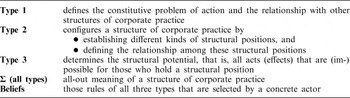
Concerning the rules for action, different types can be distinguished. Taken together, they constitute the all-out meaning of each structure of corporate practice. The following differentiation is especially important when it comes to analysing empirical phenomena, since examining the development of those structures of corporate practice (be it continuity or change) in the course of social processes, that is, an analysis of the development of NATO, the EU, Al-Qaeda or the foreign policy of a certain state, still constitutes the core of our discipline.
By defining the constitutive problem of action the first type of rules establishes the meaning of the specific structure of corporate practice. The structure of corporate practice named ‘military’, for instance, constitutes that kind of substructure of a state which regulates those problems related to pressing violent conflicts between states. Hence, the military's basic rule for action can be phrased as: ‘the military regulates all pressing violent conflicts with other states in favour of the own state.’ From this definition of the problem or ascription of meaning, other rules for action of the first type can be derived that both further determine the meaning of the particular structure of corporate practice and define the relationship to other structures of corporate practice. On the level of the example given above there are additional rules for action that regulate the military's relationship to the government, the police force as well as the civilian population, to name but a few. The meaning of a structure of corporate practice changes in accordance with any transformation of the basic rule for action. In this context, such a transformation might be the use of the military to ‘fight’ non-state terrorist organisations at home or abroad – which, of course, provides a rather interesting finding in itself.
The second type of rules for action configures a structure of corporate practice by establishing different kinds of structural positions and defining the relationship among them. In the military realm again, it might be a rule for action of the second type that there has to be a commander-in-chief. Further rules of the second type regulate the relationship between members of different kinds of troops or the relationship between the commander-in-chief and his deputy. Hence, this type of rules for action establishes all structural positions within a structure of corporate practice and regulates their relationships. Moreover, analysing the development of a structure's internal configuration sheds light on the definition of a problem and on the according strategy to solve it.
The third type of rules for action determines the entirety of acts that are possible and impossible for those who hold a certain structural position. The structural position of a brigade general, for instance, includes other rules for action (and with them possibilities and with these potential effects) than the structural position of a lance corporal. The entirety of all possible effects that a human being who holds such a structural position can unfold is called structural potential. Analysing this type of rules for action provides important insights for our discipline as well. In particular, the question of which possibilities and competences the citizens, the heads of states and governments as well as the members of parliaments, constitutional courts and the military attribute to themselves and to each other is all but irrelevant for a deep understanding of political processes. Finally, those rules for action of all three types that guide an actor's concrete action (and so were selected out of the quantity of all possible latent rules for action) are to be called beliefs.
Three types of rules for action

ActorFootnote 43
After having ontologically delineated the concept of structure in the previous part, we now turn to the question of which qualities define an actor. Again, we will draw on some of classical pragmatism's central insights here. A classical pragmatist reading stipulates that only human beings have the competence to act.Footnote 44 In the social realm, only human beings are provided with corporeality, reflexivity, and the aptitude for abduction. But what precisely do these concepts mean?
From a pragmatist stance, practice is never oriented towards aims which are once and for all determined. Neither does an actor choose the most rational strategy by adapting to given means and conditions. Quite to the contrary, the aims of social practices are shaped by pre-reflexive strivings of the body as well as fundamental beliefs understood as rules for actions. This means that a human being's corporeal strivings strongly influence both the perception of a given situation and the decision between different alternatives of action. Corporeality anchors the actor in time and space and endows him with the physical ability to make a difference. Just like reflexivity and the aptitude for abduction, corporeality is a condition for the competence to act and for a departure from structurally fixed routines of action.
Reflexivity understood as the competence to reflect upon oneself, one's surrounding and the world as a whole is an actor's second significant quality. For Mead, reflexivity means a human being's capability to think of oneself as of an object, that is, to look at one's own acts out of the perspective of other actors and to realise the effects one's own acts have on others.Footnote 45 Finally, we consider the aptitude for reaching new beliefs in the form of revised rules for action by means of abductive processes as another significant quality of human beings. It is essential to mention that these processes exhibit a conscious and controlled quality and need to be understood as a ‘free game’ with experiences and thoughts performed by the reasoning human being. Reflexivity and abductive processes enable an actor to modify or replace rules for action and aims in moments of crisis. As a moment of crisis we understand all situations that cannot be coped with, either because there are no proven routines of action yet or because previous rules for action were thwarted by practice and thus cannot be followed any longer.
Moreover, the concept of ‘I’ (-self) and ‘me’ (-self) as it was developed by Mead is of particular significance for a pragmatist understanding of an actor. According to Mead, the human self is split into two temporally separated phases, ‘I’ and ‘me’. The ‘I’ determines a human being's concrete acts but it is only afterwards, when he takes the role of the other in the phase of the ‘me’, that the actor will realise the effects of his action. On this temporal relation Mead states:
It is because of the ‘I’ that we say that we are never fully aware of what we are, that we surprise ourselves by our own action […] If you ask, then, where directly in your own experience the ‘I’ comes in, the answer is that it comes in as a historical figure. It is what you were a second ago that is the ‘I’ of the ‘me’.Footnote 46
While the ‘I’ is responsible for spontaneity, creativity, and the departure from the expected, it is the ‘me’ that, by dint of reflexivity, ties together these expectations and the rules of sociality as well as their according structures of corporate practice. A human being's me-self is constituted by the structural positions he or she holds. Given that these structural positions provide an actor with all the rules for action, they enable and constrain his space of possible action.
Me-self and the universe of meaning understood as the entirety of all structures of corporate practice stand in a relation of co-constitution. Besides, I-self's acts have mono-directionally causal effects on the structures of corporate practice and thus lead to their transformation. This means that structures of corporate practice can be changed causally by the intended and unintended consequences of I-self's actions. Because of the specific qualities of their I-selves that provide them with the necessary competence to act, the capability to make a difference and to bring about change in the social world rests with human beings and human beings only. Whereas the arrangement of the structural positions and the structural potentials they include is settled by human beings in concert, the decision of how to make use of these potentials remains in the hands of those who hold the concrete positions. Therefore, the responsibility for a given action always rests with the single actor, while the responsibility for the distribution and control of the structural potentials has to be taken by all actors that participate in the respective structure of corporate practice.
In conclusion, one can say that human beings are the only actors in the social world. Their competence to act results from a specific set of qualities each of them exclusively holds. This set consists of corporeality, reflexivity, and the aptitude for initiating and controlling abductive processes. In the following part of this section we are going to discuss the interrelation between actors and structures of corporate practice.
Process
By grasping the interrelation between structures and actors we finally hope to finalise our pragmatist ontological model. Answers to the following questions stand in the centre of this section: What constitutes a process? What are the characteristics of a social process? What is the relationship between these constituting characteristics and structures as well as actors? To begin with a brief definition, as process we understand the interrelation between structures and actors that changes the characteristics of both of them in time. Thus, the beliefs of actors, the definitions of the problems that constitute the structures of corporate practice, the relationship between these structures, the relationships between the various structural positions, and the rules for action understood as possibilities included in these structural positions change in the course of processes. Necessary conditions for the emergence and maintenance of social processes are both the set of qualities that constitutes a human actor's competence to act and the different types of rules for action included in the structures of corporate practice.
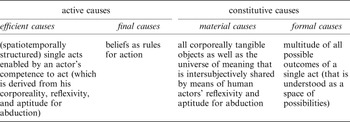
But what exactly is driving processes understood as processes of change? Which characteristics are typical of the processual interrelation between structures and actors? To answer these questions it is required to identify such causes that bring about the alleged permanent change. In the form of intended and unintended consequences of human action, these causal effects always emanate from actors whose competence to act enables them to pursue an aim in terms of their beliefs as rules for action. In this context, Milja Kurki has pointed to the advantages of an Aristotelian concept of cause: although he speaks of four kinds of causes, Aristotle distinguishes two major types of causes at the same time – active and constitutive ones. Efficient and final causes belong to the type of active causes, material and formal ones are constitutive causes.Footnote 47
What we have above denoted as competence to act is the basis of efficient causes in terms of Aristotle, while beliefs as rules for action refer to his final causes. Given that states – understood as structures – do not exhibit these qualities, they can be neither efficient nor final causes. Also in line with the Aristotelian distinction, formal causes emanate from the space of (im-)possible action. Finally, as material causes can be treated all corporeally tangible objects as well as the universe of meaning that is intersubjectively shared by means of human actors' reflexivity and aptitude for abduction. Importantly, formal and material causes have characteristics that are different from those of efficient and final causes. They do not actively make a difference. Instead, corporeality, reflexivity, and the aptitude for abduction are constitutive for the competence to act, while the rules for action refer to the wider space of (im-)possible action. Due to its potential to enable and constrain action, that space is constitutive for the beliefs as rules for action and their causal effects.
Application of the Aristotle-Kurki synthesis

The explanation of social processes presented here thus maintains the Aristotelian differentiation between causal – or active – and constitutive effects as well as their distinct characteristics. In this way, the different qualities of structures and actors can easily be integrated instead of unnecessarily opting for either one part or the other – a strategy that inevitably would blind out some of the results of one's research on social processes. So let us now examine a bit closer the meaning that active causes and constitutive effects have for processes. To do so, we again turn to Mead who, as we have already seen, conceptualised the self of an actor as split into two temporally separated phases. ‘I’ and ‘me’, he stated:
[…] are separated in the process but they belong together in the sense of being parts of a whole. They are separated and yet belong together. The separation of the ‘I’ and the ‘me’ is not fictitious. They are not identical, for, as I have said, the ‘I’ is something that is never entirely calculable […] The self is essentially a social process going on with these two distinguishing phases. If it did not have these two phases there could not be conscious responsibility, and there would be nothing novel in experience.Footnote 48
A human being's ‘me’ stands in a relation of co-constitution to the structures of corporate practice that it is participating in. Me-self is constituted by these structures, but without it there would be no socially constructed structures either. Moreover, the action of the ‘I’, that is, its intended and unintended consequences, forms a second kind of relationship between structures and actors. In this case, it is not a co-constitutive but a mono-directionally causal one. From this it follows that change only occurs in one direction. To be precise: the action taken by an actor's I-self has causal effects on the structure of corporate practice. On the flipside, structural potentials have no active causal effects at all. But since they stand in a relation of co-constitution to the actor's ‘me’, the ‘I’ has the capacity to change the ‘me’ via an impact on the structural potentials. The ‘I’ exhibits a causal effect on the structural potentials and in that way transforms them. Due to the co-constitution of the structural potentials and the ‘me’, this will finally lead to a change of the ‘me’. With a view to Wendt's distinction between causality and constitution, all conditions for a causal relationship between ‘I’ and ‘me’ are met. They exist independent of each other and they do not come in simultaneously. The ‘I’ precedes the ‘me’ – or in paraphrase of Wendt: for the ‘I’ the ‘me’ would not have occurred.Footnote 49
In the course of this process the beliefs that guide an actor are shaken by the intended and unintended consequences of action and go through crises. But the specific set of corporeality, reflexivity and the aptitude for controlling abductive processes makes it possible to cope with these crises and to establish new routines. It enables the formulation of completely new beliefs and allows for a transformation of those rules for action that turned out to be unsustainable into new ones, which will (have to) prove their worth in practice. This way of coping with crises by means of changing beliefs is the reason for an incremental transformation of structures as well as rapid and erratic phases of change.
In conclusion, research on social processes and their effects is the key for a comprehensive understanding of the concomitant structures and actors. The causal effects that a human being's beliefs and competence to act have on ideational structures bring about intended and unintended consequences that make change possible. Nevertheless, it is the relation of co-constitution between the human mind and inter-subjectively shared meanings that allows for human action to make sense. The space of (im-)possible action is enabled and constrained by the rules for action included in the structural positions, while the specific set of corporeality, reflexivity, and the aptitude for abduction enables human beings to depart from such rules. Hence, this model has the potential to provide the opportunity to theoretically substantiate the banal-sounding claim that all politics is processual and comes up with important clues for empirical research on the various processes of politics by reconciling causation and constitution.
The ‘nuclear conflict with Iran’ as a short example for an application of the model
Since the value of each collection of theoretical arguments results from its helpfulness in understanding and explaining real-world problems we are now going to illustrate – as shortly as possible – the use of our model on the basis of the so-called ‘nuclear conflict with Iran’. As seen above, the theoretical figure of structures of corporate practice (SCP) is an important element of the model. We assume that human beings, whenever they are trying to solve problems in concert, are in need of constructing a specific structure of corporate practice which is characterised by three kinds of rules for action. While the first type of rules defines the constitutive problem at hand and the relationships towards other structures of corporate practice, the second type constitutes a SCP's inner structure by defining structural positions and their respective relationships. Finally, the third type of rules for action defines the (im-)possible acts for all participants understood as holders of special structural positions.
Against this background, the first analytical step to be taken by a researcher who is confronted with a particular problem is to compile the structures of corporate practice that are involved. In the case of the ‘nuclear conflict with Iran’, these are not only Iran and the US but also other states like Israel, Russia, China, the United Kingdom (UK), France, and Germany. Moreover, a couple of international institutions like the International Atomic Energy Agency (IAEA), the United Nations (UN), the EU-3 (France, the UK and Germany), the Permanent Five (P5) + Germany, the Arab League, and the Gulf Cooperation Council (GCC) have stakes in that case.
In a second analytical step, the question has to be addressed whether there is a commonly shared definition of the problem. If there is, it would be important to know how the definition is spelled out – while carefully analysing the differences would be decisive to understand all dimensions of the constitutive problem in case of competing definitions. Furthermore, the model suggests reconstructing the rules for action that regulate the relationships between the structures of corporate practice involved. At first sight, some of the rules that guide the action by those who hold exposed positions in a certain SCP can, quite rudimentarily and bound to a concrete political or cultural perspective, be stated as follows: ‘Enhance regional power position’, ‘Achieve the capacity to enrich Uranium’ (Iran), ‘Prevent Iran from going nuclear at all costs’ (Israel), ‘Prevent Iran from achieving nuclear weapons’ (US), ‘Prevent Iran from achieving nuclear weapons and mitigate the likelihood of another military conflict in the Middle East’ (EU-3, Arab League, GCC) or perhaps ‘Prevent the United States from gaining more power’ (Russia, China).Footnote 50
Other basic research questions that immediately result from our model are: i) How is the configuration of the structure of corporate practice constituted to solve a certain problem?, ii) What kinds of structural positions were created and how has their relation to each other been regulated?, iii) What are the characteristics of the structural potential inherent in the individual structural positions, that is, what kinds of power or influence were included in a structural position by a certain rule for action? In this context, the whole range of negotiators, mediators, special envoys, and inspectors comes in. In order to answer the question concerning the (im-)possible space for action, it is thereafter central to analyse, given that they can be read as a text, the beliefs as rules for action that are held by those in a certain structural position. Reconstructing this type of rules for action clarifies both the aims-in-view pursued by the participating actors and their rooms for manoeuvre.
Moreover, our model suggests that different persons who hold the same structural position or who succeed one another make – due to their varying personal qualities – different choices and decisions out of the spectrum of rules for action inscribed in that certain structural position. Given this theoretical assumption, it is advisable to consider in one's analysis the replacement of those who hold a structural position and to ask whether it brings about a different kind of aims-in-view. Since our model treats the development of social phenomena embedded in structured processes as the normal case, it is also important to ask how relevant changes of the subject matter in form of modified rules for action could have been produced in another way, be it by abductive processes driven by the participating actors or by unintended consequences of action.
Here again, the three types of rules for action guide our understanding of research. The questions that arise are: i) Have the definitions of the problem or has the commonly shared definition of the problem changed, that is, is it the peaceful use of atomic energy or the threat by nuclear weapons that is at stake in the Iran case?, ii) Have the relationships between the structures of corporate practice that are involved changed – those between China, Russia and the US, between Israel and the Gulf countries, or between the US and the EU?, and finally, iii) Have new structural positions been created, have existing structural positions been modified by granting them new competences, or has the structural potential inscribed in such a position changed in another way? Have an actor's beliefs as rules for action changed, or have new rules come along that provide new information about an actor's aims-in-view?
Against this background, it becomes clear that our process- and problem-centred model helps to shift the researcher's attention from a mere duplication of the system's supposed ‘invisible hand’ back to an analysis of the political practice constituted by human actors and socially constructed rules for action that is as concise as possible. Besides, the model helps to generate research questions on all levels of the processes of international politics.
Some implications of the pragmatist ontological model
In this last section we have to ask for implications that our ontological model may have for the discipline of International Relations, especially when compared to a conceptualisation of states as (real) persons. Our reflection on this point encompasses two aspects: a concise analysis of continuity and change that is based on the centrality of process and a reservation of responsibility, hope, and solidarity for human beings.
Grasping continuity and change
The model should have shown that it is not only possible to avoid both the pitfalls of reductionism and reification, but also to deliver a process-oriented solution to the state personhood debate.Footnote 51 Treating processes as well as structures of corporate practice and human beings understood as the sole actors in their own right allows for analysing the state without reducing it to acts performed by those who act on its behalf. In this manner, we more than just confess that the whole is more than the sum of its parts. Instead we anchor this statement in the concrete practice of research and make it a rule for action. Simultaneously, we restrain from any actorisation of structures – a move that like in the case of treating states as actors or real persons always spreads the odour of reification.
Whereas a conceptualisation of states as persons tends to reify developments within states as (collective) intentions held by ‘state persons’, the pragmatist perspective not only offers a non-reductive set of new focal points for research (like the three types of rules for action included in the structural positions), but also allows for a treatment of the question of how these change or continue in time.Footnote 52 Understood as a framework for analysing political processes the model makes it possible to look for the dialectically entwined phenomena of continuity and change simultaneously. Different forms of change and continuity can be grasped on the level of each type of rules for action. Firstly, the definition of the problem that brought about a certain structure of corporate practice or the relationship between different structures of corporate practice might be transformed. Secondly, new structural positions could be established or the relationship between existing structural positions could be transformed. Thirdly, the space of (im-)possible action might be transformed (intended or not) by means of a formulation of either modified or completely new beliefs. By separating the modification of previous rules for action from the creation of new ones it is also possible to grasp the transformation of those rules that are placed at the disposal of other actors in the form of latent rules (and thereby shake the previous beliefs of these actors). Finally and not tied with any type of rules for action in particular, a change of staff and the possibly joint transformation of the space of (im-)possible beliefs as rules for action can be analysed.Footnote 53
On responsibility, hope, and solidarity
A second bundle of implications refers to the concepts of responsibility, hope, and solidarity. Wendt's emphatic stance that ‘states help bring order, and yes, even justice to the world, and if we want to have states then it is better they take the form of persons rather than something more amorphous, because this will help make their effects more politically accountable’Footnote 54 may sound reasonable at first glance, but turns out to be rather problematic. A world of states as persons would at least raise the following three questions. What would be the relationship between these state persons and human persons? Who of these two kinds of persons will be called to account by whom and in which form? And finally, will single human beings, members of a government for instance, have to take the responsibility for a state person's action? We are indeed very sceptical about the irritations and conflicts of competences implicated by these questions. To our minds, world politics in Wendt's world runs the risk of taking the form of a dialogue between state persons that could not be influenced by human beings any longer. Moreover, we believe that any treatment of states as responsible actors reduces human beings to a passive crowd apathetically watching what is happening around.
According to our pragmatist model of process only human beings can be held responsible, but not structures of corporate practice. At first sight one might feel inclined to delegate the responsibility for war to legal persons like states. But this idea turns out to be misleading on a closer inspection by dint of the theoretical assumptions sketched above. To our minds, the concept of the state as a legal person can only be defended on the basis of an as if-argument: Since we know that the state is no person we just treat it ‘as if’ it was one in terms of law. This as if-argument is obviously fed by our knowledge that states possess and manage physical objects, are provided with financial resources and that acts are carried out in their names. But even in this context, it is important to stress that states really exist. For that reason, they are able to possess things and it is possible to carry out acts in their names. Nevertheless, that is only feasible because human beings are involved in these processes – human beings who place all these things at the disposal of the state and manage them for it.
On the flipside, hope is not for states either. Hope rests with human beings, too. Every human being has the capability to make a difference. Instead of accepting the notion of inexorably and teleologically evolving structures, pragmatists believe in the capability of human beings to run against the tide and hope for a more satisfying future. Notwithstanding social differences, this capability means both the only reason for hope and the aptitude for solidarity. For us, the very idea of solidarity depends on the ability of human beings to empathise with others, with their pain and humiliation.Footnote 55 Put in that way, we have to ask ourselves whether we seriously believe state persons to be capable of solidarity. Is it possible to imagine solidarity merely as a characteristic of structures independent of human action?
Conclusion
Given an interpretation of Wendt's framing of the current state personhood debate as a dilemma from which it was only possible to escape by either confessing reductionism or recognising the real personhood of states, we propose a third possibility to deal with the problem in this article. Entirely agreeing with Wendt's assessment that our discipline is in dire need of a concept of the state that is more than the sum of the interactions of its members we developed a tripartite ontological pragmatist model consisting of: i) structures of corporate practice like states, supra- or international organisations etc., ii) human beings as sole actors, and iii) processes understood as the dialectical interrelation between those structures and actors. While considering, in a classical pragmatist stance, corporeality, reflexivity, and the aptitude for abduction as exclusively human qualities we treat human beings as sole actors and therefore distinguish them sharply from all kinds of structures of corporate practice.
Against this background, the value-added of the proposed pragmatist model is the following: It enables better explanations of the contingency of social processes in general and international politics in particular and makes it possible to cope with changes of and within states as well as all other structures of relevance in our discipline. Besides, the model gives the responsibility for what is happening in the social sphere back to human beings and their macro-level social constructions from which it was once transferred to anonymous, invisible and rather sinister forces like ‘systems’ or ‘structures’. Furthermore, by stringently conceptualising the theoretical figure of the ‘human actor’ the model provides explanations of social phenomena with another dimension that was either, in a kind of crude (male) elitism, reduced to ‘great men’ and other forms of exposed – and isolated – individuals or just hidden behind misleading concepts like ‘state actor’, ‘collective actor’ or ‘state person’. Including – socially embedded – human beings into the actor-structure-process ‘equations’ of our discipline, as we did in our model, is deemed to strengthen the explanatory power of socio-scientific analyses of social phenomena. Finally, it is the model's focus on processes and on the different types of rules for action that allows for a simultaneous but thorough examination of the manifold dimensions and constellations of the social realm.
A consequent approach to world politics understood as process thus has some potential for studying international relations, in particular the possibility to generate new insights about the subjects of our research. Nevertheless, realising this potential requires the willingness of the actors involved to review the previous models critically. Those who point out that this idea is not new are invited to present their models of political processes, since in our view not ‘agency’ but a concept of the social world as ‘process’ seems to be the figure that is for the most part implicitly taken for granted, yet largely marginalised in theoretic models. So, would it not be a worthy challenge to change that? Arguably, even in the field of IR the rule applies that social science is what we make of it. In addition to hope and responsibility this endeavour will certainly be accompanied with risks and hardship. But has actually anybody claimed that it will be easy?