

Introduction
The rapid transition towards democracy of Eastern Europe after the fall of the Berlin Wall seemed to confirm the ‘end of history’ theory (Fukuyama, Reference Fukuyama1989). However, the democratic euphoria was soon frustrated by lack of progress in the Post-Soviet Space, even if it was ephemerally relaunched by the Colour Revolutions. These failures revealed that the Post-Soviet states – long assumed to be in a ‘transitional’ phase – were not necessarily moving toward democracy. Although recurring elections and multi-party systems are present almost everywhere, a more or less intense lack of democracy characterizes the Post-Soviet countries. Instead, they experienced long-term, open-ended and potentially reversible processes (Whitehead, Reference Whitehead2002) and confirmed both the non-linear character of democratization processes and the strong teleological flavour of the notion of ‘democratic consolidation’ (O'Donnell, Reference O'Donnell1996).
The principal interpretative efforts have presented this regional trend as either structure-driven or actor-driven. More recently, a growing number of scholars have become convinced that the international dimension must be included to get a more comprehensive understanding of this phenomenon. As a result, most of these scholars have resorted to the ‘black knight’ paradigm to describe a counter-hegemonic power whose support contributes to weaken the democratizing forces (Levitsky and Way, Reference Levitsky and Way2006; Ambrosio, Reference Ambrosio2009). This framework has been mainly dealt with by considering its theoretical features and normative implications, or through empirical analysis based on longitudinal large-N analyses. Only a few scholars have investigated the Kremlin's efforts in thwarting democracy abroad through in-depth analysis. They have generally narrowed these studies to the ‘new’ Eastern Europe,Footnote 1 leaving the rest of the Post-Soviet Space underinvestigated. Moreover, they interpreted the black knight effect in light of the Russian regime's survival.
By contrast, the article posits that Russia has played the black knight role in Southern Caucasus and explores the causes and modes of its choice through a qualitative analysis. It demonstrates that democracy does not represent a problem per se, but that it is significant in terms of the international struggle for power. Furthermore, it shows that the fewer the international and internal constraints on Russia, the broader and more intentional its commitment to counter democracy in the Southern Caucasus becomes.
Thus, the analysis is conducted at the crossroads between Comparative Politics (CP) and International Relations (IR). The diachronic comparison of Kremlin's policies fostering authoritarianism in Southern Caucasus is based both on primary (strategic documents, institutional websites) and secondary sources (newspapers, scientific literature). It serves to test the black knight paradigm in the Post-Soviet Space, due to the post-colonial dynamics that link all these territories with Russia (Toal, Reference Toal2016). To be clear, this analysis does not assume that the Kremlin's policies are sufficient to hinder democratization or that they generate homogenous effects on Armenia, Azerbaijan and Georgia. Domestic variables remain relevant in determining the authoritarian resurgence in Southern Caucasus.
This article proceeds as follows: Sections 1–2 offer an overview of the literature on the relationship between the international and domestic spheres, and clarify the research hypothesis, its theoretical framework and methodology. Section 3 outlines the strategic interests of Russia in opposing moves towards democratization in the Post-Soviet Space. Lastly, Section 4 provides an in-depth analysis of Russian policies towards Armenia, Azerbaijan and Georgia. It focuses on three main periods – Yeltsin's presidency, the first Putin presidency and the Putin–Medvedev diarchy – and highlights four of Russia's modes of actions – subvert, bolster, coordinate and lead – that thwarted democracy in the Southern Caucasus.
Disentangling the authoritarian resurgence in Southern Caucasus
Following the collapse of the Soviet Union, the Caucasian countries embarked in regime transitions that fell short of installing democracy in the region, though. More specifically, after a promising start Armenia's democratization was undermined by a series of elections that international observers condemned for failing to meet democratic standards. The transition to a parliamentary system of government, approved by a 2015 referendum, was denounced by the opposition as a manipulation by the Republican Party to strengthen Serzh Sargsyan's power. As expected, he shifted from the presidential office to that of prime minister in 2018 but resigned after days of mass protests.
In consequence of the Nagorno-Karabakh War, Azerbaijan has experienced the authoritarian regime of Heydar Aliyev, a former deputy premier of the USSR. The 1995 constitution outlined an imbalance of powers between the executive and legislative branches. This situation has been exacerbated by the repeal of the two-term limit for the presidential office in 2009, as well as by the extension of the president's term of officeFootnote 2 and the creation of a vice-presidential post, chosen and dismissed by the president, in 2016.
Georgia performed better than its neighbours even if its democratization has been characterized by fits and starts. Eduard Shevardnadze's presidency was interrupted by the Rose Revolution in 2003. This democratic breakthrough favoured a drastic reduction in corruption and media independence. Nonetheless, President Mikhail Saakashvili soon showed dirigiste inclinations. A new democratic enhancement followed the political turnover brought about by the 2012 and 2013 elections. However, the political scenario remained highly polarized, as is reflected by the violence that shocked the 2014 and 2016 legislative consultations.
How can the absence of democracy in the region be explained? Scholars focus on either structural factors or agencies. The first explanation argues that the survival of authoritarianism is favoured by geographical factors (Kopstein and Reilly, Reference Kopstein and Reilly2000), by a long history of authoritarianism (Pop-Eleches, Reference Pop-Eleches2007) or by the presence of an institutionalized one-party rule backed by a highly salient ideology, an extensive coercive apparatus, and/or a state-directed economy (Way, Reference Way, Bunce, McFaul and Stoner Weiss2010). The second perspective concentrates on the interactions among the post-Soviet élites (Hale, Reference Hale2005; Bunce and Wolchik, Reference Bunce and Wolchik2006) or on the autocrats’ strategies of ‘anti-colour insurance’, namely to limit the independence of civil society and political opposition, electoral competition and delegitimize democratic ideas as subversive (Silitski, Reference Silitski, Bunce, McFaul and Stoner Weiss2010).
The internal factors can certainly contribute to explaining the democratic failure in Southern Caucasus, but they do not draw the full picture of what went wrong. Croatia, Montenegro and Serbia share some domestic conditions with their Caucasian counterparts. They fought wars due to contested bordersFootnote 3 and opted for semi-presidential governments,Footnote 4 as the Caucasians did. Moreover, a huge number of Croatians and Serbians are not citizens of their homeland, as happened to the Armenians of Nagorno-Karabakh. In contrast to the experience of Armenia, Azerbaijan and Georgia, these factors delayed, but did not stop, the transition towards democracy in those Balkan countries.
Similarly, the Soviet heritage weighed on both the Baltic and the Caucasian states, without hindering the democratization of the former. Furthermore, Azerbaijan and Georgia present a political community divided by ethnic cleavages, but Estonia and Latvia are fully democratic even though 30% of their citizens are ethnic Russians.
The inadequacy of both structural and actor-centred paradigms in explaining the transition processes in Southern Caucasus directs our attention towards previously overlooked factors. The most recent trend in Post-Soviet studies is either looking at exogenous factors or integrating the classic explanations with the international variable. These new efforts are theoretically anchored in some classic works from both IR and CP.
The notion that countries are self-contained units, insulated from the international dimension, is broadly challenged in IR studies. According to the Realist school, the external environment seamlessly influences states not necessarily through dramatic events but by exercising constant pressures in the shape of incentives, sanctions, opportunities and constraints (Waltz, Reference Waltz1979). Some classic works explained the pre-eminence of exogenous pull and push factors upon states’ domestic preferences because they act within an anarchic environment where security is scarce. Rational states must maximize their relative advantage by conducting their foreign policy for strategic reasons and not to pursue domestic ends (Zakaria, Reference Zakaria1998). Although realists do not deny that the domestic realm affects foreign policy, they contend that ‘the pressures of (international) competition weigh more heavily than ideological preferences or internal political pressures’ (Waltz, Reference Waltz and Keohane1986, 329). Therefore, the states consider the democratic/authoritarian nature of their counterparts only as a ‘strategic’ factor in the overall power equation and not as a goal per se (Mearsheimer, Reference Mearsheimer2001).
Comparatists are not insensitive to ‘the complex cross-penetration of national and world politics’ (Almond, Reference Almond1989, 259), as is shown by Gourevitch's seminal ‘second image reversed’ article (Reference Gourevitch1978). It illustrated the existence of an asymmetric but non-linear relationship among the international system, international economics and domestic regimes. Scholars of transition discussed the diffusion hypothesis (Brinks and Coppedge Reference Brinks and Coppedge2006), external actors’ roles (Bunce and Wolchik, Reference Bunce and Wolchik2006) or assumed an international–national approach (Huntington, Reference Huntington1991; Whitehead, Reference Whitehead2001). Later, several authors studied the scope and limits of democracy promotion in the Post-Cold War international environment (Magen et al., Reference Magen, Risse and McFaul2009).
The recent literature on the authoritarian resurgence in the Post-Soviet Space has moved from this safe ground, dealing with the international dimension both as a structural and long-run variable and as an agency-related and short to medium-run variable. Therefore, two main strands of research developed. The first concerns the diffusion mechanism, or the tendency among bordering states to emulate the political model of their neighbours (Brinks and Coppedge, Reference Brinks and Coppedge2006, 464). This phenomenon occurs without any programmed effort of the actors and operates as an unintended influence (Tansey, Reference Tansey2016). The isomorphism takes place because states are influenced either by the Zeitgeist or they want to emulate the high-level performance of an authoritarian regime, or to bandwagon with a global/regional hegemonic autocracy, or to be easily recognized as a peer by a non-democratic community of states.
Ambrosio (Reference Ambrosio2010) dealt with the problem of outlining a framework of authoritarian diffusion to analyse Russia's behaviour. He divided this process into two classes: appropriateness, namely the impact of changes in the relative normative power of democracy/autocracy, and effectiveness, meaning how the success of authoritarian countries increases the chance that others will see them as a model. Several scholars have highlighted the overlap between the rising power and prestige of Russia with the Post-Soviet states’ tendency to emulate its institutions and practices (Obydenkova and Libman Reference Obydenkova and Libman2012; Cameron and Orenstein Reference Cameron and Orenstein2013). Roberts and Ziemer (Reference Roberts and Ziemer2018) explained the diffusion of the Russian non-democratic model with geographical proximity and high levels of dependence on Moscow. By contrast, Roberts (Reference Roberts2015) outlined a more nuanced two-way norm diffusion, suggesting that Russia may have been inspired by its neighbours while inspiring them.
A second line of research refers to the external agents hampering the diffusion of authoritarianism. Several scholars use the concepts of ‘autocracy promoters’ (Whitehead, Reference Whitehead2014) or ‘black knights’ (Tolstrup, Reference Tolstrup2015). Their influence can play an active role when their actions are intended to shape the target regime and/or the direction of political change. In this case, they can pursue two different goals. On the one hand, they can hinder democracy or democratization abroad through propaganda, economic leverage, espionage or violence. On the other hand, they may strengthen the survival capacity of non-democratic incumbents by providing material resources or by legitimising them. Autocracy promoters’ influence can also be passive if it originates outside any specific strategy (Burnell, Reference Burnell, Erdmann and Kneuer2010).
The concept of black knight was originally coined to define the powers who were ready to provide military or economic support to states targeted by US sanctions to offset their effects during the Cold War (Hufbauer et al., Reference Hufbauer, Schott and Elliott1990). Recently, this notion has been used to indicate ‘external actors – be they democratic or authoritarian, great powers or regional powers, states or international organisations – that act as guardians of autocracy or challengers of democracy in specific contexts’ (Tolstrup, Reference Tolstrup2015, 676). This definition does not imply the presence of authoritarian ideological underpinnings and considers the promotion of autocracy not necessarily as an explicit goal of a state, but also as an unintentional effect of its policies. As a result, democratic states and international organizations can also sometimes play the black knight role. Among the most well-known cases, that of Iran's interference in Iraqi regime change after 2003, of Venezuela's support to Daniel Ortega's Nicaragua, or of Chinese economic and military leverage on the Central African Republic and Djibouti. On the other hand, the long-standing US alliance with Saudi Arabia, the EU support to the Egyptian élite before the Arab Spring and the French involvement in Gabon provide conclusive evidence of how the foreign policy of democratic states and organizations can steer regimes away from democratic rule (Börzel, Reference Börzel2015).
Koesel and Bunce (Reference Koesel and Bunce2013) studied how the Kremlin has tried to make its rule ‘diffusion-proof’ from the Colour Revolutions. By contrast, Burnell (Reference Burnell, Erdmann and Kneuer2010) said that Russia's authoritarian renewal at home stretches beyond domestic strategies like ‘regime insulation’. Ambrosio (Reference Ambrosio2009) and Jackson (Reference Jackson2010) disentangled Russia's policies of authoritarian strengthening to explain how the Kremlin interferes in the domestic sphere of the Post-Soviet states. In contrast to Kagan (Reference Kagan2008) and Silitski (Reference Silitski, Bunce, McFaul and Stoner Weiss2010), who argued an ideological commitment of Russia in fostering an ‘authoritarian international’, other scholars have explained its interventionist policy as something driven by geopolitical interests (Babayan, Reference Babayan2015; Van Soest, Reference Van Soest2015), by a rational estimation of the likelihood of regime breakdown and costs associated with it (Tolstrup, Reference Tolstrup2015) or by the search for domestic legitimation (Hale, Reference Hale2018). Finally, Vanderhill (Reference Vanderhill2013) and Börzel (Reference Börzel2015) posited that the degree of effectiveness of Russian promotion of authoritarianism varies in relation to the presence of favourable domestic conditions, whereas Way (Reference Way2015) and Brownlee (Reference Brownlee2017) found few signs of Russian effectiveness in undermining democracy in the region.
The black knight choice in a competitive environment
The most important merit of these studies is shifting the attention from domestic to international variable(s) in analysing the diffusion of authoritarianism. However, the literature on this topic has mainly dealt with Russia's role in the Post-Soviet Space taken as a whole or exploring it in the new Eastern Europe. Moreover, most literature remains anchored to interpreting Moscow's black knight role through the lens of the domestic power struggle, focusing on its positive effects in terms of regime stability. With few exceptions, a limitation of these studies is their neglect of the competitive nature of the international environment, so that they present the Kremlin as erecting an authoritarian firewall to insulate itself from the Colour Revolutions.
This article adopts the black knight paradigm and argues that Russia has increasingly hindered democracy in Southern Caucasus. To address the shortcomings of previous research, it is not restricted to a single field of study but uses cross-disciplinary literature. It integrates the analytical tools of CP with several well-grounded assumptions from IR. Among them, three seem to be particularly relevant.
The first tells us that the diffusion of a new kind of regime represents a noteworthy indicator of its most representative state's prestige. Great powers are those states that have been able to enforce both the international and domestic basic rules and rights that influence their own behaviour, along with those of the lesser states in the system (Gilpin, Reference Gilpin1981, 30).
The second assumption concerns the nature of the US-led international order that emerged from the events of 1989–1991. It took the shape of a homogenous international system composed of democracies, democratizing states, or, at least, non-democratic states not openly committed in the promotion of authoritarianism. Among its pillars was the belief of a causal relationship between democratic enlargement and stability. By contrast, the emergence of political formulas alternative to liberal democracy can make the system heterogeneous and, consequently, more unstable (Colombo, Reference Colombo2014; Parsi, Reference Parsi2018).
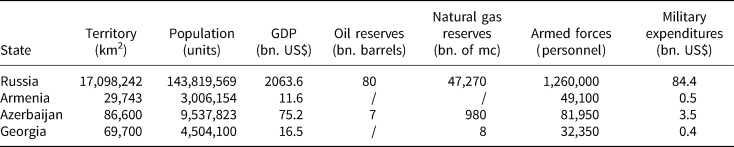
According to the third assumption, a state's overall vulnerability to external forces depends on its position in the international hierarchy of power and prestige. As a result, the more powerful the country, the more intense its impact on the outside world. Similarly, the weaker the state, the less free it is to follow its own internal preferences (Handel, Reference Handel1990). As Table 1 shows, the power indicators (Aron, Reference Aron1962) of Armenia, Azerbaijan and Georgia are incommensurable with those of Russia, outlining a deep asymmetry of power among them.

Borrowing Levitsky and Way's concept of leverage (Reference Levitsky and Way2006), the Russian influence is stronger where the countries lack bargaining power and are affected by Moscow's punitive policies. However, the status of the minor powers of the Caucasus does not necessarily mean that, some leeway of response to the pressures is to be considered impossible, although external forces may be compelling.
In light of this literature, this article investigates the causes (why?) and the modes (how?) of Russia's black knight role in the region through a qualitative analysis. Concerning the motivations, it explores the deep intertwining of Russia's foreign policy constants with the democratic setback in the Near Abroad and Moscow's quest for recognition of its great power status.
Concerning the modalities, the in-depth analysis discusses the Kremlin's support for the authoritarian resurgence in the area by a diachronic comparison between three periods: Yeltsin's presidency (1991–1999), the first Putin presidency (2000–2008) and the Putin–Medvedev diarchy (2008–present). The investigation highlights four recurring actions, namely, subvert, bolster, coordinate and lead. The first three actions are borrowed from Ambrosio's strategies of authoritarian resistance (Reference Ambrosio2009).
Subvert refers to the Kremlin's active interference in the Caucasian states’ domestic spheres by preventing their international disalignment and the threat of an anti-Russia élite's rise favouring democratic consolidation.
Bolster refers to the material support or legitimization provided by Russia to the pro-Kremlin incumbents and/or candidates.
Coordinate refers to Moscow's efforts in fostering horizontal integration within a regional community of non-democratic states, as well as providing learning opportunities for its values and models to the Post-Soviet élites.
In contrast, the lead action represents an attempt at introducing a new sub-category, more sensitive to the changes that occurred in the Kremlin's strategic stance.
Lead refers to Russia's willingness to be an example for Post-Soviet societies and to create positive public feelings towards its culture, political model and goals. In this case, the vertical dimension prevails and serves the need to relaunch Russia's soft power through a more comprehensive strategy aimed at restoring its ‘lost empire’.
Thwarting democratization to regain great power status
Three constants of Russia's foreign policy contribute in explaining the nexus between the Kremlin's attempt in thwarting democratization in Southern Caucasus and its quest for great power status.
The first concerns Russia's perception of itself being in a more precarious international condition than other states. The several past invasionsFootnote 5 proved Russia's vulnerability and left deep marks on the national collective memory. The self-representation of a vulnerable country has often led to a kind of defensive aggressiveness for pre-empting external attacks. Moscow's security has thus been developed through the edification of a strong state to halt the drift towards anarchy in an enormous territory and in the face of external interference (Kotkin, Reference Kotkin2016). Despite their huge differences, Ivan III, Peter the Great, Alexander II, Joseph Stalin and Vladimir Putin opted for this choice. While a fragile but defective democracy was in place during the 1990s, the country's democratic score has markedly declined since 2004 (Freedom House, 2005). According to Putin's entourage, Russia has built a ‘sovereign democracy’ (Surkov, Reference Surkov2009). This concept describes ‘a type of political life for the society in which the state, its organs and activities are chosen, formed and directed exclusively by the Russian nation with all its many forms and unities, to achieve the material well-being, freedom and justice for all citizens’ (Fisher, Reference Fisher2014, 20). Sovereign democracy re-assesses the collective initiative in a nationalist display, believing that the people's will is achieved through the state and that the élite must uphold domestic unity when exposed to internal and external threats. Even if sovereign democracy remains an ambiguous and ill-defined notion, it portrays Russia as a country with autonomous values and models, as well as resilient in relation to Western interference (Jackson, Reference Jackson2010).
The second constant is the belief that Russia's foreign policy is guided not only by material interests but also by a ‘special mission’ to be realized on behalf of a community much larger than the national one. The exceptional nature of the Russian Empire had its legitimising myth in the representation of Moscow as the ‘Third Rome’ and in its ‘civilising mission’ eastwards. The USSR exploited communism to propose itself as a global guide towards freedom for oppressed peoples. Nowadays, Moscow's special mission is to support the Post-Soviet states’ resistance against the exogenous (Western) forces that challenge their sovereignty.
The sense of encirclement regarding both great and minor powers represents the third constant of Russia's foreign policy. Moscow portrays the small neighbours as beachheads for enemies or treacherous allies. This image legitimizes Russia's actions moving outward and establishing a sphere of influence to make its power centres safer. Since the 1990s, the former Soviet territories have been defined as ‘Near Abroad’, or an area of special interest, mutually interdependent with Russia in the security field. The Southern Caucasus carries a significant geopolitical role in protecting Russia's southern flank from domestic (separatist movements of the Northern Caucasus), regional (Turkey, Iran and jihadism) and global (NATO enlargement) threats (Trenin, Reference Trenin2001). To deal with these perils, the Kremlin pursues its integration in Russia-led international organizations, the deployment of its troops in the area and the rejection of Western-style democracy (Cornell, Reference Cornell2001).
These three constants have exacerbated in Russia the perception of the Colour Revolutions. The Kremlin rejected the idea that they were spontaneous and denounced these events as a plan sponsored by the US to assert its primacy in Russia's Near Abroad and to promote the closer integration of the Caucasus into Western military and economic structures (Ivanov, Reference Ivanov2006). As a result, Russia identified the USSR's borders as a red line in tolerating external interferences. Several Kremlin strategic documents vigorously relaunched Russia's special mission, outlining its efforts in strengthening the sovereignty of Post-Soviet countries, as well as the deep intertwining of the restoration of its primacy over the Near Abroad with the recognition of its great power status (Medvedev, Reference Medvedev2010; Putin, Reference Putin2016).
Considering the previous assumptions, the goal of isolating the Russian regime from Western democratising influence to ensure its survival appears to be an unsatisfactory answer when looking for the reasons behind the Kremlin's black knight approach in Southern Caucasus. Instead, the Russian Federation seems to be more interested in the strategic implications of halting democracy in this region, in the alignment of the Caucasian states with the US or Russia. In contrast to the democratic and pro-American Baltic area and authoritarian and pro-Russian Central Asia, the Southern Caucasus – together with the new Eastern Europe – constitutes the battlefield for this competition.
Russia's actions backing the authoritarian resurgence
Russia implemented four recurring actions – subvert, bolster, coordinate and lead – that intentionally and unintentionally backed the resurgence of authoritarianism in Armenia, Azerbaijan and Georgia.
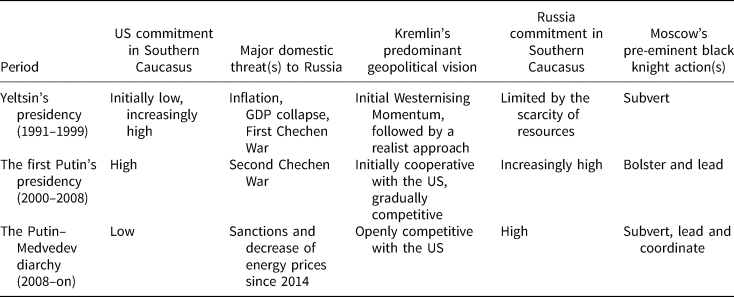
As Table 2 shows, their effectiveness has varied according to the presence of some constraints. Among them are the US commitment in Southern Caucasus, the presence/absence of major domestic threats to Russia's stability, and its rulers’ predominant geopolitical vision. For a better understanding of the intervening changes, the qualitative analysis disentangles the Kremlin's actions in three distinct periods.
Russia's support for authoritarianism in the Southern Caucasus (1991–2018)

Yeltsin's presidency (1991–1999)
In the aftermath of the USSR's dissolution, the US Congress adopted the Freedom for Russia and Emerging Eurasian Democracies and Open Markets Support Act, aimed at fostering the democratization of the Post-Soviet Space. Russia's integration in the new world order represented a top priority for Washington. Thus, the US tried to avoid unnecessary tensions with it, especially in non-vital, strategic areas such as the Southern Caucasus. The subsequent exhaustion of the honeymoon period between Bill Clinton and Boris Yeltsin overlapped with growing American interest for the region's strategic role in transporting Caspian energy resources towards international markets (Clinton, Reference Clinton1998).
The triple-digit levels of inflation in 1993–1995, the collapse of the national GDP and the outbreak of the First Chechen War (1994) negatively influenced Moscow's international ambitions during this phase (World Bank, 2002). The Chechen war ended in 1996, but the social and economic traumas that followed the transition were further deepened by the 1998 financial crisis.
Yeltsin's Russia external action was steered by the Minister of Foreign Affairs, Andrei Kozyrev (1991–1996). He considered the cultural similarities between Russia and the West as sufficient to determine cooperation, and he denied the image of Russia's special mission. Although Kozyrev adopted a cooperative attitude towards Washington, he never departed from long-standing national interests and ambitions. Moscow tried to get the recognition of its prerogatives in the Southern Caucasus as a step towards regaining primacy over the Post-Soviet Space and recognition as a great power (Yeltsin, Reference Yeltsin1992). Kozyrev's policies were largely discredited in light of the concessions to the US, which were made without commensurate rewards.Footnote 6 Therefore, Yevgeny Primakov replaced him as Minister of Foreign Affairs (1996–1998). He was convinced that Russia did not belong to the Western world, nor that the US and the EU were the natural partners of his country (Trenin, Reference Trenin2001). Moreover, if Russia officially endorsed the democratization of the Southern Caucasus during Yeltsin's first mandate, it no longer considered democracy as an absolute value from the mid-1990s. The ‘Primakov doctrine’ theorized the need to counterbalance US dominance in the Near Abroad, depicting the Russia–US relationship in Southern Caucasus as a zero-sum game (Toal, Reference Toal2016).
The Kremlin's willingness to bolster its favourite candidates was immediately tested with the 1991 presidential elections in the Caucasus. It initially backed the presidency of the former local Communist Party's Secretary Ayaz Mutallibov in Azerbaijan. Then, it supported the 1993 coup against Abulfaz Elchibey and favoured the rise to power of Aliyev, who granted Russia the use of an anti-missile radar plant in Gabala. Shevardnadze became chairman of the Georgian Parliament also with the support of 19,000 Russian troops in Georgia in 1992. At the end of Yeltsin's only presidential trip to the Southern Caucasus in 1994, the former Soviet Minister of Foreign Affairs signed an agreement allowing Russia to maintain its bases in Vaziani, Gudauta, Akhalkalaki and Batumi (Ferrari, Reference Ferrari2007).
A coordinate action was also carried out by Moscow after the USSR's dissolution. The Commonwealth of Independent States (CIS) constituted the main attempt to minimize Western influence in the region. Armenia immediately ratified its agreement. Azerbaijan joined the organization after Aliyev's presidential election, and Georgia reversed its initial refusal to enter the CIS with Shevardnadze. Furthermore, the three states signed the Collective Security Treaty in 1994. Both of these regional integration initiatives were supported by countries that, although with different intensity, were dominated by Russia and not respecting democratic standards (Smith, Reference Smith2016).
Moscow also generated a lead effect on the new Caucasian states that were shaping their institutional architecture. Due to their historical linkages and their connection to the common crisis they were experiencing in the fields of security and economy, Armenia and Azerbaijan adopted constitutions inspired by 1993 Russian constitution.Footnote 7 Both texts provided broad prerogatives to the head of state, as seen in the Russian constitution, outlining a president-parliamentary form of semi-presidential government where the Prime Minister and the Cabinet were collectively responsible to the Parliament and the President. Likewise, the Georgian constitution gave the right of legislative initiative to the president, similar to articles 84 and 104 of the Russian constitution.
However, Russia's attempt to restore its influence over Caucasus passed mostly through subvert action. Because of full-scale fighting that had erupted in the area, the Kremlin took advantage of the unofficial mandate of restoring the order received by the White House. Despite its official neutrality, Moscow contributed to conflicts by providing weapons and Russian-trained fighters, thereby influencing both the outcome of military operations. After the ceasefires, the Russian–Armenian alliance was finalized with the Treaty of Friendship, Cooperation, and Mutual Assistance (1997), allowing the Kremlin to maintain Soviet military bases in Gyumri. Simultaneously, the Russia-led CIS peacekeepers (CSIPK) was repeatedly accused of fuelling the 1997–1998 ethnic riots in Georgia. At the same time, Shevardnadze's quest for the withdrawal of Russian soldiers from Georgia was considered the catalyst of his assassination attempt in 1998 (Starr and Cornell, Reference Starr and Cornell2014).
The lack of durable agreements between Yerevan and Baku, as well as among Tbilisi, Abkhazian, and South Ossetian separatist movements, was useful for Moscow's interests. It made Russia a necessary actor in keeping the precarious truces safe and preventing the major destabilising effects of the ‘frozen’ conflicts. Its ‘controlled instability’ policy fuelled the ‘rally round the flag effect’. The national security issue had narrowed the scope of the political debate within the Caucasian Republics, imposing it as a top priority. It favoured the strengthening of both charismatic leaders and power centres representative of closed clans, as well as the militarization of societies and the use of nationalist appeals to mobilize masses (Fischer, Reference Fischer2016).
The Armenian President Levon Ter-Petrosyan was accused by the opposition of being willing to accept the settlement on Nagorno-Karabakh proposed by the Organization for Security and Cooperation in Europe (OSCE). As a result, the founder of the Artsakh Defense Army Robert KocharyanFootnote 8 became the president of Armenia in 1998 and established the power of a native élite from the separatist region. Moreover, the threat posed by Baku and the blockade implemented by the latter, together with Ankara, encouraged Yerevan to consider Moscow as the sole guarantor of its survival, despite massive funding from Washington (de Waal, Reference de Waal2010). Aliyev was confirmed as the president of Azerbaijan in 1998 with a programme that included no provisions on negotiations. Conversely, he reaffirmed the need to restore national territorial integrity and guarantee the right of return to approximately 700,000 internally displaced people. The electoral success of the local Communist Party's former secretary also led to the consolidation of the Nakhichevan clan. Both the President and the most influential members of his entourage were natives of this Azerbaijani exclave among Armenia, Iran and Turkey.Footnote 9 Shevardnadze obtained a second mandate as Georgian president in 2000, becoming the only reliable candidate for managing relations between the central government, the autonomist regions and Russia. His opponents, Djumber Patiashvili and Aslan Abashidze, appeared inadequate to face this priority challenge. The former had been the Secretary of the Georgian Communist Party during the bloody repression of the 1989 protests; the latter was the leader of the Autonomous Republic of Adjara (Ferrari, Reference Ferrari2007).
The first Putin presidency (2000–2008)
After the 9/11 attacks, US interest in Southern Caucasus suddenly increased, due to its strategic position both in terms of the Afghan and Iraqi wars and exporting democracy outlined by the Freedom agenda (Bush, Reference Bush2005). It should also be noted that steep increases in oil and gas prices, starting in 2003, added relevance to the region as a source of alternative energy routes. The Bush Administration dealt with the Caucasus as part of the Greater Middle East, the preferential target area for implementing the US grand strategy in the early 2000s.
During this phase, the growing energy prices also had a positive impact on Russia's GDP, which increased fivefold between 2000 and 2008 (World Bank, 2009). Meanwhile, the Second Chechen war broke out (1999–2009), accompanied by a wave of domestic terrorist attacks.
According to Minister of Foreign Affairs Igor Ivanov (1998–2004), the first phase of Putin's presidency was marked by a soft claim for multipolarity and the search for cooperation with the West in the global war on terror and energy issues. Nevertheless, the US–Russia relationship markedly deteriorated with the spread of the Colour Revolutions in the Post-Soviet Space. Minister Sergej Lavrov (2004–present) opted for a more assertive policy in the Southern Caucasus, aimed at implementing the assumption of the 2000 Foreign Policy Concept. This document stated that ‘Russia's national interests in the international sphere lie in upholding its sovereignty and strengthening its position as a great power and as one of the influential centres of a multipolar world’ (Putin, Reference Putin2000). In 2005, the talk was no longer focused on Moscow's integration into the Western alliance, and the Caucasus became one of the most important areas for the renewed US–Russia competition (Perovic, Reference Perovic2005).
Within this new strategic framework, Russia's will to coordinate the integration of the Post-Soviet Space was revitalized when the Collective Security Treaty turned into an Organisation in 2002. Armenia promptly adhered to the CSTO, hosting its Rubezh 2008 military training, which involved a combined total of 4000 troops from member countries (de Haas, Reference de Haas2016).
New efforts were made to actively bolster pro-Russian incumbents. Putin's travels abroad were important indicators of this action, aimed at providing them with legitimacy through a diplomatic framework covered by international media. These presidential trips were arranged not according to the democratic quality of the hosting countries, but to the governments’ willingness to be aligned or non-hostile to Moscow's interests. Putin's first official visit in Southern Caucasus was in Armenia in March 2005. At that time, Kocharyan was dealing with persistent unpopularity as a consequence of his controversial victory in the 2003 elections, and he was going to face a constitutional referendum the following November. At the beginning of 2006, Putin met Ilham Aliyev in Baku, only a few months after mass protests against rigging the 2005 elections. By contrast, no visit was organized in Tbilisi. However, it must be noticed that Russia initially did not contrast the Rose Revolution, because it considered Shevardnadze to be disloyal and Saakashvili to be the best option to prevent chaos (Axmith, Reference Axmith2003). Moreover, Russia favoured the establishment of election monitoring groups alternative to the OSCEs. Their goal was to certify full adherence to democratic standards in the elections won by the Kremlin's favourite candidates. A first group of observers monitored the 2003 elections in CaucasusFootnote 10 under the guidance of political analyst Aleksev Kochetkov. They certified the fairness of the voting processes, whose winners the Kremlin welcomed (such as Kocharyan) or at least acquiesced to (such as I. Aliyev). This monitoring group evolved into the CIS-Election Monitoring Organisation (CIS-EMO). Its first official test in Southern Caucasus was the 2005 Azerbaijani elections.Footnote 11 The results were followed by accusations of electoral fraud, which were confirmed by OSCE reports, and large-scale protests that seemed a first step towards a second Colour Revolution in the area. Russia kept a low profile, probably because there never was any serious threat to the party in power (Nygren, Reference Nygren2008), while CIS-EMO confirmed the substantial fairness of the Azerbaijani voting process. The absence of impartiality, faults in the work methodology, and the mission's composition with a majority of Russian members facilitated accusations against the organization as being a ‘Government-Organised Non-Governmental Organisation’ (Daxecker and Schneider, Reference Daxecker, Schneider, Norris and Frank2014).
The previous unintentional lead action turned into an active one, with the aim of increasing Russia's soft power. Its first effort was an attempt to replace the Western-financed NGOs with more compliant and Kremlin-backed organizations. Among them, the Caucasian Institute for Peace, Democracy, and Development launched the Aizald-FM radio station, broadcasting in South Ossetia, and published the newspaper Gudok-Abkhazia that circulates in Abkhazia (Popescu, Reference Popescu2006). Moreover, the Kremlin supported the opening of Russia Today in 2005.Footnote 12 This TV channel was inspired by the BBC and it broadcasted in four languages,Footnote 13 with an initial financing of $30 million that has since expanded tenfold. However, the most ambitious project was that of the Russkiy Mir Foundation, established by the Foreign Affairs Ministry, the Education Ministry and the Russian Orthodox Church in 2007. The Foundation operates across the world with the official aim of spreading Russian language and culture and strengthening a shared identity among people from the former Soviet territories (Van Herpen, Reference Van Herpen2015). It has offices in both Yerevan and Baku, but is not present in Tbilisi. It channels state funds to promote Russian language and culture in Southern Caucasus and provides philosophical support for diffusing the Russkiy Mir concept. Mir means ‘peace’, but also ‘world’, and implies the willingness of people living outside Russia to look at it as the leader of non-Westernized countries.Footnote 14
Finally, the Russian subvert action aimed mainly at undermining the Georgian economy and delegitimising the Rose Revolution's democratic breakthrough. The ban on Georgian wine,Footnote 15 mineral water and other agriculture products was followed by the recall of the Russian ambassador from Tbilisi after the arrest of five Russian officers accused of espionage. Moreover, the Kremlin doubled energy prices in 2006 and facilitated granting Russian passports to the separatist region's inhabitants to assert Moscow's duty in protecting its new citizens (Suny, Reference Suny2009).
The Putin–Medvedev diarchy (2008–present)
Due to the 2007–2008 financial crisis, the White House focused on preventing ‘imperial overstretch’. The concept draws from the lessons of past leading states whose global interests and obligations became far too large for the country to defend them simultaneously and led to their decline (Gilpin, Reference Gilpin1981). Therefore, the US needed to redress the imbalance between resources and commitments. The budget cuts on the worldwide democratic revolution were considerable. Moreover, the Obama Administration shifted its focus on the Asia-Pacific region, dealing with Southern Caucasus as a non-vital area (Obama, Reference Obama2010).
During this decade, the Russian Federation definitively restored order in the Northern Caucasus and its GDP reached the highest peak in 2013. It started declining with the overlap between Western sanctions and decreasing oil and gas prices after 2014 (World Bank 2017).
The 2010 Military Doctrine hypothesized that NATO's enlargements eastward, and Western interferences within the Post-Soviet countries, were major threats to Russia's security (Medvedev, Reference Medvedev2010). Furthermore, the 2016 Foreign Policy Concept affirmed Russia's opposition to using human rights to legitimize destabilising other states or overthrowing their governments (Putin, Reference Putin2016). These documents pointed out a step change in the Russian élite's mindset, with its increasingly revisionist efforts against the US-led international order. The consolidation of this strategic posture was guaranteed by both the political stability assured with the Putin–MedvedevFootnote 16 alternation in power and Lavrov's confirmation as Minister of Foreign Affairs. Therefore, the Caucasus returned to a central role within their strategy (Toal, Reference Toal2016).
This new phase was ushered in by a Russian subvert action in Southern Caucasus. The 2008 military option for addressing the presence of Georgian troops in South Ossetia occurred after NATO's ambiguous promise of the Membership Action Plan to Georgia at the Bucharest Summit. It must be noted that the North Atlantic Treaty requires applicant countries to be democratic (NATO, 1949). The conflict served as a turning point for the regional balance of power. Medvedev's decision had a deep impact on further evolutions for the domestic regimes of Caucasian countries. The US inaction in front of the Georgian debacle encouraged the Kremlin in rapidly recognising the independence of Abkhazia and South Ossetia (de Waal, Reference de Waal2010). The ongoing tensions with Russia triggered a new rally round the flag effect, deepened political polarization and legitimated Saakashvili's snap decision method. Several members of the Democratic Movement-United Georgia party were arrested after its leader, Nino Burjanadze, broke with the President, while the founder of Georgian Dream party, Bidzina Ivanishvili, was portrayed as a Kremlin agent by the National Movement during the 2012 electoral campaigns (Fairbanks, Reference Fairbanks2014). The 2008 conflict also caused a tighter chokehold over the media. To avoid tensions with Russia, Azerbaijan's temporarily closed the Day.Az. This newspaper depicted the Russian–Georgian conflict with a view that Moscow did not like. Moreover, during the conflict, it interviewed Boris Berezovskij, a Russian business oligarch denouncing Putin's $40 billion ownership of foreign accounts. Like many other Azerbaijani media, when the Day.Az re-opened, it had a more accommodating view about Russia and its political élite (Valiyev, Reference Valiyev2009).
The broad pro-Georgian international media coverage of the 2008 war negatively impacted Russia's public image. This outcome constituted a new incentive to the Kremlin's lead action aimed at circulating a positive image of Russia and its standpoint over international affairs. Three ambitious projects were realized. The Alexander Gorchakov Public Diplomacy Fund was established in 2010 to promote Russian values among the former Soviet territories.Footnote 17 It carries out The Caucasus Dialogue, a roundtable designed to create a network of Russian, Armenian, Azerbaijani and Georgian political analysts and journalists. The second project is Rossotrudnichestvo, a federal agency for the CIS, Compatriots Living Abroad and International Humanitarian Cooperation. Established in 2008, it plays a significant role in Moscow's foreign policy by consolidating the activities of pro-Russian players in the post-Soviet region and in disseminating the Kremlin's narrative.Footnote 18 Its Yerevan branch strives to maintain ties with local graduates of Russian institutions and selects Armenian pupils for study in Russia within state-regulated quotas (Agadjanian et al., Reference Agadjanian, Jödicke and van der Zweerde2014). The last project is Sputnik, a modern news agency whose products include newsfeeds, websites and social networks.Footnote 19 It was launched by the Kremlin-controlled Rossya Segodnya in 2014. Sputnik broadcasts in more than 30 languages, including Armenian, Azerbaijani, Georgian, Abkhazian and Ossetian to provide ‘objective’ news, or, according to its critics, ‘purified’ news from Western influences.Footnote 20 Sputnik’s attempt in promoting the Kremlin's standpoint on Armenian affairs was highlighted by the 2016 Yerevan hostage crisis. A group of war veterans stormed a police station and took hostages, demanding the release of opposition leader Jirair Sefilian and the resignation of Sargsyan. The 2 weeks that followed were characterized by strong police repression and sizeable anti-government protests. Sputnik depicted this crisis as a Western-backed attempt to achieve regime change in Armenia (Roberts and Ziemer, Reference Roberts and Ziemer2018).
Moscow also continued to bolster friendly or non-hostile governments in Southern Caucasus. Medvedev visited Sargsyan after the 2008 presidential election, followed by new protests and violence culminating with 10 deaths and strengthening the power of the ‘Karabakh clan’.Footnote 21 Furthermore, the Russian president again met his Armenian counterpart in 2010. Considerably important, however, is the attention addressed to Azerbaijan. When the pro-Western feelings in the country weakened in 2008 as a consequence of abandoning Georgia, Medvedev met I. Aliyev in Baku three times (2008, 2009 and 2010). Once Putin returned to the presidency, he visited Armenia in 2013 and, most importantly, in 2015 when the country was approaching a constitutional referendum. The Russian president also visited Azerbaijan in 2013, for the opening of the European Games in 2015, and in 2016. Neither Medvedev nor Putin planned a visit to Tbilisi, but they met the separatist leaders of both South Ossetia and Abkhazia. Medvedev visited Tskhinvali in 2009 and Sukhumi in 2010, while Putin went to Abkhazia in 2013 and 2017. The CIS-EMO also started to work in the two self-proclaimed independent states, certifying the elections’ fairness in Abkhazia and South Ossetia since 2009.Footnote 22 Afterwards, electoral monitoring missions by the CIS in these de facto independent Republics and Nagorno-Karabakh were realized by the new Russia-backed NGOs as the Civic Control Association or the Eurasian Observatory for Democracy and Elections (Laruelle, Reference Laruelle2015).
Finally, Moscow boosted its efforts to coordinate the Post-Soviet states through regional integration. While Georgia formally withdrew from the CIS after 2008, Armenia abandoned the plan to sign an EU Association Agreement in 2013 and joined the Eurasian Economic Union (EEU) in 2014 (EEU, 2014). This reversal occurred because of the relaunch of Moscow–Baku relationship, implemented by the sale of Russian weapons to Azerbaijan, and of a last-minute Putin–Sargsyan meeting in September 2013 (Giragosian, Reference Giragosian2014). Different from the EU Association Agreement, the EEU statute does not mention the issue of democracy. The adhesion produced a twofold result in the Armenian domestic sphere. On the one hand, it reduced the effects of the linkages with the US and the EU (Libman, Reference Libman, Obydenkova and Libman2016). This connection has been balanced by the increasing relations between a weak state like Armenia and more powerful, non-democratic partner like Russia. They favoured the consolidation of the authoritarian tendencies of the Caucasian country, where this regression was slower and found more obstacles than within its EEU partners. On the other hand, the EEU membership legitimized the Armenian incumbents with high-level meetings with international key political figures (Libman, Reference Libman, Obydenkova and Libman2016). This choice positively contributed to the Armenian regime's legitimacy, supporting the success of Sargsyan's Republican Party at the 2017 elections, the first held after the contested constitutional reform.
Conclusions
The article addressed the relationship between the international and the domestic dimensions, investigating causes and modes of Russia's black knight role on the resurgence of authoritarianism in Southern Caucasus.
Its contribution to the scientific debate is twofold. The overcoming of the clear-cut distinction between CP and IR facilitated the understanding of the Kremlin's strategic choice to back authoritarianism in the Southern Caucasus, as well as in the rest of the Post-Soviet Space. It makes clear that countering the threat of a Colour Revolution within Russian borders is not the core goal of the Kremlin's strategy. Rather, it turns out that Moscow's actions in support of the authoritarian resurgence in Southern Caucasus are intertwined with its foreign policy constants and its quest for great power status. Indeed, the expansion of authoritarianism in this area not only reflects Russia's prestige abroad, but also reveals how much its international role is at odds with the projection of US power in the Post-Soviet Space and, broadly speaking, with the stability of the liberal order.
Therefore, the article shows that Moscow's support for authoritarianism cannot be interpreted as the mirror image of ‘democratic promotion’ due to the absence of an equally intense ideological élan. The Kremlin is committed in undermining democracy only when its own foreign policy is driven by a revisionist geopolitical vision and where it sees its strategic interests at stake. Despite its frequent appeals to sovereign democracy, it does not specifically promote its own or any other non-democratic regime type beyond its borders and uses that notion to strengthen its legitimacy. Russia opposes the democratization of the Post-Soviet Space because it associates this process with Western interference within its sphere of influence. Elsewhere, it supports democracy if it considers elections as an opportunity to seize power for pro-Russian parties.
As Table 2 summarizes, the second contribution of the article is bringing out the progressively more nuanced and intentional black knight strategy implemented by the Kremlin in Southern Caucasus. It finds evidence of the four proposed actions – subvert, bolster, coordinate and lead – in the overarching timespan. However, it shows a different balance between them.
Given low US commitment, deep domestic problems affecting Russia and an initial Westernising momentum of the Russian élite, the subvert action dominated during Yeltsin's presidency. The ‘controlled instability’ policy undermined the sovereignty of the Caucasian Republics, having a negative – but generally unintentional – long-term impact on their regimes’ evolution. Indeed, it prevented the governments providing the security that is a precondition for free and fair elections, fostered the rally round the flag effect and the rise of charismatic leaderships, and halted the political turnover.
The overlap of rising US interest in Southern Caucasus with the growth of the Russian economy and the increasing will of its élite in jeopardising relations with the US extended the significance, as well as the variety, of both bolster and lead actions. These became more intentionally committed to countering the democratization of the area during the first Putin presidency. On the one hand, the Kremlin provided legitimacy to the pro-Russian or non-hostile incumbents through presidential trips and Russia-backed election monitoring missions, paying more attention to Armenia and Azerbaijan. On the other hand, it funded the activities of NGOs and media aimed at strengthening Russia's soft power in the region.
Finally, the retrenchment of the American Freedom agenda, the end of the Second Chechen War, and the assertive competitive posture assumed by the Russian establishment towards the US-led order fostered the Kremlin's adoption of a more comprehensive and definitively intentional approach in promoting authoritarianism in Southern Caucasus. Hard power and soft power have been cleverly combined to pursue this goal during the Putin–Medvedev diarchy. The subvert action affected Georgia in particular. The 2008 war seriously hobbled its democratization but also had demonstrative effects in the surrounding area. Moreover, it encouraged the Kremlin to pursue further efforts in the lead action to spread a more positive image of Russia and to overcome the perception of its quest of great power status as only based on projecting Russian strength. The relaunch of the coordinate action with the EEU project was addressed mainly towards Armenia, contributing to its authoritarian breakthrough.
To conclude, this study is aware that the asymmetric power relation between Russia and its southern neighbours does not explain the different outcomes of the transitions in Armenia, Azerbaijan and Georgia. Some leeway in responding to the Russian black knight strategy proved possible, as the Georgian case shows. However, the article illustrates a recurring pattern of interaction in the Post-Soviet Space, highlighting the nature of the relationship between Russia as dominant power and other minor Post-Soviet powers.
Author ORCIDs
Gabriele Natalizia, 0000-0001-6372-7758.
Acknowledgements
The author thanks Alessandro Colombo for constructive remarks to earlier versions of the article, Andrea Cassani and Luca Tomini for the helpful comments and suggestions and Gianluca Passarelli for his constant incitement.
Financial support
The research received no grants from public, commercial or non-profit funding agency.
Data
The replication dataset is available at http://thedata.harvard.edu/dvn/dv/ipsr-risp.